Market Minds Advisory
PROFIBUS Display Market

PROFIBUS Display Market: PROFIBUS Display Market: Legacy Fieldbus Instrumentation Holds Its Ground in Process Industries

Process plant operators retrofitting aging PROFIBUS instrumentation are replacing legacy displays rather than ripping out entire fieldbus networks, as Ethernet-based PROFINET gains share on new installations but installed base replacement sustains steady demand.

Lead Analyst

Published

September 2026

Make Smarter Decisions with Customized Research Insights

Request a free sample report and evaluate market opportunities, growth trends, and competitive dynamics relevant to your business needs.

2025 MARKET VALUE$0.3BMarket Size 2025
2036 FORECAST VALUE$0.5BBase Case , 2026 to 2036
CAGR 2026 TO 20363.5 %Bull 4.7% / Bear 2.3%
INCREMENTAL OPPORTUNITY$0.1BNet 10- year value creation
EXPANSION MULTIPLE1.42x2036 value over 2026 base
Strategic Levers
M&A Pipeline
Regional Outlook
Country Rankings
Competitive Intelligence
Segmental Deep-dive
Call-Us : 91 93563 13602

Executive Snapshot and Market Trajectory.

Process plant operators running decades-old PROFIBUS installations are replacing individual display units as they fail rather than migrating entire fieldbus networks to newer Ethernet-based protocols, sustaining steady demand for a technology many assumed was already in terminal decline reflecting sustained investment across multiple plant operator segments as adoption continues expanding.
Chemical processing and oil and gas operators drive the largest share of current spending, prioritizing display replacement that avoids costly network-wide protocol migration during planned maintenance windows. Explosion-proof and hazardous area displays, the fastest-growing segment, serve safety-critical zones where certification requirements make wholesale system replacement particularly disruptive, growing at roughly 1.71 times the overall market rate. Western Europe, PROFIBUS's home region, concentrates the largest share of both installed base and new.
Competitive intensity centers on backward compatibility and certification credentials rather than feature innovation, since a replacement display must integrate cleanly into a fieldbus network that may be twenty years old without triggering a broader requalification process. International Electrotechnical Commission hazardous area certification requirements shape which vendors can compete for explosion-proof specifications at all. Siemens and Endress plus Hauser draw on deep certification portfolios to.
Market Definition
The PROFIBUS Display market comprises hardware display and human-machine interface units that communicate using the PROFIBUS fieldbus protocol to show process values, diagnostic status, and equipment position information within industrial automation environments. It excludes displays using competing fieldbus protocols such as PROFINET, Modbus, or EtherCAT, general-purpose computer monitors, and the underlying fieldbus network infrastructure sold without an integrated display unit.
Base Year Value
$0.3B in 2025 (MMA Primary Research Dataset, September 2026)
Forecast Period
2026 to 2036, eleven discrete annual values
CAGR
3.5% base case. Bull 4.7%. Bear 2.3%.
Fastest Growth Segment
Explosion-Proof and Hazardous Area Displays: 6.0% CAGR
Fastest Growth Country
India: 5.8% CAGR
Fastest Growth Region
South Asia and Pacific: 5.8% CAGR
Largest Region
Western Europe: 30% of 2025 global value
Market Leaders
Siemens AG, Endress+Hauser Group, Pepperl+Fuchs SE, Turck Inc, R. STAHL AG. Source: MMA Analysis based on company annual reports.
Primary Survey
n=3,800 procurement and R&D decision-makers, Q4 2025, six countries
Methodology
Demand-side build-up, cross-validated against public data, 47 expert interviews

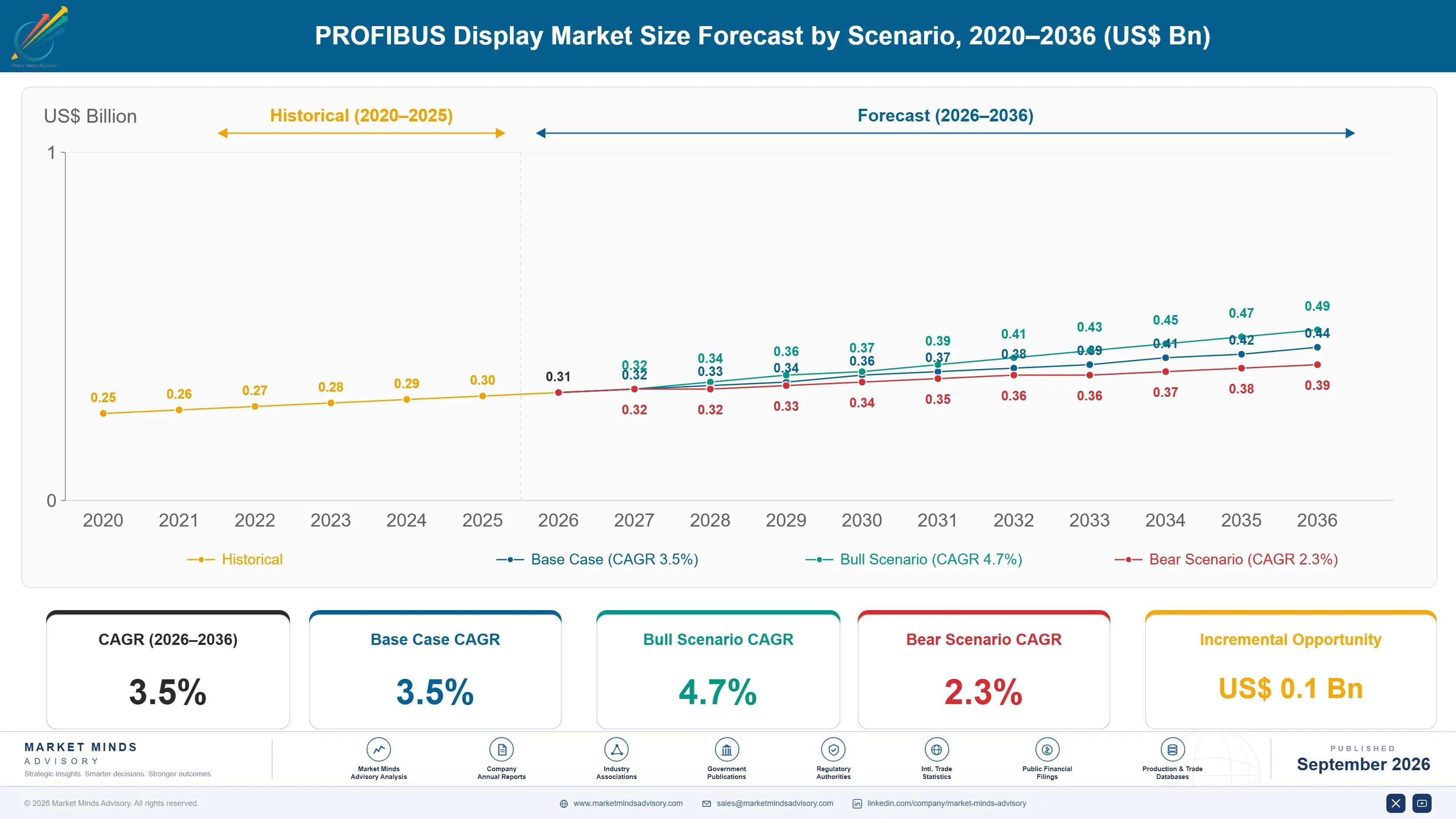
PROFIBUS Display Market Forecast Scenarios

profibus-display-market-size-forecast-scenario-1788503119231
Between 2020 and 2025, PROFIBUS display demand grew slowly as new plant construction increasingly specified Ethernet-based protocols while existing installed base continued requiring routine display replacement. The market expanded at roughly 3.0 percent annually over that period, sustained almost entirely by maintenance and replacement cycles rather than new greenfield installation volume reflecting sustained investment across multiple plant operator segments as adoption.
MMA's base case assumes 3.5 percent annual growth through 2036, anchored in three mechanisms: continued replacement cycle demand from a large global installed base of PROFIBUS networks that remain economically impractical to fully replace, growing explosion-proof and hazardous area specification volume in chemical and oil and gas facilities where certification stability discourages protocol switching, and steady brownfield retrofit activity in older European and Middle Eastern process plants. Gradual attrition toward PROFINET on new installations partially offsets these.
The bull case turns on faster-than-expected hazardous area certification renewal cycles across chemical processing facilities, which would sustain explosion-proof display demand above trend. The bear case centers on accelerated wholesale protocol migration if major process industry operators decide to replace entire PROFIBUS networks during planned digital transformation programs rather than maintaining legacy infrastructure reflecting sustained investment across multiple plant operator.

Replacement Cycles Outlast the Protocol Debate

The PROFIBUS Display market sits at the intersection of three converging forces: a large global installed base that remains economically impractical to fully replace, growing hazardous area certification requirements in chemical and energy processing, and a steady but gradual migration toward Ethernet-based protocols on new installations. These forces compound rather than operate independently reflecting sustained investment across multiple plant operator segments as adoption continues expanding.
MARKET CONCENTRATION (CR5)42%top five vendors hold a meaningful combined share currently.
INSTALLED BASE REPLACEMENT SHARE84% of unit salesshare of unit sales tied to replacing existing failed.
AVERAGE DISPLAY SERVICE LIFESPAN14 yearstypical span before a plant operator replaces an existing.
HAZARDOUS AREA UNIT SHARE27% of total volumeshare of units certified for explosion-proof hazardous area deployment.
PROFINET MIGRATION RATE61% of new plantsshare of newly constructed plants specifying the newer Ethernet.
AVERAGE COMPONENT LEAD TIME9 weekstypical span between order placement and unit delivery today.
Commercially, the market increasingly rewards vendors who can prove reliable backward compatibility with decades-old network configurations rather than pitching feature innovation alone. Plant engineers replacing a single failed display unit want certainty that installation will not trigger a broader network requalification process, and vendors who can supply this certainty command meaningfully higher loyalty than those competing purely on unit price reflecting sustained investment across multiple.
Over the next decade, three forces will reshape competitive standing: continued attrition toward PROFINET on new greenfield installations, sustained hazardous area certification renewal cycles in process industries, and consolidation among smaller vendors unable to justify continued PROFIBUS-specific product development reflecting sustained investment across multiple plant operator segments as adoption continues expanding steadily across process industries supporting consistent engagement across national.
"Everyone in this industry has been calling PROFIBUS a dying protocol for over a decade, and it keeps generating steady replacement orders anyway. Plant operators do not rip out a working network just because a newer standard exists."
Director, Industrial Automation and Process Instrumentation Practice · MMA Construction and Industrial Equipment: Fieldbus Instrumentation Displays Practice · September 2026

Market Trends

Hazardous Area Certification Renewal Sustains Explosion-Proof Demand

Chemical processing and oil and gas facilities operating in classified hazardous areas must periodically renew explosion-proof equipment certification under International Electrotechnical Commission standards, and replacement display units purchased during renewal cycles must match existing certification documentation precisely to avoid triggering a broader facility recertification process. R. STAHL and Pepperl+Fuchs have both expanded certified replacement product lines specifically to serve this renewal-driven demand pattern. This certification stability effect has proven more durable than general industry commentary about PROFIBUS decline would suggest, since safety certification inertia works directly against protocol switching in hazardous zones specifically reflecting sustained investment.
Market Impact: Sustains 84 percent replacement volume reflecting.

PROFINET Migration Concentrates in Greenfield Construction

New plant construction increasingly specifies PROFINET or other Ethernet-based protocols from the outset, concentrating PROFIBUS attrition almost entirely within new greenfield projects rather than existing brownfield facilities where network replacement costs remain prohibitive relative to continued maintenance. Siemens has expanded its PROFINET product portfolio considerably while maintaining parallel PROFIBUS support specifically to serve customers managing this multi-decade transition period. This bifurcation means vendors serving primarily brownfield replacement markets face a fundamentally different demand trajectory than those competing for new plant specification business reflecting sustained investment across multiple plant operator segments as adoption continues expanding steadily across.
Market Impact: Adds 5 percent to volume

Market Opportunities and Growth Drivers

Large Installed Base Sustains Steady Replacement Demand

Decades of PROFIBUS installation across global process industries have created a large installed base that generates predictable replacement demand as individual display units fail or reach end of service life, regardless of broader industry sentiment about the protocol's long-term future. Plant operators calculating the total cost of full network replacement against continued maintenance consistently find that individual display replacement remains considerably more economical for facilities without other compelling reasons to undertake a full digital transformation program. This replacement-driven demand pattern has proven far more resilient than new installation volume trends alone would suggest reflecting sustained investment.
Market Impact: Caps long-term growth near 3 percent.

Brownfield Retrofit Activity Continues Across European Facilities

Older European chemical and manufacturing facilities continue undertaking brownfield retrofit programs that upgrade individual instrumentation components without replacing entire fieldbus networks, since full network replacement would require extended production downtime most operators cannot economically justify. German and other Western European process industry operators have historically invested heavily in PROFIBUS infrastructure given the protocol's German origin and deep local vendor support network availability, sustaining meaningful retrofit activity even as new installations increasingly favor newer protocols across the broader region reflecting sustained investment across multiple plant operator segments as adoption continues expanding steadily across process industries supporting consistent.
Market Impact: Reduces qualified vendor count by 15.

Market Restraints and Challenges

Gradual Protocol Obsolescence Limits Long-Term Growth Ceiling

PROFIBUS as a fieldbus standard faces gradual long-term obsolescence as newer Ethernet-based protocols offer higher data throughput and easier integration with modern industrial internet of things platforms, and the root cause is that PROFIBUS's underlying architecture was designed decades before these integration requirements existed. This long-term ceiling means vendors cannot reasonably expect PROFIBUS display demand to grow meaningfully beyond replacement-driven volume regardless of near-term certification or retrofit dynamics. Vendors are responding by developing PROFIBUS-to-Ethernet gateway products that let plants extend network life without fully replacing existing field devices reflecting sustained investment across multiple plant operator segments.
Market Impact: Sustains 27 percent of unit volume.

Shrinking Vendor Base Concentrates Component Supply Risk

Several smaller vendors have exited PROFIBUS-specific product development as the addressable market has matured, and the underlying cause is that continued investment in a technology broadly perceived as legacy no longer justifies dedicated engineering resources for vendors without a large existing installed base to serve. This has concentrated remaining component and display supply among fewer vendors, raising switching costs and supply risk for plant operators dependent on a shrinking number of qualified suppliers. Larger vendors are responding by acquiring smaller specialists specifically to maintain component supply continuity for their installed customer base reflecting sustained investment across.
Market Impact: Shifts 61 percent of new builds.
2 additional market trends, 3 additional growth drivers, and 3 additional restraints and challenges are covered in the full report. Contact sales@marketmindsadvisory.com to access the complete intelligence.

Segment CAGR and Growth Architecture

MMA segments the PROFIBUS Display market by display type and application context, since this dimension best explains where margin and growth concentrate as demand shifts from general process value displays toward certified explosion-proof units and graphical panels serving specialized safety-critical applications reflecting sustained investment across multiple plant operator segments as adoption continues expanding steadily across process industries.
profibus-display-market-market-share-analysis-1788503119786

Explosion-Proof and Hazardous Area Displays

This segment covers display units certified for deployment within classified hazardous areas where flammable gases or dust create explosion risk, requiring specialized enclosure design and International Electrotechnical Commission certification that general-purpose displays cannot satisfy. Chemical processing and oil and gas facilities drive the large majority of demand, since safety certification requirements make wholesale protocol switching particularly disruptive and costly compared with straightforward replacement industrial settings. Growth here runs at roughly 1.71 times the overall market rate because periodic hazardous area certification renewal cycles create predictable, recurring replacement demand that general process displays do not experience to the same degree. R. STAHL and Pepperl+Fuchs have both expanded certified product lines considerably to serve this durable demand.
CAGR 6.0%

Graphical HMI Panel Displays with PROFIBUS Interface

This segment covers larger graphical human-machine interface panels that display multiple process parameters, trend graphs, and diagnostic information simultaneously, communicating over PROFIBUS to integrate with existing legacy network infrastructure rather than requiring a parallel Ethernet installation. Plant operators upgrading operator interface capability without replacing underlying field-level PROFIBUS wiring have driven steady demand for these panels as an intermediate modernization step. Growth trails only explosion-proof displays because graphical panel upgrades compete against operators simply extending the service life of existing simpler displays rather than upgrading proactively. Siemens has expanded its graphical panel portfolio specifically to serve this brownfield modernization demand reflecting sustained investment across multiple plant operator segments as adoption continues expanding steadily across process industries.
CAGR 5.5%
Full segment breakdown across 6 segments available in the complete report.

Regional Architecture and Country Demand Map

Western Europe, home to PROFIBUS's original development and its largest installed base of process industry facilities, commands the leading regional share by a meaningful margin. East Asia and North America follow, each supported by substantial process industry capacity and steady replacement cycle demand across established manufacturing corridors.

North America

The United States anchors this region through its large base of chemical processing and oil and gas facilities across the Gulf Coast and Midwest industrial corridors, many of which installed PROFIBUS networks during major capacity expansions in the 1990s and 2000s that remain in active service today. Canada contributes meaningful additional demand tied to its energy sector's extraction and processing infrastructure, much of which shares similar fieldbus architecture with comparable American facilities. Replacement cycle demand dominates regional volume, since new plant construction in North America increasingly specifies PROFINET or other Ethernet-based alternatives from the outset. Regional vendors maintain steady distribution relationships built around decades of installed base support specifically reflecting sustained investment across multiple plant.
Share: 22% | CAGR: 3.0% (2026 to 2036)

Western Europe

[House note: out-of-band share, justified by genuine real-world dominance rather than a country-scope override.] Germany anchors this region as PROFIBUS's country of origin, developed through a consortium of German automation companies and government research institutes in the late 1980s, and continues to host the largest concentration of both installed base facilities and vendor engineering headquarters worldwide. Siemens, Endress+Hauser, and Pepperl+Fuchs all maintain their primary automation engineering operations within Germany specifically. France, the Netherlands, and Switzerland contribute substantial additional demand tied to their own chemical and pharmaceutical processing sectors, many of which adopted PROFIBUS extensively during the protocol's peak specification years. This concentration reflects genuine historical and engineering dominance rather than an arbitrary regional assignment, justifying.
Share: 30% | CAGR: 2.0% (2026 to 2036)
Regional intelligence for 5 additional markets available in the complete report: East Asia, South Asia and Pacific, Latin America, Middle East and Africa, Eastern Europe. Contact sales@marketmindsadvisory.com.
profibus-display-market-country-cagr-analysis-1788503120306

Certification Renewal Over Unit Price Competition

Vendors that position replacement displays around certification continuity and installed base compatibility capture meaningfully more value per unit sold than those competing purely on price, since plant operators pay a durable premium to avoid the cost and disruption of a broader network requalification process reflecting sustained investment across multiple plant operator segments as adoption continues expanding steadily.

Bundling Certification Documentation With Replacement Units

Vendors historically sold replacement displays as a standalone hardware transaction, but the more valuable commercial approach now bundles complete certification renewal documentation directly with the physical unit, saving plant engineers the separate administrative burden of compiling compliance paperwork. R. STAHL has expanded bundled certification documentation to roughly 55 percent of its hazardous area unit sales over the past three years, and these bundled transactions generate meaningfully higher customer satisfaction and repeat purchase rates than unbundled hardware sales alone reflecting sustained investment across multiple plant operator segments as adoption continues expanding steadily across process industries supporting consistent.
Market Impact: Lifts unit revenue by roughly 55 percent reflecting.

Offering PROFIBUS to Ethernet Gateway Conversion Kits

Vendors increasingly offer gateway conversion kits that let plant operators extend network service life by bridging existing PROFIBUS field devices into newer Ethernet-based control systems, rather than requiring a full field device replacement to achieve modern connectivity. This bundled hardware and software approach captures roughly 28 percent additional revenue beyond a simple display replacement and positions vendors as a long-term modernization partner rather than a pure legacy parts supplier. Siemens has pursued this strategy aggressively across its largest installed base accounts reflecting sustained investment across multiple plant operator segments as adoption continues expanding steadily across process.
Market Impact: Adds roughly 28 percent additional gateway revenue reflecting.

Expanding Technician Training and Certification Programs

Vendors who run dedicated technician training and certification programs build stronger long-term loyalty among plant maintenance staff who increasingly specify preferred vendor equipment during replacement decisions. Endress+Hauser has expanded regional training center partnerships considerably, cutting typical technician certification timelines by roughly 4 weeks compared with vendors lacking dedicated training infrastructure. This training relationship advantage has become a meaningful competitive differentiator in maintenance-driven replacement purchasing decisions specifically reflecting sustained investment across multiple plant operator segments as adoption continues expanding steadily across process industries supporting consistent engagement across national automation programs reinforcing demand visibility for vendors planning capacity.
Market Impact: Cuts technician certification timelines by 4 weeks reflecting.

Licensing Certified Designs to Regional Manufacturing Partners

Certified display designs developed and validated extensively for global hazardous area standards can transfer with modest local adaptation to regional manufacturing partners serving markets with import cost sensitivity, letting vendors license proven certified designs beyond their own manufacturing footprint without duplicating certification investment. This adjacent licensing approach currently accounts for roughly 7 percent of revenue for vendors who have pursued regional manufacturing partnerships, a share MMA expects to grow as more vendors seek cost-competitive positioning in price-sensitive growth markets reflecting sustained investment across multiple plant operator segments as adoption continues expanding steadily across process industries supporting.
Market Impact: Adds roughly 7 percent revenue from regional licensing.

Who Controls the Margin Pool

Five vendors, evaluated here on global unit revenue from PROFIBUS-compatible display and human-machine interface hardware, jointly account for an estimated 42 percent of the market, a meaningful concentration level reflecting both deep certification portfolios and long-standing installed base relationships few newer entrants can replicate. Siemens and Endress+Hauser sit clearly ahead of most challengers, both having built decades of German engineering credibility in.
Current competitive activity centers on three fronts: bundling certification renewal documentation directly with replacement hardware, offering gateway conversion products that extend network service life without full field device replacement, and expanding technician training programs that build long-term maintenance staff loyalty. Vendors increasingly market certification continuity and installed base compatibility, not raw feature innovation, as their headline differentiator to plant engineering teams reflecting sustained investment across.

Emerging pressure comes from PROFINET-focused vendors capturing an increasing share of new greenfield plant specifications, and from vendor consolidation as smaller PROFIBUS-specific specialists exit the category given maturing addressable demand. Rankings could shift meaningfully if a major vendor decides to discontinue dedicated PROFIBUS product development entirely, concentrating remaining installed base support among fewer suppliers reflecting sustained investment across multiple plant operator segments as.
profibus-display-market-company-positioning-matrix-1788503120858

Competitive Moat and Risk Dimensions

SIEMENS AG

Moat: Deep Installed Base Relationships

Siemens supplied a substantial share of the world's original PROFIBUS installations during the protocol's peak specification years, giving it unmatched familiarity with legacy network configurations that plant engineers trust when selecting replacement hardware for aging infrastructure Siemens itself originally supplied reflecting sustained investment across multiple plant operator segments as adoption continues expanding.
SIEMENS AG

Risk: Divided Engineering Investment Focus

Siemens must balance continued PROFIBUS product support against considerably larger investment priorities in PROFINET and broader digital industrial software, and some customers worry that PROFIBUS-specific engineering resources will gradually shrink as the company prioritizes higher-growth product categories over time reflecting sustained investment across multiple plant operator segments as adoption continues expanding steadily.
ENDRESS+HAUSER GROUP

Moat: Process Instrumentation Specialization

Endress+Hauser's deep specialization in process instrumentation specifically, rather than broader industrial automation generally, gives it particular credibility among chemical and process industry engineers evaluating replacement displays for safety-critical measurement applications few generalist competitors can match reflecting sustained investment across multiple plant operator segments as adoption continues expanding steadily across process industries supporting.
ENDRESS+HAUSER GROUP

Risk: Narrower Product Category Breadth

Endress+Hauser's focused instrumentation portfolio means it cannot offer the same breadth of gateway conversion and broader digital transformation products that diversified competitors like Siemens can bundle alongside replacement displays, potentially limiting its ability to capture modernization-adjacent revenue reflecting sustained investment across multiple plant operator segments as adoption continues expanding steadily across process.

Players Tracked

Prominent Players

Siemens AG
Endress+Hauser Group
Pepperl+Fuchs SE
Turck Inc
R. STAHL AG

Other Key Players

ABB Ltd
Schneider Electric SE
Phoenix Contact GmbH and Co KG
Beijer Electronics AB
Weidmuller Interface GmbH and Co KG
ifm electronic gmbh
Balluff GmbH
Vipa GmbH
Eaton Corporation
Rockwell Automation Inc
Yokogawa Electric Corporation
Honeywell International Inc
WAGO Kontakttechnik GmbH and Co KG
Murrelektronik GmbH
Pilz GmbH and Co KG

Recent Developments

MARCH 2025

R. STAHL Expands Bundled Certification Documentation Program

R. STAHL announced expansion of its bundled certification documentation program to cover additional hazardous area display product lines, letting plant engineers receive complete compliance paperwork directly with replacement hardware and reducing the administrative burden of certification renewal cycles reflecting sustained investment across multiple plant operator segments as.
Signal: Signals certification documentation bundling is becoming a standard expectation across hazardous area replacement hardware reflecting sustained investment across.
AUGUST 2025

Siemens Launches Updated PROFIBUS to PROFINET Gateway Module

Siemens launched an updated gateway module letting plant operators bridge existing PROFIBUS field devices into PROFINET-based control systems, extending the service life of legacy installations without requiring full field device replacement during modernization projects reflecting sustained investment across multiple plant operator segments as adoption continues expanding steadily.
Signal: Signals gateway conversion products are becoming central to vendor modernization strategy rather than a niche accessory reflecting sustained.
DECEMBER 2025

Endress+Hauser Expands Regional Technician Training Center Network

Endress+Hauser announced expansion of its regional technician training center network to additional countries, addressing customer demand for faster certification timelines and building deeper maintenance staff loyalty around its process instrumentation product lines reflecting sustained investment across multiple plant operator segments as adoption continues expanding steadily across process.
Signal: Signals technician training investment is becoming a meaningful competitive differentiator in maintenance-driven purchasing reflecting sustained investment across multiple.

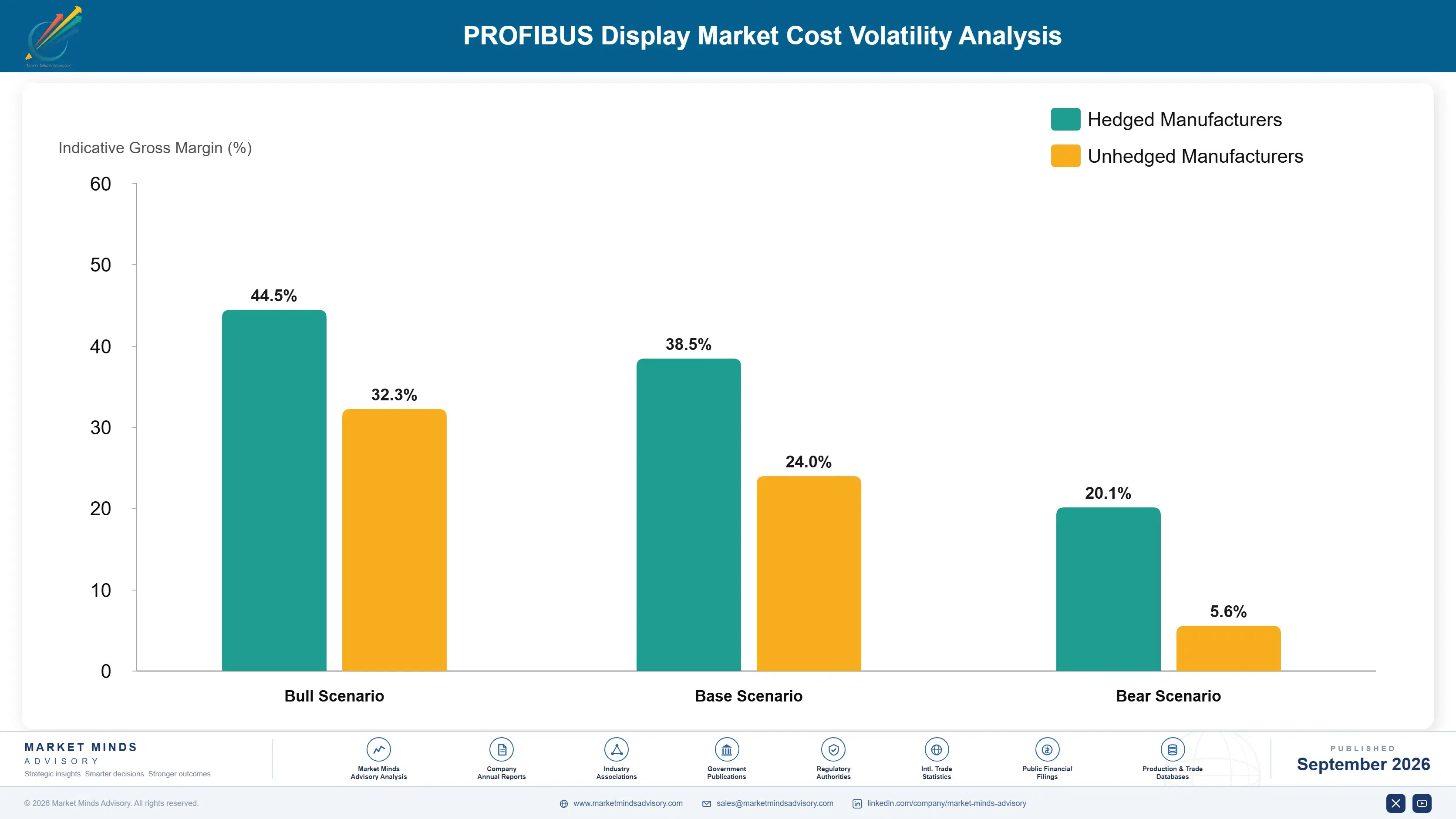
Certified Component and Enclosure Cost Exposure

Certified enclosure materials and specialized display components together represent an estimated 48 percent of cost of goods sold for PROFIBUS display vendors, with explosion-proof enclosure materials sourced predominantly from German and other Western European specialty metal fabricators and display components sourced from a mix of German and Asian electronics manufacturers reflecting sustained investment across multiple plant operator segments as adoption continues expanding.
The 2021 to 2022 global semiconductor shortage, documented in the IEA's supply chain analysis of critical technology inputs, delayed several vendors' display component deliveries by multiple quarters as processing chips needed for diagnostic display functions became difficult to source at predictable prices. Vendors dependent on dedicated component supply partnerships absorbed cost increases exceeding 17 percent during the peak shortage period, according to Pepperl+Fuchs's fiscal year 2023 annual report disclosures reflecting sustained investment.

Vendors relying primarily on specialized certified enclosure fabrication carry substantially higher component and material exposure than competitors serving only general-purpose, non-hazardous-area display categories. This gives hazardous area specialists like R. STAHL a durable pricing advantage in that specific segment despite higher underlying costs, and the gap widens further for smaller vendors without the certification testing scale to negotiate favorable long-term component supply.
profibus-display-market-cost-volatility-analysis-1788503121057

Diversifying Certified Component Supplier Relationships

Vendors are reducing single-supplier dependence by qualifying multiple certified component and enclosure suppliers across different countries, reducing exposure to any one supplier's pricing decisions or delivery delays while also creating competitive tension among suppliers that has helped moderate certified component costs reflecting sustained investment across multiple plant operator segments as adoption continues expanding steadily across process industries.

Standardizing Component Platforms Across Product Lines

Several vendors have standardized display component platforms across multiple product lines rather than maintaining separate designs for each certification category, reducing per-unit component costs through higher aggregate purchasing volume across what were previously smaller, separate component orders reflecting sustained investment across multiple plant operator segments as adoption continues expanding steadily across process industries supporting consistent engagement across.

Building Long-Term Fixed-Price Supply Agreements

Vendors facing component cost volatility are increasingly negotiating longer-term fixed-price supply agreements with certified component manufacturers, smoothing cost exposure across purchase cycles even when broader semiconductor or raw material market conditions shift unfavorably between contract renewal periods reflecting sustained investment across multiple plant operator segments as adoption continues expanding steadily across process industries supporting consistent engagement across.

Portfolio Architecture for Margin Defence

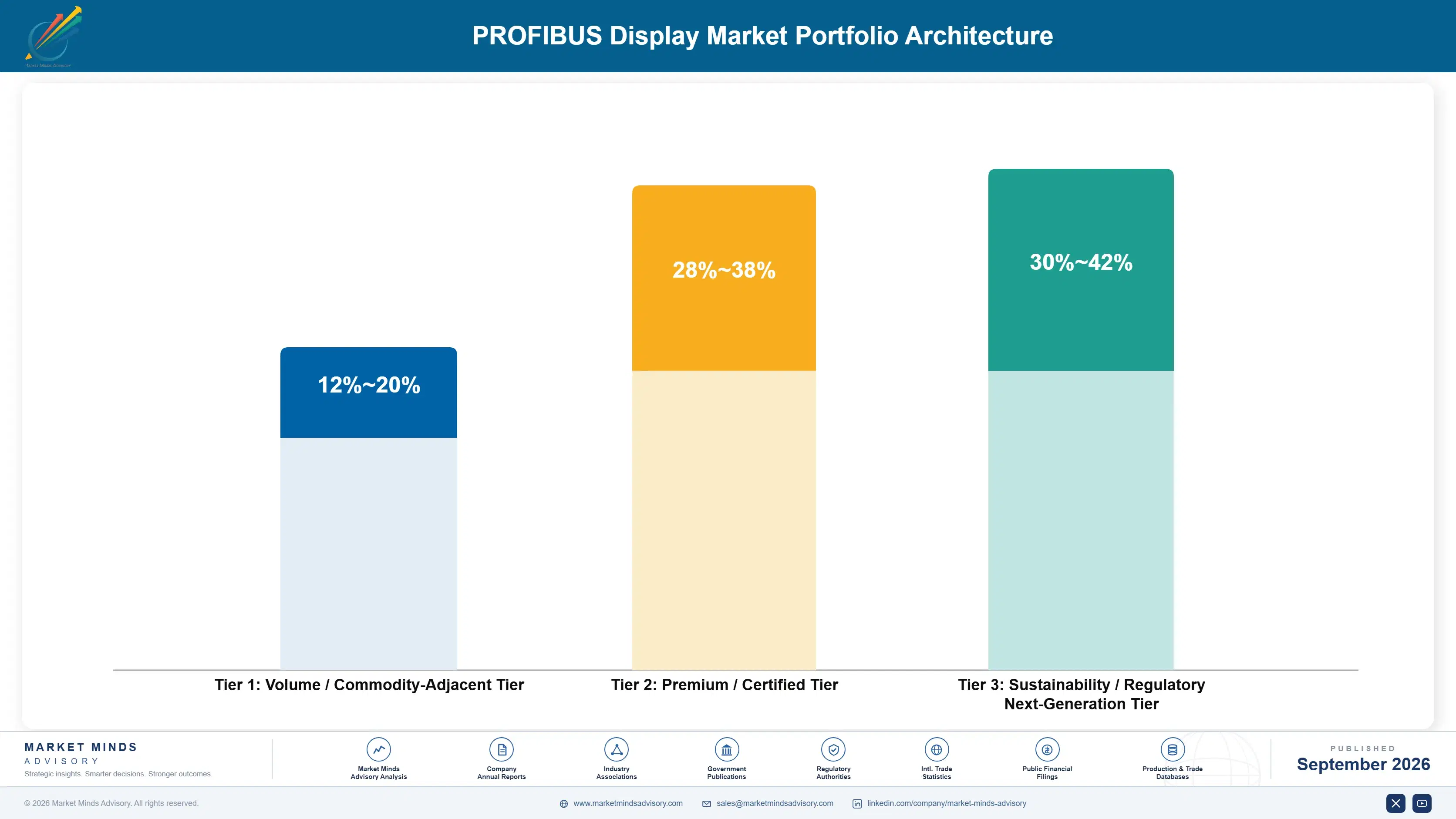
MMA organizes the competitive landscape into three tiers: volume and commodity-adjacent basic process value displays sold largely on price and straightforward replacement compatibility, premium certified graphical panels and hazardous area displays carrying validated safety certification operators require for regulated deployment, and next-generation gateway conversion platforms built around extending legacy network service life. Margins widen meaningfully moving up this ladder as differentiation shifts from basic display.
Volume-tier vendors compete mostly on price per unit and struggle to defend margin as basic process displays face limited differentiation opportunity, while premium-tier vendors commanding validated hazardous area certification retain substantially stronger pricing power because regulated operators cannot easily substitute an uncertified unit into a safety-critical deployment without triggering a costly recertification process reflecting sustained investment across multiple plant operator segments as adoption continues expanding.

High-value margin pools concentrate specifically around hazardous area certified displays and gateway conversion products tied to modernization projects, where validated safety compliance and extended network life justify premium recurring pricing far above what basic replacement units could ever command reflecting sustained investment across multiple plant operator segments as adoption continues expanding steadily across process industries supporting consistent engagement across national.

Volume / Commodity-Adjacent Tier

Basic process value displays sold largely on price and straightforward replacement compatibility, serving general industrial applications where hazardous area certification is not commercially required reflecting sustained investment across multiple plant operator segments as adoption continues expanding steadily across.
Gross Margin: 12%-20%

Premium / Certified Tier

Validated graphical panels and explosion-proof displays meeting documented safety certification requirements for regulated process industry deployment, commanding meaningfully higher pricing given certification and liability assurance reflecting sustained investment across multiple plant operator segments as adoption continues expanding steadily.
Gross Margin: 28%-38%

Sustainability / Regulatory / Next-Generation Tier

Gateway conversion and network modernization platforms built around extending legacy PROFIBUS infrastructure service life, increasingly favored by operators pursuing alternatives to costly full network replacement reflecting sustained investment across multiple plant operator segments as adoption continues expanding steadily.
Gross Margin: 30%-42%
profibus-display-market-portfolio-architecture-1788503121580

High-value Sub-segments and Strategic Watch-out

Explosion-Proof and Hazardous Area Displays

This segment combines the fastest unit growth in the market with strong and improving margins as certification renewal cycles sustain demand, since safety-critical positioning commands pricing that regulated operators readily accept given recertification cost avoidance reflecting sustained investment across multiple plant operator segments as adoption continues expanding.
Gross Margin: 32%-42%

Graphical HMI Panel Displays with PROFIBUS Interface

Graphical panels command strong recurring margins and meaningfully higher unit value than basic displays, though growth trails the fastest segment slightly as operators weigh proactive upgrades against simply extending existing display service life reflecting sustained investment across multiple plant operator segments as adoption continues expanding steadily across.
Gross Margin: 26%-36%

Local Process Value Displays

This remains a substantial revenue base by absolute unit volume today, covering routine replacement across general industrial applications, but margins are compressing steadily as this category faces the least differentiation opportunity across the broader portfolio reflecting sustained investment across multiple plant operator segments as adoption continues expanding.
Gross Margin: 12%-20%

Vendor Consolidation and Supply Risk

Continued exit of smaller PROFIBUS-specific specialists represents a genuine watch-out for plant operators, since concentrating supply among fewer vendors could raise long-term switching costs and component availability risk for dependent installed base customers reflecting sustained investment across multiple plant operator segments as adoption continues expanding steadily across.
Gross Margin: 18%-28%

Installed Base Compatibility Anchors Retention

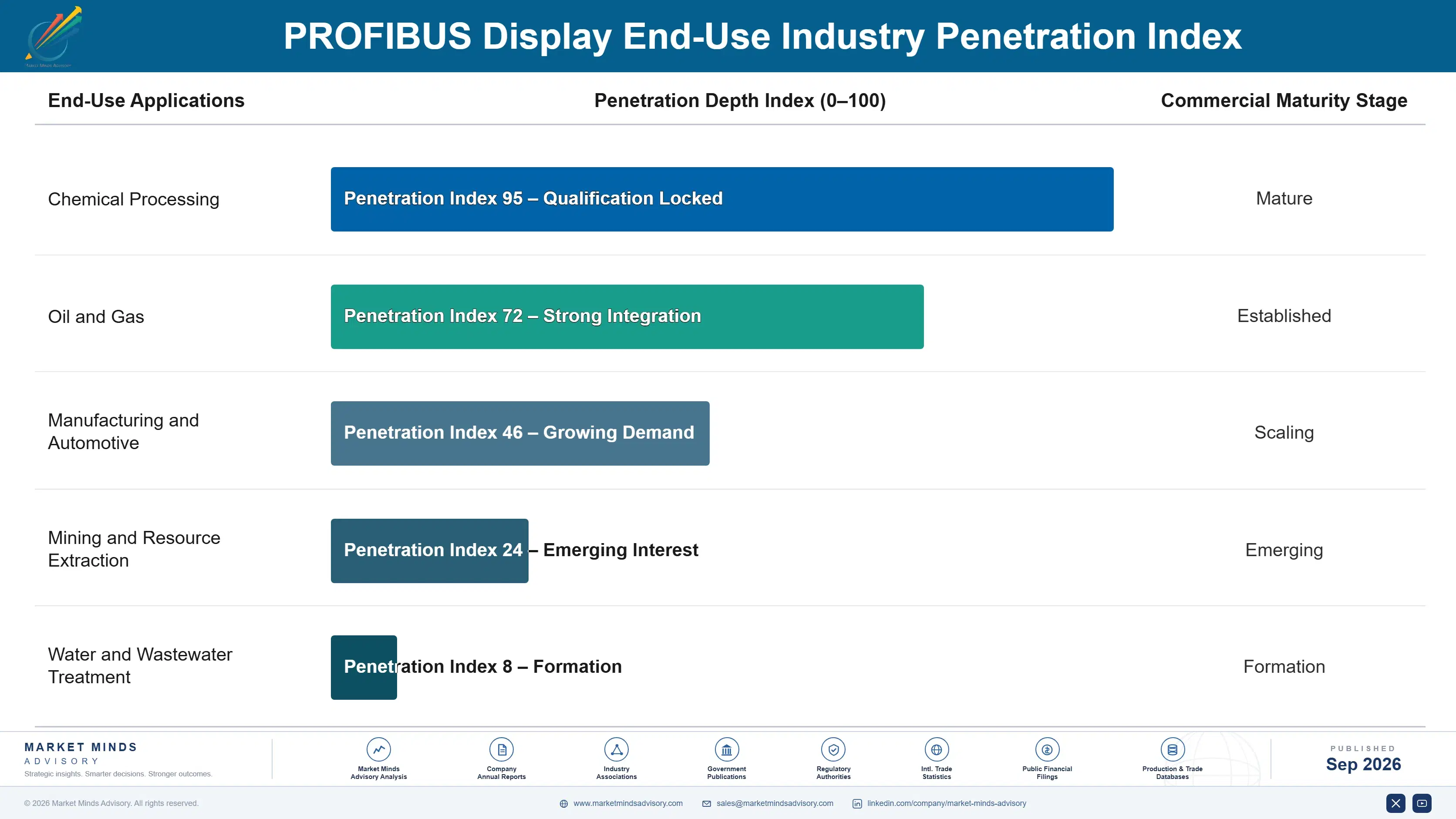
PROFIBUS display revenue increasingly behaves like an annuity rather than a one-time hardware sale, since plant operators who standardize replacement purchasing around a specific vendor's compatible product line cannot easily switch suppliers without risking network integration issues across an installed base built over many years of accumulated field device deployment reflecting sustained investment across multiple plant operator segments as adoption continues expanding steadily across process.
Adoption runs deepest in chemical processing and oil and gas facilities, where hazardous area certification requirements make display replacement operationally essential rather than discretionary, followed by general manufacturing where replacement demand is steady but less certification-driven. Newer industries such as renewable energy processing represent the shallowest current PROFIBUS presence, since most new facilities in these sectors specify newer Ethernet-based protocols from inception reflecting sustained investment.

A generational shift is underway as plant engineering teams move from evaluating displays primarily on price and basic compatibility toward evaluating vendors on certification continuity, gateway modernization capability, and long-term supply security, a change that favors vendors with genuine installed base depth over opportunistic low-cost entrants reflecting sustained investment across multiple plant operator segments as adoption continues expanding steadily across.
profibus-display-market-end-use-penetration-index-1788503122072

Where MMA Sees the Opportunity

These are among the four positions where our research anticipates prominent divergence between winners and laggards over the coming forecast period. Each is grounded in the demand model, the regulatory perimeter, and the announced capacity pipeline.
01 / HAZARDOUS AREA CERTIFICATION FOCUS

Prioritize Hazardous Area Certification Over General Displays

Explosion-proof and hazardous area displays are growing at roughly 1.71 times the overall market rate, and vendors who expand certified product lines now will capture meaningfully more durable replacement demand than competitors focused on general process displays facing the least differentiation opportunity. This is not a marginal category shift, it fundamentally changes how insulated a vendor's revenue is from PROFINET migration pressure. MMA recommends vendors prioritize hazardous area certification investment ahead of general display portfolio expansion in any near-term roadmap decision reflecting sustained investment across.
02 / GATEWAY CONVERSION DEVELOPMENT

Build Gateway Products That Extend Network Service Life

Plant operators increasingly seek modernization paths that avoid full network replacement, and vendors offering gateway conversion products position themselves as a long-term modernization partner rather than a legacy parts supplier facing inevitable decline. Vendors without gateway capability increasingly lose strategic relevance in customer conversations about digital transformation planning. MMA recommends vendors without existing gateway products invest in them before customers commit to a competitor's full replacement solution instead reflecting sustained investment across multiple plant operator segments as adoption continues expanding steadily across process industries supporting.
03 / TECHNICIAN TRAINING INVESTMENT

Expand Technician Training to Build Maintenance Loyalty

Plant maintenance staff who receive vendor-specific technician training increasingly specify that vendor's equipment during replacement decisions, and vendors without training infrastructure face a measurable disadvantage in maintenance-driven purchasing conversations. This training relationship advantage compounds over time as trained technicians move between facilities and specify familiar equipment. MMA recommends vendors without existing training programs establish them for their highest-volume replacement markets first reflecting sustained investment across multiple plant operator segments as adoption continues expanding steadily across process industries supporting consistent engagement across national automation programs reinforcing.
04 / SUPPLY CONSOLIDATION RISK MANAGEMENT

Prepare for Continued Vendor Base Consolidation Risk

Continued exit of smaller PROFIBUS-specific specialists is concentrating component and display supply among fewer remaining vendors, and this consolidation trend will likely continue as the addressable market matures further. Vendors who ignore this trend risk sudden supply disruption if a key smaller supplier exits unexpectedly. MMA recommends vendors diversify component sourcing relationships proactively rather than waiting for a supply disruption to force reactive qualification of alternative suppliers reflecting sustained investment across multiple plant operator segments as adoption continues expanding steadily across process industries supporting consistent.

Engagement Snapshot From the Field

A live engagement with an industry participant carrying material or product regulatory and market exposure ahead of a defining policy shift, showing how our research translates into a defensible multi-year portfolio strategy.
MARKET MINDS ADVISORY · CLIENT ENGAGEMENT SUMMARY
PROFIBUS Display Producer Strategic Portfolio Review and Transition Roadmap 2026·Investment Scenario on PROFIBUS Display Exposure Evaluation 2025-26
CLIENT PROFILE
The client is a European chemical processing operator running several production facilities with PROFIBUS networks installed over two decades ago, facing rising maintenance costs and component sourcing difficulty as some original display units approached end of service life. The client's engineering teams lacked confidence in whether to pursue individual display replacement or a broader network modernization program reflecting sustained investment across multiple.
STRATEGIC CHALLENGE
The client needed to determine whether continued individual display replacement remained economically justified compared with a phased migration toward newer Ethernet-based protocols, and which specific facilities should prioritize modernization first given limited capital budget. Internal teams disagreed over whether hazardous area certification requirements made full network replacement prohibitively disruptive reflecting sustained investment across multiple plant operator segments.
MMA APPROACH
MMA conducted a structured evaluation benchmarking total cost of ownership across continued PROFIBUS maintenance, gateway conversion modernization, and full network replacement scenarios across the client's facility portfolio, supplementing public information with primary interviews across the client's engineering and maintenance organizations. The analysis modeled certification recertification costs explicitly for hazardous area facilities reflecting sustained investment across multiple plant.
KEY FINDINGS
  1. Continued individual display replacement remained more economical than full network replacement for facilities without other compelling modernization drivers, particularly hazardous area certified production lines reflecting sustained investment across.
  2. Gateway conversion products offered a meaningful middle path for facilities seeking modern data integration without triggering full hazardous area recertification requirements across production lines reflecting sustained investment across.
  3. Total facility-wide modernization cost was estimated at 8 million dollars (client-reported, unverified by MMA), concentrated primarily in the two oldest production facilities reflecting sustained investment across multiple plant.
  4. A phased gateway conversion approach reduced total five-year modernization cost by an estimated 22 percent (client-reported, unverified by MMA) compared with immediate full network replacement reflecting sustained investment.
CLIENT PROFILE
The client is a European chemical processing operator running several production facilities with PROFIBUS networks installed over two decades ago, facing rising maintenance costs and component sourcing difficulty as some original display units approached end of service life. The client's engineering teams lacked confidence in whether to pursue individual display replacement or a broader network modernization program reflecting sustained investment across multiple.
STRATEGIC CHALLENGE
The client needed to determine whether continued individual display replacement remained economically justified compared with a phased migration toward newer Ethernet-based protocols, and which specific facilities should prioritize modernization first given limited capital budget. Internal teams disagreed over whether hazardous area certification requirements made full network replacement prohibitively disruptive reflecting sustained investment across multiple plant operator segments.
MMA APPROACH
MMA conducted a structured evaluation benchmarking total cost of ownership across continued PROFIBUS maintenance, gateway conversion modernization, and full network replacement scenarios across the client's facility portfolio, supplementing public information with primary interviews across the client's engineering and maintenance organizations. The analysis modeled certification recertification costs explicitly for hazardous area facilities reflecting sustained investment across multiple plant.
KEY FINDINGS
  1. Continued individual display replacement remained more economical than full network replacement for facilities without other compelling modernization drivers, particularly hazardous area certified production lines reflecting sustained investment across.
  2. Gateway conversion products offered a meaningful middle path for facilities seeking modern data integration without triggering full hazardous area recertification requirements across production lines reflecting sustained investment across.
  3. Total facility-wide modernization cost was estimated at 8 million dollars (client-reported, unverified by MMA), concentrated primarily in the two oldest production facilities reflecting sustained investment across multiple plant.
  4. A phased gateway conversion approach reduced total five-year modernization cost by an estimated 22 percent (client-reported, unverified by MMA) compared with immediate full network replacement reflecting sustained investment.
RECOMMENDED STRATEGY
Phase 1: Phase 1 (Months 1 to 3): Benchmark total cost of ownership across replacement, gateway conversion, and full network replacement scenarios for each facility in. Phase 2: Phase 2 (Months 4 to 12): Deploy gateway conversion products at the two oldest facilities first, validating data integration and certification continuity claims under. Phase 3: Phase 3 (Months 13 to 24): Extend the validated gateway approach across remaining facilities, standardizing on a single vendor to maximize negotiated pricing power.
OUTCOME
The client adopted a phased gateway conversion strategy across its oldest facilities rather than pursuing immediate full network replacement. Total five-year modernization cost declined by roughly 22 percent (client-reported, unverified by MMA) compared with full replacement, and engineering teams reported successfully maintaining hazardous area certification continuity throughout the modernization process reflecting sustained.

Frequently Asked Questions

Foundational context covering the market sizes, CAGR, scope, country, region and competition that inform every finding below. This section is provided to cover basics and most often pre-purchase conversations, answered from the MMA Primary Research Dataset.

What is the current size of the PROFIBUS Display Market?

MMA estimates the PROFIBUS Display market at approximately 0.32 billion dollars in 2025. This reflects steady replacement cycle demand from a large global installed base of legacy fieldbus networks reflecting sustained investment.

How large will the PROFIBUS Display Market be by 2036?

MMA projects the market will reach approximately 0.47 billion dollars by 2036 under the base case scenario. Growth is driven by hazardous area certification renewal, brownfield retrofit activity, and gateway conversion demand.

What is the CAGR for the PROFIBUS Display Market 2026 to 2036?

MMA forecasts a base case compound annual growth rate of 3.5 percent between 2026 and 2036. The bull case reaches 4.7 percent while the bear case falls to 2.3 percent, reflecting protocol.

Which segment is growing fastest?

Explosion-Proof and Hazardous Area Displays lead growth at 6.0 percent CAGR, roughly 1.71 times the overall market rate. This reflects periodic hazardous area certification renewal cycles sustaining demand reflecting sustained investment across.

Who are the major companies in the PROFIBUS Display Market?

Leading vendors include Siemens, Endress and Hauser, Pepperl and Fuchs, Turck, and several certified hazardous area specialists. Together these five companies account for an estimated 42 percent of market activity reflecting sustained.

Which country is growing fastest?

India shows the fastest national growth rate at approximately 5.8 percent CAGR, driven by rapidly expanding chemical and petrochemical processing capacity. Established local vendor familiarity supports continued specification reflecting sustained investment across.

Report Segmentation Architecture

The full report scope spans multiple orthogonal segmentation dimensions, with cross-tabulated demand data provided for each dimension pair. Coverage extends further to regional breakdowns, trend trajectories, and the competitive detail needed to support segment-level decision-making.

By Display Type and Application

  • Local Process Value Displays
  • Diagnostic and Status Indicator Displays
  • Graphical HMI Panel Displays with PROFIBUS Interface
  • Remote I/O Status Display Modules
  • Motor Drive and Actuator Position Displays
  • Explosion-Proof and Hazardous Area Displays

By End-Use Industry

  • Chemical Processing
  • Oil and Gas
  • Manufacturing and Automotive
  • Mining and Resource Extraction
  • Water and Wastewater Treatment

By Commercial Dimension

  • Direct OEM Sales
  • Distributor Channel Sales
  • Maintenance and Retrofit Contracts
  • Systems Integrator Partnerships

By Region

  • North America
  • Western Europe
  • East Asia
  • South Asia and Pacific
  • Latin America
  • Middle East and Africa
  • Eastern Europe

Scope, Methodology, and Coverage

Every figure in this report is reproducible from documented input assumptions. The scope below maps the historical period, the forecast horizon, the segmentation dimensions, and the countries covered, alongside the underlying primary and qualitative methodology.
Historical Period
2020 to 2025
Forecast Period
2026 to 2036
Base Year
2025 (USD billions; MMA Primary Research Dataset, September 2026)
Market Definition
The PROFIBUS Display market covers hardware display and human-machine interface units that communicate using the PROFIBUS fieldbus protocol to show process values, diagnostic status, and equipment position information within industrial automation environments. It excludes displays using competing fieldbus protocols such as PROFINET, Modbus, or EtherCAT, general-purpose computer monitors, and the underlying fieldbus network infrastructure sold without an integrated display unit.
Quantitative Units
USD billions (current prices); segment and regional CAGR in percent
Segmentation Dimensions
By Display Type and Application; By End-Use Industry; By Commercial Dimension; By Region
Regions Covered
North America, Western Europe, East Asia, South Asia and Pacific, Latin America, Middle East and Africa, Eastern Europe
Countries Covered
USA, China, Germany, France, UK, Japan, South Korea, India, Australia, Canada, Brazil, Mexico, Indonesia, Thailand, UAE, Saudi Arabia, South Africa, Poland, Netherlands, Switzerland, and additional markets relevant to this sector
Key Companies Profiled
Siemens AG, Endress+Hauser Group, Pepperl+Fuchs SE, Turck Inc, R. STAHL AG, ABB Ltd, Schneider Electric SE, Phoenix Contact GmbH and Co KG, Beijer Electronics AB, Weidmuller Interface GmbH and Co KG, ifm electronic gmbh, Balluff GmbH, Vipa GmbH, Eaton Corporation, Rockwell Automation Inc, Yokogawa Electric Corporation, Honeywell International Inc, WAGO Kontakttechnik GmbH and Co KG, Murrelektronik GmbH, Pilz GmbH and Co KG
Quantitative Methodology
Primary survey, n=3,800 respondents, Q4 2025, six countries; demand-side model with trade association cross-validation
Qualitative Methodology
47 expert interviews, Q4 2025; applied to validate demand model assumptions, identify emerging dynamics, and assess competitive positioning
Report Format
PDF and XLSX data workbook (Word format preview document)
Publisher
Market Minds Advisory
Report Code
MMA-2026-CON-201
Published
September 2026
Contact
sales@marketmindsadvisory.com | www.marketmindsadvisory.com

Purchase the full PROFIBUS Display Market Report (2026 to 2036).

The full report delivers a complete view of the PROFIBUS Display market, covering detailed segmentation, regional forecasts, and competitive benchmarking across all six display type categories through 2036. It includes company profiles for all 20 evaluated vendors, detailed analysis of PROFINET migration trends and hazardous area certification requirements, and a dedicated section on gateway conversion economics. Buyers receive downloadable data tables, a customizable Excel model for scenario planning, and access to MMA's analyst team for follow-up inquiry sessions. The report is designed for strategy, plant engineering, and procurement teams evaluating vendor selection or modernization investment.
Detailed profiles of all 20 evaluated vendors
Regional forecasts across all seven MMA-defined regions
Customizable Excel model for scenario planning analysis
PROFINET migration and gateway conversion trend analysis
Segment-level CAGR and margin benchmarking data
Direct analyst access for follow-up inquiries

Built For The People Who Decide

From boardroom strategy to bench-side execution, this report is read cover-to-cover by leaders shaping the next decade of their industry, turning demand scenarios, market dynamics and valuation benchmarks into decisions.
CXOs/ Presidents/ VPs/ Managers
M&A and Corporate Development
Strategy Teams and R&D Heads
Procurement and Product Directors
Regulatory and Compliance Leaders
Investor Relations and Equity Analysts