Market Minds Advisory
Professional Gear Bags Market

Professional Gear Bags Market: Professional Gear Bags Market. Category Specialization, Premiumization, and Channel Dynamics Through 2036

Premiumization, category specialization, and direct-to-consumer brand growth are reshaping how professional gear bags protect cameras, medical equipment, trade tools, and tactical gear across increasingly demanding end-use environments worldwide this decade

Lead Analyst

Published

September 2026

Make Smarter Decisions with Customized Research Insights

Request a free sample report and evaluate market opportunities, growth trends, and competitive dynamics relevant to your business needs.

2025 MARKET VALUE$8.4BMarket Size 2025
2036 FORECAST VALUE$17.3BBase Case , 2026 to 2036
CAGR 2026 TO 20366.8 %Bull 7.9% / Bear 5.6%
INCREMENTAL OPPORTUNITY$8.3BNet 10- year value creation
EXPANSION MULTIPLE1.93x2036 value over 2026 base
Strategic Levers
M&A Pipeline
Regional Outlook
Country Rankings
Competitive Intelligence
Segmental Deep-dive
Call-Us : 91 93563 13602

Executive Snapshot and Market Trajectory.

Professional gear bag makers are splitting into narrow, purpose-built categories as buyers reject general-purpose carry solutions for gear that fits their exact working conditions, whether that means a camera rig, a trauma kit, or a full loadout built for a demanding jobsite environment.
Photography, medical, trade, and tactical end users increasingly demand modular, weatherproof, and application-specific bag systems rather than generic carry cases, pushing average selling prices upward across nearly every category covered in this report. Tactical and outdoor gear bags and camera bags are pulling ahead of the broader category, while North America and East Asia together account for more than half of global revenue on a comparable basis, a gap that keeps widening each year.
Five branded manufacturers hold roughly a quarter of global revenue when measured on a comparable basis, leaving a long tail of specialist and regional brands to compete on durability claims and application-specific design rather than price alone. Direct-to-consumer channels and trade-specific retail partnerships are reshaping how buyers discover these products, and that shift is accelerating fastest among younger buyers entering trades and creative fields, reshaping retail partnerships regionally as well.
Market Definition
The Professional Gear Bags Market covers purpose-built carrying and protective bag systems for photography equipment, medical and first-responder gear, trade and construction tools, and tactical or outdoor professional equipment, sold through retail and e-commerce channels. It excludes general consumer luggage, everyday backpacks, and industrial freight packaging.
Base Year Value
$8.4B in 2025 (MMA Primary Research Dataset, September 2026)
Forecast Period
2026 to 2036, eleven discrete annual values
CAGR
6.8% base case. Bull 7.9%. Bear 5.6%.
Fastest Growth Segment
Tactical and Outdoor Gear Bags: 10.9% CAGR
Fastest Growth Country
India: 9.6% CAGR
Fastest Growth Region
South Asia and Pacific: 8.7% CAGR
Largest Region
North America: 28% of 2025 global value
Market Leaders
Peak Design, Pelican Products, Lowepro, 5.11 Tactical, and Klein Tools lead the category. Source: MMA Primary Research Dataset, July 2026.
Primary Survey
n=3,800 procurement and R&D decision-makers, Q4 2025, six countries
Methodology
Demand-side build-up, cross-validated against public data, 47 expert interviews

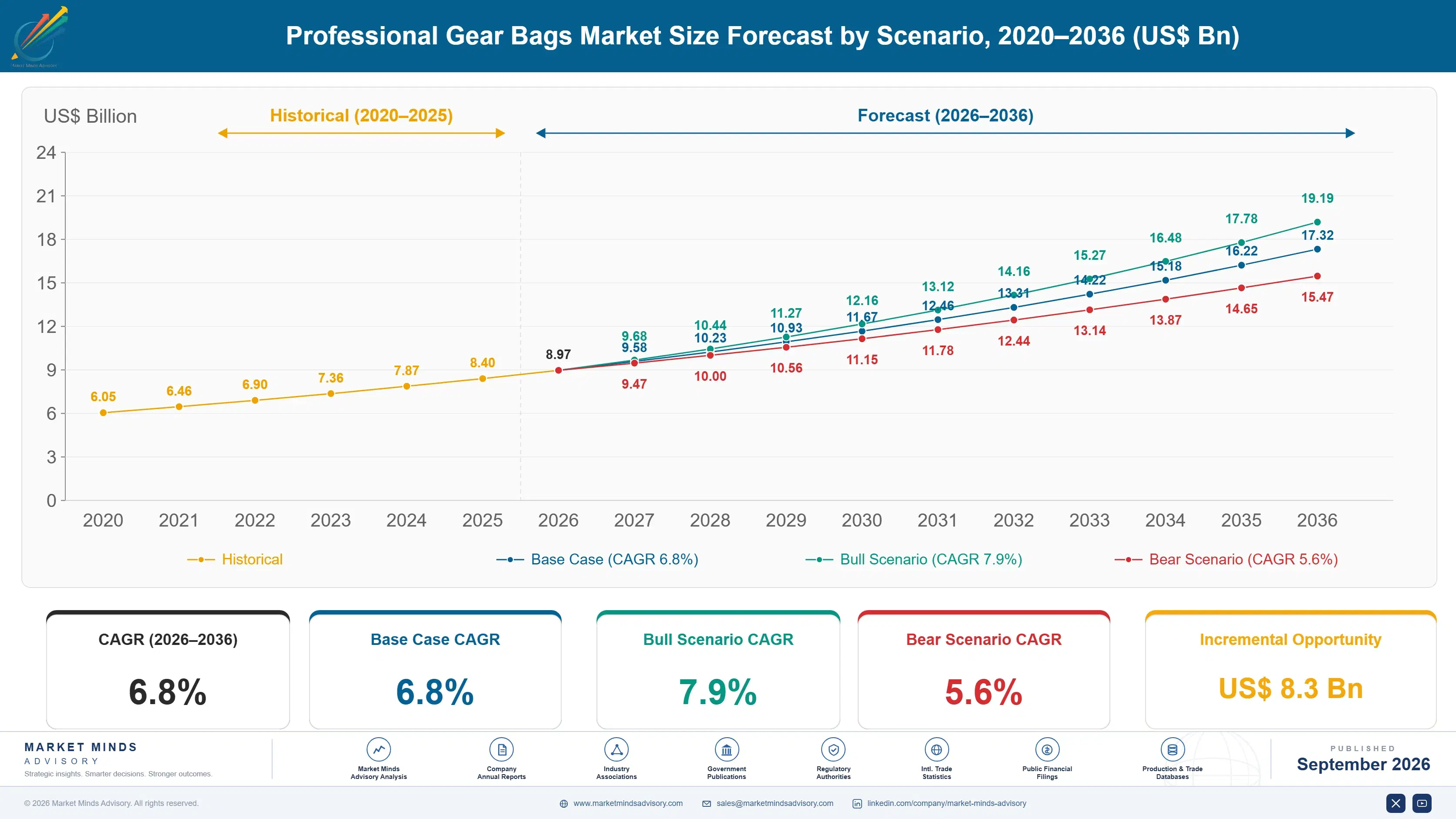
Professional Gear Bags Market Forecast Scenarios

professional-gear-bags-market-size-forecast-scenario-1790012633780
Between 2020 and 2025 demand grew steadily as remote work, outdoor recreation, and persistent trade labor shortages pushed more professionals to invest in durable personal equipment of their own. The historical CAGR of 6.1% reflects that steady expansion, supported by rising trade employment and camera equipment upgrade cycles across several major consuming markets throughout the period.
The base case assumes 6.8% annual growth through 2036, built on three commercial mechanisms: continued premiumization as buyers trade up to modular and weatherproof systems, expansion of trade and first-responder employment in emerging urban markets, and direct-to-consumer brands capturing distribution margin previously ceded to general retailers and big-box chains. Together these mechanisms lift both volume and average selling price without depending on any single end-use category to carry the market.
A faster-adoption bull case near 7.9% depends on tactical and outdoor categories sustaining their current pace as personal preparedness spending broadens across new buyer segments. The bear case near 5.6% reflects a scenario where economic softness delays professional equipment upgrade cycles and trade employment growth slows across the largest consuming markets simultaneously, a divergence retailers are already planning around.

Specialization Reshapes the Professional Carry Category

The professional gear bags category spans four end-use verticals and generates revenue mainly through specialty retail, trade distributors, and direct e-commerce rather than mass retail. Average selling prices vary sharply, from basic tool pouches to modular tactical loadout systems, and that spread means concentration figures understate how differentiated pricing power actually is at the category's top end. Buyers increasingly expect durability certification before purchase.
MARKET CONCENTRATION CR524%Share held by five largest branded gear bag manufacturers
E-COMMERCE CHANNEL SHARE31%Portion of category revenue sold through direct online channels
TRADE PROFESSIONAL BUYER SHARE38%Share of unit volume purchased by working trade professionals
AVERAGE BASKET PRICE GROWTH+4.1%Annual increase in average spending per professional gear purchase
TOP PRODUCING COUNTRY SHARE21%Portion of global manufacturing output concentrated within the leading country
MATERIAL INPUT COST SHARE34%Portion of finished bag cost tied to technical fabric materials
Two forces are reshaping margin capture across the category. Manufacturers keep pushing modular, application-specific designs that command premium pricing over generic carry solutions, while direct-to-consumer brands reclaim distribution margin previously ceded to big-box retailers and general sporting goods chains. Brands combining genuine durability engineering with a direct customer relationship are pulling ahead of category peers, regardless of which end-use vertical they compete in day to day.
North America and East Asia anchor global revenue because trade employment density and camera equipment ownership there support the highest average transaction values, while South Asia and Pacific is where unit volume is expanding fastest as trade employment and outdoor recreation both grow from a smaller base. Category leadership increasingly depends on engineering credibility rather than shelf count. Retailers are still adjusting merchandising to match that shift.
"A gear bag used to be an afterthought line item. Now it is a certification-grade purchase decision, and manufacturers still selling generic carry cases are losing the buyers who matter most."
Senior Analyst, Consumer and Professional Equipment Practice · MMA Consumer Practice · September 2026

Market Trends

Workflow-Specific Engineering Commands Premium Pricing Broadly

Manufacturers are engineering bag systems around specific professional workflows rather than designing one generic case and marketing it across every use case. Camera bags now ship with modular dividers rated for specific lens kits, medical bags carry sub-compartments certified for cold-chain pharmaceuticals, and trade bags integrate tool-specific pockets validated against jobsite drop tests. This shift toward workflow-specific engineering commands a meaningful price premium over generic carry cases, often 25 to 40% higher on comparable capacity, and is reshaping how brands structure their entire product development roadmap around named professional use cases rather than broad categories.
Market Impact: Adds 2.4 million new trade jobs
Technical Weatherproof Materials Migrate Into Mainstream Segments

Weatherproof and abrasion-resistant technical fabrics, once reserved for premium tactical and outdoor lines, are migrating into mainstream photography and trade bag segments as buyers demand equipment protection that matches the value of the gear inside. Roll-top closures, welded seams, and impact-rated hard-shell inserts that were niche five years ago now appear across a much wider range of price points. Manufacturers sourcing these technical materials at scale are capturing share from competitors still using standard nylon and canvas construction, particularly among buyers who have experienced equipment damage from an inadequate bag before.
Market Impact: Lifts prices 18% on average

Market Opportunities and Growth Drivers

Expanding Formal Trade Employment Drives Tool Bag Demand

Trade employment in construction, electrical, plumbing, and HVAC fields is expanding steadily across South Asia and parts of Latin America as infrastructure investment accelerates and skilled labor shortages push wages higher, drawing more workers into formal trades. India alone is adding an estimated 2.4 million new trade jobs annually through the early 2030s, and each new tradesperson typically purchases branded tool bags within the first year on the job rather than relying on unbranded alternatives. The mechanism is direct: more tradespeople working formally means more units sold into a category that barely existed as a branded segment a decade ago.
Market Impact: Erodes 8% of branded unit sales

Rising Professional Camera Ownership Lifts Average Prices

Camera and content-creation equipment ownership keeps expanding as more consumers monetize photography and video work professionally rather than as a hobby, creating a growing population of buyers who treat their gear bag as a professional investment rather than an accessory. Mirrorless camera systems and associated lens kits have grown heavier and more modular, which increases the functional requirements a bag must meet and supports higher average selling prices across the category. Manufacturers are responding with camera-specific product lines built around named camera systems rather than generic capacity tiers, and that responsiveness is becoming a competitive differentiator in its own right.
Market Impact: Adds 7% to material costs

Market Restraints and Challenges

Counterfeit Products Erode Brand Trust and Margin

Counterfeit and low-cost imitation gear bags have proliferated across major e-commerce marketplaces, closely copying branded designs while using inferior zippers, seams, and weatherproofing materials that fail under real working conditions. The root cause is weak marketplace enforcement combined with genuine visual similarity that makes counterfeits difficult for casual buyers to distinguish from authentic products before purchase. The commercial impact falls hardest on mid-tier brands lacking strong trademark enforcement budgets, since premium brands can absorb legal costs that smaller competitors cannot. Some manufacturers are mitigating exposure through serialized authentication tags and tighter marketplace partnership agreements that restrict unauthorized sellers.
Market Impact: Adds 25 to 40% premium

Technical Fabric Input Costs Rise Industry-Wide

Technical fabric and hardware input costs have risen alongside broader specialty textile demand, driven by competition for the same weatherproof materials used in outdoor apparel and military equipment categories. The root cause is a supply base concentrated among a small number of specialized fabric mills that cannot expand capacity quickly enough to match demand growth across multiple end markets simultaneously. The commercial impact compresses margin fastest for manufacturers without long-term supply agreements. Some brands are mitigating exposure through multi-year fabric contracts and qualifying secondary suppliers in different regions to reduce single-source dependence.
Market Impact: Lifts durability ratings 3x over
3 additional market trends, 4 additional growth drivers, and 2 additional restraints and challenges are covered in the full report. Contact sales@marketmindsadvisory.com to access the complete intelligence.

Segment CAGR and Growth Architecture

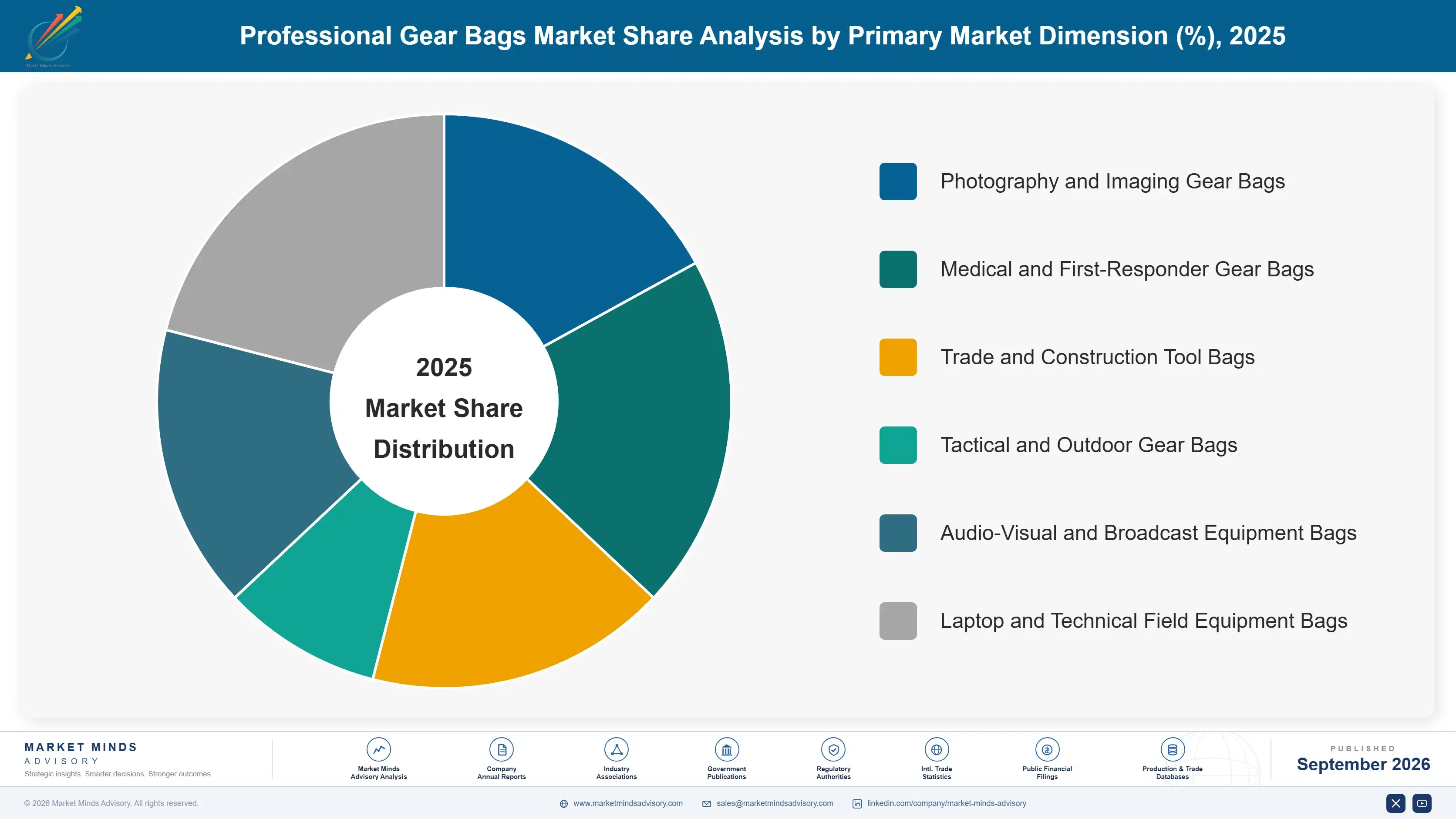
The professional gear bags market breaks into six segments defined by end-use application: photography and imaging, medical and first-responder, trade and construction tools, tactical and outdoor, audio-visual and broadcast equipment, and laptop and technical field equipment. Tactical and outdoor and medical and first-responder bags are pulling away on growth, trading up to certified equipment fastest.
professional-gear-bags-market-market-share-analysis-1790012634347

Tactical and Outdoor Gear Bags

Tactical and outdoor gear bags cover load-bearing packs, modular pouch systems, and weatherproof duffel bags built for law enforcement, military-adjacent, and serious outdoor recreation buyers who demand MOLLE-compatible attachment points and abrasion-rated fabrics. Growth here outpaces every other segment as personal preparedness spending broadens beyond its traditional core buyer base into general outdoor recreation and overlanding communities. Manufacturers compete heavily on certified drop-test ratings and modularity, since buyers in this segment routinely reconfigure their loadout for different missions or trips rather than buying a single fixed-capacity bag. Direct-to-consumer sales are especially strong here because specialized retailers stock only a narrow range of configurations, pushing buyers who want a specific build toward manufacturer websites instead of physical stores.
CAGR 10.9%

Medical and First-Responder Gear Bags

Medical and first-responder gear bags include trauma kits, cold-chain pharmaceutical carriers, and EMS-grade equipment bags built to meet infection-control and rapid-access standards required in clinical and field settings. Growth is running well ahead of the category average as emergency medical staffing expands and hospital systems standardize field kit procurement across larger provider networks. Average selling prices are among the highest in the category because certification requirements, sterile compartment design, and rapid-access hardware all add engineering cost that buyers are willing to pay for given the stakes involved. Procurement here increasingly runs through institutional contracts rather than individual retail purchases, which rewards manufacturers with dedicated healthcare sales teams over consumer-focused competitors.
CAGR 7.8%
Full segment breakdown across 6 segments available in the complete report.

Regional Architecture and Country Demand Map

Global revenue concentrates where trade employment and professional equipment ownership are densest, but unit volume growth is shifting fastest toward South Asia and Pacific as formal trade employment expands rapidly from a smaller base, reshaping where manufacturers prioritize distribution and channel investment going forward across every region.

North America

North America's dense trade employment base across construction, electrical, plumbing, and HVAC fields, combined with the highest per-capita spend on branded photography and outdoor equipment anywhere in the world, supports the highest average transaction values of any region in this report. Tactical and outdoor gear bags see particularly strong demand here, driven by both professional first-responder procurement and a large recreational preparedness buyer base. This combination of trade density and professional equipment ownership, not a default regional assumption, is why North America holds the largest single share of global category revenue on a comparable basis. Direct-to-consumer brands are also most advanced here, capturing distribution margin that general retailers previously held.
Share: 28% | CAGR: 7.1% (2026 to 2036)

Western Europe

Regulatory emphasis on occupational safety equipment standards shapes how Western European trade and medical buyers select gear bags more than in any other region, pushing manufacturers toward certification compliance well ahead of most global deadlines. Germany, France, and the United Kingdom together account for the largest share of regional revenue, supported by dense trade apprenticeship systems and established outdoor recreation culture. Growth trails the global average because trade employment growth is slower here than in emerging markets and per-capita equipment ownership is already near saturation in several core categories. Specialty retailers remain a stronger channel here than in North America, slowing the direct-to-consumer shift somewhat, though direct-to-consumer adoption is accelerating among younger trade entrants.
Share: 22% | CAGR: 5.6% (2026 to 2036)
Regional intelligence for 5 additional markets available in the complete report: East Asia, South Asia and Pacific, Latin America, Middle East and Africa, Eastern Europe. Contact sales@marketmindsadvisory.com.
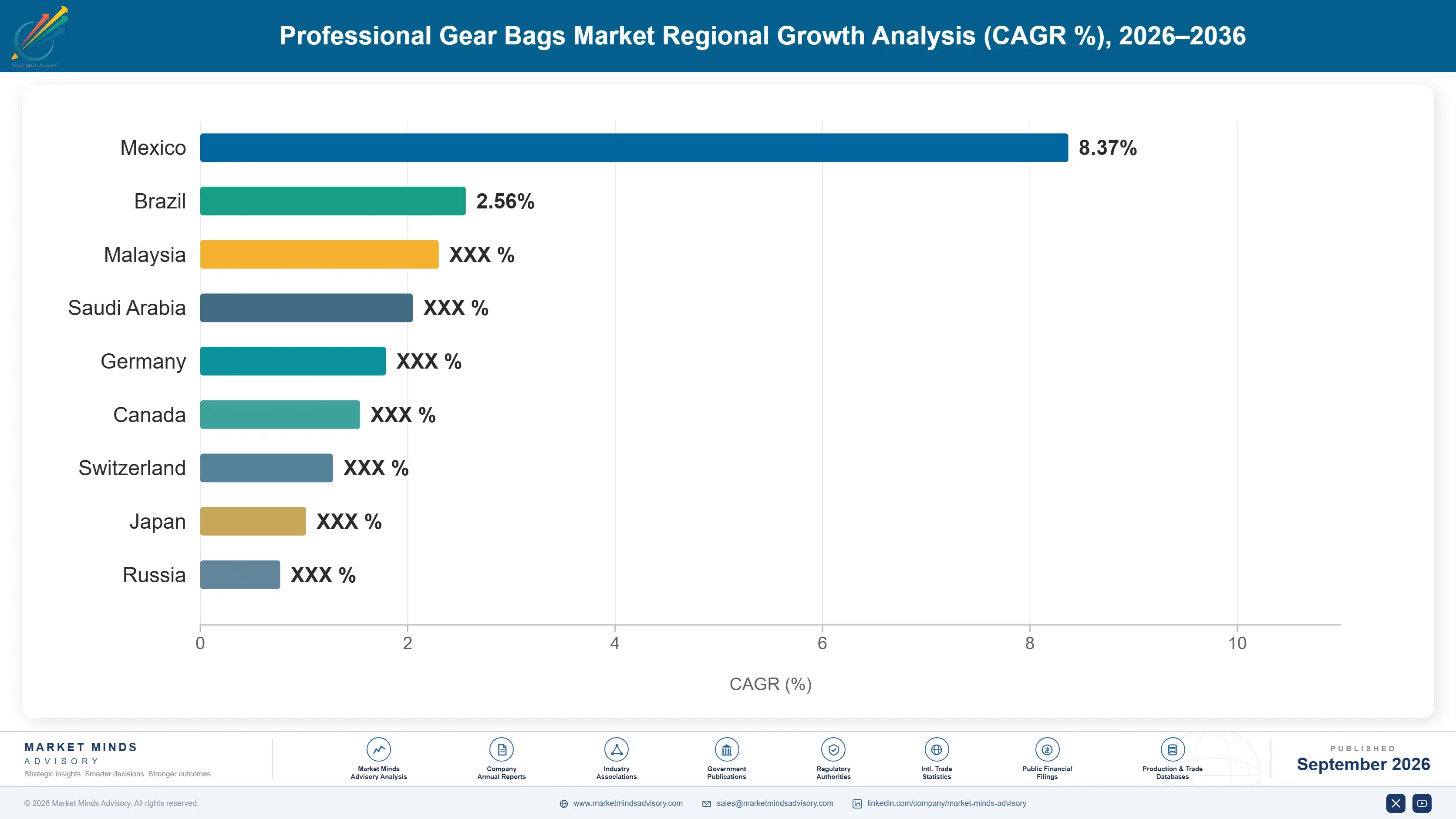
professional-gear-bags-market-country-cagr-analysis-1790012634907

Where Category Margin Actually Concentrates

Margin capture in this category increasingly depends on engineering credibility and direct customer relationships rather than shelf presence alone. Manufacturers with the strongest growth treat application-specific design, direct-to-consumer channels, and institutional procurement as deliberate profit levers rather than defensive reactions to counterfeit and private-label pressure, and the gap between the two groups keeps widening.

Expand Direct-to-Consumer Community and Custom-Build Sales

Manufacturers building owned e-commerce storefronts and direct sales relationships with trade associations and camera clubs capture distribution margin that would otherwise go to a specialty retailer intermediary, typically adding 5 to 7 percentage points of gross margin on units sold direct versus wholesale. Tactical and outdoor categories see the strongest lift because buyers actively research configurations online before purchasing and value direct access to product engineers for custom builds. Building this capability requires upfront investment in content and community infrastructure, but payback periods are shortening as social platforms lower customer acquisition costs for niche technical brands.
Market Impact: Adds 5 to 7 points of gross margin

Lock In Institutional and Emergency Services Procurement

Selling directly into institutional procurement channels, hospital systems, emergency medical services, and municipal trade departments locks in recurring multi-year contracts that individual retail sales cannot match, and typically carries 8 to 12 percentage points better margin than competitive retail pricing since institutional buyers value reliability and certification over price alone. This works best where a manufacturer already holds relevant safety certifications and can demonstrate consistent supply capacity across a contract term. The approach requires dedicated institutional sales capability and patience, since procurement cycles run longer than typical retail cycles for the manufacturer involved.
Market Impact: Adds 8 to 12 points of gross margin

Layer In Authentication and Extended Warranty Programs

Offering serialized authentication and extended warranty programs lets manufacturers reposition against counterfeit competition while capturing incremental revenue from buyers willing to pay for verified authenticity and repair coverage. Brands executing this well have converted 12 to 18% of buyers into extended warranty purchasers within the first year of launch, adding a recurring service revenue stream that carries substantially higher margin than the underlying hardware sale. The lever works best in premium tactical and medical segments where buyers already associate higher price with higher reliability and are primed to value formal authentication.
Market Impact: Converts 12 to 18% of buyers into warranty revenue

Who Controls the Margin Pool

Five branded manufacturers hold roughly 24% of global professional gear bag revenue, a level of concentration that reflects genuine engineering and certification barriers rather than simple brand recognition. The gap between the two leaders and the next tier of challengers is wide on institutional and trade distribution reach but narrower on product innovation speed, where smaller specialist brands remain highly competitive.
Current competitive activity centers on three fronts: expanding direct-to-consumer and community sales channels, pursuing institutional procurement contracts across healthcare and emergency services, and defending brand trust against counterfeit products through authentication programs. Larger players are also acquiring smaller specialist brands to fill segment gaps, while regional challengers use faster product development cycles to win specific application niches before larger competitors can respond effectively.

Emerging pressure is coming from direct-to-consumer brands with no legacy retail infrastructure to protect, and from counterfeit sellers that keep improving visual fidelity to authentic designs. Rankings are most likely to shift within tactical and medical categories, where certification credibility and institutional relationships are resetting what counts as a defensible competitive position, and where a well-funded challenger can displace an established mid-tier brand within a few product cycles.
professional-gear-bags-market-company-positioning-matrix-1790012635434

Competitive Moat and Risk Dimensions

PEAK DESIGN

Moat: Direct community brand loyalty

Peak Design built its customer base through crowdfunded product launches and an active online community that gives it direct feedback and marketing reach competitors struggle to replicate without years of accumulated trust. That relationship lets it launch new configurations with pre-validated demand rather than guessing at retail sell-through.
PEAK DESIGN

Risk: Narrow institutional distribution reach

Peak Design's direct-to-consumer focus leaves it with limited penetration into institutional and emergency services procurement channels where competitors with dedicated sales teams win multi-year contracts. Building that institutional relationship capability from scratch would require a meaningfully different go-to-market approach than its current model, a gap it is only beginning to close through recent hiring.
PELICAN PRODUCTS

Moat: Certified protective case engineering

Pelican's decades of certified drop-test and watertight case engineering give it credibility with institutional, medical, and military-adjacent buyers that newer entrants cannot match without years of accumulated certification history. That reputation lets it command premium pricing even against lighter, less rugged competitor designs, built over decades of accumulated field-tested reliability.
PELICAN PRODUCTS

Risk: Weight and portability tradeoffs

Pelican's rugged hard-case engineering comes at a meaningful weight penalty compared with lighter soft-sided competitors, a tradeoff that increasingly matters to buyers prioritizing portability over maximum protection. Newer entrants using lighter technical fabrics are winning share among buyers willing to accept somewhat less protection for daily carry ease.

Players Tracked

Prominent Players

Peak Design
Pelican Products
Lowepro
5.11 Tactical
Klein Tools

Other Key Players

Osprey Packs
Think Tank Photo
Nanuk
Tenba
Milwaukee Tool
DeWalt
Blackhawk
Condor Outdoor
Maxpedition
Case Logic
Vertx
Manfrotto
Vanguard World
Veto Pro Pac
5col Survival Supply

Recent Developments

SEPTEMBER 2025

Pelican Products Acquires Tactical Pouch Specialist

Pelican Products completed the acquisition of a specialist tactical pouch manufacturer to broaden its modular attachment system offerings beyond hard-case protective products. The deal adds soft-goods engineering capability that Pelican previously lacked internally and positions the combined portfolio to compete more directly against modular tactical specialists.
Signal: Signals hard-case manufacturers expanding into soft-goods tactical categories through targeted acquisition of specialist pouch and pack makers
JANUARY 2026

Peak Design Launches Institutional Sales Division

Peak Design launched a dedicated institutional sales division targeting healthcare systems and emergency services procurement, extending beyond its historical direct-to-consumer model. The division includes certification testing partnerships aimed at qualifying products for formal medical and emergency services procurement processes across multiple regions across several priority state and regional markets.
Signal: Signals direct-to-consumer brands building institutional sales capability to capture new procurement revenue streams beyond core retail
APRIL 2026

5.11 Tactical Expands Weatherproof Fabric Sourcing Agreement

5.11 Tactical expanded a multi-year sourcing agreement with a specialized weatherproof fabric supplier to secure capacity amid rising technical textile demand across the outdoor and military-adjacent categories. The agreement locks in pricing and priority allocation through the remainder of the decade for several core product lines.
Signal: Signals manufacturers locking in multi-year fabric supply agreements amid rising specialty textile input costs industry-wide overall

Technical Fabric and Hardware Cost Exposure

Technical fabrics and hardware, primarily ballistic nylon, weatherproof laminates, and metal buckle hardware, account for roughly 34% of finished bag cost of goods sold, sourced predominantly from specialty textile mills in East Asia and hardware suppliers concentrated in China and Taiwan. Foam padding and structural inserts add another meaningful cost share, with technical foam grades often imported from a small number of specialized suppliers.
Specialty textile prices rose sharply during 2024 as demand for weatherproof and abrasion-resistant fabrics spiked across outdoor apparel, military, and gear bag categories simultaneously, according to IEA commentary on energy-intensive textile manufacturing costs during the period. Several manufacturers cited the resulting input cost pressure directly in annual report commentary on gross margin, with some delaying planned product launches until fabric costs stabilized enough to support target pricing.

Smaller manufacturers without long-term fabric supply agreements absorb volatility episodes far less efficiently than the largest branded groups, which can qualify multiple mills across regions and negotiate volume-based pricing that smaller competitors cannot access on comparable terms. That gap in purchasing leverage widens during volatility spikes specifically, giving scale players a cost advantage that smaller regional and direct-to-consumer brands struggle to match until conditions normalize across the supply base.
professional-gear-bags-market-cost-volatility-analysis-1790012635629

Qualify Multiple Regional Fabric Mills

Manufacturers are qualifying alternative fabric mills across multiple regions rather than relying on a single supplier, which spreads exposure across more than one regional cost cycle and cuts the impact of any single mill disruption on overall landed cost meaningfully, while also improving negotiating position on price during peak seasonal demand periods for the largest branded participants.

Lock Multi-Year Fabric Supply Contracts

Larger manufacturers are negotiating multi-year fabric and hardware supply agreements that smooth price volatility rather than relying on spot purchasing during disruption periods. This trades some flexibility for cost predictability, which matters most for premium categories with long product development lead times, a tradeoff that matters most given the multi-season design cycles typical of premium tactical lines.

Portfolio Architecture for Margin Defence

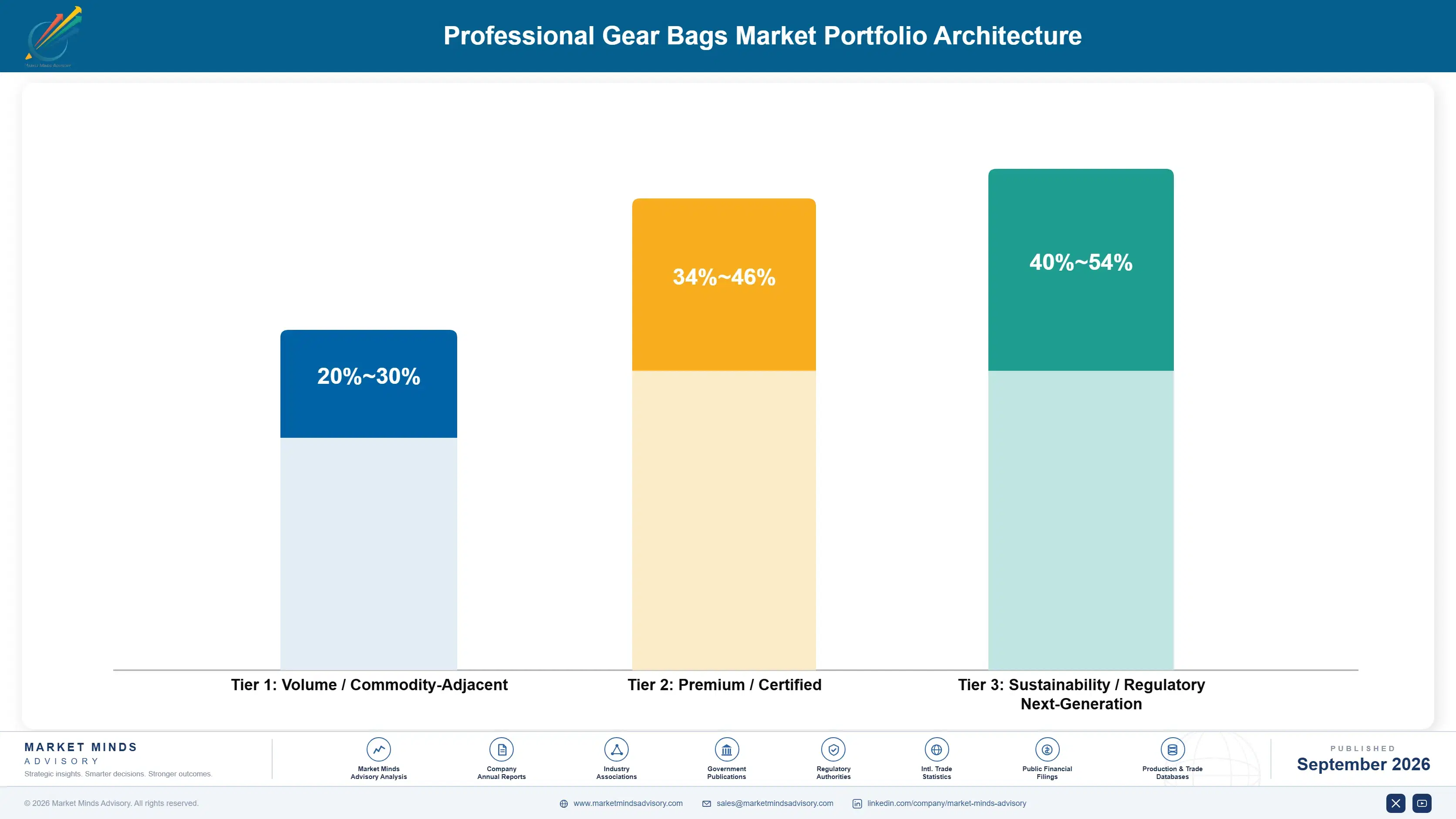
Category portfolios split cleanly into three margin tiers, and the economics between them differ sharply enough that treating the category as one homogeneous market misses where profit actually concentrates. Volume and commodity-adjacent products carry the thinnest margins but the highest unit velocity, while sustainability and next-generation lines carry the widest margins on comparatively small volume, a spread averages obscure.
The tension between volume and premium shapes how retailers and institutional buyers plan procurement: mass retailers protect volume-tier presence because it drives foot traffic, while specialty and direct-to-consumer channels increasingly favor premium and certified products where margin per unit justifies the smaller footprint. Manufacturers straddling both tiers face real internal tension over where to direct innovation spending each budget cycle, and that tension rarely resolves cleanly.

High-value margin pools concentrate most heavily in tactical and medical categories, where certification credibility and institutional relationships support durable price premiums that private competitors struggle to match. Sustainability and regulatory-driven next-generation lines built around recycled technical fabrics remain smaller today but are growing fastest, and manufacturers that build capability there early are positioning for where institutional procurement is clearly heading over the next decade, ahead of when the shift becomes obvious to competitors.

Volume / Commodity-Adjacent

Basic tool pouches, generic camera bags, and entry-level carry cases sold primarily through mass retail on price and availability rather than application-specific engineering or certification, competing mainly through manufacturing scale and price rather than engineering.
Gross Margin: 20-30%

Premium / Certified

Branded products carrying drop-test certification, application-specific engineering, or established brand equity that supports meaningful price premiums over commodity-adjacent equivalents in the same use case, sustained through continued investment in materials and testing.
Gross Margin: 34-46%

Sustainability / Regulatory / Next-Generation

Products built around recycled technical fabrics, modular repairable construction, or emerging smart-tracking technology that command the highest margins but still represent a small share of total category volume today, though that share is expanding quickly across every region.
Gross Margin: 40-54%
professional-gear-bags-market-portfolio-architecture-1790012636137

High-value Sub-segments and Strategic Watch-out

Institutional Medical Procurement

Certified trauma and cold-chain bags sold through institutional healthcare contracts combine high margin with the fastest growth in the category, driven by expanding emergency medical staffing and hospital field-kit standardization across North America and East Asia specifically, a combination few other sub-categories can currently match.
Gross Margin: 48-58%

Certified Tactical and Outdoor

Drop-test certified tactical and outdoor bags grow at a steady, strong pace while commanding durable price premiums, supported by preparedness spending and modular attachment standards that raise the bar for credible premium positioning industry-wide, especially across North America and Western Europe each budget cycle for planning purposes.
Gross Margin: 38-48%

Mass Trade Tool Bags

Everyday trade tool bags remain the largest volume base in the category, generating steady cash flow with thin margins that depend heavily on manufacturing scale and tight material cost control across every region this market covers, leaving very little room for pricing error at scale.
Gross Margin: 20-26%

Generic Camera Bag Exposure

Basic camera bags facing the heaviest counterfeit and generic substitution risk represent a genuine strategic watch-out, since imitation products now match visual quality at meaningfully lower price points across major e-commerce marketplaces, squeezing branded manufacturers on trust and margin alike across most major regions over time.
Gross Margin: 14-22%

Institutional Loyalty and Replacement Cycles

Institutional and trade replenishment cycles behave closer to an annuity than a one-time sale, since emergency services and trade employers repurchase branded bags on a predictable multi-year replacement cycle once a manufacturer earns a place in their procurement standards. That repeat-purchase economics is exactly why institutional and warranty-backed revenue commands such a premium valuation relative to one-time consumer purchases, far more durable than a single discretionary consumer purchase.
Stickiness varies sharply by end-use vertical. Medical and institutional buyers show the deepest loyalty because switching carries real certification and retraining cost, while consumer photography and outdoor buyers see far more brand-switching driven by product reviews and price promotions. Trade tool bag buyers sit in between, sticky within a trusted brand once adopted but vulnerable whenever a competitor introduces a genuinely superior jobsite-specific design.

Generational buyer profiles are shifting who drives category decisions. Younger professionals research extensively online before purchasing and expect modular, repairable construction as a baseline rather than a differentiator, while older tradespeople still weight brand heritage and in-store trust signals more heavily. That generational split is forcing manufacturers to run genuinely different marketing and channel strategies within the same product line simultaneously.
professional-gear-bags-market-end-use-penetration-index-1790012636644

Where Category Leadership Gets Decided

These are among the four positions where our research anticipates prominent divergence between winners and laggards over the coming forecast period. Each is grounded in the demand model, the regulatory perimeter, and the announced capacity pipeline.
01 / APPLICATION ENGINEERING FOCUS

Build workflow-specific product lines instead of generic carry cases

Manufacturers still selling generic carry solutions are losing ground fastest, since buyers across every end-use vertical now expect application-specific engineering before they will pay a premium price. Building genuine workflow-specific product lines, not just rebadged generic cases with new branding, is no longer optional for brands that want to retain pricing power over the next decade. The manufacturers investing in that specificity now are the ones best positioned to own their category outright, rather than compete purely on price against generic alternatives that keep undercutting margin.
02 / INSTITUTIONAL REVENUE CAPTURE

Build dedicated institutional sales capability before competitors do

Institutional procurement in healthcare and emergency services is the clearest path to durable, recurring revenue available in this category right now, particularly given how replacement cycles there run on predictable multi-year schedules rather than impulse purchase decisions. Brands without dedicated institutional sales capability are ceding this channel entirely to competitors willing to invest in certification and long procurement cycles that most consumer-focused brands avoid. Manufacturers building that capability now will own the credibility advantage for years once formal procurement relationships compound across a growing base of accounts.
03 / BRAND PROTECTION DISCIPLINE

Treat counterfeit defense as a permanent revenue protection program

Counterfeit products are not a temporary nuisance that marketplace enforcement will eventually solve on its own; they are now a persistent feature of e-commerce distribution that separates disciplined brand protection programs from reactive ones across every category this market covers. Manufacturers investing in serialized authentication and tighter marketplace partnership agreements are protecting real revenue, not just brand reputation in the abstract sense that most competitors still treat it as. That protection is becoming a genuine and durable competitive advantage on its own terms, independent of product quality alone.
04 / REGIONAL ADAPTATION APPROACH

Localize pricing and distribution for South Asia and Pacific specifically

Regional expansion into South Asia and Pacific requires pricing and distribution built specifically for expanding trade employment there, not repurposed premium global pricing sold with a simply translated label. Manufacturers exporting standard price points into these markets unchanged are steadily losing share to regional competitors adapting deliberately to local trade wages and purchasing patterns that differ meaningfully from mature markets. The fastest-growing regional opportunity in this entire category consistently rewards patience and sustained local investment over speed of entry alone, a lesson several global brands are still learning.

Engagement Snapshot From the Field

A live engagement with an industry participant carrying material or product regulatory and market exposure ahead of a defining policy shift, showing how our research translates into a defensible multi-year portfolio strategy.
MARKET MINDS ADVISORY · CLIENT ENGAGEMENT SUMMARY
Professional Gear Bags Producer Strategic Portfolio Review and Transition Roadmap 2026·Investment Scenario on Professional Gear Bags Exposure Evaluation 2025-26
CLIENT PROFILE
A mid-size tactical and outdoor gear manufacturer with roughly $180 million in annual revenue (client-reported, unverified by MMA) approached MMA in mid-2025 after losing institutional bids to competitors with dedicated healthcare and emergency services sales teams. The client's product engineering was strong, but its go-to-market model remained built almost entirely around specialty retail and direct-to-consumer channels.
STRATEGIC CHALLENGE
The client had lost three consecutive institutional procurement bids worth an estimated $14 million combined (client-reported, unverified by MMA) despite product quality scoring competitively in formal evaluations. Leadership needed to determine whether the losses reflected a genuine product gap, a certification gap, or simply an absent institutional sales relationship, before committing further investment.
MMA APPROACH
MMA combined primary survey data on institutional buyer decision criteria with a review of the client's lost bid documentation to isolate exactly where evaluations broke down. The team benchmarked the client's certification portfolio against winning competitors and modeled the investment required to build a credible institutional sales function, including expected payback timeline against the addressable procurement pipeline.
KEY FINDINGS
  1. Lost bids traced almost entirely to missing certification credentials rather than any genuine underlying product performance gap versus established, better-funded institutional competitors.
  2. Winning competitors had maintained dedicated institutional sales staff who managed multi-year relationships with procurement officers well before formal bid processes even began.
  3. The client's existing direct-to-consumer customer base included several emergency services professionals willing to serve as informal reference accounts during formal bid evaluations.
  4. Certification investment required twelve to eighteen months but showed a clear, well-documented path to bid eligibility across the client's target institutional accounts.
CLIENT PROFILE
A mid-size tactical and outdoor gear manufacturer with roughly $180 million in annual revenue (client-reported, unverified by MMA) approached MMA in mid-2025 after losing institutional bids to competitors with dedicated healthcare and emergency services sales teams. The client's product engineering was strong, but its go-to-market model remained built almost entirely around specialty retail and direct-to-consumer channels.
STRATEGIC CHALLENGE
The client had lost three consecutive institutional procurement bids worth an estimated $14 million combined (client-reported, unverified by MMA) despite product quality scoring competitively in formal evaluations. Leadership needed to determine whether the losses reflected a genuine product gap, a certification gap, or simply an absent institutional sales relationship, before committing further investment.
MMA APPROACH
MMA combined primary survey data on institutional buyer decision criteria with a review of the client's lost bid documentation to isolate exactly where evaluations broke down. The team benchmarked the client's certification portfolio against winning competitors and modeled the investment required to build a credible institutional sales function, including expected payback timeline against the addressable procurement pipeline.
KEY FINDINGS
  1. Lost bids traced almost entirely to missing certification credentials rather than any genuine underlying product performance gap versus established, better-funded institutional competitors.
  2. Winning competitors had maintained dedicated institutional sales staff who managed multi-year relationships with procurement officers well before formal bid processes even began.
  3. The client's existing direct-to-consumer customer base included several emergency services professionals willing to serve as informal reference accounts during formal bid evaluations.
  4. Certification investment required twelve to eighteen months but showed a clear, well-documented path to bid eligibility across the client's target institutional accounts.
RECOMMENDED STRATEGY
Phase 1: Phase one: pursue the certification credentials most frequently required across the client's lost bid evaluations within the first twelve months. Phase 2: Phase two: hire two dedicated institutional account managers and formalize relationships with existing reference customers well ahead of upcoming bid cycles. Phase 3: Phase three: target three specific procurement pipelines identified through primary research and track win rate closely against the established baseline.
OUTCOME
Within eighteen months of the certification investment, the client won two of the three targeted procurement pipelines, generating an estimated $9 million in new institutional revenue (client-reported, unverified by MMA). The certification credentials also opened bid eligibility for accounts the client had not previously pursued, expanding its addressable institutional pipeline meaningfully.

Frequently Asked Questions

Foundational context covering the market sizes, CAGR, scope, country, region and competition that inform every finding below. This section is provided to cover basics and most often pre-purchase conversations, answered from the MMA Primary Research Dataset.

What is the current size of the Professional Gear Bags Market?

The Professional Gear Bags Market was valued at $8.4 billion in 2025. It spans photography, medical, trade, tactical, broadcast, and technical field equipment bags sold through retail and e-commerce.

How large will the Professional Gear Bags Market be by 2036?

The market is projected to reach $17.32 billion by 2036, roughly 1.93 times its 2026 value. Growth is led by workflow-specific engineering and institutional procurement expansion.

What is the CAGR for the Professional Gear Bags Market 2026 to 2036?

The base case CAGR is 6.8% annually between 2026 and 2036. Bull and bear scenarios range from 5.6% to 7.9%, depending on preparedness spending and trade employment growth.

Which segment is growing fastest?

Tactical and Outdoor Gear Bags is growing fastest at 10.9% CAGR, roughly 1.6 times the overall market rate. Medical and First-Responder Gear Bags follows at 7.8% CAGR.

Who are the major companies in the Professional Gear Bags Market?

Peak Design, Pelican Products, Lowepro, 5.11 Tactical, and Klein Tools lead the category on a revenue basis. Together the top five hold roughly 24% of global revenue.

Which country is growing fastest?

India is growing fastest at 9.6% CAGR, driven by expanding formal trade employment in construction and electrical fields. That pace outstrips every other major consuming country.

Report Segmentation Architecture

The full report scope spans multiple orthogonal segmentation dimensions, with cross-tabulated demand data provided for each dimension pair. Coverage extends further to regional breakdowns, trend trajectories, and the competitive detail needed to support segment-level decision-making.

By Primary Market Dimension

  • Photography and Imaging Gear Bags
  • Medical and First-Responder Gear Bags
  • Trade and Construction Tool Bags
  • Tactical and Outdoor Gear Bags
  • Audio-Visual and Broadcast Equipment Bags
  • Laptop and Technical Field Equipment Bags

By End-Use Industry

  • Photography and Content Creation
  • Healthcare and Emergency Services
  • Construction and Skilled Trades
  • Law Enforcement and Defense-Adjacent
  • Broadcast and Media Production

By Commercial Dimension

  • Specialty and Independent Retail
  • Institutional and Procurement Contracts
  • E-Commerce and Direct-to-Consumer
  • Trade Distributor Channels
  • Marketplace and Third-Party Platforms

By Region

  • North America
  • Western Europe
  • East Asia
  • South Asia and Pacific
  • Latin America
  • Middle East and Africa
  • Eastern Europe

Scope, Methodology, and Coverage

Every figure in this report is reproducible from documented input assumptions. The scope below maps the historical period, the forecast horizon, the segmentation dimensions, and the countries covered, alongside the underlying primary and qualitative methodology.
Historical Period
2020 to 2025
Forecast Period
2026 to 2036
Base Year
2025 (USD billions; MMA Primary Research Dataset, September 2026)
Market Definition
The Professional Gear Bags Market covers purpose-built carrying and protective bag systems for photography equipment, medical and first-responder gear, trade and construction tools, and tactical or outdoor professional equipment, sold through retail and e-commerce channels. It excludes general consumer luggage, everyday backpacks, and industrial freight packaging.
Quantitative Units
USD Billion; unit volume in million units where category-relevant
Segmentation Dimensions
By end-use application, by end-use industry, and by commercial distribution channel
Regions Covered
North America, Western Europe, East Asia, South Asia and Pacific, Latin America, Middle East and Africa, Eastern Europe
Countries Covered
40+ countries across seven regions
Key Companies Profiled
20 companies profiled, including 5 key players and 15 additional participants
Quantitative Methodology
Primary survey, n=3,800 respondents, Q4 2025, six countries; demand-side model with trade association cross-validation
Qualitative Methodology
47 expert interviews, Q4 2025; applied to validate demand model assumptions, identify emerging dynamics, and assess competitive positioning
Report Format
PDF and XLSX data workbook (Word format preview document)
Publisher
Market Minds Advisory
Report Code
MMA-2026-CHM-311
Published
September 2026
Contact
sales@marketmindsadvisory.com | www.marketmindsadvisory.com

Purchase the full Professional Gear Bags Market Report (2026 to 2036).

This report gives category leaders, procurement buyers, and investors a comparable read on where professional gear bag revenue and margin are actually concentrating. Coverage spans seven regions and six application segments, from photography and medical through tactical and trade categories. The analysis combines primary survey data from 3,800 consumers across six countries with 47 expert interviews, separating durable demand shifts from short-term promotional noise that often clouds category planning. It is built for teams making portfolio, channel, and pricing decisions over a multi-year horizon, not a single planning cycle.
Segment-level CAGR and margin benchmarking data
Seven-region demand and share breakdown analysis
Competitive positioning across twenty profiled companies
Input cost exposure and mitigation pathways
Portfolio tier and margin architecture mapping
Anonymized client case study with outcomes

Built For The People Who Decide

From boardroom strategy to bench-side execution, this report is read cover-to-cover by leaders shaping the next decade of their industry, turning demand scenarios, market dynamics and valuation benchmarks into decisions.
CXOs/ Presidents/ VPs/ Managers
M&A and Corporate Development
Strategy Teams and R&D Heads
Procurement and Product Directors
Regulatory and Compliance Leaders
Investor Relations and Equity Analysts