Market Minds Advisory
Process Automation and Instrumentation Market

Process Automation and Instrumentation Market: Distributed Control Systems, Field Instrumentation, and Industrial Digitalization

Chemical and refining operators are retrofitting decades-old distributed control systems as cyber-hardening mandates and predictive-maintenance software make legacy analog instrumentation the single largest unplanned-downtime risk left in modern process plants.

Lead Analyst

David Horsley

Published

September 2026

Make Smarter Decisions with Customized Research Insights

Request a free sample report and evaluate market opportunities, growth trends, and competitive dynamics relevant to your business needs.

2025 MARKET VALUE$68.5BMarket Size 2025
2036 FORECAST VALUE$141.3BBase Case , 2026 to 2036
CAGR 2026 TO 20366.8 %Bull 8.1% / Bear 5.5%
INCREMENTAL OPPORTUNITY$68.1BNet 10- year value creation
EXPANSION MULTIPLE1.93x2036 value over 2026 base
Strategic Levers
M&A Pipeline
Regional Outlook
Country Rankings
Competitive Intelligence
Segmental Deep-dive
Call-Us : 91 93563 13602

Executive Snapshot and Market Trajectory

Cybersecurity mandates, not productivity gains, are now the primary trigger for distributed control system replacement, and plant operators running systems installed before 2010 face insurance and compliance pressure that productivity arguments alone never generated in twenty long years of digitalization pitches.
China's chemical and refining capacity additions now outpace the rest of the world combined, pulling distributed control system and field instrumentation demand toward Chinese engineering, procurement, and construction contractors while Honeywell, Emerson, and Siemens compete for the same retrofit contracts in North America and Europe. Manufacturing execution systems and industrial software are the fastest-growing product class, smaller than hardware today but critical to the predictive-maintenance and digital-twin programmes every major process operator is piloting.
Five suppliers, Honeywell, Emerson, ABB, Siemens, and Schneider Electric, hold roughly 52 percent of global process automation revenue, a concentration built on decades of proprietary control system architecture that makes rip-and-replace switching costly for plant operators. Cyber-hardening regulation across the EU's NIS2 directive and US critical infrastructure rules is pulling instrumentation and control system upgrades forward on the replacement calendar well beyond what productivity-driven capital budgets alone would have funded.
Market Definition
The process automation and instrumentation market covers distributed control systems, programmable logic controllers, SCADA software, field instrumentation, industrial safety systems, and manufacturing execution software used to monitor and control continuous and batch industrial processes. It excludes discrete manufacturing robotics, building automation systems, and standalone industrial IT infrastructure sold outside a process control context.
Base Year Value
$68.5B in 2025 (MMA Primary Research Dataset, August 2026)
Forecast Period
2026 to 2036, eleven discrete annual values
CAGR
6.8% base case. Bull 8.1%. Bear 5.5%.
Fastest Growth Segment
Manufacturing Execution Systems and Industrial Software: 9.8% CAGR
Fastest Growth Country
China: 10.2% CAGR
Fastest Growth Region
South Asia and Pacific: 8.8% CAGR
Largest Region
East Asia: 30% of 2025 global value
Market Leaders
Honeywell, Emerson Electric, ABB, Siemens, Schneider Electric. Source: MMA Analysis based on company annual reports and investor filings.
Primary Survey
n=3,800 procurement and R&D decision-makers, Q4 2025, six countries
Methodology
Demand-side build-up, cross-validated against public data, 47 expert interviews

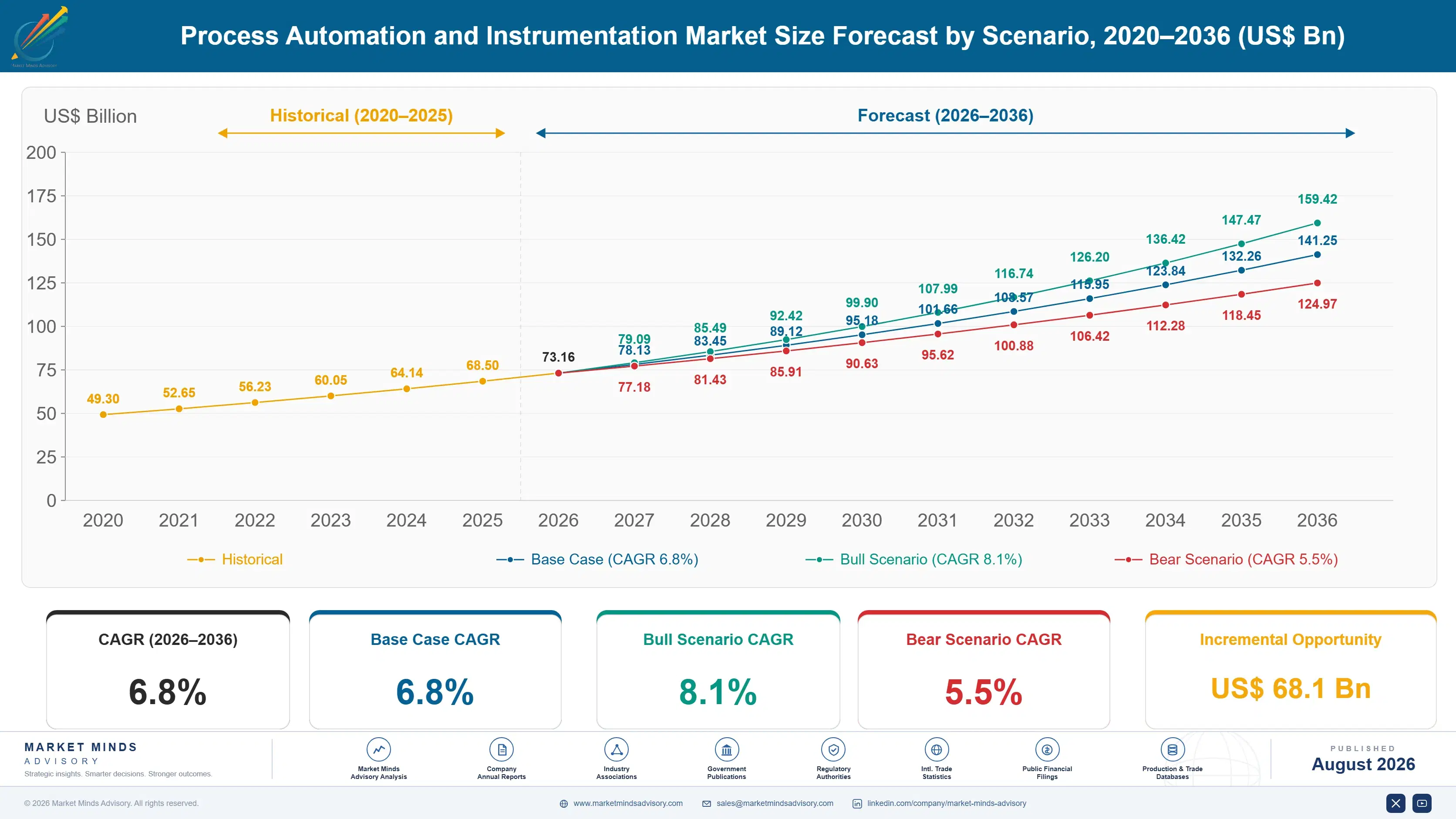
Process Automation and Instrumentation Market Forecast Scenarios

process-automation-and-instrumentation-market-size-forecast-scenario-1787300041247
Process automation investment grew steadily from 2020 through 2025 as supply chain reshoring and chemical and refining capacity additions in China and the Middle East pulled distributed control system orders higher. Cybersecurity retrofit spending accelerated toward the end of the period, and the segment grew at roughly a 6.0 percent historical compound rate, slower than the growth now underway across the industry.
MMA's base case assumes 6.8 percent compound growth through 2036, anchored in three mechanisms. First, cyber-hardening regulation under the EU's NIS2 directive and US critical infrastructure rules is forcing replacement of legacy analog and unsecured digital control systems. Second, chemical and refining capacity expansion across China, India, and the Middle East is generating a stream of greenfield automation contracts independent of the replacement cycle. Third, predictive-maintenance and digital-twin software adoption is pulling manufacturing execution systems into budgets that funded hardware alone.
A bull scenario near 8.1 percent follows if cybersecurity regulation tightens further and insurers begin pricing unpatched control systems into industrial coverage premiums. The bear case near 5.5 percent materialises if capital spending discipline delays greenfield chemical and refining projects across Asia and the Middle East, pushing automation contractors toward smaller brownfield retrofit work with thinner margins.

Cybersecurity-Driven Replacement Reshapes Capital Planning

Process automation has moved from a productivity and uptime discipline into a cybersecurity and compliance discipline almost overnight, and that shift is reshaping how plant operators justify capital spending. Control systems that would have run another decade on pure reliability grounds are now being replaced early because insurers and regulators increasingly treat unpatched, internet-exposed instrumentation as an unacceptable risk rather than an engineering judgment call left to the plant.
MARKET CONCENTRATION52%Five suppliers hold roughly half of global revenue
AVERAGE DCS PROJECT VALUE$18.4MReflects typical greenfield distributed control system installation scope
CHINA CAPACITY SHARE34%Chinese chemical and refining capacity additions lead global growth
LEGACY SYSTEM SHARE46%Installed control systems still run architecture over fifteen years old
SOFTWARE ATTACH RATE38%Share of hardware orders now bundled with digital software licences
TRADE INTENSITYModerateControl system hardware ships globally from a handful of factories
Commercial activity concentrates in distributed control system retrofits and field instrumentation replacement, where proprietary architecture and decades of installed base give the five largest suppliers durable switching-cost advantages. Manufacturing execution systems and industrial software remain a smaller but fast-scaling category, increasingly bundled into hardware contracts rather than sold as a separate line item to operators still building out their digital-twin capability.
The next decade will be shaped less by control theory innovation than by how fast operators can retrofit cybersecurity into plants designed before the threat existed. Suppliers that can bundle hardware, software, and compliance documentation into a single retrofit contract capture disproportionate share of a budget cycle now driven by regulation rather than by pure productivity economics.
"Nobody budgets for a new control system because the old one still works fine. They budget for it because their insurer just asked an uncomfortable question about it."
Director, Industrial Automation and Process Control Practice · MMA Industrial Au

Market Trends

Cybersecurity Regulation Forces Legacy System Replacement Forward

The European Union's NIS2 directive and US critical infrastructure cybersecurity rules require documented patching, network segmentation, and incident-response capability that legacy analog and early digital control systems cannot support without a full architecture replacement. Plant operators running systems installed before 2010 face compliance deadlines that make gradual, reliability-driven replacement scheduling impossible, forcing capital budgets forward by several years. Honeywell and Emerson both report that cybersecurity compliance, not productivity improvement, is the primary justification cited in new distributed control system proposals, a reversal from a decade of efficiency-led sales conversations that dominated the industry.
Market Impact: Adds $6.8B in greenfield project orders
Digital Twin Adoption Bundles Software Into Hardware Contracts

Process operators piloting digital-twin programmes require that new distributed control system and instrumentation contracts include the software and data infrastructure needed to feed a live plant model, rather than procuring simulation software separately after commissioning. Siemens and ABB have both restructured their commercial offerings around this bundled model, since customers report faster digital-twin deployment when hardware and software are specified and delivered together rather than integrated after the fact by a third party. Suppliers without a credible native software offering are losing bundled contracts to competitors that can deliver both halves of the scope from a single vendor relationship.
Market Impact: Adds 22% more sensors per retrofit

Market Opportunities and Growth Drivers

Chemical and Refining Capacity Expansion Drives Greenfield Demand

China's petrochemical capacity additions and the Middle East's refining and gas processing buildout are generating a steady pipeline of greenfield automation contracts independent of the cybersecurity-driven replacement cycle affecting installed plants. Saudi Aramco, SABIC, and Chinese state-owned chemical groups are commissioning new distributed control systems at a pace that has kept Honeywell, Emerson, and Yokogawa's Asian and Middle Eastern order books growing while North American and European retrofit spending remains the larger revenue pool. This geographic split is shifting where automation suppliers concentrate engineering headcount and manufacturing capacity, favouring vendors established in Gulf and Chinese supply chains over newer entrants.
Market Impact: Extends retrofit timelines by roughly 30%

Predictive Maintenance Software Extends Instrumentation Sensor Demand

Predictive maintenance programmes require denser sensor coverage than traditional process control alone, since machine-learning failure models depend on vibration, temperature, and pressure data streams that legacy plants were never instrumented to provide at the granularity these programmes require. Operators retrofitting predictive maintenance capability are installing wireless sensor networks alongside existing wired instrumentation rather than replacing it, creating an incremental instrumentation demand stream layered on top of conventional replacement cycles. Emerson and Endress+Hauser have both expanded wireless sensor product lines to capture this incremental demand, which analysts track separately from core control system replacement spending given its distinct growth trajectory.
Market Impact: Caps project throughput by roughly 15%

Market Restraints and Challenges

Brownfield Integration Complexity Slows Retrofit Timelines

Retrofitting a distributed control system into a decades-old plant requires integrating new digital architecture with instrumentation, wiring, and safety systems never designed for interoperability, and the root cause is an architectural mismatch: legacy plants were built around proprietary, closed designs that resist the open, networked standards modern systems assume. That mismatch extends retrofit timelines beyond initial schedules, since engineering teams discover undocumented wiring and control logic once integration work begins on site. Suppliers including Honeywell and Rockwell Automation mitigate the friction with phased migration paths that replace control logic before hardware, letting operators validate new systems before a full cutover.
Market Impact: Pulls forward $4.2B in replacement spend

Skilled Automation Engineer Shortage Constrains Project Capacity

Experienced control system engineers capable of commissioning distributed control systems and troubleshooting legacy plant-specific logic are in short supply, and the root cause is demographic: a generation of engineers who built and maintained these plants is retiring faster than automation-specific engineering programmes are producing replacements. That shortage caps how many retrofit and greenfield projects suppliers can staff simultaneously, regardless of order book size, rationing growth by engineering capacity rather than by market demand. Suppliers including Emerson and Yokogawa are mitigating the constraint by investing in remote commissioning tools and simulation-based training that reduce on-site senior engineering time each project requires.
Market Impact: Lifts software attach rate to 38%
3 additional market trends, 4 additional growth drivers, and 3 additional restraints and challenges are covered in the full report. Contact sales@marketmindsadvisory.com to access the complete intelligence.

Segment CAGR and Growth Architecture

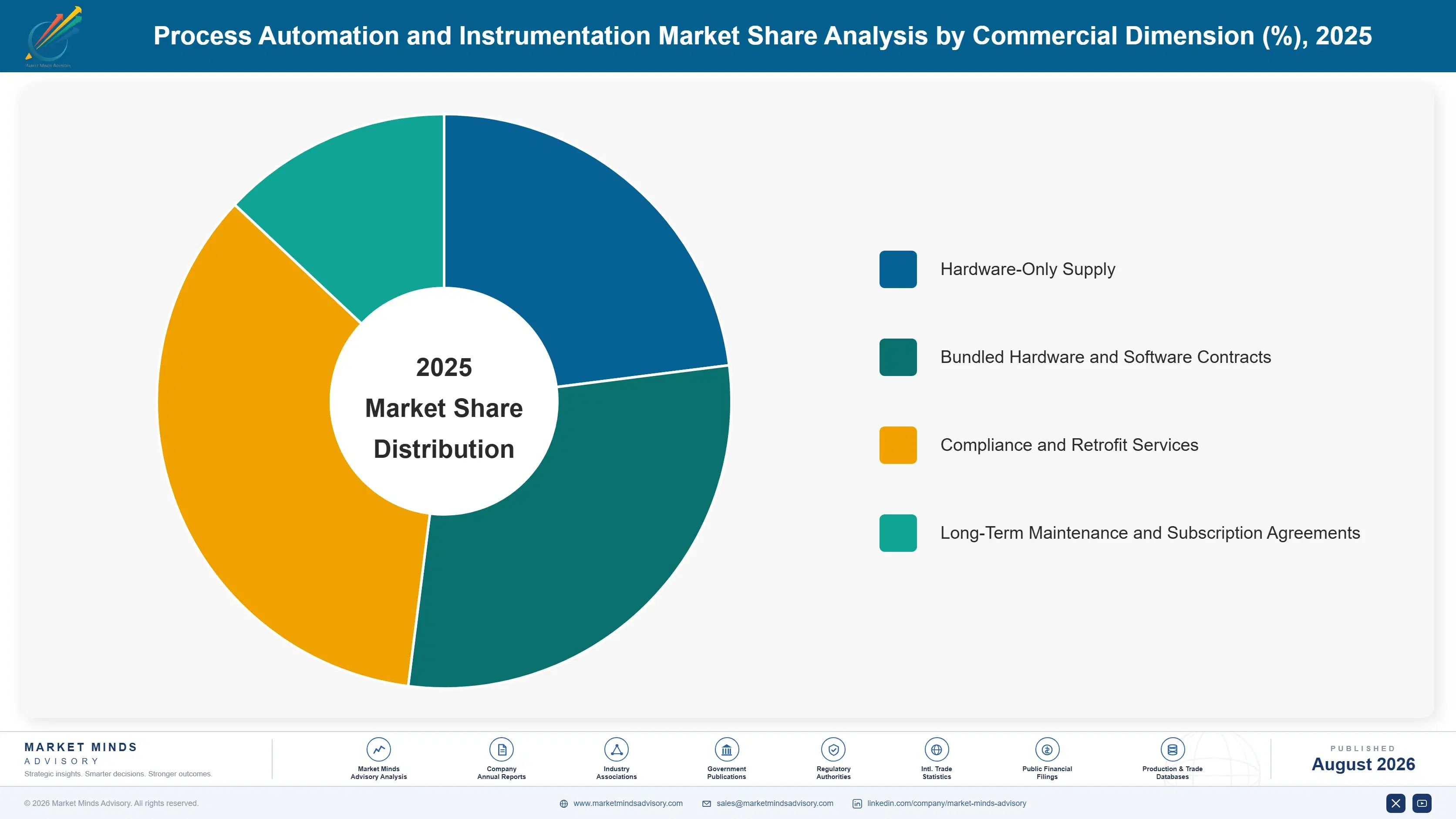
MMA segments the process automation and instrumentation market by system type, the classification engineering, procurement, and construction contractors actually specify and budget against, rather than by end industry or communication protocol. Six system types cover the addressable market, each with distinct architecture, qualification, and software integration requirements across chemical, refining, power, and pharmaceutical process industries.
process-automation-and-instrumentation-market-market-share-analysis-1787300041923

Manufacturing Execution Systems and Industrial Software

Manufacturing execution systems and industrial software are growing fastest because digital-twin and predictive-maintenance programmes require the data infrastructure layer that hardware alone cannot provide, and operators specify software requirements before finalising hardware vendor selection rather than after. Siemens and ABB have both restructured commercial offerings to bundle software licensing into distributed control system contracts, recognising that customers evaluate software capability as a primary purchase criterion rather than an optional add-on. Smaller specialist software vendors face growing pressure from this bundling trend, since operators prefer a single integrated vendor relationship over stitching together best-of-breed point solutions from multiple suppliers. Growth here reflects new spending rather than migration from hardware budgets, since most operators fund software separately from their instrumentation capital programmes.
CAGR 9.8%

Industrial Safety and Asset Performance Management Systems

Industrial safety and asset performance management systems are the second-fastest-growing segment as regulatory scrutiny following major process safety incidents pushes operators to invest in predictive failure detection ahead of statutory safety instrumented system upgrades. Honeywell and Emerson both dominate this segment given their existing installed base of safety systems and the deep domain expertise required to model failure modes across specific process equipment types accurately. Insurers are increasingly requiring documented asset performance management programmes as a condition of industrial coverage renewal, converting what was once a discretionary reliability investment into a compliance-adjacent purchase similar to the cybersecurity dynamic reshaping the broader control system market. Growth here tracks closely with insurance underwriting requirements rather than with capital expenditure cycles alone.
CAGR 8.9%
Full segment breakdown across 6 segments available in the complete report.

Regional Architecture and Country Demand Map

East Asia leads process automation demand as China's chemical and refining capacity additions outpace the rest of the world combined, while North America and Western Europe retain the deepest installed base of legacy systems now entering cybersecurity-driven replacement cycles. The Middle East is scaling fastest on greenfield petrochemical investment.

North America

The United States' chemical and refining sector, concentrated along the Gulf Coast, anchors North American demand through a mix of cybersecurity-driven brownfield retrofits and new petrochemical capacity tied to natural gas feedstock advantages that continue attracting investment despite a mature overall industrial base. Rockwell Automation and Emerson both maintain their largest engineering and manufacturing footprints domestically, giving North American operators faster access to commissioning support than most other regions receive. Canada's oil sands and LNG export infrastructure represent a smaller but steady secondary demand pool, while Mexican manufacturing nearshoring is gradually building a new installed base of automation equipment tied to expanding industrial parks along the US border that increasingly require modern control architecture from the outset.
Share: 24% | CAGR: 6.8% (2026 to 2036)

Western Europe

Germany's chemical industry, anchored by BASF and other major producers along the Rhine corridor, drives the bulk of Western European demand even as some European chemical capacity has shifted toward lower-cost regions over the past several years, leaving a large installed base requiring cybersecurity retrofit rather than greenfield replacement. The EU's NIS2 directive applies uniformly across member states, giving Siemens and ABB's European engineering teams a large, relatively homogeneous compliance retrofit market to serve compared with the more fragmented regulatory landscape elsewhere. The Nordic region's pulp, paper, and specialty chemical operators are notably early adopters of digital-twin and predictive-maintenance software, often piloting new industrial software offerings before larger German or French operators commit to full-scale deployment.
Share: 19% | CAGR: 5.3% (2026 to 2036)
Regional intelligence for 5 additional markets available in the complete report: East Asia, South Asia and Pacific, Latin America, Middle East and Africa, Eastern Europe. Contact sales@marketmindsadvisory.com.
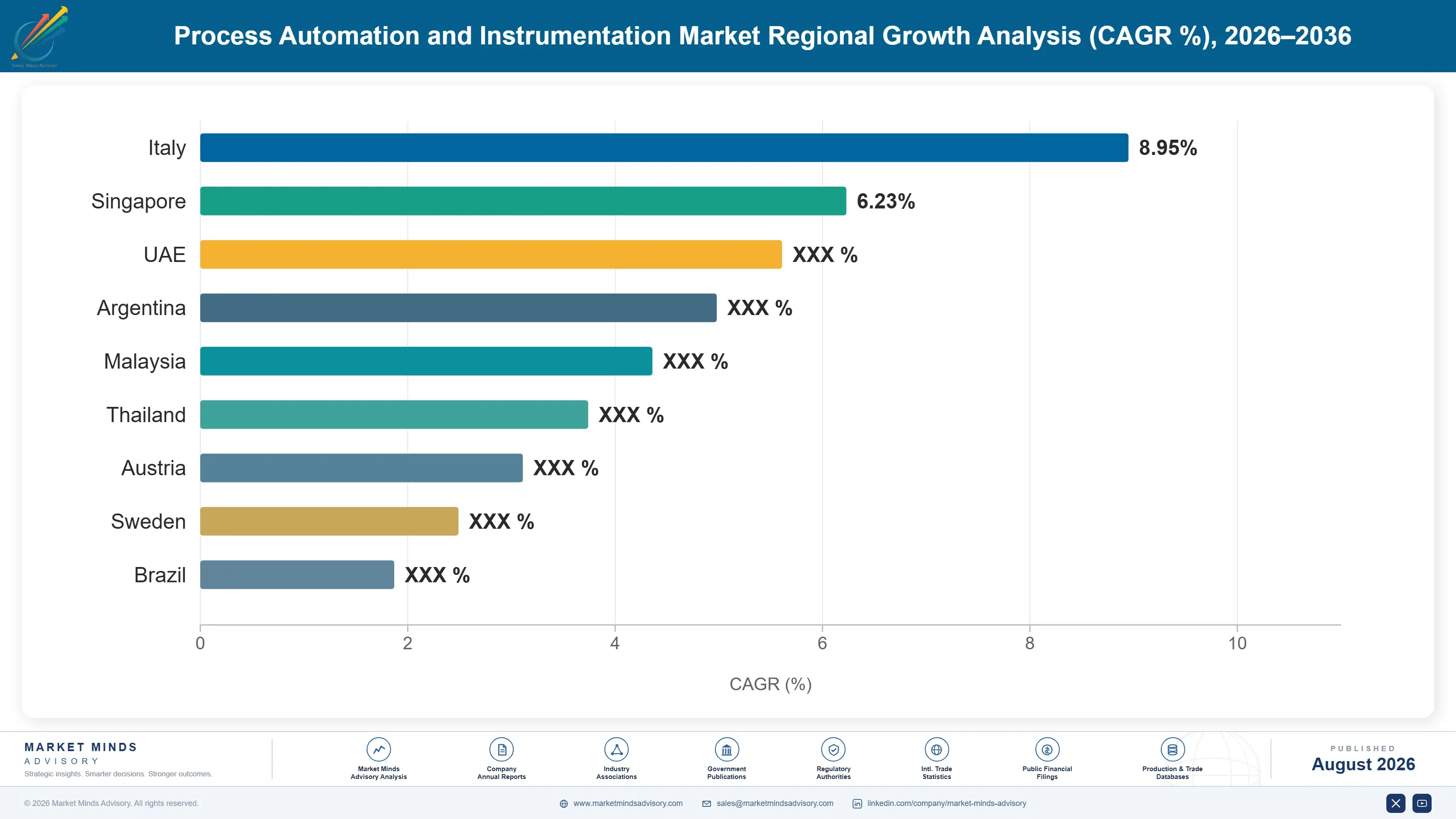
process-automation-and-instrumentation-market-country-cagr-analysis-1787300042575

Software Bundling and Compliance Retrofit Premiums

Suppliers extract value less through hardware pricing than through bundling software licensing into control system contracts, capturing recurring compliance and maintenance revenue, and winning greenfield capacity contracts in Asia and the Middle East ahead of competitors. The levers below describe how each part of the value chain captures its share of a market driven by regulation rather than productivity economics.

Software Licensing Bundled Into Hardware Contracts

Suppliers are structuring distributed control system contracts to include multi-year software licensing rather than selling hardware and software separately, converting a portion of what was once one-time capital revenue into recurring subscription-like revenue. Siemens and ABB both report that bundled software attach rates have risen from roughly 20 percent to 38 percent over the past three years, as customers evaluate total cost of ownership across the contract term rather than comparing upfront hardware pricing alone. This bundling also deepens switching costs, since replacing a control system now means replacing the whole software platform, not just the hardware.
Market Impact: Lifts recurring software revenue by roughly 8-12pp share

Compliance Documentation Services Command Premium Fees

Suppliers offering documented cybersecurity compliance packages, including network segmentation design, patching schedules, and incident-response planning, charge 20 to 25 percent more than for equivalent hardware sold without compliance documentation, since operators need audit-ready paperwork rather than working equipment to satisfy regulators and insurers. Honeywell has built a dedicated compliance services practice to capture this premium, recognising that documentation work carries higher margins than hardware installation given its lower capital intensity. Operators facing imminent compliance deadlines are willing to pay this premium rather than risk delayed certification, giving suppliers pricing power in a segment that barely existed five years ago.
Market Impact: Commands a 20-25% pricing premium for compliance documentation packages

Greenfield Capacity Contracts Anchor Multi-Year Revenue

Suppliers that win greenfield distributed control system contracts for petrochemical and refining capacity in China, India, and the Middle East secure not just the initial hardware sale but 15-plus years of follow-on instrumentation, software, and maintenance revenue as the facility scales toward full production. Yokogawa and Honeywell have prioritised Middle Eastern and Asian greenfield relationships because these contracts anchor multi-decade customer relationships in markets where capacity additions continue at a pace North American and European brownfield retrofit spending cannot match. Suppliers without an established Gulf or Chinese presence find it difficult to compete for this anchor business regardless of capability.
Market Impact: Anchors 15-plus years of recurring follow-on service revenue

Predictive Maintenance Retrofits Extend Sensor Attach Rates

Suppliers bundling predictive maintenance sensor packages into routine instrumentation replacement capture roughly 22 percent higher per-project revenue than suppliers selling replacement sensors alone, since predictive maintenance requires denser sensor coverage and dedicated data infrastructure that standard replacement projects never included. Emerson and Endress+Hauser have both trained field sales teams to identify predictive-maintenance upsell opportunities during routine instrumentation replacement visits, converting what was once a like-for-like swap into a larger project scope. This approach has proven effective in brownfield retrofit projects, where the incremental cost of adding sensor density is small relative to the mobilisation cost committed to the site visit.
Market Impact: Adds roughly 22% more sensor revenue per retrofit visit

Who Controls the Margin Pool

Five suppliers, Honeywell, Emerson, ABB, Siemens, and Schneider Electric, hold roughly 52 percent of global process automation revenue, a concentration built on decades of proprietary control architecture that makes switching costly. The gap to challengers like Yokogawa and Rockwell Automation narrows in specific segments, particularly safety systems and field instrumentation, where installed base matters less than in core distributed control systems.
Current competitive activity centres on three fronts: bundling software into hardware contracts to capture recurring revenue, building cybersecurity compliance services to capture the retrofit premium regulation commands, and racing for greenfield capacity contracts across China, India, and the Middle East that anchor decades of follow-on business. Suppliers are investing in remote commissioning tools to offset the shortage of field engineers constraining project throughput.

Emerging pressure comes from Chinese suppliers including Supcon Technology and Hollysys Automation, winning a growing share of domestic greenfield contracts and beginning to compete on price for less safety-critical applications elsewhere in Asia. Rankings are most likely to shift in industrial software, where no incumbent holds the installed-base advantage anchoring hardware share, leaving the fastest-growing segment open to whichever supplier delivers the strongest digital-twin platform.
process-automation-and-instrumentation-market-company-positioning-matrix-1787300043124

Competitive Moat and Risk Dimensions

HONEYWELL

Moat: Deep Cybersecurity Services Franchise

Honeywell built a dedicated compliance and cybersecurity services practice earlier than most rivals, giving it a head start capturing the premium retrofit contracts that NIS2 and equivalent US rules now generate. That services relationship, layered on top of its large installed hardware base, is difficult for competitors without comparable domain expertise to replicate quickly.
HONEYWELL

Risk: Legacy Portfolio Complexity Overhead

Honeywell's broad legacy product portfolio, accumulated across decades of acquisitions, creates integration and support overhead that leaner competitors with more unified architectures do not carry. If customers increasingly prefer simpler, more modern platform architectures, Honeywell's portfolio breadth could become a support burden rather than a competitive advantage.
EMERSON ELECTRIC

Moat: Broad Field Instrumentation Installed Base

Emerson's field instrumentation installed base spans more process industries and geographies than most rivals, giving it a distribution advantage when cross-selling predictive maintenance sensors and software into existing customer relationships. That breadth is difficult for control-system-only competitors to match without a comparable instrumentation franchise of their own.
EMERSON ELECTRIC

Risk: Slower Digital Software Platform Rollout

Emerson has moved more cautiously than Siemens and ABB in bundling industrial software directly into hardware contracts, risking losing bundled-contract share to faster-moving rivals as customers increasingly evaluate software capability before finalising hardware vendor selection. Closing that gap will require faster software platform development than Emerson has historically prioritised.

Players Tracked

Prominent Players

Honeywell
Emerson Electric
ABB
Siemens
Schneider Electric

Other Key Players

Yokogawa Electric
Rockwell Automation
Mitsubishi Electric
Endress+Hauser
Azbil Corporation
Omron Corporation
KROHNE Group
Yaskawa Electric
WIKA
VEGA Grieshaber
Metso
AMETEK
Fortive
Hollysys Automation
Supcon Technology

Recent Developments

JANUARY 2026

Honeywell Launches Dedicated Cybersecurity Compliance Retrofit Practice

Honeywell launched a cybersecurity compliance retrofit practice in January 2026, packaging network segmentation design, patching services, and audit-ready documentation into a standalone offering sold alongside hardware upgrades. The practice targets operators facing NIS2 and comparable compliance deadlines who need documentation faster than a full hardware replacement cycle allows.
Signal: Confirms that compliance services are becoming a standalone revenue category rather than a hardware sale add-on.
OCTOBER 2025

Yokogawa Wins Major Saudi Petrochemical Automation Contract

Yokogawa was awarded a major distributed control system contract for a new Saudi petrochemical facility in October 2025, one of the largest single greenfield automation awards in the region this year. The contract extends Yokogawa's established Gulf region relationships and secures a multi-year instrumentation and software follow-on revenue stream.
Signal: Signals that established Gulf-region relationships remain decisive in winning the largest available greenfield contracts across the region.
JUNE 2025

Supcon Technology Expands Overseas Automation Export Capacity

Supcon Technology announced expanded export-grade manufacturing capacity for distributed control systems in June 2025, positioning the Chinese automation vendor to compete for international contracts beyond its dominant position in the domestic Chinese market. The expansion follows several years of qualification investment targeting Southeast Asian and Middle Eastern process industry customers.
Signal: Marks a clear step toward Chinese automation vendors competing seriously in international markets well beyond their home region.

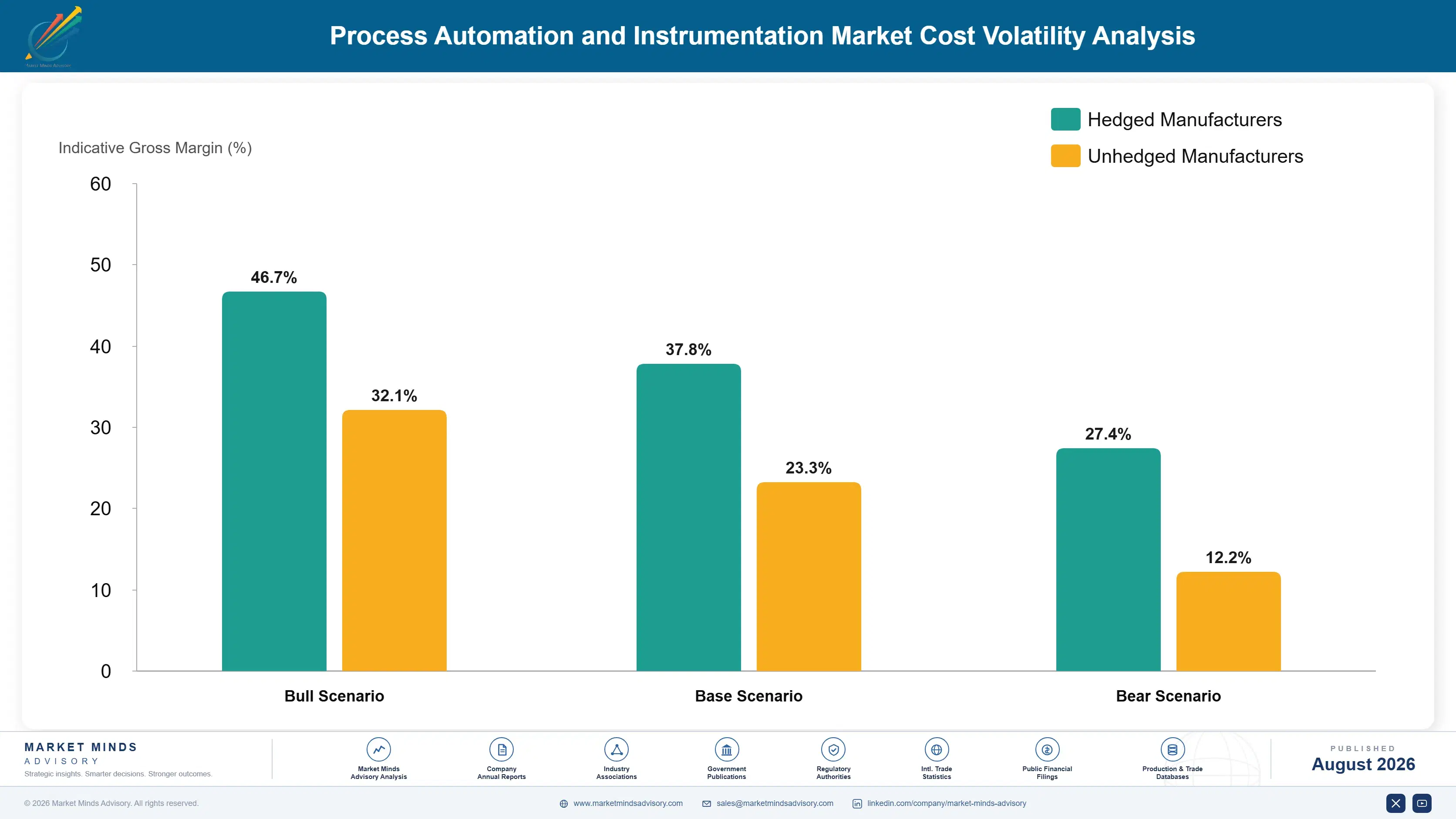
Semiconductor and Specialty Alloy Cost Exposure

Semiconductor components represent a significant cost input for modern control system hardware, accounting for roughly 25 percent of finished distributed control system cost, sourced from a global chip supply chain concentrated in Taiwan, South Korea, and increasingly China. Specialty alloys used in high-precision field instrumentation, particularly for corrosive or high-temperature process applications, add meaningful secondary cost exposure sourced from a smaller, more specialised metals suppl
The 2021 through 2022 global semiconductor shortage disrupted control system hardware deliveries, and Emerson's fiscal year 2022 annual report cited component availability as a direct constraint on its ability to fulfil order backlog. Suppliers responded by qualifying additional chip suppliers and redesigning some control modules around more widely available component families, reducing exposure to any single semiconductor supplier or geographic chokepoint that had concentrated the industry's component sourcing.

Vertically integrated suppliers with long-term semiconductor supply agreements, including Honeywell and Siemens, absorbed the 2021 shortage more predictably than smaller instrumentation specialists who competed for allocation on the open market at spot prices. That gap gives larger suppliers a durable cost-stability and delivery-reliability advantage over smaller competitors during future supply disruptions, reinforcing the market's existing concentration around the largest five suppliers.
process-automation-and-instrumentation-market-cost-volatility-analysis-1787300043326

Multi-Sourcing Semiconductor Components Across Suppliers

Leading suppliers are qualifying multiple semiconductor suppliers for control system components, reducing dependence on any single chip fabricator or geographic region for components that could become a single point of failure during future supply disruptions. This approach adds qualification cost and complexity but reduces delivery risk during periods of component scarcity, protecting order backlog fulfilment.

Redesigning Control Modules Around Available Components

Suppliers are redesigning some control system modules to use more widely available semiconductor component families rather than specialised chips with limited alternative sourcing, trading some performance optimisation for meaningfully improved supply chain resilience. This redesign work takes engineering time upfront but reduces long-term exposure to component-specific shortages that disrupted deliveries during the 2021 semiconductor crisis.

Long-Term Semiconductor Supply Agreements With Fabricators

Larger suppliers are signing multi-year supply agreements directly with semiconductor fabricators to secure priority allocation during periods of industry-wide component scarcity, an option generally unavailable to smaller instrumentation specialists without comparable purchasing scale. This advantage reinforces existing market concentration, since guaranteed component access increasingly determines which suppliers can reliably fulfil large greenfield contracts on schedule.

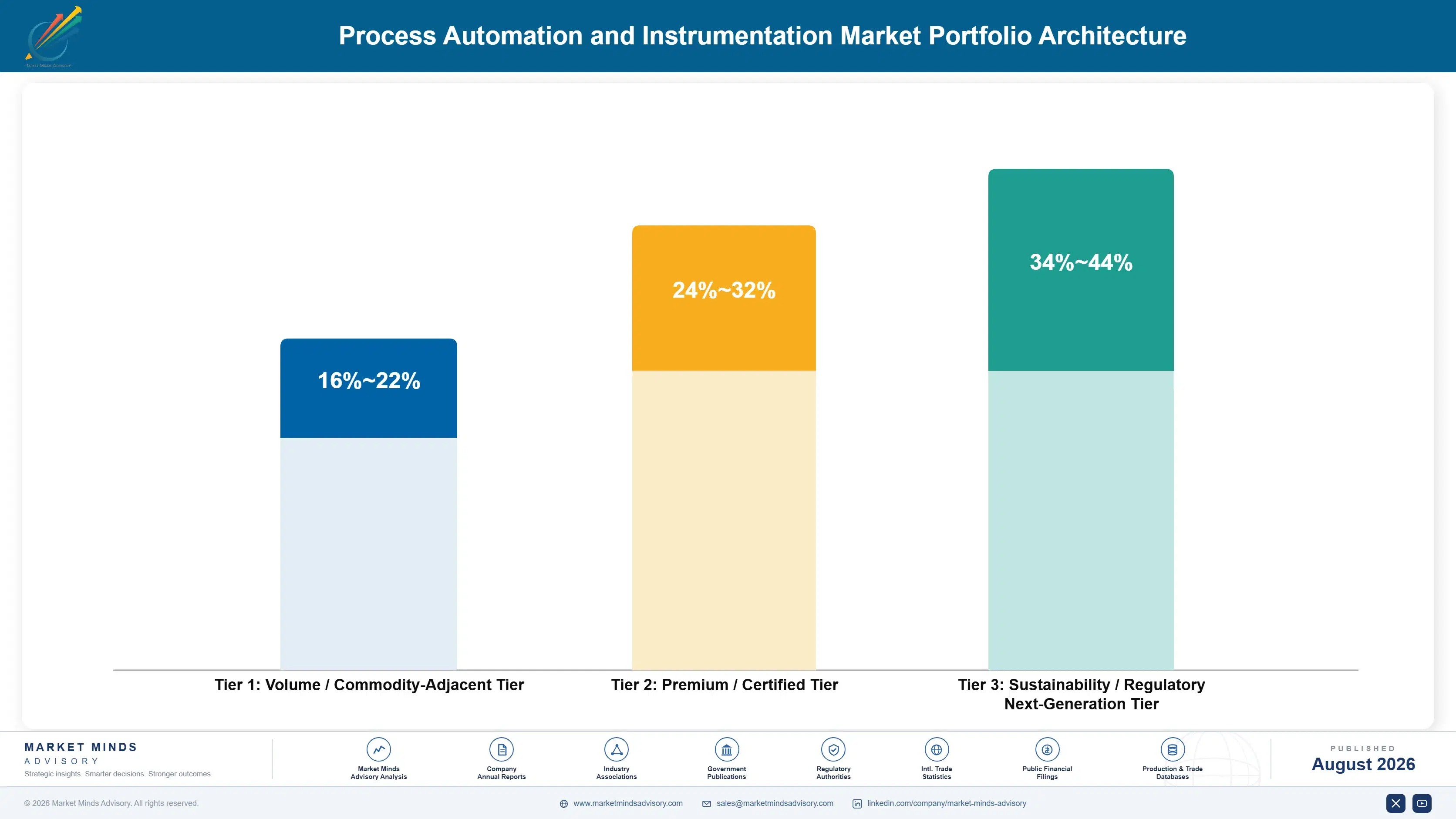
Portfolio Architecture for Margin Defence

Process automation suppliers operate across three margin tiers built around software content and compliance complexity rather than simple hardware volume. Commodity-adjacent field instrumentation and standard PLCs sit at the volume base, distributed control system hardware and core software licensing occupy the middle at meaningfully firmer margins, and cybersecurity compliance services and predictive-maintenance software platforms sit at the top, commanding premium pricing that few pure-hardwar
The volume-premium tension plays out most visibly in how suppliers allocate scarce senior engineering talent: every hour spent commissioning standard field instrumentation is an hour not spent delivering higher-margin compliance documentation or software integration work, so suppliers increasingly prioritise premium engagements even when it means outsourcing routine instrumentation installation to smaller regional integrators.

High-value margin pools concentrate in cybersecurity compliance services and industrial software platforms, both of which command pricing closer to specialised professional services economics than to commodity hardware manufacturing. Suppliers that can move a customer from standalone hardware supply into a bundled compliance-and-software relationship capture meaningfully more of total account value across the life of a multi-year customer relationship.

Volume / Commodity-Adjacent Tier

Standard field instrumentation and programmable logic controllers sold at scale into routine process monitoring applications, priced close to established manufacturing benchmarks with limited technical differentiation between qualified suppliers. Suppliers compete here mainly on price and delivery lead time.
Gross Margin: 16-22%

Premium / Certified Tier

Distributed control system hardware and core software licensing requiring extensive engineering integration and long-term reliability guarantees, commanding a defensible premium given the scale and criticality of each installation. Buyers weigh integration track record heavily in vendor selection.
Gross Margin: 24-32%

Sustainability / Regulatory / Next-Generation Tier

Cybersecurity compliance services and predictive-maintenance software platforms carrying the deepest domain expertise and engineering support, sold primarily as multi-year subscription and services relationships. Few competitors can currently match this depth of domain expertise.
Gross Margin: 34-44%
process-automation-and-instrumentation-market-portfolio-architecture-1787300043841

High-value Sub-segments and Strategic Watch-out

Cybersecurity Compliance Services

Cybersecurity compliance documentation and retrofit services carry the category's highest margins and fastest growth, driven by NIS2 and equivalent regulation forcing operators to prioritise audit-ready compliance over discretionary productivity upgrades across nearly every major process industry. Suppliers with early compliance-practice scale hold a durable pricing advantage.
Gross Margin: 34-44%

Industrial Software and Digital Twin Platforms

Industrial software platforms carry strong margins and steady growth, anchored in multi-year licensing relationships that renew predictably as operators expand digital-twin coverage across additional plant units and process areas. Operators renew software licences predictably each budget cycle, giving suppliers unusually stable multi-year revenue visibility across the portfolio.
Gross Margin: 28-36%

Standard Field Instrumentation

Routine field instrumentation replacement remains the category's volume anchor, growing steadily with overall industrial output but carrying commodity-level margins that make it a scale rather than profit driver for most suppliers. Suppliers defend this tier mainly to preserve distribution reach into future upgrade cycles across the installed base.
Gross Margin: 16-22%

Chinese Domestic Automation Vendors

Chinese suppliers including Supcon Technology and Hollysys Automation qualifying export-grade control system production represent a long-term competitive threat to established suppliers' pricing power, particularly as Chinese customers increasingly favour domestic vendors over Western incumbents. European suppliers slow to localise face mounting share loss in Asian markets.
Gross Margin: 18-26%

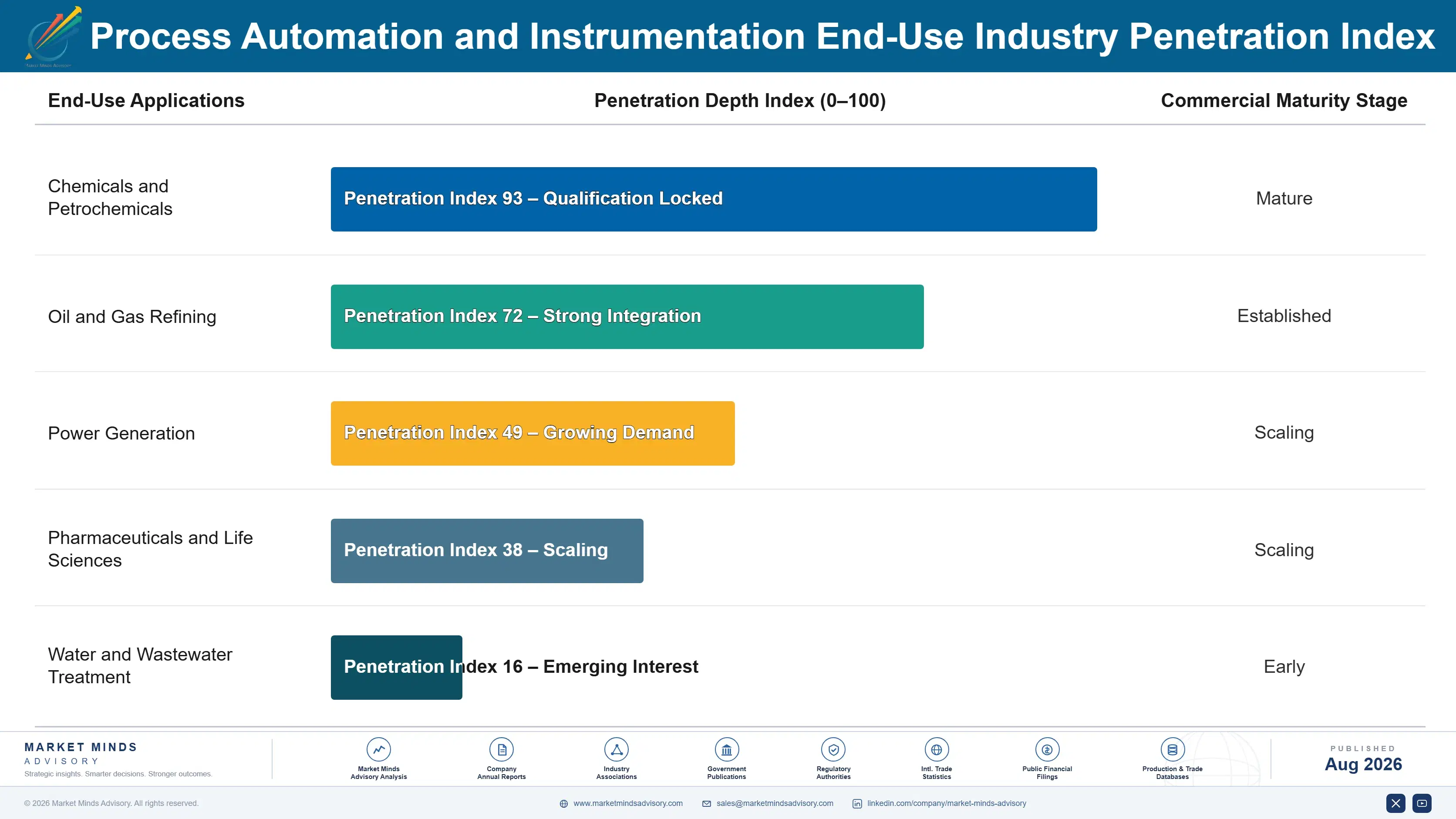
From Reliability Purchase to Compliance Mandate

Process automation purchasing is shifting from a reliability-driven, discretionary capital decision toward a compliance-mandated, recurring relationship that resembles an annuity more than a series of one-time transactions. Suppliers that embed software subscriptions and compliance services into hardware contracts lock in renewal revenue automatically, while operators increasingly budget for automation spending as a fixed compliance cost rather than an optional productivity investment they can d
Adoption depth varies sharply by process industry. Chemical and refining operators show the deepest reliance on compliance-driven purchasing, since regulatory scrutiny and insurance requirements are most acute in industries with the highest safety and environmental risk profiles. Power generation and water treatment operators show steadier but less urgent demand, often facing longer regulatory timelines that give them more flexibility in sequencing upgrades relative to chemical operators. Pharmaceutical manufacturers sit between these extremes, balancing strict quality regulation against comparatively lower cybersecurity exposure.

A generational shift among plant engineering teams is reinforcing the trend. Younger engineers trained on modern, networked control architecture expect software-first purchasing conversations, while veteran engineers accustomed to hardware-led procurement are adapting more slowly, occasionally delaying digital-twin adoption until forced by a compliance deadline or major incident elsewhere in the industry.
process-automation-and-instrumentation-market-end-use-penetration-index-1787300044340

Where MMA Sees the Real Opportunity

These are among the four positions where our research anticipates prominent divergence between winners and laggards over the coming forecast period. Each is grounded in the demand model, the regulatory perimeter, and the announced capacity pipeline.
01 / COMPLIANCE SERVICES PRIORITY

Build cybersecurity compliance services capability now

Suppliers that build dedicated cybersecurity compliance services capability now are positioned to capture the retrofit premium that NIS2 and equivalent US critical infrastructure regulation is generating across nearly every major process industry today. This positioning matters more than competing purely on hardware pricing, since documentation and compliance expertise, not equipment specifications, increasingly determine which supplier wins retrofit contracts facing imminent deadlines. MMA recommends prioritising compliance services investment over incremental hardware feature development in the current three-year window, particularly for operators serving European and North American customers.
02 / SOFTWARE BUNDLING STRATEGY

Bundle industrial software into every hardware contract

Industrial software and digital-twin platforms are growing at roughly 1.4 times the category average, and suppliers that bundle software licensing directly into hardware contracts are capturing recurring revenue that pure-hardware competitors cannot match. Suppliers still selling hardware and software as separate transactions are ceding bundled-contract share to Siemens and ABB, both of which have already restructured commercial offerings around this model. MMA views software bundling capability as the highest-return near-term investment available within the category over the next three years.
03 / GREENFIELD MARKET ACCESS

Prioritise Gulf and Asian greenfield relationships now

Greenfield petrochemical and refining capacity additions across China, India, and the Middle East are generating a steady pipeline of multi-decade customer relationships that North American and European brownfield retrofit spending cannot replicate at comparable scale or duration. Suppliers without an established Gulf or Chinese presence face a genuinely difficult path to winning this anchor business regardless of technical capability or price competitiveness. MMA recommends prioritising local engineering and manufacturing investment in these regions ahead of competitors still weighing whether to commit meaningful resources there.
04 / PREDICTIVE MAINTENANCE UPSELL

Train field teams to upsell predictive maintenance sensors

Predictive maintenance sensor retrofits carry meaningfully higher per-project revenue than standard like-for-like instrumentation replacement, yet many suppliers still treat routine field service visits as a pure maintenance cost rather than a sales opportunity worth training staff to capture. Emerson and Endress+Hauser have both demonstrated that trained field teams can identify and close meaningful incremental sensor revenue during otherwise routine visits without materially increasing service costs. MMA recommends extending this training model across the broader supplier base as a low-capital, high-return near-term revenue opportunity.

Engagement Snapshot From the Field

A live engagement with an industry participant carrying material or product regulatory and market exposure ahead of a defining policy shift, showing how our research translates into a defensible multi-year portfolio strategy.
MARKET MINDS ADVISORY · CLIENT ENGAGEMENT SUMMARY
Process Automation and Instrumentation Producer Strategic Portfolio Review and Transition Roadmap 2026·Investment Scenario on Process Automation and Instrumentation Exposure Evaluation 2025-26
CLIENT PROFILE
The client is a mid-sized specialty chemical producer operating four processing facilities across the US Gulf Coast, running distributed control systems installed between 2005 and 2012 across its plant portfolio. The company reported annual revenue in the low billions of dollars (client-reported, unverified by MMA) and faced an approaching compliance deadline under emerging US critical infrastructure cybersecurity requirements without a clear retrofit prioritisation plan.
STRATEGIC CHALLENGE
The client's ageing control systems faced compliance deadlines simultaneously across all four facilities, but limited capital and engineering resources meant a phased approach was unavoidable, requiring a defensible framework for prioritising which facility to retrofit first. Management needed a strategy that balanced compliance risk, production criticality, and available capital across a multi-year retrofit programme without disrupting ongoing operations at any single site.
MMA APPROACH
MMA's engagement team assessed cybersecurity exposure, production criticality, and existing hardware condition across all four facilities, interviewed the client's insurer to clarify compliance deadline flexibility, and modelled retrofit cost and downtime risk across three sequencing scenarios. The team recommended a risk-weighted prioritisation framework that sequenced retrofits by combined compliance exposure and production value rather than by simple chronological system age.
KEY FINDINGS
  1. The client's insurer indicated willingness to extend compliance deadlines for facilities with documented interim mitigation measures (client-reported, unverified by MMA), reducing pressure to retrofit all four sites simultaneously.
  2. The facility with the oldest control system was not the facility with the highest cybersecurity exposure, since network architecture mattered more than system age in the client's actual risk profile.
  3. Bundling software licensing into the hardware retrofit contract reduced total programme cost compared with procuring software separately after each facility's hardware upgrade.
  4. Field engineering capacity, not capital availability, was the client's binding constraint on how many facilities could be retrofitted simultaneously within the compliance window.
CLIENT PROFILE
The client is a mid-sized specialty chemical producer operating four processing facilities across the US Gulf Coast, running distributed control systems installed between 2005 and 2012 across its plant portfolio. The company reported annual revenue in the low billions of dollars (client-reported, unverified by MMA) and faced an approaching compliance deadline under emerging US critical infrastructure cybersecurity requirements without a clear retrofit prioritisation plan.
STRATEGIC CHALLENGE
The client's ageing control systems faced compliance deadlines simultaneously across all four facilities, but limited capital and engineering resources meant a phased approach was unavoidable, requiring a defensible framework for prioritising which facility to retrofit first. Management needed a strategy that balanced compliance risk, production criticality, and available capital across a multi-year retrofit programme without disrupting ongoing operations at any single site.
MMA APPROACH
MMA's engagement team assessed cybersecurity exposure, production criticality, and existing hardware condition across all four facilities, interviewed the client's insurer to clarify compliance deadline flexibility, and modelled retrofit cost and downtime risk across three sequencing scenarios. The team recommended a risk-weighted prioritisation framework that sequenced retrofits by combined compliance exposure and production value rather than by simple chronological system age.
KEY FINDINGS
  1. The client's insurer indicated willingness to extend compliance deadlines for facilities with documented interim mitigation measures (client-reported, unverified by MMA), reducing pressure to retrofit all four sites simultaneously.
  2. The facility with the oldest control system was not the facility with the highest cybersecurity exposure, since network architecture mattered more than system age in the client's actual risk profile.
  3. Bundling software licensing into the hardware retrofit contract reduced total programme cost compared with procuring software separately after each facility's hardware upgrade.
  4. Field engineering capacity, not capital availability, was the client's binding constraint on how many facilities could be retrofitted simultaneously within the compliance window.
RECOMMENDED STRATEGY
Phase 1: Phase 1 (Months 1 to 6): Retrofit the highest cybersecurity-exposure facility first, securing insurer-documented interim mitigation for the remaining three sites. Phase 2: Phase 2 (Months 7 to 18): Sequence the remaining three retrofits by combined production value and exposure, bundling software licensing into each hardware contract. Phase 3: Phase 3 (Months 19 to 30): Complete the final facility retrofit and consolidate all four sites onto a unified software and compliance documentation platform.
OUTCOME
Following the engagement, the client reported completing its four-facility retrofit programme within the extended compliance window while avoiding the capital and engineering strain of simultaneous retrofits (client-reported, unverified by MMA). Bundled software licensing reduced total programme cost relative to the client's original separate-procurement budget, and the unified compliance documentation platform simplified ongoing insurer reporting across all four sites.

Frequently Asked Questions

Foundational context covering the market sizes, CAGR, scope, country, region and competition that inform every finding below. This section is provided to cover basics and most often pre-purchase conversations, answered from the MMA Primary Research Dataset.

What is the current size of the Process Automation and Instrumentation Market?

The global process automation and instrumentation market reached approximately $73.2 billion in 2026. Demand is concentrated in cybersecurity-driven retrofits and greenfield petrochemical capacity additions, with East Asia the largest regional contributor.

How large will the Process Automation and Instrumentation Market be by 2036?

MMA projects the market will reach approximately $141.3 billion by 2036. That represents nearly a doubling of 2026 revenue across the ten-year forecast period, driven largely by cybersecurity retrofit spending.

What is the CAGR for the Process Automation and Instrumentation Market 2026 to 2036?

The base case compound annual growth rate is 6.8 percent. Bull and bear scenarios range from roughly 5.5 percent to 8.1 percent depending on regulatory and capital spending developments.

Which segment is growing fastest?

Manufacturing execution systems and industrial software are growing fastest, at roughly 1.4 times the overall market rate. Digital-twin and predictive-maintenance programmes are driving that outperformance.

Who are the major companies in the Process Automation and Instrumentation Market?

Honeywell, Emerson Electric, ABB, Siemens, and Schneider Electric lead the market. Together they hold roughly 52 percent of global process automation revenue, built on decades of proprietary control system architecture.

Which country is growing fastest?

China is the fastest-growing major market, driven by petrochemical and refining capacity additions that outpace the rest of the world combined. Its process automation demand is expanding at roughly 10.2 percent annually.

Report Segmentation Architecture

The full report scope spans multiple orthogonal segmentation dimensions, with cross-tabulated demand data provided for each dimension pair. Coverage extends further to regional breakdowns, trend trajectories, and the competitive detail needed to support segment-level decision-making.

By System Type

  • Distributed Control Systems
  • Programmable Logic Controllers
  • SCADA and Supervisory Software
  • Field Instrumentation
  • Industrial Safety and Asset Performance Management
  • Manufacturing Execution Systems and Industrial Software

By End-Use Industry

  • Chemicals and Petrochemicals
  • Oil and Gas Refining
  • Power Generation
  • Pharmaceuticals and Life Sciences
  • Water and Wastewater Treatment

By Commercial Dimension

  • Hardware-Only Supply
  • Bundled Hardware and Software Contracts
  • Compliance and Retrofit Services
  • Long-Term Maintenance and Subscription Agreements

By Region

  • North America
  • Western Europe
  • East Asia
  • South Asia and Pacific
  • Latin America
  • Middle East and Africa
  • Eastern Europe

Scope, Methodology, and Coverage

Every figure in this report is reproducible from documented input assumptions. The scope below maps the historical period, the forecast horizon, the segmentation dimensions, and the countries covered, alongside the underlying primary and qualitative methodology.
Historical Period
2020 to 2025
Forecast Period
2026 to 2036
Base Year
2025 (USD billions; MMA Primary Research Dataset, August 2026)
Market Definition
The process automation and instrumentation market covers distributed control systems, programmable logic controllers, SCADA software, field instrumentation, industrial safety systems, and manufacturing execution software used to monitor and control continuous and batch industrial processes. It excludes discrete manufacturing robotics, building automation systems, and standalone industrial IT infrastructure sold outside a process control context.
Quantitative Units
USD billions (current prices); installed control loop count where applicable
Segmentation Dimensions
By System Type; By End-Use Industry; By Commercial Dimension; By Region
Regions Covered
North America, Western Europe, East Asia, South Asia and Pacific, Latin America, Middle East and Africa, Eastern Europe
Countries Covered
USA, China, Germany, France, UK, Japan, South Korea, India, Australia, Canada, Brazil, Mexico, Indonesia, Vietnam, Thailand, Malaysia, UAE, Saudi Arabia, South Africa, Nigeria, Turkey, Poland, Netherlands, Italy, Spain, Sweden, Switzerland, Argentina, Colombia, Singapore, and additional markets relevant to this sector
Key Companies Profiled
Honeywell, Emerson Electric, ABB, Siemens, Schneider Electric, Yokogawa Electric, Rockwell Automation, Mitsubishi Electric, Endress+Hauser, Azbil Corporation, Omron Corporation, KROHNE Group, Yaskawa Electric, WIKA, VEGA Grieshaber, Metso, AMETEK, Fortive, Hollysys Automation, Supcon Technology
Quantitative Methodology
Primary survey, n=3,800 respondents, Q4 2025, six countries; demand-side model with trade association cross-validation
Qualitative Methodology
47 expert interviews, Q4 2025; applied to validate demand model assumptions, identify emerging dynamics, and assess competitive positioning
Report Format
PDF and XLSX data workbook (Word format preview document)
Publisher
Market Minds Advisory
Report Code
MMA-2026-CON-142
Published
August 2026
Contact
sales@marketmindsadvisory.com | www.marketmindsadvisory.com

Purchase the full Process Automation and Instrumentation Market Report (2026 to 2036).

The full report delivers a complete quantitative and qualitative assessment of the global process automation and instrumentation market across all seven regions. It includes detailed country-level sizing for the fifteen largest chemical, refining, and power-generation markets, full profiles of all twenty companies named in the competitive landscape, and a complete database of corporate developments tracked over the trailing eighteen months. Analysts provide segment-by-segment margin benchmarking derived from primary interviews with forty-seven industrial automation experts, alongside a cybersecurity regulation tracker covering major compliance jurisdictions. Buyers receive access to underlying data tables and a ninety-minute analyst briefing call included with purchase.
Country-level sizing for fifteen major producing markets
Full profiles of all twenty companies profiled
Cybersecurity regulation tracker across major jurisdictions
Segment-level margin benchmarking from primary expert interviews
Eighteen-month corporate development and contract tracking database
Ninety-minute analyst briefing call included with purchase

Built For The People Who Decide

From boardroom strategy to bench-side execution, this report is read cover-to-cover by leaders shaping the next decade of their industry, turning demand scenarios, market dynamics and valuation benchmarks into decisions.
CXOs/ Presidents/ VPs/ Managers
M&A and Corporate Development
Strategy Teams and R&D Heads
Procurement and Product Directors
Regulatory and Compliance Leaders
Investor Relations and Equity Analysts