Market Minds Advisory
Probiotic Yogurt Market

Probiotic Yogurt Market: Strain-Specific Evidence, Cold Chain Viability and the Retreat From Generic Gut Health Claims

European regulators stripped generic gut health wording from labels and the category responded by buying documented strains instead, turning culture licensing into the most defensible position in a business otherwise ruled by milk price.

Lead Analyst

Lisa Gevelber

Published

September 2026

Make Smarter Decisions with Customized Research Insights

Request a free sample report and evaluate market opportunities, growth trends, and competitive dynamics relevant to your business needs.

2025 MARKET VALUE$48.0BMarket Size 2025
2036 FORECAST VALUE$89.2BBase Case , 2026 to 2036
CAGR 2026 TO 20365.8 %Bull 6.9% / Bear 4.6%
INCREMENTAL OPPORTUNITY$38.5BNet 10- year value creation
EXPANSION MULTIPLE1.76x2036 value over 2026 base
Strategic Levers
M&A Pipeline
Regional Outlook
Country Rankings
Competitive Intelligence
Segmental Deep-dive
Call-Us : 91 93563 13602

Executive Snapshot and Market Trajectory

European regulators removed generic gut health wording from yogurt labels and the category adapted rather than shrank. It went and bought documented strains instead, which turned culture licensing into the most defensible position in an otherwise commodity business. Nobody planned it that way, but it has worked out rather well.
Strain-documented products carry the growth because a named organism with its own clinical file supports pricing that generic cultures cannot. High-protein strained formats grow nearly as fast on protein positioning where probiotic content has become an expectation rather than the reason for purchase. East Asia holds the largest share on Chinese ambient drinking yogurt volume and on Japanese daily-dose habits that no Western market matches.
Concentration reads at 37% for the top five, which understates real power because a handful of culture houses hold the documented strains that everybody's premium products depend on. Raw milk cost dominates manufactured cost and moves independently of anything a brand does, so the commercial contest is fought over strain access, cold chain reach and shelf position rather than over formulation skill. Culture houses upstream hold more of it than any brand does.
Market Definition
This market covers yogurt products containing live probiotic cultures, spanning clinically documented strain yogurts, high-protein strained formats, drinking and ambient shelf-stable yogurts, plant-based cultured alternatives, and children's probiotic formats. Non-cultured dairy desserts, fermented milk drinks sold as supplements in dose formats, cheese and kefir, and probiotic supplements in capsule or sachet form are excluded from the sizing.
Base Year Value
$48.0B in 2025 (MMA Primary Research Dataset, August 2026)
Forecast Period
2026 to 2036, eleven discrete annual values
CAGR
5.8% base case. Bull 6.9%. Bear 4.6%.
Fastest Growth Segment
Clinically Documented Strain Yogurts: 8.7% CAGR
Fastest Growth Country
India: 9.6% CAGR
Fastest Growth Region
South Asia and Pacific: 8.0% CAGR
Largest Region
East Asia: 30% of 2025 global value
Market Leaders
Danone, Yakult Honsha, Nestlé, Yili Group and Lactalis lead on probiotic yogurt retail value. Source: MMA Primary Research Dataset, July 2026.
Primary Survey
n=3,800 procurement and R&D decision-makers, Q4 2025, six countries
Methodology
Demand-side build-up, cross-validated against public data, 47 expert interviews

Probiotic Yogurt Market Forecast Scenarios

probiotic-yogurt-market-trends-size-forecast-scenario-1787335767392
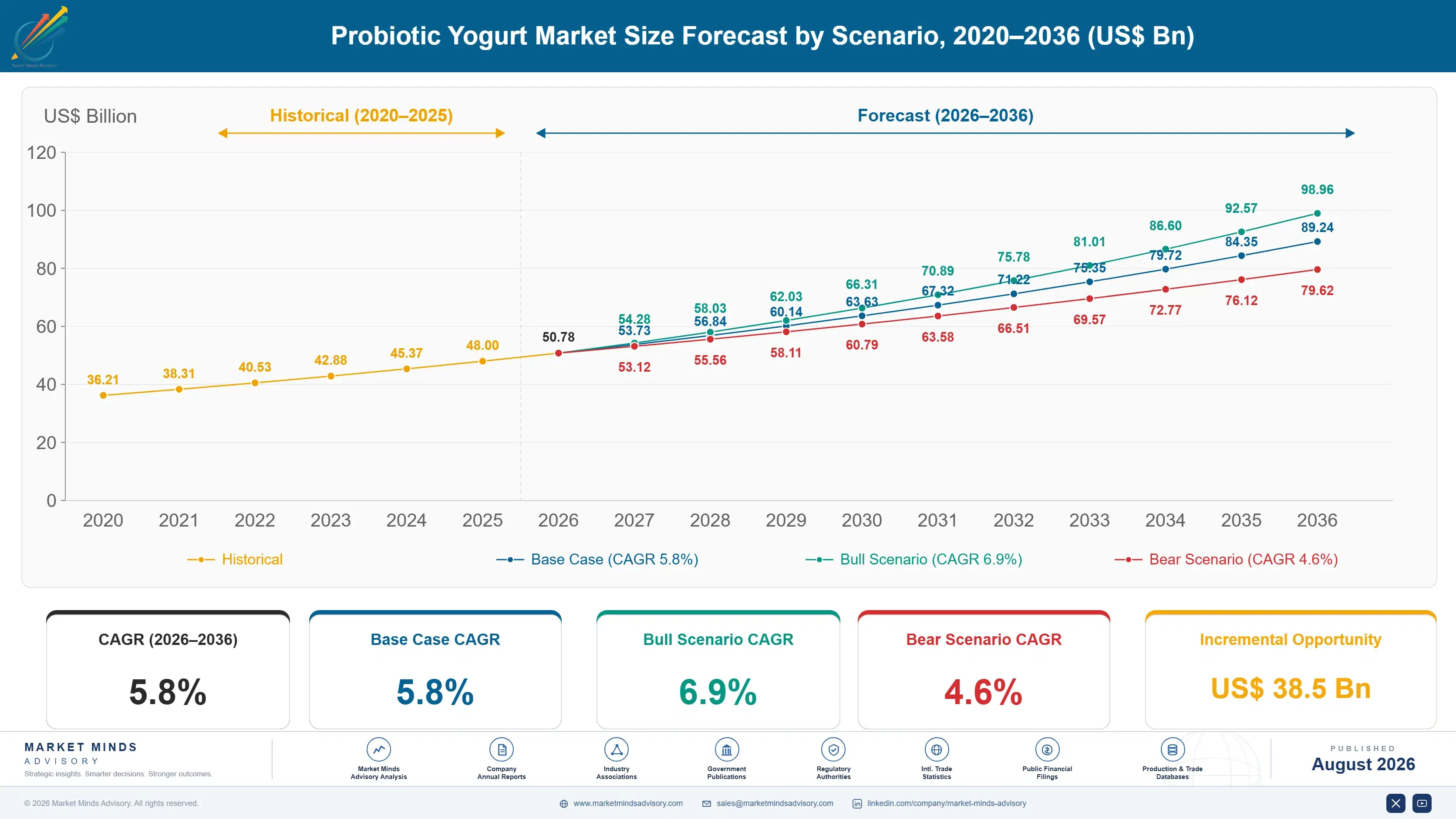
Growth ran at 4.9% annually between 2020 and 2025, and two forces pulled in opposite directions throughout. Raw milk inflation lifted value while pressuring volume, particularly across Europe where retail resistance to price increases was strongest. Meanwhile the shift toward documented strains and high-protein formats raised realised price per kilogram considerably, which carried value growth even where tonnage barely moved at all.
The base case at 5.8% rests on three mechanisms. Strain documentation keeps migrating from premium into mainstream ranges as clinical files accumulate and licensing terms become more accessible to mid-tier brands. High-protein strained formats continue taking share from set yogurt on positioning that needs no regulatory permission. And Indian and Southeast Asian volume grows on cold chain extension into markets where refrigerated distribution has only recently become reliable enough to support the category.
The bull case at 6.9% turns on new strain-specific claim approvals in Europe, which would restore label language the category lost and reopen premium positioning across mainstream ranges. The bear case at 4.6% reflects sustained raw milk inflation combined with retail resistance, since yogurt competes for shelf against categories that absorb input cost more comfortably than dairy does.

Strain Access Beats Formulation Skill Here

Two things determine whether a probiotic yogurt business earns anything worth having, and neither is the yogurt. The first is access to a strain with a clinical file behind it. The second is raw milk cost, which runs above half of manufactured cost and moves on dairy markets that pay no attention whatsoever to what a brand is trying to do with its positioning.
TOP FIVE CONCENTRATION37%Moderate at brand level, considerably higher in culture supply
RAW MILK COST SHARE53% of COGSMilk contribution to finished product manufactured cost typically
DOCUMENTED STRAIN PREMIUM34%Price advantage of named clinical strains over generic cultures
COLD CHAIN SHELF LIFE32 daysTypical refrigerated shelf life maintaining declared culture viability
AMBIENT FORMAT SHARE21%Portion of volume in shelf-stable and ambient drinking formats
PRIVATE LABEL SHARE29%Retailer own-brand portion of total category retail value
Strain access is where the real concentration sits. Brand-level concentration reads at 37%, which looks unremarkable, but the documented organisms underpinning premium products across the whole category come from a handful of culture houses. A brand without licensed access to a documented strain is selling generic culture into a market where regulators removed the generic claim language, which is a difficult position to hold at premium pricing.
Private label deserves attention because it behaves differently here than in most food categories. Retailer own-brand takes roughly 29% of value, and retailers have learned they can license documented strains too. That removes the last technical defence a mid-tier brand had, and it explains why brand investment has moved toward proprietary strain development and exclusive licensing rather than toward advertising the category once relied on.
"The interesting negotiation in this category is not with the retailer. It is with the culture house that decides whether your competitor gets the same strain you just built a launch around."
Director, Dairy and Fermented Foods Practice · MMA Food and Beverage Practice · August 2026

Market Trends

Documented Strains Replace Generic Culture Claims Across Ranges

European authorities removed generic gut health wording from yogurt labels, and the category responded by licensing named strains carrying their own published human trial evidence. That evidence is strain-specific rather than genus-level, which is precisely why it survived scrutiny that broader claims did not. Documented strain products command roughly 34% price premiums over generic cultures and give retailers a reason to list at that price. Strain licensing has become a genuine business, with a handful of culture houses holding the organisms everyone's premium range now depends on. Access is now a negotiation, not a purchase.
Market Impact: Strained formats grow at 7.4%
Ambient Formats Extend Reach Beyond Cold Chain Limits

Refrigerated distribution is the binding constraint on this category across large parts of Asia, Latin America and Africa, and ambient shelf-stable drinking formats remove it entirely. The trade is real: heat treatment after fermentation kills the live cultures, so ambient products either carry different claims or use spore-forming organisms that survive processing. Roughly 21% of volume now sits in ambient and shelf-stable formats, and that share rises fastest exactly where refrigerated retail is least developed and reach matters most. Distribution reach rather than product preference is what decides the format here.
Market Impact: India grows at 9.6% annually

Market Opportunities and Growth Drivers

High-Protein Positioning Sells Without Regulatory Permission

Protein content is a nutrition declaration rather than a health claim, which means it can be stated plainly on pack while gut health wording cannot. That single asymmetry has driven the strained format from Greek-style speciality into a category of its own across every developed market. Consumers buying protein accept pricing that set yogurt never supported, and probiotic content arrives as an expectation rather than as the purchase reason. The format now grows at 7.4% annually against a category growing considerably slower. No regulator has to approve a protein number on a pack.
Market Impact: Milk is 53% of manufactured cost

Cold Chain Extension Opens Indian And Southeast Asian Volume

Refrigerated retail distribution has become reliable enough across Indian tier two cities and Southeast Asian urban markets to support fresh yogurt properly, which was simply not true a decade ago. Indian volume now grows near 9.6% annually as organised retail expands and domestic dairies build chilled distribution alongside it. Traditional home fermentation remains widespread and is the real competitor rather than another brand. Packaged product wins on convenience and consistency rather than on any nutritional argument. Domestic dairies are building chilled distribution alongside the organised retail expansion itself rather than waiting for it.
Market Impact: Shelf life capped near 32 days

Market Restraints and Challenges

Raw Milk Volatility Dominates Manufactured Cost Entirely

Raw milk runs above half of manufactured cost and prices on dairy markets driven by herd cycles, feed costs and export demand that have nothing to do with yogurt. The root cause is that milk cannot be stored or hedged the way grains and oils can, so processors absorb volatility that other food manufacturers pass into futures markets. Commercially this compresses margin whenever retail resists price increases. Participants are responding with multi-year farmer contracts, whey valorisation, and format mix shifts toward products carrying lower milk content per unit. Futures markets simply do not exist here.
Market Impact: Commands 34% premium over generic

Culture Viability Limits Shelf Life And Distribution Reach

Declared live culture counts must hold through refrigerated shelf life, and organisms decline steadily from the moment fermentation stops. The root cause is biological rather than technical, and no packaging or formulation change fully arrests it. Commercially this caps shelf life near 32 days, restricts distribution radius, and forces overdosing at fill to guarantee the count at expiry. Participants are responding with more stable strain selection, protective packaging atmospheres, and ambient spore-forming formats that trade live dairy culture for genuine distribution reach. Overdosing at fill is an accepted cost of doing business.
Market Impact: Ambient formats hold 21% of volume
3 additional market trends, 4 additional growth drivers, and 2 additional restraints and challenges are covered in the full report. Contact sales@marketmindsadvisory.com to access the complete intelligence.

Segment CAGR and Growth Architecture

Five product formats divide this market on how the yogurt is made and sold rather than on the benefit it claims. Claimed benefits overlap almost completely across the category while formats differ sharply in milk content per unit, cold chain requirement, pricing power and the regulatory language each is permitted to carry on pack.
probiotic-yogurt-market-trends-market-share-analysis-1787335767927

Clinically Documented Strain Yogurts

Growing at 8.7% and the fastest part of this market. These are yogurts carrying named strains with published human trial evidence, sold on a specific functional benefit rather than on general gut health suggestion. The commercial argument is straightforward: a strain with its own clinical file supports pricing and claim language that a generic culture cannot, and it gives retailers a reason to list at a premium that promotion alone never provides. Strain licensing has become a real business in its own right, with a handful of culture houses holding the documented organisms everybody wants. What constrains the segment is that the evidence must be strain-specific, and genus-level claims have been steadily removed from labels across Europe.
CAGR 8.7%

High-Protein Strained Yogurts

Growing at 7.4% on high-protein strained yogurts carrying live cultures, a format that arrived as a Greek-style speciality and became a category of its own. Protein content is what sells it, and probiotic content increasingly comes as an expectation rather than as the reason for purchase, which is a genuinely different commercial position from the functional segment. Straining removes whey and concentrates solids, which raises milk input per unit considerably and makes the format exposed to raw milk pricing in ways set yogurt is not. Whey disposal or valorisation is a real cost line. Retail pricing has held better than most dairy categories through recent input inflation. Milk input per unit is the real constraint.
CAGR 7.4%
Full segment breakdown across 5 segments available in the complete report.

Regional Architecture and Country Demand Map

East Asia holds 30% of global value on Chinese ambient drinking yogurt volume and Japanese daily-dose habits no Western market matches. Western Europe follows at 24% on per-capita consumption, while South Asia and Pacific grows fastest as cold chain distribution reaches tier two cities. Volume growth sits mostly in Asia.

East Asia

Chinese ambient drinking yogurt is the single largest volume position anywhere in this category and it exists because refrigerated retail could not reach most of the country when the format took off. Heat treatment after fermentation made national distribution possible, and Yili and Mengniu built enormous businesses on exactly that. Japanese demand runs on daily-dose habits that have no Western parallel, with Yakult's distribution model reaching households directly through a sales force rather than through retail. Korean consumption is smaller and heavily weighted toward drinking formats. Documented strain positioning is well established across all three markets and consumers genuinely read strain names on pack. Strain names genuinely influence purchase in these markets.
Share: 30% | CAGR: 6.8% (2026 to 2036)

Western Europe

Per-capita consumption here is the highest in the world and the category is entirely mature, which makes value growth a function of format mix rather than volume. European Food Safety Authority rejection of generic gut health claims reshaped labelling across the whole region and pushed brands toward documented strains and protein positioning instead. France and Germany carry the largest volumes, with French consumers particularly attached to set yogurt formats. Private label penetration is high and rising, and retailers have learned to license documented strains themselves. Raw milk pricing under European dairy market conditions moves processor margins more than any commercial decision a brand makes. Value growth is a format question rather than a volume one.
Share: 24% | CAGR: 4.3% (2026 to 2036)
Regional intelligence for 5 additional markets available in the complete report: North America, South Asia and Pacific, Latin America, Middle East and Africa, Eastern Europe. Contact sales@marketmindsadvisory.com.
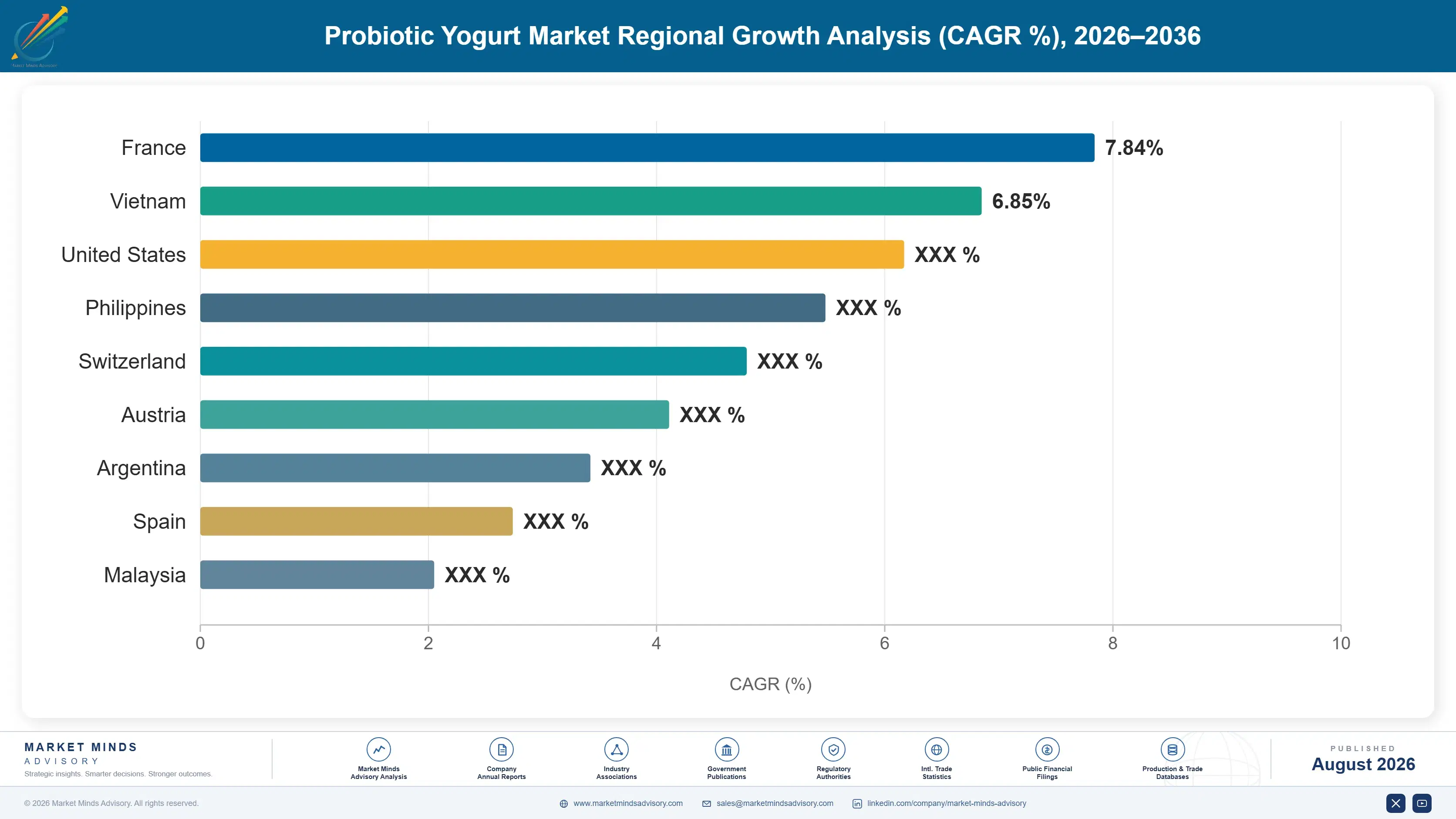
probiotic-yogurt-market-trends-country-cagr-analysis-1787335768449

Where Probiotic Yogurt Margin Is Won

Four positions separate brands earning premium returns from those competing on promotion against private label: securing exclusive documented strain access, shifting mix toward high-protein formats, extending reach through ambient formats, and contracting raw milk on terms that survive a bad dairy year without margin collapse. Only the first of those is genuinely hard to copy.

Secure Exclusive Access To Documented Clinical Strains

A named strain with published human trial evidence supports roughly 34% price premiums over generic culture and gives retailers a listing reason that promotion never provides. The organisms sit with a handful of culture houses who will license to anybody, including the retailer's own private label supplier, unless exclusivity is negotiated and paid for. Exclusive terms typically cost 3% to 5% of the affected revenue line. That is cheap against watching the same strain appear opposite you at a lower price. Access to a strain is not the same thing as exclusivity.
Market Impact: Protects a shelf pricing premium of roughly 34%

Shift Format Mix Toward High-Protein Strained Products

Protein content is a nutrition declaration rather than a health claim, so it can be stated plainly on pack while gut health wording cannot, and consumers respond directly to the number. Strained formats support pricing set yogurt has never sustained and grow at 7.4% annually against a considerably slower category. The offsetting cost is milk input per unit, which rises materially with straining, so the mix shift only pays where retail pricing holds. It generally has. Retail buyers list protein products without requiring any claim substantiation at all from the brand.
Market Impact: Strained format volume grows at 7.4% each year

Extend Reach Through Ambient And Drinking Formats

Refrigerated distribution is the binding constraint across large parts of Asia, Africa and Latin America, and ambient shelf-stable formats remove it entirely rather than merely easing it. Roughly 21% of global volume already sits in ambient and drinking products, and the share rises fastest exactly where cold chain is weakest. Distribution radius expands by a factor of three or more once refrigeration is not required. The trade is live culture content, which changes what the pack can honestly claim. Heat treated product and spore-forming culture are two genuinely different propositions on the shelf.
Market Impact: Expands distribution radius by more than 3 times

Contract Raw Milk To Survive A Bad Year

Milk runs above half of manufactured cost and cannot be hedged the way grains and oils can, so processors absorb volatility that other food manufacturers pass into futures markets. Multi-year farmer contracts with formula pricing smooth roughly 40% of the swing and secure supply during the tight periods that follow every herd contraction. The commitment carries volume risk when demand softens, which is the honest cost of predictability in a category with no financial hedge available. Farmers gain the planning certainty they need to hold herd size, which is why the terms are available at all.
Market Impact: Smooths roughly 40% of the raw milk swing

Who Controls the Margin Pool

Concentration reads at 37% for the top five measured on probiotic yogurt retail value, the basis used throughout this section, and it understates where power actually sits. Danone and Yakult built the category on documented strains decades before anybody else took the evidence seriously. Nestlé, Yili and Lactalis bring processing scale. Culture houses upstream hold more leverage over premium positioning than any of them.
Competition runs on three fronts. Strain access is the first and increasingly the decisive one, since a documented organism is the only technical defence left against private label. Format development is the second, with high-protein and ambient products both taking share. Cold chain reach is the third, and it determines which geographies a fresh product can serve at all. None of the three is about advertising weight.

Pressure arrives from two directions. Retailers now license documented strains for their own private label, removing the last technical gap between brand and own-label product. Separately, plant-based cultured alternatives are taking shelf space in developed markets, though from a small base. Rankings will shift toward brands holding exclusive strain access and ambient capability rather than those competing on advertising weight.
probiotic-yogurt-market-trends-company-positioning-matrix-1787335768970

Competitive Moat and Risk Dimensions

DANONE

Moat: Strain portfolio and evidence

A proprietary strain collection built over decades, supported by published human trial work the company funded long before regulators required it, gives the group claim positions competitors must license or reproduce from scratch. Global processing scale across fresh dairy also supports cold chain reach in markets where distribution rather than product quality decides who can compete at all.
DANONE

Risk: European claim regulation exposure

A large share of value sits in European markets where generic gut health claims were removed and where private label penetration keeps rising as retailers license documented strains themselves. Raw milk cost across the European dairy complex also moves margin in ways that brand strength does not offset, particularly when retail resists passing increases through.
YAKULT HONSHA

Moat: Direct household distribution model

A sales force delivering directly to households rather than through retail creates a customer relationship no shelf position replicates, removes retailer margin entirely and produces repeat purchase rates that retail-distributed products never reach. Decades of published work on a single documented strain also give the brand claim positions built on evidence rather than on marketing assertion.
YAKULT HONSHA

Risk: Narrow format and geography

Concentration in a single small-format drinking product and heavy weighting toward Japan and a few Asian markets leaves the business exposed to demographic decline in its core geography. The direct distribution model also scales poorly into markets where household delivery economics do not work, which is most of Europe and North America.

Players Tracked

Prominent Players

Danone
Yakult Honsha
Nestlé
Yili Group
Lactalis

Other Key Players

General Mills
Chobani
Mengniu Dairy
Meiji Holdings
Morinaga Milk Industry
FrieslandCampina
Arla Foods
MĂĽller Group
Fage International
Amul
Britannia Industries
Grupo Lala
Almarai
Chr. Hansen
Sacco System

Recent Developments

JANUARY 2025

Exclusive strain licence signed covering European retail ranges

A dairy brand signed an exclusive licence covering a clinically documented strain across European retail, removing the organism from competitor and private label availability in those markets and converting what had been an open ingredient into a defensible position for the term. The term runs five years.
Signal: Strain exclusivity is becoming the technical defence that formulation skill no longer provides against private label
MAY 2025

Ambient drinking yogurt capacity commissioned for Southeast Asian markets

A regional dairy processor commissioned ambient drinking yogurt capacity aimed at Southeast Asian distribution beyond reliable cold chain, trading live culture content for a distribution radius that refrigerated product cannot reach at any acceptable cost. Output is aimed at markets sitting well beyond reliable refrigeration entirely.
Signal: Ambient capability is a distribution decision rather than a product decision in cold chain limited markets
SEPTEMBER 2025

Retailer launches private label range on licensed documented strain

A European grocery retailer launched a private label probiotic range built on a licensed clinically documented strain, matching the technical position of branded competitors at considerably lower shelf pricing and closing the evidence gap that had justified the brand premium. Branded volume in the account fell immediately.
Signal: Retailers licensing documented strains removes the last technical argument supporting a mainstream brand premium at shelf

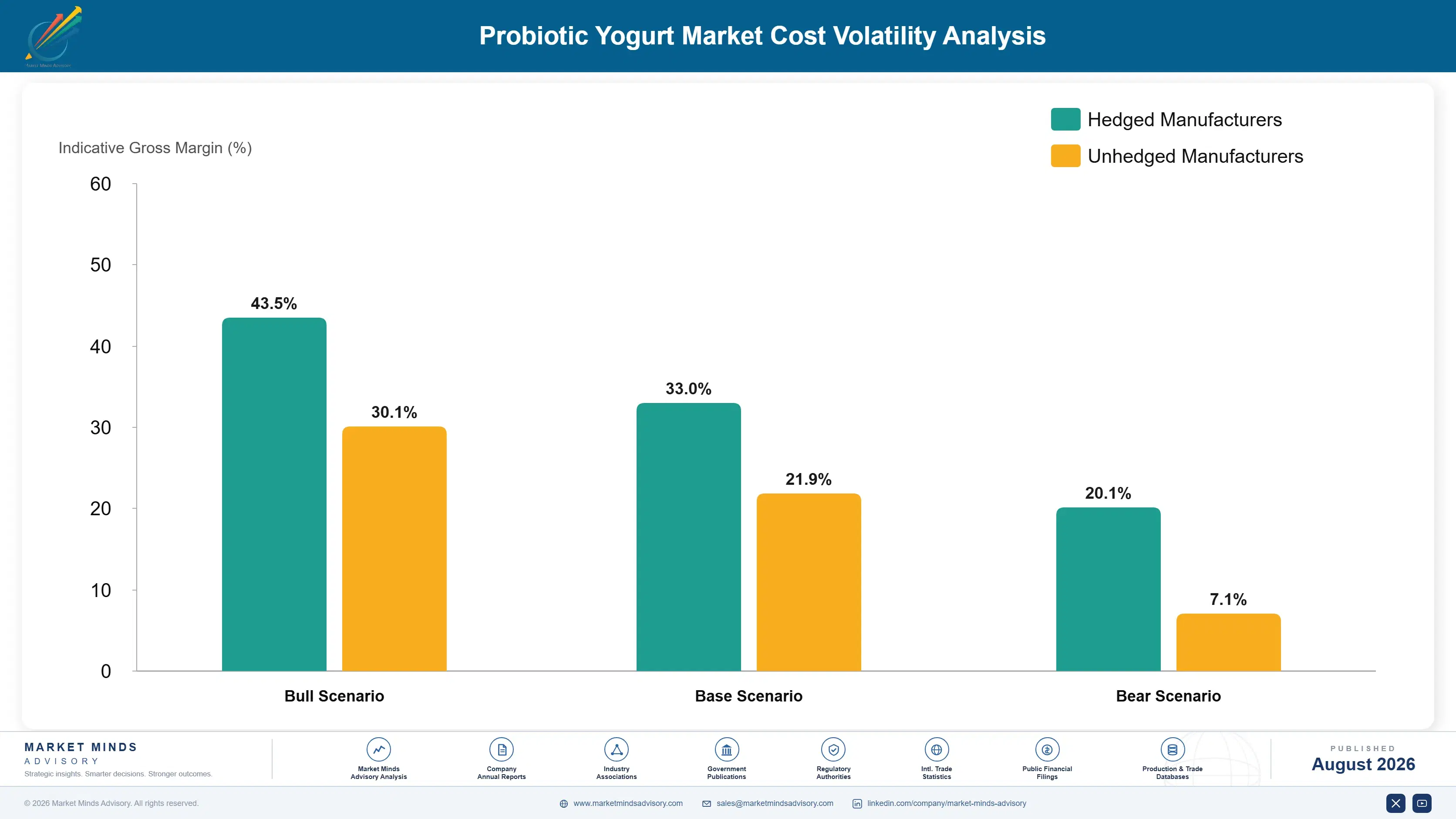
What Drives Yogurt Manufactured Cost

Raw milk accounts for roughly 53% of manufactured cost and dominates everything else, with the share running higher still in strained formats where whey removal concentrates solids. Packaging contributes around 14%, mostly polypropylene pots and film lidding. Cultures and strain licensing add about 6%, small in cost and decisive in positioning. Energy for pasteurisation and chilling reaches roughly 9%, cold chain distribution close to 11%.
European and North American raw milk pricing swung sharply through 2022 and 2023 on feed cost inflation and herd contraction, with United States Department of Agriculture data showing farmgate prices well outside their historical range. Processors absorbed much of it where retail resisted increases. Energy costs for chilling rose across the same period, according to International Energy Agency data, compounding pressure on a category that cannot avoid it.

The disadvantage mechanism is that milk cannot be hedged, and every processor carries it regardless of size. Grain and oil buyers hedge into futures markets; dairy processors carry it. Exposure varies by contract structure rather than size, since processors holding multi-year formula-priced agreements smooth roughly 40% of the swing while spot buyers absorb all of it, and by format, since strained products carry more milk per unit.
probiotic-yogurt-market-trends-cost-volatility-analysis-1787335769166

Contract farmgate supply on multi-year formula pricing

Multi-year agreements with formula pricing smooth roughly 40% of raw milk volatility and secure supply through the tight periods that follow every herd contraction, which processors underestimate until it happens. Farmers gain the planning certainty they need to hold herd size. The commitment carries volume risk when demand softens, and that risk is the genuine price of predictability here.

Valorise whey rather than paying for its disposal

Straining concentrates solids and produces whey volumes that cost money to dispose of, and every strained product makes that line larger. Processing whey into protein concentrate, permeate or feed converts a disposal cost into revenue. The capital required is significant and only pays above a volume threshold, which is why smaller processors keep paying to have it removed.

Shift mix toward formats carrying less milk per unit

Drinking and ambient formats use considerably less milk per unit of retail value than strained products do, which reduces exposure to farmgate volatility without giving up volume. Mix management is the fastest available response when milk prices move sharply. The limit is consumer preference, since formats are not interchangeable and shifting toward the cheaper one only works where demand exists.

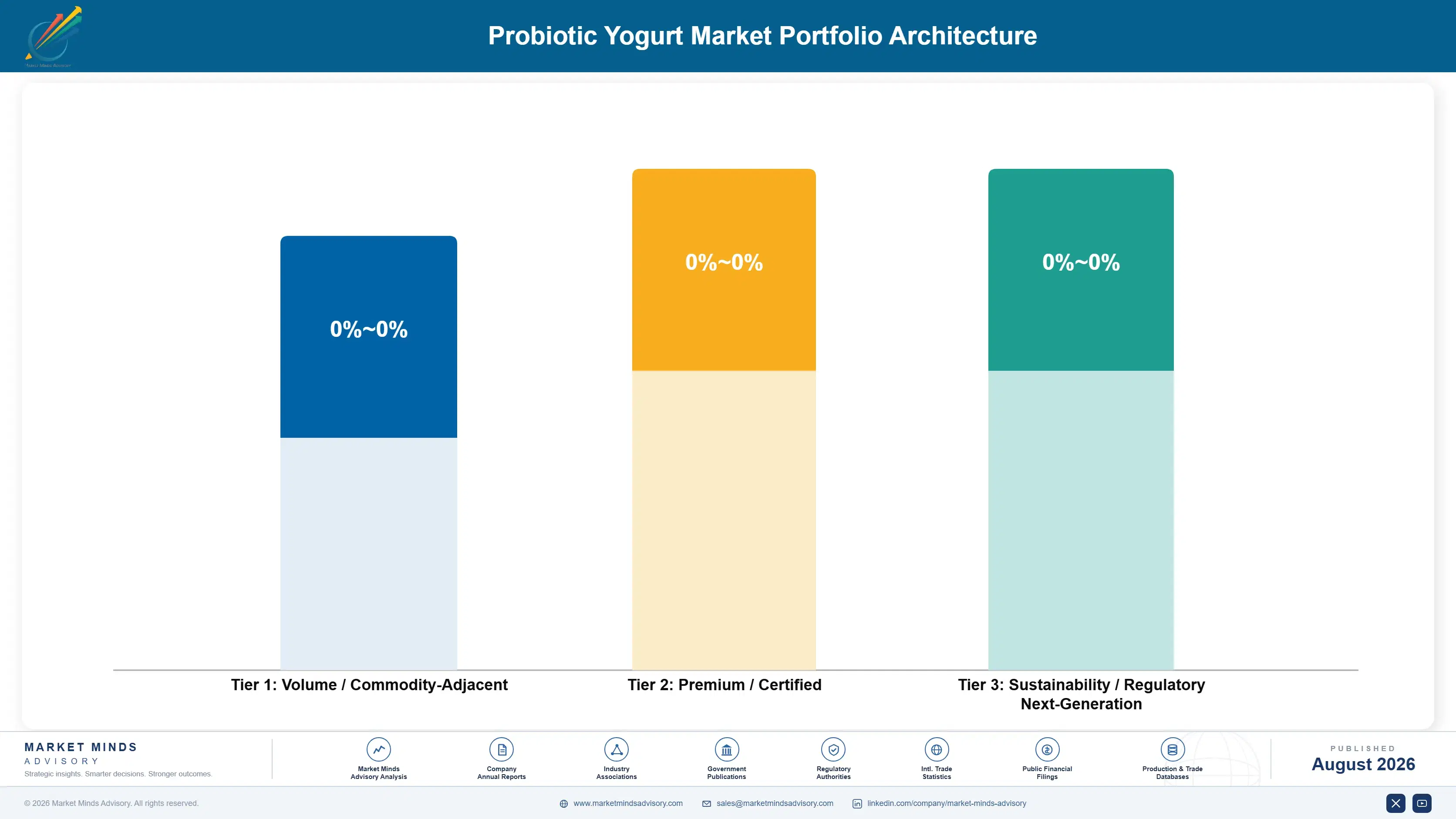
Portfolio Architecture for Margin Defence

Portfolio economics here divide on claim position and format rather than on brand strength. Generic culture set yogurt sold against private label is the weakest position in the category, since the regulator removed the claim language and the retailer can license the same organisms anyway, leaving promotional depth as the only remaining argument. Advertising weight no longer moves a retail listing decision at all.
The middle tier is high-protein strained product. Protein is a nutrition declaration statable plainly on pack while gut health wording is not, and consumers accept pricing set yogurt never sustained. Milk input per unit rises materially with straining, so the margin depends on holding that retail price. It generally has held, and margins reach the mid twenties. Milk input is the whole risk here.

Above both sits exclusively licensed documented strain product. A named organism with published human evidence supports roughly 34% premiums and, where exclusivity is secured, cannot appear opposite you under a retailer label. Margins reach the high thirties. The position requires licensing negotiation and a willingness to pay for exclusivity rather than accept open access, which is exactly where most mid-tier brands have quietly given ground.

Volume / Commodity-Adjacent

Generic culture set yogurt competing directly against private label. The range reflects raw milk cost and promotional depth rather than anything the brand controls, and no technical defence remains at this position.
Gross Margin: 11 to 18%

Premium / Certified

High-protein strained formats sold on nutrition declaration rather than health claim. The range reflects retail price realisation against milk input per unit, which is considerably higher for strained products than set.
Gross Margin: 21 to 29%

Sustainability / Regulatory / Next-Generation

Exclusively licensed documented strain products carrying published human evidence. The wide range reflects whether exclusivity was actually secured or the same organism sits available to private label suppliers. Most brands conceded this.
Gross Margin: 33 to 42%
probiotic-yogurt-market-trends-portfolio-architecture-1787335769661

High-value Sub-segments and Strategic Watch-out

Exclusive Documented Strain Ranges

High value and high growth together. Published human evidence supports roughly 34% premiums and exclusivity keeps the organism off competing labels. The wide range reflects whether exclusivity was genuinely secured or the strain remains openly licensable. Most mid-tier brands have never negotiated for it at all.
Gross Margin: 33 to 42%

High-Protein Strained Formats

High value on strong growth and the format that reshaped developed markets. Protein is statable on pack where health claims are not. The range reflects retail price realisation against the higher milk input that straining unavoidably requires. Milk input per unit rises considerably once straining is involved.
Gross Margin: 21 to 29%

Ambient And Drinking Formats

The volume core across cold chain limited markets and the fastest route to distribution reach. The range reflects whether the product carries live spore-forming culture or is heat treated after fermentation, which changes both cost and claim. Reach rather than claim is what sells this format.
Gross Margin: 18 to 26%

Generic Culture Set Yogurt

The strategic watch-out. Volumes remain large but the claim language is gone, private label matches the technical position exactly, and promotion is the only lever left. The range reflects milk cost and promotional depth rather than brand strength. Promotional depth is now the only lever remaining here.
Gross Margin: 11 to 18%

How Yogurt Demand Actually Repeats

Yogurt repeats more reliably than almost anything else in packaged food because it sits inside a weekly grocery routine rather than being decided fresh each time. Household penetration is high and stable across developed markets, and the purchase is habitual to the point of being unconsidered. That makes the commercial question one of format and shelf position rather than of persuading anybody to buy the category at all.
Stickiness varies sharply by position. Direct household delivery holds best by a wide margin, since Yakult's model removes both retailer and competitor from the moment of purchase entirely. Documented strain products hold well, because the buyer has a problem in mind rather than a habit. Children's formats hold through the age window then stop. Generic set yogurt holds worst, switching on promotion without hesitation.

The buyer profile has shifted noticeably. Yogurt was bought as a light dairy food and is increasingly bought as a protein source, which changed both the format and the consumer. Male buyers, historically a small share, grew fastest as high-protein positioning took hold. Older consumers buying for digestive reasons remain a distinct and loyal group, and they actually read strain names on a pack.
probiotic-yogurt-market-trends-end-use-penetration-index-1787335770146

Where To Compete And Why

These are among the four positions where our research anticipates prominent divergence between winners and laggards over the coming forecast period. Each is grounded in the demand model, the regulatory perimeter, and the announced capacity pipeline.
01 / STRAIN EXCLUSIVITY NEGOTIATION

Culture houses license to everyone

A documented strain with published human evidence supports roughly 34% price premiums, but the culture houses holding those organisms will license to anybody who asks, including the supplier making the retailer's private label version. Exclusive terms typically cost 3% to 5% of the affected revenue line, which is genuinely cheap against watching the same strain appear opposite you at a lower shelf price. Most mid-tier brands have quietly conceded this ground without ever seriously negotiating for it at all, which is a cheap mistake to keep making.
02 / PROTEIN FORMAT WEIGHTING

Nutrition declarations need no approval

Protein content is a nutrition declaration statable plainly on pack while gut health wording was removed from European labels entirely, and consumers respond directly to the number in a way that health claims never achieved. Strained formats grow at 7.4% annually against a considerably slower category and sustain pricing set yogurt never supported. The offsetting cost is higher milk input per unit, so the mix shift only pays where retail pricing genuinely holds, and across most developed markets so far it has held up.
03 / AMBIENT DISTRIBUTION REACH

Cold chain is the real constraint

Refrigerated distribution rather than consumer demand is what limits this category across large parts of Asia, Africa and Latin America, and ambient formats remove that constraint completely rather than merely easing it. Distribution radius expands by a factor of three or more once refrigeration stops being required for the product. The trade is live culture content, which changes what the pack can honestly claim, and that trade is worth making where reach rather than claim strength is the genuinely binding commercial limit.
04 / MILK COST CONTRACTING

Dairy carries what grains hedge

Raw milk runs above half of manufactured cost and cannot be hedged the way grains and oils can, so dairy processors absorb volatility that other food manufacturers simply pass into futures markets instead. Multi-year farmer contracts with formula pricing smooth roughly 40% of the swing and secure supply through the tight periods following every herd contraction. The volume commitment is the honest cost of that predictability, and it binds in the weak years as well, which is exactly when it hurts most.

Engagement Snapshot From the Field

A live engagement with an industry participant carrying material or product regulatory and market exposure ahead of a defining policy shift, showing how our research translates into a defensible multi-year portfolio strategy.
MARKET MINDS ADVISORY · CLIENT ENGAGEMENT SUMMARY
Probiotic Yogurt Producer Strategic Portfolio Review and Transition Roadmap 2026·Investment Scenario on Probiotic Yogurt Exposure Evaluation 2025-26
CLIENT PROFILE
A European regional dairy processor with annual revenue near $470 million (client-reported, unverified by MMA), roughly 61% of it from branded and private label yogurt with the balance in fresh milk and cream. The business held strong regional distribution and modern processing capacity, but its branded range ran entirely on generic cultures with no documented strain licences at all.
STRATEGIC CHALLENGE
Claim regulation had stripped the branded range of its gut health language while private label from the same factory competed on identical technical ground at lower shelf pricing. Raw milk inflation had compressed margins across two seasons. Management needed to decide between exiting branded yogurt, licensing documented strains, or shifting mix toward high-protein formats.
MMA APPROACH
MMA modelled contribution by format and claim position across three years of the client's own sales and cost data, benchmarked strain licensing terms available from the major culture houses, and assessed whey valorisation economics against current disposal cost. Twenty expert interviews with retail category buyers, culture suppliers and dairy farmers tested what actually drives listing decisions.
KEY FINDINGS
  1. Branded generic culture products earned barely more contribution per litre than the private label made on the same lines, which made the entire branded marketing spend difficult to justify commercially.
  2. Retail buyers stated plainly that a documented strain was the only argument that would support a price gap over private label, and that advertising weight had stopped influencing listing decisions.
  3. High-protein strained products carried 44% higher milk input per unit but realised retail pricing that more than covered it, delivering roughly double the contribution per litre of set yogurt.
  4. Whey from existing strained production was being paid for as disposal at a cost that valorisation capital would have recovered within four years at current volumes.
CLIENT PROFILE
A European regional dairy processor with annual revenue near $470 million (client-reported, unverified by MMA), roughly 61% of it from branded and private label yogurt with the balance in fresh milk and cream. The business held strong regional distribution and modern processing capacity, but its branded range ran entirely on generic cultures with no documented strain licences at all.
STRATEGIC CHALLENGE
Claim regulation had stripped the branded range of its gut health language while private label from the same factory competed on identical technical ground at lower shelf pricing. Raw milk inflation had compressed margins across two seasons. Management needed to decide between exiting branded yogurt, licensing documented strains, or shifting mix toward high-protein formats.
MMA APPROACH
MMA modelled contribution by format and claim position across three years of the client's own sales and cost data, benchmarked strain licensing terms available from the major culture houses, and assessed whey valorisation economics against current disposal cost. Twenty expert interviews with retail category buyers, culture suppliers and dairy farmers tested what actually drives listing decisions.
KEY FINDINGS
  1. Branded generic culture products earned barely more contribution per litre than the private label made on the same lines, which made the entire branded marketing spend difficult to justify commercially.
  2. Retail buyers stated plainly that a documented strain was the only argument that would support a price gap over private label, and that advertising weight had stopped influencing listing decisions.
  3. High-protein strained products carried 44% higher milk input per unit but realised retail pricing that more than covered it, delivering roughly double the contribution per litre of set yogurt.
  4. Whey from existing strained production was being paid for as disposal at a cost that valorisation capital would have recovered within four years at current volumes.
RECOMMENDED STRATEGY
Phase 1: Phase one: shift branded mix decisively toward high-protein strained formats, since contribution per litre roughly doubles and no licence or approval is required to do it. Phase 2: Phase two: license a documented strain on exclusive regional terms for the premium range, accepting the fee as the price of a defensible gap over private label. Phase 3: Phase three: commit whey valorisation capital once strained volume passes the threshold, converting a disposal cost line into a revenue stream.
OUTCOME
The client moved 38% of branded volume into strained formats within a year and secured regional strain exclusivity for its premium line (client-reported, unverified by MMA). Contribution per litre on branded product rose by roughly 41%, retail listings expanded in two accounts, and whey valorisation capital was approved for commissioning during 2027.

Frequently Asked Questions

Foundational context covering the market sizes, CAGR, scope, country, region and competition that inform every finding below. This section is provided to cover basics and most often pre-purchase conversations, answered from the MMA Primary Research Dataset.

What is the current size of the Probiotic Yogurt Market?

The global probiotic yogurt market was valued at $48.00 billion in 2025, reaching an estimated $50.78 billion in 2026. That measures retail value of yogurt products containing live probiotic cultures.

How large will the Probiotic Yogurt Market be by 2036?

MMA forecasts the market reaching $89.24 billion by 2036, an increase of $38.46 billion over the 2026 base. That represents an expansion multiple of 1.76 times across the forecast period.

What is the CAGR for the Probiotic Yogurt Market 2026 to 2036?

The base case compound annual growth rate is 5.8%, with a bull case of 6.9% and a bear case of 4.6%. Historical growth between 2020 and 2025 ran at 4.9% annually.

Which segment is growing fastest?

Clinically documented strain yogurts grow at 8.7%, a full 1.50 times the market rate, on published evidence that survived claim scrutiny. High-protein strained yogurts follow at 7.4% annually.

Who are the major companies in the Probiotic Yogurt Market?

Danone, Yakult Honsha, Nestlé, Yili Group and Lactalis lead on probiotic yogurt retail value. Together they account for roughly 37%, though culture houses upstream hold more pricing leverage.

Which country is growing fastest?

India grows fastest at 9.6% annually, driven by refrigerated retail distribution reaching tier two cities and organised retail expansion. Indonesia and Vietnam follow on ambient format growth.

Report Segmentation Architecture

The full report scope spans multiple orthogonal segmentation dimensions, with cross-tabulated demand data provided for each dimension pair. Coverage extends further to regional breakdowns, trend trajectories, and the competitive detail needed to support segment-level decision-making.

By Product Format

  • Clinically Documented Strain Yogurts
  • High-Protein Strained Yogurts
  • Drinking and Ambient Shelf-Stable Yogurts
  • Plant-Based Cultured Alternatives
  • Children's Probiotic Formats

By End-Use Industry

  • Everyday Household Consumption
  • Digestive Health and Functional Purchase
  • Sports and Active Nutrition
  • Children and Family Nutrition
  • Foodservice and Institutional Supply
  • Clinical and Elderly Care Nutrition

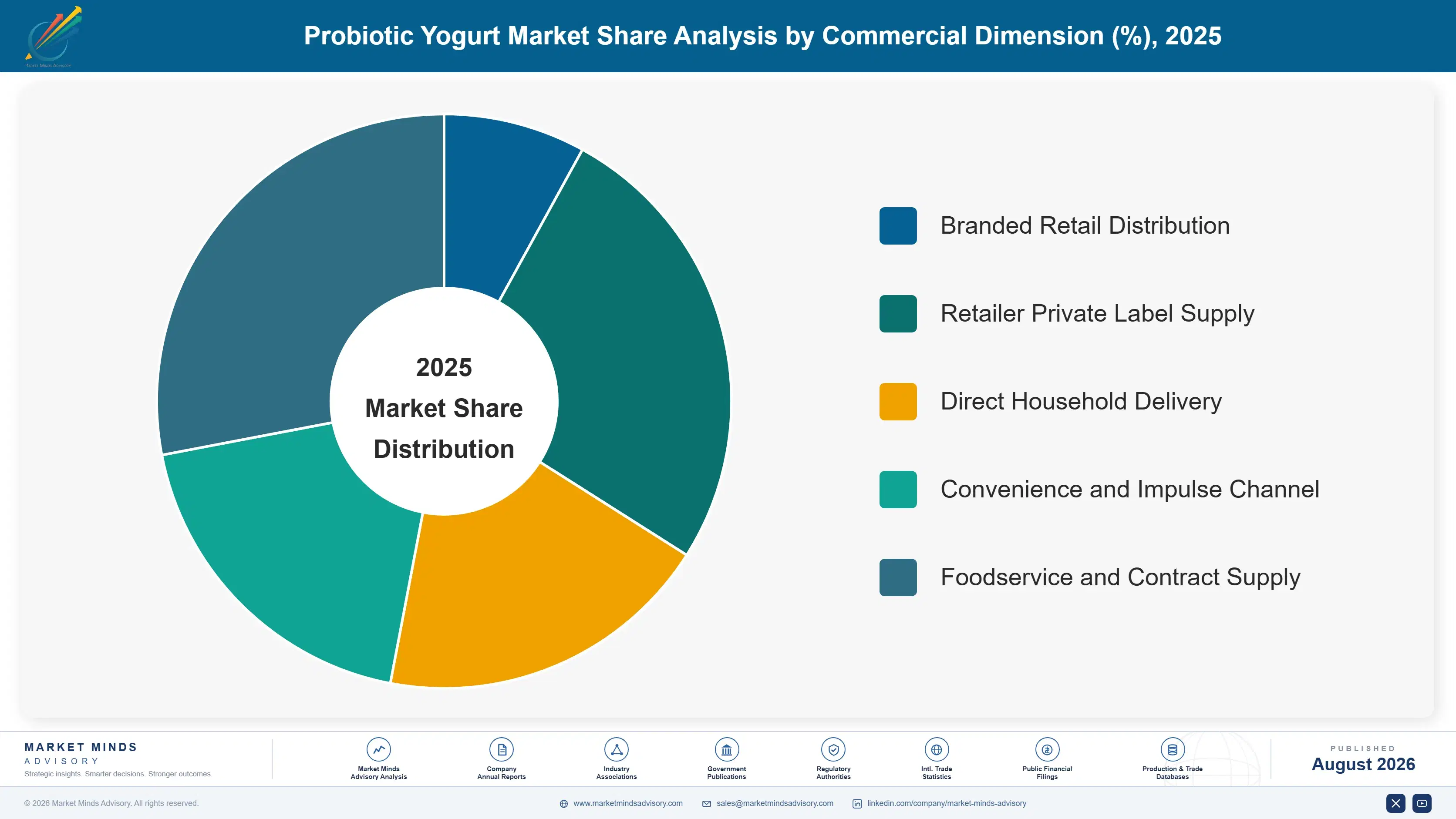
By Commercial Dimension

  • Branded Retail Distribution
  • Retailer Private Label Supply
  • Direct Household Delivery
  • Convenience and Impulse Channel
  • Foodservice and Contract Supply

By Region

  • North America
  • Western Europe
  • East Asia
  • South Asia and Pacific
  • Latin America
  • Middle East and Africa
  • Eastern Europe

Scope, Methodology, and Coverage

Every figure in this report is reproducible from documented input assumptions. The scope below maps the historical period, the forecast horizon, the segmentation dimensions, and the countries covered, alongside the underlying primary and qualitative methodology.
Historical Period
2020 to 2025
Forecast Period
2026 to 2036
Base Year
2025 (USD billions; MMA Primary Research Dataset, August 2026)
Market Definition
This report covers yogurt products containing live probiotic cultures sold at retail and foodservice, spanning clinically documented strain yogurts, high-protein strained formats, drinking and ambient shelf-stable yogurts, plant-based cultured alternatives, and children's probiotic formats, across branded, private label, direct delivery and foodservice channels. Non-cultured dairy desserts, cheese and kefir, fermented milk drinks positioned and dosed as supplements, and probiotic supplements in capsule, sachet or tablet form are excluded from the sizing.
Quantitative Units
USD billions at retail value; volume in million tonnes; realised price in USD per kilogram.
Segmentation Dimensions
By product format; by end-use industry; by commercial dimension; by region.
Regions Covered
North America, Western Europe, East Asia, South Asia and Pacific, Latin America, Middle East and Africa, Eastern Europe
Countries Covered
China, Japan, South Korea, India, Indonesia, Thailand, Vietnam, Australia, United States, Canada, Mexico, Brazil, France, Germany, United Kingdom, Spain, Netherlands, Poland, Turkey, Saudi Arabia.
Key Companies Profiled
Danone, Yakult Honsha, Nestlé, Yili Group, Lactalis, General Mills, Chobani, Mengniu Dairy, Meiji Holdings, FrieslandCampina, Arla Foods, Fage International, Amul, Chr. Hansen and others.
Quantitative Methodology
Primary survey, n=3,800 respondents, Q4 2025, six countries; demand-side model with trade association cross-validation
Qualitative Methodology
47 expert interviews, Q4 2025; applied to validate demand model assumptions, identify emerging dynamics, and assess competitive positioning
Report Format
PDF and XLSX data workbook (Word format preview document)
Publisher
Market Minds Advisory
Report Code
MMA-2026-AGR-096
Published
August 2026
Contact
sales@marketmindsadvisory.com | www.marketmindsadvisory.com

Purchase the full Probiotic Yogurt Market Report (2026 to 2036).

The full report sizes the probiotic yogurt market across five product formats, six consumption occasions and seven regions, with tonnage and realised price detail behind every value estimate. It profiles twenty companies on strain portfolio, format capability and cold chain reach. Regional chapters cover consumption habits, claim regulation and private label penetration by market. Cost analysis quantifies raw milk exposure and whey economics by format. Strain licensing analysis maps which documented organisms are held exclusively and which remain openly available to any licensee who asks for them.
Tonnage and realised price detail by product format
Documented strain licensing positions and exclusivity mapping
Health claim regulation comparison across major jurisdictions
Raw milk exposure and whey economics by format
Competitive position assessments across twenty companies
Private label penetration and cold chain reach by market

Built For The People Who Decide

From boardroom strategy to bench-side execution, this report is read cover-to-cover by leaders shaping the next decade of their industry, turning demand scenarios, market dynamics and valuation benchmarks into decisions.
CXOs/ Presidents/ VPs/ Managers
M&A and Corporate Development
Strategy Teams and R&D Heads
Procurement and Product Directors
Regulatory and Compliance Leaders
Investor Relations and Equity Analysts