Market Minds Advisory
Probiotic Strains Market

Probiotic Strains Market: A Licensing Business Dressed as a Fermentation One

Two organisms of the same species can behave identically in a gut and differ nearly sixfold in price, because one carries a clinical dossier and a deposit number and the other does not.

Lead Analyst

Lisa Gevelber

Published

September 2026

Make Smarter Decisions with Customized Research Insights

Request a free sample report and evaluate market opportunities, growth trends, and competitive dynamics relevant to your business needs.

2025 MARKET VALUE$1.6BMarket Size 2025
2036 FORECAST VALUE$4.2BBase Case , 2026 to 2036
CAGR 2026 TO 20369.0 %Bull 10.3% / Bear 7.7%
INCREMENTAL OPPORTUNITY$2.4BNet 10- year value creation
EXPANSION MULTIPLE2.37x2036 value over 2026 base
Strategic Levers
M&A Pipeline
Regional Outlook
Country Rankings
Competitive Intelligence
Segmental Deep-dive
Call-Us : 91 93563 13602

Executive Snapshot and Market Trajectory

The physical product is freeze-dried powder at a stated count, and a number of fermentation companies can make it. What they cannot make is the clinical dossier behind a named strain, which is why a documented organism sells at roughly 5.8 times an undocumented culture of the same species.
That makes this a licensing business, and licensing businesses live and die on protection. Roughly 34% of commercial volume now sits on strains past patent expiry, where a deposit number is public and a competitor can supply the same organism under a different name. Trademark protects the label rather than the bacterium. Suppliers respond by developing new strains continuously and building evidence faster than protection erodes, which is a treadmill rather than a solution.
Two developments change the shape of it. Next-generation anaerobic strains grow at 13.5%, half again the market rate of 9.0%, and several are heading down drug regulatory paths rather than supplement ones. Postbiotics remove viability from the argument entirely, and already account for 23% of formulator enquiries. Western Europe holds 31% of value, above the usual band, because strain intellectual property concentrates there to a degree no other region matches.
Market Definition
Probiotic strains, cultures and inactivated preparations supplied to manufacturers of supplements, foods, beverages and animal nutrition, spanning lactobacilli, bifidobacteria, spore-forming bacilli, yeasts, next-generation anaerobes and postbiotic preparations, measured at supplier selling value. Excludes finished consumer probiotic products, fermented foods sold at retail, dairy starter cultures for fermentation function, and live biotherapeutic products under drug approval.
Base Year Value
$1.6B in 2025 (MMA Primary Research Dataset, August 2026)
Forecast Period
2026 to 2036, eleven discrete annual values
CAGR
9.0% base case. Bull 10.3%. Bear 7.7%.
Fastest Growth Segment
Next-Generation Anaerobic Strains: 13.5% CAGR
Fastest Growth Country
India: 11.8% CAGR
Fastest Growth Region
South Asia and Pacific: 11.2% CAGR
Largest Region
Western Europe: 31% of 2025 global value
Market Leaders
Novonesis, IFF, Lallemand, Probi, BioGaia. Source: MMA Primary Research Dataset, July 2026.
Primary Survey
n=3,800 procurement and R&D decision-makers, Q4 2025, six countries
Methodology
Demand-side build-up, cross-validated against public data, 47 expert interviews

Probiotic Strains Market Forecast Scenarios

probiotic-strains-market-trends-size-forecast-scenario-1787580986522
Growth ran near 7.8% between 2020 and 2025 as finished product demand rose sharply through the pandemic period and pulled strain volume with it. Formulators became measurably more sophisticated across those years, asking for strain designation and dossiers where they had previously specified a species. Patent expiries on several commercially significant strains began eroding pricing at the same time, which held value below volume growth.
Base case 9.0% rests on three mechanisms. Formulators and retailers increasingly require named strains with evidence, which shifts volume from commodity cultures toward documented ones at far higher prices. Postbiotic preparations are opening applications that live organisms cannot survive, particularly in ambient and heat-processed formats. And Indian and Southeast Asian contract manufacturing is scaling quickly and buying strains rather than developing them. Documented strains carry the value. None requires finished demand to accelerate.
The bull case at 10.3% assumes next-generation anaerobes reach commercial supplement scale alongside their pharmaceutical development, which would create a premium tier above anything currently sold. The bear case at 7.7% is continued patent expiry outpacing new strain development, which would commoditise the documented tier that carries most of the industry's margin today. That tier carries most of the industry's margin today.

The Dossier Is the Product

Strip the marketing away and this industry sells freeze-dried bacteria by the kilogramme at a stated viable count. Several fermentation companies can produce that, and the barrier is not microbiology. What separates a five dollar culture from a thirty dollar one is a deposit number, a set of published human trials on a defined endpoint, and the right to reference them, which costs around four million dollars to generate per strain.
TOP FIVE CONCENTRATION57%Clinical dossier ownership narrows the supplier field sharply
DOCUMENTED STRAIN PREMIUM5.8xPrice against an equivalent undocumented culture of the species
CLINICAL DOSSIER COST$4 millionTypical spend generating human trial evidence for one strain
PATENT EXPIRY EXPOSURE34%Share of commercial volume on strains past patent protection
DRYING SURVIVAL VARIATION18%Spread in viability through drying between candidate strains
POSTBIOTIC ENQUIRY SHARE23%Formulator enquiries now specifying inactivated preparations rather than live
So the economics are licensing economics and the vulnerability is licensing vulnerability. A deposited strain is public by definition, and when the patent lapses a competent fermenter can obtain the deposit and supply the same organism under a different commercial name. Roughly 34% of commercial volume now sits past expiry. The trademark survives and the bacterium does not care about it.
Manufacturability is the filter nobody outside the industry sees. Viability through freeze-drying varies by around 18 percentage points across candidate strains, and some organisms with excellent clinical data are miserable to dry and stabilise. A strain that performs in a trial and dies in a dryer never reaches a commercial dossier, which quietly shapes which evidence base the whole industry ends up with.
"The strain is a molecule anyone can grow and the dossier is an asset with a clock on it. Everybody in this business knows they are on a treadmill, generating new evidence faster than the old patents expire, and nobody talks about what happens if that treadmill ever slows down."
Director, Biotic Ingredients and Nutrition Science Practice · MMA Healthcare and Nutrition Practice · August 2026

Market Trends

Postbiotic preparations removing viability from the equation

Heat-killed cells and cell fractions deliver documented effects without requiring a live organism, which eliminates cold chain, shelf life decay and the format restrictions that constrain live cultures throughout food and beverage. Roughly 23% of formulator enquiries now specify inactivated preparations. That opens ambient shelf-stable applications, heat-processed foods and high water activity matrices where live organisms simply do not survive. The regulatory position differs by jurisdiction and the evidence base is younger, which is what currently limits adoption rather than any technical obstacle. Manufacturing is considerably simpler once the organism no longer has to stay alive at all.
Market Impact: Shifts volume toward a 5.8x premium

Next-generation anaerobes splitting toward drug development

Strict anaerobes including Akkermansia and Faecalibacterium require entirely different fermentation and stabilisation than conventional probiotics, and several developers are pursuing them as live biotherapeutic products under drug regulation rather than as supplement ingredients. That path costs far more, takes far longer and produces claims no supplement can make. The supplement route continues in parallel for pasteurised and less demanding organisms. The industry is effectively splitting into two regulatory futures with different economics and different competitor sets entirely. The industry is splitting into two regulatory futures with different economics and entirely different competitor sets.
Market Impact: Delivers 11.8% annual Indian growth

Market Opportunities and Growth Drivers

Formulators and retailers requiring named strains with evidence

Retail technical teams and brand formulators increasingly specify a strain designation and supporting dossier rather than a species, which moves volume from commodity culture toward documented organisms selling at roughly 5.8 times the price. That shift is driven by consumer scrutiny working upstream rather than by any regulation, and it favours suppliers holding evidence over those holding fermentation capacity. A supplier without a dossier finds itself quoting into an ever narrower set of applications where nobody is asking the question. That shift favours suppliers holding evidence over those holding only fermentation capacity.
Market Impact: Exposes 34% of commercial volume

Indian contract manufacturing buying strains rather than developing them

India grows fastest anywhere at 11.8%, as nutraceutical contract manufacturing scales to supply both domestic and export finished product demand. Those manufacturers buy documented strains from established suppliers rather than developing their own, since a dossier costs around four million dollars and takes years to generate. That makes the growth additive to strain supplier revenue rather than competitive with it. Southeast Asian contract manufacturing follows the same pattern behind India at smaller scale. Southeast Asian contract manufacturing follows the same pattern behind India at somewhat smaller scale. Dossiers are bought, not built.
Market Impact: Varies survival by 18 points

Market Restraints and Challenges

Patent expiry converting documented strains into generic organisms

A deposited strain is publicly identified by definition, and once patent protection lapses a competent fermenter can obtain the deposit and supply the identical organism under a different commercial name. Roughly 34% of commercial volume now sits past expiry. The root cause is that patents protect the organism while trademarks protect only the name, and the bacterium is indifferent to branding. Suppliers respond by developing new strains continuously and by building evidence faster than protection erodes, which is a treadmill rather than a solution. The treadmill runs faster as a portfolio ages.
Market Impact: Covers 23% of formulator enquiries

Manufacturability filtering out strains with good clinical data

Viability through freeze-drying varies by around 18 percentage points across candidate strains, and organisms that survive a clinical trial do not necessarily survive a dryer, a blend or eighteen months on a shelf. The root cause is that stress tolerance and clinical activity are unrelated properties of an organism. Commercially it means promising candidates are abandoned after the expensive part of development. Suppliers screen manufacturability early and use protective matrices, and neither rescues a fundamentally fragile organism. Promising candidates are abandoned after the expensive part of development has already been spent.
Market Impact: Splits development across 2 pathways
3 additional market trends, 4 additional growth drivers, and 2 additional restraints and challenges are covered in the full report. Contact sales@marketmindsadvisory.com to access the complete intelligence.

Segment CAGR and Growth Architecture

Six segments split by organism class, because class determines fermentation conditions, stabilisation difficulty, regulatory route and the evidence base available. A spore former and a strict anaerobe are different manufacturing businesses that happen to share a customer. Application and commercial channel are handled in the framework instead. Manufacturing differs completely. Customers are the only overlap.
probiotic-strains-market-trends-market-share-analysis-1787580987078

Next-Generation Anaerobic Strains

Growing at 13.5%, half again the market rate of 9.0%, strict anaerobes including Akkermansia and Faecalibacterium require oxygen-free fermentation and stabilisation techniques that conventional probiotic manufacturing does not use. Several developers are pursuing them under drug regulation as live biotherapeutic products, which costs far more and permits claims no supplement can make, while pasteurised and less demanding organisms proceed on the supplement route in parallel. Capacity is scarce and specialised. The segment is small today and holds the strongest long-run position, since the evidence and the manufacturing barrier reinforce each other rather than competing. Capacity is scarce and specialised, which defends the position alongside the evidence rather than instead of it.
CAGR 13.5%

Postbiotic and Inactivated Preparations

At 12.2% postbiotics deliver documented effects from heat-killed cells or cell fractions, which removes viability, cold chain and shelf life decay from the commercial equation entirely. Roughly 23% of formulator enquiries now specify them, principally for ambient shelf-stable products, heat-processed foods and high water activity matrices where live organisms cannot survive at all. Regulatory treatment differs by jurisdiction and the evidence base is younger than for live strains, which limits adoption more than any technical obstacle does. Manufacturing is considerably simpler once the organism no longer has to stay alive. Regulatory treatment differs by jurisdiction and the evidence base is younger, which limits adoption more than any technical obstacle does.
CAGR 12.2%
Full segment breakdown across 6 segments available in the complete report.

Regional Architecture and Country Demand Map

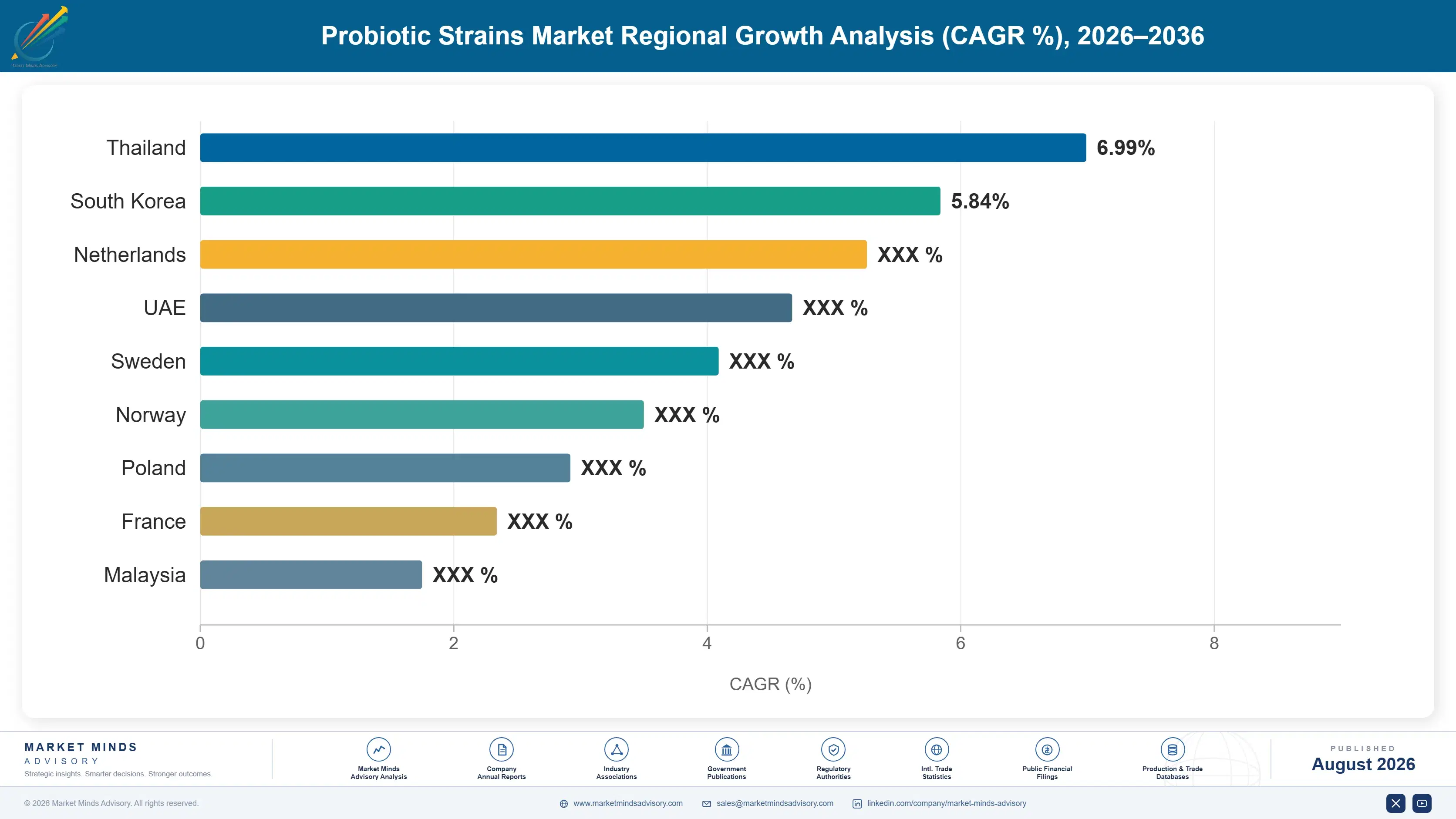
Western Europe holds 31% of value, above its usual band, because strain intellectual property and clinical development are concentrated across Denmark, Sweden, France and the Netherlands. North America follows at 24% and East Asia at 22% on the scale of their finished product manufacturing rather than on strain development.

North America

American demand is driven by a very large finished supplement industry whose formulators have become measurably more sophisticated about strain designation over recent years, partly through consumer scrutiny working upstream. IFF holds substantial strain intellectual property and fermentation capacity domestically. Next-generation anaerobe development is concentrated here alongside the venture funding that supports it, with several companies pursuing drug approval routes rather than supplement ones. Contract manufacturing scale means strain suppliers sell to converters rather than to brands in many cases, which shapes how dossiers actually get evaluated. Venture funding supports next-generation development here in a way no other region matches. Strain suppliers frequently sell to converters rather than to brands, which changes how a dossier gets evaluated.
Share: 24% | CAGR: 8.1% (2026 to 2036)

Western Europe

The 31% share sits above the usual band because strain intellectual property and the clinical development behind it concentrate here to a degree no other region matches. Danish, Swedish, French and Dutch companies hold a disproportionate share of documented strains and the dossiers supporting them, built over decades of dairy culture and nutrition science. European claim regulation is simultaneously the strictest anywhere, which has pushed evidence standards higher and made European dossiers valuable in markets that never required them. Contract fermentation capacity is well developed across the region. European claim regulation has pushed evidence standards higher and made European dossiers valuable in markets that never required them. Contract fermentation capacity is well developed.
Share: 31% | CAGR: 7.6% (2026 to 2036)
Regional intelligence for 5 additional markets available in the complete report: East Asia, South Asia and Pacific, Latin America, Middle East and Africa, Eastern Europe. Contact sales@marketmindsadvisory.com.
probiotic-strains-market-trends-country-cagr-analysis-1787580987590

Four Moves on a Treadmill

The dossier is the asset and it depreciates on a patent clock. Everything worth doing either extends protection, generates the next dossier faster, or moves into a class where the manufacturing barrier does some of the defending. Selling fermentation capacity alone is the position nobody wants. Protection is the asset. Fermentation is for hire.

Generate the next dossier before the last one expires

Roughly 34% of commercial volume already sits on strains past patent protection, where a competent fermenter can obtain the public deposit and supply the identical organism. A dossier costs around four million dollars and several years to generate, which means development has to start long before the revenue it replaces begins declining. Suppliers running that pipeline continuously hold pricing that lapsed-patent competitors cannot approach. Those who stopped developing during a strong period are discovering the arithmetic now. The arithmetic catches everyone eventually. Nobody escapes the clock. Pricing depends entirely on it.
Market Impact: Replaces the 34% of volume past patent protection

Screen manufacturability before funding the trial

Viability through freeze-drying varies by around 18 percentage points across candidate strains, and clinical performance tells you nothing about whether an organism survives a dryer or a shelf. Screening stabilisation early costs a fraction of a trial and prevents abandoning a candidate after the expensive part of development is already spent. Several suppliers have funded human studies on organisms that later proved uncommercial to manufacture, which is the most avoidable mistake available in this business. It is the most avoidable mistake in the business. Screening costs a fraction of a trial.
Market Impact: Protects a $4 million dossier from being wasted

Build postbiotic capability while evidence is still young

Inactivated preparations remove viability, cold chain and shelf life decay from the commercial argument, and already account for 23% of formulator enquiries. The evidence base is younger than for live strains and the regulatory treatment varies by jurisdiction, which is what limits adoption rather than anything technical. Generating postbiotic evidence now, while the field is uncrowded, establishes positions in ambient and heat-processed applications that live organisms will never be able to serve at all. Live organisms will never serve those applications. The field is still genuinely uncrowded. Regulatory treatment varies by jurisdiction.
Market Impact: Serves the 23% of enquiries that already arrive

Take a position in anaerobic fermentation capacity

Strict anaerobes require oxygen-free fermentation and stabilisation that conventional probiotic manufacturing simply does not have, and capacity is scarce and specialised. That manufacturing barrier defends the position alongside the evidence, which is rare in an industry where fermentation is otherwise widely available. The segment grows at 13.5% and splits between supplement and drug routes with different economics. Building capability now costs real capital and buys a barrier that patent expiry cannot erode. Patent expiry cannot erode a fermentation barrier, which is what makes this different from every other position in the industry.
Market Impact: Enters a segment growing 13.5% each year now

Who Controls the Margin Pool

Participation is measured on annual strain and culture supply value to manufacturers, and the top five hold 57%. Concentration is high because clinical dossiers rather than fermentation capacity define the business, and dossiers cost around four million dollars each to generate. Novonesis and IFF lead on portfolio breadth across documented strains. The gap to challengers is accumulated evidence rather than any manufacturing difficulty at all.
Competition runs on three fronts. Dossier portfolio decides which applications a supplier can serve as formulators increasingly demand named strains with evidence behind them. Manufacturability decides which promising organisms ever reach commercial supply, and it filters candidates after clinical spend rather than before it. Patent position decides how long any given dossier keeps earning, and roughly 34% of volume has already lost that protection.

The pressure ahead comes from two directions at once. Patent expiry commoditises the documented tier from below while next-generation anaerobes and drug-route development create a premium tier above it that most current participants cannot manufacture. Expect strain licensing arrangements and anaerobic capacity investment rather than acquisitions. Rankings shift as postbiotic evidence accumulates and as the supplement and pharmaceutical paths separate further.
probiotic-strains-market-trends-company-positioning-matrix-1787580988108

Competitive Moat and Risk Dimensions

NOVONESIS

Moat: Dossier portfolio breadth and depth

Novonesis holds documented strains across a wide range of species and endpoints, accumulated over decades and representing hundreds of millions of dollars of clinical spend that no competitor can replicate quickly. Breadth also matters commercially, since a formulator wanting several documented organisms prefers one supplier with one set of commercial terms and one quality system.
NOVONESIS

Risk: Patent expiry across the portfolio

A portfolio accumulated over decades necessarily contains strains reaching or past patent expiry, where competent fermenters can supply the same public deposit under different names. Replacing that revenue requires continuous new dossier generation at around four million dollars each, and the treadmill runs faster as the portfolio ages regardless of how well the business is otherwise managed.
IFF

Moat: Strain assets and application reach

IFF combines documented strain assets with formulation and application capability across food, beverage and supplement customers, which lets it sell a solution rather than a culture. That application reach is worth a great deal when a formulator is trying to get a live organism through a manufacturing process it was never designed to survive.
IFF

Risk: Portfolio integration and focus

Probiotic strains sit inside a very large ingredients group where they compete for capital against businesses with different growth and return profiles, and strategic reviews have repeatedly reshaped the portfolio. Focused competitors commit to strain development on longer horizons than a diversified group's capital allocation process naturally permits.

Players Tracked

Prominent Players

Novonesis
IFF
Lallemand
Probi
BioGaia

Other Key Players

Kerry Group
ADM
Morinaga Milk Industry
Yakult Honsha
Sacco System
Sabinsa
SynbioTech
Lactobio
Winclove Probiotics
Bifodan
UAS Labs
Deerland Probiotics
Genome and Company
Pendulum Therapeutics
Asahi Group

Recent Developments

FEBRUARY 2026

Commercially significant strain reaches patent expiry across major markets

Patent protection lapsed on a widely used documented probiotic strain across several major markets, allowing competent fermenters to supply the same public deposit under alternative commercial designations. The originator retains trademark rights to the commercial name while the organism itself became freely available. Pricing moved within months.
Signal: Trademark protects the name and never the bacterium, which is the recurring vulnerability of this entire business
SEPTEMBER 2025

Supplier launches postbiotic range for heat-processed food applications

A strain supplier launched inactivated postbiotic preparations aimed at heat-processed and ambient shelf-stable food applications where live organisms cannot survive processing or storage. The range carries its own clinical evidence rather than relying on data generated for the live parent strain. Regulatory positions vary by market.
Signal: Postbiotics open applications live organisms were structurally excluded from, which expands demand rather than merely shifting it
MAY 2026

Anaerobic strain developer commissions dedicated oxygen-free fermentation capacity

A next-generation probiotic developer commissioned dedicated anaerobic fermentation and stabilisation capacity for strict anaerobe production, serving both supplement and clinical development requirements. The investment is organic capacity building rather than any partnership with an established fermentation supplier. Capacity serves both routes. Commissioning ran through the year.
Signal: Anaerobic capacity is scarce enough that owning it defends a position which patent expiry can never erode

Fermentation Is the Cheap Part

Fermentation media, principally dairy-derived and plant protein hydrolysates alongside sugars, accounts for roughly 21% of production cost. Freeze-drying is the largest single element at about 29%, since sublimation is slow and energy intensive and capacity is capital heavy. Cryoprotectants and stabilising matrices add a further 12%. Amortised clinical dossier cost sits outside the manufacturing stack entirely and dominates the economics that actually matter.
European energy costs through 2022 hit freeze-drying directly, since the process runs for extended cycles under vacuum and cannot be economically interrupted partway. Producers holding fixed supply contracts absorbed a substantial share, per IEA industrial energy data for that period, and several disclosed the effect in their reporting. Media costs moved separately with dairy protein pricing, which affects strains requiring dairy-based media more than those grown on plant substrates.

The competitive mechanism has very little to do with any of that. Manufacturing cost is a small fraction of a documented strain's price, and the difference between an efficient fermenter and an average one is invisible next to the difference between holding a dossier and not holding one. Cost discipline matters most for undocumented cultures, which is precisely the tier nobody wants to be competing in.
probiotic-strains-market-trends-cost-volatility-analysis-1787580988302

Contract industrial energy on long tenor for drying capacity

Freeze-drying runs extended vacuum cycles that cannot be interrupted economically, which makes it among the more energy intensive unit operations in ingredients manufacture. European producers on spot power carried the full 2022 increase while those on long-dated contracts absorbed a fraction. Most restructured procurement afterwards, and the exposure recurs whenever regional power markets tighten.

Select plant-based media where strain performance permits

Dairy-derived fermentation media carry pricing that moves with global dairy protein markets, while plant protein hydrolysates move on entirely separate cycles. Where a strain performs adequately on plant media the substitution reduces both cost volatility and the allergen declaration burden downstream. Not every organism grows equally well, which is a screening question best answered during development rather than afterwards.

Amortise dossier cost across licensees rather than volume

A four million dollar dossier recovered through unit pricing on a supplier's own volume is a slow and risky proposition. Licensing the strain to multiple finished product manufacturers spreads that cost across far more volume and converts a fixed investment into royalty income. It also accelerates market presence, which matters when the patent clock has already started running.

Portfolio Architecture for Margin Defence

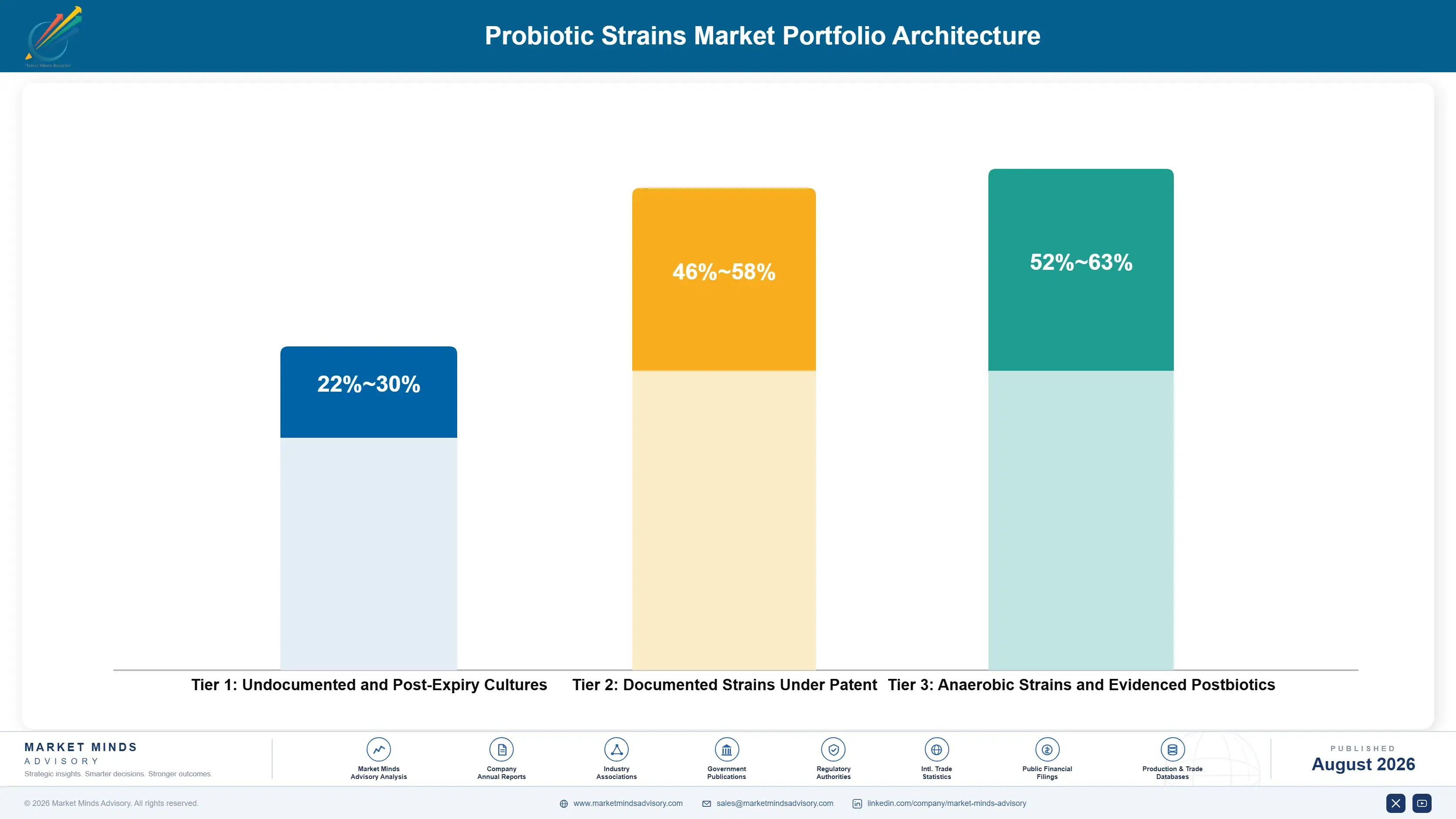
Margin here tracks documentation and protection rather than anything in the fermenter. Undocumented cultures sold on species designation earn margins in the mid twenties, competing against any competent fermenter on price alone, and it is a tier with no defensible position whatsoever once a formulator starts asking about strains. A formulator asking about strains ends the conversation immediately. Fermentation efficiency is the only lever available in that tier.
Documented strains still under patent hold margins in the high forties to high fifties, because the dossier cannot be replicated and the organism cannot legally be supplied by anyone else. The range reflects evidence depth and how many endpoints a strain covers, which determines how many applications it can serve credibly. Nobody else can legally supply the organism while protection holds. Evidence depth determines how many applications a strain can credibly serve.

Next-generation anaerobes and postbiotics with their own evidence hold the strongest position, running into the low sixties, because manufacturing difficulty defends them alongside the documentation. That combination is rare in an industry where fermentation is otherwise widely available, and it is where the industry's capital is now visibly heading. That is where the industry's capital is now visibly heading.

Undocumented and Post-Expiry Cultures

Species-level cultures and strains past patent protection available from any competent fermenter. The eight point range reflects fermentation efficiency and drying cost rather than any product position worth defending in a tender.
Gross Margin: 22-30%

Documented Strains Under Patent

Named strains with published human trial evidence and active patent protection. The twelve point range reflects evidence depth and the number of endpoints a strain covers, which determines how many applications it credibly serves.
Gross Margin: 46-58%

Anaerobic Strains and Evidenced Postbiotics

Strict anaerobes and inactivated preparations carrying their own clinical evidence. The eleven point range reflects how far manufacturing difficulty defends the position alongside documentation, which varies considerably by organism. Both barriers apply at once.
Gross Margin: 52-63%
probiotic-strains-market-trends-portfolio-architecture-1787580988800

High-value Sub-segments and Strategic Watch-out

Next-Generation Anaerobic Strains

High value and the fastest growth at 13.5%, where scarce oxygen-free fermentation capacity defends the position alongside the evidence. Drug route development creates claims no supplement ingredient can approach at all. Drug route claims exceed anything a supplement can make. Capital is heading here visibly.
Gross Margin: 55-63%

Evidenced Postbiotic Preparations

High value and growing at 12.2% on applications live organisms are excluded from entirely. Removing viability removes cold chain, shelf life decay and format restriction from the customer's problem in one step. Ambient and heat-processed formats open up entirely. Manufacturing simplifies considerably. Viability stops mattering.
Gross Margin: 52-60%

Documented Strains Under Patent

The profit core and the tier on a clock. Protection is absolute while it lasts and worth nothing afterwards, which is why continuous dossier generation is a survival requirement rather than a growth strategy for anyone here. Protection is absolute while it lasts and worthless afterwards.
Gross Margin: 46-58%

Post-Expiry Documented Strains

The strategic watch-out. Roughly 34% of commercial volume sits here already, where a public deposit lets any competent fermenter supply the identical organism under a different commercial name entirely. Pricing falls sharply within two years of expiry. Price competition arrives immediately afterwards. Trademark survives, the organism does not.
Gross Margin: 22-32%

How the Licence Keeps Paying

A strain written into a finished product formulation behaves like an annuity until the patent expires. Reformulating means new stability work, new label copy and frequently new consumer claims, so a brand does not change strain casually once a product is established and selling. Volume then follows the finished product's own performance rather than any purchasing decision, which makes the supplier's revenue a function of its customer's marketing rather than its own.
Stickiness depends almost entirely on protection. While a strain is under patent it cannot be substituted at all, which is the most complete lock available in ingredients. After expiry the same formulation can switch to an identical organism under another name with minimal reformulation risk, and price competition arrives immediately. Postbiotic and anaerobic positions hold better, because manufacturing capability limits who can supply them at all.

The specifying decision has moved upstream toward the retailer. Strain selection sat with a brand's formulation team choosing on cost and availability. Retail technical requirements for strain designation and evidence now shape what a brand can list, which means the strain supplier's real customer is increasingly a retail technologist who has never spoken to them.
probiotic-strains-market-trends-end-use-penetration-index-1787580989289

Where We Would Commit Capital

These are among the four positions where our research anticipates prominent divergence between winners and laggards over the coming forecast period. Each is grounded in the demand model, the regulatory perimeter, and the announced capacity pipeline.
01 / DOSSIER PIPELINE CONTINUITY

Fund the next strain while the current one still earns

Roughly 34% of commercial volume already sits on strains past patent protection, where any competent fermenter can obtain the public deposit and supply the identical organism under a different name. A dossier costs around four million dollars and several years to produce, so development must begin long before the revenue it replaces starts declining. Suppliers running that pipeline continuously hold pricing that lapsed-patent competitors cannot approach, and those who paused development during a strong period are discovering that arithmetic right now.
02 / MANUFACTURABILITY SCREENING DISCIPLINE

Test the dryer before you fund the clinical trial

Viability through freeze-drying varies by around 18 percentage points across candidate strains, and clinical performance says nothing whatever about whether an organism survives drying, blending or eighteen months on a shelf. Screening stabilisation behaviour early costs a very small fraction of a trial and prevents abandoning a candidate after four million dollars is already committed. Several suppliers have funded human studies on organisms that later proved uncommercial to manufacture, which is comfortably the most avoidable error available anywhere in this business.
03 / POSTBIOTIC EVIDENCE BUILDING

Generate the data while the field is still uncrowded

Inactivated preparations remove viability, cold chain and shelf life decay from the customer's problem entirely, and they already account for 23% of the formulator enquiries now arriving. The evidence base is younger than it is for live strains and regulatory treatment varies by jurisdiction, which is what limits adoption rather than anything technical about the preparations. Generating postbiotic evidence now, while the field remains uncrowded, establishes positions in ambient and heat-processed applications that live organisms are permanently excluded from serving.
04 / ANAEROBIC CAPACITY POSITION

Buy a barrier that patent expiry cannot erode

Strict anaerobes need oxygen-free fermentation and stabilisation that conventional probiotic manufacturing simply does not possess at all, and that capacity is genuinely scarce and specialised right across the whole industry. The manufacturing barrier defends a position alongside the evidence, which is genuinely rare where fermentation is otherwise widely available for hire. The segment grows at 13.5% annually and splits between supplement and drug routes, and building that capability now costs real capital while buying protection that a lapsing patent never threatens.

Engagement Snapshot From the Field

A live engagement with an industry participant carrying material or product regulatory and market exposure ahead of a defining policy shift, showing how our research translates into a defensible multi-year portfolio strategy.
MARKET MINDS ADVISORY · CLIENT ENGAGEMENT SUMMARY
Probiotic Strains Producer Strategic Portfolio Review and Transition Roadmap 2026·Investment Scenario on Probiotic Strains Exposure Evaluation 2025-26
CLIENT PROFILE
A European probiotic strain supplier holding documented organisms across several species, with annual revenue near 96 million euros supplied to supplement and dairy manufacturers across Europe and North America (client-reported, unverified by MMA). Three strains carried the majority of revenue, and two of those were within four years of patent expiry. No postbiotic capability existed.
STRATEGIC CHALLENGE
Dossier development had been paused during a period of strong demand, leaving no new documented strain close to commercial readiness as two major patents approached expiry. Formulators had separately begun asking about postbiotic options the client could not supply. Management needed to prioritise between pipeline restart, postbiotic capability and anaerobic capacity investment.
MMA APPROACH
MMA modelled revenue erosion following patent expiry using observed pricing behaviour on previously expired strains, costed dossier generation and postbiotic evidence programmes separately, and screened the client's development candidates for freeze-drying survival before any clinical commitment. Anaerobic capacity requirements were assessed with two engineering contractors. Interviews with 47 experts covered strain development, fermentation and formulator specification.
KEY FINDINGS
  1. Observed pricing on previously expired strains fell by roughly 60% within two years of protection lapsing, which implied severe revenue erosion across the client's two exposed strains.
  2. Two of five development candidates showed freeze-drying survival well below commercial viability, and neither had been screened before clinical planning had already begun on one.
  3. Postbiotic evidence generation cost materially less than live strain dossiers, since stability and viability requirements fall away and trial design is simpler in several respects.
  4. Anaerobic capacity investment exceeded what the client could fund alongside pipeline restart, and no partnership route was available on acceptable commercial terms.
CLIENT PROFILE
A European probiotic strain supplier holding documented organisms across several species, with annual revenue near 96 million euros supplied to supplement and dairy manufacturers across Europe and North America (client-reported, unverified by MMA). Three strains carried the majority of revenue, and two of those were within four years of patent expiry. No postbiotic capability existed.
STRATEGIC CHALLENGE
Dossier development had been paused during a period of strong demand, leaving no new documented strain close to commercial readiness as two major patents approached expiry. Formulators had separately begun asking about postbiotic options the client could not supply. Management needed to prioritise between pipeline restart, postbiotic capability and anaerobic capacity investment.
MMA APPROACH
MMA modelled revenue erosion following patent expiry using observed pricing behaviour on previously expired strains, costed dossier generation and postbiotic evidence programmes separately, and screened the client's development candidates for freeze-drying survival before any clinical commitment. Anaerobic capacity requirements were assessed with two engineering contractors. Interviews with 47 experts covered strain development, fermentation and formulator specification.
KEY FINDINGS
  1. Observed pricing on previously expired strains fell by roughly 60% within two years of protection lapsing, which implied severe revenue erosion across the client's two exposed strains.
  2. Two of five development candidates showed freeze-drying survival well below commercial viability, and neither had been screened before clinical planning had already begun on one.
  3. Postbiotic evidence generation cost materially less than live strain dossiers, since stability and viability requirements fall away and trial design is simpler in several respects.
  4. Anaerobic capacity investment exceeded what the client could fund alongside pipeline restart, and no partnership route was available on acceptable commercial terms.
RECOMMENDED STRATEGY
Phase 1: Phase one: restart dossier development immediately on the three candidates that survive drying, since patent erosion is already modelled and cannot be deferred. Phase 2: Phase two: build postbiotic evidence on existing strains, which costs materially less than new live dossiers and answers enquiries the client currently declines. Phase 3: Phase three: defer any anaerobic capacity investment for now, rather than underfunding a pipeline restart that protects the existing revenue base.
OUTCOME
The supplier restarted development on three screened candidates during 2025 and began postbiotic evidence work on two existing strains (client-reported, unverified by MMA). One exposed patent lapsed as modelled with pricing falling in line with the forecast, and anaerobic investment was deferred to a later planning cycle rather than abandoned.

Frequently Asked Questions

Foundational context covering the market sizes, CAGR, scope, country, region and competition that inform every finding below. This section is provided to cover basics and most often pre-purchase conversations, answered from the MMA Primary Research Dataset.

What is the current size of the Probiotic Strains Market?

MMA sizes it at USD 1.62 billion in 2025, rising to USD 1.77 billion in 2026. The figure covers strains, cultures and inactivated preparations supplied to manufacturers rather than finished consumer products.

How large will the Probiotic Strains Market be by 2036?

USD 4.19 billion by 2036, an incremental USD 2.42 billion over the 2026 base and an expansion multiple of 2.37 times. Anaerobic strains and postbiotics account for a disproportionate share.

What is the CAGR for the Probiotic Strains Market 2026 to 2036?

9.0% in the base case, with a bull case at 10.3% and a bear case at 7.7%. The spread turns on whether new strain development outpaces patent expiry across the industry.

Which segment is growing fastest?

Next-generation anaerobic strains at 13.5%, half again the market rate of 9.0%. Scarce oxygen-free fermentation capacity defends the position alongside the clinical evidence behind it.

Who are the major companies in the Probiotic Strains Market?

Novonesis, IFF, Lallemand, Probi and BioGaia lead on annual strain and culture supply value, holding 57% between them. Fifteen further participants are profiled in the report.

Which country is growing fastest?

India at 11.8%, as nutraceutical contract manufacturing scales and buys documented strains rather than developing dossiers that cost around four million dollars each to generate.

Report Segmentation Architecture

The full report scope spans multiple orthogonal segmentation dimensions, with cross-tabulated demand data provided for each dimension pair. Coverage extends further to regional breakdowns, trend trajectories, and the competitive detail needed to support segment-level decision-making.

By Organism Class

  • Lactobacillus and Lactiplantibacillus Strains
  • Bifidobacterium Strains
  • Bacillus Spore-Forming Strains
  • Yeast Based Strains
  • Next-Generation Anaerobic Strains
  • Postbiotic and Inactivated Preparations

By End-Use Industry

  • Dietary Supplements
  • Dairy and Fermented Foods
  • Functional Beverages
  • Infant and Paediatric Nutrition
  • Animal Nutrition
  • Clinical and Medical Nutrition

By Commercial Dimension

  • Direct Supply to Manufacturers
  • Strain Licensing Agreements
  • Contract Manufacturer Supply
  • Distributor and Trader Channels
  • Co-Development Arrangements
  • Export and Cross-Border Supply

By Region

  • North America
  • Western Europe
  • East Asia
  • South Asia and Pacific
  • Latin America
  • Middle East and Africa
  • Eastern Europe

Scope, Methodology, and Coverage

Every figure in this report is reproducible from documented input assumptions. The scope below maps the historical period, the forecast horizon, the segmentation dimensions, and the countries covered, alongside the underlying primary and qualitative methodology.
Historical Period
2020 to 2025
Forecast Period
2026 to 2036
Base Year
2025 (USD billions; MMA Primary Research Dataset, August 2026)
Market Definition
Probiotic strains, cultures and inactivated preparations supplied to manufacturers of dietary supplements, foods, beverages and animal nutrition, spanning lactobacilli, bifidobacteria, spore-forming bacilli, yeasts, next-generation anaerobes and postbiotic or inactivated preparations, measured at supplier selling value including licensing income. Finished consumer probiotic products, fermented foods sold at retail, dairy starter cultures supplied for fermentation function alone, and live biotherapeutic products holding drug approval are excluded from scope.
Quantitative Units
USD billions (current prices); tonnes of dried culture supplied annually; USD per kilogramme by organism class
Segmentation Dimensions
Organism class; end-use industry; commercial dimension; region
Regions Covered
North America, Western Europe, East Asia, South Asia and Pacific, Latin America, Middle East and Africa, Eastern Europe
Countries Covered
United States, Canada, Denmark, Sweden, France, Netherlands, Germany, Italy, China, Japan, South Korea, India, Indonesia, Vietnam, Australia, Brazil, Mexico, Israel, South Africa, Poland
Key Companies Profiled
Novonesis, IFF, Lallemand, Probi, BioGaia, Kerry Group, ADM, Morinaga Milk Industry, Yakult Honsha, Sacco System, Sabinsa, SynbioTech, Lactobio, Winclove Probiotics, Bifodan, UAS Labs, Deerland Probiotics, Genome and Company, Pendulum Therapeutics, Asahi Group
Quantitative Methodology
Primary survey, n=3,800 respondents, Q4 2025, six countries; demand-side model with trade association cross-validation
Qualitative Methodology
47 expert interviews, Q4 2025; applied to validate demand model assumptions, identify emerging dynamics, and assess competitive positioning
Report Format
PDF and XLSX data workbook (Word format preview document)
Publisher
Market Minds Advisory
Report Code
MMA-2026-HLT-123
Published
August 2026
Contact
sales@marketmindsadvisory.com | www.marketmindsadvisory.com

Purchase the full Probiotic Strains Market Report (2026 to 2036).

The full report treats the clinical dossier as the asset it actually is, sizing each organism class independently through 2036. It maps patent expiry schedules across commercially significant strains, models the pricing erosion that follows protection lapsing, and assesses manufacturability screening practice against clinical development spend. Regional chapters cover all seven regions with strain development and fermentation capacity detail wherever public disclosure permits it. Competitive profiling covers 20 participants on a single strain and culture supply value basis, alongside dossier portfolio depth compared across each supplier covered.
Each organism class sized independently through 2036
Patent expiry schedules mapped across commercially significant strains
Pricing erosion modelled following protection lapsing
Manufacturability screening assessed against clinical development spend
Twenty participants profiled on one consistent basis
Dossier portfolio depth compared across each supplier

Built For The People Who Decide

From boardroom strategy to bench-side execution, this report is read cover-to-cover by leaders shaping the next decade of their industry, turning demand scenarios, market dynamics and valuation benchmarks into decisions.
CXOs/ Presidents/ VPs/ Managers
M&A and Corporate Development
Strategy Teams and R&D Heads
Procurement and Product Directors
Regulatory and Compliance Leaders
Investor Relations and Equity Analysts