Market Minds Advisory
Probiotic Chewing Gum Market

Probiotic Chewing Gum Market: Probiotic Gum: The Right Delivery Vehicle for the Wrong Half of the Category

Gum holds a live organism against oral tissue for several minutes and then gets spat out, which makes it excellent for the mouth and close to pointless for the gut.

Lead Analyst

Lisa Gevelber

Published

September 2026

Make Smarter Decisions with Customized Research Insights

Request a free sample report and evaluate market opportunities, growth trends, and competitive dynamics relevant to your business needs.

2025 MARKET VALUE$0.3BMarket Size 2025
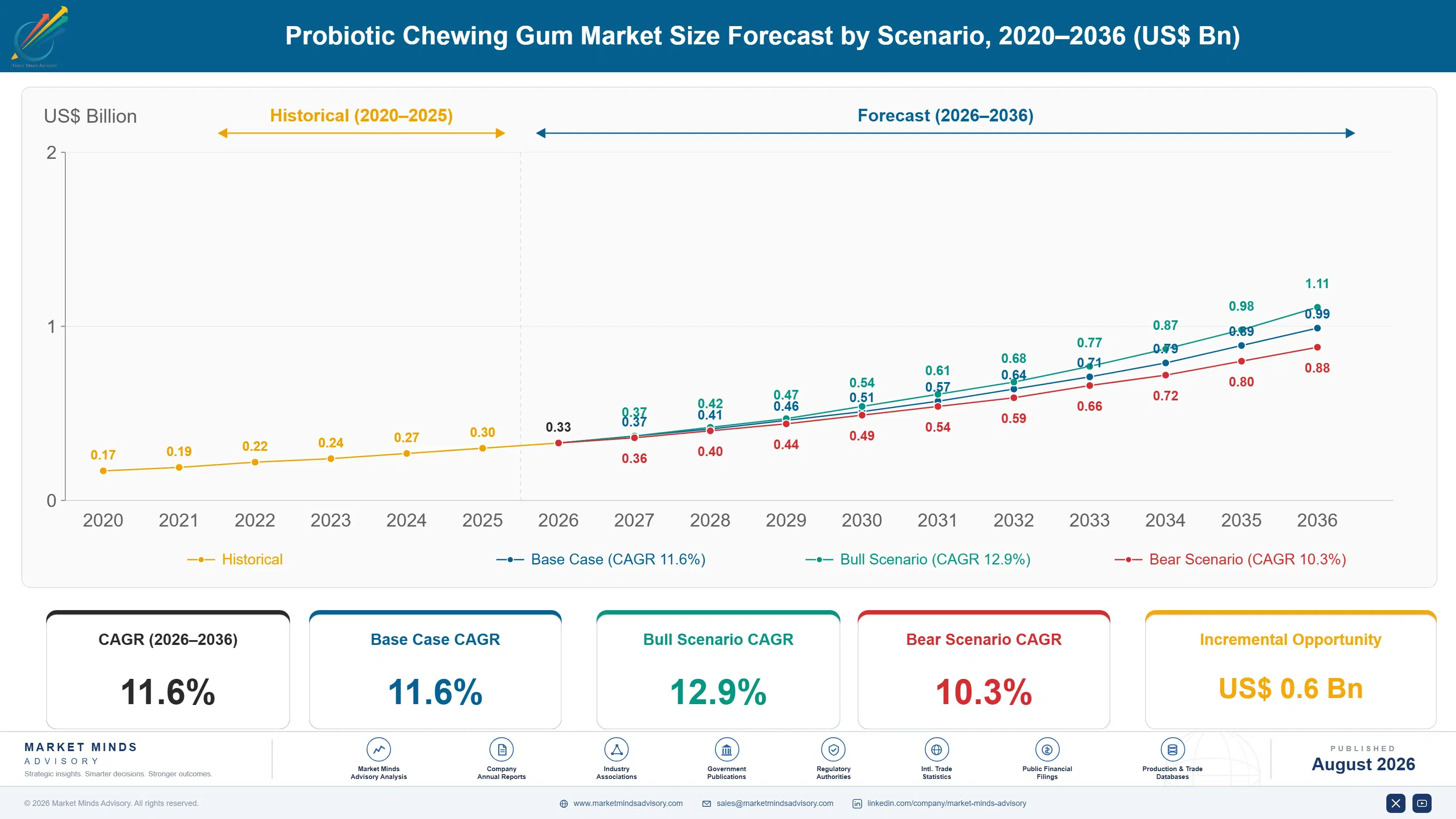
2036 FORECAST VALUE$1.0BBase Case , 2026 to 2036
CAGR 2026 TO 203611.6 %Bull 12.9% / Bear 10.3%
INCREMENTAL OPPORTUNITY$0.6BNet 10- year value creation
EXPANSION MULTIPLE3.00x2036 value over 2026 base
Strategic Levers
M&A Pipeline
Regional Outlook
Country Rankings
Competitive Intelligence
Segmental Deep-dive
Call-Us : 91 93563 13602

Executive Snapshot and Market Trajectory.

Chewing gum is a hostile place to put a live organism and an excellent place to deliver one, depending entirely on where it is meant to act. Gum holds bacteria against oral tissue for minutes and then leaves the mouth, so almost nothing reaches the gut. Destination decides it.
That splits the category cleanly. Oral and periodontal positioning has a delivery route that makes sense and clinical work behind specific strains, and it grows at 17.4%, half again the market rate of 11.6%. Digestive positioning has the larger share of shelf space and a delivery vehicle that does very little for the claimed endpoint. Roughly 59% of shelf space sits on the side where the route does not reach the endpoint.
Manufacturing follows the same logic. Hot extrusion kills the organisms, so roughly 78% of production uses cold compression, which excludes conventional gum manufacturers holding only extrusion lines and limits texture and flavour. Average viability at declared expiry sits near 34% of the labelled count. Retail pricing runs around 3.4 times conventional sugar-free gum, which is conspicuous on a confectionery shelf and unremarkable in a pharmacy.
Market Definition
Chewing gum products containing viable probiotic organisms and marketed on a functional health claim, spanning oral and periodontal, breath, digestive, immune, respiratory and general wellness positioning, measured at retail selling value. Excludes conventional and sugar-free chewing gum without probiotic content, probiotic lozenges and tablets, dental gum containing xylitol alone, and probiotic supplements in other formats.
Base Year Value
$0.3B in 2025 (MMA Primary Research Dataset, August 2026)
Forecast Period
2026 to 2036, eleven discrete annual values
CAGR
11.6% base case. Bull 12.9%. Bear 10.3%.
Fastest Growth Segment
Oral and Periodontal Health: 17.4% CAGR
Fastest Growth Country
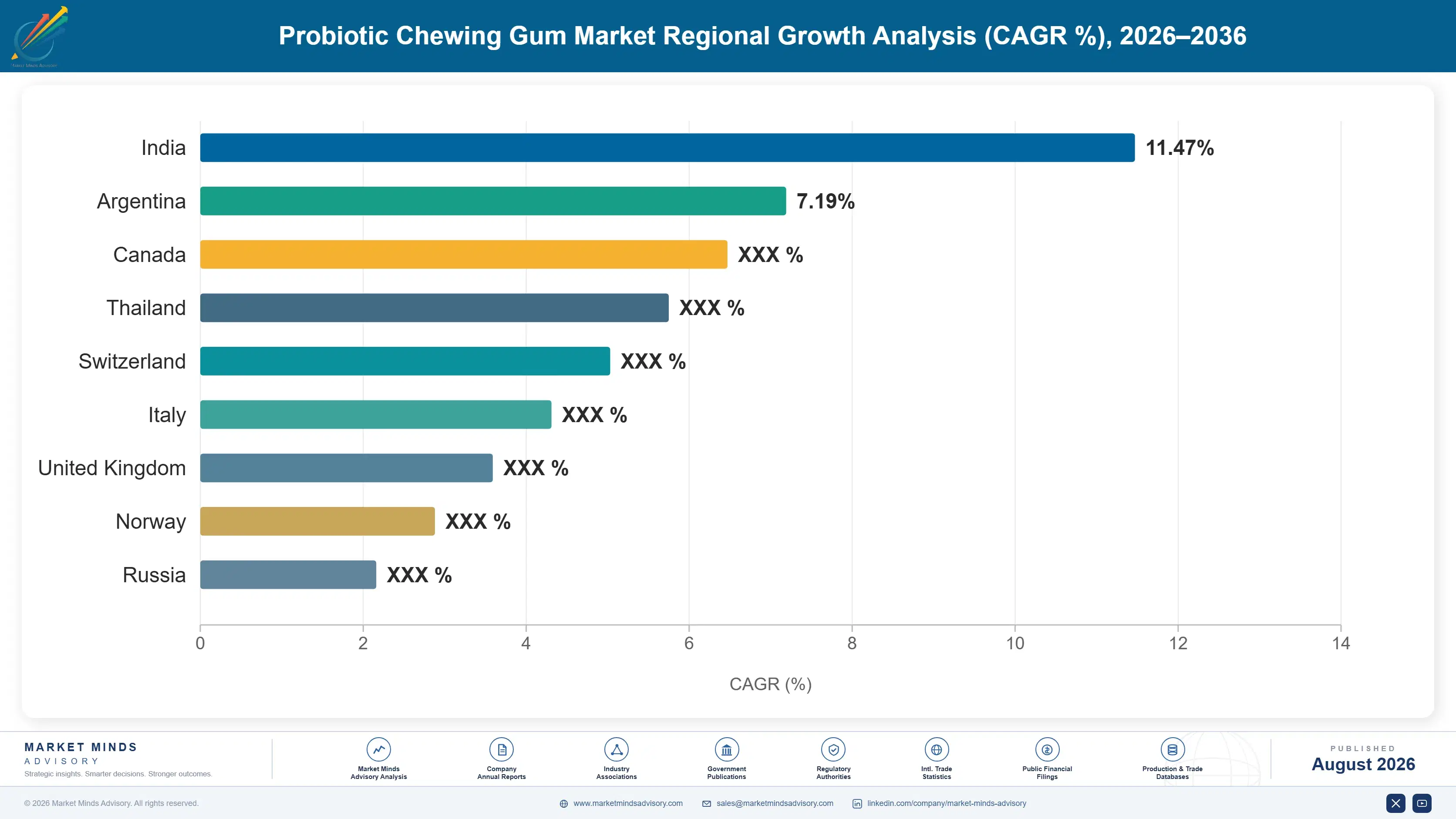
China: 14.8% CAGR
Fastest Growth Region
South Asia and Pacific: 13.8% CAGR
Largest Region
East Asia: 31% of 2025 global value
Market Leaders
BioGaia, Mars Wrigley, Perfetti Van Melle, Lotte, Mondelez International. Source: MMA Primary Research Dataset, July 2026.
Primary Survey
n=3,800 procurement and R&D decision-makers, Q4 2025, six countries
Methodology
Demand-side build-up, cross-validated against public data, 47 expert interviews

Probiotic Chewing Gum Market Forecast Scenarios

probiotic-chewing-gum-market-trends-size-forecast-scenario-1787580949967
Growth ran near 10.2% between 2020 and 2025 from a very small base, against a conventional gum category contracting roughly 3% annually across Western markets as social consumption occasions never fully recovered. Probiotic positioning was one of the few things adding value to a declining format. Strain specialists and confectionery majors entered from opposite directions and largely stayed in separate applications throughout.
Base case 11.6% rests on three mechanisms. Oral microbiome research continues producing evidence for specific strains against periodontal and halitosis endpoints, which is a delivery route gum genuinely suits. Dental professionals are recommending oral probiotics in a way they never did for gut formats. And Chinese and East Asian functional confectionery demand is growing quickly where oral care positioning carries unusual consumer weight. None of the three depends on conventional gum recovering.
The bull case at 12.9% assumes end of shelf life viability labelling becomes standard, which would advantage products that actually survive and clear out the ones that do not. The bear case at 10.3% is a regulator requiring claim substantiation for digestive positioning in gum, which would remove the larger share of current shelf space rather than merely repositioning it.

Right Place, Wrong Destination

A probiotic has to survive three things: manufacture, shelf life and the journey to wherever it is supposed to act. Gum handles the first two badly and the third depends entirely on the destination. Chewing holds organisms in contact with teeth, gums and tongue for several minutes, which is exactly what an oral probiotic needs, and then the gum is discarded and almost nothing is swallowed.
TOP FIVE CONCENTRATION31%Confectionery majors compete alongside the probiotic strain specialists
COLD COMPRESSION SHARE78%Portion produced by compression rather than hot extrusion
VIABILITY AT EXPIRY34%Organisms surviving to the declared expiry date on average
ORAL TARGETED SHARE41%Portion positioned for oral rather than digestive endpoints
RETAIL PRICE PREMIUM3.4xPrice against conventional sugar-free gum on a piece basis
BASE CATEGORY CONTRACTION3%Annual decline in conventional gum across Western markets
So a gum positioned for digestive health is delivering its payload to the wrong postcode. That is not a formulation failure, it is a category mismatch, and roughly 59% of shelf space sits on the wrong side of it. Oral positioning is the defensible half, with named strains carrying published work on periodontal markers and halitosis rather than general wellness language. Named strains carry published work rather than general wellness language.
Manufacture forces its own discipline. Hot extrusion, the standard gum process, reaches temperatures that kill the organisms, so roughly 78% of probiotic gum uses cold compression instead. That excludes conventional manufacturers holding only extrusion lines, limits achievable texture and flavour, and raises cost enough that retail pricing runs around 3.4 times conventional sugar-free gum. Conventional manufacturers holding only extrusion lines are excluded entirely.
"Half this category is a genuinely sensible oral care product and half of it is a supplement delivered through a route that throws most of the dose away. The second half sells perfectly well right now, which is the awkward part of saying so."
Principal, Functional Foods and Consumer Health Practice · MMA Healthcare and Nutrition Practice · August 2026

Market Trends

Oral microbiome research supporting specific named strains

Work on oral commensal organisms has produced published evidence for particular strains against periodontal markers and halitosis, which is a considerably narrower and better supported claim than general wellness positioning. Those strains are proprietary and licensed, which gives brands using them something a competitor cannot simply copy from an ingredient catalogue. Dental professionals recommend oral probiotics in a way they never did for digestive formats, and that recommendation carries weight the confectionery aisle cannot generate on its own. A strain a dentist can look up is worth more than confectionery brand equity here.
Market Impact: Supports a 3.4x price premium
Cold compression manufacturing excluding conventional gum makers

Hot extrusion is how chewing gum has been made for a century and it reaches temperatures that destroy probiotic organisms, so roughly 78% of this category is produced by cold compression instead. Compression gum has a different texture, a shorter chew and a narrower flavour range, which consumers notice. It also requires equipment conventional manufacturers do not have, which is why strain specialists and contract compressors hold positions that confectionery scale cannot displace by itself. Strain specialists and contract compressors hold positions that confectionery scale cannot displace by itself. Consumers notice the difference.
Market Impact: Delivers 14.8% annual Chinese growth

Market Opportunities and Growth Drivers

Dental professional recommendation reaching consumers directly

Dentists and hygienists increasingly discuss oral microbiome balance with patients and recommend specific probiotic strains alongside conventional oral care, which is a recommendation channel that did not exist for this category five years ago. A professional recommendation converts far better than any confectionery marketing and carries authority a gum brand cannot manufacture. It also pushes the purchase toward pharmacy and dental practice rather than the confectionery aisle, where the price premium of roughly 3.4 times is far less conspicuous. It also moves the purchase toward pharmacy and dental practice rather than the confectionery aisle.
Market Impact: Affects 59% of shelf space

East Asian functional confectionery demand growing quickly

China grows fastest anywhere at 14.8%, with Japanese and Korean consumers already accustomed to functional confectionery carrying specific health positioning rather than general wellness language. Oral care claims carry unusual weight across these markets, where breath and dental appearance are both socially salient. Domestic confectionery majors including Lotte, Meiji and Orion hold distribution that international brands find hard to contest. Growth here is genuine category creation rather than share taken from conventional gum. Domestic confectionery majors hold distribution that international brands find genuinely hard to contest across these markets. Category creation rather than substitution.
Market Impact: Leaves 34% viable at expiry

Market Restraints and Challenges

Digestive positioning delivering very little to the claimed site

A chewed and discarded gum sends almost nothing to the gut, so digestive positioning rests on a delivery route that does not reach the endpoint it claims. The root cause is category mismatch rather than any formulation failure, and roughly 59% of shelf space sits on that side. Commercially it works until a regulator asks for substantiation. Producers are repositioning toward oral endpoints where the route makes sense, and toward swallowable formats where digestive claims can actually be supported. It works commercially until a regulator asks for substantiation. Repositioning is the response.
Market Impact: Supports 41% oral targeted share

Viability at expiry falling well below declared counts

Average viability at the declared expiry date sits near 34% of the labelled organism count, since most products declare at manufacture rather than at end of shelf life. The root cause is that ambient storage across a long gum shelf life is genuinely hostile to live organisms, particularly under heat and humidity. Commercially it exposes the category if end of life declaration becomes standard. Producers are working on microencapsulation and spore-forming strains, and both approaches raise cost materially. Both approaches raise formulation cost materially. Heat and humidity do most of the damage during ambient storage.
Market Impact: Covers 78% of production
3 additional market trends, 4 additional growth drivers, and 2 additional restraints and challenges are covered in the full report. Contact sales@marketmindsadvisory.com to access the complete intelligence.

Segment CAGR and Growth Architecture

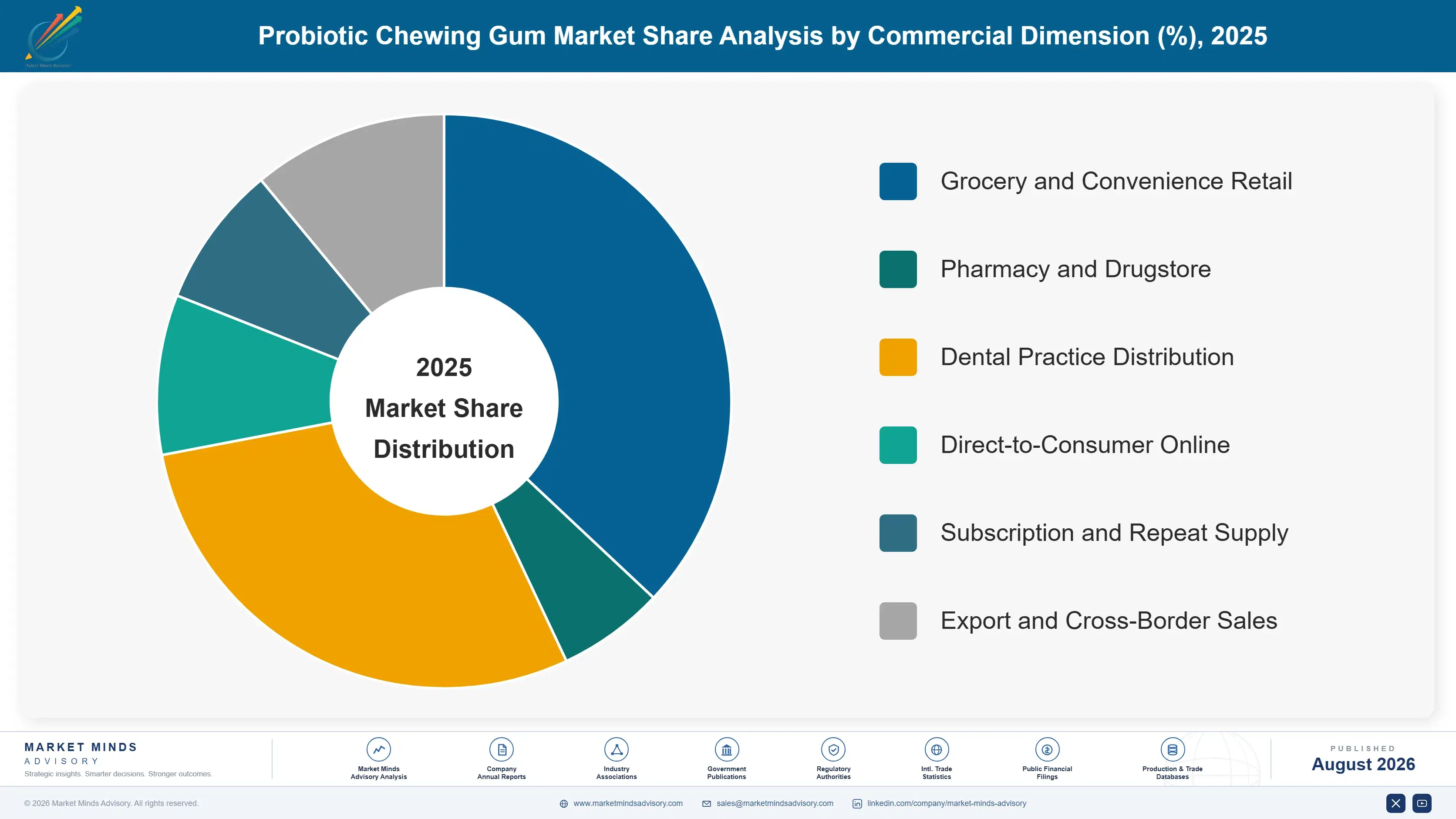
Six segments split by health positioning, because positioning determines whether the delivery route matches the claimed endpoint, what evidence exists and which channel sells the product. Oral and digestive claims share a format and almost nothing else. Consumer group and commercial channel are handled in the framework instead. Route and endpoint decide everything. Nothing else does.
probiotic-chewing-gum-market-trends-market-share-analysis-1787580950497

Oral and Periodontal Health

Growing at 17.4%, half again the market rate of 11.6%, oral positioning is the half of this category where the delivery vehicle matches the destination. Chewing holds organisms against teeth, gums and tongue for several minutes, which is what colonisation of oral surfaces requires, and named strains carry published work on periodontal markers rather than general wellness language. Dental professional recommendation is emerging as a genuine channel. Strains are proprietary and licensed, which gives brands something a competitor cannot lift from an ingredient catalogue, and pricing reflects that properly. Dental professional recommendation is emerging as a genuine channel, and it reaches consumers already thinking about oral health. Pricing reflects that properly.
CAGR 17.4%

Breath and Halitosis

At 15.2% breath positioning shares the oral delivery logic and adds an immediate, self-evident benefit that a consumer can assess without any clinical argument. Halitosis originates largely from volatile sulphur compounds produced by particular oral bacteria, and specific probiotic strains compete with those organisms rather than masking the result the way conventional mint gum does. That distinction is genuinely demonstrable to a user within days. The category overlaps heavily with conventional breath products, which means it competes on shelf against a far cheaper alternative that solves the problem temporarily. Conventional mint gum masks the result temporarily at a fraction of the price, which is the competitive problem on shelf. Verification takes days.
CAGR 15.2%
Full segment breakdown across 6 segments available in the complete report.

Regional Architecture and Country Demand Map

East Asia holds 31% of value, above its usual band, because functional confectionery is an established consumer category there and oral care claims carry unusual social weight. North America follows at 24% and Western Europe at 22% on dental professional channels that digestive positioning cannot access.

North America

Digestive positioning dominates the American shelf, which is the half of the category where the delivery route does least, and it reflects a consumer base familiar with gut health messaging from other formats. Oral positioning is growing faster from a smaller base, helped by dental practice recommendation that has developed genuinely over recent years. Conventional gum has contracted here as sharply as anywhere, which makes probiotic positioning one of few ways to add value to a declining format. Retail distribution splits awkwardly between confectionery aisles and supplement sections. Retail distribution splits awkwardly between confectionery aisles and supplement sections. Probiotic positioning is one of few ways to add value to a declining format.
Share: 24% | CAGR: 10.6% (2026 to 2036)

Western Europe

European claim regulation is the strictest anywhere and has constrained digestive positioning considerably more than in North America, which has pushed European products toward oral endpoints where evidence is narrower and better supported. Pharmacy distribution carries substantial volume, and pharmacist recommendation reaches consumers a confectionery aisle does not. Nordic and German markets show the highest oral probiotic penetration. BioGaia and other strain specialists hold strong European positions built on clinical work rather than on confectionery brand equity of any kind. Pharmacy distribution carries substantial volume and pharmacist recommendation reaches consumers a confectionery aisle never does. Nordic and German markets show the highest oral probiotic penetration anywhere in the region. Evidence rather than brand equity.
Share: 22% | CAGR: 10.1% (2026 to 2036)
Regional intelligence for 5 additional markets available in the complete report: East Asia, South Asia and Pacific, Latin America, Middle East and Africa, Eastern Europe. Contact sales@marketmindsadvisory.com.
probiotic-chewing-gum-market-trends-country-cagr-analysis-1787580951018

Four Moves in a Split Category

Half this market has a delivery route that matches its claim and half does not, and the second half is currently larger. Manufacturing excludes most confectionery scale, strains are licensed rather than generic, and the base category is shrinking underneath all of it. Positioning is the decision that matters. Everything else follows. Positioning first.

Reposition toward oral endpoints the format actually serves

Chewing holds organisms against oral tissue for minutes and then discards almost everything, which serves colonisation of the mouth and serves the gut hardly at all. Roughly 59% of shelf space carries digestive positioning that the route does not support. Moving a range toward oral and periodontal claims aligns the product with its own delivery mechanism and with the evidence that exists, and it also opens dental professional recommendation that digestive positioning cannot access at all. The evidence points the same way. Both point the same direction. Alignment is the whole move.
Market Impact: Repositions the 59% of shelf space now misaligned

License proprietary strains rather than commodity cultures

Named oral strains carry published work on periodontal markers and halitosis and are licensed rather than freely available, which gives a brand something a competitor cannot lift from a catalogue. Licensing costs royalties and buys both evidence and exclusivity in one arrangement. Commodity cultures deliver neither, and a product built on them competes purely on price in a category where the retail premium already runs around 3.4 times conventional gum. That is not a position worth defending. Catalogue cultures deliver neither. Exclusivity comes with the evidence. Price competition is the alternative.
Market Impact: Defends a 3.4x premium over conventional gum pricing

Declare viability at expiry before anyone requires it

Average viability at the declared expiry date sits near 34% of the labelled count, because most products declare at manufacture. A producer whose organisms genuinely survive can declare at end of shelf life and make a comparison competitors cannot match, ahead of any regulator requiring it. Microencapsulation and spore-forming strains both improve survival at real cost. The declaration itself costs nothing and turns a formulation investment into a visible claim on pack. Most producers spend on the number instead. Survival is the harder investment. Declaration costs nothing extra. The claim is visible on pack.
Market Impact: Beats a 34% average survival rate at expiry

Sell through pharmacy and dental practice, not confectionery

A 3.4 times premium over conventional gum is conspicuous on a confectionery shelf and unremarkable in a pharmacy, where the comparison set is oral care rather than sweets. Dental professional recommendation converts far better than any confectionery marketing and reaches consumers when they are already thinking about oral health. Building that channel requires professional education material and practice sampling rather than retail spend, and it costs considerably less than fighting for confectionery shelf position. Retail spend buys far less here. Three minutes with a hygienist beats four seconds at a display.
Market Impact: Moves a 3.4x premium off the confectionery shelf

Who Controls the Margin Pool

Participation is measured on retail sales value of probiotic chewing gum, and the top five hold 31%. The field divides between confectionery majors with distribution and no strain position, and probiotic specialists with strains and clinical work but limited retail reach. BioGaia leads on clinical strain ownership rather than on volume. The gap between the two groups is capability rather than scale, and neither easily acquires the other's.
Competition therefore runs on complementary rather than overlapping strengths. Strain ownership and clinical evidence decide credibility and professional recommendation. Cold compression manufacturing capability decides who can produce at all, since extrusion destroys the organisms and most confectionery capacity is extrusion. Distribution decides reach, and the pharmacy and dental channels that suit the price premium are not where confectionery companies are strongest.

The pressure ahead is regulatory clarity on digestive claims. A substantiation requirement would remove roughly 59% of current shelf positioning rather than repositioning it, which falls hardest on confectionery majors who entered on gut health messaging. Expect licensing arrangements and contract compression rather than acquisitions. Rankings shift as oral positioning grows and as professional recommendation channels mature into something confectionery marketing cannot match.
probiotic-chewing-gum-market-trends-company-positioning-matrix-1787580951543

Competitive Moat and Risk Dimensions

BIOGAIA

Moat: Clinical strain ownership and evidence

BioGaia owns strains with published clinical work behind them and licenses them rather than selling commodity cultures, which gives products built on them evidence and exclusivity together. In a category where professional recommendation is emerging as the decisive channel, a strain a dentist can look up is worth considerably more than confectionery brand equity.
BIOGAIA

Risk: Limited confectionery retail reach

Distribution strength sits in pharmacy and professional channels rather than in the confectionery aisle where most gum volume still moves, and building that reach means competing for shelf against companies whose entire commercial machinery is built for it. Licensing strains to those companies generates revenue and also arms competitors with the evidence that distinguishes the business.
MARS WRIGLEY

Moat: Gum distribution and category scale

Mars Wrigley holds gum distribution and shelf position across virtually every market, built over decades in a category it substantially defines. When a functional variant reaches mainstream retail, no competitor can match the placement, promotional support or supply reliability that distribution machine provides almost automatically.
MARS WRIGLEY

Risk: Extrusion capacity and strain dependence

Conventional gum capacity is hot extrusion, which destroys probiotic organisms and cannot be used for this category without new compression equipment. The strains that carry credible evidence are licensed from specialists rather than owned, which leaves the differentiating element in somebody else's hands while the manufacturing constraint sits in nobody's favour.

Players Tracked

Prominent Players

BioGaia
Mars Wrigley
Perfetti Van Melle
Lotte
Mondelez International

Other Key Players

BLIS Technologies
Novonesis
Lallemand
ProBiora Health
Fertin Pharma
Sunstar
Haleon
Colgate-Palmolive
Church and Dwight
Meiji Holdings
Ezaki Glico
Orion Corporation
Kanro
DSM-Firmenich
Probi AB

Recent Developments

FEBRUARY 2026

Dental association guidance references oral probiotics alongside conventional care

A national dental association referenced oral probiotic use alongside conventional oral hygiene in patient guidance, citing evidence for specific strains against periodontal markers. The guidance is professional rather than regulatory and reached practitioners who advise patients directly on product selection. No product endorsement was made.
Signal: Professional recommendation is a channel that digestive positioning cannot access, which separates the two halves further
SEPTEMBER 2025

Producer declares organism count at expiry rather than at manufacture

A probiotic gum producer moved to declaring viable organism counts at the end of shelf life rather than at manufacture, supported by microencapsulation improving survival through ambient storage. The change is voluntary and no regulator currently requires end of life declaration in the affected markets.
Signal: Declaring at expiry is a comparison that competitors carrying poor survival simply cannot answer anywhere on pack
JUNE 2026

Confectionery major contracts compression capacity for functional gum range

A confectionery company contracted external cold compression capacity for a probiotic gum range, since its own manufacturing is hot extrusion throughout and cannot preserve viable organisms. The arrangement is contract manufacturing rather than any investment in owned compression equipment. Owned capacity was never considered. Volumes were not disclosed.
Signal: Extrusion capacity is useless in this category, which stops confectionery scale translating into any manufacturing advantage

Cultures, Gum Base and Compression

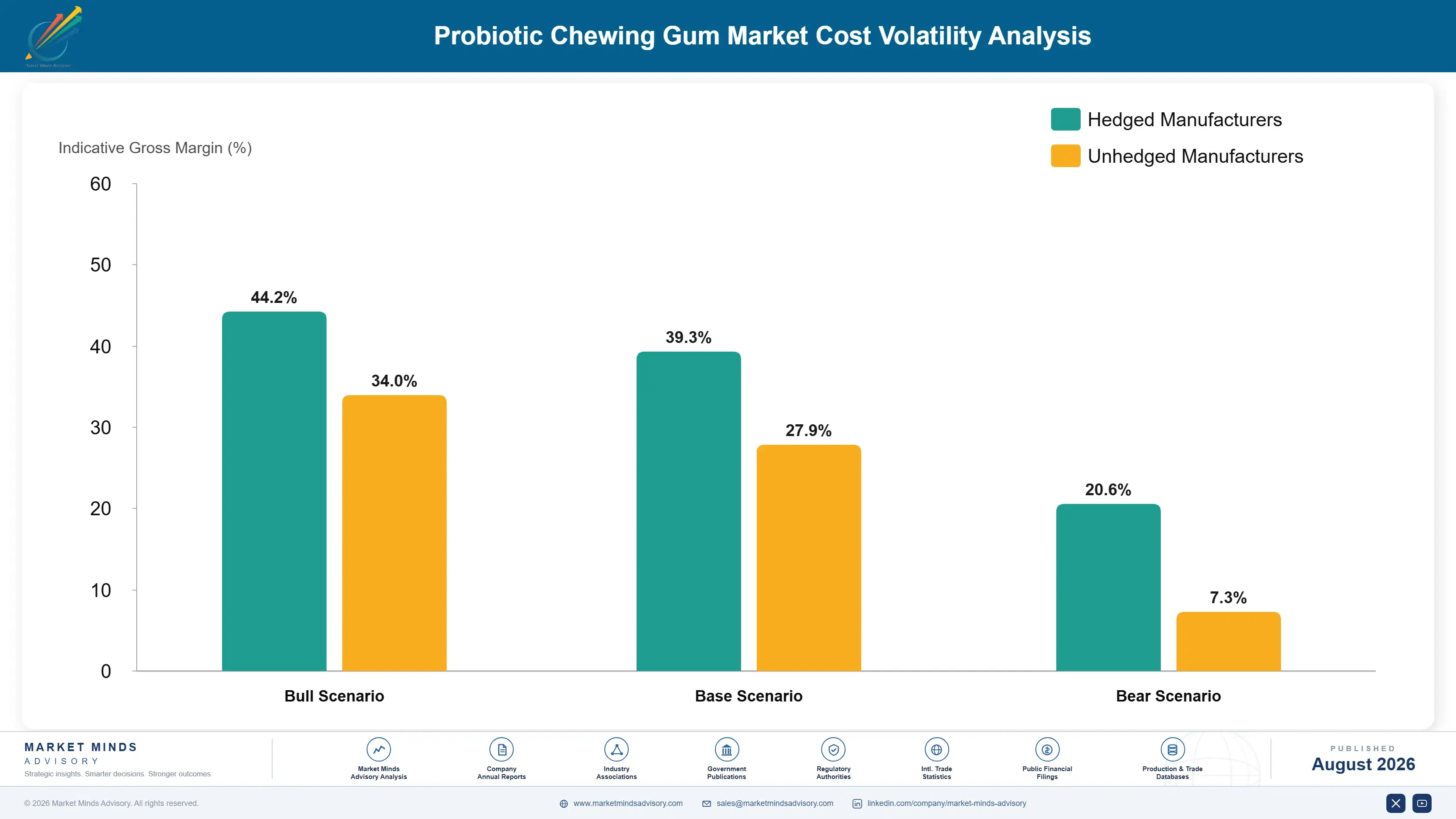
Probiotic cultures account for roughly 31% of product cost, with licensed clinical strains costing several times commodity cultures and microencapsulation adding further. Gum base, sweeteners and flavours carry about 27%, considerably less than in conventional gum because piece counts are smaller. Cold compression manufacturing takes a further 24%, which is more than extrusion would cost at equivalent volume and reflects both slower throughput and specialised equipment.
Culture pricing has been stable relative to other inputs, though licensed strain royalties rose across the industry as clinical evidence accumulated and strain owners repriced accordingly. Microencapsulation materials moved with wider excipient pricing through 2022. The larger cost story is manufacturing rather than ingredients, since cold compression capacity is scarce and contract compressors have held pricing power that ingredient suppliers have not. Compression capacity remains the binding constraint.

Exposure divides on strain position and manufacturing access. A producer licensing a proprietary strain pays royalties and gets evidence, while one using commodity cultures pays less and competes on price in a premium category. Manufacturing access is the sharper divide: producers with owned compression capacity control cost and schedule, while those contracting it compete for capacity that is genuinely limited across most regions.
probiotic-chewing-gum-market-trends-cost-volatility-analysis-1787580951738

Secure cold compression capacity on multi-year terms

Compression capacity is scarce relative to demand and contract compressors have held pricing power accordingly, which leaves producers without owned equipment exposed on both cost and schedule. Multi-year capacity agreements cost commitment flexibility and secure the ability to launch when planned. Several brands have missed launch windows entirely for want of available compression slots.

Weigh strain licensing against evidence value carefully

Licensed clinical strains cost several times commodity cultures in royalties and deliver published evidence and exclusivity alongside. In a category where professional recommendation is the emerging channel, that evidence is what the royalty actually buys. Commodity cultures make sense only where the product competes purely on price, which is a difficult position at a 3.4 times premium.

Invest in survival before investing in declared count

Declaring a high organism count at manufacture costs little and means little if 34% survives to expiry. Microencapsulation and spore-forming strain selection both improve survival at real formulation cost, and they convert into an end of life declaration competitors cannot match. Spending on the count rather than the survival is the more common choice and the less defensible one.

Portfolio Architecture for Margin Defence

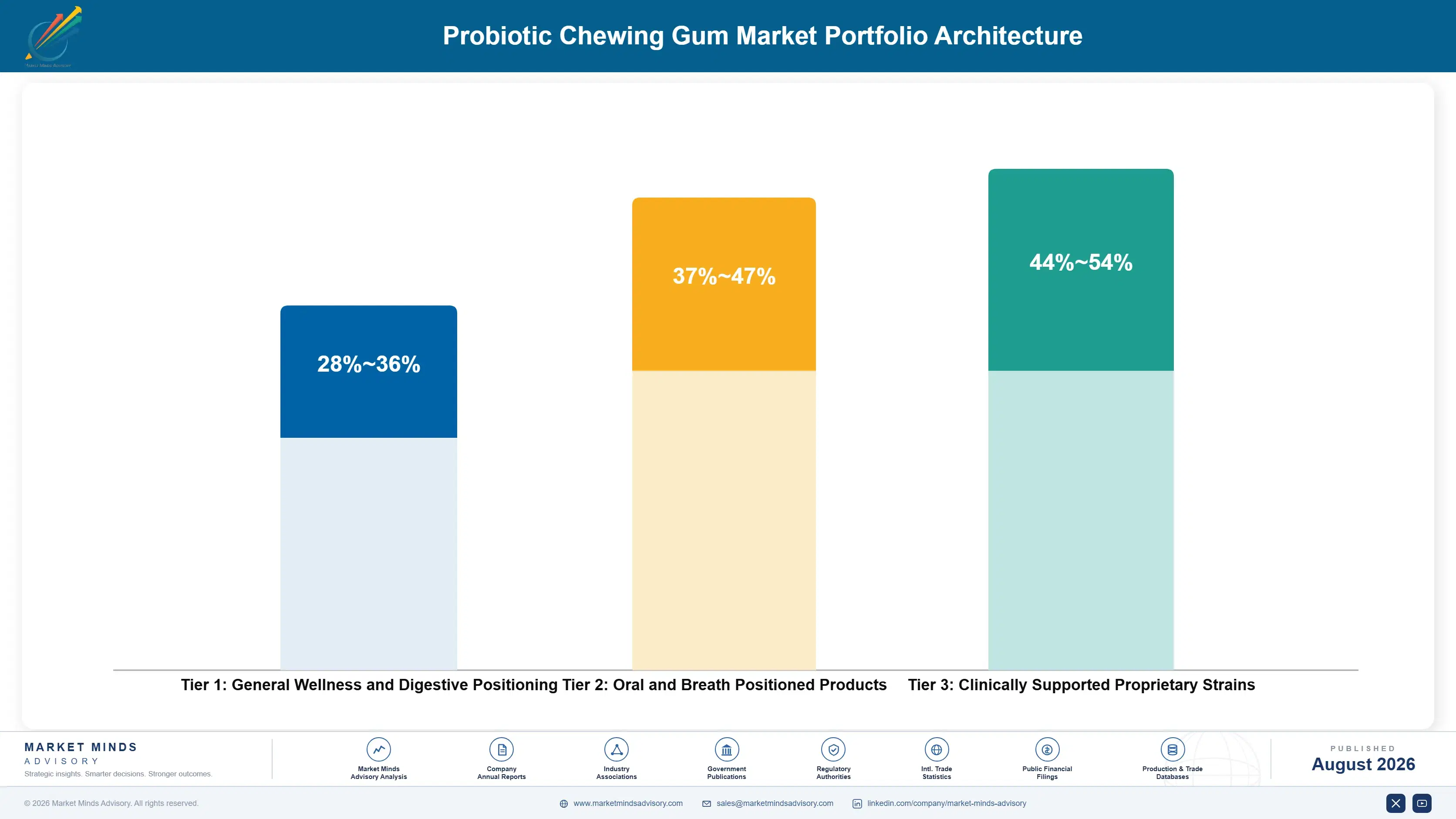
Margin here tracks evidence and channel rather than formulation cost. General wellness and digestive positioned products earn margins in the low thirties, which is respectable until the promotional support required to hold confectionery shelf position against a far cheaper conventional alternative is deducted from it. Holding shelf against a far cheaper conventional alternative consumes most of the difference.
Oral and breath positioned products do better in the high thirties to high forties, because the delivery route matches the claim, the evidence is narrower and better supported, and pharmacy placement puts the price premium against oral care rather than against sweets. The range reflects strain ownership and whether professional recommendation supports the product. Pharmacy placement puts the premium against oral care rather than against sweets.

Clinically supported proprietary strain products hold the strongest position, running into the low fifties, where licensed evidence and professional recommendation combine to remove price comparison almost entirely. Those margins reflect the royalty being an investment rather than a cost, and they persist while the evidence base stays exclusive to the licensor. The royalty is an investment rather than a cost in that arrangement.

General Wellness and Digestive Positioning

Products using commodity cultures and general health language sold through confectionery retail. The eight point range reflects promotional support required to hold shelf against far cheaper conventional gum alternatives. Volume is substantial and defensibility is not.
Gross Margin: 28-36%

Oral and Breath Positioned Products

Products where the delivery route matches the claimed endpoint, sold increasingly through pharmacy alongside oral care. The ten point range reflects strain ownership and whether professional recommendation supports the product.
Gross Margin: 37-47%

Clinically Supported Proprietary Strains

Products built on licensed strains carrying published clinical work on defined oral endpoints. The ten point range reflects depth of evidence and exclusivity terms, which vary considerably between licensing arrangements.
Gross Margin: 44-54%
probiotic-chewing-gum-market-trends-portfolio-architecture-1787580952238

High-value Sub-segments and Strategic Watch-out

Clinical Strain Oral Products

High value and the fastest growth at 17.4%, where the delivery route matches the destination and licensed strains carry published evidence. Professional recommendation removes price comparison in a way retail marketing never manages. Licensed evidence is what removes the comparison entirely. Professional channels convert far better.
Gross Margin: 46-54%

Breath and Halitosis Positioning

High value and growing at 15.2% on a benefit a consumer can verify within days without any clinical argument. Competes on shelf against far cheaper mint gum that masks the problem rather than addressing it. Verification within days is a rare advantage. Mint gum is far cheaper.
Gross Margin: 39-47%

Digestive Positioned Products

The volume core and the position where the delivery route does least for the claim. Roughly 59% of shelf space sits here, and a substantiation requirement would remove it rather than reposition it. Repeat purchase runs at half the oral rate. Substantiation would remove it.
Gross Margin: 28-36%

Commodity Culture Formulations

The strategic watch-out. Products built on catalogue cultures carry no evidence and no exclusivity while charging a 3.4 times premium, which is a position that fails the moment a consumer compares anything. No evidence and no exclusivity at a premium price. Any comparison exposes it.
Gross Margin: 22-34%

How the Pack Gets Rebought

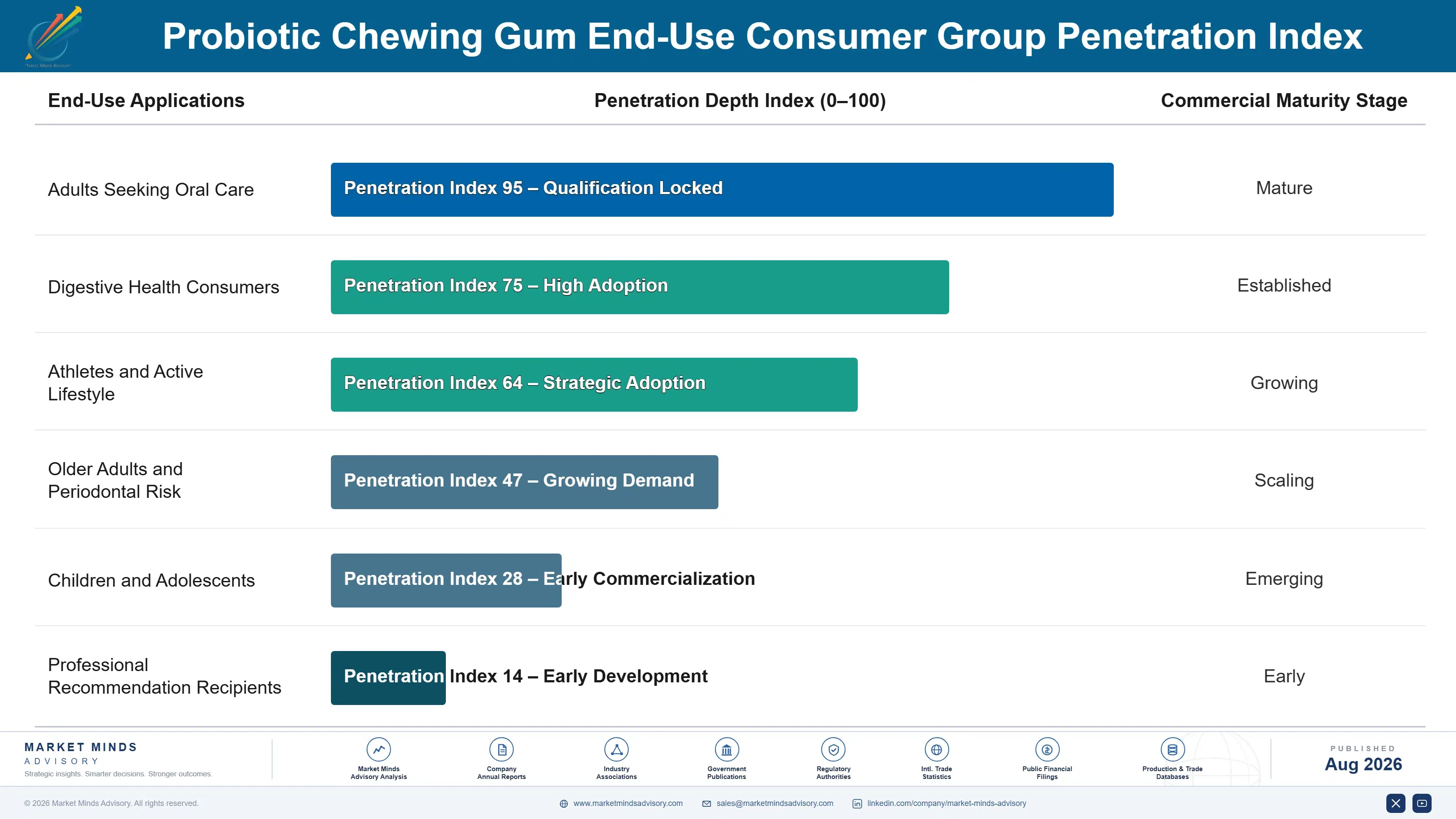
Probiotic gum is bought as a course in oral positioning and as an occasion in confectionery positioning, which produces entirely different repeat behaviour from the same format. A consumer using it for periodontal or breath purposes takes it daily and reorders predictably. A consumer who bought it from a confectionery shelf treats it as a variant of gum and returns to conventional product when the novelty passes.
Stickiness therefore follows positioning rather than product. Professionally recommended oral products are stickiest, since a dentist's recommendation carries through repeat purchase and the consumer is treating it as oral care rather than confectionery. Breath positioning is moderately sticky where the benefit is noticed. Digestive and general wellness positioning shows the weakest repeat, which is consistent with a delivery route that does not reach the claimed endpoint.

The specifying influence has moved partly outside retail. Confectionery purchases are made at the shelf on packaging and price. Oral positioning increasingly follows a dental practice conversation, which means the brand's real audience is a hygienist with three minutes at the end of an appointment rather than a shopper with four seconds at a display.
probiotic-chewing-gum-market-trends-end-use-penetration-index-1787580952725

Where We Would Commit Capital

These are among the four positions where our research anticipates prominent divergence between winners and laggards over the coming forecast period. Each is grounded in the demand model, the regulatory perimeter, and the announced capacity pipeline.
01 / POSITIONING REALIGNMENT WORK

Move the range to the endpoint the format actually reaches

Chewing holds organisms against oral tissue for several minutes and then discards nearly everything, which serves colonisation of the mouth well and serves the gut almost not at all. Roughly 59% of current shelf space carries digestive positioning that the delivery route simply cannot support. Repositioning toward oral and periodontal claims aligns the product with its own mechanism and with the evidence that exists, and it opens the dental professional recommendation channel that digestive positioning can never access at all.
02 / PROPRIETARY STRAIN LICENSING

Pay the royalty, because it buys the evidence as well

Named oral strains carry published work on periodontal markers and halitosis and are licensed rather than freely available from any catalogue. The royalty buys published evidence and exclusivity together in a single arrangement, which is exactly what professional recommendation requires and what commodity cultures cannot provide at all. A product built on catalogue cultures competes purely on price while charging a premium around 3.4 times conventional gum, and that is not a commercial position worth defending for very long at all.
03 / SURVIVAL OVER DECLARATION

Spend on organisms that live, then declare at expiry

Average viability at the declared expiry date sits at around 34% of the labelled count, because most producers declare at manufacture and then spend on the number rather than on actual survival. Microencapsulation and spore-forming strain selection both improve survival at genuine formulation cost to the producer, and a producer whose organisms actually last can declare at end of shelf life. That is a comparison which competitors carrying poor survival simply cannot answer on pack at any price at all.
04 / CHANNEL RELOCATION STRATEGY

Put the premium in a pharmacy, not on a sweet shelf

A premium around 3.4 times conventional gum is conspicuous on a confectionery shelf and entirely unremarkable in a pharmacy, where the comparison set is oral care products rather than sweets on a display. Dental professional recommendation converts considerably better than any confectionery marketing does and reaches consumers already thinking about oral health. Building the channel needs professional education and practice sampling rather than retail promotional spend, and it costs considerably less than fighting for confectionery shelf position year after year.

Engagement Snapshot From the Field

A live engagement with an industry participant carrying material or product regulatory and market exposure ahead of a defining policy shift, showing how our research translates into a defensible multi-year portfolio strategy.
MARKET MINDS ADVISORY · CLIENT ENGAGEMENT SUMMARY
Probiotic Chewing Gum Producer Strategic Portfolio Review and Transition Roadmap 2026·Investment Scenario on Probiotic Chewing Gum Exposure Evaluation 2025-26
CLIENT PROFILE
A European functional confectionery brand selling probiotic chewing gum across five markets through grocery and convenience retail, with annual revenue near 41 million euros (client-reported, unverified by MMA). The range used commodity cultures under digestive health positioning, and organism counts were declared at manufacture in line with category practice. No strain licence was held at all.
STRATEGIC CHALLENGE
Repeat purchase had fallen for six consecutive quarters and promotional support required to hold shelf position had risen to a level management could not sustain. A European regulator had separately opened a review of digestive claims on formats where delivery to the gut was limited. Management needed to decide whether to reposition, reformulate or exit.
MMA APPROACH
MMA tested consumer repeat behaviour by positioning across the client's markets using the quantitative survey base, measured organism viability at expiry across the range and against six competitors, and assessed dental professional channel receptivity in three markets. Strain licensing terms were reviewed with two licensors. Interviews with 47 experts covered oral microbiome research, probiotic formulation and pharmacy channel management.
KEY FINDINGS
  1. Repeat purchase among digestive positioned buyers was less than half that of oral positioned competitors, consistent with a delivery route that does not reach the claimed endpoint.
  2. Measured viability at expiry across the client's range averaged 31% of declared count, below two competitors using microencapsulation and above three others using none.
  3. Dental practices in all three markets tested were receptive to oral probiotic sampling and none had been approached by any confectionery brand previously.
  4. Licensed clinical strains would raise ingredient cost materially while removing the promotional spend that is currently required to defend confectionery shelf position entirely.
CLIENT PROFILE
A European functional confectionery brand selling probiotic chewing gum across five markets through grocery and convenience retail, with annual revenue near 41 million euros (client-reported, unverified by MMA). The range used commodity cultures under digestive health positioning, and organism counts were declared at manufacture in line with category practice. No strain licence was held at all.
STRATEGIC CHALLENGE
Repeat purchase had fallen for six consecutive quarters and promotional support required to hold shelf position had risen to a level management could not sustain. A European regulator had separately opened a review of digestive claims on formats where delivery to the gut was limited. Management needed to decide whether to reposition, reformulate or exit.
MMA APPROACH
MMA tested consumer repeat behaviour by positioning across the client's markets using the quantitative survey base, measured organism viability at expiry across the range and against six competitors, and assessed dental professional channel receptivity in three markets. Strain licensing terms were reviewed with two licensors. Interviews with 47 experts covered oral microbiome research, probiotic formulation and pharmacy channel management.
KEY FINDINGS
  1. Repeat purchase among digestive positioned buyers was less than half that of oral positioned competitors, consistent with a delivery route that does not reach the claimed endpoint.
  2. Measured viability at expiry across the client's range averaged 31% of declared count, below two competitors using microencapsulation and above three others using none.
  3. Dental practices in all three markets tested were receptive to oral probiotic sampling and none had been approached by any confectionery brand previously.
  4. Licensed clinical strains would raise ingredient cost materially while removing the promotional spend that is currently required to defend confectionery shelf position entirely.
RECOMMENDED STRATEGY
Phase 1: Phase one: reposition the range onto oral and breath endpoints, since repeat purchase there runs at more than double the digestive positioned rate. Phase 2: Phase two: license a clinical strain and invest in microencapsulation, funding both from the promotional spend that confectionery shelf defence currently consumes. Phase 3: Phase three: build pharmacy and dental practice distribution, where the price premium sits against oral care rather than against conventional gum.
OUTCOME
The brand repositioned onto oral endpoints during 2026 and reported repeat purchase roughly doubling within three quarters (client-reported, unverified by MMA). A clinical strain licence was signed, promotional spend on confectionery shelf defence was withdrawn, and pharmacy distribution opened in two of the five markets.

Frequently Asked Questions

Foundational context covering the market sizes, CAGR, scope, country, region and competition that inform every finding below. This section is provided to cover basics and most often pre-purchase conversations, answered from the MMA Primary Research Dataset.

What is the current size of the Probiotic Chewing Gum Market?

MMA sizes it at USD 0.29 billion in 2025, rising to USD 0.32 billion in 2026. The figure covers chewing gum containing viable probiotic organisms marketed on a functional health claim.

How large will the Probiotic Chewing Gum Market be by 2036?

USD 0.96 billion by 2036, an incremental USD 0.64 billion over the 2026 base and an expansion multiple of 3.00 times. Oral positioned products account for most of that addition.

What is the CAGR for the Probiotic Chewing Gum Market 2026 to 2036?

11.6% in the base case, with a bull case at 12.9% and a bear case at 10.3%. The spread turns on how regulators treat digestive claims on a format that reaches the gut poorly.

Which segment is growing fastest?

Oral and periodontal health at 17.4%, half again the market rate of 11.6%. Chewing holds organisms against oral tissue for minutes, which is exactly what oral colonisation requires.

Who are the major companies in the Probiotic Chewing Gum Market?

BioGaia, Mars Wrigley, Perfetti Van Melle, Lotte and Mondelez International lead on retail sales value. Fifteen further participants are profiled in the full report on that basis.

Which country is growing fastest?

China at 14.8%, where functional confectionery is an established consumer category and oral care claims carry unusual social weight across tier one and tier two cities.

Report Segmentation Architecture

The full report scope spans multiple orthogonal segmentation dimensions, with cross-tabulated demand data provided for each dimension pair. Coverage extends further to regional breakdowns, trend trajectories, and the competitive detail needed to support segment-level decision-making.

By Health Positioning

  • Oral and Periodontal Health
  • Breath and Halitosis
  • Digestive and Gut Health
  • Immune Support
  • Upper Respiratory and Throat
  • General Wellness and Blended Claims

By End-Use Consumer Group

  • Adults Seeking Oral Care
  • Digestive Health Consumers
  • Athletes and Active Lifestyle
  • Older Adults and Periodontal Risk
  • Children and Adolescents
  • Professional Recommendation Recipients

By Commercial Dimension

  • Grocery and Convenience Retail
  • Pharmacy and Drugstore
  • Dental Practice Distribution
  • Direct-to-Consumer Online
  • Subscription and Repeat Supply
  • Export and Cross-Border Sales

By Region

  • North America
  • Western Europe
  • East Asia
  • South Asia and Pacific
  • Latin America
  • Middle East and Africa
  • Eastern Europe

Scope, Methodology, and Coverage

Every figure in this report is reproducible from documented input assumptions. The scope below maps the historical period, the forecast horizon, the segmentation dimensions, and the countries covered, alongside the underlying primary and qualitative methodology.
Historical Period
2020 to 2025
Forecast Period
2026 to 2036
Base Year
2025 (USD billions; MMA Primary Research Dataset, August 2026)
Market Definition
Chewing gum products containing viable probiotic organisms and marketed on a functional health claim, spanning oral and periodontal, breath and halitosis, digestive, immune support, respiratory and general wellness positioning, measured at retail selling value. Conventional and sugar-free chewing gum without probiotic content, probiotic lozenges, tablets and capsules, dental gum containing xylitol or other agents alone, and probiotic supplements in any other format are excluded from scope entirely.
Quantitative Units
USD billions (current prices); million packs sold annually; USD per pack by health positioning and channel
Segmentation Dimensions
Health positioning; end-use consumer group; commercial dimension; region
Regions Covered
North America, Western Europe, East Asia, South Asia and Pacific, Latin America, Middle East and Africa, Eastern Europe
Countries Covered
United States, Canada, Mexico, Germany, Sweden, Denmark, United Kingdom, France, Italy, China, Japan, South Korea, India, Indonesia, Australia, Brazil, Colombia, United Arab Emirates, South Africa, Poland
Key Companies Profiled
BioGaia, Mars Wrigley, Perfetti Van Melle, Lotte, Mondelez International, BLIS Technologies, Novonesis, Lallemand, ProBiora Health, Fertin Pharma, Sunstar, Haleon, Colgate-Palmolive, Church and Dwight, Meiji Holdings, Ezaki Glico, Orion Corporation, Kanro, DSM-Firmenich, Probi AB
Quantitative Methodology
Primary survey, n=3,800 respondents, Q4 2025, six countries; demand-side model with trade association cross-validation
Qualitative Methodology
47 expert interviews, Q4 2025; applied to validate demand model assumptions, identify emerging dynamics, and assess competitive positioning
Report Format
PDF and XLSX data workbook (Word format preview document)
Publisher
Market Minds Advisory
Report Code
MMA-2026-HLT-121
Published
August 2026
Contact
sales@marketmindsadvisory.com | www.marketmindsadvisory.com

Purchase the full Probiotic Chewing Gum Market Report (2026 to 2036).

The full report separates the half of this category where the delivery route matches the claim from the half where it does not, and sizes each positioning independently through 2036. It measures organism viability at expiry against declared counts across the competitive set, assesses evidence quality by strain and endpoint, and tracks dental professional channel development by market. Regional chapters cover all seven regions with channel detail across grocery, pharmacy and professional routes. Competitive profiling covers 20 participants on a single retail value basis, with cold compression capacity mapped across contract manufacturers.
Each health positioning sized independently through 2036
Viability at expiry measured against declared organism counts
Evidence quality assessed by strain and clinical endpoint
Dental professional channel development tracked by market
Twenty participants profiled on one consistent basis
Cold compression capacity mapped across contract manufacturers

Built For The People Who Decide

From boardroom strategy to bench-side execution, this report is read cover-to-cover by leaders shaping the next decade of their industry, turning demand scenarios, market dynamics and valuation benchmarks into decisions.
CXOs/ Presidents/ VPs/ Managers
M&A and Corporate Development
Strategy Teams and R&D Heads
Procurement and Product Directors
Regulatory and Compliance Leaders
Investor Relations and Equity Analysts