Market Minds Advisory
Printing Toners Market

Printing Toners Market: Printing Toners Market. Remanufactured Cartridge Growth Reshapes Enterprise Procurement Demand

Rising remanufactured cartridge adoption, expanding compatible cartridge price competition, and growing enterprise sustainability procurement mandates are reshaping toner purchasing across OEM, aftermarket, and managed print retail channels worldwide. each procurement cycle.

Lead Analyst

Published

September 2026

Make Smarter Decisions with Customized Research Insights

Request a free sample report and evaluate market opportunities, growth trends, and competitive dynamics relevant to your business needs.

2025 MARKET VALUE$15.8BMarket Size 2025
2036 FORECAST VALUE$23.1BBase Case , 2026 to 2036
CAGR 2026 TO 20363.5 %Bull 4.7% / Bear 2.3%
INCREMENTAL OPPORTUNITY$6.7BNet 10- year value creation
EXPANSION MULTIPLE1.41x2036 value over 2026 base
Strategic Levers
M&A Pipeline
Regional Outlook
Country Rankings
Competitive Intelligence
Segmental Deep-dive
Call-Us : 91 93563 13602

Executive Snapshot and Market Trajectory.

Remanufactured toner cartridges are reshaping the market fastest right now, propelled by enterprise sustainability procurement mandates that now formally require documented cartridge recycling and reuse programs. Manufacturers are responding by expanding certified remanufacturing programs that meet corporate sustainability reporting requirements ahead of regulatory disclosure deadlines already in effect. today.
Commercial momentum concentrates around compatible cartridge price competition, managed print service consolidation, and rising remanufactured adoption, with East Asia and North America together anchoring the largest share of global purchasing across nearly every retail and enterprise procurement channel tracked. Retailers report the strongest growth within compatible and remanufactured categories rather than premium OEM cartridges favored by earlier generations of enterprise purchasers.
The competitive field remains concentrated around a handful of dominant OEM printer manufacturers, though independent aftermarket suppliers continue capturing share within compatible and remanufactured segments the OEM incumbents address less aggressively on price. Independent aftermarket suppliers slower to invest in quality certification risk losing enterprise contracts to established OEM manufacturers with deeper compliance infrastructure. These smaller aftermarket suppliers often move faster on pricing, though they lack the certification budgets supporting the strongest enterprise procurement contracts.
Market Definition
The Printing Toners Market covers OEM, compatible, and remanufactured toner cartridges for laser printing and copying devices. It excludes inkjet cartridges, printing paper, and non-toner imaging consumables.
Base Year Value
$15.8B in 2025 (MMA Primary Research Dataset, September 2026)
Forecast Period
2026 to 2036, eleven discrete annual values
CAGR
3.5% base case. Bull 4.7%. Bear 2.3%.
Fastest Growth Segment
Remanufactured Toner Cartridges: 6.0% CAGR
Fastest Growth Country
India: 5.5% CAGR
Fastest Growth Region
South Asia and Pacific: 5.5% CAGR
Largest Region
East Asia: 28% of 2025 global value
Market Leaders
HP Inc, Canon, Epson, Brother Industries, and Xerox lead the global competitive field. Source: MMA Analysis, company annual reports and investor filings, 2025.
Primary Survey
n=3,800 procurement and R&D decision-makers, Q4 2025, six countries
Methodology
Demand-side build-up, cross-validated against public data, 47 expert interviews

Printing Toners Market Forecast Scenarios

printing-toners-market-size-forecast-scenario-1790021066165
Between 2020 and 2025, the market grew at an estimated 3.0 percent annually, a period shaped by hybrid work arrangements that reduced office printing volume before demand stabilized as enterprises settled into consistent post-pandemic printing patterns. Compatible and remanufactured suppliers captured disproportionate share of this stabilized demand as enterprises sought cost savings during a period of tighter procurement budgets across most affected sectors.
The base case assumes 3.5 percent annual growth through 2036, driven by three commercial mechanisms: expanding remanufactured cartridge adoption tied to corporate sustainability procurement mandates, continued compatible cartridge price competition pressuring OEM margins, and steady managed print service consolidation among large enterprise accounts. OEM manufacturers are responding by expanding their own certified remanufacturing programs, though independent aftermarket suppliers retain a meaningful price advantage among cost-conscious enterprise buyers who prioritize savings over brand loyalty.
The bull case, at 4.7 percent, assumes accelerated remanufactured cartridge adoption and faster managed print service consolidation than currently modeled. The bear case, at 2.3 percent, assumes continued shift toward digital documentation reduces overall print volume faster than category growth mechanisms can offset. Currency and input cost volatility could also meaningfully affect realized growth in either direction across major enterprise procurement channels.

Remanufactured Cartridge Growth Redefines Category Value

Manufacturing remains concentrated in Japan and China, which together supply the majority of global cartridge components even as final assembly and branding happen closer to end markets. Several manufacturers have begun qualifying secondary assembly partners in Vietnam and Malaysia to reduce single-country dependency, though specialized toner powder chemical formulation remains heavily concentrated regardless of final assembly location chosen.
MARKET CONCENTRATION42% CR5Consolidated field led by dominant global OEM printer manufacturers
AVERAGE SELLING PRICE$62.00Blended price across OEM, compatible, and remanufactured cartridge tiers
TOP PRODUCING COUNTRYJapan 26%Leads global cartridge manufacturing output across major OEM brands
COMPATIBLE CARTRIDGE PENETRATION24%Share of unit sales flowing through aftermarket compatible suppliers
REPLACEMENT CYCLE LENGTH6 monthsAverage time between routine enterprise cartridge replacement transactions
RAW MATERIAL COST SHARE36% of COGSToner powder, plastic housing, and drum component costs combined
Compatible and remanufactured suppliers continue capturing share from OEM manufacturers, particularly among cost-conscious small business and home office buyers less loyal to brand-specific cartridges. OEM manufacturers are responding by expanding warranty terms and bundling service contracts to defend share against price-driven aftermarket competition among enterprise accounts specifically. Retailers report higher retention among accounts enrolled in these bundle programs.
Replacement cycle length varies meaningfully by usage volume. High-volume enterprise printers require replacement every few months, while low-volume home office devices last considerably longer between cartridge changes. Managed print service providers increasingly bundle cartridge replacement into flat monthly contracts, shifting purchasing decisions away from individual employees toward centralized procurement departments. This shift reduces per-unit price sensitivity considerably, since contract terms rather than individual purchase decisions increasingly determine cartridge volume.
"OEM manufacturers spent years fighting compatible cartridges with chip locks and warranty threats. The ones actually growing now are the ones that stopped fighting and started remanufacturing instead."
Director, Office Imaging and Printing Supplies Practice · MMA OEM Practice · September 2026

Market Trends

Remanufactured Cartridges Gain Enterprise Procurement Traction

Corporate sustainability procurement mandates increasingly require documented cartridge recycling and remanufacturing programs, pushing enterprise buyers toward certified remanufactured cartridges that previously carried a quality perception disadvantage relative to new OEM alternatives. Manufacturers investing in rigorous remanufacturing quality control report meaningfully stronger enterprise contract retention, since procurement departments increasingly require documented environmental impact reporting alongside standard cost and performance metrics. Several major OEM manufacturers have launched or expanded their own certified remanufacturing programs specifically to defend enterprise contracts against independent aftermarket suppliers gaining share on price and sustainability credentials simultaneously. today.
Market Impact: Expands addressable base by 14 percent
Managed Print Services Consolidate Enterprise Purchasing

Managed print service providers increasingly bundle cartridge replacement into flat monthly contracts covering entire enterprise printer fleets, shifting purchasing decisions away from individual departments toward centralized procurement relationships negotiated at scale. This consolidation trend favors larger suppliers capable of servicing multi-location enterprise contracts, since managed print providers prefer working with fewer vendors offering comprehensive geographic coverage and service reliability. Independent regional suppliers report losing enterprise accounts to managed print consolidation faster than they can replace that volume through smaller business and consumer channels alone. Adoption continues broadening steadily across most enterprise segments.
Market Impact: Raises compatible penetration by 17 percent

Market Opportunities and Growth Drivers

Rising Enterprise Sustainability Mandates Expand Demand

Growing corporate sustainability reporting requirements across most large enterprises are expanding demand for remanufactured and recycled cartridge programs beyond the narrow group of environmentally focused organizations that previously drove most category purchasing decisions in this segment. Procurement departments increasingly treat documented cartridge recycling as a standard vendor qualification requirement rather than an optional preference, meaningfully expanding the addressable market for suppliers with credible sustainability certification and reporting capability. Retailers report meaningfully higher enterprise contract win rates among suppliers offering documented environmental impact tracking. Adoption continues broadening across most enterprise segments and industries.
Market Impact: Reduces print volume by 8 percent

Compatible Cartridge Cost Savings Sustain Demand

Persistent price gaps between OEM and compatible cartridges continue sustaining demand among cost-conscious small business and home office buyers who prioritize per-page cost savings over brand loyalty and warranty coverage that OEM cartridges typically provide. This price sensitivity has meaningfully expanded beyond casual home users who previously drove most compatible cartridge purchasing into small business accounts increasingly comparing cost per page across supplier options before committing to a purchase decision. Retailers report meaningfully higher trade-down conversion among small business buyers facing tighter operating budgets. Adoption continues broadening steadily across most small business categories.
Market Impact: Raises input costs by 12 percent

Market Restraints and Challenges

Declining Print Volume Limits Category Growth

Continued shift toward digital documentation and cloud-based collaboration tools is steadily reducing overall enterprise print volume, constraining category growth to price and unit-value increases rather than genuine consumption growth the category historically relied upon for baseline demand expansion. The root cause traces to broader workplace digitization trends well beyond the category's direct control, since remote work adoption and paperless initiatives reflect corporate cost-cutting and environmental priorities unrelated to toner cartridge marketing specifically. Manufacturers are responding by emphasizing higher-margin managed print service contracts to sustain revenue despite a shrinking baseline print volume.
Market Impact: Lifts segment growth to 6.0 percent

Chip Component Cost Volatility Pressures Margins

Semiconductor chip components used for cartridge authentication and usage tracking have experienced meaningful price volatility tied to global chip supply constraints, squeezing manufacturer margins particularly among smaller aftermarket suppliers lacking long-term supply contracts with established chip suppliers. Larger manufacturers with locked-in supplier agreements have weathered this volatility with comparatively less margin disruption, widening the competitive gap between scaled and boutique aftermarket brands operating in the category. Several smaller manufacturers have begun passing a portion of these cost increases directly through to retail pricing. Store-brand style budget alternatives have also emerged, competing for shelf space at meaningfully lower price points.
Market Impact: Shifts 19 percent of volume
3 additional market trends, 4 additional growth drivers, and 2 additional restraints and challenges are covered in the full report. Contact sales@marketmindsadvisory.com to access the complete intelligence.

Segment CAGR and Growth Architecture

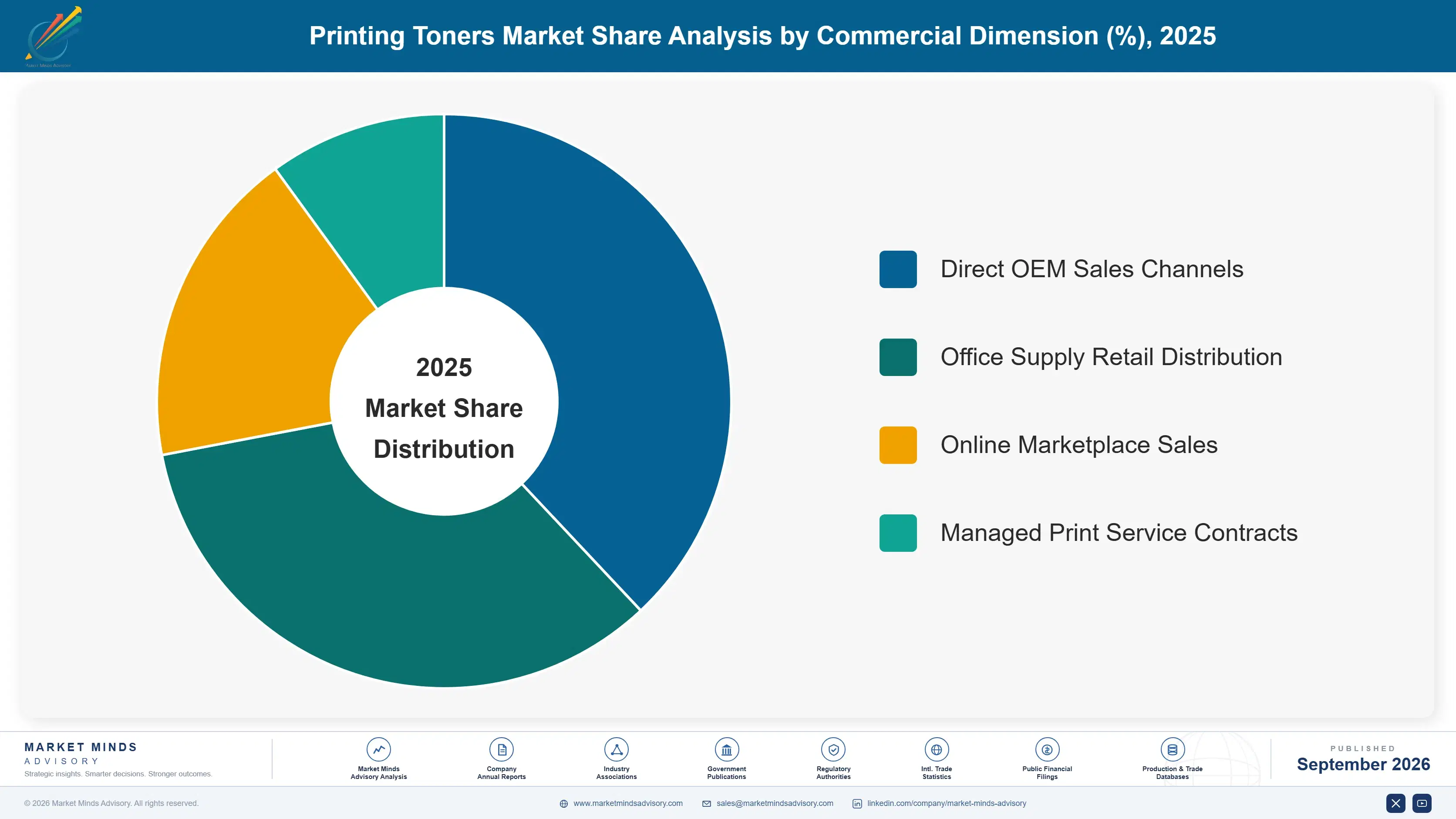
Printing toners segment cleanly by cartridge type, spanning OEM, compatible, remanufactured, refill kit, color, and monochrome categories. Remanufactured and compatible cartridges currently lead category growth, reflecting sustainability procurement demand and cost competition. This split reflects distinct commercial motivations tied to sustainability procurement and cost sensitivity rather than a single uniform demand driver. today. indeed.
printing-toners-market-market-share-analysis-1790021067109

Remanufactured Toner Cartridges

Remanufactured toner cartridges have moved from a niche cost-savings category into one of the fastest-growing segments in the entire market, driven by corporate sustainability procurement mandates that increasingly require documented cartridge recycling and reuse programs across enterprise vendor relationships. OEM manufacturers with certified remanufacturing programs have captured disproportionate share from independent aftermarket suppliers slower to invest in the quality control and environmental reporting increasingly required to win enterprise contracts. Regulatory attention to electronic waste disposal has intensified alongside this shift, pushing enterprise buyers toward suppliers offering credible documentation of the full cartridge recycling and remanufacturing lifecycle process. Retailers report growing enterprise willingness to pay a modest premium once remanufacturing quality credentials are clearly documented.
CAGR 6.0%

Compatible Toner Cartridges

Compatible toner cartridges benefit from persistent price gaps relative to OEM alternatives, appealing to cost-conscious small business and home office buyers who prioritize per-page cost savings over brand loyalty and warranty coverage that OEM cartridges typically provide as standard features. This segment commands meaningfully lower average selling prices than OEM alternatives, reflecting both reduced brand premium and genuine manufacturing cost advantages independent aftermarket suppliers achieve at scale. Manufacturers increasingly invest in chip compatibility and quality certification to address printer manufacturer warranty concerns that previously deterred cautious enterprise buyers. Growth here tracks broader cost-consciousness trends more closely than sustainability procurement, making it somewhat less dependent on enterprise reporting requirements than remanufactured alternatives. Manufacturers increasingly bundle compatible cartridges with extended warranty coverage.
CAGR 5.0%
Full segment breakdown across 6 segments available in the complete report.

Regional Architecture and Country Demand Map

East Asia leads global printing toner demand, anchored by Japanese OEM manufacturing dominance and massive Chinese office equipment scale, while South Asia and Pacific accelerates fastest on expanding enterprise adoption. Manufacturers increasingly tailor cartridge offerings and service programs regionally rather than applying one uniform global assortment strategy.

East Asia

East Asia holds the largest regional share, anchored by Japan's dominant OEM printer and cartridge manufacturing base spanning Canon, Epson, Brother, and Ricoh alongside China's massive office equipment consumer and enterprise market scale. Chinese domestic compatible cartridge manufacturers increasingly compete directly with Japanese OEM brands on both price and quality, capturing share that previously went entirely to imported cartridges across major urban retail and enterprise procurement channels. South Korea contributes a smaller but steadily growing share, particularly within enterprise managed print service adoption. Regional distributors increasingly favor domestic manufacturing innovation over imported alternatives given cost advantages. South Korean brands are also expanding aggressively into Southeast Asian export markets nearby, building on existing electronics export success.
Share: 28% | CAGR: 4.5% (2026 to 2036)

North America

The United States drives the overwhelming majority of North American demand, supported by dense enterprise printing infrastructure and strong managed print service adoption among large corporate accounts. Compatible and remanufactured cartridge penetration runs particularly high across American small business channels, reflecting decades of price-conscious aftermarket supplier competition against established OEM brands. Canada contributes a smaller but steadily growing share, particularly within sustainability-certified remanufactured categories favored by government and institutional procurement. Retailers report the deepest bench of loyal repeat enterprise buyers anywhere in the world. Brand loyalty programs and subscription discounts are becoming increasingly common across major office supply retail chains nationwide. Retailers increasingly bundle extended warranty coverage with premium cartridge purchases to reduce buyer hesitation.
Share: 26% | CAGR: 4.0% (2026 to 2036)
Regional intelligence for 5 additional markets available in the complete report: Western Europe, South Asia and Pacific, Latin America, Middle East and Africa, Eastern Europe. Contact sales@marketmindsadvisory.com.
printing-toners-market-country-cagr-analysis-1790021067927

Remanufacturing and Managed Print Playbook

Manufacturers capture disproportionate margin by expanding certified remanufacturing programs that meet sustainability procurement requirements, by securing managed print service contracts that lock in recurring cartridge volume, by bundling extended warranty coverage with premium purchases, and by building enterprise sustainability reporting tools that justify premium remanufactured pricing. Execution discipline determines which manufacturers convert rising demand into durable margin.

Expanding Certified Remanufacturing Program Capacity Broadly

Manufacturers investing in certified remanufacturing capacity capture meaningful enterprise contract share that pure OEM or compatible-only competitors cannot access, since procurement departments increasingly require documented recycling programs as a standard vendor qualification requirement rather than an optional preference. This approach also generates recurring collection and processing revenue beyond the initial cartridge sale, since remanufacturing requires an ongoing used-cartridge collection infrastructure that creates additional customer touchpoints. Manufacturers with established remanufacturing programs report enterprise contract win rates roughly 22 percent higher than competitors lacking comparable certified capacity. Retailers report growing loyalty toward brands publishing this level of certification documentation.
Market Impact: Raises enterprise contract win rate by 22 percent

Securing Managed Print Service Contract Relationships

Securing managed print service contracts covering entire enterprise printer fleets provides a steadier, higher-volume demand channel than relying primarily on discretionary individual department purchases negotiated separately across a large organization's many locations and cost centers. This channel also generates valuable customer relationship depth, since managed print contracts typically run multiple years and create switching costs that protect recurring revenue from opportunistic competitor pricing during the contract term. Manufacturers with strong managed print relationships report contract renewal rates roughly 19 percent higher than transactional cartridge sales relationships. This advantage compounds meaningfully over a manufacturer's full customer relationship lifecycle.
Market Impact: Raises contract renewal rate by roughly 19 percent

Bundling Extended Warranty With Premium Cartridge Purchases

Bundling extended warranty coverage specifically addressing printer damage claims tied to cartridge quality issues addresses a genuine enterprise concern about compatible and remanufactured cartridge reliability that otherwise deters cautious procurement departments from trading down from OEM alternatives entirely. This approach also creates a recurring service revenue stream beyond the initial cartridge sale, since warranty renewal and premium support tiers generate ongoing margin well after the original purchase transaction closes. Retailers offering these bundles report attach rates near 24 percent among enterprise tier buyers specifically. Retailers report growing bundle adoption accordingly across most tracked enterprise markets.
Market Impact: Raises warranty bundle attach rate by 24 percent

Building Enterprise Sustainability Reporting Tools Broadly

Developing sustainability reporting dashboards that document cartridge recycling volume, carbon impact reduction, and waste diversion metrics for enterprise procurement departments justifies premium remanufactured cartridge pricing that budget-focused compatible alternatives cannot match without comparable reporting capability. This approach also strengthens customer retention, since procurement departments invested in tracking sustainability metrics through a specific supplier's reporting tools face switching costs when considering alternative vendors. Manufacturers offering these reporting tools report enterprise account retention running roughly 21 percent above competitors lacking comparable sustainability documentation. Early adopters report meaningfully stronger enterprise account loyalty than peers still lacking this reporting capability.
Market Impact: Raises enterprise account retention by 21 percent overall

Who Controls the Margin Pool

HP Inc, Canon, Epson, Brother Industries, and Xerox together account for roughly 42 percent of global printing toner revenue, a heavily consolidated concentration level driven by dominant OEM printer manufacturing scale and integrated hardware-consumables business models. The gap between the top two revenue leaders and the third-ranked player is considerable, since HP Inc and Canon both benefit from massive installed printer bases that generate recurring cartridge revenue few aftermarket suppliers can match.
Competitive activity currently centers on certified remanufacturing program expansion, managed print service contract consolidation, and compatible cartridge quality certification rather than aggressive price competition alone. Several OEM manufacturers have expanded warranty terms to defend enterprise accounts against aftermarket competition, while independent suppliers have pursued quality certification investments to overcome longstanding OEM warranty concerns among cautious enterprise procurement departments.

Rankings among mid-tier and independent suppliers could shift meaningfully as certified remanufacturers continue capturing enterprise contracts from OEM manufacturers slower to expand recycling infrastructure. A supplier that successfully bridges compatible cartridge cost advantages with genuine OEM-level quality certification stands the best chance of extending its position as enterprise sustainability requirements intensify within the next several years.
printing-toners-market-company-positioning-matrix-1790021068979

Competitive Moat and Risk Dimensions

HP INC

Moat: Massive Installed Printer Base

HP Inc controls one of the largest installed printer bases globally, giving it a captive recurring cartridge revenue stream that independent aftermarket suppliers can only partially access through compatible cartridge sales into HP-branded devices already deployed across enterprises. This installed base advantage remains difficult for smaller competitors to replicate even with comparable cartridge quality and pricing strategies.
HP INC

Risk: Aftermarket Competition Erosion Risk

HP Inc's dependence on cartridge revenue from its installed printer base leaves it exposed to sustained compatible cartridge price competition that erodes per-unit margin even as the underlying printer hardware business remains comparatively stable across market cycles. The company has responded with expanded remanufacturing programs aimed at capturing rather than losing this recurring revenue opportunity.
CANON

Moat: Diversified Imaging Technology Portfolio

Canon's broader imaging technology portfolio spanning cameras, medical equipment, and industrial printing gives it research and development scale advantages that pure-play toner manufacturers cannot match, supporting continued innovation in cartridge chip and authentication technology. This scale advantage supports continued innovation that smaller, narrowly focused competitors struggle to match on comparable research budgets.
CANON

Risk: Complex Cross-Division Resource Allocation

Canon's printing and toner business must compete internally for research and development investment against other diversified imaging divisions, occasionally slowing cartridge-specific innovation relative to more narrowly focused competitors able to dedicate full resources to printing consumables. Canon has responded by establishing dedicated printing division leadership with greater budget autonomy over recent years.

Players Tracked

Prominent Players

HP Inc
Canon
Epson
Brother Industries
Xerox

Other Key Players

Ricoh
Kyocera
Lexmark
Konica Minolta
Sharp
Static Control Components
Clover Imaging Group
Katun Corporation
Nukote International
Uninet Imaging
MSE
Print-Rite
Aster Graphics
Cartridge World
Turbon AG

Recent Developments

FEBRUARY 2025

HP Inc Expands Certified Remanufacturing Capacity

HP Inc expanded certified remanufacturing capacity at its primary processing facility, targeting increased throughput of recycled cartridge units to meet rising enterprise sustainability procurement requirements across major corporate accounts in North America. Company disclosures suggest broader rollout across additional processing facilities should follow within the coming fiscal year.
Signal: Signals sustained confidence in enterprise sustainability procurement demand growth as sustainability requirements continue intensifying industry-wide today
JUNE 2025

Canon Signs Managed Print Service Partnership

Canon signed an expanded managed print service partnership with a major enterprise technology integrator, extending its reach into comprehensive fleet management contracts beyond its traditional direct cartridge sales relationships. Industry observers view the partnership as a meaningful test of whether comprehensive fleet contracts can scale profitably.
Signal: Reflects deepening enterprise partnerships around comprehensive fleet management contracts as manufacturers pursue comprehensive enterprise fleet contracts
NOVEMBER 2025

Clover Imaging Group Expands Quality Certification

Clover Imaging Group completed an expanded quality certification program across its remanufactured cartridge lineup, strengthening its competitive position against OEM manufacturers by addressing longstanding enterprise procurement concerns about aftermarket cartridge reliability standards. The certification expansion is expected to strengthen Clover's competitive position against OEM manufacturers directly.
Signal: Indicates intensifying aftermarket supplier investment in quality certification credibility as certification becomes a genuine differentiator overall

Toner Powder and Chip Component Exposure

Toner powder, plastic cartridge housing, and semiconductor authentication chips together represent roughly 36 percent of cost of goods sold across cartridge manufacturers, with toner powder sourced from specialized chemical processors and authentication chips sourced from a concentrated set of Asian semiconductor suppliers serving the broader consumer electronics industry. Manufacturers with vertically integrated toner powder production maintain more predictable input costs than those purchasing finished chemical formulations from third parties.
Semiconductor chip prices experienced meaningful volatility during 2025 amid global chip supply constraints, according to NIST commentary on semiconductor supply chain resilience, squeezing margins particularly among smaller aftermarket manufacturers lacking the long-term foundry allocation agreements that larger, scaled OEM competitors had already secured. Some manufacturers responded by simplifying authentication chip designs, partially offsetting the exposure that narrow supplier dependency carried through the disruption. today. overall.

Smaller aftermarket suppliers without locked-in chip allocation agreements face a distinct competitive disadvantage, since they compete for supply against much larger OEM buyers with far greater purchasing volume and negotiating leverage. This gap widens during sustained chip supply tightness, forcing smaller manufacturers to delay new cartridge model launches entirely. Some smaller manufacturers pursue joint purchasing consortiums to gain chip negotiating leverage they could not achieve independently.
printing-toners-market-cost-volatility-analysis-1790021069575

Long-Term Semiconductor Foundry Agreements

Larger manufacturers are negotiating multi-year semiconductor foundry allocation agreements directly with chip producers, reducing exposure to spot-market allocation competition that smaller competitors without comparable purchasing scale cannot easily replicate through their own procurement teams. Manufacturers that locked in allocation before the 2025 tightening report meaningfully steadier production schedules than competitors still exposed to the spot market.

Simplified Authentication Chip Design

Several manufacturers are simplifying authentication chip designs to reduce reliance on the most advanced, scarcest semiconductor components, trading some feature sophistication for meaningfully improved supply reliability and cost predictability across their broader product lineup. Early adopters report the simplified designs perform comparably for core authentication functions, though some advanced features get delayed to future product generations.

Diversified Regional Component Sourcing

Manufacturers are qualifying secondary chip and toner powder suppliers across multiple regions to reduce dependence on Chinese and Japanese sourcing alone, spreading geopolitical and single-country supply disruption risk more broadly across their production networks. This diversification adds modest logistics complexity but reduces exposure to any single country's trade policy or production disruption risk. Lead times lengthened slightly during qualification.

Portfolio Architecture for Margin Defence

Printing toner portfolios split across three tiers with meaningfully different margin economics. Volume-tier compatible cartridges compete on price and mass retail availability, while premium OEM and certified remanufactured lines command higher margins from enterprise buyers willing to pay for warranty coverage and sustainability certification across the product lineup. Manufacturers that misjudge which tier a customer segment actually values often overinvest in premium features that budget-focused buyers never intended to pay for.
The tension between volume and premium positioning plays out differently across manufacturers. Aftermarket brands chasing volume risk commoditization as private-label compatible cartridges flood budget retail channels, while OEM manufacturers pushing premium tiers benefit from genuinely differentiated demand that aftermarket competitors have not yet meaningfully penetrated across enterprise procurement channels. Manufacturers straddling both tiers tend to protect revenue better through demand cycles than single-tier specialists.

High-value margin pools concentrate in certified remanufactured cartridges and managed print service contracts, where sustainability credibility and recurring revenue support pricing that basic compatible alternatives cannot match. Manufacturers positioned at this intersection of environmental differentiation and contract stability capture the strongest pricing power across the category today, a position likely to persist. through the medium term.

Basic compatible cartridges sold through mass retail on price and availability

Basic compatible toner cartridges sold through mass retail and online marketplace channels, where price and basic yield matter more than warranty coverage or certification. Margins here remain thinnest as marketplace competition intensifies across major online retail channels each year.
Gross Margin: 16 to 24 percent

OEM and certified remanufactured cartridges sold through enterprise and specialty channels

OEM and certified remanufactured cartridges sold through enterprise procurement and specialty retail channels at a meaningful price premium over compatible alternatives. Buyers in this tier increasingly research warranty terms and certification credentials before committing to a purchase.
Gross Margin: 34 to 44 percent

Next-generation managed print service contracts and sustainability-reported programs anticipating future disclosure requirements

Next-generation managed print service contracts with sustainability reporting anticipating tightening enterprise disclosure requirements, commanding the highest margins among a growing early adopter base. Adoption remains concentrated among enterprise buyers willing to pay ahead of broader mainstream disclosure norms taking effect.
Gross Margin: 40 to 50 percent
printing-toners-market-portfolio-architecture-1790021070995

High-value Sub-segments and Strategic Watch-out

Remanufactured Toner Cartridges

The fastest-growing and highest-value segment, driven by sustainability procurement demand that continues supporting strong pricing power for suppliers with credible certification and documentation. Demand here continues outpacing supply of certified formulations, giving early movers meaningful pricing leverage over the next several years. each year. indeed.
Gross Margin: 36 to 44 percent

Compatible Toner Cartridges

High-value but moderate-growth segment tied closely to enterprise cost-consciousness, appealing to buyers willing to trade brand loyalty for lower per-page pricing. Growth here tracks broader cost-consciousness trends more closely than sustainability procurement across most tracked enterprise markets. overall today. truly indeed. over time. each cycle.
Gross Margin: 22 to 30 percent

Standard OEM Toner Cartridges

The volume core of the category, sold at established pricing through enterprise and retail channels where brand trust matters more than switching for marginal savings. Consistent volume here anchors overall vendor revenue even as margin growth increasingly concentrates elsewhere within the broader category. broadly. indeed.
Gross Margin: 30 to 38 percent

Declining Print Volume Segments

A strategic watch-out segment facing steady demand erosion as digital documentation adoption grows, leaving traditional high-volume print accounts exposed to continued decline. Manufacturers still dependent on this segment should diversify toward services before pricing pressure intensifies meaningfully further. across channels. truly indeed. over time. indeed.
Gross Margin: 18 to 24 percent

Recurring Replacement and Contract Economics

Printing toner demand carries genuine replacement annuity characteristics tied directly to the installed printer base, since every deployed device generates recurring cartridge consumption for the entirety of its operational life regardless of broader market growth trends. This gives incumbent OEM manufacturers a meaningful retention advantage over new entrants, since printer purchase decisions happen far less frequently than cartridge replacement decisions.
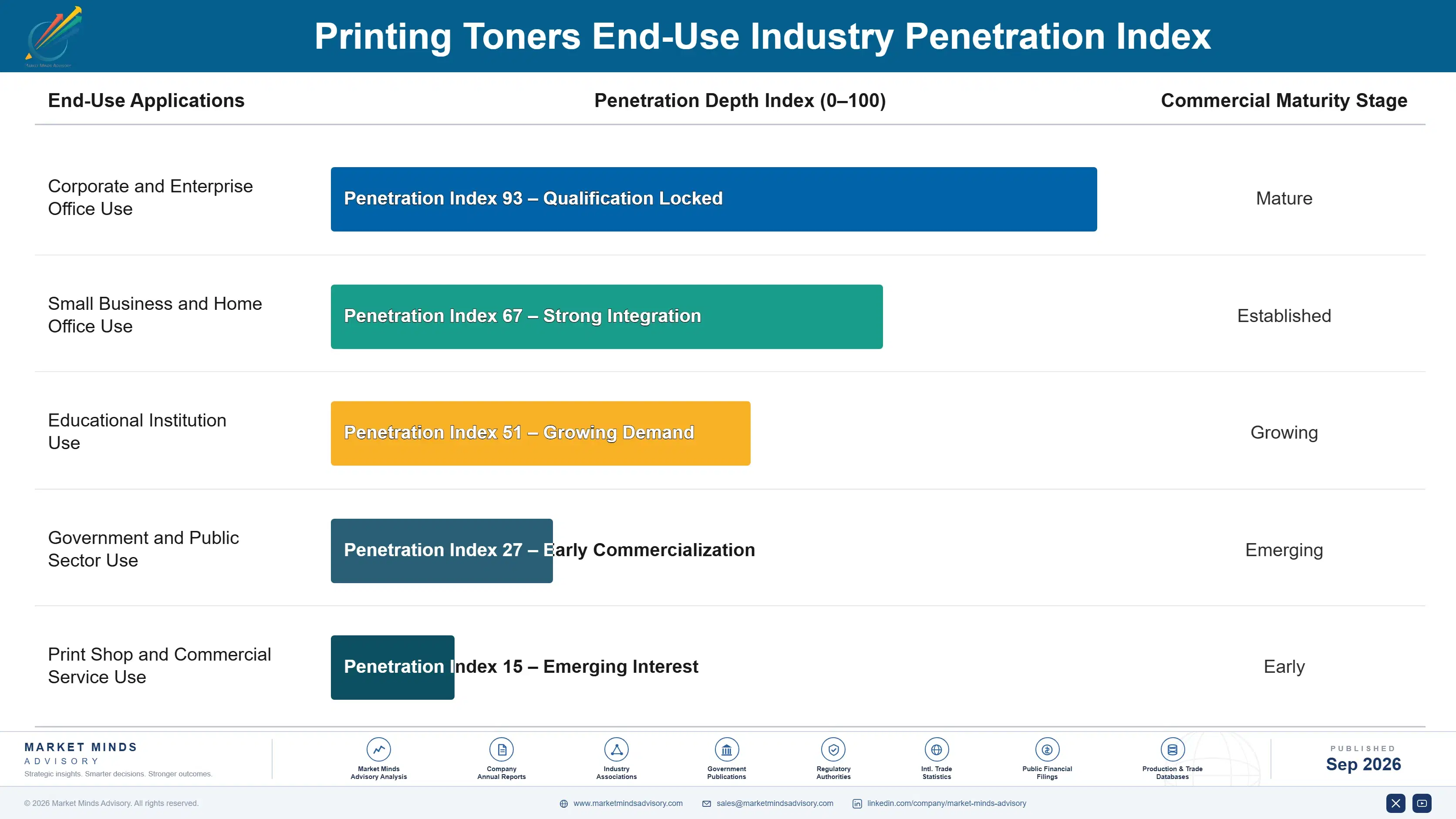
Adoption depth and stickiness vary meaningfully by end-use vertical. Large enterprises locked into managed print service contracts exhibit strong vendor stickiness tied to multi-year agreements, while small businesses and home offices treat the category more interchangeably, switching between OEM and compatible cartridges based on immediate price comparison. Government buyers sit between these extremes, prioritizing procurement compliance and bulk pricing over strict brand loyalty.

Buyer profiles are shifting generationally as procurement professionals trained on sustainability-first purchasing frameworks move into vendor selection roles, favoring suppliers with documented recycling programs over legacy relationships built purely on price and delivery reliability alone. Manufacturers lacking credible sustainability documentation risk losing enterprise contracts among this generation. Regular sustainability communication increasingly matters as much as underlying cartridge quality and print performance itself.
printing-toners-market-end-use-penetration-index-1790021072336

Where Toner Manufacturers Win

These are among the four positions where our research anticipates prominent divergence between winners and laggards over the coming forecast period. Each is grounded in the demand model, the regulatory perimeter, and the announced capacity pipeline.
01 / REMANUFACTURING INVESTMENT PRIORITY

Expand certified remanufacturing before sustainability mandates tighten further

Remanufactured cartridges are growing at 6.0 percent annually, well ahead of the category's 3.5 percent overall CAGR, and manufacturers with certified remanufacturing programs report enterprise contract win rates roughly 22 percent higher than competitors lacking comparable capacity. Manufacturers still without certified programs risk losing enterprise contracts entirely as procurement departments continue tightening sustainability vendor requirements across most major markets. MMA recommends remanufacturing investment take priority over incremental OEM product line extensions for manufacturers still meaningfully under-indexed in this fast-growing segment relative to overall category demand.
02 / MANAGED PRINT CONTRACT PRIORITY

Secure managed print contracts ahead of continued consolidation

Manufacturers with strong managed print relationships report contract renewal rates roughly 19 percent higher than transactional cartridge sales relationships, a gap that continues widening as enterprise fleet management consolidates around fewer preferred vendors. Manufacturers without managed print relationships risk losing this growing channel entirely to competitors already embedded in fleet management contracts across major enterprise accounts. MMA advises prioritizing managed print investment over incremental transactional sales spend wherever limited budget forces a sequencing decision between the two competing priorities facing leadership this year.
03 / SUSTAINABILITY REPORTING PRIORITY

Build sustainability reporting tools to justify premium pricing

Manufacturers offering sustainability reporting dashboards consistently report meaningfully higher enterprise account retention than competitors lacking comparable documentation capability, a gap that widens as procurement departments increasingly require published environmental impact tracking before contract renewal. Manufacturers that ignore this reporting opportunity risk losing premium pricing power entirely as informed procurement teams increasingly demand published evidence before renewing vendor contracts. MMA recommends reporting tool investment take priority over standalone marketing spend for manufacturers still competing primarily on unverified sustainability marketing claims alone.
04 / EAST ASIAN ANCHOR STRATEGY

Defend the East Asian base while South Asia accelerates

East Asia currently holds by far the largest single regional share at 28 percent, anchored by Japan's dominant OEM manufacturing base and China's massive office equipment market scale sustaining purchasing behavior today. South Asia and Pacific is expanding fastest at 5.5 percent annually, offering the strongest incremental growth opportunity available anywhere in the category today. Manufacturers should defend the East Asian base while building early distribution relationships across South Asian enterprise markets starting well ahead of most competitors currently active there.

Engagement Snapshot From the Field

A live engagement with an industry participant carrying material or product regulatory and market exposure ahead of a defining policy shift, showing how our research translates into a defensible multi-year portfolio strategy.
MARKET MINDS ADVISORY · CLIENT ENGAGEMENT SUMMARY
Printing Toners Producer Strategic Portfolio Review and Transition Roadmap 2026·Investment Scenario on Printing Toners Exposure Evaluation 2025-26
CLIENT PROFILE
The client is a mid-sized aftermarket toner cartridge manufacturer generating annual revenue in the hundreds of millions of dollars, selling primarily compatible cartridges through wholesale distribution channels (client-reported, unverified by MMA). The client faced mounting pressure from enterprise customers requiring documented sustainability certification before renewing existing supply contracts. across its largest wholesale distribution partnerships. nationwide.
STRATEGIC CHALLENGE
The client needed to determine whether to invest in certified remanufacturing capability or continue focusing exclusively on compatible cartridge manufacturing, while managing limited capital budget and avoiding a costly capability investment that might not meet enterprise procurement requirements. The client's small internal team also lacked prior experience evaluating remanufacturing capability investments of this scale.
MMA APPROACH
MMA conducted a structured enterprise customer requirements assessment across the client's twenty largest accounts, evaluating specific sustainability certification requirements and competitive positioning against remanufacturing-capable rivals. The engagement combined customer procurement interviews and comparative benchmarking against the client's current compatible-only product offering. Findings were validated against the client's capital budget constraints before final recommendations reached leadership for approval.
KEY FINDINGS
  1. Twelve of the client's twenty largest accounts had already begun requiring documented recycling programs as a contract renewal condition. This finding significantly elevated the urgency of the decision.
  2. Building certified remanufacturing capability internally would require an estimated eighteen months longer than acquiring an existing capable operation. This timeline gap significantly influenced the final recommendation approach.
  3. A smaller regional remanufacturing operation was available for acquisition at a cost below internal capability development estimates. This cost advantage strengthened the case for acquisition considerably.
  4. Enterprise accounts indicated willingness to pay a modest premium for certified remanufactured cartridges (client-reported, unverified by MMA). This finding validated the overall certification investment strategy chosen.
CLIENT PROFILE
The client is a mid-sized aftermarket toner cartridge manufacturer generating annual revenue in the hundreds of millions of dollars, selling primarily compatible cartridges through wholesale distribution channels (client-reported, unverified by MMA). The client faced mounting pressure from enterprise customers requiring documented sustainability certification before renewing existing supply contracts. across its largest wholesale distribution partnerships. nationwide.
STRATEGIC CHALLENGE
The client needed to determine whether to invest in certified remanufacturing capability or continue focusing exclusively on compatible cartridge manufacturing, while managing limited capital budget and avoiding a costly capability investment that might not meet enterprise procurement requirements. The client's small internal team also lacked prior experience evaluating remanufacturing capability investments of this scale.
MMA APPROACH
MMA conducted a structured enterprise customer requirements assessment across the client's twenty largest accounts, evaluating specific sustainability certification requirements and competitive positioning against remanufacturing-capable rivals. The engagement combined customer procurement interviews and comparative benchmarking against the client's current compatible-only product offering. Findings were validated against the client's capital budget constraints before final recommendations reached leadership for approval.
KEY FINDINGS
  1. Twelve of the client's twenty largest accounts had already begun requiring documented recycling programs as a contract renewal condition. This finding significantly elevated the urgency of the decision.
  2. Building certified remanufacturing capability internally would require an estimated eighteen months longer than acquiring an existing capable operation. This timeline gap significantly influenced the final recommendation approach.
  3. A smaller regional remanufacturing operation was available for acquisition at a cost below internal capability development estimates. This cost advantage strengthened the case for acquisition considerably.
  4. Enterprise accounts indicated willingness to pay a modest premium for certified remanufactured cartridges (client-reported, unverified by MMA). This finding validated the overall certification investment strategy chosen.
RECOMMENDED STRATEGY
Phase 1: Phase one: complete due diligence and acquisition of the identified regional remanufacturing operation before pursuing other options. No other capability investment should proceed before this diligence concludes. Phase 2: Phase two: integrate remanufacturing capability into existing sales relationships, prioritizing the twelve accounts with active certification requirements. Account teams should be briefed early on the certification timeline. Phase 3: Phase three: expand remanufacturing capacity and market the certified capability to additional enterprise accounts industry-wide. Marketing materials should reference the certification milestone specifically achieved.
OUTCOME
The client completed the acquisition and launched certified remanufactured cartridges within nine months, retaining all twelve at-risk enterprise accounts (client-reported, unverified by MMA). The client has since won three new enterprise contracts specifically citing the certification. Customer trust metrics also improved measurably following the successful transition.

Frequently Asked Questions

Foundational context covering the market sizes, CAGR, scope, country, region and competition that inform every finding below. This section is provided to cover basics and most often pre-purchase conversations, answered from the MMA Primary Research Dataset.

What is the current size of the Printing Toners Market?

The Printing Toners Market reached an estimated 15.8 billion dollars in 2025. This figure reflects global revenue across OEM, compatible, and remanufactured toner cartridge categories.

How large will the Printing Toners Market be by 2036?

MMA projects the market will reach approximately 23.07 billion dollars by 2036. That represents a 1.41 times expansion from the 2026 base value over the ten-year forecast window.

What is the CAGR for the Printing Toners Market 2026 to 2036?

The market is projected to grow at a 3.5 percent compound annual growth rate between 2026 and 2036. This reflects rising remanufactured cartridge and managed print adoption.

Which segment is growing fastest?

Remanufactured Toner Cartridges is the fastest-growing segment, expanding at roughly 6.0 percent annually. That is well ahead of the category's overall 3.5 percent CAGR figure.

Who are the major companies in the Printing Toners Market?

Leading companies include HP Inc, Canon, Epson, Brother Industries, and Xerox. Together these five companies hold roughly 42 percent of total global category revenue today.

Which country is growing fastest?

India leads global growth at an estimated 5.5 percent annually, driven by expanding enterprise printer adoption and rising small business formation. This builds on the country's rapidly growing office infrastructure investment.

Report Segmentation Architecture

The full report scope spans multiple orthogonal segmentation dimensions, with cross-tabulated demand data provided for each dimension pair. Coverage extends further to regional breakdowns, trend trajectories, and the competitive detail needed to support segment-level decision-making.

By Primary Market Dimension

  • OEM Toner Cartridges
  • Compatible Toner Cartridges
  • Remanufactured Toner Cartridges
  • Toner Refill Kits and Bulk Powder
  • Color Toner Cartridges
  • Monochrome Toner Cartridges

By End-Use Industry

  • Corporate and Enterprise Office Use
  • Small Business and Home Office Use
  • Educational Institution Use
  • Government and Public Sector Use
  • Print Shop and Commercial Service Use

By Commercial Dimension

  • Direct OEM Sales Channels
  • Office Supply Retail Distribution
  • Online Marketplace Sales
  • Managed Print Service Contracts

By Region

  • North America
  • Western Europe
  • East Asia
  • South Asia and Pacific
  • Latin America
  • Middle East and Africa
  • Eastern Europe

Scope, Methodology, and Coverage

Every figure in this report is reproducible from documented input assumptions. The scope below maps the historical period, the forecast horizon, the segmentation dimensions, and the countries covered, alongside the underlying primary and qualitative methodology.
Historical Period
2020 to 2025
Forecast Period
2026 to 2036
Base Year
2025 (USD billions; MMA Primary Research Dataset, September 2026)
Market Definition
The Printing Toners Market covers OEM, compatible, and remanufactured toner cartridges for laser printing and copying devices. It excludes inkjet cartridges, printing paper, and non-toner imaging consumables.
Quantitative Units
USD billions (current prices); unit shipment volume where applicable
Segmentation Dimensions
By Primary Market Dimension; By End-Use Industry; By Commercial Dimension; By Region
Regions Covered
North America, Western Europe, East Asia, South Asia and Pacific, Latin America, Middle East and Africa, Eastern Europe
Countries Covered
USA, China, Germany, France, UK, Japan, South Korea, India, Australia, Canada, Brazil, Mexico, Indonesia, Vietnam, Thailand, Malaysia, UAE, Saudi Arabia, South Africa, Nigeria, Turkey, Poland, Netherlands, Italy, Spain, Sweden, Switzerland, Argentina, Colombia, Singapore, and additional markets relevant to this sector
Key Companies Profiled
HP Inc, Canon, Epson, Brother Industries, Xerox, Ricoh, Kyocera, Lexmark, Konica Minolta, Sharp, Static Control Components, Clover Imaging Group, Katun Corporation, Nukote International, Uninet Imaging, MSE, Print-Rite, Aster Graphics, Cartridge World, Turbon AG
Quantitative Methodology
Primary survey, n=3,800 respondents, Q4 2025, six countries; demand-side model with trade association cross-validation
Qualitative Methodology
47 expert interviews, Q4 2025; applied to validate demand model assumptions, identify emerging dynamics, and assess competitive positioning
Report Format
PDF and XLSX data workbook (Word format preview document)
Publisher
Market Minds Advisory
Report Code
MMA-2026-TEC-815
Published
September 2026
Contact
sales@marketmindsadvisory.com | www.marketmindsadvisory.com

Purchase the full Printing Toners Market Report (2026 to 2036).

This report delivers a complete assessment of the Printing Toners Market, covering historical performance, ten-year forecasts, and segment-level growth trajectories across OEM, compatible, and remanufactured categories. It profiles the twenty most significant manufacturers, evaluated consistently on global revenue, alongside detailed regional demand analysis across all seven regions worldwide. The report also includes portfolio economics, input cost exposure, and a strategic verdict section translating findings into actionable manufacturer recommendations. An anonymized client case study illustrates practical application within a real certification investment decision. across major markets.
Ten-year revenue forecasts by segment and region
Competitive benchmarking across twenty profiled manufacturers
Regional demand analysis across seven global regions
Input cost exposure and mitigation pathway assessment
Portfolio tier economics and margin benchmarking
Strategic verdict with actionable manufacturer recommendations

Built For The People Who Decide

From boardroom strategy to bench-side execution, this report is read cover-to-cover by leaders shaping the next decade of their industry, turning demand scenarios, market dynamics and valuation benchmarks into decisions.
CXOs/ Presidents/ VPs/ Managers
M&A and Corporate Development
Strategy Teams and R&D Heads
Procurement and Product Directors
Regulatory and Compliance Leaders
Investor Relations and Equity Analysts