Market Minds Advisory
Preterm Birth and PROM Testing Market

Preterm Birth and PROM Testing Market: Biomarker Assays Redefine Prenatal Risk Screening

Obstetric practices are converting from clinical symptom assessment alone toward biomarker-confirmed testing for preterm labor and membrane rupture, as insurers increasingly reimburse rapid point-of-care assays that cut unnecessary hospital admissions.

Lead Analyst

Alice Ballenger

Published

September 2026

Make Smarter Decisions with Customized Research Insights

Request a free sample report and evaluate market opportunities, growth trends, and competitive dynamics relevant to your business needs.

2025 MARKET VALUE$1.1BMarket Size 2025
2036 FORECAST VALUE$2.8BBase Case , 2026 to 2036
CAGR 2026 TO 20369.0 %Bull 10.3% / Bear 7.6%
INCREMENTAL OPPORTUNITY$1.6BNet 10- year value creation
EXPANSION MULTIPLE2.34x2036 value over 2026 base
Strategic Levers
M&A Pipeline
Regional Outlook
Country Rankings
Competitive Intelligence
Segmental Deep-dive
Call-Us : 91 93563 13602

Executive Snapshot and Market Trajectory

Preterm birth risk testing is converting from symptom-based clinical judgment toward biomarker-confirmed diagnosis, as obstetric practices adopt rapid assays that separate true preterm labor from false alarms. Insurer reimbursement is accelerating that shift. Clinics ignoring this shift risk falling behind on reimbursement-linked triage protocols.
Combined preterm labor and PROM biomarker panels lead every segment on growth as clinics move from single-marker tests toward integrated assays confirming both conditions in one visit. India has become the fastest-growing country, driven by expanding institutional delivery rates and investment, while North America holds the largest share of global demand given its concentration of maternal-fetal medicine specialists and established reimbursement pathways. Point-of-care fibronectin testing remains the second-fastest category.
Competitive character remains moderately concentrated among diagnostics manufacturers, evaluated here on test kit and instrument placement revenue combined. Hospital and clinic laboratory procurement cycles increasingly decide which manufacturer's platform a given health system standardizes on, pushing companies toward larger clinical validation studies well beyond typical device marketing spend. Smaller vendors increasingly struggle to fund the multi-site trials that differentiated combined-panel positioning now requires. This dynamic increasingly shapes vendor selection at contract renewal each year.
Market Definition
The preterm birth and PROM testing market covers fetal fibronectin assays, insulin-like growth factor binding protein-1 (IGFBP-1) assays, placental alpha microglobulin-1 (PAMG-1) assays, combined preterm labor and PROM biomarker panels, point-of-care testing instruments, and associated test kit consumables used to assess preterm labor risk and premature rupture of membranes. It excludes general prenatal ultrasound screening and cervical length measurement services not paired with biomarker assay testing.
Base Year Value
$1.1B in 2025 (MMA Primary Research Dataset, August 2026)
Forecast Period
2026 to 2036, eleven discrete annual values
CAGR
9.0% base case. Bull 10.3%. Bear 7.6%.
Fastest Growth Segment
Combined Preterm Labor and PROM Biomarker Panels: 15.2% CAGR
Fastest Growth Country
India: 13.4% CAGR
Fastest Growth Region
South Asia and Pacific: 11.2% CAGR
Largest Region
North America: 30% of 2025 global value
Market Leaders
Hologic, Inc., QIAGEN N.V., Sera Prognostics, Inc., Laboratoire CCD, Parsagen Diagnostics, Inc. Source: MMA Analysis based on company annual reports.
Primary Survey
n=3,800 procurement and R&D decision-makers, Q4 2025, six countries
Methodology
Demand-side build-up, cross-validated against public data, 47 expert interviews

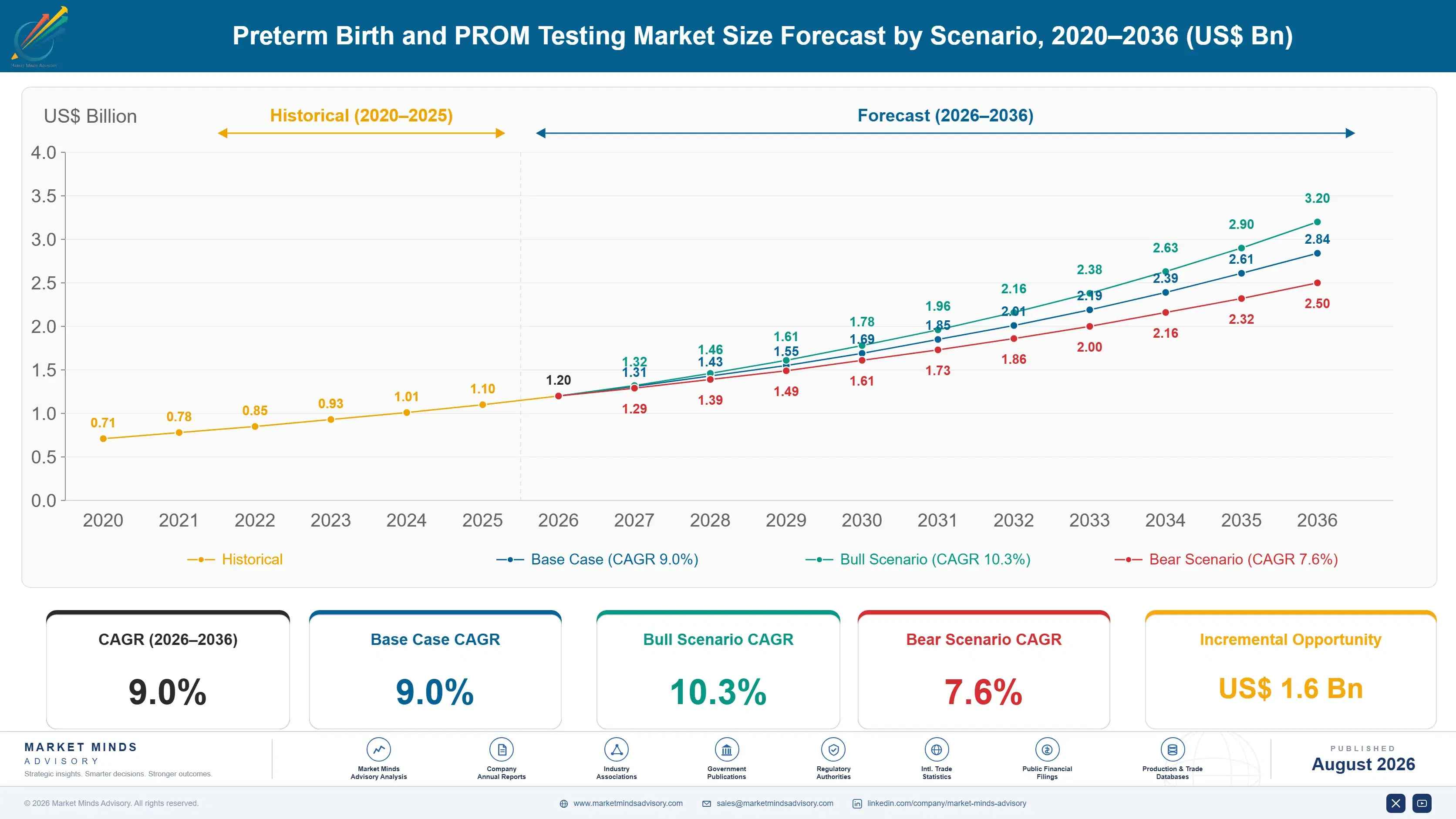
Preterm Birth and PROM Testing Market Forecast Scenarios

preterm-birth-and-prom-testing-market-size-forecast-scenario-1787307767271
Testing demand grew steadily but unevenly between 2020 and 2025. Pandemic-era prenatal visit disruptions briefly slowed adoption through 2021, then expanding maternal-fetal medicine referral volume and growing payer coverage sustained momentum, lifting historical growth to an estimated 7.8% compound rate. Order volume varied by country and reimbursement cycle. That momentum built gradually as obstetric practice guidelines updated to reflect newer evidence.
The base case assumes 9.0% annual growth through 2036, anchored on three mechanisms. First, expanding insurer reimbursement keeps pulling clinics toward biomarker-confirmed testing over symptom-based admission decisions across both developed and emerging markets. Second, combined-panel adoption keeps converting single-marker test users toward higher-value integrated assays commanding meaningfully higher per-test pricing. Third, expanding institutional delivery rates keep broadening the addressable testing population, assuming reimbursement frameworks expand at a broadly similar pace across major markets.
A bull case builds if combined-panel adoption expands faster than currently expected, pushing growth toward 10.3% as more clinics standardize around integrated testing. The bear risk is reimbursement tightening: if payers narrow coverage more than anticipated, biomarker test adoption could slow well below expectations, capping growth near 7.6% across the forecast period. Clinics able to absorb premium pricing stand best positioned to capture bull-case upside.

From Symptom Assessment to Biomarker-Confirmed Diagnosis

Preterm birth and PROM testing remains fundamentally a specialty obstetric diagnostics category, but the market is undergoing a genuine shift as combined biomarker panels convert testing from single-marker screening into integrated risk confirmation. Expanding insurer reimbursement is broadening the addressable testing population well beyond what institutional delivery growth alone would predict. That reimbursement shift is reshaping purchasing decisions across both hospital and outpatient obste
MARKET CONCENTRATION68% CR5Five manufacturers hold more than two-thirds of category revenue
AVERAGE SELLING PRICE$42 per test kitCombined panels command a meaningful pricing premium overall
LEADING PRODUCT CATEGORY SHAREFetal fibronectin assays, 44%One assay category still dominates total testing volume
POINT-OF-CARE TESTING SHARE58%Most testing now happens outside centralized laboratory settings
LEADING PRODUCING COUNTRY SHAREUnited States, 31% of global demandOne country accounts for a disproportionate share of testing
REAGENT COMPONENT COST SHARE34% of unit COGSMonoclonal antibody sourcing dominates production cost most heavily
Clinics compete less on raw assay speed than on demonstrated negative predictive value data that combined panels make achievable over single-marker platforms. Manufacturing remains concentrated in the United States and France, while India's domestic diagnostics sector is expanding rapidly to serve its own growing institutional delivery base. Smaller diagnostics manufacturers without comparable scale increasingly struggle to match this validation investment.
The next decade will be shaped by two forces pulling in the same direction: expanding insurer reimbursement finally scaling biomarker testing from specialist referral use into standard obstetric triage protocols, and combined-panel technology growing sophisticated enough to expand total testing demand regardless of which specific biomarker a given clinic previously favored. Both push investment toward integrated platforms even as cost-constrained clinics weigh premium pricing against still-uneven reimbursement in several markets.
"Obstetricians used to admit on suspicion alone. A negative biomarker result now sends most patients home the same afternoon."
Director, Women's Health and Prenatal Diagnostics Practice · MMA Healthcare Diag

Market Trends

Combined Panels Convert Single-Marker Testing Practice

Combined preterm labor and PROM biomarker panels, integrating fetal fibronectin or PAMG-1 detection with membrane rupture confirmation in a single assay, are converting obstetric practices away from sequential single-marker testing toward platforms offering faster triage decisions and meaningfully reduced unnecessary hospital admissions. This is pushing clinics to requalify testing protocols ahead of typical instrument replacement cycles, since integrated confirmation achieves diagnostic clarity that sequential testing struggled to match consistently for ambiguous presentations. Manufacturers with validated combined panels are capturing disproportionate share of this conversion wave as additional clinics adopt integrated technique each year.
Market Impact: Adds 1,200 annual clinic installati
Negative Predictive Value Data Reshapes Purchasing Decisions

Growing clinical evidence around negative predictive value, the probability that a negative biomarker result correctly rules out imminent preterm delivery, is converting biomarker testing from a supplementary clinical tool into a required triage step for obstetric programs previously reliant on symptom assessment alone. This is opening genuinely new testing volume among labor and delivery units whose triage protocols previously had no standardized biomarker confirmation step at all. Manufacturers with the strongest negative predictive value data are capturing disproportionate share of this expanding triage population as more units adopt biomarker-first protocols. Early evidence suggests this trend will only accelerate further.
Market Impact: Cuts unnecessary admissions by 34%

Market Opportunities and Growth Drivers

Expanding Institutional Delivery Rates Sustain Baseline Testing Demand

Institutional delivery rates continue expanding across nearly every major market tracked in this report, driving growing biomarker testing demand that persists regardless of which specific risk factor a given patient ultimately presents with. This demand base gives the category resilience that pure reimbursement trends alone would not provide, since underlying institutional delivery investment keeps expanding even as testing priorities shift toward more advanced platforms across the field. Manufacturers investing in both standard and combined-panel product lines are capturing disproportionate share of this expanding testing base as health systems increasingly span both routine screening and high-risk triage activities.
Market Impact: Adds $18 per-test cost premium

Reduced False-Positive Rates Cut Unnecessary Hospital Admissions

Continued advances in biomarker assay specificity are compressing the false-positive rate that historically drove unnecessary tocolytic treatment and hospital admission, converting what used to be a meaningful trade-off between caution and cost into a narrowing gap that increasingly favors biomarker-confirmed triage. This is forcing clinics still relying on symptom assessment alone to requalify admission protocols faster than typical practice change would otherwise allow across affected labor units. Manufacturers with the most specific assays are converting this admission reduction into meaningfully faster adoption across major hospital networks. Vendors expect this trend to strengthen as triage standards rise across the category.
Market Impact: Limits access across 24% of clinics

Market Restraints and Challenges

Combined Panel Cost Slows Broad Clinic Access

Combined biomarker panels carry a meaningful cost premium over single-marker assays, creating genuine budget friction for smaller clinics and community hospitals evaluating adoption against constrained laboratory budgets already competing across multiple diagnostic service lines. The root cause is that combined panels require both dual-antibody reagent formulation and specialized reader instrumentation that single-marker tests do not require at comparable manufacturing cost. Manufacturers are mitigating this by developing shared-instrument leasing models and by helping smaller clinics offset the premium against reduced downstream admission and monitoring costs that accurate triage typically delivers. This shift typically takes several years to mature across affected markets.
Market Impact: Adds 21% combined panel adoption

Uneven Reimbursement Restrains Rural Testing Access

Reimbursement for biomarker-based preterm testing remains inconsistent across payers and rural health systems, creating genuine friction for clinics weighing premium test investment against uncertain per-test revenue recovery relative to standard clinical assessment. The underlying cause is that many rural payer frameworks still price biomarker testing similarly to basic prenatal visits despite the additional reagent and instrumentation cost testing requires. Manufacturers are mitigating this by funding outcomes studies and working directly with rural health networks to establish differentiated reimbursement codes, helping clinics justify adoption against demonstrated clinical and cost benefit over time.
Market Impact: Adds 480,000 annual confirmatory te
4 additional market trends, 3 additional growth drivers, and 3 additional restraints and challenges are covered in the full report. Contact sales@marketmindsadvisory.com to access the complete intelligence.

Segment CAGR and Growth Architecture

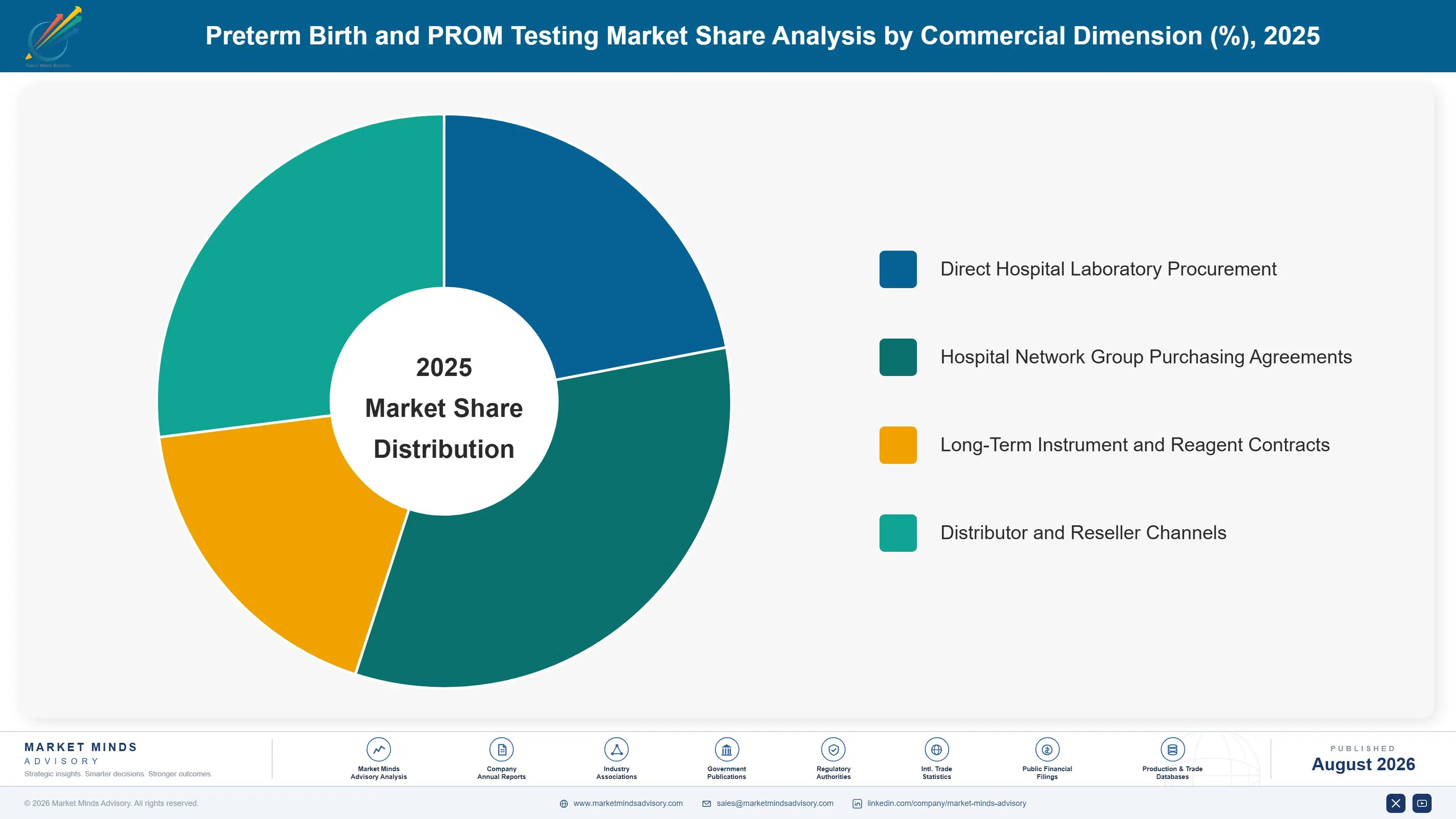
MMA segments the market by assay technology and product type, the classification clinics use when specifying test selection and comparing manufacturer platforms across competing laboratory procurement decisions. This avoids blending upstream biomarker technology with downstream clinical application categories that define how these tests are actually purchased. It keeps upstream biomarker science separate from downstream diagnostic application entirely.
preterm-birth-and-prom-testing-market-market-share-analysis-1787307767862

Combined Preterm Labor and PROM Biomarker Panels

Combined preterm labor and PROM biomarker panels, integrating dual-biomarker detection to confirm both conditions from a single sample, remain the fastest-growing category as clinics convert from sequential single-marker testing toward platforms enabling faster triage decisions and reduced admission uncertainty. Growth concentrates wherever maternal-fetal medicine specialist density intersects with well-funded hospital laboratory infrastructure, particularly across North America and increasingly India's rapidly expanding institutional delivery capacity. Hologic and Sera Prognostics have each expanded combined-panel clinical validation substantially, recognizing that dual-marker confirmation, not single-marker speed alone, decides which manufacturer captures a clinic's long-term testing relationship. At a 15.2% forecast CAGR, roughly 1.69 times the market average, this segment is pulling capital investment toward combined-panel conversion faster than any other category.
CAGR 15.2%

Point-of-Care Fetal Fibronectin Testing

Point-of-care fetal fibronectin testing, delivering results at bedside rather than through centralized laboratory processing, tracks expanding same-visit triage demand more directly than any other segment, making result turnaround time a disproportionate growth driver for this category specifically. QIAGEN and Laboratoire CCD lead on installed point-of-care platform scale, while newer entrants increasingly compete on cartridge cost rather than turnaround speed alone. Demand here is tied more closely to labor and delivery unit workflow redesign than to overall birth volume, since point-of-care attach rates rise fastest wherever hospitals pursue faster triage decisions. This segment's growth trajectory now depends heavily on how quickly hospitals adopt integrated bedside testing workflows across their broader labor units.
CAGR 11.8%
Full segment breakdown across 6 segments available in the complete report.

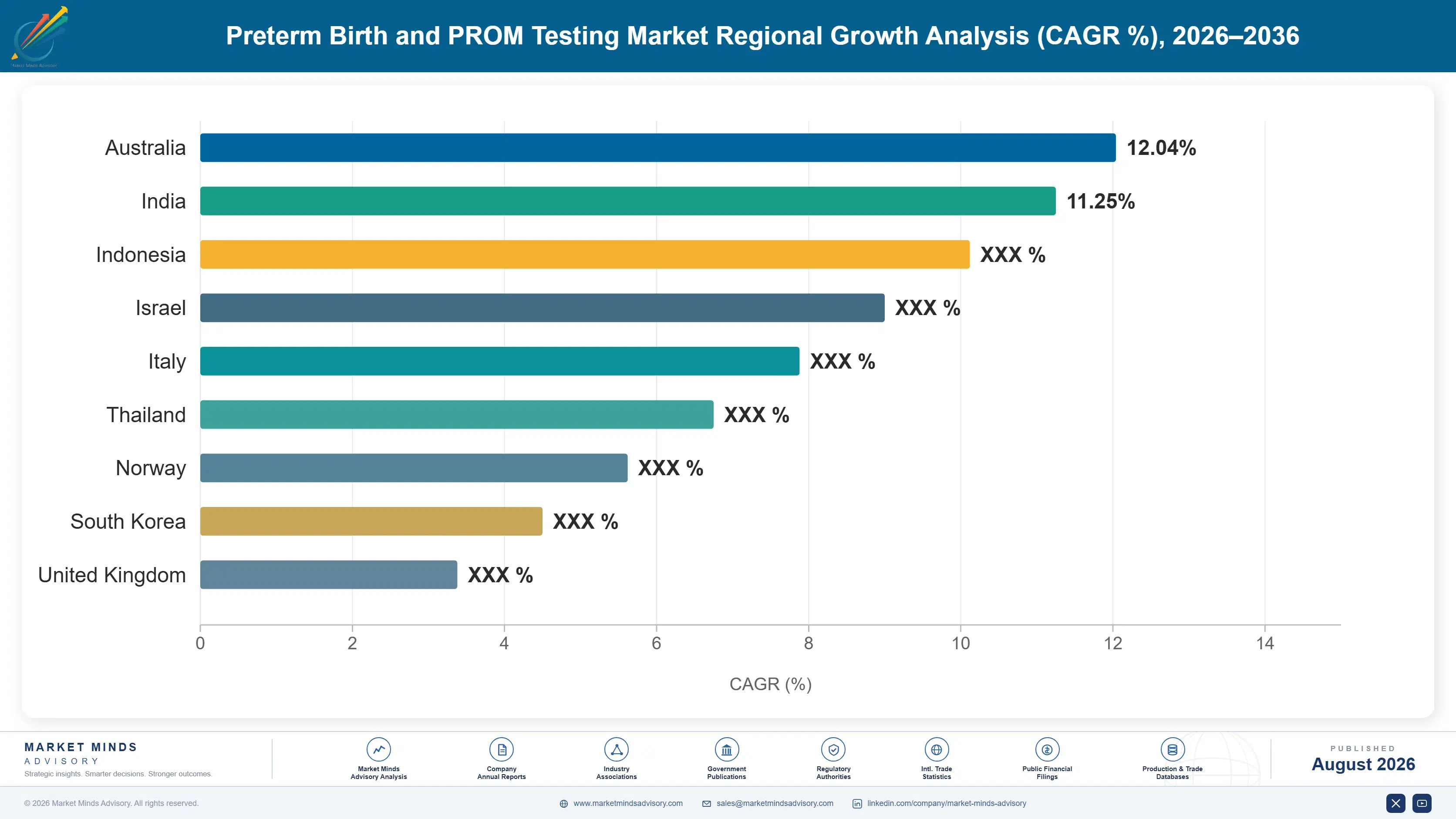
Regional Architecture and Country Demand Map

North America commands the largest share of global demand given its dense concentration of maternal-fetal medicine specialists and established reimbursement pathways, while South Asia and Pacific and East Asia anchor the fastest-growing regional pipelines. Western Europe contributes steady, more gradually expanding demand of its own.

North America

The United States anchors regional demand through its dense concentration of maternal-fetal medicine specialists and the earliest, deepest combined-panel installed base of any market tracked in this report. Canada contributes a smaller, steadily growing demand base benefiting from proximity to the same manufacturer distribution networks and shared clinical training programs serving the broader North American obstetric community. Deeper payer coverage for biomarker testing and established reimbursement pathways give the region durable spending power even as unit growth moderates relative to faster-growing emerging markets. Growth stays healthy but trails East Asia and South Asia and Pacific because the region's largest hospitals have already completed much of their initial platform adoption. Mexico's growing prenatal testing capacity adds regional momentum worth tracking.
Share: 30% | CAGR: 8.4% (2026 to 2036)

Western Europe

France anchors both regional manufacturing depth and demand, home to established diagnostics manufacturers and a dense academic obstetric network whose institutions supply the broader European market. Germany and the United Kingdom follow with steady demand tied to national health system coverage increasingly recognizing biomarker testing as clinically beneficial. Regulatory harmonization plays a meaningful role here, but European national health service laboratory budgets are pushing hospitals toward combined-panel adoption well ahead of many other global markets tracked in this report. Growth trails East Asia and South Asia and Pacific because the region's mature testing base is expanding equipment spending more slowly than newer market entrants. Switzerland and the Netherlands contribute smaller but growing demand of their own.
Share: 23% | CAGR: 7.5% (2026 to 2036)
Regional intelligence for 5 additional markets available in the complete report: East Asia, South Asia and Pacific, Latin America, Middle East and Africa, Eastern Europe. Contact sales@marketmindsadvisory.com.
preterm-birth-and-prom-testing-market-country-cagr-analysis-1787307768371

Where Preterm Testing Manufacturers Actually Capture Margin

Standard single-marker test sales increasingly compete on price alone as more manufacturers enter the category, so the companies protecting margin monetize the evidence and service layer: clinical outcomes evidence, instrument placement bundling, and long-term hospital network agreements. The four levers below reflect where MMA's interviews with laboratory procurement teams show real, sustained willingness to pay a premium.

Negative Predictive Value Evidence Generation Programs

Manufacturers increasingly fund multi-site clinical outcomes studies demonstrating combined-panel negative predictive value, since payers and hospital purchasing committees increasingly require documented clinical evidence before approving differentiated reimbursement for premium biomarker platforms. Manufacturers investing in rigorous outcomes evidence capture meaningfully higher hospital adoption rates than manufacturers relying on preliminary data alone, worth roughly 24% higher institutional win rates versus standard evidence packages, since evidence investment builds purchasing trust that marketing claims cannot replicate on their own. Adoption of dedicated clinical evidence teams continues accelerating industry-wide as combined-panel testing expands. This trend continues strengthening as combined-panel adoption widens.
Market Impact: Adds roughly 24 percent higher inst

Instrument Placement and Reagent Bundling Programs

Manufacturers increasingly place point-of-care reader instruments at no upfront cost in exchange for exclusive reagent supply agreements, since clinics increasingly require documented capital-free access before committing to biomarker testing programs. Manufacturers offering integrated placement bundling capture meaningfully higher clinic renewal rates than instrument-sale vendors, worth roughly 27% higher contract renewal within the first three years, since placement investment builds clinic loyalty that equipment specification alone cannot replicate. This revenue stream continues expanding as more clinics adopt point-of-care testing. Smaller manufacturers without similar scale struggle to offer comparable placement terms. This attach pattern strengthens further as reimbursement clarity improves.
Market Impact: Adds roughly 27 percent higher cont

Laboratory Information System Integration Support Services

Manufacturers offering integrated laboratory information system connectivity alongside testing hardware capture recurring software licensing revenue while simultaneously deepening customer relationships that make competitive displacement more difficult for rivals without comparable software infrastructure available today. For hospitals pursuing standardized triage workflows, the value proposition is faster result reporting without separate software and hardware procurement processes across multiple clinical programs. Early adopters report integration attach rates approaching 31% among first-time combined-panel buyers, growing steadily each year as reimbursement expands. Smaller manufacturers without comparable software development budgets increasingly struggle to match this attach rate.
Market Impact: Reaches nearly 31 percent overall i

Long-Term Hospital Network Supply and Loyalty Agreements

Large hospital networks increasingly sign multi-year test supply and instrument upgrade agreements guaranteeing consistent access to the latest biomarker panel technology, converting what used to be a series of individual purchase orders into predictable recurring revenue worth roughly 21% of a manufacturer's forward account revenue across the agreement term. Manufacturers offering these agreements gain visibility into future demand that supports continued production investment, while networks gain protection against obsolescence and pricing volatility on tests purchased under long-term relationships each procurement cycle. Smaller manufacturers without comparable balance sheet strength increasingly struggle to offer similar long-term terms.
Market Impact: Locks in supply revenue for 3 to 5

Who Controls the Margin Pool

CR5 sits at 68%, reflecting a category moderately concentrated among diagnostics manufacturers, evaluated here on test kit and instrument placement revenue combined. Hologic and QIAGEN lead on category revenue scale, with a meaningful gap separating them from smaller challengers, including Sera Prognostics and Laboratoire CCD, each strong in specific product or regional segments rather than universally. Smaller manufacturers increasingly struggle to match the clinical evidence investment larger
Current activity centers on three dimensions: negative predictive value evidence generation for reimbursement negotiations, instrument placement and reagent bundling depth, and laboratory information system integration capability for large hospital network accounts. Manufacturers lacking combined-panel capability are increasingly partnering with specialty biomarker developers rather than losing procurement tenders on missing-technology grounds alone across the industry.

Emerging pressure comes from Sera Prognostics, expanding aggressively on proprietary proteomic biomarker innovation into premium risk-stratification segments historically dominated by established single-marker suppliers. If proteomic-based entrants continue converting clinical validation depth into procurement wins, expect rankings among the next several challengers to shift by 2030, as innovation-led entrants displace slower-moving incumbents across premium segments worldwide. Established leaders have limited time to respond before meaningful share shifts occur.
preterm-birth-and-prom-testing-market-company-positioning-matrix-1787307768892

Competitive Moat and Risk Dimensions

HOLOGIC, INC.

Moat: Established Fetal Fibronectin Franchise

Hologic's decades of clinical evidence supporting its fetal fibronectin assay give it hospital trust and regulatory documentation depth that newer entrants cannot quickly replicate regardless of technical investment committed. That accumulated evidence and relationship depth increasingly functions as a competitive moat for large hospital network negotiations specifically. Competitors are unlikely to close this gap quickly.
HOLOGIC, INC.

Risk: Combined-Panel Displacement Exposure

Hologic's single-marker product concentration leaves it more exposed than combined-panel competitors to hospitals seeking integrated dual-biomarker confirmation in a single test visit. Managing this requires balancing continued single-marker investment against broader combined-panel development across the full range of accounts served. This tension is likely to intensify as combined-panel adoption accelerates industry-wide.
QIAGEN N.V.

Moat: Broad Molecular Diagnostics Portfolio

QIAGEN's broad, integrated molecular diagnostics portfolio spanning multiple women's health testing categories gives it switching-cost advantages that narrower single-product manufacturers cannot easily replicate across a hospital's full laboratory procurement relationship. That portfolio breadth makes QIAGEN a default vendor for health systems seeking a single integrated diagnostics relationship. Competitors are unlikely to close this gap quickly.
QIAGEN N.V.

Risk: Proteomic Biomarker Innovation Gap

QIAGEN's antibody-based assay concentration leaves it more exposed than proteomic biomarker specialists to hospitals seeking the highest-sensitivity risk-stratification data now emerging from newer platforms. Closing this gap requires sustained investment in proteomic research partnerships over several years. Momentum currently favors proteomic-focused rivals in the most demanding academic tenders.

Players Tracked

Prominent Players

Hologic, Inc.
QIAGEN N.V.
Sera Prognostics, Inc.
Laboratoire CCD
Parsagen Diagnostics, Inc.

Other Key Players

Biosynex S.A.
Amires Biotech Co., Ltd.
Gentian Diagnostics AS
MFB Fertility, Inc.
Sekisui Diagnostics, LLC
IQ Products BV
Alfa Scientific Designs, Inc.
Rovers Medical Devices B.V.
Standard Diagnostics, Inc.
Boditech Med Incorporated
AJ Biotech Co., Ltd.
Wondfo Biotech Co., Ltd.
InTec Products, Inc.
Nix Diagnostics AG
Amgenix Diagnostics Corporation

Recent Developments

MARCH 2025

Hologic Expands Combined-Panel Clinical Validation Study

Hologic announced an expanded multi-site clinical validation study for its combined preterm labor and PROM biomarker panel, targeting broader regulatory clearance across additional gestational age ranges. The study follows growing customer demand for integrated triage confirmation ahead of continued reimbursement expansion. Early enrollment data suggests strong site interest.
Signal: Signals Hologic prioritizing combined-pane
JULY 2025

Sera Prognostics Launches Expanded Proteomic Risk Panel

Sera Prognostics announced commercial launch of an expanded proteomic biomarker panel engineered for improved preterm birth risk stratification in asymptomatic populations. The launch follows favorable validation data shared with several major hospital network accounts recently. Early customer feedback cited improved diagnostic confidence across affected facility networks.
Signal: Signals Sera Prognostics prioritizing prot
NOVEMBER 2025

QIAGEN Signs Distribution Agreement With Indian Hospital Network

QIAGEN signed a multi-year distribution agreement with a major Indian hospital network, securing preferred-supplier status for combined-panel and point-of-care platforms ahead of the region's expanding institutional delivery growth. The agreement covers test supply and training support across the network's growing facility portfolio nationwide this year.
Signal: Signals established manufacturers actively

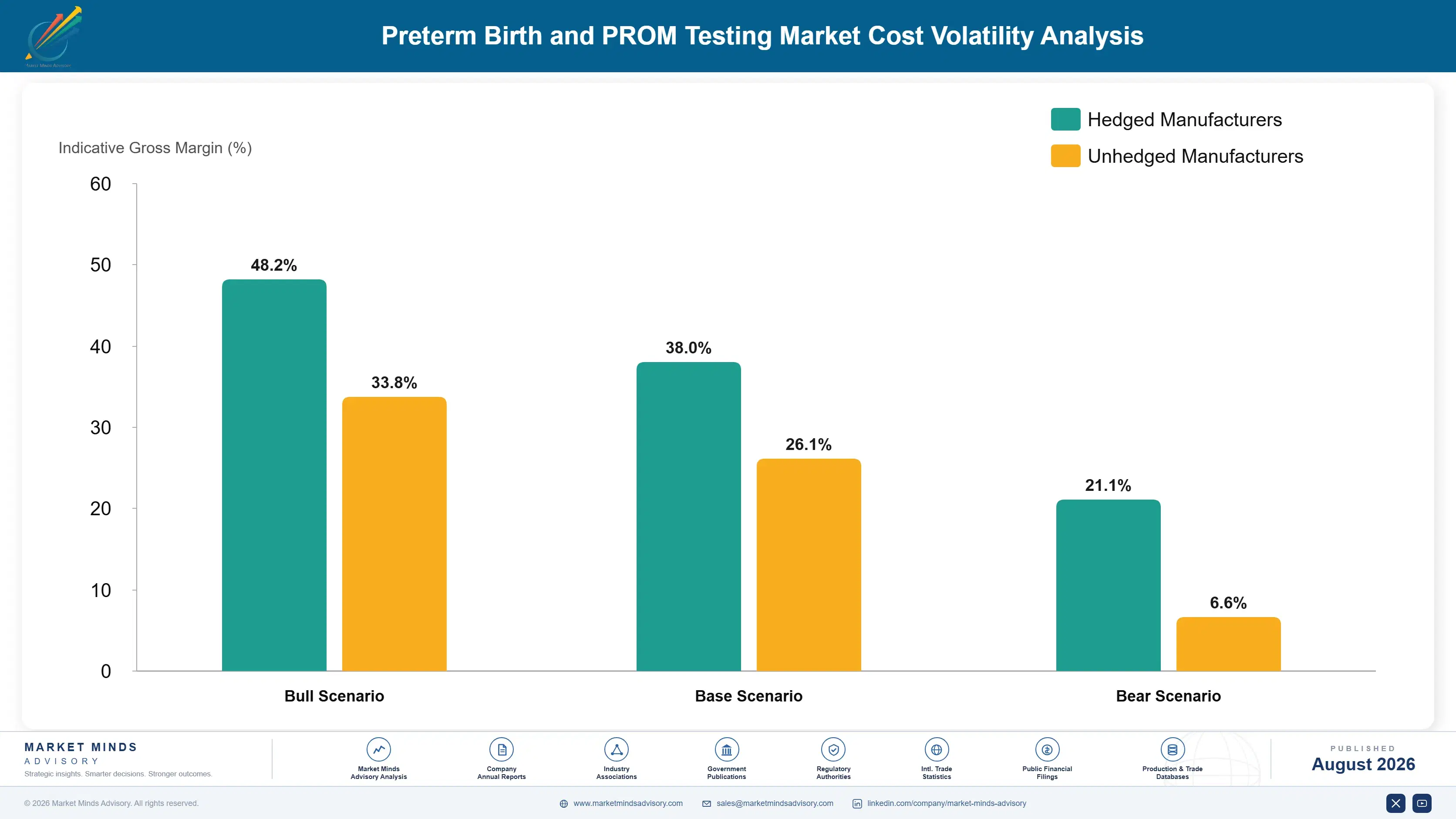
Monoclonal Antibody and Reagent Costs

Monoclonal antibody and specialty reagent components together account for roughly 34% of preterm testing kit cost of goods sold, making these inputs the dominant cost driver in the category ahead of general cartridge and instrument manufacturing. Antibody costs vary substantially by specificity requirement, with combined-panel formulations driving most of the cost variability manufacturers face today.
Specialty monoclonal antibody costs spiked through 2022 as broader diagnostics and biopharmaceutical demand absorbed available specialized manufacturing capacity faster than new capacity could be added, according to company disclosures citing constrained cell culture and purification capacity across multiple regional suppliers. Manufacturers without long-term supply agreements or in-house antibody production capability saw costs rise faster than they could pass through to fixed-price hospital contract pricing signed before the spike occurred across the industry.

Smaller manufacturers without established antibody sourcing relationships absorb input cost volatility directly into thin margins, while larger players like Hologic and QIAGEN use existing biopharmaceutical supply chain relationships to insulate margins from component cost swings across their broader networks. Manufacturers newly entering the category without comparable established supply relationships carry meaningfully greater cost exposure than incumbents who capture more of the value chain themselves across the broader category.
preterm-birth-and-prom-testing-market-cost-volatility-analysis-1787307769088

Long-Term Antibody Supply Agreements

The largest manufacturers are locking multi-year monoclonal antibody supply agreements directly with cell culture partners rather than competing for spot market capacity, securing priority access and more predictable pricing across major production programs and forecast cycles ahead, reinforcing the scale advantages already present across the category. Smaller manufacturers increasingly struggle to secure comparable terms.

Vertical Integration Into Antibody Manufacturing

Larger manufacturers are investing directly in in-house monoclonal antibody production capability rather than relying entirely on third-party reagent suppliers, capturing more of the value chain and reducing exposure to specialty component price swings across the category's highest-volume combined-panel product lines. This trend continues strengthening as demand for validated panels keeps expanding across every major regional market tracked.

Component Sourcing Diversification Strategies

Manufacturers are diversifying antibody and reagent component sourcing across multiple regional suppliers rather than depending on a single source, reducing exposure to specific production disruptions that have affected particular reagent categories during recent volatility episodes across markets. This diversification has become standard practice among the category's larger manufacturers over the past several procurement cycles industry-wide.

Portfolio Architecture for Margin Defence

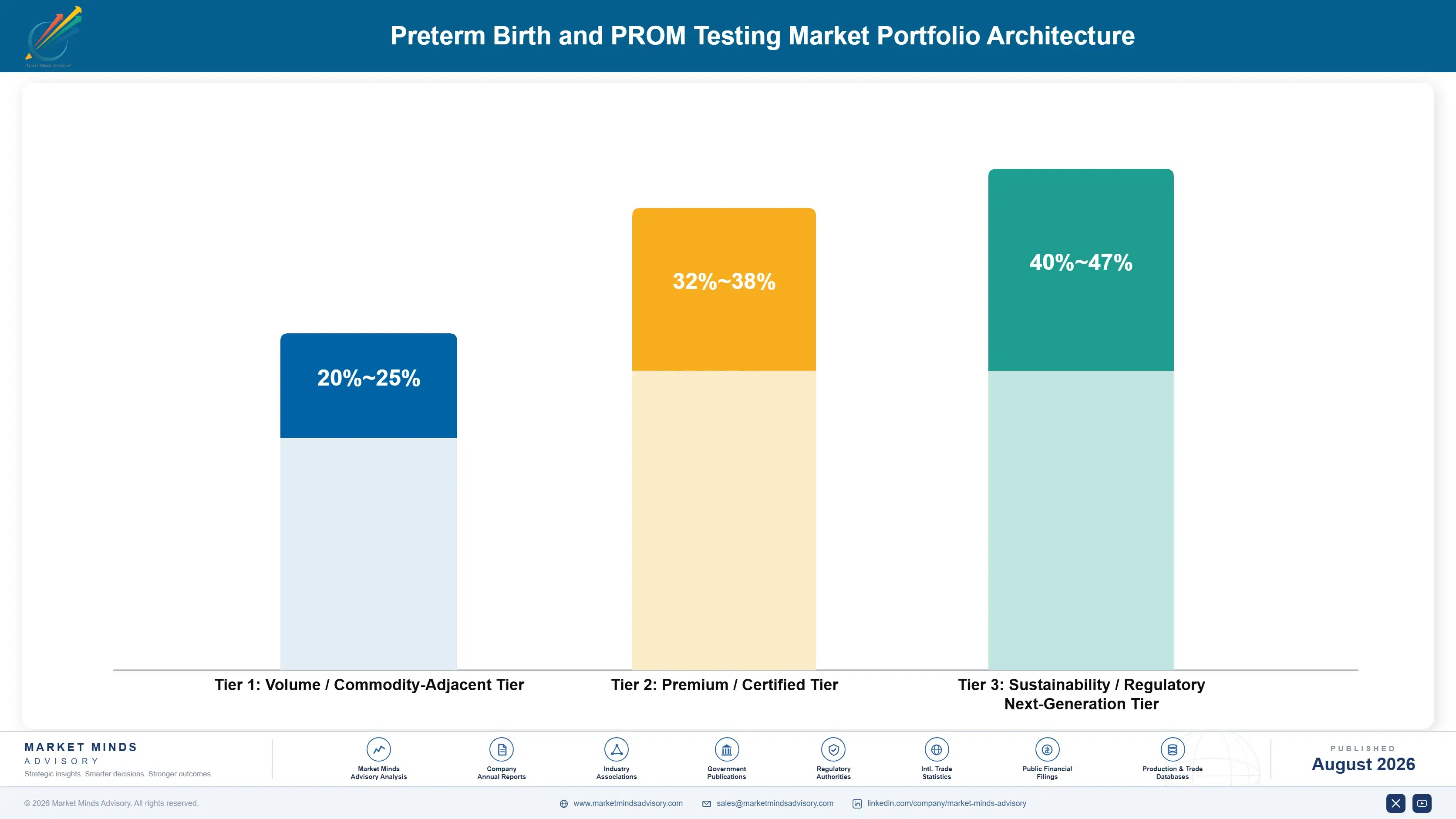
MMA's tier architecture separates the category into three margin bands. Volume and commodity-adjacent standard single-marker tests compete on price against widely available generic configurations and carry thin margin, premium and certified combined-panel and point-of-care platforms carry higher margin on documented clinical validation and instrument support, and sustainability-linked next-generation formats, including proteomic risk-stratification panels, command the highest margin as the newes
The tension between volume and premium plays out most visibly among mid-sized community hospitals, who want combined-panel capability at closer to standard test pricing. That up-tier migration remains slow given how many mid-sized hospitals still evaluate laboratory budget cost cautiously before committing further procurement resources. Manufacturers that fail to bundle clinical evidence and instrument support risk losing share to more capable rivals.

High-value margin pools concentrate in large academic and clinical institutional account agreements bundled with clinical evidence, instrument placement, and laboratory information system integration, where recurring evidence and support-attach revenue increasingly outweighs the margin earned on any individual test sale alone. That concentration is pulling investment steadily toward evidence and service support capability rather than incremental manufacturing capacity expansion alone across the category.

Volume / Commodity-Adjacent Tier

Standard single-marker fetal fibronectin and PAMG-1 tests sold primarily on price against widely available generic configurations, serving cost-sensitive community hospitals where gross margin stays thin and competition is driven almost entirely by landed unit cost.
Gross Margin: 20%-25%

Premium / Certified Tier

Combined-panel and point-of-care platforms specified by hospitals requiring documented clinical validation, instrument support, and long-term supply agreements, commanding meaningfully higher margin on demonstrated performance achieved across every major procurement market worldwide today.
Gross Margin: 32%-38%

Sustainability / Regulatory / Next-Generation Tier

Proteomic risk-stratification panels positioned for hospitals chasing regulatory-cleared asymptomatic screening and reduced overtreatment, where technology innovation and evidence depth support the category's highest margin overall across most major markets today.
Gross Margin: 40%-47%
preterm-birth-and-prom-testing-market-portfolio-architecture-1787307769600

High-value Sub-segments and Strategic Watch-out

Combined Preterm Labor and PROM Biomarker Panels

The fastest-growing and highest-evidence-intensity segment, where hospital demand is pulling capital toward validated dual-biomarker confirmation away from sequential single-marker testing alone, representing the clearest near-term path to share gain and margin expansion together across a manufacturer's entire institutional relationship base worldwide. Investment here compounds fastest of any category.

Point-of-Care Fetal Fibronectin Testing

Steady, workflow-driven growth from point-of-care formats that bundle into large hospital account agreements, less explosive than combined-panel demand but increasingly sticky, giving manufacturers reliable recurring revenue tied to labor unit workflow redesign rather than open test competition alone across most accounts. Capital cycles drive most of this growth.

Fetal Fibronectin Assays

The volume core of the category across established hospitals, sold in steady but modest unit numbers as overall institutional delivery volume continues growing, competing on price and least affected by the evidence-driven dynamics seen elsewhere in the broader portfolio described above, served across most regions today.

IGFBP-1 Assays

A strategic watch-out segment where growth trails the category average as adoption remains concentrated among legacy single-modality users, and manufacturers risk ceding the niche entirely if larger competitors keep deprioritizing standalone investment ahead of clearer combined-panel and point-of-care demand arriving soon across every affected market.

Clinic Testing and Evidence Economics

A test kit sale is rarely a single transaction for the largest academic and clinical institutional accounts. Clinical evidence, instrument placement, and laboratory information system integration convert what used to be a one-time purchase order into a relationship of recurring test volume and upgrade cycles. Manufacturers that capture the evidence and instrument attachment at first sale retain greater lifetime value per account than those competing on unit price alone.
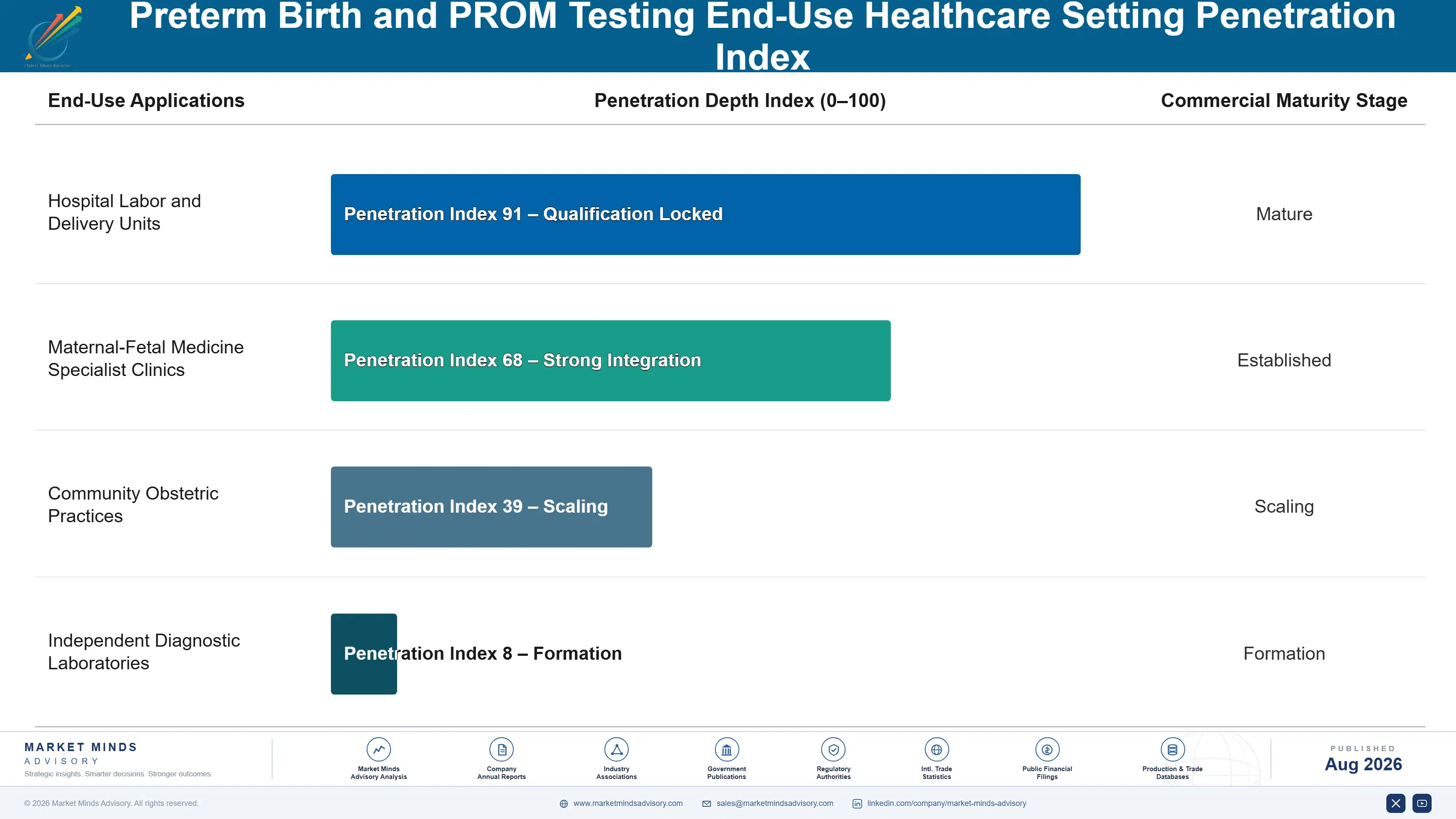
Adoption depth varies sharply by institution type. Large academic maternal-fetal medicine centers and hospital systems convert fastest and most completely, standardizing entire triage protocols onto certified, proven suppliers once regulatory and quality standards align, making them the highest-value account type despite competitive pricing negotiated across the relationship. Smaller community hospitals convert more slowly, often relying on standard single-marker tests for years before adopting combined-panel formats directly.

A generational shift in obstetricians is compounding the evidence-driven shift. Younger obstetricians entering practice increasingly expect biomarker-validated triage tools as standard clinical protocol, a preference an older generation of obstetricians, who trained primarily on symptom assessment alone, rarely weighted as heavily. That shift is accelerating premium-tier adoption even among hospitals that have not yet faced direct pressure to convert away from standard testing.
preterm-birth-and-prom-testing-market-end-use-penetration-index-1787307770095

What Matters Most Through 2036

These are among the four positions where our research anticipates prominent divergence between winners and laggards over the coming forecast period. Each is grounded in the demand model, the regulatory perimeter, and the announced capacity pipeline.
01 / COMBINED-PANEL CAPACITY INVESTMENT

Build validated dual-biomarker testing before competitors do

Combined-panel demand is converting test specification from a niche capability into a mainstream hospital expectation, and manufacturers with established validated combined-panel data are already capturing disproportionate share of laboratory procurement decisions ahead of broader market adoption. Manufacturers that invest in combined-panel capacity now will secure preferred-vendor status with major hospital accounts before competitors catch up on the evidence investment required. Continuing to treat capacity as a future concern risks ceding the fastest-growing, most differentiated segment to manufacturers already building validated production depth.
02 / PROTEOMIC BIOMARKER TECHNOLOGY DEPTH

Deepen risk-stratification innovation ahead of the next validation cycle

Proteomic biomarker technology increasingly decides purchasing decisions as much as unit cost itself, and manufacturers that deepen validated risk-stratification pathways will capture disproportionate share of installed base upgrades as hospitals seek diagnostic confidence without full instrument replacement. Manufacturers that invest in open, validated biomarker technology now will build switching costs that protect installed base better than competitors relying on price alone. This technology investment requires sustained development spending across multiple years before any single validation cycle fully rewards that patient positioning choice.
03 / RECURRING INSTRUMENT REVENUE CAPTURE

Bundle instrument placement and evidence into every large hospital quote

Instrument placement bundling and clinical evidence generation already generate meaningfully higher recurring revenue than standard test sales, yet many manufacturers still sell these as separate negotiations rather than a default part of every quote presented to large hospital buyers. Manufacturers that make placement and evidence attachment the default, requiring buyers to actively opt out rather than opt in, will capture materially more lifetime value per account than competitors treating these services as an afterthought. This remains underexploited by every manufacturer outside the two largest players active in the category.
04 / PROTEOMIC ENTRANT COMPETITION PRESSURE

Diversify toward certified segments ahead of continued innovation pressure

Proteomic biomarker specialists continue expanding aggressively into premium risk-stratification segments, and manufacturers overly dependent on undifferentiated single-marker sales into innovation-sensitive markets face real margin compression risk across the forecast period covered in this report. Manufacturers that diversify toward certified, differentiated evidence and service sales in segments less exposed to proteomic innovation competition will protect margin better than competitors continuing to compete primarily on undifferentiated commodity-grade test price. This repositioning requires sustained investment in evidence well before competitive pressure fully materializes in each affected market.

Engagement Snapshot From the Field

A live engagement with an industry participant carrying material or product regulatory and market exposure ahead of a defining policy shift, showing how our research translates into a defensible multi-year portfolio strategy.
MARKET MINDS ADVISORY · CLIENT ENGAGEMENT SUMMARY
Preterm Birth and PROM Testing Producer Strategic Portfolio Review and Transition Roadmap 2026·Investment Scenario on Preterm Birth and PROM Testing Exposure Evaluation 2025-26
CLIENT PROFILE
The client is a multi-site academic hospital network operating 5 dedicated labor and delivery units, with an accelerating high-risk pregnancy referral pipeline and a stated goal of standardizing combined-panel triage protocols across its network. Annual diagnostics procurement spend exceeds $8.4 million (client-reported, unverified by MMA), concentrated primarily across single-marker, point-of-care, and emerging combined-panel platforms across its units.
STRATEGIC CHALLENGE
The client faced a technology transition decision balancing combined-panel platform adoption against existing single-marker testing infrastructure and uncertain reimbursement pathway timing across its varied unit payer mix. Leadership needed a structured evaluation framework weighing dual-biomarker confirmation benefits against protocol standardization complexity across its unit network and budget. Unit leadership also worried that a rushed rollout could compromise ongoing triage workflow continuity.
MMA APPROACH
MMA conducted a structured evaluation of the client's current testing specification patterns against combined-panel platform readiness and outcomes data across its units, benchmarked vendor-reported negative predictive value claims against MMA's proprietary diagnostics performance database, and facilitated reference site visits with comparable academic networks that had already completed combined-panel conversion. The engagement combined primary interviews with clinical leadership alongside independent performance verification.
KEY FINDINGS
  1. Two of the client's five labor and delivery units lacked reader instrumentation capable of supporting combined-panel testing without capital upgrade investment first and foremost.
  2. The client's high-risk pregnancy programs showed meaningfully improved triage accuracy with combined panels than with single-marker tests tested across multiple unit deployments.
  3. Standardizing on validated combined panels reduced projected unnecessary admission rate by an estimated 29%, per MMA's proprietary internal forecasting model, improving unit throughput capacity.
  4. Unit-specific instrument readiness variation across the client's network emerged as a meaningfully underestimated factor in conversion planning requiring further review ahead of the network-wide rollout scheduled for subsequent phases.
CLIENT PROFILE
The client is a multi-site academic hospital network operating 5 dedicated labor and delivery units, with an accelerating high-risk pregnancy referral pipeline and a stated goal of standardizing combined-panel triage protocols across its network. Annual diagnostics procurement spend exceeds $8.4 million (client-reported, unverified by MMA), concentrated primarily across single-marker, point-of-care, and emerging combined-panel platforms across its units.
STRATEGIC CHALLENGE
The client faced a technology transition decision balancing combined-panel platform adoption against existing single-marker testing infrastructure and uncertain reimbursement pathway timing across its varied unit payer mix. Leadership needed a structured evaluation framework weighing dual-biomarker confirmation benefits against protocol standardization complexity across its unit network and budget. Unit leadership also worried that a rushed rollout could compromise ongoing triage workflow continuity.
MMA APPROACH
MMA conducted a structured evaluation of the client's current testing specification patterns against combined-panel platform readiness and outcomes data across its units, benchmarked vendor-reported negative predictive value claims against MMA's proprietary diagnostics performance database, and facilitated reference site visits with comparable academic networks that had already completed combined-panel conversion. The engagement combined primary interviews with clinical leadership alongside independent performance verification.
KEY FINDINGS
  1. Two of the client's five labor and delivery units lacked reader instrumentation capable of supporting combined-panel testing without capital upgrade investment first and foremost.
  2. The client's high-risk pregnancy programs showed meaningfully improved triage accuracy with combined panels than with single-marker tests tested across multiple unit deployments.
  3. Standardizing on validated combined panels reduced projected unnecessary admission rate by an estimated 29%, per MMA's proprietary internal forecasting model, improving unit throughput capacity.
  4. Unit-specific instrument readiness variation across the client's network emerged as a meaningfully underestimated factor in conversion planning requiring further review ahead of the network-wide rollout scheduled for subsequent phases.
RECOMMENDED STRATEGY
Phase 1: Phase 1 (Months 1 to 3): Complete unit-level instrument assessment and convert the two best-positioned units to combined-panel technique first. Phase 2: Phase 2 (Months 4 to 9): Deploy instrument upgrades at remaining units while closely tracking admission rate against baseline triage metrics. Phase 3: Phase 3 (Months 10 to 16): Complete network-wide standardization pending validated results from the initial deployment phase across all units.
OUTCOME
The client's first two units achieved measurable improvements in admission rate and triage accuracy within six months of combined-panel conversion (client-reported, unverified by MMA), supporting the phased network-wide rollout that had originally motivated the instrument assessment engagement. The remaining three units are scheduled for phased conversion over the following twelve months.

Frequently Asked Questions

Foundational context covering the market sizes, CAGR, scope, country, region and competition that inform every finding below. This section is provided to cover basics and most often pre-purchase conversations, answered from the MMA Primary Research Dataset.

What is the current size of the Preterm Birth and PROM Testing Market?

MMA estimates the global preterm birth and PROM testing market at $1.1 billion in 2025. Growth concentrates in combined-panel and point-of-care platforms, driven by expanding insurer reimbursement.

How large will the Preterm Birth and PROM Testing Market be by 2036?

MMA forecasts the market reaching $2.8 billion by 2036, up from $1.199 billion in 2026. That represents roughly a 2.34 times expansion over the full ten-year forecast period covered here.

What is the CAGR for the Preterm Birth and PROM Testing Market 2026 to 2036?

MMA's base case forecasts a 9.0% compound annual growth rate, with a bull case of 10.3% and a bear case of 7.6% depending on reimbursement expansion timing.

Which segment is growing fastest?

Combined preterm labor and PROM biomarker panels lead at a 15.2% CAGR, roughly 1.69 times the overall market rate, as clinics convert sequential testing toward integrated dual-biomarker confirmation.

Who are the major companies in the Preterm Birth and PROM Testing Market?

Hologic, QIAGEN, Sera Prognostics, Laboratoire CCD, and Parsagen Diagnostics lead the category, together holding an estimated 68% combined share on a revenue basis worldwide. Each maintains distinct regional and product strengths across the category.

Which country is growing fastest?

India leads at an estimated 13.4% CAGR, outpacing the global average as its expanding institutional delivery rates and growing prenatal screening investment continue growing faster than any comparable economy.

Report Segmentation Architecture

The full report scope spans multiple orthogonal segmentation dimensions, with cross-tabulated demand data provided for each dimension pair. Coverage extends further to regional breakdowns, trend trajectories, and the competitive detail needed to support segment-level decision-making.

By Assay Technology and Product Type

  • Fetal Fibronectin Assays
  • IGFBP-1 Assays
  • PAMG-1 Assays
  • Combined Preterm Labor and PROM Biomarker Panels
  • Point-of-Care Testing Instruments
  • Test Kit Consumables

By End-Use Healthcare Setting

  • Hospital Labor and Delivery Units
  • Maternal-Fetal Medicine Specialist Clinics
  • Community Obstetric Practices
  • Independent Diagnostic Laboratories

By Commercial Dimension

  • Direct Hospital Laboratory Procurement
  • Hospital Network Group Purchasing Agreements
  • Long-Term Instrument and Reagent Contracts
  • Distributor and Reseller Channels

By Region

  • North America
  • Western Europe
  • East Asia
  • South Asia and Pacific
  • Latin America
  • Middle East and Africa
  • Eastern Europe

Scope, Methodology, and Coverage

Every figure in this report is reproducible from documented input assumptions. The scope below maps the historical period, the forecast horizon, the segmentation dimensions, and the countries covered, alongside the underlying primary and qualitative methodology.
Historical Period
2020 to 2025
Forecast Period
2026 to 2036
Base Year
2025 (USD billions; MMA Primary Research Dataset, August 2026)
Market Definition
The preterm birth and PROM testing market covers fetal fibronectin assays, insulin-like growth factor binding protein-1 (IGFBP-1) assays, placental alpha microglobulin-1 (PAMG-1) assays, combined preterm labor and PROM biomarker panels, point-of-care testing instruments, and associated test kit consumables used to assess preterm labor risk and premature rupture of membranes. It excludes general prenatal ultrasound screening and cervical length measurement services not paired with biomarker assay testing.
Quantitative Units
USD billions (current prices); test kit unit volume and installed instrument count where applicable
Segmentation Dimensions
By Assay Technology and Product Type; By End-Use Healthcare Setting; By Commercial Dimension; By Region
Regions Covered
North America, Western Europe, East Asia, South Asia and Pacific, Latin America, Middle East and Africa, Eastern Europe
Countries Covered
USA, China, Germany, France, UK, Japan, South Korea, India, Australia, Canada, Brazil, Mexico, Indonesia, Vietnam, Thailand, Singapore, UAE, Saudi Arabia, South Africa, Nigeria, Turkey, Poland, Netherlands, Italy, Spain, Sweden, Switzerland, Argentina, Colombia, and additional markets relevant to this sector
Key Companies Profiled
Hologic, Inc., QIAGEN N.V., Sera Prognostics, Inc., Laboratoire CCD, Parsagen Diagnostics, Inc., Biosynex S.A., Amires Biotech Co., Ltd., Gentian Diagnostics AS, MFB Fertility, Inc., Sekisui Diagnostics, LLC, IQ Products BV, Alfa Scientific Designs, Inc., Rovers Medical Devices B.V., Standard Diagnostics, Inc., Boditech Med Incorporated, AJ Biotech Co., Ltd., Wondfo Biotech Co., Ltd., InTec Products, Inc., Nix Diagnostics AG, Amgenix Diagnostics Corporation
Quantitative Methodology
Primary survey, n=3,800 respondents, Q4 2025, six countries; demand-side model with trade association cross-validation
Qualitative Methodology
47 expert interviews, Q4 2025; applied to validate demand model assumptions, identify emerging dynamics, and assess competitive positioning
Report Format
PDF and XLSX data workbook (Word format preview document)
Publisher
Market Minds Advisory
Report Code
MMA-2026-HLT-102
Published
August 2026
Contact
sales@marketmindsadvisory.com | www.marketmindsadvisory.com

Purchase the full Preterm Birth and PROM Testing Market Report (2026 to 2036).

The full Preterm Birth and PROM Testing Market report delivers granular five-year and ten-year forecasts across all six technology segments, clinical adoption tracking by region, and manufacturer benchmarking drawn from MMA's proprietary diagnostics database. It includes detailed profiles of all twenty companies covered here, extended regional analysis across every major hospital market worldwide, and a technology tracker spanning combined-panel and proteomic platform development. Subscribers receive quarterly data refreshes through the full forecast period. Buyers also gain direct analyst access for engagement-specific questions throughout the subscription term.
Clinical adoption and reimbursement tracker by region
Ten-year segment-level forecasts across all technology types
Manufacturer benchmarking data across pricing and validation
Technology platform development tracking module here
Twenty-company competitive profiles with moat analysis
Quarterly data refresh access throughout subscription period

Built For The People Who Decide

From boardroom strategy to bench-side execution, this report is read cover-to-cover by leaders shaping the next decade of their industry, turning demand scenarios, market dynamics and valuation benchmarks into decisions.
CXOs/ Presidents/ VPs/ Managers
M&A and Corporate Development
Strategy Teams and R&D Heads
Procurement and Product Directors
Regulatory and Compliance Leaders
Investor Relations and Equity Analysts