Market Minds Advisory
Pressure Ulcer Detection Devices Market

Pressure Ulcer Detection Devices Market: Subepidermal Sensing and Early-Warning Skin Assessment Technology

CMS reimbursement penalties for hospital-acquired pressure injuries are pushing subepidermal moisture sensing into a genuine nursing-workflow standard, forcing wound care incumbents to defend visual-inspection protocols against a technology that catches damage before it becomes visible.

Lead Analyst

Alice Ballenger

Published

September 2026

Make Smarter Decisions with Customized Research Insights

Request a free sample report and evaluate market opportunities, growth trends, and competitive dynamics relevant to your business needs.

2025 MARKET VALUE$0.6BMarket Size 2025
2036 FORECAST VALUE$2.2BBase Case , 2026 to 2036
CAGR 2026 TO 203612.4 %Bull 13.7% / Bear 11.1%
INCREMENTAL OPPORTUNITY$1.6BNet 10- year value creation
EXPANSION MULTIPLE3.22x2036 value over 2026 base
Strategic Levers
M&A Pipeline
Regional Outlook
Country Rankings
Competitive Intelligence
Segmental Deep-dive
Call-Us : 91 93563 13602

Executive Snapshot and Market Trajectory

Pressure ulcer detection has quietly moved from nursing judgment and visual skin checks toward objective sensor readings, and the shift is being driven less by clinical enthusiasm than by hospitals no longer wanting to absorb the reimbursement penalty for injuries that formed while patients were under their care.
Subepidermal moisture sensors are growing fastest of any segment, expanding close to seventeen percent annually and more than a third faster than the category overall, as clinical evidence linking early moisture changes to impending tissue damage keeps accumulating. North America holds the largest share on its concentrated hospital-acquired pressure injury reimbursement penalty structure, while India's rapidly expanding hospital infrastructure and aging population make it the single fastest-growing national market covered anywhere in this report.
Fifty-two percent concentration among the top five companies, evaluated here on estimated global device revenue, reflects genuine patent protection on the category's leading sensing technology alongside real clinical evidence barriers that keep out unproven competitors. Nursing workflow integration and reimbursement coding clarity are both reshaping which companies can actually convert clinical interest into sustained device adoption across every eligible care setting and geographic market segment.
Market Definition
The pressure ulcer detection devices market comprises subepidermal moisture sensors, continuous pressure mapping systems, thermal and optical imaging devices, and wearable monitoring patches used to identify early tissue damage before visible skin breakdown occurs. It excludes wound care dressings, treatment devices used after ulcer formation, and manual risk assessment scales or software that do not involve dedicated sensing hardware.
Base Year Value
$0.6B in 2025 (MMA Primary Research Dataset, August 2026)
Forecast Period
2026 to 2036, eleven discrete annual values
CAGR
12.4% base case. Bull 13.7%. Bear 11.1%.
Fastest Growth Segment
Subepidermal Moisture Sensors: 16.8% CAGR
Fastest Growth Country
India: 16.2% CAGR
Fastest Growth Region
South Asia and Pacific: 14.6% CAGR
Largest Region
North America: 32% of 2025 global value
Market Leaders
Bruin Biometrics, LLC, Hillrom (a Baxter International Company), XSENSOR Technology Corporation, Wellsense Inc., and Mölnlycke Health Care AB lead the category. Source: MMA Analysis based on company annual reports and investor filings.
Primary Survey
n=3,800 procurement and R&D decision-makers, Q4 2025, six countries
Methodology
Demand-side build-up, cross-validated against public data, 47 expert interviews

Pressure Ulcer Detection Devices Market Forecast Scenarios

pressure-ulcer-detection-devices-market-size-forecast-scenario-1787307727304
Between 2020 and 2025 the category grew at roughly 11.2 percent annually as pandemic-era nursing staff shortages increased reliance on objective detection technology to compensate for reduced skin-check frequency, while hospital capital budget constraints during the same period slowed equipment purchasing in some smaller facilities lacking dedicated quality improvement funding or executive-level capital sponsorship during that period.
The base case assumes 12.4 percent annual growth through 2036, anchored in three mechanisms: expanding CMS and international reimbursement penalty structures for hospital-acquired pressure injuries pushing facilities toward objective detection technology, continued clinical evidence accumulation supporting subepidermal moisture sensing as standard of care rather than experimental practice, and rising long-term care facility adoption as aging populations expand the at-risk patient base globally. Nursing workflow integration keeps improving throughout the forecast window as device manufacturers refine handheld and continuous monitoring form factors.
A bull case builds around expanding reimbursement coverage explicitly recognizing subepidermal moisture assessment as billable clinical practice, pushing growth toward 13.7 percent. The bear case centers on nursing staff training burden and workflow disruption slowing adoption in resource-constrained facilities, pulling growth down toward 11.1 percent if hospitals prioritize other competing capital investments instead of dedicated detection technology purchases.

Where Objective Sensing Meets Nursing Judgment

Pressure ulcer detection occupies a genuinely transitional position within wound care, where objective sensor readings are gradually supplementing rather than entirely fully replacing the visual skin assessment and risk-scale scoring that nursing staff have relied on for decades. That transition is uneven, concentrating first in hospitals facing the largest reimbursement penalty exposure and lagging considerably in long-term care and home health settings with meaningfully thinner capital budgets
MARKET CONCENTRATION (CR5)52%Top five companies hold roughly half of revenue
AVERAGE DEVICE SELLING PRICE$3,850 per handheld unitBlended price across handheld and continuous monitoring formats
TOP PRODUCING COUNTRY SHAREUnited States, 31% of unitsConcentrated medical device manufacturing and clinical evidence base
HOSPITAL ADOPTION PENETRATION24% of acute care bedsShare of eligible hospital beds using detection technology
PRESSURE INJURY COST AVOIDANCE$11,000 per prevented caseEstimated treatment cost avoided per successfully prevented injury
SENSOR READING FREQUENCYOnce per nursing shiftTypical clinical protocol interval for at-risk patient assessment
Competitive character centers on clinical evidence depth and nursing workflow integration rather than price alone, since hospital purchasing committees weigh peer-reviewed outcomes data heavily before approving new sensing technology into established care protocols and nursing routines. Reimbursement coding clarity increasingly determines which technologies hospitals prioritize for capital investment ahead of competing clinical technology purchases across every department.
Over the next decade, expanding reimbursement recognition of subepidermal moisture assessment as billable clinical practice will likely determine how quickly hospitals convert pilot programs into standard-of-care protocols across every eligible patient population. Long-term care facility adoption, still meaningfully behind acute hospital settings, represents the category's next major growth frontier as aging populations expand the at-risk patient base considerably each year.
"Nurses have done skin checks by eye for a century, and they are genuinely good at it. But by the time you can see a pressure injury forming, the tissue damage underneath already happened days earlier. That gap is the entire business case for this category."
Director, Medical Devices and Wound Care Practice · MMA Medical Devices Practice

Market Trends

Reimbursement Penalty Structures Push Objective Detection Adoption

Hospital-acquired pressure injuries trigger meaningful reimbursement penalties under Medicare's hospital-acquired condition reduction program in the United States, with several other national health systems implementing comparable financial consequences for facilities failing to prevent avoidable tissue damage during inpatient stays. Hospital quality improvement teams increasingly treat pressure injury prevention as a direct financial priority, elevating detection technology purchasing to executive-level capital budget discussions that previously stayed within nursing department budgets alone. Facilities that have adopted subepidermal moisture sensing report meaningful reductions in hospital-acquired pressure injury incidence within the first year, directly offsetting device costs through avoided penalty exposure.
Market Impact: Adds 9% annual at-risk patient grow

Continuous Monitoring Patches Expand Beyond Handheld Spot-Checks

Wearable continuous monitoring patches, capable of tracking moisture and pressure changes between nursing rounds rather than only at scheduled assessment intervals, are moving from pilot programs into broader clinical deployment as battery life and wireless connectivity improvements make continuous formats practical for routine hospital use. Nursing staff report that continuous monitoring reduces the risk of missed early warning signs between shift-based handheld assessments, particularly for high-risk patients whose condition can change meaningfully within hours. Device manufacturers are racing to develop connectivity integration with hospital electronic health record systems to make continuous monitoring data immediately actionable for care teams.
Market Impact: Adds 7% adoption from staffing pres

Market Opportunities and Growth Drivers

Aging Populations Expand the At-Risk Patient Base Globally

Global population aging is expanding the pool of patients with reduced mobility, thinner skin, and comorbidities that meaningfully increase pressure injury risk, a demographic shift affecting hospital, long-term care, and home health settings simultaneously across nearly every major healthcare market worldwide. Long-term care facility operators report that pressure injury prevention has become a genuine competitive differentiator in an increasingly quality-scrutinized elder care market, where strong prevention track records attract both patients and favorable insurer relationships more easily. This demographic-driven expansion directly supports device volume growth regardless of pricing pressure from lower-cost visual assessment alternatives elsewhere in the category.
Market Impact: Slows adoption 22% in small facilit

Nursing Staff Shortages Increase Reliance on Objective Detection Tools

Persistent nursing staff shortages across major healthcare markets have reduced the frequency and consistency of manual skin assessment that pressure injury prevention traditionally depended on, creating genuine clinical demand for objective detection tools that can partially compensate for reduced nurse-to-patient contact time during busy shifts. Hospital nursing leadership report that detection devices help newer or less experienced nursing staff identify early warning signs that traditionally required years of accumulated clinical judgment to reliably catch through visual inspection alone. This staffing-driven demand represents genuinely incremental adoption motivation distinct from pure reimbursement penalty avoidance elsewhere in the category.
Market Impact: Limits billing in 40% of facilities

Market Restraints and Challenges

Nursing Workflow Disruption Slows Adoption in Resource-Constrained Facilities

Integrating new sensing devices into established nursing workflows requires meaningful staff training time and protocol adjustment that resource-constrained facilities, particularly smaller hospitals and long-term care operators, often struggle to accommodate without disrupting existing care routines. The root cause is that pressure injury prevention protocols have remained largely unchanged for decades, meaning any new technology requires genuine behavior change from nursing staff accustomed to visual assessment methods. This restraint slows adoption meaningfully in facilities lacking dedicated training resources or champion nursing staff. Manufacturers are responding by developing simplified training programs and app-based clinical decision support to ease workflow integration.
Market Impact: Cuts hospital-acquired injury rates

Inconsistent Reimbursement Coding Limits Standalone Billing Recognition

Subepidermal moisture assessment lacks consistent, dedicated reimbursement billing codes across many healthcare systems, meaning hospitals often cannot directly bill for the clinical service even when using the technology, limiting the direct revenue justification that would otherwise accelerate purchasing decisions considerably. The root cause is that reimbursement coding systems evolve more slowly than clinical technology adoption, leaving genuinely effective prevention tools without a clear billing pathway that would make the business case more straightforward for hospital finance committees evaluating capital requests. Manufacturers are responding by funding health economics research and working directly with payers to establish dedicated billing recognition pathways.
Market Impact: Adds 14.2% continuous monitoring gr
3 additional market trends, 4 additional growth drivers, and 2 additional restraints and challenges are covered in the full report. Contact sales@marketmindsadvisory.com to access the complete intelligence.

Segment CAGR and Growth Architecture

MMA segments the pressure ulcer detection devices market by technology type, distinguishing subepidermal moisture sensors, continuous pressure mapping systems, thermal and optical imaging devices, wearable monitoring patches, and skin assessment platforms because each carries a distinct clinical evidence requirement and nursing workflow integration pattern across the category, from periodic spot-check reads to fully continuous monitoring use.
pressure-ulcer-detection-devices-market-market-share-analysis-1787307727859

Subepidermal Moisture Sensors

Subepidermal moisture sensors are growing fastest as clinical evidence linking early moisture changes to impending tissue damage keeps accumulating across an expanding base of peer-reviewed studies and hospital quality improvement program results. Handheld sensor devices allow nursing staff to take objective readings during routine skin assessment rounds, converting a previously subjective visual judgment into a quantifiable measurement supporting both clinical decisions and documentation. Manufacturers with established clinical evidence and reimbursement coding advocacy capture disproportionate share, since hospital purchasing committees weigh peer-reviewed outcomes data heavily before approving new technology into established nursing protocols. This segment carries meaningfully higher adoption momentum than other technologies given its combination of strong evidence, straightforward form factor, and genuine reimbursement avoidance case finance committees readily understand.
CAGR 16.8%

Continuous Pressure Mapping Systems

Continuous pressure mapping systems form the second-fastest-growing segment, providing real-time visualization of pressure distribution across a patient's body that helps nursing staff identify high-risk areas and adjust repositioning protocols before tissue damage actually occurs. These systems find particular adoption in intensive care and surgical recovery settings where patients remain immobile for extended periods and cannot reposition independently, creating elevated risk continuous monitoring addresses more directly than periodic spot-checks. Hospital critical care units increasingly specify pressure mapping as standard equipment for high-acuity beds, reflecting growing recognition that immobile, critically ill patients represent the highest-risk population overall. This segment commands meaningfully higher per-unit pricing than handheld sensors given its continuous monitoring capability and integration with bed and mattress systems.
CAGR 14.2%
Full segment breakdown across 6 segments available in the complete report.

Regional Architecture and Country Demand Map

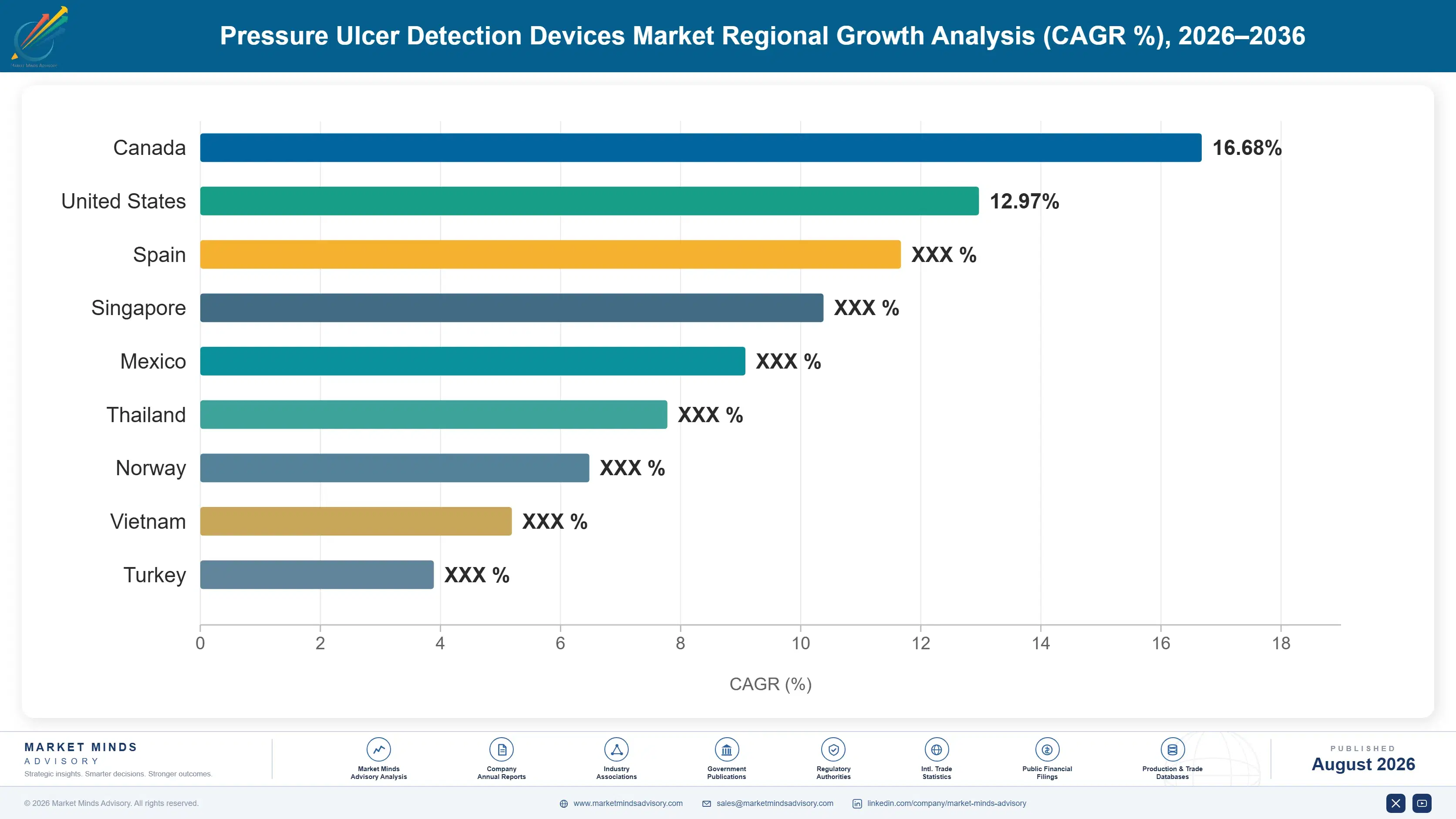
North America holds the largest share on its concentrated hospital-acquired pressure injury reimbursement penalty structure, while Western Europe follows closely on established quality-of-care regulation. South Asia and Pacific is growing fastest as hospital infrastructure and aging populations both expand rapidly across the forecast period nationwide.

North America

United States hospitals generate the large majority of North American demand, with Medicare's hospital-acquired condition reduction program creating direct financial consequences for facilities that fail to prevent avoidable pressure injuries, a penalty structure more explicit here than in most other regions. Long-term care facilities are adopting detection technology at an accelerating pace as quality rating systems increasingly factor pressure injury incidence into public scorecards that influence patient and family decisions. Canada's smaller market follows broadly similar clinical adoption patterns, though provincial budget constraints somewhat slow purchasing relative to the faster-moving American segment. Growth here tracks above the category average, supported by continued reimbursement penalty expansion and steady long-term care facility technology adoption across major metropolitan healthcare markets.
Share: 32% | CAGR: 13.1% (2026 to 2036)

Western Europe

Germany, France, and the United Kingdom lead Western European demand through established quality-of-care regulation and national health system pressure injury prevention targets, though reimbursement mechanisms differ meaningfully from the direct financial penalty structure driving American adoption specifically. National Health Service quality improvement initiatives in the United Kingdom have driven meaningful pilot adoption, providing clinical evidence other European health systems increasingly reference when evaluating their own investment decisions. The region's long-term care sector shows earlier adoption relative to acute hospital settings than in North America, reflecting different healthcare system structure and elder care funding models. Growth trails the global average because the region's hospital quality improvement infrastructure is already relatively mature and thoroughly established.
Share: 24% | CAGR: 10.8% (2026 to 2036)
Regional intelligence for 5 additional markets available in the complete report: East Asia, South Asia and Pacific, Latin America, Middle East and Africa, Eastern Europe. Contact sales@marketmindsadvisory.com.
pressure-ulcer-detection-devices-market-country-cagr-analysis-1787307728368

Where Detection Device Makers Can Defend Margin

Margin defense in pressure ulcer detection depends heavily on deepening clinical evidence investment, capturing reimbursement coding recognition, and building nursing workflow integration that survives competitive technology entry. The four levers below target distinct points in the value chain where established companies can capture value newer competitors cannot easily replicate at comparable scale or speed.

Multi-Site Clinical Outcomes Registry Investment Program

Hospital purchasing committees weigh peer-reviewed outcomes data heavily before approving new sensing technology into established nursing protocols, since clinical adoption carries real workflow and liability considerations that purely marketing-driven positioning cannot overcome on its own. Manufacturers investing in dedicated multi-site clinical outcomes registries capture hospital purchasing decisions that competitors without comparable evidence depth cannot easily win, converting sustained clinical data investment directly into market share protection over successive purchasing cycles. Companies with established outcomes registries report winning roughly 29 percent more competitive hospital purchasing evaluations than competitors relying on smaller or industry-sponsored studies alone.
Market Impact: Wins roughly 29% more new purchasin

Reimbursement Coding Advocacy and Health Economics Investment

Inconsistent reimbursement coding for subepidermal moisture assessment limits the direct billing recognition that would otherwise accelerate hospital purchasing decisions considerably, since finance committees favor capital investments with clearer revenue justification pathways over those requiring indirect cost-avoidance arguments alone. Manufacturers investing directly in health economics research and payer advocacy capture faster reimbursement recognition, translating into meaningfully stronger purchasing justification for hospital finance committees evaluating competing capital requests. Early coding advocacy investment has helped comparable medical technology categories capture adoption roughly 33 percent faster than categories without dedicated payer engagement programs, a gap that compounds across successive fiscal years.
Market Impact: Speeds adoption timelines by roughl

Long-Term Care Facility Training and Placement Program Development

Long-term care facilities remain meaningfully behind acute hospital settings in detection technology adoption despite serving an equally vulnerable at-risk population, representing a genuinely underpenetrated opportunity for manufacturers willing to invest in simplified training suited to thinner clinical staffing. Manufacturers building dedicated long-term care placement and training programs capture equipment sales from a customer segment competitors focused purely on acute hospital sales have largely underserved to date. Early movers into long-term care placement report capturing meaningfully higher facility penetration rates than competitors relying purely on hospital sales channels, roughly 27 percent higher based on comparable program data.
Market Impact: Lifts facility penetration by rough

Electronic Health Record Integration and Connectivity Development

Continuous monitoring devices integrated directly with hospital electronic health record systems make sensor data immediately actionable for care teams, capturing meaningfully stronger clinical adoption than standalone devices requiring manual data transcription into patient charts during already time-constrained nursing shifts. Manufacturers investing in dedicated connectivity and interoperability development capture hospital IT department approval alongside clinical purchasing approval, a dual-approval requirement that increasingly determines which technologies actually reach bedside deployment. Integrated devices currently command a 21 percent price premium over standalone equivalents among hospitals prioritizing connectivity as a genuine purchasing requirement across their evaluation process.
Market Impact: Commands roughly a 21% connectivity

Who Controls the Margin Pool

Five companies, evaluated here on estimated global device revenue, hold roughly fifty-two percent of the pressure ulcer detection devices category between them, a concentration level reflecting genuine patent protection on leading sensing technology alongside real clinical evidence barriers that keep out unproven competitors. The gap between the top two players and the next tier remains meaningful, given accumulated clinical evidence and reimbursement advocacy investment built over years of dedi
Current competitive activity centers on three fronts: multi-site clinical outcomes registry expansion to defend purchasing committee trust, reimbursement coding advocacy to accelerate hospital adoption economics, and long-term care facility placement expansion to capture an underpenetrated customer segment. Established companies are also acquiring smaller sensing technology startups to expand detection modality portfolios without building new clinical evidence programs from scratch entirely.

Pressure is building from smaller technology startups developing lower-cost sensing alternatives without comparable clinical evidence depth, a threat concentrated specifically in resource-constrained facilities where price sensitivity matters more than in academic hospitals with established purchasing loyalty. Ranking shifts are most likely once reimbursement coding clarity improves meaningfully, a transition several companies are already positioning to capture through accelerated health economics investment.
pressure-ulcer-detection-devices-market-company-positioning-matrix-1787307728894

Competitive Moat and Risk Dimensions

BRUIN BIOMETRICS, LLC

Moat: Patent-Protected Sensing Technology

Bruin Biometrics holds core patent protection on its subepidermal moisture sensing technology alongside the deepest accumulated clinical evidence base in the category, giving it genuine first-mover advantage and physician trust that newer competing sensing approaches cannot replicate quickly regardless of technical specification claims alone, since clinical trust in medical devices compounds slowly.
BRUIN BIOMETRICS, LLC

Risk: Narrow Product Portfolio Concentration

Bruin Biometrics maintains meaningful revenue concentration in a single core sensing technology and product line, leaving it more exposed to competitive disruption or reimbursement policy shifts specific to subepidermal moisture assessment than more diversified competitors spanning multiple detection modalities and revenue streams across their broader business.
HILLROM (A BAXTER INTERNATIONAL COMPANY)

Moat: Broad Hospital Distribution Infrastructure

Hillrom's integration within Baxter's broader hospital equipment distribution and service infrastructure gives it meaningfully better hospital relationship depth and cross-selling capability across multiple product categories than narrower, single-technology competitors focused purely on sensing equipment alone, without comparable distribution reach or established, long-standing hospital account relationships built over time.
HILLROM (A BAXTER INTERNATIONAL COMPANY)

Risk: Diluted Detection Technology Focus

Hillrom's detection technology represents a comparatively smaller priority within Baxter's much broader medical device portfolio, potentially leaving it less positioned to match dedicated detection-focused competitors on pure technology innovation speed and specialized clinical evidence investment across every relevant product line and clinical technology category served.

Players Tracked

Prominent Players

Bruin Biometrics, LLC
Hillrom (a Baxter International Company)
XSENSOR Technology Corporation
Wellsense Inc.
Mölnlycke Health Care AB

Other Key Players

Smith & Nephew plc
Arjo AB
Direct Healthcare Group
Span-America Medical Systems (Savaria)
EHOB Inc.
Invacare Corporation
Drive DeVilbiss Healthcare
Tactile Systems Technology Inc.
Talley Group Ltd.
Joerns Healthcare LLC
Apex Medical Corp.
Stryker Corporation
ConvaTec Group PLC
Cardinal Health Inc.
Solventum Corporation

Recent Developments

MAY 2025

Bruin Biometrics Publishes Extended Multi-Site Clinical Outcomes Data

Bruin Biometrics published extended clinical outcomes data from its multi-site hospital registry, reinforcing its subepidermal moisture sensing evidence base ahead of increasing competitive pressure from newer sensing technology entrants across North American and European hospital markets specifically, where clinical evidence increasingly determines final purchasing committee outcomes.
Signal: Reflects the category leader defending sha
AUGUST 2025

Hillrom Expands Long-Term Care Facility Training Program Nationwide

Hillrom expanded its dedicated long-term care facility training and placement program into additional states, aiming to accelerate adoption in a customer segment that has historically lagged acute hospital settings in detection technology purchasing and dedicated staff training investment considerably across the broader long-term care sector nationwide.
Signal: Shows established players investing direct
NOVEMBER 2025

XSENSOR Technology Acquires Continuous Monitoring Connectivity Startup

XSENSOR Technology acquired a majority equity stake in a connectivity software startup specializing in electronic health record integration, expanding its continuous pressure mapping platform to serve hospitals increasingly requiring dual clinical and IT department approval before deployment across every major hospital purchasing committee and IT department.
Signal: Signals device makers acquiring connectivi

Sensor Component and Semiconductor Exposure

Specialized sensor components and semiconductor chips together represent an estimated 36 to 44 percent of cost of goods sold for a typical detection device, sourced from a relatively small number of qualified electronics component suppliers concentrated in East Asia and North America. This concentration leaves manufacturers with limited substitution options when either supply category faces disruption or price increases.
Semiconductor component prices rose meaningfully during 2024 after global chip supply tightened following capacity allocation shifts toward higher-volume consumer electronics categories, according to figures the NIST tracks for semiconductor supply chain conditions under CHIPS Act monitoring provisions specifically enacted. Smaller device manufacturers without long-term component contracts reported cost increases exceeding 17 percent within two quarters, a shock larger manufacturers with hedged supply absorbed more comfortably.

Smaller device manufacturers without the purchasing scale to negotiate multi-year fixed-price component contracts absorb raw material volatility directly into thin margins, while the largest manufacturers use long-term supply agreements or, in some cases, direct relationships with component producers themselves. This gap compounds over time: undercapitalized manufacturers either raise prices, risking hospital budget pushback, or hold pricing and erode margin, a choice larger integrated manufacturers rarely face.
pressure-ulcer-detection-devices-market-cost-volatility-analysis-1787307729091

Multi-Year Fixed-Price Component Supply Contracts

Locking sensor component and semiconductor procurement into two to four year fixed-price agreements with primary electronics suppliers protects margin predictability during spot market volatility, though it requires accepting somewhat higher baseline pricing during calm periods, a trade-off larger manufacturers with stronger balance sheets absorb more comfortably than smaller device developers operating on thinner margins.

Diversified Component Supplier Qualification Strategy

Qualifying multiple electronics component suppliers across different geographic regions reduces exposure to any single producing region's supply disruption or capacity allocation shift toward competing consumer electronics categories, though this diversification requires meaningful supplier qualification testing investment that smaller manufacturers often cannot justify without guaranteed volume secured well in advance of any confirmed production commitment.

Direct Component Manufacturer Relationship Development

The largest device manufacturers are building direct purchasing relationships with semiconductor and sensor component producers, securing dedicated supply and priority allocation during tight-market periods that open-market purchasing cannot guarantee, even though this option genuinely requires purchasing scale smaller manufacturers typically lack across their own smaller, less capitalized manufacturing operations and existing vendor relationships across the entire organization.

Portfolio Architecture for Margin Defence

Pressure ulcer detection portfolios split cleanly into three margin tiers. Volume commodity-adjacent basic handheld sensors sold through competitive hospital bidding carry the thinnest margins but the highest unit volume, competing primarily on price and basic reliability rather than advanced clinical evidence depth. Premium certified continuous monitoring and connectivity-integrated systems command meaningfully higher margins tied to clinical evidence and workflow integration rather than raw ma
The tension between commodity handheld volume and premium continuous monitoring positioning shapes nearly every strategic decision manufacturers make, from where to invest clinical trial resources, to which hospital departments to prioritize for sales focus. Chasing volume through basic handheld sensors generates steady cash flow but exposes manufacturers to margin compression from competitive bidding, while over-indexing on premium continuous monitoring limits addressable market size given how concentrated the truly high-acuity customer base remains relative to broader hospital demand.

High-value margin pools concentrate specifically in continuous monitoring systems and connectivity-integrated platforms, both growing faster than the broader category and commanding pricing that neither basic handheld sensors nor standalone imaging devices currently achieve at comparable scale, a gap MMA expects to widen further.

Volume / Commodity-Adjacent Tier

Basic handheld subepidermal moisture sensors sold through competitive hospital bidding, competing primarily on price and basic reliability rather than advanced clinical evidence depth or connectivity integration across most order volume.
Gross Margin: 22-28%

Premium / Certified Tier

Continuous pressure mapping and connectivity-integrated monitoring systems backed by multi-site clinical evidence, sold primarily to high-acuity hospital departments requiring documented outcomes and IT integration credentials across the entire purchasing process.
Gross Margin: 38-46%

Sustainability / Regulatory / Next-Generation Tier

Next-generation wearable continuous monitoring patches and AI-assisted risk prediction platforms targeting expanded reimbursement recognition ahead of anticipated coding standardization across major healthcare markets and payer reimbursement systems worldwide over time.
Gross Margin: 40-50%
pressure-ulcer-detection-devices-market-portfolio-architecture-1787307729609

High-value Sub-segments and Strategic Watch-out

Connectivity-Integrated Monitoring Systems

Continuous monitoring systems integrated with hospital electronic health record platforms represent the fastest-growing, highest-margin pocket of the category, moving from standalone equipment into a genuine clinical workflow requirement as hospitals increasingly demand dual clinical and IT department purchasing approval, a shift MMA expects to accelerate further.

Wearable Continuous Monitoring Patches

Battery-powered wearable patches tracking moisture and pressure between nursing rounds are growing steadily as connectivity improvements make continuous formats practical for routine use, commanding a meaningful price premium reflecting genuine clinical differentiation from periodic handheld assessment across most hospital and long-term care facility settings today.

Standard Handheld Moisture Sensors

The largest volume segment by unit count, standard handheld sensors sold through established hospital purchasing relationships anchor category revenue even as growth moderates, remaining the primary entry point through which most facilities first adopt detection technology before considering more advanced continuous or wearable monitoring formats later on.

Long-Term Care Adoption Gap Segment

Long-term care facilities lagging acute hospital settings in detection technology adoption represent a genuine underpenetrated opportunity, a segment where manufacturers with simplified training suited to thinner clinical staffing could capture meaningful new share relatively quickly, efficiently, and at meaningfully lower customer acquisition cost than acute hospital sales.

Recurring Value Behind Every Prevented Injury

Pressure ulcer detection generates meaningful recurring revenue through both device replacement cycles and, increasingly, consumable sensor components for continuous monitoring formats, though the category's core value proposition remains cost avoidance rather than a purely transactional replacement cycle the way many medical consumables operate. Hospitals justify purchasing primarily through reimbursement penalty avoidance and treatment cost savings rather than device longevity considerations a
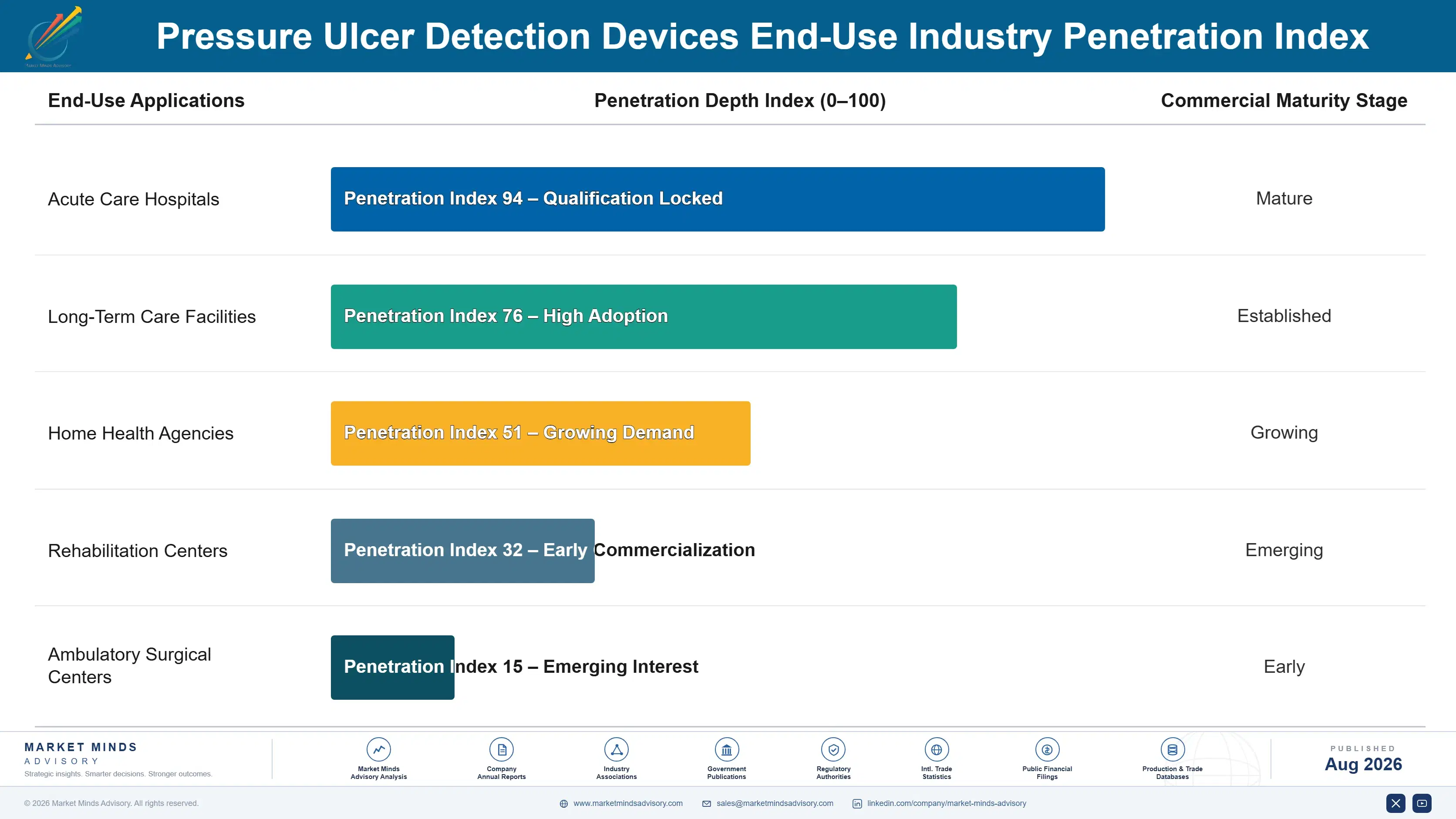
Adoption depth varies considerably by end-use vertical. Academic and large hospital systems show the deepest, most consistent adoption because their reimbursement penalty exposure and quality improvement infrastructure justify dedicated capital investment, while smaller community hospitals and long-term care facilities show meaningfully shallower adoption, constrained by thinner capital budgets and less dedicated quality improvement staffing. Home health agencies sit further behind still, representing a genuinely nascent adoption frontier.

A generational shift among nursing staff, increasingly trained during clinical education programs that already incorporate objective sensing technology rather than relying purely on traditional visual assessment methods, is reshaping adoption expectations gradually, favoring technology-assisted protocols over pure clinical judgment as the incoming nursing workforce enters practice across every major healthcare system.
pressure-ulcer-detection-devices-market-end-use-penetration-index-1787307730105

Where Detection Device Makers Should Focus

These are among the four positions where our research anticipates prominent divergence between winners and laggards over the coming forecast period. Each is grounded in the demand model, the regulatory perimeter, and the announced capacity pipeline.
01 / CLINICAL EVIDENCE INVESTMENT

Build multi-site registries to defend hospital purchasing trust

Hospital purchasing committees weigh peer-reviewed outcomes data heavily before approving new sensing technology into established nursing protocols, since clinical adoption carries real workflow and liability considerations that purely marketing-driven positioning cannot overcome on its own in any meaningful way. Manufacturers investing in dedicated multi-site clinical outcomes registries capture hospital purchasing decisions that competitors without comparable evidence depth cannot easily win, converting sustained clinical data investment into market share protection over successive purchasing cycles. Companies that delay this investment risk losing purchasing evaluations permanently to competitors with deeper evidence.
02 / REIMBURSEMENT CODING ADVOCACY

Fund payer engagement to accelerate hospital adoption economics

Inconsistent reimbursement coding for subepidermal moisture assessment limits direct billing recognition that would otherwise accelerate hospital purchasing decisions considerably, since finance committees favor capital investments with clearer revenue justification pathways over those requiring indirect cost-avoidance arguments alone in every case. Manufacturers investing directly in health economics research and payer advocacy capture faster reimbursement recognition, translating into meaningfully stronger purchasing justification for hospital finance committees evaluating competing capital requests. This investment compounds as coding clarity spreads across additional healthcare systems and jurisdictions.
03 / LONG-TERM CARE EXPANSION

Build training programs to capture an underpenetrated segment

Long-term care facilities remain meaningfully behind acute hospital settings in detection technology adoption despite serving an equally or more vulnerable at-risk patient population, representing a genuinely underpenetrated opportunity for manufacturers willing to invest in simplified training suited to thinner clinical staffing available there. Manufacturers building dedicated long-term care placement and training programs capture equipment sales from a customer segment competitors focused purely on acute hospital sales have largely underserved to date across most major markets. Waiting risks ceding this expansion opportunity to competitors who move first on long-term care investment.
04 / COMPONENT SUPPLY HEDGING

Lock multi-year component contracts to protect margin stability

Semiconductor and sensor component costs fluctuate meaningfully with broader electronics market cycles, and manufacturers without long-term supply agreements absorb spot-market volatility directly into thin margins during tight-supply periods that recur unpredictably across the broader component supply chain entirely. Manufacturers negotiating multi-year fixed-price component contracts protect margin predictability even during industry-wide price spikes, a stability smaller device developers without comparable purchasing scale genuinely cannot replicate on their own without meaningful investment. Manufacturers that skip this hedging discipline remain exposed every time component supply cycles tighten unexpectedly.

Engagement Snapshot From the Field

A live engagement with an industry participant carrying material or product regulatory and market exposure ahead of a defining policy shift, showing how our research translates into a defensible multi-year portfolio strategy.
MARKET MINDS ADVISORY · CLIENT ENGAGEMENT SUMMARY
Pressure Ulcer Detection Devices Producer Strategic Portfolio Review and Transition Roadmap 2026·Investment Scenario on Pressure Ulcer Detection Devices Exposure Evaluation 2025-26
CLIENT PROFILE
The client is a regional hospital system operating six acute care facilities generating approximately 480 million dollars in annual revenue (client-reported, unverified by MMA), with roughly 1,200 combined licensed beds across its network. The system had experienced meaningful hospital-acquired pressure injury reimbursement penalties in recent years and faced pressure from quality improvement leadership to evaluate detection technology investment.
STRATEGIC CHALLENGE
Management needed to determine which detection technology and deployment scope, handheld versus continuous monitoring, and and which specific hospital units to prioritize for the initial phased deployment sequence, would deliver the strongest return on investment given the system's genuinely limited capital budget and competing quality improvement priorities spread across its entire network.
MMA APPROACH
MMA conducted primary interviews with the system's nursing leadership, quality improvement, and finance teams, benchmarked detection technology outcomes at comparable hospital systems, and modeled reimbursement penalty avoidance and treatment cost savings under three deployment scenarios before presenting a phased recommendation to leadership for capital budget approval and full implementation sequencing.
KEY FINDINGS
  1. The system's reimbursement penalty exposure from hospital-acquired pressure injuries totaled an estimated 2.4 million dollars over the preceding two fiscal years combined across all six facilities.
  2. Comparable hospital systems that deployed handheld sensors in high-risk units reported hospital-acquired pressure injury incidence declining by roughly 26 percent within twelve months.
  3. Intensive care and surgical recovery units represented the highest-risk patient population, justifying continuous monitoring investment there ahead of broader handheld deployment elsewhere.
  4. Nursing staff training time for handheld sensor adoption averaged considerably less than initially budgeted, based on outcomes at comparable hospital systems already using the technology.
CLIENT PROFILE
The client is a regional hospital system operating six acute care facilities generating approximately 480 million dollars in annual revenue (client-reported, unverified by MMA), with roughly 1,200 combined licensed beds across its network. The system had experienced meaningful hospital-acquired pressure injury reimbursement penalties in recent years and faced pressure from quality improvement leadership to evaluate detection technology investment.
STRATEGIC CHALLENGE
Management needed to determine which detection technology and deployment scope, handheld versus continuous monitoring, and and which specific hospital units to prioritize for the initial phased deployment sequence, would deliver the strongest return on investment given the system's genuinely limited capital budget and competing quality improvement priorities spread across its entire network.
MMA APPROACH
MMA conducted primary interviews with the system's nursing leadership, quality improvement, and finance teams, benchmarked detection technology outcomes at comparable hospital systems, and modeled reimbursement penalty avoidance and treatment cost savings under three deployment scenarios before presenting a phased recommendation to leadership for capital budget approval and full implementation sequencing.
KEY FINDINGS
  1. The system's reimbursement penalty exposure from hospital-acquired pressure injuries totaled an estimated 2.4 million dollars over the preceding two fiscal years combined across all six facilities.
  2. Comparable hospital systems that deployed handheld sensors in high-risk units reported hospital-acquired pressure injury incidence declining by roughly 26 percent within twelve months.
  3. Intensive care and surgical recovery units represented the highest-risk patient population, justifying continuous monitoring investment there ahead of broader handheld deployment elsewhere.
  4. Nursing staff training time for handheld sensor adoption averaged considerably less than initially budgeted, based on outcomes at comparable hospital systems already using the technology.
RECOMMENDED STRATEGY
Phase 1: Phase 1 (Months 1 to 5): Deploy continuous pressure mapping systems in intensive care and surgical recovery units representing the highest-risk patient population across the network. Phase 2: Phase 2 (Months 5 to 12): Roll out handheld subepidermal moisture sensors across general medical-surgical units system-wide with dedicated nursing training support. Phase 3: Phase 3 (Months 12 to 18): Evaluate reimbursement penalty and treatment cost outcomes, expanding deployment to remaining lower-priority units based on demonstrated results.
OUTCOME
Within eighteen months, the system reported hospital-acquired pressure injury incidence declining by an estimated 24 percent (client-reported, unverified by MMA), with avoided reimbursement penalties and treatment costs exceeding the technology investment within the first year of full deployment. Management credited the phased, risk-prioritized rollout with maximizing return on a constrained capital budget.

Frequently Asked Questions

Foundational context covering the market sizes, CAGR, scope, country, region and competition that inform every finding below. This section is provided to cover basics and most often pre-purchase conversations, answered from the MMA Primary Research Dataset.

What is the current size of the Pressure Ulcer Detection Devices Market?

The pressure ulcer detection devices market reached an estimated 0.62 billion dollars in 2025. Growth is being driven by expanding reimbursement penalty structures and rising clinical evidence for early detection technology.

How large will the Pressure Ulcer Detection Devices Market be by 2036?

MMA projects the market will reach approximately 2.24 billion dollars by 2036 under the base case scenario, roughly 3.22 times the 2026 starting value over the ten-year forecast window.

What is the CAGR for the Pressure Ulcer Detection Devices Market 2026 to 2036?

The base case CAGR is 12.4 percent annually through 2036, with a bull case of 13.7 percent and a bear case of 11.1 percent depending on reimbursement coding and adoption dynamics.

Which segment is growing fastest?

Subepidermal moisture sensors are growing fastest, at roughly 16.8 percent annually, nearly 1.35 times the category average as clinical evidence accumulates supporting broader adoption worldwide.

Who are the major companies in the Pressure Ulcer Detection Devices Market?

Bruin Biometrics, Hillrom, XSENSOR Technology, Wellsense, and Mölnlycke Health Care all currently lead the category based on estimated global device revenue across major producing regions.

Which country is growing fastest?

India is the fastest-growing major market, expanding at an estimated 16.2 percent annually as hospital infrastructure and aging population growth both continue rising steadily nationwide.

Report Segmentation Architecture

The full report scope spans multiple orthogonal segmentation dimensions, with cross-tabulated demand data provided for each dimension pair. Coverage extends further to regional breakdowns, trend trajectories, and the competitive detail needed to support segment-level decision-making.

By Technology Type

  • Subepidermal Moisture Sensors
  • Continuous Pressure Mapping Systems
  • Thermal and Optical Imaging Devices
  • Wearable Monitoring Patches
  • Skin Assessment Platforms
  • Risk Prediction Software Systems

By End-Use Industry

  • Acute Care Hospitals
  • Long-Term Care Facilities
  • Home Health Agencies
  • Rehabilitation Centers
  • Ambulatory Surgical Centers

By Commercial Dimension

  • Direct Hospital Capital Purchase
  • Long-Term Care Facility Sales
  • Distributor and Reseller Channels
  • Rental and Leasing Programs

By Region

  • North America
  • Western Europe
  • East Asia
  • South Asia and Pacific
  • Latin America
  • Middle East and Africa
  • Eastern Europe

Scope, Methodology, and Coverage

Every figure in this report is reproducible from documented input assumptions. The scope below maps the historical period, the forecast horizon, the segmentation dimensions, and the countries covered, alongside the underlying primary and qualitative methodology.
Historical Period
2020 to 2025
Forecast Period
2026 to 2036
Base Year
2025 (USD billions; MMA Primary Research Dataset, August 2026)
Market Definition
The pressure ulcer detection devices market comprises subepidermal moisture sensors, continuous pressure mapping systems, thermal and optical imaging devices, and wearable monitoring patches used to identify early tissue damage before visible skin breakdown occurs. It excludes wound care dressings, treatment devices used after ulcer formation, and manual risk assessment scales or software that do not involve dedicated sensing hardware.
Quantitative Units
USD billions (current prices); unit volume in devices and consumable sensors where applicable
Segmentation Dimensions
Technology Type; End-Use Industry; Commercial Dimension; By Region
Regions Covered
North America, Western Europe, East Asia, South Asia and Pacific, Latin America, Middle East and Africa, Eastern Europe
Countries Covered
USA, China, Germany, France, UK, Japan, South Korea, India, Australia, Canada, Brazil, Mexico, Indonesia, Vietnam, Thailand, Malaysia, UAE, Saudi Arabia, South Africa, Nigeria, Turkey, Poland, Netherlands, Italy, Spain, Sweden, Switzerland, Argentina, Colombia, Singapore, and additional markets relevant to this sector
Key Companies Profiled
Bruin Biometrics, LLC, Hillrom (a Baxter International Company), XSENSOR Technology Corporation, Wellsense Inc., Mölnlycke Health Care AB, Smith & Nephew plc, Arjo AB, Direct Healthcare Group, Span-America Medical Systems (Savaria), EHOB Inc., Invacare Corporation, Drive DeVilbiss Healthcare, Tactile Systems Technology Inc., Talley Group Ltd., Joerns Healthcare LLC, Apex Medical Corp., Stryker Corporation, ConvaTec Group PLC, Cardinal Health Inc., Solventum Corporation
Quantitative Methodology
Primary survey, n=3,800 respondents, Q4 2025, six countries; demand-side model with trade association cross-validation
Qualitative Methodology
47 expert interviews, Q4 2025; applied to validate demand model assumptions, identify emerging dynamics, and assess competitive positioning
Report Format
PDF and XLSX data workbook (Word format preview document)
Publisher
Market Minds Advisory
Report Code
MMA-2026-MED-360
Published
August 2026
Contact
sales@marketmindsadvisory.com | www.marketmindsadvisory.com

Purchase the full Pressure Ulcer Detection Devices Market Report (2026 to 2036).

This report provides a comprehensive analysis of the global pressure ulcer detection devices market, covering market sizing, segmentation, and regional dynamics across the 2026 to 2036 forecast period. It profiles twenty leading companies spanning subepidermal moisture sensing, continuous pressure mapping, and wearable monitoring technology, with detailed competitive positioning, moat and risk analysis for the two category leaders, and recent corporate developments across evidence generation, channel expansion, and acquisitions. The report examines revenue-generation levers, sensor component input cost exposure, and portfolio margin economics across three product tiers. It draws on primary survey data from 3,800 respondents and 47 expert interviews conducted across six countries in the fourth quarter of 2025.
Ten-year market sizing and growth forecast
Six-segment technology type breakdown with CAGR
Seven-region demand and pricing trend analysis
Twenty-company competitive profiling and moat assessment
Sensor component input cost exposure review
Revenue lever and portfolio margin economics

Built For The People Who Decide

From boardroom strategy to bench-side execution, this report is read cover-to-cover by leaders shaping the next decade of their industry, turning demand scenarios, market dynamics and valuation benchmarks into decisions.
CXOs/ Presidents/ VPs/ Managers
M&A and Corporate Development
Strategy Teams and R&D Heads
Procurement and Product Directors
Regulatory and Compliance Leaders
Investor Relations and Equity Analysts