

Market Minds Advisory
Prescription Delivery Services Market

Prescription Delivery Services Market: On-Demand Logistics and Cold-Chain Specialty Delivery Redraw Pharmacy Economics

Pharmacy operators are shifting prescription fulfillment away from in-store pickup toward same-day delivery platforms, forcing incumbent chains to rebuild last-mile logistics networks faster than reimbursement models can keep pace with rising specialty medication volume.

Lead Analyst

Alice Ballenger

Published

September 2026

Make Smarter Decisions with Customized Research Insights

Request a free sample report and evaluate market opportunities, growth trends, and competitive dynamics relevant to your business needs.

2025 MARKET VALUE$9.5BMarket Size 2025
2036 FORECAST VALUE$25.8BBase Case , 2026 to 2036
CAGR 2026 TO 20369.5 %Bull 10.8% / Bear 8.2%
INCREMENTAL OPPORTUNITY$15.4BNet 10- year value creation
EXPANSION MULTIPLE2.48x2036 value over 2026 base
Strategic Levers
M&A Pipeline
Regional Outlook
Country Rankings
Competitive Intelligence
Segmental Deep-dive
Call-Us : 91 93563 13602

Executive Snapshot and Market Trajectory

Pharmacy operators are shifting prescription fulfillment away from in-store pickup toward same-day delivery platforms faster than most reimbursement systems can adjust, as patients increasingly expect medication to arrive the way groceries and takeout already do daily. Chains slow to adapt risk losing patients to faster-moving digital-first competitors entirely.
Cold-chain and specialty medication delivery is the second clear growth driver, and commercial momentum concentrates in chronic disease and biologic therapy categories, where temperature-controlled logistics increasingly determine which pharmacy wins a patient's ongoing prescription relationship over time and across renewal cycles. North America leads regional volume by a wide margin, reflecting deep insurance-linked delivery infrastructure and the highest chain pharmacy delivery penetration MMA tracks anywhere.
No single delivery provider holds commanding share, and five players together account for roughly a third of global revenue, reflecting a fragmented field where regional couriers and gig platforms compete credibly against national pharmacy chains on speed and coverage across most geographies and patient segments. Reimbursement policy and last-mile logistics cost shape purchasing decisions as much as delivery speed does across every service tier in this market, and that dependency keeps deepening.
Market Definition
The Prescription Delivery Services Market covers logistics services that transport dispensed prescription medications from a pharmacy or fulfillment center to a patient, including same-day, scheduled, and cold-chain delivery models. It excludes pharmacy dispensing operations themselves, wholesale pharmaceutical distribution, and general retail e-commerce delivery not specific to prescription medication.
Base Year Value
$9.5B in 2025 (MMA Primary Research Dataset, August 2026)
Forecast Period
2026 to 2036, eleven discrete annual values
CAGR
9.5% base case. Bull 10.8%. Bear 8.2%.
Fastest Growth Segment
Same-Day and On-Demand Prescription Delivery: 15.0% CAGR
Fastest Growth Country
India: 12.0% CAGR
Fastest Growth Region
South Asia and Pacific: 12.0% CAGR
Largest Region
North America: 34% of 2025 global value
Market Leaders
CVS Health Corporation, Amazon.com Inc, Walgreens Boots Alliance Inc, Maplebear Inc, DoorDash Inc. Source: MMA Analysis based on company annual reports.
Primary Survey
n=3,800 procurement and R&D decision-makers, Q4 2025, six countries
Methodology
Demand-side build-up, cross-validated against public data, 47 expert interviews

Prescription Delivery Services Market Forecast Scenarios

prescription-delivery-services-market-size-forecast-scenario-1787308189164
Between 2020 and 2025 the market grew quickly as pandemic-era contactless delivery demand accelerated pharmacy investment in last-mile logistics across most major consumer markets and patient categories, interrupted briefly by gig-economy driver shortages in 2022 before recovering through 2023 as delivery platforms rebuilt courier networks and pharmacy partnerships. The historical CAGR ran at roughly 8.0%.
The base case assumes steady 9.5% annual growth through 2036, anchored to three commercial mechanisms: chronic disease patients increasingly choosing recurring home delivery over in-store pickup to maintain medication adherence across their full treatment course, specialty and biologic therapies requiring cold-chain logistics that expand the addressable delivery revenue pool considerably beyond standard formats, and national pharmacy chains investing in proprietary delivery fleets to defend market share against gig-platform and pure-play delivery entrants.
The bull case centers on insurance reimbursement expanding to cover delivery fees as a standard pharmacy benefit across additional payer systems, pulling forward adoption considerably across several major markets and patient categories. The bear case centers on last-mile labor cost inflation compressing delivery provider margins, slowing network expansion into lower-density markets for smaller providers facing tighter capital constraints.

Last-Mile Logistics Reshapes Pharmacy Economics

Pharmacy operators increasingly treat same-day delivery capability as a mandatory service offering rather than a differentiator, since patients now expect prescription fulfillment to match the convenience of general e-commerce and food delivery platforms they already use daily for other purchases across every category, price point, and market segment nationwide today. Chains that lag on this expectation lose consideration quickly and permanently.
MARKET CONCENTRATIONCR5 34%Reflects a fragmented field of couriers and pharmacy chains
AVERAGE DELIVERY COST$6-14 per deliveryVaries considerably by distance and cold-chain requirement type
TOP PRODUCING COUNTRYUnited States, 29% shareLargest base of pharmacy delivery infrastructure investment worldwide
SAME-DAY FULFILLMENT RATE58% of urban ordersShare of orders delivered within hours of dispensing
REORDER RETENTION RATE5-7 fills per patient yearlyTypical recurring delivery frequency for a chronic patient yearly
LABOR COST SHARE46% of COGSReflects courier wages as the dominant recurring input cost
Cold-chain reliability now shapes which delivery provider wins specialty pharmacy contracts more than delivery speed alone does, since a temperature excursion on a biologic medication can destroy the entire dose and create liability exposure that pharmacy operators increasingly refuse to accept regardless of the cost savings from a cheaper courier alternative lacking validated monitoring capability, reliable audit trails, and adequate insurance coverage overall.
Over the next decade, integrated delivery networks combining proprietary fleets with gig-platform overflow capacity will likely become the default operating model across most major pharmacy chains, narrowing the gap between providers built for urban density and those engineered for broader geographic coverage across suburban and rural markets currently underserved by same-day formats, premium delivery tiers, and cold-chain infrastructure alike even today.
"Patients used to drive to the pharmacy because that's just what you did. Now a missed delivery window is a five-star review away from losing that patient forever."
Director, Healthcare Services Practice · MMA Healthcare Services Practice

Market Trends

Same-Day Delivery Platforms Expand Beyond Urban Cores

Same-day prescription delivery platforms are extending coverage beyond dense urban cores into suburban and smaller metropolitan markets, addressing patient demand that national pharmacy chains historically underserved outside their largest markets and highest-density zip codes nationwide and internationally as well. Several major delivery platforms have publicly committed to expanding same-day coverage to additional metropolitan areas by 2028, and pharmacy chains report meaningfully higher delivery order volume in markets where same-day service recently launched compared to markets still limited to next-day or scheduled delivery windows and time slots offered previously by most chains.
Market Impact: Adds roughly 4.0% annual demand gro

Cold-Chain Specialty Delivery Gains Dedicated Infrastructure

Specialty and biologic medication delivery is driving dedicated cold-chain infrastructure investment as pharmacies and delivery providers respond to growing prescription volume for temperature-sensitive therapies across oncology, immunology, cardiology, and diabetes categories facing expanding patient rolls and treatment protocols nationwide and internationally each and every single calendar year. Delivery providers report meaningfully higher cold-chain order volume from specialty pharmacies than from standard retail pharmacy locations, and this gap is widening as more biologic therapies move from hospital administration toward at-home patient self-injection requiring reliable, validated delivery infrastructure and continuous monitoring capability.
Market Impact: Adds roughly 3.0% annual demand gro

Market Opportunities and Growth Drivers

Chronic Disease Prevalence Expands Recurring Delivery Demand

Chronic disease prevalence continues rising across most major consumer markets as aging populations and lifestyle-related conditions drive diagnosis volume higher, directly widening the addressable recurring prescription delivery patient population for providers supplying this growing segment worldwide. Health authority data shows meaningfully rising chronic disease diagnosis rates in several large-population countries, and each additional diagnosed patient on maintenance medication represents incremental recurring delivery demand across the network. This prevalence trend is expected to continue for at least the next decade given sustained demographic aging across most tracked markets and healthcare systems.
Market Impact: Compresses margins by roughly 5 poi

Insurance Delivery Benefit Expansion Lowers Patient Cost

Insurance payers across most major markets continue expanding prescription delivery as a covered pharmacy benefit rather than an out-of-pocket convenience fee, directly widening the addressable patient population willing to choose delivery over in-store pickup across most demographics and income levels nationwide. Pharmacy chains and payers report meaningfully higher delivery utilization among patients whose insurance covers the delivery fee compared to patients paying out of pocket themselves. This benefit expansion trend is broadening across an expanding number of payer systems beyond the markets where it first took hold several years ago.
Market Impact: Extends entry by 6 months

Market Restraints and Challenges

Last-Mile Labor Cost Inflation Compresses Provider Margins

Courier and driver wage inflation across most major delivery markets has risen faster than delivery fee pricing power in many contracts, compressing provider margins ahead of most operators' ability to pass costs through to pharmacy or payer customers across their networks. The root cause is that many delivery contracts lock in per-delivery pricing for twelve to twenty-four months at a time, leaving providers exposed to labor cost increases they cannot immediately recover from customers. Delivery providers are increasingly negotiating shorter repricing intervals and labor cost pass-through clauses into new contracts.
Market Impact: Shifts roughly 24% of orders

Regulatory Fragmentation Complicates Multi-State Delivery Operations

Prescription delivery regulation varies considerably by state and country regarding chain-of-custody documentation, controlled substance handling, and pharmacist verification requirements, creating compliance complexity that slows multi-state delivery network expansion for most providers across their target markets and geographies of active operation nationwide and abroad. The root cause is that pharmacy regulation historically developed around in-store dispensing rather than remote delivery, leaving providers to navigate inconsistent rules jurisdiction by jurisdiction across their full service footprint and customer base. Providers are increasingly investing in compliance automation software to manage this fragmented regulatory landscape.
Market Impact: Expands cold-chain orders by 19% ye
3 additional market trends, 4 additional growth drivers, and 3 additional restraints and challenges are covered in the full report. Contact sales@marketmindsadvisory.com to access the complete intelligence.

Segment CAGR and Growth Architecture

The market segments by delivery service model, spanning same-day and on-demand delivery, scheduled recurring mail-order delivery, cold-chain specialty delivery, hospital-to-home discharge delivery, last-mile courier and gig platform delivery, and automated locker-based delivery, since each model follows a distinct logistics infrastructure and cost structure across most tracked markets, patient categories, and reimbursement pathways currently served.
prescription-delivery-services-market-market-share-analysis-1787308189743

Same-Day and On-Demand Prescription Delivery

Same-day and on-demand prescription delivery is the fastest-growing segment as patients increasingly expect medication fulfillment to match the speed of general e-commerce and food delivery platforms they already use for daily purchases. Delivery providers have invested heavily in dynamic routing and courier network density that shrink delivery windows without proportionally increasing per-delivery cost, addressing the speed-versus-cost tradeoff that historically limited broader pharmacy chain confidence in same-day service outside their highest-density urban markets. Major national pharmacy chains increasingly specify same-day delivery as their default service offering for newly filled prescriptions, and providers supplying this segment report meaningfully higher order volume growth than providers focused primarily on legacy scheduled mail-order formats without comparable speed.
CAGR 15.0%

Cold-Chain Specialty Medication Delivery

Cold-chain specialty medication delivery is growing quickly as biologic and temperature-sensitive therapies increasingly move from hospital administration toward at-home patient self-injection requiring reliable, validated cold-chain logistics across every fulfillment cycle and renewal period each calendar year. Delivery providers have invested in improving temperature monitoring and validated packaging reliability, addressing liability concerns that historically limited broader specialty pharmacy confidence in outsourced cold-chain delivery for high-value therapies requiring precise handling and detailed documentation. Large specialty pharmacy networks increasingly specify validated cold-chain delivery as their default requirement for biologic prescriptions, broadening the addressable market considerably beyond the oncology-only positioning cold-chain delivery held five years ago across most major healthcare systems and provider networks.
CAGR 13.0%
Full segment breakdown across 6 segments available in the complete report.

Regional Architecture and Country Demand Map

North America carries the largest regional share by a wide margin, reflecting deep insurance-linked delivery infrastructure and high chain pharmacy delivery penetration, while South Asia and Pacific posts the fastest regional growth rate off a considerably smaller existing installed delivery infrastructure base across most surveyed countries.

North America

The United States carries a share of regional demand well above the standard band for this market, a concentration justified by the combination of the deepest insurance-linked pharmacy delivery infrastructure MMA tracks anywhere and the highest chain pharmacy delivery platform penetration globally, driven by CVS, Walgreens, and Amazon Pharmacy investment. Canada contributes steady additional volume tied to its own aging population and public healthcare system prescription programs. National pharmacy chains across both countries increasingly specify same-day delivery as their default fulfillment standard, accelerating displacement of legacy in-store-pickup-only models still common at independent pharmacies. Insurance benefit expansion covering delivery fees across most major payers continues supporting predictable recurring order volume for the largest national providers.
Share: 34% | CAGR: 9.5% (2026 to 2036)

Western Europe

Germany and the United Kingdom carry the largest share of regional demand, supported by well-established public healthcare prescription delivery programs alongside their position as home to several leading delivery platform operators with regional service reach and established payer relationships built over many years. France contributes meaningful additional volume tied to its own national health insurance system and aging population profile across its major metropolitan centers and surrounding regions. National health service procurement processes across the region increasingly favor delivery providers capable of supporting cold-chain and controlled substance documentation, giving providers serving this market meaningful experience with reimbursement requirements that increasingly transfers to their operations in other regulated healthcare markets worldwide.
Share: 21% | CAGR: 8.0% (2026 to 2036)
Regional intelligence for 5 additional markets available in the complete report: East Asia, South Asia and Pacific, Latin America, Middle East and Africa, Eastern Europe. Contact sales@marketmindsadvisory.com.
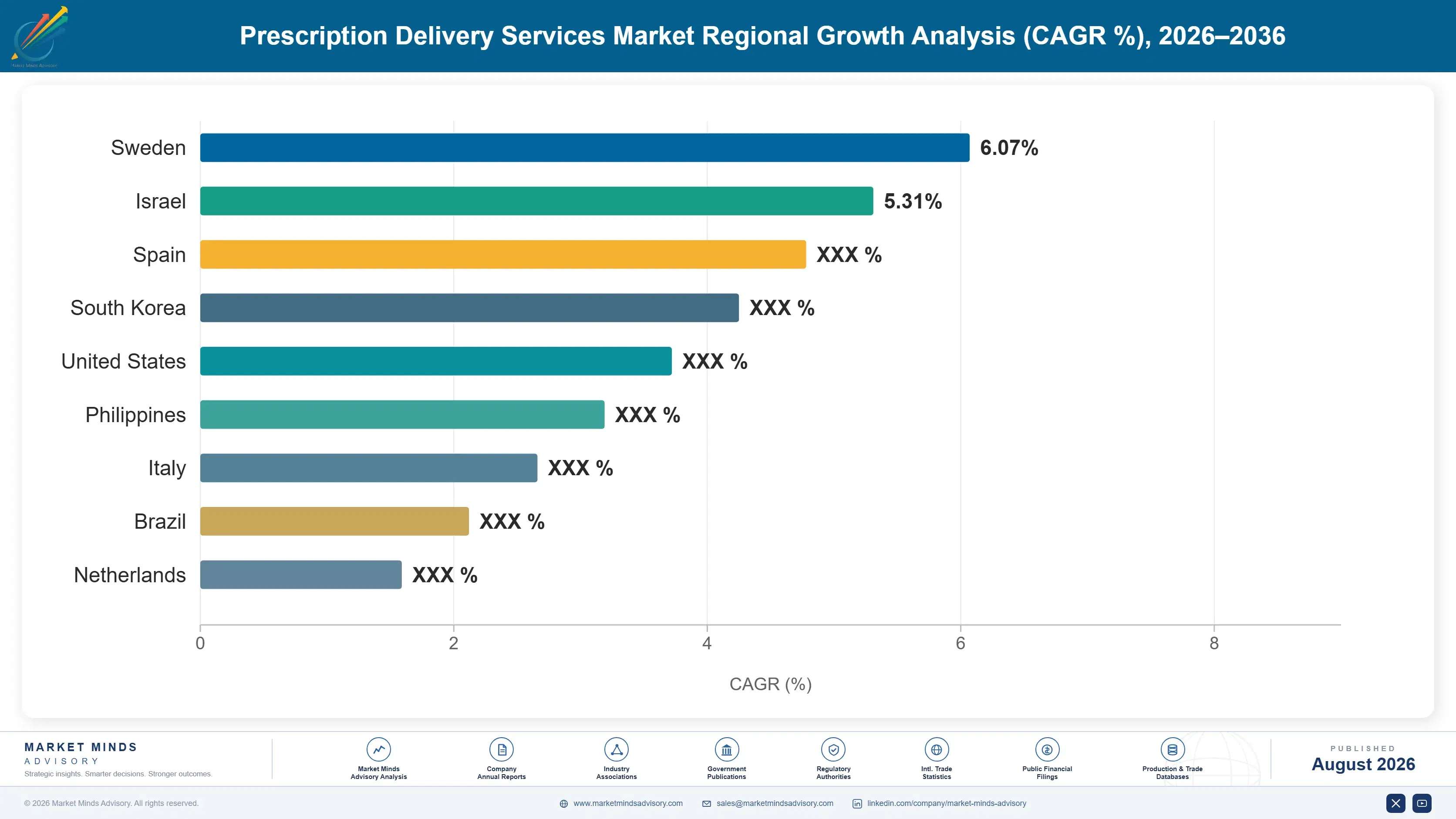
prescription-delivery-services-market-country-cagr-analysis-1787308190267

Where Delivery Providers Can Grow Margin

Beyond order volume growth, delivery providers have several concrete paths to lift revenue per pharmacy account, spanning subscription membership programs, cold-chain premium service tiers, white-label logistics partnerships, and data analytics services layered on top of the core delivery fee across every account tier, geography, patient category, and reimbursement channel currently served worldwide each year.

Subscription Membership Delivery Programs for Patients

Delivery providers increasingly offer subscription membership programs that give patients unlimited or discounted delivery for a flat monthly fee, converting per-delivery transactions into a recurring revenue relationship worth roughly 10 to 15% of annual delivery revenue per enrolled patient account and household budget across the subscription term. Patients favor subscription programs because predictable pricing removes the friction of weighing delivery cost against in-store pickup for every single prescription fill, creating strong incentive to enroll once a patient reaches a threshold number of recurring medications requiring regular fulfillment and refill cycles.
Market Impact: Adds roughly 10 to 15% recurring an

Cold-Chain Premium Service Tier Contracts Offered

Delivery providers increasingly offer premium cold-chain service tiers with validated temperature monitoring and guaranteed delivery windows for specialty pharmacy customers, a service worth roughly 25 to 35% more per delivery than standard ambient-temperature service given the specialized packaging and monitoring involved across every fulfillment cycle and shipment handled nationwide and abroad each and every year. These premium contracts typically extend the provider's relationship with specialty pharmacies considerably beyond a single delivery transaction, since biologic medication programs require consistent, validated cold-chain performance across every fulfillment cycle and renewal period each year.
Market Impact: Adds 25 to 35% premium per single d

White-Label Logistics Partnerships With Chains Built

White-label logistics partnerships let delivery providers operate branded delivery fleets on behalf of national pharmacy chains that prefer outsourcing logistics to building proprietary fleets, expanding the addressable customer base into chains that would otherwise defer delivery investment given the high capital cost of building in-house capability across every market they serve nationwide and abroad each year. These partnerships typically secure 3 to 5 years of predictable order volume across the chain's full store network, making them an attractive account type for providers seeking long-term revenue visibility and stable growth trajectories.
Market Impact: Secures 3 to 5 years of order volum

Delivery Analytics and Adherence Data Services Sold

Delivery providers increasingly package delivery timing and patient adherence data into analytics services sold to pharmacy chains and payers seeking to identify patients at risk of medication non-adherence, a service worth roughly 8 to 12% of the underlying delivery contract value annually across every account served nationwide and abroad each and every single full calendar year. These analytics engagements typically extend the provider's relationship well beyond the original delivery contract, since adherence insights become embedded into a pharmacy or payer's broader patient engagement strategy over multiple years and renewal cycles.
Market Impact: Adds 8 to 12% of contract value yea

Who Controls the Margin Pool

Five providers hold 34% of global revenue, with CVS Health and Amazon Pharmacy forming a clear leading pair whose combined pharmacy network scale and logistics infrastructure give them a durable gap over the next tier of challengers, including Walgreens, Instacart, and DoorDash, none of which currently matches their integrated pharmacy-to-delivery footprint or national reach at scale.
Current competitive activity centers on three dimensions: extending same-day delivery coverage beyond dense urban cores into suburban and rural markets nationwide, building validated cold-chain infrastructure for specialty medication delivery, and winning white-label logistics partnerships with national pharmacy chains expanding their own delivery footprints across multiple states, regions, and international markets nationwide and abroad each year.

Emerging pressure comes from regional gig-economy delivery platforms offering lower-cost standard delivery with increasingly credible pharmacy integration, gaining ground fastest among independent pharmacies across South Asia and parts of Latin America and Eastern Europe as well today. Rankings among the established national leaders are unlikely to shift materially before 2030, but the standard-delivery segment is becoming considerably more contested territory as regional platforms close the integration gap faster than expected across most markets tracked.
prescription-delivery-services-market-company-positioning-matrix-1787308190790

Competitive Moat and Risk Dimensions

CVS HEALTH CORPORATION

Moat: Integrated Pharmacy Network Scale

CVS Health's extensive owned pharmacy network and integrated delivery infrastructure give it a fulfillment cost advantage that competitors relying on third-party pharmacy partnerships cannot easily replicate, and this advantage becomes more valuable as patients increasingly expect delivery bundled directly into their existing pharmacy relationship and refill routine.
CVS HEALTH CORPORATION

Risk: High Fixed Infrastructure Cost

CVS Health's sustained investment in proprietary delivery fleets and fulfillment centers creates a meaningful fixed cost structure that leaner gig-platform competitors do not carry, potentially limiting its flexibility to scale down delivery capacity during periods of softer prescription volume across its national network and store footprint.
AMAZON.COM INC

Moat: Logistics Network and Data Depth

Amazon Pharmacy's access to Amazon's broader logistics network and consumer purchase data gives it a delivery routing and demand forecasting advantage that pharmacy-only competitors cannot easily match, and this advantage increasingly matters as delivery efficiency becomes a larger share of overall service cost and pricing.
AMAZON.COM INC

Risk: Limited Physical Pharmacy Presence

Amazon Pharmacy's limited physical pharmacy footprint leaves it considerably more dependent on digital-first patient acquisition than CVS or Walgreens, whose extensive retail presence generates steady walk-in prescription volume that converts readily to delivery relationships without comparable acquisition cost, ongoing marketing spend, or campaign investment overall.

Players Tracked

Prominent Players

CVS Health Corporation
Amazon.com Inc
Walgreens Boots Alliance Inc
Maplebear Inc
DoorDash Inc

Other Key Players

Capsule Corp
NowRx Inc
Alto Pharmacy
ScriptDrop Inc
TruePill Inc
Walmart Inc
Rite Aid Corporation
Express Scripts Holding Company
OptumRx Inc
Uber Technologies Inc
Shipt Inc
Zipline International Inc
Wingcopter GmbH
API Holdings Limited
Tata 1mg Healthcare Solutions Private Limited

Recent Developments

MARCH 2026

CVS Health Expands Same-Day Delivery to Suburban Markets

CVS Health extended same-day prescription delivery coverage from its largest metropolitan markets into surrounding suburban zip codes across several states nationwide and beyond. The expansion targeted chronic disease patients on maintenance medications first, with broader coverage planned across the following fiscal year and beyond that timeline.
Signal: Same-day coverage expansion into lower-den
OCTOBER 2025

Amazon Pharmacy Acquires Cold-Chain Logistics Specialist

Amazon Pharmacy completed the acquisition of a validated cold-chain logistics specialist to secure specialty medication delivery capability ahead of anticipated biologic prescription growth across its network and customer base. The deal brought additional temperature-controlled fulfillment capacity in-house, expanding Amazon's delivery footprint considerably across new markets and regions.
Signal: Validated cold-chain logistics capacity is
JUNE 2025

Walgreens Signs White-Label Logistics Partnership

Walgreens entered a white-label logistics partnership with a regional delivery provider covering last-mile fulfillment across its store network in several states nationwide. The agreement was a logistics services contract, not a joint venture or acquisition, covering delivery operations across Walgreens' regional footprint and expansion plans.
Signal: Multi-year, full-network white-label logis

Courier Labor and Cold-Chain Packaging Exposure

Courier labor and cold-chain packaging together represent roughly 46% of cost of goods sold for a typical prescription delivery, with labor costs concentrated in local courier markets and specialized insulated packaging sourced from a smaller number of qualified suppliers holding pharmaceutical-grade validation and temperature performance certification built over many years of rigorous testing and refinement.
The 2022 to 2023 gig-economy driver shortage, driven by rising fuel costs and competing demand from food and general retail delivery platforms, pushed courier wages meaningfully higher across most major delivery markets, with several delivery providers reporting margin compression in company annual reports covering that period. The International Energy Agency's transport cost analysis of that period noted the disproportionate impact on last-mile logistics providers competing for the same limited driver pool against faster-growing general delivery platforms.

Smaller delivery providers without long-term courier partnerships or proprietary fleet investment bear considerably more exposure to wage swings than the largest players, who can negotiate volume commitments and secure priority driver allocation during shortages. This dynamic reinforces the advantage already held by the leading delivery providers, since a courier shortage can delay a smaller competitor's deliveries while larger players continue fulfilling orders on schedule and protecting pharmacy relationships.
prescription-delivery-services-market-cost-volatility-analysis-1787308190985

Dynamic Courier Network Density Optimization

Larger delivery providers are investing in dynamic routing software that increases deliveries per courier shift, reducing per-delivery labor cost exposure without reducing courier wages directly, a step that meaningfully improves margin resilience during periods of local wage inflation across their operating markets and geographies served nationwide, internationally, and across every service tier and account category.

Long-Term Cold-Chain Packaging Supply Agreements

Delivery providers are increasingly negotiating multi-year supply agreements with validated cold-chain packaging manufacturers directly, trading some pricing flexibility for supply certainty and predictable input costs across their specialty delivery contract portfolio and account base spanning multiple regions, geographies, reimbursement systems, product categories, patient segments, delivery formats, service tiers, and every pharmacy account type offered.

Gig-Platform Overflow Capacity Partnerships

Delivery providers are increasingly partnering with gig-economy platforms for overflow capacity during peak demand periods, reducing reliance on maintaining a fully dedicated courier fleet sized for peak volume and lowering fixed labor cost exposure during slower periods, seasonal lulls, off-peak windows, and unexpected demand troughs across every market and account tier served nationwide and abroad.

Portfolio Architecture for Margin Defence

The market organizes into three tiers by delivery speed and cold-chain capability, with margin profile widening accordingly across each successive tier. Volume-tier standard scheduled delivery covers the broadest patient base, priced largely as a flat per-delivery fee or bundled pharmacy benefit tied to insurance coverage. Premium-tier same-day and cold-chain delivery command meaningfully higher prices tied to speed and validated temperature performance that patients and specialty pharmacies inc
Gross margins widen considerably moving up the tiers, since same-day and cold-chain formats carry disproportionate pricing power relative to their incremental logistics cost, while standard scheduled delivery competes primarily on price against a growing field of regional couriers entering the value tier from multiple geographies. Pharmacy chains rarely downgrade delivery sophistication once speed or cold-chain reliability benefits have been realized in patient retention data and satisfaction scores.

High-value margin pools concentrate in cold-chain delivery bundled with analytics services, where recurring subscription and data revenue carries substantially wider margin than the underlying delivery fee that first brought the pharmacy account onto the provider's platform in the first place. This dynamic is reshaping how delivery providers prioritize account investment across their commercial teams.

Volume / Commodity-Adjacent Tier

Standard scheduled delivery priced largely as a flat per-delivery fee, competing primarily on cost against a growing field of regional couriers with limited service differentiation between competing bids submitted for contracts.
Gross Margin: 16-24%

Premium / Certified Tier

Same-day and expedited delivery carrying stronger speed credentials, commanding meaningfully wider margins than standard scheduled formats while requiring greater courier network density investment from providers across markets and geographies served.
Gross Margin: 28-36%

Sustainability / Regulatory / Next-Generation Tier

Validated cold-chain specialty delivery bundled with analytics services, representing the newest category and commanding the highest margins given their compliance documentation and patient retention advantage over legacy delivery formats used industry-wide.
Gross Margin: 38-46%
prescription-delivery-services-market-portfolio-architecture-1787308191484

High-value Sub-segments and Strategic Watch-out

Cold-Chain Delivery With Analytics Services

Cold-chain delivery paired with adherence analytics services combines the category's fastest growth with its widest margins, drawing concentrated provider investment as specialty pharmacies increasingly require this capability across biologic therapy programs worldwide and every major reimbursement channel, pharmacy network, and provider category currently tracked closely.
Gross Margin: 40-48%

Same-Day and On-Demand Delivery

Same-day and on-demand delivery delivers strong unit growth on the back of rising patient convenience expectations, though margins sit a tier below fully cold-chain designs, supported by broadening adoption across suburban and mid-density markets nationwide and beyond every major metropolitan area currently tracked closely by MMA analysts.
Gross Margin: 30-38%

Standard Scheduled Mail-Order Delivery

Standard scheduled mail-order delivery remains the category's volume backbone across insurance-driven purchasing worldwide, competing on cost that leaves thin margins and limited room for meaningful service differentiation across most geographies, patient categories, reimbursement systems, provider networks, and delivery formats currently tracked closely by MMA analysts.
Gross Margin: 14-22%

Legacy In-Store Pickup-Only Pharmacy Models

Legacy in-store pickup-only pharmacy models still serving a meaningful patient share warrant monitoring as delivery adoption continues expanding, a dynamic that could compress this once-standard fulfillment model faster than smaller independent pharmacies currently plan for in their own strategies, budget cycles, and capital investment plans.
Gross Margin: 10-16%

Recurring Fills and Patient Retention

Delivery providers generate recurring revenue through prescription refill cycles far more than through any single delivery transaction, since a chronic disease patient, once enrolled in recurring delivery, typically continues that relationship for the duration of their medication therapy rather than switching pharmacies absent a major service failure or insurance network change affecting coverage terms, eligibility, and full formulary access.
Adoption depth varies considerably by end-use vertical. Chronic disease and specialty pharmacy patients adopt recurring and cold-chain delivery fastest and often serve as reference accounts providers use to influence broader pharmacy chain investment decisions, while acute-care patients filling one-time prescriptions typically remain price-sensitive and less loyal to any single delivery provider or platform relationship over time and across each renewal cycle.

Buyer profiles are shifting generationally as younger patients who grew up with on-demand delivery apps show far greater comfort choosing delivery over in-store pickup than an older cohort that historically defaulted to physical pharmacy visits before considering delivery convenience at all. This generational shift is accelerating adoption across households where younger family members increasingly manage medication logistics for aging relatives and extended family members alike.
prescription-delivery-services-market-end-use-penetration-index-1787308191978

Positioning for the Delivery Shift

These are among the four positions where our research anticipates prominent divergence between winners and laggards over the coming forecast period. Each is grounded in the demand model, the regulatory perimeter, and the announced capacity pipeline.
01 / SAME-DAY COVERAGE STRATEGY

Providers without suburban coverage will lose share to faster movers

Same-day delivery command meaningfully higher patient loyalty than scheduled formats, and providers without competitive suburban and mid-density coverage risk losing consideration entirely as convenience expectations continue rising across major markets. This gap is widening as more patients cite delivery speed as their primary pharmacy selection driver, and that delay carries real commercial consequence for providers slow to expand beyond dense urban cores. Companies that close this gap early stand to capture disproportionate share of the fastest-growing segment before rankings solidify further.
02 / COLD-CHAIN INFRASTRUCTURE INVESTMENT

Validated cold-chain capability will separate specialty leaders from the rest

Specialty pharmacies increasingly require validated temperature performance before qualifying a new delivery provider, and providers with established cold-chain infrastructure capture disproportionate share of this higher-margin segment simply by virtue of a shorter qualification timeline than newer entrants face in the market. Providers still building this capability increasingly lose consideration to competitors who can demonstrate a proven cold-chain track record, and that delay carries real commercial consequence as biologic prescription volume keeps rising. That gap widens with every new therapy launch requiring reliable delivery.
03 / WHITE-LABEL PARTNERSHIP INVESTMENT

White-label deals will separate durable chain loyalty from one-off contracts

Delivery providers winning white-label logistics partnerships capture the full multi-year store network pipeline rather than competing store by store, and providers without this capability increasingly lose account relationships to competitors who have already built these chain partnerships across major networks. This gap is widening as more pharmacy chains seek operational consistency across their networks, and delayed investment here carries real commercial cost as competitors lock in multi-year contracts. Companies that build this capability early stand to capture disproportionate long-term chain loyalty.
04 / COURIER NETWORK DENSITY DEPTH

Network density will separate margin leaders from cost-exposed rivals

Dynamic routing and courier network density require technology and driver relationships that few delivery providers currently possess at scale, and companies with the deepest network density investment capture disproportionate order fulfillment share simply by being able to guarantee reliable delivery windows that disrupt weaker rivals entirely. Providers still exposed to thin courier networks increasingly lose order consideration to competitors who can demonstrate reliable, predictable service across every account. That gap widens further with every new market entry attempt against established local competitors.

Engagement Snapshot From the Field

A live engagement with an industry participant carrying material or product regulatory and market exposure ahead of a defining policy shift, showing how our research translates into a defensible multi-year portfolio strategy.
MARKET MINDS ADVISORY · CLIENT ENGAGEMENT SUMMARY
Prescription Delivery Services Producer Strategic Portfolio Review and Transition Roadmap 2026·Investment Scenario on Prescription Delivery Services Exposure Evaluation 2025-26
CLIENT PROFILE
The client is a regional independent pharmacy network operating twenty-two locations across the midwestern United States, serving approximately 85,000 active patients with roughly $340 million in annual revenue (client-reported, unverified by MMA). The network faced eroding market share against national chains offering integrated same-day delivery and broader delivery coverage across suburban and rural markets alike.
STRATEGIC CHALLENGE
The network lacked proprietary delivery infrastructure entirely across all locations, and leadership needed clear, defensible data on white-label partnership versus in-house fleet economics before committing fresh capital across its full twenty-two-location network and its upcoming annual budget planning cycle with its board of directors, regional operations leadership team, and finance committee members.
MMA APPROACH
MMA benchmarked white-label partnership costs and in-house fleet economics across three delivery providers against the network's current pickup-only baseline, incorporating location-specific patient density and chronic medication volume across the footprint. The analysis modeled projected outcomes over a three-year forward planning horizon under two patient adoption scenarios developed with the network's operations team.
KEY FINDINGS
  1. White-label partnership costs ran meaningfully lower than in-house fleet buildout across all twenty-two locations evaluated in the analysis and full modeling exercise.
  2. Approximately 55% of the network's chronic disease patients indicated strong interest in switching to recurring home delivery if it were offered to them.
  3. Same-day delivery adoption was projected to reduce prescription abandonment rates by roughly 18% across the network's full patient base and service territory nationwide.
  4. A phased, location-by-location rollout sequenced carefully around patient density minimized capital exposure compared to an immediate simultaneous full network-wide launch approach entirely.
CLIENT PROFILE
The client is a regional independent pharmacy network operating twenty-two locations across the midwestern United States, serving approximately 85,000 active patients with roughly $340 million in annual revenue (client-reported, unverified by MMA). The network faced eroding market share against national chains offering integrated same-day delivery and broader delivery coverage across suburban and rural markets alike.
STRATEGIC CHALLENGE
The network lacked proprietary delivery infrastructure entirely across all locations, and leadership needed clear, defensible data on white-label partnership versus in-house fleet economics before committing fresh capital across its full twenty-two-location network and its upcoming annual budget planning cycle with its board of directors, regional operations leadership team, and finance committee members.
MMA APPROACH
MMA benchmarked white-label partnership costs and in-house fleet economics across three delivery providers against the network's current pickup-only baseline, incorporating location-specific patient density and chronic medication volume across the footprint. The analysis modeled projected outcomes over a three-year forward planning horizon under two patient adoption scenarios developed with the network's operations team.
KEY FINDINGS
  1. White-label partnership costs ran meaningfully lower than in-house fleet buildout across all twenty-two locations evaluated in the analysis and full modeling exercise.
  2. Approximately 55% of the network's chronic disease patients indicated strong interest in switching to recurring home delivery if it were offered to them.
  3. Same-day delivery adoption was projected to reduce prescription abandonment rates by roughly 18% across the network's full patient base and service territory nationwide.
  4. A phased, location-by-location rollout sequenced carefully around patient density minimized capital exposure compared to an immediate simultaneous full network-wide launch approach entirely.
RECOMMENDED STRATEGY
Phase 1: Phase 1 (Months 1-3): Complete a thorough provider evaluation and location-specific delivery demand prioritization across the full pharmacy network footprint. Phase 2: Phase 2 (Months 4-12): Execute phased rollout starting with the six highest-density locations identified during the initial analysis phase first. Phase 3: Phase 3 (Months 13-24): Complete rollout across remaining locations sequenced around patient adoption data and the annual budget planning cycle.
OUTCOME
The network selected a white-label logistics partnership strategy across its full footprint, prioritizing its six highest-density locations first. Projected annual patient retention gains translated to approximately $4.2 million (client-reported, unverified by MMA) in preserved revenue against the prior pickup-only baseline across the network and its territory.

Frequently Asked Questions

Foundational context covering the market sizes, CAGR, scope, country, region and competition that inform every finding below. This section is provided to cover basics and most often pre-purchase conversations, answered from the MMA Primary Research Dataset.

What is the current size of the Prescription Delivery Services Market?

The Prescription Delivery Services Market was valued at approximately $9.5 billion globally in 2025. This includes same-day, scheduled, cold-chain, and last-mile courier delivery formats worldwide.

How large will the Prescription Delivery Services Market be by 2036?

The market is projected to reach approximately $25.8 billion by 2036, roughly 2.48 times its 2026 value. Growth is driven by chronic disease prevalence and cold-chain specialty delivery.

What is the CAGR for the Prescription Delivery Services Market 2026 to 2036?

The base case CAGR is 9.5% annually, with a bull case of 10.8% and a bear case of 8.2%. This reflects steady demand growth alongside accelerating same-day adoption.

Which segment is growing fastest?

Same-day and on-demand prescription delivery is the fastest-growing segment, expanding at roughly 15.0% annually. Rising patient demand for delivery speed is driving this shift nationwide.

Who are the major companies in the Prescription Delivery Services Market?

Leading companies include CVS Health, Amazon Pharmacy, Walgreens, Instacart, and DoorDash. Together these five leading providers hold roughly 34% of total global market revenue combined.

Which country is growing fastest?

India is the fastest-growing country, expanding at roughly 12.0% annually through 2036. This reflects rapidly expanding e-commerce and digital pharmacy infrastructure across the entire country.

Report Segmentation Architecture

The full report scope spans multiple orthogonal segmentation dimensions, with cross-tabulated demand data provided for each dimension pair. Coverage extends further to regional breakdowns, trend trajectories, and the competitive detail needed to support segment-level decision-making.

By Delivery Service Model

  • Same-Day and On-Demand Delivery
  • Scheduled Recurring Mail-Order Delivery
  • Cold-Chain Specialty Delivery
  • Hospital-to-Home Discharge Delivery
  • Last-Mile Courier and Gig Platform Delivery
  • Automated and Locker-Based Delivery

By End-Use Industry

  • Retail and Chain Pharmacy
  • Independent Pharmacy
  • Specialty and Biologic Pharmacy
  • Hospital and Health System Pharmacy

By Commercial Dimension

  • Direct Patient Payment
  • Insurance and Payer Reimbursement
  • Pharmacy-Contracted Delivery
  • White-Label Logistics Partnership

By Region

  • North America
  • Western Europe
  • East Asia
  • South Asia and Pacific
  • Latin America
  • Middle East and Africa
  • Eastern Europe

Scope, Methodology, and Coverage

Every figure in this report is reproducible from documented input assumptions. The scope below maps the historical period, the forecast horizon, the segmentation dimensions, and the countries covered, alongside the underlying primary and qualitative methodology.
Historical Period
2020 to 2025
Forecast Period
2026 to 2036
Base Year
2025 (USD billions; MMA Primary Research Dataset, August 2026)
Market Definition
The Prescription Delivery Services Market covers logistics services that transport dispensed prescription medications from a pharmacy or fulfillment center to a patient, including same-day, scheduled, and cold-chain delivery models. It excludes pharmacy dispensing operations themselves, wholesale pharmaceutical distribution, and general retail e-commerce delivery not specific to prescription medication.
Quantitative Units
USD billions (current prices); delivery volume where applicable
Segmentation Dimensions
By Delivery Service Model; By End-Use Industry; By Commercial Dimension; By Region
Regions Covered
North America, Western Europe, East Asia, South Asia and Pacific, Latin America, Middle East and Africa, Eastern Europe
Countries Covered
USA, China, Germany, France, UK, Japan, South Korea, India, Australia, Canada, Brazil, Mexico, Indonesia, Vietnam, Thailand, Malaysia, UAE, Saudi Arabia, South Africa, Nigeria, Turkey, Poland, Netherlands, Italy, Spain, Sweden, Switzerland, Argentina, Colombia, Singapore, and additional markets relevant to this sector
Key Companies Profiled
CVS Health Corporation, Amazon.com Inc, Walgreens Boots Alliance Inc, Maplebear Inc, DoorDash Inc, Capsule Corp, NowRx Inc, Alto Pharmacy, ScriptDrop Inc, TruePill Inc, Walmart Inc, Rite Aid Corporation, Express Scripts Holding Company, OptumRx Inc, Uber Technologies Inc, Shipt Inc, Zipline International Inc, Wingcopter GmbH, API Holdings Limited, Tata 1mg Healthcare Solutions Private Limited
Quantitative Methodology
Primary survey, n=3,800 respondents, Q4 2025, six countries; demand-side model with trade association cross-validation
Qualitative Methodology
47 expert interviews, Q4 2025; applied to validate demand model assumptions, identify emerging dynamics, and assess competitive positioning
Report Format
PDF and XLSX data workbook (Word format preview document)
Publisher
Market Minds Advisory
Report Code
MMA-2026-HLT-152
Published
August 2026
Contact
sales@marketmindsadvisory.com | www.marketmindsadvisory.com

Purchase the full Prescription Delivery Services Market Report (2026 to 2036).

The full report delivers detailed segmentation across all six delivery service model categories, with country-level sizing for all thirty-one covered markets. It profiles the complete competitive landscape of all twenty companies named in this summary, including moat and risk analysis for the two leading delivery providers. Multi-year forecast models are provided under base, bull, and bear scenarios. Primary survey data drawn from pharmacy operators, delivery platform executives, and patient panels across six countries supports every major finding, and purchasers receive editable data files alongside the formatted report.
Same-day coverage expansion tracker by metropolitan area
Cold-chain validation and packaging cost benchmark model
White-label partnership economics comparison calculator tool
Courier labor cost tracker updated quarterly by region
Delivery provider network density database by country
Competitive benchmarking across key delivery platforms

Built For The People Who Decide

From boardroom strategy to bench-side execution, this report is read cover-to-cover by leaders shaping the next decade of their industry, turning demand scenarios, market dynamics and valuation benchmarks into decisions.
CXOs/ Presidents/ VPs/ Managers
M&A and Corporate Development
Strategy Teams and R&D Heads
Procurement and Product Directors
Regulatory and Compliance Leaders
Investor Relations and Equity Analysts