Market Minds Advisory
Prepreg Composite Fibers Market

Prepreg Composite Fibers Market: A Material With a Shelf Life and a Freezer Bill

Everything about this material follows from the fact that it lives at minus eighteen degrees and expires anyway, which turns a supply chain into a cold chain and a quarter of the roll into scrap.

Lead Analyst

Bilal Shaikh

Published

September 2026

Make Smarter Decisions with Customized Research Insights

Request a free sample report and evaluate market opportunities, growth trends, and competitive dynamics relevant to your business needs.

2025 MARKET VALUE$4.9BMarket Size 2025
2036 FORECAST VALUE$11.7BBase Case , 2026 to 2036
CAGR 2026 TO 20368.2 %Bull 9.4% / Bear 7.0%
INCREMENTAL OPPORTUNITY$6.4BNet 10- year value creation
EXPANSION MULTIPLE2.20x2036 value over 2026 base
Strategic Levers
M&A Pipeline
Regional Outlook
Country Rankings
Competitive Intelligence
Segmental Deep-dive
Call-Us : 91 93563 13602

Executive Snapshot and Market Trajectory

Prepreg is fibre already impregnated with partially cured resin, which is why it delivers fibre volume fraction and void content that liquid resin processes struggle to match. It is also why it lives at minus eighteen degrees, expires on a clock and produces layup scrap near 26%.
The freezer defines the commercial model. Material ships frozen, thaws on an out-life budget and gets written off when that budget runs out, so minimum orders, storage capital and scrap all sit inside the buyer's cost rather than the supplier's. Every competing process exists to escape exactly that. Minimum orders, storage capital and write-offs all sit inside the buyer's cost rather than the supplier's, and every competing process exists to escape exactly that arrangement.
Out-of-autoclave prepreg grows fastest at 12.3%, half again the market rate of 8.2%, because it removes a curing vessel costing 14 million dollars without giving up prepreg quality. Thermoplastic tapes follow at 11.0% and remove the freezer entirely. Concentration is 71%, since qualification onto an aircraft programme takes four years. Thermoplastic tapes follow at 11.0% and remove the freezer entirely, since the polymer is already fully reacted.
Market Definition
Reinforcing fibres pre-impregnated with partially cured resin systems and supplied as sheet, tape or fabric for subsequent layup and cure, spanning epoxy, out-of-autoclave, thermoplastic, phenolic, bismaleimide and hybrid systems across carbon, glass and aramid reinforcement. Excludes dry fibre and fabric, liquid resin systems sold separately, moulding compounds, finished composite components, and carbon fibre precursor.
Base Year Value
$4.9B in 2025 (MMA Primary Research Dataset, August 2026)
Forecast Period
2026 to 2036, eleven discrete annual values
CAGR
8.2% base case. Bull 9.4%. Bear 7.0%.
Fastest Growth Segment
Out-of-Autoclave Cure Prepreg: 12.3% CAGR
Fastest Growth Country
India: 11.6% CAGR
Fastest Growth Region
South Asia and Pacific: 10.4% CAGR
Largest Region
North America: 34% of 2025 global value
Market Leaders
Toray Advanced Composites, Hexcel, Solvay, Teijin, SGL Carbon. Source: MMA Primary Research Dataset, July 2026.
Primary Survey
n=3,800 procurement and R&D decision-makers, Q4 2025, six countries
Methodology
Demand-side build-up, cross-validated against public data, 47 expert interviews

Prepreg Composite Fibers Market Forecast Scenarios

prepreg-composite-fibers-market-size-forecast-scenario-1787580913779
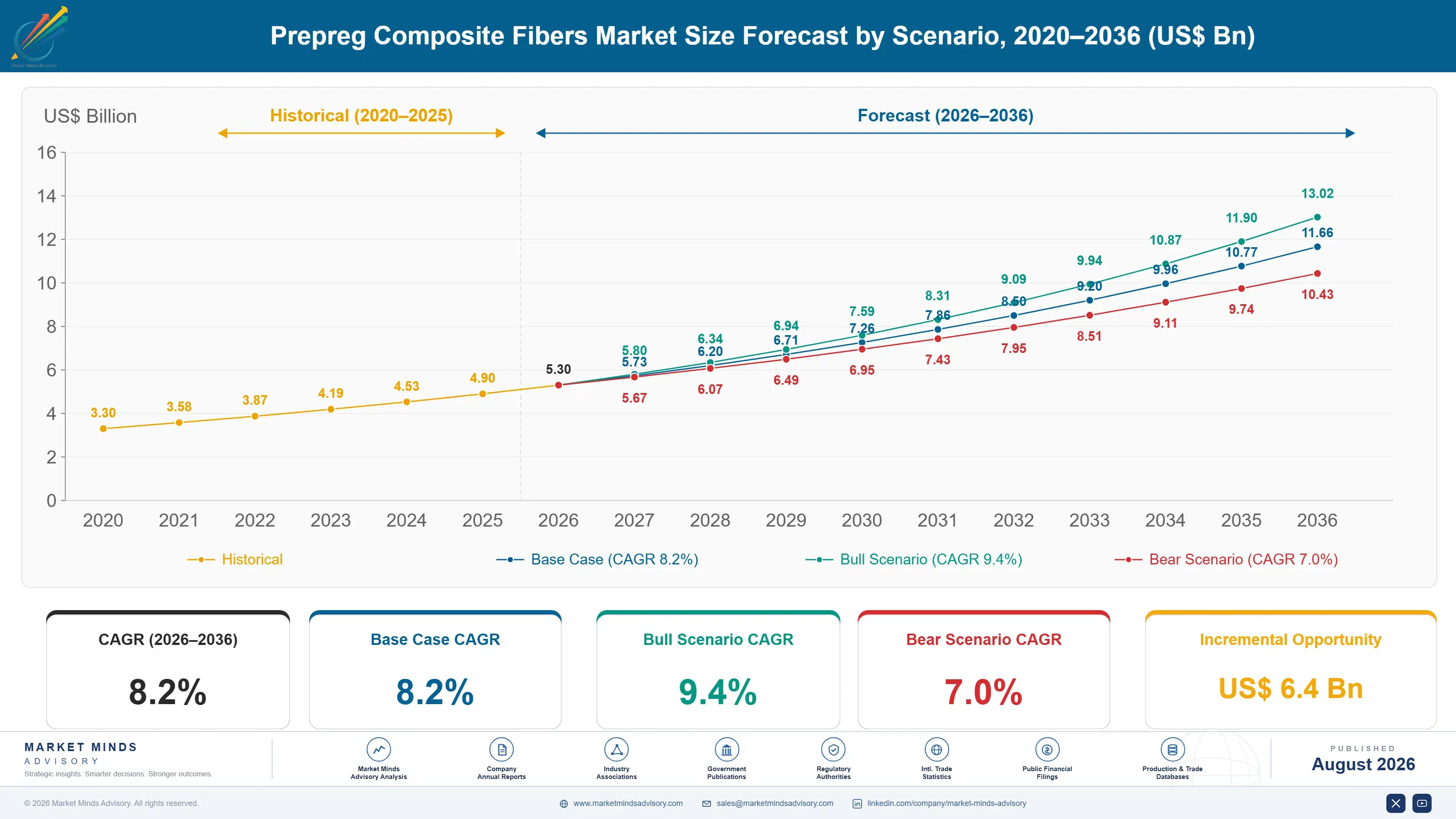
Growth ran near 7.1% between 2020 and 2025 through a period that began with aerospace build rates collapsing and ended with them constrained by supply chain rather than by demand. Defence programmes held up throughout and partly offset the commercial aviation trough. Space launch and emerging electric aviation both consumed prepreg at rates disproportionate to their revenue, and wind energy demand moved on entirely separate timing.
Base case 8.2% rests on three mechanisms. Commercial aircraft build rates continue recovering toward and beyond pre-pandemic levels on order books stretching years ahead. Out-of-autoclave systems keep opening prepreg to manufacturers who cannot justify autoclave capital, which expands the addressable customer base rather than shifting share within it. And Indian aerospace component manufacturing is expanding rapidly on offset obligations attached to defence and commercial procurement. None requires the others alongside it.
The bull case at 9.4% assumes thermoplastic tape qualification accelerates on next generation single aisle programmes, where the absence of a freezer and the possibility of welded assembly both change manufacturing economics substantially. The bear case at 7.0% is an aerospace build rate stall combined with liquid resin infusion taking further primary structure, removing growth from both directions at once.

Everything Follows From the Freezer

Impregnating fibre with resin before layup rather than during it is what gives prepreg its properties. Fibre volume fraction is controlled at manufacture, resin distribution is uniform, and void content after autoclave cure is low enough for primary aircraft structure. Liquid infusion cannot reliably match that on a wing skin, which is why the 787 and A350 use prepreg where it matters most and infusion where it does not.
TOP FIVE CONCENTRATION71%Qualification barriers keep the supplier field extremely narrow
FROZEN STORAGE TEMPERATURE-18CCondition required throughout shipping and storage of material
LAYUP SCRAP RATE26%Material lost to offcuts and expired out-life during layup
PROGRAMME QUALIFICATION TIMELINE4 yearsPeriod to qualify a new material onto an aircraft programme
CARBON FIBRE COST SHARE58%Share of prepreg cost carried by the reinforcing fibre
AUTOCLAVE CAPITAL COST$14 millionTypical investment for an aerospace scale curing vessel
The price is that the resin is already reacting. Material ships and stores at minus eighteen degrees, thaws onto an out-life clock measured in days at room temperature, and is scrapped when that clock expires whether it has been used or not. Add offcuts from nesting a flat material onto curved tools and layup scrap reaches roughly 26%, which the buyer pays for entirely.
Every alternative process is an attempt to escape that. Resin infusion uses dry fibre and liquid resin at ambient temperature. Out-of-autoclave prepreg keeps the material and removes a curing vessel costing 14 million dollars. Thermoplastic tape removes the freezer altogether, since the polymer is fully reacted and has no shelf life at all, and it can be welded rather than bonded.
"The whole competitive story in composites is people trying to get prepreg performance without prepreg logistics. Thermoplastic tape is the version that actually removes the freezer, and once a manufacturer has costed the storage, the scrap and the write-offs, the material price stops being the argument."
Director, Advanced Materials and Aerospace Structures Practice · MMA Advanced Materials and Composites Practice · August 2026

Market Trends

Out-of-autoclave systems removing the curing vessel constraint

Out-of-autoclave prepreg cures under vacuum bag pressure in an oven rather than requiring an autoclave costing around 14 million dollars for an aerospace scale vessel. That capital threshold has kept prepreg out of reach for many component manufacturers and for larger structures where no vessel is big enough. Void content and mechanical properties now approach autoclave results closely enough for secondary structure and increasingly for primary. The effect is to widen the customer base rather than shift share between suppliers, which is why the segment grows fastest. The segment widens the customer base rather than shifting share.
Market Impact: Lifts tonnage across 2 demand streams
Thermoplastic tapes eliminating shelf life and enabling welding

Thermoplastic prepreg uses a fully reacted polymer matrix, which means no refrigeration, no out-life clock and no expiry write-offs anywhere in the supply chain. Components can also be welded rather than bonded or fastened, which removes joining operations and weight from an assembly. Processing temperatures are far higher and equipment differs completely, so adoption requires new capability rather than a material substitution. Next generation single aisle programmes are where qualification effort concentrates, and the decisions there will set the trajectory. Adoption means building new capability rather than substituting a material.
Market Impact: Delivers 11.6% annual Indian growth

Market Opportunities and Growth Drivers

Commercial aircraft build rates recovering against long order books

Order books at both major airframers stretch years ahead and build rates continue climbing toward and past pre-pandemic levels, constrained by supply chain capability rather than by demand. Composite content per aircraft on current generation widebodies is far higher than on the aluminium types they replace, so each rate increase converts into prepreg tonnage disproportionately. Defence programmes add a second demand stream on entirely separate timing. Nothing in the order book suggests this reverses within the forecast period. Composite content per aircraft on current widebodies is far higher than on the aluminium types they replaced.
Market Impact: Loses 26% of material to scrap

Indian aerospace manufacturing expanding on offset obligations

India grows fastest anywhere at 11.6%, as offset obligations attached to defence and commercial aircraft procurement pull component manufacturing into the country and domestic aerospace suppliers scale accordingly. Those manufacturers qualify onto programmes at tier two and tier three level, consuming prepreg for structures and assemblies produced locally. Qualification runs through the airframer specification regardless of where production sits, which advantages established material suppliers. Growth here is capability building rather than any shift in where materials are sourced from. Qualification runs through the airframer specification regardless of where production sits, which advantages established material suppliers rather than opening the field.
Market Impact: Requires 4 years to qualify

Market Restraints and Challenges

Cold chain and out-life driving scrap the buyer absorbs

Prepreg ships and stores at minus eighteen degrees and carries an out-life clock that runs whenever material is above that temperature, so unused rolls expire and get written off. Combined with offcuts from nesting flat material onto curved tools, layup scrap reaches roughly 26%. The root cause is that the resin is already partially reacted, which is exactly what gives the material its properties. Suppliers are extending out-life through resin chemistry and offering smaller roll formats, and neither removes the underlying constraint. Neither response removes the underlying constraint. The constraint is inherent.
Market Impact: Removes a $14 million capital barrier

Programme qualification locking material choice for decades

Qualifying a prepreg onto an aircraft programme takes around four years of coupon, element and component testing before any production part is built, and the material is then written into the design allowables. Changing it means repeating much of that work. The root cause is that composite properties are process dependent, so a material cannot be substituted on paper. Commercially it protects incumbents heavily and slows every new entrant regardless of merit, which is why five suppliers hold 71% of the market. Five suppliers hold 71% of the market as a direct result.
Market Impact: Eliminates the minus 18 degree requirement
3 additional market trends, 4 additional growth drivers, and 2 additional restraints and challenges are covered in the full report. Contact sales@marketmindsadvisory.com to access the complete intelligence.

Segment CAGR and Growth Architecture

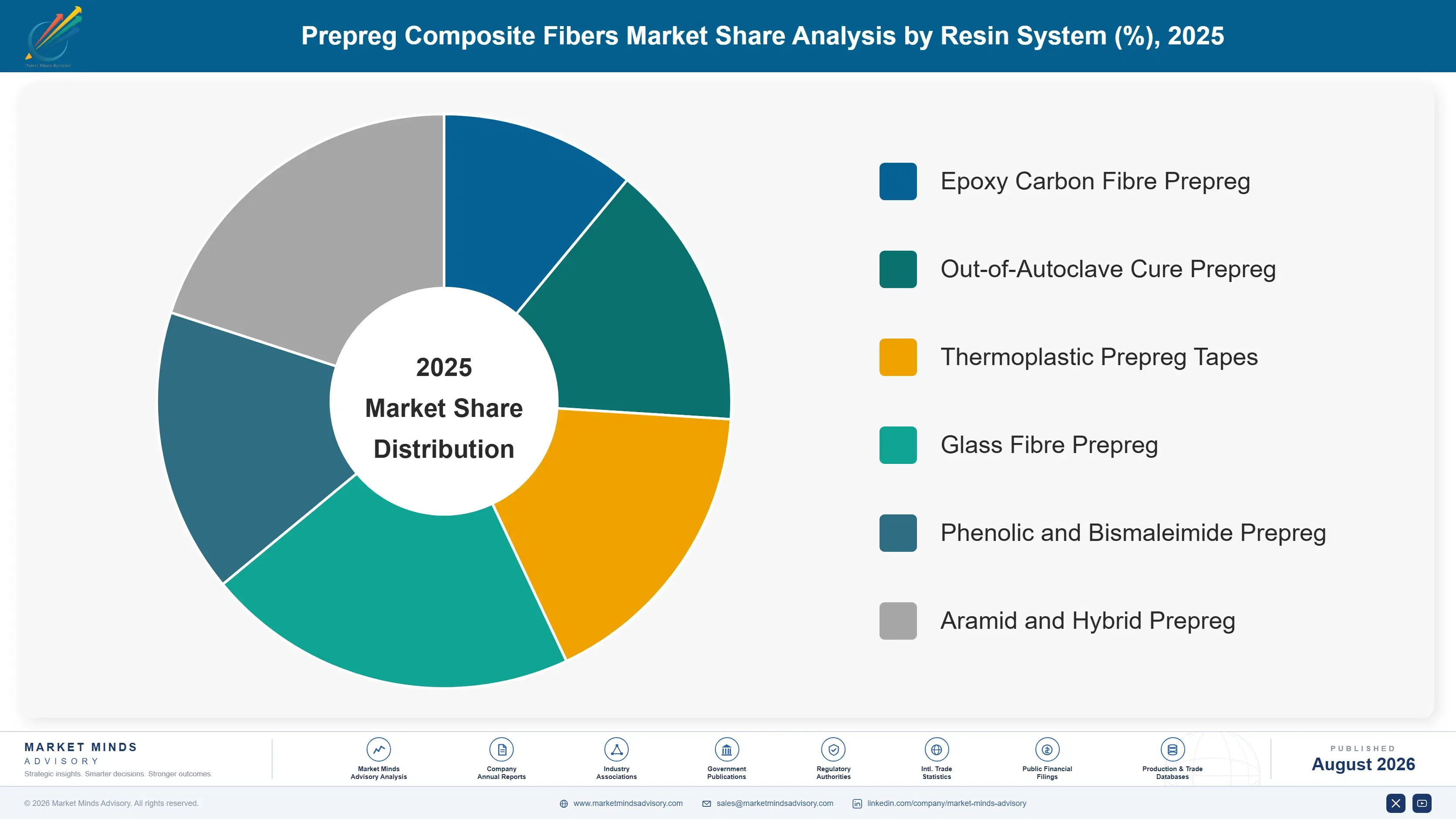
Six segments split by resin system, because the resin determines cure conditions, storage requirements, achievable properties and therefore which structures a material can serve. An epoxy prepreg and a thermoplastic tape need different factories entirely. End-use industry and commercial channel are handled in the framework rather than folded in here. Different factories entirely. Nothing transfers between them.
prepreg-composite-fibers-market-market-share-analysis-1787580914311

Out-of-Autoclave Cure Prepreg

Growing at 12.3%, half again the market rate of 8.2%, out-of-autoclave systems cure under vacuum bag pressure in an oven rather than requiring a pressurised vessel costing around 14 million dollars at aerospace scale. Resin chemistry and fibre architecture are engineered to evacuate volatiles and consolidate without external pressure, and void content now approaches autoclave results closely enough for secondary structure and increasingly for primary applications. The commercial effect is to widen the addressable customer base rather than redistribute existing volume, since manufacturers previously excluded by capital cost can now buy prepreg at all. Manufacturers previously excluded by capital cost can now buy prepreg at all, which is a rarer kind of growth than taking share.
CAGR 12.3%

Thermoplastic Prepreg Tapes

At 11.0% thermoplastic tapes use a fully reacted polymer matrix, which removes refrigerated storage, out-life clocks and expiry write-offs from the supply chain completely. Components can be welded rather than bonded or mechanically fastened, which removes joining operations, weight and inspection burden from an assembly. Processing temperatures run far above thermoset systems and the equipment is entirely different, so adoption requires building new capability rather than substituting a material. Qualification effort concentrates on next generation single aisle programmes, where the decisions taken will determine how quickly the segment scales. Decisions taken on those programmes will determine how quickly the segment actually scales. Removing the freezer changes the supply chain more than any material property does.
CAGR 11.0%
Full segment breakdown across 6 segments available in the complete report.

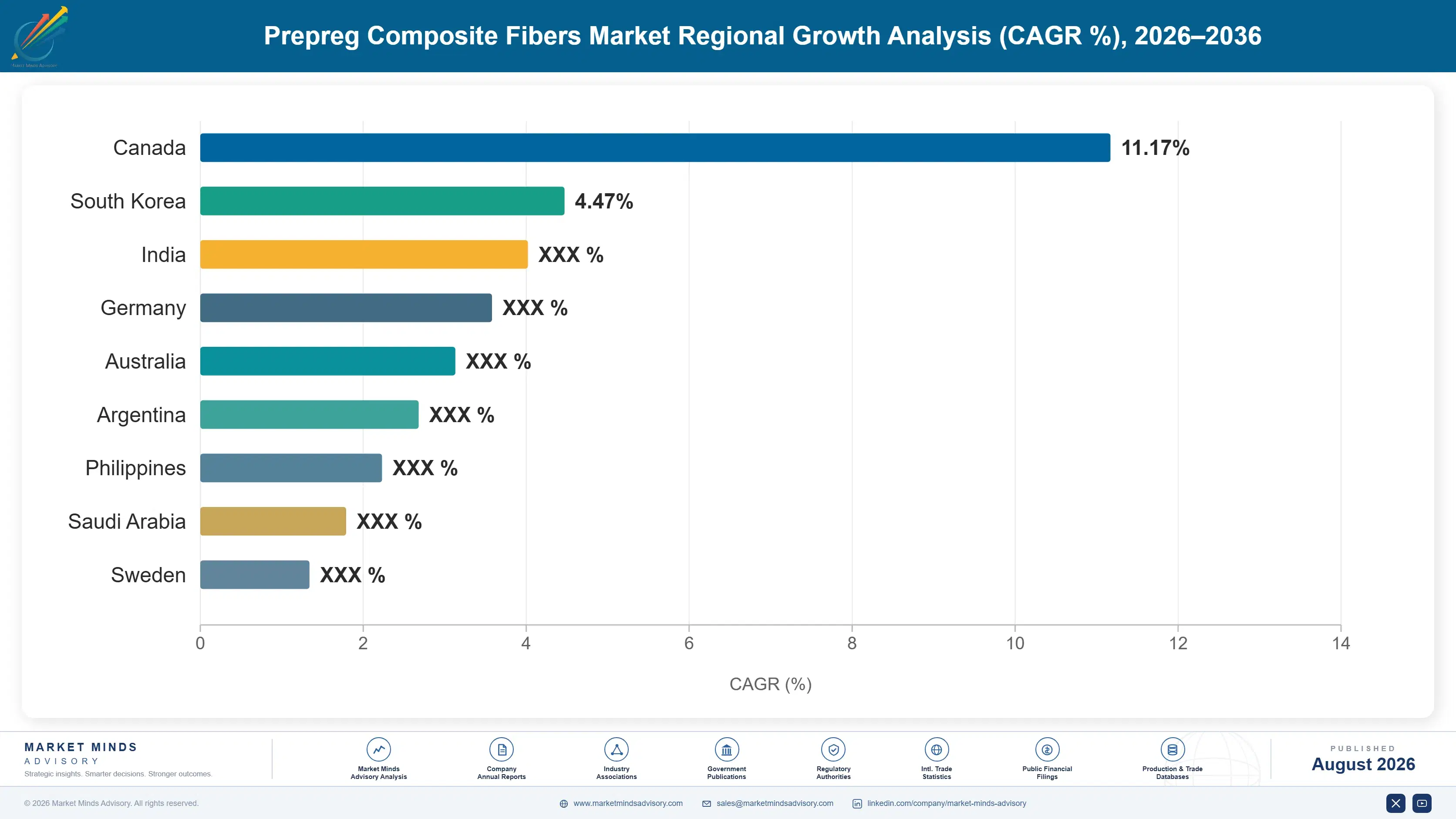
Regional Architecture and Country Demand Map

North America holds 34% of value and Western Europe 28%, both above their usual bands, because the airframers, engine makers and defence primes that consume prepreg are concentrated in those two regions. East Asia sits below its band at 18% despite producing most of the world's aerospace grade fibre.

North America

The 34% share sits above the usual band because Boeing, the American defence primes and the space launch sector all consume prepreg here and specify it through their own material standards. Hexcel and Solvay operate substantial domestic capacity qualified onto those programmes. Space launch has become a genuinely significant demand stream, with reusable vehicle programmes consuming structural prepreg at rates disproportionate to their revenue. Electric aviation developers are concentrated here too and specify heavily toward out-of-autoclave and thermoplastic systems that suit their production scale. Electric aviation developers concentrate here and specify heavily toward out-of-autoclave and thermoplastic systems that suit their production scale. Space launch has become a genuinely significant demand stream.
Share: 34% | CAGR: 7.4% (2026 to 2036)

Western Europe

The 28% share also sits above its usual band, on Airbus, the European defence programmes and a deep tier one structures base across France, Germany, Spain and the United Kingdom. Airbus composite content per aircraft is high and its material specifications propagate across the whole European supply chain. Toray Advanced Composites and Solvay both hold significant European capacity. Wind energy demand adds a second stream on separate timing, with glass and hybrid prepreg used in blade spar caps where infusion alone cannot achieve the fibre fraction required. Airbus material specifications propagate across the whole European supply chain, which extends their influence well beyond the airframer itself. Wind blade spar caps add a second stream on separate timing.
Share: 28% | CAGR: 6.8% (2026 to 2036)
Regional intelligence for 5 additional markets available in the complete report: East Asia, South Asia and Pacific, Latin America, Middle East and Africa, Eastern Europe. Contact sales@marketmindsadvisory.com.
prepreg-composite-fibers-market-country-cagr-analysis-1787580914832

Four Moves Behind a Qualification Wall

Qualification takes four years and then holds for a programme lifetime, which makes this business about being in the right specification at the right moment rather than about competing continuously. Everything else is an argument about the freezer, and the buyer is the one paying for it. Qualification is the whole game. Timing decides it.

Sell against total layup cost, not material price

Layup scrap reaches roughly 26% once expired out-life and nesting offcuts are counted, and the buyer absorbs all of it alongside freezer capital and handling. A material priced above a competitor but delivering better out-life, wider rolls or nesting-friendly formats can cost less delivered into a finished part. Very few suppliers build that case, and manufacturers rarely calculate it themselves. Presenting it changes the conversation from cost per kilogramme to cost per shipset, which is the number the customer actually manages. It is the number the customer actually manages. Nobody quotes it that way.
Market Impact: Addresses a full 26% total scrap rate directly

Position for next generation single aisle qualification

Qualification onto an aircraft programme takes roughly 4 years and then holds for the type's production life, which can run decades. Next generation single aisle programmes are where thermoplastic and out-of-autoclave decisions are being made now, and a supplier absent from that testing is absent from the resulting production entirely. Qualification campaigns cost several million dollars with no revenue attached until production begins. Missing the window means waiting for the following programme generation, which is a very long wait. A campaign costs several million dollars with no revenue until the aircraft enters service.
Market Impact: Locks positions across 4 year qualification cycles now

Build thermoplastic capability before the freezer argument lands

Thermoplastic tape removes refrigerated storage, out-life clocks and expiry write-offs entirely, and allows welded assembly that eliminates joining operations. Processing temperatures and equipment differ completely from thermoset lines, so this is capability building rather than product extension, at capital cost in the tens of millions. Suppliers treating it as a niche will find the argument becomes decisive once a major programme adopts it, and the qualification lead times mean the decision has to be taken years before the demand appears. Capital runs to roughly 34 million dollars and the equipment differs completely from thermoset lines.
Market Impact: Removes the minus 18 degree cold chain entirely

Serve manufacturers who cannot afford an autoclave

An aerospace scale autoclave costs around 14 million dollars, which excludes a large population of component manufacturers from prepreg entirely and caps part size at whatever vessel exists. Out-of-autoclave systems remove that barrier and grow at 12.3% as a direct result. Selling into that population means technical support for manufacturers new to prepreg processing rather than to established aerospace tier ones. It expands the customer base rather than competing for existing accounts, which is the rarer kind of growth. That expands the market rather than competing for accounts. It is the rarer kind of growth.
Market Impact: Opens buyers priced out below $14 million capital

Who Controls the Margin Pool

Participation is measured on annual prepreg production capacity in tonnes, and the top five hold 71%. Concentration is extreme because qualification onto an aircraft programme takes four years and the material is then written into design allowables that nobody reopens casually. Toray and Hexcel lead through fibre integration and qualified positions across both major airframers. The gap to challengers is qualification history rather than any manufacturing difficulty.
Competition is therefore episodic rather than continuous. Programme qualification windows open when a new aircraft or a major derivative enters development, and suppliers absent from that testing are absent from decades of production. Fibre integration is the second front, since carbon fibre is 58% of prepreg cost and producers making their own hold a position merchant buyers cannot match. Technical support capability decides the out-of-autoclave and new entrant business.

The pressure ahead is process substitution rather than competitor action. Liquid resin infusion continues taking structures where its properties suffice, while thermoplastic tape threatens the thermoset supply chain from the other direction by removing the freezer. Expect qualification investment and thermoplastic capability building rather than acquisitions. Rankings shift on next generation programme decisions, which are being taken now and will hold for decades afterwards.
prepreg-composite-fibers-market-company-positioning-matrix-1787580915352

Competitive Moat and Risk Dimensions

TORAY ADVANCED COMPOSITES

Moat: Fibre integration and qualified breadth

Toray produces carbon fibre and prepreg within one group, which removes the 58% of cost that merchant prepreggers purchase, and holds qualified positions across both major airframers built over decades of programme testing. That combination of upstream integration and qualification history cannot be assembled quickly by anyone, since the qualification alone takes four years per programme.
TORAY ADVANCED COMPOSITES

Risk: Thermoset portfolio process exposure

The portfolio weights heavily toward thermoset prepreg, and both liquid resin infusion and thermoplastic tape attack that position from opposite directions without competing on price. Building thermoplastic capability requires different equipment and process knowledge, and the qualification lead times mean commitments must be made years before any programme decision confirms the demand exists.
HEXCEL

Moat: Aerospace specification depth

Hexcel holds qualified material positions across a very large number of aircraft programmes and defence applications, each representing four years of testing that a competitor would have to repeat. Design allowables generated on Hexcel materials are embedded in structural analyses across the industry, which makes substitution an engineering exercise rather than a purchasing decision.
HEXCEL

Risk: Commercial aerospace cycle concentration

Revenue concentrates in commercial aerospace, which demonstrated in 2020 how completely build rates can collapse and how little a materials supplier can do about it. Defence and space diversification helps and does not fully offset a widebody rate cut, and the fixed cost base behind qualified capacity cannot be flexed on the timescale a build rate change occurs.

Players Tracked

Prominent Players

Toray Advanced Composites
Hexcel
Solvay
Teijin
SGL Carbon

Other Key Players

Mitsubishi Chemical
Gurit
Park Aerospace
Axiom Materials
TCR Composites
Rock West Composites
Sicomin
Victrex
Arkema
Porcher Industries
Chomarat
Kordsa
Avient
Jiangsu Hengshen
Weihai Guangwei

Recent Developments

FEBRUARY 2026

Airframer selects thermoplastic tape for next generation fuselage demonstrator

An airframer selected thermoplastic prepreg tape for a next generation single aisle fuselage demonstrator, citing welded assembly and the absence of refrigerated storage as decisive factors. The demonstrator precedes any production commitment, though material qualification work has begun alongside it. Production commitment follows later. Qualification work has begun.
Signal: Removing the freezer and enabling welded joints changes assembly economics more than material price ever does
SEPTEMBER 2025

Component manufacturer adopts out-of-autoclave prepreg without buying a vessel

A tier two aerospace component manufacturer qualified out-of-autoclave prepreg for secondary structure production using oven cure, avoiding an autoclave investment it could not justify. The qualification followed the airframer specification route rather than any internal material standard of its own. Oven cure capability already existed.
Signal: Out-of-autoclave systems add new customers to this market rather than moving volume between the existing suppliers
MAY 2026

Supplier extends prepreg out-life to reduce customer scrap write-offs

A prepreg supplier released a resin system with materially extended out-life at ambient temperature, aimed at reducing the expired material write-offs that contribute to layup scrap. Qualification onto existing programmes requires the same testing route as any other material change. Existing programmes require full requalification.
Signal: Suppliers are attacking scrap because it is the largest cost the customer carries and never sees quoted

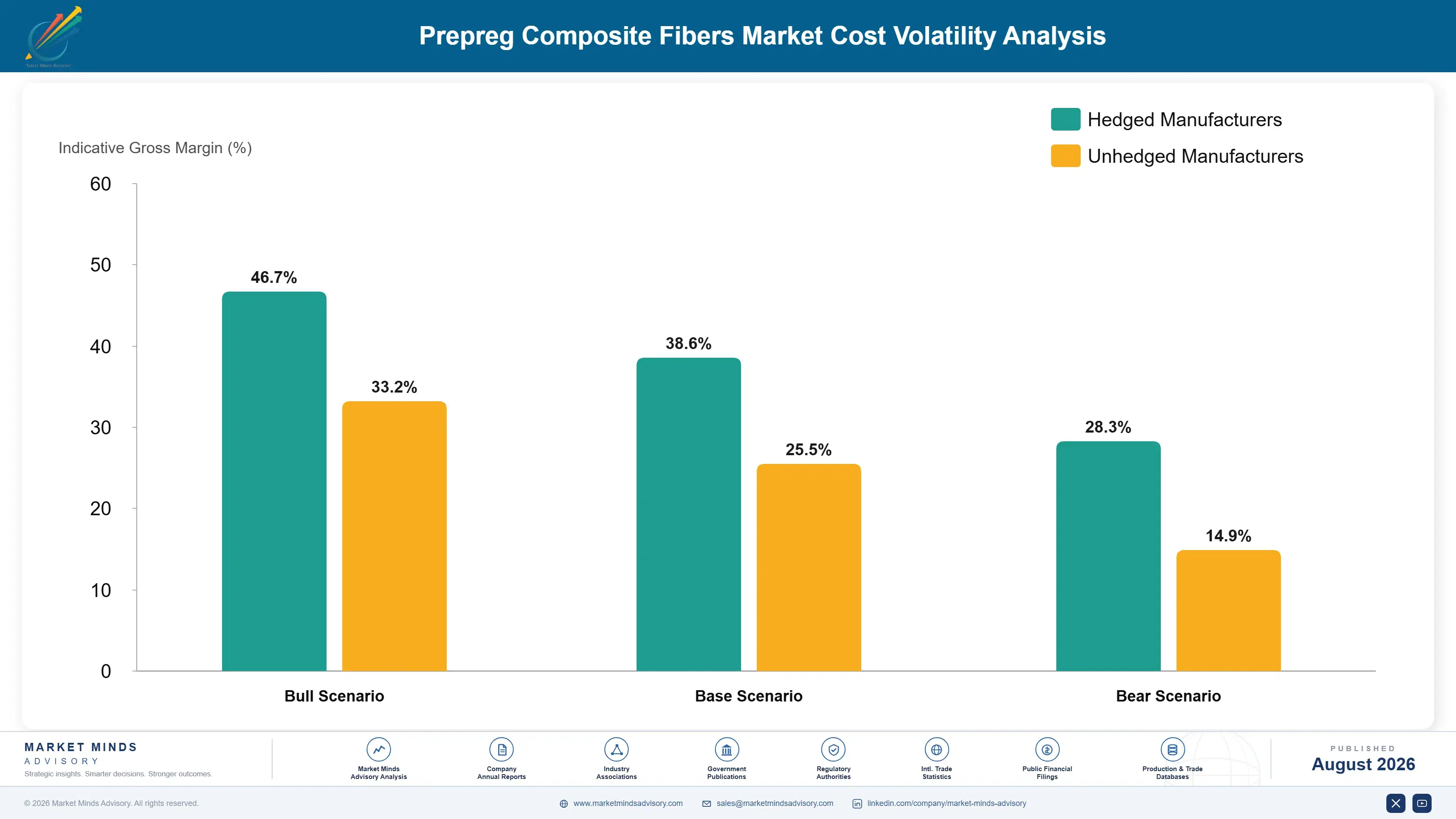
The Fibre Is Most of It

Carbon fibre accounts for roughly 58% of prepreg cost, produced from polyacrylonitrile precursor through oxidation and carbonisation in an energy intensive process concentrated among a small number of producers. Resin systems add about 16%, with aerospace qualified epoxies costing far more than industrial equivalents. Impregnation, freezing and cold chain distribution together carry a further 19%, attributable almost entirely to the storage requirement.
Energy costs through 2022 hit carbon fibre production directly, since oxidation and carbonisation run continuously at high temperature and cannot be economically interrupted. European producers carried industrial power increases well above Asian and American levels, per IEA industrial energy data for that period, and several disclosed the effect in reporting for that year. Precursor supply concentration compounds it, since polyacrylonitrile capacity qualified for aerospace grade fibre is genuinely limited.

Exposure divides on fibre integration above all else. A producer making its own carbon fibre holds 58% of cost internally while a merchant prepregger buys it from a supplier that may also be a competitor downstream. That single fact explains most of the concentration in this market. Cold chain cost is the second divide, falling on thermoset systems and not at all on thermoplastic ones.
prepreg-composite-fibers-market-cost-volatility-analysis-1787580915546

Secure multi-year carbon fibre supply where integration is absent

Carbon fibre at 58% of cost bought from a supplier who also competes downstream is an uncomfortable position that merchant prepreggers occupy by necessity. Multi-year supply agreements on defined terms remove the availability risk if not the cost disadvantage, and aerospace grade qualified fibre capacity is limited enough that availability is the greater concern.

Extend out-life through resin chemistry rather than logistics

Cold chain and expiry write-offs are attributable to the resin reacting slowly at ambient temperature, and extending out-life addresses the cause rather than managing the symptom. Development and requalification cost real money and take years, and the resulting reduction in customer scrap is a selling argument no logistics improvement can match. No logistics improvement matches it.

Contract industrial energy on long tenor for fibre production

Oxidation and carbonisation run continuously at high temperature and cannot be interrupted economically, which makes carbon fibre production among the most energy intensive processes in materials. European producers on spot power carried the full 2022 increase while those on long-dated contracts absorbed a fraction of it, and most restructured procurement afterwards. Most restructured procurement afterwards.

Portfolio Architecture for Margin Defence

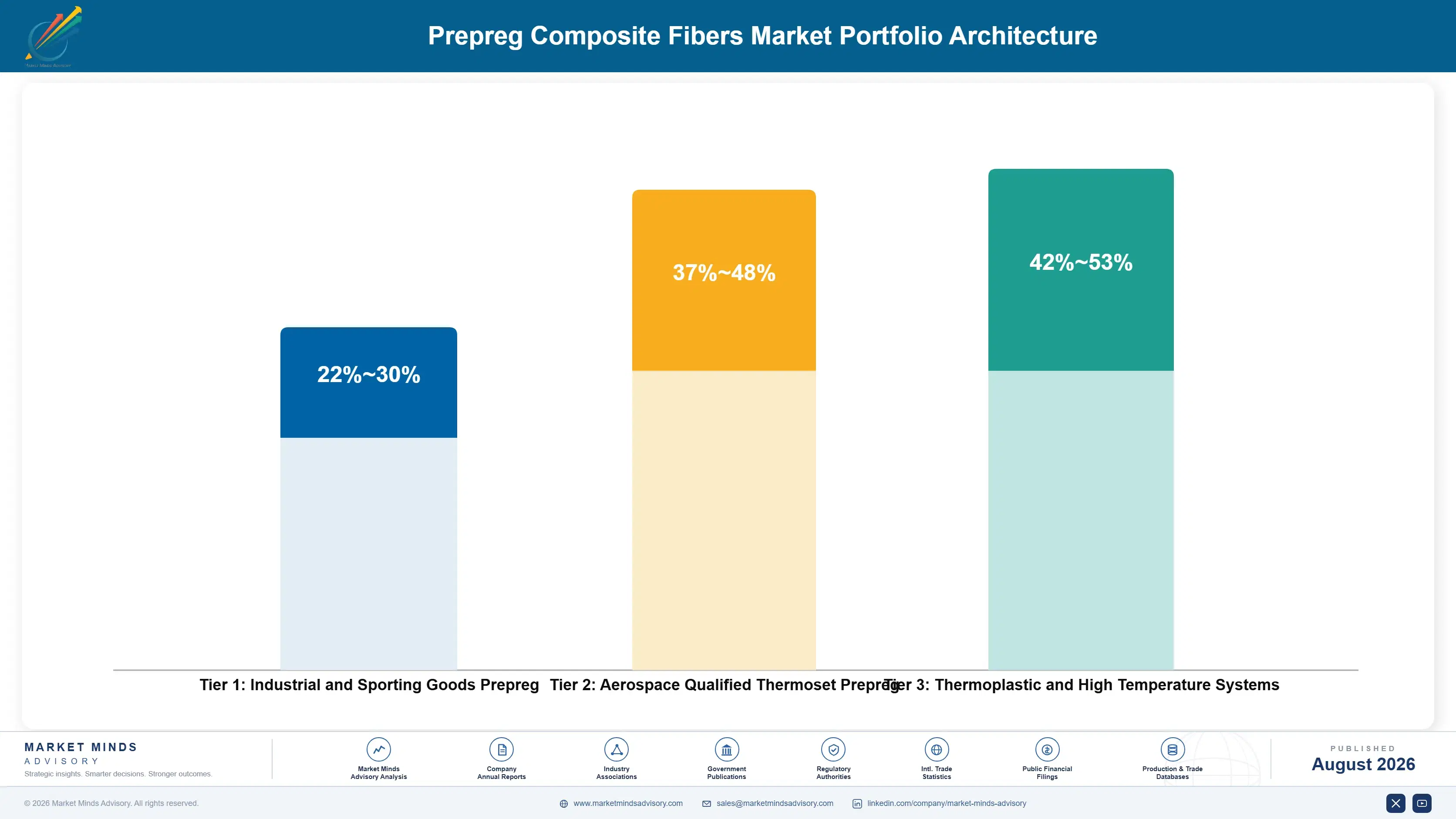
Margin here tracks qualification depth rather than volume or chemistry. Industrial and sporting goods prepreg earns margins in the mid twenties, because qualification requirements are light, Chinese and Korean capacity competes directly and the customer can substitute between suppliers with a process trial rather than a testing campaign. A process trial rather than a testing campaign is all that stands between suppliers in that tier.
Aerospace qualified thermoset prepreg holds margins in the high thirties to high forties, because four years of programme testing stands between any competitor and the business, and design allowables generated on a specific material are embedded in structural analyses across the industry. The range reflects programme age and whether the position is sole source or shared. Nobody reopens a structural analysis to save on materials.

Thermoplastic tapes and specialist high temperature systems hold the strongest economics, running into the low fifties, where the supplier field narrows to a handful with the processing capability. Those margins reflect scarcity of capability rather than any qualification barrier yet, and they will compress as more suppliers build thermoplastic lines against next generation programmes. Compression follows as more suppliers build thermoplastic lines against next generation programmes.

Industrial and Sporting Goods Prepreg

Glass and standard modulus carbon prepreg for sporting goods, industrial and general applications with light qualification requirements. The eight point range reflects fibre sourcing position and volume rather than any qualified position worth defending.
Gross Margin: 22-30%

Aerospace Qualified Thermoset Prepreg

Epoxy and out-of-autoclave systems qualified onto aircraft and defence programmes with design allowables established. The eleven point range reflects programme age and whether the supplier holds a sole source or a shared position.
Gross Margin: 37-48%

Thermoplastic and High Temperature Systems

Thermoplastic tapes and bismaleimide or polyimide systems for high temperature and next generation applications. The eleven point range reflects how few suppliers hold the processing capability rather than any established qualification barrier.
Gross Margin: 42-53%
prepreg-composite-fibers-market-portfolio-architecture-1787580916049

High-value Sub-segments and Strategic Watch-out

Thermoplastic Prepreg Tapes

High value and growing at 11.0%, removing refrigerated storage, out-life and expiry write-offs from the supply chain entirely. Welded assembly removes joining operations as well. Capability rather than qualification is currently what limits the supplier field. Processing capability rather than qualification limits it. Welding removes joints.
Gross Margin: 45-53%

Out-of-Autoclave Aerospace Systems

High value and the fastest growth at 12.3%, removing a 14 million dollar capital barrier that excluded many manufacturers from prepreg altogether. The segment adds customers rather than redistributing volume between the existing suppliers. Technical support for new users is the requirement. Part size stops being capped.
Gross Margin: 39-48%

Industrial and Sporting Goods Prepreg

The volume core and permanently exposed to Chinese and Korean capacity on light qualification requirements. Customers substitute between suppliers on a process trial rather than a testing campaign, which caps pricing everywhere in this tier. Fibre sourcing and volume are the only levers left. Pricing is capped everywhere.
Gross Margin: 22-30%

Thermoset Systems Facing Process Substitution

The strategic watch-out. Liquid resin infusion takes structures where its properties suffice while thermoplastic removes the freezer from the other direction. The range reflects how differently that pressure lands across programme types and structures. Neither threat competes on price at all. Structure type decides exposure.
Gross Margin: 30-46%

How Programme Volume Repeats

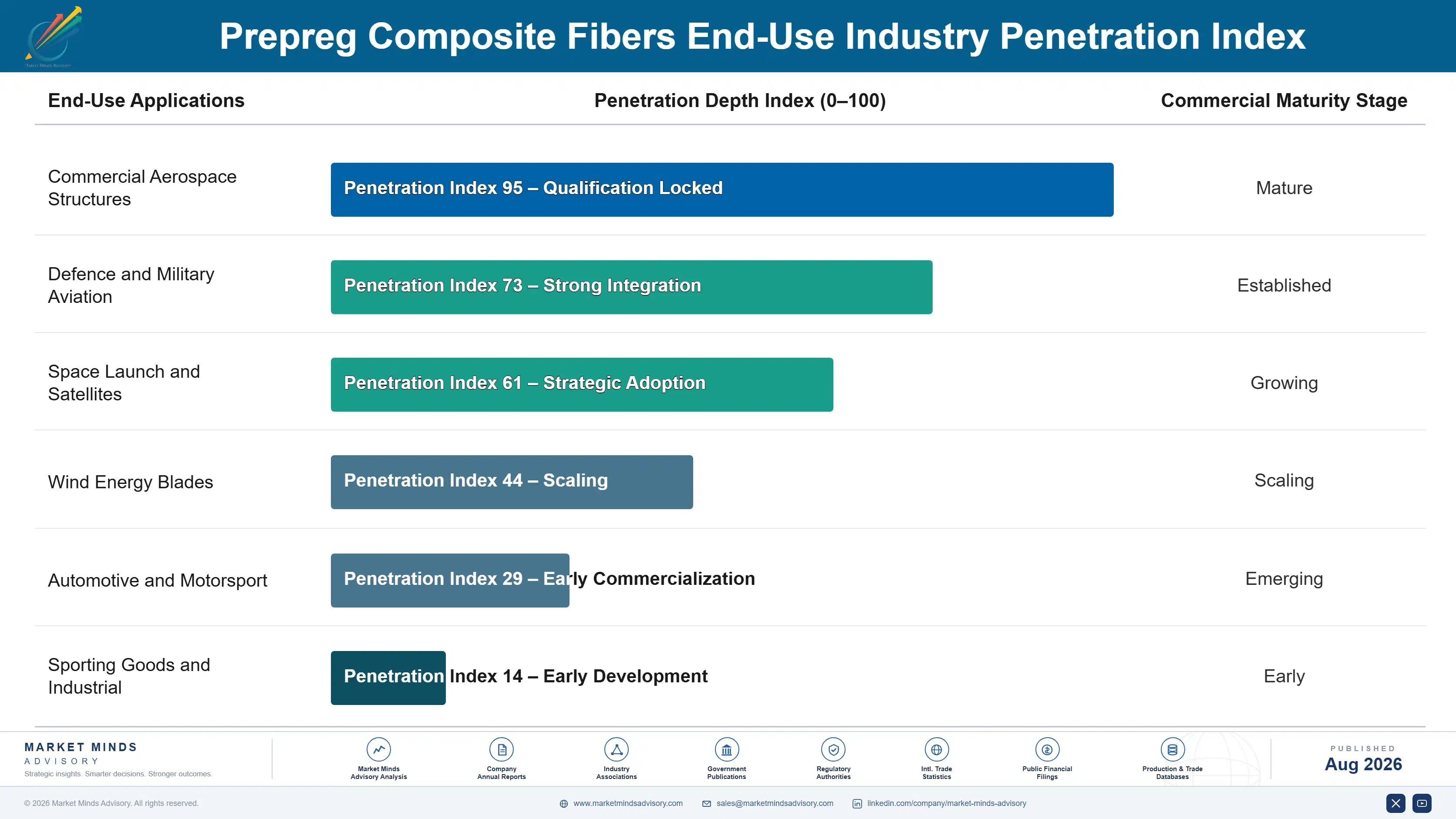
A qualified prepreg position behaves like an annuity of unusual length. Once a material is written into design allowables for an aircraft programme, it is consumed for the type's entire production life, which can run three decades on a successful single aisle, at volumes following build rate rather than any purchasing decision. Nobody substitutes a qualified material to save on price, because the requalification would cost more than several years of the saving.
Stickiness therefore tracks qualification depth exactly. Primary structure positions are close to permanent, since the design allowables and the structural analysis both assume that specific material. Secondary structure is slightly more open at major derivative points. Repair and maintenance prepreg follows the original qualification. Industrial and sporting goods business switches on a process trial, and it behaves like an ordinary materials market throughout.

The specifying decision sits with structural engineers years before any material is bought. Prepreg is selected during design development when allowables are generated, not by a procurement function comparing quotations later. That means a supplier's real customer is a stress engineer choosing what to test, and the commercial outcome is settled long before anyone issues a purchase order against it.
prepreg-composite-fibers-market-end-use-penetration-index-1787580916540

Where We Would Commit Capital

These are among the four positions where our research anticipates prominent divergence between winners and laggards over the coming forecast period. Each is grounded in the demand model, the regulatory perimeter, and the announced capacity pipeline.
01 / TOTAL COST SELLING

Quote cost per shipset, because the scrap is the real number

Layup scrap reaches roughly 26% once expired out-life and nesting offcuts are both counted, and the buyer absorbs every bit of that alongside the freezer capital and the handling cost. A material priced above a competitor while delivering longer out-life or nesting-friendly formats can cost materially less delivered into a finished part. Very few suppliers build that case at all, and the manufacturers rarely calculate it for themselves, which leaves the argument entirely available to whichever supplier chooses to make it first.
02 / PROGRAMME QUALIFICATION TIMING

Be in the testing campaign or be absent for decades

Qualification onto an aircraft programme takes roughly four years and then holds for the type's entire production life, which on a successful single aisle programme can easily run to three decades. Next generation programmes are precisely where thermoplastic and out-of-autoclave decisions are being taken right now, and any supplier absent from that testing is absent from the decades of production which follow it. Campaigns cost several million dollars with no revenue attached at all until the aircraft finally enters service.
03 / THERMOPLASTIC CAPABILITY BUILD

Commit to the process that removes the freezer entirely

Thermoplastic tape eliminates refrigerated storage, out-life clocks and expiry write-offs from the supply chain altogether, and it permits welded assembly that removes joining operations, weight and inspection burden from a structure. Processing temperatures and the equipment itself differ completely from thermoset lines, which makes this capability building rather than product extension, at a capital cost running into the tens of millions. Qualification lead times mean that commitment has to be made years before any programme decision confirms the demand actually exists.
04 / AUTOCLAVE-FREE CUSTOMER ACCESS

Sell to the manufacturers a curing vessel priced out

An autoclave at aerospace scale costs around 14 million dollars to install, which excluded a large population of component manufacturers from prepreg entirely and capped part size at whatever curing vessel happened to exist already. Out-of-autoclave systems remove that barrier entirely and grow at 12.3% as a direct consequence of it. Serving those customers requires real technical support for manufacturers entirely new to prepreg processing, and that genuinely expands the market rather than competing for the accounts which already exist elsewhere.

Engagement Snapshot From the Field

A live engagement with an industry participant carrying material or product regulatory and market exposure ahead of a defining policy shift, showing how our research translates into a defensible multi-year portfolio strategy.
MARKET MINDS ADVISORY · CLIENT ENGAGEMENT SUMMARY
Prepreg Composite Fibers Producer Strategic Portfolio Review and Transition Roadmap 2026·Investment Scenario on Prepreg Composite Fibers Exposure Evaluation 2025-26
CLIENT PROFILE
A European prepreg producer supplying aerospace and industrial customers from two impregnation lines, with annual revenue near 210 million euros and carbon fibre purchased entirely on merchant terms (client-reported, unverified by MMA). The portfolio was thermoset epoxy throughout, with qualified positions on several established aircraft programmes and none on any programme in development. Thermoplastic capability was absent.
STRATEGIC CHALLENGE
An airframer had selected thermoplastic tape for a next generation fuselage demonstrator using a competitor's material, and the client held no thermoplastic capability. Separately, industrial prepreg margins had compressed against Chinese and Korean capacity. Management needed to decide between thermoplastic investment, out-of-autoclave development and exiting industrial grades, with capital for two.
MMA APPROACH
MMA mapped qualification windows across announced aircraft programmes through 2033, costed thermoplastic line investment and process development against out-of-autoclave qualification, and benchmarked the client's industrial grade delivered cost against Chinese and Korean producers. Customer scrap rates were measured across five aerospace accounts. Interviews with 47 experts covered composite qualification, thermoplastic processing and airframer material selection.
KEY FINDINGS
  1. Industrial grade delivered cost could not be closed against Chinese producers in any scenario, since the gap sat in fibre purchasing and energy rather than in impregnation efficiency.
  2. Thermoplastic line investment cost roughly 34 million euros and would take four years to reach qualification, which matched the next programme window but not the current demonstrator.
  3. Measured layup scrap across the five aerospace accounts averaged 26%, and none of those customers had ever been shown a cost per shipset comparison by any supplier.
  4. Out-of-autoclave qualification on two existing programmes could be completed in under two years, since the airframer specification route was already established for those types.
CLIENT PROFILE
A European prepreg producer supplying aerospace and industrial customers from two impregnation lines, with annual revenue near 210 million euros and carbon fibre purchased entirely on merchant terms (client-reported, unverified by MMA). The portfolio was thermoset epoxy throughout, with qualified positions on several established aircraft programmes and none on any programme in development. Thermoplastic capability was absent.
STRATEGIC CHALLENGE
An airframer had selected thermoplastic tape for a next generation fuselage demonstrator using a competitor's material, and the client held no thermoplastic capability. Separately, industrial prepreg margins had compressed against Chinese and Korean capacity. Management needed to decide between thermoplastic investment, out-of-autoclave development and exiting industrial grades, with capital for two.
MMA APPROACH
MMA mapped qualification windows across announced aircraft programmes through 2033, costed thermoplastic line investment and process development against out-of-autoclave qualification, and benchmarked the client's industrial grade delivered cost against Chinese and Korean producers. Customer scrap rates were measured across five aerospace accounts. Interviews with 47 experts covered composite qualification, thermoplastic processing and airframer material selection.
KEY FINDINGS
  1. Industrial grade delivered cost could not be closed against Chinese producers in any scenario, since the gap sat in fibre purchasing and energy rather than in impregnation efficiency.
  2. Thermoplastic line investment cost roughly 34 million euros and would take four years to reach qualification, which matched the next programme window but not the current demonstrator.
  3. Measured layup scrap across the five aerospace accounts averaged 26%, and none of those customers had ever been shown a cost per shipset comparison by any supplier.
  4. Out-of-autoclave qualification on two existing programmes could be completed in under two years, since the airframer specification route was already established for those types.
RECOMMENDED STRATEGY
Phase 1: Phase one: pursue out-of-autoclave qualification on the two established programmes, since the specification route exists and the timeline is under two years. Phase 2: Phase two: commit thermoplastic line investment against the following programme window rather than chasing a demonstrator already awarded to a competitor. Phase 3: Phase three: exit industrial grades progressively, since the delivered cost gap against Chinese producers cannot be closed by any operational programme.
OUTCOME
The producer completed out-of-autoclave qualification on both programmes within twenty-two months and began thermoplastic line construction in 2026 (client-reported, unverified by MMA). Industrial grade volumes were withdrawn rather than defended, and cost per shipset comparisons were introduced across the aerospace account base. Fibre remains bought on merchant terms.

Frequently Asked Questions

Foundational context covering the market sizes, CAGR, scope, country, region and competition that inform every finding below. This section is provided to cover basics and most often pre-purchase conversations, answered from the MMA Primary Research Dataset.

What is the current size of the Prepreg Composite Fibers Market?

MMA sizes it at USD 4.9 billion in 2025, rising to USD 5.30 billion in 2026. The figure covers fibres pre-impregnated with resin supplied as sheet, tape or fabric at producer selling price.

How large will the Prepreg Composite Fibers Market be by 2036?

USD 11.66 billion by 2036, an incremental USD 6.36 billion over the 2026 base and an expansion multiple of 2.20 times. Out-of-autoclave and thermoplastic systems account for a disproportionate share.

What is the CAGR for the Prepreg Composite Fibers Market 2026 to 2036?

8.2% in the base case, with a bull case at 9.4% and a bear case at 7.0%. The spread turns on aircraft build rates and on how far liquid infusion takes primary structure.

Which segment is growing fastest?

Out-of-autoclave cure prepreg at 12.3%, half again the market rate of 8.2%. It removes a curing vessel costing around 14 million dollars without giving up prepreg properties.

Who are the major companies in the Prepreg Composite Fibers Market?

Toray Advanced Composites, Hexcel, Solvay, Teijin and SGL Carbon lead on annual production capacity, holding 71% between them. Fifteen further participants are profiled in the report.

Which country is growing fastest?

India at 11.6%, as offset obligations attached to defence and commercial aircraft procurement pull composite component manufacturing into the country and domestic suppliers scale up.

Report Segmentation Architecture

The full report scope spans multiple orthogonal segmentation dimensions, with cross-tabulated demand data provided for each dimension pair. Coverage extends further to regional breakdowns, trend trajectories, and the competitive detail needed to support segment-level decision-making.

By Resin System

  • Epoxy Carbon Fibre Prepreg
  • Out-of-Autoclave Cure Prepreg
  • Thermoplastic Prepreg Tapes
  • Glass Fibre Prepreg
  • Phenolic and Bismaleimide Prepreg
  • Aramid and Hybrid Prepreg

By End-Use Industry

  • Commercial Aerospace Structures
  • Defence and Military Aviation
  • Space Launch and Satellites
  • Wind Energy Blades
  • Automotive and Motorsport
  • Sporting Goods and Industrial

By Commercial Dimension

  • Airframer Specification Supply
  • Tier One Structures Contracts
  • Distributor and Stockist Supply
  • Repair and Maintenance Supply
  • Development Programme Supply
  • Export and Cross-Border Trade

By Region

  • North America
  • Western Europe
  • East Asia
  • South Asia and Pacific
  • Latin America
  • Middle East and Africa
  • Eastern Europe

Scope, Methodology, and Coverage

Every figure in this report is reproducible from documented input assumptions. The scope below maps the historical period, the forecast horizon, the segmentation dimensions, and the countries covered, alongside the underlying primary and qualitative methodology.
Historical Period
2020 to 2025
Forecast Period
2026 to 2036
Base Year
2025 (USD billions; MMA Primary Research Dataset, August 2026)
Market Definition
Reinforcing fibres pre-impregnated with partially cured or fully reacted resin systems and supplied as sheet, tape or fabric for subsequent layup and cure, spanning epoxy, out-of-autoclave, thermoplastic, phenolic, bismaleimide, aramid and hybrid systems across carbon and glass reinforcement, measured at producer selling price. Dry fibre and fabric, liquid resin systems sold separately, sheet and bulk moulding compounds, finished composite components, and carbon fibre precursor are excluded from scope.
Quantitative Units
USD billions (current prices); thousand tonnes produced annually; USD per kilogramme by resin system and region
Segmentation Dimensions
Resin system; end-use industry; commercial dimension; region
Regions Covered
North America, Western Europe, East Asia, South Asia and Pacific, Latin America, Middle East and Africa, Eastern Europe
Countries Covered
United States, Canada, Mexico, France, Germany, United Kingdom, Spain, Italy, China, Japan, South Korea, India, Australia, Brazil, Turkey, Israel, Morocco, Poland, Czech Republic, Romania
Key Companies Profiled
Toray Advanced Composites, Hexcel, Solvay, Teijin, SGL Carbon, Mitsubishi Chemical, Gurit, Park Aerospace, Axiom Materials, TCR Composites, Rock West Composites, Sicomin, Victrex, Arkema, Porcher Industries, Chomarat, Kordsa, Avient, Jiangsu Hengshen, Weihai Guangwei
Quantitative Methodology
Primary survey, n=3,800 respondents, Q4 2025, six countries; demand-side model with trade association cross-validation
Qualitative Methodology
47 expert interviews, Q4 2025; applied to validate demand model assumptions, identify emerging dynamics, and assess competitive positioning
Report Format
PDF and XLSX data workbook (Word format preview document)
Publisher
Market Minds Advisory
Report Code
MMA-2026-CHM-130
Published
August 2026
Contact
sales@marketmindsadvisory.com | www.marketmindsadvisory.com

Purchase the full Prepreg Composite Fibers Market Report (2026 to 2036).

The full report treats the cold chain as the commercial variable it actually is, sizing each resin system independently through 2036. It quantifies layup scrap and its cost to the buyer, maps qualification windows across announced aircraft programmes through 2033, and assesses process substitution risk from liquid infusion and thermoplastic assembly by structure type. Regional chapters cover all seven regions with programme and capacity detail where disclosure permits. Competitive profiling covers 20 participants on a single production capacity basis, alongside qualified programme positions by supplier.
Each resin system sized independently through 2036
Layup scrap quantified and costed to the buyer
Qualification windows mapped across announced programmes to 2033
Process substitution risk assessed by structure type
Twenty participants profiled on one consistent basis
Qualified programme positions compared across suppliers

Built For The People Who Decide

From boardroom strategy to bench-side execution, this report is read cover-to-cover by leaders shaping the next decade of their industry, turning demand scenarios, market dynamics and valuation benchmarks into decisions.
CXOs/ Presidents/ VPs/ Managers
M&A and Corporate Development
Strategy Teams and R&D Heads
Procurement and Product Directors
Regulatory and Compliance Leaders
Investor Relations and Equity Analysts