Market Minds Advisory
Prenatal Vitamin Supplement Market

Prenatal Vitamin Supplement Market: Selling Into the Wrong Window

The neural tube closes at around the fourth week, usually before a pregnancy is even confirmed, and roughly four fifths of prenatal courses begin after that window has already shut.

Lead Analyst

Lisa Gevelber

Published

September 2026

Make Smarter Decisions with Customized Research Insights

Request a free sample report and evaluate market opportunities, growth trends, and competitive dynamics relevant to your business needs.

2025 MARKET VALUE$6.4BMarket Size 2025
2036 FORECAST VALUE$14.0BBase Case , 2026 to 2036
CAGR 2026 TO 20367.4 %Bull 8.6% / Bear 6.2%
INCREMENTAL OPPORTUNITY$7.2BNet 10- year value creation
EXPANSION MULTIPLE2.04x2036 value over 2026 base
Strategic Levers
M&A Pipeline
Regional Outlook
Country Rankings
Competitive Intelligence
Segmental Deep-dive
Call-Us : 91 93563 13602

Executive Snapshot and Market Trajectory

This is the best-evidenced supplement category in existence and it mostly sells too late. Folic acid prevents neural tube defects during a window that closes around the fourth week, before most pregnancies are confirmed, and only 18% of courses begin preconception.
Guidelines also commoditise the product. Folic acid, iodine, iron and vitamin D intakes are specified by health authorities everywhere, so any contract manufacturer can produce a compliant prenatal cheaply and differentiation has to come from somewhere other than the formula meeting the guidance. Differentiation has to come from somewhere other than a formula meeting the guidance every competing formula also meets. Any contract manufacturer can produce a compliant prenatal cheaply.
Where it comes from is format and tolerability rather than composition. Choline requirements in pregnancy are high enough that a meaningful dose dominates a tablet, so only 9% of formulas carry one. Multi-component packs grow at 11.1%, half again the market rate of 7.4%, since splitting the dose is the only way to deliver it. Completion sits at 54%. Conventional iron salts on top of pregnancy nausea are what stops women finishing a course.
Market Definition
Nutritional supplements formulated and marketed for use before and during pregnancy, spanning tablet multivitamins, softgel and capsule formats, gummies, powders and drinks, multi-component pack systems and sachet formats, measured at retail and institutional selling value. Excludes postnatal and lactation supplements, general adult multivitamins, fertility-specific supplements not positioned prenatally, and prescription pharmaceuticals.
Base Year Value
$6.4B in 2025 (MMA Primary Research Dataset, August 2026)
Forecast Period
2026 to 2036, eleven discrete annual values
CAGR
7.4% base case. Bull 8.6%. Bear 6.2%.
Fastest Growth Segment
Multi-Component Pack Systems: 11.1% CAGR
Fastest Growth Country
India: 10.4% CAGR
Fastest Growth Region
South Asia and Pacific: 9.6% CAGR
Largest Region
East Asia: 30% of 2025 global value
Market Leaders
Bayer, Church and Dwight, Perrigo, Nestlé Health Science, Reckitt. Source: MMA Primary Research Dataset, July 2026.
Primary Survey
n=3,800 procurement and R&D decision-makers, Q4 2025, six countries
Methodology
Demand-side build-up, cross-validated against public data, 47 expert interviews

Prenatal Vitamin Supplement Market Forecast Scenarios

prenatal-vitamin-supplement-market-size-forecast-scenario-1787580895467
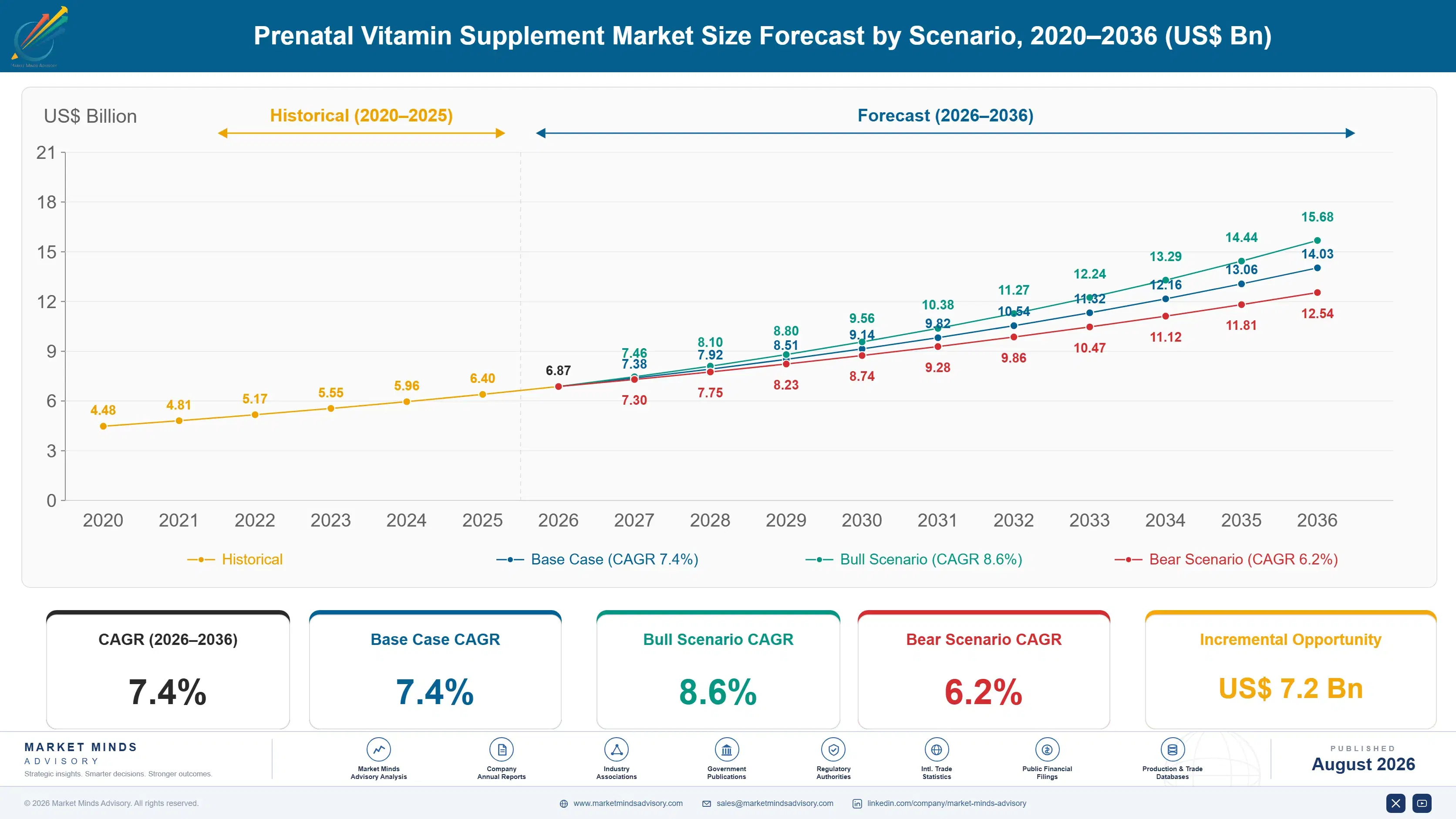
Growth ran near 6.3% between 2020 and 2025 as direct-to-consumer maternal brands entered a category that established vitamin houses had run on autopilot for decades. Those entrants competed on format, ingredient form and design rather than on the guideline compliance every product already met. Falling birth rates across developed markets pulled against that, and rising spend per course more than offset it.
Base case 7.4% rests on three mechanisms. Choline and omega-3 recommendations are strengthening in obstetric guidance, and neither fits into a conventional tablet at a meaningful dose. Iron tolerability is being taken more seriously as adherence data improves, since nausea already suppresses completion during pregnancy. And Indian and Southeast Asian private supplement spending is rising against maternal anaemia prevalence among the highest of any large economies. None of the three depends on birth rates recovering.
The bull case at 8.6% assumes preconception marketing succeeds in shifting purchase earlier, which would extend the average course by months and is the single largest unexploited opportunity here. The bear case at 6.2% is continued birth rate decline across developed markets outpacing spend per course, which would shrink the category in exactly the geographies where it earns most.

Everything Right Except the Timing

Folic acid supplementation before conception is among the best-evidenced interventions in nutrition, and it works during a window that has largely closed by the time a woman knows she is pregnant. The neural tube fuses around the fourth week. Only 18% of prenatal courses begin preconception, which means the category's strongest clinical argument applies to a period it barely sells into and the rest is supporting a pregnancy already underway.
TOP FIVE CONCENTRATION26%Established vitamin houses lead alongside newer direct brands
PRECONCEPTION PURCHASE SHARE18%Portion of courses begun before pregnancy is confirmed
CHOLINE ADEQUACY RATE9%Share of formulas carrying a meaningful choline dose
METHYLFOLATE PRICE PREMIUM2.6xPrice against folic acid formulations of equal potency
COURSE COMPLETION RATE54%Buyers finishing the full recommended supplementation period properly
CLINICAL CHANNEL SHARE34%Portion of sales arising from a practitioner recommendation
Guidelines settle the composition and therefore remove it as a competitive variable. Every health authority specifies folic acid, iodine, iron and vitamin D intakes, and any contract manufacturer can meet them for very little. That leaves differentiation to come from form, format, tolerability and marketing, which is why the category argues about methylfolate against folic acid at a 2.6 times price premium the evidence does not clearly support.
Two genuine gaps do exist. Choline requirements rise substantially in pregnancy and a meaningful dose is physically bulky, so only 9% of formulas carry one and the rest include a token amount that fits the tablet. Iron tolerability is the second: conventional salts cause gastrointestinal effects on top of pregnancy nausea, and course completion sits at 54%.
"The uncomfortable arithmetic is that the intervention with the strongest evidence needs to happen before the customer knows she is a customer. Everything sold after week four is doing something useful and none of it is doing the thing the category built its reputation on."
Director, Nutrition and Consumer Health Practice · MMA Healthcare and Nutrition Practice · August 2026

Market Trends

Choline recommendations outgrowing what a tablet can carry

Obstetric guidance increasingly references choline adequacy during pregnancy, and the requirement is high enough that a meaningful dose occupies most of a tablet by itself. Only 9% of formulas carry one, with the rest including a token amount that fits alongside everything else. The physical constraint is real rather than a formulation choice. Multi-component packs, powders and drinks all solve it by abandoning the single tablet, and brands committed to one pill a day cannot address the gap without changing format entirely. Brands committed to one pill a day cannot address the gap without changing format entirely.
Market Impact: Delivers 10.4% annual Indian growth
Ingredient form marketing outrunning the supporting evidence

Methylfolate commands roughly 2.6 times the price of folic acid at equal potency, marketed around genetic variants in folate metabolism that affect a substantial share of the population. The evidence that this changes what anyone should take is considerably weaker than the marketing implies, and public health guidance continues to specify folic acid. Consumers arrive having read otherwise. Brands face a choice between a premium the evidence does not support and losing shelf position to competitors who take it. Brands choose between a premium the evidence does not support and losing shelf position.
Market Impact: Addresses a 54% completion rate

Market Opportunities and Growth Drivers

Indian maternal supplement spending rising against deficiency prevalence

India grows fastest anywhere at 10.4%, on maternal anaemia prevalence documented in national health surveys as among the highest of any large economy, alongside rising private health spending in urban households. Government iron and folic acid programmes create awareness and cover part of the need, leaving substantial branded demand where quality perception matters. Obstetric practice distribution carries far more weight than retail advertising there. Growth is genuine unmet need rather than premiumisation of an already served market. This is genuine unmet need rather than premiumisation of an already served market.
Market Impact: Settles intakes across 4 nutrients

Iron tolerability recognised as an adherence problem

Course completion sits at 54%, and conventional iron salts causing gastrointestinal effects on top of pregnancy nausea are the most cited reason women stop. Bisglycinate and sucrosomial iron forms improve tolerability and command premiums that formulators previously judged unaffordable in a guideline-compliant product. Obstetric practitioners increasingly specify tolerable forms by name, having watched patients abandon courses. The commercial point is that an unfinished course delivers nothing, which makes adherence a clinical argument rather than a marketing one. An unfinished course delivers nothing regardless of what the label promised, which makes this a clinical argument.
Market Impact: Shrinks cohorts across 3 regions

Market Restraints and Challenges

Guideline compliance removing composition as a competitive variable

Every health authority specifies the intakes a prenatal supplement should deliver, and meeting them costs very little through any contract manufacturer. The root cause is that this is a well-evidenced category with settled requirements, which is genuinely good for public health and commercially flattening. It leaves brands competing on format, ingredient form and design rather than on nutritional content. Producers are responding by targeting the gaps guidance has not settled, principally choline and omega-3, where composition still differentiates a product meaningfully. Choline and omega-3 are where composition still differentiates. Nothing else is left open.
Market Impact: Leaves 91% of formulas short

Birth rate decline shrinking the developed market customer base

Birth rates have fallen across most developed markets for a decade and continue falling, which reduces the number of customers regardless of what any brand does. The root cause sits entirely outside this industry. Commercially it means growth in North America, Western Europe and East Asia depends on spend per course rising faster than the cohort shrinks, which it currently does. Brands are responding by extending courses into preconception and by pursuing markets where birth rates and unmet need are both higher. Extending courses into preconception is the response that does not require new customers.
Market Impact: Commands a 2.6x price premium
3 additional market trends, 4 additional growth drivers, and 2 additional restraints and challenges are covered in the full report. Contact sales@marketmindsadvisory.com to access the complete intelligence.

Segment CAGR and Growth Architecture

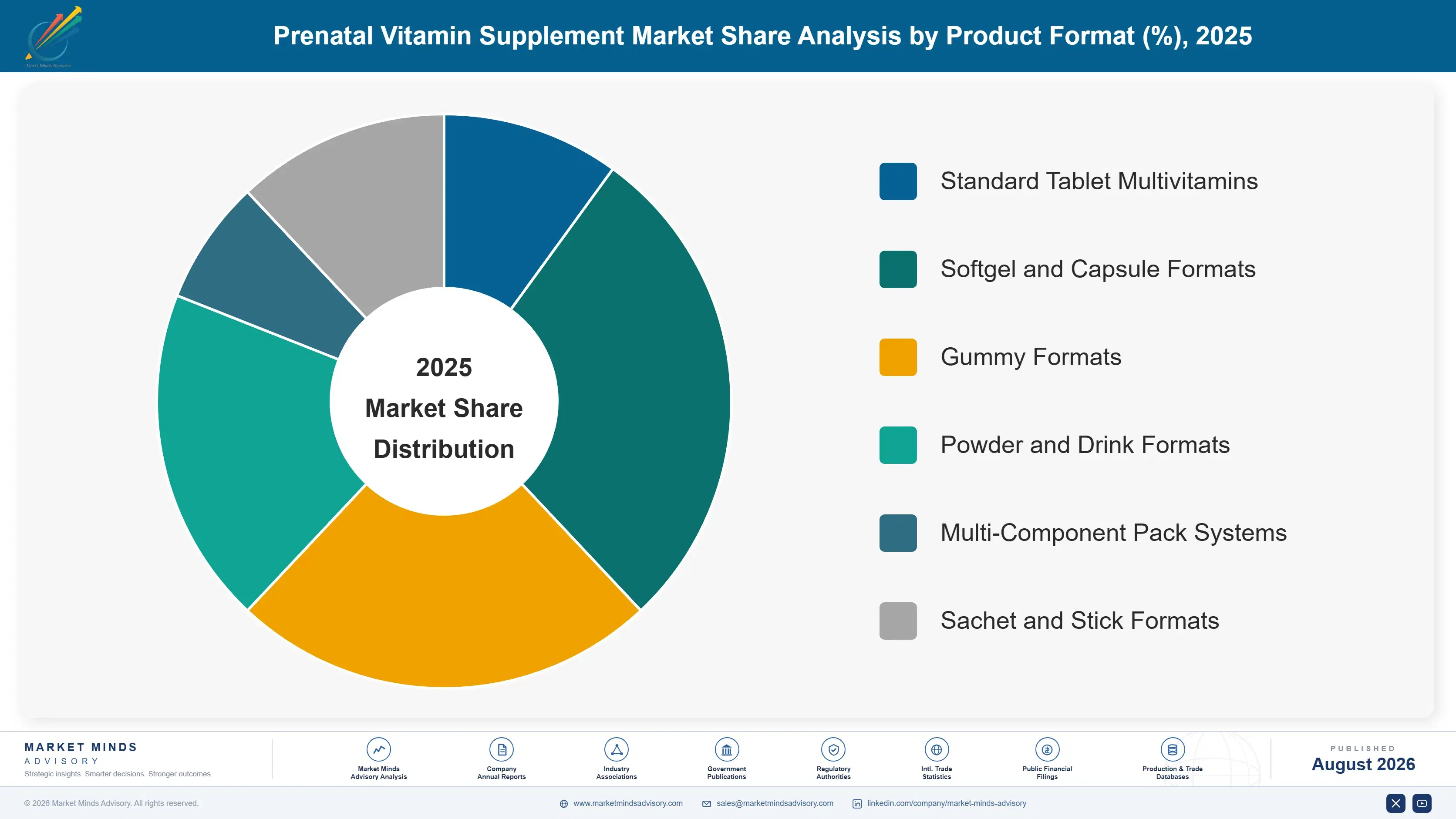
Six segments split by product format, because format determines what can physically be delivered, how tolerable a course is during nausea and where the product is bought. A tablet and a multi-component pack answer the same guidance with entirely different capabilities. End-use setting and commercial channel sit in the framework instead. Format decides capability here.
prenatal-vitamin-supplement-market-market-share-analysis-1787580896029

Multi-Component Pack Systems

Growing at 11.1%, half again the market rate of 7.4%, multi-component packs split a day's supplementation across several units, which is the only way to deliver a meaningful choline dose alongside iron, omega-3 and everything guidance specifies. A single tablet physically cannot carry it, and only 9% of conventional formulas even try. Packs also allow different release profiles and let a woman take iron separately from the components that interfere with its absorption. Adherence is the obvious risk, since more units means more opportunities to skip, and brands address it with daily sachets rather than separate bottles. Daily sachet presentation rather than separate bottles is what keeps completion comparable to a tablet.
CAGR 11.1%

Powder and Drink Formats

At 9.8% powders and drinks solve two problems that tablets cannot. Bulky nutrients including choline fit without any size constraint, and a drink is often tolerable when a tablet is not, which matters considerably during the first trimester when nausea suppresses adherence most. Taste and texture are the formulation obstacles, since pregnancy alters taste perception unpredictably and a product that becomes unpalatable is abandoned. Volumes are smaller than tablet formats and pricing runs higher, supported by a genuine functional advantage rather than by presentation alone. Taste and texture are the formulation obstacles, since pregnancy alters taste perception unpredictably and an unpalatable product is simply abandoned. Pricing runs higher on a genuine functional advantage.
CAGR 9.8%
Full segment breakdown across 6 segments available in the complete report.

Regional Architecture and Country Demand Map

East Asia holds 30% of value on birth cohort size and a strong premium imported supplement culture together. North America follows at 26% and Western Europe at 19%, while South Asia and Pacific sits above its usual band at 14% on genuine unmet need rather than on premiumisation.

North America

Direct-to-consumer maternal brands reshaped this market, competing on ingredient form, format and design against established vitamin houses that had run the category unchanged for decades. Methylfolate positioning is more prevalent here than anywhere, supported by consumer genetic testing that reached mainstream awareness early. Obstetric practice recommendation carries real weight and roughly a third of purchases follow it. Birth rate decline is the persistent headwind, offset so far by spend per course rising faster. Canadian demand follows American patterns under somewhat tighter claim regulation. Obstetric practice recommendation carries real weight and roughly a third of purchases follow it directly. Direct brands took the premium end on format and design. Spend per course still offsets it.
Share: 26% | CAGR: 6.5% (2026 to 2036)

Western Europe

European claim regulation is the strictest anywhere, which limits the ingredient form marketing that drives premium pricing in North America and keeps positioning closer to the underlying guidance. Pharmacy and midwifery channels dominate distribution, with recommendation from a midwife carrying more weight than any retail brand position in most markets. German and French pharmacy chains hold the majority of volume. Birth rate decline is steeper here than in North America, which makes spend per course the only route to growth and puts pressure on premium formats. Midwife recommendation carries more weight than any retail brand position in most of these markets. Claim regulation limits the ingredient form marketing. Pharmacy channels dominate distribution.
Share: 19% | CAGR: 5.8% (2026 to 2036)
Regional intelligence for 5 additional markets available in the complete report: East Asia, South Asia and Pacific, Latin America, Middle East and Africa, Eastern Europe. Contact sales@marketmindsadvisory.com.
prenatal-vitamin-supplement-market-country-cagr-analysis-1787580896567

Four Moves Around a Settled Guideline

Composition is fixed by guidance and available cheaply to anyone, which removes the obvious place a brand would look for advantage. What remains is timing, format, tolerability and the two nutrients guidance has not settled. Competing on the parts everyone already meets is how this category commoditises itself. Timing is the opening. Everything else is settled.

Market into preconception rather than into pregnancy

Only 18% of courses begin before pregnancy is confirmed, which is when folic acid does the work the category's reputation rests on. Reaching that customer means fertility clinics, contraception cessation moments and general practice rather than antenatal channels, none of which prenatal brands currently work. Shifting purchase earlier extends the average course by several months of revenue and delivers the clinical benefit the product actually claims. It is the largest unexploited opportunity here and almost nobody is pursuing it. Nobody is pursuing it seriously. The channels are entirely unworked. Nothing else extends a course.
Market Impact: Extends every course beyond an 18% preconception base

Abandon the single tablet to deliver choline properly

Choline requirements in pregnancy are high enough that a meaningful dose occupies most of a tablet, which is why only 9% of formulas carry one. The constraint is physical and no reformulation resolves it inside one pill. Multi-component packs, powders and drinks all deliver it, at development cost near 400 thousand dollars across a range and a format change customers have to accept. Brands committed to one pill a day are simply unable to close a gap that obstetric guidance keeps widening. Obstetric guidance keeps widening the gap. Format change is the only route.
Market Impact: Closes a gap affecting 91% of current formulas

Compete on iron tolerability, not iron content

Course completion sits at 54% and conventional iron salts on top of pregnancy nausea are the most cited reason women stop taking a prenatal. Bisglycinate and sucrosomial forms improve tolerability at a cost formulators previously judged unaffordable in a guideline-compliant product, and obstetric practitioners increasingly specify them by name. An unfinished course delivers nothing regardless of what the label promised, which makes adherence a clinical argument that practitioners repeat rather than a marketing claim. Practitioners repeat that argument for a brand, which no advertising campaign achieves at comparable cost or credibility.
Market Impact: Lifts completion above the current 54% rate today

Build the obstetric practice channel deliberately

Roughly 34% of sales already follow practitioner recommendation, and that share is higher wherever antenatal contact is systematic. A recommendation from an obstetrician or midwife converts far more reliably than any retail impression and carries authority through the whole course, which improves adherence as well as sales. Building the channel means practice sampling, midwifery education and evidence a clinician will actually read. It costs less than equivalent consumer marketing and compounds rather than decaying. It compounds instead of decaying with each campaign, which consumer marketing in this category never does.
Market Impact: Grows the 34% clinical channel share much further

Who Controls the Margin Pool

Participation is measured on retail and clinical channel sales value, and the top five hold 26%. Concentration is low because guideline compliance is cheap to achieve and hundreds of brands have entered on that basis. Bayer and Church and Dwight lead on distribution reach and pharmacy familiarity rather than on any formulation distinctiveness. The gap to challengers is channel access and clinical credibility, not product.
Competition runs on three things now. Format capability decides which nutritional gaps a brand can address at all, since a tablet cannot carry choline whatever a formulator intends. Ingredient form positioning is the second, and it drives premium pricing on evidence weaker than the marketing suggests. Clinical channel access is the third, and it is where the durable positions sit because a practitioner recommendation outlasts any advertising campaign.

The pressure ahead comes from demographics rather than from competitors. Birth rates are falling across the three regions carrying most of the category's value, which makes spend per course the only growth mechanism available in those geographies. Expect format investment and clinical channel building rather than acquisitions. Rankings shift as choline guidance firms up and brands unable to change format cannot respond.
prenatal-vitamin-supplement-market-company-positioning-matrix-1787580897084

Competitive Moat and Risk Dimensions

BAYER

Moat: Pharmacy familiarity and trust

Bayer holds pharmacy distribution and pharmacist familiarity across most major markets, built over decades in consumer health, and a pharmacist asked to recommend a prenatal reaches for what they know. In a category where every product meets the same guidance, that recommendation habit is worth more than any formulation difference a competitor could demonstrate.
BAYER

Risk: Single tablet format commitment

A portfolio built on conventional tablet formats cannot deliver a meaningful choline dose whatever the formulation team attempts, since the constraint is physical rather than technical. As obstetric guidance firms up on choline adequacy, that becomes a gap competitors in pack and powder formats will point to directly, and changing format across an established range is slow and expensive.
CHURCH AND DWIGHT

Moat: Mass retail distribution depth

Church and Dwight reaches mass grocery and drug retail at a scale that specialist and direct brands cannot approach, which matters in a category where a substantial share of purchases are made without any research at the shelf. Distribution depth converts guideline compliance into volume more effectively than any premium positioning does.
CHURCH AND DWIGHT

Risk: Direct brand premium erosion

Direct-to-consumer maternal brands have taken the premium end of the category on format, ingredient form and design, leaving mass retail positions competing at price points that guideline compliance makes easy to match. Defending the premium tier means capabilities in clinical channel and format that a mass retail organisation is not naturally built to develop quickly.

Players Tracked

Prominent Players

Bayer
Church and Dwight
Perrigo
Nestlé Health Science
Reckitt

Other Key Players

Pfizer
Haleon
Pharmavite
Ritual
Needed
Blackmores
By-Health
Amway
Abbott
Danone
Jamieson Wellness
Swisse Wellness
Garden of Life
Thorne
Health and Happiness Group

Recent Developments

MARCH 2026

Obstetric body strengthens choline adequacy guidance for pregnancy

A national obstetric professional body strengthened its guidance on choline adequacy during pregnancy, noting that most prenatal supplements carry token amounts well below recommended intakes. The guidance is professional rather than regulatory and reached practitioners who advise directly on supplement selection. Formulators have limited room to respond.
Signal: A tablet cannot physically carry a meaningful choline dose, which turns guidance into a format problem
AUGUST 2025

Direct brand launches preconception-positioned course ahead of pregnancy

A direct-to-consumer maternal brand launched a supplement course positioned explicitly for preconception use, marketed through fertility and general practice channels rather than antenatal ones. The positioning targets the window in which folic acid supplementation actually prevents neural tube defects. Antenatal channels were deliberately avoided. Fertility clinics were targeted.
Signal: Almost nobody markets into preconception, which is exactly where the category's core clinical benefit gets delivered
JANUARY 2026

Indian obstetric network standardises prenatal supplement recommendation

A large Indian obstetric practice network standardised its prenatal supplement recommendation around tolerable iron forms, following adherence data showing patients discontinuing on conventional salts. Product selection moved from patient choice at pharmacy to practice recommendation across the affected clinics. Pharmacy choice no longer determines selection.
Signal: Adherence data rather than marketing is what moves a practitioner network to specify a product by name

Cheap Ingredients, Expensive Format

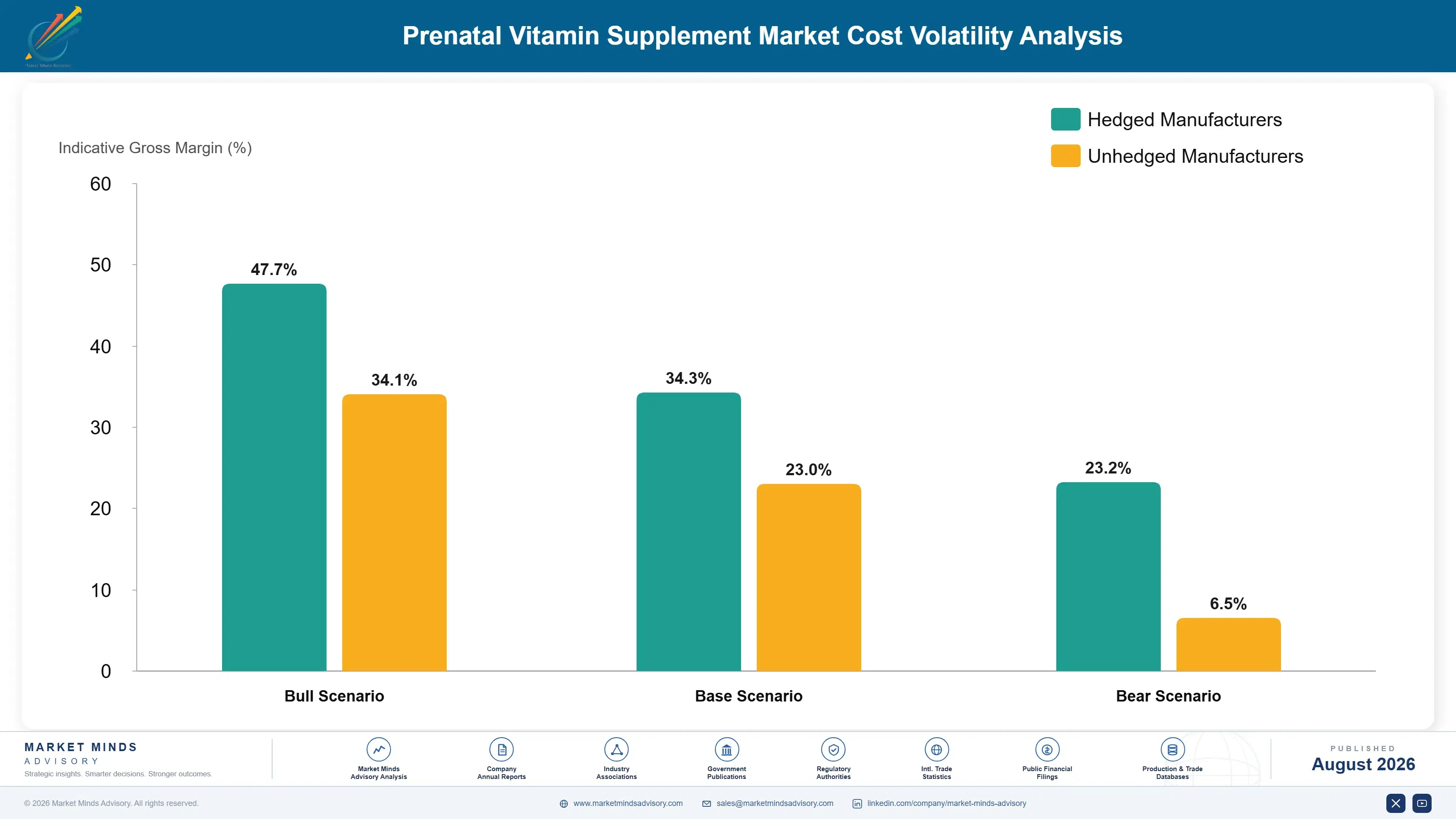
Active ingredients account for roughly 22% of finished product cost in a conventional tablet, which is low because the guideline nutrients are commodity vitamins and minerals produced at scale in China and India. Methylfolate and specialty iron forms raise that materially where used. Tabletting, coating and packaging carry about 34%, and multi-component packs and sachets add considerably more on both counts.
Vitamin pricing moved sharply through 2021 and 2022 as Chinese production concentrated after capacity rationalisation and freight costs rose, with several vitamins reaching multiples of historic levels before easing. Brands holding annual retail contracts absorbed a substantial share. The episode illustrated how little of the retail price the ingredients represent, since a doubling of active cost moved finished goods cost by only a few percentage points overall.

The competitive mechanism therefore runs through format and scale rather than through ingredients. Multi-component packs and sachets cost considerably more to fill than a bottle of tablets, which is the real barrier to closing the choline gap. Contract manufacturers price small runs at substantial premiums too, so a direct brand doing modest volumes pays materially more per course than an established house running national retail volume.
prenatal-vitamin-supplement-market-cost-volatility-analysis-1787580897279

Consolidate contract manufacturing to reach scale pricing

Contract manufacturers price small runs at substantial premiums, and brands spreading volume across several partners pay for the privilege twice over. Consolidating improves unit cost materially and simplifies the quality documentation that clinical channel supply increasingly requires. The trade-off is supply concentration, which a qualified second source addresses at modest additional cost. Few small brands have reached that scale.

Qualify alternative vitamin sources outside one origin

Commodity vitamin production concentrated in China and India, and the 2021 episode showed how quickly that transmits into cost. Qualifying alternative sources costs stability and analytical work per ingredient and matters more for supply continuity than for price, since actives are only 22% of a tablet's cost in the first place. Continuity is the real argument here.

Price format cost into the course, not the unit

Multi-component packs and sachets cost considerably more to fill than bottled tablets, and brands comparing unit prices against tablet competitors lose an argument they should never have entered. Pricing the course against what it delivers, including nutrients a tablet physically cannot carry, is the only framing where the format cost is defensible to a customer.

Portfolio Architecture for Margin Defence

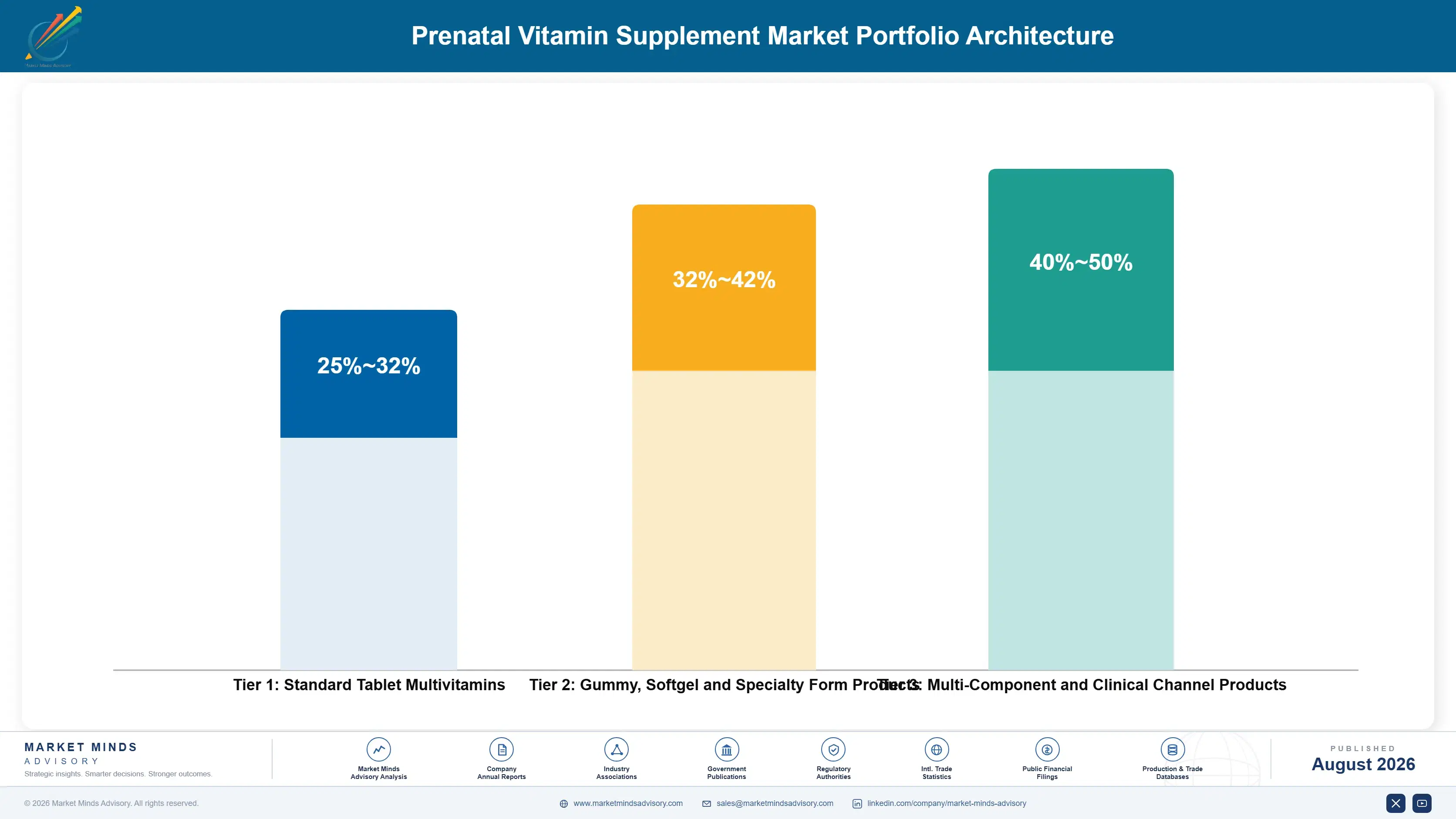
Margin here tracks format and channel rather than composition, because composition is settled and cheap. Standard tablet multivitamins earn margins in the high twenties, which sounds comfortable until the contract manufacturing and retail margin behind it are counted, and hundreds of brands offer an equivalent product meeting the same guidance. Hundreds of brands offer an equivalent product meeting the same guidance.
Gummy and softgel formats do somewhat better in the mid thirties, where format preference supports pricing despite delivering less nutrition per unit than a tablet, which is an uncomfortable fact the category rarely discusses. The range reflects retail channel and brand position rather than any nutritional advantage a formulator could demonstrate. Nutrition per unit is frequently lower in exactly the formats that price highest, which the category rarely discusses openly.

Multi-component packs and clinically positioned products hold the strongest economics, running into the high forties, because they deliver nutrients a tablet cannot and because practitioner recommendation supports pricing that retail comparison would not. Those margins reflect format capability and clinical credibility, which are both slow to build and correspondingly hard to copy. Both are slow to build and correspondingly hard for a competitor to copy quickly.

Standard Tablet Multivitamins

Conventional tablets meeting guideline intakes, produced by contract manufacturers and sold through mass retail. The seven point range reflects manufacturing scale and retail terms rather than any formulation difference a buyer could identify.
Gross Margin: 25-32%

Gummy, Softgel and Specialty Form Products

Format-led products and those using premium ingredient forms such as methylfolate or specialty iron. The ten point range reflects channel position and how far ingredient form positioning supports pricing in a given market.
Gross Margin: 32-42%

Multi-Component and Clinical Channel Products

Pack systems, powders and clinically positioned courses delivering nutrients a tablet cannot carry. The ten point range reflects format complexity and depth of practitioner channel support behind the product. Both take years to establish.
Gross Margin: 40-50%
prenatal-vitamin-supplement-market-portfolio-architecture-1787580897777

High-value Sub-segments and Strategic Watch-out

Multi-Component Pack Systems

High value and the fastest growth at 11.1%, delivering choline and other bulky nutrients that a single tablet physically cannot carry. Adherence risk rises with unit count, which daily sachet presentation largely addresses in practice. No tablet format competes with it on delivery. Guidance keeps widening the gap.
Gross Margin: 42-50%

Preconception Positioned Courses

High value and strategically the most important position available. Only 18% of courses begin preconception, which is when folic acid does the work. Reaching that customer requires channels prenatal brands do not currently work. Fertility and general practice channels are entirely unworked. Courses extend by several months.
Gross Margin: 38-48%

Standard Tablet Multivitamins

The volume core and permanently commoditised by the guidance it meets. Any contract manufacturer can produce a compliant product cheaply, and hundreds of brands do. Growth follows birth cohorts rather than any pricing improvement. Contract manufacturing makes compliance cheap for anyone. Cohort size drives the volume.
Gross Margin: 25-32%

Genetic Variant Positioned Products

The strategic watch-out. Methylfolate premiums built on folate metabolism genetic marketing face claim substantiation enforcement, which one European regulator has already applied. The range reflects how differently that lands by jurisdiction. One European regulator has already restricted the claim. Repositioning is the only response available.
Gross Margin: 30-46%

A Course With a Fixed End

Prenatal supplementation is a defined course rather than an ongoing habit, running from purchase to delivery with a hard stop, and course completion sits at 54%. A brand acquires a customer, serves one pregnancy and loses her unless another follows. That arithmetic makes acquisition cost the central economic question, and it is why preconception marketing matters so much: starting earlier extends the same customer relationship by months without acquiring anybody new.
Stickiness within a course is high and between courses is not. Once a woman is taking a product she tolerates during pregnancy she rarely switches, since experimentation carries obvious downside and nausea makes any change unappealing. Between pregnancies, brand recall competes against whatever a practitioner recommends next time and whatever is at the shelf. Clinical channel positions are the exception, since a practice recommends consistently.

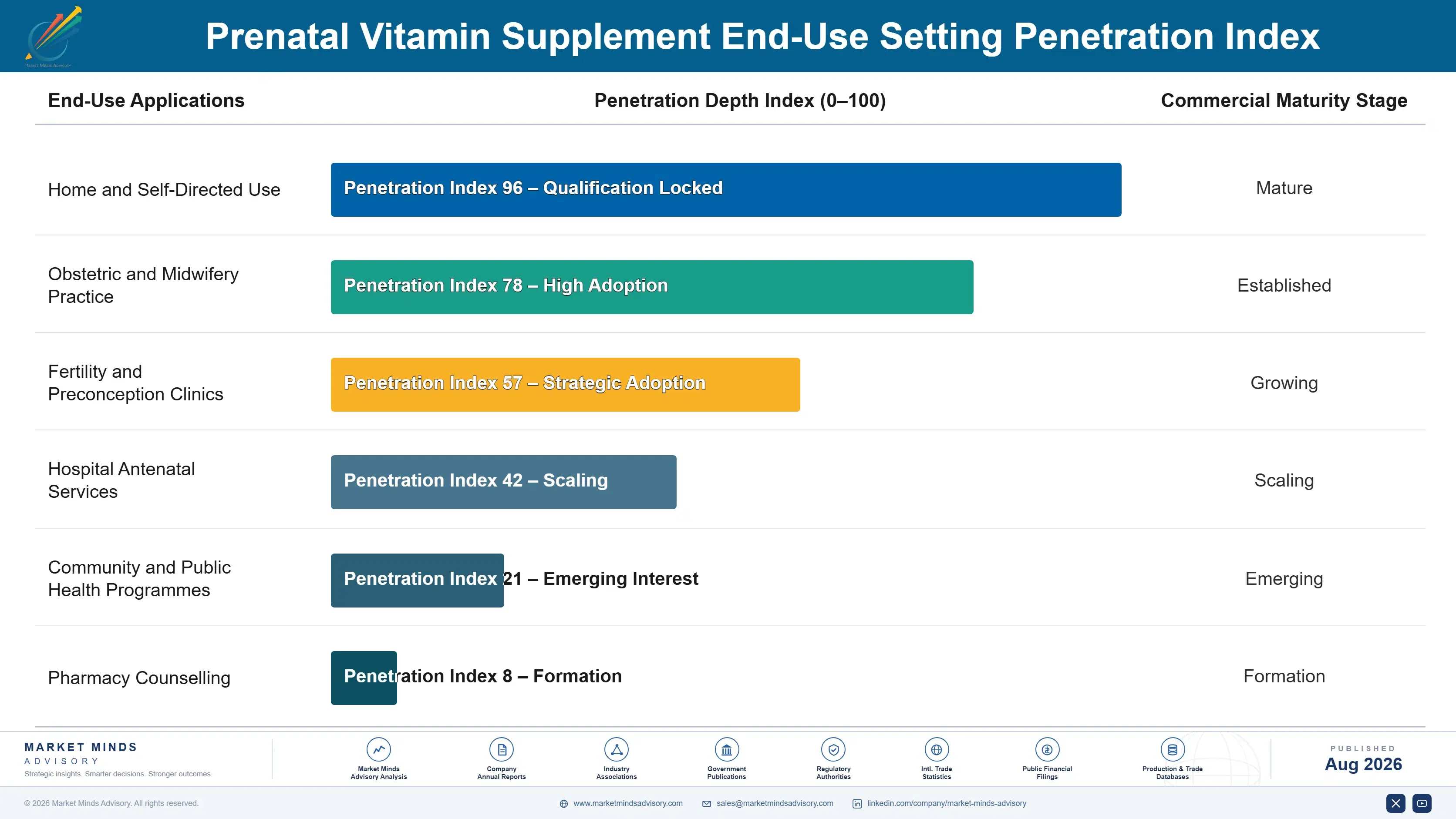
The specifying buyer differs sharply by market. Where antenatal contact is systematic, obstetricians and midwives effectively choose the product and roughly 34% of sales follow that recommendation. Where it is not, the decision sits with a woman comparing labels in a pharmacy against advice she has read online, which is a very different commercial problem for the same product.
prenatal-vitamin-supplement-market-end-use-penetration-index-1787580898268

Where We Would Commit Capital

These are among the four positions where our research anticipates prominent divergence between winners and laggards over the coming forecast period. Each is grounded in the demand model, the regulatory perimeter, and the announced capacity pipeline.
01 / PRECONCEPTION CHANNEL ENTRY

Sell into the window where folic acid actually works

Only 18% of prenatal courses begin before pregnancy is confirmed, which is precisely when folic acid prevents the neural tube defects this category built its reputation on preventing. Reaching that customer means fertility clinics, general practice and contraception cessation moments rather than the antenatal channels every prenatal brand already works. Shifting purchase earlier extends the same course by several months of revenue and delivers the clinical benefit the product claims, and almost nobody in the category is currently pursuing it at all.
02 / FORMAT CAPABILITY INVESTMENT

Leave the single tablet behind to deliver choline

Choline requirements during pregnancy are high enough that a meaningful dose occupies most of a tablet by itself, which is why only 9% of formulas carry one and the rest include a token amount. The constraint is physical and no reformulation resolves it inside a single pill. Multi-component packs, powders and drinks all deliver it at development cost near 400 thousand dollars across a range, and brands committed to one pill a day simply cannot close a gap that obstetric guidance keeps widening.
03 / IRON ADHERENCE POSITIONING

Sell completion, because an abandoned course delivers nothing

Course completion sits at 54% and conventional iron salts on top of pregnancy nausea are the reason women most often cite for stopping. Bisglycinate and sucrosomial forms improve tolerability at a cost that formulators had previously judged unaffordable inside a guideline-compliant product. Obstetric practitioners increasingly specify tolerable forms by name after watching patients abandon courses, which turns adherence into a clinical argument that a practitioner repeats on a brand's behalf rather than a marketing claim the brand has to assert itself.
04 / CLINICAL CHANNEL BUILDING

Invest where the recommendation is made, not where it is bought

Roughly 34% of sales already follow practitioner recommendation and that share runs higher wherever antenatal contact is systematic across a health system. A recommendation from an obstetrician or a midwife converts far more reliably than any retail impression ever does and carries authority through the whole course, which improves adherence alongside sales. Practice sampling, midwifery education and readable evidence cost less than equivalent consumer marketing and they compound over time rather than decaying with each successive campaign the way consumer advertising does.

Engagement Snapshot From the Field

A live engagement with an industry participant carrying material or product regulatory and market exposure ahead of a defining policy shift, showing how our research translates into a defensible multi-year portfolio strategy.
MARKET MINDS ADVISORY · CLIENT ENGAGEMENT SUMMARY
Prenatal Vitamin Supplement Producer Strategic Portfolio Review and Transition Roadmap 2026·Investment Scenario on Prenatal Vitamin Supplement Exposure Evaluation 2025-26
CLIENT PROFILE
A European maternal health brand selling prenatal supplements through pharmacy channels across six countries, with annual revenue near 84 million euros almost entirely from a single tablet format (client-reported, unverified by MMA). The formulation met all applicable guideline intakes and carried a token choline dose typical of tablet products across the category. No alternative format existed in the range.
STRATEGIC CHALLENGE
An obstetric professional body had strengthened choline guidance in the client's largest market, and midwives had begun asking representatives why the product carried so little. Separately, birth rate decline was shrinking the customer cohort across every market served. Management needed a view on format investment, channel priorities and whether preconception marketing was worth attempting.
MMA APPROACH
MMA modelled choline delivery across tablet, pack, powder and sachet formats against the strengthened guidance, costed format development and filling capability for each, and tested preconception channel access with fertility clinics and general practices across three markets. Practitioner recommendation drivers were assessed through the qualitative interview base. Interviews with 47 experts covered obstetric practice, supplement formulation and pharmacy channel management.
KEY FINDINGS
  1. No tablet format could carry a meaningful choline dose alongside guideline intakes, and the constraint was physical rather than a matter of formulation skill or ingredient selection.
  2. Daily sachet presentation delivered the full requirement while maintaining adherence comparable to tablets, unlike separate bottles which showed materially worse completion in comparable products.
  3. Fertility clinics and general practices in all three markets tested were entirely unapproached by prenatal brands and receptive to sampling and educational material.
  4. Midwives cited iron tolerability more often than any other single factor when explaining why their patients abandoned a prenatal course before delivery.
CLIENT PROFILE
A European maternal health brand selling prenatal supplements through pharmacy channels across six countries, with annual revenue near 84 million euros almost entirely from a single tablet format (client-reported, unverified by MMA). The formulation met all applicable guideline intakes and carried a token choline dose typical of tablet products across the category. No alternative format existed in the range.
STRATEGIC CHALLENGE
An obstetric professional body had strengthened choline guidance in the client's largest market, and midwives had begun asking representatives why the product carried so little. Separately, birth rate decline was shrinking the customer cohort across every market served. Management needed a view on format investment, channel priorities and whether preconception marketing was worth attempting.
MMA APPROACH
MMA modelled choline delivery across tablet, pack, powder and sachet formats against the strengthened guidance, costed format development and filling capability for each, and tested preconception channel access with fertility clinics and general practices across three markets. Practitioner recommendation drivers were assessed through the qualitative interview base. Interviews with 47 experts covered obstetric practice, supplement formulation and pharmacy channel management.
KEY FINDINGS
  1. No tablet format could carry a meaningful choline dose alongside guideline intakes, and the constraint was physical rather than a matter of formulation skill or ingredient selection.
  2. Daily sachet presentation delivered the full requirement while maintaining adherence comparable to tablets, unlike separate bottles which showed materially worse completion in comparable products.
  3. Fertility clinics and general practices in all three markets tested were entirely unapproached by prenatal brands and receptive to sampling and educational material.
  4. Midwives cited iron tolerability more often than any other single factor when explaining why their patients abandoned a prenatal course before delivery.
RECOMMENDED STRATEGY
Phase 1: Phase one: develop a daily sachet format delivering full choline alongside guideline intakes, since no tablet can carry it and midwives are already asking about the gap. Phase 2: Phase two: switch iron to a tolerable form across the range, addressing the factor midwives cite most often for course abandonment before delivery. Phase 3: Phase three: open preconception channels through fertility clinics and general practice, which no competitor currently approaches in any market tested.
OUTCOME
The brand launched a daily sachet format during 2026 and reported midwife recommendation rising materially in its largest market within two quarters (client-reported, unverified by MMA). Preconception channel work began in two markets, and iron reformulation completed across the range in the same year. Tablet volumes were allowed to decline.

Frequently Asked Questions

Foundational context covering the market sizes, CAGR, scope, country, region and competition that inform every finding below. This section is provided to cover basics and most often pre-purchase conversations, answered from the MMA Primary Research Dataset.

What is the current size of the Prenatal Vitamin Supplement Market?

MMA sizes it at USD 6.4 billion in 2025, rising to USD 6.87 billion in 2026. The figure covers supplements formulated for use before and during pregnancy at retail and institutional value.

How large will the Prenatal Vitamin Supplement Market be by 2036?

USD 14.03 billion by 2036, an incremental USD 7.16 billion over the 2026 base and an expansion multiple of 2.04 times. Multi-component formats account for a disproportionate share.

What is the CAGR for the Prenatal Vitamin Supplement Market 2026 to 2036?

7.4% in the base case, with a bull case at 8.6% and a bear case at 6.2%. The spread turns on preconception purchase timing and on developed market birth rate decline.

Which segment is growing fastest?

Multi-component pack systems at 11.1%, half again the market rate of 7.4%. Splitting the daily dose across several units is the only way to deliver meaningful choline alongside everything else.

Who are the major companies in the Prenatal Vitamin Supplement Market?

Bayer, Church and Dwight, Perrigo, Nestlé Health Science and Reckitt lead on retail and clinical channel sales value. Fifteen further participants are profiled in the full report.

Which country is growing fastest?

India at 10.4%, on maternal anaemia prevalence among the highest of any large economy alongside rising private health spending in urban households. Obstetric distribution drives that growth.

Report Segmentation Architecture

The full report scope spans multiple orthogonal segmentation dimensions, with cross-tabulated demand data provided for each dimension pair. Coverage extends further to regional breakdowns, trend trajectories, and the competitive detail needed to support segment-level decision-making.

By Product Format

  • Standard Tablet Multivitamins
  • Softgel and Capsule Formats
  • Gummy Formats
  • Powder and Drink Formats
  • Multi-Component Pack Systems
  • Sachet and Stick Formats

By End-Use Setting

  • Home and Self-Directed Use
  • Obstetric and Midwifery Practice
  • Fertility and Preconception Clinics
  • Hospital Antenatal Services
  • Community and Public Health Programmes
  • Pharmacy Counselling

By Commercial Dimension

  • Retail Pharmacy
  • Grocery and Mass Retail
  • Direct-to-Consumer Subscription
  • Practitioner Dispensing
  • Cross-Border Online Sales
  • Institutional and Programme Supply

By Region

  • North America
  • Western Europe
  • East Asia
  • South Asia and Pacific
  • Latin America
  • Middle East and Africa
  • Eastern Europe

Scope, Methodology, and Coverage

Every figure in this report is reproducible from documented input assumptions. The scope below maps the historical period, the forecast horizon, the segmentation dimensions, and the countries covered, alongside the underlying primary and qualitative methodology.
Historical Period
2020 to 2025
Forecast Period
2026 to 2036
Base Year
2025 (USD billions; MMA Primary Research Dataset, August 2026)
Market Definition
Nutritional supplements formulated and marketed for use before and during pregnancy, spanning tablet multivitamins, softgel and capsule formats, gummies, powders and drinks, multi-component pack systems and sachet or stick formats, measured at retail and institutional selling value. Postnatal and lactation supplements, general adult multivitamins not positioned prenatally, fertility-specific supplements, and prescription pharmaceuticals are excluded from scope entirely.
Quantitative Units
USD billions (current prices); million courses supplied annually; USD per course by product format and channel
Segmentation Dimensions
Product format; end-use setting; commercial dimension; region
Regions Covered
North America, Western Europe, East Asia, South Asia and Pacific, Latin America, Middle East and Africa, Eastern Europe
Countries Covered
United States, Canada, Mexico, Germany, France, United Kingdom, Italy, Spain, China, Japan, South Korea, India, Indonesia, Vietnam, Australia, Brazil, Colombia, Saudi Arabia, United Arab Emirates, Poland
Key Companies Profiled
Bayer, Church and Dwight, Perrigo, Nestlé Health Science, Reckitt, Pfizer, Haleon, Pharmavite, Ritual, Needed, Blackmores, By-Health, Amway, Abbott, Danone, Jamieson Wellness, Swisse Wellness, Garden of Life, Thorne, Health and Happiness Group
Quantitative Methodology
Primary survey, n=3,800 respondents, Q4 2025, six countries; demand-side model with trade association cross-validation
Qualitative Methodology
47 expert interviews, Q4 2025; applied to validate demand model assumptions, identify emerging dynamics, and assess competitive positioning
Report Format
PDF and XLSX data workbook (Word format preview document)
Publisher
Market Minds Advisory
Report Code
MMA-2026-HLT-120
Published
August 2026
Contact
sales@marketmindsadvisory.com | www.marketmindsadvisory.com

Purchase the full Prenatal Vitamin Supplement Market Report (2026 to 2036).

The full report examines why the best-evidenced supplement category sells mostly outside the window its evidence applies to, and sizes each product format independently through 2036. It quantifies choline delivery capability by format against strengthening obstetric guidance, assesses ingredient form claim exposure by jurisdiction, and models course economics against completion and preconception purchase timing. Regional chapters cover all seven regions with channel detail across retail, pharmacy and practitioner routes. Competitive profiling covers 20 participants on a single sales value basis, with preconception channel access mapped across three market types.
Each product format sized independently through 2036
Choline delivery capability quantified by format against guidance
Ingredient form claim exposure assessed by jurisdiction
Course economics modelled against completion and purchase timing
Twenty participants profiled on one consistent basis
Preconception channel access mapped across three market types

Built For The People Who Decide

From boardroom strategy to bench-side execution, this report is read cover-to-cover by leaders shaping the next decade of their industry, turning demand scenarios, market dynamics and valuation benchmarks into decisions.
CXOs/ Presidents/ VPs/ Managers
M&A and Corporate Development
Strategy Teams and R&D Heads
Procurement and Product Directors
Regulatory and Compliance Leaders
Investor Relations and Equity Analysts