Market Minds Advisory
Premix Bread Flour Market

Premix Bread Flour Market: Buying the Baker, Not the Flour

A premix turns bread into an add-water-and-watch-the-timer operation, which is exactly what a supermarket bakery needs when roughly a quarter of its own craft baking positions are simply sitting unfilled.

Lead Analyst

Lisa Gevelber

Published

September 2026

Make Smarter Decisions with Customized Research Insights

Request a free sample report and evaluate market opportunities, growth trends, and competitive dynamics relevant to your business needs.

2025 MARKET VALUE$7.9BMarket Size 2025
2036 FORECAST VALUE$14.4BBase Case , 2026 to 2036
CAGR 2026 TO 20365.6 %Bull 6.8% / Bear 4.4%
INCREMENTAL OPPORTUNITY$6.0BNet 10- year value creation
EXPANSION MULTIPLE1.72x2036 value over 2026 base
Strategic Levers
M&A Pipeline
Regional Outlook
Country Rankings
Competitive Intelligence
Segmental Deep-dive
Call-Us : 91 93563 13602

Executive Snapshot and Market Trajectory

Nobody buys premix for the flour. They buy it because craft baking skill has left the building, roughly 24% of baking positions sit unfilled across surveyed markets, and a bag that turns bread into a timed procedure solves a staffing problem rather than an ingredient one.
That logic put premix into 67% of retail bakery points, and it works as long as nobody looks too closely at what is in the bag. Emulsifiers, oxidising agents and enzymes deliver the tolerance that lets an untrained operator produce a consistent loaf, and consumer scrutiny of exactly those additives is rising steadily. Flour is 61% of cost and none of the value, which is why millers rarely win here.
The industry's answer is quiet and clever. Enzymes are processing aids rather than ingredients in most jurisdictions and therefore need no label declaration, and roughly 43% of emulsifier function has already been substituted that way. Gluten-free premixes grow fastest at 8.4%, half again the market rate of 5.6%, because no small bakery can develop them. Western Europe holds 30% of value, above its usual band. No bakery can formulate gluten-free bread on its own.
Market Definition
Formulated flour-based mixes for bread and related baked goods supplied to industrial, retail and foodservice bakeries, spanning complete premixes, concentrates, base improvers, gluten-free and allergen-free formulations, protein and fibre enriched mixes and sourdough systems, measured at supplier selling price. Excludes plain milling flour, standalone bakery enzymes and emulsifiers, cake and pastry mixes, and finished bakery products.
Base Year Value
$7.9B in 2025 (MMA Primary Research Dataset, August 2026)
Forecast Period
2026 to 2036, eleven discrete annual values
CAGR
5.6% base case. Bull 6.8%. Bear 4.4%.
Fastest Growth Segment
Gluten-Free and Allergen-Free Premixes: 8.4% CAGR
Fastest Growth Country
India: 9.0% CAGR
Fastest Growth Region
South Asia and Pacific: 7.9% CAGR
Largest Region
Western Europe: 30% of 2025 global value
Market Leaders
Puratos, Lesaffre, IREKS, CSM Ingredients, Bakels. Source: MMA Primary Research Dataset, July 2026.
Primary Survey
n=3,800 procurement and R&D decision-makers, Q4 2025, six countries
Methodology
Demand-side build-up, cross-validated against public data, 47 expert interviews

Premix Bread Flour Market Forecast Scenarios

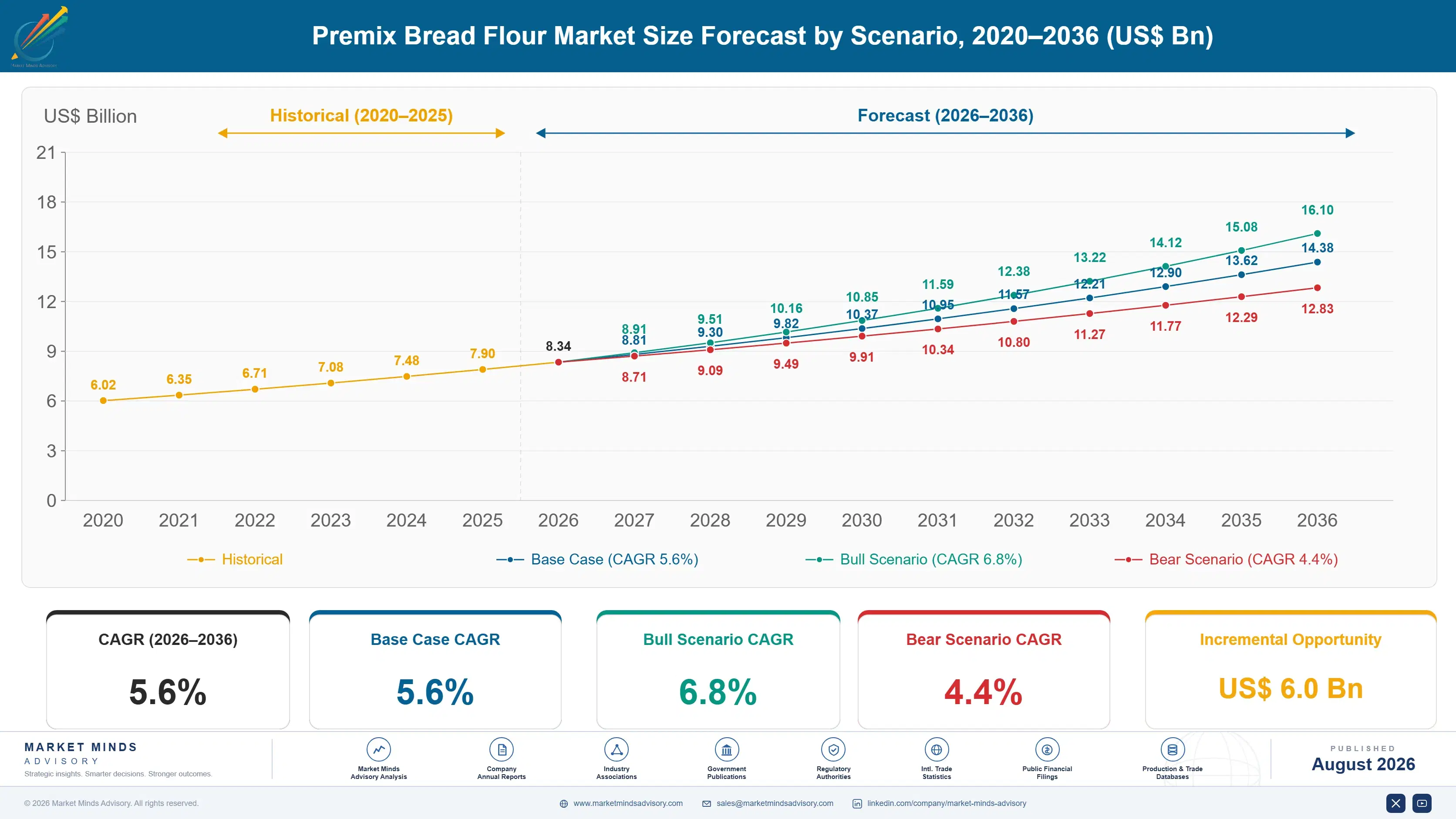
premix-bread-flour-market-trends-growth-size-forecast-scenario-1787580876364
Growth ran near 4.5% between 2020 and 2025 while in-store bake-off penetration continued rising and craft baking employment continued falling. Wheat pricing moved violently through 2022 following supply disruption in the Black Sea region, lifting value well ahead of volume that year. Foodservice demand collapsed in 2020 and recovered fully, while retail bake-off gained share throughout and did not give it back.
Base case 5.6% rests on three mechanisms. Craft baking recruitment continues failing across developed markets, which pushes retail and foodservice bakeries further toward systems an untrained operator can run. Gluten-free and allergen-free demand keeps growing on diagnosis rates and on avoidance behaviour that no bakery can formulate for itself. And Indian and Southeast Asian organised bakery is expanding rapidly where traditional flatbread and unbranded bread previously dominated. None depends on bread consumption rising.
The bull case at 6.8% assumes enzyme substitution continues far enough that premix bread survives ultra-processed classification scrutiny with its label intact. The bear case at 4.4% is dietary guidance in a major market treating additive-containing bread as ultra-processed, which would push retailers toward simpler formulations that require the baking skill nobody can currently recruit.

What the Bag Is Actually Replacing

Bread made by a skilled baker tolerates variation. Flour protein shifts with the harvest, ambient temperature moves the proof, and a baker adjusts hydration and timing without thinking about it. An untrained operator cannot, so the premix has to build that tolerance chemically: emulsifiers strengthen the dough, oxidising agents tighten the gluten network and enzymes manage sugar release and crumb softness through the bake.
TOP FIVE CONCENTRATION38%Specialist premix houses lead a technically demanding field
FLOUR COST SHARE61%Share of premix cost carried by the flour base
ENZYME SUBSTITUTION RATE43%Emulsifier functions now delivered by enzyme systems instead
BAKE-OFF OUTLET PENETRATION67%Share of retail bakery points using premix based systems
BAKER RECRUITMENT SHORTFALL24%Unfilled craft baking positions across the surveyed markets
FORMULATION DEVELOPMENT TIME9 monthsTypical development period for a new premix specification
That is what a supermarket bakery is actually buying, and roughly 24% of craft baking positions across surveyed markets sit unfilled with no recruitment pipeline behind them. The result is premix in 67% of retail bakery points. Flour is 61% of the cost and none of the value, which is why milling companies rarely win in this business and formulation houses reliably do.
The pressure is on the label rather than the loaf. Emulsifiers such as diacetyl tartaric acid esters must be declared and increasingly attract consumer scrutiny; enzymes are processing aids in most jurisdictions and need no declaration at all. Roughly 43% of emulsifier function has been substituted that way already. It is a genuine technical achievement and it is also, plainly, a labelling arbitrage.
"The entire industry has quietly rebuilt its formulations around what does not have to appear on a label, and it has done it well enough that the bread is better. Whether that survives a dietary guideline written by somebody who understands processing aids is the open question nobody in this sector wants to discuss."
Director, Bakery and Cereal Ingredients Practice · MMA Food and Agriculture Ingredients Practice · August 2026

Market Trends

Enzyme systems replacing declarable emulsifiers in formulation

Emulsifiers such as diacetyl tartaric acid esters must be declared as ingredients, while enzymes are classified as processing aids in most jurisdictions and require no label declaration at all. Formulators have substituted roughly 43% of emulsifier function with enzyme systems, principally lipases, amylases and xylanases delivering comparable dough strength and crumb softness. The technical work is genuine and the bread is generally better for it. The commercial driver is a shorter ingredient declaration rather than any performance gain, and everyone in the industry knows it. Everyone in the industry understands the distinction perfectly well.
Market Impact: Covers a 24% recruitment shortfall
Ultra-processed classification reaching bread formulation debates

Dietary classification systems treat bread containing emulsifiers and additives as ultra-processed regardless of nutritional composition, and several national guidance frameworks have begun referencing that classification directly. Bread is a staple with strong cultural standing, which makes it a politically awkward target and an obvious one simultaneously. The industry's enzyme substitution reduces declared additives without changing processing intensity. Whether a guidance framework written with processing aids in mind would accept that distinction has not yet been tested anywhere. Bread is a staple with strong cultural standing, which makes it a politically awkward target and an obvious one at the same time.
Market Impact: Delivers 9.0% annual Indian growth

Market Opportunities and Growth Drivers

Craft baking recruitment failing across developed markets

Roughly 24% of craft baking positions across surveyed markets sit unfilled, with apprenticeship intake far below replacement and night working making the trade a hard sell against alternatives. A retail bakery cannot operate on skill it cannot hire, and premix converts bread production into a timed procedure a general food operative can run reliably. Penetration across retail bakery points has reached 67% on that basis alone. Nothing in current training pipelines suggests the shortfall narrows, which makes this the most durable driver in the category. A retail bakery cannot operate on skill it is unable to hire.
Market Impact: Removes tolerance from 2 additive classes

Indian and Southeast Asian organised bakery expanding rapidly

India grows fastest anywhere at 9.0%, as organised bakery chains, supermarket bake-off and quick service formats expand into markets where traditional flatbread and unbranded bread previously dominated. Those operators face the same skill constraint as Western bakeries and start without any craft tradition to draw on, which makes premix the default rather than a substitute. Southeast Asian markets follow similar paths. Formulation must accommodate local flour quality and ambient conditions, which favours suppliers with regional technical presence over exporters. Formulation must accommodate local flour quality and ambient conditions, which favours suppliers with regional technical presence over exporters.
Market Impact: Exposes 61% of premix cost

Market Restraints and Challenges

Clean label demand conflicting with the tolerance premix provides

Consumers reading ingredient declarations react badly to emulsifiers and additives on a product they regard as fundamentally simple, and retailers pass that reaction into specifications. The root cause is that the additives exist precisely to compensate for the baking skill the retailer no longer employs, so removing them returns the problem premix was bought to solve. Enzyme substitution addresses the declaration without addressing the underlying processing question. Suppliers are also developing sourdough and long fermentation systems that deliver tolerance biologically rather than chemically. Sourdough systems deliver tolerance biologically instead. Nothing else answers it.
Market Impact: Replaces 43% of emulsifier function

Wheat price volatility passing directly into premix pricing

Flour accounts for roughly 61% of premix cost, which is a higher raw material share than most formulated food ingredients carry. The root cause is that formulation adds performance rather than bulk, so a premix is mostly flour with a small and expensive functional fraction. Wheat moved violently through 2022 following Black Sea supply disruption and premix suppliers holding annual bakery contracts absorbed a substantial share. Indexing to published wheat references addresses it, and adoption remains uneven across a fragmented bakery customer base. Adoption remains uneven across a fragmented bakery customer base.
Market Impact: Affects guidance in 3 markets
3 additional market trends, 4 additional growth drivers, and 2 additional restraints and challenges are covered in the full report. Contact sales@marketmindsadvisory.com to access the complete intelligence.

Segment CAGR and Growth Architecture

Six segments split by premix type, because dosage rate determines what the supplier actually sells: flour with a little function, or function with a little flour. A complete mix and a base improver are entirely different businesses. End-use bakery type and commercial channel are handled in the framework rather than here. Dosage decides the business.
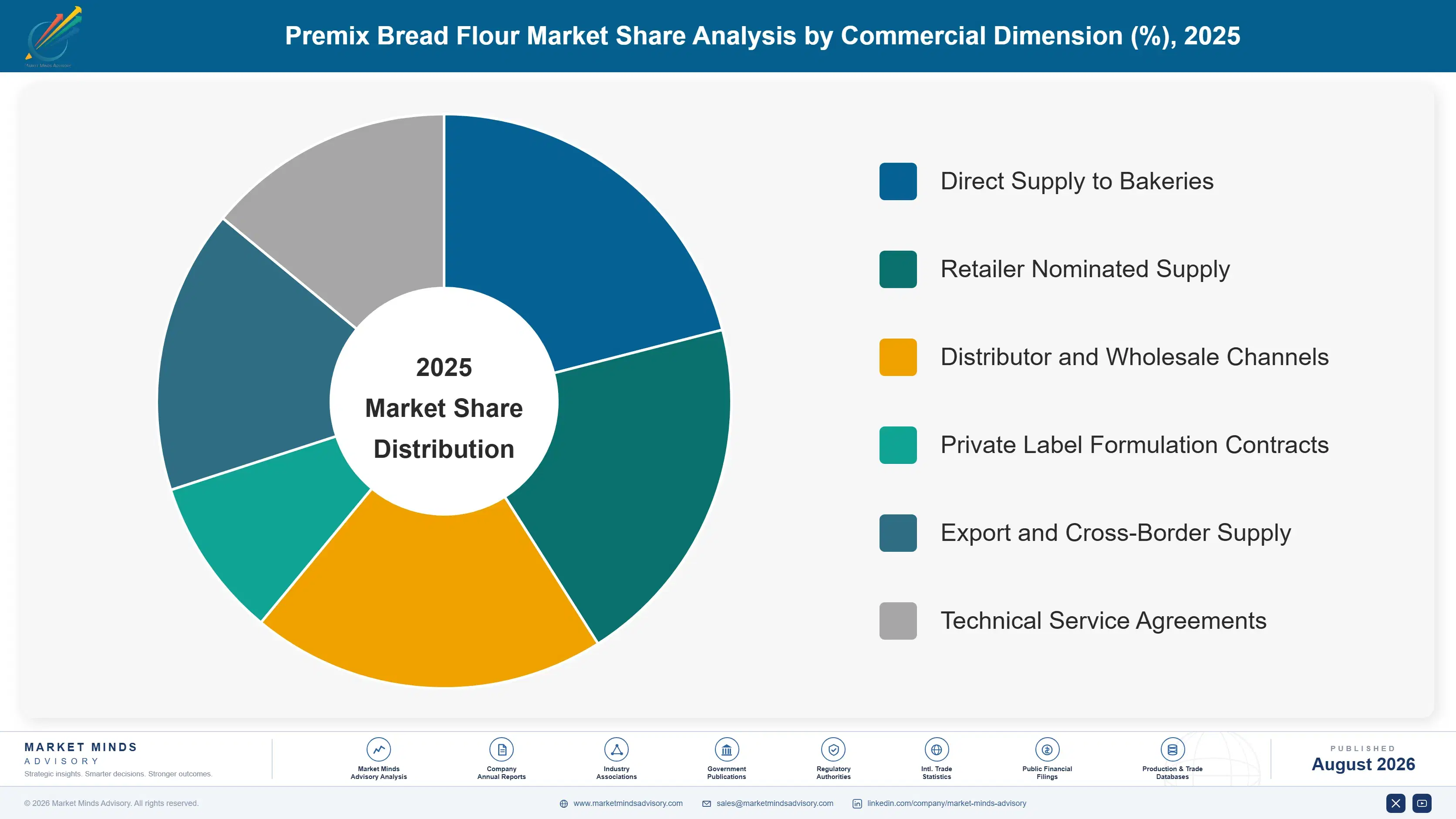
premix-bread-flour-market-trends-growth-market-share-analysis-1787580876898

Gluten-Free and Allergen-Free Premixes

Growing at 8.4%, half again the market rate of 5.6%, gluten-free premix is where formulation expertise matters most and where no bakery can develop its own. Removing gluten removes the structure bread depends on, so the mix has to rebuild it from hydrocolloids, starches and protein isolates in a system that behaves acceptably in an ordinary bakery oven. Coeliac diagnosis rates and broader avoidance behaviour both continue rising. Dedicated production lines and allergen segregation add real cost, which excludes suppliers unwilling to commit facilities, and pricing reflects that properly. Dedicated production lines and genuine allergen segregation add real cost, which excludes suppliers unwilling to commit facilities rather than merely schedule around the problem.
CAGR 8.4%

Protein and Fibre Enriched Premixes

At 7.6% enriched premixes serve retailers pursuing nutritional claims on a category consumers already regard as everyday. Adding protein or fibre damages dough handling and crumb structure in ways that require reformulation rather than simple inclusion, since both compete with gluten for water and interfere with gas retention. Getting an acceptable loaf at a meaningful claim threshold is genuinely difficult. Retailer own-label programmes drive most volume, and the specifications tend to hold for several years once a range is established, which makes the positions unusually durable. Both nutrients compete with gluten for water and interfere with gas retention, so getting an acceptable loaf at a meaningful claim threshold is genuinely difficult work.
CAGR 7.6%
Full segment breakdown across 6 segments available in the complete report.

Regional Architecture and Country Demand Map

Western Europe holds 30% of value, above its usual band, because industrial and retail bake-off systems developed here first and the major premix houses are European. South Asia and Pacific sits above its band at 14% on rapid organised bakery expansion, while East Asia falls below at 20%.

North America

In-store bakery is close to universal across American grocery and almost entirely premix based, with craft baking confined to a small artisan segment that operates on different economics entirely. Clean label pressure arrived here early through retailer commitments rather than regulation, which pushed enzyme substitution ahead of European practice in several categories. Gluten-free penetration is the highest of any region, supported by diagnosis rates and by avoidance behaviour that extends well beyond diagnosed coeliac disease. Canadian and Mexican demand follows similar retail structures at smaller scale. Clean label pressure arrived early here through retailer commitments rather than through regulation of any kind. Gluten-free penetration is the highest of any region covered.
Share: 22% | CAGR: 4.7% (2026 to 2036)

Western Europe

The 30% share sits above the usual band because industrial and retail bake-off systems were developed here and the major formulation houses remain European. German, Dutch and Belgian technical traditions in bakery ingredients are genuinely deep, with sourdough and long fermentation systems more advanced than anywhere else. Craft baking retains cultural standing in France and Italy, which limits premix penetration in traditional formats while doing nothing to slow it in supermarket bake-off. Ultra-processed classification debate is furthest advanced here, and it is where the category faces its most serious reputational exposure. Craft baking retains cultural standing in France and Italy, which limits penetration in traditional formats without slowing supermarket bake-off.
Share: 30% | CAGR: 4.1% (2026 to 2036)
Regional intelligence for 5 additional markets available in the complete report: East Asia, South Asia and Pacific, Latin America, Middle East and Africa, Eastern Europe. Contact sales@marketmindsadvisory.com.
premix-bread-flour-market-trends-growth-country-cagr-analysis-1787580877447

Four Moves in a Formulation Business

Flour is 61% of cost and none of the value, which is why milling companies keep losing this business to formulation houses. What sells is tolerance in an unskilled kitchen and a label a retailer can defend. Those two requirements pull against each other, which is where the work is. That tension is the business.

Push enzyme substitution further than competitors have

Enzymes are processing aids requiring no declaration while emulsifiers must be listed, and roughly 43% of emulsifier function has already been substituted across the industry. The remainder is harder, since the functions still carried by emulsifiers are the ones enzymes reproduce least well. Development runs about nine months per specification and costs perhaps 180 thousand dollars. A supplier reaching a fully enzyme-based system offers retailers a declaration nobody else can match, and retailers under clean label pressure will pay for it. Retailers under clean label pressure pay for it. Nobody has managed it yet.
Market Impact: Costs about $180 thousand for every specification converted

Commit dedicated facilities to allergen-free production

Gluten-free premix grows at 8.4% and requires dedicated lines with genuine allergen segregation, which excludes suppliers unwilling to commit facilities rather than merely schedule around contamination. Building that capability costs perhaps 6 million dollars and takes about eighteen months including validation. The resulting position is defensible because no bakery can formulate gluten-free bread itself and few suppliers will commit the facilities. Pricing reflects the burden properly, which is rare in a category where flour dominates the cost stack. Pricing reflects the burden properly here. Few competitors will commit the facilities.
Market Impact: Costs $6 million to build dedicated allergen facilities

Develop sourdough tolerance rather than chemical tolerance

Long fermentation and sourdough systems deliver dough tolerance biologically, through acidification and enzyme activity from the culture itself, which answers the clean label problem at its root rather than relocating it to a processing aid classification. The obstacle is time, since fermentation cannot be hurried and bakery throughput schedules resist it. Suppliers solving that with stable cultures, controlled acidification and shorter proof windows hold something an enzyme system cannot claim, and European retailers are already asking for it. Reducing fermentation to roughly 4 hours while keeping the tolerance is the difficulty.
Market Impact: Answers scrutiny on 2 declarable classes of additive

Build regional formulation capability in growth markets

Local flour protein, ash content and ambient conditions all differ enough that a premix developed in Europe performs badly in Indian or Southeast Asian bakeries, and exporting a specification does not work. India grows at 9.0% and the operators there have no craft tradition to fall back on when a mix underperforms. Regional technical centres and local flour bases cost far less than manufacturing capacity and win the business that exported specifications lose repeatedly. Exported specifications fail repeatedly there. Local technical presence wins it instead. Specifications do not travel well.
Market Impact: Serves 9.0% annual growth in the Indian market

Who Controls the Margin Pool

Participation is measured on annual premix production volume in tonnes, and the top five hold 38%. Concentration is high for a flour-based product because the value sits in formulation rather than milling, and formulation capability took decades to build. Puratos and Lesaffre lead on technical depth and global technical service coverage. The gap to challengers is application expertise and regional formulation presence rather than manufacturing scale.
Competition runs on three fronts. Formulation performance in an unskilled kitchen decides most retail bake-off business, since a mix that fails when the operator gets distracted costs the retailer a bake. Declaration length is the second, and it has become a retailer specification rather than a preference. Regional technical service is the third, and it decides growth market business where exported specifications reliably underperform against local conditions.

The pressure ahead is classification rather than competition. Dietary guidance treating additive-containing bread as ultra-processed would reach the whole category regardless of enzyme substitution, since processing intensity rather than declaration length is what those frameworks assess. Expect sourdough and fermentation investment rather than acquisitions. Rankings shift as clean label specifications tighten and as growth market formulation capability separates suppliers who built it from those exporting recipes.
premix-bread-flour-market-trends-growth-company-positioning-matrix-1787580877964

Competitive Moat and Risk Dimensions

PURATOS

Moat: Technical service and sourdough depth

Puratos operates technical centres and application bakeries across most major markets, which lets it develop formulations against local flour and conditions rather than exporting a specification and hoping. Its sourdough culture library and fermentation expertise are genuinely deep, and that capability answers the clean label question in a way enzyme substitution alone cannot.
PURATOS

Risk: Ultra-processed classification exposure

A large formulated bakery ingredient business is directly exposed if dietary guidance treats additive-containing bread as ultra-processed, since the assessment turns on processing intensity rather than on declaration length. Sourdough investment answers part of it, and the fermentation time such systems require conflicts with the throughput schedules that made premix commercially attractive in the first place.
LESAFFRE

Moat: Yeast and fermentation science base

Lesaffre's position in yeast and fermentation gives it biological capability that formulation houses without that base cannot replicate, and the clean label direction of travel favours biological tolerance over chemical tolerance directly. Owning the organism as well as the formulation is a genuine advantage as sourdough and long fermentation systems become the answer retailers ask for.
LESAFFRE

Risk: Premix versus ingredient channel conflict

Selling yeast and enzymes to competing premix houses while also selling complete premixes creates a conflict that customers notice and periodically act on. Competitors have alternative fermentation suppliers available, and a formulation house that suspects its ingredient supplier of competing for its own customers will eventually qualify somebody else.

Players Tracked

Prominent Players

Puratos
Lesaffre
IREKS
CSM Ingredients
Bakels

Other Key Players

AB Mauri
Zeelandia
Dawn Foods
Lallemand
Novonesis
Kerry Group
Corbion
Backaldrin
Uniferm
Bocker
Limagrain Ingredients
Muntons
Griffith Foods
Pfahnl Backmittel
Sonneveld Group

Recent Developments

FEBRUARY 2026

European retailer specifies fully enzyme-based improver systems for own-label bread

A European grocery retailer specified improver systems containing no declarable emulsifiers across its own-label bread range, requiring suppliers to deliver dough tolerance through enzymes and fermentation instead. Suppliers unable to meet the specification lost listings at the following range review across affected categories. Reformulation timelines were tight.
Signal: Declaration length has become a retailer specification rather than a preference, and it removes suppliers entirely
SEPTEMBER 2025

National dietary guidance references ultra-processed classification for bread

A national dietary guidance framework referenced ultra-processed food classification in advice on bread consumption, capturing products containing emulsifiers and certain additives regardless of nutritional composition. Industry bodies responded that processing aid substitution had already reduced declared additives substantially across the category. No transition period was offered.
Signal: Classification assesses processing intensity, which enzyme substitution reduces on the label but not in the process
JUNE 2026

Premix supplier opens Indian technical centre for regional formulation

A European premix supplier opened a technical centre and application bakery in India, developing formulations against local flour quality and ambient conditions rather than adapting European specifications. The investment is an organic capability addition rather than any joint venture with a local milling group. Local flour bases are used throughout.
Signal: Exported specifications underperform in growth markets, and regional formulation capability is what actually fixes that problem

Mostly Flour, All the Value Elsewhere

Flour accounts for roughly 61% of premix cost, sourced from regional millers whose wheat protein and ash specifications determine what the formulation must correct for. Enzymes, emulsifiers and oxidising agents together carry about 14% despite tiny inclusion rates, since the functional fraction is expensive per kilogramme. Yeast, sugars and minor ingredients add 11%, with blending, packaging and technical service accounting for the balance.
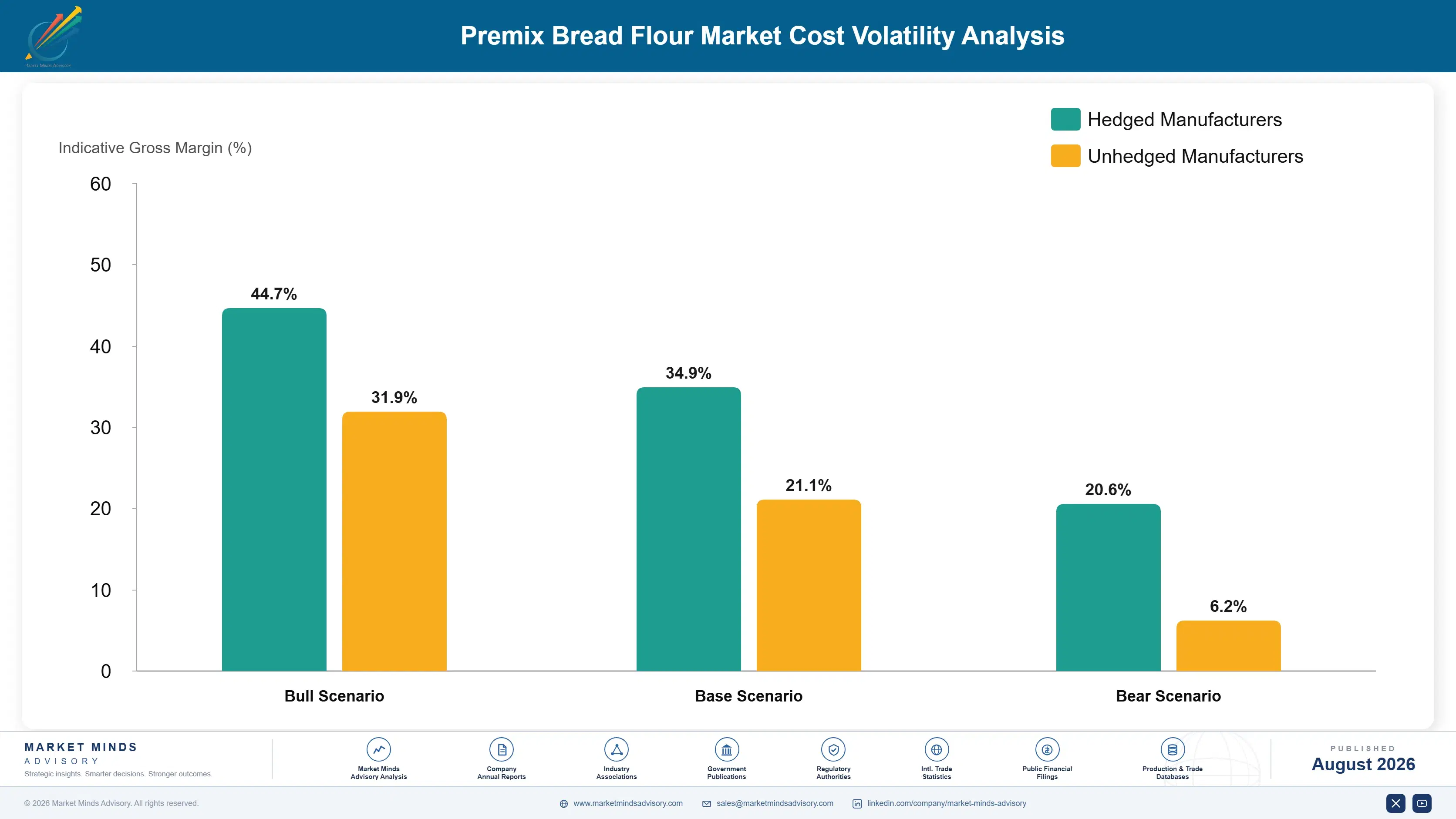
Wheat moved violently through 2022 following supply disruption in the Black Sea region, with milling wheat reaching levels well outside historic ranges before easing, per published grain trade reporting for that season. Premix suppliers holding annual bakery contracts absorbed a substantial share, since bakery pricing to retailers is set annually and does not accommodate a mid-year flour move. Several suppliers disclosed margin compression in reporting for that year.

Exposure divides on contract structure and on flour sourcing flexibility. A supplier indexing bakery contracts to a published wheat reference passes movement through with a lag, while one holding fixed prices carries all of it on a formulation margin that flour dominates. Regional sourcing matters too: European suppliers buying locally milled flour carry different exposure from those importing into markets where wheat itself arrives by sea.
premix-bread-flour-market-trends-growth-cost-volatility-analysis-1787580878166

Index bakery contracts to published wheat references

Flour at 61% of cost bought against annually set bakery pricing guarantees margin variance whenever wheat moves, which it did severely within recent memory. Indexing to a published reference passes movement through with a defined lag. Large industrial bakery customers accept indexing considerably more readily than fragmented retail bakery accounts, which shapes which customers reward pursuit.

Qualify multiple flour specifications per formulation

A premix formulated around one miller's flour specification fails when that flour is unavailable, and holding qualified alternatives lets a supplier switch without reworking the mix. Qualification requires baking trials across the specification range, costing perhaps 40 thousand dollars per formulation family, and it protects supply continuity as much as cost. Supply continuity matters as much as cost here.

Price technical service separately from the mix

Application support, troubleshooting and formulation development carry real cost that a bag of premix does not, and suppliers quoting one delivered price obscure where that value sits. Separating technical service protects it when flour pricing moves and makes the value visible to customers who otherwise treat the mix as a commodity with free advice attached.

Portfolio Architecture for Margin Defence

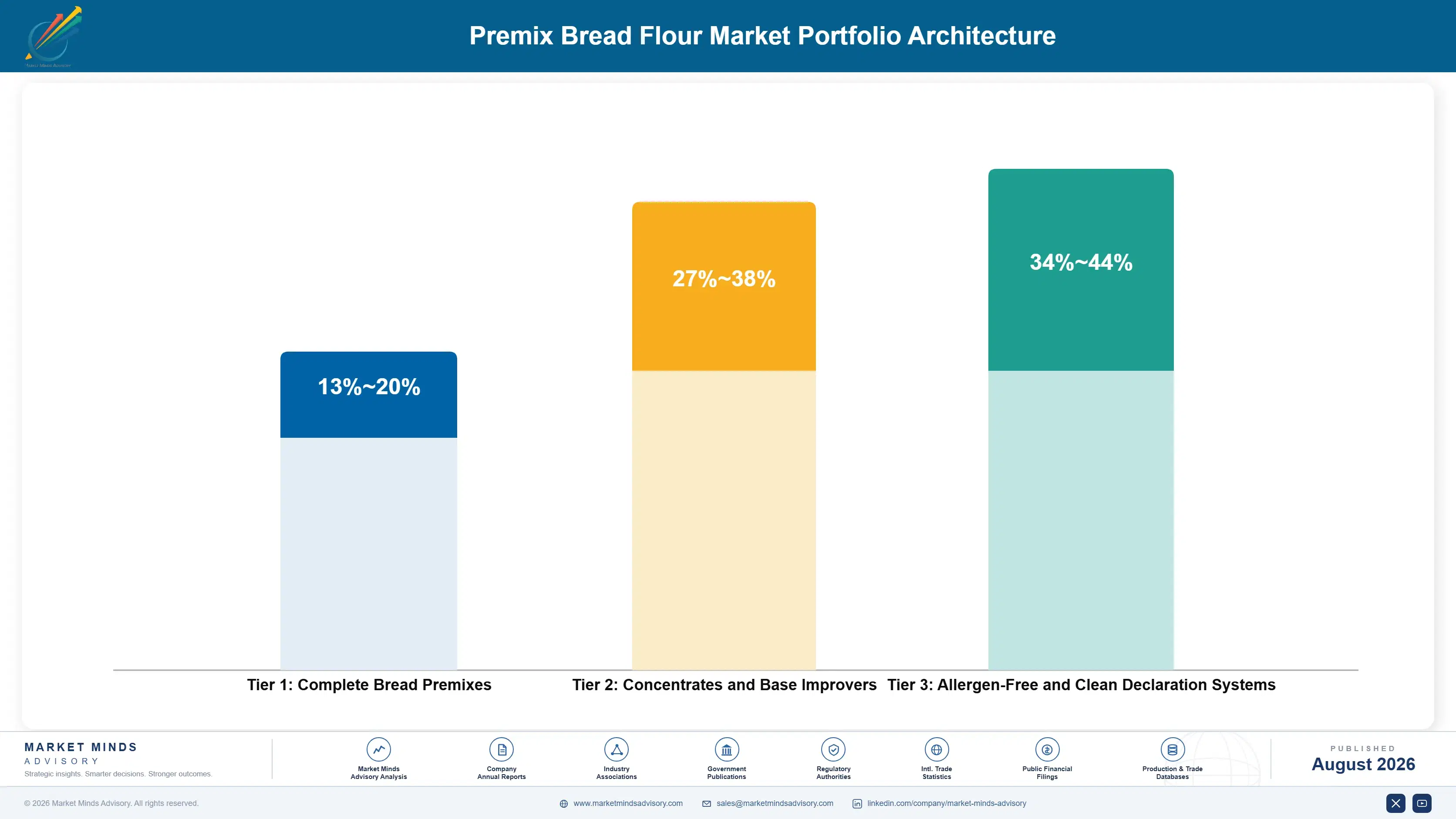
Margin here tracks how much of the bag is function rather than flour. Complete premixes earn margins in the mid teens, because the mix is mostly flour and the customer can compare delivered price per tonne against a competitor without much difficulty. Volume is substantial and the pricing power is genuinely limited, which is where most tonnage sits.
Concentrates and base improvers do considerably better at margins in the high twenties to high thirties, because the functional fraction dominates and the customer cannot readily assess what is in it. The range reflects dosage rate directly: a mix used at 2% carries far more formulation value per tonne than one used at 50%, and the pricing follows that arithmetic closely. Dosage rate is the whole variable in that tier.

Gluten-free and allergen-free formulations hold the strongest position, running into the low forties, where dedicated facilities and genuine formulation difficulty exclude most of the field. Those margins reflect a capability barrier and a facility commitment rather than any ingredient advantage, and they persist because no bakery can develop these products for itself. No bakery can develop these products for itself, which is the point.

Complete Bread Premixes

All-in mixes where flour dominates the bag and customers compare delivered price per tonne. The seven point range reflects flour sourcing position and contract scale rather than formulation capability that a buyer can assess.
Gross Margin: 13-20%

Concentrates and Base Improvers

Lower dosage systems where the functional fraction dominates the value. The eleven point range follows dosage rate directly, since a mix used at low inclusion carries far more formulation value per tonne than a complete mix does.
Gross Margin: 27-38%

Allergen-Free and Clean Declaration Systems

Gluten-free formulations and fully enzyme-based or sourdough systems requiring dedicated facilities or advanced fermentation capability. The ten point range reflects facility commitment and how far declaration reduction has actually been achieved.
Gross Margin: 34-44%
premix-bread-flour-market-trends-growth-portfolio-architecture-1787580878674

High-value Sub-segments and Strategic Watch-out

Gluten-Free and Allergen-Free Premixes

High value and the fastest growth at 8.4%, requiring dedicated lines and genuine segregation that most suppliers will not commit to. No bakery can formulate gluten-free bread itself, which keeps the capability barrier firmly in place. Facility commitment is the real barrier. Diagnosis rates keep rising.
Gross Margin: 36-44%

Sourdough and Fermentation Systems

High value and strategically important, since biological tolerance answers clean label scrutiny at its root rather than relocating it. Fermentation time conflicts with bake-off schedules, and solving that conflict is where the real capability sits. Schedule compatibility is the technical problem. Retailers are asking already.
Gross Margin: 32-42%

Complete Bread Premixes

The volume core and permanently exposed to flour pricing and per tonne comparison. Formulation value is diluted by the flour that dominates the bag. Growth follows bakery volume with no meaningful margin improvement available. Flour dominates the bag and the comparison. Comparison is straightforward for buyers.
Gross Margin: 13-20%

Emulsifier-Dependent Formulations

The strategic watch-out. Retailers are specifying systems with no declarable emulsifiers and suppliers who cannot deliver lose listings at range review. The range reflects how differently that requirement has landed by market. Range review is when suppliers actually lose the listing. Reformulation is the only route back.
Gross Margin: 12-24%

How the Bakery Keeps Ordering

Premix demand is about as reliable as food ingredient demand gets, because bread sells every day and a bakery orders against its own production schedule rather than any purchasing decision. Once a formulation is established in a bakery, the operators are trained on it, the oven programmes are set for it and the finished product is what customers expect, which makes switching considerably more disruptive than a price comparison suggests.
Stickiness rises sharply with formulation specificity. Gluten-free and allergen-free supply is stickiest, since requalifying a dedicated facility is slow and the product cannot simply be substituted. Retailer own-label specifications come next, held by range review cycles that run for years. Complete premixes for standard bread switch on delivered price at contract renewal, and industrial bakeries requalify readily where the formulation is straightforward.

The specifying buyer has moved from the bakery to the retailer. Premix used to be chosen by a bakery manager on performance in their own oven. Clean label commitments moved the decision to retail technical and sustainability functions who write declaration requirements into own-label specifications, and who evaluate suppliers on what does not appear on a label rather than on what comes out of the oven.
premix-bread-flour-market-trends-growth-end-use-penetration-index-1787580879196

Where We Would Focus Effort

These are among the four positions where our research anticipates prominent divergence between winners and laggards over the coming forecast period. Each is grounded in the demand model, the regulatory perimeter, and the announced capacity pipeline.
01 / ENZYME SUBSTITUTION DEPTH

Reach a fully declarable-free system before competitors manage it

Enzymes count as processing aids requiring no declaration while emulsifiers must be listed, and roughly 43% of emulsifier function has already been substituted across the industry, leaving the harder remainder where enzymes reproduce the function least well. Development work runs about nine months and costs perhaps 180 thousand dollars for each specification converted. A supplier reaching a fully enzyme-based system offers retailers a declaration that nobody else can match, and retailers under clean label pressure will pay for exactly that.
02 / ALLERGEN FACILITY COMMITMENT

Commit dedicated lines where competitors only schedule around

Gluten-free premix grows at 8.4% and needs dedicated lines with genuine allergen segregation rather than production scheduled to avoid contamination, which is precisely the distinction that most suppliers quietly avoid making at all. Building that capability costs perhaps 6 million dollars over about eighteen months including validation. The position is defensible because no bakery can formulate gluten-free bread for itself and few competitors will commit the facilities, so pricing here reflects the facility burden rather than the flour that dominates every other tier.
03 / BIOLOGICAL TOLERANCE DEVELOPMENT

Build sourdough systems that fit a bake-off schedule

Long fermentation delivers dough tolerance biologically through acidification and culture enzyme activity, which answers clean label scrutiny at its root rather than relocating the problem into a processing aid classification. The obstacle is time, since fermentation cannot be hurried and bakery throughput schedules resist it directly. Suppliers solving that with stabilised cultures and controlled acidification hold something no enzyme system can claim, and European retailers are already asking for precisely that, ahead of any supplier being able to deliver it.
04 / REGIONAL FORMULATION PRESENCE

Develop in the market, because exported recipes fail there

Local flour protein, ash content and ambient conditions differ enough that a premix developed in Europe performs badly in Indian or Southeast Asian bakeries, and exporting a specification simply does not work. India grows at 9.0% and operators there have no craft tradition to fall back on when a mix underperforms in their oven. Regional technical centres and locally developed flour bases cost far less than manufacturing capacity and they win business that exported specifications have been losing repeatedly for years.

Engagement Snapshot From the Field

A live engagement with an industry participant carrying material or product regulatory and market exposure ahead of a defining policy shift, showing how our research translates into a defensible multi-year portfolio strategy.
MARKET MINDS ADVISORY · CLIENT ENGAGEMENT SUMMARY
Premix Bread Flour Producer Strategic Portfolio Review and Transition Roadmap 2026·Investment Scenario on Premix Bread Flour Exposure Evaluation 2025-26
CLIENT PROFILE
A European bakery ingredients supplier producing bread premixes and improvers for retail bake-off and industrial bakery customers across nine countries, with annual revenue near 340 million euros (client-reported, unverified by MMA). Formulations relied substantially on declarable emulsifiers, and gluten-free production ran on shared lines with scheduled changeovers rather than dedicated facilities. Regional formulation capability was absent.
STRATEGIC CHALLENGE
Two large retail customers had specified own-label improver systems containing no declarable emulsifiers, and the client could meet neither specification. A third had questioned whether shared-line gluten-free production met its allergen policy. Management needed to decide where to invest between reformulation, dedicated facilities and growth market expansion, with capital for two at most.
MMA APPROACH
MMA benchmarked the client's formulations against competitors on declaration length, costed dedicated allergen facilities and enzyme reformulation programmes separately, and tested retailer specification direction with technical teams at eleven grocery groups. Indian and Southeast Asian formulation requirements were assessed against exported specification performance. Interviews with 47 experts covered bakery formulation, enzyme systems and retail technical specification.
KEY FINDINGS
  1. Nine of eleven retailers surveyed intended to specify systems without declarable emulsifiers within three years, and four had already begun doing so across own-label ranges.
  2. Full enzyme reformulation of the core bread range would take roughly two years and cost near 3 million euros across the specifications the client actually needed to convert.
  3. Shared-line gluten-free production would not satisfy the allergen policies of four of the eleven retailers, and dedicated facilities cost roughly 6 million euros to establish.
  4. Exported European specifications had failed in two Indian customer trials on flour protein and ambient handling, and no local formulation capability existed to correct them.
CLIENT PROFILE
A European bakery ingredients supplier producing bread premixes and improvers for retail bake-off and industrial bakery customers across nine countries, with annual revenue near 340 million euros (client-reported, unverified by MMA). Formulations relied substantially on declarable emulsifiers, and gluten-free production ran on shared lines with scheduled changeovers rather than dedicated facilities. Regional formulation capability was absent.
STRATEGIC CHALLENGE
Two large retail customers had specified own-label improver systems containing no declarable emulsifiers, and the client could meet neither specification. A third had questioned whether shared-line gluten-free production met its allergen policy. Management needed to decide where to invest between reformulation, dedicated facilities and growth market expansion, with capital for two at most.
MMA APPROACH
MMA benchmarked the client's formulations against competitors on declaration length, costed dedicated allergen facilities and enzyme reformulation programmes separately, and tested retailer specification direction with technical teams at eleven grocery groups. Indian and Southeast Asian formulation requirements were assessed against exported specification performance. Interviews with 47 experts covered bakery formulation, enzyme systems and retail technical specification.
KEY FINDINGS
  1. Nine of eleven retailers surveyed intended to specify systems without declarable emulsifiers within three years, and four had already begun doing so across own-label ranges.
  2. Full enzyme reformulation of the core bread range would take roughly two years and cost near 3 million euros across the specifications the client actually needed to convert.
  3. Shared-line gluten-free production would not satisfy the allergen policies of four of the eleven retailers, and dedicated facilities cost roughly 6 million euros to establish.
  4. Exported European specifications had failed in two Indian customer trials on flour protein and ambient handling, and no local formulation capability existed to correct them.
RECOMMENDED STRATEGY
Phase 1: Phase one: begin enzyme reformulation of the core bread range immediately, since nine of eleven retailers intend to specify declarable-free systems within three years. Phase 2: Phase two: commit dedicated gluten-free facilities, which four retailers already require and which no competitor in the client's markets currently operates. Phase 3: Phase three: defer Indian expansion until reformulation completes, rather than attempting three capital programmes against a balance sheet capacity for two.
OUTCOME
The supplier completed enzyme reformulation of its core range within twenty months and retained both at-risk retail specifications (client-reported, unverified by MMA). Dedicated gluten-free facilities were commissioned in 2026, and Indian expansion was scheduled for the following planning cycle rather than abandoned. Regional formulation capability remains unbuilt.

Frequently Asked Questions

Foundational context covering the market sizes, CAGR, scope, country, region and competition that inform every finding below. This section is provided to cover basics and most often pre-purchase conversations, answered from the MMA Primary Research Dataset.

What is the current size of the Premix Bread Flour Market?

MMA sizes it at USD 7.9 billion in 2025, rising to USD 8.34 billion in 2026. The figure covers formulated flour-based mixes for bread supplied to industrial, retail and foodservice bakeries.

How large will the Premix Bread Flour Market be by 2036?

USD 14.38 billion by 2036, an incremental USD 6.04 billion over the 2026 base and an expansion multiple of 1.72 times. Allergen-free and clean declaration systems account for a disproportionate share.

What is the CAGR for the Premix Bread Flour Market 2026 to 2036?

5.6% in the base case, with a bull case at 6.8% and a bear case at 4.4%. The spread turns on how ultra-processed classification treats bread containing additives.

Which segment is growing fastest?

Gluten-free and allergen-free premixes at 8.4%, half again the market rate of 5.6%. Removing gluten removes the structure bread depends on, which no bakery can rebuild itself.

Who are the major companies in the Premix Bread Flour Market?

Puratos, Lesaffre, IREKS, CSM Ingredients and Bakels lead on annual premix production volume. Fifteen further participants are profiled in the full report on that basis.

Which country is growing fastest?

India at 9.0%, as organised bakery chains and supermarket bake-off expand where traditional flatbread previously dominated. Those operators have no craft tradition to displace at all.

Report Segmentation Architecture

The full report scope spans multiple orthogonal segmentation dimensions, with cross-tabulated demand data provided for each dimension pair. Coverage extends further to regional breakdowns, trend trajectories, and the competitive detail needed to support segment-level decision-making.

By Premix Type

  • Complete Bread Premixes
  • Concentrate Premixes
  • Base Improvers
  • Gluten-Free and Allergen-Free Premixes
  • Protein and Fibre Enriched Premixes
  • Sourdough and Fermentation Systems

By End-Use Bakery Type

  • Industrial Plant Bakeries
  • Retail In-Store Bake-Off
  • Craft and Artisan Bakeries
  • Foodservice and Catering Bakeries
  • Quick Service Restaurant Supply
  • Institutional and Contract Catering

By Commercial Dimension

  • Direct Supply to Bakeries
  • Retailer Nominated Supply
  • Distributor and Wholesale Channels
  • Private Label Formulation Contracts
  • Export and Cross-Border Supply
  • Technical Service Agreements

By Region

  • North America
  • Western Europe
  • East Asia
  • South Asia and Pacific
  • Latin America
  • Middle East and Africa
  • Eastern Europe

Scope, Methodology, and Coverage

Every figure in this report is reproducible from documented input assumptions. The scope below maps the historical period, the forecast horizon, the segmentation dimensions, and the countries covered, alongside the underlying primary and qualitative methodology.
Historical Period
2020 to 2025
Forecast Period
2026 to 2036
Base Year
2025 (USD billions; MMA Primary Research Dataset, August 2026)
Market Definition
Formulated flour-based mixes for bread and related baked goods supplied to industrial, retail and foodservice bakeries, spanning complete premixes, concentrates, base improvers, gluten-free and allergen-free formulations, protein and fibre enriched mixes and sourdough or fermentation systems, measured at supplier selling price. Plain milling flour, standalone bakery enzymes and emulsifiers sold as ingredients, cake and pastry mixes, and finished bakery products are excluded from scope entirely.
Quantitative Units
USD billions (current prices); million tonnes supplied annually; USD per tonne by premix type and region
Segmentation Dimensions
Premix type; end-use bakery type; commercial dimension; region
Regions Covered
North America, Western Europe, East Asia, South Asia and Pacific, Latin America, Middle East and Africa, Eastern Europe
Countries Covered
United States, Canada, Mexico, Germany, Netherlands, Belgium, France, United Kingdom, Italy, China, Japan, South Korea, India, Indonesia, Australia, Brazil, Colombia, Saudi Arabia, South Africa, Poland
Key Companies Profiled
Puratos, Lesaffre, IREKS, CSM Ingredients, Bakels, AB Mauri, Zeelandia, Dawn Foods, Lallemand, Novonesis, Kerry Group, Corbion, Backaldrin, Uniferm, Bocker, Limagrain Ingredients, Muntons, Griffith Foods, Pfahnl Backmittel, Sonneveld Group
Quantitative Methodology
Primary survey, n=3,800 respondents, Q4 2025, six countries; demand-side model with trade association cross-validation
Qualitative Methodology
47 expert interviews, Q4 2025; applied to validate demand model assumptions, identify emerging dynamics, and assess competitive positioning
Report Format
PDF and XLSX data workbook (Word format preview document)
Publisher
Market Minds Advisory
Report Code
MMA-2026-AGR-178
Published
August 2026
Contact
sales@marketmindsadvisory.com | www.marketmindsadvisory.com

Purchase the full Premix Bread Flour Market Report (2026 to 2036).

The full report explains what a premix actually replaces and sizes each type independently through 2036. It quantifies enzyme substitution against declarable emulsifier function by formulation category, tracks retailer declaration specifications by grocery group, and assesses ultra-processed classification exposure across the product range. Regional chapters cover all seven regions with detail on bake-off penetration, craft baking employment levels and local flour characteristics wherever the data permits it. Competitive profiling covers 20 participants on a single production volume basis, alongside regional formulation capability compared across each supplier covered.
Each premix type sized independently through 2036
Enzyme substitution quantified against declarable emulsifier function
Retailer declaration specifications tracked by grocery group
Ultra-processed classification exposure assessed across the range
Twenty participants profiled on one consistent basis
Regional formulation capability compared across suppliers

Built For The People Who Decide

From boardroom strategy to bench-side execution, this report is read cover-to-cover by leaders shaping the next decade of their industry, turning demand scenarios, market dynamics and valuation benchmarks into decisions.
CXOs/ Presidents/ VPs/ Managers
M&A and Corporate Development
Strategy Teams and R&D Heads
Procurement and Product Directors
Regulatory and Compliance Leaders
Investor Relations and Equity Analysts