

Market Minds Advisory
Premium Bicycle Market

Premium Bicycle Market: After the Destocking, Two Markets Wearing One Name

The industry ordered against eighteen month lead times into demand that had already been pulled forward, and spent two years discounting its way out of the inventory that arrived afterwards.

Lead Analyst

David Horsley

Published

September 2026

Make Smarter Decisions with Customized Research Insights

Request a free sample report and evaluate market opportunities, growth trends, and competitive dynamics relevant to your business needs.

2025 MARKET VALUE$22.6BMarket Size 2025
2036 FORECAST VALUE$45.6BBase Case , 2026 to 2036
CAGR 2026 TO 20366.6 %Bull 7.8% / Bear 5.4%
INCREMENTAL OPPORTUNITY$21.6BNet 10- year value creation
EXPANSION MULTIPLE1.89x2036 value over 2026 base
Strategic Levers
M&A Pipeline
Regional Outlook
Country Rankings
Competitive Intelligence
Segmental Deep-dive
Call-Us : 91 93563 13602

Executive Snapshot and Market Trajectory

Pandemic demand pulled forward several years of purchases, brands ordered against eighteen month lead times, and the bicycles arrived into a market that had already bought. Channel stock fell roughly 31% through the correction, most of it discounted, and pricing discipline went with it. Nobody has fully recovered it since.
What emerges is not one market. High-end electric mountain and road bicycles are premium sporting goods bought by cyclists through specialist channels. Urban and cargo electric bikes are transport bought by commuters and increasingly by fleets, on different economics and different repair expectations entirely. Electric assistance now covers 46% of premium units shipped. Brands that built one proposition and tried to serve both have generally done neither of them well.
Electric mountain bicycles grow fastest at 9.9%, half again the market rate of 6.6%, because the technology genuinely extends what a rider can do rather than merely making it easier. Western Europe holds 34% of value, above the usual band, on the deepest cycling culture and the highest electric penetration anywhere. East Asia sits below its band at 18%, though Chinese participation is changing that quickly.
Market Definition
Complete bicycles sold above premium price thresholds through specialist and brand channels, spanning road, mountain, gravel and urban categories in both conventional and electrically assisted form, measured at brand selling price. Excludes bicycles below premium thresholds, components and accessories sold separately, electric mopeds and scooters requiring registration, and second-hand bicycle transactions.
Base Year Value
$22.6B in 2025 (MMA Primary Research Dataset, August 2026)
Forecast Period
2026 to 2036, eleven discrete annual values
CAGR
6.6% base case. Bull 7.8%. Bear 5.4%.
Fastest Growth Segment
Electric Mountain Bicycles: 9.9% CAGR
Fastest Growth Country
China: 8.6% CAGR
Fastest Growth Region
South Asia and Pacific: 8.7% CAGR
Largest Region
Western Europe: 34% of 2025 global value
Market Leaders
Trek, Specialized, Giant Manufacturing, Pon Holdings, Canyon. Source: MMA Primary Research Dataset, July 2026.
Primary Survey
n=3,800 procurement and R&D decision-makers, Q4 2025, six countries
Methodology
Demand-side build-up, cross-validated against public data, 47 expert interviews

Premium Bicycle Market Forecast Scenarios

premium-bicycle-market-trends-growth-size-forecast-scenario-1787580858149
The period from 2020 to 2025 contained a boom and a bust rather than a trend, and the historical rate near 5.5% describes neither well. Demand surged through 2020 and 2021 while supply could not respond, then bicycles ordered at the peak arrived through 2022 and 2023 into a market that had already been served. Discounting through the correction damaged pricing across the industry.
Base case 6.6% rests on three mechanisms. Electric assistance keeps extending what riders can do rather than simply making cycling easier, which is a genuine product improvement rather than a fashion. Battery certification requirements following fires in several cities have made market access a compliance matter that favours established brands. And Chinese urban road cycling participation is growing quickly from a base that barely existed a decade ago. None of the three depends on participation growth.
The bull case at 7.8% assumes electric penetration continues rising across categories while resale platforms keep supporting higher initial prices through better value retention. The bear case at 5.4% is a repeat of channel over-ordering as lead times normalise and memories fade, which this industry has done before and which discounting would again resolve at the expense of everybody's pricing.

Two Businesses, One Product Category

Calling this one market obscures the most important thing about it. A ten thousand dollar electric mountain bicycle is a sporting good, bought by somebody who already rides, sold through specialists who fit it properly and serviced by mechanics who know the suspension. An electric cargo bike replacing a second car is transport, bought on running cost against a school run, and its owner wants it fixed on Tuesday.
TOP FIVE CONCENTRATION29%Established brands lead a field of regional specialists
ELECTRIC SHARE OF UNITS46%Portion of premium bicycles shipped with electric assistance
INVENTORY CORRECTION DEPTH31%Channel stock reduction achieved through the destocking cycle
FRAME COST SHARE27%Share of bicycle cost carried by the frame assembly
RESALE VALUE RETENTION58%Value retained after three years across premium models
DEALER SERVICE ATTACHMENT72%Portion of premium sales supported by physical service access
Those buyers want different things from a brand and from a shop. The sporting customer values weight, geometry and component specification and will travel to find them. The transport customer values reliability, service proximity and carrying capacity and will not. Brands that built one proposition and tried to serve both have generally done neither well.
The destocking cycle taught the industry something it should have known already. Ordering against eighteen month lead times into demand that had been pulled forward produced roughly 31% excess channel stock, cleared through discounting that damaged pricing across the sector and left dealers distrustful of brand forecasts. Lead times have normalised and the temptation to repeat the exercise is already visible.
"The brands that came through this well were the ones that admitted they were running two businesses. The ones that tried to sell a cargo bike through a race shop, or a superbike through a mobility retailer, discovered that neither customer particularly wanted to be in the other's shop."
Director, Consumer Mobility and Sporting Goods Practice · MMA Consumer Durables and Mobility Practice · August 2026

Market Trends

Battery certification becoming a market access requirement

Fires involving uncertified lithium batteries in several cities produced rules requiring recognised certification for electric bicycles sold or stored in residential buildings, and insurers followed with their own conditions. Certification testing is expensive and time consuming, which excludes the cheapest imports and favours brands already running compliant battery and charger systems. That is a genuine barrier rather than a marketing claim, and it arrived at exactly the moment the industry needed something to arrest price competition from below. It arrived at precisely the moment the industry needed something to arrest competition from below.
Market Impact: Drives 9.9% segment growth annually

Resale platforms supporting higher new bicycle pricing

Premium bicycles retain roughly 58% of value after three years and resale has become liquid through dedicated platforms with inspection and warranty provision. That changes the purchase arithmetic, since a buyer comparing a premium model against a cheaper one is increasingly comparing net cost of ownership rather than sticker price. Brands with strong resale performance benefit directly from a market they do not participate in. Weak resale performance now shows up as a purchase objection at the point of sale. Weak resale performance now surfaces as an objection at the point of sale that a salesperson cannot answer.
Market Impact: Delivers 8.6% annual Chinese growth

Market Opportunities and Growth Drivers

Electric assistance extending rideable terrain and distance

An electric mountain bicycle lets a rider climb trails that were previously a walk and fit two rides into the time one used to take, which is a genuine expansion of what the sport offers rather than a convenience. Electric mountain bicycles grow at 9.9% on that basis and now dominate premium mountain sales in several European markets. Road and gravel assistance follows a similar logic for older riders and mixed-ability groups. Nothing about it is a fashion that reverses. Nothing about this looks like a fashion that reverses later.
Market Impact: Requires service across 72% of sales

Chinese urban cycling participation growing from a low base

China grows fastest anywhere at 8.6%, as road cycling participation expands across major cities from a base that scarcely existed a decade ago. Premium road bicycles have become a visible enthusiast category with clubs, events and specialist retail developing alongside. Domestic brands and international ones both benefit, though international brands hold the aspirational positions that premium purchasing tends to follow. Growth here is participation-led rather than replacement-led, which makes it additive to the global installed base rather than substituting within it. International brands hold the aspirational positions that premium purchasing tends to follow.
Market Impact: Produced 31% excess channel stock

Market Restraints and Challenges

Direct-to-consumer models struggling with service obligations

Direct brands disrupted premium pricing by removing dealer margin, and then discovered that a bicycle needs assembly, fitting and warranty repair that a courier cannot provide. Roughly 72% of premium sales involve physical service access somewhere. The root cause is that a bicycle is a serviceable mechanical product rather than a sealed device. Direct brands have been building service partner networks that increasingly resemble the dealer arrangements they set out to replace, at costs that erode the margin advantage they were founded on. The margin advantage they were founded on erodes as those networks build out.
Market Impact: Excludes uncertified imports from 2 channels

Channel over-ordering repeating as lead times normalise

The industry ordered against eighteen month lead times into pulled-forward demand and produced roughly 31% excess channel stock, cleared through discounting that damaged pricing everywhere. The root cause is a forecasting process that treats current sell-through as a forward signal when lead times are long. Lead times have now normalised and the same temptation is visible again. Brands are moving toward shorter ordering cycles and consignment arrangements with dealers, and neither fully solves a problem that is behavioural rather than structural. The problem is behavioural rather than structural, which is why it repeats.
Market Impact: Retains 58% at three years
3 additional market trends, 4 additional growth drivers, and 2 additional restraints and challenges are covered in the full report. Contact sales@marketmindsadvisory.com to access the complete intelligence.

Segment CAGR and Growth Architecture

Six segments split by product category, because each carries its own buyer, channel and service expectation despite sharing a showroom in many cases. An electric mountain bicycle and a premium urban commuter answer entirely different questions. Rider type and channel sit in the framework. Sharing a showroom does not make them one market. Buyers differ completely.
premium-bicycle-market-trends-growth-market-share-analysis-1787580858700

Electric Mountain Bicycles

Growing at 9.9%, half again the market rate of 6.6%, electric mountain bicycles now account for the majority of premium mountain sales across several European markets. Assistance lets a rider climb terrain that was previously a walk and fit two descents into the time one used to take, which expands what the sport offers rather than merely easing it. Motor and battery integration into frame design has matured considerably, and suspension platforms have been redesigned around the extra weight. Service intensity is higher than conventional mountain bicycles, which strengthens rather than weakens the specialist dealer position. Service intensity runs higher than conventional mountain bicycles, which strengthens rather than weakens the specialist dealer position.
CAGR 9.9%

Electric Road and Gravel Bicycles

At 8.8% electric road and gravel bicycles serve older riders, mixed-ability groups and riders returning after injury or illness, which is a considerably larger population than the category's early positioning suggested. Assistance levels are lower and systems lighter than mountain applications, with the design objective being a bicycle that rides normally until it needs to help. Weight remains the critical specification, and each generation of lighter motor and battery opens a further band of buyers. Specialist fitting matters as much here as in conventional road, which keeps the sale in physical retail. Each generation of lighter motor and battery opens a further band of buyers who found earlier systems too heavy to consider.
CAGR 8.8%
Full segment breakdown across 6 segments available in the complete report.

Regional Architecture and Country Demand Map

Western Europe holds 34% of value, above its usual band, on the deepest cycling culture and highest electric penetration anywhere. North America follows at 24%, while East Asia sits below its band at 18% despite manufacturing most of the world's bicycles, though that is changing quickly.

North America

Mountain and gravel dominate the American premium picture, with road cycling a smaller enthusiast category than in Europe and commuting cycling smaller still outside a handful of cities. The destocking correction hit hardest here, since American dealers carried more inventory risk than European counterparts under prevailing terms. Battery certification rules following fires in New York have made compliance a genuine access requirement in the largest urban market. Canadian demand follows similar category preferences at smaller scale, and Trek and Specialized hold domestic positions that international brands find difficult to contest. American dealers carried more inventory risk than European counterparts under prevailing terms. Detroit-scale brand loyalty simply does not exist here, and dealers hold real influence.
Share: 24% | CAGR: 5.7% (2026 to 2036)

Western Europe

The 34% share sits above the usual band because cycling is transport and sport simultaneously here in a way it is nowhere else, and electric penetration across premium categories is the highest anywhere. Dutch, German and Danish urban cycling supports a premium commuting and cargo category that barely exists elsewhere. Alpine markets drive electric mountain demand, where assistance transforms terrain access directly. Italian road heritage sustains brands with genuine pricing power. Dealer networks are dense and service expectations high, which has constrained direct brands considerably more than they anticipated. Dealer networks are dense and service expectations high, which has constrained direct brands more than they anticipated. Italian road heritage sustains brands with genuine pricing power.
Share: 34% | CAGR: 5.2% (2026 to 2036)
Regional intelligence for 5 additional markets available in the complete report: East Asia, South Asia and Pacific, Latin America, Middle East and Africa, Eastern Europe. Contact sales@marketmindsadvisory.com.
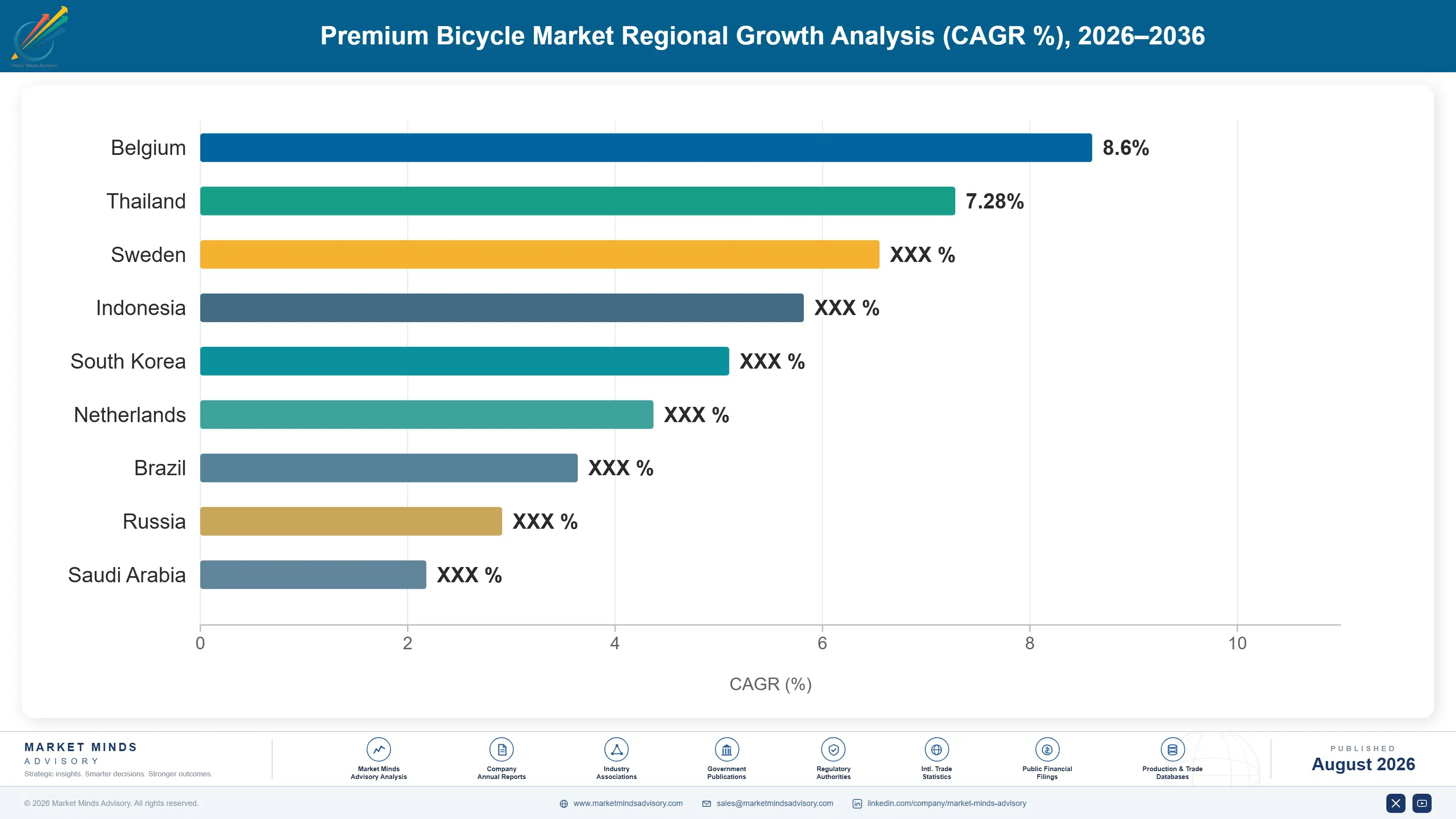
premium-bicycle-market-trends-growth-country-cagr-analysis-1787580859222

Four Moves After the Correction

Two customer bases sit inside this category and most brands serve them through one structure. Certification now gates access from below and resale supports pricing from above. What destroyed value most recently was a forecasting habit rather than anything in the product, and it is entirely repeatable. The habit is the risk, not the product.

Separate the sporting and transport propositions properly

A premium electric mountain bicycle and an electric cargo bike are bought by different people, through different channels, with entirely different service expectations behind them. Brands running both through one structure serve neither well, and dealers report the two customer types visibly uncomfortable in the same showroom. Separating brand, channel and service model costs organisational effort rather than capital, and the brands that did it came through the destocking correction with pricing intact where competitors did not. Electric assistance now covers 46% of premium units, and the two customer groups split that volume very differently between them.
Market Impact: Serves 2 distinct customer bases properly at last

Treat battery certification as a competitive position

Certification requirements following urban fires exclude the cheapest imports from residential storage and from insurance cover, which is the first genuine barrier this industry has had against price competition from below. Brands already running compliant battery and charger systems should be selling that fact rather than treating it as a cost of doing business. Retailers and building managers increasingly ask about it directly. The certification cost is real and it buys market access competitors cannot obtain quickly at any price. Testing costs roughly 400 thousand dollars per battery platform and buys access competitors cannot obtain quickly at all.
Market Impact: Blocks competitors from 2 separate market access routes

Manage resale value as a pricing instrument

Premium bicycles retain roughly 58% of value after three years and resale is now liquid enough that buyers compare net ownership cost rather than sticker price. A brand with strong retention can hold higher new pricing because the effective cost to the customer is lower, and one with weak retention faces an objection at the point of sale it cannot answer. Supporting inspection, warranty transfer and parts availability on the used market costs little and defends new pricing directly. Weak retention is an objection nobody can answer. Retention is measurable and manageable.
Market Impact: Defends new pricing on a 58% retention figure

Shorten ordering cycles before the habit returns

Ordering against eighteen month lead times into pulled-forward demand produced roughly 31% excess channel stock and a discounting cycle that damaged pricing across the industry. Lead times have normalised and the same behaviour is visible returning. Shorter ordering cycles, consignment arrangements and dealer stock visibility all reduce the exposure, at the cost of some manufacturing efficiency. Every brand knows this and the forecasting process rewards optimism, which is why the exercise repeats reliably every cycle. The forecasting process rewards optimism reliably. Nobody is short of evidence here. Memory fades faster than the lesson.
Market Impact: Avoids repeating a 31% channel stock overhang again

Who Controls the Margin Pool

Participation is measured on annual unit shipment volume of complete premium bicycles, and the top five hold 29%. Concentration is moderate because brand preference is regional and dealer relationships are local, even where manufacturing is concentrated in Taiwan and mainland China. Trek and Specialized lead in North America, with Pon and Giant holding the strongest European and global positions respectively. The gap to challengers is dealer network depth.
Competition now runs on three things. Electric system integration decides product credibility, since motor, battery and frame have to work as one and a bought-in system shows. Dealer network quality is the second, and the destocking correction damaged brand relationships that will take years to rebuild. Certification compliance is the third, and it has become an access requirement rather than a differentiator in the markets that adopted it.

The pressure ahead comes from the two customer bases diverging further. Transport cycling is becoming a fleet and subscription business in several European cities, which is a different commercial model from selling a bicycle to a rider. Expect brand separation and channel specialisation rather than acquisitions. Rankings shift as electric penetration rises and as direct brands finish rebuilding the service networks they removed.
premium-bicycle-market-trends-growth-company-positioning-matrix-1787580859759

Competitive Moat and Risk Dimensions

TREK

Moat: Dealer network depth and support

Trek operates one of the deepest specialist dealer networks in premium cycling, with support, training and inventory systems that took decades to build. Through the destocking correction that network absorbed stock and preserved relationships better than competitors managed, and a brand that treats dealers well during a downturn holds shelf position afterwards that discounting cannot buy.
TREK

Risk: North American demand concentration

Revenue concentrates in a North American market where the destocking correction bit hardest and where premium cycling participation is narrower than in Europe. Building European position means competing against brands with deeper local heritage and against dealer relationships that are equally entrenched, on a continent where electric penetration and cycling culture both run well ahead.
PON HOLDINGS

Moat: Multi-brand European portfolio

Pon holds a portfolio spanning sporting and transport cycling across several distinct brands, which lets it serve both customer bases without asking either to shop alongside the other. That structure answers the central commercial problem in this category directly, and assembling an equivalent portfolio now would require acquisitions at prices the correction has not made cheap.
PON HOLDINGS

Risk: Portfolio complexity and overlap

Running many brands across overlapping categories creates internal competition, duplicated development and dealer confusion about which proposition applies where. The structure that serves two customer bases well can also dilute each brand's distinctiveness, and rationalising a portfolio assembled through acquisition is considerably harder than assembling it was.

Players Tracked

Prominent Players

Trek
Specialized
Giant Manufacturing
Pon Holdings
Canyon

Other Key Players

Scott Sports
Merida Industry
Accell Group
Cube Bikes
Bianchi
Santa Cruz Bicycles
Orbea
Pinarello
Riese and Muller
YT Industries
Colnago
Look Cycle
Ridley Bikes
Rose Bikes
Focus Bikes

Recent Developments

JANUARY 2026

Direct-to-consumer brand opens physical service network across European cities

A direct-to-consumer premium bicycle brand opened owned service locations across several European cities, addressing assembly, fitting and warranty repair that courier delivery cannot provide. The arrangement is owned retail rather than any dealer franchise, and it reverses part of the model the brand was founded on.
Signal: Direct brands are rebuilding the physical service capability that their original cost advantage came from removing
AUGUST 2025

City authority requires recognised battery certification for residential storage

A major city authority required recognised certification for electric bicycle batteries stored or charged in residential buildings, following fires involving uncertified imported units. Insurers introduced comparable conditions, effectively excluding non-compliant products from the largest urban market segment. Compliance became an access condition rather than a claim.
Signal: Certification has become market access rather than a quality claim, which finally blocks competition from below
MAY 2026

Resale platform reports premium bicycle value retention data to brands

A used bicycle platform began supplying value retention data to brands, showing measured three year residual performance by model and specification. Several brands have started referencing retention in new bicycle marketing, since buyers increasingly compare net ownership cost rather than purchase price. Retention varies widely by specification level.
Signal: Resale performance has become a pricing input for new bicycles, which brands did not previously control or measure

Frames, Batteries and Freight

Frame assembly accounts for roughly 27% of bicycle cost, with carbon layup and finishing concentrated in Taiwanese, Vietnamese and mainland Chinese production. Drivetrain and braking components add about 24%, dominated by two suppliers whose allocation decisions shape what brands can build. Motor and battery systems carry a further 21% on electric models, and outbound freight is meaningful because a boxed bicycle is bulky and travels a long way.
Component allocation rather than pricing was the defining supply issue of this decade. Drivetrain suppliers rationed output through 2021 and 2022 as demand outran capacity, and brands without allocation could not build regardless of what they were prepared to pay. Several disclosed the constraint in reporting for those years. Allocation has since eased and the dependency remains, since no third supplier has emerged at comparable scale or specification breadth.

Exposure divides on component relationships and manufacturing location. A brand holding long-standing drivetrain allocation builds what it plans, while one buying opportunistically builds what it can source. Manufacturing geography adds a second layer: Taiwanese carbon production carries quality and cost positions that Vietnamese and Chinese alternatives are approaching but have not matched at the highest specifications, per published bicycle trade data.
premium-bicycle-market-trends-growth-cost-volatility-analysis-1787580859953

Secure multi-year drivetrain allocation agreements

Two suppliers dominate premium drivetrain and braking, and allocation rather than price determined what brands could build through the last supply cycle. Multi-year agreements cost commitment flexibility and secure the ability to build a planned range. Brands that relied on spot availability found themselves specifying around what was obtainable rather than what the product needed.

Qualify a second frame manufacturing origin

Taiwanese carbon production holds quality positions at the highest specifications that alternatives are approaching without yet matching, which leaves brands concentrated on one origin. Qualifying Vietnamese or mainland Chinese capacity for mid-premium frames spreads that exposure and improves cost, at the price of tooling duplication and a genuine quality validation programme. Tooling duplication is the real cost here.

Order in shorter cycles even at higher unit cost

Long ordering cycles against long lead times produced roughly 31% excess channel stock and a discounting cycle nobody wanted. Shorter cycles cost manufacturing efficiency and reduce the exposure substantially. The trade is unattractive on a spreadsheet in a strong market and obviously correct after a correction, which is precisely why the industry keeps reverting to the wrong side of it.

Portfolio Architecture for Margin Defence

Margin here tracks brand position and electric content rather than volume. Conventional premium road and mountain bicycles earn margins in the mid twenties, because component specification is transparent to the buyer, comparison is easy and the destocking correction taught customers to wait for a discount. Recovering pricing in that tier has proved considerably harder than brands expected.
Electric models do better at margins in the low to high thirties, because system integration is genuinely difficult, the buyer cannot readily compare motor and battery packages the way component groupsets compare, and certification narrows the field. The range reflects how far a brand integrated the electric system into frame design rather than fitting a bought-in package into a conventional frame. Certification narrows the field further.

Transport and cargo electric bicycles hold interesting economics running into the high thirties, where fleet and subscription arrangements change the revenue model entirely and where service attaches recurring income to the original sale. Those margins reflect a different business rather than a better version of the same one, and few sporting brands have built the capability to capture them. Few sporting brands can capture any of it.

Conventional Premium Road and Mountain

Non-assisted premium bicycles where component specification is transparent and comparison straightforward. The eight point range reflects brand position and dealer terms rather than any product advantage that survives a specification comparison.
Gross Margin: 22-30%

Integrated Electric Sporting Bicycles

Electric mountain, road and gravel bicycles with motor and battery integrated into frame design. The nine point range reflects depth of system integration, from bought-in packages fitted to conventional frames through to purpose-designed platforms.
Gross Margin: 30-39%

Transport, Cargo and Fleet Formats

Urban, commuting and cargo electric bicycles including fleet and subscription arrangements. The nine point range reflects whether revenue is a single sale or a recurring service relationship, which are entirely different economics.
Gross Margin: 31-40%
premium-bicycle-market-trends-growth-portfolio-architecture-1787580860460

High-value Sub-segments and Strategic Watch-out

Integrated Electric Mountain Bicycles

High value and the fastest growth at 9.9%, with assistance genuinely expanding what the sport offers rather than easing it. System integration is difficult enough that buyers cannot compare packages the way they compare groupsets. Service intensity strengthens the dealer position further. Integration depth decides credibility.
Gross Margin: 33-39%

Cargo and Fleet Transport Formats

High value with a recurring revenue model that sporting brands mostly cannot serve. Fleet and subscription arrangements attach service income to the original sale, which is a different business rather than a better margin. Contract terms rather than transactions define the revenue. Sporting brands rarely have the capability.
Gross Margin: 34-40%

Conventional Premium Road and Mountain

The volume core and the tier where the destocking correction did most pricing damage. Component specification is transparent and buyers learned to wait for discounts. Recovery has proved slower than the industry expected. Buyers learned to wait and have not yet unlearned it. Pricing recovery remains incomplete.
Gross Margin: 22-30%

Uncertified Electric Import Competition

The strategic watch-out, now working in the industry's favour. Certification requirements exclude cheap imports from residential storage and insurance cover, which is the first real barrier against price competition from below. Insurance conditions reinforce the certification requirement independently. The barrier arrived when the industry most needed one.
Gross Margin: 12-26%

How the Rider Comes Back

A premium bicycle is a durable purchase with a long replacement interval, which makes new sales lumpy and the attached business steady. Servicing, consumables and upgrades generate recurring revenue through the ownership period, and roughly 72% of premium sales involve physical service access at some point. The bicycle is bought once and the relationship continues, which is why dealer quality matters more to lifetime value than the original transaction margin suggests.
Stickiness varies by customer type more than by product. Sporting customers are brand loyal to a degree unusual in consumer durables, often replacing within the same brand and travelling to a preferred dealer. Transport customers are loyal to proximity and service reliability rather than to a badge, and will switch brand for a shop that fixes things quickly. Fleet arrangements are stickiest of all, since a contract covers a defined term.

The buyer has broadened considerably. Premium cycling was a narrow enthusiast purchase, and electric assistance brought in older riders, returning riders and people replacing a car journey rather than pursuing a sport. Those buyers ask different questions and shop in different places, which several brands have found harder to accommodate than the product engineering ever was.
premium-bicycle-market-trends-growth-end-use-penetration-index-1787580860948

Where We Would Commit Capital

These are among the four positions where our research anticipates prominent divergence between winners and laggards over the coming forecast period. Each is grounded in the demand model, the regulatory perimeter, and the announced capacity pipeline.
01 / PROPOSITION SEPARATION WORK

Run the sporting and transport businesses apart, properly

A premium electric mountain bicycle and an electric cargo bike are bought by different people, through different channels, with entirely different service expectations attached to each. Brands running both through a single structure serve neither well, and dealers consistently report the two customer types visibly uncomfortable sharing a showroom. Separation costs organisational effort rather than capital, and the brands that did it came through the destocking correction with their pricing intact where competitors running a single structure plainly did not.
02 / CERTIFICATION MARKET POSITIONING

Sell the battery approval instead of absorbing its cost

Certification requirements following urban fires exclude the cheapest imports from residential storage and from insurance cover, which is the first genuine barrier this industry has ever had against price competition from below. Brands that already run compliant battery and charger systems should be marketing that fact rather than booking it as a compliance expense. Retailers and building managers both now ask about it directly, and the approval buys a market access that competitors simply cannot obtain quickly at any price.
03 / RESIDUAL VALUE MANAGEMENT

Defend new pricing by supporting the used market

Premium bicycles retain roughly 58% of value after three years and resale has become liquid enough that buyers compare net ownership cost rather than sticker price at the point of decision. A brand with strong retention can hold higher new pricing, because the effective cost to its customer is genuinely lower. Supporting inspection, warranty transfer and long-term parts availability costs very little and defends new pricing in a way that discount discipline on its own has never once managed to.
04 / ORDERING CYCLE DISCIPLINE

Shorten the cycle now, before the habit comes back

Ordering against eighteen month lead times into demand that had already been pulled forward produced roughly 31% excess channel stock and a discounting cycle that damaged pricing across the entire industry. Lead times have normalised and the identical behaviour is visible returning already. Shorter ordering cycles, consignment terms and dealer stock visibility all reduce the exposure at some cost to manufacturing efficiency, which is a trade that every brand accepts after a correction and then forgets again during the next boom.

Engagement Snapshot From the Field

A live engagement with an industry participant carrying material or product regulatory and market exposure ahead of a defining policy shift, showing how our research translates into a defensible multi-year portfolio strategy.
MARKET MINDS ADVISORY · CLIENT ENGAGEMENT SUMMARY
Premium Bicycle Producer Strategic Portfolio Review and Transition Roadmap 2026·Investment Scenario on Premium Bicycle Exposure Evaluation 2025-26
CLIENT PROFILE
A European premium bicycle group selling sporting and urban categories under a single brand through roughly 900 specialist dealers, with annual revenue near 420 million euros (client-reported, unverified by MMA). Electric models accounted for slightly under half of units, and the group had emerged from the destocking correction with heavily discounted channel inventory and damaged dealer relationships.
STRATEGIC CHALLENGE
Dealers were reporting that urban and cargo customers felt out of place in performance-oriented stores while sporting customers questioned the brand's seriousness, and both categories were losing share. Management needed to decide whether to separate the propositions, exit one, or attempt to reposition the single brand to serve both more convincingly.
MMA APPROACH
MMA surveyed 900 dealers on customer behaviour by category, tested brand perception with sporting and transport buyers separately using the quantitative survey base, and modelled the cost of channel separation against exit scenarios for each category. Certification compliance was audited across the electric range. Interviews with 47 experts covered bicycle retail, electric system integration and fleet mobility procurement.
KEY FINDINGS
  1. Dealers reported urban and cargo customers spending materially less time in store and asking fewer questions when performance product dominated the retail environment around them.
  2. Sporting buyers rated the brand's seriousness measurably lower where they were aware of its urban range, and the effect was strongest among the most experienced riders surveyed.
  3. Channel separation would cost roughly 14 million euros over two years in brand, retail fixture and organisational work, against exit costs materially higher for either category.
  4. The electric range already met certification requirements in all markets audited, and the group had never marketed that compliance to retailers or to end customers.
CLIENT PROFILE
A European premium bicycle group selling sporting and urban categories under a single brand through roughly 900 specialist dealers, with annual revenue near 420 million euros (client-reported, unverified by MMA). Electric models accounted for slightly under half of units, and the group had emerged from the destocking correction with heavily discounted channel inventory and damaged dealer relationships.
STRATEGIC CHALLENGE
Dealers were reporting that urban and cargo customers felt out of place in performance-oriented stores while sporting customers questioned the brand's seriousness, and both categories were losing share. Management needed to decide whether to separate the propositions, exit one, or attempt to reposition the single brand to serve both more convincingly.
MMA APPROACH
MMA surveyed 900 dealers on customer behaviour by category, tested brand perception with sporting and transport buyers separately using the quantitative survey base, and modelled the cost of channel separation against exit scenarios for each category. Certification compliance was audited across the electric range. Interviews with 47 experts covered bicycle retail, electric system integration and fleet mobility procurement.
KEY FINDINGS
  1. Dealers reported urban and cargo customers spending materially less time in store and asking fewer questions when performance product dominated the retail environment around them.
  2. Sporting buyers rated the brand's seriousness measurably lower where they were aware of its urban range, and the effect was strongest among the most experienced riders surveyed.
  3. Channel separation would cost roughly 14 million euros over two years in brand, retail fixture and organisational work, against exit costs materially higher for either category.
  4. The electric range already met certification requirements in all markets audited, and the group had never marketed that compliance to retailers or to end customers.
RECOMMENDED STRATEGY
Phase 1: Phase one: separate urban and cargo into a distinct brand and channel, since both customer groups are actively deterred by the shared retail environment. Phase 2: Phase two: market existing battery certification compliance to retailers and buyers, which the group already held and had never used commercially. Phase 3: Phase three: rebuild dealer relationships through shorter ordering cycles and consignment terms, rather than through the discounting that damaged them.
OUTCOME
The group separated its urban and cargo range under a distinct brand during 2026 and reported both categories returning to share growth within three quarters (client-reported, unverified by MMA). Certification compliance became a stated selling point across the electric range, and dealer ordering moved to shorter cycles with consignment on selected models.

Frequently Asked Questions

Foundational context covering the market sizes, CAGR, scope, country, region and competition that inform every finding below. This section is provided to cover basics and most often pre-purchase conversations, answered from the MMA Primary Research Dataset.

What is the current size of the Premium Bicycle Market?

MMA sizes it at USD 22.6 billion in 2025, rising to USD 24.09 billion in 2026. The figure covers complete bicycles sold above premium thresholds through specialist and brand channels.

How large will the Premium Bicycle Market be by 2036?

USD 45.64 billion by 2036, an incremental USD 21.55 billion over the 2026 base and an expansion multiple of 1.89 times. Electric categories account for most of that addition.

What is the CAGR for the Premium Bicycle Market 2026 to 2036?

6.6% in the base case, with a bull case at 7.8% and a bear case at 5.4%. The spread turns on electric penetration and on whether channel over-ordering repeats.

Which segment is growing fastest?

Electric mountain bicycles at 9.9%, half again the market rate of 6.6%. Assistance genuinely expands the terrain and distance a rider can cover rather than merely easing the effort.

Who are the major companies in the Premium Bicycle Market?

Trek, Specialized, Giant Manufacturing, Pon Holdings and Canyon lead on annual unit shipment volume of complete premium bicycles. Fifteen further participants are profiled in the report.

Which country is growing fastest?

China at 8.6%, as urban road cycling participation expands across major cities from a base that scarcely existed a decade ago. Growth there is participation-led rather than replacement-led.

Report Segmentation Architecture

The full report scope spans multiple orthogonal segmentation dimensions, with cross-tabulated demand data provided for each dimension pair. Coverage extends further to regional breakdowns, trend trajectories, and the competitive detail needed to support segment-level decision-making.

By Product Category

  • Premium Road Bicycles
  • Premium Mountain Bicycles
  • Electric Mountain Bicycles
  • Electric Road and Gravel Bicycles
  • Premium Gravel and Adventure Bicycles
  • Premium Urban and Cargo Bicycles

By End-Use Rider Type

  • Competitive and Club Cyclists
  • Recreational Enthusiasts
  • Commuters and Urban Riders
  • Cargo and Family Transport Users
  • Returning and Older Riders
  • Fleet and Subscription Users

By Commercial Dimension

  • Specialist Dealer Retail
  • Brand Owned Retail
  • Direct-to-Consumer Online
  • Fleet and Subscription Supply
  • Employer Cycle Scheme Channels
  • Export and Distributor Sales

By Region

  • North America
  • Western Europe
  • East Asia
  • South Asia and Pacific
  • Latin America
  • Middle East and Africa
  • Eastern Europe

Scope, Methodology, and Coverage

Every figure in this report is reproducible from documented input assumptions. The scope below maps the historical period, the forecast horizon, the segmentation dimensions, and the countries covered, alongside the underlying primary and qualitative methodology.
Historical Period
2020 to 2025
Forecast Period
2026 to 2036
Base Year
2025 (USD billions; MMA Primary Research Dataset, August 2026)
Market Definition
Complete bicycles sold above premium price thresholds through specialist and brand channels, spanning road, mountain, gravel, urban and cargo categories in both conventional and electrically assisted form, measured at brand selling price. Bicycles below premium price thresholds, components and accessories sold separately, electric mopeds and scooters requiring registration, cycle clothing and equipment, and second-hand bicycle transactions are excluded from scope entirely.
Quantitative Units
USD billions (current prices); million units shipped annually; USD per unit by product category and region
Segmentation Dimensions
Product category; end-use rider type; commercial dimension; region
Regions Covered
North America, Western Europe, East Asia, South Asia and Pacific, Latin America, Middle East and Africa, Eastern Europe
Countries Covered
United States, Canada, Germany, Netherlands, Denmark, Italy, France, United Kingdom, Spain, Switzerland, China, Japan, South Korea, Taiwan, India, Australia, Brazil, Colombia, South Africa, Poland
Key Companies Profiled
Trek, Specialized, Giant Manufacturing, Pon Holdings, Canyon, Scott Sports, Merida Industry, Accell Group, Cube Bikes, Bianchi, Santa Cruz Bicycles, Orbea, Pinarello, Riese and Muller, YT Industries, Colnago, Look Cycle, Ridley Bikes, Rose Bikes, Focus Bikes
Quantitative Methodology
Primary survey, n=3,800 respondents, Q4 2025, six countries; demand-side model with trade association cross-validation
Qualitative Methodology
47 expert interviews, Q4 2025; applied to validate demand model assumptions, identify emerging dynamics, and assess competitive positioning
Report Format
PDF and XLSX data workbook (Word format preview document)
Publisher
Market Minds Advisory
Report Code
MMA-2026-AUT-123
Published
August 2026
Contact
sales@marketmindsadvisory.com | www.marketmindsadvisory.com

Purchase the full Premium Bicycle Market Report (2026 to 2036).

The full report separates the sporting and transport businesses that share this category name and sizes each product category independently through 2036. It quantifies the destocking correction and its effect on realised pricing by category, tracks battery certification requirements by jurisdiction, and models resale value retention against new bicycle pricing power. Regional chapters cover all seven regions with dealer network and channel detail where disclosure permits. Competitive profiling covers 20 participants on a single unit shipment basis, alongside electric system integration depth compared across each brand covered.
Sporting and transport propositions sized as separate businesses
Destocking correction quantified against realised pricing by category
Battery certification requirements tracked by jurisdiction
Resale value retention modelled against new pricing power
Twenty participants profiled on one consistent basis
Electric system integration depth compared across brands

Built For The People Who Decide

From boardroom strategy to bench-side execution, this report is read cover-to-cover by leaders shaping the next decade of their industry, turning demand scenarios, market dynamics and valuation benchmarks into decisions.
CXOs/ Presidents/ VPs/ Managers
M&A and Corporate Development
Strategy Teams and R&D Heads
Procurement and Product Directors
Regulatory and Compliance Leaders
Investor Relations and Equity Analysts