Market Minds Advisory
Pregnancy Snacks Market

Pregnancy Snacks Market: Nine-Month Customer Windows, Claim Regulation and Clinical Substantiation

Every customer leaves after nine months whatever the brand does, health claim regulation restricts what a pack may say, and clinical recommendation is displacing the social marketing that built this category.

Lead Analyst

Lisa Gevelber

Published

September 2026

Make Smarter Decisions with Customized Research Insights

Request a free sample report and evaluate market opportunities, growth trends, and competitive dynamics relevant to your business needs.

2025 MARKET VALUE$1.3BMarket Size 2025
2036 FORECAST VALUE$4.3BBase Case , 2026 to 2036
CAGR 2026 TO 203611.6 %Bull 12.8% / Bear 10.4%
INCREMENTAL OPPORTUNITY$2.9BNet 10- year value creation
EXPANSION MULTIPLE3.00x2036 value over 2026 base
Strategic Levers
M&A Pipeline
Regional Outlook
Country Rankings
Competitive Intelligence
Segmental Deep-dive
Call-Us : 91 93563 13602

Executive Snapshot and Market Trajectory

Every customer in this category leaves after roughly nine months and nothing a brand does changes that. There is no lifetime value to build toward, which means acquisition cost must be recovered inside a single pregnancy, and that arithmetic governs how this entire market operates commercially.
Fortified nutrition bars and bites grow at 17.4%, a full 1.50 times the market rate, because a bar carries meaningful fortification in a format that fits a handbag and requires no preparation at a time when many women are managing nausea and unpredictable appetite. East Asia holds 30% of global value because Chinese households direct disproportionate spending toward pregnancy nutrition, which offsets a birth rate that continues falling.
Concentration is extraordinarily low at 14% for the top five, and this category was built almost entirely by specialist direct brands rather than by any large food or nutrition company. Nutrition multinationals are entering now through existing infant formula relationships and pharmacy access, and the regulatory capability they bring matters far more here than in most food categories, because health claim rules on products marketed to pregnant women are unusually restrictive and enforcement is active.
Market Definition
This report covers packaged snack products formulated and marketed for pregnant and breastfeeding women, spanning fortified nutrition bars and bites, lactation support cookies and baked snacks, nausea relief chews and lozenges, fortified beverages and drink mixes, and fortified savoury snacks. Prenatal vitamin supplements in tablet or capsule form, infant formula and baby food, medical nutrition products, general wellness snacks not marketed for pregnancy, and fresh prepared foods are excluded from the sizing.
Base Year Value
$1.3B in 2025 (MMA Primary Research Dataset, August 2026)
Forecast Period
2026 to 2036, eleven discrete annual values
CAGR
11.6% base case. Bull 12.8%. Bear 10.4%.
Fastest Growth Segment
Fortified Nutrition Bars and Bites: 17.4% CAGR
Fastest Growth Country
India: 14.4% CAGR
Fastest Growth Region
South Asia and Pacific: 13.8% CAGR
Largest Region
East Asia: 30% of 2025 global value
Market Leaders
Nestlé, Danone, Abbott Laboratories, Perrigo Company and Munchkin lead on maternal snack revenue. Source: MMA Analysis, July 2026.
Primary Survey
n=3,800 procurement and R&D decision-makers, Q4 2025, six countries
Methodology
Demand-side build-up, cross-validated against public data, 47 expert interviews

Pregnancy Snacks Market Forecast Scenarios

pregnancy-snacks-market-trends-growth-size-forecast-scenario-1787322193227
Between 2020 and 2025 the market compounded at 10.2%, and specialist direct-to-consumer brands drove almost all of it. Social channels reached expectant mothers efficiently and cheaply during a period when in-person antenatal contact was limited, and several brands built genuine scale before any retailer or multinational recognised the category existed as a distinct commercial opportunity.
The base case at 11.6% rests on three mechanisms. Clinical substantiation and healthcare professional recommendation are replacing social marketing, which raises both credibility and realised pricing while widening distribution into pharmacy channels. Emerging market penetration, particularly across India and Southeast Asia, converts home-prepared pregnancy foods into packaged products among rising middle-class consumers. Category breadth expands as brands add formats beyond the lactation cookies and nausea chews that established the market originally.
The bull case at 12.8% turns on obstetric and midwifery recommendation becoming routine rather than occasional, which would move these products from discretionary purchase toward something closer to standard antenatal advice. The bear case at 10.4% is falling birth rates across East Asia and Europe outrunning per-pregnancy spending growth, which would leave value expansion dependent entirely on emerging markets with far lower spend levels.

What Actually Governs Pregnancy Snack Value

The commercial problem here is unlike almost any other food category. A customer enters at the point of pregnancy confirmation, buys for a defined period, and leaves permanently. Acquisition cost must be recovered within roughly nine months against an average total spend near $118, and no subsequent purchase ever arrives. Every cohort has to pay for itself on its own terms.
TOP FIVE CONCENTRATION14%Share held by the five largest maternal nutrition companies
AVERAGE BASKET SPEND$118Typical spend across an entire pregnancy on these snacks
ONLINE CHANNEL SHARE54%Portion of volume sold through direct and marketplace channels
PURCHASE WINDOW9 monthsPeriod a customer typically remains within this category
INGREDIENT COST SHARE38% of COGSFortificants and base ingredients as portion of cost
REPEAT PURCHASE RATE62%Share of buyers who reorder within the same pregnancy
That arithmetic explains why the category built itself online. Direct channels reach women at exactly the moment of category entry through search and social behaviour that signals pregnancy clearly, and subscription formats convert a single acquisition into a predictable nine-month revenue stream. Repeat purchase within the same pregnancy runs around 62%, which is what makes the economics work at all rather than any post-pregnancy relationship.
The regulatory position deserves more attention than it usually gets. Health claims on products marketed to pregnant women are restricted tightly in Europe and scrutinised carefully elsewhere, and brands cannot state or imply benefits that the evidence does not support. That constraint pushes credible participants toward clinical substantiation and healthcare professional channels, and it disadvantages brands whose positioning rests on consumer marketing rather than evidence.
"Every food marketer I know is jealous of the targeting in this category and none of them has thought about the other side of it. You know exactly when your customer arrives and exactly when she leaves, and there is no second chance to earn back what acquiring her cost."
Practice Director, Nutrition and Wellness, Market Minds Advisory · MMA Food and Nutrition Practice · August 2026

Market Trends

Clinical Substantiation Displaces Social Marketing As Credibility Source

The brands that built this category reached customers through social channels and peer recommendation, which worked while the category was new and works considerably less well as it matures and as consumers become more sceptical. Brands investing in clinical substantiation, published dosing evidence and healthcare professional detailing reach obstetricians and midwives whose recommendation carries weight no influencer matches. That route also opens pharmacy distribution, and products carrying clinical positioning realise roughly 34% higher pricing than social-led equivalents. Pharmacy buyers will not list a product on customer reviews alone, and none of them pretend otherwise when asked directly.
Market Impact: Lifts spend 40% per pregnancy

Nausea Relief Becomes The Category Entry Point

First trimester nausea affects a substantial majority of pregnancies and arrives before most women have thought about pregnancy nutrition at all, which makes nausea relief products the moment many customers first enter this category. Brands holding that entry point acquire customers earlier and carry them into fortified formats through the remaining trimesters. The commercial value is sequencing rather than the nausea products themselves, since those are lower priced, and brands understanding that build ranges spanning the whole nine months deliberately. Ranges built without that first trimester product start every relationship late and pay for it.
Market Impact: Lifts customer value 45%

Market Opportunities and Growth Drivers

Rising Maternal Age Increases Nutrition Spending Per Pregnancy

Average maternal age at first birth has risen across every developed market and is rising in emerging ones, and older mothers spend more on pregnancy nutrition and research it considerably more thoroughly before buying. Higher household income at older ages compounds the effect directly. That shift partly offsets falling birth numbers in the markets where both trends run together, which is why value growth in Europe and East Asia continues despite fewer pregnancies occurring each year. First-time mothers over 35 are now a large share of births across Japan, Italy and Spain, and they behave like a different customer entirely.
Market Impact: Recovers cost within 9 months

Subscription Models Fit The Nine-Month Window Precisely

A defined nine-month purchase period suits subscription commerce better than almost any other consumer category, because the customer knows exactly how long she needs the product and the brand knows exactly when the relationship ends. Subscription conversion turns one acquisition into a predictable revenue stream and lifts realised value per customer by roughly 45% against one-off purchasing. It also smooths the cash flow problem that acquisition-heavy direct brands otherwise face continuously. Brands that convert well recover acquisition cost inside the first two months of a pregnancy rather than waiting on repeat orders that may never be placed at all.
Market Impact: Restricts 80% of claim wording

Market Restraints and Challenges

Nine-Month Windows Make Acquisition Economics Genuinely Brutal

Every customer leaves permanently after roughly nine months, which means there is no lifetime value to amortise acquisition cost against and no second purchase cycle to recover a first-year loss. The root cause is biological rather than commercial and no brand strategy alters it. Commercially this caps what participants can spend acquiring customers and punishes anybody who models this category like ordinary consumer packaged goods. Participants are responding with subscription conversion, referral programmes among mothers, and extension into postnatal and infant ranges. Referral works unusually well here because mothers talk to other mothers constantly.
Market Impact: Realises 34% higher pricing

Health Claim Regulation Restricts What Packs May Actually Say

Products marketed to pregnant women face tight restrictions on nutrition and health claims, particularly across Europe where permitted wording is prescribed and unsupported implication is treated seriously. The root cause is appropriate caution about a vulnerable consumer group. Commercially this raises entry cost, slows launches and disadvantages brands whose positioning rests on suggestion rather than evidence. Participants are responding by investing in substantiation, by routing communication through healthcare professionals where different rules apply, and by hiring genuine regulatory capability. Regulatory headcount is now a genuine cost of entry rather than an afterthought for anybody serious about Europe.
Market Impact: Reaches 70% of pregnancies
3 additional market trends, 4 additional growth drivers, and 2 additional restraints and challenges are covered in the full report. Contact sales@marketmindsadvisory.com to access the complete intelligence.

Segment CAGR and Growth Architecture

Segmentation follows product format, because what the product physically is determines when in pregnancy it is bought, the price a consumer will accept, the channel that reaches her and the regulatory claim position the brand can occupy. Fortification level, flavour range and packaging format all sit downstream of that format decision and are priced against it.
pregnancy-snacks-market-trends-growth-market-share-analysis-1787322193765

Fortified Nutrition Bars and Bites

The fastest segment at 17.4%, a full 1.50 times the market rate, covering bars, bites and similar formats carrying meaningful fortification alongside protein and fibre in something a woman can put in a handbag. Practicality drives it. Pregnancy brings unpredictable appetite, nausea at unpredictable times and frequent hunger between meals, and a shelf-stable format requiring no preparation solves all three at once in a way no other product does. Fortification levels are constrained by what regulators permit rather than by formulation capability. What limits the segment is taste, since fortificants including iron carry flavour notes that formulators must mask, and a bar a woman finds unpleasant simply gets abandoned after one purchase.
CAGR 17.4%

Lactation Support Cookies and Baked Snacks

Growing at 14.2% on cookies and baked products marketed for the breastfeeding period, generally containing oats, brewer's yeast, flaxseed and fenugreek in traditional combinations. This segment effectively created the category commercially. Small direct-to-consumer brands built genuine businesses selling lactation cookies through social channels years before any large company recognised the opportunity existed, and the customer loyalty they generated was remarkable for a food product. Claim regulation constrains what these products may state, particularly in Europe where supporting evidence requirements are demanding. What sustains the segment is that it reaches customers at a moment of genuine need, when advice is welcome and price sensitivity is unusually low. Repeat rates within the breastfeeding period are exceptionally high.
CAGR 14.2%
Full segment breakdown across 5 segments available in the complete report.

Regional Architecture and Country Demand Map

East Asia holds 30% of global value on Chinese household spending intensity toward pregnancy nutrition rather than on birth numbers, which are falling steadily. North America follows at 26% on specialist brand development and rising maternal age, while growth runs fastest across South Asia and Pacific on India's birth cohort.

East Asia

China dominates this region on spending intensity rather than birth numbers, which are falling. Chinese families direct disproportionate household spending toward pregnancy and infant nutrition, and maternal products carry premium positioning that Western equivalents rarely achieve. Confinement practice after birth also supports a distinct postnatal nutrition category with no real Western parallel. Domestic brands including Feihe and Yili have extended from infant formula into maternal nutrition using the same clinical and retail relationships. Japanese and Korean demand is smaller but highly developed, with pharmacy channels carrying maternal products and product quality expectations that set regional reference standards. Cross-border e-commerce also carries considerable volume, since Chinese consumers frequently prefer imported maternal nutrition brands and pay accordingly.
Share: 30% | CAGR: 12.8% (2026 to 2036)

North America

Specialist brands built this category here before any large company took it seriously. Direct-to-consumer lactation cookies, prenatal bars and nausea chews established the segment through social channels and word of mouth among expectant mothers, and several reached genuine scale before retail distribution followed. Maternal age at first birth has risen steadily, and older mothers spend more on pregnancy nutrition and research it more thoroughly. Obstetric and midwifery recommendation carries increasing weight as brands invest in clinical substantiation. Retail distribution through pharmacy, grocery and maternity chains has expanded rapidly behind the online brands that proved the demand. Canada follows the same pattern at smaller scale, with pharmacy distribution carrying proportionally more weight than it does south of the border.
Share: 26% | CAGR: 11.1% (2026 to 2036)
Regional intelligence for 5 additional markets available in the complete report: Western Europe, South Asia and Pacific, Latin America, Middle East and Africa, Eastern Europe. Contact sales@marketmindsadvisory.com.
pregnancy-snacks-market-trends-growth-country-cagr-analysis-1787322194277

Where Pregnancy Snack Margin Is Won

Four positions separate brands building durable businesses from those quietly buying customers at a loss they never recover: converting first purchases into nine-month subscriptions, funding clinical substantiation that opens pharmacy channels, owning the nausea entry point where most customers first arrive, and extending into postnatal ranges before the nine-month window closes on them for good.

Convert First Purchases Into Nine-Month Subscription Commitments

A customer who subscribes delivers roughly 45% more revenue than one buying occasionally, and the nine-month window suits subscription better than almost any consumer category because both parties know exactly when it ends. Brands achieving high conversion recover acquisition cost inside the first two months rather than hoping for repeat purchases that may not arrive. The mechanism is checkout design and incentive structure rather than product development, which makes it among the fastest changes any brand here can make. Conversion is measurable weekly, so a brand knows within a month whether the change worked.
Market Impact: Lifts realised customer value 45% per pregnancy window

Fund Clinical Substantiation That Opens Pharmacy Channels

Obstetricians, midwives and pharmacists recommend products supported by evidence and ignore those supported by testimonials, and their recommendation reaches customers at precisely the moment of category entry. Brands investing in published dosing evidence and professional detailing realise roughly 34% higher pricing and access pharmacy distribution that social-led competitors cannot reach at all. The investment is clinical work and regulatory capability rather than marketing spend, and it compounds because evidence does not expire. Pharmacy buyers require substantiation before listing and will not accept customer reviews in its place, which makes this the only reliable route onto those shelves at all.
Market Impact: Realises 34% higher pricing than social-led competing brands

Own The Nausea Entry Point Where Customers Arrive

First trimester nausea affects roughly 70% of pregnancies and arrives before most women have considered pregnancy nutrition at all, which makes nausea relief the moment many customers first enter this category. Brands holding that entry point acquire earlier and carry customers through the remaining trimesters at 28% to 36% lower acquisition cost than competitors entering later. The products themselves are low priced, so the value is sequencing rather than the margin those particular items generate. Building a range that spans all nine months deliberately, starting with nausea, is what separates brands with real cohort economics from those without.
Market Impact: Cuts blended customer acquisition cost by as much as 36%

Extend Into Postnatal Ranges Before The Customer Leaves

The nine-month window closes permanently unless a brand has something to sell afterwards, and postnatal recovery, lactation and eventually infant nutrition all reach the same customer at a moment when she already trusts the brand. Extending the range converts a nine-month relationship into one lasting two years or more, raising lifetime value by 80% to 120%. The extension must be prepared before she leaves rather than attempted afterwards, because reacquiring her costs full price again. Postnatal recovery products cost little to develop against an existing formulation base, and the customer needs no reacquisition because she is already subscribed.
Market Impact: Raises lifetime customer value by up to 120%

Who Controls the Margin Pool

Concentration sits at 14% for the top five measured on maternal snack revenue, the basis used throughout this section, and it is the lowest figure in any food category this practice covers. Nestlé, Danone and Abbott are entering from infant nutrition positions rather than having built the category, Perrigo holds acquired specialist brands, and Munchkin carries genuine maternal brand recognition through Milkmakers.
Competitive activity runs on three fronts. Clinical substantiation is the first and the most consequential, since professional recommendation is displacing the social marketing that built this market. Subscription conversion is the second, and it determines whether acquisition cost is recovered at all within the customer window. The third is range extension into postnatal and infant products, which is the only route to any relationship beyond nine months.

Pressure arrives from two directions. Nutrition multinationals bring regulatory capability, clinical resources and pharmacy relationships that specialist brands cannot match at all. Separately, private label and retailer ranges are appearing as the category proves itself commercially. Rankings will shift as clinical evidence becomes the credibility currency, which favours companies structured to produce it rather than those built on community marketing.
pregnancy-snacks-market-trends-growth-company-positioning-matrix-1787322194799

Competitive Moat and Risk Dimensions

NESTLÉ

Moat: Clinical and regulatory capability

Established clinical research capability, regulatory affairs depth and existing relationships with obstetric and paediatric healthcare professionals give the group access to the recommendation channel that increasingly determines credibility in this category. Infant nutrition distribution through pharmacy across most markets also provides a route to shelf that specialist brands spend years trying to establish.
NESTLÉ

Risk: Slow response to specialist brands

Large nutrition companies were considerably late to recognise this category and specialist brands captured the community credibility that expectant mothers actually respond to. Corporate ownership can also work against a brand in a segment where consumers are unusually alert to commercial motive around a vulnerable moment in their lives.
MUNCHKIN

Moat: Authentic maternal brand recognition

Genuine recognition among mothers built across baby products creates trust that transfers naturally into maternal nutrition, which is precisely the asset large nutrition companies find difficult to manufacture. Retail relationships across maternity and baby channels also reach expectant mothers at exactly the point they are buying everything else for the pregnancy.
MUNCHKIN

Risk: Limited clinical evidence capability

Brand affinity is being displaced by clinical substantiation as the credibility currency in this category, and building published dosing evidence requires research capability a consumer products business has no reason to have developed. Competing against nutrition multinationals on that ground means investment with an uncertain return and a long timeline.

Players Tracked

Prominent Players

Nestlé
Danone
Abbott Laboratories
Perrigo Company
Munchkin

Other Key Players

Majka
Boobie Superfoods
Bumpin' Blends
UpSpring
Pink Stork
Mommy Knows Best
Oat Mama
Rumina Naturals
Bayer
Reckitt Benckiser
Yili Group
Feihe
Meiji Holdings
Morinaga Milk Industry
ByHeart

Recent Developments

FEBRUARY 2025

Clinical dosing study published for maternal fortified snack range

A maternal nutrition brand published a controlled dosing study supporting the fortification levels used across its snack range, moving its positioning away from consumer testimonial and toward the kind of evidence that obstetric and midwifery professionals will actually consider when advising patients on what to buy.
Signal: Published clinical evidence is becoming the credibility currency that social community marketing used to supply on its own
JUNE 2025

Nutrition multinational acquires specialist maternal snack brand

A large nutrition company acquired an established direct-to-consumer maternal snack brand, buying the community credibility and loyal customer base that its own corporate structure had proved genuinely unable to generate organically despite several years of considerable marketing investment behind the attempt. The brand continues operating under its own name.
Signal: Multinationals are buying community credibility because they have found it genuinely impossible to build internally from a standing start
OCTOBER 2025

Postnatal range extension launched ahead of customer departure

A maternal brand launched a postnatal recovery and lactation range designed specifically to retain customers past the nine-month window that otherwise ends every relationship in this category permanently, extending the addressable period toward two years and removing the need to reacquire anybody. Existing subscribers were offered it first.
Signal: Range extension beyond pregnancy is the only route any brand here has to lifetime value worth the name

What Drives Pregnancy Snack Cost

Ingredients and fortificants account for roughly 38% of manufactured cost, with algal omega-3 oils, encapsulated iron and folate carrying premiums well above ordinary food ingredients. Contract manufacturing and co-packing add around 16%. Packaging contributes about 14%, fulfilment and shipping a further 14% given the direct channel weighting, and regulatory, testing and quality documentation roughly 7% across a typical product.
Cocoa pricing rose sharply through 2024 and remained elevated, which hit bar and baked formats since chocolate coating is the usual way to make iron fortification palatable. Oat and nut costs moved with agricultural conditions. Algal omega-3 supply is concentrated among few producers and pricing reflects that. World Health Organization maternal nutrition guidance shapes fortification levels, and United States Food and Drug Administration rules govern what those levels permit brands to state.

The disadvantage mechanism is customer acquisition rather than ingredients, and it does not appear in cost of goods at all. A brand paying heavily for online acquisition against an average pregnancy spend near $118 has very little room, and the nine-month window offers no recovery period. Exposure also varies by channel: pharmacy and retail distribution carry margin cost but no acquisition spend, which is a genuinely different economic model.
pregnancy-snacks-market-trends-growth-cost-volatility-analysis-1787322194993

Formulate around fortificants that do not require masking

Encapsulated and chelated mineral forms cost more per unit but need less flavour masking, which reduces cocoa, sugar and flavouring content substantially and frequently nets out cheaper overall. It also produces a product women actually finish rather than abandon after one purchase. Formulation work is upfront and the benefit recurs across every unit made afterwards.

Shift channel mix toward pharmacy and retail distribution

Retail and pharmacy carry trade margin but eliminate the customer acquisition spending that dominates direct channel economics, and in a category with a nine-month window that trade is frequently favourable. Professional recommendation also delivers customers who arrive already convinced. The requirement is clinical substantiation that pharmacy buyers will accept, which is investment rather than negotiation.

Contract algal omega-3 supply on multi-year committed terms

Algal omega-3 production is concentrated among a small number of producers, and spot purchasing exposes formulators to pricing they cannot influence at all. Multi-year contracted volume secures both supply and predictable cost on an ingredient central to most prenatal positioning. The commitment carries volume risk against demand that remains difficult to forecast in a young category.

Portfolio Architecture for Margin Defence

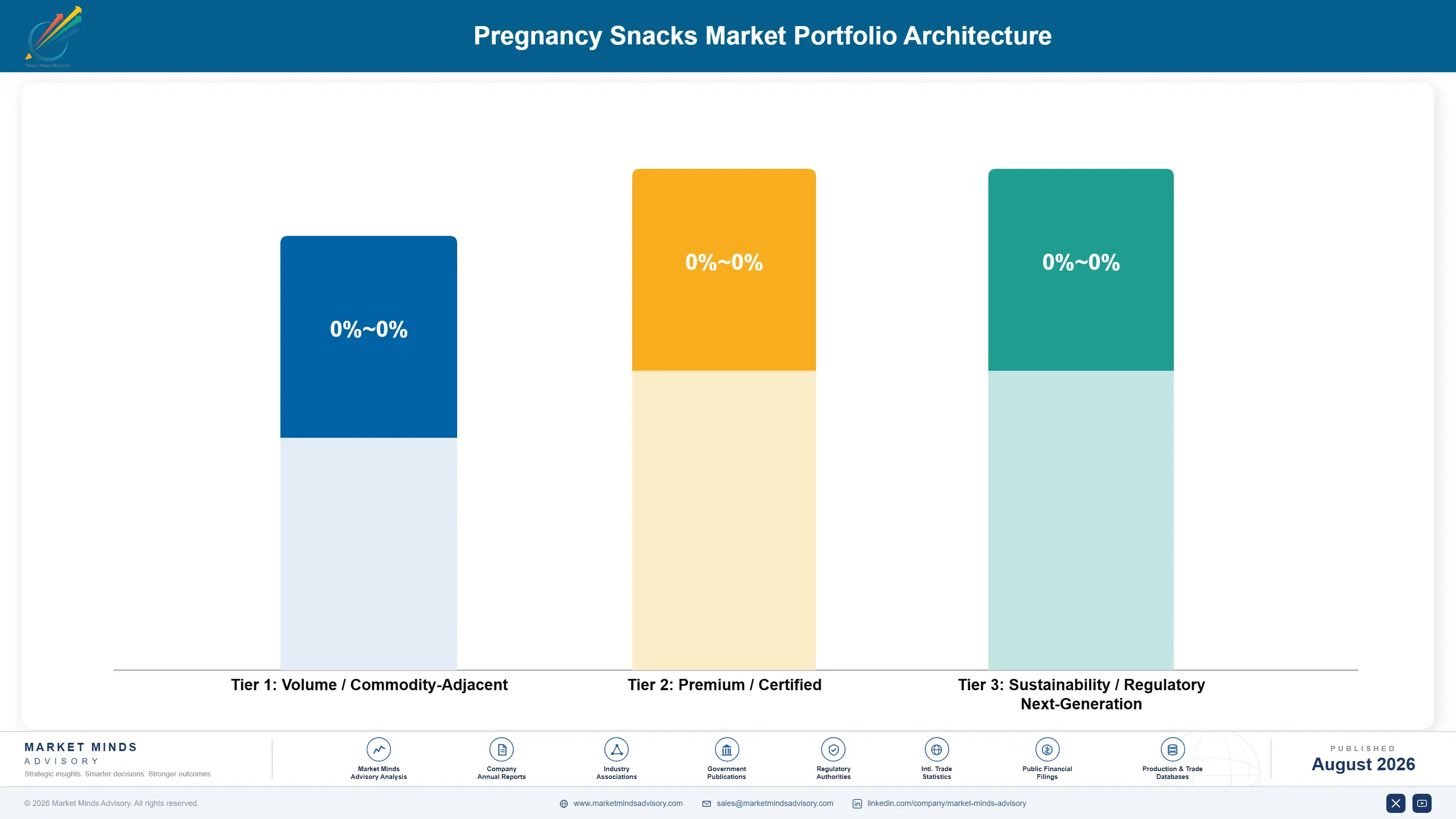
Portfolio economics here divide on channel and evidence rather than on product format. Direct online sales acquired through paid social and search earn gross margins that look healthy until acquisition cost is deducted, at which point contribution frequently disappears entirely on customers who do not convert to subscription within the first month. Format matters far less than how the customer arrived and what she was told.
The premium tier is subscription-converted direct customers. A subscriber delivers roughly 45% more revenue across the pregnancy while requiring the same single acquisition, which transforms the unit economics completely. Margins after acquisition run in the high twenties, and the predictability matters as much as the level does. Conversion rates vary enormously between brands, and the gap has more to do with checkout design than with anything about the product itself.

Above both sits pharmacy and clinically-detailed distribution. Professional recommendation delivers customers who arrive already convinced and cost nothing to acquire, and clinical positioning supports pricing roughly a third above social-led equivalents. Trade margin applies but no acquisition spending does, and margins reach the mid thirties. That position requires clinical substantiation that takes years and real money to build properly.

Volume / Commodity-Adjacent

One-off direct online sales acquired through paid social and search. Gross margin looks healthy until acquisition cost is deducted, and contribution frequently disappears on customers who never subscribe. Cohort profitability turns on subscription conversion alone.
Gross Margin: 14 to 21%

Premium / Certified

Subscription-converted direct customers across the pregnancy window. The range reflects conversion rates and how early in pregnancy the customer was acquired, which varies enormously between brands. Predictability of revenue matters here as much as the margin level does.
Gross Margin: 26 to 34%

Sustainability / Regulatory / Next-Generation

Pharmacy and clinically-detailed distribution supported by published evidence. The range spans basic professional listing through to full clinical detailing programmes with obstetric and midwifery engagement. The range is wide because clinical detailing depth varies enormously between participants.
Gross Margin: 33 to 41%
pregnancy-snacks-market-trends-growth-portfolio-architecture-1787322195496

High-value Sub-segments and Strategic Watch-out

Clinically Detailed Pharmacy Distribution

High value and high growth sitting squarely together. Professional recommendation delivers customers who arrive already convinced and cost nothing to acquire, and clinical positioning supports pricing roughly a third above anything social marketing achieves on comparable products. The wide range reflects how much clinical detailing a brand funds.
Gross Margin: 34 to 42%

Subscription Converted Direct Customers

High value running on genuinely strong growth. A subscriber delivers around 45% more revenue across the pregnancy against exactly the same single acquisition cost, which is what makes the direct model work at all rather than merely appear to. The range reflects conversion rates, which vary enormously between brands.
Gross Margin: 26 to 34%

Nausea Relief Entry Products

The acquisition gateway of this whole category. First trimester nausea reaches roughly 70% of pregnancies before most women consider nutrition at all, and brands holding that moment carry customers through every subsequent trimester at far lower cost. The range reflects format cost, since chews and lozenges differ.
Gross Margin: 22 to 30%

One-Off Paid Acquisition Sales

The strategic watch-out sitting squarely inside this portfolio. Volumes are real and the channel is straightforward to enter, but acquisition cost consumes most of the contribution and a nine-month window offers no recovery period whatsoever. The range reflects acquisition cost, which varies by channel and timing.
Gross Margin: 14 to 21%

How Pregnancy Snack Demand Repeats

This category has the shortest customer relationship in packaged food and the most predictable one. A customer enters at pregnancy confirmation, buys across roughly nine months at a repeat rate near 62% within that window, and then leaves permanently unless the brand has built something postnatal to sell her. Everything commercial follows from that shape rather than from anything about the products themselves.
Stickiness within the window is genuinely high and outside it is zero. A woman who finds a product she tolerates during nausea and continues into later trimesters rarely switches, because experimenting during pregnancy is not something most people want to do. Subscription reinforces that further. Once the pregnancy ends, however, no loyalty carries forward at all unless a postnatal or infant range captures her before she stops looking.

The buyer profile has shifted noticeably. Early customers discovered these products through social communities and peer recommendation among other expectant mothers. Today's customer increasingly arrives through obstetric or midwifery advice, or having researched the clinical evidence herself, which favours brands able to answer questions about dosing and substantiation rather than those relying on community enthusiasm.
pregnancy-snacks-market-trends-growth-end-use-penetration-index-1787322195987

Where To Compete And Why

These are among the four positions where our research anticipates prominent divergence between winners and laggards over the coming forecast period. Each is grounded in the demand model, the regulatory perimeter, and the announced capacity pipeline.
01 / SUBSCRIPTION CONVERSION DISCIPLINE

One acquisition must fund nine months

A subscriber delivers roughly 45% more revenue than an occasional buyer against exactly the same single acquisition cost, and the nine-month window suits subscription better than almost any consumer category because both parties know when it ends. Brands achieving high conversion recover acquisition inside two months rather than hoping for repeats that may never come. The mechanism is checkout design and incentive structure rather than any product development at all, which makes it the fastest change available to any brand in this category and the cheapest one to test.
02 / CLINICAL EVIDENCE INVESTMENT

Professionals ignore testimonials entirely

Obstetricians, midwives and pharmacists recommend products supported by published evidence and disregard those supported by customer testimonials, and their recommendation reaches women at precisely the moment of category entry. Brands funding dosing evidence and professional detailing realise roughly 34% higher pricing and reach pharmacy distribution social-led competitors cannot access. The investment is clinical work and regulatory capability rather than marketing spend, and it compounds year after year because published evidence does not expire the way a marketing campaign does the moment spending stops.
03 / ENTRY POINT OWNERSHIP

Nausea arrives before nutrition does

First trimester nausea affects roughly 70% of pregnancies and arrives before most women have thought about pregnancy nutrition at all, which makes relief products the moment many customers first enter this category. Brands holding that entry acquire earlier and carry customers through remaining trimesters at 28% to 36% lower acquisition cost. The products themselves are low priced, so the commercial value lies entirely in sequencing rather than in the margin those particular items generate, and brands that miss this build ranges starting far too late.
04 / POSTNATAL RANGE EXTENSION

Build the next range before she leaves

The nine-month window closes permanently unless a brand already has something to sell afterwards, and postnatal recovery, lactation and infant nutrition all reach the same customer while she still trusts the brand. Extending converts a nine-month relationship into one lasting two years or more, raising lifetime value by 80% to 120%. The extension must already exist before she leaves rather than being attempted afterwards, because a customer who has stopped looking costs the full acquisition price to win back a second time.

Engagement Snapshot From the Field

A live engagement with an industry participant carrying material or product regulatory and market exposure ahead of a defining policy shift, showing how our research translates into a defensible multi-year portfolio strategy.
MARKET MINDS ADVISORY · CLIENT ENGAGEMENT SUMMARY
Pregnancy Snacks Producer Strategic Portfolio Review and Transition Roadmap 2026·Investment Scenario on Pregnancy Snacks Exposure Evaluation 2025-26
CLIENT PROFILE
A North American maternal nutrition brand with annual revenue near $41 million (client-reported, unverified by MMA), roughly 92% of it from direct online sales acquired through paid social and search. The business held genuine community credibility built across six years and strong product affinity, but subscription conversion below a quarter of first purchases, no clinical substantiation and no pharmacy distribution at all.
STRATEGIC CHALLENGE
Customer acquisition costs had risen steadily while average pregnancy spend had not, and contribution after acquisition had turned negative on non-subscribing customers. Management needed to decide between improving subscription conversion, funding clinical evidence to reach pharmacy channels, or extending into postnatal ranges to capture value beyond the nine-month window. None of the three was obviously right.
MMA APPROACH
MMA modelled contribution by customer cohort against acquisition timing and channel, benchmarked subscription conversion against comparable direct nutrition brands, and assessed the clinical study requirement for pharmacy listing. Nineteen expert interviews with obstetricians, midwives, pharmacy buyers and recent customers tested how purchase decisions were actually being made and when. Cohort data covered thirty months of trading.
KEY FINDINGS
  1. Customers acquired during the first trimester subscribed at more than double the rate of those acquired later, which made acquisition timing the single largest determinant of whether a cohort was profitable at all.
  2. Non-subscribing customers generated negative contribution after acquisition cost across every channel tested, meaning the business was effectively paying for a majority of its customers.
  3. Pharmacy buyers uniformly required published substantiation before listing, and none would consider the client's range on community credibility or customer reviews alone.
  4. Postnatal extension tested strongly with existing customers, who reported wanting to continue with a brand they trusted rather than researching a new one while caring for a newborn.
CLIENT PROFILE
A North American maternal nutrition brand with annual revenue near $41 million (client-reported, unverified by MMA), roughly 92% of it from direct online sales acquired through paid social and search. The business held genuine community credibility built across six years and strong product affinity, but subscription conversion below a quarter of first purchases, no clinical substantiation and no pharmacy distribution at all.
STRATEGIC CHALLENGE
Customer acquisition costs had risen steadily while average pregnancy spend had not, and contribution after acquisition had turned negative on non-subscribing customers. Management needed to decide between improving subscription conversion, funding clinical evidence to reach pharmacy channels, or extending into postnatal ranges to capture value beyond the nine-month window. None of the three was obviously right.
MMA APPROACH
MMA modelled contribution by customer cohort against acquisition timing and channel, benchmarked subscription conversion against comparable direct nutrition brands, and assessed the clinical study requirement for pharmacy listing. Nineteen expert interviews with obstetricians, midwives, pharmacy buyers and recent customers tested how purchase decisions were actually being made and when. Cohort data covered thirty months of trading.
KEY FINDINGS
  1. Customers acquired during the first trimester subscribed at more than double the rate of those acquired later, which made acquisition timing the single largest determinant of whether a cohort was profitable at all.
  2. Non-subscribing customers generated negative contribution after acquisition cost across every channel tested, meaning the business was effectively paying for a majority of its customers.
  3. Pharmacy buyers uniformly required published substantiation before listing, and none would consider the client's range on community credibility or customer reviews alone.
  4. Postnatal extension tested strongly with existing customers, who reported wanting to continue with a brand they trusted rather than researching a new one while caring for a newborn.
RECOMMENDED STRATEGY
Phase 1: Phase one: rebuild subscription conversion through checkout redesign and first trimester acquisition targeting, since it corrects negative contribution without any new investment. Phase 2: Phase two: launch a postnatal range to existing customers before they leave the window, using a channel that costs nothing to reach and a trust position already earned. Phase 3: Phase three: fund a clinical dosing study to open pharmacy distribution, accepting the timeline and cost as the price of reaching professionally recommended channels.
OUTCOME
The client lifted subscription conversion from 24% to 51% of first purchases within nine months and returned every acquisition channel to positive contribution (client-reported, unverified by MMA). Postnatal revenue reached $7 million in the first year, blended gross margin improved by roughly nine points, and the clinical study is underway toward pharmacy listing in 2027.

Frequently Asked Questions

Foundational context covering the market sizes, CAGR, scope, country, region and competition that inform every finding below. This section is provided to cover basics and most often pre-purchase conversations, answered from the MMA Primary Research Dataset.

What is the current size of the Pregnancy Snacks Market?

The global pregnancy snacks market was valued at $1.30 billion in 2025, reaching an estimated $1.45 billion in 2026. That covers packaged snacks formulated and marketed for pregnant and breastfeeding women.

How large will the Pregnancy Snacks Market be by 2036?

MMA forecasts the market reaching $4.35 billion by 2036, an increase of $2.90 billion over the 2026 base. That represents an expansion multiple of 3.00 times across the forecast period.

What is the CAGR for the Pregnancy Snacks Market 2026 to 2036?

The base case compound annual growth rate is 11.6%, with a bull case of 12.8% and a bear case of 10.4%. Historical growth between 2020 and 2025 ran at 10.2% annually.

Which segment is growing fastest?

Fortified nutrition bars and bites grow at 17.4%, a full 1.50 times the market rate, on convenience and fortification density. Lactation support cookies and baked snacks follow at 14.2% annually.

Who are the major companies in the Pregnancy Snacks Market?

Nestlé, Danone, Abbott Laboratories, Perrigo Company and Munchkin lead on maternal snack revenue. Together they account for roughly 14%, the lowest concentration in any food category we cover.

Which country is growing fastest?

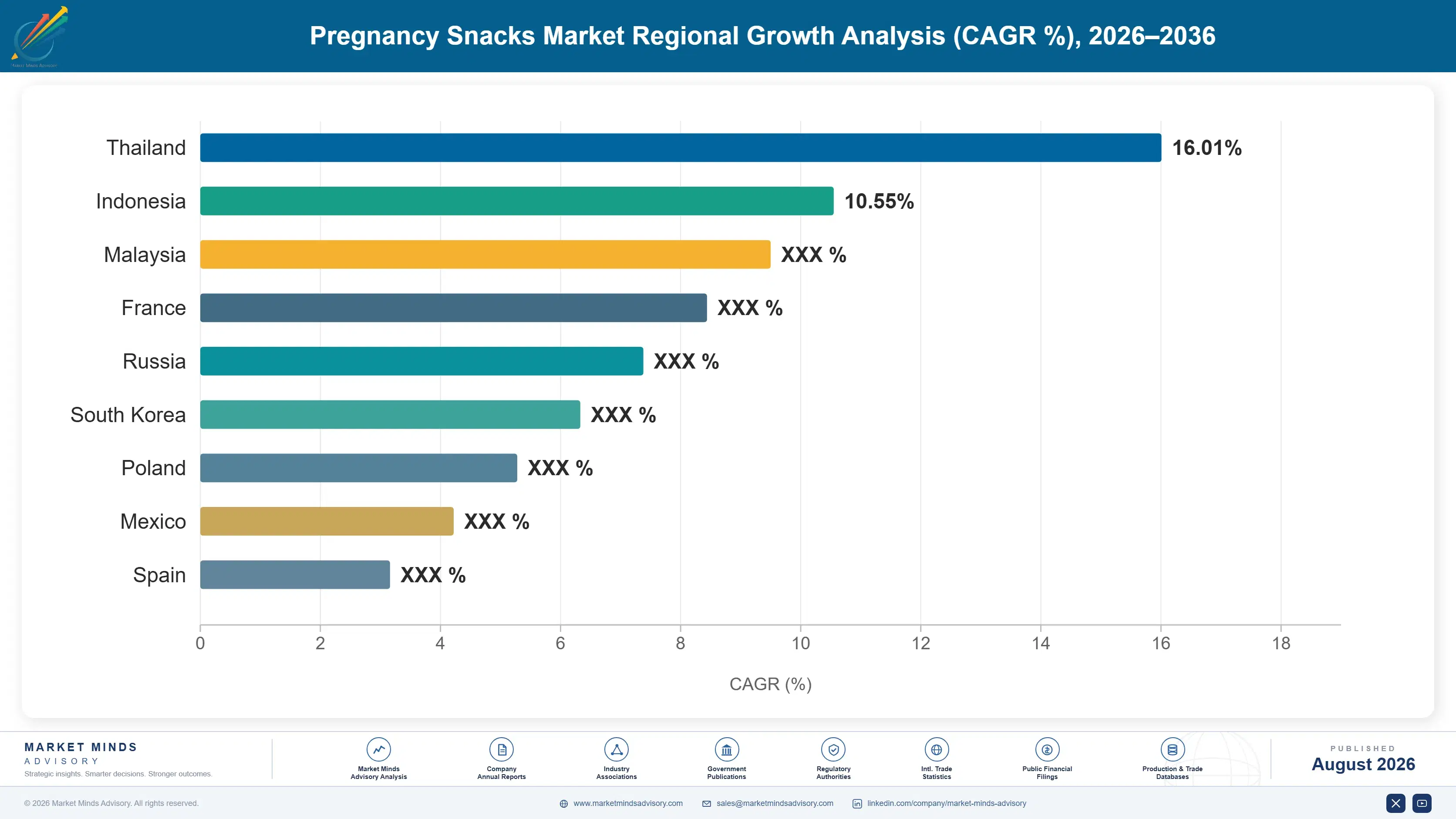
India grows fastest at 14.4% annually, driven by the largest annual birth cohort anywhere combined with rising middle-class incomes converting home-prepared foods into packaged products. Indonesia follows.

Report Segmentation Architecture

The full report scope spans multiple orthogonal segmentation dimensions, with cross-tabulated demand data provided for each dimension pair. Coverage extends further to regional breakdowns, trend trajectories, and the competitive detail needed to support segment-level decision-making.

By Product Format

  • Fortified Nutrition Bars and Bites
  • Lactation Support Cookies and Baked Snacks
  • Nausea Relief Chews and Lozenges
  • Fortified Beverages and Drink Mixes
  • Fortified Savoury and Trail Snacks

By End-Use Industry

  • First Trimester Nausea Management
  • Second and Third Trimester Nutrition
  • Breastfeeding and Lactation Support
  • Postnatal Recovery Nutrition
  • Gestational Dietary Management
  • Maternity Hospital and Clinic Supply

By Commercial Dimension

  • Direct-to-Consumer Online Sales
  • Subscription and Auto-Replenishment Programmes
  • Pharmacy and Healthcare Channel
  • Grocery and Maternity Retail
  • Marketplace and Third-Party Platform Sales

By Region

  • North America
  • Western Europe
  • East Asia
  • South Asia and Pacific
  • Latin America
  • Middle East and Africa
  • Eastern Europe

Scope, Methodology, and Coverage

Every figure in this report is reproducible from documented input assumptions. The scope below maps the historical period, the forecast horizon, the segmentation dimensions, and the countries covered, alongside the underlying primary and qualitative methodology.
Historical Period
2020 to 2025
Forecast Period
2026 to 2036
Base Year
2025 (USD billions; MMA Primary Research Dataset, August 2026)
Market Definition
This report covers packaged snack products formulated and marketed specifically for pregnant and breastfeeding women, spanning fortified nutrition bars and bites, lactation support cookies and baked snacks, nausea relief chews and lozenges, fortified beverages and drink mixes, and fortified savoury snacks, across direct, pharmacy, grocery and clinical channels. Prenatal vitamin supplements in tablet or capsule form, infant formula and baby food, medical nutrition products, general wellness snacks not marketed for pregnancy, and fresh prepared foods are excluded from the sizing.
Quantitative Units
USD billions at brand realised value; units shipped in millions; average spend in USD per pregnancy.
Segmentation Dimensions
By product format; by end-use industry; by commercial dimension; by region.
Regions Covered
North America, Western Europe, East Asia, South Asia and Pacific, Latin America, Middle East and Africa, Eastern Europe
Countries Covered
China, Japan, South Korea, India, Indonesia, Vietnam, Australia, United States, Canada, Mexico, Brazil, United Kingdom, Germany, France, Italy, Spain, Turkey, Saudi Arabia, Nigeria, Poland.
Key Companies Profiled
Nestlé, Danone, Abbott Laboratories, Perrigo Company, Munchkin, Majka, Boobie Superfoods, UpSpring, Pink Stork, Mommy Knows Best, Bayer, Reckitt Benckiser, Yili Group, Feihe and others.
Quantitative Methodology
Primary survey, n=3,800 respondents, Q4 2025, six countries; demand-side model with trade association cross-validation
Qualitative Methodology
47 expert interviews, Q4 2025; applied to validate demand model assumptions, identify emerging dynamics, and assess competitive positioning
Report Format
PDF and XLSX data workbook (Word format preview document)
Publisher
Market Minds Advisory
Report Code
MMA-2026-AGR-054
Published
August 2026
Contact
sales@marketmindsadvisory.com | www.marketmindsadvisory.com

Purchase the full Pregnancy Snacks Market Report (2026 to 2036).

The full report sizes the pregnancy snacks market across five product formats, six use occasions and seven regions, with unit shipment and spend-per-pregnancy detail behind every value estimate. It profiles twenty companies on clinical substantiation, subscription conversion and channel reach. Regional chapters cover birth cohort trends, health claim regulation and pharmacy channel structure by market. Unit economics analysis quantifies acquisition cost against the nine-month customer window by channel. Regulatory analysis maps permitted claim wording for maternal products across the major jurisdictions governing this category, with commentary on how enforcement differs in practice.
Unit shipment and spend detail by product format
Health claim regulation comparison across major jurisdictions
Subscription conversion benchmarking across direct brands
Acquisition cost against nine-month window economics
Competitive position assessments across twenty companies
Birth cohort and maternal age trends by regional market

Built For The People Who Decide

From boardroom strategy to bench-side execution, this report is read cover-to-cover by leaders shaping the next decade of their industry, turning demand scenarios, market dynamics and valuation benchmarks into decisions.
CXOs/ Presidents/ VPs/ Managers
M&A and Corporate Development
Strategy Teams and R&D Heads
Procurement and Product Directors
Regulatory and Compliance Leaders
Investor Relations and Equity Analysts