Market Minds Advisory
Prefilled Syringes Drug Molecules Market

Prefilled Syringes Drug Molecules Market: Viscosity Ceilings, Filling Capacity, and Biosimilar Erosion

A biologic worth billions is judged partly by a glass barrel it was never designed for, where silicone droplets aggregate protein and filling capacity rather than regulatory approval decides the launch date.

Lead Analyst

Alice Ballenger

Published

September 2026

Make Smarter Decisions with Customized Research Insights

Request a free sample report and evaluate market opportunities, growth trends, and competitive dynamics relevant to your business needs.

2025 MARKET VALUE$68.5BMarket Size 2025
2036 FORECAST VALUE$184.0BBase Case , 2026 to 2036
CAGR 2026 TO 20369.4 %Bull 10.6% / Bear 8.2%
INCREMENTAL OPPORTUNITY$109.1BNet 10- year value creation
EXPANSION MULTIPLE2.46x2036 value over 2026 base
Strategic Levers
M&A Pipeline
Regional Outlook
Country Rankings
Competitive Intelligence
Segmental Deep-dive
Call-Us : 91 93563 13602

Executive Snapshot and Market Trajectory

The prefilled syringe was designed for small volumes of well-behaved liquid, and it now carries the most valuable biologics in medicine. Silicone droplets nucleate protein aggregation and 34% of products already exceed the viscosity a standard barrel delivers comfortably. Both are artefacts of the container rather than the medicine.
Growth comes from metabolic medicine rather than from immunology, which carried the previous decade. Incretin and metabolic peptides grow fastest at 14.1%, exactly 1.50 times the market rate, and they consumed the filling capacity everybody else needed. Monoclonal antibodies and fusion proteins follow at 10.2% on newer targets. North America sits far above its framework band because United States biologic pricing runs at multiples of European reference levels for identical products.
Concentration reaches 44% across the top five measured on annual prefilled presentation revenue, held by metabolic and immunology originators rather than by any device company. Nested sterile filling lines run at 91% utilisation, which makes capacity rather than approval the practical gate on launch. Biosimilar entry removes 62% of price within three years. Metabolic peptides have not yet faced that, and the revenue base is far larger.
Market Definition
This market covers drug molecules commercialised in prefilled syringe presentation, including staked-needle and luer-lock syringes and prefilled syringes housed within autoinjector or on-body delivery systems, measured at manufacturer realised drug revenue. Scope spans monoclonal antibodies, fusion proteins, metabolic peptides, insulins, vaccines, recombinant proteins, and small molecule injectables. Empty syringe components, primary container manufacture, autoinjector hardware sold separately, vials and cartridges, and infusion presentations are excluded.
Base Year Value
$68.5B in 2025 (MMA Primary Research Dataset, August 2026)
Forecast Period
2026 to 2036, eleven discrete annual values
CAGR
9.4% base case. Bull 10.6%. Bear 8.2%.
Fastest Growth Segment
Incretin And Metabolic Peptides: 14.1% CAGR
Fastest Growth Country
China: 15.8% CAGR
Fastest Growth Region
South Asia and Pacific: 11.4% CAGR
Largest Region
North America: 41% of 2025 global value
Market Leaders
Novo Nordisk. Eli Lilly. AbbVie. Sanofi. Amgen. Source: MMA Analysis based on company annual reports.
Primary Survey
n=3,800 procurement and R&D decision-makers, Q4 2025, six countries
Methodology
Demand-side build-up, cross-validated against public data, 47 expert interviews

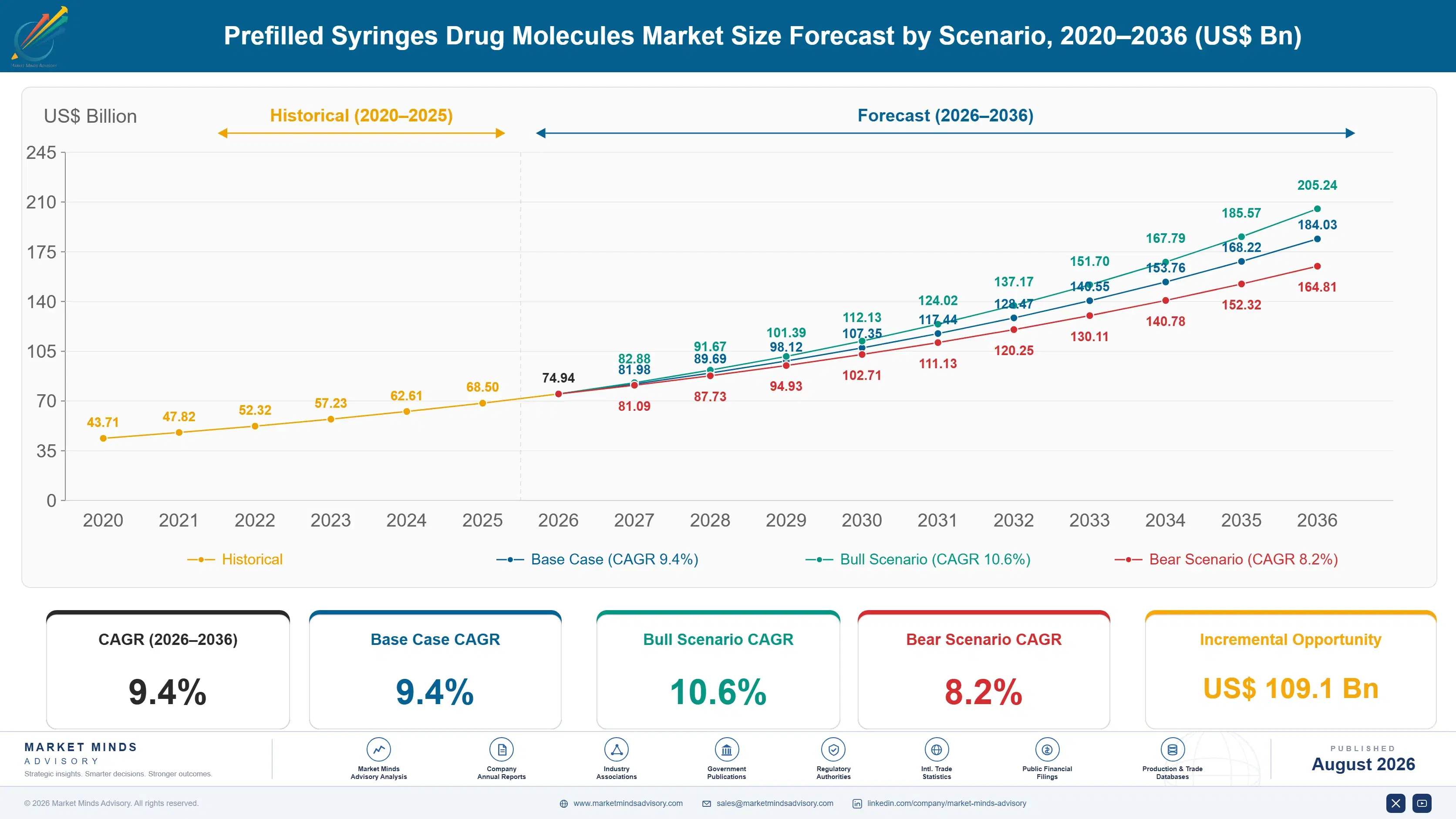
Prefilled Syringes Drug Molecules Market Forecast Scenarios

prefilled-syringes-drug-molecules-market-size-forecast-scenario-1787299166175
The 2020 to 2025 period changed which molecules matter here. Immunology biologics that had driven prefilled growth for a decade met biosimilar entry and lost most of their price, while metabolic peptides arrived and consumed every unit of spare filling capacity in the industry. Vaccine demand distorted the early years further. An 8.1% historical rate averages severe price erosion in one therapeutic area against explosive volume growth in another.
Three mechanisms carry the 9.4% base case. Metabolic peptide expansion is the largest, since obesity and diabetes indications reach patient populations an order of magnitude beyond anything immunology addressed. Self-administration migration is the second, with roughly 67% of all doses now given outside any clinical supervision. And Asian biologic access is the third, where national reimbursement listings keep adding products that were previously unaffordable to the great majority of patients there.
The 10.6% bull case rests on filling capacity expansion arriving fast enough to serve approved demand, which currently it does not. The 8.2% bear case is biosimilar entry accelerating across the metabolic peptide class as composition patents expire, repeating the 62% price erosion that immunology has already absorbed but against a far larger revenue base.

A Container the Molecules Outgrew

Two technical problems sit underneath this entire market. Silicone oil applied to let the plunger move nucleates protein aggregation in sensitive biologics, and tungsten residue left from forming the needle hole does the same. Both are container artefacts that have nothing to do with the molecule, and both surface as immunogenicity questions during development rather than as engineering ones, and neither has anything to do with the medicine itself.
TOP FIVE CONCENTRATION44%Concentrated among metabolic and immunology originator developers today
BIOLOGIC SHARE OF VALUE78%Large molecule products rather than small molecule injectables
HIGH CONCENTRATION FORMULATIONS34%Products exceeding the viscosity a standard barrel handles comfortably
FILLING LINE UTILISATION91%Nested sterile syringe capacity across contract and captive sites
HOME ADMINISTRATION SHARE67%Doses self-administered outside any clinical supervision setting whatsoever
BIOSIMILAR VALUE EROSION62%Price decline observed within three years of first entry
The second problem is viscosity. Around 34% of products now exceed the concentration a standard barrel and staked needle deliver in an acceptable injection time at tolerable thumb force. Options are all expensive: larger bore needles that patients dislike, on-body injectors that cost more than the syringe, co-formulation with hyaluronidase to permit larger volumes, or formulation science that is genuinely difficult to execute at these concentrations.
Two forces shape the next decade. Nested sterile filling capacity runs at 91% utilisation, which makes securing a line rather than obtaining approval the practical constraint on launch timing. And biosimilar entry removes 62% of price within three years, which the metabolic class has not yet experienced. Neither force can be influenced by commercial effort at all, which boards find uncomfortable.
"We keep seeing development programmes where the formulation team hands over a hundred and fifty milligram per millilitre biologic and the device team is expected to make it injectable in ten seconds. Nobody sat in a room together at the start. That conversation costs eighteen months when it happens late, and it happens late almost every time."
Director. Injectable Delivery and Combination Products Practice · MMA Pharmaceut

Market Trends

Metabolic Peptides Consumed The Industry's Filling Capacity

Incretin therapies for diabetes and obesity reach patient populations far larger than immunology biologics ever addressed, and every dose needs a sterile filled presentation. Nested syringe filling lines now run at around 91% utilisation across contract and captive sites combined, and new capacity takes three to four years to qualify and commission. The practical consequence is that a molecule can hold approval and still not launch, because no line is available. Developers without secured capacity are negotiating against companies who booked slots years ahead of their own approvals. Booking a slot has become a strategic decision.
Market Impact: Two thirds, or 67% of doses
High Concentration Formulations Exceed What Barrels Deliver

Subcutaneous administration caps practical injection volume near one to two millilitres, so higher doses mean higher concentration, and around 34% of products now sit above what a standard barrel and staked needle deliver at tolerable glide force. Protein solutions become non-Newtonian at these concentrations and injection times stretch beyond what patients accept. The industry answers with hyaluronidase co-formulation permitting larger volumes, wider bore needles, on-body injectors, and viscosity-reducing excipients, and each answer adds cost or complexity the original presentation avoided entirely. Protein solutions turn non-Newtonian at these concentrations, and injection times stretch past patient tolerance.
Market Impact: China grows at 15.8% annually

Market Opportunities and Growth Drivers

Self-Administration Now Carries Two Thirds Of Doses

Around 67% of prefilled doses are given by patients or carers outside any clinical supervision, which is the reason the presentation exists at all. Payers favour it because it removes infusion chair time and nursing cost, and patients favour it because a monthly clinic visit is a monthly disruption. That shift creates its own requirements: human factors validation, needle safety systems, cold chain to the home, and instructions a frightened first-time user can follow. Every product moving from infusion to prefilled presentation adds value here rather than merely relocating it.
Market Impact: Affects 34% of biologic candidates

Asian Reimbursement Listings Add Previously Unaffordable Biologics

China has been adding biologic products to its national reimbursement list through annual negotiation, and the price concessions demanded are severe while the volume unlocked is enormous. Patients who could never fund a monoclonal antibody privately gain access, and the presentation of choice for self-administration is prefilled. China contributes the fastest national growth rate in this forecast at 15.8%. Korean and Japanese listings follow different mechanisms but move in the same direction, and domestic biosimilar developers across the region are supplying much of the resulting volume. Domestic biosimilar developers supply much of that volume.
Market Impact: Price falls 62% in three years

Market Restraints and Challenges

Silicone And Tungsten Residues Aggregate Sensitive Proteins

Barrels are siliconised so the plunger slides, and staked needles are formed using tungsten pins that leave trace residue. Both nucleate protein aggregation in sensitive biologics, and aggregates raise immunogenicity questions that regulators take seriously. The root cause is that the container was engineered decades before the molecules it now carries. Commercial impact appears as extended stability programmes, failed presentations, and occasionally abandoned formats. Participants are moving to cross-linked or baked-on silicone, tungsten-free needle forming, and cyclic olefin polymer barrels that need no silicone at all. Regulators take immunogenicity questions extremely seriously.
Market Impact: Filling lines run at 91% utilisation

Biosimilar Entry Removes Most Of The Price In Three Years

Once biosimilars enter, price erosion of around 62% within three years is the observed pattern, and volume growth rarely compensates because the originator loses share as well as price. The root cause is that biologics face genuine competition for the first time at patent expiry, in markets where payers have built substitution mechanisms specifically for it. Commercial impact falls hardest on companies concentrated in a single expiring franchise. Mitigation runs through device differentiation, citrate-free and lower-volume reformulation, and second-generation molecules launched ahead of expiry. Payers built substitution mechanisms specifically for this purpose.
Market Impact: Ceiling affects 34% of products
2 additional market trends, 4 additional growth drivers, and 3 additional restraints and challenges are covered in the full report. Contact sales@marketmindsadvisory.com to access the complete intelligence.

Segment CAGR and Growth Architecture

Segmentation follows molecule class, because class determines the concentration and viscosity the presentation must handle, the stability sensitivities that govern container choice, the regulatory pathway, and the exposure to biosimilar entry. Care setting and indication both cut across every class rather than separating them, so neither works as a primary dimension here. Six classes result, and their exposure differs enormously.
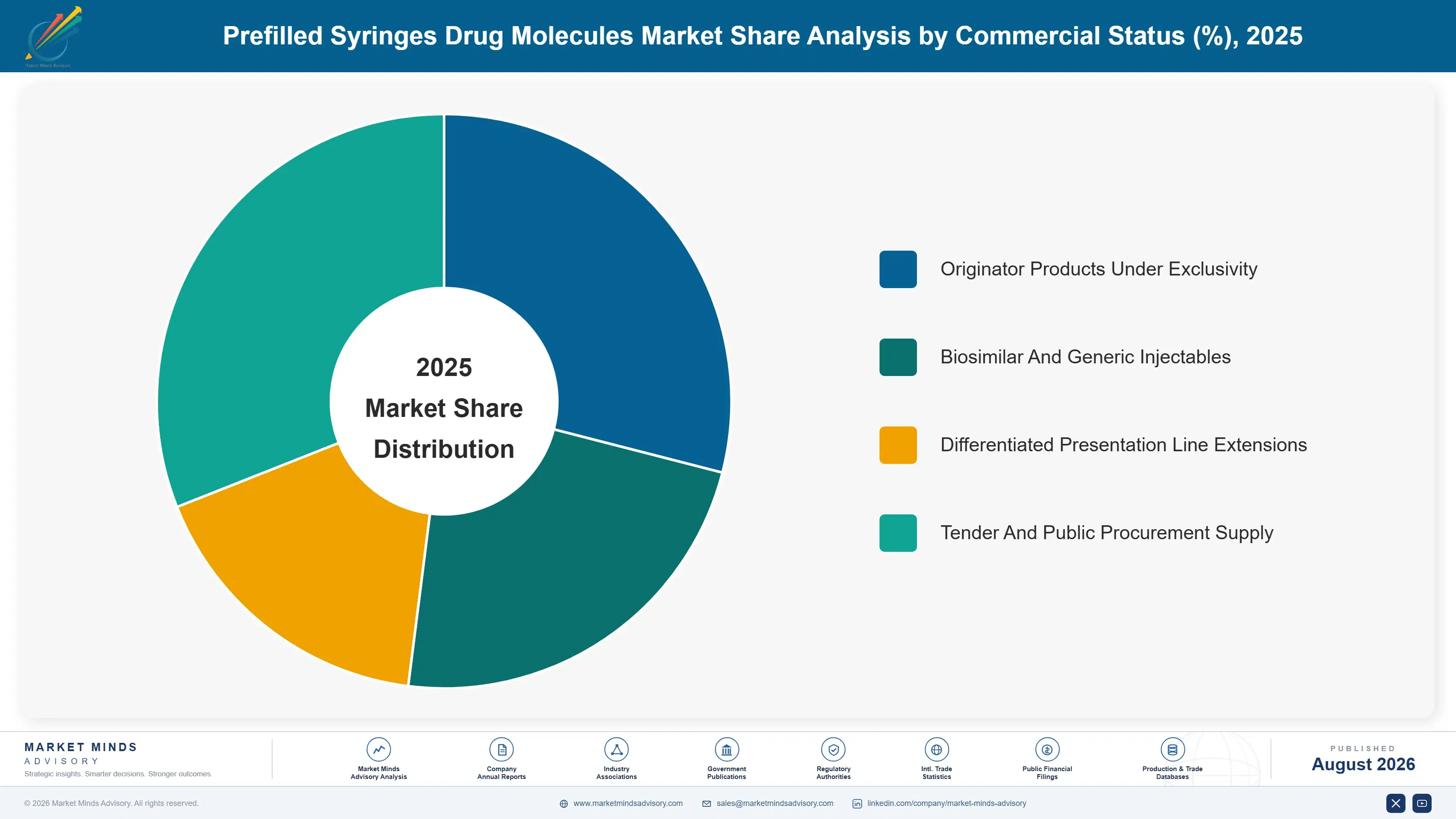
prefilled-syringes-drug-molecules-market-market-share-analysis-1787299166753

Incretin And Metabolic Peptides

The fastest class at 14.1%, exactly 1.50 times the market rate, and the one that reshaped the whole category's supply position. Obesity and diabetes indications address patient numbers an order of magnitude beyond anything immunology reached, and every dose needs a sterile filled presentation. That demand consumed the industry's spare filling capacity and pushed nested line utilisation to around 91%. Peptides are also easier to formulate at concentration than antibodies, which avoids the viscosity ceiling constraining monoclonals. The exposure sitting ahead is composition patent expiry, since this class has never yet experienced the 62% price erosion that biosimilar entry produces. Peptides also formulate at concentration more easily than antibodies, which avoids the viscosity ceiling entirely.
CAGR 14.1%

Monoclonal Antibodies And Fusion Proteins

Second fastest at 10.2% and still the largest class by value, spanning immunology, oncology, ophthalmology, and an expanding set of rarer indications. These are the molecules the container troubles most: silicone droplets and tungsten residue both nucleate aggregation, and doses above roughly a hundred and fifty milligrams per millilitre push glide force past what patients tolerate. Hyaluronidase co-formulation and on-body delivery both exist to work around that ceiling. Biosimilar entry has already removed most of the price from the largest immunology franchises, so growth now comes from newer targets and from indication expansion rather than from the products that built the class. Indication expansion rather than new franchises now drives growth, which is a slower engine than before.
CAGR 10.2%
Full segment breakdown across 6 segments available in the complete report.

Regional Architecture and Country Demand Map

Value here follows drug pricing rather than dose volume, and the divergence is extreme. North America sits far above its framework band on biologic pricing that runs at multiples of European levels, while East Asia falls below band despite very large and rapidly growing dose volumes.

North America

Forty-one percent, far above the framework band, and the justification is pricing rather than patients. United States biologic prices run at multiples of European reference levels for identical molecules in identical presentations, so the same dose carries several times the revenue. Commercial payer structures fund self-administered biologics through pharmacy benefit rather than medical benefit, which favours prefilled presentation directly. Specialty pharmacy distribution is highly developed. Growth at 8.9% trails the global rate because biosimilar substitution mechanisms here are now working as designed and removing price from the largest immunology franchises faster than new products replace it. Specialty pharmacy distribution is highly developed here, Pharmacy benefit structures favour prefilled presentation directly, rather than medical benefit infusion.
Share: 41% | CAGR: 8.9% (2026 to 2036)

East Asia

Eighteen percent, below the framework band, and the shortfall is price rather than volume. Chinese national reimbursement negotiation grants access in exchange for price concessions that are severe by Western standards, so a very large and fast-growing dose volume converts into far less revenue than the same doses would elsewhere. China contributes the fastest national growth rate in this forecast at 15.8%. Domestic biosimilar developers supply a substantial share of that volume at prices originators cannot match. Japanese and Korean pricing is closer to European levels and both markets adopt prefilled presentations readily across immunology and metabolic products. Japanese and Korean pricing sits closer to European levels, and both adopt prefilled presentations readily.
Share: 18% | CAGR: 10.7% (2026 to 2036)
Regional intelligence for 5 additional markets available in the complete report: Western Europe, South Asia and Pacific, Latin America, Middle East and Africa, Eastern Europe. Contact sales@marketmindsadvisory.com.
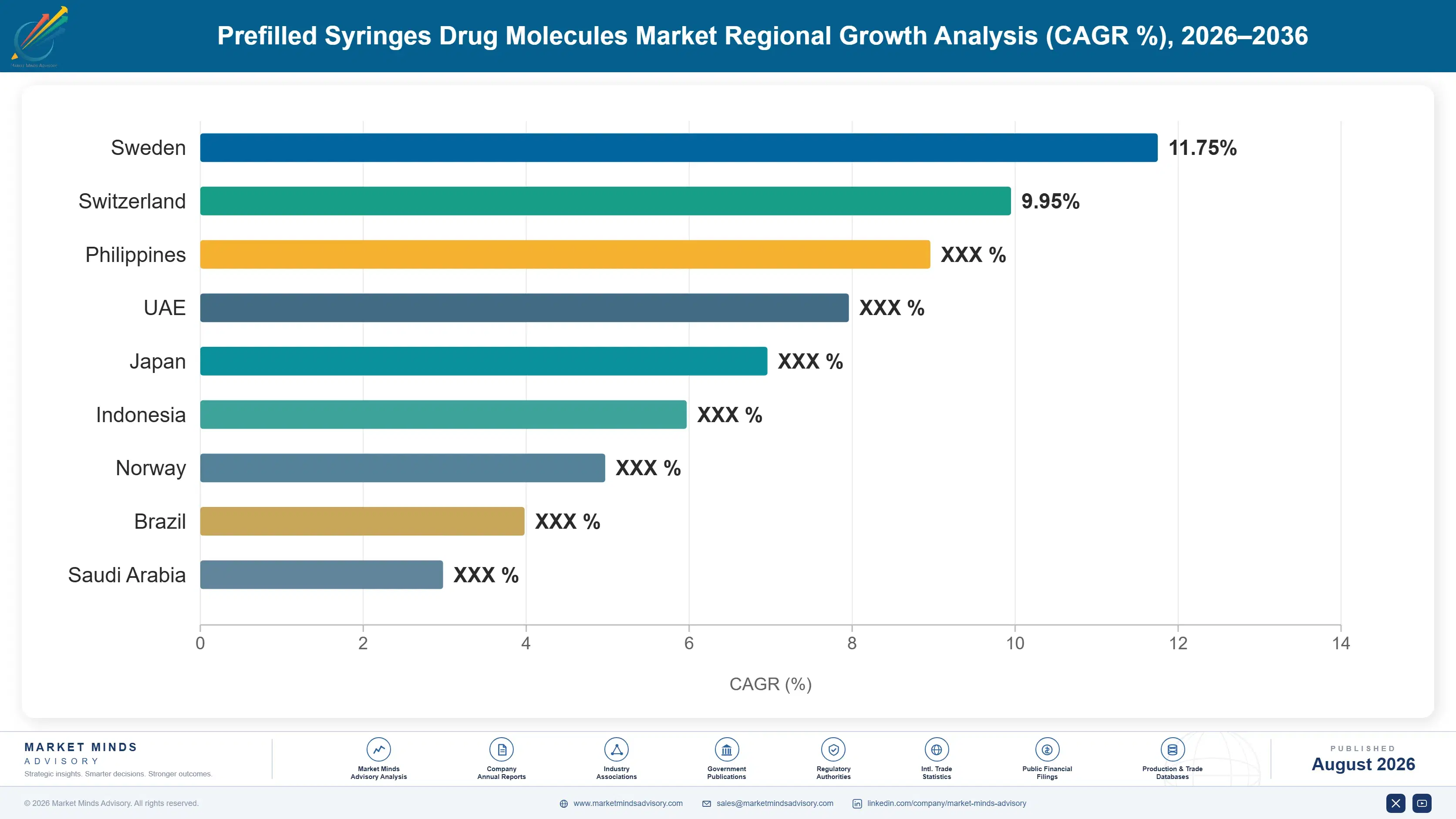
prefilled-syringes-drug-molecules-market-country-cagr-analysis-1787299167263

Four Decisions That Move Injectable Value

Molecule efficacy is settled in the clinic and nobody influences it commercially afterwards. Value in this market is decided instead by securing filling capacity well ahead of approval, by escaping the viscosity ceiling through formulation science, by moving sensitive proteins off glass altogether, and by building a device position that can survive biosimilar entry.

Book Filling Capacity Years Ahead Of Regulatory Approval

Nested sterile syringe lines run at around 91% utilisation and new capacity takes three to four years to qualify, which means a molecule can hold approval and still be unable to launch. Reserving slots against a development programme rather than against an approved product costs commitment fees and carries the risk that the molecule fails, but the alternative is losing months of exclusivity to a supply queue. Every month of delayed launch on a major biologic costs tens of millions in foregone revenue that no later capacity solves. Commitment fees are trivial against that arithmetic.
Market Impact: Delay costs 10 million dollars in each month

Use Hyaluronidase Co-Formulation To Escape Volume Limits

Subcutaneous injection caps practical volume near one to two millilitres, which forces concentration up until viscosity makes injection intolerable. Recombinant hyaluronidase temporarily disperses the subcutaneous matrix and permits considerably larger volumes at manageable concentration, removing the ceiling that constrains around 34% of products. It also converts infusion products into self-administered ones, which changes both the payer conversation and the competitive position. Licensing terms are material but far cheaper than reformulating a difficult antibody or developing a bespoke on-body delivery system. It also converts infusion products into self-administered ones, which changes the payer conversation entirely.
Market Impact: Removes the ceiling on 34% of all products

Move Aggregation-Sensitive Molecules Onto Polymer Barrels

Cyclic olefin polymer barrels need no silicone lubrication and involve no tungsten in forming, which removes both aggregation nucleation mechanisms at once. For a molecule showing particulate formation in glass, that is a formulation problem solved by a container change rather than by two more years of excipient screening. Polymer costs roughly 4 times glass per unit, which sounds prohibitive until measured against the eighteen months of development time it saves. Companies discovering this at stability rather than at formulation start pay for the lesson twice. Screening at formulation rather than at stability is the whole point.
Market Impact: Polymer costs roughly 4 times glass per unit

Build Device Differentiation Before The Patent Cliff Arrives

Biosimilar entry removes around 62% of price within three years and no amount of commercial effort prevents it, but the presentation is not automatically copied. Citrate-free formulation, reduced injection volume, autoinjector ergonomics, and connected adherence support all belong to the originator and all give prescribers a reason to stay. Building that differentiation two years before expiry rather than reacting afterwards preserves meaningfully more volume. Companies that waited until biosimilars launched found the switching had already happened at the pharmacy counter. Switching happens at the pharmacy counter without prescriber involvement without the prescriber being consulted.
Market Impact: Erosion reaches 62% within just three short years

Who Controls the Margin Pool

Concentration reaches 44% across the top five measured on annual prefilled presentation revenue, and the composition has shifted decisively over five years. Metabolic peptide developers now sit where immunology originators used to, because biosimilar entry removed most of the price from the franchises that previously defined this market. The gap to challengers is widest on filling capacity access, which is a supply chain position rather than a scientific one.
Competition runs on three fronts. Filling capacity security is the first and it currently decides launch timing more often than regulatory review does. Formulation capability at high concentration is the second, separating companies who can inject their own molecules from those who cannot. Device and presentation differentiation is the third, and it is the only defence against biosimilar substitution that works. Very few companies hold all three positions together.

Pressure builds from two directions. Biosimilar developers in India. China, and South Korea now approach originator quality at a fraction of the price. And metabolic peptide patents will expire, exposing the class that currently carries category growth to the erosion immunology has already absorbed. Both pressures arrive on a published and entirely predictable schedule, which makes the lack of preparation striking.
prefilled-syringes-drug-molecules-market-company-positioning-matrix-1787299167781

Competitive Moat and Risk Dimensions

NOVO NORDISK

Moat: Peptide manufacturing at unmatched scale

Decades of insulin production built peptide synthesis, purification, and sterile filling capability at a scale nobody outside this company and one competitor approaches. That capacity is the binding constraint across the whole metabolic class and cannot be built quickly. Owning production means the company is not queuing behind others for filling slots.
NOVO NORDISK

Risk: Concentrated in one therapeutic class

Revenue depends heavily on metabolic peptides that have never faced biosimilar competition, and composition patents will expire against a revenue base far larger than any immunology franchise before it. Manufacturing scale protects supply position but offers no protection whatsoever against price competition once substitutes arrive.
ELI LILLY

Moat: Metabolic and immunology portfolio breadth

Strong positions across metabolic, immunology, oncology, and neurology mean no single patent expiry threatens the whole business, which is unusual among companies carrying heavy prefilled exposure. That breadth also funds parallel capacity investment across molecule types rather than concentrating it. Development capability spans both peptides and antibodies.
ELI LILLY

Risk: Capacity commitments assume sustained demand

Very large capital commitments to peptide manufacturing and filling capacity assume metabolic demand continues at current trajectory across the payback horizon. Payer resistance to sustained population-scale prescribing, or clinical findings on long-term use, would leave that capacity underutilised. Building ahead of demand is the correct decision in a supply-constrained market and becomes an expensive one the moment the constraint disappears.

Players Tracked

Prominent Players

Novo Nordisk
Eli Lilly
AbbVie
Sanofi
Amgen

Other Key Players

Johnson and Johnson
Pfizer
Roche
Novartis
Regeneron
Takeda
Teva Pharmaceutical Industries
Viatris
Fresenius Kabi
Boehringer Ingelheim
GSK
Merck and Co
Bayer
UCB
Sandoz

Recent Developments

FEBRUARY 2025

Originator commissions dedicated nested syringe filling capacity

A metabolic medicines developer commissioned additional nested sterile syringe filling capacity at an existing site, dedicated to its own peptide portfolio rather than offered as contract capacity. The investment was organic capital expenditure funded internally rather than any acquisition of a contract filling business. Capacity figures were not disclosed publicly.
Signal: Captive filling capacity is becoming a competitive asset rather than a manufacturing detail, and contract slots are effectively unavailable
MAY 2025

Subcutaneous co-formulation approved for major oncology antibody

A regulator approved a subcutaneous co-formulated presentation of an oncology monoclonal antibody using recombinant hyaluronidase to permit larger injection volume. The approval converts an infusion product into a self-administered one and was a regulatory decision on submitted data rather than any commercial arrangement. Injection volume increases were substantial.
Signal: Hyaluronidase is quietly becoming the standard escape route from the subcutaneous volume ceiling constraining high-dose antibodies
AUGUST 2025

Chinese reimbursement negotiation adds several self-administered biologics

Chinese authorities concluded annual national reimbursement negotiations adding further self-administered biologic products at substantially reduced prices. The outcome was a pricing negotiation between authorities and manufacturers rather than any approval decision, and it converts previously unaffordable therapies into reimbursed volume. Price concessions were not individually published.
Signal: Access expands enormously in exchange for price concessions that make volume rather than value the growth story there

What Sits Behind an Injectable Dose

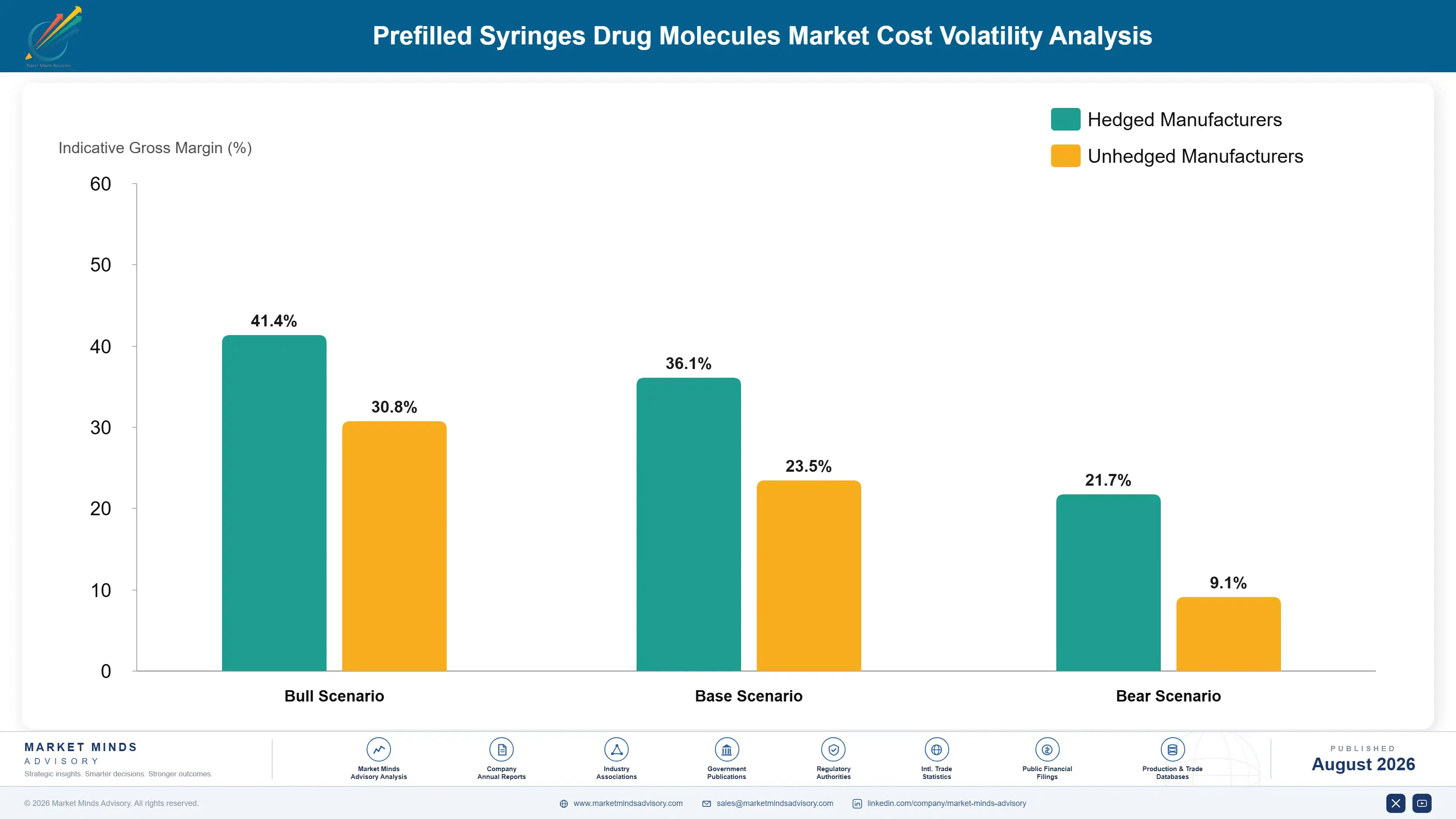
Cost of goods on a biologic is dominated by the molecule itself. Drug substance manufacture, meaning cell culture, purification, and analytical release, runs about 46% of product cost of goods, produced at a small number of qualified sites worldwide. Sterile fill-finish adds roughly 19%, primary container components around eight percent, and cold chain distribution, packaging, and quality release make up the remainder.
Fill-finish capacity rather than any material was the exposure that mattered. Contract sterile filling slots became genuinely unobtainable as metabolic peptide demand consumed the industry's spare lines, and contract pricing rose sharply for whatever capacity remained available. Company annual reports across biopharmaceutical manufacturing describe capacity constraint in consistent terms, and several developers publicly attributed launch timing to filling availability rather than to regulatory review. Approval no longer determines launch timing here.

The competitive disadvantage mechanism is positional rather than operational. A company owning its own filling lines controls launch timing, while one dependent on contract capacity queues behind whoever booked earlier and frequently behind that contractor's own priority customers. Smaller biotechs without commitments are worst placed, lacking both the volume to interest a contractor and the capital to build.
prefilled-syringes-drug-molecules-market-cost-volatility-analysis-1787299167976

Reserve filling capacity against development programmes not approvals

Booking slots after approval means joining a queue three to four years long, which is the qualification and commissioning time for entirely new capacity. Reserving against a phase three programme costs commitment fees and risks paying for a molecule that fails, and that risk is far cheaper than losing exclusivity months to a queue.

Qualify a second fill-finish site before it becomes urgent

Single-site filling concentrates launch risk in one facility's inspection history, capacity allocation, and operational continuity. Second-site qualification takes eighteen months of technology transfer and comparability work that cannot be compressed during a crisis. The cost is real and the alternative is a supply interruption on a product where interruption means patients switching to a competitor permanently.

Select the container during formulation rather than after stability

Silicone and tungsten aggregation problems appear at stability testing, by which point the formulation is already locked and every remaining option is an expensive one. Screening glass, cross-linked silicone, and polymer barrels alongside excipient selection costs a few months early and saves years later on. Container selection is routinely handed to an entirely different function.

Portfolio Architecture for Margin Defence

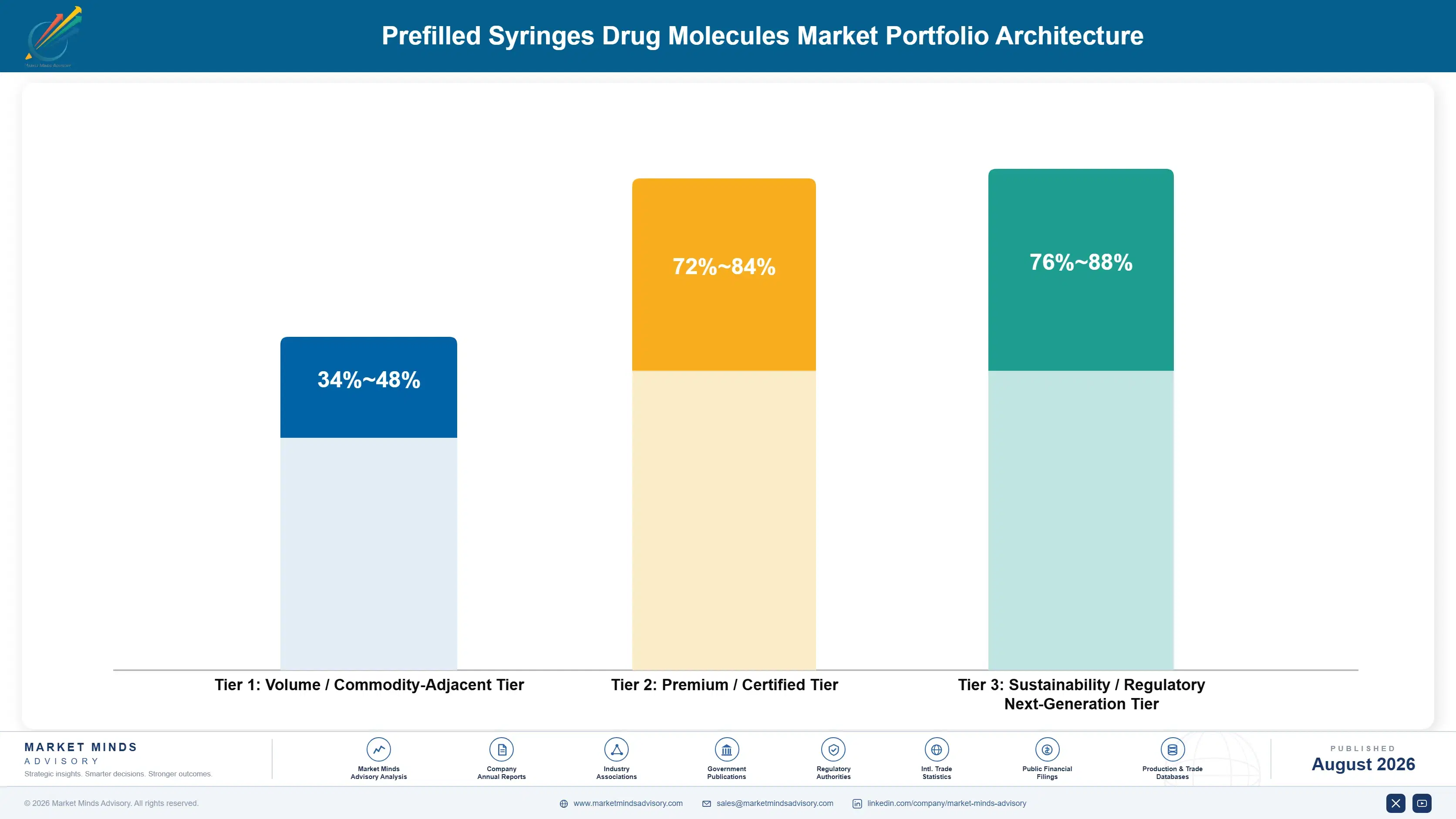
Three tiers describe this market and the spread reflects competitive exposure rather than manufacturing cost. Biosimilars and off-patent injectables sit at the bottom, competing on price into tender and substitution mechanisms built specifically to erode them. Originator biologics with exclusivity remaining sit far higher, priced against clinical value rather than against cost. And differentiated presentations, meaning co-formulated, device-integrated, and reduced-frequency products, occupy a th
The tension is that every product in the second tier eventually falls into the first, and the transition removes around 62% of price within three years. Companies concentrated in a single expiring franchise experience that as a cliff rather than a slope. Building third-tier differentiation before expiry is the only mechanism that reliably preserves volume, and it must be started while the product still looks safe. Expiry dates are published years ahead and still surprise people.

High-value pools concentrate where the presentation does something the molecule alone cannot. Reduced dosing frequency and self-administration both change the patient's life rather than merely the delivery route. A biosimilar copies the molecule and not the presentation, which is the whole defence.

Volume / Commodity-Adjacent Tier

Biosimilars, generic injectables, and off-patent products competing into tender and substitution mechanisms. Thin margin under deliberate payer pressure, though volume is very large and access expansion across Asia and Latin America keeps it growing steadily.
Gross Margin: 34-48%

Premium / Certified Tier

Originator biologics and peptides with exclusivity remaining, priced against clinical benefit rather than production cost. Margin is excellent while it lasts and the exposure is entirely predictable, since patent expiry dates are published years in advance.
Gross Margin: 72-84%

Sustainability / Regulatory / Next-Generation Tier

Co-formulated subcutaneous conversions, device-integrated presentations, reduced-frequency dosing schedules, and polymer container products for aggregation-sensitive molecules. Best margin because the presentation itself carries value that a biosimilar molecule alone cannot replicate.
Gross Margin: 76-88%
prefilled-syringes-drug-molecules-market-portfolio-architecture-1787299168468

High-value Sub-segments and Strategic Watch-out

Co-Formulated Subcutaneous Conversions

Best margin and genuinely defensible, since hyaluronidase co-formulation converts infusion products into self-administered ones and removes the volume ceiling affecting 34% of products. Licensing terms are material but far cheaper than reformulating a difficult antibody from scratch. Payer conversations change entirely once infusion chairs disappear.
Gross Margin: 76-88%

Exclusive Metabolic Peptide Presentations

Strong margin and the fastest growth at 14.1%, though the class has never yet experienced biosimilar entry against a revenue base this large. Filling capacity rather than demand is the current constraint, and it will not ease quickly. New capacity takes three to four years to commission.
Gross Margin: 72-84%

Off-Patent Biosimilar Injectables

The volume core at compressed margin, growing on Asian and Latin American access expansion while price erodes 62% within three years of entry. Very large treated populations at prices that originator cost structures were never designed to serve. Access expansion keeps the volume growing regardless of price.
Gross Margin: 34-48%

Aggregation-Sensitive Glass Presentations

The strategic watch-out, since silicone and tungsten residues nucleate protein aggregation and immunogenicity questions surface late in stability programmes. Polymer barrels solve it at several times the container cost, which is trivial against a delayed or abandoned presentation. Immunogenicity questions surface late in stability programmes.
Gross Margin: 68-81%

How Injectable Revenue Persists

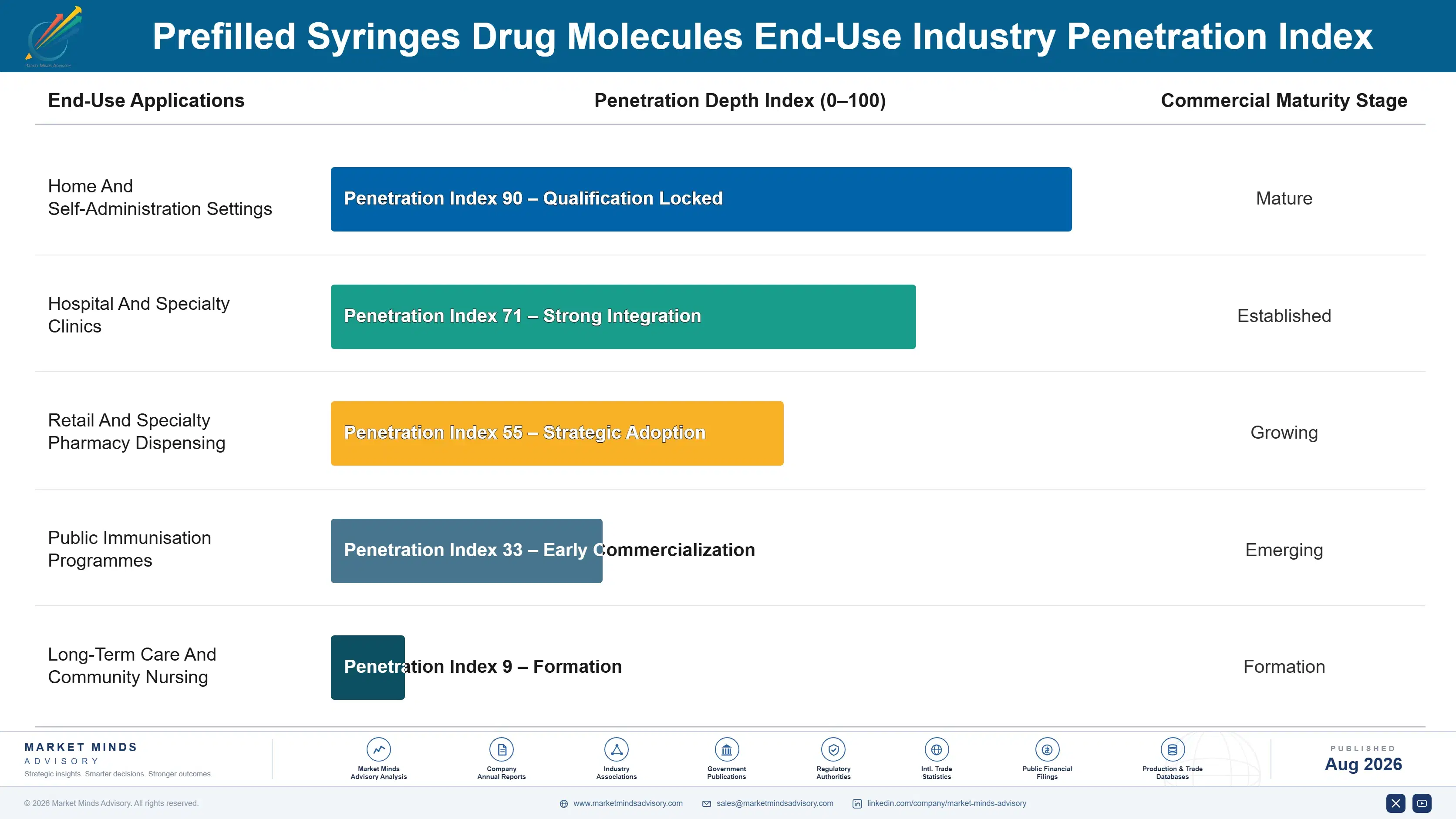
Chronic biologic therapy is among the most durable revenue in pharmacy, because a patient stabilised on a monoclonal antibody or a metabolic peptide typically stays on it for years and switching carries genuine clinical risk. Around 67% of doses are self-administered, which removes the clinic visit that used to give prescribers regular opportunities to reconsider. What ends the annuity is biosimilar substitution at the pharmacy rather than any clinical decision, and that happens without the pres
Depth of adoption varies enormously by therapeutic area and by market structure. Immunology patients are long-tenured and highly adherent because the disease returns visibly when therapy stops. Metabolic peptide adherence is far weaker, with substantial discontinuation inside twelve months driven by tolerability and by cost where reimbursement is partial. Oncology courses are finite by design. Ophthalmology sits in clinics rather than homes and behaves differently again.

Buyer profiles are shifting as payers rather than prescribers determine which presentation a patient receives. Formulary placement and substitution rules now decide more volume than clinical preference does. Formulary placement and substitution rules now decide the volume, and clinical preference decides considerably less.
prefilled-syringes-drug-molecules-market-end-use-penetration-index-1787299168961

What We Would Tell a Board

These are among the four positions where our research anticipates prominent divergence between winners and laggards over the coming forecast period. Each is grounded in the demand model, the regulatory perimeter, and the announced capacity pipeline.
01 / FILLING CAPACITY SECURITY

Book the line before you have the approval

Nested sterile filling runs at around 91% utilisation and new capacity takes three to four years to qualify and commission, which means an approved molecule can sit unlaunched because no line is free. Reserving slots against a phase three programme costs commitment fees and risks paying for a failure, while the alternative costs exclusivity months worth tens of millions each on a major biologic. Every developer who waited to book capacity until after approval has learned this lesson expensively and in public.
02 / VISCOSITY CEILING STRATEGY

Solve injectability in formulation, not in the device

Around 34% of products now exceed what a standard barrel and staked needle can deliver at tolerable glide force, and the industry keeps handing that problem to device engineering long after the formulation is locked. Recombinant hyaluronidase co-formulation removes the subcutaneous volume ceiling entirely, and it converts infusion products into self-administered ones at the same time. Licensing terms are material but considerably cheaper than reformulating a difficult antibody or than building a bespoke on-body delivery system from nothing at all.
03 / CONTAINER SELECTION TIMING

Choose the barrel while the formulation is still moving

Silicone droplets and tungsten residue both nucleate protein aggregation, and these problems surface at stability testing when the formulation is already locked and every remaining option is expensive. Screening glass, cross-linked silicone, and polymer barrels alongside excipient selection costs a few months at the start and saves several years at the end. Development organisations treat the container as packaging and hand it off to an entirely separate function, which is precisely why this same problem keeps recurring across programme after programme.
04 / PATENT CLIFF PREPARATION

Differentiate the presentation two years before expiry

Biosimilar entry removes around 62% of the price within three years and no commercial effort prevents that, but the presentation itself is not automatically copied alongside the molecule. Citrate-free formulation, reduced injection volume, autoinjector ergonomics, and connected adherence support all belong to the originator alone and give prescribers a genuine reason to stay where they are. Companies that waited until biosimilars had actually launched discovered the switching had already happened at the pharmacy counter, without anybody consulting the prescriber at all.

Engagement Snapshot From the Field

A live engagement with an industry participant carrying material or product regulatory and market exposure ahead of a defining policy shift, showing how our research translates into a defensible multi-year portfolio strategy.
MARKET MINDS ADVISORY · CLIENT ENGAGEMENT SUMMARY
Prefilled Syringes Drug Molecules Producer Strategic Portfolio Review and Transition Roadmap 2026·Investment Scenario on Prefilled Syringes Drug Molecules Exposure Evaluation 2025-26
CLIENT PROFILE
A biopharmaceutical company with approximately 2.4 billion dollars in annual revenue (client-reported, unverified by MMA), holding two marketed monoclonal antibodies in prefilled presentation and a metabolic peptide in late-stage development. The company relied entirely on contract fill-finish capacity, had no second qualified filling site, and had selected siliconised glass for all presentations without comparative container screening.
STRATEGIC CHALLENGE
The lead antibody faced biosimilar entry within thirty months and no presentation differentiation programme existed, while the peptide had no secured filling capacity for launch. A stability signal on subvisible particles had appeared in the peptide programme. The board wanted an integrated view rather than three separate functional assessments. Nobody had assessed the three together.
MMA APPROACH
We modelled revenue erosion on the lead antibody under differentiated and undifferentiated presentation scenarios across four markets, mapped available contract filling capacity against the peptide launch timeline, and reviewed the particle data against published silicone and tungsten aggregation mechanisms. Container options were costed against development time saved rather than against unit price.
KEY FINDINGS
  1. No contract filling capacity was obtainable within the peptide launch window from any qualified supplier, and the earliest available slot fell fourteen months after planned approval.
  2. Presentation differentiation modelling showed roughly 19 percentage points more volume retained at three years after biosimilar entry against the undifferentiated base case.
  3. The subvisible particle signal correlated with silicone content across stability batches, and polymer barrel screening had never been performed at any point in development.
  4. Second-site qualification had been deferred twice on cost grounds, leaving both marketed products dependent on a single contract facility with no alternative available.
CLIENT PROFILE
A biopharmaceutical company with approximately 2.4 billion dollars in annual revenue (client-reported, unverified by MMA), holding two marketed monoclonal antibodies in prefilled presentation and a metabolic peptide in late-stage development. The company relied entirely on contract fill-finish capacity, had no second qualified filling site, and had selected siliconised glass for all presentations without comparative container screening.
STRATEGIC CHALLENGE
The lead antibody faced biosimilar entry within thirty months and no presentation differentiation programme existed, while the peptide had no secured filling capacity for launch. A stability signal on subvisible particles had appeared in the peptide programme. The board wanted an integrated view rather than three separate functional assessments. Nobody had assessed the three together.
MMA APPROACH
We modelled revenue erosion on the lead antibody under differentiated and undifferentiated presentation scenarios across four markets, mapped available contract filling capacity against the peptide launch timeline, and reviewed the particle data against published silicone and tungsten aggregation mechanisms. Container options were costed against development time saved rather than against unit price.
KEY FINDINGS
  1. No contract filling capacity was obtainable within the peptide launch window from any qualified supplier, and the earliest available slot fell fourteen months after planned approval.
  2. Presentation differentiation modelling showed roughly 19 percentage points more volume retained at three years after biosimilar entry against the undifferentiated base case.
  3. The subvisible particle signal correlated with silicone content across stability batches, and polymer barrel screening had never been performed at any point in development.
  4. Second-site qualification had been deferred twice on cost grounds, leaving both marketed products dependent on a single contract facility with no alternative available.
RECOMMENDED STRATEGY
Phase 1: Phase 1 (months one to nine): secure filling capacity through a commitment agreement and begin polymer barrel comparability work on the peptide programme. Phase 2: Phase 2 (months nine to twenty-four): develop a citrate-free reduced-volume presentation for the lead antibody well ahead of biosimilar entry. Phase 3: Phase 3 (months twenty-four to thirty-six): qualify a second fill-finish site across both marketed products and the new peptide presentation.
OUTCOME
The client secured committed filling capacity and initiated polymer comparability work. The peptide launch timeline was preserved, and differentiated presentation of the lead antibody entered development ahead of biosimilar entry (client-reported, unverified by MMA), with second-site qualification now funded and underway, and the particle signal resolved on polymer.

Frequently Asked Questions

Foundational context covering the market sizes, CAGR, scope, country, region and competition that inform every finding below. This section is provided to cover basics and most often pre-purchase conversations, answered from the MMA Primary Research Dataset.

What is the current size of the Prefilled Syringes Drug Molecules Market?

The market is valued at USD 68.5 billion in 2025, rising to USD 74.94 billion in 2026. Biologics carry roughly 78% of that value, with metabolic peptides now the fastest-growing class.

How large will the Prefilled Syringes Drug Molecules Market be by 2036?

MMA forecasts USD 184.00 billion by 2036, an increase of USD 109.06 billion over the 2026 base. That represents an expansion multiple of 2.46 times.

What is the CAGR for the Prefilled Syringes Drug Molecules Market 2026 to 2036?

The base case CAGR is 9.4%, with a bull case of 10.6% and a bear case of 8.2%. The historical rate from 2020 to 2025 was 8.1%.

Which segment is growing fastest?

Incretin and metabolic peptides at 14.1%, exactly 1.50 times the market rate. Obesity and diabetes indications reach populations an order of magnitude beyond anything immunology addressed.

Who are the major companies in the Prefilled Syringes Drug Molecules Market?

Novo Nordisk, Eli Lilly, AbbVie, Sanofi, and Amgen lead on annual prefilled presentation revenue, together holding 44% of the market. Metabolic developers have displaced immunology originators at the top.

Which country is growing fastest?

China at 15.8%, driven by national reimbursement negotiation adding biologics at heavily reduced prices. Access expands enormously while value per dose stays far below Western levels.

Report Segmentation Architecture

The full report scope spans multiple orthogonal segmentation dimensions, with cross-tabulated demand data provided for each dimension pair. Coverage extends further to regional breakdowns, trend trajectories, and the competitive detail needed to support segment-level decision-making.

By Molecule Class

  • Incretin And Metabolic Peptides
  • Monoclonal Antibodies And Fusion Proteins
  • Vaccines In Prefilled Presentation
  • Insulins And Insulin Analogues
  • Recombinant Proteins And Hormones
  • Anticoagulants And Small Molecule Injectables

By End-Use Industry

  • Home And Self-Administration Settings
  • Hospital And Specialty Clinics
  • Retail And Specialty Pharmacy Dispensing
  • Public Immunisation Programmes
  • Long-Term Care And Community Nursing

By Commercial Status

  • Originator Products Under Exclusivity
  • Biosimilar And Generic Injectables
  • Differentiated Presentation Line Extensions
  • Tender And Public Procurement Supply

By Region

  • North America
  • East Asia
  • Western Europe
  • South Asia and Pacific
  • Latin America
  • Middle East and Africa
  • Eastern Europe

Scope, Methodology, and Coverage

Every figure in this report is reproducible from documented input assumptions. The scope below maps the historical period, the forecast horizon, the segmentation dimensions, and the countries covered, alongside the underlying primary and qualitative methodology.
Historical Period
2020 to 2025
Forecast Period
2026 to 2036
Base Year
2025 (USD billions; MMA Primary Research Dataset, August 2026)
Market Definition
This market comprises drug molecules commercialised in prefilled syringe presentation, measured at manufacturer realised drug revenue rather than at container or device value. Coverage spans staked-needle and luer-lock prefilled syringes and prefilled syringes housed within autoinjector or on-body delivery systems, across monoclonal antibodies, fusion proteins, incretin and metabolic peptides, insulins, vaccines, recombinant proteins and hormones, anticoagulants, and small molecule injectables. Empty syringe components and primary container manufacture, autoinjector hardware sold as devices, vials, cartridges and ampoules, infusion and intravenous presentations, and contract fill-finish service revenue fall outside scope.
Quantitative Units
USD billions (current prices); million prefilled units dispensed; realised revenue per dose
Segmentation Dimensions
By Molecule Class; By End-Use Industry; By Commercial Status; By Region
Regions Covered
North America, East Asia, Western Europe, South Asia and Pacific, Latin America, Middle East and Africa, Eastern Europe
Countries Covered
USA, Canada, Mexico, Brazil, Argentina, Colombia, Germany, France, UK, Italy, Spain, Netherlands, Sweden, Switzerland, Denmark, Poland, Czechia, Hungary, Turkey, China, Japan, South Korea, Taiwan, India, Australia, Saudi Arabia, UAE, South Africa, Egypt, and additional markets relevant to this sector
Key Companies Profiled
Novo Nordisk, Eli Lilly, AbbVie, Sanofi, Amgen, Johnson and Johnson, Pfizer, Roche, Novartis, Regeneron, Takeda, Teva Pharmaceutical Industries, Viatris, Fresenius Kabi, Boehringer Ingelheim, GSK, Merck and Co, Bayer, UCB, Sandoz
Quantitative Methodology
Primary survey, n=3,800 respondents, Q4 2025, six countries; demand-side model with trade association cross-validation
Qualitative Methodology
47 expert interviews, Q4 2025; applied to validate demand model assumptions, identify emerging dynamics, and assess competitive positioning
Report Format
PDF and XLSX data workbook (Word format preview document)
Publisher
Market Minds Advisory
Report Code
MMA-2026-HLT-280
Published
August 2026
Contact
sales@marketmindsadvisory.com | www.marketmindsadvisory.com

Purchase the full Prefilled Syringes Drug Molecules Market Report (2026 to 2036).

The full report sizes drug molecules in prefilled presentation across six molecule classes, five care settings, four commercial statuses, and seven regions, with country detail for the twenty largest national markets. Originator and biosimilar value are tracked separately throughout, with erosion curves modelled from observed entry events by therapeutic area. Nested sterile filling capacity is mapped by site, owner, and availability window across contract and captive networks. Competitive profiling covers twenty companies on prefilled presentation revenue. High-concentration formulation constraints and container compatibility issues are documented by molecule class.
Originator and biosimilar value tracked separately with erosion curves
Nested filling capacity mapped by site and availability window
High-concentration formulation constraints documented by molecule class
Container compatibility and aggregation risk assessed by material
Patent expiry calendar with presentation differentiation status
Self-administration penetration and adherence data by therapeutic area

Built For The People Who Decide

From boardroom strategy to bench-side execution, this report is read cover-to-cover by leaders shaping the next decade of their industry, turning demand scenarios, market dynamics and valuation benchmarks into decisions.
CXOs/ Presidents/ VPs/ Managers
M&A and Corporate Development
Strategy Teams and R&D Heads
Procurement and Product Directors
Regulatory and Compliance Leaders
Investor Relations and Equity Analysts