Market Minds Advisory
Predictive Analytics Solutions for PCR Resin Quality Market

Predictive Analytics Solutions for PCR Resin Quality Market: Predictive Analytics Solutions for PCR Resin Quality Market. AI-Driven Contamination and Consistency Prediction for Recycled Resin

European recycled content mandates push resin processors toward predictive quality software as batch-level contamination prediction becomes mandatory infrastructure rather than a post-production inspection afterthought across the entire broader supply chain

Lead Analyst

Published

September 2026

Make Smarter Decisions with Customized Research Insights

Request a free sample report and evaluate market opportunities, growth trends, and competitive dynamics relevant to your business needs.

2025 MARKET VALUE$0.4BMarket Size 2025
2036 FORECAST VALUE$1.4BBase Case , 2026 to 2036
CAGR 2026 TO 203612.5 %Bull 13.8% / Bear 11.2%
INCREMENTAL OPPORTUNITY$1.0BNet 10- year value creation
EXPANSION MULTIPLE3.26x2036 value over 2026 base
Strategic Levers
M&A Pipeline
Regional Outlook
Country Rankings
Competitive Intelligence
Segmental Deep-dive
Call-Us : 91 93563 13602

Executive Snapshot and Market Trajectory.

Predictive analytics for PCR resin quality are moving from optional process monitoring to mandatory compliance infrastructure, as regulators demand documented batch-level contamination prediction rather than post-production sampling alone across most European packaging categories this year. Buyers now treat prediction accuracy as a compliance metric itself.
AI-powered contamination detection and consistency modeling are converging fastest, as resin processors race to demonstrate recycled content quality ahead of European regulatory deadlines covering packaging categories specifically. Western Europe commands the largest regional share, reflecting the region's binding recycled content mandates driving urgent software procurement across domestic resin processors. Facility operators increasingly qualify multiple analytics vendors simultaneously to reduce single-source dependency ahead of enforcement deadlines. Certification depth separates platforms competing for enterprise contracts.
Competitive intensity is rising as materials testing specialists expand into predictive software while enterprise manufacturing execution system vendors bolt on quality modules to existing platforms. Brand owner sustainability commitments are creating a parallel demand channel, as major consumer goods companies increasingly require documented resin quality data from suppliers before contract renewal. Rankings could shift meaningfully as certification requirements tighten across major recycled content procurement programs over the coming years.
Market Definition
This report covers software platforms applying machine learning to predict contamination levels, mechanical property consistency, and processing viability for post-consumer recycled plastic resin batches. It excludes general enterprise resource planning systems, laboratory testing equipment, and virgin resin quality software not applied to recycled feedstock.
Base Year Value
$0.4B in 2025 (MMA Primary Research Dataset, September 2026)
Forecast Period
2026 to 2036, eleven discrete annual values
CAGR
12.5% base case. Bull 13.8%. Bear 11.2%.
Fastest Growth Segment
AI-Powered Contamination Detection and Sorting Analytics: 17.0% CAGR
Fastest Growth Country
India: 15.0% CAGR
Fastest Growth Region
South Asia and Pacific: 14.5% CAGR
Largest Region
Western Europe: 26% of 2025 global value
Market Leaders
Polysecure, Recycleye, AMP Robotics, Trinamix, and Pellenc ST lead the market. Source: MMA Analysis, July 2026.
Primary Survey
n=3,800 procurement and R&D decision-makers, Q4 2025, six countries
Methodology
Demand-side build-up, cross-validated against public data, 47 expert interviews

Predictive Analytics Solutions for PCR Resin Quality Market Forecast Scenarios

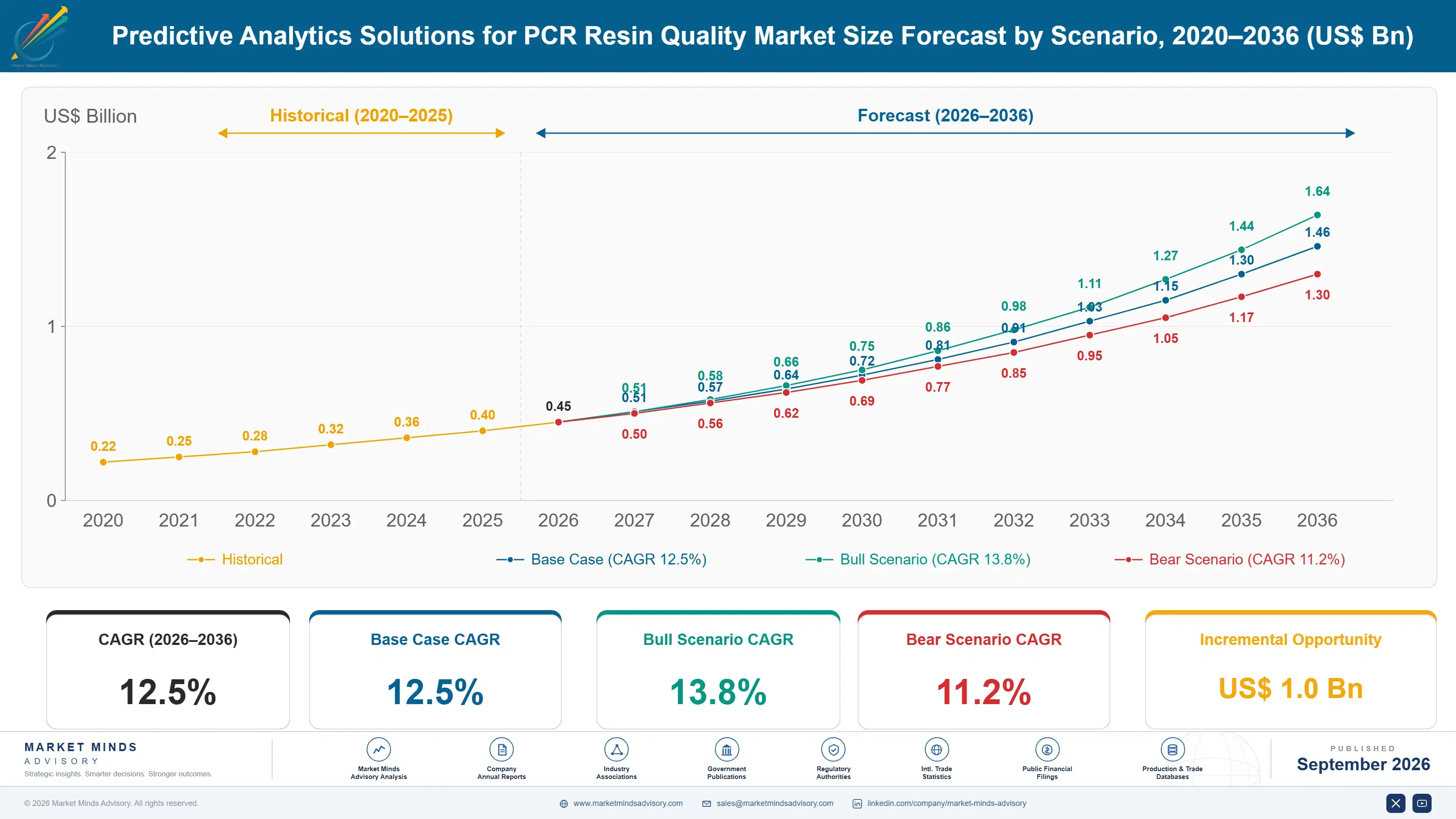
predictive-analytics-solutions-for-pcr-resin-quali-size-forecast-scenario-1788428041377
Between 2020 and 2025 the market grew at a historical rate of roughly 11.5 percent annually, accelerating as European regulatory proposals moved through comment periods toward final recycled content enforcement rules. Early adoption concentrated among large processors with dedicated quality staff before spreading to mid-market producers facing the same enforcement deadlines. Talent and equipment investment increased steadily throughout this transition period.
The base case assumes continued European regulatory enforcement rollout, expanding brand owner supplier compliance requirements, and steady adoption of AI-assisted contamination detection across mid-market resin processors. Three commercial mechanisms sustain the base forecast: mandatory recycled content verification frequency requirements, brand owner supplier scorecards incorporating quality prediction metrics, and expanding sorting facility automation investment across processing operations. These three mechanisms together anchor confidence in the base scenario across the ten-year forecast window ahead.
The bull case rests on accelerated regulatory enforcement actions against non-compliant processors pushing faster software adoption industry-wide. The bear case centers on larger processors building in-house predictive capability rather than licensing third-party platforms, compressing the addressable software market opportunity for independent vendors. Rankings could shift meaningfully if either scenario dominates the market's trajectory over the coming several years.

Batch Certainty Becomes Procurement Currency

Purchase decisions increasingly hinge on documented prediction accuracy rather than sensor breadth alone, as processors weigh the cost of downstream production failure against platform price during vendor evaluation processes across facilities. This calculation increasingly appears explicitly within enterprise vendor selection scorecards used by procurement and quality assurance teams together. Documented accuracy now weighs as heavily as sensor breadth in most purchasing evaluations across the sector.
MARKET CONCENTRATIONCR5 39%Top vendors hold a fragmented combined market position currently
AVERAGE PLATFORM PRICE$85KReflects blended annual pricing across standard deployment tiers
PREDICTION ACCURACY RATE88%Share of predicted batches matching actual lab-verified quality outcomes
CONTAMINATION DETECTION RATE76%Share of contaminated batches flagged before downstream processing occurs
IMPLEMENTATION COST SHARE31%Integration and sensor calibration share of total platform contract value
CONTRACT RENEWAL RATE71%Share of platform subscriptions renewed at annual contract expiration
Vendors offering pre-built brand owner reporting templates are pressuring generalist quality platforms to accelerate their own connector development, since processors increasingly favor software that reduces the manual documentation burden across multiple customer requirements. Processors report faster onboarding timelines when using pre-built brand owner connectors rather than custom reporting projects requiring dedicated compliance resources. This speed advantage matters most for processors facing near-term enforcement deadlines and audit dates.
Implementation and sensor calibration costs remain a meaningful share of total contract value, particularly for processors integrating legacy sorting line equipment. Vendors with proven rapid deployment methodologies increasingly outcompete smaller specialists facing longer implementation timelines. This dynamic increasingly separates vendors with proven implementation methodologies from smaller specialists still refining their deployment playbooks across new processor accounts. Onboarding speed increasingly determines vendor shortlist inclusion at larger enterprise accounts.
"A resin batch that fails downstream costs far more than the software that would have flagged it upstream. The vendors winning now are proving that math to procurement, not just selling sensor accuracy claims."
Practice Lead, Materials Science and Recycling Technology Research · MMA Recycled Plastics Quality Prediction Software Practice · September 2026

Market Trends

AI Contamination Detection Precedes Physical Sorting

Vendors are integrating artificial intelligence into near-infrared and hyperspectral sensor data streams, predicting contamination levels before material reaches downstream extrusion equipment rather than relying solely on post-processing laboratory sampling that historically caught defects too late for corrective action. This capability is reducing the batch rejection rate that historically discouraged smaller processors from adopting comprehensive predictive quality software beyond basic visual inspection. Roughly 41 percent of new platform deployments now include upstream contamination prediction, up meaningfully from a much smaller share only a few years earlier as the technology matured rapidly.
Market Impact: 43 percent faster adoption pace

Brand Owner Supplier Scorecards Formalize Quality Requirements

Major consumer goods brands are incorporating documented resin quality prediction results directly into supplier scorecards, creating a demand channel that pressures processors to adopt compliant software regardless of their own internal regulatory urgency assessment. This brand-driven pressure is proving more immediate for many processors than direct regulatory enforcement timelines alone, since losing supplier status carries faster commercial consequences than a regulatory audit. Suppliers failing brand owner quality scorecards report losing roughly 24 percent of contracted volume within a single review cycle. Vendors ignoring this shift risk being excluded entirely from multi-vendor qualification lists across major consumer brand accounts.
Market Impact: 32 percent higher renewal rate

Market Opportunities and Growth Drivers

European Recycled Content Mandates Drive Software Adoption

The European Union's packaging and packaging waste regulation requires processors handling designated resin categories to demonstrate documented recycled content quality within specified compliance timeframes, creating a hard mandate that forces predictive software adoption regardless of internal budget prioritization cycles that might otherwise delay procurement decisions. This regulatory mandate gives compliance-focused vendors more predictable demand visibility than software tied to discretionary process improvement initiatives that lack comparable urgency. Processors citing regulatory deadline pressure as their primary purchase driver report adopting software roughly 43 percent faster than processors upgrading voluntarily. Speed matters most here.
Market Impact: 27 percent adopt accelerated integration paths

Brand Owner Contract Requirements Sustain Mid-Market Demand

Major consumer goods and packaging brands increasingly require documented resin quality prediction as a condition of ongoing supplier contracts, sustaining steady demand among mid-market processors that might otherwise delay compliance software investment until regulatory deadlines force the issue directly. This contractual pressure functions independently of direct regulatory enforcement timing, giving vendors serving brand-driven demand more predictable revenue visibility than software tied purely to regulatory compliance calendars. Processors citing brand contract requirements as a primary driver report roughly 32 percent higher software renewal rates than processors adopting for regulatory reasons alone.
Market Impact: 22 percent of platforms offer retraining

Market Restraints and Challenges

Legacy Sorting Line Integration Complexity Slows Deployment

Processors running older sorting and extrusion equipment frequently lack standardized sensor interfaces needed for real-time predictive analytics integration, a root cause tied to decades of accumulated equipment customization that varies meaningfully across individual processing facilities within the same corporate parent. The commercial impact shows up as extended implementation timelines and higher integration service fees relative to processors running modern automated sorting lines. Some vendors are addressing this through retrofit sensor kits for common legacy equipment, though only roughly 27 percent of processors have adopted these accelerated integration paths meaningfully. Speed matters here.
Market Impact: 41 percent of deployments predict contamination

Feedstock Variability Limits Prediction Model Accuracy

Post-consumer recycled resin feedstock composition varies considerably by collection region and waste stream source, a friction point rooted in the fundamentally heterogeneous nature of consumer plastic waste that resists the consistent input assumptions predictive models require to achieve high accuracy. The commercial impact shows up as processors questioning prediction reliability when feedstock sourcing shifts seasonally or regionally without model retraining. Some vendors are addressing this through continuous model retraining pipelines, though only roughly 22 percent of platforms currently offer automated retraining capability. This gap is expected to narrow gradually as retraining pipeline adoption spreads over time.
Market Impact: 24 percent volume loss for non-compliance
3 additional market trends, 4 additional growth drivers, and 3 additional restraints and challenges are covered in the full report. Contact sales@marketmindsadvisory.com to access the complete intelligence.

Segment CAGR and Growth Architecture

Six software categories serve PCR resin quality prediction needs, spanning contamination detection analytics, mechanical property consistency modeling, sorting optimization software, brand owner reporting tools, continuous model retraining pipelines, and feedstock traceability platforms, each addressing distinct workflow stages. Western Europe and East Asia lead uptake, while smaller processors globally trail on adoption pace given budget constraints today.
Section default visual

AI-Powered Contamination Detection and Sorting Analytics

AI-powered contamination detection is growing fastest as processors seek to identify defects before material reaches downstream extrusion equipment rather than discovering quality failures after costly processing has already occurred across production runs. This capability reduces the batch rejection rate that historically discouraged smaller processors from adopting comprehensive predictive quality software beyond basic visual inspection methods. Vendors with proven upstream detection accuracy command meaningfully higher pricing than platforms relying on downstream laboratory sampling requiring dedicated compliance staff time. Leading vendors are extending detection accuracy claims into marketing materials as a genuine competitive differentiator against manual-inspection competitors. Pricing power favors early movers who established qualification depth before competitors caught up to comparable standards.
CAGR 17.0%

Mechanical Property Consistency Modeling

Mechanical property consistency modeling addresses the growing requirement that processors demonstrate documented batch-to-batch material performance predictability satisfying both regulatory auditors and brand owner scorecard requirements simultaneously. This segment benefits from genuine commercial urgency since inconsistent mechanical properties carry faster financial consequences than a regulatory audit finding for most mid-market processors serving demanding downstream manufacturers. Vendors offering pre-built templates for major brand reporting formats increasingly outcompete generalist platforms lacking comparable brand-specific integration depth. Facilities lacking dedicated compliance staff increasingly favor these templates to reduce the manual reporting burden across multiple brand accounts. Vendors ignoring this shift risk losing accounts to faster-moving competitors entirely across major brand procurement programs. Buyers notice this differentiation.
CAGR 14.0%
Full segment breakdown across 6 segments available in the complete report.

Regional Architecture and Country Demand Map

Regional demand tracks recycled content regulatory maturity closely, with Western Europe leading given binding packaging waste regulation while North America and East Asia follow through parallel sustainability programs. Retailer scorecard pressure and enforcement deadlines compound regional demand differently depending on local regulatory maturity and export orientation.

Western Europe

Germany, France, and the Netherlands drive regional demand through European Union packaging and packaging waste regulation requiring documented recycled content quality across designated resin categories, concentrating near-term software demand among processors handling covered materials across major manufacturing hubs. The United Kingdom contributes meaningfully through comparable domestic recycled content requirements despite operating outside direct European Union regulatory jurisdiction. Brand owner sustainability commitments compound regulatory pressure further, as major consumer goods companies increasingly require documented quality prediction independent of direct regulatory enforcement timing across their supplier base. Retrofit spending is expected to remain elevated through the middle years of the forecast window. Insurance underwriting incentives compound this trend further across most facility investment decisions.
Share: 26% | CAGR: 11.5% (2026 to 2036)

North America

United States processors face growing compliance pressure given state-level recycled content mandates covering designated packaging categories, concentrating near-term software demand among processors and converters handling covered products across most major production regions. Canada contributes meaningfully through processors exporting into United States markets who must meet equivalent quality documentation standards for cross-border shipments. Retailer and brand owner supplier scorecards compound regulatory pressure further, as major consumer goods companies increasingly require documented quality data independent of direct state enforcement timing. Certification and enforcement varies meaningfully by state across the broader country. Fusion of retailer pressure and regulatory precedent sustains regional adoption momentum broadly. Talent pipelines here remain deep given decades of manufacturing quality experience.
Share: 24% | CAGR: 13.0% (2026 to 2036)
Regional intelligence for 5 additional markets available in the complete report: East Asia, South Asia and Pacific, Latin America, Middle East and Africa, Eastern Europe. Contact sales@marketmindsadvisory.com.
predictive-analytics-solutions-for-pcr-resin-quali-market-share-analysis-1788428041970

Building Margin Beyond Standard Platform Licensing

Vendors face compressing standard analytics licensing pricing as competition intensifies, but AI-assisted detection, brand owner scorecard integration, and model retraining services offer genuine margin expansion paths worth pursuing deliberately across the forecast period ahead. Vendors that treat these as core product lines rather than bolt-on services will capture disproportionate share of category profit pools ahead.

Expand AI-Assisted Contamination Detection Depth Broadly

Vendors offering deeper upstream contamination detection capture premium pricing over standard sampling platforms while reducing the batch rejection rate that discourages smaller processors from adopting comprehensive predictive software beyond basic visual inspection. This positions vendors to compete directly for accounts prioritizing rapid detection over marginal licensing cost savings. Early movers building dedicated detection engineering capability report attach rates of roughly 41 percent among new deployments, meaningfully above vendors lacking comparable technology. Larger enterprise accounts increasingly demand this detection capability explicitly during vendor selection processes. Speed to market matters here. Adoption grows.
Market Impact: Captures the 41 percent detection opportunity right now

Build Brand Owner Scorecard Integration Services

As major consumer goods retailers formalize quality prediction requirements within supplier scorecards, vendors offering pre-built brand reporting templates capture share from generalist platforms unable to demonstrate comparable brand-specific integration depth. This lever directly addresses a genuinely urgent commercial pressure, where suppliers failing brand owner scorecards report losing roughly 24 percent of contracted volume within a single review cycle. Vendors moving early on brand template development win disproportionate share of this urgent demand. Scorecard integration also strengthens customer retention across multi-year partnership contracts renewed annually. Trust compounds across engagements. Growth compounds.
Market Impact: Addresses the 24 percent volume loss risk now

Develop Legacy Sorting Line Integration Connectors

Vendors building pre-built connector libraries for common legacy sorting and extrusion equipment address the integration complexity that currently limits adoption among processors running older systems lacking standardized sensor interfaces. Given that only roughly 27 percent of processors have adopted accelerated integration paths, vendors building this capability early capture a genuinely underserved segment before competitors close the technical gap entirely. Connector libraries also strengthen customer retention across multi-year platform support contracts renewed annually. Connector depth increasingly determines shortlist inclusion at larger enterprise accounts evaluating vendors. Growth continues broadly. Now truly. Indeed.
Market Impact: Captures the 27 percent legacy integration segment now

Pursue Continuous Model Retraining Pipeline Services

Vendors offering automated model retraining pipelines address the feedstock variability challenge that currently limits prediction accuracy for processors sourcing from diverse and seasonally shifting waste streams across regional markets. Roughly 22 percent of platforms currently offer automated retraining capability, and vendors moving early into this underserved segment secure durable relationships before larger competitors recognize the opportunity. Retraining pipelines also strengthen customer retention across multi-year platform support contracts renewed annually. Retraining depth increasingly determines shortlist inclusion at larger enterprise accounts evaluating vendors. Growth continues broadly across accounts. Now. Truly indeed. Now.
Market Impact: Captures the 22 percent retraining pipeline segment now

Who Controls the Margin Pool

The top five vendors hold roughly 39 percent combined share on a subscribing processor basis, leaving considerable room for challengers even as Polysecure and Recycleye maintain a clear lead over mid-tier competitors given established brand owner integration depth. The gap between leader and nearest challenger has narrowed as newer AI-native platforms gain traction through faster deployment claims. Certification depth and brand owner integration breadth remains the primary axis separating leaders from mid-tier challengers today.
Current competitive activity centers on AI detection depth expansion, brand owner scorecard integration, and legacy system connector development as vendors chase demand beyond core analytics licensing sales. Vendors are also racing to build continuous retraining pipelines as feedstock variability limits broader market penetration. Pricing pressure on standard analytics licensing is accelerating this diversification trend across the supplier base broadly.

Enterprise manufacturing execution system vendors bolting on quality modules represent the clearest emerging pressure on dedicated predictive analytics specialists, threatening to compress the standalone software opportunity meaningfully. Rankings could shift substantially if a major enterprise software vendor acquires a leading analytics specialist outright, consolidating engineering talent that currently spans multiple independent vendors. Smaller specialists lacking brand owner integration depth face the greatest exposure to this consolidation risk.
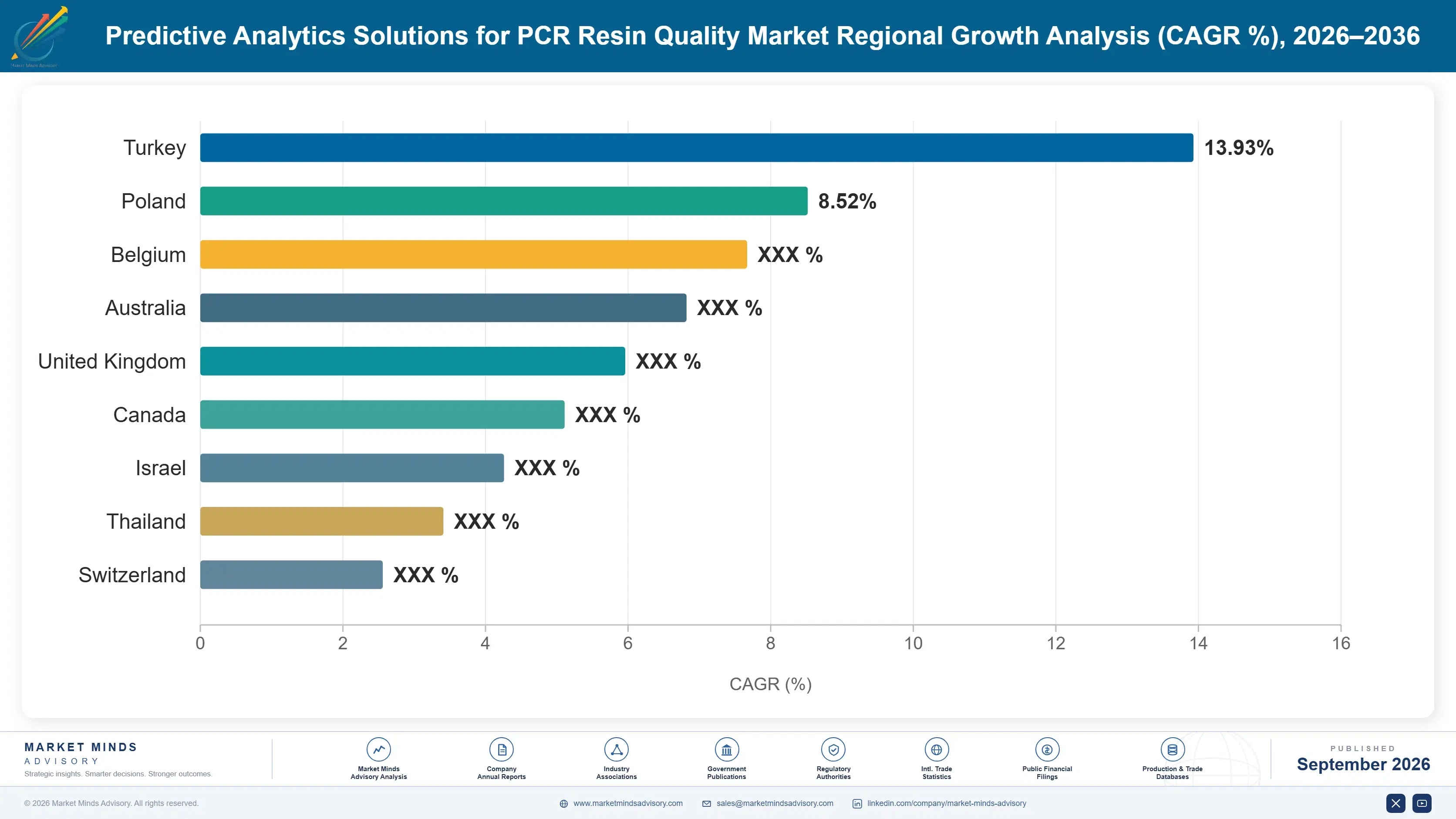
predictive-analytics-solutions-for-pcr-resin-quali-country-cagr-analysis-1788428042569

Competitive Moat and Risk Dimensions

POLYSECURE

Moat: Deep Contamination Tracer Technology

Polysecure's proprietary fluorescent tracer and detection technology gives it contamination identification precision competitors relying solely on optical sensing struggle to match, particularly for identifying subtle polymer contamination invisible to conventional near-infrared scanning methods. This precision translates into lower false-negative rates that brand owner auditors increasingly reference during supplier qualification.
POLYSECURE

Risk: Limited Legacy Equipment Compatibility

Polysecure's tracer-dependent approach requires upstream material marking infrastructure many legacy processing facilities lack, leaving it exposed as competitors offering retrofit-compatible optical detection win accounts unwilling to invest in tracer adoption. Competitors moving faster on retrofit compatibility risk eroding Polysecure's positioning among cost-sensitive processor accounts. Speed matters.
RECYCLEYE

Moat: Broad Computer Vision Training Data

Recycleye's extensive computer vision training dataset spanning diverse waste stream compositions gives it detection accuracy breadth competitors with narrower training data struggle to replicate, particularly across heterogeneous international feedstock sources requiring varied model calibration. This breadth reduces model retraining overhead considerably compared to competitors with narrower international feedstock training coverage.
RECYCLEYE

Risk: Slower Brand Owner Integration Pace

Recycleye's technology-first engineering focus has moved slower on brand owner scorecard integration than competitors prioritizing commercial partnership development, an area where dedicated business development investment increasingly determines account wins. Commercially focused rivals moving faster on partnerships could erode Recycleye's positioning in the fastest-growing segment. Speed matters.

Players Tracked

Prominent Players

Polysecure
Recycleye
AMP Robotics
Trinamix
Pellenc ST

Other Key Players

Tomra Systems
Optical Sorting Solutions
Greyparrot
Sensoneo
Nextek
Refind Technologies
ZenRobotics
Bollegraaf Recycling Solutions
Machinex
CP Group
Steinert
Redwave
S+S Separation and Sorting
UNTHA Shredding Technology
Van Dyk Recycling Solutions

Recent Developments

APRIL 2026

Polysecure Launches Retrofit Optical Detection Module

Polysecure launched a new retrofit optical detection module combining tracer technology with camera-based sensing, targeting processors seeking broader legacy equipment compatibility without sacrificing the contamination precision its platform already provides for tracer-marked materials. The launch positions Polysecure to compete directly against optical-only entrants gaining traction on retrofit simplicity alone.
Signal: Signals Polysecure's strategic response to rising retrofit compatibility competitive pressure from peers ahead of intensifying retrofit compatibility competitive pressure
NOVEMBER 2025

Recycleye Acquires Brand Owner Reporting Startup

Recycleye acquired a privately held brand owner reporting startup to strengthen its scorecard integration capability, gaining proprietary compliance documentation technology and an engineering team with dedicated brand partnership experience already built over several years. Terms of the transaction were not disclosed publicly. Integration should complete by mid-2026.
Signal: Confirms acquisition as Recycleye's preferred route into reporting rather than internal development rather than slower internal development timelines
JULY 2025

AMP Robotics Signs Partnership With Consumer Goods Brand

AMP Robotics signed a multi-year partnership agreement with a major consumer goods brand to provide standardized quality prediction reporting integration across its processor supply base, launching across multiple resin categories over the coming several months. Financial terms were not made publicly available. AMP expects rollout to begin soon.
Signal: Reflects growing brand demand for standardized supplier quality reporting integration depth across multiple resin category product lines

Sensor Hardware and AI Engineering Exposure

Optical and hyperspectral sensor hardware together represent roughly 27 to 33 percent of platform cost of goods sold for predictive quality vendors, sourced primarily from specialized sensor manufacturers concentrated in Germany, the United States, and increasingly China. AI engineering and model training staffing form a second major cost category for vendors building proprietary contamination detection capability.
Sensor hardware and semiconductor component pricing rose meaningfully during 2024 as broader industrial sensor demand competed directly with recycling-sector procurement for available manufacturing capacity, an effect documented in several major sensor producers' annual reports citing tight component supply pressuring pricing upward. Vendors without long-term hardware supply agreements faced extended lead times during this period. Lead times for sensor-grade hardware orders stretched several months beyond pre-2024 norms across most affected vendors.

Smaller predictive analytics vendors lacking dedicated AI engineering expertise face a genuine competitive disadvantage relative to larger incumbents able to hire specialized computer vision talent supporting complex feedstock variability challenges. This exposure varies meaningfully by segment, with vendors serving brand owner scorecard integration facing steeper staffing requirements than vendors offering simpler contamination flagging modules. This gap is widening as demand for specialized computer vision talent continues outpacing available candidate supply.
predictive-analytics-solutions-for-pcr-resin-quali-company-positioning-matrix-1788428042895

Secure Long-Term Sensor Supply Agreements

Vendors committing to multi-year sensor hardware supply agreements with manufacturer partners secure priority allocation and more predictable pricing, insulating margin from spot market volatility that disproportionately affects vendors relying on transactional purchasing relationships year to year. This approach also strengthens producer relationships that pay dividends during future capacity crunches across the broader industry. Margin holds.

Build Shared AI Engineering Service Teams

Vendors building centralized AI engineering teams serving multiple processor implementations simultaneously reduce per-customer staffing cost meaningfully, maintaining detection accuracy quality without absorbing the compensation premium that dedicated single-customer specialist staffing requires. Shared staffing models also improve detection consistency across geographically distributed processor accounts and deployment timelines. This model scales efficiently as processor count grows across the vendor pipeline.

Portfolio Architecture for Margin Defence

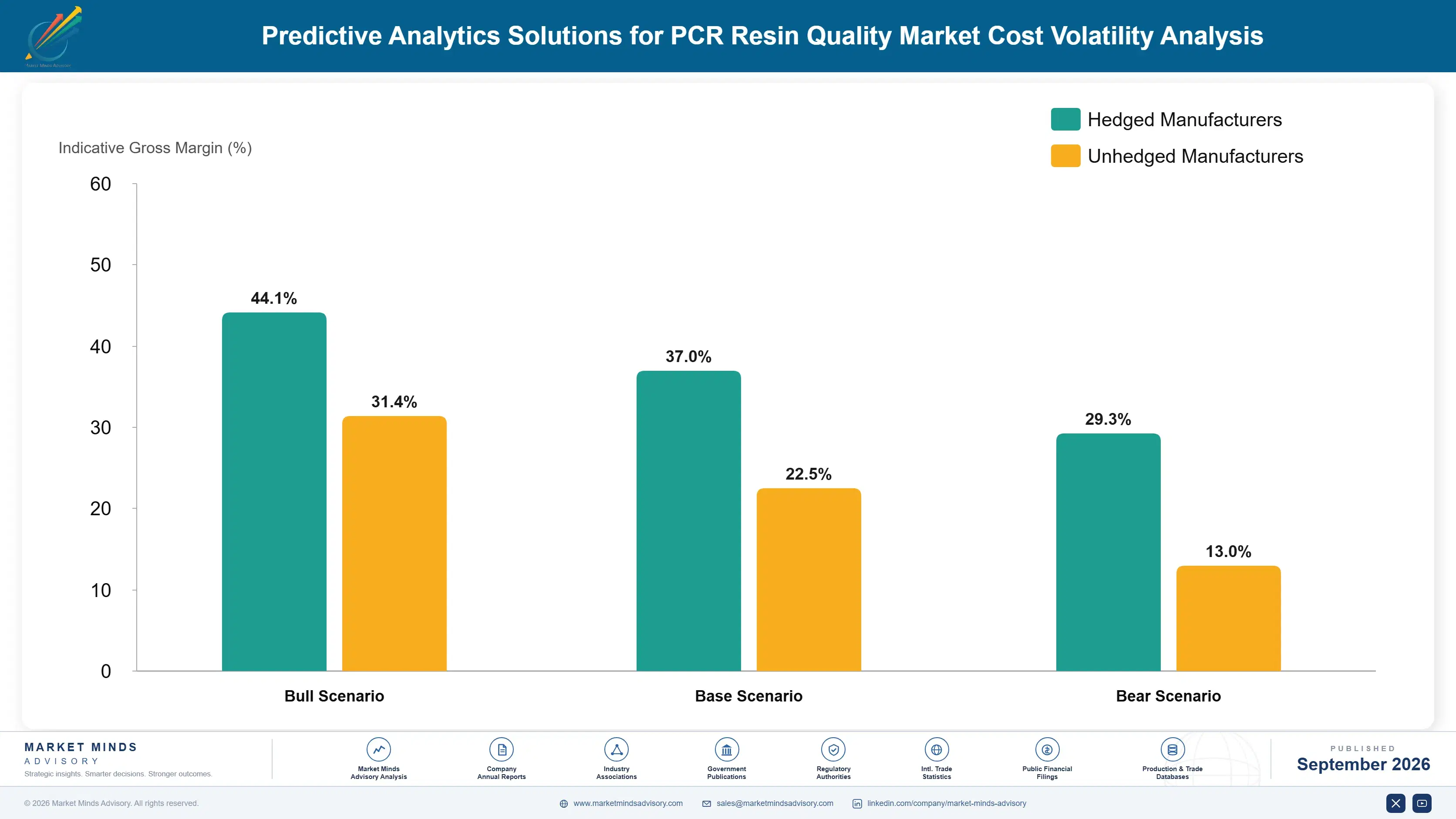
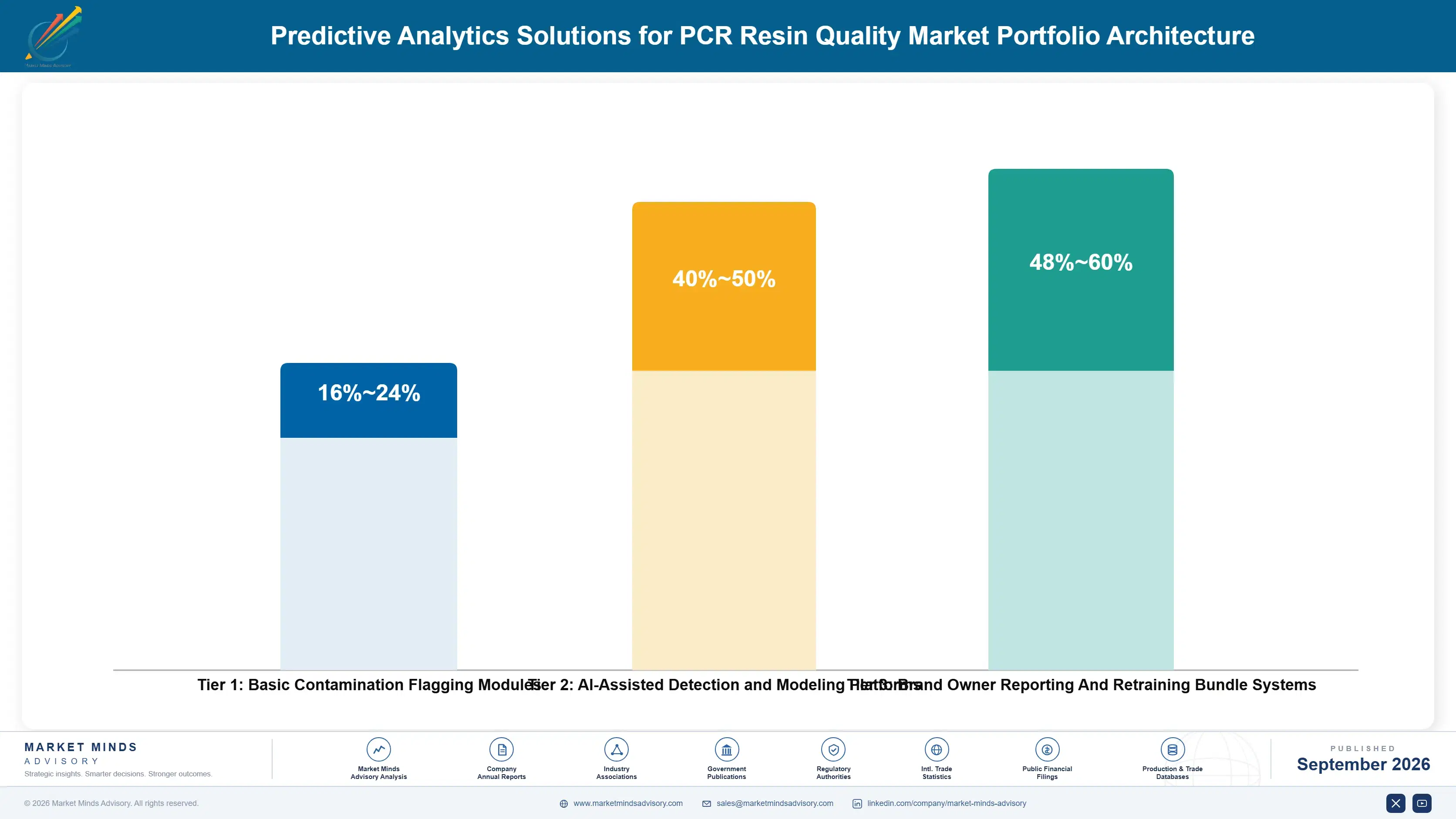
Predictive analytics vendors operate across three margin tiers, from basic contamination flagging modules carrying thin unit economics through AI-assisted detection platforms commanding meaningfully stronger margin, up to brand owner reporting and retraining bundles capturing the richest gross margins. Volume tiers monetize through per-facility licensing scale, while premium tiers monetize through AI capability and brand owner integration bundling. Vendors misjudging tier boundaries risk cannibalizing their own premium accounts over time. Vendors misjudging tier boundaries risk cannibalizing their own premium accounts.
Tension persists between volume growth, which favors standardized low-cost modules sold at scale to smaller price-sensitive processors, and premium positioning, which favors AI-assisted detection and brand owner integration depth commanding materially higher willingness to pay among enterprise accounts. Vendors chasing both simultaneously risk diluting brand positioning across a fragmented buyer base with sharply different purchasing criteria.

High-value margin pools concentrate in AI-assisted detection and brand owner scorecard integration, both commanding meaningfully higher gross margin than basic contamination flagging sold without additional capability bundling. Vendors building durable AI detection capability and brand relationships capture disproportionate margin relative to their processor count across the broader competitive landscape. Vendors ignoring this shift risk ceding the most profitable accounts.

Basic Contamination Flagging Modules

Standardized contamination flagging tools sold at scale to smaller processors prioritizing baseline compliance capability over advanced AI detection, carrying thin unit economics but broad market reach across cost-sensitive segments. Replacement of this tier by AI-assisted platforms is accelerating across most new processor deployments.
Gross Margin: 16-24%

AI-Assisted Detection and Modeling Platforms

AI-powered platforms bundling upstream contamination detection and mechanical property modeling, commanding stronger recurring revenue and materially higher gross margin than basic flagging sold without predictive capability included. Facility operators increasingly request this depth explicitly during vendor evaluation and procurement processes.
Gross Margin: 40-50%

Brand Owner Reporting And Retraining Bundle Systems

Integrated platforms bundling brand owner reporting templates with continuous model retraining capability, carrying the richest margin profile in the category given urgent commercial demand and expanding buyer willingness to pay. Adoption here is accelerating fastest among enterprise accounts facing urgent brand compliance pressure.
Gross Margin: 48-60%
predictive-analytics-solutions-for-pcr-resin-quali-cost-volatility-analysis-1788428043414

High-value Sub-segments and Strategic Watch-out

AI-Powered Contamination Detection and Sorting Analytics

Fastest-growing and highest-value segment, combining strong pricing power with accelerating adoption as processors seek automated compliance capability across fragmented feedstock sources and enforcement deadline pressure nationwide. Vendors moving early capture outsized long-term partnership relationships across this segment. Vendors here shape category standards. Precision matters most here.

Mechanical Property Consistency Modeling

High-value segment with moderate growth, anchored by urgent commercial pressure from brand owner scorecard requirements, though smaller processor budgets constrain broader adoption pace relative to enterprise accounts. Long-term account value here rewards vendors investing in AI model depth. Providers expanding here gain volume steadily. Steady growth continues.

Standard Contamination Flagging Software

Volume core of the market, delivering steady processor counts and established margin, serving as the primary entry point into AI-assisted detection and brand owner scorecard upgrades over time. Retention in this segment anchors long-term vendor revenue predictability across cycles. Renewal rates here anchor vendor cash flow.

Manual Laboratory Sampling Alternatives

Strategic watch-out segment facing intensifying regulatory enforcement pressure, pushing processors toward paid software adoption and requiring vendors to differentiate through implementation speed and pricing accessibility. Differentiation now determines which vendors convert this segment successfully ahead. Act early to capture conversion demand. Watch closely now. Now.
Gross Margin: 0-8%

Qualification Cycles Anchor Vendor Relationships

Predictive analytics purchasing behaves less like a discretionary process spend and more like an annuity tied to brand owner audit cycles, with processors committing to multi-year platform contracts once a system passes initial qualification testing rather than re-qualifying suppliers for every production run. Vendors offering bundled compliance documentation see meaningfully higher renewal rates than component-only competitors.
Adoption stickiness varies considerably by end-use vertical. Large processors serving multinational consumer goods brands show the deepest stickiness given lengthy qualification processes tied to specific brand certifications, while general regional processors see comparatively higher vendor switching as facilities reconfigure feedstock sourcing less frequently between contract cycles. Mid-market processors occupy a middle position, balancing qualification continuity against periodic customer-driven feedstock reevaluation. This spread shapes how vendors prioritize account management staffing across processor tiers.

Younger quality engineering leadership increasingly favors integrated detection and reporting platforms purchased as complete systems rather than assembling point solutions from multiple component vendors, shifting negotiating leverage toward suppliers offering complete quality stacks. Veteran plant quality officers still favor incremental component upgrades from established suppliers with long reliability track records, creating a generational split vendors must navigate across account types.
Section default visual

Where Analytics Vendors Should Focus Next

These are among the four positions where our research anticipates prominent divergence between winners and laggards over the coming forecast period. Each is grounded in the demand model, the regulatory perimeter, and the announced capacity pipeline.
01 / AI DETECTION INVESTMENT

Accelerate upstream contamination detection now

Processors increasingly prioritize catching defects before costly downstream processing, and vendors slow to build deeper AI detection capability risk ceding the fastest-growing segment of the market to faster-moving competitors already shipping accurate upstream platforms at scale. Engineering investment here carries real near-term cost, but the segment's growth rate justifies front-loading development spend now rather than waiting for competitive pressure to force the issue later across major processor accounts. Vendors delaying this investment will find catch-up increasingly expensive as upstream detection becomes the default buyer expectation.
02 / BRAND SCORECARD INTEGRATION

Build brand owner reporting templates ahead of rivals

Brand owner supplier scorecards increasingly determine contract renewal independent of direct regulatory enforcement timing, and vendors offering pre-built reporting templates capture a genuinely urgent commercial channel before competitors close the gap. This capability requires dedicated integration engineering investment distinct from standard analytics product lines, but the addressable brand-driven demand remains substantial and largely untapped by generalist platforms. Vendors moving early on brand template development will hold a durable advantage as brand scrutiny intensifies further across the forecast period ahead, where documentation quality increasingly determines contract renewal outcomes.
03 / LEGACY INTEGRATION CAPABILITY

Develop connectors for common sorting platforms

Legacy system integration complexity currently limits adoption among processors running older sorting equipment lacking standardized sensor interfaces needed for real-time predictive analytics integration. Vendors building pre-built connector libraries address this friction directly, capturing a genuinely underserved segment before competitors close the technical gap on integration capability. Vendors delaying this investment risk losing legacy-equipment accounts to competitors offering faster, lower-cost implementation pathways entirely across comparable engagements, where implementation speed increasingly determines vendor shortlist inclusion during procurement evaluation across most processing facility categories.
04 / FEEDSTOCK RESILIENCE ENGINEERING

Build automated model retraining pipeline capability

Feedstock variability currently limits prediction accuracy for processors sourcing from diverse and seasonally shifting waste streams, and vendors offering automated retraining pipelines capture a genuinely underserved segment before larger competitors recognize the opportunity and adjust their own product roadmaps accordingly. This capability requires dedicated machine learning operations investment distinct from standard detection product lines, but the addressable segment continues expanding as feedstock sourcing diversifies globally. Waiting risks permanent exclusion from this segment as processor awareness of feedstock variability challenges continues increasing across the broader industry.

Engagement Snapshot From the Field

A live engagement with an industry participant carrying material or product regulatory and market exposure ahead of a defining policy shift, showing how our research translates into a defensible multi-year portfolio strategy.
MARKET MINDS ADVISORY · CLIENT ENGAGEMENT SUMMARY
Predictive Analytics Solutions for PCR Resin Quality Producer Strategic Portfolio Review and Transition Roadmap 2026·Investment Scenario on Predictive Analytics Solutions for PCR Resin Quality Exposure Evaluation 2025-26
CLIENT PROFILE
A mid-size European resin processor supplying recycled packaging resin to several major consumer goods brands approached MMA seeking guidance on selecting predictive quality software ahead of tightening recycled content regulatory deadlines covering its core product categories. The client's quality assurance leadership had limited prior experience evaluating predictive analytics software relative to the manual sampling processes it had traditionally relied upon.
STRATEGIC CHALLENGE
The client faced an approaching regulatory deadline with limited internal expertise evaluating predictive analytics vendors and no established contamination prediction process across its facilities. Leadership needed a vendor selection framework balancing implementation speed against the brand owner scorecard requirements its major customers were beginning to enforce directly. Delayed action risked both regulatory penalty exposure and continued brand relationship risk relative to more prepared competitors.
MMA APPROACH
MMA conducted a vendor capability audit across leading predictive analytics platforms alongside interviews with the client's quality assurance leadership to define selection criteria weighted toward detection accuracy and brand integration depth. The engagement benchmarked candidate vendors on AI detection capability, brand template coverage, and total deployment timeline across comparable engagements.
KEY FINDINGS
  1. Vendors offering AI-assisted contamination detection reduced batch rejection rates meaningfully compared to platforms requiring manual sampling across the client's fragmented feedstock sources.
  2. Brand owner scorecard integration proved decisive in vendor selection given the client's exposure to major consumer goods brand supplier compliance requirements already in effect.
  3. Feedstock variability testing revealed genuine gaps in the client's existing manual quality process that would have failed regulatory audit scrutiny during inspection.
  4. Vendors with proven implementation methodologies reduced deployment risk considerably compared to newer entrants lacking comparable enterprise deployment history and track record. This factor ultimately outweighed marginal pricing differences between otherwise comparable finalist vendors evaluated.
CLIENT PROFILE
A mid-size European resin processor supplying recycled packaging resin to several major consumer goods brands approached MMA seeking guidance on selecting predictive quality software ahead of tightening recycled content regulatory deadlines covering its core product categories. The client's quality assurance leadership had limited prior experience evaluating predictive analytics software relative to the manual sampling processes it had traditionally relied upon.
STRATEGIC CHALLENGE
The client faced an approaching regulatory deadline with limited internal expertise evaluating predictive analytics vendors and no established contamination prediction process across its facilities. Leadership needed a vendor selection framework balancing implementation speed against the brand owner scorecard requirements its major customers were beginning to enforce directly. Delayed action risked both regulatory penalty exposure and continued brand relationship risk relative to more prepared competitors.
MMA APPROACH
MMA conducted a vendor capability audit across leading predictive analytics platforms alongside interviews with the client's quality assurance leadership to define selection criteria weighted toward detection accuracy and brand integration depth. The engagement benchmarked candidate vendors on AI detection capability, brand template coverage, and total deployment timeline across comparable engagements.
KEY FINDINGS
  1. Vendors offering AI-assisted contamination detection reduced batch rejection rates meaningfully compared to platforms requiring manual sampling across the client's fragmented feedstock sources.
  2. Brand owner scorecard integration proved decisive in vendor selection given the client's exposure to major consumer goods brand supplier compliance requirements already in effect.
  3. Feedstock variability testing revealed genuine gaps in the client's existing manual quality process that would have failed regulatory audit scrutiny during inspection.
  4. Vendors with proven implementation methodologies reduced deployment risk considerably compared to newer entrants lacking comparable enterprise deployment history and track record. This factor ultimately outweighed marginal pricing differences between otherwise comparable finalist vendors evaluated.
RECOMMENDED STRATEGY
Phase 1: Phase one selected a vendor with proven AI detection capability and established brand template coverage for the client's highest-risk product lines. Phase 2: Phase two conducted a documented contamination prediction validation exercise to confirm platform readiness ahead of the approaching deadline. Results informed final vendor configuration adjustments before go-live. Phase 3: Phase three formalized ongoing detection cadence and brand scorecard monitoring as standard quarterly compliance operating procedure across lines. Quality assurance teams adopted the cadence as standard operating policy.
OUTCOME
Within two quarters, the client reported (client-reported, unverified by MMA) successful contamination prediction validation results and improved brand scorecard standing across its major consumer goods accounts, validating the vendor selection framework MMA recommended ahead of enforcement. Leadership extended the compliance program scope for the following fiscal year based on these early results.

Frequently Asked Questions

Foundational context covering the market sizes, CAGR, scope, country, region and competition that inform every finding below. This section is provided to cover basics and most often pre-purchase conversations, answered from the MMA Primary Research Dataset.

What is the current size of the Predictive Analytics Solutions for PCR Resin Quality Market?

The global market was valued at approximately 0.38 billion dollars in 2025, driven by European recycled content mandates and brand owner supplier scorecard requirements industry-wide.

How large will the Predictive Analytics Solutions for PCR Resin Quality Market be by 2036?

The market is projected to reach roughly 1.4 billion dollars by 2036, nearly quadrupling from its 2026 base as enforcement deadlines expand software adoption broadly.

What is the CAGR for the Predictive Analytics Solutions for PCR Resin Quality Market 2026 to 2036?

The market is forecast to grow at a compound annual rate of approximately 12.5 percent between 2026 and 2036, supported by regulatory and brand owner pressure.

Which segment is growing fastest?

AI-Powered Contamination Detection and Sorting Analytics leads segment growth at approximately 17.0 percent annually, outpacing the broader market as upstream detection capability expands quite rapidly today.

Who are the major companies in the Predictive Analytics Solutions for PCR Resin Quality Market?

Polysecure, Recycleye, AMP Robotics, Trinamix, and Pellenc ST lead the competitive landscape, collectively holding the largest position on a subscribing processor basis nationwide currently today.

Which country is growing fastest?

India leads country-level growth at approximately 15.0 percent annually, driven by recycled plastics processors seeking access to European and North American export markets quite broadly.

Report Segmentation Architecture

The full report scope spans multiple orthogonal segmentation dimensions, with cross-tabulated demand data provided for each dimension pair. Coverage extends further to regional breakdowns, trend trajectories, and the competitive detail needed to support segment-level decision-making.

By Software Type

    By End-Use Resin Category

      By Commercial Deployment Model

        By Region

        • North America
        • Western Europe
        • East Asia
        • South Asia and Pacific
        • Latin America
        • Middle East and Africa
        • Eastern Europe

        Scope, Methodology, and Coverage

        Every figure in this report is reproducible from documented input assumptions. The scope below maps the historical period, the forecast horizon, the segmentation dimensions, and the countries covered, alongside the underlying primary and qualitative methodology.
        Historical Period
        2020 to 2025
        Forecast Period
        2026 to 2036
        Base Year
        2025 (USD billions; MMA Primary Research Dataset, September 2026)
        Market Definition
        This report covers software platforms applying machine learning to predict contamination levels, mechanical property consistency, and processing viability for post-consumer recycled plastic resin batches. It excludes general enterprise resource planning systems, laboratory testing equipment, and virgin resin quality software not applied to recycled feedstock.
        Quantitative Units
        USD billions, percent CAGR, percent share
        Segmentation Dimensions
        Software type, end-use resin category, commercial deployment model
        Regions Covered
        North America, Western Europe, East Asia, South Asia and Pacific, Latin America, Middle East and Africa, Eastern Europe
        Countries Covered
        Germany, France, Netherlands, United Kingdom, United States, Canada, China, Japan, South Korea, India, Australia, Thailand, Vietnam, Brazil, Mexico, United Arab Emirates, Saudi Arabia, South Africa, Poland, Czech Republic
        Key Companies Profiled
        Polysecure, Recycleye, AMP Robotics, Trinamix, Pellenc ST, Tomra Systems, Optical Sorting Solutions, Greyparrot, Sensoneo, Nextek, Refind Technologies, ZenRobotics, Bollegraaf Recycling Solutions, Machinex, CP Group, Steinert, Redwave, S+S Separation and Sorting, UNTHA Shredding Technology, Van Dyk Recycling Solutions
        Quantitative Methodology
        Primary survey, n=3,800 respondents, Q4 2025, six countries; demand-side model with trade association cross-validation
        Qualitative Methodology
        47 expert interviews, Q4 2025; applied to validate demand model assumptions, identify emerging dynamics, and assess competitive positioning
        Report Format
        PDF and XLSX data workbook (Word format preview document)
        Publisher
        Market Minds Advisory
        Report Code
        MMA-2026-CHM-267
        Published
        September 2026
        Contact
        sales@marketmindsadvisory.com | www.marketmindsadvisory.com

        Purchase the full Predictive Analytics Solutions for PCR Resin Quality Market Report (2026 to 2036).

        This report delivers a comprehensive assessment of the global predictive analytics solutions for PCR resin quality market, spanning market sizing, segmentation, competitive positioning, and regional demand dynamics through 2036. It profiles twenty leading vendors across detection, modeling, and reporting categories, benchmarking each on a consistent processor basis. Readers gain a detailed view of revenue levers, sensor hardware cost exposure, and margin architecture across the category. The analysis draws on primary survey data, expert interviews, and company disclosures to support strategic planning across the full ten-year forecast period ahead.
        Ten-year market sizing and forecast model
        Six-segment MECE software type framework overview
        Twenty-company competitive benchmarking dataset included fully
        Seven-region demand share and CAGR analysis
        Sensor hardware cost exposure and mitigation playbook
        Anonymized client compliance engagement case study included

        Built For The People Who Decide

        From boardroom strategy to bench-side execution, this report is read cover-to-cover by leaders shaping the next decade of their industry, turning demand scenarios, market dynamics and valuation benchmarks into decisions.
        CXOs/ Presidents/ VPs/ Managers
        M&A and Corporate Development
        Strategy Teams and R&D Heads
        Procurement and Product Directors
        Regulatory and Compliance Leaders
        Investor Relations and Equity Analysts