Market Minds Advisory
Precocious Puberty Treatment Market

Precocious Puberty Treatment Market: GnRH Agonist Therapeutics and Long-Acting Depot Formulations

Six-month depot formulation approvals are pulling prescribing away from monthly and three-month GnRH agonist injections, forcing legacy manufacturers to defend decades-old prescribing relationships against genuinely differentiated dosing convenience across most major markets.

Lead Analyst

Alice Ballenger

Published

August 2026

Make Smarter Decisions with Customized Research Insights

Request a free sample report and evaluate market opportunities, growth trends, and competitive dynamics relevant to your business needs.

2025 MARKET VALUE$2.9BMarket Size 2025
2036 FORECAST VALUE$7.2BBase Case , 2026 to 2036
CAGR 2026 TO 20368.6 %Bull 9.9% / Bear 7.2%
INCREMENTAL OPPORTUNITY$4.0BNet 10- year value creation
EXPANSION MULTIPLE2.28x2036 value over 2026 base
Strategic Levers
M&A Pipeline
Regional Outlook
Country Rankings
Competitive Intelligence
Segmental Deep-dive
Call-Us : 91 93563 13602

Executive Snapshot and Market Trajectory

Six-month depot formulation approvals are pulling prescribing away from monthly and three-month GnRH agonist injections, forcing legacy manufacturers to defend decades-old prescribing relationships against genuinely differentiated dosing convenience across most major markets nationwide, a shift few legacy suppliers anticipated when the category was purely monotherapy-driven and across the wider landscape.
Six-month depot injectables are growing fastest as caregivers and pediatric endocrinologists favor reduced injection frequency, with demand concentrating in North America and East Asia, where rising documented diagnosis rates and strong pediatric endocrinology infrastructure sustain the world's deepest treatment volume across both public and private healthcare systems, well ahead of every other region tracked in this study, where strong pediatric endocrinology infrastructure sustains category depth few other regions can match at comparable scale.
Competition remains moderately concentrated across a handful of established GnRH agonist manufacturers, while long-acting formulation innovation and generic entry reshape which companies capture the fastest-growing, most defensible segments of this steadily expanding pediatric therapeutic category, forcing even long-established manufacturers to defend prescribing share against fast-moving long-acting rivals entering adjacent categories nationwide and increasingly across international markets too, well beyond their original core geographies.
Market Definition
This market covers pharmaceutical and device-based therapeutics used to treat central precocious puberty in children, including GnRH agonist injectables, implants, and growth hormone adjunct therapies. It excludes general pediatric endocrinology diagnostics and treatments for peripheral precocious puberty unrelated to GnRH agonist mechanisms.
Base Year Value
$2.9B in 2025 (MMA Primary Research Dataset, August 2026)
Forecast Period
2026 to 2036, eleven discrete annual values
CAGR
8.6% base case. Bull 9.9%. Bear 7.2%.
Fastest Growth Segment
6-Month Depot GnRH Agonist Injectables: 13.5% CAGR
Fastest Growth Country
China: 10.5% CAGR
Fastest Growth Region
South Asia and Pacific: 10.8% CAGR
Largest Region
East Asia: 29% of 2025 global value
Market Leaders
AbbVie Inc., Ferring Pharmaceuticals A/S, Ipsen S.A., Endo International plc, Tolmar Inc. Source: MMA Analysis based on company annual reports.
Primary Survey
n=3,800 procurement and R&D decision-makers, Q4 2025, six countries
Methodology
Demand-side build-up, cross-validated against public data, 47 expert interviews

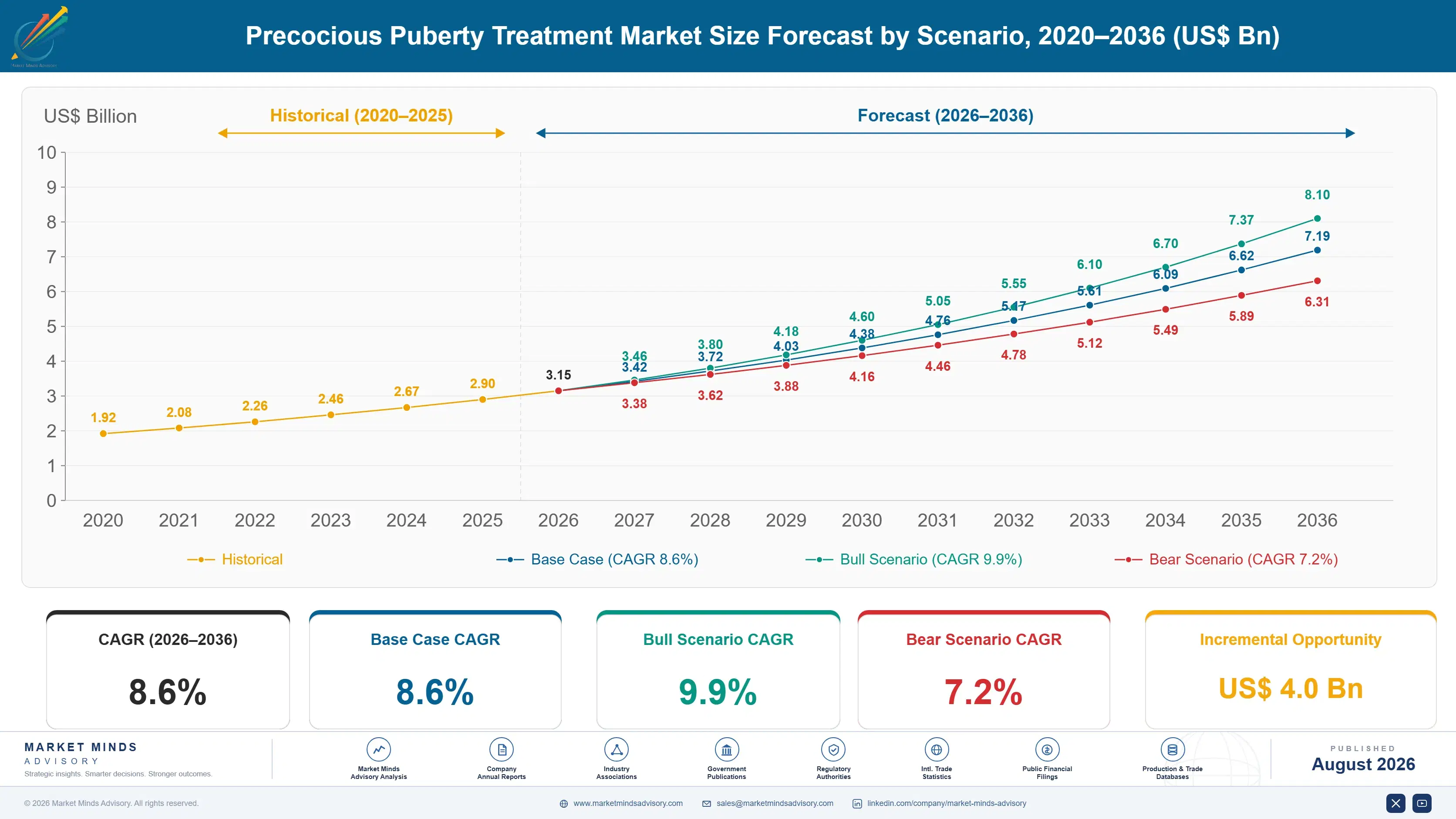
Precocious Puberty Treatment Market Forecast Scenarios

precocious-puberty-treatment-market-size-forecast-scenario-1787308079725
Precocious puberty treatment spending grew at roughly 7.6% annually between 2020 and 2025, as rising documented diagnosis rates and expanding pediatric endocrinology screening access drove steady treatment volume growth across most major consumer markets tracked in this study, a pattern that has held steady even as individual formulation categories diverged meaningfully in underlying growth trajectory.
The base case assumes continued diagnosis rate growth, accelerating six-month depot formulation adoption, and steady reimbursement coverage expansion, sustaining an 8.6% blended annual growth rate through 2036 as caregivers increasingly favor reduced injection frequency formulations over legacy monthly regimens. These three mechanisms reinforce each other: diagnosis growth widens the addressable base, formulation adoption lifts premium mix, and reimbursement sustains broad volume nationally across most major healthcare markets and reimbursement systems tracked in this study.
A bull scenario assumes faster-than-expected diagnosis rate growth pulls treatment volume well ahead of current projections across major pediatric healthcare markets. The bear case centers on reimbursement rate pressure and generic competition that could meaningfully compress manufacturer margins across legacy formulation categories, lifting growth toward 9.9% if diagnosis accelerates. The bear case pulls growth down toward 7.2% instead if reimbursement pressure intensifies faster than expected.

Dosing Convenience Reshapes a Steady Pediatric Category

The precocious puberty treatment market sits at the convergence of rising documented diagnosis rates and a genuinely meaningful formulation innovation cycle around dosing frequency, a combination pulling this historically stable, monotherapy-dominated category into more competitively differentiated territory across most major healthcare markets, a shift accelerating faster than most legacy-focused manufacturers originally expected when planning multi-year investment budgets even a few years earl
MARKET CONCENTRATIONCR5 58%share held by the five largest GnRH agonist manufacturers combined
AVERAGE ANNUAL TREATMENT COST$18,500blended average annual treatment cost per patient across standard formulations
LEADING COUNTRY SHAREUnited States 24%of global category spending in a single healthcare market
DIAGNOSED CASE GROWTH RATE9.1%annual growth rate in newly diagnosed precocious puberty cases globally
SIX-MONTH DEPOT PENETRATION22%of total treatment volume now using six-month depot injectable formulations
TREATMENT ADHERENCE RATE81%of diagnosed patients maintaining consistent treatment adherence through puberty completion
Commercially, this market splits between legacy monthly and three-month GnRH agonist injectables facing generic competition, and newer six-month depot and implant formulations sold at meaningfully higher price points to caregivers and health systems valuing reduced injection burden, a divide reshaping manufacturer product strategy, leaving slower-moving legacy-only manufacturers increasingly confined to generic-exposed, price-competitive volume categories nationwide as this bifurcation continues deepening across most healthcare markets tracked.
Over the next decade, continued diagnosis rate growth, accelerating long-acting formulation adoption, and steady reimbursement coverage expansion will keep pulling treatment volume toward premium, convenience-differentiated formulations across most major pediatric healthcare markets and reimbursement systems tracked in this study, reshaping research, manufacturing, and commercial investment priorities across nearly every major GnRH agonist producer globally across research, manufacturing, and commercial planning alike nationwide.
"Parents don't ask about mechanism of action. They ask how many more times their child has to get a shot. That question is what actually drives formulation switching in this category."
Director, Pediatric Endocrinology and Rare Disease Practice · MMA Healthcare and

Market Trends

Six-Month Depot Formulations Reshape Prescribing Patterns

Regulatory approval of six-month depot GnRH agonist formulations continues reshaping prescribing patterns as pediatric endocrinologists and caregivers increasingly favor reduced injection frequency over legacy monthly and three-month regimens that historically dominated this therapeutic category for decades. Industry data indicates six-month depot formulations now represent roughly 22% of total treatment volume, a meaningful increase from a negligible base just several years earlier before the first six-month products reached major healthcare markets. This shift is pulling manufacturers without dedicated long-acting formulation capability to invest rapidly or risk losing prescribing share entirely across most major markets covered in this study.
Market Impact: Expands screening coverage by 16 pe
Rising Diagnosis Rates Expand the Treated Population

Continued expansion of pediatric endocrinology screening access and growing clinical awareness of central precocious puberty symptoms continues driving diagnosed case volume considerably faster than population growth alone would suggest, reflecting both genuine incidence increases and improved case identification across most major healthcare markets tracked in this study. Clinical registry data confirms diagnosed case volume has grown meaningfully faster than the underlying pediatric population base over the past several years, directly expanding the addressable treatment market. This trend is pulling manufacturers to expand pediatric endocrinology outreach as broader diagnosis rate growth continues nationally.
Market Impact: Expands incidence rates by 12 perce

Market Opportunities and Growth Drivers

Expanding Pediatric Endocrinology Screening Access Nationwide

Continued expansion of pediatric endocrinology screening programmes and growing primary care physician awareness of central precocious puberty symptoms continues driving earlier case identification, directly expanding the diagnosed and treated patient population across most major healthcare markets tracked in this study. National clinical registry data confirms screening programme coverage has expanded meaningfully across major healthcare systems over the past several years, directly expanding the addressable treatment population reached through formal pediatric care pathways. This driver is expected to keep sustaining above-average treatment volume growth through the coming decade across most major regional healthcare markets tracked.
Market Impact: Reimbursement rates fell 14 percent

Documented Environmental and Dietary Incidence Factors

Growing clinical research documenting environmental and dietary factors associated with earlier puberty onset continues expanding the underlying incidence base requiring treatment, a trend that researchers have increasingly documented across multiple major healthcare markets over the past decade tracked in this study. Clinical epidemiological data confirms documented incidence rates have risen meaningfully across several major countries over the past several years, directly expanding the addressable treatment population independent of screening or diagnostic access improvements alone. This driver is expected to keep sustaining underlying demand growth through the coming decade across most major healthcare markets tracked.
Market Impact: Generic pricing runs 35 percent low

Market Restraints and Challenges

Reimbursement Rate Pressure Compresses Manufacturer Margins

Major private and government payers across developed healthcare markets continue negotiating aggressively on GnRH agonist reimbursement rates, squeezing manufacturer margins on legacy formulations even as diagnosed treatment volume continues expanding across the broader patient population tracked in this study. The root cause is that payers increasingly view long-established GnRH agonist products as mature, well-understood categories worth negotiating centrally rather than accepting historical pricing precedent indefinitely. This pressure disproportionately affects manufacturers dependent primarily on legacy monthly and three-month formulation revenue. Manufacturers are responding by expanding long-acting formulation portfolios to diversify revenue away from reimbursement-pressured legacy products.
Market Impact: Reaches 22 percent depot penetratio

Generic Competition Erodes Legacy Formulation Pricing

Continued generic entry into legacy monthly and three-month GnRH agonist formulations continues eroding branded pricing power, as originator manufacturers face intensifying competition from lower-cost generic alternatives once patent protection expires across most major regulated pharmaceutical markets tracked in this study. The underlying cause is that legacy GnRH agonist compounds have been commercially available long enough that patent protection has lapsed in most major jurisdictions, opening the category to generic manufacturer entry at meaningfully lower price points. This pressure disproportionately affects originator manufacturers still dependent on legacy formulation revenue. Manufacturers are responding by shifting commercial focus toward newer, still-protected long-acting formulations.
Market Impact: Grows diagnosed case volume 9 perce
3 additional market trends, 4 additional growth drivers, and 3 additional restraints and challenges are covered in the full report. Contact sales@marketmindsadvisory.com to access the complete intelligence.

Segment CAGR and Growth Architecture

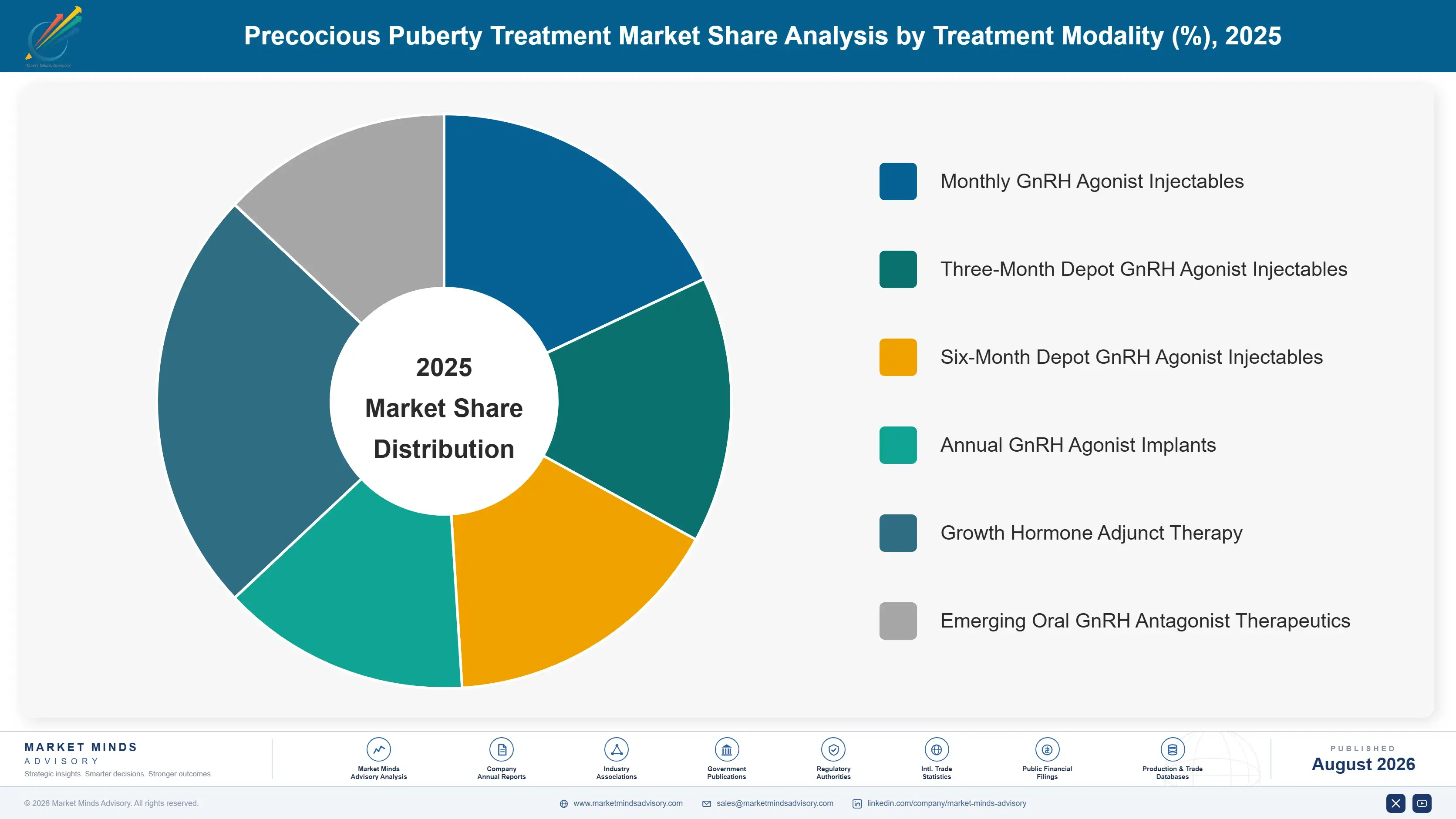
This market segments by treatment modality spanning monthly GnRH agonist injectables, three-month depot injectables, six-month depot injectables, annual GnRH agonist implants, growth hormone adjunct therapy, and emerging oral GnRH antagonist therapeutics used across major pediatric healthcare markets broadly nationwide and internationally, spanning both reimbursed insurance channels and direct hospital procurement pathways across the industry.
precocious-puberty-treatment-market-market-share-analysis-1787308080304

6-Month Depot GnRH Agonist Injectables

Six-month depot GnRH agonist injectables are the fastest-growing segment as caregivers and pediatric endocrinologists increasingly favor reduced injection frequency over legacy monthly and three-month regimens that require considerably more frequent clinical visits across the treatment period tracked in this study. Leading manufacturers have invested heavily in extended-release formulation technology that maintains consistent hormone suppression across the full six-month dosing interval without compromising clinical efficacy compared to more frequent dosing schedules used historically. This segment commands meaningfully higher pricing than legacy formulations, reflecting both the additional formulation complexity required and genuine caregiver willingness to pay for reduced treatment burden. Manufacturers are pursuing expanded six-month product registration specifically to compete for this fastest-growing segment across major healthcare markets nationwide.
CAGR 13.5%

Emerging Oral GnRH Antagonist Therapeutics

Emerging oral GnRH antagonist therapeutics are growing considerably faster than the broader market as clinical development programmes advance non-injectable treatment alternatives that could eventually eliminate the injection burden entirely for diagnosed patients across most major healthcare markets tracked in this study. Leading manufacturers have invested significantly in clinical trial programmes demonstrating oral antagonist efficacy and safety comparable to established injectable GnRH agonist standards, though genuine commercial availability remains limited to a small number of approved products currently. This segment benefits from genuine caregiver and patient preference for non-injectable treatment options that traditional injectable formulations cannot match regardless of dosing interval extension. Manufacturers are investing heavily in oral formulation clinical development specifically to compete for this genuinely differentiated segment nationwide.
CAGR 11.8%
Full segment breakdown across 6 segments available in the complete report.

Regional Architecture and Country Demand Map

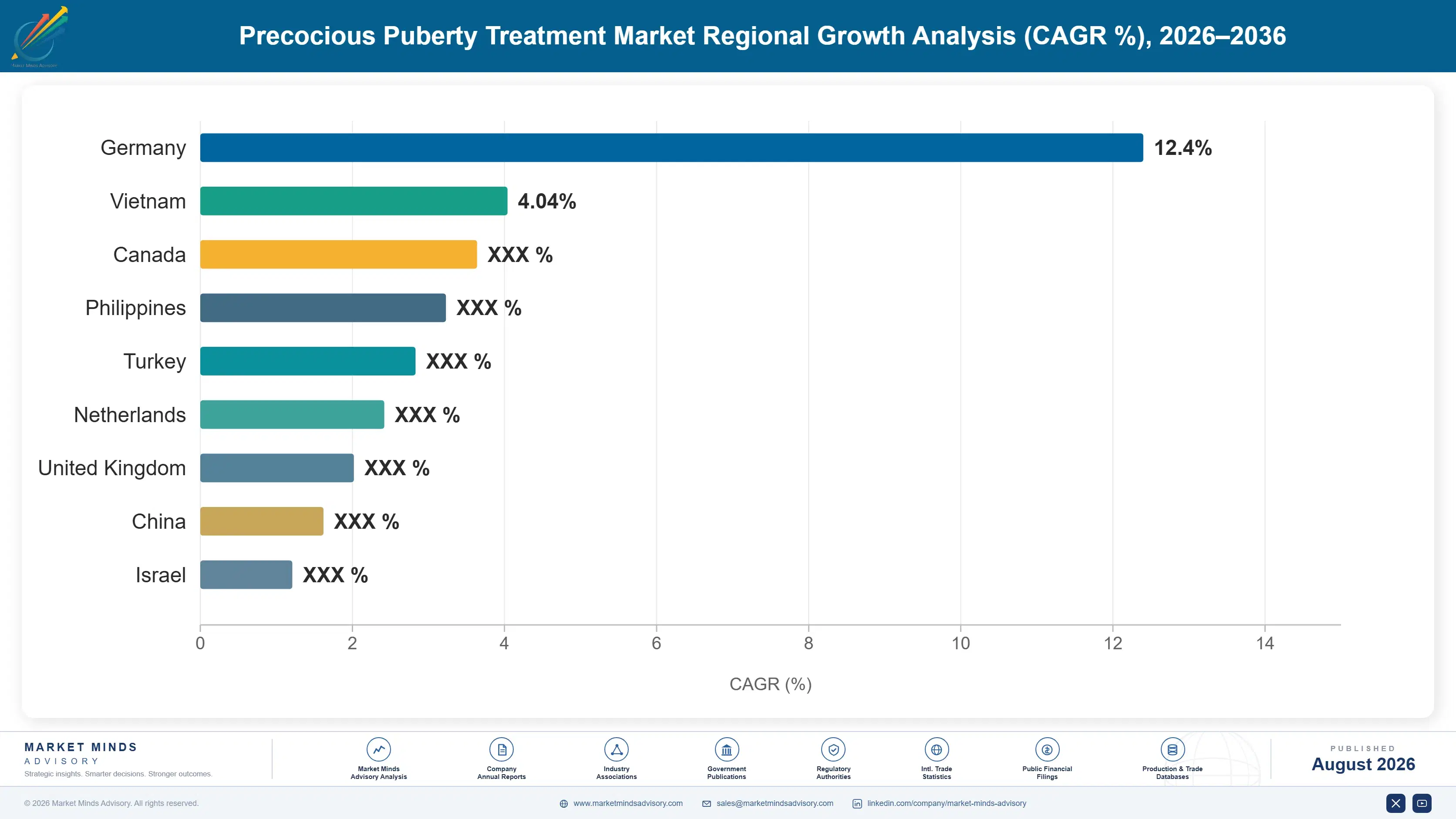
North America and East Asia lead global precocious puberty treatment spending given strong pediatric endocrinology infrastructure and rising documented diagnosis rates, while South Asia and Pacific sustains meaningful additional growth from expanding screening access broadly across most healthcare markets tracked and improving diagnostic access nationwide.

North America

The United States anchors North American demand through extensive pediatric endocrinology infrastructure and broad private insurance and Medicaid reimbursement coverage that sustains steady treatment volume across most major healthcare systems nationwide. Canada follows a broadly similar diagnosis and treatment pattern driven by comparable pediatric healthcare infrastructure at meaningfully smaller absolute scale relative to its larger neighbor. Six-month depot formulation adoption has accelerated meaningfully across the region as caregivers and physicians increasingly favor reduced injection frequency products entering the market in recent years. Reimbursement rate pressure continues expanding across major private payers, creating a genuinely tightening pricing environment for legacy formulation manufacturers serving this market. Mexico contributes growing demand as private healthcare infrastructure expands screening capability.
Share: 28% | CAGR: 8.6% (2026 to 2036)

Western Europe

Germany and France anchor Western European demand through comprehensive statutory health insurance coverage that sustains broad treatment access across most diagnosed pediatric patients within these national health systems. The United Kingdom maintains steady demand through National Health Service coverage, though reimbursement negotiation has grown considerably more rigorous in recent years compared to historical pricing precedent established decades earlier. Smaller Western European markets including the Netherlands and Scandinavian countries show comparatively high per-capita treatment access despite modest absolute market size, reflecting strong pediatric healthcare system infrastructure and screening culture broadly across the region. Italy and Spain contribute additional demand, both showing steady screening access expansion as national pediatric endocrinology infrastructure continues developing further.
Share: 21% | CAGR: 6.9% (2026 to 2036)
Regional intelligence for 5 additional markets available in the complete report: East Asia, South Asia and Pacific, Latin America, Middle East and Africa, Eastern Europe. Contact sales@marketmindsadvisory.com.
precocious-puberty-treatment-market-country-cagr-analysis-1787308080841

Long-Acting Formulation and Diagnosis Access Strategy

Manufacturers are shifting commercial strategy toward six-month depot formulation investment, oral antagonist clinical development, and pediatric endocrinology screening partnership, capturing premium pricing power that legacy monthly formulations alone increasingly cannot sustain across reimbursement-tightening major healthcare markets globally and beyond, from long-established legacy manufacturers to newer clinical-stage specialty pharmaceutical challengers alike across the entire industry nat

Six-Month Depot Formulation Investment Strategy Programme

Manufacturers are investing in extended-release six-month depot formulation development that maintains consistent hormone suppression while dramatically reducing injection frequency compared to legacy monthly and three-month regimens, capturing premium pricing that standard formulations cannot command given their comparatively limited convenience differentiation. This lever requires substantial formulation and clinical trial investment, but successfully developed products command materially stronger prescriber loyalty and caregiver satisfaction. Manufacturers report six-month depot investment improving average treatment revenue by roughly 29% compared to legacy monthly formulation portfolios across most major healthcare markets and formulary evaluation processes nationwide broadly.
Market Impact: Improves average treatment revenue

Oral Antagonist Clinical Development Investment Strategy

Manufacturers are investing in oral GnRH antagonist clinical development programmes that could eventually eliminate the injection burden entirely, positioning to capture the next generation of formulation innovation ahead of competitors still focused primarily on incremental injectable dosing interval extension. This lever requires substantial multi-year clinical trial investment, but successfully developed oral products would command genuinely differentiated positioning that injectable competitors cannot easily replicate. Manufacturers report oral antagonist development investment improving long-term pipeline valuation by roughly 33% compared to injectable-only portfolios across most major clinical development pipelines tracked in this study.
Market Impact: Improves pipeline valuation by roug

Pediatric Endocrinology Screening Partnership Programme Strategy

Manufacturers are partnering directly with pediatric endocrinology practices and screening programmes to support expanded early case identification, indirectly growing the addressable diagnosed and treated patient population beyond what treatment availability alone could reach across underserved healthcare markets tracked in this study. This lever requires meaningful partnership investment without immediate direct commercial return, but successfully expanded screening access grows the addressable treated population considerably over time. Manufacturers report screening partnership strategies improving addressable patient population by roughly 19% within partnership regions broadly, particularly across the most underserved rural and suburban pediatric healthcare markets tracked.
Market Impact: Expands addressable population by r

Reimbursement Value Demonstration Investment Programme Strategy

Manufacturers are investing in real-world outcomes research and direct payer engagement to defend reimbursement rates against downward pricing pressure, demonstrating quantified clinical and quality-of-life improvements from long-acting formulations that justify sustained premium reimbursement levels to increasingly cost-conscious payers. This lever requires meaningful clinical research investment, but successfully demonstrated value protects pricing considerably better than passive reimbursement negotiation alone. Manufacturers report payer value demonstration programmes improving reimbursement rate retention by roughly 17% compared to markets without dedicated payer engagement broadly, particularly as payers face mounting pressure to justify sustained premium pricing across most reimbursed categories.
Market Impact: Improves rate retention by roughly

Who Controls the Margin Pool

The top five manufacturers control roughly 58% of global category spending, a moderately concentrated market reflecting genuinely meaningful barriers to entry including decades-long clinical evidence requirements, pediatric formulation development complexity, and established prescriber relationships that most smaller pharmaceutical companies cannot easily replicate within a reasonable commercial timeframe, and this concentration level has held roughly steady even as newer long-acting formulation
Current competitive activity centers on six-month depot formulation investment, oral antagonist clinical development, and pediatric endocrinology screening partnership building, as the leading manufacturers pursue genuinely different strategic emphases while generic entrants target legacy formulation categories facing intensifying price competition across most major healthcare markets and reimbursement systems tracked in this study, spanning both branded originator strategy and generic manufacturer commercial planning simultaneously.

Emerging pressure comes from generic manufacturers in India and increasingly China entering legacy monthly and three-month formulation categories with meaningfully lower pricing, alongside specialty biotechnology companies pursuing oral antagonist development that could eventually reshape which companies lead the fastest-growing next-generation formulation segment specifically, forcing established leaders to respond with acquisitions and clinical investment rather than organic capability alone within the fastest-growing next-generation formulation segments tracked.
precocious-puberty-treatment-market-company-positioning-matrix-1787308081443

Competitive Moat and Risk Dimensions

ABBVIE INC.

Moat: Decades-Long Clinical Prescribing Relationships

AbbVie's Lupron Depot maintains decades-long clinical track record and dominant pediatric endocrinologist prescribing relationships built since the product's original approval, giving it prescriber trust and formulary positioning that newer competitors would need years of comparable clinical evidence accumulation to replicate at similar scale nationwide today.
ABBVIE INC.

Risk: Generic and Long-Acting Competition Risk

AbbVie faces intensifying exposure to accelerating generic competition and longer-acting formulation entrants eroding legacy monthly and three-month depot volume, and continued acceleration of this substitution trend could meaningfully compress the company's traditional revenue base absent further long-acting formulation investment over time nationally and beyond broadly.
FERRING PHARMACEUTICALS A/S

Moat: Broad European Regulatory Distribution Scale

Ferring benefits from broad international triptorelin distribution and strong European pediatric endocrinology regulatory relationships built over decades of continuous regional presence, giving it market access and reimbursement credibility that newer entrants cannot easily replicate without comparable regulatory investment nationwide and beyond today across most major markets nationwide.
FERRING PHARMACEUTICALS A/S

Risk: European Reimbursement Pricing Pressure

Ferring faces meaningful exposure to reimbursement pricing pressure across national health systems facing tightening pharmaceutical budget scrutiny, and continued acceleration of centralized European pricing negotiation could meaningfully compress the company's core reimbursed revenue relative to more geographically diversified competitors over time nationally and beyond broadly.

Players Tracked

Prominent Players

AbbVie Inc.
Ferring Pharmaceuticals A/S
Ipsen S.A.
Endo International plc
Tolmar Inc.

Other Key Players

Sun Pharmaceutical Industries Ltd.
Sandoz Group AG
Teva Pharmaceutical Industries Ltd.
Fresenius Kabi AG
Hikma Pharmaceuticals plc
Cipla Limited
Dr. Reddy's Laboratories Limited
Viatris Inc.
Lupin Limited
Aurobindo Pharma Limited
Sagent Pharmaceuticals Inc.
Piramal Pharma Limited
Debiopharm International SA
Bharat Serums and Vaccines Limited
Emcure Pharmaceuticals Limited

Recent Developments

MARCH 2026

Tolmar Expands Six-Month Depot Formulation Distribution

Tolmar announced expanded distribution of its six-month leuprolide depot formulation across additional North American pediatric endocrinology practices, broadening patient access to reduced-frequency dosing beyond its initial launch markets and specialist networks nationwide, following months of internal commercial planning and physician outreach coordination and third-party logistics operators.
Signal: Reflects continued manufacturer investment
OCTOBER 2025

Ferring Signs European Reimbursement Agreement for Depot Formulation

Ferring secured an expanded reimbursement agreement with a major European national health system for its triptorelin depot formulation, broadening covered patient access across the country's pediatric endocrinology treatment programme under newly negotiated terms following an extended negotiation process involving several national pricing committee stakeholders domestically.
Signal: Indicates continued manufacturer investmen
JANUARY 2026

AbbVie Advances Oral Antagonist Clinical Trial Programme

AbbVie announced advancement of its oral GnRH antagonist clinical trial programme into a later development phase, positioning the company to compete for the emerging non-injectable treatment segment gaining growing caregiver and physician interest following several years of internal clinical trial design and regulatory agency consultation.
Signal: Signals established manufacturers investin

Peptide Synthesis and Manufacturing Complexity

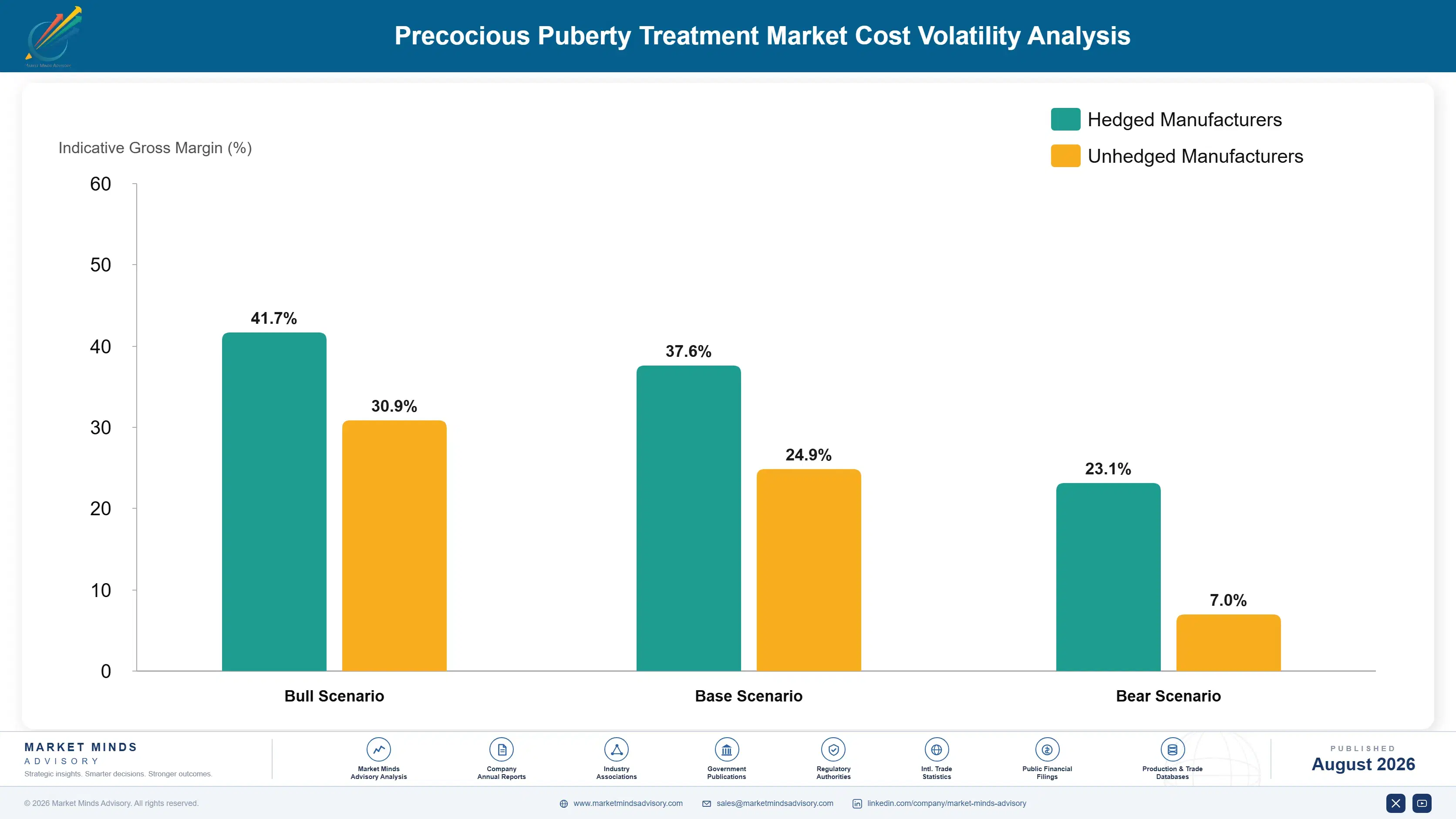
Peptide active pharmaceutical ingredient synthesis, specialized depot polymer excipients, and sterile injectable manufacturing together represent roughly 46% of cost of goods sold for GnRH agonist manufacturers, with peptide synthesis concentrated among a small group of specialized contract manufacturers serving the broader pharmaceutical industry, where limited redundancy across production capacity shapes long-term sourcing strategy for most manufacturers regardless of scale today.
Peptide synthesis and specialized polymer costs rose meaningfully during 2021 and 2022 amid broader pharmaceutical supply chain disruption and elevated specialty chemical manufacturing input costs, with company annual reports from major manufacturers confirming elevated production costs persisted through much of 2022 before moderating gradually through 2023 and 2024 to date, with 2022 marking the peak of disruption across most producing regions tracked in this study broadly.

Manufacturers without long-term peptide synthesis contracts or vertically integrated sterile manufacturing capability face materially higher input cost exposure and supply chain risk than better-capitalized competitors, creating a durable cost stability advantage for larger companies able to invest in dedicated production infrastructure, particularly as national tender processes increasingly require verified reliable supply chain commitments from bidding manufacturers nationally and internationally.
precocious-puberty-treatment-market-cost-volatility-analysis-1787308081703

Long-Term Peptide Synthesis Supply Contracts

Larger manufacturers are locking in multi-year peptide synthesis supply contracts with qualified contract manufacturers, stabilizing input costs and securing reliable supply volume ahead of anticipated demand growth, reducing exposure to spot-market price swings that periodically disrupt smaller competitors, a mitigation strategy requiring substantial procurement sophistication most smaller manufacturers cannot access easily nationwide broadly today.

Vertical Integration Into Sterile Manufacturing

Larger manufacturers are investing in vertically integrated sterile injectable and depot formulation manufacturing capability, reducing dependency on external contract manufacturers and insulating production costs and supply reliability from open-market volatility, giving vertically integrated manufacturers a durable cost stability advantage over standalone competitors nationwide, particularly across the largest formulation-diversified manufacturers tracked in this report today.

Contract Manufacturer Diversification Strategy

Manufacturers are qualifying additional peptide synthesis and sterile manufacturing partners across multiple geographic regions to reduce dependency on any single supplier, building resilience against regional supply disruption affecting concentrated specialty manufacturing capacity, particularly across regions facing periodic trade policy uncertainty or supply chain disruption nationally, particularly across the fastest-growing regulated healthcare markets tracked broadly.

Portfolio Architecture for Margin Defence

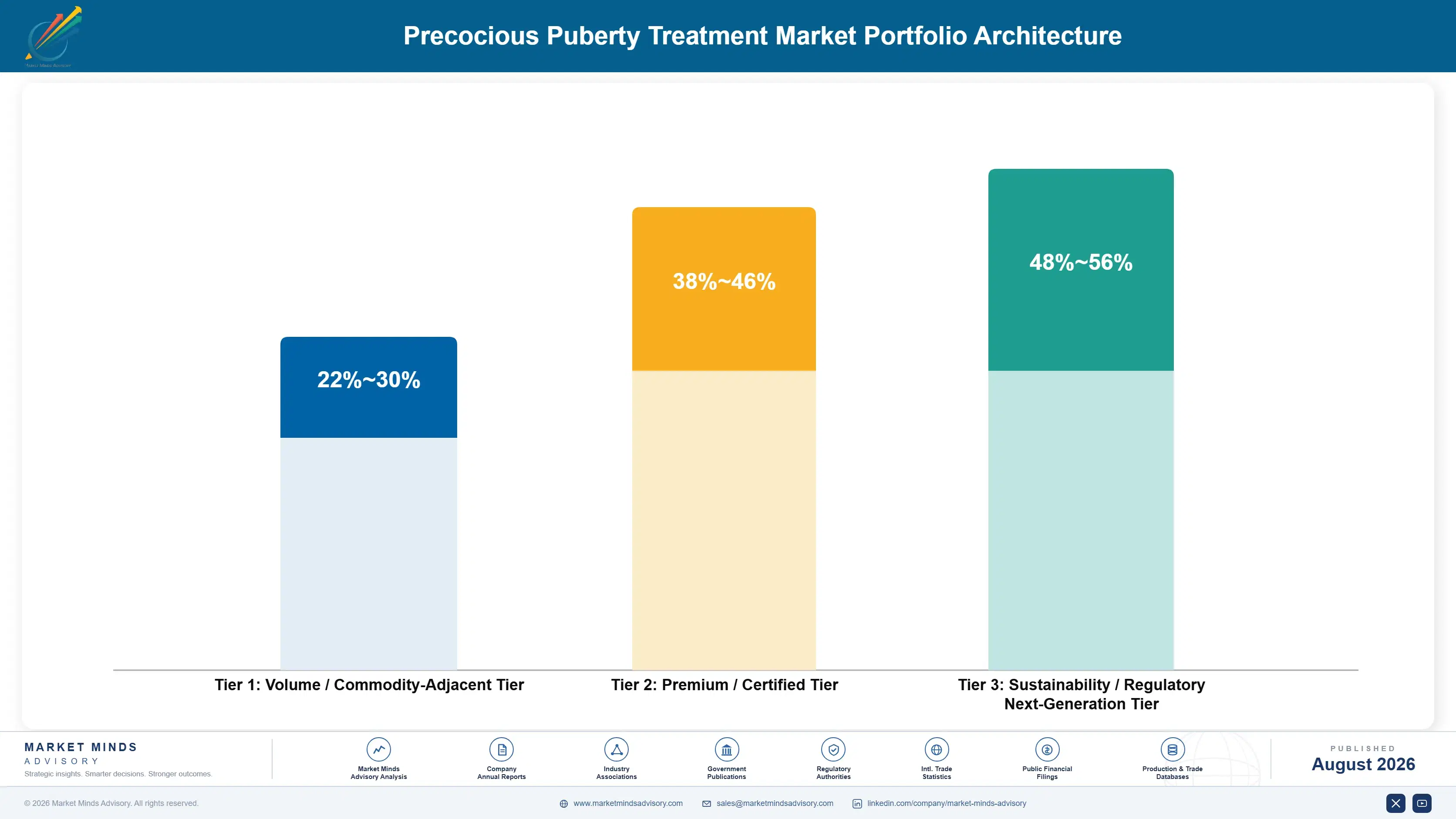
This market organizes into three commercial tiers spanning legacy monthly and generic-exposed injectables at the volume end, standard branded three-month and implant formulations in the middle tier, and premium six-month depot and emerging oral antagonist products capturing the strongest margins at the top of the portfolio architecture, a structure that increasingly mirrors the broader industry's shift toward convenience-driven premiumization across most major healthcare markets.
Legacy and premium tiers pull manufacturers in genuinely different directions: legacy formulations sustain broad prescriber familiarity and reimbursed volume at compressed margins, while long-acting and oral products deliver materially stronger margins that increasingly fund the clinical development investment this competitive therapeutic category requires, forcing many manufacturers to run genuinely distinct commercial and clinical teams for each tier simultaneously.

The highest-value pools concentrate around six-month depot formulations and emerging oral antagonist products sold to convenience-focused caregivers and health systems, where dosing differentiation and clinical evidence together sustain premium pricing power that legacy monthly formulations simply cannot match across comparable patient volume, making these categories the clearest strategic priority for manufacturers planning multi-year clinical investment across the industry and across the broader competitive landscape.

Volume / Commodity-Adjacent Tier

Legacy monthly GnRH agonist injectables facing generic competition and reimbursement pricing pressure across most major healthcare markets broadly, competing primarily on unit price and reimbursement negotiation rather than dosing convenience or clinical differentiation.
Gross Margin: 22-30%

Premium / Certified Tier

Standard branded three-month depot and annual implant formulations sold under established clinical evidence to prescribing physicians nationally, typically requiring established clinical registries that smaller generic-focused manufacturers rarely maintain in-house broadly.
Gross Margin: 38-46%

Sustainability / Regulatory / Next-Generation Tier

Six-month depot and emerging oral antagonist products commanding the strongest convenience and innovation premium available today, typically sold under long-term formulary positioning rather than transactional generic-competitive pricing dynamics across most reimbursement systems nationwide.
Gross Margin: 48-56%
precocious-puberty-treatment-market-portfolio-architecture-1787308082381

High-value Sub-segments and Strategic Watch-out

6-Month Depot GnRH Agonist Injectables

The fastest-growing and highest-margin segment, combining strong prescriber and caregiver adoption momentum with genuine dosing convenience advantages across most major healthcare markets tracked broadly, drawing intense manufacturer research investment and rapidly expanding formulary positioning activity across the industry nationwide today across leading manufacturers and healthcare systems nationwide.
Gross Margin: 48-56%

Emerging Oral GnRH Antagonist Therapeutics

Strong long-term margin potential driven by genuine non-injectable differentiation that traditional depot formulations cannot match regardless of dosing interval extension achieved nationally, particularly among caregivers and adolescent patients seeking to avoid recurring injection-related distress and internationally today across most major markets tracked and clinical development pipelines broadly.
Gross Margin: 50-58%

Three-Month Depot GnRH Agonist Injectables

The volume core segment sustaining broad prescriber familiarity even as newer formulations increasingly capture disproportionate industry profit growth overall nationally today, even as manufacturers increasingly redirect incremental investment toward faster-growing depot and oral categories instead overall broadly across the broader regional market and provider networks currently.
Gross Margin: 38-46%

Legacy Monthly GnRH Agonist Injectables

A strategic watch-out segment facing accelerating generic substitution pressure, requiring manufacturers to manage declining branded volume while defending remaining legacy relationships, particularly across jurisdictions where generic entry has already reached broad market maturity and abroad currently within select healthcare settings and reimbursement channels nationwide broadly.
Gross Margin: 18-26%

Treatment-Duration Anchored Prescribing Streams

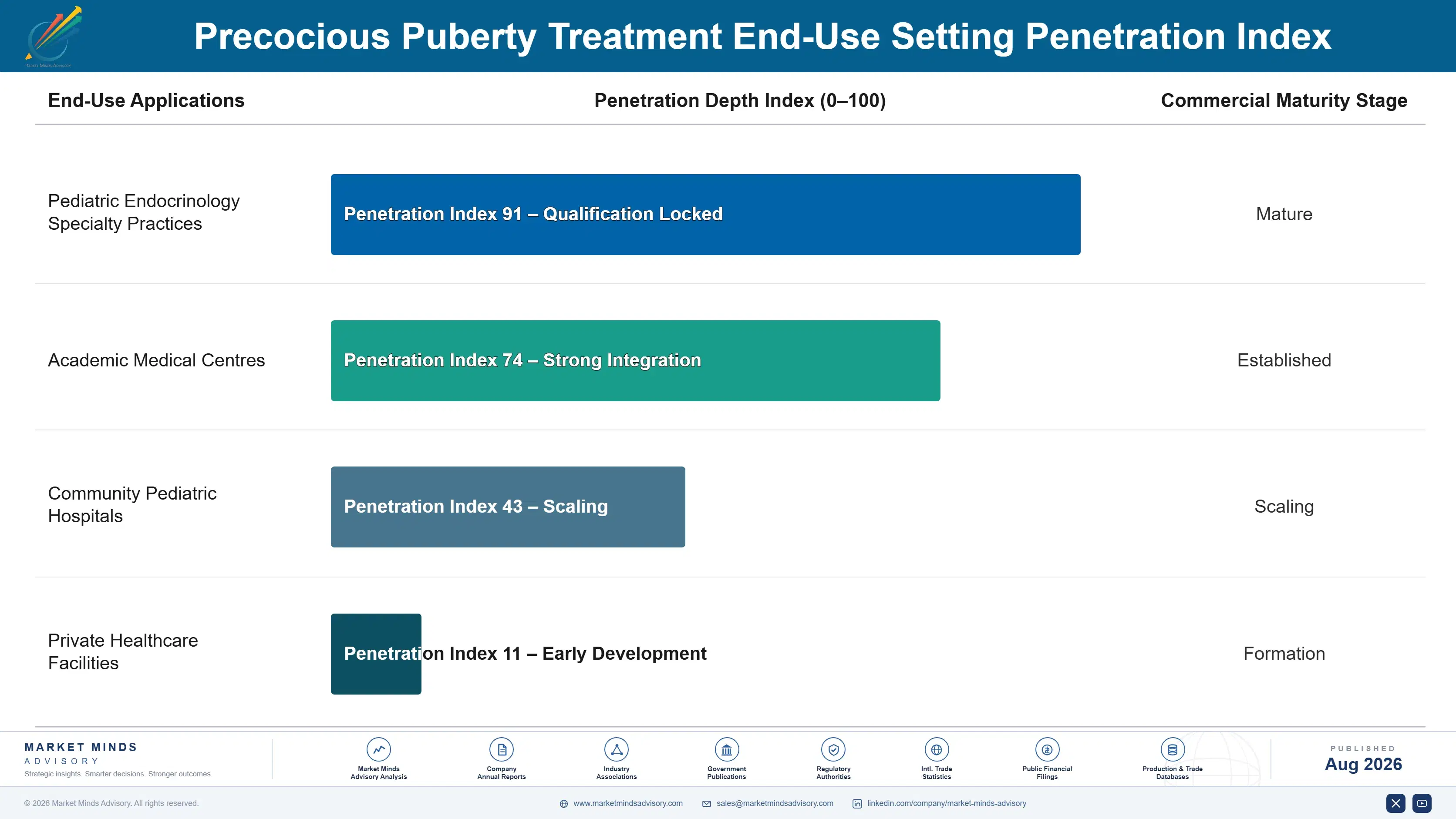
Winning a prescribing relationship with a pediatric endocrinology practice functions as an annuity anchor across a patient's multi-year treatment duration: securing initial prescription generates recurring formulation sales throughout the treatment period until puberty progression concludes, and losing that prescribing relationship to a competing formulation can eliminate a manufacturer's revenue from that patient almost immediately within a single treatment decision affecting broader family hea
Adoption depth varies considerably by healthcare system tier: private-pay and well-reimbursed public healthcare systems adopt premium six-month depot and emerging oral formulations earliest given clear caregiver value proposition around reduced injection burden, while more resource-constrained health systems more often continue prescribing legacy monthly formulations until reimbursement coverage broadens further, a pattern that continues shifting gradually as reimbursement coverage and caregiver awareness accumulate across most healthcare systems broadly.

A generational shift is underway as younger pediatric endocrinologists trained during the long-acting formulation era enter practice expecting reduced-frequency dosing as standard treatment consideration, gradually normalizing a category that earlier-trained physicians historically associated almost entirely with monthly injection regimens established decades earlier, a shift manufacturers slow to recognize risk finding themselves increasingly disconnected from where prescribing decision-making is heading.
precocious-puberty-treatment-market-end-use-penetration-index-1787308082954

Where Puberty Treatment Economics Are Heading

These are among the four positions where our research anticipates prominent divergence between winners and laggards over the coming forecast period. Each is grounded in the demand model, the regulatory perimeter, and the announced capacity pipeline.
01 / LONG-ACTING FORMULATION RACE

Six-month depot investment will separate convenience leaders from laggards

Manufacturers investing in six-month depot formulation development are capturing disproportionate share of the fastest-growing, highest-margin premium segments where dosing convenience increasingly determines prescriber and caregiver loyalty over legacy monthly regimens. Companies without meaningful long-acting formulation investment risk being confined to lower-margin generic-exposed categories facing intensifying price competition. Expect long-acting formulation capability to become the single most important competitive differentiator for manufacturers seeking sustainable premium positioning through the coming decade, well ahead of manufacturers relying purely on legacy monthly formulation production alone.
02 / ORAL ANTAGONIST DEVELOPMENT RACE

Non-injectable innovation will determine next-generation leadership

Manufacturers investing in oral GnRH antagonist clinical development are positioning for genuinely differentiated next-generation leadership that could eventually eliminate the injection burden entirely for diagnosed patients across most major healthcare markets tracked in this study. Companies without meaningful oral development investment risk missing the next major formulation transition entirely. Expect oral antagonist development capability to become an increasingly important long-term competitive differentiator for manufacturers seeking sustainable category leadership, particularly within the fastest-growing non-injectable treatment preference segments tracked, where clinical trial results increasingly determine which manufacturers attract specialist prescriber attention first.
03 / SCREENING ACCESS EXPANSION

Diagnosis rate growth will keep expanding the addressable market

Manufacturers and healthcare systems investing in expanded pediatric endocrinology screening access are steadily growing the addressable diagnosed and treated patient population beyond what treatment availability alone could reach previously across most major healthcare markets tracked. This trajectory shows no sign of reversing given sustained clinical awareness growth and improving diagnostic infrastructure globally. Expect screening access expansion to open meaningfully larger addressable treatment populations across most major healthcare markets broadly, especially across underserved communities where pediatric specialist access remains genuinely limited.
04 / GENERIC CONSOLIDATION PRESSURE

Legacy formulation decline will accelerate portfolio rebalancing

Continued generic competition in legacy monthly and three-month formulation categories is disproportionately affecting manufacturers lacking meaningful long-acting or oral formulation diversification, accelerating portfolio rebalancing as originator companies redirect investment toward genuinely differentiated next-generation products facing less direct generic substitution risk. This trajectory favors manufacturers with existing long-acting formulation pipelines and clinical development capability. Expect continued portfolio rebalancing toward premium formulation categories throughout the coming several years across most major healthcare markets across most major healthcare markets and reimbursement systems tracked.

Engagement Snapshot From the Field

A live engagement with an industry participant carrying material or product regulatory and market exposure ahead of a defining policy shift, showing how our research translates into a defensible multi-year portfolio strategy.
MARKET MINDS ADVISORY · CLIENT ENGAGEMENT SUMMARY
Precocious Puberty Treatment Producer Strategic Portfolio Review and Transition Roadmap 2026·Investment Scenario on Precocious Puberty Treatment Exposure Evaluation 2025-26
CLIENT PROFILE
The client is a mid-sized specialty pharmaceutical manufacturer generating projected annual precocious puberty treatment revenue of approximately $95 million (client-reported, unverified by MMA) upon successful long-acting formulation launch. Leadership sought guidance on prioritizing six-month depot versus oral antagonist development investment ahead of a multi-year clinical development budget cycle, running through the following two fiscal quarters ahead of the planned launch.
STRATEGIC CHALLENGE
The client had historically competed primarily in legacy monthly formulation categories facing intensifying generic competition, and leadership was uncertain whether six-month depot or oral antagonist development offered stronger near-term commercial return given limited capital available for simultaneous pursuit of both pathways within a limited multi-year development budget simultaneously, given genuinely constrained internal clinical development staff capacity.
MMA APPROACH
MMA's team benchmarked comparable manufacturer long-acting formulation launch strategies, modeled projected revenue and development timeline under various formulation investment scenarios, and assessed the client's existing clinical and regulatory capability relative to established competitors pursuing similar development pathways, drawing on primary interview data gathered from pediatric endocrinology specialists across the client's core target markets nationwide.
KEY FINDINGS
  1. Six-month depot formulations showed meaningfully faster projected regulatory approval timelines than oral antagonist development given the more established clinical and manufacturing precedent for depot injectable technology.
  2. The client's existing clinical development team possessed genuine depot formulation expertise that would require considerably less new capability investment than pursuing oral antagonist development from a comparatively limited existing base.
  3. Comparable manufacturers that prioritized six-month depot development achieved meaningfully faster commercial revenue realization than those pursuing oral antagonist development as an initial long-acting formulation strategy.
  4. A phased development strategy pursuing six-month depot first while building oral antagonist capability in parallel reduced projected commercial risk considerably compared to pursuing either pathway in isolation.
CLIENT PROFILE
The client is a mid-sized specialty pharmaceutical manufacturer generating projected annual precocious puberty treatment revenue of approximately $95 million (client-reported, unverified by MMA) upon successful long-acting formulation launch. Leadership sought guidance on prioritizing six-month depot versus oral antagonist development investment ahead of a multi-year clinical development budget cycle, running through the following two fiscal quarters ahead of the planned launch.
STRATEGIC CHALLENGE
The client had historically competed primarily in legacy monthly formulation categories facing intensifying generic competition, and leadership was uncertain whether six-month depot or oral antagonist development offered stronger near-term commercial return given limited capital available for simultaneous pursuit of both pathways within a limited multi-year development budget simultaneously, given genuinely constrained internal clinical development staff capacity.
MMA APPROACH
MMA's team benchmarked comparable manufacturer long-acting formulation launch strategies, modeled projected revenue and development timeline under various formulation investment scenarios, and assessed the client's existing clinical and regulatory capability relative to established competitors pursuing similar development pathways, drawing on primary interview data gathered from pediatric endocrinology specialists across the client's core target markets nationwide.
KEY FINDINGS
  1. Six-month depot formulations showed meaningfully faster projected regulatory approval timelines than oral antagonist development given the more established clinical and manufacturing precedent for depot injectable technology.
  2. The client's existing clinical development team possessed genuine depot formulation expertise that would require considerably less new capability investment than pursuing oral antagonist development from a comparatively limited existing base.
  3. Comparable manufacturers that prioritized six-month depot development achieved meaningfully faster commercial revenue realization than those pursuing oral antagonist development as an initial long-acting formulation strategy.
  4. A phased development strategy pursuing six-month depot first while building oral antagonist capability in parallel reduced projected commercial risk considerably compared to pursuing either pathway in isolation.
RECOMMENDED STRATEGY
Phase 1: Phase 1 (Months 1-14): Advance six-month depot formulation development applying the client's existing depot manufacturing expertise and validate manufacturing scale-up feasibility early. Phase 2: Phase 2 (Months 15-24): Launch the six-month depot product commercially while building early-stage oral antagonist research capability while monitoring early prescriber adoption closely. Phase 3: Phase 3 (Months 25-36): Advance oral antagonist clinical development based on six-month depot commercial results and capability built and broader competitive market feedback gathered along the way.
OUTCOME
The client advanced its six-month depot formulation through regulatory approval and commercial launch within the recommended timeline, reporting revenue results consistent with initial modeling projections during the following two fiscal years (client-reported, unverified by MMA), exceeding the client's original internal projections modestly during the first two fiscal years following launch.

Frequently Asked Questions

Foundational context covering the market sizes, CAGR, scope, country, region and competition that inform every finding below. This section is provided to cover basics and most often pre-purchase conversations, answered from the MMA Primary Research Dataset.

What is the current size of the Precocious Puberty Treatment Market?

The market was valued at approximately $2.9 billion in 2025. This includes GnRH agonist injectables, implants, and growth hormone adjunct therapies used globally nationally and abroad.

How large will the Precocious Puberty Treatment Market be by 2036?

The market is projected to reach approximately $7.19 billion by 2036, up from about $3.15 billion in 2026. This reflects rising diagnosis rates and long-acting formulation growth.

What is the CAGR for the Precocious Puberty Treatment Market 2026 to 2036?

The market is expected to grow at a compound annual growth rate of 8.6% between 2026 and 2036. This reflects expanding diagnosis rates and premium formulation adoption.

Which segment is growing fastest?

Six-month depot GnRH agonist injectables are the fastest-growing segment, expanding at approximately 13.5% annually, well above the market's 8.6% blended growth rate. This reflects strong caregiver demand.

Who are the major companies in the Precocious Puberty Treatment Market?

Leading companies include AbbVie, Ferring, Ipsen, Endo International, and Tolmar. Together these five manufacturers account for roughly 58% of global category spending across most major markets worldwide.

Which country is growing fastest?

China is the fastest-growing major country at an estimated 10.5% CAGR, driven by its large pediatric population base and rising documented incidence rates and abroad nationwide.

Report Segmentation Architecture

The full report scope spans multiple orthogonal segmentation dimensions, with cross-tabulated demand data provided for each dimension pair. Coverage extends further to regional breakdowns, trend trajectories, and the competitive detail needed to support segment-level decision-making.

By Treatment Modality

  • Monthly GnRH Agonist Injectables
  • Three-Month Depot GnRH Agonist Injectables
  • Six-Month Depot GnRH Agonist Injectables
  • Annual GnRH Agonist Implants
  • Growth Hormone Adjunct Therapy
  • Emerging Oral GnRH Antagonist Therapeutics

By End-Use Setting

  • Pediatric Endocrinology Specialty Practices
  • Academic Medical Centres
  • Community Pediatric Hospitals
  • Private Healthcare Facilities

By Commercial Dimension

  • Reimbursed Insurance Channels
  • Direct Hospital Procurement
  • Specialty Pharmacy Distribution
  • Government Health Programme Coverage

By Region

  • North America
  • Western Europe
  • East Asia
  • South Asia and Pacific
  • Latin America
  • Middle East and Africa
  • Eastern Europe

Scope, Methodology, and Coverage

Every figure in this report is reproducible from documented input assumptions. The scope below maps the historical period, the forecast horizon, the segmentation dimensions, and the countries covered, alongside the underlying primary and qualitative methodology.
Historical Period
2020 to 2025
Forecast Period
2026 to 2036
Base Year
2025 (USD billions; MMA Primary Research Dataset, August 2026)
Market Definition
This report covers pharmaceutical and device-based therapeutics used to treat central precocious puberty in children, including GnRH agonist injectables, implants, and growth hormone adjunct therapies. It excludes general pediatric endocrinology diagnostics and treatments for peripheral precocious puberty unrelated to GnRH agonist mechanisms.
Quantitative Units
USD billions (current prices); treatment volume; average annual treatment cost per patient
Segmentation Dimensions
By Treatment Modality; By End-Use Setting; By Commercial Dimension; By Region
Regions Covered
North America, Western Europe, East Asia, South Asia and Pacific, Latin America, Middle East and Africa, Eastern Europe
Countries Covered
USA, China, Germany, France, UK, Japan, South Korea, India, Australia, Canada, Brazil, Mexico, Indonesia, Vietnam, Thailand, Malaysia, UAE, Saudi Arabia, South Africa, Nigeria, Turkey, Poland, Netherlands, Italy, Spain, Sweden, Switzerland, Argentina, Colombia, Singapore, and additional markets relevant to this sector
Key Companies Profiled
AbbVie Inc., Ferring Pharmaceuticals A/S, Ipsen S.A., Endo International plc, Tolmar Inc., Sun Pharmaceutical Industries Ltd., Sandoz Group AG, Teva Pharmaceutical Industries Ltd., Fresenius Kabi AG, Hikma Pharmaceuticals plc, Cipla Limited, Dr. Reddy's Laboratories Limited, Viatris Inc., Lupin Limited, Aurobindo Pharma Limited, Sagent Pharmaceuticals Inc., Piramal Pharma Limited, Debiopharm International SA, Bharat Serums and Vaccines Limited, Emcure Pharmaceuticals Limited
Quantitative Methodology
Primary survey, n=3,800 respondents, Q4 2025, six countries; demand-side model with trade association cross-validation
Qualitative Methodology
47 expert interviews, Q4 2025; applied to validate demand model assumptions, identify emerging dynamics, and assess competitive positioning
Report Format
PDF and XLSX data workbook (Word format preview document)
Publisher
Market Minds Advisory
Report Code
MMA-2026-HLT-138
Published
August 2026
Contact
sales@marketmindsadvisory.com | www.marketmindsadvisory.com

Purchase the full Precocious Puberty Treatment Market Report (2026 to 2036).

The full report provides detailed modality-level segmentation, country-level diagnosis rate and reimbursement analysis, and channel distribution tracking across major global healthcare markets covered in this study. It includes manufacturer-level competitive benchmarking based on long-acting formulation investment and clinical development capability. Subscribers receive quarterly updates tracking new product approvals and reimbursement policy changes as they occur. A companion dataset provides diagnosed patient volume estimates by country for detailed market sizing purposes, including scenario modeling for long-acting formulation launch and reimbursement value demonstration planning across major healthcare markets.
Modality-level segmentation breakdown by formulation category
Country-level diagnosis rate and reimbursement trend analysis
Distribution channel tracking and benchmarking service
Manufacturer competitive benchmarking scorecards and overview
Quarterly product approval and policy update service
Diagnosed patient volume dataset segmented by country region

Built For The People Who Decide

From boardroom strategy to bench-side execution, this report is read cover-to-cover by leaders shaping the next decade of their industry, turning demand scenarios, market dynamics and valuation benchmarks into decisions.
CXOs/ Presidents/ VPs/ Managers
M&A and Corporate Development
Strategy Teams and R&D Heads
Procurement and Product Directors
Regulatory and Compliance Leaders
Investor Relations and Equity Analysts