Preclinical Medical Device Testing Services Market
Preclinical Medical Device Testing Services Market: Chemical Characterisation First, Sterilisation Revalidation Waves and the Regulatory Critical Path
A revised standard turned biological safety assessment from a biology problem into an analytical chemistry problem, and an air emissions rule is now forcing thousands of already approved devices back through full revalidation.
2025 MARKET VALUE$2.1BMarket Size 2025
2036 FORECAST VALUE$5.2BBase Case , 2026 to 2036
CAGR 2026 TO 20368.4 %Bull 9.6% / Bear 7.2%
INCREMENTAL OPPORTUNITY$2.9BNet 10- year value creation
EXPANSION MULTIPLE2.24x2036 value over 2026 base
Strategic Levers
M&A Pipeline
Regional Outlook
Country Rankings
Competitive Intelligence
Segmental Deep-dive
Executive Snapshot and Market Trajectory
Testing sits on the critical path of every device launch, and nobody notices until it slips. A biocompatibility programme runs fourteen weeks, a notified body slot cannot be booked until the file is complete, and a delayed report costs a quarter of commercial revenue. Nobody budgets for it properly.
Chemical characterisation and toxicological risk assessment compound at 12.6%, exactly 1.50 times the market, because the 2018 revision of ISO 10993-1 inverted the order of work. Analytical chemistry now answers first and animal studies only fill gaps chemistry cannot close. East Asia holds 28% of demand, driven by Chinese type testing rules that no foreign laboratory report can satisfy. No foreign report substitutes for it.
Five providers hold 38% between them, which is fragmented for a regulated service. Accreditation scope rather than laboratory scale determines who can perform a given test, and capacity is the binding constraint through most of the year. Sponsors book slots months ahead and treat availability as more important than price. Slot availability decides schedules more often than quoted price does. Sponsors who have learned that lesson book capacity a year ahead.
Market Definition
The market covers outsourced non-clinical testing services supporting medical device regulatory submission and design verification, spanning biological safety and biocompatibility, chemical characterisation and toxicological risk assessment, sterilisation validation and microbiology, package integrity and shelf-life, bench performance and mechanical testing, and electrical safety and electromagnetic compatibility. Clinical investigations, notified body conformity assessment, in-house manufacturer testing and post-market surveillance services are excluded.
Base Year Value
$2.1B in 2025 (MMA Primary Research Dataset, August 2026)
Forecast Period
2026 to 2036, eleven discrete annual values
CAGR
8.4% base case. Bull 9.6%. Bear 7.2%.
Fastest Growth Segment
Chemical Characterisation and Toxicological Risk Assessment: 12.6% CAGR
Fastest Growth Country
India: 11.4% CAGR
Fastest Growth Region
South Asia and Pacific: 10.6% CAGR
Largest Region
East Asia: 28% of 2025 global value
Market Leaders
NAMSA, Eurofins Scientific, Sotera Health, WuXi AppTec, SGS. Source: MMA Analysis based on company annual reports.
Primary Survey
n=3,800 procurement and R&D decision-makers, Q4 2025, six countries
Methodology
Demand-side build-up, cross-validated against public data, 47 expert interviews
Preclinical Medical Device Testing Services Market Forecast Scenarios

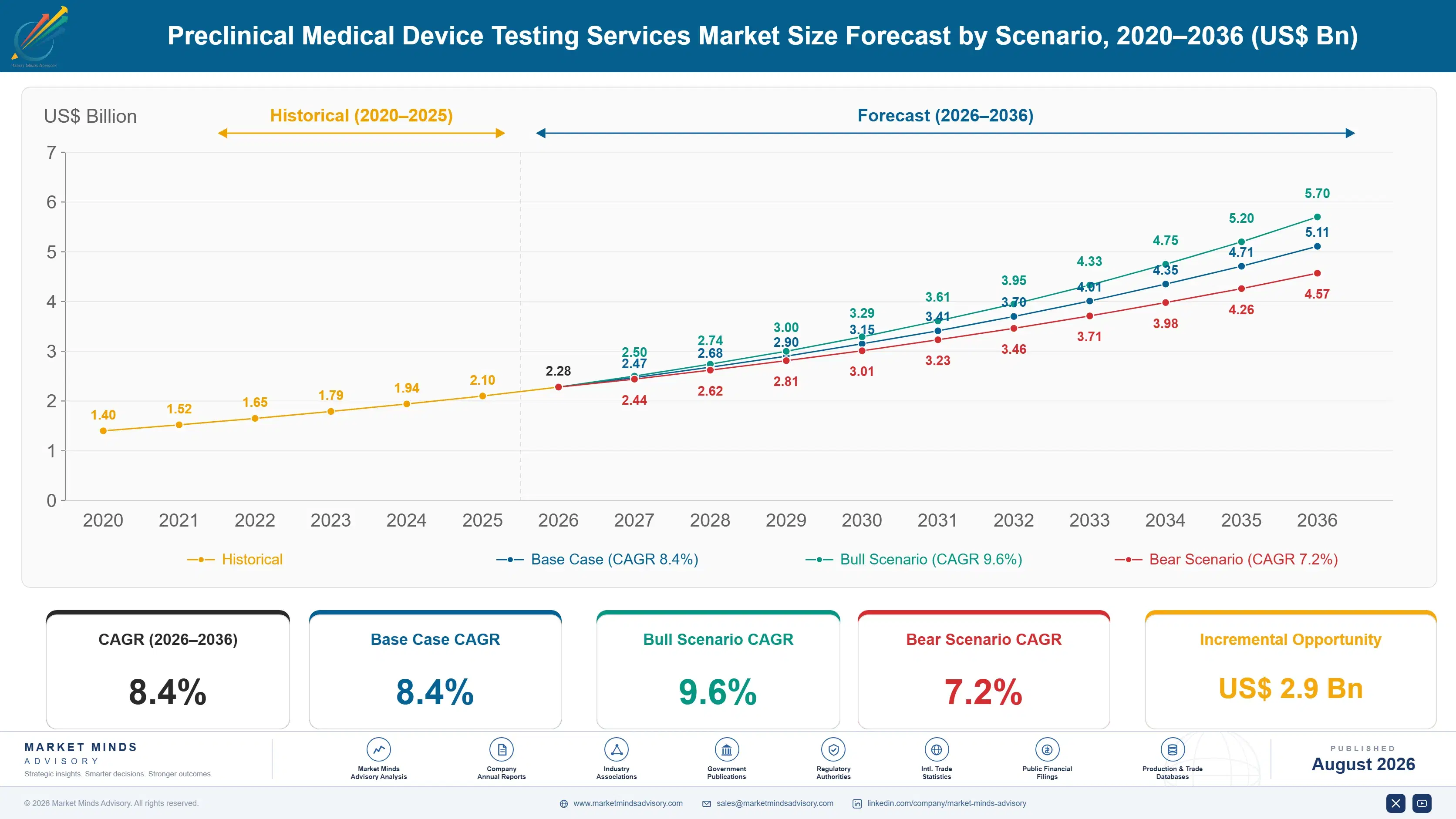
Growth ran at an implied 7.0% across 2020 to 2025 and the drivers changed midway. Device development activity stalled through 2020 as elective procedures collapsed, then European Medical Device Regulation transition deadlines pulled an enormous volume of legacy device work forward from 2022, and testing capacity became the constraint rather than sponsor demand. Capacity became the binding limit.
The base case at 8.4% rests on three mechanisms. Ethylene oxide emissions regulation is pushing manufacturers toward radiation and other modalities, and every sterilisation change requires full revalidation of an already approved device. The revised ISO 10993-1 keeps shifting work from animal studies toward analytical chemistry, which is more expensive per programme. And Chinese type testing rules require domestic laboratory work that no foreign report replaces. All three run on regulatory timetables rather than on product pipelines.
The bull case at 9.6% assumes ethylene oxide restrictions tighten further and faster, converting revalidation from a planned migration into an urgent one across large device portfolios. The bear case at 7.2% follows from European Medical Device Regulation deadline extensions reducing urgency, letting manufacturers spread legacy device work over years rather than competing for scarce laboratory capacity now.
The base case at 8.4% rests on three mechanisms. Ethylene oxide emissions regulation is pushing manufacturers toward radiation and other modalities, and every sterilisation change requires full revalidation of an already approved device. The revised ISO 10993-1 keeps shifting work from animal studies toward analytical chemistry, which is more expensive per programme. And Chinese type testing rules require domestic laboratory work that no foreign report replaces. All three run on regulatory timetables rather than on product pipelines.
The bull case at 9.6% assumes ethylene oxide restrictions tighten further and faster, converting revalidation from a planned migration into an urgent one across large device portfolios. The bear case at 7.2% follows from European Medical Device Regulation deadline extensions reducing urgency, letting manufacturers spread legacy device work over years rather than competing for scarce laboratory capacity now.
The Service Nobody Budgets For Until It Delays a Launch
Preclinical device testing is bought the way insurance is bought: reluctantly, late, and by people who resent the cost right up to the moment it saves them. A biological safety evaluation takes fourteen weeks. A notified body will not open a review slot until the technical file is complete. Miss the slot and the launch slips a quarter, which costs vastly more than any testing programme.
TOP FIVE CONCENTRATION38%Combined share held by the five largest global service providers
BIOCOMPATIBILITY PROGRAMME DURATION14 weeksTypical elapsed time for a full biological safety evaluation
CHEMISTRY-FIRST SUBSTITUTION43% of studiesAnimal studies avoided through analytical characterisation and risk assessment
LABORATORY CAPACITY UTILISATION89% of slotsBooked capacity across accredited providers during peak periods
STERILISATION REVALIDATION COSTUSD 210,000 typicalCost of revalidating one device after a modality change
OUTSOURCED SHARE OF TESTING71% of spendTesting performed by external laboratories rather than manufacturers
The technical content changed fundamentally in 2018. The revised ISO 10993-1 put chemical characterisation and toxicological risk assessment first, with animal studies reserved for questions the chemistry genuinely cannot answer. That turned biological safety evaluation from a biology exercise into an analytical chemistry one, and 43% of studies that would once have gone to an animal model are now resolved by extractables work and a toxicologist.
Meanwhile an air emissions rule is generating work nobody planned. Ethylene oxide restrictions are pushing manufacturers toward radiation sterilisation, and every modality change requires full revalidation of an already approved device at roughly USD 210,000 each. Capacity runs at 89% during peak periods, so slot availability decides schedules more often than price does.
"The thing manufacturers underestimate every single time is that the laboratory is not waiting for them. Capacity gets booked months out, and a programme that starts eight weeks late finishes eight weeks late. There is no expediting a fourteen week extraction study."
Market Trends
The 2018 revision of ISO 10993-1 restructured biological safety evaluation around chemical characterisation under ISO 10993-18, with toxicological risk assessment interpreting the results and animal studies used only where chemistry leaves a genuine gap. Regulators across the United States Food and Drug Administration and European notified bodies have applied that hierarchy consistently. Roughly 43% of studies that once went to an animal model now resolve analytically. The work is more expensive per programme and requires mass spectrometry capability and toxicologists rather than animal facilities, which has reshaped provider investment entirely.
Market Impact: Duplicate programmes for 100% of im
Ethylene Oxide Restrictions Force Revalidation of Approved Devices
United States Environmental Protection Agency rules on ethylene oxide emissions have tightened substantially, and manufacturers are migrating toward gamma, electron beam and X-ray sterilisation. Every modality change requires full revalidation of a device already on the market: material compatibility, functional performance after irradiation, and biological safety on the newly sterilised article. Typical cost runs near USD 210,000 per device. This is testing demand created by an environmental regulation rather than by any product launch, and it applies across entire installed portfolios at once. Portfolios migrate together rather than device by device.
Market Impact: Legacy work at 34% regionally
Market Opportunities and Growth Drivers
Chinese Type Testing Rules Require Domestic Laboratory Work
China's National Medical Products Administration requires type testing performed at accredited domestic laboratories before device registration, and a report from an accredited European or American laboratory does not substitute. That means every device entering the Chinese market generates a second complete testing programme regardless of what has already been done elsewhere. Combined with a large domestic manufacturer base filing its own registrations, this makes East Asia the single largest regional source of demand at 28%, and the requirement is a geographic lock no commercial arrangement can bypass. Scientific standing elsewhere buys nothing here.
Market Impact: Utilisation reaching 89% of slots
European Regulation Transition Pulls Legacy Device Work Forward
The European Medical Device Regulation requires technical documentation for legacy devices that were certified under a far lighter regime, and much of that documentation depends on testing never previously performed. Notified body review capacity is the visible bottleneck, but a file cannot enter the queue incomplete. Manufacturers therefore compete for laboratory slots ahead of competing for review slots. Roughly 34% of European preclinical testing volume now relates to legacy devices rather than to new development, which is an unusual and temporary composition. That composition is temporary by definition, and regional demand will normalise once the transition window finally closes.
Market Impact: Late starts affecting 27% of progra
Market Restraints and Challenges
Accredited Capacity Cannot Expand at the Pace of Demand
Laboratory utilisation runs at 89% during peak periods and sponsors book months ahead. The root cause is that accreditation scope is granted per test method per site, and adding a method requires validation, proficiency testing and assessor visits that take the better part of a year regardless of how much equipment a provider buys. Capital does not solve it. Providers mitigate by transferring methods between accredited sites within a network, and by scheduling long-lead studies against forecast rather than confirmed sponsor demand. Equipment purchases do not shorten assessor schedules. Time, not capital, is the constraint.
Market Impact: Chemistry resolving 43% of studies
Sponsors Treat Testing as Cost Rather Than Schedule Risk
Device developers routinely budget testing as a procurement line and select on quoted price, then discover that the cheapest provider had no available slot for eleven weeks. The root cause is organisational: testing is bought by procurement while the consequence lands on regulatory affairs and commercial launch. Programmes start late and finish late accordingly. Providers mitigate by quoting committed start dates alongside price, and by contracting reserved capacity annually with sponsors who have learned the lesson at least once already. Learning usually requires one delayed launch. One delayed launch usually settles the argument internally.
Market Impact: Revalidation costing USD 210,000 ea
3 additional market trends, 4 additional growth drivers, and 2 additional restraints and challenges are covered in the full report. Contact sales@marketmindsadvisory.com to access the complete intelligence.
Segment CAGR and Growth Architecture
Segmentation follows testing service type, because each demands different accreditation scope, different scientific capability and different facilities. An extractables study needs mass spectrometry and a toxicologist, while sterilisation validation needs microbiology and dosimetry, and no provider is automatically credible across both. Accreditation is granted per method per site, so credibility is specific rather than general.

Chemical Characterisation and Toxicological Risk Assessment
Chemical characterisation compounds at 12.6%, exactly 1.50 times the market rate, because a standard revision made it the first step rather than a supporting one. ISO 10993-18 extractables and leachables work identifies what a device releases, and a toxicological risk assessment then decides whether those compounds present a hazard at the exposure involved. Animal studies follow only where the chemistry cannot resolve the question. The capability required is high-resolution mass spectrometry, method development and board-certified toxicologists rather than animal facilities, which is why providers built around biology have found the transition difficult. Programme values run well above the animal studies they displace, and the interpretive judgement is what sponsors are actually paying for.
CAGR 12.6%
Sterilisation Validation and Microbiology
Sterilisation validation grows at 10.2%, driven almost entirely by regulatory pressure on ethylene oxide rather than by new device development. Migrating a product from ethylene oxide to gamma, electron beam or X-ray means demonstrating that materials survive the dose, that function is unaffected, that residuals and degradation products are acceptable, and that sterility assurance is achieved. Cost runs near USD 210,000 per device and applies across entire portfolios simultaneously. Dosimetry capability, validated microbiology and access to irradiation facilities are the requirements, and few providers hold all three. Demand here arrives as a wave tied to a compliance deadline rather than as a steady development pipeline, which complicates capacity planning considerably.
CAGR 10.2%
Full segment breakdown across 6 segments available in the complete report.
Regional Architecture and Country Demand Map
Demand follows regulatory jurisdiction rather than device manufacturing location, because a submission requires testing acceptable to the receiving authority. Markets imposing domestic testing requirements generate demand that no amount of work performed elsewhere can satisfy or replace. Jurisdiction rather than manufacturing footprint is the map worth reading here.
East Asia
East Asia holds 28% of global demand, the largest regional share, and a regulatory rule rather than manufacturing scale explains most of it. China's National Medical Products Administration requires type testing at accredited domestic laboratories before registration, and reports from accredited laboratories elsewhere do not substitute, so every imported device generates a complete second testing programme. Domestic Chinese manufacturers filing their own registrations add substantial further volume, and that manufacturer base has grown rapidly across imaging, orthopaedics and single-use devices. Japanese demand is smaller, technically exacting and concentrated in providers with long domestic relationships. Korean device development, particularly in aesthetics and dental, generates a steady programme flow. Regional growth of 9.6% sits comfortably above the global rate.
Share: 28% | CAGR: 9.6% (2026 to 2036)
North America
North America accounts for 27% of demand and grows at 7.6%. The distinguishing feature is the ethylene oxide transition: Environmental Protection Agency emissions rules have pushed manufacturers toward radiation sterilisation faster here than anywhere, and every modality change requires full revalidation of an already approved device at roughly USD 210,000. That is testing demand created by an environmental regulation rather than by product development. The Food and Drug Administration accreditation scheme for conformity assessment has given accredited laboratories a defined status in submissions, which concentrates work with providers holding that recognition. Device development activity across the Boston, Minneapolis and Orange County clusters provides the underlying programme flow beneath the revalidation wave.
Share: 27% | CAGR: 7.6% (2026 to 2036)
Regional intelligence for 5 additional markets available in the complete report: Western Europe, South Asia and Pacific, Latin America, Middle East and Africa, Eastern Europe. Contact sales@marketmindsadvisory.com.

Selling Capacity Against a Regulatory Deadline
Sponsors say they buy testing on price and then behave entirely differently once a launch date is at risk. The commercial positions worth holding are the ones where accreditation scope, committed capacity or interpretive judgement remove a sponsor's ability to shop the work elsewhere. Four qualify. Price is almost never the deciding variable. Availability usually is.
Sell Committed Start Dates Alongside Quoted Prices
Roughly 27% of programmes start late because a sponsor selected on price from a provider with no available slot, and a programme starting eight weeks late finishes eight weeks late. Providers quoting a committed start date alongside the price win work that never reaches a straight cost comparison, because the person who owns the launch date overrules procurement once the trade-off is visible. Reserved capacity agreements negotiated annually with repeat sponsors carry pricing roughly 15 to 22% above spot programme work and give the provider forecastable utilisation in return. Utilisation improves on both sides.
Market Impact: Reserved capacity priced 15 to 22%
Build Mass Spectrometry and Toxicology Rather Than Animal Capacity
Chemical characterisation compounds at 12.6% and now resolves 43% of studies that would once have used an animal model. The capability required is high-resolution mass spectrometry, method development and board-certified toxicologists, which is a different investment entirely from animal facilities. Providers built around biology have found the transition genuinely difficult. Programme values run 1.7 times the animal studies displaced, and the interpretive risk assessment rather than the analytical run is what sponsors are paying for, which makes the position defensible against providers competing on instrument time alone. Instrument time alone is not the product.
Market Impact: Chemistry programmes worth 1.7 time
Assemble Complete Sterilisation Modality Migration Packages
Moving a device off ethylene oxide requires material compatibility, functional performance after irradiation, residuals and degradation chemistry, and biological safety on the newly sterilised article, at roughly USD 210,000 per device. Sponsors migrating whole portfolios want one provider coordinating all of it rather than four separate engagements. Providers holding dosimetry, microbiology, chemistry and irradiation access together can price the package rather than the components, and portfolio migrations run to dozens of devices, which converts a single relationship into multi-year visibility. Coordination across four disciplines is what the sponsor is buying.
Market Impact: Migration packages at USD 210,000 f
Hold Accredited Capacity Inside Restricted Jurisdictions
Chinese type testing must be performed at accredited domestic laboratories, and no foreign report substitutes regardless of the accreditation behind it. That rule creates demand a provider simply cannot serve from outside the jurisdiction, and every imported device generates a full duplicate programme. Providers with accredited Chinese capacity capture work international competitors cannot quote at all. The same logic applies in a weaker form across several other markets tightening registration requirements, and the barrier is regulatory rather than technical or commercial. Every imported device generates a full duplicate programme, and East Asia consequently holds 28% of global demand.
Market Impact: Duplicate testing on 100% of all im
Who Controls the Margin Pool
Five providers hold 38% of the market measured on testing service revenue, the basis applied consistently through this section. That is fragmented for a regulated service, and accreditation structure explains it: scope is granted per method per site, so a provider is credible only where it holds the specific accreditation a submission requires. NAMSA and Eurofins Scientific lead. Scale confers far less advantage than sponsors assume.
Competition operates on three dimensions. Accreditation scope decides which studies a provider can perform for a given submission at all. Available capacity decides whether a sponsor can start on schedule, and utilisation across the industry runs near 89% at peak. And scientific interpretation, particularly toxicological risk assessment, decides whether a report survives regulator questions without a second round of work. None of the three can be bought quickly.
Two pressures will reshape position. Providers built around animal facilities are struggling as chemical characterisation displaces 43% of those studies, and rebuilding around mass spectrometry takes years. Against that, Chinese domestic laboratories hold jurisdictional positions international providers cannot contest. Rankings will move toward whoever pairs analytical depth with accredited capacity inside restricted markets. Very few providers hold both today.

Competitive Moat and Risk Dimensions
Moat: Regulatory pathway advisory integration
NAMSA combines testing with regulatory strategy advice, which places it in the sponsor conversation before the study list is written rather than after. Deciding what testing a submission actually requires is worth more to a developer than performing it, and that converts into scope the provider has helped define.
Risk: Legacy animal facility exposure
A capability base built around biological testing faces the substitution of 43% of those studies by analytical chemistry, and rebuilding around high-resolution mass spectrometry and toxicology is a multi-year investment rather than an equipment purchase. Providers that began as analytical laboratories entered the shift already holding the capability that regulators now expect first.
Moat: Analytical chemistry network depth
Eurofins operates one of the largest analytical laboratory networks anywhere, and extractables and leachables work under ISO 10993-18 draws on exactly the mass spectrometry capability that network already holds. Method transfer between accredited sites within the group also provides capacity flexibility that single-site providers cannot offer when a sponsor needs an immediate start date.
Risk: Device regulatory specialisation depth
Analytical capability alone does not produce a toxicological risk assessment that survives notified body scrutiny, and device-specific regulatory judgement is what sponsors increasingly buy. Competitors positioned as device regulatory specialists reach the sponsor earlier in the programme design conversation, where scope is set and where a general analytical provider is rarely invited.
Players Tracked
Prominent Players
NAMSA
Eurofins Scientific
Sotera Health
WuXi AppTec
SGS
Other Key Players
Charles River Laboratories
Intertek Group
TUV SUD
TUV Rheinland
Bureau Veritas
UL Solutions
Element Materials Technology
Pacific BioLabs
Toxikon
Nucro-Technics
Medistri
Micom Laboratories
BSI Group
DEKRA
Labcorp
Recent Developments
Ethylene oxide emissions rules accelerate sterilisation modality migration
Medical device manufacturers expanded programmes migrating products from ethylene oxide to radiation sterilisation, responding to tightened United States emissions requirements. This reflects environmental regulation rather than any commercial development, and each migrated device requires full revalidation regardless of its existing approval status. Approval status confers no exemption whatsoever.
Signal: An air quality rule is now generating devi
Notified body capacity constrains European legacy device transition
European notified body review capacity remained the limiting factor for legacy device certification under the Medical Device Regulation, with manufacturers competing for laboratory slots to complete files before queuing. This reflects transition timetable pressure rather than a corporate transaction, and it has concentrated demand into a narrow window.
Signal: Laboratory capacity has become the first b
Chemical characterisation displaces further biological study categories
Regulators continued accepting chemical characterisation with toxicological risk assessment in place of animal studies across additional biological endpoints, extending the hierarchy established by the revised ISO 10993-1. These were review practice developments rather than formal standard revisions or commercial transactions. Provider capability requirements have shifted accordingly.
Signal: The capability a provider needs is shiftin
Scientists, Instruments and Accreditation
This is a labour business before anything else. Scientific and technical staff account for roughly 47% of cost of delivery, with board-certified toxicologists and experienced method development chemists commanding the sharpest premiums. Instrument depreciation and service contracts run a further 16%, dominated by high-resolution mass spectrometry. Accreditation maintenance, proficiency testing and quality systems make up most of the remainder.
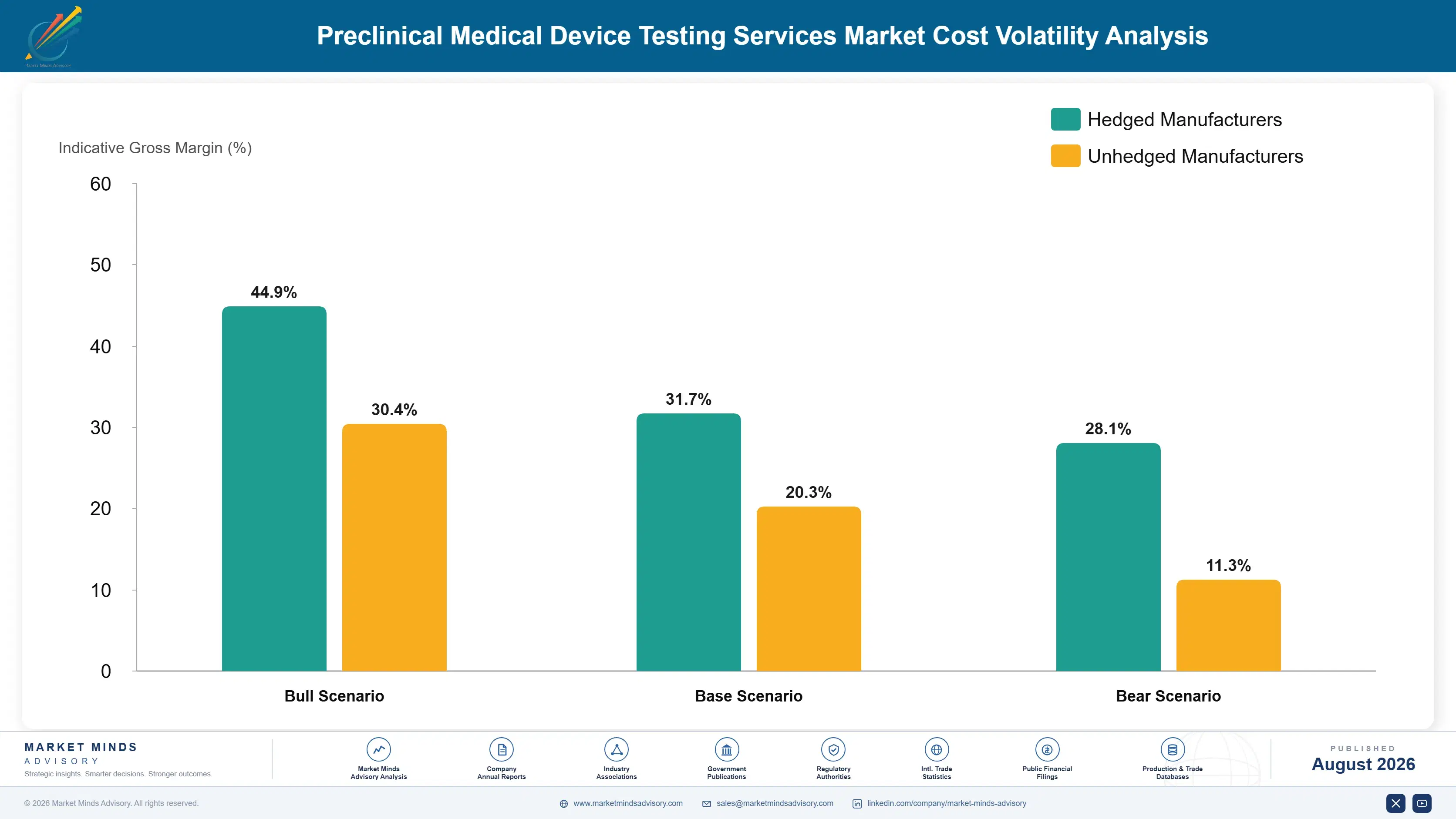
Laboratory staff costs rose sharply across 2022 and 2023 as demand for analytical chemists competed with pharmaceutical and semiconductor employers in the same regional labour markets, and European energy costs documented in International Energy Agency reporting raised facility operating costs simultaneously. Company annual reports covering laboratory services segments disclose the resulting wage inflation and margin pressure across several consecutive quarters. Recruiting has not become easier since.
Exposure divides by capability mix rather than by size. Providers weighted toward routine bench and package testing compete against low-cost regional laboratories and cannot pass wage increases through at all. Those weighted toward toxicological risk assessment and complex characterisation price on scarce expert judgement, where the sponsor has few alternatives and where a report that fails regulator scrutiny costs far more than the fee difference.

Transfer accredited methods between sites within a network
Accreditation is granted per method per site, so capacity at one location cannot simply absorb overflow from another. Providers that invest in transferring key methods across multiple accredited sites gain genuine flexibility when a sponsor needs an immediate start. The transfer cost is one validation exercise per method per site, and it converts into committed start dates competitors cannot offer.
Develop toxicology capability internally rather than recruiting it
Board-certified toxicologists are scarce and expensive, and competing on salary against pharmaceutical employers is a losing position for a service laboratory. Building a training pathway from analytical chemistry into device toxicology takes several years but produces staff who understand both halves of the work. Providers that started this before the standard revision now hold a genuine capacity advantage.
Schedule long-lead studies against forecast rather than confirmed demand
Extraction and ageing studies occupy capacity for months and cannot be compressed, so waiting for signed orders leaves instruments idle then oversubscribed. Scheduling against sponsor forecasts, with commercial terms reflecting the risk taken, smooths utilisation materially. Sponsors with reserved capacity agreements provide the forecast reliability that makes this workable in practice. Commercial terms should reflect the risk taken.
Portfolio Architecture for Margin Defence
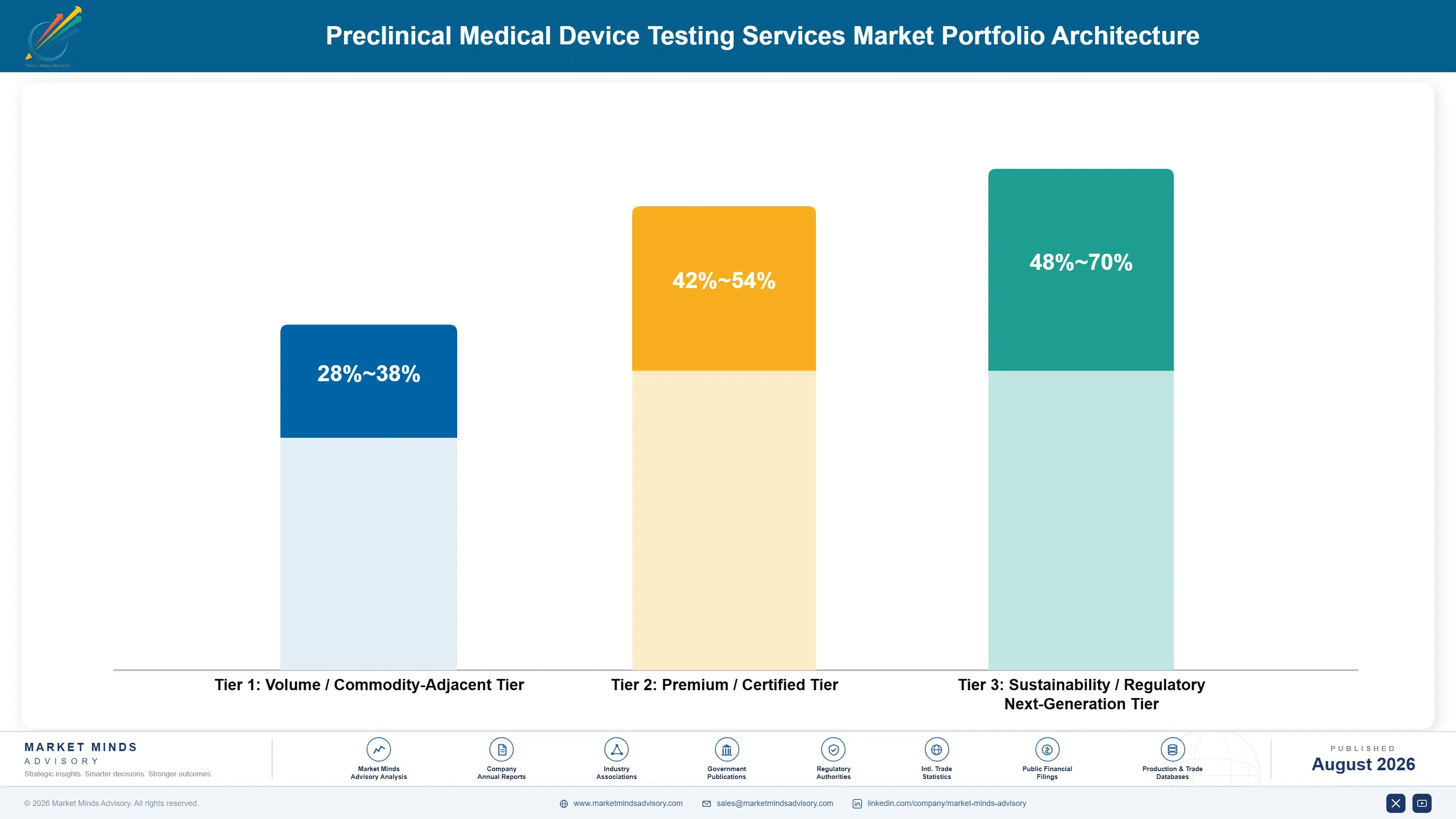
The portfolio separates on whether the deliverable is a measurement or a judgement. Bench performance, package integrity and routine electrical safety testing produce numbers, and regional laboratories compete for that work on price and turnaround. Chemical characterisation with toxicological risk assessment produces an argument a regulator either accepts or does not, and sponsors pay for the judgement rather than the instrument time behind it. Measurement and judgement are priced very different
The tension is that measurement work fills instruments and builds the sponsor relationships from which interpretive work follows. A provider that pursues only high-judgement studies loses the account when the sponsor needs routine verification testing and finds another laboratory that does everything. Most successful providers run the routine tiers deliberately at modest margin to hold the relationship intact. Relationship and margin have to be managed as separate objectives.
High-value pools concentrate where a regulator will question the conclusion, where a deadline is fixed, or where a jurisdiction restricts who may perform the work. Toxicological risk assessment, sterilisation migration packages and accredited testing inside restricted markets all qualify. None of them is awarded on quoted fee alone.
Volume / Commodity-Adjacent Tier
Bench performance, mechanical testing, package integrity and routine electrical safety work producing measurements against defined specifications. Regional laboratories compete on price and turnaround, and accreditation is widely held rather than scarce across the provider base.
Gross Margin: 28-38%
Premium / Certified Tier
Biological safety evaluation, sterilisation validation and microbiology requiring specific accreditation scope, validated methods and facilities few providers hold together. Capacity availability rather than quoted price frequently decides who wins the programme.
Gross Margin: 42-54%
Sustainability / Regulatory / Next-Generation Tier
Chemical characterisation with toxicological risk assessment, sterilisation modality migration packages and accredited testing inside restricted jurisdictions. The wide margin range reflects the gap between analytical throughput work and scarce expert interpretive judgement.
Gross Margin: 48-70%

High-value Sub-segments and Strategic Watch-out
Toxicological Risk Assessment
Compounding at 12.6% as chemical characterisation resolves 43% of studies that once used animal models. Board-certified toxicologists are genuinely scarce, and the interpretive judgement rather than the analytical run is what a sponsor is actually paying for here. Recruiting that expertise is genuinely hard. Salary competition is fierce.
Gross Margin: 56-70%
Sterilisation Migration Packages
Growing at 10.2% on an environmental rule rather than product development, at roughly USD 210,000 per device across whole portfolios. Providers holding dosimetry, microbiology, chemistry and irradiation access together can price the package rather than its separate components. Dozens of devices move at once. Capacity planning is difficult.
Gross Margin: 46-58%
Bench and Package Verification Testing
The volume core at 6.2 to 6.8%, competing against regional laboratories on price and turnaround. Run to hold the sponsor relationship and instrument utilisation, since a provider unable to do routine work loses the interpretive work that follows it. Instrument utilisation depends on it. Margin comes from elsewhere.
Gross Margin: 28-38%
Restricted Jurisdiction Accredited Capacity
The watch-out and the opportunity together. Chinese type testing must occur at domestic accredited laboratories, so international providers without local capacity cannot quote the work at all regardless of their scientific standing elsewhere. Accredited local capacity is the only route in. The regulatory barrier is deliberate rather than incidental.
Gross Margin: 40-62%
Programmes Booked Before Files Open
The recurring economics here rest on the sequence of regulatory work rather than on any contract. A sponsor that used a provider for biological safety returns for the sterilisation validation, then for the design change verification, then for the next generation of the device, because the historical data sits with that laboratory and comparability is easier to argue than to establish fresh. Roughly 71% of testing spend is outsourced, and switching providers mid-programme is close to unheard of.
Depth varies sharply by sponsor type. Large device manufacturers buy deepest, holding reserved capacity agreements and involving providers in programme design. Mid-sized developers buy programme by programme and feel capacity constraints hardest. Start-ups buy on price and regret it. Contract manufacturers buy narrow verification testing only, since regulatory responsibility sits with their customer rather than with them. Sponsor size predicts depth almost perfectly.
The deciding population has moved. Testing was historically specified by regulatory affairs and purchased by procurement on price. Increasingly the launch owner intervenes once a slipped date becomes visible, and that participant weighs committed start dates far above any quoted fee difference. That intervention usually arrives too late.

Where Testing Providers Win
These are among the four positions where our research anticipates prominent divergence between winners and laggards over the coming forecast period. Each is grounded in the demand model, the regulatory perimeter, and the announced capacity pipeline.
A committed start date beats a lower price every single time
Around 27% of programmes start late because a sponsor selected on quoted price from a provider holding no available slot, and a study starting eight weeks late finishes eight weeks late without exception. Providers quoting committed start dates win work that never reaches a straight cost comparison, because the launch owner overrules procurement once the trade-off becomes visible. Reserved capacity agreements price 15 to 22% above equivalent spot programme work, and they deliver forecastable utilisation to the provider in return.
Mass spectrometry has replaced animal facilities as the required asset
The 2018 revision of ISO 10993-1 placed chemical characterisation first in the evaluation hierarchy, and roughly 43% of the studies that once used an animal model now resolve analytically instead of biologically. The capability now required is high-resolution mass spectrometry, method development and board-certified toxicologists, which is an entirely different business from running animal facilities. Programme values run at about 1.7 times the animal studies they displace, and providers built around biological testing have found the transition genuinely difficult to execute at all.
An emissions rule is generating testing demand no product launch created
Ethylene oxide emissions restrictions are pushing manufacturers toward radiation sterilisation, and every modality change requires a full revalidation of an already approved device at roughly USD 210,000. That demand arrives across entire product portfolios at once rather than device by device over time. Providers that hold dosimetry, microbiology, chemistry and irradiation access together can price a complete migration package rather than its separate parts, which converts a single sponsor relationship into dozens of individual devices and several years of revenue visibility.
Chinese type testing cannot be performed from anywhere else
China's National Medical Products Administration requires type testing at accredited domestic laboratories, and no foreign report substitutes regardless of the accreditation standing behind it. Every imported device therefore generates a complete duplicate testing programme locally, which is a large part of why East Asia holds 28% of global demand. Providers that hold no accredited Chinese capacity cannot quote that work at all, and the barrier is regulatory rather than technical, so scientific reputation established anywhere else buys precisely nothing here.
Engagement Snapshot From the Field
A live engagement with an industry participant carrying material or product regulatory and market exposure ahead of a defining policy shift, showing how our research translates into a defensible multi-year portfolio strategy.
MARKET MINDS ADVISORY · CLIENT ENGAGEMENT SUMMARY
Preclinical Medical Device Testing Services Producer Strategic Portfolio Review and Transition Roadmap 2026·Investment Scenario on Preclinical Medical Device Testing Services Exposure Evaluation 2025-26
CLIENT PROFILE
An orthopaedic implant and instrument manufacturer with roughly USD 340 million in revenue (client-reported, unverified by MMA), holding 148 device families across European and United States markets. Annual preclinical testing spend ran near USD 6.2 million (client-reported, unverified by MMA), distributed across nine laboratory providers selected programme by programme through procurement. No single function held responsibility for testing schedule risk across the portfolio.
STRATEGIC CHALLENGE
Two product launches had slipped a quarter each because testing programmes started later than planned, and the ethylene oxide migration facing the portfolio had not been scoped at all. Management proposed consolidating providers to improve pricing leverage. Regulatory affairs argued that price was never the problem and that consolidation on cost alone would make the schedule risk worse.
MMA APPROACH
MMA reconstructed the actual elapsed timeline for eighteen recent programmes, separating quoted duration from queue time before study start. Provider accreditation scope was mapped against the client's full testing requirement, and the ethylene oxide migration was scoped device by device against sterilisation modality compatibility of the materials involved. Reserved capacity pricing was benchmarked against spot rates.
KEY FINDINGS
- Queue time before study start averaged 7.4 weeks across the eighteen programmes reviewed, and it accounted for substantially more schedule loss than any variation in the studies themselves.
- The two lowest-priced providers in the client's panel had the longest queues, and both launch delays traced directly to programmes awarded on quoted price without any start date commitment.
- Ethylene oxide migration would affect 61 device families, at an estimated USD 210,000 each, and no internal function had scoped it or reserved laboratory capacity for any part of it.
- Only three of the nine providers held accreditation scope covering chemical characterisation with toxicological risk assessment, and the client had been sending that work to a fourth without checking.
CLIENT PROFILE
An orthopaedic implant and instrument manufacturer with roughly USD 340 million in revenue (client-reported, unverified by MMA), holding 148 device families across European and United States markets. Annual preclinical testing spend ran near USD 6.2 million (client-reported, unverified by MMA), distributed across nine laboratory providers selected programme by programme through procurement. No single function held responsibility for testing schedule risk across the portfolio.
STRATEGIC CHALLENGE
Two product launches had slipped a quarter each because testing programmes started later than planned, and the ethylene oxide migration facing the portfolio had not been scoped at all. Management proposed consolidating providers to improve pricing leverage. Regulatory affairs argued that price was never the problem and that consolidation on cost alone would make the schedule risk worse.
MMA APPROACH
MMA reconstructed the actual elapsed timeline for eighteen recent programmes, separating quoted duration from queue time before study start. Provider accreditation scope was mapped against the client's full testing requirement, and the ethylene oxide migration was scoped device by device against sterilisation modality compatibility of the materials involved. Reserved capacity pricing was benchmarked against spot rates.
KEY FINDINGS
- Queue time before study start averaged 7.4 weeks across the eighteen programmes reviewed, and it accounted for substantially more schedule loss than any variation in the studies themselves.
- The two lowest-priced providers in the client's panel had the longest queues, and both launch delays traced directly to programmes awarded on quoted price without any start date commitment.
- Ethylene oxide migration would affect 61 device families, at an estimated USD 210,000 each, and no internal function had scoped it or reserved laboratory capacity for any part of it.
- Only three of the nine providers held accreditation scope covering chemical characterisation with toxicological risk assessment, and the client had been sending that work to a fourth without checking.
RECOMMENDED STRATEGY
Phase 1: Phase 1 (months 1 to 6): Replace procurement price selection with reserved capacity agreements at three providers covering committed start dates across the pipeline. Phase 2: Phase 2 (months 6 to 20): Scope and sequence the ethylene oxide migration across all 61 affected device families and contract capacity ahead of the deadline. Phase 3: Phase 3 (months 20 to 34): Consolidate chemical characterisation and toxicological work with providers holding verified accreditation scope for it.
OUTCOME
Queue time before study start fell to under two weeks across the reserved capacity agreements (client-reported, unverified by MMA). Testing spend rose by roughly USD 900,000 annually while two further launches held their scheduled dates. The ethylene oxide migration was contracted eighteen months early at rates roughly 20% below expected spot pricing (client-reported, unverified by MMA).
Frequently Asked Questions
Foundational context covering the market sizes, CAGR, scope, country, region and competition that inform every finding below. This section is provided to cover basics and most often pre-purchase conversations, answered from the MMA Primary Research Dataset.
What is the current size of the Preclinical Medical Device Testing Services Market?
The global market was worth USD 2.15 billion in 2025, reaching USD 2.33 billion in 2026. East Asia holds the largest regional share at 28% of demand.
How large will the Preclinical Medical Device Testing Services Market be by 2036?
MMA forecasts USD 5.22 billion by 2036, an expansion multiple of 2.24 times the 2026 base. That represents roughly USD 2.89 billion of incremental value.
What is the CAGR for the Preclinical Medical Device Testing Services Market 2026 to 2036?
The base case compounds at 8.4% annually, with a bull case of 9.6% and a bear case of 7.2%. Historical growth from 2020 to 2025 ran at 7.0%.
Which segment is growing fastest?
Chemical characterisation and toxicological risk assessment compound at 12.6%, exactly 1.50 times the market rate. A standard revision made analytical chemistry the first step rather than a supporting one.
Who are the major companies in the Preclinical Medical Device Testing Services Market?
NAMSA, Eurofins Scientific, Sotera Health, WuXi AppTec and SGS hold a combined 38% of the market. Accreditation scope rather than laboratory scale determines who can perform a given study.
Which country is growing fastest?
India compounds at 11.4%, ahead of every other national market. Device manufacturing expansion and progressively widening registration requirements are both generating substantial new testing demand.
Report Segmentation Architecture
The full report scope spans multiple orthogonal segmentation dimensions, with cross-tabulated demand data provided for each dimension pair. Coverage extends further to regional breakdowns, trend trajectories, and the competitive detail needed to support segment-level decision-making.
By Testing Service Type
- Biological Safety and Biocompatibility Testing
- Chemical Characterisation and Toxicological Risk Assessment
- Sterilisation Validation and Microbiology
- Package Integrity and Shelf-Life Testing
- Bench Performance and Mechanical Testing
- Electrical Safety and Electromagnetic Compatibility Testing
By End-Use Industry
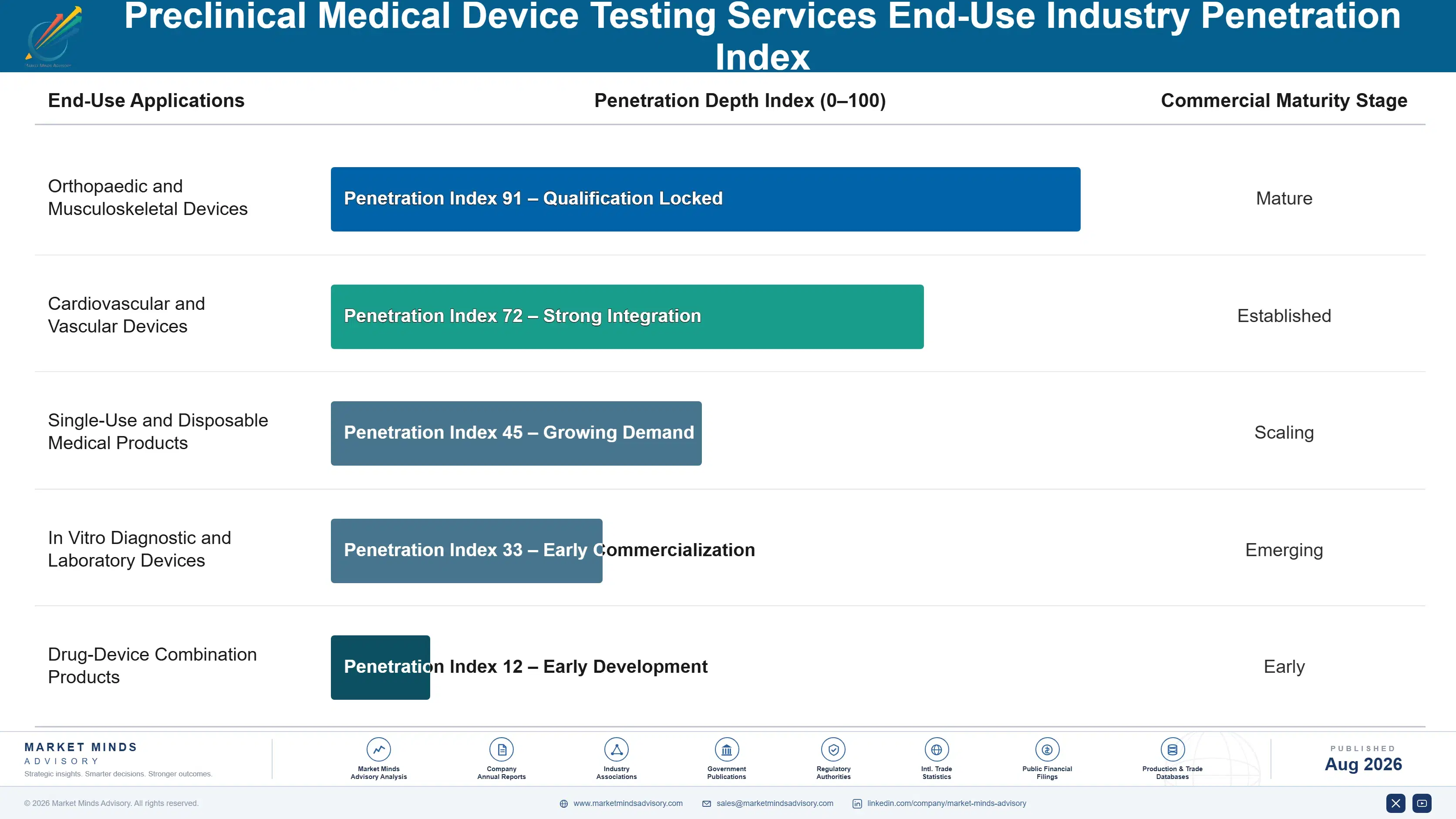
- Orthopaedic and Musculoskeletal Devices
- Cardiovascular and Vascular Devices
- Single-Use and Disposable Medical Products
- In Vitro Diagnostic and Laboratory Devices
- Drug-Device Combination Products
By Commercial Dimension
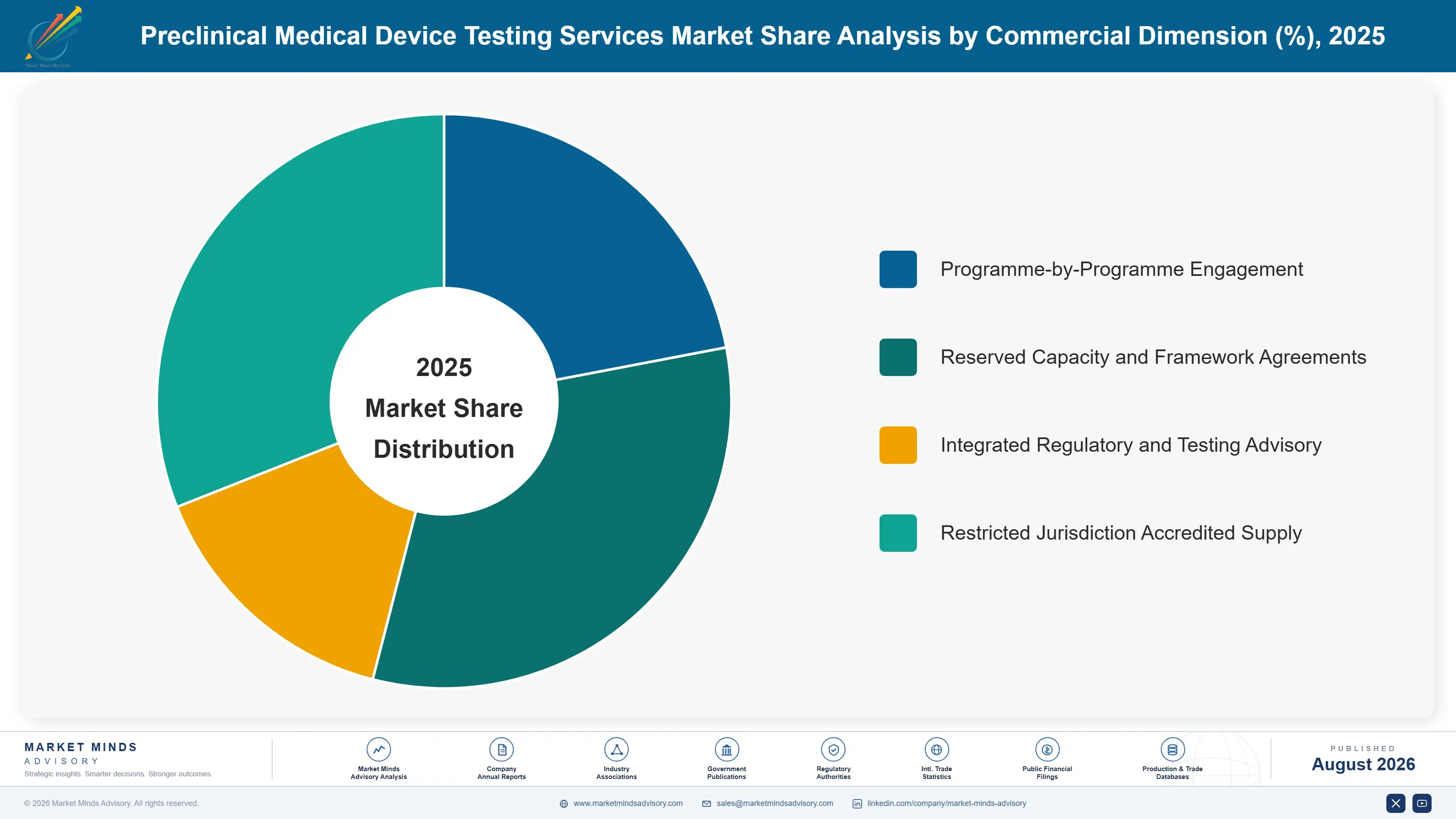
- Programme-by-Programme Engagement
- Reserved Capacity and Framework Agreements
- Integrated Regulatory and Testing Advisory
- Restricted Jurisdiction Accredited Supply
By Region
- North America
- Western Europe
- East Asia
- South Asia and Pacific
- Latin America
- Middle East and Africa
- Eastern Europe
Scope, Methodology, and Coverage
Every figure in this report is reproducible from documented input assumptions. The scope below maps the historical period, the forecast horizon, the segmentation dimensions, and the countries covered, alongside the underlying primary and qualitative methodology.
Historical Period
2020 to 2025
Forecast Period
2026 to 2036
Base Year
2025 (USD billions; MMA Primary Research Dataset, August 2026)
Market Definition
The market covers outsourced non-clinical laboratory testing services supporting medical device regulatory submission, design verification and validation, spanning biological safety and biocompatibility evaluation, chemical characterisation and toxicological risk assessment, sterilisation validation and microbiology, package integrity and shelf-life testing, bench performance and mechanical testing, and electrical safety and electromagnetic compatibility testing. Clinical investigations, notified body conformity assessment, manufacturer in-house testing, calibration services and post-market surveillance activities are excluded. Sizing is measured at service provider revenue in current prices.
Quantitative Units
USD billions (current prices); testing programmes and elapsed weeks to report where applicable
Segmentation Dimensions
By Testing Service Type; By End-Use Industry; By Commercial Dimension; By Region
Regions Covered
North America, Western Europe, East Asia, South Asia and Pacific, Latin America, Middle East and Africa, Eastern Europe
Countries Covered
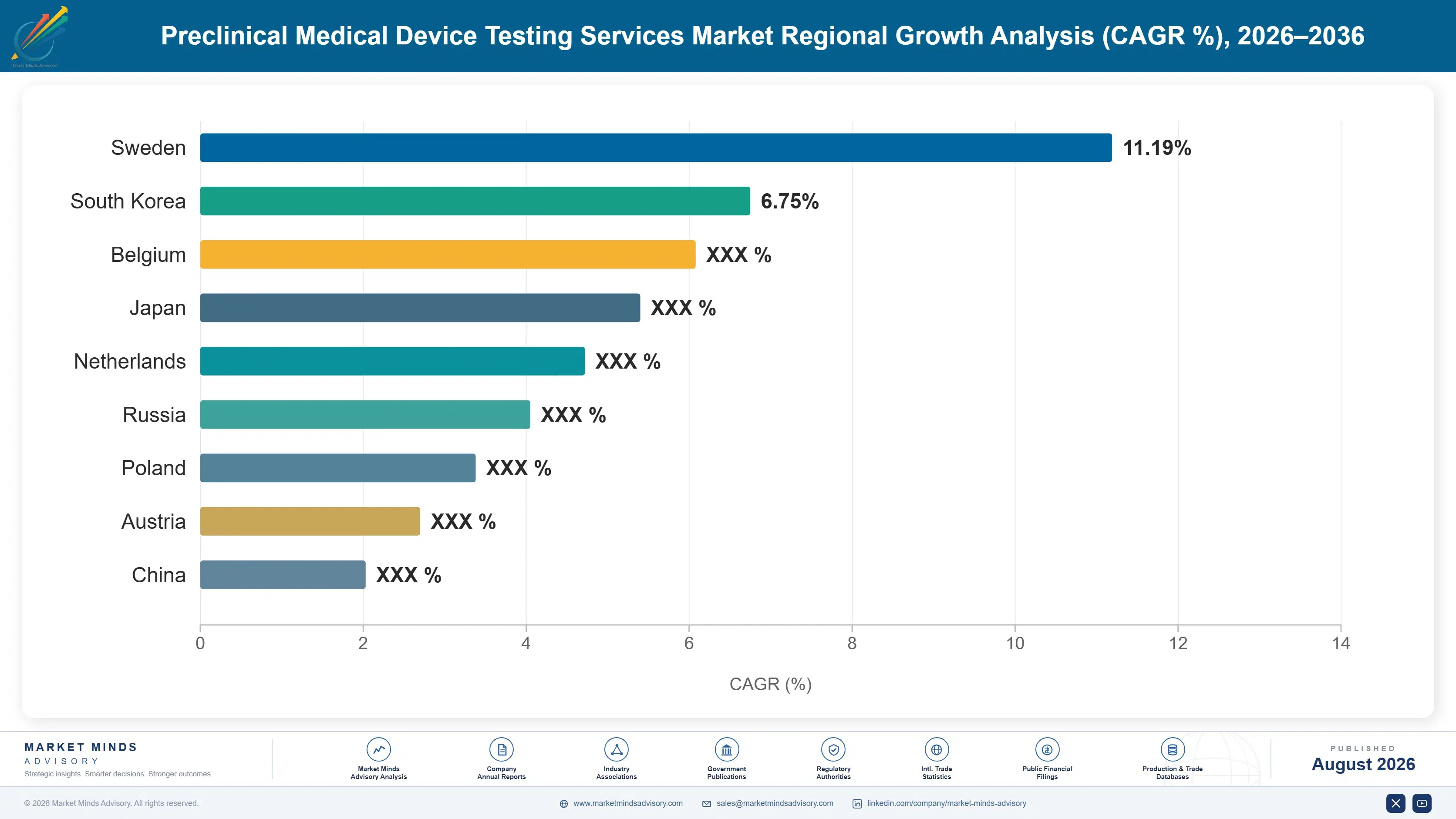
USA, China, Germany, France, UK, Japan, South Korea, India, Australia, Canada, Brazil, Mexico, Indonesia, Vietnam, Thailand, Malaysia, UAE, Saudi Arabia, South Africa, Nigeria, Turkey, Poland, Netherlands, Italy, Spain, Sweden, Switzerland, Argentina, Colombia, Singapore, and additional markets relevant to this sector
Key Companies Profiled
NAMSA, Eurofins Scientific, Sotera Health, WuXi AppTec, SGS, Charles River Laboratories, Intertek Group, TUV SUD, TUV Rheinland, Bureau Veritas, UL Solutions, Element Materials Technology, Pacific BioLabs, Toxikon, Nucro-Technics, Medistri, Micom Laboratories, BSI Group, DEKRA, Labcorp
Quantitative Methodology
Primary survey, n=3,800 respondents, Q4 2025, six countries; demand-side model with trade association cross-validation
Qualitative Methodology
47 expert interviews, Q4 2025; applied to validate demand model assumptions, identify emerging dynamics, and assess competitive positioning
Report Format
PDF and XLSX data workbook (Word format preview document)
Publisher
Market Minds Advisory
Report Code
MMA-2026-MED-675
Published
August 2026
Contact
sales@marketmindsadvisory.com | www.marketmindsadvisory.com
Purchase the full Preclinical Medical Device Testing Services Market Report (2026 to 2036).
The full report sizes preclinical medical device testing across six service types, three commercial dimensions and seven regions, with annual forecasts to 2036 under base, bull and bear scenarios. Ethylene oxide migration demand is modelled device family by device family against sterilisation modality compatibility, producing a revalidation wave forecast independent of product development activity. Provider accreditation scope is mapped against submission requirements by jurisdiction, showing where capacity genuinely exists. Queue time ahead of study start is quantified separately from study duration. Twenty providers are profiled on a consistent testing service revenue basis.
Ethylene oxide revalidation wave modelled by device family
Provider accreditation scope mapped against submission requirements
Queue time quantified separately from study duration
Chemical characterisation substitution rates tracked by endpoint
Restricted jurisdiction testing requirements compared across markets
Reserved capacity agreement pricing benchmarked against spot work
Built For The People Who Decide
From boardroom strategy to bench-side execution, this report is read cover-to-cover by leaders shaping the next decade of their industry, turning demand scenarios, market dynamics and valuation benchmarks into decisions.
CXOs/ Presidents/ VPs/ Managers
M&A and Corporate Development
Strategy Teams and R&D Heads
Procurement and Product Directors
Regulatory and Compliance Leaders
Investor Relations and Equity Analysts