

Market Minds Advisory
Pre Made Cups Market

Pre Made Cups Market: The Lid Is What Breaks the Recycling Claim

Brands spent years arguing about paper against plastic while roughly two thirds of cups still ship with a lid made of a different polymer, which defeats a mono-material claim on its own.

Lead Analyst

Bilal Shaikh

Published

September 2026

Make Smarter Decisions with Customized Research Insights

Request a free sample report and evaluate market opportunities, growth trends, and competitive dynamics relevant to your business needs.

2025 MARKET VALUE$14.2BMarket Size 2025
2036 FORECAST VALUE$24.8BBase Case , 2026 to 2036
CAGR 2026 TO 20365.2 %Bull 6.4% / Bear 4.0%
INCREMENTAL OPPORTUNITY$9.9BNet 10- year value creation
EXPANSION MULTIPLE1.66x2036 value over 2026 base
Strategic Levers
M&A Pipeline
Regional Outlook
Country Rankings
Competitive Intelligence
Segmental Deep-dive
Call-Us : 91 93563 13602

Executive Snapshot and Market Trajectory

The paper against plastic argument in cups has been largely beside the point. A polyethylene-lined paper cup is not repulpable in most streams, a polypropylene cup is recyclable where polypropylene collection exists, and roughly 68% of cups ship with a lid in a different polymer from the cup body.
That mismatch defeats a mono-material recyclability claim before any consumer behaviour enters the question. Producers addressing it seriously are changing the coating and the lid together rather than the substrate alone. Dispersion-coated repulpable paper cups grow at 7.8%, half again the market rate of 5.2%, and penetration across paper cups still sits near 11%. The lid remains a separate problem that a repulpable body does not solve on its own.
The second change is where cups are used. Delivery and quick commerce now carry roughly 27% of volume, and a cup travelling in a bag needs a leak-proof lid rather than a counter-service one. That requirement pulls in the opposite direction from mono-material simplicity, and nobody has reconciled the two properly yet. East Asia holds 30% of value and South Asia and Pacific sits above its band at 14%. Nobody has reconciled the two yet.
Market Definition
Pre-formed cups supplied to food and beverage processors and foodservice operators, spanning polyethylene-coated and dispersion-coated paper, polypropylene and polystyrene constructions, in-mould labelled cups and compostable formats, measured at converter selling price. Excludes cups thermoformed in line during filling, lids and closures sold separately, bottles and jars, and cutlery and other foodservice disposables.
Base Year Value
$14.2B in 2025 (MMA Primary Research Dataset, August 2026)
Forecast Period
2026 to 2036, eleven discrete annual values
CAGR
5.2% base case. Bull 6.4%. Bear 4.0%.
Fastest Growth Segment
Dispersion-Coated Repulpable Paper Cups: 7.8% CAGR
Fastest Growth Country
India: 8.4% CAGR
Fastest Growth Region
South Asia and Pacific: 7.4% CAGR
Largest Region
East Asia: 30% of 2025 global value
Market Leaders
Huhtamaki, Berry Global, Dart Container, Greiner Packaging, Pactiv Evergreen. Source: MMA Primary Research Dataset, July 2026.
Primary Survey
n=3,800 procurement and R&D decision-makers, Q4 2025, six countries
Methodology
Demand-side build-up, cross-validated against public data, 47 expert interviews

Pre Made Cups Market Forecast Scenarios

pre-made-cups-market-size-forecast-scenario-1787580839294
Growth ran near 4.1% between 2020 and 2025 through a period that scrambled every normal pattern in foodservice. Counter service collapsed in 2020 and delivery expanded to replace part of it, permanently shifting where cups are used and what lids they need. Board and resin pricing both swung sharply through 2021 and 2022, moving value independently of the underlying volume in those years.
Base case 5.2% rests on three mechanisms. Single-use plastic rules and recycled content targets are pushing brands toward constructions that survive a recyclability assessment, which means coating and lid together rather than substrate alone. Delivery and quick commerce continue growing as a share of foodservice, raising leak-proof lid requirements. And Indian and Southeast Asian organised foodservice is expanding from a base where unbranded and reusable serving dominated. None depends on a material transition.
The bull case at 6.4% assumes dispersion coating reaches barrier parity with polyethylene film, which would let paper cups claim repulpability without the performance penalty that limits adoption today. The bear case at 4.0% is reusable cup mandates in major urban markets, which several cities have trialled and which would remove single-use volume rather than shifting it between materials.

Nobody Recycles a Cup and a Lid Together

A paper cup is board with a thin polyethylene film laminated inside it, and that film is what stops the drink soaking through. It is also what stops the cup repulping, because the film survives the pulper and comes out as rejects. Dispersion coatings applied as a water-based barrier repulp with the fibre instead, and they currently give up some performance on hot liquid and shelf life.
TOP FIVE CONCENTRATION24%Regional converters compete alongside a few global producers
LID MATERIAL MISMATCH68%Share of cups sold with a differing lid polymer
SUBSTRATE COST SHARE57%Share of cup cost carried by board or resin
REPULPABLE COATING PENETRATION11%Portion of paper cups using a dispersion rather than film
DELIVERY CHANNEL SHARE27%Portion of volume moving through delivery rather than counter
TOOLING PAYBACK PERIOD2.8 yearsTypical recovery period on in-mould labelling tool investment
Polypropylene cups have the opposite profile. The material is genuinely recyclable where polypropylene collection exists, in-mould labelling decorates without a separate label, and barrier performance is not in question. What they lack is the perception advantage that paper carries with consumers, which is why brands with sustainability commitments keep choosing the substrate that scores worse on an actual recyclability assessment.
The lid settles the argument in most cases and nobody discusses it. Roughly 68% of cups ship with a lid made from a different polymer than the cup, typically polystyrene or polypropylene on a paper cup, which breaks mono-material sorting whatever the body is made from. Producers taking recyclability seriously change the coating and the lid together, and that is a considerably harder engineering problem.
"Every recyclability discussion I sit in on is about the cup and every one of them should be about the lid. You can put a beautiful repulpable coating on the body and then clip a polystyrene lid onto it, and the sorting facility does not care how good your intentions were."
Director, Foodservice Packaging Practice · MMA Packaging Practice · August 2026

Market Trends

Dispersion coatings replacing polyethylene film in paper cups

Water-based dispersion barrier coatings repulp with the fibre rather than surviving the pulper as rejects, which is what a polyethylene film liner does. Penetration across paper cups sits near 11% and rises as brands face recyclability assessments they cannot pass with laminated construction. The coatings currently give up some performance on hot liquid resistance and shelf life, which limits them to applications where those margins are comfortable. Coating suppliers are closing the gap steadily, and each improvement opens a further band of applications. Each improvement opens a further band of applications to conversion.
Market Impact: Delivers 8.4% annual Indian growth
Delivery volume reshaping lid and leak requirements

Delivery and quick commerce now carry roughly 27% of cup volume, and a cup travelling in a courier bag faces conditions counter service never imposed. Leak resistance becomes a specification rather than a convenience, which pushes toward more substantial lids with tighter sealing geometry. That requirement pulls directly against mono-material simplicity, since a leak-proof lid is usually a different polymer with different stiffness from the cup body. Operators discovering the conflict tend to prioritise the leak performance, which is the commercially rational choice. A leak-proof lid is usually a different polymer with different stiffness from the body.
Market Impact: Pays back in 2.8 years

Market Opportunities and Growth Drivers

Organised foodservice expanding across South and Southeast Asia

India grows fastest anywhere at 8.4%, as branded quick service, café and delivery formats expand into markets where unbranded outlets and reusable serving previously dominated. Each converted occasion creates cup demand where none existed rather than substituting between suppliers. Organised chains also specify centrally, which favours converters able to supply consistent quality at scale over the local producers serving independents. Southeast Asian markets follow the same pattern, with Vietnam and Indonesia expanding fastest behind India itself. Organised chains specify centrally, which favours converters able to supply consistent quality at scale over the local producers serving independent outlets.
Market Impact: Breaks claims on 68% of cups

In-mould labelling improving polypropylene cup economics at scale

In-mould labelling places decoration into the tool during moulding, removing a separate label and the adhesive with it, which improves both cost per cup at volume and recyclability by keeping the construction mono-material. Tooling investment pays back in roughly 2.8 years at typical dairy and dessert volumes. The approach suits processors running long production runs of a stable design and suits nobody running short runs of many variants. Adoption concentrates in dairy, where product ranges change slowly and volumes are substantial. Dairy ranges change slowly enough that a tooling position persists for years.
Market Impact: Removes volume across 2 channels

Market Restraints and Challenges

Lid polymer mismatch defeating mono-material recyclability claims

Roughly 68% of cups ship with a lid made from a different polymer than the body, which breaks mono-material sorting regardless of how the cup itself is constructed. The root cause is functional: a lid needs stiffness and sealing geometry that the cup material frequently cannot provide at acceptable cost. Commercially it undermines recyclability claims that brands have already made publicly. Producers are developing matched lid and cup systems in single polymers, and the engineering is harder than changing a substrate. The engineering is harder than changing a substrate. Almost nobody has done it.
Market Impact: Covers 11% of paper cups

Reusable cup mandates removing single-use volume entirely

Several city and national authorities have trialled or introduced reusable cup requirements for on-premise consumption, which removes single-use volume rather than shifting it between materials. The root cause is waste policy rather than any failure of the packaging. Commercially it threatens the counter service base while leaving delivery volume untouched, since a reusable cup cannot travel in a courier bag. Producers are responding by weighting toward delivery formats and by developing reusable cup systems themselves, which is a different business entirely. A reusable cup cannot travel in a courier bag, which is where the defence lies.
Market Impact: Covers 27% of cup volume
3 additional market trends, 4 additional growth drivers, and 2 additional restraints and challenges are covered in the full report. Contact sales@marketmindsadvisory.com to access the complete intelligence.

Segment CAGR and Growth Architecture

Six segments split by cup construction, because construction determines the barrier mechanism, the recyclability outcome and the production process required. A dispersion-coated paper cup and an in-mould labelled polypropylene cup answer the same brief in incompatible ways. End-use channel and lid specification are handled in the framework instead. Construction settles everything downstream. Nothing else matters as much.
pre-made-cups-market-market-share-analysis-1787580839877

Dispersion-Coated Repulpable Paper Cups

Growing at 7.8%, half again the market rate of 5.2%, dispersion coatings apply a water-based barrier that repulps with the fibre rather than surviving the pulper as rejects the way a polyethylene film liner does. Penetration across paper cups sits near 11% and rises as brands face recyclability assessments that laminated construction fails. The coatings still give up performance on hot liquid resistance and shelf life, which confines them to applications with comfortable margins on both. Coating suppliers are narrowing that gap, and the lid remains a separate problem that a repulpable body does not solve on its own. Converters with coating capability already installed capture that volume as it becomes available to them.
CAGR 7.8%

In-Mould Labelled Polypropylene Cups

At 7.0% in-mould labelling places decoration into the tool during moulding, removing a separate label and its adhesive and keeping the cup genuinely mono-material. Cost per cup falls at volume and tooling pays back in roughly 2.8 years at typical dairy and dessert throughputs. The approach suits long runs of stable designs and suits short runs of many variants very poorly, which is why adoption concentrates in dairy where ranges change slowly. Recyclability is genuine where polypropylene collection exists, though the lid mismatch problem applies here exactly as it does to paper. Adoption concentrates in dairy, where product ranges change slowly and volumes are substantial enough to justify the tooling.
CAGR 7.0%
Full segment breakdown across 6 segments available in the complete report.

Regional Architecture and Country Demand Map

East Asia holds 30% of value on manufacturing scale and dense convenience retail together. South Asia and Pacific sits above its usual band at 14% as organised foodservice expands rapidly. North America follows at 24%, with Western Europe at 20% where recyclability assessment is a live commercial requirement.

North America

Coffee chain volume dominates the American picture and hot cup construction accordingly, with polyethylene lined paper the standard and dispersion coating still at trial scale across most operators. State-level single-use plastic legislation has been more active than federal policy, producing a patchwork operators plan around rather than a single requirement. Delivery has grown faster here than in most regions, which has raised leak performance requirements sharply. Dart and Pactiv hold substantial domestic capacity, with dairy cup volume served largely by polypropylene constructions. State legislation has been more active than federal policy, producing a patchwork operators plan around rather than one requirement. Leak requirements have risen sharply with delivery growth here.
Share: 24% | CAGR: 4.3% (2026 to 2036)

Western Europe

Single-use plastic rules bite harder here than anywhere and the 20% share reflects a market where recyclability assessment is a live commercial requirement rather than a stated intention. Dispersion coating adoption is furthest advanced across German, Nordic and Dutch operators. Reusable cup requirements have been trialled in several cities, which threatens the counter service base directly. Huhtamaki and Greiner hold strong regional positions built on both paper and polypropylene capability. Dairy cup volume is substantial and increasingly in-mould labelled polypropylene rather than printed or sleeved. Reusable cup requirements have been trialled in several cities, which threatens the counter service base directly. Dairy volume is increasingly in-mould labelled rather than sleeved.
Share: 20% | CAGR: 3.8% (2026 to 2036)
Regional intelligence for 5 additional markets available in the complete report: East Asia, South Asia and Pacific, Latin America, Middle East and Africa, Eastern Europe. Contact sales@marketmindsadvisory.com.
pre-made-cups-market-country-cagr-analysis-1787580840421

Four Moves for a Cup Converter

Substrate is 57% of cost and hundreds of converters compete on it, which makes cup making a difficult business defended on price alone. The defensible positions involve solving the lid problem, owning a coating capability or holding tooling that a customer cannot easily move. Substrate choice alone settles nothing. Substrate choice settles nothing. Only three things defend.

Develop matched cup and lid systems in one polymer

Roughly 68% of cups ship with a lid in a different polymer from the body, which breaks mono-material sorting whatever the cup is made from and defeats recyclability claims brands have already made publicly. Solving it means engineering a lid with adequate stiffness and sealing geometry in the cup material, which is harder than changing a substrate and which almost nobody has done properly. A converter offering a genuinely matched system answers a question its customers cannot currently answer at all. Nobody else is offering it. It is the hardest problem here.
Market Impact: Fixes the 68% mismatch in the lid polymer

Build dispersion coating capability before parity arrives

Dispersion coatings repulp with the fibre and currently give up performance on hot liquid resistance and shelf life, which confines them to roughly 11% of paper cups. Each improvement from coating suppliers opens a further band of applications, and converters with the application capability already installed capture that volume as it becomes available. Coating line investment and process development cost real money against a segment still small today. Waiting until parity arrives means competing for customers somebody else has already qualified. Qualification takes time somebody else will use. Investment precedes the volume by years.
Market Impact: Positions against an 11% coating penetration base today

Win tooling positions in in-mould labelled dairy

In-mould labelling tooling pays back in roughly 2.8 years at typical dairy volumes and then holds the customer for as long as the design runs, because moving means new tools somewhere else. The approach suits long runs of stable designs, which describes dairy precisely and describes short-run foodservice not at all. Winning a tooling position is therefore worth considerably more than winning a printed cup contract of the same annual value, and dairy ranges change slowly enough that positions persist. Moving means funding tools twice. Dairy designs change slowly. Positions persist for years.
Market Impact: Holds customers past a 2.8 year tooling payback

Specify for delivery rather than counter service

Delivery carries roughly 27% of cup volume and imposes leak resistance requirements that counter service never did, which operators discovering the problem prioritise above material simplicity every time. Designing lid geometry and cup rim tolerance for transport rather than for a counter is a genuine engineering difference that most converters have not made. It also insulates volume from reusable cup mandates, which apply to on-premise consumption and cannot reach a cup travelling in a courier bag. Mandates cannot reach a cup in transit. Most converters have not made the distinction.
Market Impact: Protects 27% of volume from any reuse mandate

Who Controls the Margin Pool

Participation is measured on annual cup production volume in units, and the top five hold 24%. Concentration is moderate because cups are bulky and freight-limited, which makes converting regional even where customers are global. Huhtamaki and Berry lead on breadth across paper and polypropylene construction. The gap to challengers is coating and tooling capability rather than moulding or forming capacity in itself.
Competition runs on three fronts. Construction capability decides which briefs a converter can answer at all, since paper coating and polypropylene moulding are different plants with different economics. Recyclability engineering is the second, and it increasingly means the lid rather than the cup. Tooling positions are the third, particularly in in-mould labelled dairy where a customer that has paid for tools does not move casually to anyone else.

The pressure ahead comes from reusable cup mandates and from delivery growth pulling in opposite directions. Mandates remove counter service volume while delivery raises leak requirements that favour more complex construction. Expect coating capability investment and lid system development rather than acquisitions, since regional converting assets consolidate poorly. Rankings shift as recyclability assessment moves from stated intention to procurement requirement across more customers.
pre-made-cups-market-company-positioning-matrix-1787580840938

Competitive Moat and Risk Dimensions

HUHTAMAKI

Moat: Paper and polymer capability breadth

Huhtamaki operates paper cup forming and polypropylene moulding across most major regions, which lets a multinational customer specify one supplier across constructions and geographies. As recyclability assessment forces customers to compare constructions rather than assume one, breadth across both becomes considerably more valuable than depth in either.
HUHTAMAKI

Risk: European regulatory volume exposure

European operations carry disproportionate exposure to reusable cup requirements now being trialled in several cities, which remove single-use volume rather than shifting it between materials. That risk cannot be answered by any construction change, and the region is also where the company's premium positions and recyclability credibility have been built.
BERRY GLOBAL

Moat: Polypropylene moulding scale

Berry operates injection and thermoforming capacity at a scale few competitors approach, with in-mould labelling capability and tooling investment that customers cannot easily replicate elsewhere. Once a dairy customer has paid for tools in a Berry plant, moving means paying for them again somewhere else, which holds the position for the design life.
BERRY GLOBAL

Risk: Paper substrate perception disadvantage

Brands with sustainability commitments continue choosing paper over polypropylene despite polypropylene performing better on an actual recyclability assessment where collection exists. That perception gap costs volume regardless of technical merit, and a business weighted toward polymer construction has limited ability to argue against a consumer belief its customers have already accommodated.

Players Tracked

Prominent Players

Huhtamaki
Berry Global
Dart Container
Greiner Packaging
Pactiv Evergreen

Other Key Players

Amcor
Sonoco
Graphic Packaging
Klöckner Pentaplast
Faerch
Coveris
Detmold Group
Seda International
Benders Paper Cups
Karat Packaging
Lollicup
Napco National
Hotpack Packaging
Paccor
IPL Plastics

Recent Developments

MARCH 2026

Coffee chain adopts matched polypropylene cup and lid system

An international coffee chain adopted a matched cup and lid system in a single polymer across selected markets, addressing the material mismatch that had defeated its recyclability claims previously. The rollout covers markets where polypropylene collection infrastructure exists rather than the full estate. Other markets follow as collection develops.
Signal: Solving the lid rather than the cup is what finally makes a recyclability claim survive assessment
SEPTEMBER 2025

Coating supplier reports dispersion barrier improvement for hot applications

A barrier coating supplier reported dispersion coating performance improvements aimed at hot beverage applications where polyethylene film has remained necessary. Converter trials are under way and commercial qualification at sustained production speeds has not yet been demonstrated at scale. Converter trials continue through the year.
Signal: Every coating improvement opens a further band of applications to repulpable paper cup construction across the market
JANUARY 2026

European city introduces reusable cup requirement for on-premise service

A European city introduced a reusable cup requirement for beverages consumed on premises, exempting takeaway and delivery volume from the rule. Operators reported reconfiguring service models rather than changing single-use cup specifications for the remaining channels. Takeaway volume was explicitly exempted from the requirement. Service models were reconfigured instead.
Signal: Mandates remove counter volume entirely while leaving delivery untouched, which reshapes where converters should be selling

Board, Resin and Freight

Substrate accounts for roughly 57% of cup cost, split between cup board for paper constructions and polypropylene or polystyrene resin for moulded formats. Barrier films and dispersion coatings add about 9%, with dispersion currently costing more per square metre than polyethylene film. Forming, printing and conversion take a further 21%, and outbound freight carries an unusually high share for a packaging product because a cup ships mostly air.
Cup board pricing rose sharply through 2021 and 2022 as pulp markets tightened and European energy costs climbed, per published pulp and paper pricing for that period. Converters holding annual foodservice contracts absorbed a substantial share, since operator pricing is agreed on cycles that cannot accommodate a mid-year board move. Polypropylene moved on a separate cycle entirely, which advantaged converters holding both constructions and hurt those committed to one.

Exposure divides on construction breadth and on freight geography. A converter operating both paper and polymer lines can shift emphasis as substrate cycles diverge, while a single-construction producer carries whichever cycle it sits in. Freight matters more here than in most packaging, since a cup ships mostly air and delivered cost rises steeply with distance.
pre-made-cups-market-cost-volatility-analysis-1787580841136

Operate both paper and polymer construction capability

Cup board and polypropylene move on separate cycles driven by pulp and petrochemical markets respectively, so a converter holding both can shift emphasis as they diverge. The capital requirement is the obstacle, since these are genuinely different plants. Converters with both came through the last substrate cycle materially better than single-construction producers did. Few operate both capabilities.

Index foodservice contracts to published substrate references

Substrate is 57% of cup cost and operator pricing runs on annual cycles that cannot absorb a mid-year board or resin move. Indexing to published references passes movement through with a defined lag. Large chain operators accept indexing more readily than independents and distributors do, which shapes which customers are worth pursuing under volatile input conditions.

Site converting close to the customer base

A cup ships mostly air, so delivered cost rises steeply with distance and converting economics are regional whatever the customer's geography. Placing capacity near demand beats optimising a single large plant in most cases. This constrains scale economics and it is the reason concentration in this market sits at only 24% despite decades of consolidation attempts.

Portfolio Architecture for Margin Defence

Margin here tracks specification difficulty rather than volume, and most volume sits in the easiest tier. Standard polyethylene lined paper and plain polypropylene cups earn margins in the mid teens, because hundreds of regional converters make them and operators tender them against a straightforward specification. Freight economics protect local position somewhat and confer no pricing power at all.
Recyclability-engineered constructions do considerably better at margins in the mid twenties to mid thirties, because dispersion coating capability and matched lid systems narrow the field sharply. The range is wide because it spans a dispersion-coated body still carrying a mismatched lid at one end and a genuinely matched single-polymer system at the other, and only the second survives an assessment. Only one of those two passes an assessment.

In-mould labelled tooling positions hold the strongest economics, running into the high thirties, because a customer that has paid for tools does not move until the design changes. Those margins reflect a switching barrier the customer funded themselves, which is unusually durable, and they persist for as long as the product range stays stable. A barrier the customer funded is the most durable kind.

Standard Paper and Polymer Cups

Polyethylene lined paper cups and plain polypropylene or polystyrene constructions tendered against straightforward specifications. The seven point range reflects freight position and substrate buying rather than any capability worth defending.
Gross Margin: 13-20%

Recyclability Engineered Constructions

Dispersion-coated repulpable paper and matched single-polymer cup and lid systems. The eleven point range separates a repulpable body still carrying a mismatched lid from a genuinely matched system that survives assessment.
Gross Margin: 24-35%

In-Mould Labelled Tooling Positions

Cups produced on customer-funded in-mould labelling tooling for dairy and dessert ranges. The nine point range reflects run length and design stability, which determine how long a tooling position actually holds.
Gross Margin: 30-39%
pre-made-cups-market-portfolio-architecture-1787580841725

High-value Sub-segments and Strategic Watch-out

Matched Single-Polymer Cup and Lid Systems

High value and genuinely scarce, since roughly 68% of cups still ship with a mismatched lid. Engineering stiffness and sealing geometry in the cup material is harder than changing substrate, and almost nobody has solved it properly. Customers cannot answer the question themselves. Scarcity is genuine.
Gross Margin: 29-35%

Dispersion-Coated Repulpable Paper

High value and the fastest growth at 7.8% from an 11% penetration base. Coating capability narrows the field, and each supplier improvement on hot liquid performance opens a further band of applications to conversion. Hot cup parity is the remaining obstacle to wider conversion. Capability narrows the field.
Gross Margin: 25-33%

Standard Lined Paper and Plain Polymer

The volume core and permanently price-led against hundreds of regional converters. Freight protects local position without conferring pricing power. Growth follows foodservice volume with no specification premium available anywhere. Freight protects local position without conferring any pricing power at all on the converter holding it.
Gross Margin: 13-20%

Counter Service Volume Facing Reuse Mandates

The strategic watch-out. Reusable cup requirements remove on-premise volume entirely rather than shifting it between materials, and no construction change answers that. Delivery volume is untouched, which is where the defence lies. No construction change answers a mandate that removes the occasion. Delivery volume is where the defence lies.
Gross Margin: 12-22%

How the Volume Comes Back

Cup demand repeats continuously because beverages are served continuously, and a cup is consumed once. An operator buys against its own transaction volume rather than any purchasing decision, which makes demand predictable within a few percent and pricing power largely absent unless something in the specification stands in the way. Chain operators contract annually and independents buy through distributors on shorter cycles entirely. Volume is therefore easy to forecast and hard to price.
Stickiness follows tooling and specification. In-mould labelled positions are stickiest, since the customer paid for tools that sit in a specific plant. Dispersion-coated and matched-lid constructions come next, held by the narrow field able to supply them. Standard lined paper and plain polymer cups switch on delivered price at every tender, and operators requalify a converter in days rather than months.

The specifying buyer has moved toward sustainability functions in chain operators. Cup selection was a procurement exercise comparing delivered cost for decades. Recyclability commitments moved part of it to people who read assessment reports, and those people ask about the lid, which procurement never did and which most converters were not prepared to answer. Most converters were not prepared for that conversation at all.
pre-made-cups-market-end-use-penetration-index-1787580842289

Where We Would Focus Effort

These are among the four positions where our research anticipates prominent divergence between winners and laggards over the coming forecast period. Each is grounded in the demand model, the regulatory perimeter, and the announced capacity pipeline.
01 / MATCHED LID ENGINEERING

Solve the lid, because the cup was never the problem

Roughly 68% of cups ship with a lid in a different polymer from the body, which breaks mono-material sorting whatever the cup itself is made from and it defeats recyclability claims that brands have already made publicly. Engineering adequate stiffness and sealing geometry into the cup material is harder than changing a substrate, and almost nobody has done it properly. A converter offering a genuinely matched system therefore answers the one question that its customers currently cannot answer at all.
02 / COATING CAPABILITY INVESTMENT

Install dispersion capability before performance parity arrives

Dispersion coatings repulp with the fibre and currently give up performance on hot liquid resistance and shelf life, which confines them to roughly 11% of paper cup volume as things stand today. Every improvement that coating suppliers make opens up a further band of applications, and converters with the application capability already installed capture that volume as it becomes available to them. Waiting until parity arrives means competing for customers that a better-prepared converter has already qualified and locked into a contract.
03 / TOOLING POSITION BUILDING

Chase dairy tooling rather than printed cup contracts

In-mould labelling tooling pays back in roughly 2.8 years at typical dairy volumes and then holds the customer for as long as the design runs, because moving means funding new tools somewhere else entirely. The approach suits long runs of stable designs, which describes dairy precisely and short-run foodservice not at all. A tooling position is therefore worth considerably more than a printed cup contract of identical annual value, and dairy product ranges change slowly enough that positions persist for years.
04 / DELIVERY CHANNEL WEIGHTING

Engineer for the courier bag, not for the counter

Delivery carries roughly 27% of cup volume and imposes leak resistance requirements that counter service never did, which operators consistently prioritise above material simplicity whenever the two requirements conflict. Designing lid geometry and rim tolerance for transport rather than for a counter is a genuine engineering difference that most converters have simply not made. It also insulates volume from reusable cup mandates, which apply only to on-premise consumption and cannot reach a cup travelling across a city in a courier bag.

Engagement Snapshot From the Field

A live engagement with an industry participant carrying material or product regulatory and market exposure ahead of a defining policy shift, showing how our research translates into a defensible multi-year portfolio strategy.
MARKET MINDS ADVISORY · CLIENT ENGAGEMENT SUMMARY
Pre Made Cups Producer Strategic Portfolio Review and Transition Roadmap 2026·Investment Scenario on Pre Made Cups Exposure Evaluation 2025-26
CLIENT PROFILE
A European cup converter operating paper cup forming at two plants and polypropylene thermoforming at a third, with annual revenue near 195 million euros across foodservice and dairy customers (client-reported, unverified by MMA). Paper cups used polyethylene film liners throughout, and lids were bought in from third parties in whichever polymer suited the tooling available.
STRATEGIC CHALLENGE
Two chain customers had failed recyclability assessments on cup ranges the client supplied, and a city in the client's largest market had introduced a reusable cup requirement for on-premise service. Management needed to decide where to invest between dispersion coating capability, matched lid development and delivery-oriented design, with capital for roughly one of them.
MMA APPROACH
MMA assessed dispersion coating performance against the client's hot cup specifications with two coating suppliers, costed matched lid tooling development in both paper and polypropylene, and quantified the client's volume exposure to reusable cup mandates across its customer base. Delivery channel requirements were tested with three operators. Interviews with 47 experts covered barrier coating, cup forming and foodservice procurement.
KEY FINDINGS
  1. Dispersion coatings could not meet the client's hot cup specification at the time of assessment, though both suppliers expected parity within roughly three years of development.
  2. Matched lid development in polypropylene was achievable with existing thermoforming capability, and no customer had been offered a genuinely matched system by any competitor.
  3. Reusable cup mandates threatened roughly 19% of the client's volume across on-premise service, with delivery and takeaway volume entirely unaffected by them.
  4. Both failed recyclability assessments traced to lid polymer mismatch rather than to the cup construction the customers had actually been discussing with the client.
CLIENT PROFILE
A European cup converter operating paper cup forming at two plants and polypropylene thermoforming at a third, with annual revenue near 195 million euros across foodservice and dairy customers (client-reported, unverified by MMA). Paper cups used polyethylene film liners throughout, and lids were bought in from third parties in whichever polymer suited the tooling available.
STRATEGIC CHALLENGE
Two chain customers had failed recyclability assessments on cup ranges the client supplied, and a city in the client's largest market had introduced a reusable cup requirement for on-premise service. Management needed to decide where to invest between dispersion coating capability, matched lid development and delivery-oriented design, with capital for roughly one of them.
MMA APPROACH
MMA assessed dispersion coating performance against the client's hot cup specifications with two coating suppliers, costed matched lid tooling development in both paper and polypropylene, and quantified the client's volume exposure to reusable cup mandates across its customer base. Delivery channel requirements were tested with three operators. Interviews with 47 experts covered barrier coating, cup forming and foodservice procurement.
KEY FINDINGS
  1. Dispersion coatings could not meet the client's hot cup specification at the time of assessment, though both suppliers expected parity within roughly three years of development.
  2. Matched lid development in polypropylene was achievable with existing thermoforming capability, and no customer had been offered a genuinely matched system by any competitor.
  3. Reusable cup mandates threatened roughly 19% of the client's volume across on-premise service, with delivery and takeaway volume entirely unaffected by them.
  4. Both failed recyclability assessments traced to lid polymer mismatch rather than to the cup construction the customers had actually been discussing with the client.
RECOMMENDED STRATEGY
Phase 1: Phase one: develop matched polypropylene cup and lid systems using existing thermoforming capability, since both failed assessments traced to the lid rather than the cup. Phase 2: Phase two: engineer lid geometry and rim tolerance specifically for delivery transport, protecting volume that reusable cup mandates cannot reach. Phase 3: Phase three: defer dispersion coating investment until suppliers demonstrate hot cup parity, rather than committing capital to a capability not yet ready.
OUTCOME
The converter launched a matched polypropylene system during 2026 and both chain customers passed subsequent recyclability assessments on the affected ranges (client-reported, unverified by MMA). Delivery-oriented lid design was adopted across the polypropylene range, and dispersion coating investment was scheduled rather than abandoned. Both changes were completed inside the year.

Frequently Asked Questions

Foundational context covering the market sizes, CAGR, scope, country, region and competition that inform every finding below. This section is provided to cover basics and most often pre-purchase conversations, answered from the MMA Primary Research Dataset.

What is the current size of the Pre Made Cups Market?

MMA sizes it at USD 14.2 billion in 2025, rising to USD 14.94 billion in 2026. The figure covers pre-formed cups at converter selling price, excluding cups thermoformed in line during filling.

How large will the Pre Made Cups Market be by 2036?

USD 24.80 billion by 2036, an incremental USD 9.86 billion over the 2026 base and an expansion multiple of 1.66 times. Recyclability-engineered constructions account for a disproportionate share.

What is the CAGR for the Pre Made Cups Market 2026 to 2036?

5.2% in the base case, with a bull case at 6.4% and a bear case at 4.0%. The spread turns on dispersion coating parity and on reusable cup mandate adoption.

Which segment is growing fastest?

Dispersion-coated repulpable paper cups at 7.8%, half again the market rate of 5.2%. The coating repulps with the fibre where a polyethylene film liner does not.

Who are the major companies in the Pre Made Cups Market?

Huhtamaki, Berry Global, Dart Container, Greiner Packaging and Pactiv Evergreen lead on annual cup production volume. Fifteen further participants are profiled in the full report.

Which country is growing fastest?

India at 8.4%, as branded quick service, café and delivery formats expand where unbranded outlets and reusable serving previously dominated. Each converted occasion creates new demand.

Report Segmentation Architecture

The full report scope spans multiple orthogonal segmentation dimensions, with cross-tabulated demand data provided for each dimension pair. Coverage extends further to regional breakdowns, trend trajectories, and the competitive detail needed to support segment-level decision-making.

By Cup Construction

  • Polyethylene-Coated Paper Cups
  • Dispersion-Coated Repulpable Paper Cups
  • Polypropylene Thermoformed and Injection Cups
  • In-Mould Labelled Polypropylene Cups
  • Polystyrene and Foam Cups
  • Compostable and Bio-Based Cups

By End-Use Industry

  • Coffee and Beverage Chains
  • Quick Service Restaurants
  • Dairy and Dessert Processing
  • Delivery and Quick Commerce
  • Convenience and Forecourt Retail
  • Institutional and Vending

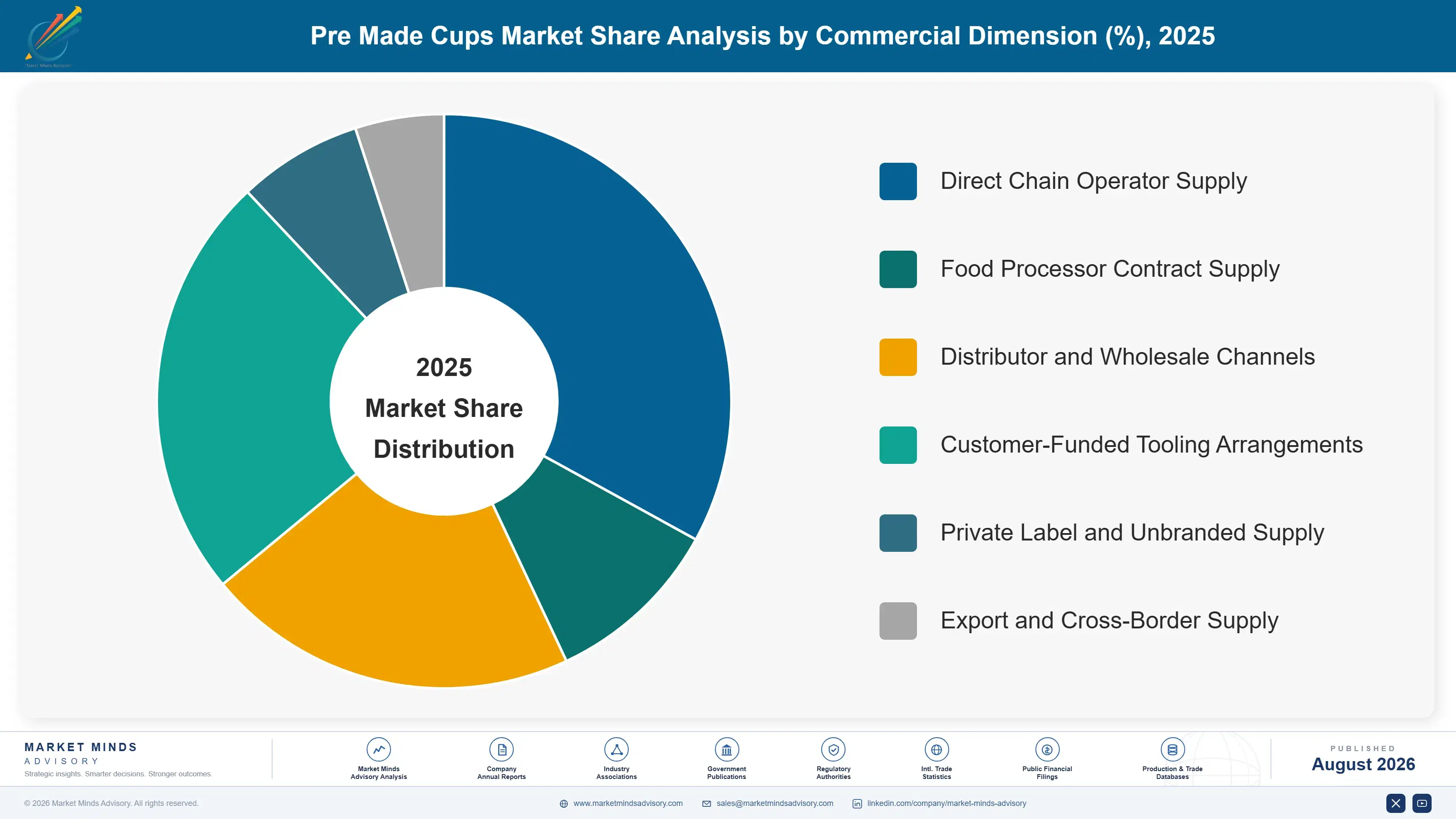
By Commercial Dimension

  • Direct Chain Operator Supply
  • Food Processor Contract Supply
  • Distributor and Wholesale Channels
  • Customer-Funded Tooling Arrangements
  • Private Label and Unbranded Supply
  • Export and Cross-Border Supply

By Region

  • North America
  • Western Europe
  • East Asia
  • South Asia and Pacific
  • Latin America
  • Middle East and Africa
  • Eastern Europe

Scope, Methodology, and Coverage

Every figure in this report is reproducible from documented input assumptions. The scope below maps the historical period, the forecast horizon, the segmentation dimensions, and the countries covered, alongside the underlying primary and qualitative methodology.
Historical Period
2020 to 2025
Forecast Period
2026 to 2036
Base Year
2025 (USD billions; MMA Primary Research Dataset, August 2026)
Market Definition
Pre-formed cups supplied to food and beverage processors and foodservice operators, spanning polyethylene-coated and dispersion-coated paper constructions, polypropylene thermoformed and injection moulded cups, in-mould labelled formats, polystyrene and foam cups and compostable or bio-based constructions, measured at converter selling price. Cups thermoformed in line during filling, lids and closures sold separately, bottles and jars, and cutlery and other foodservice disposables are excluded from scope.
Quantitative Units
USD billions (current prices); billion cups produced annually; USD per thousand cups by construction and region
Segmentation Dimensions
Cup construction; end-use industry; commercial dimension; region
Regions Covered
North America, Western Europe, East Asia, South Asia and Pacific, Latin America, Middle East and Africa, Eastern Europe
Countries Covered
United States, Canada, Mexico, United Kingdom, Germany, Netherlands, France, Sweden, China, Japan, South Korea, India, Vietnam, Indonesia, Australia, Brazil, United Arab Emirates, Saudi Arabia, Nigeria, Poland
Key Companies Profiled
Huhtamaki, Berry Global, Dart Container, Greiner Packaging, Pactiv Evergreen, Amcor, Sonoco, Graphic Packaging, Klöckner Pentaplast, Faerch, Coveris, Detmold Group, Seda International, Benders Paper Cups, Karat Packaging, Lollicup, Napco National, Hotpack Packaging, Paccor, IPL Plastics
Quantitative Methodology
Primary survey, n=3,800 respondents, Q4 2025, six countries; demand-side model with trade association cross-validation
Qualitative Methodology
47 expert interviews, Q4 2025; applied to validate demand model assumptions, identify emerging dynamics, and assess competitive positioning
Report Format
PDF and XLSX data workbook (Word format preview document)
Publisher
Market Minds Advisory
Report Code
MMA-2026-PAC-117
Published
August 2026
Contact
sales@marketmindsadvisory.com | www.marketmindsadvisory.com

Purchase the full Pre Made Cups Market Report (2026 to 2036).

The full report treats the lid as the recyclability variable it actually is, sizing each cup construction independently through 2036. It benchmarks dispersion coating performance against polyethylene film across hot and cold applications, quantifies volume exposure to reusable cup mandates by market, and models in-mould labelling tooling economics against run length and design stability. Regional chapters cover all seven regions with converting capacity and freight economics where disclosure permits. Competitive profiling covers 20 participants on a single cup production volume basis, with lid polymer mismatch mapped across construction types.
Each cup construction sized independently through 2036
Dispersion coating benchmarked against film across applications
Reusable mandate volume exposure quantified by market
Tooling economics modelled against run length and stability
Twenty participants profiled on one consistent basis
Lid polymer mismatch mapped across construction types

Built For The People Who Decide

From boardroom strategy to bench-side execution, this report is read cover-to-cover by leaders shaping the next decade of their industry, turning demand scenarios, market dynamics and valuation benchmarks into decisions.
CXOs/ Presidents/ VPs/ Managers
M&A and Corporate Development
Strategy Teams and R&D Heads
Procurement and Product Directors
Regulatory and Compliance Leaders
Investor Relations and Equity Analysts