Market Minds Advisory
Pre Gummed Labels Market

Pre Gummed Labels Market: The Adhesive That Does Not Ruin the Paper Stream

Everyone declared this category finished when self-adhesive labelling arrived, and then the paper mills started to count what pressure-sensitive adhesive was actually costing them in lost yield every single year.

Lead Analyst

Bilal Shaikh

Published

September 2026

Make Smarter Decisions with Customized Research Insights

Request a free sample report and evaluate market opportunities, growth trends, and competitive dynamics relevant to your business needs.

2025 MARKET VALUE$1.2BMarket Size 2025
2036 FORECAST VALUE$1.9BBase Case , 2026 to 2036
CAGR 2026 TO 20364.2 %Bull 5.4% / Bear 3.0%
INCREMENTAL OPPORTUNITY$0.7BNet 10- year value creation
EXPANSION MULTIPLE1.51x2036 value over 2026 base
Strategic Levers
M&A Pipeline
Regional Outlook
Country Rankings
Competitive Intelligence
Segmental Deep-dive
Call-Us : 91 93563 13602

Executive Snapshot and Market Trajectory

Pressure-sensitive labelling was supposed to end this category thirty years ago. Two things kept it alive: fiscal and postal applications where a water-activated gum is itself the security feature, and paper recycling, where the convenient adhesive turns out to be expensive. Both enclaves are now growing.
Adhesive contamination costs paper mills roughly 4% of yield through stickies that foul screens, break sheets and end up in finished product. A gummed paper label repulps with the substrate and contributes nothing to that problem. Recycling economics have made mills and brand owners look at a technology they had written off entirely. Nobody valued that property until recycled content targets arrived. Mills and brand owners now share one arithmetic, which they never did before.
Beverage and container labelling grows fastest at 6.3%, half again the market rate of 4.2%, as that argument reaches brand owners with recycled content targets. Security and fiscal applications follow at 5.6% on excise stamp programmes expanding across emerging markets. Western Europe holds 26% of value, where recycling policy bites hardest. Security applications follow at 5.6% on excise stamp expansion. Western Europe holds 26% of value, where recycling policy bites hardest.
Market Definition
Labels supplied with a dry water-activated gum applied at manufacture, spanning security and fiscal stamps, postal and philatelic labels, beverage and container labelling, stationery, industrial and pharmaceutical applications, measured at converter selling price. Excludes pressure-sensitive self-adhesive labels, wet-glue labels where adhesive is applied at the labelling machine, water-activated carton sealing tape, and in-mould labels.
Base Year Value
$1.2B in 2025 (MMA Primary Research Dataset, August 2026)
Forecast Period
2026 to 2036, eleven discrete annual values
CAGR
4.2% base case. Bull 5.4%. Bear 3.0%.
Fastest Growth Segment
Beverage and Container Labelling: 6.3% CAGR
Fastest Growth Country
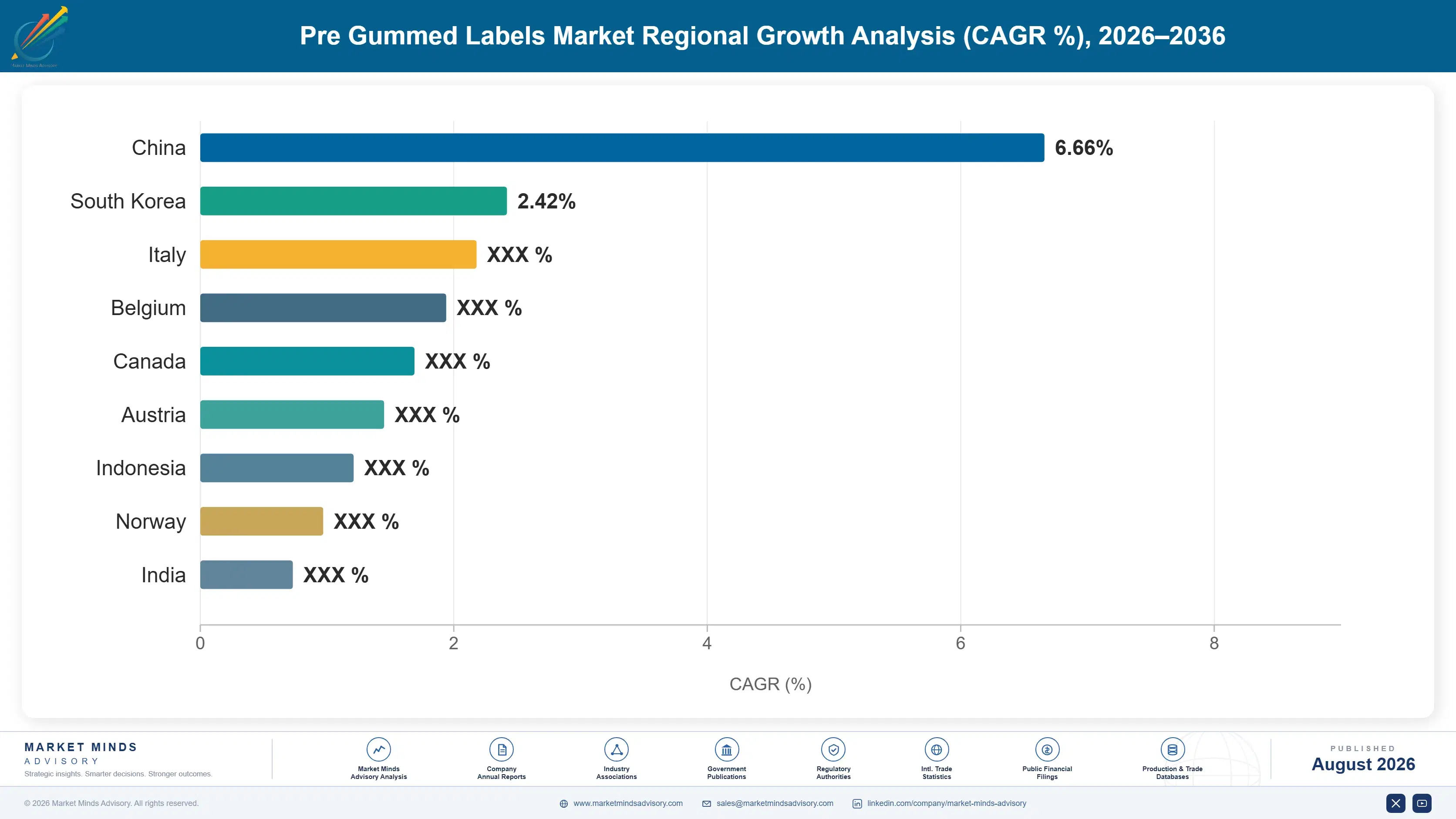
India: 6.8% CAGR
Fastest Growth Region
South Asia and Pacific: 6.2% CAGR
Largest Region
Western Europe: 26% of 2025 global value
Market Leaders
Ahlstrom, UPM Raflatac, De La Rue, SICPA, Avery Dennison. Source: MMA Primary Research Dataset, July 2026.
Primary Survey
n=3,800 procurement and R&D decision-makers, Q4 2025, six countries
Methodology
Demand-side build-up, cross-validated against public data, 47 expert interviews

Pre Gummed Labels Market Forecast Scenarios

pre-gummed-labels-market-size-forecast-scenario-1787580820679
Growth ran near 3.1% between 2020 and 2025 as postal volumes continued their long decline while fiscal stamp programmes expanded across emerging markets, roughly offsetting one another. Beverage applications began returning on recyclability grounds toward the end of the period, which nobody in the industry had forecast. Paper substrate pricing swung sharply through 2021 and 2022, lifting value more than volume in those years.
Base case 4.2% rests on three mechanisms. Paper mills and brand owners are quantifying adhesive contamination yield loss and specifying repulpable labelling where line speeds permit it. Excise and tax stamp programmes continue expanding across African, South Asian and Latin American markets as tax authorities formalise collection. And pharmaceutical and laboratory applications are growing where a label that destroys on removal is a tamper-evidence requirement rather than a convenience. None depends on postal volume.
The bull case at 5.4% assumes recycled content targets push brand owners toward repulpable labelling faster than line speed constraints allow today, which would require labelling equipment investment alongside. The bear case at 3.0% is continued postal decline combined with digital tax stamp technologies displacing physical banderoles, which would remove the security applications that carry 38% of current demand.

What the Convenient Adhesive Actually Costs

Pressure-sensitive adhesive is wonderful until the label reaches a paper mill. It softens under heat, passes through screens as tacky fragments and deposits on wires and rolls, which the industry calls stickies. Mills lose roughly 4% of yield to adhesive contamination and spend real money on screening and cleaning to keep the rest usable. Nobody paid for it until recycled content targets made mills and brand owners share one arithmetic.
TOP FIVE CONCENTRATION34%Security printers and speciality paper mills lead the field
RECYCLING YIELD LOSS4%Paper mill yield lost to pressure sensitive adhesive contamination
SECURITY APPLICATION SHARE38%Portion of demand in fiscal, postal and authentication uses
APPLICATION LINE SPEED180Labels applied per minute on gummed labelling equipment
GUM COAT WEIGHT18 gsmTypical dry gum coating applied to a label substrate
SUBSTRATE COST SHARE52%Share of label cost carried by the paper substrate
A gummed paper label has none of that behaviour. The gum is starch or dextrin based, water soluble, and it disperses in the pulper along with the paper it was printed on. There is no residue to screen out because there is no adhesive in the sense a mill worries about. That property was irrelevant for decades and became interesting the moment recycling yield entered a cost model.
The obstacle is application speed. Gummed labelling requires moistening, which limits lines to around 180 labels a minute against pressure-sensitive equipment running several times faster, and the equipment is different. That keeps gummed labelling out of high-speed beverage lines entirely. Security work never had a speed problem, which is why it never left.
"This industry spent three decades being told it was obsolete by people who had never costed a stickies problem in a recycling mill. The technology did not improve. The accounting did, and now a starch gum looks rather clever again."
Director, Labelling and Converted Paper Practice · MMA Packaging Practice · August 2026

Market Trends

Recycling yield loss making repulpable labelling commercially interesting

Paper mills lose roughly 4% of yield to pressure-sensitive adhesive contamination, through stickies that foul screens and appear as defects in finished product. Brand owners with recycled content targets increasingly share that cost through fibre pricing and through their own recyclability claims. A gummed paper label repulps with the substrate and contributes nothing to the problem, which is a property the category always had and nobody valued. Specification conversations now start with recyclability rather than with application cost, which is a genuine reversal. Specification conversations now open on recyclability rather than on application cost.
Market Impact: Delivers 6.8% annual Indian growth
Excise stamp programmes expanding across emerging tax authorities

Tax authorities across African, South Asian and Latin American markets continue introducing physical excise banderoles on tobacco, alcohol and increasingly on beverages, as formalisation of collection improves. A water-activated gummed stamp destroys on removal, which is exactly the behaviour a fiscal stamp requires and which pressure-sensitive labels do not provide reliably. Security applications now carry 38% of category demand. These programmes are procured centrally on multi-year contracts and specified for security behaviour rather than application convenience. Programmes are procured centrally on multi-year contracts and specified for security behaviour rather than for application convenience of any kind.
Market Impact: Serves 2 regulated application areas

Market Opportunities and Growth Drivers

Recycled content targets pushing brand owners toward repulpable formats

Brand owners committing to recycled fibre content and to recyclability claims have begun examining what their own labelling contributes to the problem, and pressure-sensitive adhesive is the answer more often than they expected. A gummed label removes the contamination entirely rather than reducing it. India grows fastest anywhere at 6.8% on a combination of that pressure and excise programme expansion. The constraint is application line speed rather than any argument about the label, and equipment investment resolves it where volumes justify. Equipment investment resolves the constraint wherever volumes justify it.
Market Impact: Caps lines near 180 per minute

Tamper evidence requirements in pharmaceutical and laboratory use

A label that destroys when removal is attempted is a tamper-evidence feature rather than a defect, and pharmaceutical packaging and laboratory sample identification both value it. Pressure-sensitive labels can frequently be lifted and reapplied without visible evidence, which defeats the purpose entirely. Regulatory expectations on pharmaceutical tamper evidence have tightened across several jurisdictions. Volumes here are small against beverage or security applications and prices reflect the specification, which makes it a disproportionately attractive part of the category. Volumes are small against beverage or security work and prices reflect the specification properly, which makes the tier attractive.
Market Impact: Puts 38% of demand at risk

Market Restraints and Challenges

Application line speed capping addressable beverage volume

Gummed labelling requires moistening before application, which limits lines to around 180 labels a minute against pressure-sensitive equipment running several times faster. The root cause is physical rather than a matter of machine design, since the gum needs contact time with water to activate properly. Commercially it excludes high-speed beverage and food lines regardless of any recyclability argument. Equipment makers are developing faster moistening systems and pre-activation approaches, and none yet reaches pressure-sensitive line speeds at acceptable reliability. Speed is the whole obstacle, and it is an equipment problem rather than a substrate one.
Market Impact: Avoids 4% mill yield loss

Digital tax stamp technologies threatening physical banderoles

Several tax authorities are evaluating digital track and trace systems using printed codes and databases rather than physical stamps, which would remove the banderole entirely. The root cause is administrative cost rather than any failure of the physical stamp. Commercially it puts the 38% of demand sitting in security applications at risk over a long horizon. Suppliers are responding by combining physical stamps with digital authentication rather than competing against it, which several authorities have found harder to defeat than either alone. Combining the two defers the question rather than settling it.
Market Impact: Carries 38% of category demand
3 additional market trends, 4 additional growth drivers, and 2 additional restraints and challenges are covered in the full report. Contact sales@marketmindsadvisory.com to access the complete intelligence.

Segment CAGR and Growth Architecture

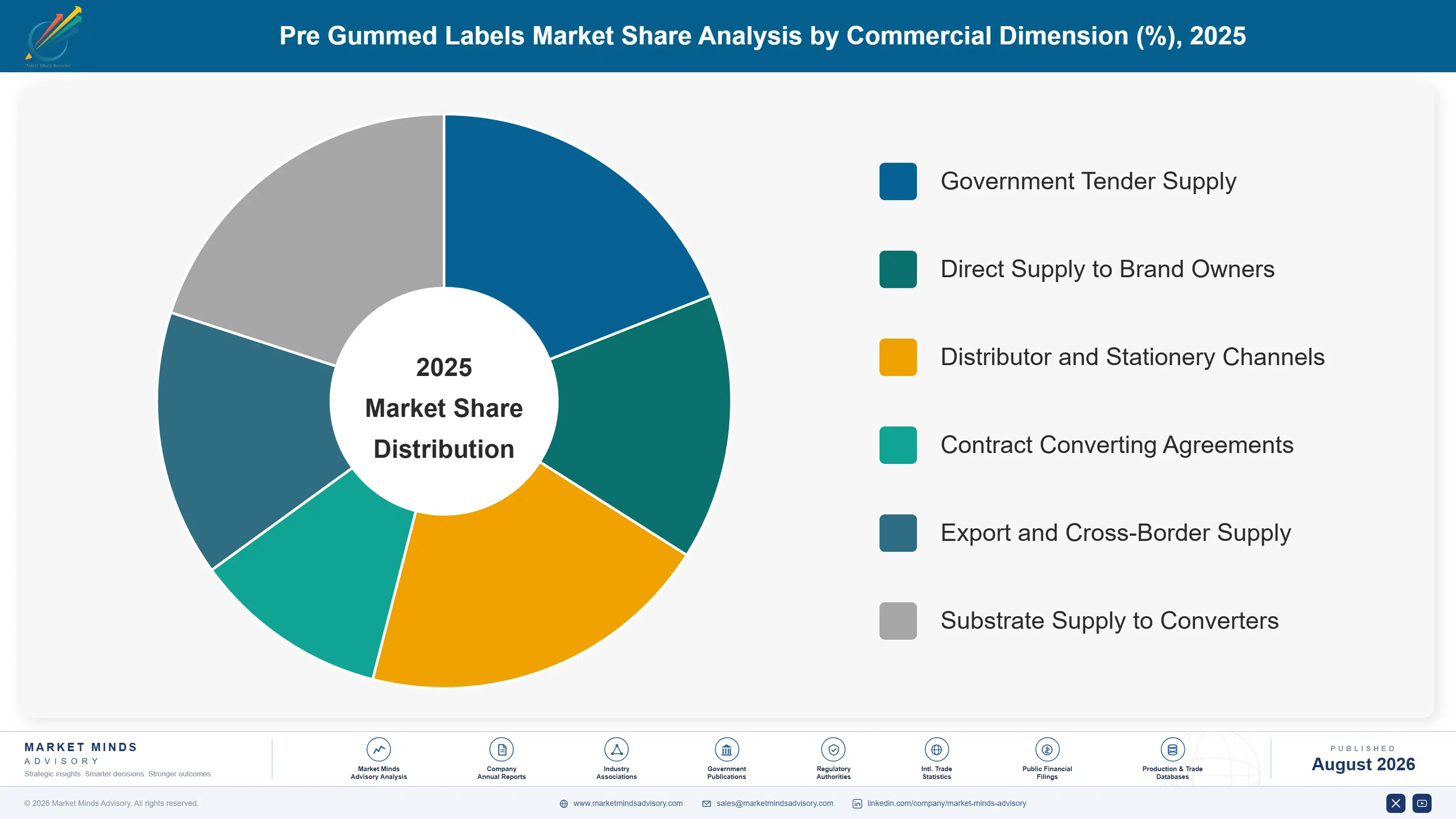
Six segments split by application, because each carries a different reason for choosing gummed adhesive over pressure-sensitive and a different procurement process behind it. A fiscal stamp is specified for destructive removal and a beverage label for repulpability. Substrate type and commercial channel are handled in the framework instead. The reasons for choosing gum differ completely.
pre-gummed-labels-market-market-share-analysis-1787580821239

Beverage and Container Labelling

Growing at 6.3%, half again the market rate of 4.2%, beverage labelling is returning to gummed adhesive on recyclability grounds after decades of losing ground to pressure-sensitive. A gummed paper label repulps with the container's own paper stream and contributes nothing to the roughly 4% yield loss that adhesive contamination causes in mills. Brand owners with recycled content targets increasingly specify it. The constraint is line speed near 180 labels a minute, which excludes the fastest beverage lines and confines the return to premium, craft and lower-throughput applications where the recyclability argument outweighs the throughput penalty. Equipment development on moistening speed is what would open the mainstream volume, and it has finally started.
CAGR 6.3%

Security and Fiscal Applications

At 5.6% security applications carry 38% of category demand and grow on excise stamp programmes expanding across African, South Asian and Latin American tax authorities. A water-activated gummed stamp destroys on removal, which is precisely what a fiscal stamp must do and what pressure-sensitive labels achieve unreliably. Procurement runs through central government tenders on multi-year contracts, with security printing capability and substrate authentication features weighing far more than price. Digital track and trace systems are the long-run threat, and several authorities have concluded that combining physical stamps with digital codes works better than either approach alone. Winning one of these programmes reshapes a converter's revenue base for several years at a time.
CAGR 5.6%
Full segment breakdown across 6 segments available in the complete report.

Regional Architecture and Country Demand Map

Western Europe holds 26% of value, the largest share of any region, because recycling policy and fibre yield economics bite hardest there and fiscal stamp programmes are long established. East Asia follows at 24% on manufacturing scale, with North America at 22% on fiscal stamp work at state level.

North America

Postal volume decline has been steeper here than in most regions, which removed a demand base that once dominated the category entirely. What remains is fiscal stamp work at state level for tobacco and alcohol, pharmaceutical tamper evidence and a small beverage return driven by craft producers marketing recyclability. Paper mill adhesive contamination is well documented in the American recycling industry and increasingly quantified. Application equipment is the constraint on wider beverage adoption, since most bottling lines here run at speeds gummed labelling cannot approach without material investment. Craft beverage producers market repulpability as a visible statement, which mainstream bottlers have not yet followed. Equipment speed is the constraint on wider adoption.
Share: 22% | CAGR: 3.4% (2026 to 2036)

Western Europe

Recycling policy and fibre economics bite hardest here, and the 26% share reflects that alongside long-established fiscal stamp programmes across most member states. German and Nordic paper mills quantify adhesive contamination carefully and pass the cost into fibre pricing, which brand owners with recycled content targets feel directly. Craft beverage producers have adopted gummed labelling as a visible recyclability statement. Speciality paper mills including Ahlstrom and several regional producers hold strong substrate positions built on gum coating capability that ordinary paper mills do not have. Gum coating capability is what those speciality mills hold and ordinary paper producers do not. Mills pass contamination cost into fibre pricing directly. Craft producers adopted it first.
Share: 26% | CAGR: 3.0% (2026 to 2036)
Regional intelligence for 5 additional markets available in the complete report: East Asia, South Asia and Pacific, Latin America, Middle East and Africa, Eastern Europe. Contact sales@marketmindsadvisory.com.
pre-gummed-labels-market-country-cagr-analysis-1787580821819

Four Ways to Sell a Starch Gum

This category spent thirty years defending itself on cost and losing. The arguments that work now are recycling yield, destructive removal and tamper evidence, none of which appear on a label price comparison. Selling to a mill or a tax authority is a different motion from selling to a packaging buyer. The audience has changed.

Quantify mill yield loss for brand owner customers

Paper mills lose roughly 4% of yield to pressure-sensitive adhesive contamination, and brand owners with recycled content targets increasingly bear part of that through fibre pricing and recyclability claims. Very few of them have connected their own labelling decision to that figure. Building the calculation for a specific brand owner, using their volumes and their fibre supply, converts a specification conversation that a label price comparison never opens. The analysis costs a few days and reaches people who never discuss labels. It reaches people who never discuss labels. Nobody has run the numbers for them.
Market Impact: Quantifies a 4% yield loss for each customer

Bid fiscal stamp programmes on destructive removal

A water-activated gummed stamp destroys when removal is attempted, which is what a fiscal banderole must do and what pressure-sensitive alternatives achieve unreliably. Tax authorities specify that behaviour rather than any application convenience, and security applications already carry 38% of category demand. These programmes run on multi-year central contracts where substrate authentication features and security printing capability weigh far more heavily than unit price does. Winning one changes a converter's revenue base for several years at a time. Price is a secondary consideration throughout. Track record outweighs unit price entirely.
Market Impact: Competes for 38% of the total category demand

Partner with equipment makers on moistening speed

Line speed near 180 labels a minute is the single constraint keeping gummed labelling out of mainstream beverage volume, and it is an equipment problem rather than a substrate one. Working with labelling machinery makers on faster moistening and pre-activation approaches addresses the actual barrier rather than arguing around it. Development investment is modest against the volume it would open, and a converter involved in that work influences the specification that results. Waiting for equipment makers to solve it independently concedes that influence entirely. Nobody else is doing this work.
Market Impact: Targets the 180 labels per minute speed ceiling

Build tamper evidence positions in regulated applications

Pharmaceutical packaging and laboratory sample identification both value a label that destroys on removal, and regulatory expectations on tamper evidence have tightened across several jurisdictions. Volumes are small against beverage or security work and prices reflect the specification properly, which makes the tier disproportionately attractive. Qualification into a pharmaceutical packaging specification takes time and then holds for the product life. Competition is limited because most label converters cannot supply gummed material at pharmaceutical documentation standards at all. Qualification takes roughly 12 months and then holds for the product life. Few converters can meet the standard.
Market Impact: Holds positions across 2 regulated application areas today

Who Controls the Margin Pool

Participation is measured on annual production volume of gummed label material and finished labels, and the top five hold 34%. Concentration reflects two distinct capabilities rather than one: speciality paper mills able to apply gum coating consistently, and security printers holding government programme relationships. Ahlstrom and UPM lead on substrate, De La Rue and SICPA on security programmes. The gap to challengers is coating capability or programme access.
Competition divides along the same line. Substrate supply competes on gum coating consistency, paper quality and cost, with speciality mills holding positions ordinary paper producers cannot enter without coating investment. Security programme work competes on authentication technology, government relationships and multi-year tender capability, where price is a secondary consideration. Very few participants operate credibly in both, and those that do generally supply one another rather than compete.

The pressure ahead is recyclability driving substrate demand into applications the security printers never served. Beverage conversion at 6.3% growth is being won by paper mills and general label converters rather than by security specialists. Expect equipment partnerships and coating capacity investment rather than acquisitions. Rankings shift as beverage volume grows relative to the fiscal work that has carried the category for decades.
pre-gummed-labels-market-company-positioning-matrix-1787580822342

Competitive Moat and Risk Dimensions

AHLSTROM

Moat: Gum coating capability at scale

Ahlstrom operates speciality paper capacity with gum coating capability that ordinary paper mills cannot replicate without dedicated investment and process knowledge. As recyclability drives demand into beverage applications, substrate supply becomes the constraint rather than converting, and mills already holding that capability serve demand the rest of the industry has to buy in.
AHLSTROM

Risk: European cost and volume exposure

European speciality paper carries energy and fibre costs well above Asian levels on a product where substrate is 52% of label cost, and the beverage volume now growing is price sensitive in a way fiscal stamp work never was. Growth in the segment that expands the market fastest arrives at the margins most exposed to competition on delivered cost.
DE LA RUE

Moat: Government programme relationships

De La Rue holds fiscal stamp and authentication programme relationships with tax authorities across many jurisdictions, built through multi-year tenders where security capability and track record weigh far above price. Those relationships renew rather than reopen in most cases, and a new entrant faces a procurement process designed to exclude untested suppliers.
DE LA RUE

Risk: Digital stamp technology displacement

Several tax authorities are evaluating digital track and trace systems that would remove the physical banderole entirely, on administrative cost grounds rather than any failure of the stamp. That would eliminate the demand base underlying the business rather than shifting it to a competitor, and combining physical and digital authentication only defers the question rather than settling it.

Players Tracked

Prominent Players

Ahlstrom
UPM Raflatac
De La Rue
SICPA
Avery Dennison

Other Key Players

Sappi
Mondi
Fedrigoni
Lecta
Koehler Paper
Cartor Security Printing
Madras Security Printers
Authentix
OpSec Security
Multi-Color Corporation
CCL Industries
Herma
Bagla Group
Gascogne Papier
Torraspapel

Recent Developments

FEBRUARY 2026

European brewer converts craft range to gummed paper labelling

A European brewing group converted several craft beer ranges from pressure-sensitive to gummed paper labelling, citing repulpability and recycled content commitments. Line speed was accepted as a constraint on the affected ranges, which run at throughputs well below the group's mainstream bottling operations. Other ranges were left unchanged.
Signal: Recyclability is now converting beverage volume that pressure-sensitive labelling took away from this category decades ago
SEPTEMBER 2025

African tax authority introduces excise banderoles on beverage categories

An African tax authority extended physical excise stamps from tobacco and alcohol into wider beverage categories as part of a collection formalisation programme. The contract was awarded internationally on a multi-year basis, since domestic security printing capability could not meet the specification. Rollout runs across three years.
Signal: Fiscal programme expansion across formalising economies is where the reliable volume growth in this category sits
MAY 2026

Labelling equipment maker demonstrates faster moistening system

A labelling machinery manufacturer demonstrated a moistening system aimed at raising gummed application speeds materially above current levels, using pre-activation ahead of the application station. Commercial availability and reliability at sustained production rates have not yet been established in any customer installation. Field trials are expected next year.
Signal: Line speed is an equipment problem rather than a substrate one, and equipment makers have finally noticed

Paper First, Gum Second

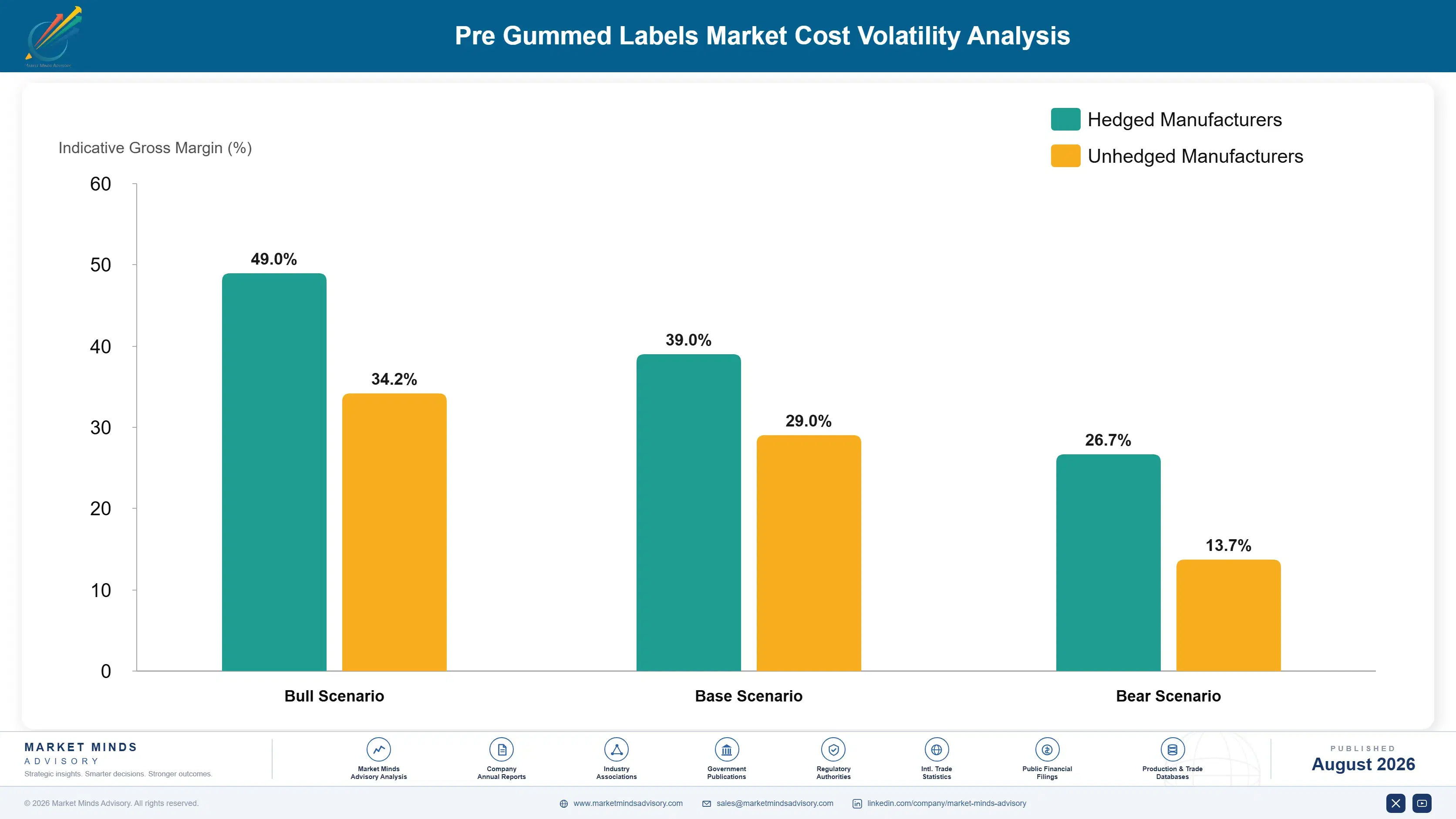
Paper substrate accounts for roughly 52% of label cost, sourced from speciality mills able to hold the surface properties gum coating requires. Starch and dextrin gum formulations add about 14%, with plasticisers and anti-curl additives inside that share. Printing, including security features where applicable, takes a further 21%, rising sharply for fiscal work where authentication and controlled production add cost.
European paper and energy costs rose sharply through 2022 as gas prices climbed and pulp markets tightened, per published pulp and paper pricing and IEA industrial energy data for that period. Gummed label converters holding annual contracts absorbed a substantial share, since label pricing with brand owners and government programmes is agreed on cycles that do not accommodate a mid-term substrate move. Several European converters disclosed margin compression in reporting for that year.

Exposure varies with substrate sourcing and contract structure. A converter buying substrate from a single speciality mill carries whatever that mill charges, while one with qualified alternatives moves between them, and gum coating capability is narrow enough that alternatives are genuinely limited. European speciality paper also carries fibre and energy costs above Asian equivalents, which is why substrate increasingly ships east to west.
pre-gummed-labels-market-cost-volatility-analysis-1787580822543

Qualify a second gum-coated substrate source

Gum coating capability is narrow enough that most converters buy from one mill and accept whatever that costs. Qualifying a second source requires print trial and application testing, costing perhaps 70 thousand dollars per substrate family, and it recovers within a single pricing cycle. The obstacle is that qualified alternatives genuinely are limited rather than merely inconvenient to arrange.

Index contracts to published paper references

Substrate is 52% of label cost and label pricing with brand owners and government programmes is agreed annually or on longer cycles that cannot absorb a mid-term paper move. Indexing to a published reference passes movement through with a defined lag. Government programme contracts accommodate this more readily than brand owner agreements, which is worth knowing before negotiating either.

Separate security printing cost from substrate pricing

Fiscal stamp work carries authentication features and controlled production costs that ordinary label printing does not, and converters quoting a single delivered price obscure where that value sits. Separating the security element in contract structure protects it when paper pricing moves, and government procurement teams understand the distinction readily since they specified the features.

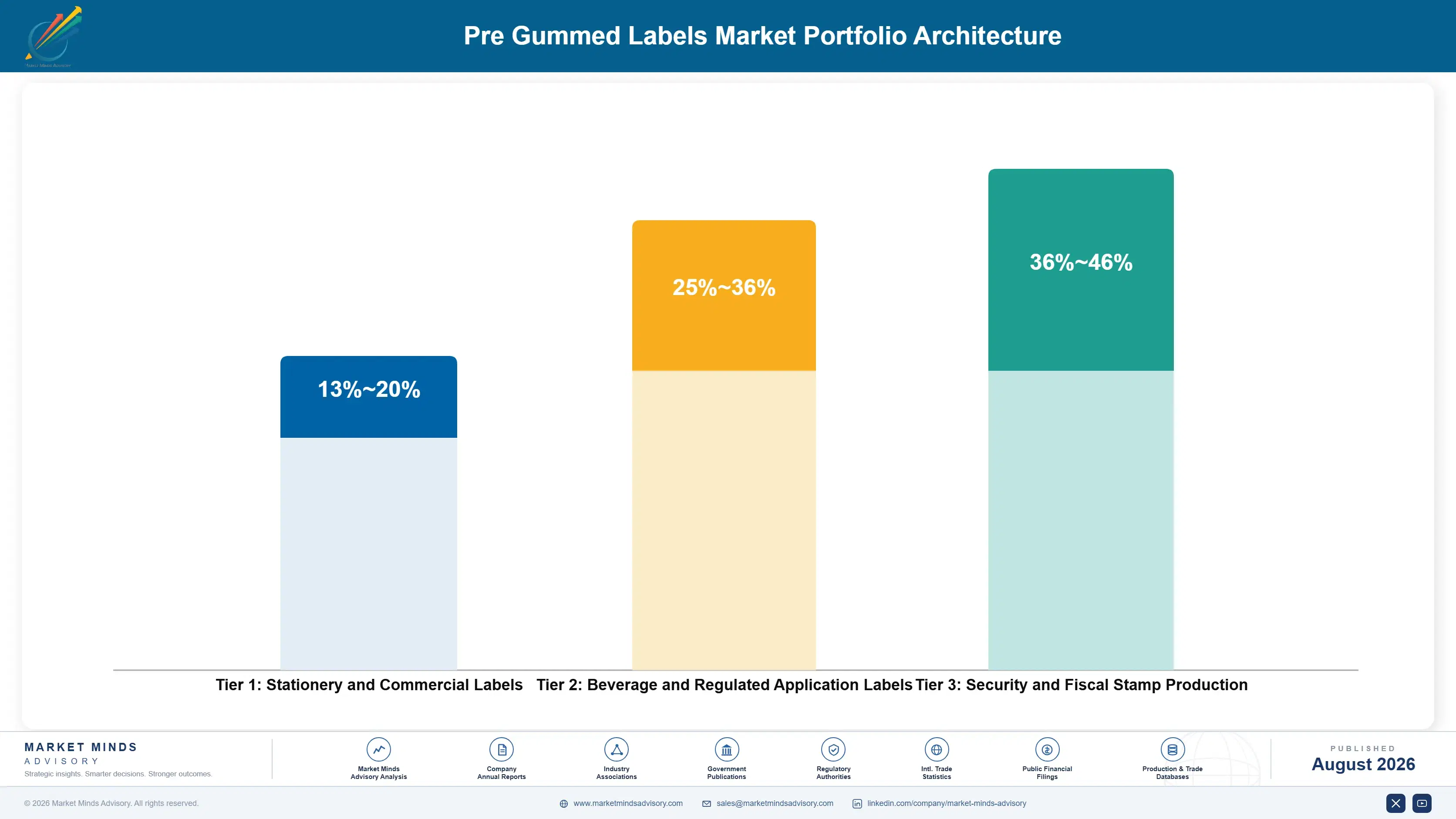
Portfolio Architecture for Margin Defence

Margin here tracks security content rather than volume. Stationery, office and general commercial gummed labels earn margins in the mid teens, because the product is simple, the substrate is available and converters compete on price against a shrinking demand base. Nothing about this tier is worth defending and several converters have exited it entirely. Several have exited it and none has regretted doing so.
Beverage and container labelling does better at margins in the mid twenties to mid thirties, because the recyclability argument is a genuine specification rather than a preference and brand owners with recycled content targets are not primarily price shopping. The range reflects how directly a given brand owner feels fibre yield economics, which varies enormously by region and by fibre supply arrangement.

Security and fiscal work holds the strongest position, running into the mid forties, where authentication features, controlled production and government programme relationships exclude nearly everyone. Those margins reflect a procurement barrier rather than any manufacturing advantage, and they persist for the contract term, which typically runs several years at a time. Contract terms typically run several years at a time, which gives unusually good revenue visibility.

Stationery and Commercial Labels

General gummed labels for office, stationery and commercial use sold against simple specifications. The seven point range reflects substrate buying position and print run length rather than any capability worth defending against competitors.
Gross Margin: 13-20%

Beverage and Regulated Application Labels

Container labelling specified for repulpability and pharmaceutical or laboratory labels specified for tamper evidence. The eleven point range reflects how directly a customer feels fibre yield economics or regulatory tamper evidence expectations.
Gross Margin: 25-36%

Security and Fiscal Stamp Production

Excise banderoles and authentication stamps produced under controlled conditions for tax authorities. The ten point range reflects authentication feature complexity and whether a programme includes digital track and trace integration alongside.
Gross Margin: 36-46%
pre-gummed-labels-market-portfolio-architecture-1787580823084

High-value Sub-segments and Strategic Watch-out

Excise and Fiscal Stamp Programmes

High value and growing at 5.6% on programme expansion across formalising tax systems. Multi-year central contracts where authentication capability outweighs unit price. Digital track and trace is the long-run threat rather than any competitor. Revenue visibility is better than anything else here. Programmes renew rather than reopen.
Gross Margin: 38-46%

Repulpable Beverage Labelling

High value and the fastest growth at 6.3%, converting on recycling yield rather than on cost. Line speed near 180 per minute confines it to premium and craft applications until labelling equipment improves materially. Equipment development would open mainstream volume. Craft and premium lines convert first.
Gross Margin: 27-36%

Stationery and Commercial Labels

The volume core and a permanently declining one against pressure-sensitive convenience. Substrate buying and run length are the only cost levers available. Several converters have exited this tier rather than continue defending it. Pressure-sensitive convenience wins this tier permanently. Demand declines steadily every year. Nothing reverses it.
Gross Margin: 13-20%

Postal and Philatelic Applications

The strategic watch-out. Postal volume decline continues everywhere and philatelic demand is a collector market rather than a functional one. The range reflects the gap between commemorative issues and ordinary postage production. Decline continues everywhere and shows no sign of reversing. Collector demand is not functional demand.
Gross Margin: 18-30%

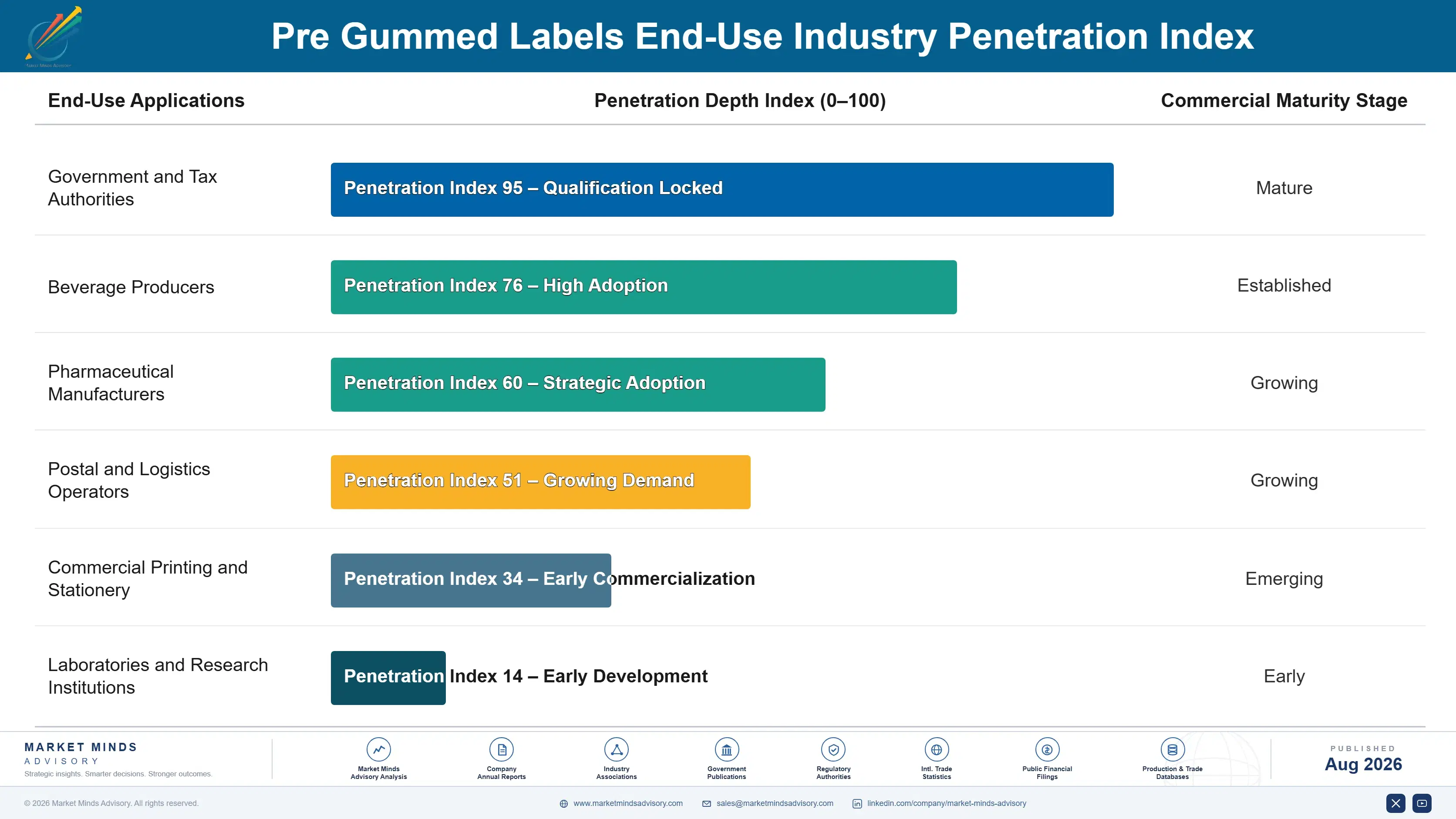
Where the Volume Keeps Returning

Fiscal stamp programmes are the closest thing to an annuity this category offers. A tax authority awarding a multi-year contract consumes stamps at volumes set by the taxed goods moving through the economy rather than by any purchasing decision, and the contract renews rather than reopening in most cases. Security applications carry 38% of demand on that basis, and the revenue visibility is better than anything else available here.
Stickiness varies considerably elsewhere. Pharmaceutical tamper evidence supply is sticky because a label sits inside a packaging specification that takes real effort to change. Beverage labelling is moderately sticky once a line has been converted, since going back means the equipment investment was wasted. Stationery and commercial work switches on price at every order and behaves like ordinary commercial printing throughout.

The specifying buyer has moved somewhere unexpected. Gummed labels were bought by packaging purchasers comparing unit prices for decades. Recycled content commitments moved part of that decision to sustainability functions who read mill yield analyses, and fiscal work sits with tax authorities who never had a packaging conversation at all. That is a genuinely unusual buyer shift for a converted paper product.
pre-gummed-labels-market-end-use-penetration-index-1787580823581

Where We Would Focus

These are among the four positions where our research anticipates prominent divergence between winners and laggards over the coming forecast period. Each is grounded in the demand model, the regulatory perimeter, and the announced capacity pipeline.
01 / YIELD LOSS QUANTIFICATION

Build the mill arithmetic for each brand owner individually

Paper mills lose roughly 4% of yield to pressure-sensitive adhesive contamination, and brand owners with recycled content commitments increasingly bear part of that through fibre pricing and their own recyclability claims. Very few of them have connected their own labelling choice to that number themselves. Building the calculation with a specific customer's volumes and fibre supply opens a specification conversation that no label price comparison ever reaches, and it costs only a few days of analytical work to prepare properly.
02 / FISCAL PROGRAMME BIDDING

Compete on destructive removal, not on stamp unit price

A water-activated gummed stamp destroys when removal is attempted, which is precisely the behaviour a fiscal banderole must exhibit and which pressure-sensitive alternatives deliver unreliably at the very best. Tax authorities specify that property rather than application convenience, and security applications already carry 38% of category demand. These programmes run on multi-year central contracts where authentication capability and track record weigh far above unit price, and winning a single programme reshapes a converter's revenue base for several years at a time.
03 / EQUIPMENT PARTNERSHIP WORK

Attack the line speed ceiling rather than arguing around it

Application speed near 180 labels a minute is the single constraint keeping gummed labelling out of mainstream beverage volume, and it is an equipment problem rather than a substrate one that converters can solve alone. Working with labelling machinery makers on faster moistening and pre-activation addresses the actual barrier directly. Development investment is modest against the volume it would open, and a converter involved in that work shapes the resulting specification instead of inheriting whatever specification somebody else eventually settles on.
04 / REGULATED TAMPER EVIDENCE

Qualify into pharmaceutical specifications where competition is thin

Pharmaceutical packaging and laboratory sample identification both value a label that destroys on removal, and tamper evidence expectations have been tightening across several regulatory jurisdictions in recent years. Volumes are small against beverage or fiscal work and prices reflect the specification properly, which makes the tier disproportionately attractive on margin. Competition is thin here because most label converters cannot supply gummed material to pharmaceutical documentation standards at all, and a qualification once obtained then holds for the entire product life.

Engagement Snapshot From the Field

A live engagement with an industry participant carrying material or product regulatory and market exposure ahead of a defining policy shift, showing how our research translates into a defensible multi-year portfolio strategy.
MARKET MINDS ADVISORY · CLIENT ENGAGEMENT SUMMARY
Pre Gummed Labels Producer Strategic Portfolio Review and Transition Roadmap 2026·Investment Scenario on Pre Gummed Labels Exposure Evaluation 2025-26
CLIENT PROFILE
A European converter producing gummed and pressure-sensitive labels across two plants, with gummed label revenue near 46 million euros and the balance in self-adhesive work (client-reported, unverified by MMA). The gummed business was weighted toward stationery, commercial and declining postal applications, with no security printing capability and no beverage presence at all. Coating knowledge was held in one plant.
STRATEGIC CHALLENGE
Gummed volumes had declined for six consecutive years and management had prepared a proposal to exit the technology entirely and consolidate on pressure-sensitive. A brand owner enquiry about repulpable beverage labelling arrived during the review, which nobody in the business could evaluate, and the board deferred the decision pending an outside view.
MMA APPROACH
MMA quantified paper mill yield loss from adhesive contamination with three European recycled fibre operations, tested brand owner willingness to specify repulpable labelling across nine customers, and assessed line speed constraints with two labelling equipment makers. Fiscal stamp programme entry requirements were reviewed with two security printing consultancies. Interviews with 47 experts covered gum coating, recycled fibre operations and government stamp procurement.
KEY FINDINGS
  1. Adhesive contamination yield loss across the three fibre operations examined ran near 4%, and two were already passing part of that cost into their pricing to brand owner customers.
  2. Six of nine brand owners would specify repulpable labelling on lines running below roughly 200 labels a minute, and none had previously been offered it by any supplier.
  3. Fiscal stamp programme entry required security printing accreditation and government references the client did not hold and could not obtain within a useful timeframe.
  4. Exiting gummed production would have written off coating and application knowledge that no pressure-sensitive competitor holds, immediately before demand began returning to it.
CLIENT PROFILE
A European converter producing gummed and pressure-sensitive labels across two plants, with gummed label revenue near 46 million euros and the balance in self-adhesive work (client-reported, unverified by MMA). The gummed business was weighted toward stationery, commercial and declining postal applications, with no security printing capability and no beverage presence at all. Coating knowledge was held in one plant.
STRATEGIC CHALLENGE
Gummed volumes had declined for six consecutive years and management had prepared a proposal to exit the technology entirely and consolidate on pressure-sensitive. A brand owner enquiry about repulpable beverage labelling arrived during the review, which nobody in the business could evaluate, and the board deferred the decision pending an outside view.
MMA APPROACH
MMA quantified paper mill yield loss from adhesive contamination with three European recycled fibre operations, tested brand owner willingness to specify repulpable labelling across nine customers, and assessed line speed constraints with two labelling equipment makers. Fiscal stamp programme entry requirements were reviewed with two security printing consultancies. Interviews with 47 experts covered gum coating, recycled fibre operations and government stamp procurement.
KEY FINDINGS
  1. Adhesive contamination yield loss across the three fibre operations examined ran near 4%, and two were already passing part of that cost into their pricing to brand owner customers.
  2. Six of nine brand owners would specify repulpable labelling on lines running below roughly 200 labels a minute, and none had previously been offered it by any supplier.
  3. Fiscal stamp programme entry required security printing accreditation and government references the client did not hold and could not obtain within a useful timeframe.
  4. Exiting gummed production would have written off coating and application knowledge that no pressure-sensitive competitor holds, immediately before demand began returning to it.
RECOMMENDED STRATEGY
Phase 1: Phase one: retain gummed capability and reposition it around beverage and container repulpability, abandoning the declining stationery and commercial volume instead. Phase 2: Phase two: build the mill yield loss calculation for each target brand owner individually, since none had connected their labelling decision to fibre economics. Phase 3: Phase three: engage labelling equipment makers on moistening speed, rather than pursuing fiscal stamp work the business cannot realistically enter.
OUTCOME
The converter retained gummed production and won three beverage conversions during 2026, with gummed revenue growing for the first time in seven years (client-reported, unverified by MMA). Stationery and commercial volumes were allowed to decline as planned, and an equipment maker discussion on moistening speed is continuing at the time of writing.

Frequently Asked Questions

Foundational context covering the market sizes, CAGR, scope, country, region and competition that inform every finding below. This section is provided to cover basics and most often pre-purchase conversations, answered from the MMA Primary Research Dataset.

What is the current size of the Pre Gummed Labels Market?

MMA sizes it at USD 1.24 billion in 2025, rising to USD 1.29 billion in 2026. The figure covers labels supplied with dry water-activated gum at converter selling price.

How large will the Pre Gummed Labels Market be by 2036?

USD 1.95 billion by 2036, an incremental USD 0.66 billion over the 2026 base and an expansion multiple of 1.51 times. Beverage and fiscal applications account for most of that.

What is the CAGR for the Pre Gummed Labels Market 2026 to 2036?

4.2% in the base case, with a bull case at 5.4% and a bear case at 3.0%. The spread turns on recyclability conversion pace and on digital tax stamp adoption.

Which segment is growing fastest?

Beverage and container labelling at 6.3%, half again the market rate of 4.2%. Gummed paper labels repulp with the substrate and avoid the adhesive contamination that costs mills yield.

Who are the major companies in the Pre Gummed Labels Market?

Ahlstrom, UPM Raflatac, De La Rue, SICPA and Avery Dennison lead on annual production volume of gummed material and finished labels. Fifteen further participants are profiled.

Which country is growing fastest?

India at 6.8%, on excise stamp programme expansion across states as tax collection formalises, alongside early recyclability interest from beverage brand owners in the same market.

Report Segmentation Architecture

The full report scope spans multiple orthogonal segmentation dimensions, with cross-tabulated demand data provided for each dimension pair. Coverage extends further to regional breakdowns, trend trajectories, and the competitive detail needed to support segment-level decision-making.

By Application

  • Security and Fiscal Applications
  • Postal and Philatelic Applications
  • Beverage and Container Labelling
  • Stationery and Office Applications
  • Industrial and Archival Applications
  • Pharmaceutical and Laboratory Applications

By End-Use Industry

  • Government and Tax Authorities
  • Beverage Producers
  • Pharmaceutical Manufacturers
  • Postal and Logistics Operators
  • Commercial Printing and Stationery
  • Laboratories and Research Institutions

By Commercial Dimension

  • Government Tender Supply
  • Direct Supply to Brand Owners
  • Distributor and Stationery Channels
  • Contract Converting Agreements
  • Export and Cross-Border Supply
  • Substrate Supply to Converters

By Region

  • North America
  • Western Europe
  • East Asia
  • South Asia and Pacific
  • Latin America
  • Middle East and Africa
  • Eastern Europe

Scope, Methodology, and Coverage

Every figure in this report is reproducible from documented input assumptions. The scope below maps the historical period, the forecast horizon, the segmentation dimensions, and the countries covered, alongside the underlying primary and qualitative methodology.
Historical Period
2020 to 2025
Forecast Period
2026 to 2036
Base Year
2025 (USD billions; MMA Primary Research Dataset, August 2026)
Market Definition
Labels supplied with a dry water-activated gum applied at manufacture, spanning security and fiscal stamps, postal and philatelic labels, beverage and container labelling, stationery and office labels, industrial and archival labels and pharmaceutical and laboratory applications, measured at converter selling price. Pressure-sensitive self-adhesive labels, wet-glue labels where adhesive is applied at the labelling machine, water-activated carton sealing tape, and in-mould and direct print decoration are excluded from scope.
Quantitative Units
USD billions (current prices); billion labels supplied annually; USD per thousand labels by application and region
Segmentation Dimensions
Application; end-use industry; commercial dimension; region
Regions Covered
North America, Western Europe, East Asia, South Asia and Pacific, Latin America, Middle East and Africa, Eastern Europe
Countries Covered
United States, Canada, Mexico, Germany, France, United Kingdom, Italy, Spain, China, Japan, South Korea, India, Bangladesh, Australia, Brazil, Colombia, Kenya, Nigeria, South Africa, Poland
Key Companies Profiled
Ahlstrom, UPM Raflatac, De La Rue, SICPA, Avery Dennison, Sappi, Mondi, Fedrigoni, Lecta, Koehler Paper, Cartor Security Printing, Madras Security Printers, Authentix, OpSec Security, Multi-Color Corporation, CCL Industries, Herma, Bagla Group, Gascogne Papier, Torraspapel
Quantitative Methodology
Primary survey, n=3,800 respondents, Q4 2025, six countries; demand-side model with trade association cross-validation
Qualitative Methodology
47 expert interviews, Q4 2025; applied to validate demand model assumptions, identify emerging dynamics, and assess competitive positioning
Report Format
PDF and XLSX data workbook (Word format preview document)
Publisher
Market Minds Advisory
Report Code
MMA-2026-PAC-116
Published
August 2026
Contact
sales@marketmindsadvisory.com | www.marketmindsadvisory.com

Purchase the full Pre Gummed Labels Market Report (2026 to 2036).

The full report explains why a category written off decades ago is growing again, sizing each application independently through 2036. It quantifies paper mill yield loss from adhesive contamination and traces how that cost reaches brand owners, tracks excise stamp programme introductions by tax authority, and assesses labelling equipment line speed development against beverage conversion potential. Regional chapters cover all seven regions with programme level detail where procurement disclosure permits. Competitive profiling covers 20 participants on a single production volume basis, with gum coating substrate capability mapped across speciality mills.
Each application sized independently through 2036
Mill yield loss from adhesive contamination quantified directly
Excise stamp programme introductions tracked by tax authority
Labelling equipment speed development assessed against conversion potential
Twenty participants profiled on one consistent basis
Gum coating substrate capability mapped across speciality mills

Built For The People Who Decide

From boardroom strategy to bench-side execution, this report is read cover-to-cover by leaders shaping the next decade of their industry, turning demand scenarios, market dynamics and valuation benchmarks into decisions.
CXOs/ Presidents/ VPs/ Managers
M&A and Corporate Development
Strategy Teams and R&D Heads
Procurement and Product Directors
Regulatory and Compliance Leaders
Investor Relations and Equity Analysts