Market Minds Advisory
PPG Biosensors Market

PPG Biosensors Market: Cuffless Blood Pressure Sensing Reshapes Wearable Health Monitoring

Expanding wearable health monitoring demand and rising cuffless blood pressure sensing adoption are pushing device makers toward multi-wavelength PPG modules, pressuring single-wavelength sensors whose limited biomarker range increasingly conflicts with modern continuous health tracking expectations.

Lead Analyst

Alice Ballenger

Published

September 2026

Make Smarter Decisions with Customized Research Insights

Request a free sample report and evaluate market opportunities, growth trends, and competitive dynamics relevant to your business needs.

2025 MARKET VALUE$3.2BMarket Size 2025
2036 FORECAST VALUE$10.9BBase Case , 2026 to 2036
CAGR 2026 TO 203611.8 %Bull 13.0% / Bear 10.5%
INCREMENTAL OPPORTUNITY$7.3BNet 10- year value creation
EXPANSION MULTIPLE3.05x2036 value over 2026 base
Strategic Levers
M&A Pipeline
Regional Outlook
Country Rankings
Competitive Intelligence
Segmental Deep-dive
Call-Us : 91 93563 13602

Executive Snapshot and Market Trajectory

ams-OSRAM and Analog Devices built the modern PPG biosensor category on consumer wearable sensor modules, and blood pressure estimation sensors are now the fastest growing answer to device makers facing continuous health tracking demand that single-wavelength sensors cannot satisfy across most major wearable platforms worldwide today overall.
ams-OSRAM and Analog Devices still command meaningful combined share of the category through decades of semiconductor manufacturing scale and device maker procurement relationships, while expanding wearable health monitoring demand keeps growing the addressable sensor pool each year. Multi-wavelength modules and blood pressure estimation formats have pulled purchasing decisions firmly toward advanced biomarker sensing across consumer wearable and clinical monitoring programmes, concentrated heavily in North America's dense wearable device base.
Five companies hold well over half of global category revenue, a moderately concentrated structure built on decades of semiconductor engineering investment that smaller suppliers struggle to replicate, and the order rarely shifts since device makers standardise their sensor architecture around one vendor's optical platform for years at a time. Rising cuffless blood pressure adoption and multi-wavelength demand will determine how quickly advanced sensors displace single-wavelength incumbents across every major wearable channel worldwide each year.
Market Definition
This market covers photoplethysmography optical sensor components and modules used to measure blood volume changes for health monitoring applications, including consumer wearable PPG sensors, clinical-grade pulse oximetry PPG sensors, blood pressure estimation PPG sensors, multi-wavelength PPG sensor modules, and implantable and continuous monitoring PPG sensors. It excludes ECG-only biosensors and non-optical bioimpedance sensing components not incorporating a photoplethysmography measurement mechanism.
Base Year Value
$3.2B in 2025 (MMA Primary Research Dataset, August 2026)
Forecast Period
2026 to 2036, eleven discrete annual values
CAGR
11.8% base case. Bull 13.0%. Bear 10.5%.
Fastest Growth Segment
Blood Pressure Estimation PPG Sensors: 16.2% CAGR
Fastest Growth Country
China: 13.6% CAGR
Fastest Growth Region
South Asia and Pacific: 13.8% CAGR
Largest Region
North America: 30% of 2025 global value
Market Leaders
ams-OSRAM AG, Analog Devices Inc, Texas Instruments Incorporated, Broadcom Inc, STMicroelectronics N.V. Source: MMA Analysis based on company annual reports.
Primary Survey
n=3,800 procurement and R&D decision-makers, Q4 2025, six countries
Methodology
Demand-side build-up, cross-validated against public data, 47 expert interviews

PPG Biosensors Market Forecast Scenarios

ppg-biosensors-market-size-forecast-scenario-1787299107796
Between 2020 and 2025, the market grew at a historical rate near 10.2 percent, reflecting steady replacement demand for established consumer wearable sensors and gradual multi-wavelength adoption across clinical monitoring programmes, with blood pressure estimation sensors remaining a comparatively small share of total volume through most of this recovery period as conventional single-wavelength sensors still dominated most device maker purchasing.
The base case assumes 11.8 percent annual growth through 2036, built on three mechanisms: expanding wearable health monitoring demand driving sensor purchasing volume, rising cuffless blood pressure adoption supporting advanced module growth, and East Asian manufacturing capacity expansion pulling forward volume well ahead of comparable Western replacement cycles still under gradual modernisation across most major producing regions, tracked closely by device maker procurement teams reviewing purchasing cycles each year and every fiscal review cycle overall.
A bull case near 13.0 percent depends on cuffless blood pressure regulatory clearance holding firm across major markets still finalizing certification policy for advanced sensor formats today. The bear case near 10.5 percent reflects continued device maker budget caution around premium multi-wavelength price differentials pushing some purchasing toward single-wavelength alternatives in cost constrained wearable markets worldwide each budget cycle.

Single-Wavelength Legacy Meets Multi-Wavelength Demand

PPG biosensor procurement has quietly become a biomarker range and power efficiency specification decision as much as a sensing one. The core function, detecting blood volume changes through optical measurement, has not changed, but device makers increasingly weigh biomarker breadth alongside battery life when planning new sensor purchasing protocols across every affected wearable category worldwide. That shift already shapes new procurement evaluations.
TOP 5 CONCENTRATION56% CR5revenue share held by five largest global optical sensor manufacturers
AVERAGE MODULE ASP$3.80 per unittypical PPG sensor module price across major device maker channels
LEADING PRODUCING COUNTRYUSA, 24%share of global product value, by manufacturer home country
MULTI-WAVELENGTH REVENUE SHARE22% of revenueshare of category revenue from multi-wavelength sensor formats
WEARABLE DEVICE VOLUME SHARE54% of unitsshare of unit volume purchased by consumer wearable manufacturers
OPTICAL COMPONENT COST SHARE36% of COGSinput cost weight from LED and photodiode component sourcing
Commercial behaviour splits by device tier and application criticality. Mainstream fitness tracker and entry-level smartwatch applications still rely heavily on established single-wavelength sensors that have performed reliably for years, while premium wearables and clinical monitoring devices increasingly specify multi-wavelength and blood pressure estimation sensors where biomarker range carries meaningfully higher practical value than marginal cost savings. Distributors report this split sharpening recently.
The next decade turns on whether single-wavelength-focused manufacturers can build sufficient multi-wavelength depth to compete for biomarker-driven device purchasing while defending their core fitness tracker relationships against rising specialty competitors. Manufacturers that solve both problems stand to capture share from a single-wavelength installed base that has dominated PPG sensing for more than two decades of continuous wearable use worldwide. That transition will not happen overnight.
"Nobody redesigns a watch's sensor stack because the spec sheet has more wavelengths. They redesign it because the FDA just cleared cuffless blood pressure and every competitor is about to ship it."
Director, Medical Devices and Wearable Sensing Practice · MMA Medical Devices Pr

Market Trends

Cuffless Blood Pressure Adoption Accelerates Sensor Upgrades

Cuffless blood pressure sensing adoption has expanded considerably as wearable device makers increasingly favor pulse-wave-based estimation that conventional single-wavelength sensors struggle to support against advanced alternatives offering continuous cuffless monitoring. ams-OSRAM and Analog Devices have both reported expanded order books for blood pressure estimation sensors from major wearable manufacturers in recent years, driven by product teams specifically seeking modules that reduce cuff-based measurement dependency. Device data has documented meaningfully higher consumer engagement versus comparable single-wavelength programmes across audited institutional comparisons reviewed by MMA analysts. Wearable manufacturers across Europe and Asia have announced comparable adoption expansions recently.
Market Impact: Reaches 27% of capacity investment

Wearable Health Monitoring Growth Expands Sensor Demand

Global wearable health monitoring adoption has expanded considerably as consumer device makers increasingly integrate biomarker tracking that legacy fitness bands could not support at required measurement accuracy. Texas Instruments and Broadcom have both expanded dedicated wearable-grade sensor portfolios targeting the more than 580 device manufacturers adopting standardised health tracking protocols annually according to trade association data reviewed by MMA analysts. Programmes across Southeast Asia and Latin America have announced comparable adoption expansions over the past two years, reflecting the trend's broadening reach across multiple wearable systems worldwide, tracked closely by procurement teams each cycle.
Market Impact: Adds 6,400-plus screening-enabled devices

Market Opportunities and Growth Drivers

Expanding Wearable Device Manufacturing Capacity Drives Volume

Global wearable device manufacturing capacity continues expanding considerably across major consumer electronics systems, a shift that has fundamentally changed PPG biosensor demand patterns since new wearable facility construction commands meaningfully higher per-unit sensor volume than routine replacement purchasing historically generated. Manufacturers have responded with dedicated wearable-ready sensor bundles specifically engineered for these higher-volume requirements. An estimated 27 percent of new PPG biosensor purchasing now targets new wearable facility construction, up considerably from a meaningfully smaller share just a decade earlier, reflecting accelerating consumer electronics investment across major markets worldwide, tracked closely by procurement teams.
Market Impact: Loses 6 to 9% share

Rising Chronic Disease Screening Awareness Expands Demand

Global chronic disease screening awareness has risen considerably in recent years, driven by rising demand for continuous cardiovascular monitoring offering higher early-detection value and reduced clinical visit dependency than conventional periodic checkup alternatives historically delivered. Manufacturers have responded by developing dedicated screening-ready sensor lines specifically engineered for these tighter consumer requirements. New wearable assortment capacity is projected to grow considerably across major markets through the coming decade, each device maker requiring sensing capability capable of sustaining faster biomarker detection than conventional systems allow, across nearly every major wearable network worldwide, reviewed closely by procurement analysts each year.
Market Impact: Limits adoption to 25% of manufacturers

Market Restraints and Challenges

High Multi-Wavelength Cost Slows Budget Constrained Adoption

Many device makers in budget-constrained regions find the cost of multi-wavelength sensors over conventional single-wavelength modules economically difficult, even where the biomarker case is well documented. The root cause is that annual product budget cycles, not clinical outcome data, drive most purchasing decisions, and lower-margin manufacturers see meaningfully slower multi-wavelength adoption than higher-margin manufacturers facing the same purchasing decision. Manufacturers have responded by developing tiered pricing programmes and simplified multi-wavelength designs specifically intended to narrow the cost gap across multiple budget-constrained wearable markets worldwide, each year and every ongoing budget review cycle.
Market Impact: Lifts multi-wavelength share 22%

Fragmented Regulatory Standards Slow Global Adoption

Blood pressure estimation sensor compliance requires jurisdiction-specific clinical validation data and testing infrastructure that many smaller manufacturers lack capacity to maintain, since multi-jurisdiction compliance differs meaningfully from single-market sensor production most manufacturers already manage. This restricts advanced sensor adoption among smaller regional manufacturers serving fragmented, resource-constrained device markets rather than large multinational wearable brands. Manufacturers have responded by developing simplified validation lookup tools and dedicated compliance support programmes specifically intended to lower the adoption barrier across multiple underserved regional markets worldwide, particularly among smaller manufacturers with limited compliance staff available today, reviewed each fiscal cycle by regional teams overall.
Market Impact: Covers 580-plus adopting manufacturers
3 additional market trends, 4 additional growth drivers, and 3 additional restraints and challenges are covered in the full report. Contact sales@marketmindsadvisory.com to access the complete intelligence.

Segment CAGR and Growth Architecture

Segmentation follows sensor technology, the classification device makers, clinical manufacturers, and procurement teams already use to distinguish consumer, clinical, blood pressure, and multi-wavelength categories across every product type this report covers, spanning both established single-wavelength and rapidly emerging advanced categories, from routine wearable sensing through next-generation blood pressure platforms now scaling worldwide across major purchasing markets.
ppg-biosensors-market-market-share-analysis-1787299108334

Blood Pressure Estimation PPG Sensors

Blood pressure estimation PPG sensors are the fastest-growing category as device makers increasingly specify pulse-wave-analysis capable modules to enable continuous cuffless monitoring across premium wearable and clinical settings. The technology uses pulse transit time and waveform analysis rather than cuff-based occlusion measurement, delivering meaningfully more convenient continuous tracking than conventional alternatives typically achieve. ams-OSRAM and Analog Devices both compete directly in this segment, each pursuing expanded distribution relationships with wearable manufacturers worldwide. Growth concentrates among device makers serving high cardiovascular monitoring demand, though broader adoption still depends on closing the remaining cost gap with established single-wavelength alternatives each year. Manufacturers investing early in this transition stand to capture disproportionate share as regulatory clearance broadens across markets.
CAGR 16.2%

Multi-Wavelength PPG Sensor Modules

Multi-wavelength PPG sensor modules grow fastest among established categories as device makers increasingly specify multi-channel optical sensing for products requiring greater biomarker range than single-wavelength methods provide. Texas Instruments and Broadcom both hold significant positions in this segment, backed by years of semiconductor investment and established device maker distribution relationships across major wearable systems worldwide. Growth concentrates among manufacturers specifically expanding advanced biomarker product lines, though manufacturers face rising competitive pressure from blood pressure alternatives in applications where cardiovascular monitoring weighs more heavily than general biomarker range on purchasing decisions. Manufacturers with compact, lower-cost multi-wavelength designs increasingly win these smaller-scale deployments ahead of larger legacy competitors, particularly across regional device makers.
CAGR 14.4%
Full segment breakdown across 5 segments available in the complete report.

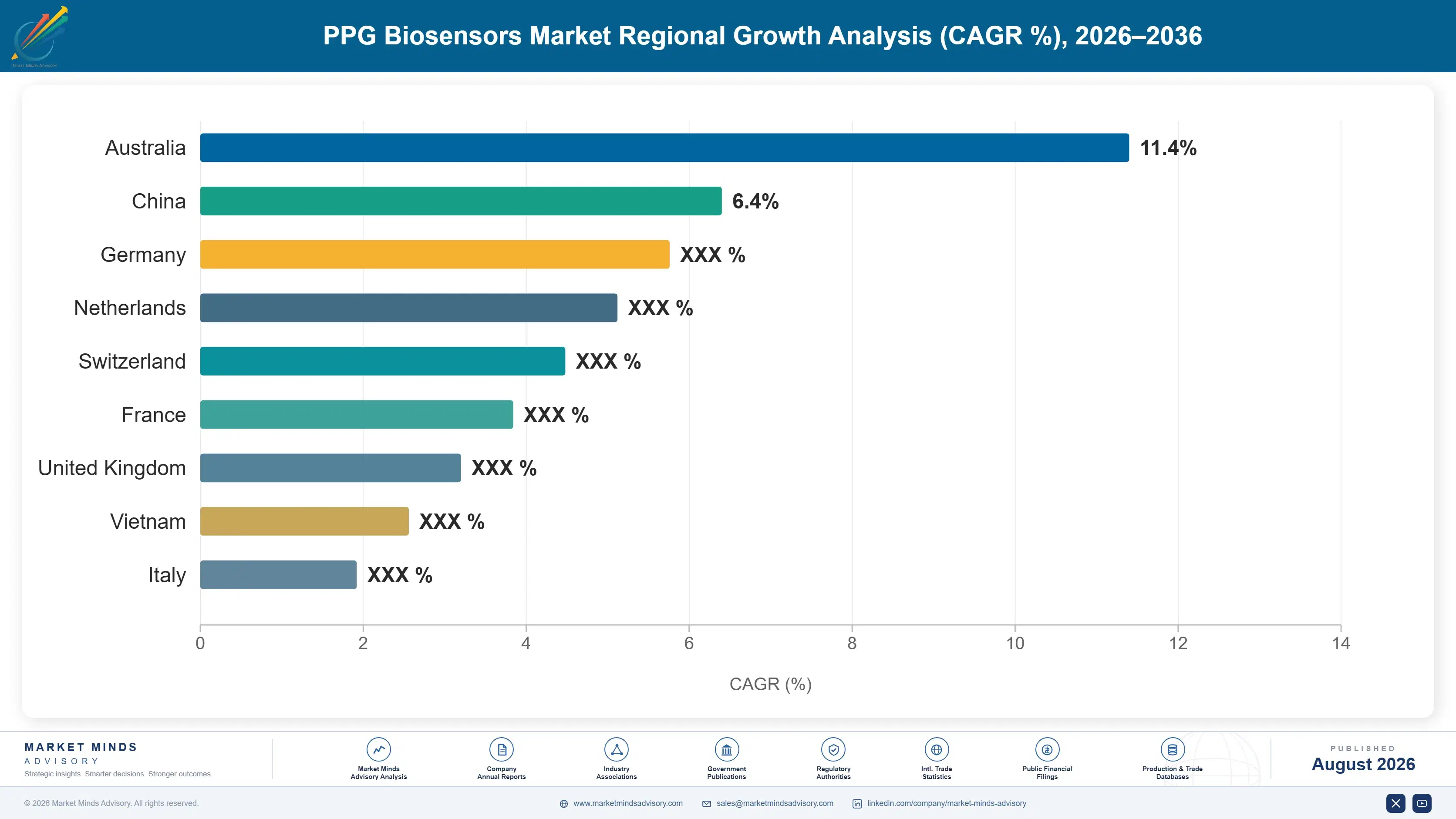
Regional Architecture and Country Demand Map

North America accounts for nearly a third of global PPG biosensor revenue, reflecting concentrated consumer wearable device activity and dense health monitoring adoption, while South Asia and Pacific posts the fastest regional growth on expanding manufacturing capacity nationwide each year across the region's major purchasing markets and networks.

North America

The United States drives the majority of regional demand through its concentration of consumer wearable device manufacturing and its position as home base for Analog Devices' and Texas Instruments' semiconductor operations. Analog Devices and Texas Instruments both maintain domestic distribution and clinical training presence serving this demand directly. Rising cuffless blood pressure adoption has meaningfully expanded demand for advanced sensors across multiple regional wearable networks in particular. Canada contributes a smaller but stable share, with device manufacturing systems gradually expanding coverage for multi-wavelength adoption following patterns already established in the United States. Mexico's demand ties increasingly to cross-border electronics distribution networks serving both domestic and North American device manufacturing programmes.
Share: 30% | CAGR: 12.4% (2026 to 2036)

Western Europe

Germany anchors regional demand through its well-established semiconductor manufacturing infrastructure and long-standing manufacturer distributor relationships built over decades of continuous product development. The United Kingdom follows closely, with major device maker safety compliance commitments driving sustained sensor procurement across wearable networks nationwide. Austria and Switzerland contribute meaningful shares tied to ams-OSRAM's manufacturing base and long-standing relationships across the continent, while France and the Netherlands add steady demand from established medical device clusters supplying domestic and wider purchasing networks. Regional growth trails East Asia and South Asia because much of Western Europe's PPG biosensor base is already relatively mature, a pattern regional manufacturers expect to persist through continued gradual modernisation each fiscal year across most national markets and affiliated distribution channels.
Share: 20% | CAGR: 10.4% (2026 to 2036)
Regional intelligence for 5 additional markets available in the complete report: East Asia, South Asia and Pacific, Latin America, Middle East and Africa, Eastern Europe. Contact sales@marketmindsadvisory.com.
ppg-biosensors-market-country-cagr-analysis-1787299108860

Where PPG Biosensor Margin Concentrates

Margin follows biomarker validation depth and device maker relationship positioning, not unit volume alone. Manufacturers who win early design relationships lock in multi-year purchasing streams that generic sensor makers struggle to match once the relationship is fully established across the entire product line, a dynamic reshaping how manufacturers prioritise validation investment planning each year.

Winning Early Device Maker Design Relationships

Manufacturers who secure sensor specification during a device maker's early product planning phase typically retain that device maker's purchasing volume across successive generations, since switching manufacturers mid-programme requires costly firmware and calibration revalidation that device makers avoid wherever possible across every affected product line. ams-OSRAM and Analog Devices have both invested heavily in early engagement with device maker design teams specifically to secure these relationships ahead of formal supplier competitions. Early-established manufacturers typically capture pricing 8 to 13 percent above what competitive late-stage positioning would produce, reflecting the switching-cost advantage built into the relationship timing itself.
Market Impact: Adds an 8 to 13% pricing edge overall

Building Extended Clinical Validation Support Programmes

Manufacturers who pair sensors with proprietary clinical validation and accuracy tracking programmes capture higher-margin recurring purchasing beyond the unit cost itself, since device maker regulatory teams increasingly value integrated validation support when justifying premium sensor specification internally to procurement committees each budget cycle. Texas Instruments and Broadcom both run dedicated validation documentation teams that work directly with customer regulatory affairs departments throughout the specification process. This validation layer has widened effective programme margins by an estimated 10 to 16 percentage points versus sensor-only supply agreements documented in recent investor materials, across multiple major markets.
Market Impact: Widens margins by 10 to 16 points overall

Regional Manufacturing Capacity for Local Content Eligibility

Manufacturers establishing local manufacturing capacity in markets with national electronics content requirements, notably China's domestic manufacturing preference programme, secure preferential access to purchasing decisions tied to those same requirements set by policy and periodically revised over time. Several global manufacturers have expanded Chinese manufacturing specifically to capture this advantage ahead of competitors still supplying from import-based positions and lacking comparable local presence of their own. Local manufacturers report winning an estimated 16 to 23 percent more purchasing decisions in content-linked markets than comparable import-dependent competitors face each year, across multiple product categories.
Market Impact: Wins 16 to 23% more purchasing decisions overall

Building Structured Clinical Accuracy Evidence Programmes

Manufacturers who develop structured accuracy evidence programmes documenting measurement reliability and biomarker correlation outcomes capture higher-margin premium sensor revenue while shortening the evidence-gathering timeline for device makers otherwise facing lengthy independent clinical studies entirely on their own. ams-OSRAM and Texas Instruments both maintain dedicated product research teams that work directly with device maker investigators throughout the evidence generation and publication process. Data-backed sensors have historically captured 17 to 24 percent higher purchasing approval rates than sensors lacking comparable published clinical data, based on comparable prior programme patterns MMA has tracked closely across multiple recent evidence cycles.
Market Impact: Lifts approval rate 17 to 24% overall each cycle

Who Controls the Margin Pool

CR5 sits at 56 percent, moderately concentrated for a specialty semiconductor category this size, reflecting the substantial engineering barriers and regulatory clearance costs that keep new entrants from challenging incumbents quickly. ams-OSRAM and Analog Devices hold the largest positions, with a meaningful gap to Texas Instruments and Broadcom in the next tier of established challengers across most global regions today.
Current competitive activity centres on three fronts: established single-wavelength-focused manufacturers defending fitness tracker relationships while expanding into higher-margin multi-wavelength sensors, specialty blood pressure firms racing to expand accuracy evidence ahead of incumbent responses, and all major players investing in clinical validation support programmes targeting rapidly tightening regulatory clearance requirements worldwide each cycle.

Emerging pressure comes from Chinese domestic semiconductor manufacturers, who have moved from basic single-wavelength supply toward broader multi-wavelength ambitions as domestic manufacturing incentive programmes create a genuine opening against established incumbents defending their core franchise across every major product category. Rankings shift most at the device-tier level rather than globally: a manufacturer's dominant position in premium wearables carries limited weight in entry-level fitness trackers, where price and delivery speed increasingly determine outcomes each budget cycle.
ppg-biosensors-market-company-positioning-matrix-1787299109381

Competitive Moat and Risk Dimensions

AMS-OSRAM AG

Moat: Full-Portfolio Sensor Coverage

ams-OSRAM's full-portfolio sensor line, spanning single-wavelength through multi-wavelength formats, lets it win comprehensive device-maker-wide purchasing agreements that single-application competitors cannot match, giving it a durable revenue base across nearly every applicable device category and consumer tier worldwide, reinforced by decades of accumulated engineering trust and deep design relationship continuity.
AMS-OSRAM AG

Risk: Blood Pressure Portfolio Underexposure

ams-OSRAM's comparatively limited presence in specialty blood pressure estimation sensors leaves it exposed to Analog Devices capturing the fastest-growing segment of category demand, a gap that could widen as blood pressure purchasing continues expanding faster than ams-OSRAM's core single-wavelength franchise grows each year. That gap has widened noticeably in recent tender cycles.
ANALOG DEVICES INC

Moat: Semiconductor Distribution Scale

Analog Devices' semiconductor distribution scale and long-standing relationships with device maker procurement departments give it a cost and delivery-speed advantage in mainstream PPG sensors that specialty-focused competitors have struggled to match on comparable large distributor tenders across multiple developed markets worldwide, reinforced by decades of accumulated device maker trust.
ANALOG DEVICES INC

Risk: Limited Asian Manufacturing Exposure

Analog Devices' North America and Europe centered commercial strategy leaves it comparatively less exposed to Asian domestic manufacturing revenue than diversified rivals, a gap that could widen as Asian demand continues expanding faster than the traditional markets Analog Devices has prioritised historically each year going forward. That gap has already attracted scrutiny from investors monitoring regional exposure closely.

Players Tracked

Prominent Players

ams-OSRAM AG
Analog Devices Inc
Texas Instruments Incorporated
Broadcom Inc
STMicroelectronics N.V.

Other Key Players

Vishay Intertechnology Inc
ROHM Co Ltd
Renesas Electronics Corporation
Sony Semiconductor Solutions Corporation
Samsung Electronics Co Ltd
Valencell Inc
Murata Manufacturing Co Ltd
InvenSense Inc
TDK Corporation
Sensirion AG
Empatica Inc
NXP Semiconductors N.V.
Microchip Technology Incorporated
ON Semiconductor Corporation
Infineon Technologies AG

Recent Developments

MARCH 2026

ams-OSRAM Opens Dedicated Multi-Wavelength Manufacturing Facility

ams-OSRAM completed construction of a dedicated manufacturing facility for multi-wavelength PPG sensors, adding capacity equivalent to roughly 18 percent of its existing annual multi-wavelength volume. The expansion targets rising demand from wearable manufacturers seeking qualified advanced sensing suppliers across multiple regional distribution networks and affiliated engineering programmes.
Signal: Established single-wavelength-focused manufacturers are dedicating standalone capacity to multi-wavelength sensors as demand diverges sharply from legacy volume.
OCTOBER 2025

Analog Devices Acquires Specialty Blood Pressure Algorithm Company

Analog Devices completed an acquisition of a specialty blood pressure algorithm company, strengthening its cuffless sensing portfolio ahead of rising demand. The deal covers exclusive access to specific pulse-wave-analysis technology developed by the acquired company, alongside shared future improvement rights under terms disclosed only partially and pending regulatory review.
Signal: Established PPG biosensor manufacturers are acquiring specialty algorithm technology to defend against cardiovascular-focused competitors emerging quickly worldwide.
JUNE 2025

Texas Instruments Signs Multi-Year Supply Agreement With Regional Wearable Manufacturer Network

Texas Instruments signed a multi-year supply agreement with a major regional wearable manufacturer network, covering an estimated 62 million additional units across the network's product expansion programme. The agreement followed extensive evaluation of accuracy and delivery reliability data across participating manufacturers and affiliated distribution networks reviewed closely by MMA analysts.
Signal: Wearable manufacturer networks are standardising sensor procurement around single qualified suppliers to simplify multi-product compliance nationwide and abroad.

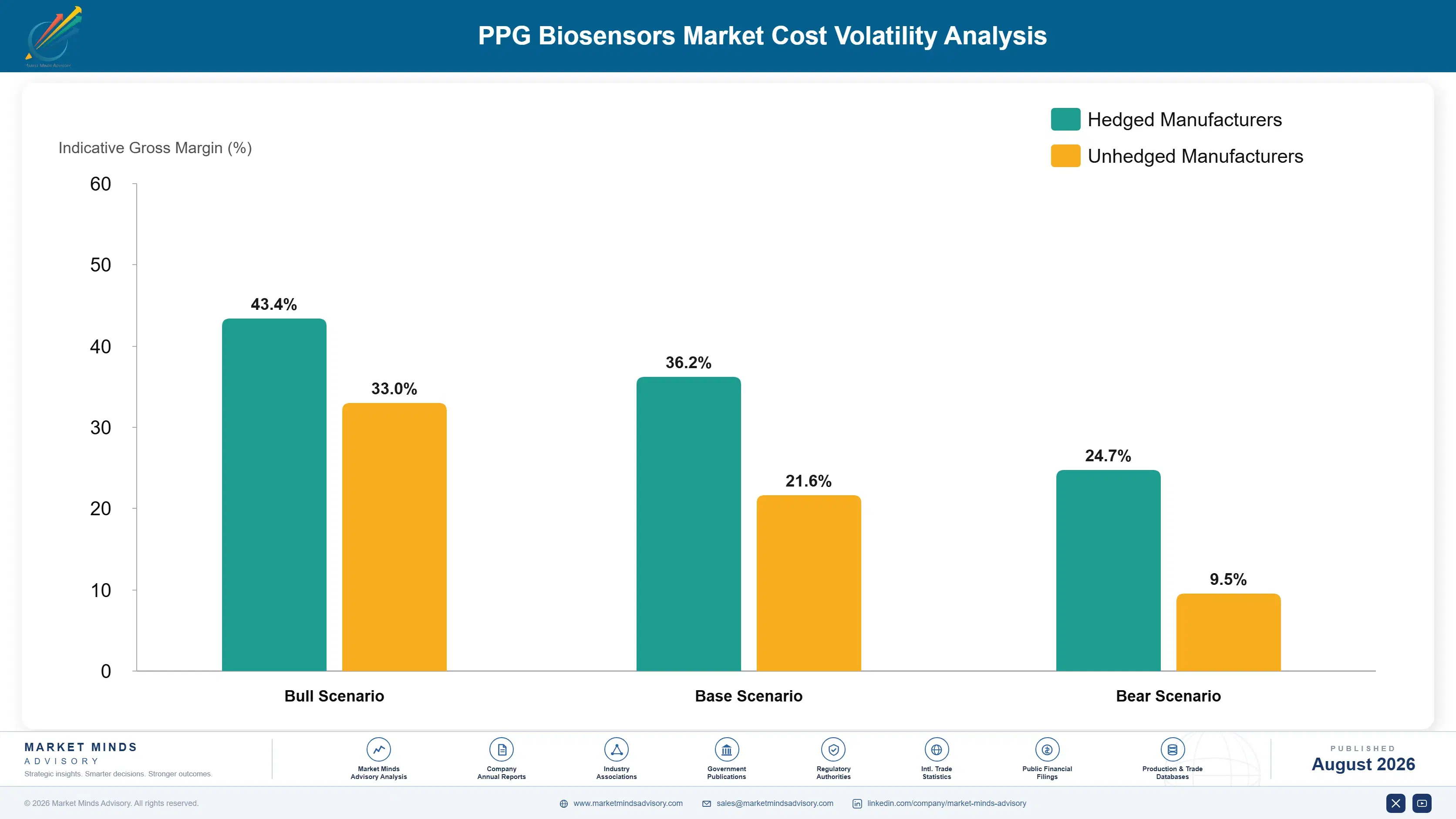
LED and Photodiode Component Costs

LED emitter arrays and photodiode receiver components together represent roughly 36 percent of PPG biosensor manufacturing COGS, sourced from a global base of specialized optoelectronics fabricators and a smaller set of photodiode suppliers qualified to consumer-grade reliability specifications required across every major product segment worldwide, particularly for multi-wavelength grades, across every major manufacturing hub tracked closely each year worldwide.
LED component pricing volatility during 2021 and 2022 pushed input costs up a documented 21 percent according to industry supplier disclosures, forcing several manufacturers to renegotiate multi-year fixed-price device maker contracts signed before the increase took hold across the industry. Photodiode component pricing, particularly relevant to premium multi-wavelength grades, has added further cost pressure given periodic tightness in specialized manufacturing capacity shared with broader consumer electronics end markets.

Exposure varies by manufacturer scale and product mix. Smaller manufacturers reliant on spot LED purchases remain most exposed to price swings given limited hedging capacity, while larger integrated manufacturers with long-term optoelectronics contracts face comparatively more stable input costs tied to supply flexibility that has expanded considerably over recent years of contract structuring across the industry worldwide each fiscal cycle overall.
ppg-biosensors-market-cost-volatility-analysis-1787299109577

Long-Term LED Component Supply Agreements

Larger manufacturers now lock in multi-year LED component supply agreements with fixed volume commitments, insulating unit pricing from short-term commodity swings that previously forced costly mid-contract renegotiations with device maker customers across the industry and delayed delivery schedules considerably each production cycle observed across multiple manufacturing regions and supplier tiers worldwide each fiscal year of ongoing review.

In-House Photodiode Fabrication Capability

Several leading manufacturers have built internal photodiode fabrication and quality control capability specifically to reduce dependence on external suppliers for standard and premium applications, trading higher fixed capital investment for greater supply certainty during periods of industry-wide demand and constrained component availability across the entire supply chain each fiscal year overall and beyond consistently.

Dual-Sourcing LED Component Suppliers

Manufacturers increasingly qualify two LED component suppliers per product line rather than one, adding validation cost upfront but avoiding single-supplier exposure during periods of raw material tightness affecting the broader optoelectronics supply chain simultaneously across multiple concurrent production and testing programmes worldwide each cycle of ongoing procurement planning and annual budget review across every major supplier region.

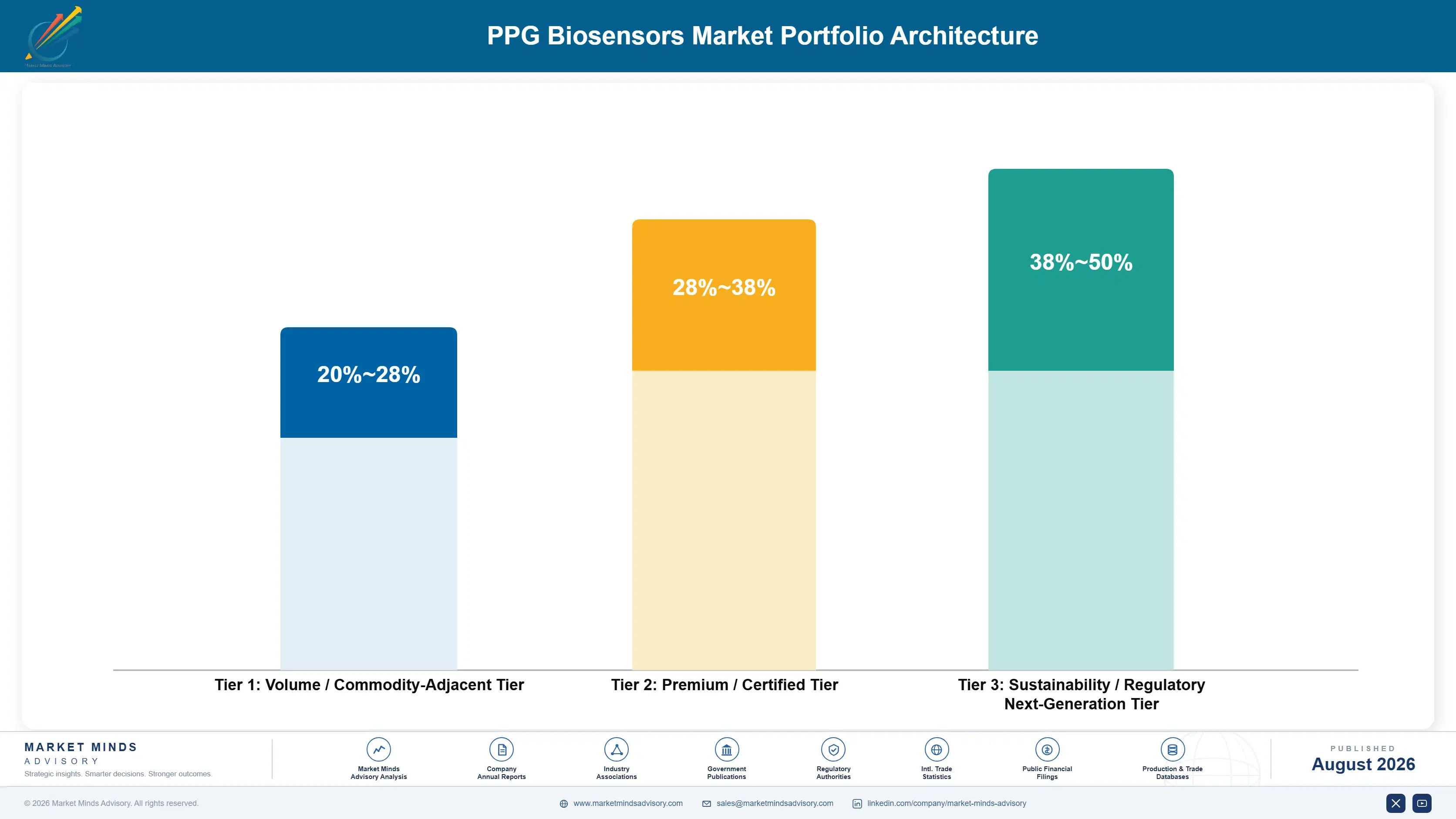
Portfolio Architecture for Margin Defence

Portfolio economics split across three tiers. Standard single-wavelength sensors for mainstream fitness tracker applications compete mainly on price in a moderately concentrated market shaped by years of manufacturing efficiency gains, while multi-wavelength and blood pressure sensors command the highest margins, reflecting the engineering premium buyers pay for capabilities standard products cannot deliver in high-value, biomarker-constrained applications built around modern continuous health m
The tension between volume and premium plays out most visibly in the transition period underway right now, where manufacturers must simultaneously defend mature single-wavelength business generating predictable cash flow while investing heavily in multi-wavelength capacity that may not reach profitable scale for several more years of platform ramp-up and device maker qualification testing across multiple production programmes still working through clinical validation processes.

High-value margin pools concentrate in early device maker design relationships and clinical validation support programmes, where limited qualified competition keeps pricing power intact well past what the mature single-wavelength segment retains after years of established, price-competitive manufacturing among a stable group of global manufacturers serving nearly every major application worldwide, across nearly every purchasing channel available today and every fiscal cycle beyond overall each year.

Volume / Commodity-Adjacent Tier

Standard single-wavelength sensors for mainstream fitness tracker applications, competing primarily on price against multiple qualified global manufacturers with comparable manufacturing scale, delivery reliability, and distribution network coverage nationwide and abroad each fiscal year.
Gross Margin: 20%-28%

Premium / Certified Tier

Standard multi-wavelength and clinical-grade sensors carrying established brand equity or proven reliability credentials across multiple device maker and specialty purchasing platforms sold worldwide each year and every affected region and market segment today.
Gross Margin: 28%-38%

Sustainability / Regulatory / Next-Generation Tier

Blood pressure estimation sensors with integrated clinical validation tracking capturing premium pricing during this early commercial adoption phase across leading wearable platforms and mandate-driven segments today and every fiscal year beyond that as well.
Gross Margin: 38%-50%
ppg-biosensors-market-portfolio-architecture-1787299110078

High-value Sub-segments and Strategic Watch-out

Wearable Manufacturer Blood Pressure Design Wins

Early blood pressure estimation sensor supply contracts on major wearable manufacturer platforms combine high per-unit value with the fastest specification growth in the category, as manufacturers commit to the technology across successive product generations following initial validation and extended clinical testing programmes across multiple markets and customer segments each year.
Gross Margin: 36%-46%

China Domestic Manufacturing Infrastructure Contracts

Sensor supply agreements tied to China's national domestic manufacturing preference programme carry solid margins with a growth curve still accelerating rapidly, as domestic device makers scale purchasing volume faster than most Western modernisation programmes have managed to date across comparable timelines now firmly in place today.
Gross Margin: 23%-33%

Established Single-Wavelength Fitness Base

Long-established single-wavelength sensor demand generates steady, predictable revenue tied to product replacement cycles but carries thin margins after years of price-competitive manufacturing among a broad group of qualified manufacturers worldwide competing mainly on price and delivery reliability offered nationwide each year and abroad overall today.
Gross Margin: 20%-28%

AI-Assisted Biomarker Prediction Platforms

AI-assisted biomarker prediction platforms designed to forecast cardiovascular risk from raw waveform data represent a strategic watch-out: it remains unclear how quickly regulatory acceptance and purchasing recognition will accumulate given unresolved long-term validation questions tracked closely by MMA analysts across multiple regional regulatory jurisdictions and device categories each year.
Gross Margin: N/A pre-validation

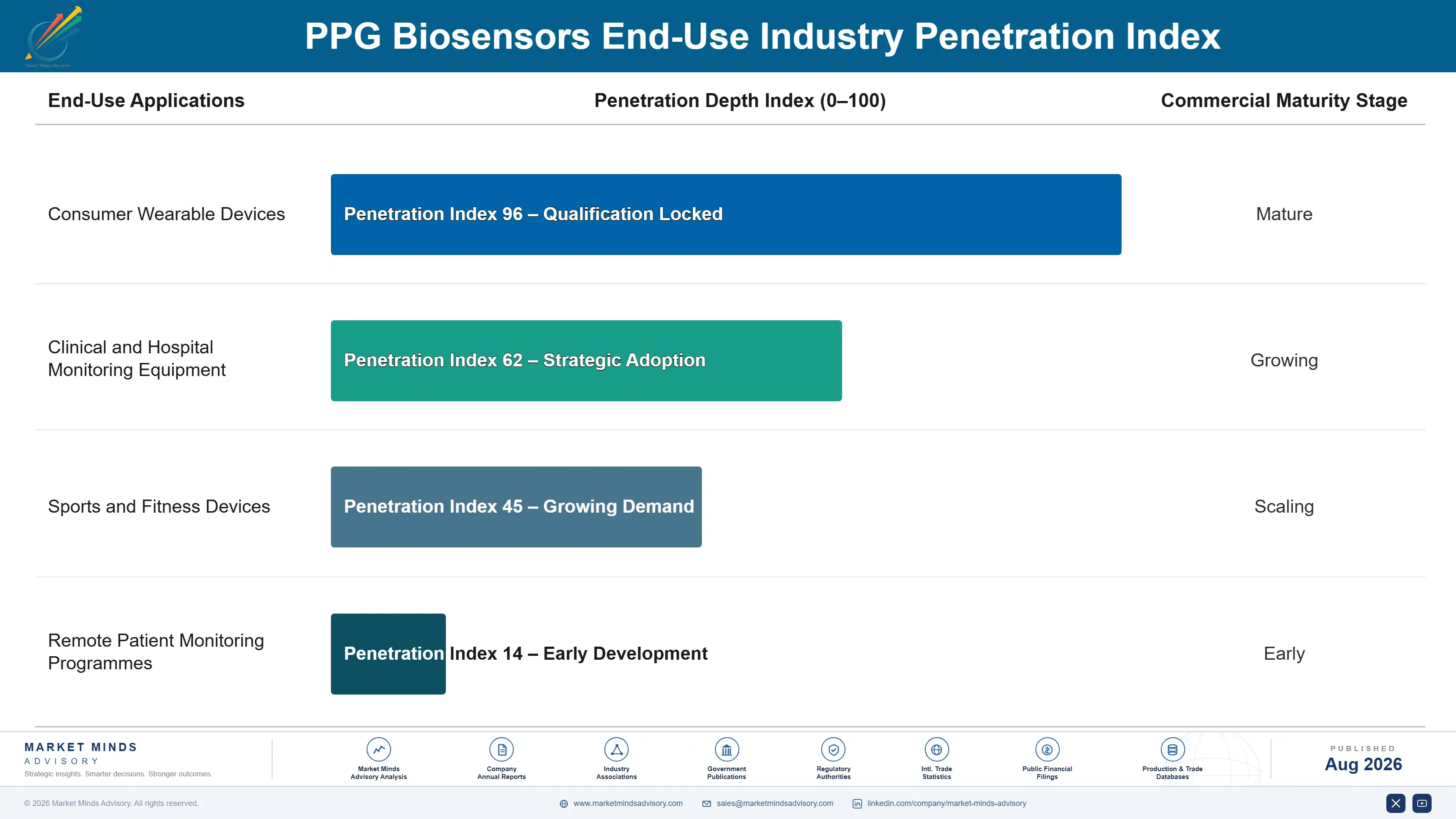
Device Maker Replacement Cycle Economics

PPG biosensor demand behaves like a per-device-maker replacement annuity rather than a purely discretionary purchase, since every operating wearable production line consumes sensor replacement resources regardless of how long that device maker has followed prior purchasing patterns, generating predictable recurring revenue tied directly to product cycle volume rather than a one-time component sale negotiated and forgotten across every major device network worldwide.
Adoption depth varies considerably by device tier and regulatory exposure. Premium wearable and clinical device makers adopt multi-wavelength sensors fastest, since biomarker accuracy in these categories carries meaningfully higher practical consequence than in routine fitness tracking. Smaller regional device makers and value-focused markets show far slower adoption, as budget constraints and functional standard sensors keep conventional single-wavelength formats the default choice until biomarker demand forces change.

A generational shift is underway in device engineering and product design training programmes. Engineers trained on biomarker-focused guidance after 2015 show meaningfully more comfort specifying multi-wavelength, technology-driven sensors than predecessors trained purely on conventional single-wavelength technique, a shift that should widen multi-wavelength adoption further as this cohort gains seniority within device maker and engineering organisations over the next decade across every major purchasing market worldwide.
ppg-biosensors-market-end-use-penetration-index-1787299110575

Positioning for the Multi-Wavelength Transition

These are among the four positions where our research anticipates prominent divergence between winners and laggards over the coming forecast period. Each is grounded in the demand model, the regulatory perimeter, and the announced capacity pipeline.
01 / DEVICE MAKER RELATIONSHIP TIMING

Engage design teams years before formal purchasing decisions

Manufacturers who wait for formal purchasing decisions to begin lose relationship opportunities to rivals who engaged device maker design teams during early product planning, well before any competitive bidding process starts. ams-OSRAM's purchasing win success traces directly to years of early engagement with design teams that competitors are now scrambling to replicate across comparable programmes. Manufacturers without comparable early relationships face a lasting competitive disadvantage in device maker sourcing that formal competitive bidding alone cannot fully overcome once purchasing decisions are already locked in for the coming budget cycle.
02 / TECHNOLOGY BRIDGE STRATEGY

Offer both single and multi-wavelength options across tiers

Device maker networks remain genuinely divided on whether to adopt full multi-wavelength programmes immediately or continue relying on proven single-wavelength sensors for lower-risk settings. Manufacturers offering only one technology risk losing purchasing decisions to buyers whose risk tolerance does not match that single technology choice at this particular point in the budget cycle. The most successful manufacturers maintain both single-wavelength and multi-wavelength product lines simultaneously, letting buyer risk assessment rather than manufacturer limitation determine which technology ultimately wins each purchasing decision made across the device maker.
03 / REGIONAL MANUFACTURING STRATEGY

Build local capacity ahead of content-linked electronics deadlines

Content-linked electronics investment programmes like China's domestic manufacturing preference increasingly determine which manufacturers win purchasing decisions in fast-growing markets, yet several established manufacturers still treat regional manufacturing as a secondary consideration rather than a near-mandatory market entry requirement worth prioritising early on. That sequencing costs real purchasing share during a market's critical early growth phase, when procurement moves fastest and decisions lock in for years. Manufacturers who establish local capacity ahead of infrastructure deadlines consistently outperform import-dependent competitors on purchasing win rates.
04 / INPUT COST RESILIENCE STRATEGY

Diversify LED exposure before commodity volatility returns

LED component price volatility during 2021 and 2022 forced several manufacturers to renegotiate fixed-price device maker contracts at a loss, and LED exposure tied to standard-grade production now presents a comparable emerging risk few manufacturers have fully hedged against. Manufacturers still buying LEDs on unhedged spot-market terms remain exposed to the same risk as production volume scales considerably over the coming years across major producing regions. LED hedging has already proven its value for manufacturers who adopted it ahead of recent price volatility cycles.

Engagement Snapshot From the Field

A live engagement with an industry participant carrying material or product regulatory and market exposure ahead of a defining policy shift, showing how our research translates into a defensible multi-year portfolio strategy.
MARKET MINDS ADVISORY · CLIENT ENGAGEMENT SUMMARY
PPG Biosensors Producer Strategic Portfolio Review and Transition Roadmap 2026·Investment Scenario on PPG Biosensors Exposure Evaluation 2025-26
CLIENT PROFILE
The client is a mid-size regional wearable device manufacturer preparing for expanded multi-wavelength sensor coverage across three product lines, with annual device shipment volume reported in the 8.2 million to 11.4 million unit range (client-reported, unverified by MMA), evaluating supplier sourcing options ahead of a binding product launch deadline across multiple product categories and affiliated distribution partners nationwide.
STRATEGIC CHALLENGE
The manufacturer's product engineering team was divided between committing to a single premium sensor supplier for maximum accuracy consistency or running competitive tenders across multiple qualified suppliers for potentially lower unit cost, given internal disagreement over total cost of ownership across the manufacturer's expected multi-year contract timeline and validation cost assumptions used in financial modelling.
MMA APPROACH
MMA benchmarked comparable regional wearable manufacturer sourcing decisions made by four manufacturers over the prior three years, analysing sensor reliability, accuracy outcomes, and total system cost across both procurement approaches under consideration. The team conducted primary interviews with product engineering staff and sensor manufacturers actively bidding both contract structures in parallel across the industry.
KEY FINDINGS
  1. Single-supplier framework contracts offered meaningfully better accuracy outcomes than multi-supplier tenders across every comparable product line scenario reviewed in detail by the team.
  2. Three of four benchmarked manufacturers had experienced at least one significant accuracy gap under multi-supplier tendering due to component inconsistency outside their control.
  3. Multi-supplier tenders carried an 8 to 12 percent lower average unit cost given competitive pressure across multiple bidding rounds already proven at scale.
  4. Single-supplier mobilisation times ran approximately two months faster than multi-supplier alternatives across the benchmarked comparable programmes reviewed by the team overall each year.
CLIENT PROFILE
The client is a mid-size regional wearable device manufacturer preparing for expanded multi-wavelength sensor coverage across three product lines, with annual device shipment volume reported in the 8.2 million to 11.4 million unit range (client-reported, unverified by MMA), evaluating supplier sourcing options ahead of a binding product launch deadline across multiple product categories and affiliated distribution partners nationwide.
STRATEGIC CHALLENGE
The manufacturer's product engineering team was divided between committing to a single premium sensor supplier for maximum accuracy consistency or running competitive tenders across multiple qualified suppliers for potentially lower unit cost, given internal disagreement over total cost of ownership across the manufacturer's expected multi-year contract timeline and validation cost assumptions used in financial modelling.
MMA APPROACH
MMA benchmarked comparable regional wearable manufacturer sourcing decisions made by four manufacturers over the prior three years, analysing sensor reliability, accuracy outcomes, and total system cost across both procurement approaches under consideration. The team conducted primary interviews with product engineering staff and sensor manufacturers actively bidding both contract structures in parallel across the industry.
KEY FINDINGS
  1. Single-supplier framework contracts offered meaningfully better accuracy outcomes than multi-supplier tenders across every comparable product line scenario reviewed in detail by the team.
  2. Three of four benchmarked manufacturers had experienced at least one significant accuracy gap under multi-supplier tendering due to component inconsistency outside their control.
  3. Multi-supplier tenders carried an 8 to 12 percent lower average unit cost given competitive pressure across multiple bidding rounds already proven at scale.
  4. Single-supplier mobilisation times ran approximately two months faster than multi-supplier alternatives across the benchmarked comparable programmes reviewed by the team overall each year.
RECOMMENDED STRATEGY
Phase 1: Phase 1 (Months 1 to 4): Finalise target product line sensor requirements and confirm launch budget approval by category and site. Phase 2: Phase 2 (Months 5 to 10): Select a single-supplier framework for flagship product lines while maintaining competitive tendering for lower-priority segments. Phase 3: Phase 3 (Months 11 to 18): Execute distribution mobilisation and begin sensor rollout ahead of the manufacturer's later contract phases.
OUTCOME
The manufacturer selected a hybrid approach combining a single-supplier framework for flagship product lines with competitive tendering for lower-priority segments, avoiding an estimated three to five month launch delay across its initial deadline (client-reported, unverified by MMA). The decision reduced near-term accuracy risk while preserving competitive pricing pressure on non-critical work.

Frequently Asked Questions

Foundational context covering the market sizes, CAGR, scope, country, region and competition that inform every finding below. This section is provided to cover basics and most often pre-purchase conversations, answered from the MMA Primary Research Dataset.

What is the current size of the PPG Biosensors Market?

The global market reached an estimated 3.2 billion dollars in 2025, anchored by a mature single-wavelength sensor base. Growth is concentrated in multi-wavelength and blood pressure segments.

How large will the PPG Biosensors Market be by 2036?

MMA projects the market will reach approximately 10.92 billion dollars by 2036 under the base-case forecast scenario. This reflects expanding wearable health monitoring demand and cuffless blood pressure adoption worldwide.

What is the CAGR for the PPG Biosensors Market 2026 to 2036?

The base-case compound annual growth rate is 11.8 percent across the full ten-year forecast period. Bull and bear scenarios range from 10.5 to 13.0 percent.

Which segment is growing fastest?

Blood pressure estimation PPG sensors lead at a 16.2 percent CAGR, roughly 1.37 times the overall market rate. Multi-wavelength PPG sensor modules follow as the second-fastest segment.

Who are the major companies in the PPG Biosensors Market?

ams-OSRAM, Analog Devices, Texas Instruments, Broadcom, and STMicroelectronics hold the top five positions by revenue worldwide. Chinese domestic manufacturers are closing the multi-wavelength gap each year.

Which country is growing fastest?

China leads at an estimated 13.6 percent CAGR, driven by its exceptionally large wearable device manufacturing base and growing domestic consumer affordability. Domestic manufacturing scale supports continued adoption.

Report Segmentation Architecture

The full report scope spans multiple orthogonal segmentation dimensions, with cross-tabulated demand data provided for each dimension pair. Coverage extends further to regional breakdowns, trend trajectories, and the competitive detail needed to support segment-level decision-making.

By Sensor Technology

  • Consumer Wearable PPG Sensors
  • Clinical-Grade Pulse Oximetry PPG Sensors
  • Blood Pressure Estimation PPG Sensors
  • Multi-Wavelength PPG Sensor Modules
  • Implantable and Continuous Monitoring PPG Sensors

By End-Use Industry

  • Consumer Wearable Devices
  • Clinical and Hospital Monitoring Equipment
  • Sports and Fitness Devices
  • Remote Patient Monitoring Programmes

By Commercial Dimension

  • Direct Device Maker Procurement
  • Component Distributor Channel
  • Original Design Manufacturer Channel
  • Custom Engineering and Module Integration Channel

By Region

  • North America
  • East Asia
  • Western Europe
  • South Asia and Pacific
  • Latin America
  • Middle East and Africa
  • Eastern Europe

Scope, Methodology, and Coverage

Every figure in this report is reproducible from documented input assumptions. The scope below maps the historical period, the forecast horizon, the segmentation dimensions, and the countries covered, alongside the underlying primary and qualitative methodology.
Historical Period
2020 to 2025
Forecast Period
2026 to 2036
Base Year
2025 (USD billions; MMA Primary Research Dataset, August 2026)
Market Definition
This market covers photoplethysmography optical sensor components and modules used to measure blood volume changes for health monitoring applications, including consumer wearable PPG sensors, clinical-grade pulse oximetry PPG sensors, blood pressure estimation PPG sensors, multi-wavelength PPG sensor modules, and implantable and continuous monitoring PPG sensors. It excludes ECG-only biosensors and non-optical bioimpedance sensing components not incorporating a photoplethysmography measurement mechanism.
Quantitative Units
USD billions (current prices); unit sales volume by application where applicable
Segmentation Dimensions
By Sensor Technology; By End-Use Industry; By Commercial Dimension; By Region
Regions Covered
North America, East Asia, Western Europe, South Asia and Pacific, Latin America, Middle East and Africa, Eastern Europe
Countries Covered
USA, China, Germany, France, UK, Japan, South Korea, India, Australia, Canada, Brazil, Mexico, Indonesia, Vietnam, Austria, UAE, Saudi Arabia, South Africa, Nigeria, Turkey, Poland, Russia, Switzerland, Netherlands, Argentina, Colombia, Singapore, and additional markets relevant to this sector
Key Companies Profiled
ams-OSRAM AG, Analog Devices Inc, Texas Instruments Incorporated, Broadcom Inc, STMicroelectronics N.V., Vishay Intertechnology Inc, ROHM Co Ltd, Renesas Electronics Corporation, Sony Semiconductor Solutions Corporation, Samsung Electronics Co Ltd, Valencell Inc, Murata Manufacturing Co Ltd, InvenSense Inc, TDK Corporation, Sensirion AG, Empatica Inc, NXP Semiconductors N.V., Microchip Technology Incorporated, ON Semiconductor Corporation, Infineon Technologies AG
Quantitative Methodology
Primary survey, n=3,800 respondents, Q4 2025, six countries; demand-side model with trade association cross-validation
Qualitative Methodology
47 expert interviews, Q4 2025; applied to validate demand model assumptions, identify emerging dynamics, and assess competitive positioning
Report Format
PDF and XLSX data workbook (Word format preview document)
Publisher
Market Minds Advisory
Report Code
MMA-2026-MED-604
Published
August 2026
Contact
sales@marketmindsadvisory.com | www.marketmindsadvisory.com

Purchase the full PPG Biosensors Market Report (2026 to 2036).

The full report delivers a company-by-company product design tracker covering every major PPG biosensor developer through 2030 with disclosed expansion timelines and anticipated regulatory eligibility milestones. It includes a wearable health monitoring and clinical clearance policy tracker mapping compliance requirements across every profiled product category and region worldwide. Device maker and clinical engineer adoption survey data is provided from MMA's primary research programme, alongside component cost benchmarking across major producing regions tracked closely. Buyers also receive a company-level financial and capacity-milestone model updated quarterly throughout the subscription period each year.
Company-by-company product design and capacity tracker
Wearable health monitoring and clinical clearance policy database
Device maker and clinical engineer survey data
Quarterly competitor financial and milestone model updates
Component cost benchmark and comparison data set
Custom sourcing strategy and procurement workshops

Built For The People Who Decide

From boardroom strategy to bench-side execution, this report is read cover-to-cover by leaders shaping the next decade of their industry, turning demand scenarios, market dynamics and valuation benchmarks into decisions.
CXOs/ Presidents/ VPs/ Managers
M&A and Corporate Development
Strategy Teams and R&D Heads
Procurement and Product Directors
Regulatory and Compliance Leaders
Investor Relations and Equity Analysts