Market Minds Advisory
PP Jumbo Bags Market

PP Jumbo Bags Market: A Lifting Device Bought as Packaging

A tonne of material suspended overhead on woven polypropylene is a lifting appliance governed by tested safety factors, and most of it is still tendered on price per bag by people buying packaging.

Lead Analyst

Bilal Shaikh

Published

September 2026

Make Smarter Decisions with Customized Research Insights

Request a free sample report and evaluate market opportunities, growth trends, and competitive dynamics relevant to your business needs.

2025 MARKET VALUE$5.4BMarket Size 2025
2036 FORECAST VALUE$10.0BBase Case , 2026 to 2036
CAGR 2026 TO 20365.8 %Bull 7.0% / Bear 4.6%
INCREMENTAL OPPORTUNITY$4.3BNet 10- year value creation
EXPANSION MULTIPLE1.76x2036 value over 2026 base
Strategic Levers
M&A Pipeline
Regional Outlook
Country Rankings
Competitive Intelligence
Segmental Deep-dive
Call-Us : 91 93563 13602

Executive Snapshot and Market Trajectory

A flexible intermediate bulk container holds a tonne of material and gets lifted over people's heads. It is certified to a tested safety factor, usually five to one for single trip use, and a failure is a crushing injury rather than a spillage. Nobody calls it packaging on a site.
That reality sits awkwardly against how the product is bought. Concentration among producers is 13%, thousands of converters compete, and most tenders are decided on price per bag. Roughly 58% of world output converts in India, where the field ranges from certified exporters running full test programmes to workshops that do not. Verifying which is which requires audit work that a great many buyers skip entirely. Nothing in the tender rewards the difference.
Where specification genuinely bites, the market behaves differently. Type D antistatic bags grow at 8.7%, half again the market rate of 5.8%, because they dissipate charge without the grounding connection that Type C requires and that operators forget to attach. Food and pharmaceutical grades grow next fastest on clean room and traceability requirements. South Asia and Pacific holds 33% of value, above its band, on that converting position.
Market Definition
Flexible intermediate bulk containers woven from polypropylene tape yarn, spanning standard, conductive and antistatic types, food and pharmaceutical grades, and multi-trip and United Nations certified constructions, measured at converter selling price. Excludes polypropylene tape yarn and woven fabric sold as such, small woven sacks below fifty kilogrammes, rigid intermediate bulk containers, and drum and pail formats.
Base Year Value
$5.4B in 2025 (MMA Primary Research Dataset, August 2026)
Forecast Period
2026 to 2036, eleven discrete annual values
CAGR
5.8% base case. Bull 7.0%. Bear 4.6%.
Fastest Growth Segment
Type D Antistatic Bags: 8.7% CAGR
Fastest Growth Country
India: 8.9% CAGR
Fastest Growth Region
South Asia and Pacific: 8.0% CAGR
Largest Region
South Asia and Pacific: 33% of 2025 global value
Market Leaders
Rishi FIBC Solutions, LC Packaging, Greif, Conitex Sonoco, Emmbi Industries. Source: MMA Primary Research Dataset, July 2026.
Primary Survey
n=3,800 procurement and R&D decision-makers, Q4 2025, six countries
Methodology
Demand-side build-up, cross-validated against public data, 47 expert interviews

PP Jumbo Bags Market Forecast Scenarios

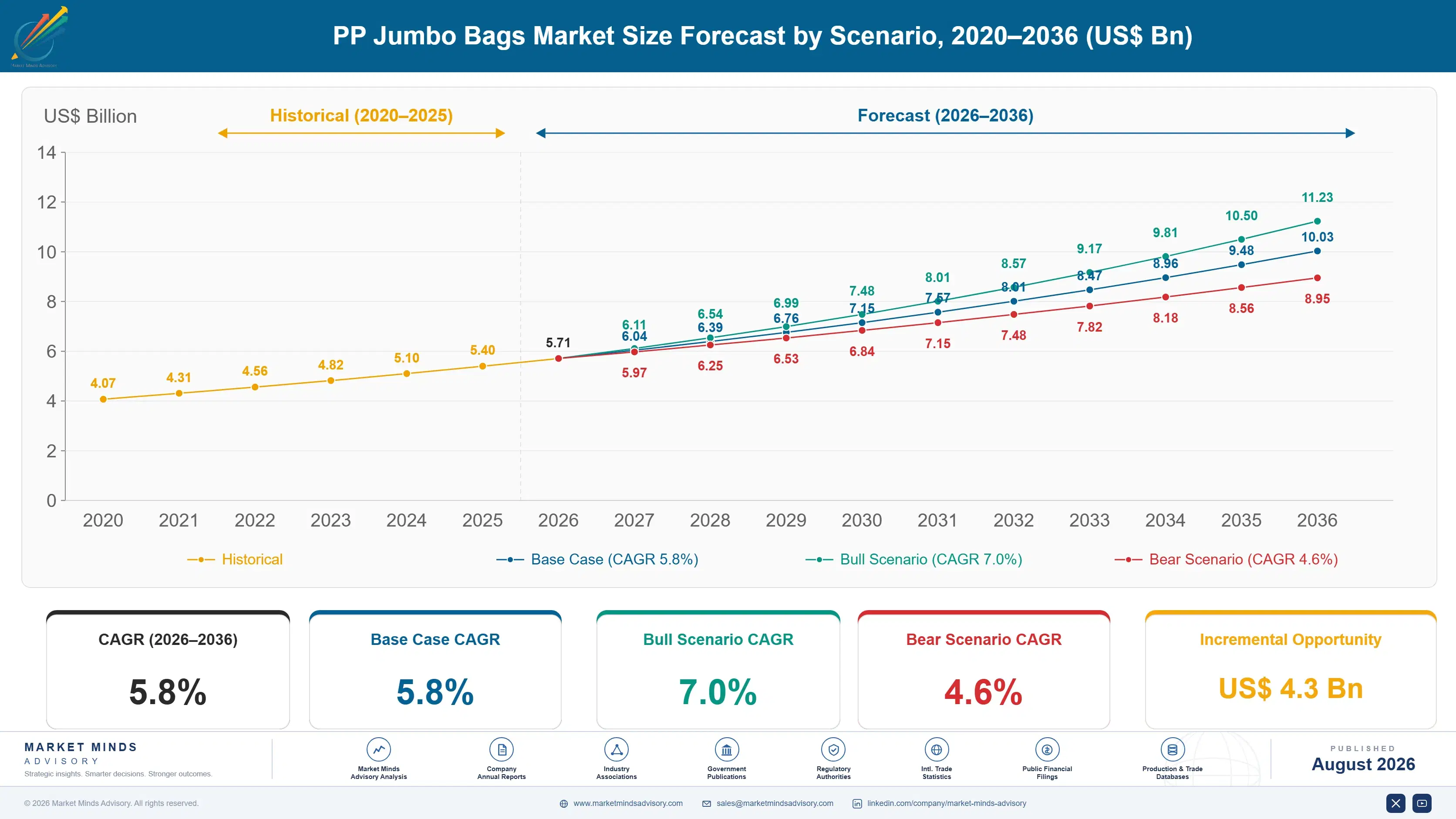
pp-jumbo-bags-market-size-forecast-scenario-1787580797465
Growth ran near 4.7% between 2020 and 2025, tracking bulk material handling across chemicals, food ingredients, minerals and construction. Polypropylene resin pricing swung sharply enough to move value independently of volume in several of those years, and converters holding fixed bag pricing absorbed a great deal of it. Indian export capacity kept expanding throughout, which held delivered prices down even as input costs rose.
Base case 5.8% rests on three mechanisms. Combustible dust handling requirements are pushing chemical and food processors toward certified antistatic bags where standard types were previously accepted. Food and pharmaceutical customers are tightening traceability and clean room requirements that most converters cannot meet. And bulk packaging conversion from jute and multiwall paper continues across African and Southeast Asian cement, fertiliser and grain handling. None depends on bulk volumes rising. Conversion runs on safety review.
The bull case at 7.0% assumes combustible dust enforcement tightens across more jurisdictions, converting standard bag volume into certified antistatic at considerably higher value. The bear case at 4.6% is a construction and chemicals slowdown coinciding with resin price weakness, which would cut both volume and realised value while Indian capacity continues expanding into the same demand. Nothing offsets that combination.

Certification Is the Only Real Difference

Every jumbo bag carries a rated load and a tested safety factor behind it, typically five to one for single trip construction and six to one where a bag is certified for repeated use. Those ratios exist because the bag is a lifting appliance in practical terms, suspended above people, and a seam failure at a tonne is not a packaging incident. Certification testing is what establishes them.
TOP FIVE CONCENTRATION13%Thousands of converters compete across an intensely fragmented field
STANDARD SAFETY FACTOR5:1Ratio of tested strength to rated load for single trip
FABRIC COST SHARE61%Share of bag cost carried by woven polypropylene fabric
CERTIFIED ANTISTATIC SHARE19%Portion supplied to a conductive or dissipative specification
SINGLE TRIP PROPORTION74%Share certified for one use rather than repeated handling
INDIAN OUTPUT SHARE58%Portion of world bag production converted in one country
The market does not price that way. Concentration among producers sits at 13%, thousands of converters operate, and most procurement tenders compare price per bag against a written specification. Verifying that a supplier actually tests to the specification is harder work than comparing quotations, and a great many buyers do not do it thoroughly.
Where the specification carries an obvious safety consequence, behaviour changes completely. Combustible dust handling requires conductive or dissipative bags, and the difference between Type C and Type D matters: Type C works only when grounded, and operators forget to attach the connection. Type D dissipates charge without grounding, which is why it grows at 8.7% while standard construction grows at the market rate.
"The gap between what this product is and how it gets bought is the widest I see in packaging. It is a certified lifting device, and a procurement system built for corrugated boxes is deciding who supplies it on a price comparison that never checks whether the test reports are real."
Director, Industrial Packaging and Bulk Handling Practice · MMA Packaging Practice · August 2026

Market Trends

Combustible dust requirements converting standard bags to antistatic

Handling flammable powders and solvent-wetted materials requires bags that dissipate electrostatic charge, and processors are applying that requirement where standard construction was previously accepted. Type C bags achieve it through conductive threads that must be grounded, and Type D through charge dissipation requiring no connection at all. Roughly 19% of bags are now supplied to conductive or dissipative specification. The conversion moves volume into a considerably higher value tier, and it happens on safety review rather than on any commercial approach from a supplier. The value uplift is substantial and the trigger is entirely outside a supplier's control.
Market Impact: Delivers 8.9% annual Indian growth
Food and pharmaceutical traceability requirements narrowing the field

Food ingredient and pharmaceutical customers increasingly require clean room bag production, traceable resin, documented liner specification and audit access, which a converter running a general industrial operation cannot provide without dedicated facilities. Those requirements exclude the majority of the fragmented producer base rather than merely disadvantaging it. Certification and facility investment costs real money against volumes smaller than industrial supply. The customers accept prices that reflect it, which makes this the one part of the market where a converter can genuinely escape price competition. Requalifying an audited facility is slow and expensive, which makes positions here unusually durable.
Market Impact: Verifies a 5:1 tested safety factor

Market Opportunities and Growth Drivers

Bulk packaging conversion from jute and multiwall paper continuing

Cement, fertiliser, grain and mineral handling across African and Southeast Asian markets continues converting from jute sacks and multiwall paper toward woven polypropylene bulk bags, on moisture resistance, strength to weight and handling cost. India grows fastest anywhere at 8.9% on domestic conversion alongside its export production. The conversion is well advanced in some markets and barely started in others, so the runway is considerably longer than headline penetration suggests. Each conversion is permanent, since nobody handling a tonne of cement returns to paper sacks. Penetration is well advanced in some markets and barely begun in others.
Market Impact: Leaves 87% outside top five scrutiny

Chemical processors auditing supplier test programmes more seriously

Bag failures during lifting cause injuries, and processors who have experienced one audit their supply chains rather differently afterwards. Verifying that a converter actually runs the cyclic and top-lift testing behind a claimed safety factor requires facility visits and test witness rather than certificate review, and more customers are doing that work. It narrows the accepted supplier list sharply wherever it happens. Converters who invested in genuine test capability find that audit process converts into business their quotations alone never won. Certificates alone no longer satisfy the more serious buyers, which changes who can bid at all.
Market Impact: Exposes 61% of bag cost

Market Restraints and Challenges

Price-led procurement rewarding converters who under-test

Most jumbo bag tenders compare price per bag against a written specification, and verifying that a supplier genuinely tests to it requires audit work that buyers frequently skip. The root cause is that a certified lifting device is being bought through a procurement system designed for ordinary packaging. Commercially it means converters running full test programmes compete against those who do not, on price alone. Serious buyers are moving to witnessed testing and facility audit, and that practice remains far from universal across the industry. Nothing in the tender process rewards the difference.
Market Impact: Covers 19% of bags supplied

Resin price volatility transmitting straight into converter margin

Woven polypropylene fabric accounts for roughly 61% of bag cost, the highest raw material share of any large packaging format. The root cause is that converting adds relatively little value beyond cutting, sewing and testing, so bag price is essentially fabric plus a thin conversion margin. Converters holding fixed price contracts through a resin move absorb the entire swing, which removed several small producers during recent cycles. Indexing bag pricing to a published resin reference addresses it, and buyer resistance has kept adoption limited. Buyer resistance to indexation has kept adoption limited among smaller converters.
Market Impact: Excludes most of 13% concentration field
3 additional market trends, 4 additional growth drivers, and 2 additional restraints and challenges are covered in the full report. Contact sales@marketmindsadvisory.com to access the complete intelligence.

Segment CAGR and Growth Architecture

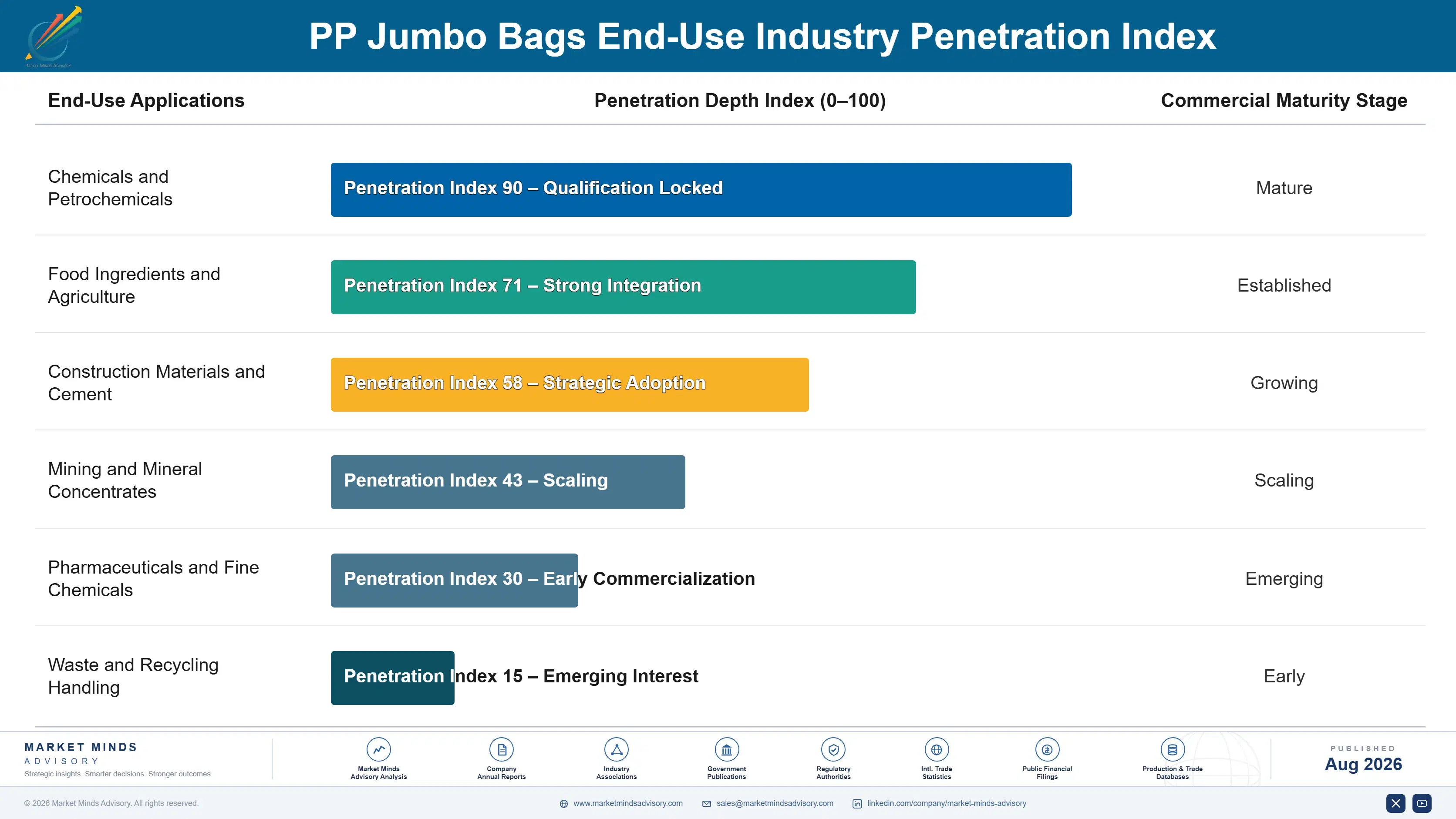
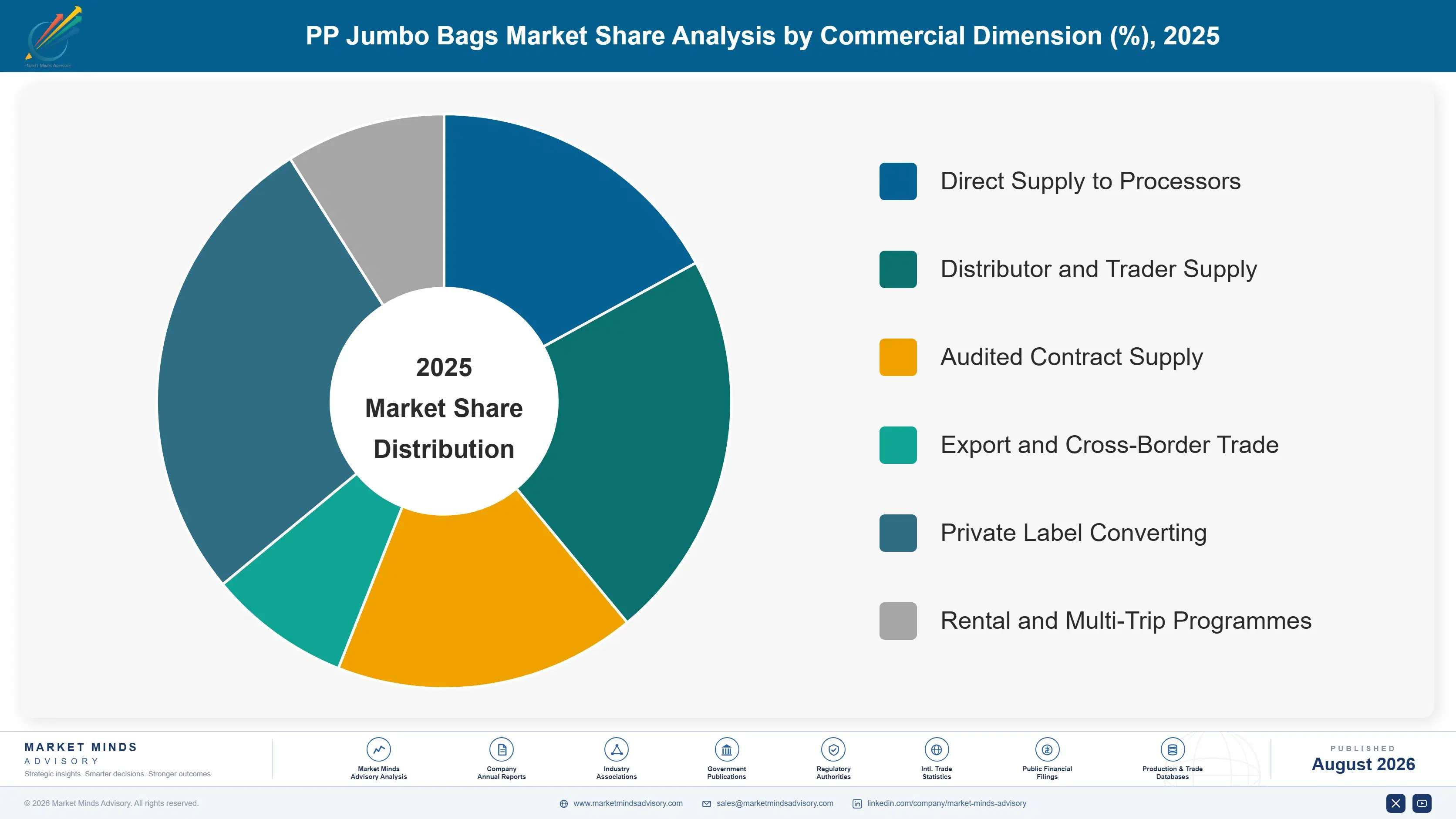
Six segments split by certification class, because the class determines the testing behind the bag, the applications it may legally serve and the field of converters able to supply it. A Type D antistatic bag and a standard construction share a fabric and nothing else commercially. End-use industry and channel sit in the framework. Testing separates them.
pp-jumbo-bags-market-market-share-analysis-1787580797996

Type D Antistatic Bags

Growing at 8.7%, half again the market rate of 5.8%, Type D bags dissipate electrostatic charge through the fabric itself and require no grounding connection, which is the whole commercial argument for them. Type C achieves the same protection only when the operator remembers to attach a ground, and operators forget, which processors reviewing incident data understand well. Fabric containing dissipative fibres costs considerably more and the testing regime is more demanding, so the converter field narrows sharply. Combustible dust handling requirements are converting standard bag volume into this tier on safety review rather than through any commercial persuasion at all. Processors reviewing incident data reach this conclusion on their own, which is why the substitution runs steadily.
CAGR 8.7%

Food and Pharmaceutical Grade Bags

At 7.8% food and pharmaceutical grades demand clean room production, traceable resin, documented liner specification and customer audit access. Those requirements exclude the majority of the fragmented producer base rather than merely disadvantaging it, since a general industrial converter cannot meet them without dedicated facilities and separate handling. Volumes are smaller than industrial supply and prices reflect the certification burden properly. This is the one part of the market where a converter genuinely escapes price competition, and customers switch supplier reluctantly because requalifying an audited facility is slow and expensive work. Prices reflect the certification burden properly, which is rare anywhere else in this market. Customers switch supplier reluctantly here, because requalifying an audited facility is slow and expensive.
CAGR 7.8%
Full segment breakdown across 6 segments available in the complete report.

Regional Architecture and Country Demand Map

South Asia and Pacific holds 33% of value, well above its usual band, because roughly 58% of world bag production converts in India. East Asia follows at 22%, with North America below its band at 16% as domestic converting largely gave way to imported supply two decades ago.

North America

Domestic converting largely gave way to imports two decades ago, and the 16% share sits below the usual band as a result, though consumption remains substantial across chemicals, agriculture and construction. What survives locally is certified antistatic and food grade production where audit proximity and lead time matter more than landed cost. Combustible dust standards are enforced more consistently here than in most regions, which has driven Type C and Type D penetration above global averages. Distributors rather than converters hold most customer relationships, which shapes how specification decisions actually get made. The 16% share sits below the usual band on converting rather than on consumption, which remains substantial. Distributors shape the specification.
Share: 16% | CAGR: 4.9% (2026 to 2036)

Western Europe

European buyers apply the most rigorous certification scrutiny anywhere, with witnessed testing and facility audit more common than in other regions, and that practice shapes what suppliers can serve the market. LC Packaging and several specialist converters hold positions built on audit credibility rather than on price. Food and pharmaceutical grade requirements are strictest here, with clean room production and full traceability expected as standard rather than as premium. Most volume is imported from Indian and Turkish converters who meet those requirements, since European converting cost cannot compete on standard construction. European converting cost cannot compete on standard construction, so the position rests on verification instead. Imported supply meets those requirements.
Share: 18% | CAGR: 4.3% (2026 to 2036)
Regional intelligence for 5 additional markets available in the complete report: East Asia, South Asia and Pacific, Latin America, Middle East and Africa, Eastern Europe. Contact sales@marketmindsadvisory.com.
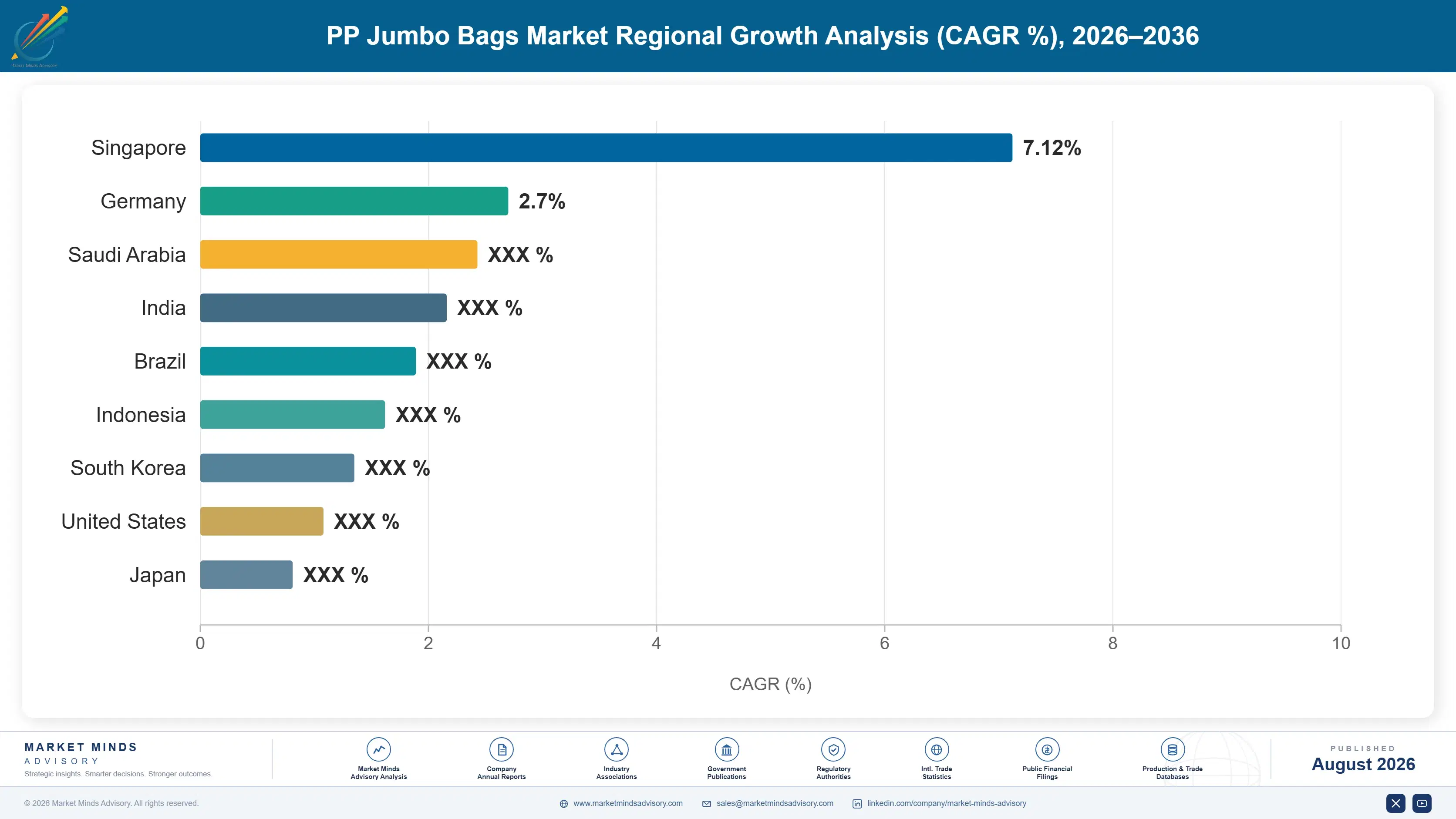
pp-jumbo-bags-market-country-cagr-analysis-1787580798538

Four Ways Out of Price Competition

Fabric is 61% of cost and thousands of converters compete, which makes standard construction a business with no defensible position at all. Everything worth having sits behind a certification requirement that most of the field cannot meet. The commercial question is which certification to invest in first. Standard construction is not a business worth defending.

Certify for Type D antistatic production

Type D bags dissipate charge without grounding, which processors reviewing incident data prefer because operators forget to attach a Type C connection. The segment grows at 8.7% and the fabric and testing requirements narrow the converter field sharply. Qualification including dissipative fabric sourcing, testing capability and documentation costs perhaps 600 thousand dollars, and the resulting position cannot be entered quickly by a standard bag producer. Conversion happens on customer safety review rather than through commercial persuasion, which makes it durable. A standard bag producer cannot enter it quickly. Durability follows from the trigger.
Market Impact: Costs $600 thousand for full Type D certification

Build audited food and pharmaceutical grade capability

Clean room production, traceable resin, documented liners and customer audit access exclude the majority of a field where concentration sits at 13%. Building dedicated facilities costs perhaps 3 million dollars and takes about eighteen months including customer qualification. Volumes are smaller than industrial supply and pricing reflects the burden properly, which makes it the one tier where price competition genuinely stops. Customers requalify audited facilities reluctantly, so a position won here holds for years rather than for a tender cycle. Price competition genuinely stops in this tier. Requalification is slow for the customer.
Market Impact: Costs $3 million for audited clean room facilities

Invite witnessed testing rather than sending certificates

Buyers verifying a claimed 5 to 1 safety factor need facility visits and test witness rather than certificate review, and serious customers are increasingly doing that work after a failure somewhere in their supply chain. A converter running genuine cyclic and top-lift testing should invite that audit rather than wait to be asked. It converts a price comparison into a capability comparison, which is a conversation the under-testing competition cannot join at all. The cost is a few days of technical time. A witnessed programme costs a few days of technical time against contracts worth many times that.
Market Impact: Proves a tested 5:1 safety factor to buyers

Index bag pricing to a published resin reference

Woven fabric is 61% of bag cost and converters holding fixed pricing through a resin move absorb the whole swing on a thin conversion margin, which removed several producers during recent cycles. Indexing to a published reference converts a volatile margin into a stable conversion fee. Buyers resist the change until a supplier fails on them, and larger converters have been indexed for years while smaller ones carry the exposure. It costs nothing to propose and protects everything. It costs nothing to propose. Smaller converters carry the exposure and larger ones do not.
Market Impact: Removes 61% of cost exposure from every contract

Who Controls the Margin Pool

Participation is measured on annual bag production volume in units, and the top five hold just 13%. This is among the most fragmented packaging markets anywhere, because weaving and sewing capacity is inexpensive and thousands of converters operate regionally. Rishi and LC Packaging lead on certification breadth and audit credibility rather than on tonnage. The gap to challengers is testing capability and facility qualification, not manufacturing scale.
Competition divides sharply by certification tier. Standard construction competes purely on delivered price, with Indian and Chinese converters setting it and nobody holding a defensible position. Antistatic, food and pharmaceutical grades compete on facility qualification, testing capability and audit access, where most of the field cannot participate at all. Very few converters operate credibly across both, and those that do generally subsidise the first from the second.

The pressure ahead is buyer audit practice spreading. Where customers move from certificate review to witnessed testing, the accepted supplier list narrows sharply and converters who invested in genuine capability gain business their quotations never won. Expect certification investment rather than acquisitions, since a fragmented workshop base is not worth consolidating. Rankings shift as combustible dust enforcement widens and food grade requirements tighten across more customers.
pp-jumbo-bags-market-company-positioning-matrix-1787580799060

Competitive Moat and Risk Dimensions

RISHI FIBC SOLUTIONS

Moat: Certification breadth and audit record

Rishi operates certified antistatic and food grade production alongside standard construction, with test capability and audit history that Western buyers have verified directly. In a field where thousands of converters quote and few can withstand a facility audit, that record is the commercial asset rather than the weaving capacity behind it.
RISHI FIBC SOLUTIONS

Risk: Indian cost base convergence

Indian converting cost advantages narrow as domestic wages and compliance requirements rise, while Bangladeshi and Vietnamese capacity expands on the same economics that built the Indian position originally. Certification credibility protects the higher tiers, and the standard construction volume that provides scale is exposed to exactly the competition India itself once represented.
LC PACKAGING

Moat: European audit and distribution position

LC Packaging combines owned production with a European distribution and technical position that gives buyers audit access and lead times imported supply cannot match. In a market where verification is the real difficulty for a buyer, being the party that stands behind the certification is worth more than being the lowest quotation on a tender list.
LC PACKAGING

Risk: Limited manufacturing cost position

Owned production cannot match Indian or Chinese converting cost on standard construction, which caps participation in the volume tier that provides scale economics. The business therefore depends on buyers valuing verification enough to pay for it, and procurement teams under cost pressure periodically decide that a certificate is sufficient after all.

Players Tracked

Prominent Players

Rishi FIBC Solutions
LC Packaging
Greif
Conitex Sonoco
Emmbi Industries

Other Key Players

Berry Global
Bulk Lift International
Halsted Corporation
Jumbo Bag Limited
Global-Pak
Isbir Sentetik
Bag Supplies
Taihua Group
Shandong Xinguang
Flexi-Tuff Industries
Sackmaker
BAG Corp
Intertape Polymer Group
Langston Companies
Nihon Matai

Recent Developments

MARCH 2026

Chemical processor moves bulk bag supply to witnessed testing qualification

A multinational chemical processor replaced certificate-based bag qualification with witnessed testing and facility audit across its supplier list, following a lifting failure at one of its sites. The approved supplier list contracted sharply once verification replaced document review across the affected categories. Several incumbent suppliers lost approved status.
Signal: Audit practice rather than any regulation is what narrows the accepted supplier field in this market
AUGUST 2025

Indian converter commissions clean room facility for pharmaceutical grade bags

An Indian bulk bag converter commissioned a dedicated clean room facility for food and pharmaceutical grade production, with traceable resin handling and customer audit provision built in. The investment is an organic capability addition rather than any partnership or licensing arrangement with a Western customer.
Signal: Certification investment is how a converter escapes the price competition that standard construction can never win
JANUARY 2026

Food ingredient group specifies Type D bags across combustible powder handling

A food ingredient manufacturer specified Type D antistatic bags across all combustible powder handling following a safety review, replacing Type C construction on the grounds that grounding connections were inconsistently attached in practice. The change applies across every affected site in the group. Grounding compliance had been inconsistent.
Signal: Type D wins on operator behaviour rather than on any technical superiority over grounded Type C

Fabric Is Almost All of It

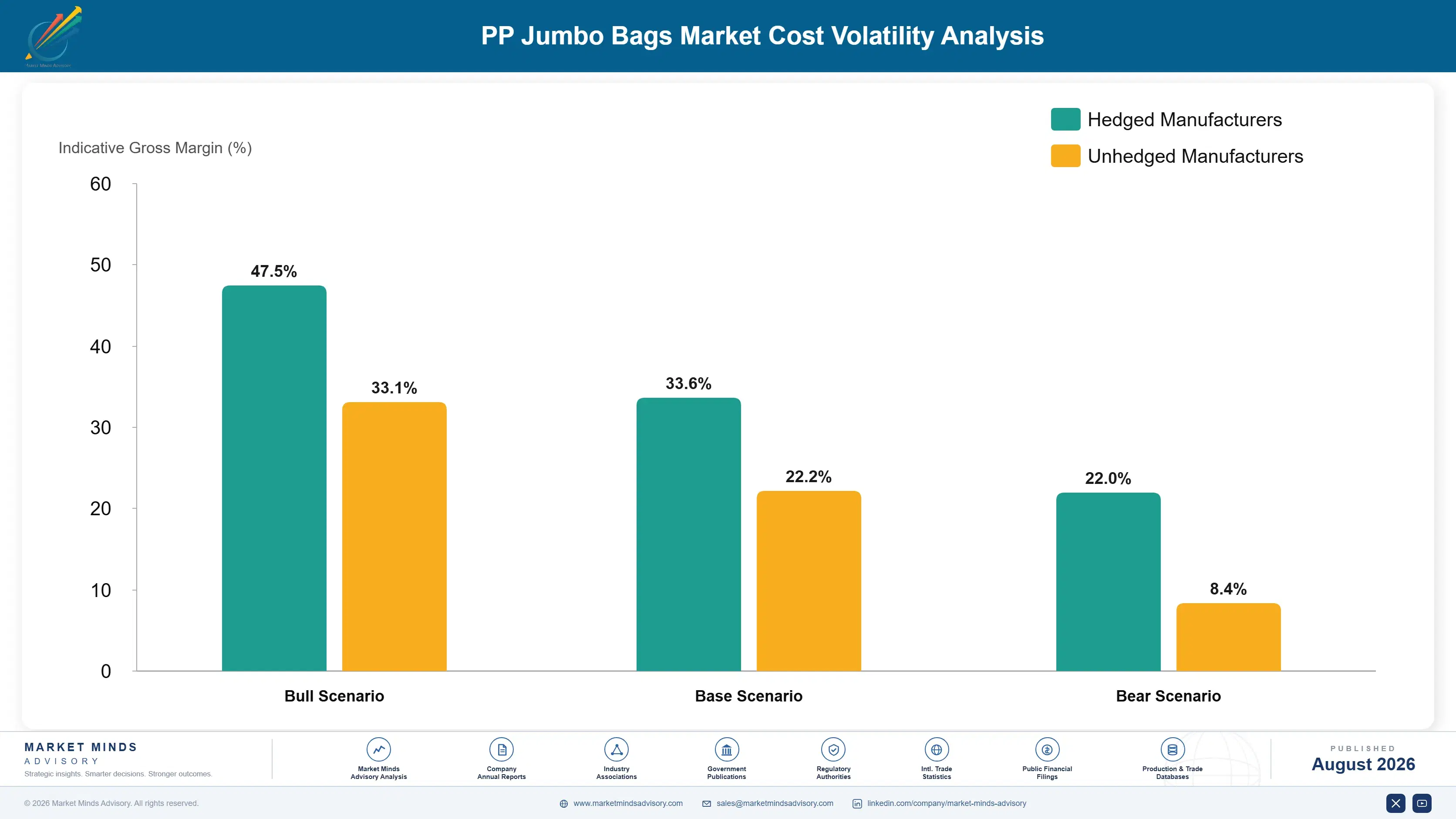
Woven polypropylene fabric accounts for roughly 61% of bag cost, produced from tape yarn extruded and woven either within the converter or purchased from specialist weavers. Webbing, thread, liners and printing add about 17%, with dissipative fibres raising that materially for antistatic construction. Cutting, sewing and testing together take a further 14%, and testing costs rise sharply where witnessed qualification and certification are required.
Polypropylene resin pricing rose sharply through 2021 and 2022 on propylene tightness and supply disruption, then fell back over the following period, per published petrochemical price reporting. Converters holding fixed bag pricing absorbed the full increase because conversion margin could not cover it, and several small Indian and European producers closed rather than trade through the cycle. Converters with indexed contracts passed most of it through instead.

Exposure is decided by contract structure rather than by operating skill, plainly. A converter with resin-indexed bag pricing passes movement through with a short lag while one holding fixed prices carries everything on a thin margin. Geography compounds it: Indian and Chinese converters sit beside domestic resin and weaving capacity, while European converters buy fabric at import parity with freight attached, per published polymer trade data.
pp-jumbo-bags-market-cost-volatility-analysis-1787580799256

Index bag pricing to a published resin reference

Passing resin movements through with a defined lag converts a volatile margin into a stable conversion fee, which is the single most effective protection available to a converter. Buyers resist until a supplier fails on them, and larger converters have been indexed for years while smaller ones continue carrying the exposure that closes them.

Integrate backward into tape yarn and weaving

Fabric at 61% of cost bought from a specialist weaver leaves a converter exposed to two margins rather than one. Integration into extrusion and weaving is capital intensive but changes the cost position permanently, which is why the Indian converters holding export positions almost all operate integrated. Buying fabric is viable only at small scale.

Price certification and testing separately from the bag

Witnessed testing, clean room production and audit provision all carry real cost that standard construction does not, and converters quoting a single delivered price obscure where that value sits. Separating it in contract structure protects the premium when standard bag pricing moves, and audited customers understand the distinction readily once it is explained. Most converters quote a single number instead.

Portfolio Architecture for Margin Defence

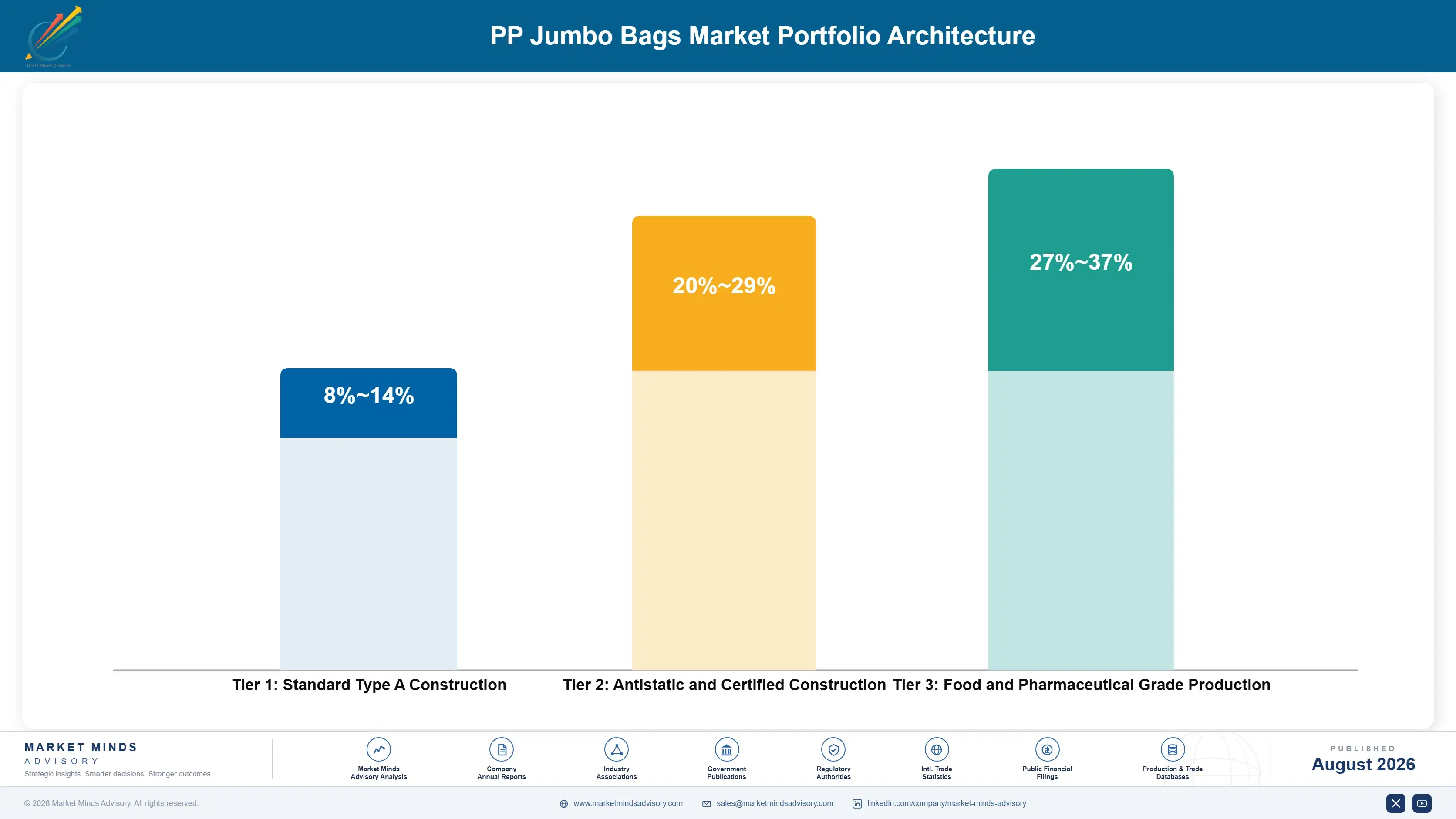
Margin here tracks certification and nothing else worth mentioning. Standard construction earns margins in the high single digits to low teens, because thousands of converters make an interchangeable product and fabric at 61% of cost sets the price. Scale improves purchasing slightly and confers no pricing power at all, which is the position most of this industry occupies permanently.
Antistatic and United Nations certified construction does considerably better at margins in the low to high twenties, because dissipative fabric, testing regimes and documentation narrow the field sharply. The range is wide because Type C and Type D carry different fabric costs and different testing burdens, and because certification scrutiny varies enormously between customers and regions. Documentation is the barrier here.

Food and pharmaceutical grades hold the strongest position, running into the mid thirties, where clean room facilities, traceable resin and audit access exclude the great majority of the producer base. Those margins reflect a facility and documentation barrier rather than any product superiority, and they persist because requalifying an audited facility is slow and expensive for the customer. A certificate cannot substitute for a facility a customer has walked through.

Standard Type A Construction

Standard bulk bags supplied against written specification with certificate-based qualification. Thousands of converters produce an interchangeable product, so the six point range reflects fabric integration and scale rather than any defensible position.
Gross Margin: 8-14%

Antistatic and Certified Construction

Type B, Type C and Type D antistatic bags alongside United Nations certified hazardous goods construction. The nine point range reflects differing fabric costs and testing burdens between the types and varying certification scrutiny by customer.
Gross Margin: 20-29%

Food and Pharmaceutical Grade Production

Clean room produced bags with traceable resin, documented liners and customer audit access. The ten point range reflects audit depth, which varies from documented food grade through to full pharmaceutical facility qualification.
Gross Margin: 27-37%
pp-jumbo-bags-market-portfolio-architecture-1787580799766

High-value Sub-segments and Strategic Watch-out

Type D Antistatic Construction

High value and the fastest growth at 8.7%, converting on customer safety review rather than commercial approach. Dissipative fabric and testing requirements narrow the converter field sharply, and grounding failures with Type C keep driving the substitution forward. Safety review rather than selling drives it.
Gross Margin: 23-30%

Pharmaceutical Grade Clean Room Bags

High value and the only tier where price competition genuinely stops. Clean room facilities, traceable resin and audit access exclude most of the producer base entirely. Requalifying an audited facility is slow enough that positions hold for years. Volumes are smaller and prices reflect the burden.
Gross Margin: 31-37%

Standard Type A Bulk Supply

The volume core and permanently price-led against Indian and Chinese converting cost. Fabric at 61% of cost sets the price and thousands of converters compete on the remainder. No margin improvement is realistically available to anyone here. Fabric integration and scale are the only levers.
Gross Margin: 8-14%

Uncertified Supply Facing Audit Practice

The strategic watch-out. As buyers move from certificate review to witnessed testing, converters who under-test lose approved status abruptly rather than gradually. The range reflects how differently that transition lands across customers and regions. Losing approved status happens abruptly rather than gradually here. Transitions land very unevenly.
Gross Margin: 6-16%

How the Bag Volume Repeats

Bulk bag demand repeats continuously because bulk material ships continuously, and roughly 74% of bags are certified for a single trip, which means every tonne shipped consumes a new one. A chemical or food processor buys against its own production schedule rather than any purchasing decision, and the volumes are therefore predictable to within a few percent. What is not predictable is which converter supplies them, unless certification stands in the way.
Stickiness follows the certification tier almost exactly. Pharmaceutical grade supply is stickiest, since requalifying an audited clean room facility is slow and expensive for the customer. Antistatic construction comes next, held by testing and documentation. United Nations certified hazardous goods bags sit alongside it. Standard construction switches on delivered price at every tender, and buyers requalify a standard supplier in days rather than months.

The specifying buyer differs by tier as well. Standard bags are bought by procurement against a written specification somebody else wrote. Antistatic and food grade bags are specified by safety and quality functions who conduct audits and who never negotiate a price, which is why those tiers behave like a different industry despite sharing a weaving loom.
pp-jumbo-bags-market-end-use-penetration-index-1787580800255

Where We Would Invest

These are among the four positions where our research anticipates prominent divergence between winners and laggards over the coming forecast period. Each is grounded in the demand model, the regulatory perimeter, and the announced capacity pipeline.
01 / ANTISTATIC CERTIFICATION INVESTMENT

Certify for Type D before combustible dust review reaches you

Type D bags dissipate electrostatic charge without the grounding connection Type C requires, and processors reviewing incident data know operators forget to attach it. The segment grows at 8.7% against a market rate of 5.8%, and dissipative fabric sourcing plus testing capability costs around 600 thousand dollars to establish. Conversion happens on a customer safety review rather than through any commercial approach, which makes the resulting position durable and effectively impossible for a standard bag converter to contest on price alone.
02 / AUDITED FACILITY BUILDING

Build clean room capability, the only tier without price competition

Clean room production, traceable resin, documented liners and customer audit access exclude the great majority of a field where the top five hold only 13%. Dedicated facilities cost perhaps 3 million dollars over about eighteen months including customer qualification, against volumes smaller than industrial supply at prices reflecting the burden properly. Customers requalify audited facilities reluctantly because the process is slow and expensive for them, so a position won here tends to hold for years rather than for a single tender cycle.
03 / VERIFICATION LED SELLING

Invite the audit rather than waiting to be asked for certificates

Buyers verifying a claimed five to one safety factor need facility visits and witnessed testing rather than certificate review, and serious customers increasingly do that work after a lifting failure somewhere in their supply chain. A converter running genuine cyclic and top-lift testing should be inviting that audit rather than waiting to be asked for it. That converts a price comparison into a capability comparison, which is a conversation that the under-testing competition simply cannot join at any quoted price at all.
04 / CONTRACT STRUCTURE DISCIPLINE

Index to resin or expect to fail through the next cycle

Woven fabric is 61% of bag cost, the highest raw material share of any large packaging format, and converters on fixed pricing absorb the entire swing on a conversion margin far too thin to cover it. That combination closed several producers through recent resin cycles and will do so again. Indexing to a published reference converts a volatile margin into a stable conversion fee, costs nothing to propose, and the larger converters have already been operating that way for several years.

Engagement Snapshot From the Field

A live engagement with an industry participant carrying material or product regulatory and market exposure ahead of a defining policy shift, showing how our research translates into a defensible multi-year portfolio strategy.
MARKET MINDS ADVISORY · CLIENT ENGAGEMENT SUMMARY
PP Jumbo Bags Producer Strategic Portfolio Review and Transition Roadmap 2026·Investment Scenario on PP Jumbo Bags Exposure Evaluation 2025-26
CLIENT PROFILE
An Indian bulk bag converter with integrated tape yarn extrusion, weaving and bag making across two plants in Gujarat, producing near 9 million bags annually with revenue around 78 million dollars (client-reported, unverified by MMA). Output was almost entirely standard Type A construction sold to European and North American distributors on delivered price. No certified tiers were produced at all.
STRATEGIC CHALLENGE
Delivered price competition from Bangladeshi and Vietnamese converters had compressed margins for two consecutive years, and a resin cycle absorbed against fixed contracts had made one plant loss-making. Management needed to decide whether to compete on further cost reduction, invest in certification tiers, or accept declining returns on a volume business.
MMA APPROACH
MMA benchmarked the client's delivered cost against Bangladeshi and Vietnamese converters, costed Type D antistatic and food grade certification requirements with two certification bodies, and tested European and North American buyer audit practice across eleven customers. Contract structures were reviewed against resin exposure. Interviews with 47 experts covered bulk bag certification, combustible dust practice and industrial procurement.
KEY FINDINGS
  1. Delivered cost against Bangladeshi converters could not be closed through any operational programme modelled, since the gap sat in labour and utility costs rather than in efficiency.
  2. Type D certification cost near 600 thousand dollars including dissipative fabric qualification and testing capability, against pricing roughly double the standard construction the plants already produced.
  3. Seven of eleven buyers interviewed had moved or were moving to witnessed testing, and three had removed suppliers who could not withstand a facility audit.
  4. Fixed price contracts covered 71% of volume with no resin indexation, which was the direct cause of the loss-making plant rather than any operational failure.
CLIENT PROFILE
An Indian bulk bag converter with integrated tape yarn extrusion, weaving and bag making across two plants in Gujarat, producing near 9 million bags annually with revenue around 78 million dollars (client-reported, unverified by MMA). Output was almost entirely standard Type A construction sold to European and North American distributors on delivered price. No certified tiers were produced at all.
STRATEGIC CHALLENGE
Delivered price competition from Bangladeshi and Vietnamese converters had compressed margins for two consecutive years, and a resin cycle absorbed against fixed contracts had made one plant loss-making. Management needed to decide whether to compete on further cost reduction, invest in certification tiers, or accept declining returns on a volume business.
MMA APPROACH
MMA benchmarked the client's delivered cost against Bangladeshi and Vietnamese converters, costed Type D antistatic and food grade certification requirements with two certification bodies, and tested European and North American buyer audit practice across eleven customers. Contract structures were reviewed against resin exposure. Interviews with 47 experts covered bulk bag certification, combustible dust practice and industrial procurement.
KEY FINDINGS
  1. Delivered cost against Bangladeshi converters could not be closed through any operational programme modelled, since the gap sat in labour and utility costs rather than in efficiency.
  2. Type D certification cost near 600 thousand dollars including dissipative fabric qualification and testing capability, against pricing roughly double the standard construction the plants already produced.
  3. Seven of eleven buyers interviewed had moved or were moving to witnessed testing, and three had removed suppliers who could not withstand a facility audit.
  4. Fixed price contracts covered 71% of volume with no resin indexation, which was the direct cause of the loss-making plant rather than any operational failure.
RECOMMENDED STRATEGY
Phase 1: Phase one: index existing contracts to a published resin reference at renewal, since the fixed structure rather than operations caused the loss-making position. Phase 2: Phase two: certify one plant for Type D antistatic production, entering the tier growing fastest and least exposed to delivered price competition. Phase 3: Phase three: begin food grade clean room investment once antistatic volumes establish, rather than committing to both certification programmes simultaneously.
OUTCOME
The converter indexed 64% of contract volume during 2026 and completed Type D certification at one plant within eleven months, with antistatic construction reaching 18% of output (client-reported, unverified by MMA). The previously loss-making plant returned to positive margin, and food grade investment was scheduled rather than abandoned.

Frequently Asked Questions

Foundational context covering the market sizes, CAGR, scope, country, region and competition that inform every finding below. This section is provided to cover basics and most often pre-purchase conversations, answered from the MMA Primary Research Dataset.

What is the current size of the PP Jumbo Bags Market?

MMA sizes it at USD 5.4 billion in 2025, rising to USD 5.71 billion in 2026. The figure covers flexible intermediate bulk containers woven from polypropylene at converter selling price.

How large will the PP Jumbo Bags Market be by 2036?

USD 10.03 billion by 2036, an incremental USD 4.32 billion over the 2026 base and an expansion multiple of 1.76 times. Certified tiers account for a disproportionate share.

What is the CAGR for the PP Jumbo Bags Market 2026 to 2036?

5.8% in the base case, with a bull case at 7.0% and a bear case at 4.6%. The spread turns on combustible dust enforcement and on resin pricing through the period.

Which segment is growing fastest?

Type D antistatic bags at 8.7%, half again the market rate of 5.8%. They dissipate charge without the grounding connection Type C needs and operators frequently forget.

Who are the major companies in the PP Jumbo Bags Market?

Rishi FIBC Solutions, LC Packaging, Greif, Conitex Sonoco and Emmbi Industries lead on annual bag production volume. Fifteen further participants are profiled in the full report.

Which country is growing fastest?

India at 8.9%, on domestic conversion from jute and paper sacks alongside its export production. Roughly 58% of world bag output already converts within the country.

Report Segmentation Architecture

The full report scope spans multiple orthogonal segmentation dimensions, with cross-tabulated demand data provided for each dimension pair. Coverage extends further to regional breakdowns, trend trajectories, and the competitive detail needed to support segment-level decision-making.

By Certification Class

  • Standard Type A Bags
  • Type B Bags
  • Type C Conductive Bags
  • Type D Antistatic Bags
  • Food and Pharmaceutical Grade Bags
  • Multi-Trip and Certified Hazardous Goods Bags

By End-Use Industry

  • Chemicals and Petrochemicals
  • Food Ingredients and Agriculture
  • Construction Materials and Cement
  • Mining and Mineral Concentrates
  • Pharmaceuticals and Fine Chemicals
  • Waste and Recycling Handling

By Commercial Dimension

  • Direct Supply to Processors
  • Distributor and Trader Supply
  • Audited Contract Supply
  • Export and Cross-Border Trade
  • Private Label Converting
  • Rental and Multi-Trip Programmes

By Region

  • North America
  • Western Europe
  • East Asia
  • South Asia and Pacific
  • Latin America
  • Middle East and Africa
  • Eastern Europe

Scope, Methodology, and Coverage

Every figure in this report is reproducible from documented input assumptions. The scope below maps the historical period, the forecast horizon, the segmentation dimensions, and the countries covered, alongside the underlying primary and qualitative methodology.
Historical Period
2020 to 2025
Forecast Period
2026 to 2036
Base Year
2025 (USD billions; MMA Primary Research Dataset, August 2026)
Market Definition
Flexible intermediate bulk containers woven from polypropylene tape yarn, spanning standard Type A construction, Type B, conductive Type C and antistatic Type D bags, food and pharmaceutical grades, and multi-trip and certified hazardous goods constructions, measured at converter selling price. Polypropylene tape yarn and woven fabric sold as such, small woven sacks below fifty kilogrammes, rigid intermediate bulk containers, and drum and pail formats are excluded from scope entirely.
Quantitative Units
USD billions (current prices); million bags produced annually; USD per bag by certification class and region
Segmentation Dimensions
Certification class; end-use industry; commercial dimension; region
Regions Covered
North America, Western Europe, East Asia, South Asia and Pacific, Latin America, Middle East and Africa, Eastern Europe
Countries Covered
United States, Canada, Mexico, Germany, Netherlands, United Kingdom, France, Italy, China, Japan, South Korea, India, Bangladesh, Vietnam, Australia, Brazil, Chile, Turkey, Saudi Arabia, Poland
Key Companies Profiled
Rishi FIBC Solutions, LC Packaging, Greif, Conitex Sonoco, Emmbi Industries, Berry Global, Bulk Lift International, Halsted Corporation, Jumbo Bag Limited, Global-Pak, Isbir Sentetik, Bag Supplies, Taihua Group, Shandong Xinguang, Flexi-Tuff Industries, Sackmaker, BAG Corp, Intertape Polymer Group, Langston Companies, Nihon Matai
Quantitative Methodology
Primary survey, n=3,800 respondents, Q4 2025, six countries; demand-side model with trade association cross-validation
Qualitative Methodology
47 expert interviews, Q4 2025; applied to validate demand model assumptions, identify emerging dynamics, and assess competitive positioning
Report Format
PDF and XLSX data workbook (Word format preview document)
Publisher
Market Minds Advisory
Report Code
MMA-2026-PAC-115
Published
August 2026
Contact
sales@marketmindsadvisory.com | www.marketmindsadvisory.com

Purchase the full PP Jumbo Bags Market Report (2026 to 2036).

The full report treats the bulk bag as the certified lifting device it is, sizing each certification class independently through 2036. It tracks buyer audit practice across industrial customers, quantifies Type C to Type D substitution against combustible dust review activity, and models converter margin against resin exposure and contract structure. Regional chapters cover all seven regions with converting capacity detail where disclosure permits. Competitive profiling covers 20 participants on a single bag production volume basis, alongside certification and audit capability compared across each converter covered.
Each certification class sized independently through 2036
Buyer audit practice tracked across industrial customer groups
Type C to Type D substitution quantified against safety reviews
Converter margin modelled against resin and contract structure
Twenty participants profiled on one consistent basis
Certification and audit capability compared across converters

Built For The People Who Decide

From boardroom strategy to bench-side execution, this report is read cover-to-cover by leaders shaping the next decade of their industry, turning demand scenarios, market dynamics and valuation benchmarks into decisions.
CXOs/ Presidents/ VPs/ Managers
M&A and Corporate Development
Strategy Teams and R&D Heads
Procurement and Product Directors
Regulatory and Compliance Leaders
Investor Relations and Equity Analysts