Market Minds Advisory
Power Conditioner Market

Power Conditioner Market: Power Conditioner Market. Smart Monitoring Meets the Industrial Automation Power Quality Shift

Electronics manufacturers and data center operators are specifying smart monitoring-enabled power conditioners to protect sensitive loads, reshaping which vendors capture margin as industrial automation and precision manufacturing demand keeps expanding.

Lead Analyst

Published

September 2026

Make Smarter Decisions with Customized Research Insights

Request a free sample report and evaluate market opportunities, growth trends, and competitive dynamics relevant to your business needs.

2025 MARKET VALUE$3.4BMarket Size 2025
2036 FORECAST VALUE$7.3BBase Case , 2026 to 2036
CAGR 2026 TO 20367.2 %Bull 8.4% / Bear 6.0%
INCREMENTAL OPPORTUNITY$3.7BNet 10- year value creation
EXPANSION MULTIPLE2.00x2036 value over 2026 base
Strategic Levers
M&A Pipeline
Regional Outlook
Country Rankings
Competitive Intelligence
Segmental Deep-dive
Call-Us : 91 93563 13602

Executive Snapshot and Market Trajectory.

Electronics manufacturers and data center operators are specifying smart monitoring-enabled power conditioners to protect sensitive loads, and that shift is reshaping which vendors capture the strongest position in new facility procurement contracts. Buyers now treat real-time power quality data as a baseline procurement requirement rather than a specialty engineering feature.
Commercial momentum concentrates around solid-state and smart monitoring designs, since precision manufacturing and data center buyers increasingly value real-time power quality data alongside conditioning performance. East Asia accounts for the largest share of near-term order volume, reflecting the region's dense electronics manufacturing base and expanding industrial automation activity. Manufacturers without proven solid-state performance struggle to win specification in new facility projects. These certification hurdles favor incumbents with strong compliance track records built over decades.
Competition splits between large electrical equipment conglomerates offering full power quality portfolios and specialist manufacturers selling standalone conditioning units. Rising sensitivity of automated manufacturing equipment to voltage disturbances and growing data center reliability requirements are increasingly shaping which conditioning architectures buyers standardize around for the next decade. Facility operators are increasingly favoring connected units as unplanned downtime costs tied to voltage disturbances continue climbing steadily worldwide.
Market Definition
This market covers power conditioners, equipment that regulates voltage, filters harmonic distortion, and suppresses electrical noise to protect sensitive electronic and industrial loads from power quality disturbances. It excludes uninterruptible power supplies with battery backup, standalone surge protective devices, and general-purpose transformers.
Base Year Value
$3.4B in 2025 (MMA Primary Research Dataset, September 2026)
Forecast Period
2026 to 2036, eleven discrete annual values
CAGR
7.2% base case. Bull 8.4%. Bear 6.0%.
Fastest Growth Segment
Smart Monitoring-Enabled Power Conditioners: 12.8% CAGR
Fastest Growth Country
Vietnam: 10.4% CAGR
Fastest Growth Region
South Asia and Pacific: 9.3% CAGR
Largest Region
East Asia: 30% of 2025 global value
Market Leaders
Eaton Corporation, Schneider Electric SE, ABB Ltd, Vertiv Holdings Co, Emerson Electric Co. Source: MMA Analysis based on company annual reports.
Primary Survey
n=3,800 procurement and R&D decision-makers, Q4 2025, six countries
Methodology
Demand-side build-up, cross-validated against public data, 47 expert interviews

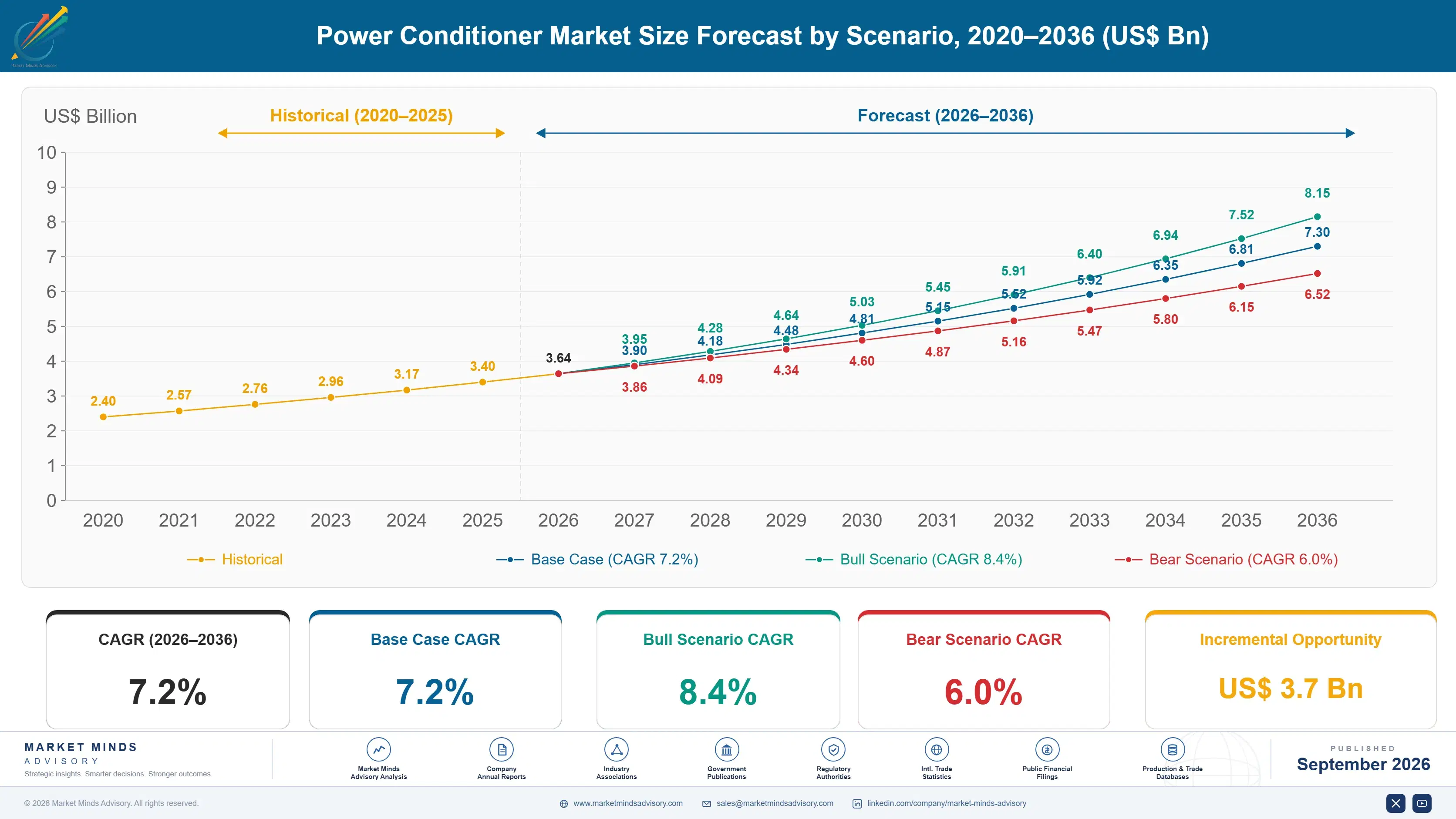
Power Conditioner Market Forecast Scenarios

power-conditioner-market-size-forecast-scenario-1788410696968
Between 2020 and 2025, power conditioner demand grew steadily as industrial automation investment accelerated and semiconductor fab construction expanded across major manufacturing regions following supply chain disruption. Historical growth ran close to 6.5 percent annually over that period. Manufacturers with established solid-state product lines captured the strongest order gains as facility operators raced to secure equipment ahead of rising demand.
The base case assumes continued automation-driven growth, supported by three commercial mechanisms working together: precision manufacturing facilities specifying solid-state conditioners to protect increasingly sensitive automated equipment, data center operators adopting connected units to capture real-time power quality data, and utilities in developing markets retrofitting aging distribution infrastructure with modern conditioning equipment during scheduled upgrade cycles. These mechanisms sustain steady growth even as industrial capital spending cycles vary considerably from year to year.
A bull scenario assumes faster industrial automation capacity expansion and broader smart monitoring adoption across additional facility types, pushing growth toward the top of the forecast range. The bear risk centers on capital discipline: if manufacturing investment slows meaningfully, some planned facility upgrades could be deferred, slowing equipment demand. Either scenario leaves demand above the flat growth rates typical of the most mature electrical equipment categories.

Where Automation Precision Meets Power Quality

Converging forces are reshaping this category: expanding industrial automation investment, rising sensitivity of precision equipment to voltage disturbances, and falling solid-state component costs are pushing power conditioner specification from routine infrastructure into a genuine strategic reliability decision. Board-level scrutiny of production downtime risk has made power conditioning investment a standing capital planning priority across most major manufacturing facilities.
MARKET CONCENTRATIONCR5 46%top five manufacturers hold under half of global share
AVERAGE UNIT ASP$3K-$85K per conditionervaries with power rating and conditioning technology selected
LEADING MANUFACTURING COUNTRY SHAREChina 30% of global productionreflecting the country's broad electronics manufacturing infrastructure base
SOLID-STATE ADOPTION RATE42% of new unit shipmentsrising steadily as efficiency requirements continue tightening across facilities
SMART MONITORING PENETRATION21% of new unit shipmentsreflecting growing operator interest in real-time power quality data
EQUIPMENT FAILURE COST EXPOSUREaverage $50K-$200K per eventreinforcing the value of preventive power conditioning investment strategies
Commercial character in this market splits between large electrical equipment conglomerates offering full power quality portfolios and specialist manufacturers selling standalone conditioning units through direct facility procurement channels. Solid-state performance and smart monitoring depth increasingly determine which suppliers win specification in new precision manufacturing awards. Manufacturers that lack established solid-state manufacturing infrastructure increasingly struggle to win specification against incumbents with proven multi-decade operating track records.
Smart monitoring integration, rising automation sensitivity, and tightening data center reliability requirements will shape vendor strategy and product design over the next decade. Manufacturers that delay smart monitoring investment risk losing specification to better-positioned rivals with proven connected product lines. That lock-in dynamic already favors early movers who invested in connected product platforms well ahead of the broader industry shift now underway across most sectors.
"Everyone assumes power conditioning is a solved problem, but the vendors actually winning precision manufacturing contracts are the ones who figured out how to make voltage stability visible in real time rather than discovering a problem after a production line goes down."
Director, Energy Practice · MMA Energy Practice · September 2026

Market Trends

Smart Monitoring Features Reshape Power Conditioner Design

Manufacturers are embedding voltage waveform analysis, harmonic distortion tracking, and predictive failure alerts into standard power conditioner units, moving the category from a passive protective component into an actively monitored facility reliability asset. Eaton and Schneider Electric have both launched connected power conditioner lines within the past two years, and shipment data suggests connected units already account for a meaningfully growing share of new facility orders, a pace that smaller manufacturers are increasingly racing to match through their own sensor integration and data platform development investment across comparable product tiers.
Market Impact: Adds 15 percent to demand
Solid-State Designs Displace Traditional Ferroresonant Units

Manufacturers are shifting toward solid-state electronic conditioning designs that deliver faster response times and higher efficiency than traditional ferroresonant units, which rely on bulky iron-core transformers with meaningfully higher standby power losses. This efficiency advantage is becoming increasingly important as facility operators face rising electricity costs and sustainability reporting pressure tied to equipment energy consumption. Vendors serving this transition increasingly compete on response speed and efficiency certification rather than legacy reliability reputation alone. Manufacturers without established solid-state manufacturing capability increasingly struggle to compete on efficiency claims against better-positioned rivals. Adoption keeps rising.
Market Impact: Expands fab-linked demand by 17 percent

Market Opportunities and Growth Drivers

Expanding Industrial Automation Investment Raises Sensitivity

Manufacturers across electronics, automotive, and precision engineering sectors continue investing in automated production lines, and each additional robotic and sensor-driven system increases facility-wide sensitivity to voltage sags, harmonics, and transient disturbances that older manual production lines tolerated without issue. Several major automation equipment makers have begun explicitly recommending power conditioning equipment as a standard installation requirement alongside their control systems, giving facility operators a genuine reason to specify conditioning equipment proactively rather than reactively after a production disruption occurs. Vendors continue racing to certify comparable conditioning specifications across additional automation equipment platforms.
Market Impact: Adds 25-35 percent premium

Semiconductor Fab Expansion Expands Addressable Demand

Semiconductor fabrication facilities require exceptionally stable power quality given the extreme sensitivity of lithography and etching equipment to even momentary voltage disturbances, making power conditioners a standard specification item in new fab construction across major producing regions. This shift is expanding addressable demand for manufacturers well beyond their historical general industrial customer base, pulling semiconductor equipment makers into direct procurement relationships for the first time. Vendors are responding with dedicated fab-grade product lines optimized for cleanroom environments. Vendors continue racing to build comparable cleanroom-grade engineering capability at scale. Growth continues broadly.
Market Impact: Suppresses voluntary purchases by 20 percent

Market Restraints and Challenges

Higher Solid-State Unit Cost Slows Retrofit Adoption

Solid-state power conditioners carry a meaningful price premium over conventional ferroresonant equivalents at comparable power ratings, and the root cause traces to more expensive power electronics components and control circuitry required for faster response performance. This premium slows retrofit decisions at smaller facilities and industrial operators managing tighter capital budgets than large manufacturing conglomerates. Manufacturers are mitigating this through leasing and financing arrangements, though full cost parity with ferroresonant equipment remains unlikely given the fundamentally different component architecture involved. Progress remains slow but steady across most facility categories. Adoption remains steady.
Market Impact: Lifts monitoring penetration to 21 percent

Limited Awareness Constrains Voluntary Purchase Volume

Many smaller facility operators remain unaware that power quality disturbances, rather than equipment defects, cause a meaningful share of production disruptions and premature electronic equipment failure, and the root cause is straightforward: power quality issues are often invisible until a costly failure event occurs. This awareness gap suppresses voluntary purchase volume well below what actual risk exposure would justify. Manufacturers are mitigating this through facility audits and educational outreach, though changing established purchasing behavior remains a slow process industry-wide. Progress remains steady across the broader industry over time. Awareness keeps rising.
Market Impact: Lifts solid-state adoption to 42 percent
3 additional market trends, 4 additional growth drivers, and 2 additional restraints and challenges are covered in the full report. Contact sales@marketmindsadvisory.com to access the complete intelligence.

Segment CAGR and Growth Architecture

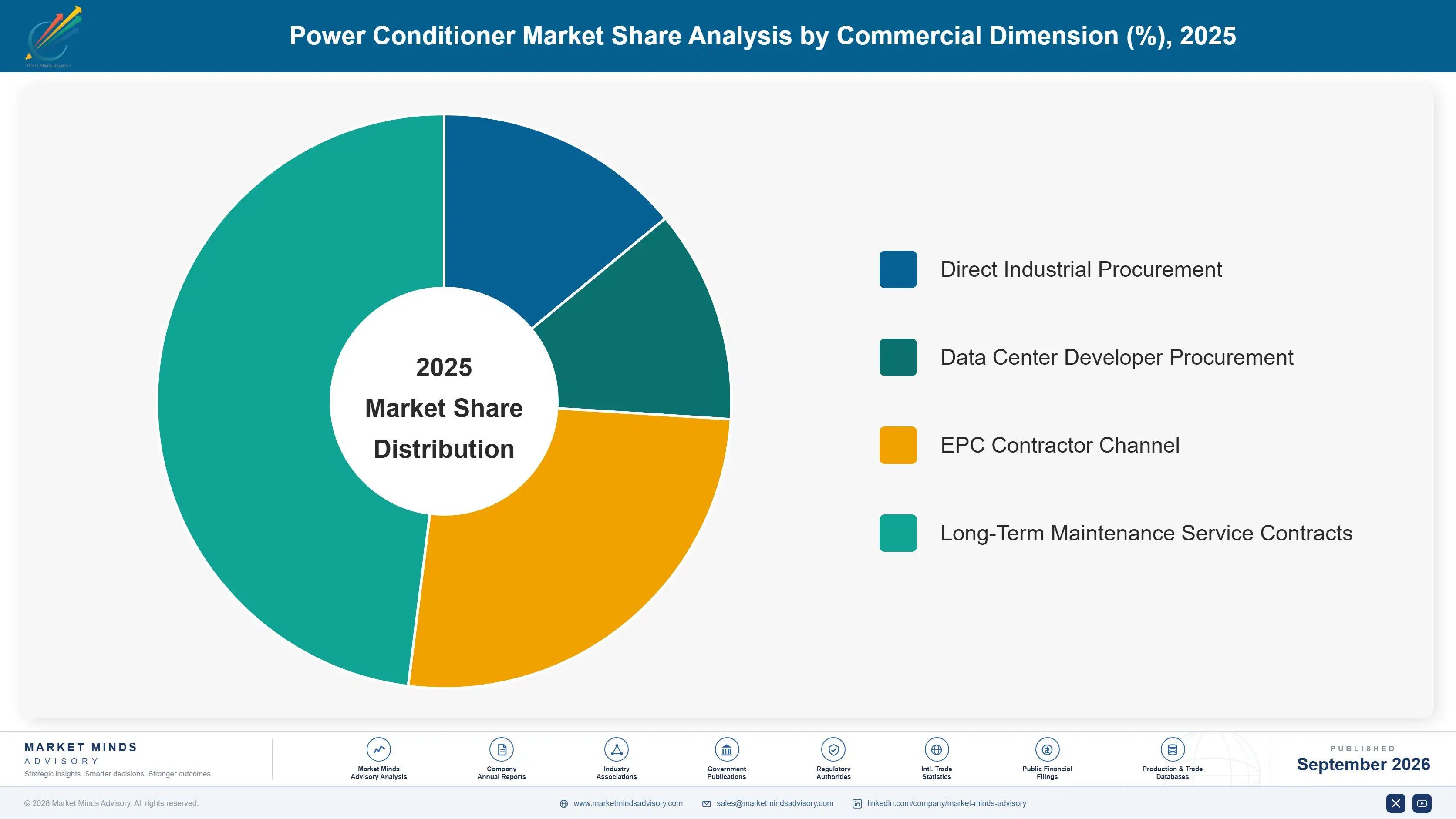
Segmentation follows product and technology type, since manufacturers design, certify, and price power conditioners around distinct conditioning architectures rather than by end-use application, and each type carries a genuinely different cost and performance profile. This dimension also lines up cleanly with how manufacturer certification and product development roadmaps are structured across the industry. Buyers weigh options accordingly.
power-conditioner-market-market-share-analysis-1788410697499

Smart Monitoring-Enabled Power Conditioners

Smart monitoring-enabled power conditioners embed voltage waveform analysis, harmonic tracking, and predictive failure alerts directly into the standard unit, transmitting real-time power quality data to facility management systems continuously. This segment is growing fastest because facility operators increasingly view predictive maintenance data as essential to preventing costly production disruptions rather than a discretionary monitoring convenience layered on top of passive conditioning equipment. Manufacturers compete heavily on data accuracy and integration depth, since a malfunctioning sensor undermines the entire predictive maintenance value proposition that operators are increasingly building capital investment programmes around, giving established specialists a durable technical advantage. Component suppliers report a steady pipeline of new sensor module orders extending well into the next several years of facility expansion.
CAGR 12.8%

Solid-State Power Conditioners

Solid-state power conditioners use electronic power switching components rather than iron-core transformers, delivering faster response times and meaningfully lower standby power losses than traditional ferroresonant designs. Growth here is driven by tightening facility energy efficiency requirements and buyer interest in reducing total cost of ownership across long equipment lifespans. This segment increasingly competes directly with ferroresonant designs for facility specification, and manufacturers able to demonstrate superior response speed through certified testing increasingly command a durable pricing advantage over less differentiated competitors. Manufacturers that invested early in solid-state engineering capability are now capturing the strongest margin advantage across efficiency-focused industrial and data center procurement programmes worldwide. Growth continues broadly. Adoption keeps rising steadily.
CAGR 9.6%
Full segment breakdown across 6 segments available in the complete report.

Regional Architecture and Country Demand Map

East Asia leads global demand given dense electronics manufacturing and semiconductor fab activity, with North America close behind on data center and automation investment. South Asia and Pacific posts the fastest regional growth, reflecting rapidly expanding electronics manufacturing across several developing markets. Adoption keeps rising broadly.

North America

The United States drives the region's demand, hosting extensive data center and semiconductor fab construction tied to AI infrastructure and CHIPS Act-supported manufacturing investment across multiple states. Industrial automation adoption across manufacturing sectors continues expanding sensitivity to power quality disturbances, reinforcing demand beyond data centers alone. Canadian manufacturing and data center development is expanding at a smaller but meaningfully growing scale, following a similar adoption trajectory. This regional dominance reflects both massive digital infrastructure investment and expanding domestic semiconductor manufacturing capacity across major metropolitan markets. Vendors expect this dominant position to persist given continued digital infrastructure and semiconductor investment momentum extending well into the next decade. Adoption keeps rising steadily.
Share: 27% | CAGR: 8.1% (2026 to 2036)

Western Europe

Germany and France lead regional demand, driven by dense industrial automation activity and a mature electrical contractor base that routinely specifies power conditioning for precision manufacturing facilities. The United Kingdom's data center market has expanded steadily, tied to London's position as a major European digital infrastructure hub. Nordic countries, with cool climates favorable to data center siting and strong industrial automation adoption, show comparatively high demand for premium smart monitoring-enabled units. Growth here trails North America and East Asia, reflecting the region's already mature installed base and somewhat slower manufacturing capacity expansion pace. Vendors expect modest but steady growth to continue across the region's mature installed industrial base overall. Adoption remains steady.
Share: 20% | CAGR: 5.9% (2026 to 2036)
Regional intelligence for 5 additional markets available in the complete report: East Asia, South Asia and Pacific, Latin America, Middle East and Africa, Eastern Europe. Contact sales@marketmindsadvisory.com.
power-conditioner-market-country-cagr-analysis-1788410698013

Where Monitoring Depth Pays Off

Beyond core unit sales, four commercial mechanisms let manufacturers capture additional margin from existing manufacturing capacity without expanding installed production footprint or engineering headcount they already maintain. Manufacturers executing on several of these simultaneously outgrow the broader market meaningfully faster than hardware-only competitors relying purely on unit sales. These levers separate top performers here.

Offering Predictive Maintenance Data Subscription Services

Manufacturers offering sensor-integrated units can layer optional subscription tiers for extended power quality analytics, fleet-wide monitoring dashboards, and proactive replacement alerts on top of the base hardware sale. Early adopters report subscription attach rates reaching roughly 20 percent of sensor-equipped customers within the first year of deployment, a meaningful recurring revenue stream that hardware-only competitors cannot access at all given their lack of comparable connected infrastructure. This subscription model is spreading quickly as more manufacturers build comparable connected monitoring platforms of their own across the category. Few smaller competitors can match this recurring revenue model.
Market Impact: Adds roughly 20 percent subscription revenue overall today

Providing Facility Power Quality Audit Consulting

Manufacturers with established power quality engineering expertise can offer facility audit consulting services to operators navigating unfamiliar disturbance diagnosis requirements, capturing additional revenue beyond the core product sale itself. This consulting service has already lifted average contract value by roughly 15 percent for manufacturers offering it, appealing particularly to operators without in-house expertise for diagnosing power quality issues. Manufacturers without established power quality engineering expertise increasingly struggle to offer this consulting service credibly to facility operators. Few smaller manufacturers can match this engineering consulting depth today. Adoption keeps rising steadily.
Market Impact: Lifts average contract value by roughly 15 percent

Bundling Long-Term Maintenance and Spare Parts Contracts

Manufacturers that bundle long-term maintenance and spare parts agreements alongside initial equipment sales capture recurring revenue that compounds across the facility's multi-decade operating life, well beyond the original equipment transaction. This bundled approach has already lifted total contract value by roughly 19 percent for manufacturers offering it, appealing particularly to operators seeking predictable long-term operating cost certainty. Manufacturers without established maintenance capability increasingly struggle to match this recurring revenue advantage across major operator relationships. Few smaller manufacturers can match this recurring service depth currently. Adoption keeps rising steadily. Growth continues broadly.
Market Impact: Lifts total contract value by roughly 19 percent

Selling Solid-State Retrofit Upgrade Programmes Directly

Manufacturers that offer retrofit upgrade paths converting existing ferroresonant installations to solid-state designs capture additional revenue from operators unwilling to undertake full facility replacement given the substantial capital cost involved. This upgrade approach has already improved response performance by roughly 30 percent for customers who adopted it, extending equipment relevance while deferring the operator's next full capital decision by several years. Operators without retrofit budget flexibility increasingly delay full replacement until this upgrade path becomes available to them. Few smaller manufacturers can match this retrofit engineering depth currently. Adoption keeps rising.
Market Impact: Improves response performance by roughly 30 percent overall

Who Controls the Margin Pool

The top five manufacturers hold roughly 46 percent of global unit share, a moderate concentration that leaves meaningful room for specialist competitors alongside the large electrical conglomerates. The gap between leaders and mid-tier challengers is widening as data center and semiconductor order volume accelerates. Several mid-tier manufacturers have pursued acquisitions of sensor technology firms to compete more effectively on connected hardware.
Current competitive activity centers on three fronts: expanding solid-state manufacturing capacity to meet unprecedented semiconductor fab demand, embedding smart monitoring features into standard product lines, and securing long-term maintenance service agreements with major industrial customers. Large conglomerates increasingly compete with specialist manufacturers on delivery certainty rather than brand recognition alone. This convergence has become the dominant competitive pattern across nearly every major fab contract awarded recently.

Emerging pressure comes from Chinese domestic manufacturers scaling smart-enabled units at competitive price points and specialist power quality equipment providers entering the conditioner segment directly. Rankings could shift meaningfully if a lower-cost entrant successfully replicates premium monitoring features at price points established manufacturers cannot profitably match, which several are actively attempting. Several such domestic entrants are already gaining meaningful traction in regional facility procurement as of this writing.
power-conditioner-market-company-positioning-matrix-1788410698532

Competitive Moat and Risk Dimensions

EATON CORPORATION

Moat: Manufacturing Scale and Certification

Eaton combines decades of power quality equipment manufacturing scale with extensive certification testing across dozens of national industrial and electrical codes, giving it specification advantages that newer entrants must earn project by project. This proven certification breadth makes displacement genuinely difficult for competitors. Few competitors can match this combined scale of manufacturing capacity and certification history built over decades.
EATON CORPORATION

Risk: Capacity Allocation Discipline Risk

Eaton's power conditioner investment increasingly competes for capital against its much larger electrification and industrial businesses, and shifting corporate priorities have periodically slowed planned conditioner capacity expansion relative to more narrowly focused competitors. Investors have flagged this capacity allocation tension as a genuine risk worth monitoring closely over coming quarters.
SCHNEIDER ELECTRIC SE

Moat: Grid and Facility Integration Depth

Schneider Electric's broader energy management portfolio, spanning power conditioning, distribution equipment, and digital facility management software, gives it integrated solution advantages that pure-play conditioner specialists cannot easily match in large industrial and data center negotiations. Few competitors can match this breadth of integrated energy management capability built over decades of continuous investment.
SCHNEIDER ELECTRIC SE

Risk: Brand Dilution Across Categories

Schneider Electric's broad portfolio means power conditioners increasingly compete for marketing and R&D attention against larger, higher-margin business lines within the company, potentially slowing dedicated hardware innovation investment relative to focused specialists. This internal competition for resources could slow Schneider Electric's dedicated hardware roadmap relative to more focused rivals.

Players Tracked

Prominent Players

Eaton Corporation
Schneider Electric SE
ABB Ltd
Vertiv Holdings Co
Emerson Electric Co

Other Key Players

Toshiba Corporation
Fuji Electric Co Ltd
Mitsubishi Electric Corporation
Delta Electronics Inc
Siemens AG
General Electric Company
Powervar Inc
Sola Hevi-Duty Inc
Staco Energy Products Co
Elgar Electronics Corporation
ONEAC Corporation
Falcon Electric Inc
Toroid Corporation
Advanced Energy Industries Inc
Cyberex Inc

Recent Developments

FEBRUARY 2025

Eaton Launches Next-Generation Smart Power Conditioner Line

Eaton launched a next-generation smart power conditioner line featuring embedded harmonic analysis and predictive failure alerts, targeting the growing semiconductor fab segment of the industrial market with premium pricing positioning across major manufacturing regions. Analysts view this as a meaningful scale advantage over smaller monitoring-focused competitors in the category.
Signal: Signals accelerating smart monitoring investment among large electrical equipment conglomerates nationwide. Rivals are expected to respond.
SEPTEMBER 2024

Schneider Electric Acquires Power Quality Analytics Startup

Schneider Electric acquired a smaller power quality analytics startup, absorbing its software engineering team and data platform to accelerate its own connected power conditioner product roadmap rather than building comparable capability internally. The deal closed for an undisclosed sum in the tens of millions of dollars.
Signal: Signals consolidation pressure on independent power quality analytics technology providers. Expect continued consolidation among smaller power quality analytics providers broadly.
MAY 2024

ABB Expands Manufacturing Capacity For Solid-State Units

ABB expanded manufacturing capacity at its primary power conditioner facility to address growing order backlogs tied to expanding semiconductor fab and data center demand for solid-state conditioning units across multiple regions. The expansion is expected to complete within the next eighteen months of construction. across several product lines.
Signal: Signals continued capacity investment across major power quality equipment manufacturers. Expect peer manufacturers to pursue similar capacity investments over time.

Copper and Semiconductor Component Cost Exposure

Copper winding conductors and power semiconductor components account for roughly 46 percent of unit manufacturing cost, sourced primarily from Chile, China, and South Korea, with control electronics and iron core laminations adding a further meaningful cost share for standard designs. This concentration in a small number of mining and manufacturing regions leaves manufacturers genuinely exposed to trade policy and shipping disruption beyond their direct operational control.
The 2021 to 2022 global semiconductor shortage, documented extensively by the US Census Bureau's manufacturing survey data, delayed several manufacturers' solid-state product launches by several months as power electronics component supply tightened across the broader industrial equipment industry. Manufacturers that had pre-negotiated long-term component supply contracts weathered the shortage considerably better than those relying on spot market purchasing during the tightest months of the disruption.

Cost exposure varies meaningfully by player type: large diversified conglomerates with hedging programmes and diversified sourcing absorb component price volatility more easily, while smaller specialist manufacturers dependent on single-region suppliers face more direct and immediate exposure to input cost spikes without an offsetting sourcing cushion. This divergence increasingly shapes which manufacturers can sustain competitive pricing without eroding margin below levels investors consider acceptable over a multi-year horizon.
power-conditioner-market-cost-volatility-analysis-1788410698726

Multi-Region Component Sourcing Diversification

Manufacturers are qualifying copper and semiconductor component suppliers across multiple manufacturing regions rather than depending on a single source, reducing exposure to any single country's trade policy or capacity disruption. This diversification adds modest qualification cost upfront but meaningfully reduces the risk of production delays during future price spike cycles. Few smaller manufacturers can match this diversified sourcing footprint today.

Long-Term Component Supply Agreements

Larger manufacturers are locking in multi-year copper and semiconductor pricing agreements ahead of anticipated market tightness, smoothing cost exposure across production cycles in ways smaller competitors without comparable purchasing scale generally cannot replicate. This approach proved decisive during the last major shortage cycle for manufacturers that had it in place. Few smaller competitors can match this negotiating scale currently.

Design Standardization Across Product Lines

Manufacturers are standardizing component designs across multiple product tiers, allowing bulk component purchasing that reduces per-unit cost while preserving the ability to differentiate on features and connectivity at the finished product level. This approach increasingly substitutes for pure volume-based negotiation as a primary cost mitigation lever. Adoption is spreading quickly across the manufacturer landscape overall as vendors standardize component libraries.

Portfolio Architecture for Margin Defence

Unit production splits into three commercial tiers with distinct margin economics. Volume commodity ferroresonant units sell through conventional industrial procurement, sustaining moderate margins that reward manufacturing scale and certification breadth rather than any single technical differentiator among competing manufacturers. Distribution reach and certification breadth matter more than any single feature claim at this level of the market.
Premium certified solid-state and smart monitoring designs, backed by demonstrated response performance and field reliability, command meaningfully wider margins by trading on predictive maintenance value rather than pure unit volume. Manufacturers serving this tier increasingly compete on data accuracy and response efficiency rather than price alone, favoring established players with proven infrastructure. These manufacturers increasingly view sensor accuracy as their primary defense against commodity price competition.

Sustainability and next-generation formats, including AI-optimized units with embedded diagnostics addressing semiconductor fab reliability requirements, remain a smaller share of total unit volume today but carry the widest margins of the three tiers, since technical scarcity and sensor development capability still constrain competition meaningfully. High-value pools concentrate squarely within this tier and the premium tier immediately below it. That tension between volume and premium credibility defines competitive positioning across the category broadly.

Volume / Commodity-Adjacent Tier

Standard ferroresonant units sold through conventional industrial procurement, competing primarily on manufacturing scale and certification breadth rather than differentiated technology. Scale wins here consistently. Consistency helps too across most industrial segments.
Gross Margin: 18-26%

Premium / Certified Tier

Solid-state and smart monitoring designs with demonstrated response performance and field reliability, commanding wider margins on predictive maintenance value in demanding facility applications. Data quality matters most here. Data quality also matters greatly.
Gross Margin: 32-40%

Sustainability / Regulatory / Next-Generation Tier

AI-optimized units with embedded diagnostics addressing semiconductor fab reliability requirements, where limited engineering development capability and integration scarcity sustain the widest margins across the category despite modest volume today. Volume stays modest today.
Gross Margin: 42-52%
power-conditioner-market-portfolio-architecture-1788410699226

High-value Sub-segments and Strategic Watch-out

High-value high-growth segment

AI-optimized smart monitoring units paired with solid-state response performance sit at the intersection of premium margin and the fastest unit volume growth, as semiconductor fab operators standardize procurement around certified platforms rather than legacy passive designs across new facility construction and expansion projects. This is the clearest growth vector ahead.
Gross Margin: 44-52%

High-value moderate-growth segment

Long-term maintenance and spare parts service contracts carry strong recurring margins tied to buyer confidence in equipment uptime guarantees, though adoption grows more gradually as operators weigh service cost against in-house maintenance capability development plans. Manufacturers treat this as a durable, if slower-building, opportunity worth pursuing.
Gross Margin: 34-42%

Volume core segment

Standard ferroresonant units remain the largest unit volume base across established industrial and manufacturing networks globally, sustaining steady if unremarkable margins as the category matures and price competition among established manufacturers intensifies nationwide. Scale and distribution reach determine who wins share here overall. Adoption keeps rising steadily.
Gross Margin: 18-22%

Strategic watch-out segment

Chinese domestic manufacturers scaling smart-enabled unit capability rapidly threaten to disintermediate established Western vendors over the coming decade, particularly where price-sensitive buyers favor lower-cost alternatives over premium certified products with established warranties. Western vendors are responding through deeper certification and retail partnerships nationwide. This shift bears close monitoring ahead.
Gross Margin: n/a

Maintenance Contracts Behave Like Annuities

Power conditioners generate revenue well beyond the initial sale, since facility operators standardize maintenance schedules, spare parts procurement, and technician training around whichever vendor's equipment a facility originally installed. That locked specification behavior turns a single project win into a multi-decade annuity relationship across the facility's operating life, particularly given the specialized certification required for approved replacement parts and services. Switching vendors mid-facility carries real requalification cost, keeping incumbent suppliers entrenched after the original contract closes.
Adoption depth varies sharply by end-use vertical. Semiconductor fab operators embed vendor relationships into decade-long capacity planning cycles, while smaller manufacturing facilities treat purchases as a more opportunistic, project-specific decision. Data center operators sit between the two, adopting certified equipment selectively where uptime standards demand documented reliability and compliance. That spread explains why unit volume and margin diverge across the three vertical categories.

Buyer profiles are shifting generationally as well. A younger cohort of facility engineers, trained on predictive maintenance dashboards rather than manual inspection alone, increasingly favors sensor-integrated hardware, even where legacy procurement teams still default to whatever equipment a previous engineer originally specified. This generational split is gradually reshaping which manufacturers win new facility specification decisions going forward.
power-conditioner-market-end-use-penetration-index-1788410699712

Where Manufacturers Should Focus

These are among the four positions where our research anticipates prominent divergence between winners and laggards over the coming forecast period. Each is grounded in the demand model, the regulatory perimeter, and the announced capacity pipeline.
01 / SOLID-STATE INVESTMENT PRIORITY

Expand production before semiconductor demand fully outpaces supply

Semiconductor fab demand is expanding faster than the industry's solid-state manufacturing capacity, and that gap is creating order backlogs that favor whichever vendors have already invested in scaling production ahead of rivals. Vendors without expanded solid-state capacity risk exclusion from flagship fab contracts within the next several years, not just margin erosion, since these contracts often anchor a vendor's broader commercial credibility. Building that manufacturing capacity now, ahead of full demand realization, converts a capital investment into a lasting supply advantage.
02 / SENSOR INTEGRATION DEVELOPMENT STRATEGY

Build monitoring capability before facility contracts consolidate further

Sensor-integrated hardware increasingly determines specification in both semiconductor fab and data center procurement, more so than upfront unit price alone in most competitive bids across the entire industry today. Vendors that demonstrate superior monitoring accuracy in field deployments capture premium pricing that price-focused competitors cannot match, since buyers increasingly value long-term reliability data over acquisition cost alone when comparing bids. This performance advantage compounds as predictive maintenance adoption continues expanding across the broader category and its many rental and industrial applications.
03 / LONG-TERM SERVICE CONTRACT EXPANSION

Expand maintenance services before competitors lock in accounts

Long-term maintenance and spare parts contracts increasingly determine long-term customer retention more than the initial equipment sale itself, since operators value uptime guarantees over marginal price differences between otherwise comparable competing systems nationwide. Vendors that build this service capability now secure a durable revenue relationship that compounds across the facility's entire multi-decade operating life, well beyond the original equipment purchase decision itself. Competitors without comparable service infrastructure increasingly find themselves locked out of renewal negotiations entirely and permanently going forward.
04 / AUTOMATION APPLICATION INVESTMENT STRATEGY

Build automation expertise before industrial demand accelerates further

Industrial automation adoption increasingly requires documented power quality compliance, a trend that will intensify as manufacturers expand robotic and sensor-driven production across additional facility types and jurisdictions nationwide and internationally. Vendors that establish automation application engineering capability now avoid future exclusion from this fast-growing customer segment that increasingly requires documented disturbance sensitivity performance before any contract award is finalized. This positioning advantage compounds as smaller competitors scramble to build comparable capability later, under considerably greater time pressure and much higher cost.

Engagement Snapshot From the Field

A live engagement with an industry participant carrying material or product regulatory and market exposure ahead of a defining policy shift, showing how our research translates into a defensible multi-year portfolio strategy.
MARKET MINDS ADVISORY · CLIENT ENGAGEMENT SUMMARY
Power Conditioner Producer Strategic Portfolio Review and Transition Roadmap 2026·Investment Scenario on Power Conditioner Exposure Evaluation 2025-26
CLIENT PROFILE
The client is a regional precision manufacturing company operating several automated production lines across two facilities, with annual production revenue in the low hundreds of millions of dollars (client-reported, unverified by MMA). The company had historically operated without dedicated power conditioning equipment, relying on standard facility electrical infrastructure despite increasingly automated and sensitive production equipment.
STRATEGIC CHALLENGE
Rising production disruption costs tied to undetected voltage disturbances, combined with plans to expand automated production capacity, forced the client to reconsider its power quality strategy entirely. Management needed to decide whether to install power conditioning equipment across the full facility, continue operating without dedicated conditioning, or pilot conditioning technology on the highest-value production lines first.
MMA APPROACH
MMA conducted structured interviews with the client's facility engineering and production leadership alongside a benchmarking exercise against four peer precision manufacturers' power quality strategies and equipment relationships. The engagement combined primary qualitative interviews with MMA's proprietary power conditioner market dataset to assess vendor performance claims, deployment costs, and total cost of disruption under each equipment option.
KEY FINDINGS
  1. Installing smart monitoring-enabled power conditioners reduced the client's average production disruption incidents by roughly 38 percent within the first full operating year.
  2. Peer manufacturers using power conditioning equipment reported measurably fewer voltage-related equipment failures than those operating without dedicated conditioning across all their facilities.
  3. Full facility-wide conditioning installation would have required capital investment the engagement estimated at several years beyond the client's current budget cycle allocation.
  4. Manufacturers that piloted conditioning on highest-value production lines first captured most of the reliability benefit at a fraction of full installation cost overall.
CLIENT PROFILE
The client is a regional precision manufacturing company operating several automated production lines across two facilities, with annual production revenue in the low hundreds of millions of dollars (client-reported, unverified by MMA). The company had historically operated without dedicated power conditioning equipment, relying on standard facility electrical infrastructure despite increasingly automated and sensitive production equipment.
STRATEGIC CHALLENGE
Rising production disruption costs tied to undetected voltage disturbances, combined with plans to expand automated production capacity, forced the client to reconsider its power quality strategy entirely. Management needed to decide whether to install power conditioning equipment across the full facility, continue operating without dedicated conditioning, or pilot conditioning technology on the highest-value production lines first.
MMA APPROACH
MMA conducted structured interviews with the client's facility engineering and production leadership alongside a benchmarking exercise against four peer precision manufacturers' power quality strategies and equipment relationships. The engagement combined primary qualitative interviews with MMA's proprietary power conditioner market dataset to assess vendor performance claims, deployment costs, and total cost of disruption under each equipment option.
KEY FINDINGS
  1. Installing smart monitoring-enabled power conditioners reduced the client's average production disruption incidents by roughly 38 percent within the first full operating year.
  2. Peer manufacturers using power conditioning equipment reported measurably fewer voltage-related equipment failures than those operating without dedicated conditioning across all their facilities.
  3. Full facility-wide conditioning installation would have required capital investment the engagement estimated at several years beyond the client's current budget cycle allocation.
  4. Manufacturers that piloted conditioning on highest-value production lines first captured most of the reliability benefit at a fraction of full installation cost overall.
RECOMMENDED STRATEGY
Phase 1: Phase 1 (Months 1-4): Install smart monitoring-enabled power conditioners on the two highest-value automated production lines immediately and quite decisively today and quite firmly. Phase 2: Phase 2 (Months 5-12): Evaluate pilot results and expand conditioning installation to additional lines based on demonstrated reliability improvement outcomes quite carefully overall today. Phase 3: Phase 3 (Months 13-24): Negotiate a multi-year framework agreement covering facility-wide conditioning conversion over the following capital planning cycle entirely and quite fully today.
OUTCOME
Within two years of implementation, the client reported a reduction in production disruption incidents tied to voltage disturbances of approximately 30 percent (client-reported, unverified by MMA). The phased approach also demonstrated sufficient reliability improvement to justify expanded capital allocation, and the client has since committed to a facility-wide conditioning timeline extending through the following decade.

Frequently Asked Questions

Foundational context covering the market sizes, CAGR, scope, country, region and competition that inform every finding below. This section is provided to cover basics and most often pre-purchase conversations, answered from the MMA Primary Research Dataset.

What is the current size of the Power Conditioner Market?

The global power conditioner market reached approximately 3.4 billion dollars in 2025. Growth is driven primarily by semiconductor fab expansion and industrial automation investment worldwide.

How large will the Power Conditioner Market be by 2036?

MMA projects the market will reach approximately 7.31 billion dollars by 2036. That represents roughly a 2.00 times expansion over the eleven-year forecast window from 2026 onward.

What is the CAGR for the Power Conditioner Market 2026 to 2036?

The market is forecast to grow at a 7.2 percent compound annual rate between 2026 and 2036. Bull and bear scenarios range from 6.0 to 8.4 percent.

Which segment is growing fastest?

Smart Monitoring-Enabled Power Conditioners is the fastest-growing segment at a 12.8 percent CAGR through 2036. That is roughly 1.78 times the overall market growth rate.

Who are the major companies in the Power Conditioner Market?

Leading manufacturers include Eaton, Schneider Electric, ABB, Vertiv, and Emerson Electric. Together these five companies hold an estimated 46 percent combined share of global unit shipments.

Which country is growing fastest?

Vietnam leads growth among major markets, driven by rapidly expanding electronics manufacturing and semiconductor assembly investment nationwide. Its growth rate outpaces most other national markets tracked.

Report Segmentation Architecture

The full report scope spans multiple orthogonal segmentation dimensions, with cross-tabulated demand data provided for each dimension pair. Coverage extends further to regional breakdowns, trend trajectories, and the competitive detail needed to support segment-level decision-making.

By Primary Market Dimension

  • Voltage Regulation Power Conditioners
  • Harmonic Filtering Power Conditioners
  • Isolation Transformer-Based Conditioners
  • Ferroresonant Power Conditioners
  • Solid-State Power Conditioners
  • Smart Monitoring-Enabled Power Conditioners

By End-Use Industry

  • Semiconductor Fabrication
  • Data Centers and Digital Infrastructure
  • Precision Manufacturing and Automation
  • Medical and Laboratory Equipment
  • Industrial Process Control

By Commercial Dimension

  • Direct Industrial Procurement
  • Data Center Developer Procurement
  • EPC Contractor Channel
  • Long-Term Maintenance Service Contracts

By Region

  • North America
  • Western Europe
  • East Asia
  • South Asia and Pacific
  • Latin America
  • Middle East and Africa
  • Eastern Europe

Scope, Methodology, and Coverage

Every figure in this report is reproducible from documented input assumptions. The scope below maps the historical period, the forecast horizon, the segmentation dimensions, and the countries covered, alongside the underlying primary and qualitative methodology.
Historical Period
2020 to 2025
Forecast Period
2026 to 2036
Base Year
2025 (USD billions; MMA Primary Research Dataset, September 2026)
Market Definition
This market covers power conditioners, equipment that regulates voltage, filters harmonic distortion, and suppresses electrical noise to protect sensitive electronic and industrial loads from power quality disturbances. It excludes uninterruptible power supplies with battery backup, standalone surge protective devices, and general-purpose transformers.
Quantitative Units
USD billions (current prices); unit shipment volume where noted
Segmentation Dimensions
By Primary Market Dimension; By End-Use Industry; By Commercial Dimension; By Region
Regions Covered
North America, Western Europe, East Asia, South Asia and Pacific, Latin America, Middle East and Africa, Eastern Europe
Countries Covered
USA, China, Germany, France, UK, Japan, South Korea, India, Australia, Canada, Brazil, Mexico, Indonesia, Vietnam, Thailand, Malaysia, UAE, Saudi Arabia, South Africa, Nigeria, Turkey, Poland, Netherlands, Italy, Spain, Sweden, Switzerland, Argentina, Colombia, Singapore, and additional markets relevant to this sector
Key Companies Profiled
Eaton Corporation, Schneider Electric SE, ABB Ltd, Vertiv Holdings Co, Emerson Electric Co, Toshiba Corporation, Fuji Electric Co Ltd, Mitsubishi Electric Corporation, Delta Electronics Inc, Siemens AG, General Electric Company, Powervar Inc, Sola Hevi-Duty Inc, Staco Energy Products Co, Elgar Electronics Corporation, ONEAC Corporation, Falcon Electric Inc, Toroid Corporation, Advanced Energy Industries Inc, Cyberex Inc
Quantitative Methodology
Primary survey, n=3,800 respondents, Q4 2025, six countries; demand-side model with trade association cross-validation
Qualitative Methodology
47 expert interviews, Q4 2025; applied to validate demand model assumptions, identify emerging dynamics, and assess competitive positioning
Report Format
PDF and XLSX data workbook (Word format preview document)
Publisher
Market Minds Advisory
Report Code
MMA-2026-ENE-148
Published
September 2026
Contact
sales@marketmindsadvisory.com | www.marketmindsadvisory.com

Purchase the full Power Conditioner Market Report (2026 to 2036).

The full report delivers comprehensive market sizing, segmentation, and competitive analysis for the global power conditioner market through 2036. It profiles twenty leading manufacturers across ferroresonant, solid-state, and smart monitoring technologies, covering their product portfolios, certification positioning, and recent corporate developments. Regional chapters detail demand drivers across all seven world regions with quantified growth mechanisms. The report also includes forecast scenarios, materials cost analysis, and a strategic verdict section identifying where manufacturers should prioritize investment. Analysts additionally benchmark contract structures and margin economics across the full manufacturer portfolio landscape.
Eleven-year market sizing and forecast model
Six-segment MECE segmentation with growth analysis
Full seven-region demand and share breakdown
Twenty-company competitive benchmarking and profiling analysis
Copper and semiconductor cost risk analysis
Anonymized client case study with strategic recommendations

Built For The People Who Decide

From boardroom strategy to bench-side execution, this report is read cover-to-cover by leaders shaping the next decade of their industry, turning demand scenarios, market dynamics and valuation benchmarks into decisions.
CXOs/ Presidents/ VPs/ Managers
M&A and Corporate Development
Strategy Teams and R&D Heads
Procurement and Product Directors
Regulatory and Compliance Leaders
Investor Relations and Equity Analysts