Market Minds Advisory
Korea Powdered Cellulose Market

Korea Powdered Cellulose Market: Pharmacopoeia Qualification, Import Dependence and Clean-Label Reformulation Demand

Korean generic exporters need excipients whose documentation survives a foreign inspection, while clean-label reformulation pulls food-grade volume upward against imported material that competes purely on delivered cost, leaving domestic capacity almost entirely absent.

Lead Analyst

Lisa Gevelber

Published

September 2026

Make Smarter Decisions with Customized Research Insights

Request a free sample report and evaluate market opportunities, growth trends, and competitive dynamics relevant to your business needs.

2025 MARKET VALUE$0.1BMarket Size 2025
2036 FORECAST VALUE$0.2BBase Case , 2026 to 2036
CAGR 2026 TO 20367.0 %Bull 8.2% / Bear 5.8%
INCREMENTAL OPPORTUNITY$0.1BNet 10- year value creation
EXPANSION MULTIPLE1.97x2036 value over 2026 base
Strategic Levers
M&A Pipeline
Regional Outlook
Country Rankings
Competitive Intelligence
Segmental Deep-dive
Call-Us : 91 93563 13602

Executive Snapshot and Market Trajectory

Korean generic pharmaceutical manufacturers export into regulated markets, which means their excipients have to satisfy foreign inspectors rather than just domestic ones. That single requirement decides who supplies this market and who merely quotes into it. Price is a conversation that happens afterwards, if it happens with them at all.
Pharmaceutical excipient grade carries the growth on triple pharmacopoeia compliance and drug master file support that most suppliers cannot provide. Food grade grows nearly as fast on clean-label reformulation removing synthetic anti-caking agents from Korean ingredient lists. East Asia holds essentially the entire market by definition, since this is a Korea-scoped report and every regional figure below reflects supply origin rather than consumption.
Concentration reads at 66% for the top five, which is high because pharmaceutical qualification narrows the credible supplier base severely. Domestic production capacity is limited and import dependence runs near 78%, which exposes Korean formulators to won movement and to supply decisions taken elsewhere. Documentation depth rather than price is what moves a pharmaceutical formulator to change a supplier here. Trading houses still intermediate much of the volume, though larger manufacturers increasingly buy direct.
Market Definition
This market covers powdered cellulose supplied into Korean pharmaceutical, food, cosmetic and industrial formulation, spanning pharmaceutical excipient grade, food grade, cosmetic grade, technical and industrial grade, and specialty modified powdered cellulose. Microcrystalline cellulose sold under its own monograph, cellulose ethers including carboxymethyl and hydroxypropyl derivatives, nanocellulose, and pulp sold for paper manufacture are excluded from the sizing.
Base Year Value
$0.1B in 2025 (MMA Primary Research Dataset, August 2026)
Forecast Period
2026 to 2036, eleven discrete annual values
CAGR
7.0% base case. Bull 8.2%. Bear 5.8%.
Fastest Growth Segment
Pharmaceutical Excipient Grade: 10.5% CAGR
Fastest Growth Country
South Korea: 7.0% CAGR
Fastest Growth Region
South Asia and Pacific: 9.3% CAGR
Largest Region
East Asia: 54% of 2025 global value
Market Leaders
JRS Pharma, DuPont Nutrition, Asahi Kasei, Sigachi Industries and Daicel Corporation lead on powdered cellulose supply into Korea. Source: MMA Primary Research Dataset, July 2026.
Primary Survey
n=3,800 procurement and R&D decision-makers, Q4 2025, six countries
Methodology
Demand-side build-up, cross-validated against public data, 47 expert interviews

Powdered Cellulose Market Forecast Scenarios

powdered-cellulose-market-in-korea-size-forecast-scenario-1787335671904
Between 2020 and 2025 the market grew at an estimated 5.8% historical CAGR, expanding steadily as pharmaceutical tablet production recovered and purity-grade processing technology matured across major excipient manufacturing hubs throughout the historical period. Producers investing early in purity capability captured a disproportionate share of this accelerating demand base ahead of slower-moving industrial-only competitors across the wider industry.
The base case assumes 6.6% CAGR through 2036, anchored in three commercial mechanisms: expanding tablet excipient demand across major developed and emerging markets requiring proportional cellulose capacity, rising clean-label fiber fortification investment sustaining base food-grade demand, and growing formulator preference for pharmaceutical-grade purity over standard industrial-grade formats alone. Rising cosmetic formulation investment adds a further reinforcing tailwind across both mature and emerging cellulose markets worldwide, from established formulation hubs through fast-growing manufacturing regions.
A bull scenario, near 7.9% CAGR, assumes faster pharmaceutical tablet production growth and accelerated fiber fortification adoption pull premium cellulose orders forward across more application categories worldwide. The bear case, near 5.3% CAGR, assumes broader industrial capital spending tightens considerably and formulators extend existing industrial-grade inventories rather than converting to pharmaceutical-grade formats on the standard formulation refresh cycle.

Foreign Inspectors Decide Korean Excipient Supply

Korea's pharmaceutical industry exports, and that fact organises this entire market. A generic manufacturer shipping into the United States or Europe needs every excipient in the formulation to hold up under inspection by an authority that has never visited the supplier's plant. Documentation depth therefore matters more than price, and it narrows the credible supplier base severely. Price comes later, if at all.
TOP FIVE CONCENTRATION66%High, since pharmaceutical qualification narrows the credible supplier base
IMPORT DEPENDENCE78%Share of material sourced from outside the domestic production base
PHARMACEUTICAL GRADE SHARE41%Portion of value entering pharmaceutical excipient applications in Korea
QUALIFICATION CYCLE15 monthsTypical time to qualify an excipient with a Korean formulator
PULP COST SHARE39% of COGSDissolving pulp contribution to finished powder manufactured cost
EXCIPIENT PRICE PREMIUM52%Pharmaceutical grade advantage over comparable food grade material
Triple pharmacopoeia compliance is the practical requirement. Material must satisfy the Korean Pharmacopoeia monograph alongside United States and European monographs, and suppliers carrying drug master file support shorten the formulator's own regulatory work considerably. Qualification takes roughly 15 months of specification, stability and audit work, after which formulators change suppliers reluctantly because revalidation costs more than any price saving recovers.
Import dependence near 78% shapes behaviour more than the number suggests. Domestic powdered cellulose capacity is limited, so Korean formulators buy from Japanese, German, Indian and American producers and carry won exposure on almost all of it. Food grade buyers feel that most sharply, since specifications are looser, imported material competes directly on delivered cost, and there is very little documentation advantage to defend a price with.
"Everyone quoting into Korea talks about specification compliance. The suppliers who actually hold the pharmaceutical business are the ones whose drug master file saved a Korean formulator six months of its own regulatory work."
Director, Specialty Chemicals and Excipients Practice · MMA Specialty Chemicals Practice · August 2026

Market Trends

Korean Generic Export Growth Raises Excipient Documentation Standards

Korean generic manufacturers have built substantial capacity aimed at regulated export markets, and every shipment into the United States or Europe brings the excipient supply chain under inspection by an authority that has never seen the plant. That has pulled documentation requirements well above what domestic supply alone would demand. Suppliers carrying drug master file support and triple pharmacopoeia compliance shorten the formulator's regulatory work by months. Those without it are quoting into a market that will not qualify them at all, whatever the price. Price is not the deciding argument here.
Market Impact: Commands 52% premium over food grade

Clean-Label Reformulation Pulls Food Grade Volume Upward

Korean food manufacturers have been removing synthetic anti-caking agents from ingredient lists steadily, and powdered cellulose is the accepted replacement across shredded cheese, seasoning blends and reduced-calorie formulations. Cellulose reads acceptably to Korean consumers in a way several alternatives simply do not, which matters in a market where ingredient lists are genuinely scrutinised. Ministry of Food and Drug Safety approval covers the applications concerned, so the regulatory path is settled rather than contested. Food grade now grows at 8.8% annually. Each reformulation project converts separately rather than arriving as a category shift.
Market Impact: Import share sits at 78%

Market Opportunities and Growth Drivers

Cosmetic Formulation Adds Premium Demand From Exporting Industry

Korean cosmetic manufacturers export across the whole region and beyond, and powdered cellulose serves as a texturising and mattifying agent in formulations where particle characteristics matter to the finished sensory result. Volumes are modest against pharmaceutical and food demand but pricing is genuinely premium, since cosmetic formulators specify narrowly and buy on performance rather than on cost per kilogram. The industry's export orientation also brings foreign regulatory expectations into ingredient selection, which favours the same documented suppliers. Volumes are small but the pricing supports considerable technical service in return for it.
Market Impact: Import exposure covers 78% of volume

Domestic Capacity Limits Keep Import Dependence Persistently High

Korea has very little domestic powdered cellulose production because the economics of dissolving pulp processing at this volume have never justified building it locally. Roughly 78% of material is therefore imported from Japanese, German, Indian and American producers. That dependence sustains demand for suppliers able to hold consistent quality across long supply chains and to carry inventory positions Korean formulators historically avoided. It also means supply relationships are built to last rather than retendered annually on price. Retendering annually on price is not how these Korean accounts actually work in practice.
Market Impact: Caps roughly 30% of tablet applications

Market Restraints and Challenges

Won Weakness Raises Imported Material Cost Without Domestic Alternative

With roughly 78% of powdered cellulose imported, currency movement feeds directly into Korean formulator input cost and no domestic alternative exists at any meaningful scale. The root cause is that dissolving pulp processing economics never justified local capacity for this volume. Commercially this compresses margins hardest in food applications where price sensitivity is acute and documentation cannot defend a premium. Participants are responding with won-denominated contract terms, longer supply agreements, and inventory positions that Korean buyers traditionally preferred not to carry at all. Domestic capacity is not being built at any scale.
Market Impact: Grade takes 41% of market value

Microcrystalline Cellulose Competes Directly In Tablet Applications

Microcrystalline cellulose holds the dominant excipient position in tablet formulation and powdered cellulose competes against it rather than alongside it in many applications. The root cause is that microcrystalline grades offer superior compressibility, which formulators value above the disintegration and flow advantages powdered cellulose brings. Commercially this caps the addressable pharmaceutical volume regardless of qualification quality. Participants are responding with co-processed grades, with positioning around direct compression flow properties, and by targeting formulations where disintegration behaviour genuinely decides the outcome. Co-processed grades are where most of the development effort now sits.
Market Impact: Food grade grows at 8.8% annually
4 additional market trends, 2 additional growth drivers, and 3 additional restraints and challenges are covered in the full report. Contact sales@marketmindsadvisory.com to access the complete intelligence.

Segment CAGR and Growth Architecture

Five grades divide this market on the specification and documentation the material carries rather than on the industry consuming it. That choice is deliberate, because grade determines pharmacopoeia compliance, particle specification tightness, pricing and qualification burden simultaneously, and those four factors decide which suppliers can compete for a given position at all. Grade choice therefore precedes everything else.
powdered-cellulose-market-in-korea-market-share-analysis-1787335672886

Pharmaceutical Excipient Grade

Growing at 10.5% and the fastest part of this market. Pharmaceutical grade powdered cellulose used as a tablet excipient must meet Korean Pharmacopoeia monograph requirements alongside the United States and European monographs that Korean manufacturers export against, and that triple qualification is exactly what separates suppliers who can serve this segment from those who cannot. Particle size distribution and moisture content drive tablet compression behaviour directly, so formulators specify tightly and change suppliers reluctantly. Korean generic manufacturers exporting into regulated markets need excipients whose documentation will survive an inspection by a foreign authority, which puts a premium on suppliers carrying full drug master file support. Revalidation costs more than any saving.
CAGR 10.5%

Food Grade Powdered Cellulose

Growing at 8.8% on powdered cellulose used as an anti-caking agent, bulking agent and dietary fibre source across Korean processed foods, with shredded cheese, seasoning blends and reduced-calorie formulations taking most of the volume. Domestic food manufacturers have adopted it steadily as clean-label reformulation removes synthetic anti-caking agents from ingredient lists, and cellulose reads acceptably to Korean consumers in a way several alternatives do not. Ministry of Food and Drug Safety approval covers the applications concerned, so the regulatory path is settled rather than contested. Price competition is considerably sharper here than in pharmaceutical grades, since food specifications are looser and imported material competes directly. Delivered cost decides most of these accounts.
CAGR 8.8%
Full segment breakdown across 5 segments available in the complete report.

Regional Architecture and Country Demand Map

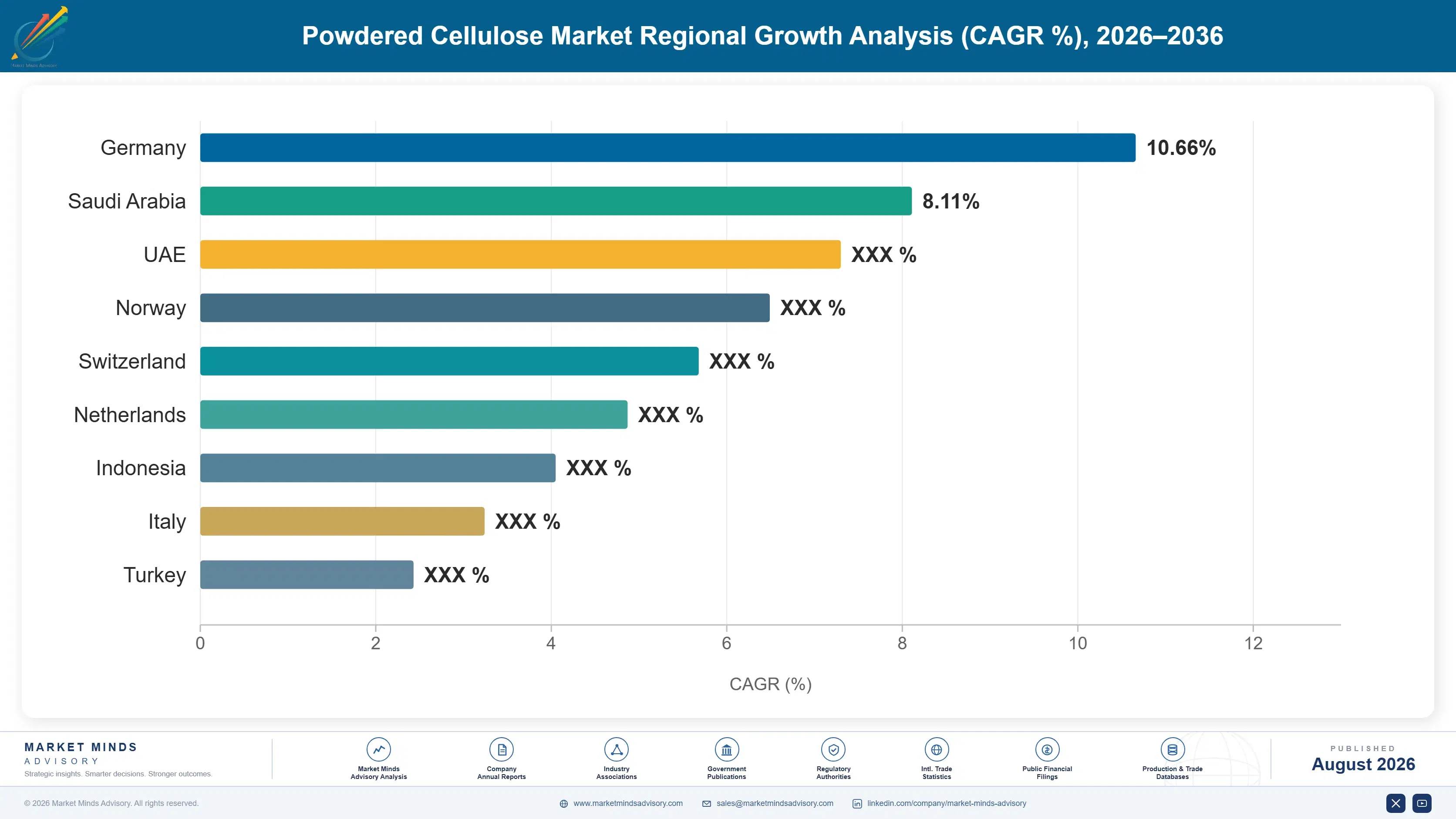
This is a Korea-scoped report, so East Asia holds essentially the entire market and every regional figure reflects supply origin rather than consumption. All seven regional shares therefore sit outside the standard global bands, with supply-side reasons given in each body below. Domestic capacity is minimal.

East Asia

Note: East Asia holds 54% because this is a Korea-scoped report and the region captures both the entire consumption base and the Japanese and Chinese production that supplies most imported volume. Korean formulators sit at the centre, running qualification cycles near 15 months and documentation expectations shaped by the foreign inspectors their pharmaceutical customers must satisfy. Japanese producers including Asahi Kasei and Daicel hold strong positions on quality consistency and proximity, with lead times no other origin matches. Chinese material competes on delivered cost in food and technical grades where documentation matters less. Limited Korean domestic capacity handles specialty and toll processing rather than base production. Lead times matter more here than most buyers admit.
Share: 54% | CAGR: 7.8% (2026 to 2036)

Western Europe

Note: Western Europe registers at 21% purely as a supply origin, since consumption falls outside a Korea-scoped market. German and other European producers supply pharmaceutical excipient grade into Korean formulation, and the drug master file support they carry as standard is precisely what Korean generic exporters need when facing American and European inspection. JRS Pharma holds the strongest position among them. European pharmacopoeia compliance comes built in rather than as an additional exercise, which shortens Korean qualification work considerably. Freight distance and euro exposure both work against the position in food grades, where the documentation advantage carries no premium at all. Indian producers have closed much of the compliance gap that once justified it.
Share: 21% | CAGR: 5.5% (2026 to 2036)
Regional intelligence for 5 additional markets available in the complete report: South Asia and Pacific, North America, Latin America, Eastern Europe, Middle East and Africa. Contact sales@marketmindsadvisory.com.
powdered-cellulose-market-in-korea-country-cagr-analysis-1787335673819

Where Cellulose Suppliers Earn In Korea

Four positions separate suppliers holding durable Korean business from those quoting against delivered cost per kilogram: carrying drug master file support Korean exporters need, qualifying before a competitor is evaluated, holding triple pharmacopoeia compliance, and pricing in won rather than pushing currency risk onto the buyer. The first two of those are the hard ones.

Carry Drug Master File Support Korean Exporters Need

A Korean generic manufacturer shipping into the United States or Europe must satisfy inspectors who have never visited the excipient supplier's plant, and a drug master file removes months of the formulator's own regulatory work. Suppliers carrying that support realise roughly 52% premium pricing over food grade equivalents and reach applications competitors cannot enter at all. The file costs real money to maintain across jurisdictions, and it is the single clearest reason a Korean formulator selects one supplier over another. Pharmacopoeia compliance alone no longer distinguishes anybody in this particular market.
Market Impact: Realises roughly 52% premium over food grade material

Qualify Before A Competitor Is Even Evaluated

Korean formulator qualification takes roughly 15 months of specification work, stability testing, audit and documentation review, and once a supplier is inside a formulation revalidation costs more than any price saving recovers. Qualified suppliers realise 26% to 33% higher pricing than those quoting spot material, on volumes stable enough to plan production against properly. The contest is decided at new product development rather than through displacement, which makes commercial timing matter far more than the offer. Once a formulation is validated the buyer has every reason to leave it alone.
Market Impact: Realises 33% higher pricing on qualified formulation volume

Hold Triple Pharmacopoeia Compliance Across All Monographs

Material must satisfy the Korean Pharmacopoeia monograph alongside United States and European monographs, because Korean pharmaceutical customers export against all three and cannot afford a grade that fails any one of them. Suppliers holding all three enter evaluations that exclude everybody else, which is a narrower field than the quoted price list suggests. Maintaining triple compliance costs roughly 4% of revenue annually in testing and documentation, and it removes competitors more effectively than pricing ever does. Indian producers reaching all three monographs is what changed this contest over the past few years.
Market Impact: Triple compliance costs roughly 4% of annual revenue

Price In Won Rather Than Passing Currency Risk

With roughly 78% of material imported, Korean formulators carry currency exposure they cannot hedge as cheaply as a supplier with a wider book can. Quoting in won shifts that risk to the party better able to manage it and removes the single most common reason a Korean buyer opens a competitive evaluation at all. Suppliers doing so hold volume through won weakness that competitors lose, typically protecting 15% to 20% of the account during a bad currency year. It also signals that the supplier intends to stay in this market.
Market Impact: Protects up to 20% of the account volume

Who Controls the Margin Pool

Concentration reads at 66% for the top five measured on powdered cellulose supply into Korea, the basis used throughout this section, and it reflects documentation capability rather than production scale. JRS Pharma and DuPont Nutrition hold pharmaceutical positions on drug master file depth. Asahi Kasei and Daicel bring Japanese quality consistency and short lead times. Sigachi competes on compliance at Indian cost.
Competition runs on three fronts. Documentation depth is the first and by some distance the most decisive, since a Korean exporter's inspector rather than its purchasing manager effectively selects the supplier. Qualification timing is the second, because displacement is rare and the contest happens at new product development. Delivered cost is the third and matters mainly in food and technical grades.

Pressure arrives from two directions. Indian producers have built genuine pharmacopoeia compliance and now compete on documentation rather than only on delivered cost, which was not true five years ago. Separately, Chinese material holds the food and technical end on price. Rankings will shift toward suppliers combining full documentation with freight economics that European supply cannot match. Documentation and freight together is the combination that wins.
powdered-cellulose-market-in-korea-company-positioning-matrix-1787335674760

Competitive Moat and Risk Dimensions

JRS PHARMA

Moat: Drug master file depth

Drug master files maintained across United States, European and Korean requirements remove months of regulatory work for Korean generic manufacturers exporting into inspected markets, which is worth considerably more than any delivered price difference. Decades of excipient specialisation also produce particle specification consistency that formulators build compression behaviour around and are reluctant to disturb.
JRS PHARMA

Risk: European freight and currency

Delivered cost from European plants is uncompetitive against Japanese, Indian and Chinese supply in food and technical grades where documentation carries no premium. Euro exposure adds a second layer that Korean buyers feel directly, and Indian producers now match the pharmacopoeia compliance that previously justified the whole gap.
ASAHI KASEI

Moat: Proximity and quality consistency

Japanese production delivers lead times and batch consistency no other origin matches for Korean formulators, and quality systems built to expectations Korean buyers share reduce the friction that longer supply chains introduce. Regional proximity also supports the technical service response that Korean formulators treat as part of the supply relationship rather than as an optional extra.
ASAHI KASEI

Risk: Microcrystalline portfolio cannibalisation

A strong microcrystalline cellulose position competes directly against powdered grades in tablet applications, which limits how hard the business can push powdered cellulose without displacing its own higher value volume. Indian suppliers face no such constraint and are pursuing the powdered position with correspondingly greater commercial focus.

Players Tracked

Prominent Players

JRS Pharma
DuPont Nutrition
Asahi Kasei
Sigachi Industries
Daicel Corporation

Other Key Players

International Flavors and Fragrances
Roquette
Borregaard
Rayonier Advanced Materials
Nippon Paper Industries
Mingtai Chemical
Anhui Sunhere Pharmaceutical
Accent Microcell
Blanver
CFF GmbH
Sweetener Supply Corporation
Ankit Pulps and Boards
Ming Tai Chemical
Foodchem International
Samsung Fine Chemicals

Recent Developments

JANUARY 2025

Indian producer completes Korean pharmacopoeia grade qualification

An Indian excipient producer completed qualification of a powdered cellulose grade against Korean Pharmacopoeia requirements alongside its existing United States and European monograph compliance, entering pharmaceutical evaluations that had previously been effectively limited to European and Japanese suppliers. Two Korean formulator evaluations followed within the same year.
Signal: Indian producers now compete on documentation rather than only on delivered cost into Korean pharmaceutical supply
MAY 2025

Korean food manufacturer completes anti-caking agent reformulation

A large Korean food manufacturer completed reformulation removing synthetic anti-caking agents across its shredded cheese and seasoning ranges, substituting powdered cellulose under existing Ministry of Food and Drug Safety approvals and adding meaningful annual volume to domestic food grade demand. Other ranges are scheduled to follow.
Signal: Clean-label reformulation converts one product range at a time rather than arriving as a single category shift
SEPTEMBER 2025

Won-denominated supply agreement signed with Korean formulator

A European excipient supplier agreed multi-year won-denominated pricing with a Korean pharmaceutical formulator, absorbing currency exposure the buyer had been carrying and removing the recurring trigger that had prompted competitive evaluation during periods of won weakness. The agreement runs four years with an annual volume floor.
Signal: Currency terms rather than material specification increasingly decide whether a Korean account opens to competitors at all

What Drives Powdered Cellulose Cost

Dissolving and specialty pulp accounts for roughly 39% of manufactured cost, sourced from North American, Scandinavian and Brazilian producers who price on global pulp markets rather than on excipient demand. Milling and classification energy adds around 18%, which is where particle specification is actually earned. Purification and washing contribute about 13%, packaging and freight roughly 15% given the distances, and quality, testing and regulatory documentation close to 8%.
Global dissolving pulp pricing moved sharply through 2022 and 2023 on capacity closures and energy-driven production costs, with European and North American mills affected most, and International Energy Agency data shows the industrial energy pricing that drove much of it remaining above the previous decade's baseline. Won weakness across 2024 and 2025 compounded the effect for Korean buyers regardless of what happened at the mill.

The disadvantage mechanism is freight and currency combined, and it falls on suppliers by origin rather than by size. European producers carry the longest freight leg and euro exposure on top of it, which is manageable in pharmaceutical grades where documentation supports a premium and impossible where it does not. Japanese and Indian suppliers carry considerably shorter freight and better delivered economics into the same accounts.
powdered-cellulose-market-in-korea-cost-volatility-analysis-1787335675046

Contract dissolving pulp on annual committed volume terms

Pulp represents close to 40% of manufactured cost and prices on global markets that pay no attention to excipient demand, which makes spot exposure uncomfortable across a contract year. Annual committed volume secures predictable cost against customer agreements that are themselves annual. The commitment carries volume risk if demand softens, and that risk is the honest price of predictability.

Quote in won and hedge the exposure centrally

Korean formulators cannot hedge currency as cheaply as a supplier running a wider book, so quoting in won moves that risk to the better placed party. It also removes the commonest trigger for competitive evaluation during won weakness. The supplier prices the hedge in, which is the genuine cost, and it is usually less than the volume protected.

Position regional milling closer to Korean customers

Freight runs near 15% of delivered cost from European origins and considerably less from Japanese or Indian plants, which is why the pharmaceutical premium is the only thing sustaining distant supply. Milling closer to the customer using imported pulp shortens the expensive leg. Capital and quality qualification are both substantial, and volume has to justify them first.

Portfolio Architecture for Margin Defence

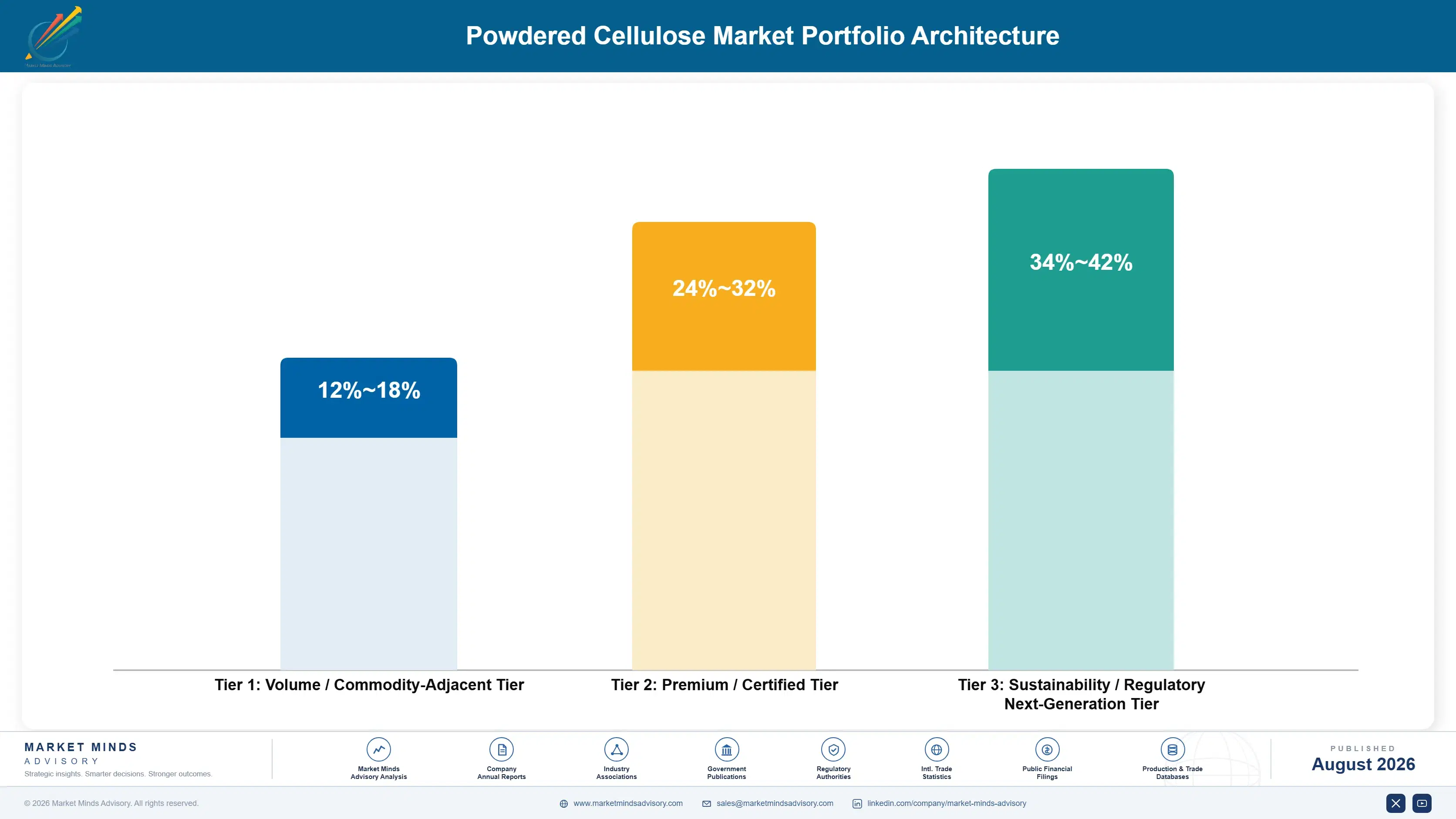
Portfolio economics here divide on documentation rather than on particle specification. Technical and industrial grade sold on delivered cost per kilogram competes against Chinese material that no European or Japanese origin matches on price, and the Korean buyer treats it as interchangeable because at that specification it genuinely is. Nothing about that position is defensible for very long at all.
The middle tier is qualified food grade inside named Korean formulations. Fifteen months of specification and audit work produce a position rarely revisited, though the premium is thinner than pharmaceutical grades because documentation carries no regulatory weight in food applications. Margins reach the high twenties and depend heavily on delivered cost holding steady against imported competition. Freight origin decides more of it than specification does.

Above both sits pharmaceutical excipient grade with drug master file support. That file removes months of a Korean exporter's regulatory work, supports roughly 52% premium pricing over food grade, and reaches applications competitors without it cannot enter at any price. Margins reach the mid forties. The position requires regulatory infrastructure maintained across three jurisdictions, which is a permanent cost rather than a one-off investment.

Volume / Commodity-Adjacent

Technical and industrial grade sold on delivered cost per kilogram. The range reflects pulp cost and freight origin rather than anything the supplier controls, and Korean buyers treat the material as fully interchangeable.
Gross Margin: 13 to 20%

Premium / Certified

Qualified food grade inside named Korean formulations. The range reflects delivered cost position against imported competition and whether the supplier holds a direct formulator relationship or sells through a trading house.
Gross Margin: 25 to 33%

Sustainability / Regulatory / Next-Generation

Pharmaceutical excipient grade supported by drug master files across three jurisdictions. The wide range reflects how complete the documentation is and whether it covers every export destination the Korean customer serves.
Gross Margin: 39 to 48%
powdered-cellulose-market-in-korea-portfolio-architecture-1787335675847

High-value Sub-segments and Strategic Watch-out

Drug Master File Supported Excipient

High value and high growth together. The file removes months of a Korean exporter's own regulatory work and supports roughly 52% premium pricing. The wide range reflects documentation completeness across the export destinations each customer actually serves. Pharmacopoeia compliance alone no longer separates the suppliers here.
Gross Margin: 39 to 48%

Qualified Food Grade Positions

High value on strong growth as clean-label reformulation continues through the Korean manufacturing base. The range reflects delivered cost position against imported competition, which matters far more here than any documentation advantage does. Documentation depth buys very little in food, which leaves freight origin deciding the account.
Gross Margin: 25 to 33%

Cosmetic Formulation Grade Supply

A genuinely premium volume pool serving an export-oriented Korean industry that specifies narrowly and buys on performance. The range reflects particle specification tightness and whether the supplier services the formulator directly rather than through intermediation. Intermediation costs more of the margin here than most suppliers realise.
Gross Margin: 31 to 39%

Technical And Industrial Grade

The strategic watch-out. Volumes are real but Chinese material holds a delivered cost position no other origin matches and specifications are wide enough that buyers switch freely. The range reflects pulp cost and freight origin rather than commercial skill. Switching happens without any notice at all.
Gross Margin: 13 to 20%

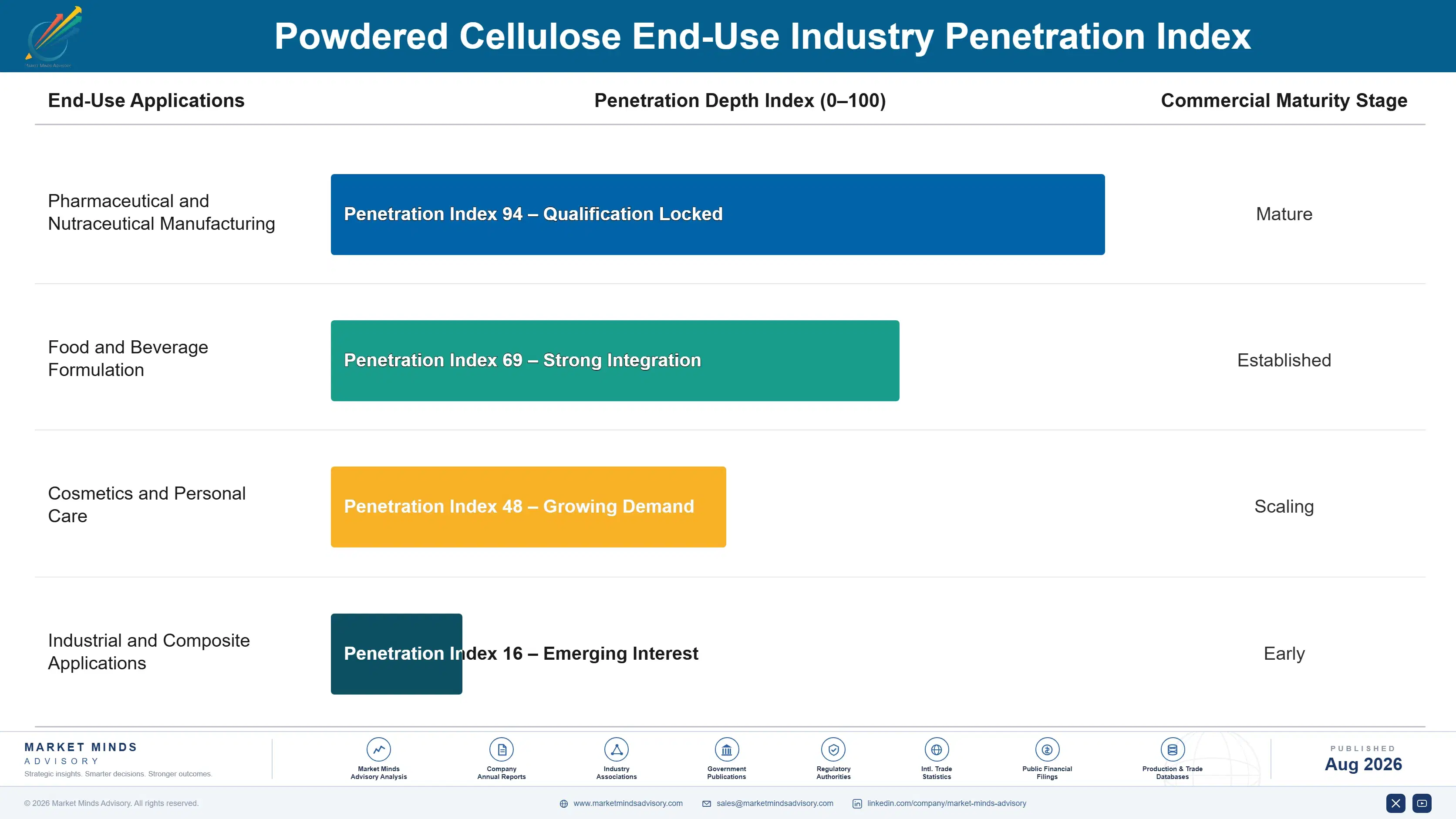
How Korean Cellulose Demand Repeats

Qualified pharmaceutical positions behave like annuities and very little else in this market does. Once an excipient sits inside a validated Korean formulation the volume repeats for as long as the product is made, because revalidation costs more than any price saving recovers and the regulatory risk of a change is genuinely unattractive. Technical grade supply repeats only until somebody quotes lower.
Stickiness varies sharply by grade. Pharmaceutical excipient positions hold best by a wide margin, since the material is named in a filing and changing it can require regulatory notification in every export destination. Cosmetic formulations hold well because sensory performance depends on particle characteristics that vary between suppliers. Food grade holds moderately. Technical and industrial grade holds worst, switching on delivered cost without hesitation.

The buyer profile has shifted noticeably. Korean purchasing once ran heavily through trading houses that intermediated ingredient supply and owned the formulator relationship. Larger pharmaceutical and food manufacturers increasingly buy direct and run their own audits, which rewards suppliers able to service that relationship without an intermediary and disadvantages those whose Korean presence exists only through a trading partner.
powdered-cellulose-market-in-korea-end-use-penetration-index-1787335676340

Where To Compete And Why

These are among the four positions where our research anticipates prominent divergence between winners and laggards over the coming forecast period. Each is grounded in the demand model, the regulatory perimeter, and the announced capacity pipeline.
01 / DOCUMENTATION INFRASTRUCTURE INVESTMENT

Inspectors select the supplier here

A Korean generic manufacturer shipping into the United States or Europe must satisfy inspectors who have never visited the excipient supplier's plant, which makes documentation depth rather than purchasing preference the deciding factor. Drug master file support removes months of the formulator's own regulatory work and sustains roughly 52% premium pricing over food grade equivalents. The file costs real money to maintain across three jurisdictions, and it is a permanent obligation rather than a single investment made once and then forgotten about.
02 / QUALIFICATION TIMING DISCIPLINE

Displacement is rare, development is not

Korean formulator qualification takes roughly 15 months of specification work, stability testing, audit and documentation review, after which revalidation costs more than any price saving a competitor could realistically offer. Qualified suppliers realise 26% to 33% higher pricing than spot material on volumes stable enough to plan production against properly. The contest is therefore decided at new product development rather than through displacement, which makes commercial timing matter far more than the offer itself and considerably more than the price quoted.
03 / CURRENCY TERMS MANAGEMENT

Won pricing keeps accounts closed

With roughly 78% of powdered cellulose imported into Korea, formulators carry currency exposure they cannot hedge as cheaply as a supplier running a wider international book can manage it. Quoting in won moves that risk to the better-placed party and removes the most common trigger for a competitive evaluation during periods of won weakness. Suppliers doing so typically protect 15% to 20% of the account through a bad currency year, and they also signal an intention to stay in this market properly.
04 / FREIGHT ORIGIN POSITIONING

Distance costs what documentation earns

Freight runs near 15% of delivered cost from European origins and considerably less from Japanese or Indian plants, which is why the pharmaceutical documentation premium is the only thing sustaining distant supply into Korea at all. In food and technical grades where documentation carries no premium, delivered economics decide the account outright. Regional milling using imported pulp shortens the expensive leg, but the capital and qualification burden both have to be justified by volume before anything at all gets built there.

Engagement Snapshot From the Field

A live engagement with an industry participant carrying material or product regulatory and market exposure ahead of a defining policy shift, showing how our research translates into a defensible multi-year portfolio strategy.
MARKET MINDS ADVISORY · CLIENT ENGAGEMENT SUMMARY
Korea Powdered Cellulose Producer Strategic Portfolio Review and Transition Roadmap 2026·Investment Scenario on Korea Powdered Cellulose Exposure Evaluation 2025-26
CLIENT PROFILE
A European excipient producer with annual revenue near $310 million (client-reported, unverified by MMA), supplying powdered and microcrystalline cellulose into pharmaceutical and food formulators across Europe, Asia and North America. Korean revenue had grown steadily for a decade but two pharmaceutical accounts had opened competitive evaluations within a single year for the first time in that period.
STRATEGIC CHALLENGE
Indian suppliers had reached the same pharmacopoeia compliance the client's premium had rested on, while won weakness made European delivered pricing look considerably worse than it had. Management needed to decide between defending price, absorbing currency risk through won-denominated terms, or investing in regional milling capacity closer to the customers.
MMA APPROACH
MMA modelled realised margin by grade and account across four years of the client's Korean sales data, benchmarked delivered cost and documentation depth against Indian and Japanese competitors, and assessed regional milling economics against current freight. Nineteen expert interviews with Korean formulator technical and purchasing leads tested what actually triggers a competitive evaluation.
KEY FINDINGS
  1. Every competitive evaluation the client faced had been triggered by currency movement rather than by any dissatisfaction with material quality, documentation depth or technical service provided.
  2. Korean pharmaceutical formulators valued drug master file coverage across every export destination they served, and the client's file covered one destination less than its customers actually shipped into.
  3. Indian competitors matched pharmacopoeia compliance but had not matched drug master file breadth, which several Korean technical leads identified as the remaining and decisive difference.
  4. Regional milling economics did not justify the capital at current Korean volumes, and would have required serving neighbouring markets that the client had not qualified into at all.
CLIENT PROFILE
A European excipient producer with annual revenue near $310 million (client-reported, unverified by MMA), supplying powdered and microcrystalline cellulose into pharmaceutical and food formulators across Europe, Asia and North America. Korean revenue had grown steadily for a decade but two pharmaceutical accounts had opened competitive evaluations within a single year for the first time in that period.
STRATEGIC CHALLENGE
Indian suppliers had reached the same pharmacopoeia compliance the client's premium had rested on, while won weakness made European delivered pricing look considerably worse than it had. Management needed to decide between defending price, absorbing currency risk through won-denominated terms, or investing in regional milling capacity closer to the customers.
MMA APPROACH
MMA modelled realised margin by grade and account across four years of the client's Korean sales data, benchmarked delivered cost and documentation depth against Indian and Japanese competitors, and assessed regional milling economics against current freight. Nineteen expert interviews with Korean formulator technical and purchasing leads tested what actually triggers a competitive evaluation.
KEY FINDINGS
  1. Every competitive evaluation the client faced had been triggered by currency movement rather than by any dissatisfaction with material quality, documentation depth or technical service provided.
  2. Korean pharmaceutical formulators valued drug master file coverage across every export destination they served, and the client's file covered one destination less than its customers actually shipped into.
  3. Indian competitors matched pharmacopoeia compliance but had not matched drug master file breadth, which several Korean technical leads identified as the remaining and decisive difference.
  4. Regional milling economics did not justify the capital at current Korean volumes, and would have required serving neighbouring markets that the client had not qualified into at all.
RECOMMENDED STRATEGY
Phase 1: Phase one: convert the two largest Korean accounts to multi-year won-denominated pricing, since currency rather than quality is what has been opening them to competitors. Phase 2: Phase two: extend drug master file coverage to the remaining export destination Korean customers ship into, closing the one gap Indian competitors could otherwise exploit. Phase 3: Phase three: defer regional milling capital and revisit only if neighbouring market qualification proceeds far enough to support the volume required.
OUTCOME
The client retained both accounts under won-denominated multi-year terms and closed the drug master file gap within nine months (client-reported, unverified by MMA). Korean revenue grew by roughly 14% across the following year despite continued won weakness, realised margin held within a point of prior levels, and no further competitive evaluations were opened.

Frequently Asked Questions

Foundational context covering the market sizes, CAGR, scope, country, region and competition that inform every finding below. This section is provided to cover basics and most often pre-purchase conversations, answered from the MMA Primary Research Dataset.

What is the current size of the Korea Powdered Cellulose Market?

The Korea powdered cellulose market was valued at $0.10 billion in 2025, reaching an estimated $0.11 billion in 2026. That measures supply into Korean pharmaceutical, food, cosmetic and industrial formulation.

How large will the Korea Powdered Cellulose Market be by 2036?

MMA forecasts the market reaching $0.22 billion by 2036, an increase of $0.11 billion over the 2026 base. That represents an expansion multiple of 1.97 times across the forecast period.

What is the CAGR for the Korea Powdered Cellulose Market 2026 to 2036?

The base case compound annual growth rate is 7.0%, with a bull case of 8.2% and a bear case of 5.8%. Historical growth between 2020 and 2025 ran at 6.0% annually.

Which segment is growing fastest?

Pharmaceutical excipient grade grows at 10.5%, a full 1.50 times the market rate, on Korean generic export expansion into regulated markets. Food grade powdered cellulose follows at 8.8% annually.

Who are the major companies in the Korea Powdered Cellulose Market?

JRS Pharma, DuPont Nutrition, Asahi Kasei, Sigachi Industries and Daicel Corporation lead on supply into Korea. Together they account for roughly 66%, which is high for a specialty excipient.

Which country is growing fastest?

South Korea is the defined scope of this report and grows at 7.0% annually, driven by pharmaceutical export expansion and clean-label food reformulation. No comparison country applies here.

Report Segmentation Architecture

The full report scope spans multiple orthogonal segmentation dimensions, with cross-tabulated demand data provided for each dimension pair. Coverage extends further to regional breakdowns, trend trajectories, and the competitive detail needed to support segment-level decision-making.

By Product Grade

  • Pharmaceutical Excipient Grade
  • Food Grade Powdered Cellulose
  • Cosmetic Formulation Grade
  • Technical and Industrial Grade
  • Specialty Modified Powdered Cellulose

By End-Use Industry

  • Generic Pharmaceutical Manufacturing
  • Processed Food and Dairy
  • Cosmetics and Personal Care
  • Dietary Supplements and Nutraceuticals
  • Industrial and Construction Applications
  • Animal Feed and Pet Nutrition

By Commercial Dimension

  • Direct Supply to Formulators
  • Trading House Intermediated Supply
  • Contract Manufacturing Supply
  • Toll Milling and Processing
  • Distributor Stock Supply

By Region

  • East Asia
  • Western Europe
  • South Asia and Pacific
  • North America
  • Latin America
  • Eastern Europe
  • Middle East and Africa

Scope, Methodology, and Coverage

Every figure in this report is reproducible from documented input assumptions. The scope below maps the historical period, the forecast horizon, the segmentation dimensions, and the countries covered, alongside the underlying primary and qualitative methodology.
Historical Period
2020 to 2025
Forecast Period
2026 to 2036
Base Year
2025 (USD billions; MMA Primary Research Dataset, August 2026)
Market Definition
This report covers powdered cellulose supplied into Korean pharmaceutical, food, cosmetic and industrial formulation, spanning pharmaceutical excipient grade, food grade, cosmetic formulation grade, technical and industrial grade, and specialty modified powdered cellulose, across direct, trading house, contract manufacturing and toll processing channels. Microcrystalline cellulose sold under its own monograph, cellulose ethers including carboxymethyl and hydroxypropyl derivatives, nanocellulose and microfibrillated grades, and pulp sold for paper or textile manufacture are excluded from the sizing.
Quantitative Units
USD billions at supplier realised value; volume in thousand tonnes; contract pricing in USD per kilogram.
Segmentation Dimensions
By product grade; by end-use industry; by commercial dimension; by supply origin region.
Regions Covered
East Asia, Western Europe, South Asia and Pacific, North America, Latin America, Eastern Europe, Middle East and Africa
Countries Covered
South Korea as the defined market, with supply origin coverage of Japan, China, Taiwan, India, Australia, United States, Canada, Brazil, Chile, Germany, France, Norway, Sweden, Finland, Netherlands, Italy, Poland, Czech Republic, Turkey and South Africa.
Key Companies Profiled
JRS Pharma, DuPont Nutrition, Asahi Kasei, Sigachi Industries, Daicel Corporation, International Flavors and Fragrances, Roquette, Borregaard, Rayonier Advanced Materials, Nippon Paper Industries, Mingtai Chemical, Accent Microcell, CFF GmbH, Samsung Fine Chemicals and others.
Quantitative Methodology
Primary survey, n=3,800 respondents, Q4 2025, six countries; demand-side model with trade association cross-validation
Qualitative Methodology
47 expert interviews, Q4 2025; applied to validate demand model assumptions, identify emerging dynamics, and assess competitive positioning
Report Format
PDF and XLSX data workbook (Word format preview document)
Publisher
Market Minds Advisory
Report Code
MMA-2026-CHM-103
Published
August 2026
Contact
sales@marketmindsadvisory.com | www.marketmindsadvisory.com

Purchase the full Korea Powdered Cellulose Market Report (2026 to 2036).

The full report sizes the Korea powdered cellulose market across five product grades, six end-use categories and seven supply origin regions, with tonnage and per kilogram pricing detail behind every value estimate. It profiles twenty companies on documentation depth, qualification position and delivered cost economics. Chapters cover Korean Pharmacopoeia requirements, drug master file practice and Ministry of Food and Drug Safety approvals in detail. Cost analysis quantifies pulp, milling energy and freight exposure separately by supply origin. Import dependence analysis maps currency exposure and qualification barriers facing each producing region.
Tonnage and per kilogram pricing by product grade
Korean Pharmacopoeia and drug master file requirements detailed
Qualification cycle benchmarking across Korean formulators
Pulp, milling and freight cost economics by origin
Competitive position assessments across twenty companies
Import dependence and currency exposure risk analysis

Built For The People Who Decide

From boardroom strategy to bench-side execution, this report is read cover-to-cover by leaders shaping the next decade of their industry, turning demand scenarios, market dynamics and valuation benchmarks into decisions.
CXOs/ Presidents/ VPs/ Managers
M&A and Corporate Development
Strategy Teams and R&D Heads
Procurement and Product Directors
Regulatory and Compliance Leaders
Investor Relations and Equity Analysts