Market Minds Advisory
Powder-to-Serum Microcapsules Market

Powder-to-Serum Microcapsules Market: Powder-to-Serum Microcapsules: Payload Fraction, Rupture Reliability and the Stability Claim That Ends At Reconstitution, 2026 to 2036

Most of what a brand buys here is wall material, roughly a third of the capsules never open on skin, and the stability claim expires the moment water touches the powder.

Lead Analyst

Published

September 2026

Make Smarter Decisions with Customized Research Insights

Request a free sample report and evaluate market opportunities, growth trends, and competitive dynamics relevant to your business needs.

2025 MARKET VALUE$0.6BMarket Size 2025
2036 FORECAST VALUE$2.7BBase Case , 2026 to 2036
CAGR 2026 TO 203614.6 %Bull 15.9% / Bear 13.3%
INCREMENTAL OPPORTUNITY$2.0BNet 10- year value creation
EXPANSION MULTIPLE3.86x2036 value over 2026 base
Strategic Levers
M&A Pipeline
Regional Outlook
Country Rankings
Competitive Intelligence
Segmental Deep-dive
Call-Us : 91 93563 13602

Executive Snapshot and Market Trajectory.

Active payload averages 23% of capsule mass, which means roughly three quarters of what a brand purchases is wall material. Only 17% of suppliers publish that figure, quoting total powder weight instead. That single omission lets a weak system look identical to a strong one on any purchase order.
Liposomal and lipid vesicle dry systems grow at 21.9%, half again the market rate of 14.6%, because dried vesicles carry the fragile actives that made this format worth building in the first place. Polymer core-shell capsules follow at 18.7%. Both address the same underlying problem, which is that vitamin C, retinoids, and peptides degrade in water and everything else is a workaround. Spray-dried matrix systems grow at roughly half that pace.
Rupture is the quieter failure. A capsule must survive manufacture, filling, and transport intact and then break reliably under a finger, and those requirements pull directly against each other. About 68% release payload reliably in normal use, and nobody downstream of the supplier can tell which capsules did and which did not. Single dose formats now carry 54% of volume for that reason. A mixed serum begins degrading measurably within about six hours of reconstitution.
Market Definition
This market covers microencapsulated active delivery systems supplied in dry powder form that reconstitute into a serum at the point of use, including spray-dried matrix microcapsules, complex coacervation microcapsules, liposomal and lipid vesicle dry systems, cyclodextrin inclusion complexes, polymer shell core-shell microcapsules, and freeze-dried porous capsule systems. It excludes anhydrous powder cosmetics without capsule architecture, conventional emulsions and serums, transdermal delivery systems, oral nutraceutical capsules, and finished branded products.
Base Year Value
$0.6B in 2025 (MMA Primary Research Dataset, September 2026)
Forecast Period
2026 to 2036, eleven discrete annual values
CAGR
14.6% base case. Bull 15.9%. Bear 13.3%.
Fastest Growth Segment
Liposomal And Lipid Vesicle Dry Systems: 21.9% CAGR
Fastest Growth Country
South Korea: 19.8% CAGR
Fastest Growth Region
South Asia and Pacific: 16.6% CAGR
Largest Region
East Asia: 41% of 2025 global value
Market Leaders
Lipotec, Ashland, Cosmax, Kolmar Korea, and Givaudan Active Beauty lead the field. Source: MMA Primary Research Dataset, July 2026.
Primary Survey
n=3,800 procurement and R&D decision-makers, Q4 2025, six countries
Methodology
Demand-side build-up, cross-validated against public data, 47 expert interviews

Powder-to-Serum Microcapsules Market Forecast Scenarios

powder-to-serum-microcapsules-market-size-forecast-scenario-1790013447740
Between 2020 and 2025 the category grew at 13.0% from a Korean starting point. Ampoule and capsule formats established the mixing ritual as something consumers would accept rather than resent, and preservative-free positioning gave brands a reason to remove water that had nothing to do with the actives inside. Western adoption followed years behind, through Korean contract manufacturers.
The base case at 14.6% rests on three mechanisms. Fragile active demand keeps growing as vitamin C, retinoids, and peptides move into mass ranges where stability was previously impossible to hold. Preservative-free claims spread across sensitive skin positioning. And shipping weight economics improve as brands sell into more markets, since removing water removes most of the freight cost from a serum. None of the three requires the encapsulation itself to perform better than it currently does.
The bull case at 15.9% depends on payload and rupture disclosure becoming standard, which would let brands compare systems and pay for the better ones. The bear case at 13.3% is consumer effort: the format asks somebody to mix a product correctly every time, and any category that depends on a consumer performing a step properly loses users steadily to formats that ask for nothing.

What Is Actually In The Powder

The engineering case for this format is genuinely good. Vitamin C oxidises in water, retinoids photodegrade, peptides hydrolyse, and probiotics die. Removing the water solves all four problems at once and removes the preservative system along with them. That is a real advance and it explains why the category grows at nearly fifteen percent while conventional serums do not.
TOP FIVE CONCENTRATION26%Share of category revenue held by the leading suppliers
ACTIVE PAYLOAD FRACTION23%Capsule mass that is active rather than wall material
RUPTURE SUCCESS RATE68%Capsules releasing payload reliably under normal application pressure
PUBLISHED PAYLOAD DISCLOSURE17%Suppliers stating loading rather than total powder weight
RECONSTITUTED STABILITY WINDOW6 hoursTime before a mixed serum begins measurable active degradation
SINGLE DOSE FORMAT SHARE54%Volume supplied in single use rather than multi dose
The commercial case is looser. Active payload averages 23% of capsule mass, so a brand buying a kilogram of encapsulated vitamin C is buying roughly 230 grams of vitamin C and 770 grams of gum, maltodextrin, or polymer shell. Only 17% of suppliers publish the loading, and specifications quoting total powder weight let a low-payload system look identical to a high-payload one on any purchase order.
Then rupture, which almost nobody measures downstream. A capsule tough enough to survive high-shear filling and six months in a warehouse is frequently too tough to break under a fingertip, and roughly 68% release payload reliably in ordinary use. The consumer feels the texture change either way, so nothing in the experience distinguishes a capsule that opened from one that simply washed off.
"Three quarters of the powder is wall, about a third of the capsules never open, and the twenty-four month stability claim ends the second water hits it. All three of those are measurable, none of them is secret, and hardly anybody puts them on a technical data sheet."
Practice Director, Delivery Systems and Active Ingredients · MMA Chemicals and Materials Practice · September 2026

Market Trends

Dried Vesicles Carry The Actives That Justify The Format

Liposomal and lipid vesicle dry systems grow at 21.9%, the fastest rate here, because they hold the fragile actives that made anhydrous delivery worth building around in the first place. Vitamin C, retinoids, and peptides all degrade in water and all survive in a dried vesicle far longer than any conventional system permits. Drying the vesicles without collapsing them is the technical difficulty, and lyoprotectant chemistry rather than encapsulation science is what separates producers who manage it consistently. Payload fractions in these systems are also the lowest of any architecture, frequently below a fifth.
Market Impact: Country grows at 19.8%
Single Dose Formats Answer The Reconstitution Problem

About 54% of volume now ships as single use sachets and ampoules rather than multi-dose containers, and the reason is that a single dose removes every question about mixing ratio and about how long the reconstituted serum then sits. A mixed serum begins measurable degradation within roughly six hours, which multi-dose formats simply cannot address. Packaging cost rises considerably per application, and brands accept it because the alternative undermines the stability argument entirely. Retail presentation also suits the format, since a sachet communicates freshness a powder jar cannot. Multi-dose containers cannot make the same claim without qualifying it.
Market Impact: Cuts shipping weight 71%

Market Opportunities and Growth Drivers

Korean Formulation Established The Format And Still Leads It

South Korean growth of 19.8% leads every country covered, and the format itself originated there in ampoule and capsule products that taught consumers to accept a mixing step rather than resent it. Korean contract manufacturers now produce most of the world's supply for brands headquartered elsewhere, which means the format arrives in Western markets already engineered. The direction of influence runs outward from Seoul, which is unusual in cosmetic delivery technology. Japanese producers hold the deepest liposomal drying competence within the region, and Chinese manufacture is scaling fast at the spray-dried end where the engineering asks least.
Market Impact: Only 68% release reliably

Removing Water Removes Preservatives And Freight Together

An anhydrous powder needs no preservative system, which answers sensitive skin positioning directly, and it removes most of the shipping weight from a product that is otherwise mostly water. Brands selling across many markets gain more from the freight economics than from the stability argument they lead with publicly. Both benefits are real and independent of whether the encapsulation performs well, which is part of why the format spread faster than the technology matured. Brands selling into many markets gain more from freight economics than from the stability argument they lead with publicly.
Market Impact: Window closes in 6 hours

Market Restraints and Challenges

Rupture Reliability Cannot Be Verified Downstream

Roughly 68% of capsules release payload reliably under normal application pressure, and the root cause is that surviving high-shear filling and warehouse storage requires a shell strength that works against breaking under a fingertip. Commercially the failure is invisible: the consumer feels the texture change whether the capsule opened or washed off intact. Suppliers respond with rupture testing protocols, with dual-trigger shells responding to both pressure and hydration, and with published release data. Very few brands test release performance independently before committing to a system. Testing costs almost nothing against a failed launch.
Market Impact: Segment grows at 21.9%

The Stability Claim Ends At Reconstitution

A powder stable for twenty-four months becomes an ordinary unstable serum within roughly six hours of mixing, and the root cause is simply that the water the format removed is added back at the point of use. Commercially it makes multi-dose formats difficult to defend honestly. Suppliers respond by pushing single dose packaging, by adding secondary stabilisers to the reconstitution medium, and by stating the post-mixing window plainly on technical documentation. Single dose packaging costs considerably more per application, and brands accept that because the alternative undermines the whole positioning.
Market Impact: Covers 54% of volume
4 additional market trends, 3 additional growth drivers, and 2 additional restraints and challenges are covered in the full report. Contact sales@marketmindsadvisory.com to access the complete intelligence.

Segment CAGR and Growth Architecture

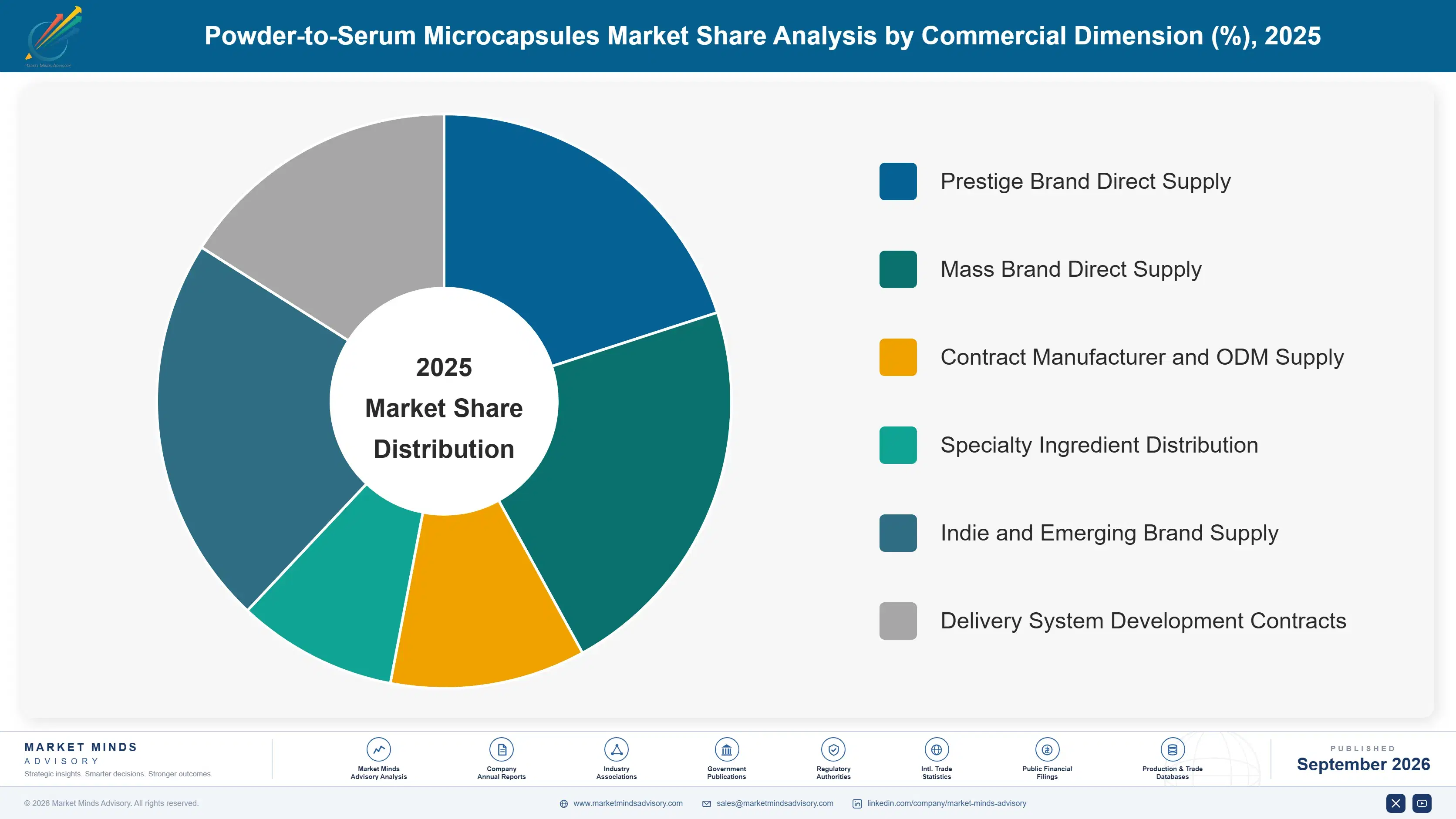
Segmentation follows encapsulation architecture across six families: spray-dried matrix microcapsules, complex coacervation microcapsules, liposomal and lipid vesicle dry systems, cyclodextrin inclusion complexes, polymer shell core-shell microcapsules, and freeze-dried porous capsule systems. Active type, packaging format, and reconstitution medium are treated as separate dimensions entirely. Reconstitution media supplied alongside are counted within the system they accompany.
powder-to-serum-microcapsules-market-market-share-analysis-1790013448657

Liposomal And Lipid Vesicle Dry Systems

Dried vesicle systems grow at 21.9%, half again the market rate of 14.6%, because they carry the fragile actives that made this whole format worth constructing. Vitamin C, retinoids, peptides, and probiotics all degrade rapidly in water and all survive far longer inside a dried vesicle than any conventional serum permits. The technical difficulty sits in drying without collapsing the bilayer, and lyoprotectant chemistry rather than encapsulation science is what separates producers who manage that reliably. Payload fractions here are also the lowest of any architecture, frequently below a fifth, which the marketing rarely mentions. Drying yield rather than encapsulation science sets the economics here. Payload disclosure matters most in exactly this architecture.
CAGR 21.9%

Polymer Shell Core-Shell Microcapsules

Core-shell polymer capsules grow at 18.7% on payload fractions considerably better than vesicle systems achieve and on rupture behaviour that can actually be engineered rather than merely hoped for. Shell thickness and crosslink density are both adjustable, which lets a producer tune the balance between surviving a filling line and breaking under a fingertip. That tuning is the whole commercial argument. Regulatory scrutiny of synthetic polymer particles in leave-on cosmetics is the segment's clearest medium-term risk, and biodegradable shell chemistry is being developed against exactly that concern. Producers with genuine dual-trigger capability report release rates far above the category average, and several competitors describe their shells that way while behaving as conventional single-trigger systems.
CAGR 18.7%
Full segment breakdown across 6 segments available in the complete report.

Regional Architecture and Country Demand Map

Regional shares here track where powder-to-serum systems are formulated and manufactured rather than where the finished products are sold, since Korean contract manufacture supplies brands across every region. Three regions sit outside the standard bands, for reasons named in their paragraphs and summarised for operator review.

East Asia

At 41% this region sits well above the standard band, and the justification is that the format originated in Korean ampoule and capsule products and Korean contract manufacturers now produce most of the world's supply for brands headquartered elsewhere. Korean growth of 19.8% leads every country covered. Japanese producers hold the deepest liposomal drying competence, and Chinese manufacture is scaling quickly at the spray-dried end where the engineering is least demanding and price competition is heaviest. Consumers across the region accepted the mixing ritual years before Western markets did, which gave producers the volume to refine the engineering. That head start still shows in payload fractions and release performance. Payload disclosure practice lags the engineering.
Share: 41% | CAGR: 15.6% (2026 to 2036)

North America

Adoption here came several years after Korea and largely through Korean contract manufacturers rather than domestic development, which means brands frequently specify a system without understanding its payload or rupture characteristics. Growth of 14.2% tracks close to the world rate. Single dose formats have taken share faster than in most regions, since retail distribution and the preservative-free claim both favour them. Domestic encapsulation capability remains concentrated in a small number of specialists. Payload disclosure practice is improving faster here than elsewhere, driven by technical formulation teams at prestige brands who began asking the question after efficacy testing disappointed them. Efficacy testing against conventional serums from the same range was what prompted those questions.
Share: 22% | CAGR: 14.2% (2026 to 2036)
Regional intelligence for 5 additional markets available in the complete report: Western Europe, South Asia and Pacific, Latin America, Middle East and Africa, Eastern Europe. Contact sales@marketmindsadvisory.com.
powder-to-serum-microcapsules-market-country-cagr-analysis-1790013449490

Where Suppliers Earn Their Specification

Four commercial moves separate the suppliers building durable positions in this market from those simply selling a powder against a total weight specification. Each of them publishes something that the category currently prefers to keep quiet: active payload fraction, rupture release performance, the post-mixing stability window, and what the shell chemistry actually consists of.

Publish Active Payload Not Powder Weight

Active payload averages 23% of capsule mass and only 17% of suppliers state it, so specifications quoting total powder weight let a weak system look identical to a strong one. Suppliers publishing payload fraction report specification win rates 2.4 times higher with technical formulation teams who already suspect the gap. Disclosure costs nothing, and it converts a purchase decision made on price per kilogram into one made on cost per unit of delivered active. Brands comparing on delivered active generally reach a different conclusion. Suppliers with genuine payload should be forcing that comparison.
Market Impact: Raises specification win rates to 2.4 times higher

Test And Publish Rupture Release Data

Around 68% of capsules release payload reliably under normal application pressure, and nobody downstream can distinguish a capsule that opened from one that washed off intact. Suppliers publishing rupture release data under defined pressure report account retention 3.1 times higher than those making qualitative release claims. It also identifies the shell strength problem before a brand launches on a system that survives filling and then never opens on skin. Testing costs very little against a failed launch. By the time a brand discovers it, the packaging is printed and the launch date is fixed.
Market Impact: Raises account retention rates to 3.1 times higher

Engineer Dual-Trigger Shells For Reliable Release

Shell strength that survives high-shear filling works directly against breaking under a fingertip, which is why release reliability sits near two thirds. Suppliers offering shells responding to both mechanical pressure and hydration report release rates of 89% to 94% against single-trigger equivalents. It resolves a genuine engineering conflict rather than trading one requirement against the other, and it is the clearest technical differentiator currently available in this category. Nothing else currently available addresses the conflict directly. Shell thickness and crosslink density are both adjustable, so the tuning is genuinely available.
Market Impact: Raises release rates to between 89 and 94%

State The Post-Mixing Window Quite Plainly

A powder stable for twenty-four months becomes an ordinary serum within roughly six hours of reconstitution, and multi-dose formats cannot honestly avoid that. Suppliers stating the window in technical documentation report single dose format conversion 2.7 times higher, because brands then choose packaging that protects the claim they intend to make. Leaving it unstated produces multi-dose launches that undermine the stability positioning the whole format exists to support. The disclosure costs a line in the technical documentation. Multi-dose launches that leave it unstated undermine the positioning the whole format exists to support.
Market Impact: Raises single dose conversion to 2.7 times higher

Who Controls the Margin Pool

Concentration is low. Five suppliers hold 26% of category revenue, measured consistently on that basis across all participants, and the remainder spreads across Korean contract manufacturers, specialist encapsulators, and active ingredient houses that added capsule capability to existing portfolios. Barriers to entry are lower than the technology suggests, which is why the field keeps widening. Korean contract manufacturers in particular can enter with production scale and no encapsulation research history behind them at all.
Competition currently turns on three dimensions: payload fraction achieved, which decides cost per unit of delivered active; rupture reliability, where dual-trigger shell engineering is the clearest current differentiator; and drying capability for vesicle systems, since collapsing a bilayer during lyophilisation destroys the whole proposition. Regulatory positioning on shell chemistry has become a fourth dimension as European rules narrow what polymer architectures can be specified.

Pressure builds from two directions. Chinese producers compete hard at the spray-dried end and are moving upward. Meanwhile European polymer particle rules threaten core-shell architectures directly. Rankings will shift toward suppliers publishing payload and rupture data, since disclosure is becoming the basis on which brands now compare. Payload and release disclosure is the dimension separating the field most clearly now.
powder-to-serum-microcapsules-market-company-positioning-matrix-1790013450439

Competitive Moat and Risk Dimensions

LIPOTEC

Moat: Active And Delivery Integration

Holding both the peptide actives and the delivery architecture lets the business optimise payload and release together rather than encapsulating somebody else's ingredient to a specification. That integration produces payload fractions competitors working from supplied actives struggle to match, and it makes the commercial conversation about delivered performance rather than powder price.
LIPOTEC

Risk: Polymer Shell Regulatory Exposure

Core-shell polymer architectures sit directly within European rules on synthetic polymer particles in leave-on cosmetics, and a substantial part of the portfolio depends on them. Shifting toward coacervation or cyclodextrin systems means rebuilding release engineering that took years to establish in the first place. Biodegradable shell chemistry is being developed against exactly that concern.
COSMAX

Moat: Korean Contract Manufacturing Scale

Manufacturing scale serving brands headquartered across every major region gives unmatched volume in a format that originated in Korea and still concentrates there. Brands arriving from Western markets receive a system already engineered and proven at production scale, which removes development risk they have no internal capability to manage themselves.
COSMAX

Risk: Limited Payload Disclosure Practice

Contract manufacturing economics reward supplying to a brand's specification rather than educating that brand about payload fraction, and the business discloses less than specialist encapsulators increasingly do. As disclosure becomes the comparison basis, that position looks progressively harder to defend in front of technical buyers.

Players Tracked

Prominent Players

Lipotec
Ashland
Cosmax
Kolmar Korea
Givaudan Active Beauty

Other Key Players

Croda International
Evonik Industries
BASF
Symrise
Seppic
Gattefosse
Lipoid Kosmetik
Sederma
Infinitec Activos
Encapsys
Balchem
Tagra Biotechnologies
Salvona Technologies
Cospharm
Nanovex Biotechnologies

Recent Developments

FEBRUARY 2026

Tagra Biotechnologies Publishes Payload And Rupture Data Across Capsule Range

Tagra Biotechnologies began publishing active payload fractions and rupture release performance under defined pressure across its capsule range, disclosing two figures that specifications across this category have historically omitted entirely. Data covers every architecture rather than a selected subset, which makes it comparable. Two competitors matched it within a quarter.
Signal: Disclosure becomes a competitive weapon rather than a commercial liability here. Competitors must now match it or explain the omission.
SEPTEMBER 2025

Cosmax Expands Freeze-Dried Capsule Production Capacity In Korea

Cosmax completed an organic capacity expansion for freeze-dried capsule production, funded internally with no partner involved, after Western brand demand for anhydrous delivery formats outran available lyophilisation and filling throughput at existing sites. Lyoprotectant formulation work accompanied the expansion. Lyoprotectant formulation work accompanied the equipment investment.
Signal: Lyophilisation capacity rather than encapsulation science is the current constraint. Drying yield decides the economics in this architecture.
APRIL 2025

Lubrizol Acquires Encapsulation Technology Specialist

Lubrizol completed an acquisition of an encapsulation technology specialist, adding dual-trigger shell engineering and lyoprotectant formulation depth to a portfolio previously built around actives supplied for somebody else to encapsulate. Encapsulating somebody else's active to a specification had limited how far payload could be optimised.
Signal: Delivery engineering is being bought by active ingredient houses directly. Integration lets payload and release be optimised together.

What A Capsule Costs

Three input groups dominate cost. Shell and wall materials run 30% to 38% of cost of goods sold, and the eight-point range separates commodity maltodextrin and gum arabic from engineered polymer and lipid systems. Active ingredient payload takes 26% to 34%, which is lower than most brands assume given payload averages 23% of mass. Drying process energy adds 22% to 30%, with lyophilisation firmly at the top.
Freeze-drying energy costs moved sharply through 2024 and 2025 as industrial electricity pricing shifted across Korea, Japan, and Europe, and several contract manufacturers described the resulting margin pressure in their annual reports for those years. EIA energy price series document the underlying movement. Gum arabic and maltodextrin wall material pricing followed agricultural harvest conditions on a completely separate path. Neither input responded to anything happening in cosmetics.

The competitive disadvantage mechanism runs through drying yield rather than through materials. Lyophilisation is slow and energy intensive, and a producer collapsing vesicles during the cycle discards a batch whose active content is the most expensive thing in it. Exposure varies sharply by architecture: spray-dried producers face modest energy exposure while liposomal specialists carry both the energy cost and the yield risk together.
powder-to-serum-microcapsules-market-cost-volatility-analysis-1790013450772

Optimise Lyoprotectant Chemistry Before Adding Dryer Capacity

Collapsing a bilayer during lyophilisation discards a batch containing the most expensive material in the process, and adding dryer capacity simply produces more failed batches at greater cost. Lyoprotectant formulation work returns considerably more than equipment investment does, and it also improves the payload fraction that competitive comparison increasingly rests on. Equipment investment without it compounds the loss.

Contract Wall Materials Against Agricultural Cycles

Gum arabic and maltodextrin follow harvest conditions in growing regions that have nothing to do with cosmetic demand, while polymer shell materials track petrochemical feedstock entirely separately. Managing both exposures on distinct contracting cycles avoids renewing everything at a single moment that happens to suit neither input. Wall supply tightens for reasons no cosmetic producer can anticipate.

Match Architecture To The Active Rather Than The Plant

Producers default to the encapsulation architecture their equipment favours rather than the one an active actually needs, which wastes payload and produces poor release. Selecting architecture by active stability requirement first improves delivered performance and frequently reduces cost, since spray drying is far cheaper than lyophilisation where it will serve. Architecture choice is frequently made backwards.

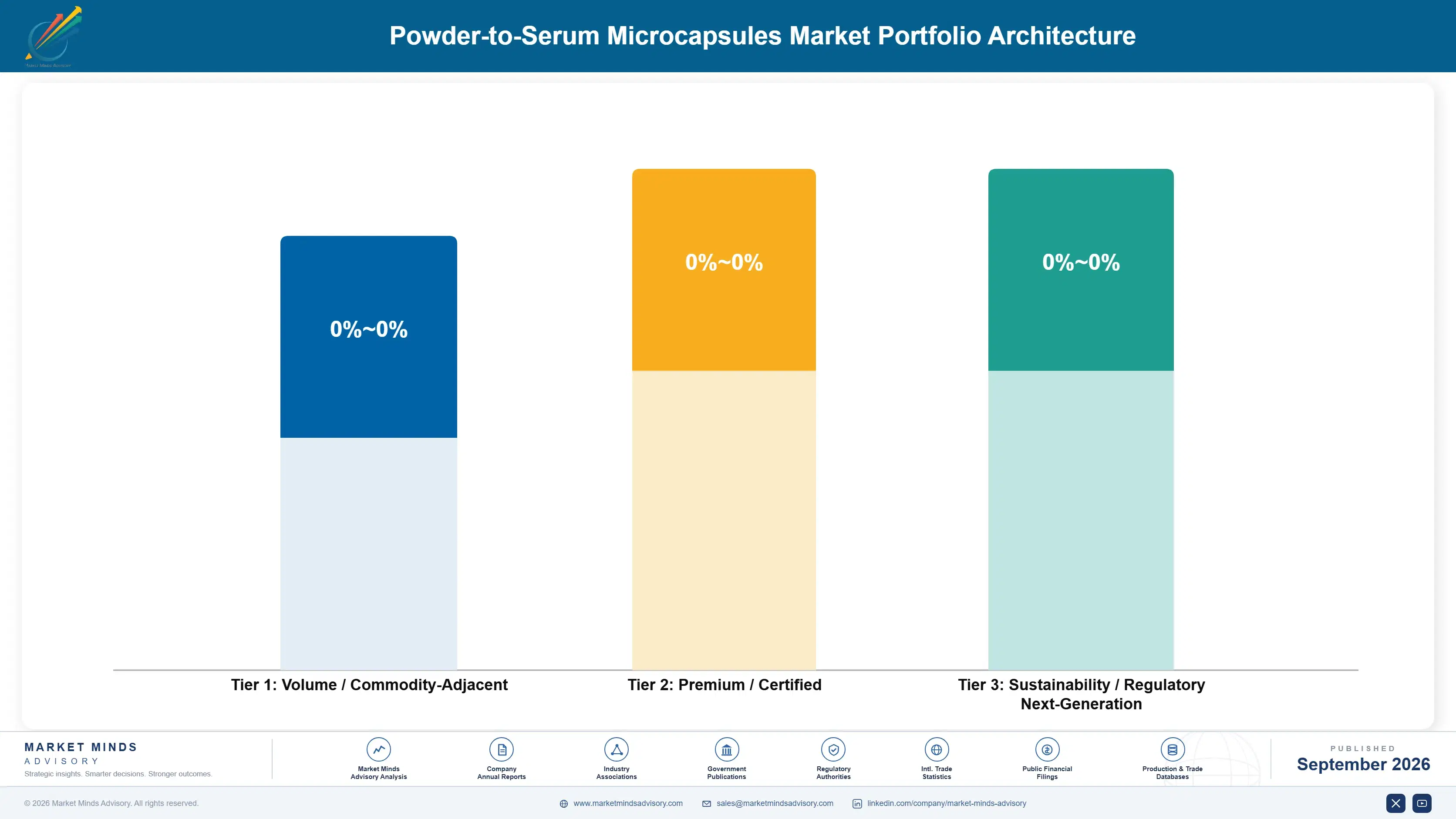
Portfolio Architecture for Margin Defence

Margin follows what the supplier is willing to prove. Spray-dried matrix systems compete on price against Chinese producers with adequate technology for undemanding actives. Coacervation and cyclodextrin systems earn moderately on avoiding the polymer question. Dual-trigger engineered shells and dried vesicle systems earn most, because both solve problems that a brand cannot solve itself and cannot verify without help. The margin spread across those four groups is very wide indeed.
The tension between volume and premium runs through how the brand buys. A brand purchasing against total powder weight chooses the cheapest kilogram and receives whatever payload comes with it. A brand purchasing against delivered active and published release data pays considerably more per kilogram and frequently less per unit of active reaching skin, which is the comparison suppliers should be forcing.

High-value pools concentrate where the active is fragile and expensive: peptides, stabilised vitamin C, retinoids, and live probiotic systems where a failed capsule wastes material worth many times the encapsulation. Where the active is a commodity humectant and the powder-to-serum moment is the whole proposition, price decides and any spray-dried system will do. That divide follows the active rather than the brand tier.

Volume / Commodity-Adjacent

Spray-dried matrix systems carrying stable actives where the transformation moment rather than the delivery performance is the proposition. The ten-point range reflects drying scale and wall material purchasing rather than any capability a formulator would pay more to obtain.
Gross Margin: 24% to 34%

Premium / Certified

Coacervation and cyclodextrin systems supplied with payload disclosure and avoiding synthetic polymer shell chemistry entirely. The twelve-point range separates suppliers publishing loading and release data from those quoting total powder weight against a specification.
Gross Margin: 38% to 50%

Sustainability / Regulatory / Next-Generation

Dual-trigger engineered shells and dried vesicle systems carrying fragile actives with published rupture performance. The sixteen-point range reflects drying yield and lyoprotectant capability, which very few producers hold consistently across successive batches.
Gross Margin: 54% to 70%
powder-to-serum-microcapsules-market-portfolio-architecture-1790013451625

High-value Sub-segments and Strategic Watch-out

Dried Vesicle Delivery Systems

Highest value in the category, growing at 21.9% on fragile actives that no conventional serum can hold stable through a supply chain. The sixteen-point range reflects lyoprotectant capability, since a collapsed bilayer discards the most expensive material in the batch. Payload fractions here are also the lowest.
Gross Margin: 56% to 72%

Dual-Trigger Engineered Shells

High value resolving the conflict between surviving a filling line and breaking under a fingertip during use. The fourteen-point range reflects genuine dual-trigger engineering against shells described that way while behaving as conventional single-trigger systems. Release data is what separates the two claims. Published data settles it quickly.
Gross Margin: 46% to 60%

Coacervation And Cyclodextrin Systems

Volume core avoiding synthetic polymer shell chemistry that European rules on leave-on cosmetics capture directly. The twelve-point range reflects payload fraction achieved, which varies considerably between producers using nominally identical wall chemistry. European polymer rules have accelerated adoption here considerably. Payload varies widely between producers using identical chemistry.
Gross Margin: 36% to 48%

Commodity Spray-Dried Matrices

The strategic watch-out. Chinese producers supply adequate systems for stable actives at prices established suppliers cannot match, and the application asks nothing that better engineering would improve. The ten-point range reflects drying scale alone. The transformation moment is the entire proposition. Better engineering would improve nothing here.
Gross Margin: 22% to 32%

How This Demand Repeats

Revenue follows product development cycles rather than consumption, and it locks in once a system passes stability and sensory testing. Reformulating a powder-to-serum product means revalidating both the anhydrous stability and the reconstituted behaviour, which is roughly twice the work of changing an ingredient in a conventional serum. Brands therefore stay with a qualified system across the life of a range without competitive review.
Attachment depth varies by how fragile the active is. Peptide and stabilised vitamin C systems produce the deepest relationships, since the encapsulation is doing genuine work that a brand cannot replicate or verify independently. Systems carrying stable actives where the transformation is theatre attach barely at all, and those specifications move on price at every review without any technical discussion. Fragility of the active predicts stickiness almost exactly.

The specifier profile splits unusually between two people who rarely speak. Product development chooses on stability and sensory performance while marketing chooses on the visible transformation moment, and the second requirement is frequently the one that actually drives the launch. Suppliers who address only the technical case are talking to whichever of the two happens to have less budget authority.
powder-to-serum-microcapsules-market-end-use-penetration-index-1790013452493

Where This Market Rewards

These are among the four positions where our research anticipates prominent divergence between winners and laggards over the coming forecast period. Each is grounded in the demand model, the regulatory perimeter, and the announced capacity pipeline.
01 / PAYLOAD FRACTION DISCLOSURE

Most of the powder is wall

Active payload averages 23% of capsule mass and only 17% of suppliers publish it, so a specification quoting total powder weight lets a weak system look identical to a far stronger one. Suppliers publishing payload fraction report specification win rates 2.4 times higher with technical formulation teams. Disclosure converts a purchase made on price per kilogram into one made on cost per unit of active actually delivered, which is a comparison suppliers with genuine payload should be forcing rather than avoiding.
02 / RUPTURE PERFORMANCE EVIDENCE

A third of capsules never open

Roughly 68% of capsules release their payload reliably under normal application pressure, and nothing downstream distinguishes a capsule that opened from one that simply washed off entirely intact. Suppliers publishing rupture release data measured under defined pressure report account retention 3.1 times higher than competitors making purely qualitative release claims instead. It also catches the shell strength problem before a brand launches on a system that never opens, by which point the packaging is printed and the launch date is fixed.
03 / DUAL TRIGGER ENGINEERING

Survive the filling line, break on skin

Shell strength sufficient to survive high-shear filling and months of warehouse storage works directly against breaking under a fingertip, which is exactly why release reliability sits near two thirds. Suppliers offering shells that respond to both mechanical pressure and hydration report release rates of 89% to 94% against otherwise comparable single-trigger equivalents. That resolves the engineering conflict rather than simply trading one requirement away against the other, and it is the clearest technical differentiator currently available anywhere in this category.
04 / RECONSTITUTION WINDOW HONESTY

The claim ends when water arrives

A powder stable for twenty-four months becomes an ordinary unstable serum within roughly six hours of being mixed, which multi-dose formats cannot honestly work around at all. Suppliers stating that window plainly in their technical documentation report single dose format conversion 2.7 times higher, because brands then select packaging that actually protects the claim. Leaving it unstated produces launches that quietly undermine the positioning the format exists to support, and the disclosure costs a single line in the technical documentation.

Engagement Snapshot From the Field

A live engagement with an industry participant carrying material or product regulatory and market exposure ahead of a defining policy shift, showing how our research translates into a defensible multi-year portfolio strategy.
MARKET MINDS ADVISORY · CLIENT ENGAGEMENT SUMMARY
Powder-to-Serum Microcapsules Producer Strategic Portfolio Review and Transition Roadmap 2026·Investment Scenario on Powder-to-Serum Microcapsules Exposure Evaluation 2025-26
CLIENT PROFILE
A prestige skincare brand with annual revenue near USD 460 million (client-reported, unverified by MMA), launching a powder-to-serum vitamin C range across fourteen markets. Consumer testing showed strong satisfaction with the mixing experience and disappointing efficacy scores against a conventional serum from the same range at a similar price point. The board asked for the gap explained before further investment.
STRATEGIC CHALLENGE
Marketing attributed the efficacy gap to consumer expectation and had proposed a communications programme explaining the technology. Nobody had established what active payload the specified system actually carried, or whether the capsules were releasing their contents under normal application at all. Both explanations were testable and neither had been tested, which meant the communications spend rested on an assumption nobody had examined.
MMA APPROACH
MMA measured active payload across the incumbent and four alternative systems, tested rupture release under controlled application pressure, compared delivered active per application against the conventional serum, and modelled reformulation cost against a switch to a higher-payload dual-trigger system. Delivered active per application was calculated for each system rather than compared on powder weight, which no previous review had attempted.
KEY FINDINGS
  1. The incumbent system carried 14% active payload against a category average of 23%, and the supplier had never disclosed the figure because the specification quoted total powder weight.
  2. Rupture testing showed 61% release under normal application pressure, so delivered active per application was roughly a third of what the brand believed it was supplying.
  3. The conventional serum in the same range delivered substantially more active per application at lower ingredient cost, which explained the efficacy scores entirely.
  4. Two alternative systems offered payload above 30% with published dual-trigger release data, at a higher price per kilogram and a lower cost per unit of delivered active.
CLIENT PROFILE
A prestige skincare brand with annual revenue near USD 460 million (client-reported, unverified by MMA), launching a powder-to-serum vitamin C range across fourteen markets. Consumer testing showed strong satisfaction with the mixing experience and disappointing efficacy scores against a conventional serum from the same range at a similar price point. The board asked for the gap explained before further investment.
STRATEGIC CHALLENGE
Marketing attributed the efficacy gap to consumer expectation and had proposed a communications programme explaining the technology. Nobody had established what active payload the specified system actually carried, or whether the capsules were releasing their contents under normal application at all. Both explanations were testable and neither had been tested, which meant the communications spend rested on an assumption nobody had examined.
MMA APPROACH
MMA measured active payload across the incumbent and four alternative systems, tested rupture release under controlled application pressure, compared delivered active per application against the conventional serum, and modelled reformulation cost against a switch to a higher-payload dual-trigger system. Delivered active per application was calculated for each system rather than compared on powder weight, which no previous review had attempted.
KEY FINDINGS
  1. The incumbent system carried 14% active payload against a category average of 23%, and the supplier had never disclosed the figure because the specification quoted total powder weight.
  2. Rupture testing showed 61% release under normal application pressure, so delivered active per application was roughly a third of what the brand believed it was supplying.
  3. The conventional serum in the same range delivered substantially more active per application at lower ingredient cost, which explained the efficacy scores entirely.
  4. Two alternative systems offered payload above 30% with published dual-trigger release data, at a higher price per kilogram and a lower cost per unit of delivered active.
RECOMMENDED STRATEGY
Phase 1: Phase one: halt the communications programme and requalify the range on a system with published payload and rupture release data. Phase 2: Phase two: write active payload and release performance into every delivery system specification rather than purchasing against total powder weight. Phase 3: Phase three: move the range to single dose packaging to protect the stability claim the format was chosen to support.
OUTCOME
Efficacy scores matched the conventional serum within two quarters of the system change (client-reported, unverified by MMA). Ingredient cost per application fell despite the higher powder price. Payload and release data now appear in every delivery system specification the brand issues. Two other ranges were reviewed on the same basis afterwards.

Frequently Asked Questions

Foundational context covering the market sizes, CAGR, scope, country, region and competition that inform every finding below. This section is provided to cover basics and most often pre-purchase conversations, answered from the MMA Primary Research Dataset.

What is the current size of the Powder-to-Serum Microcapsules Market?

The market was worth USD 0.6 billion in 2025 and reaches USD 0.7 billion in 2026. Value covers encapsulated delivery systems supplied in dry powder form for point-of-use reconstitution.

How large will the Powder-to-Serum Microcapsules Market be by 2036?

MMA forecasts USD 2.7 billion by 2036, an increase of USD 2.0 billion across the forecast period. That represents 3.86 times the 2026 base of USD 0.7 billion.

What is the CAGR for the Powder-to-Serum Microcapsules Market 2026 to 2036?

The base case compound annual growth rate is 14.6%, with a bull case at 15.9% and a bear case at 13.3%. Historical growth from 2020 to 2025 ran at 13.0%.

Which segment is growing fastest?

Liposomal and lipid vesicle dry systems grow at 21.9%, half again the market rate of 14.6%. They carry the fragile actives that made anhydrous delivery worth building at all.

Who are the major companies in the Powder-to-Serum Microcapsules Market?

Lipotec, Ashland, Cosmax, Kolmar Korea, and Givaudan Active Beauty lead the category. Together they hold 26% of revenue, leaving the field unusually fragmented for a technical market.

Which country is growing fastest?

South Korea grows at 19.8%, the fastest of any country covered here. The format originated there in ampoule and capsule products that taught consumers to accept a mixing step willingly.

Report Segmentation Architecture

The full report scope spans multiple orthogonal segmentation dimensions, with cross-tabulated demand data provided for each dimension pair. Coverage extends further to regional breakdowns, trend trajectories, and the competitive detail needed to support segment-level decision-making.

By Encapsulation Architecture

  • Spray-Dried Matrix Microcapsules
  • Complex Coacervation Microcapsules
  • Liposomal and Lipid Vesicle Dry Systems
  • Cyclodextrin Inclusion Complexes
  • Polymer Shell Core-Shell Microcapsules
  • Freeze-Dried Porous Capsule Systems

By End-Use Industry

  • Facial Serum and Ampoule Products
  • Anti-Ageing and Retinoid Treatment
  • Brightening and Vitamin C Products
  • Sensitive Skin and Barrier Care
  • Probiotic and Microbiome Skincare
  • Professional and Clinic Treatments

By Commercial Dimension

  • Prestige Brand Direct Supply
  • Mass Brand Direct Supply
  • Contract Manufacturer and ODM Supply
  • Specialty Ingredient Distribution
  • Indie and Emerging Brand Supply
  • Delivery System Development Contracts

By Region

  • East Asia
  • North America
  • Western Europe
  • South Asia and Pacific
  • Latin America
  • Middle East and Africa
  • Eastern Europe

Scope, Methodology, and Coverage

Every figure in this report is reproducible from documented input assumptions. The scope below maps the historical period, the forecast horizon, the segmentation dimensions, and the countries covered, alongside the underlying primary and qualitative methodology.
Historical Period
2020 to 2025
Forecast Period
2026 to 2036
Base Year
2025 (USD billions; MMA Primary Research Dataset, September 2026)
Market Definition
This market covers microencapsulated active delivery systems supplied in dry powder form that reconstitute into a serum at point of use, across spray-dried matrix microcapsules, complex coacervation microcapsules, liposomal and lipid vesicle dry systems, cyclodextrin inclusion complexes, polymer shell core-shell microcapsules, and freeze-dried porous capsule systems. It excludes anhydrous powders without capsule architecture, conventional emulsions and serums, transdermal systems, oral capsules, and finished branded products.
Quantitative Units
USD billions, revenue at supplier selling price
Segmentation Dimensions
Encapsulation architecture, end-use industry, commercial dimension, region
Regions Covered
East Asia, North America, Western Europe, South Asia and Pacific, Latin America, Middle East and Africa, Eastern Europe
Countries Covered
South Korea, Japan, China, Taiwan, United States, Canada, Mexico, France, Switzerland, Germany, United Kingdom, Italy, Spain, Netherlands, Poland, Czechia, India, Indonesia, Thailand, Vietnam, Australia, Brazil, Colombia, Chile, Argentina, Saudi Arabia, United Arab Emirates, Turkey, Egypt, South Africa
Key Companies Profiled
Lipotec, Ashland, Cosmax, Kolmar Korea, Givaudan Active Beauty, Croda International, Evonik Industries, BASF, Symrise, Seppic, Gattefosse, Lipoid Kosmetik, Sederma, Infinitec Activos, Encapsys, Balchem, Tagra Biotechnologies, Salvona Technologies, Cospharm, Nanovex Biotechnologies
Quantitative Methodology
Primary survey, n=3,800 respondents, Q4 2025, six countries; demand-side model with trade association cross-validation
Qualitative Methodology
47 expert interviews, Q4 2025; applied to validate demand model assumptions, identify emerging dynamics, and assess competitive positioning
Report Format
PDF and XLSX data workbook (Word format preview document)
Publisher
Market Minds Advisory
Report Code
MMA-2026-CHM-261
Published
September 2026
Contact
sales@marketmindsadvisory.com | www.marketmindsadvisory.com

Purchase the full Powder-to-Serum Microcapsules Market Report (2026 to 2036).

The full report sizes the powder-to-serum microcapsule market across six encapsulation architectures, seven regions, and thirty countries, with forecasts to 2036 under base, bull, and bear cases. It measures active payload fractions across suppliers, quantifies how reliably capsules release under normal application pressure, and sets out the reconstituted stability window that ends the anhydrous claim at the point of mixing. Competitive analysis covers twenty participants evaluated consistently on category revenue, with detailed treatment of drying capability and shell engineering. Cost structure, lyophilisation yield economics, and delivered-active pricing are analysed throughout. Primary research includes 3,800 survey responses and 47 expert interviews.
Six encapsulation architectures sized and forecast separately
Twenty participants evaluated on category revenue consistently
Active payload fractions measured across suppliers and architectures
Rupture release performance tested under defined application pressure
Reconstituted stability windows quantified by active and architecture
Polymer particle regulatory exposure mapped across shell chemistries

Built For The People Who Decide

From boardroom strategy to bench-side execution, this report is read cover-to-cover by leaders shaping the next decade of their industry, turning demand scenarios, market dynamics and valuation benchmarks into decisions.
CXOs/ Presidents/ VPs/ Managers
M&A and Corporate Development
Strategy Teams and R&D Heads
Procurement and Product Directors
Regulatory and Compliance Leaders
Investor Relations and Equity Analysts