Market Minds Advisory
Poultry Packaging Market

Poultry Packaging Market: Leak Containment as a Public Health Control

The multilayer barrier structures that stop raw chicken leaking onto a kitchen surface are precisely the structures that packaging waste rules now want removed, and nobody has resolved that yet.

Lead Analyst

Bilal Shaikh

Published

September 2026

Make Smarter Decisions with Customized Research Insights

Request a free sample report and evaluate market opportunities, growth trends, and competitive dynamics relevant to your business needs.

2025 MARKET VALUE$6.8BMarket Size 2025
2036 FORECAST VALUE$12.1BBase Case , 2026 to 2036
CAGR 2026 TO 20365.4 %Bull 6.6% / Bear 4.2%
INCREMENTAL OPPORTUNITY$5.0BNet 10- year value creation
EXPANSION MULTIPLE1.69x2036 value over 2026 base
Strategic Levers
M&A Pipeline
Regional Outlook
Country Rankings
Competitive Intelligence
Segmental Deep-dive
Call-Us : 91 93563 13602

Executive Snapshot and Market Trajectory

Leak containment on a raw poultry pack is not a convenience feature. Cross-contamination in domestic kitchens is a principal route for Campylobacter transmission, and retailers treat pack integrity as a food safety control rather than as packaging performance. Retailers audit it as a safety control. It changes the cost conversation.
That puts this category in direct conflict with packaging waste policy. Barrier and leak resistance come from multilayer structures combining polyethylene, polyamide and ethylene vinyl alcohol, and those are exactly the constructions that mono-material recycling criteria exclude. Roughly 14% of poultry packs currently meet those criteria, and no substitute matches multilayer barrier performance at comparable cost. No substitute matches multilayer barrier performance at anything close to the same cost. Nobody has solved that yet.
Vacuum skin packaging grows at 8.1%, half again the market rate of 5.4%, because it removes purge liquid entirely rather than absorbing it, which addresses leak risk and shelf life at once. North America holds 29% of value, the largest share of any region, on a case-ready retail system that is the most packaging-intensive anywhere. India grows fastest at 8.8% as modern retail converts. Quick commerce matters as much there.
Market Definition
Primary and secondary packaging materials used for fresh, chilled and frozen poultry, spanning rigid trays and lidding film, vacuum skin packs, shrink bags and pouches, flow wrap, bulk case-ready formats and roast-in-bag systems, measured at converter selling price. Excludes packaging machinery, absorbent pads sold separately, egg packaging, further-processed and cooked poultry meal packaging, and transport pallets.
Base Year Value
$6.8B in 2025 (MMA Primary Research Dataset, August 2026)
Forecast Period
2026 to 2036, eleven discrete annual values
CAGR
5.4% base case. Bull 6.6%. Bear 4.2%.
Fastest Growth Segment
Vacuum Skin Packaging: 8.1% CAGR
Fastest Growth Country
India: 8.8% CAGR
Fastest Growth Region
South Asia and Pacific: 7.5% CAGR
Largest Region
North America: 29% of 2025 global value
Market Leaders
Amcor, Sealed Air, Berry Global, Winpak, Coveris. Source: MMA Primary Research Dataset, July 2026.
Primary Survey
n=3,800 procurement and R&D decision-makers, Q4 2025, six countries
Methodology
Demand-side build-up, cross-validated against public data, 47 expert interviews

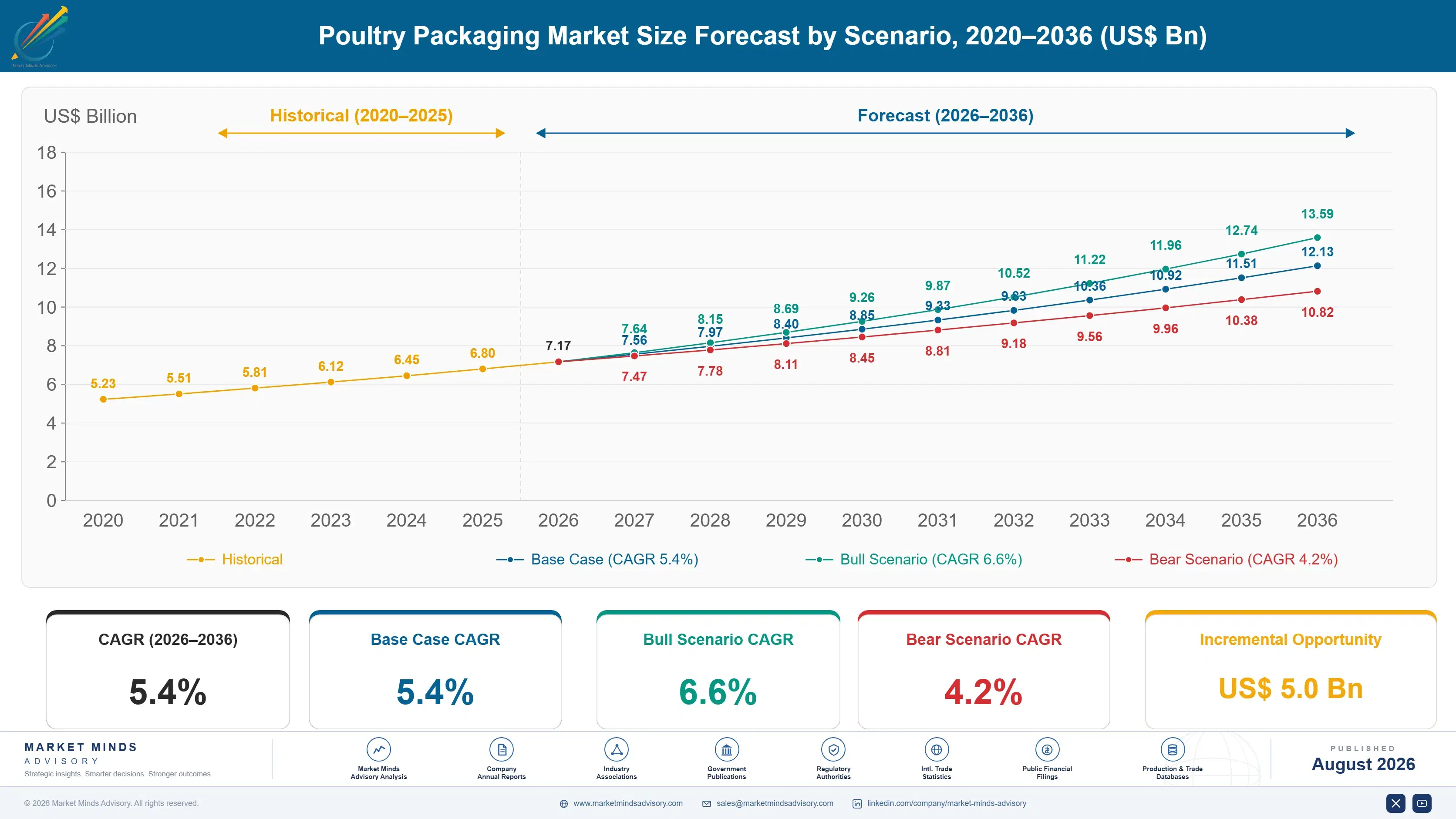
Poultry Packaging Market Forecast Scenarios

poultry-packaging-market-size-forecast-scenario-1787580761044
Growth ran near 4.3% between 2020 and 2025 as retail poultry volumes rose through the pandemic period and then normalised, while resin pricing swung sharply enough to move value independently of tonnage. Case-ready conversion continued across European and Asian retail throughout, replacing in-store butchery with centrally packed product. Avian influenza outbreaks disrupted supply repeatedly and cut packed volume in several markets across several seasons.
Base case 5.4% rests on three mechanisms. Retailers continue converting to fully enclosed no-touch formats on cross-contamination grounds, which raises packaging content per bird rather than merely changing its shape. Vacuum skin packaging is displacing conventional tray systems where shelf life and presentation both justify the film cost. And Asian retail is converting from wet market purchasing to packaged chilled poultry, which creates packaging demand where essentially none existed. Cold chain build-out is the constraint there.
The bull case at 6.6% assumes skin packaging conversion accelerates as film costs fall with volume, since it solves leak and shelf life simultaneously. The bear case at 4.2% is packaging waste rules forcing mono-material substitution before barrier performance is matched, which would cut shelf life, raise waste and push retailers back toward simpler formats at lower packaging value.

When the Pack Is a Safety Control

Raw poultry carries Campylobacter at rates high enough that public health authorities treat kitchen cross-contamination as a principal transmission route. A leaking pack transfers that risk to a shopping bag, a refrigerator shelf and a work surface. British retailers responded with fully enclosed no-touch formats and roast-in-bag presentations designed so a consumer never handles the raw bird, and other markets have followed the approach.
TOP FIVE CONCENTRATION28%Converters lead a field of regional and specialist suppliers
BARRIER LAYER COST SHARE23%Share of film cost carried by oxygen barrier layers
RETAIL LEAK FAILURE RATE1.4%Packs found leaking during retail point of sale audits
SKIN PACK FILM PREMIUM1.9xCost against conventional tray and lidding film systems
SHELF LIFE EXTENSION6 daysAdditional days achieved over a conventional overwrap presentation
RECYCLABLE FORMAT PENETRATION14%Share of poultry packs meeting mono-material recycling criteria
Achieving that means multilayer film. Polyethylene provides sealing, polyamide provides puncture resistance against bone, and ethylene vinyl alcohol provides the oxygen barrier that shelf life depends on. Those layers do different jobs and no single polymer does all three. Barrier layers alone carry roughly 23% of film cost, and the structure is what packaging waste criteria classify as unrecyclable.
Vacuum skin packaging offers the most elegant answer available. Film is drawn tightly around the product, eliminating purge liquid rather than absorbing it into a pad, which removes the leak pathway and extends shelf life by around six days over conventional overwrap. Film cost runs roughly 1.9 times a tray and lidding system. Retailers running the numbers on waste, markdowns and complaints increasingly find it pays.
"Ask a category buyer whether the pack is packaging or food safety equipment and you get a very different conversation than the one about recyclability. Both are true at once, and the industry has not found a structure that satisfies a public health officer and a waste regulator in the same laminate."
Director, Food Packaging and Protein Practice · MMA Packaging Practice · August 2026

Market Trends

Retailers converting to fully enclosed no-touch pack formats

British retailers introduced roast-in-bag and fully enclosed poultry formats specifically so that a consumer never handles the raw bird, following public health attention to Campylobacter prevalence on retail chicken. Other European and North American retailers have adopted comparable approaches through subsequent range reviews. The conversion raises packaging content per bird rather than simply changing its shape, since an enclosed format uses more film and often adds a secondary layer. Leak failure at point of sale audit runs near 1.4%, and each retailer treats that figure as a food safety metric.
Market Impact: Creates demand across 3 large markets
Vacuum skin packaging displacing conventional tray systems

Skin packaging draws film tightly around the product under vacuum, eliminating purge liquid rather than absorbing it into a pad, which removes the principal leak pathway and extends shelf life by roughly six days over conventional overwrap. Film cost runs about 1.9 times a tray and lidding system, which retailers increasingly accept once markdown, waste and complaint costs are counted properly. Presentation is also better, since the product is visible without liquid pooling. Conversion is running faster in premium tiers than in value ranges. Presentation improves as well, since the product is visible without liquid pooling underneath it.
Market Impact: Adds packaging across 2 retail tiers

Market Opportunities and Growth Drivers

Asian retail converting from wet market to packaged chilled poultry

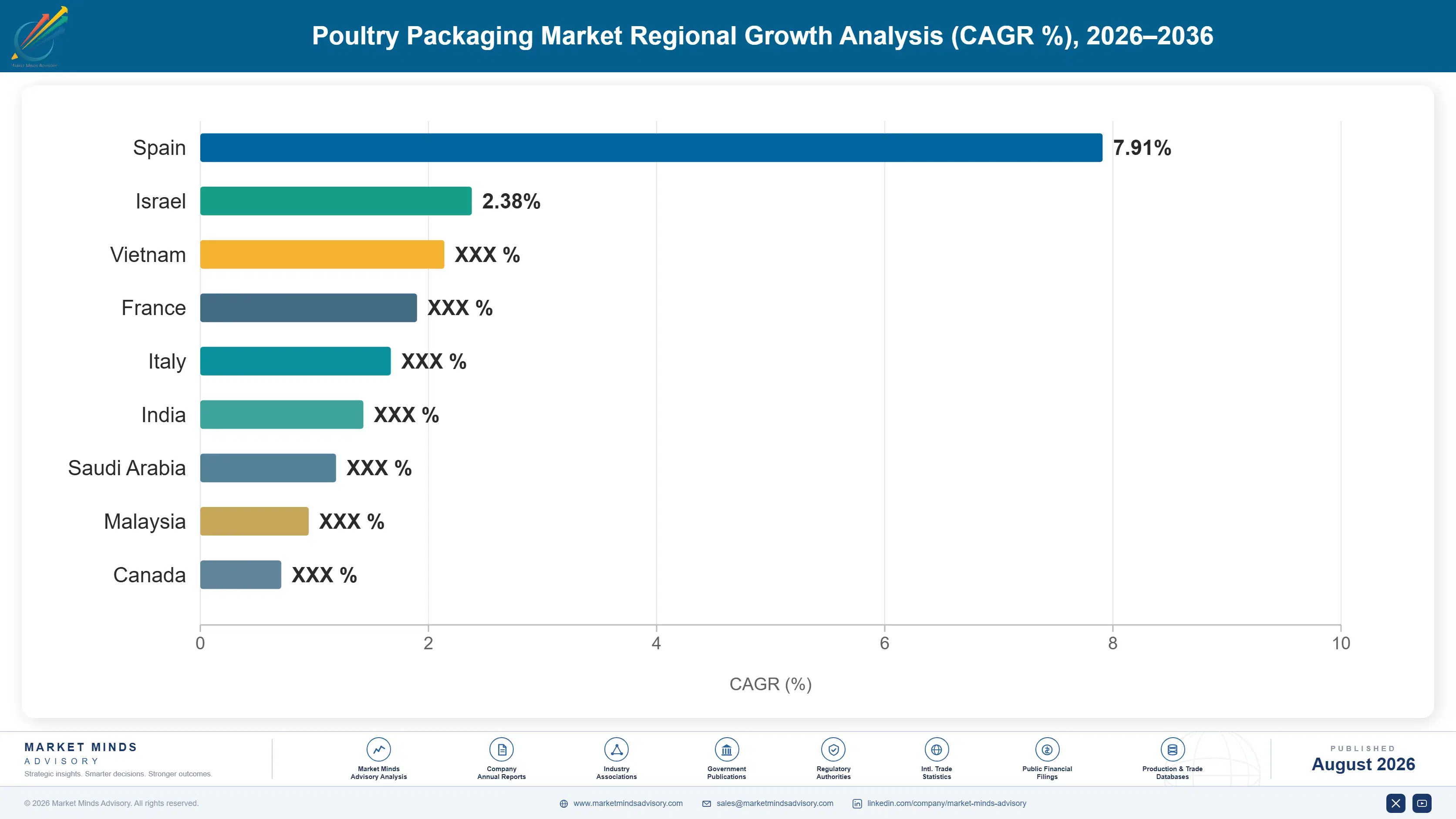
India grows fastest anywhere at 8.8%, and Chinese and Southeast Asian modern retail is converting on the same path, replacing live and wet market purchasing with centrally processed chilled poultry in retail packs. That conversion creates packaging demand where essentially none existed rather than substituting between formats. Cold chain investment is the enabling constraint rather than consumer preference, which has moved faster than infrastructure in several markets. Each converted bird carries a full pack where previously it carried none at all. Cold chain investment is the enabling constraint rather than any consumer preference.
Market Impact: Leaves 86% failing criteria

Case-ready conversion replacing in-store butchery across retail

Retailers have been moving poultry preparation from store back rooms to central processing for two decades, and the conversion continues across European and Asian chains. Case-ready product arrives packed, labelled and priced, which removes labour and hygiene risk from the store while adding packaging that in-store cutting did not require. Food safety auditing is considerably easier at a plant than across hundreds of back rooms. Each conversion permanently adds packaging content, and no retailer that has converted has moved back to in-store preparation. Food safety auditing is considerably easier at one plant than across hundreds of store back rooms.
Market Impact: Removes supply for 3 months

Market Restraints and Challenges

Barrier structures failing mono-material recycling criteria

Leak resistance and shelf life both come from multilayer film combining polyethylene, polyamide and ethylene vinyl alcohol, and packaging waste criteria classify those structures as unrecyclable. The root cause is functional: no single polymer provides sealing, puncture resistance and oxygen barrier together at comparable cost. Roughly 14% of poultry packs currently meet mono-material criteria. Converters are developing polyethylene structures with coated or thin barrier layers and evaluating recyclable polyester systems, and none yet matches multilayer barrier performance at anything approaching the same cost. Every partial answer gets trialled immediately. Nobody has reached parity yet.
Market Impact: Cuts leak failure from 1.4%

Avian influenza outbreaks removing packed volume without warning

Highly pathogenic avian influenza has disrupted poultry supply repeatedly across Europe, North America and Asia, with flock culls removing production for months at a time. The root cause sits entirely outside packaging and cannot be managed by anyone in this industry. Commercially it produces volume swings converters cannot forecast and capacity they cannot redeploy quickly. Suppliers serving several protein categories and several geographies absorb it better than poultry specialists, which is the only meaningful mitigation available. Converters serving several proteins and several geographies absorb the volatility considerably better than poultry specialists manage to.
Market Impact: Extends shelf life by 6 days
3 additional market trends, 4 additional growth drivers, and 2 additional restraints and challenges are covered in the full report. Contact sales@marketmindsadvisory.com to access the complete intelligence.

Segment CAGR and Growth Architecture

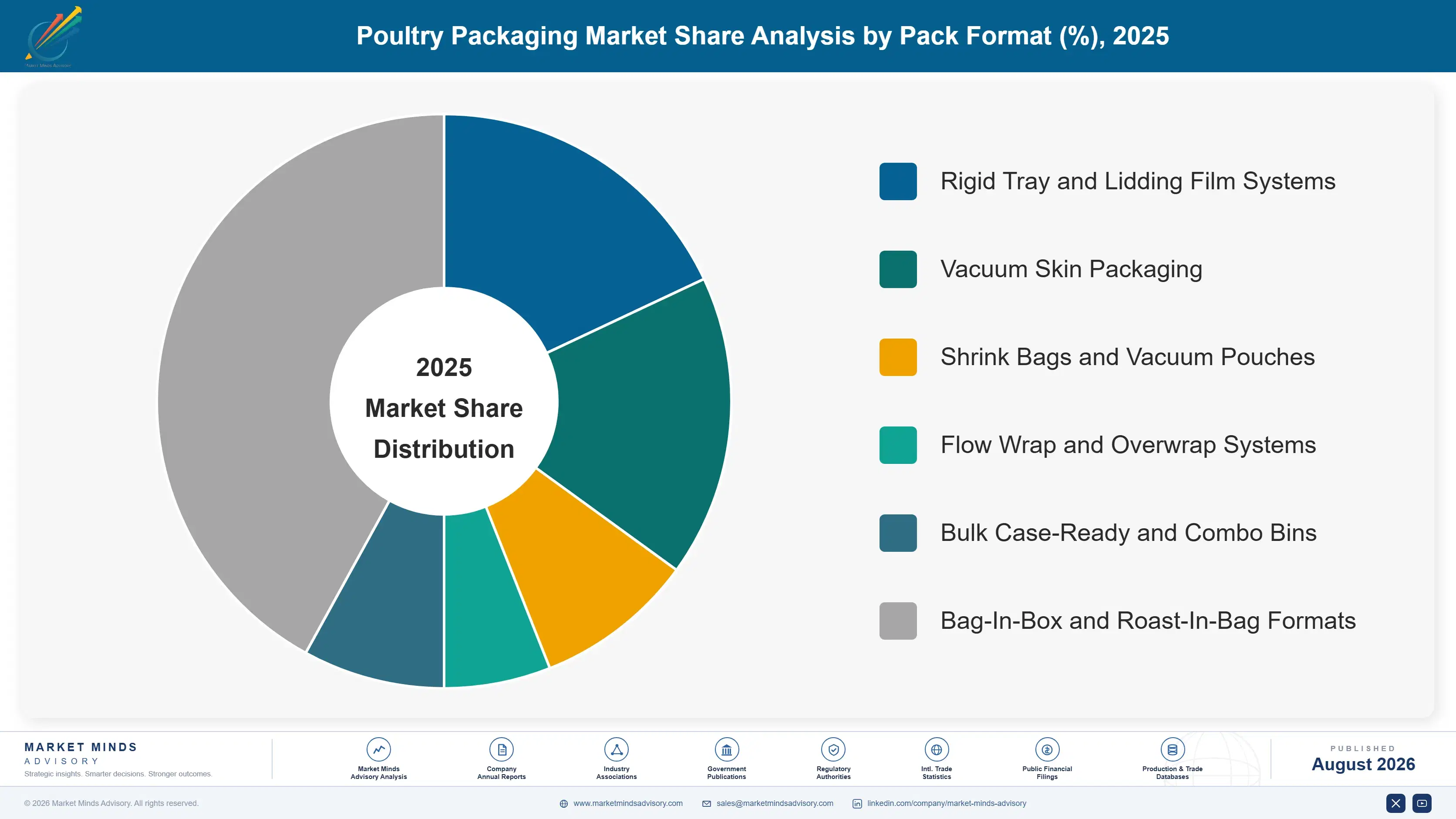
Six segments split by pack format, because format determines the film structure required, the machinery a processor must run and the shelf life achievable. A skin pack and a flow wrap solve different problems for different retail tiers. End-use channel and material composition are handled in the framework rather than folded in here. Format decides everything.
poultry-packaging-market-market-share-analysis-1787580761609

Vacuum Skin Packaging

Growing at 8.1%, half again the market rate of 5.4%, skin packaging draws film tightly around the product under vacuum so that no purge liquid collects and no absorbent pad is required. That removes the principal leak pathway and extends shelf life by roughly six days over conventional overwrap, which cuts markdown and waste at retail. Film cost runs about 1.9 times a conventional tray and lidding system, and processors need skin packaging machinery that tray lines cannot be converted to. Conversion is running fastest in premium retail tiers, where presentation and shelf life both justify the additional cost involved. Machinery rather than film cost is the real obstacle here.
CAGR 8.1%

Bag-In-Box and Roast-In-Bag Formats

At 7.2% enclosed formats designed so a consumer never handles the raw bird grew out of British retail responses to Campylobacter prevalence and have spread through other markets since. A roast-in-bag whole bird goes from pack to oven without contact, which removes the cross-contamination pathway entirely rather than merely containing it. Films must survive oven temperatures as well as chilled distribution, which narrows the supplier field considerably. Retailers treat these formats as food safety interventions and specify them accordingly, which makes the pricing conversation different from ordinary packaging tenders. Retailers treat these as food safety interventions rather than packaging choices, which makes the pricing conversation entirely different from an ordinary tender.
CAGR 7.2%
Full segment breakdown across 6 segments available in the complete report.

Regional Architecture and Country Demand Map

North America holds 29% of value, the largest share of any region, because its case-ready retail system is the most packaging-intensive anywhere. East Asia follows at 26% on volume and conversion from wet market purchasing, with Western Europe at 20% leading the world on format innovation and specification.

North America

Case-ready conversion went further and earlier here than anywhere else, and the 29% share reflects a retail system where almost all poultry arrives packed, labelled and priced from central processing. Tyson, Pilgrim's and Perdue operate at a scale that makes packaging specification decisions genuinely consequential for converters. Tray and lidding systems dominate, with skin packaging growing in premium tiers. State-level packaging waste legislation is beginning to raise recyclability questions that federal policy does not address. Mexican and Canadian volumes follow similar case-ready patterns with somewhat lower packaging content per bird. Federal packaging waste policy does not exist, so recyclability pressure arrives state by state instead. Skin packaging is growing in premium tiers.
Share: 29% | CAGR: 4.5% (2026 to 2036)

Western Europe

European retailers set the food safety agenda in this category, and British responses to Campylobacter prevalence produced the roast-in-bag and no-touch formats that other markets subsequently adopted. The 20% share understates the region's influence on specification considerably. Packaging waste rules are also most advanced here, which puts European converters at the sharp end of the conflict between barrier performance and recyclability. German and Dutch retailers push mono-material trials hardest. Skin packaging penetration is the highest of any region, particularly across premium and organic poultry ranges. European converters therefore sit at the sharp end of the conflict between barrier performance and recyclability. German and Dutch retailers push mono-material trials hardest of anyone.
Share: 20% | CAGR: 3.9% (2026 to 2036)
Regional intelligence for 5 additional markets available in the complete report: East Asia, South Asia and Pacific, Latin America, Middle East and Africa, Eastern Europe. Contact sales@marketmindsadvisory.com.
poultry-packaging-market-country-cagr-analysis-1787580762140

Four Moves for a Converter

This is a category where the buyer treats the pack as a safety control, which changes what an argument about cost achieves. Converters who sell against markdown, waste and complaint data win specifications that competitors quoting film price never reach. Recyclability is the problem nobody has solved yet. That is what the development spend is for.

Sell skin packaging on total retail cost

Skin packaging film runs roughly 1.9 times a conventional tray and lidding system, which loses a straight packaging cost comparison every time. It also extends shelf life by around six days, removes the absorbent pad, cuts leak failure and improves presentation, and those four things together outweigh the film premium in markdown and waste terms at most retailers. Building that case with a retailer's own waste data converts specifications that a film price conversation cannot. The machinery requirement is the harder obstacle. Machinery is the harder obstacle than film cost.
Market Impact: Offsets a 1.9x film premium on total cost

Develop recyclable barrier structures ahead of the rules

Roughly 14% of poultry packs meet mono-material recycling criteria, and packaging waste rules across Europe are tightening toward thresholds the category cannot currently reach. Coated polyethylene and recyclable polyester structures are both in development and neither yet matches multilayer barrier performance at comparable cost. Development spend runs into the low millions and the first converter to reach parity holds a specification position across every European retailer at once. Waiting means adopting somebody else's structure on their terms afterwards. Development spend runs into the low millions and buys a temporary specification monopoly.
Market Impact: Addresses the 86% of packs that currently fail

Follow the Asian wet market conversion early

Modern retail conversion in India, China and Southeast Asia creates packaging demand where none previously existed, at 8.8% annual growth in the fastest market. Cold chain build-out is the constraint rather than consumer preference, which means the timing is visible from infrastructure investment rather than from consumer research. Converters establishing local capability before conversion accelerates capture volume that later entrants have to displace. Local production matters because a poultry tray is bulky and freight makes imported supply uncompetitive quickly. Timing is visible from infrastructure spending. Later entrants must displace incumbents.
Market Impact: Targets 8.8% annual growth in Indian pack demand

Diversify across proteins to absorb influenza volatility

Avian influenza removes poultry supply for months at a time with no warning and no packaging response available, and a converter dedicated to poultry carries that volatility directly into utilisation. Serving beef, pork and fish alongside spreads the exposure across categories that do not fail simultaneously. Machinery and film structures overlap enough that the diversification costs less than it appears to. Poultry specialists have carried materially higher earnings volatility through the past several outbreak seasons than diversified converters have. Utilisation across affected plants has varied by more than 30% between influenza seasons, which no packaging decision addresses at all.
Market Impact: Spreads the risk across 4 distinct protein categories

Who Controls the Margin Pool

Participation is measured on annual shipment volume of poultry packaging materials, and the top five hold 28%. Concentration is moderate because film converting is regional by freight economics while specification is set nationally by retailers and processors. Amcor and Sealed Air lead on barrier film technology and machinery-linked systems. The gap to challengers is barrier structure capability and retailer specification access rather than converting capacity.
Competition runs on three fronts. Barrier film performance decides which converters can serve enclosed and skin formats at all, since sealing, puncture resistance and oxygen barrier must all be achieved together. Retailer specification access is the second, because poultry packaging is specified centrally as a food safety control rather than tendered on price. Recyclable structure development is the third, and it is where the strategic positioning is happening now rather than where revenue sits.

The pressure ahead comes from packaging waste rules reaching thresholds the category cannot currently meet. Whoever reaches barrier parity in a recyclable structure first takes specification positions across multiple retailers simultaneously. Expect development partnerships with resin producers and machinery makers rather than acquisitions. Rankings shift on that development outcome and on how fast Asian conversion runs.
poultry-packaging-market-company-positioning-matrix-1787580762660

Competitive Moat and Risk Dimensions

AMCOR

Moat: Barrier film breadth and reach

Amcor holds barrier film technology across the structures poultry requires and manufactures in most major markets, which lets a multinational retailer or processor specify one supplier across several geographies. That combination of technical range and footprint is expensive to assemble and it matters more in a category where specification is set centrally rather than bought locally.
AMCOR

Risk: Multilayer portfolio recyclability exposure

The portfolio depends heavily on multilayer structures that packaging waste criteria classify as unrecyclable, and European rules are tightening toward thresholds the category cannot currently meet. A competitor reaching barrier parity in a recyclable structure first would take specification positions across several retailers at once, and a large converting base is slower to reformulate than a focused one.
SEALED AIR

Moat: Skin packaging systems position

Sealed Air combines skin packaging film with the machinery that runs it, which means a processor adopting the format takes both from the same supplier and integrates them once. That systems position is considerably stickier than film supply alone, because changing film means proving it on installed equipment that the incumbent supplier knows better than anyone.
SEALED AIR

Risk: Machinery-linked customer resistance

Processors increasingly resist supplier arrangements that tie film to equipment, having learned what the switching cost looks like later. Open-system machinery from independent makers weakens the linkage, and retailers pressing processors on packaging cost push in the same direction. The systems advantage that built the position can become the reason a large customer deliberately looks elsewhere.

Players Tracked

Prominent Players

Amcor
Sealed Air
Berry Global
Winpak
Coveris

Other Key Players

Mondi
Huhtamaki
Sonoco
Constantia Flexibles
ProAmpac
Klöckner Pentaplast
Wipak
Faerch
Novolex
Sirane
Schur Flexibles
DS Smith
Graphic Packaging
Flexopack
Südpack

Recent Developments

JANUARY 2026

British retailer extends no-touch poultry format across its full fresh range

A British grocery retailer extended fully enclosed no-touch packaging across its entire fresh poultry range, having previously applied it to whole birds only. The retailer cited cross-contamination reduction rather than packaging cost or presentation as the reason for the wider rollout. Cost was absorbed rather than passed through.
Signal: Poultry packaging is specified as a food safety control, which changes how a cost conversation actually proceeds
AUGUST 2025

Converter launches recyclable polyester barrier structure for poultry trays

A European converter launched a recyclable polyester-based barrier structure aimed at poultry tray and lidding applications, claiming shelf life within two days of conventional multilayer performance. Retail trials began with two grocery groups during the following season across selected product lines. Wider rollout depends on the trial outcome.
Signal: Barrier parity in a recyclable structure remains unreached, and every partial answer gets trialled almost immediately
MAY 2026

Indian quick commerce operator standardises chilled poultry pack specification

An Indian quick commerce operator standardised chilled poultry packaging specification across its dark store network, moving from supplier-determined formats to a single leak-tested specification. The change followed customer complaints about leakage during delivery rather than any regulatory requirement. Suppliers were requalified against the new specification.
Signal: Delivery rather than retail shelf is now setting pack specification across the fastest growing poultry market

Where the Film Cost Goes

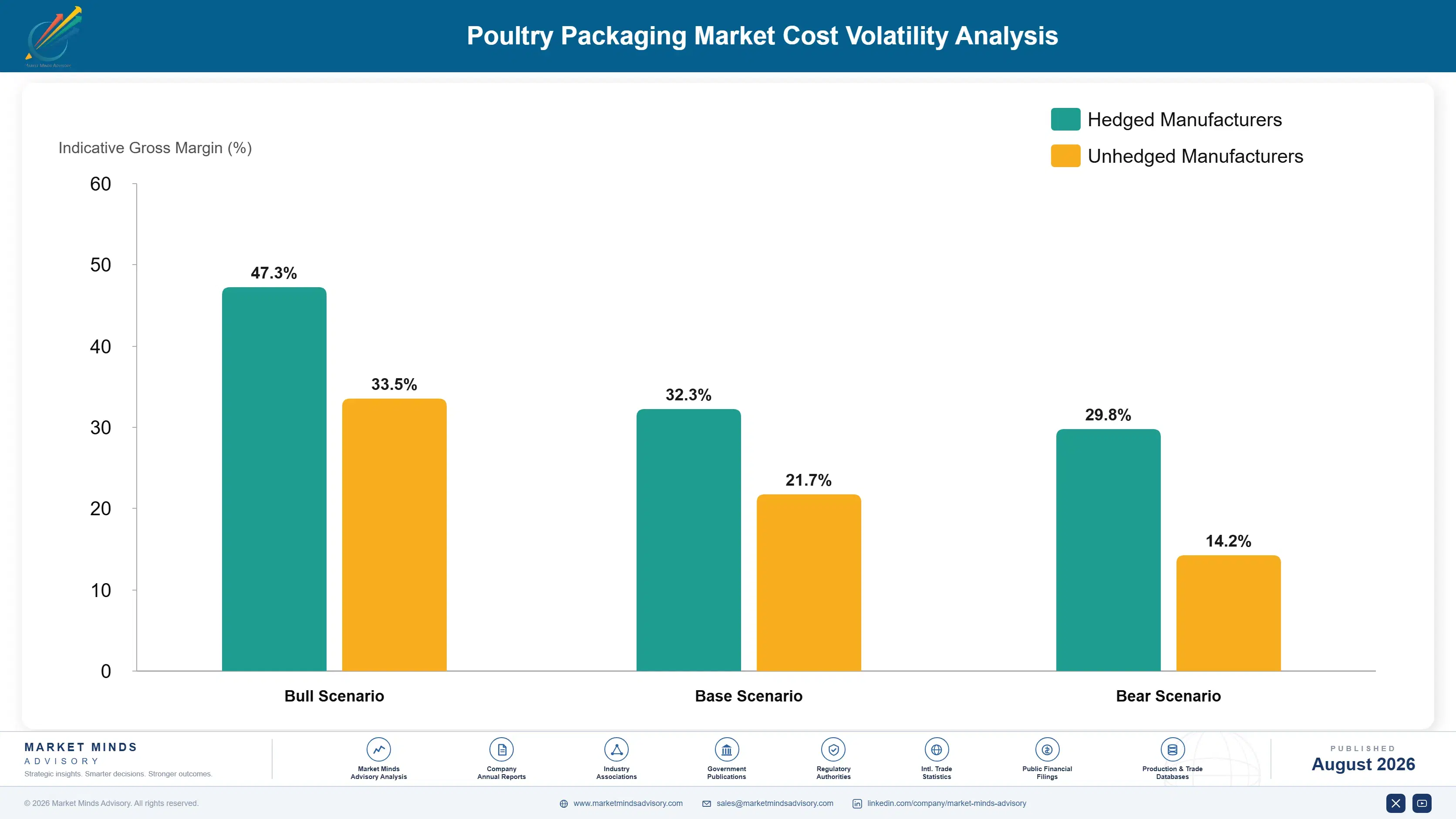
Polymer resin accounts for roughly 58% of film cost across poultry structures, with polyethylene providing seal layers, polyamide providing puncture resistance and ethylene vinyl alcohol providing the oxygen barrier. Barrier layers alone carry about 23% of that despite being thin, because the material costs several times polyethylene. Converting energy, printing and lamination add a further 21%, with rigid tray thermoforming carrying its own separate resin cost.
Ethylene vinyl alcohol supply tightened sharply during 2021 and 2022 when producer outages coincided with strong barrier packaging demand, and pricing rose well above historic ranges before easing, per producer annual reporting for the period. Converters holding annual retail contracts absorbed a substantial share, since poultry packaging pricing is agreed with retailers and processors on annual cycles that do not accommodate a mid-year barrier resin move at all.

Exposure divides on structure design and contract terms. A converter able to reduce barrier layer thickness or substitute an alternative barrier chemistry moves within a production run, while one locked to a single approved structure carries everything. European converters also carry industrial energy costs well above Asian levels, per IEA industrial tariff data, on an energy intensive process.
poultry-packaging-market-cost-volatility-analysis-1787580762855

Qualify a second barrier chemistry for the same structure

Holding an approved alternative barrier layer alongside ethylene vinyl alcohol lets a converter substitute when supply tightens, which happened twice in recent years. Qualification requires shelf life and migration testing with the retailer, costing perhaps 90 thousand dollars per structure family, and it recovers within a single supply disruption of the kind already experienced.

Index retail contracts to published resin references

Poultry packaging pricing is agreed on annual cycles with retailers and processors while resin moves continuously, which guarantees margin variance whenever inputs shift. Indexing to published references passes movement through with a defined lag. Retailers resist until a converter fails, and the practice has spread faster among processor contracts than among direct retail arrangements.

Optimise barrier layer thickness against actual shelf life need

Barrier layers carry roughly 23% of film cost and many structures are specified with more barrier than the required shelf life demands, because the specification was set once and never revisited. Testing actual oxygen ingress against the shelf life claimed frequently permits thinning, at no performance cost. Retailers approve it readily once shown the data.

Portfolio Architecture for Margin Defence

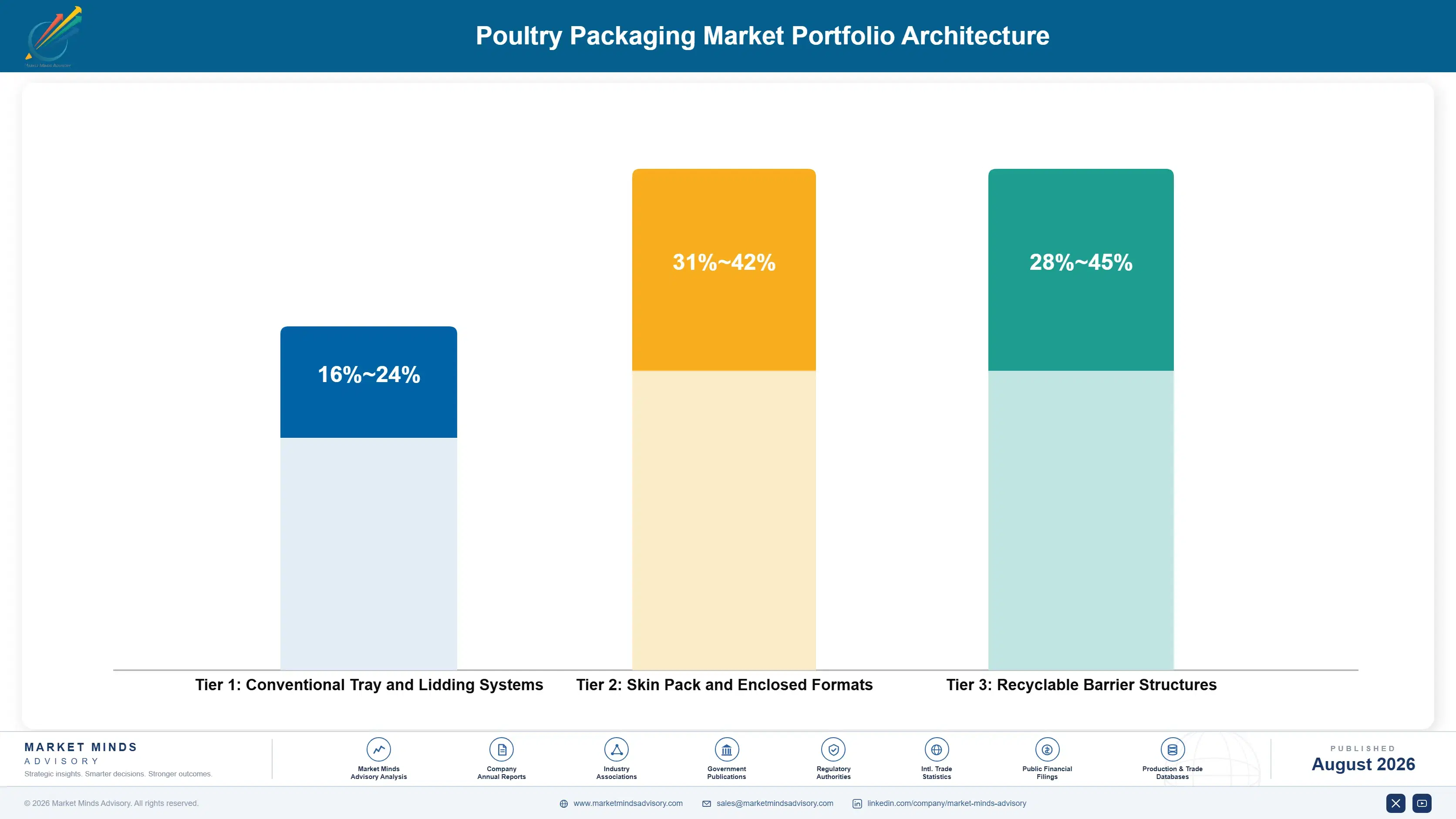
Margin here tracks barrier complexity and specification depth rather than volume. Conventional tray and lidding systems earn margins in the high teens, because many converters can produce them and retailers tender them on price against a defined specification. Volume is enormous in this tier and pricing power is largely absent, which is the arrangement most of the industry has always worked within.
Skin packaging and enclosed formats do considerably better at margins in the low to high thirties, because barrier performance, machinery compatibility and food safety positioning all narrow the field. The range is wide because it spans skin film sold against installed equipment at one end and oven-capable roast-in-bag structures at the other, where the technical requirement excludes most converters entirely. Machinery compatibility is a barrier competitors cannot argue past.

Recyclable barrier structures hold no established margin yet because nobody has reached parity, but the first converter that does will price against a specification requirement rather than a competitive alternative. That is a temporary position which compresses as others follow, and the window is what the development spend is actually buying. The window is what the development spend actually buys, and it is not a long one.

Conventional Tray and Lidding Systems

Standard thermoformed trays with barrier lidding film supplied against defined retail specifications. The eight point range reflects converting scale and resin buying position rather than any technical differentiation between suppliers.
Gross Margin: 16-24%

Skin Pack and Enclosed Formats

Vacuum skin film and fully enclosed no-touch structures including oven-capable roast-in-bag systems. The eleven point range spans skin film sold against installed machinery through to oven-capable structures excluding most converters.
Gross Margin: 31-42%

Recyclable Barrier Structures

Coated polyethylene and recyclable polyester structures targeting mono-material criteria. The seventeen point range reflects that no structure has reached barrier parity, so pricing spans development trials through to early specification wins.
Gross Margin: 28-45%
poultry-packaging-market-portfolio-architecture-1787580763350

High-value Sub-segments and Strategic Watch-out

Vacuum Skin Packaging Films

High value and the fastest growth at 8.1% on shelf life and leak elimination together. Film runs 1.9 times a tray system and retailers accept it once markdown and waste are counted. Machinery requirements narrow the supplier field considerably. Machinery investment gates the conversion. Premium tiers convert first.
Gross Margin: 34-42%

Oven-Capable Enclosed Formats

High value, growing at 7.2%, and specified as a food safety intervention rather than a packaging choice. Films must survive oven temperatures and chilled distribution together, which excludes most converters from bidding at all. Retailers specify it as a control rather than a preference. Few converters can bid.
Gross Margin: 36-44%

Conventional Tray and Lidding Supply

The volume core and tendered on price against a fixed retail specification. Many converters can produce it and resin buying position is the only real cost lever. Growth follows poultry volume with no premium available anywhere. Resin buying position is the only cost lever left.
Gross Margin: 16-24%

Multilayer Structures Facing Waste Rules

The strategic watch-out. Roughly 86% of poultry packs fail mono-material criteria and European thresholds keep tightening toward levels the category cannot reach. The margin range assumes current rules rather than announced future ones. Announced thresholds would compress the range considerably further. Thresholds keep tightening toward levels nobody can reach.
Gross Margin: 14-24%

How the Pack Volume Repeats

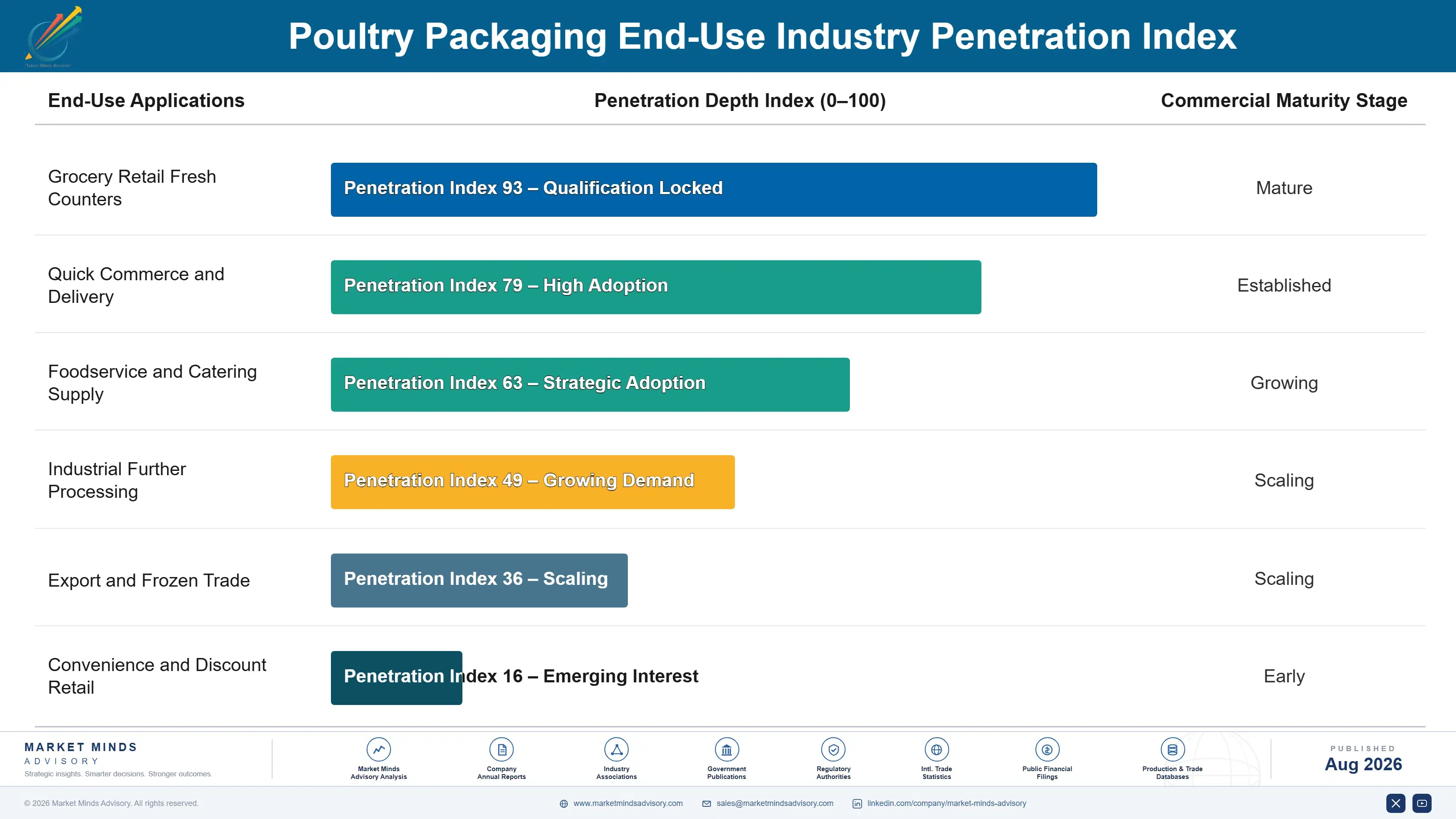
Poultry packaging demand repeats with unusual reliability because fresh protein sells continuously and every bird carries a pack. A processor running a case-ready line consumes film every shift at volumes its own order book sets, and switching supplier means requalifying a structure against retailer shelf life and leak specifications rather than negotiating a price. That makes volume predictable and, within a defined specification, pricing power modest.
Stickiness varies by format and by who holds the machinery. Skin packaging supply is stickiest, since film runs on installed equipment the incumbent supplier knows intimately and a change risks a line stoppage worth far more than any film saving. Enclosed oven-capable formats come next, held by the narrow field able to make them. Conventional tray and lidding supply switches on price within specification, and it is the majority of tonnage.

The specifying buyer sits at the retailer rather than the processor in most markets. Retail technical teams write pack specifications as food safety controls and processors buy to them, which means a converter's real customer is a retail technologist who never issues a purchase order. That arrangement is why specification access matters more here than commercial relationships with processors do.
poultry-packaging-market-end-use-penetration-index-1787580763836

Where We Would Focus Effort

These are among the four positions where our research anticipates prominent divergence between winners and laggards over the coming forecast period. Each is grounded in the demand model, the regulatory perimeter, and the announced capacity pipeline.
01 / TOTAL COST SELLING

Argue markdown and waste, never film price per square metre

Skin packaging film runs roughly 1.9 times a conventional tray and lidding system and loses a straight packaging cost comparison every single time it is made. It also adds around six days of shelf life, removes the absorbent pad, cuts leak failure and improves presentation, which together outweigh the premium in markdown and waste terms at most retailers. Building that case with a retailer's own waste data converts specifications that a film price conversation with procurement never reaches at all.
02 / RECYCLABLE BARRIER DEVELOPMENT

Fund the structure now rather than adopting somebody else's

Roughly 86% of poultry packs fail mono-material recycling criteria while European packaging rules keep tightening toward thresholds this category cannot currently reach with any structure available to it today. Coated polyethylene and recyclable polyester routes are both currently in development and neither matches multilayer barrier performance at comparable cost yet. The first converter to reach parity holds specification positions across multiple European retailers simultaneously, and waiting means adopting a competitor's structure later on their commercial terms rather than your own.
03 / ASIAN CONVERSION TIMING

Build local capability before the cold chain catches up

Modern retail and quick commerce conversion across India, China and Southeast Asia creates packaging demand where none previously existed, growing at 8.8% annually in the fastest of those markets. Cold chain build-out rather than consumer preference is the constraint, which makes the timing visible from infrastructure investment rather than from any consumer research. A poultry tray is bulky enough that freight makes imported supply uncompetitive quickly, so local converting capability has to be in place beforehand rather than assembled afterwards.
04 / PROTEIN CATEGORY SPREAD

Serve four proteins so influenza cannot empty the plant

Highly pathogenic avian influenza removes poultry supply for months at a time with no warning at all and no packaging response available to anyone in this industry. A converter dedicated to poultry alone carries that volatility straight into its utilisation and its earnings. Serving beef, pork and fish alongside spreads exposure across categories that do not fail together, and machinery and film structures overlap enough that the diversification costs considerably less than it first appears to any converter looking at it.

Engagement Snapshot From the Field

A live engagement with an industry participant carrying material or product regulatory and market exposure ahead of a defining policy shift, showing how our research translates into a defensible multi-year portfolio strategy.
MARKET MINDS ADVISORY · CLIENT ENGAGEMENT SUMMARY
Poultry Packaging Producer Strategic Portfolio Review and Transition Roadmap 2026·Investment Scenario on Poultry Packaging Exposure Evaluation 2025-26
CLIENT PROFILE
A European flexible packaging converter supplying poultry processors across five countries, with fresh protein packaging revenue near 310 million euros and roughly two thirds of that in poultry (client-reported, unverified by MMA). The portfolio was weighted heavily toward conventional tray lidding film using multilayer barrier structures, with limited skin packaging capability at a single site.
STRATEGIC CHALLENGE
Two large retail customers had signalled mono-material recyclability requirements taking effect within three years, and neither the client nor any competitor held a structure meeting them at acceptable barrier performance. Separately, an avian influenza season had cut utilisation sharply at two plants. Management needed a view on development priorities and on portfolio concentration together.
MMA APPROACH
MMA benchmarked barrier performance across coated polyethylene and recyclable polyester structures from four resin suppliers, modelled shelf life outcomes against retailer specifications, and quantified utilisation volatility across four recent influenza seasons at the client's plants. Retail specification processes were tested with technical teams at six grocery groups. Interviews with 47 experts covered barrier films, poultry processing and retail packaging specification.
KEY FINDINGS
  1. No recyclable structure tested reached multilayer barrier performance, with the closest coated polyethylene option giving up roughly two days of shelf life against the conventional specification.
  2. Retail technical teams would accept a two day shelf life reduction on selected lines if recyclability were achieved, which the client had not previously established with any of them.
  3. Utilisation across the two affected plants varied by more than 30% between influenza seasons, against a customer base concentrated almost entirely in poultry.
  4. Skin packaging capability at a single site could not serve the premium demand two customers had signalled, and competitors were quoting for that volume already.
CLIENT PROFILE
A European flexible packaging converter supplying poultry processors across five countries, with fresh protein packaging revenue near 310 million euros and roughly two thirds of that in poultry (client-reported, unverified by MMA). The portfolio was weighted heavily toward conventional tray lidding film using multilayer barrier structures, with limited skin packaging capability at a single site.
STRATEGIC CHALLENGE
Two large retail customers had signalled mono-material recyclability requirements taking effect within three years, and neither the client nor any competitor held a structure meeting them at acceptable barrier performance. Separately, an avian influenza season had cut utilisation sharply at two plants. Management needed a view on development priorities and on portfolio concentration together.
MMA APPROACH
MMA benchmarked barrier performance across coated polyethylene and recyclable polyester structures from four resin suppliers, modelled shelf life outcomes against retailer specifications, and quantified utilisation volatility across four recent influenza seasons at the client's plants. Retail specification processes were tested with technical teams at six grocery groups. Interviews with 47 experts covered barrier films, poultry processing and retail packaging specification.
KEY FINDINGS
  1. No recyclable structure tested reached multilayer barrier performance, with the closest coated polyethylene option giving up roughly two days of shelf life against the conventional specification.
  2. Retail technical teams would accept a two day shelf life reduction on selected lines if recyclability were achieved, which the client had not previously established with any of them.
  3. Utilisation across the two affected plants varied by more than 30% between influenza seasons, against a customer base concentrated almost entirely in poultry.
  4. Skin packaging capability at a single site could not serve the premium demand two customers had signalled, and competitors were quoting for that volume already.
RECOMMENDED STRATEGY
Phase 1: Phase one: commit development to the coated polyethylene route and open shelf life discussions with retail technical teams, since a two day reduction appears acceptable on selected lines. Phase 2: Phase two: add skin packaging capability at a second site, addressing premium demand two customers have already signalled to competitors as well. Phase 3: Phase three: pursue beef and pork converting volume deliberately, reducing the poultry concentration that drove utilisation volatility across recent influenza seasons.
OUTCOME
The converter committed to the coated polyethylene route during 2025 and reached retail trial on two ranges within a year, with one retailer accepting the shorter shelf life on selected lines (client-reported, unverified by MMA). Skin packaging capability was added at a second site, and poultry fell to roughly 54% of fresh protein revenue as other categories were won.

Frequently Asked Questions

Foundational context covering the market sizes, CAGR, scope, country, region and competition that inform every finding below. This section is provided to cover basics and most often pre-purchase conversations, answered from the MMA Primary Research Dataset.

What is the current size of the Poultry Packaging Market?

MMA sizes it at USD 6.8 billion in 2025, rising to USD 7.17 billion in 2026. The figure covers primary and secondary packaging for fresh, chilled and frozen poultry at converter selling price.

How large will the Poultry Packaging Market be by 2036?

USD 12.13 billion by 2036, an incremental USD 4.96 billion over the 2026 base and an expansion multiple of 1.69 times. Skin packaging accounts for a disproportionate share.

What is the CAGR for the Poultry Packaging Market 2026 to 2036?

5.4% in the base case, with a bull case at 6.6% and a bear case at 4.2%. The spread turns on skin packaging conversion pace and on how packaging waste rules resolve.

Which segment is growing fastest?

Vacuum skin packaging at 8.1%, half again the market rate of 5.4%. It eliminates purge liquid rather than absorbing it, addressing leak risk and shelf life together.

Who are the major companies in the Poultry Packaging Market?

Amcor, Sealed Air, Berry Global, Winpak and Coveris lead on annual shipment volume of poultry packaging materials. Fifteen further participants are profiled in the full report.

Which country is growing fastest?

India at 8.8%, as modern retail and quick commerce push packaged chilled poultry into urban households for the first time. Cold chain build-out is the binding constraint.

Report Segmentation Architecture

The full report scope spans multiple orthogonal segmentation dimensions, with cross-tabulated demand data provided for each dimension pair. Coverage extends further to regional breakdowns, trend trajectories, and the competitive detail needed to support segment-level decision-making.

By Pack Format

  • Rigid Tray and Lidding Film Systems
  • Vacuum Skin Packaging
  • Shrink Bags and Vacuum Pouches
  • Flow Wrap and Overwrap Systems
  • Bulk Case-Ready and Combo Bins
  • Bag-In-Box and Roast-In-Bag Formats

By End-Use Industry

  • Grocery Retail Fresh Counters
  • Quick Commerce and Delivery
  • Foodservice and Catering Supply
  • Industrial Further Processing
  • Export and Frozen Trade
  • Convenience and Discount Retail

By Commercial Dimension

  • Direct Supply to Processors
  • Retailer Nominated Supply
  • Distributor and Trader Supply
  • Machinery Linked Film Contracts
  • Export and Cross-Border Supply
  • Private Label Packaging Programmes

By Region

  • North America
  • Western Europe
  • East Asia
  • South Asia and Pacific
  • Latin America
  • Middle East and Africa
  • Eastern Europe

Scope, Methodology, and Coverage

Every figure in this report is reproducible from documented input assumptions. The scope below maps the historical period, the forecast horizon, the segmentation dimensions, and the countries covered, alongside the underlying primary and qualitative methodology.
Historical Period
2020 to 2025
Forecast Period
2026 to 2036
Base Year
2025 (USD billions; MMA Primary Research Dataset, August 2026)
Market Definition
Primary and secondary packaging materials used for fresh, chilled and frozen poultry, spanning rigid trays and lidding film, vacuum skin packs, shrink bags and vacuum pouches, flow wrap and overwrap, bulk case-ready formats and oven-capable roast-in-bag systems, measured at converter selling price. Packaging machinery, absorbent pads sold separately, egg packaging, further-processed and cooked poultry meal packaging, and transport pallets are excluded from scope entirely.
Quantitative Units
USD billions (current prices); billion packs supplied annually; USD per thousand packs by format and region
Segmentation Dimensions
Pack format; end-use industry; commercial dimension; region
Regions Covered
North America, Western Europe, East Asia, South Asia and Pacific, Latin America, Middle East and Africa, Eastern Europe
Countries Covered
United States, Canada, Mexico, United Kingdom, Germany, Netherlands, France, Spain, China, Japan, South Korea, India, Thailand, Indonesia, Australia, Brazil, Saudi Arabia, United Arab Emirates, South Africa, Poland
Key Companies Profiled
Amcor, Sealed Air, Berry Global, Winpak, Coveris, Mondi, Huhtamaki, Sonoco, Constantia Flexibles, ProAmpac, Klöckner Pentaplast, Wipak, Faerch, Novolex, Sirane, Schur Flexibles, DS Smith, Graphic Packaging, Flexopack, Südpack
Quantitative Methodology
Primary survey, n=3,800 respondents, Q4 2025, six countries; demand-side model with trade association cross-validation
Qualitative Methodology
47 expert interviews, Q4 2025; applied to validate demand model assumptions, identify emerging dynamics, and assess competitive positioning
Report Format
PDF and XLSX data workbook (Word format preview document)
Publisher
Market Minds Advisory
Report Code
MMA-2026-PAC-114
Published
August 2026
Contact
sales@marketmindsadvisory.com | www.marketmindsadvisory.com

Purchase the full Poultry Packaging Market Report (2026 to 2036).

The full report treats pack integrity as the food safety control retailers consider it to be, and sizes each format independently through 2036. It benchmarks barrier performance across conventional multilayer and candidate recyclable structures, quantifies markdown and waste economics behind skin packaging conversion, and tracks retail specification changes by grocery group. Regional chapters cover all seven regions with detail on case-ready penetration and wet market conversion where data permits. Competitive profiling covers 20 participants on a single shipment volume basis, alongside barrier structure capability by converter.
Each pack format sized independently through 2036
Barrier performance benchmarked across conventional and recyclable structures
Markdown and waste economics quantified behind skin conversion
Retail specification changes tracked by grocery group
Twenty participants profiled on one consistent basis
Case-ready penetration and wet market conversion mapped regionally

Built For The People Who Decide

From boardroom strategy to bench-side execution, this report is read cover-to-cover by leaders shaping the next decade of their industry, turning demand scenarios, market dynamics and valuation benchmarks into decisions.
CXOs/ Presidents/ VPs/ Managers
M&A and Corporate Development
Strategy Teams and R&D Heads
Procurement and Product Directors
Regulatory and Compliance Leaders
Investor Relations and Equity Analysts