Market Minds Advisory
Potassium Formate Market

Potassium Formate Market: Runways in Winter, Wells All Year

Two demand engines share this salt and never meet: airports clearing ice off runways without corroding the aircraft, and drillers weighting completion fluid without putting a single solid particle downhole.

Lead Analyst

Bilal Shaikh

Published

September 2026

Make Smarter Decisions with Customized Research Insights

Request a free sample report and evaluate market opportunities, growth trends, and competitive dynamics relevant to your business needs.

2025 MARKET VALUE$0.3BMarket Size 2025
2036 FORECAST VALUE$0.6BBase Case , 2026 to 2036
CAGR 2026 TO 20366.2 %Bull 7.4% / Bear 5.0%
INCREMENTAL OPPORTUNITY$0.2BNet 10- year value creation
EXPANSION MULTIPLE1.83x2036 value over 2026 base
Strategic Levers
M&A Pipeline
Regional Outlook
Country Rankings
Competitive Intelligence
Segmental Deep-dive
Call-Us : 91 93563 13602

Executive Snapshot and Market Trajectory

Nothing connects the two halves of this market. One sells into airport winter operations on a four-month seasonal cycle. The other sells into oil and gas completions where the attraction is a dense brine carrying no solid particles at all. A producer serving both runs two businesses sharing a plant.
De-icing is where the growth sits, and the reason is carbon brakes. Alkali metal salts catalyse oxidation of carbon brake discs, and airframe manufacturers have issued guidance on it, which has pushed airports away from acetate formulations toward formate. Runway de-icing takes roughly 31% of demand and grows at 9.3%, half again the market rate of 6.2%, on substitution rather than on traffic. European airports moved first and North American operators lag them considerably.
The completion fluid half depends on high pressure and high temperature wells rather than on rig count, because that is where a solids-free brine at 1.57 specific gravity earns its cost. Middle East and Africa takes 9% of value, above the usual band, on Gulf completion activity. Formic acid is 58% of production cost, which keeps the supplier field narrow. East Asia sits below its band at 20%.
Market Definition
Potassium formate salts and solutions produced for drilling and completion fluids, runway and road de-icing, heat transfer, agricultural and industrial applications, in solid and solution form, measured at producer selling price. Excludes formic acid, sodium and calcium formate, caesium formate, glycol and urea based de-icing fluids, and finished drilling fluid systems.
Base Year Value
$0.3B in 2025 (MMA Primary Research Dataset, August 2026)
Forecast Period
2026 to 2036, eleven discrete annual values
CAGR
6.2% base case. Bull 7.4%. Bear 5.0%.
Fastest Growth Segment
Runway De-Icing Grade: 9.3% CAGR
Fastest Growth Country
India: 8.6% CAGR
Fastest Growth Region
South Asia and Pacific: 8.0% CAGR
Largest Region
Western Europe: 28% of 2025 global value
Market Leaders
Perstorp, BASF, ADDCON Group, Shandong Baoyuan Chemical, Chongqing Chuandong Chemical. Source: MMA Primary Research Dataset, July 2026.
Primary Survey
n=3,800 procurement and R&D decision-makers, Q4 2025, six countries
Methodology
Demand-side build-up, cross-validated against public data, 47 expert interviews

Potassium Formate Market Forecast Scenarios

potassium-formate-market-trends-size-forecast-scenario-1787580742633
Growth ran near 5.1% between 2020 and 2025 on two halves that moved independently. Airport de-icing volumes collapsed with air traffic in 2020 and 2021 before recovering fully, while completion fluid demand followed a drilling cycle that fell and then rebounded on entirely different timing. Formic acid supply interruptions lifted price more than volume in two of those years, which flattered the value trend.
Base case 6.2% rests on three mechanisms. Airports are substituting formate for acetate de-icers on carbon brake oxidation concerns raised in airframe manufacturer guidance, which converts a share of an existing market rather than growing one. Gulf and Indian high pressure completion activity is expanding and consumes solids-free brine disproportionately. And secondary refrigerant demand is growing as fluorinated gas rules push industrial and retail cooling toward indirect systems. None of the three depends on the others arriving.
The bull case at 7.4% assumes acetate substitution accelerates across North American and Asian airports, where adoption lags European practice considerably. The bear case at 5.0% combines a drilling downturn with mild winters, which would hit both halves of the market at once despite their being otherwise unconnected, and there is no third application large enough to offset that.

Ice, Wells and Nothing In Between

Runway de-icing has been through three generations of chemistry. Urea came first and was abandoned over nitrogen runoff and metal corrosion. Glycol works on aircraft but not on pavement. Acetates and formates replaced both, and then a further problem emerged: alkali metal salts catalyse oxidation of carbon brake discs, which airframe manufacturers addressed in service guidance and which airports take seriously.
TOP FIVE CONCENTRATION63%Formic acid producers dominate through backward integration upstream
FORMIC ACID COST SHARE58%Share of production cost carried by the acid itself
RUNWAY DE-ICING SHARE31%Portion of demand consumed by airport winter operations
COMPLETION BRINE DENSITY1.57 sgAchievable specific gravity in a solids-free completion fluid
AIRPORT CONTRACT LENGTH4 yearsTypical tender period across major European airport programmes
SEASONAL DEMAND CONCENTRATION78%Share of de-icing volume consumed in four winter months
Formate is the less aggressive of the two on that measure, and airports running large carbon-braked fleets have been substituting accordingly. That substitution converts share of an existing market rather than creating new demand, which is why de-icing volumes grow faster than air traffic does. European airports moved first and North American and Asian adoption still lags them by a considerable margin.
The completion fluid business has nothing to do with any of that. A solids-free brine at up to 1.57 specific gravity holds pressure without the barite that damages formation permeability, and it is thermally stable enough for high pressure high temperature wells. Demand therefore tracks well complexity rather than rig count, which is why it moves on entirely different timing from the drilling cycle everyone watches.
"Anyone modelling this market off a drilling forecast is looking at two thirds of it and calling that the whole. The de-icing half is growing on a metallurgy problem with carbon brakes, and no oil price assumption tells you anything at all about how fast that substitution runs."
Principal, Specialty Chemicals and Energy Materials Practice · MMA Chemicals and Materials Practice · August 2026

Market Trends

Airports substituting formate for acetate on brake oxidation concerns

Alkali metal salts catalyse oxidation of carbon brake discs, which airframe manufacturers have addressed in service guidance, and formate is the less aggressive of the two runway de-icing chemistries on that measure. Airports operating large carbon-braked fleets have been converting through recent tender cycles, and European operators moved first. Roughly 31% of potassium formate demand now goes to runway operations. The substitution converts share of an existing de-icing market rather than creating new demand, which is why it outruns air traffic growth comfortably. North American and Asian adoption still lags European practice by a considerable margin.
Market Impact: Reaches 1.57 specific gravity solids-free
Secondary refrigerant demand growing under fluorinated gas rules

Fluorinated gas phase-down schedules are pushing retail and industrial refrigeration toward indirect systems, where a primary loop of reduced refrigerant charge cools a secondary brine circulating through the building. Potassium formate brine performs well at low temperature, carries no toxicity concerns and is considerably less corrosive than calcium chloride alternatives that dominated the application historically. Supermarket and cold storage retrofits are the principal demand, and each installation carries a multi-year fluid replacement cycle behind it once commissioned. Each installation carries a multi-year fluid replacement cycle behind it once commissioned, which builds an annuity behind the original fit.
Market Impact: Delivers 8.6% annual Indian growth

Market Opportunities and Growth Drivers

High pressure completions consuming solids-free brine disproportionately

A completion fluid must hold formation pressure without depositing solids that damage permeability, and weighting with barite does exactly the damage the fluid is meant to avoid. Potassium formate brine reaches 1.57 specific gravity solids-free and remains thermally stable at high pressure high temperature conditions. Demand therefore follows well complexity rather than rig count, which is why it moves on different timing from the drilling cycle. Gulf and Indian offshore programmes are expanding in exactly the conditions where the fluid earns its considerable cost. Barite weighting does exactly the damage the fluid exists to avoid.

Market Impact: Concentrates 78% in four months

Indian offshore and industrial demand expanding from a low base

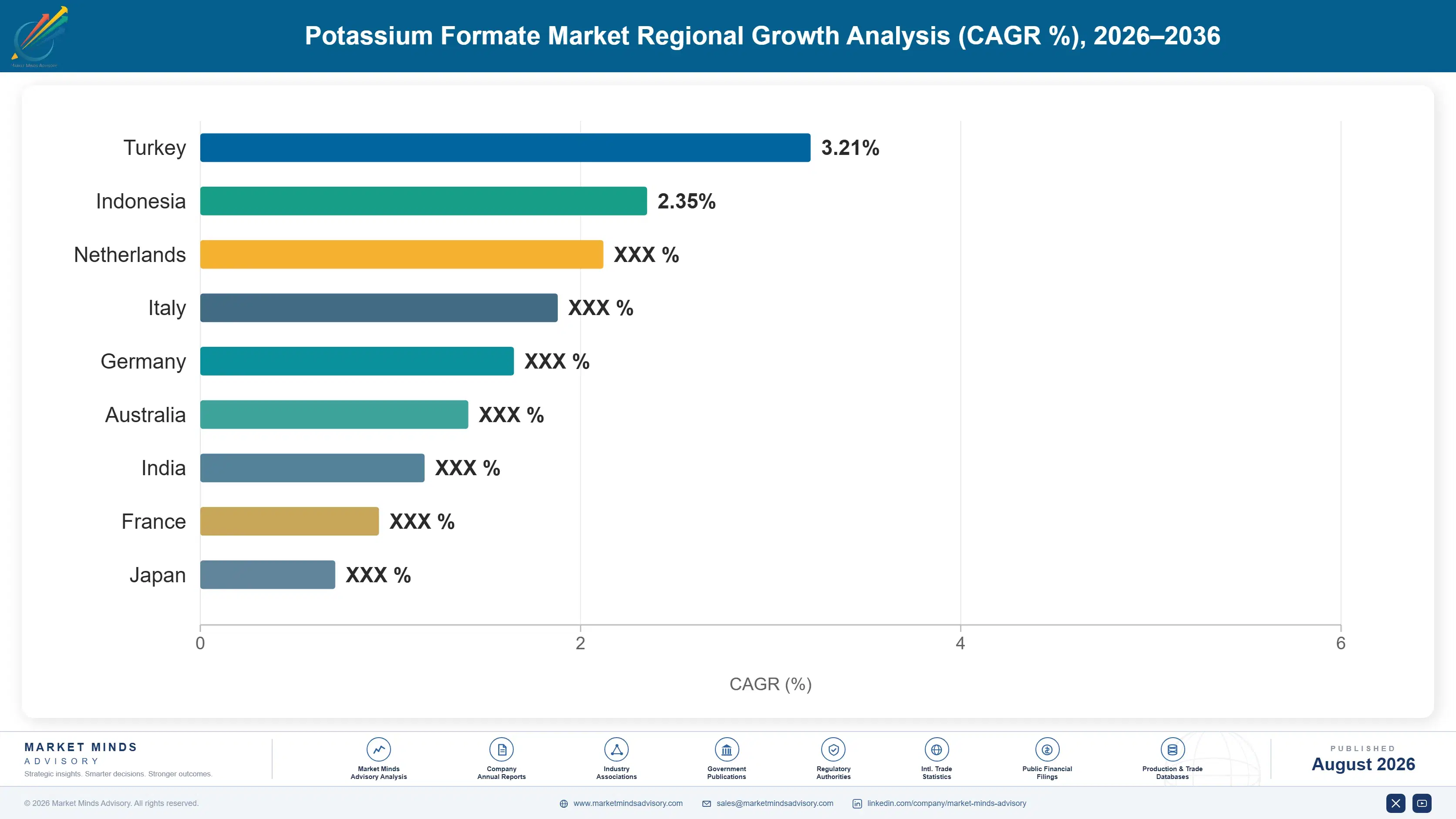
India grows fastest anywhere at 8.6%, on offshore completion activity in deepwater basins where high pressure conditions favour solids-free brine, alongside industrial cooling demand as fluorinated gas rules take effect. Domestic production capacity is limited, so most material arrives as imports from European and Chinese producers. Airport de-icing demand is negligible for obvious climatic reasons. The growth is genuinely two-stranded rather than driven by any single application, which makes it more durable than a purely drilling-led expansion would be. Airport de-icing demand is negligible there for obvious climatic reasons, which makes the growth entirely two-stranded.
Market Impact: Sets 58% of production cost

Market Restraints and Challenges

Seasonal concentration leaving de-icing capacity idle most of the year

Roughly 78% of runway de-icing volume is consumed across four winter months, and a mild season removes demand that cannot be recovered later. The root cause is obvious and unfixable: ice forms when it forms. Commercially it forces producers to carry inventory and capacity against a demand that may not arrive, and airports to hold stock they may not use. Multi-year airport contracts with minimum volume commitments address part of it, and the drilling half of the business provides the counterweight for producers serving both. Ice forms when it forms, and no commercial arrangement changes that.
Market Impact: Converts 31% of total demand

Formic acid supply concentration setting the cost floor

Formic acid accounts for roughly 58% of production cost and world capacity sits with a small number of producers, principally in Europe and China. The root cause is that formic acid production is capital intensive and demand outside formate salts is limited, so few new entrants appear. Commercially it means a formate producer without backward integration buys the majority of its cost from a concentrated field. Integration or multi-year acid contracting are the available responses, and neither is universally adopted across the smaller producers. Few new entrants appear because demand outside formate salts is limited.
Market Impact: Replaces brine across 2 loop types
3 additional market trends, 4 additional growth drivers, and 2 additional restraints and challenges are covered in the full report. Contact sales@marketmindsadvisory.com to access the complete intelligence.

Segment CAGR and Growth Architecture

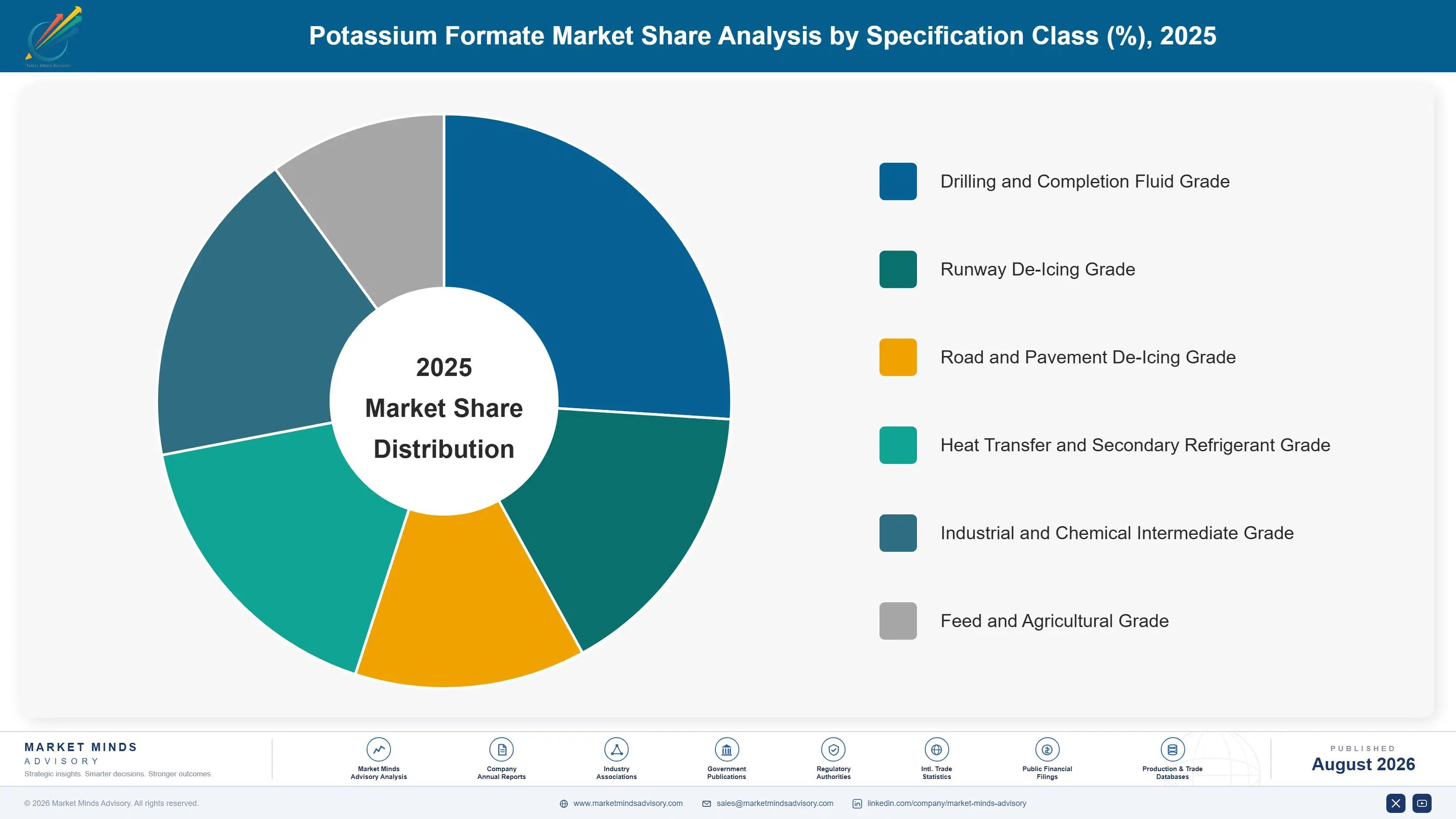
Six segments split by specification class, because each application approves material against a different standard and a product qualified for one cannot simply be sold into another. Runway approval and completion fluid qualification have nothing in common. End-use industry and channel are handled in the framework rather than folded in here. Approval, not chemistry, separates them.
potassium-formate-market-trends-market-share-analysis-1787580743209

Runway De-Icing Grade

Growing at 9.3%, half again the market rate of 6.2%, runway grade material is approved against aviation de-icing standards covering corrosion, brake material compatibility and environmental behaviour. Growth comes from substitution away from acetate formulations on carbon brake oxidation concerns rather than from air traffic, which makes it faster than the underlying market it serves. Airport tenders run around four years and switch infrequently once a product is approved and handling equipment is set up. Roughly 78% of volume moves across four winter months, which makes inventory planning the operational difficulty rather than production. Substitution rather than air traffic is what drives the volume here, which is why it outruns the market it sells into.
CAGR 9.3%

Heat Transfer and Secondary Refrigerant Grade

At 8.1% secondary refrigerant demand grows on fluorinated gas phase-down pushing retail and industrial refrigeration toward indirect systems. A potassium formate brine circulates through the building while a reduced primary refrigerant charge stays confined to the plant room, which is precisely what the regulation is designed to encourage. The fluid performs well at low temperature, carries no toxicity concerns and corrodes far less than the calcium chloride brines it replaces. Each commissioned system carries a multi-year fluid replacement cycle, which builds a service annuity behind the original installation sale. Calcium chloride brines it replaces corrode aggressively, and the switching cost of a system already commissioned is low enough that retrofits happen readily.
CAGR 8.1%
Full segment breakdown across 6 segments available in the complete report.

Regional Architecture and Country Demand Map

Western Europe holds 28% of value on Nordic airport de-icing and North Sea completion activity together. Middle East and Africa sits above its band at 9% on Gulf high pressure completions, while East Asia falls below its band at 20% with little de-icing requirement and less high pressure completion activity.

North America

Airport de-icing practice here still leans toward acetate formulations, which leaves substantial substitution ahead as carbon brake guidance works through tender cycles. Northern airports across Chicago, Minneapolis, Denver and the Canadian prairies carry the largest winter volumes. Gulf of Mexico completion activity consumes solids-free brine in deepwater high pressure conditions, and the drilling and de-icing halves are served by largely separate supply chains with different distributors. Domestic formate production is limited, so much of the material arrives from European producers. Road de-icing demand is served by cheaper chlorides almost everywhere. Substantial acetate conversion still lies ahead as guidance works through tender cycles. Separate supply chains serve each half. Chlorides serve road de-icing everywhere.
Share: 24% | CAGR: 5.4% (2026 to 2036)

Western Europe

Nordic airports pioneered formate runway de-icing and set the practice that other European operators adopted, which is why this region holds the largest share of any at 28%. Oslo, Stockholm, Helsinki and the northern German and Dutch airports all carry substantial volumes across a long winter. North Sea completion activity adds the second demand strand, with Norwegian and British high pressure wells consuming solids-free brine. Perstorp operates significant regional production integrated back into formic acid. Environmental regulation on airport runoff has favoured formate over urea and glycol for two decades. The 28% share sits above the usual band on Nordic de-icing volumes and North Sea completion activity together. Runoff regulation favoured formate.
Share: 28% | CAGR: 4.9% (2026 to 2036)
Regional intelligence for 5 additional markets available in the complete report: East Asia, South Asia and Pacific, Latin America, Middle East and Africa, Eastern Europe. Contact sales@marketmindsadvisory.com.
potassium-formate-market-trends-country-cagr-analysis-1787580743738

Four Moves Across Two Businesses

This market has two customer bases with nothing in common, and a producer serving both gets a seasonal hedge that neither alone provides. Formic acid at 58% of cost sets the floor. Approval positions in aviation and qualification in completion fluids set the ceiling, and neither transfers to the other. The two halves do not transfer.

Target airports still running acetate de-icers

Carbon brake oxidation guidance from airframe manufacturers has pushed European airports toward formate, and North American and Asian operators lag that considerably. Each conversion is worth a four-year tender at meaningful annual volume, and switching happens at tender rather than continuously, so timing matters more than pricing. Approval against aviation de-icing standards is required before any bid, and handling equipment compatibility has to be demonstrated. Producers tracking tender calendars across northern airports capture conversions that competitors discover only after the award. Each conversion is worth roughly 4 years of contracted annual volume.
Market Impact: Wins 4 year tenders at each airport converted

Qualify into high pressure completion fluid systems

Completion fluid demand follows well complexity rather than rig count, and a solids-free brine at 1.57 specific gravity earns its cost only where formation damage from weighting solids would be expensive. Gulf and Brazilian pre-salt programmes are exactly those conditions. Qualification runs through service companies rather than operators directly, which is a different selling motion from anything in de-icing. Positions won on a field development hold for the programme life, and the volumes per well are substantial enough to justify the effort involved. Volumes per well justify the qualification effort.
Market Impact: Holds positions across 1 entire field development programme

Integrate backward into formic acid or contract long

Formic acid is 58% of production cost and world capacity sits with a small number of producers, which leaves a non-integrated formate producer buying most of its cost from a concentrated field. Integration is available to very few and rarely purchasable, so multi-year acid contracting is the practical alternative for everyone else. It costs a premium in easy conditions and protects margin through the force majeure events this chain has seen repeatedly. Producers on spot terms have been the ones squeezed hardest. Integration is available to very few. Spot buyers have been squeezed hardest.
Market Impact: Covers the 58% of production cost in contracts

Serve both halves to hedge the winter season

Roughly 78% of de-icing volume moves across four winter months, and a mild season removes demand that never returns. Completion fluid demand runs year-round on entirely separate drivers, so a producer serving both carries a genuine natural hedge that a de-icing specialist cannot construct. The two require different approvals, different distribution and different selling motions, which is why few producers do both properly. Those that do carry considerably lower earnings volatility than either specialist group manages. Few producers manage both properly. Earnings volatility falls materially for those that do. The hedge is genuine rather than presentational.
Market Impact: Offsets the 78% seasonal concentration in de-icing demand

Who Controls the Margin Pool

Participation is measured on annual production capacity in tonnes, and the top five hold 63%. Concentration is high because formic acid integration is what makes production economic and very few companies hold it. Perstorp and BASF lead through that integration and through European aviation approval positions. The gap to challengers is upstream integration and approval status rather than any difficulty in making the salt itself.
Competition splits cleanly along the two demand halves. In de-icing it runs on aviation approval, tender timing and handling equipment compatibility, with switching happening only at four-year tender intervals. In completion fluids it runs through service company qualification and field development positions, on entirely different relationships. Very few producers compete credibly in both, and the ones that do gain a seasonal hedge the specialists cannot replicate.

The pressure ahead is Chinese export capacity reaching Western applications. Shandong and Chongqing producers hold cost positions European producers cannot match, and the barrier has been approval status rather than quality. Expect approval investment and distribution partnerships rather than acquisitions, since integrated formic acid positions rarely trade. Rankings shift as acetate substitution runs through North American tender cycles over the next several years.
potassium-formate-market-trends-company-positioning-matrix-1787580744251

Competitive Moat and Risk Dimensions

PERSTORP

Moat: Formic acid integration and approvals

Perstorp produces formic acid and formate salts within the same operations, which removes 58% of cost from the purchased column, and holds aviation de-icing approvals across Nordic and northern European airports built over two decades. That combination of upstream integration and approval history is not something a competitor assembles quickly at any price.
PERSTORP

Risk: European cost and seasonal exposure

European production carries energy and labour costs well above Chinese levels on a chain where formic acid economics dominate, and Nordic de-icing weighting concentrates much of the revenue into four winter months. A mild season and a strong Chinese export push arriving together would compress both volume and price simultaneously.
BASF

Moat: Scale and formic acid position

BASF operates formic acid capacity at Verbund scale with downstream flexibility across several formate salts, allowing it to allocate acid toward whichever derivative earns most at any point in the cycle. That optionality is unavailable to single-product producers and it holds through disruptions that force competitors into spot purchasing at the worst possible moment.
BASF

Risk: Limited aviation approval focus

The business has not pursued airport de-icing approval positions with the same focus as specialist competitors, which leaves it under-represented in the fastest growing segment of this market. Aviation approval and tender relationships take years to build, and a large diversified chemicals group moves slowly on a product line that is small in its own portfolio terms.

Players Tracked

Prominent Players

Perstorp
BASF
ADDCON Group
Shandong Baoyuan Chemical
Chongqing Chuandong Chemical

Other Key Players

Nouryon
Cabot Corporation
LANXESS
Gujarat Alkalies and Chemicals
Hawkins
Kilfrost
Clariant
Kemira
Aviform
Shandong Yuxin Chemical
Zibo Xinlong Chemical
Tiande Chemical
Feicheng Acid Chemicals
Luxi Chemical Group
Helm AG

Recent Developments

OCTOBER 2025

North American airport converts runway de-icing programme from acetate to formate

A major northern American airport awarded its runway de-icing tender to a formate product, converting from acetate following review of carbon brake compatibility guidance. The contract runs four years with minimum volume commitments attached, and handling equipment was modified during the preceding summer season. Volumes were not disclosed publicly.
Signal: North American conversion is beginning, and each tender award locks four years of volume for the winner
MARCH 2026

Gulf operator specifies solids-free formate brine across a high pressure field development

A Gulf operator specified potassium formate completion fluid across a high pressure high temperature field development, citing formation damage avoidance rather than any cost consideration. The specification runs for the development programme and is contracted through a service company rather than directly with the producer.
Signal: Field development specifications hold for years, which makes each award far larger than a single well order
AUGUST 2025

European producer expands formic acid capacity supporting formate derivatives

A European chemical producer expanded formic acid capacity with downstream formate salt production attached, citing de-icing and agricultural derivative demand. The expansion is an organic capacity addition at an existing integrated site rather than any acquisition or partnership arrangement. Commissioning follows during the coming year.
Signal: Integration into formic acid remains the defining cost position, and expansions reinforce rather than dilute it

The Acid Sets the Floor

Formic acid accounts for roughly 58% of production cost, produced principally in Europe and China through methanol carbonylation, with world capacity concentrated among a small number of producers. Potassium hydroxide or carbonate adds a further 21% and carries potash volatility directly. Neutralisation energy, evaporation and packaging together take about 13%, rising for solid grades where drying and handling add cost that solution supply avoids entirely.
Formic acid supply interruptions have defined this decade for the industry. Force majeure declarations at European producers during 2021 and 2022 tightened availability sharply, and pricing rose well above historic ranges before easing, per producer annual reporting for those years. Producers without integration bought at the top against downstream contracts they could not reprice, and several smaller participants took losses persisting beyond the disruption. Integration proved decisive that year.

The competitive mechanism is integration, plainly. A producer making its own formic acid holds 58% of cost internally while a merchant buyer purchases it from a field of very few suppliers with no realistic alternative. That single fact explains why the top five all hold acid positions. Chinese producers on domestic methanol and energy also run cheaper than any European equivalent, per published methanol trade data.
potassium-formate-market-trends-cost-volatility-analysis-1787580744449

Contract formic acid on multi-year terms where integration is absent

Formic acid at 58% of cost bought on spot terms against seasonal or contracted downstream pricing is the exposure that damaged smaller producers most recently. Multi-year contracting costs a premium in normal conditions and removes the mismatch when force majeure events occur, which this chain has seen more than once already this decade. Spot exposure has proved expensive.

Match potassium supply tenor to downstream contract tenor

Potassium hydroxide and carbonate carry potash volatility and represent around 21% of cost, while airport contracts run four years and completion supply follows field programmes. Matching tenor removes most of the resulting margin variance at modest premium. Few producers had aligned both sides before the 2022 potash disruption demonstrated the consequence clearly. Alignment costs very little to arrange.

Supply as solution rather than solid where logistics permit

Solid grades carry drying and handling costs that solution supply avoids, and many de-icing and heat transfer customers dilute on receipt in any case. Supplying solution where freight distance permits removes conversion cost and passes a lower delivered price without margin loss. It only works within a limited radius, which is why regional production placement matters here.

Portfolio Architecture for Margin Defence

Margin here follows approval status rather than product quality, since the salt is straightforward to make and the barriers sit entirely in qualification. Industrial and agricultural grades earn margins in the high teens, competing on delivered cost against Chinese material with no approval requirement standing in the way of substitution at all. There is no defensible position in an unapproved commodity grade.
Completion fluid grades do considerably better at margins in the low to high thirties, because service company qualification and field development specification limit the field and the fluid represents a small fraction of well cost against very large consequences if it fails. The range is wide because deepwater high pressure specifications differ substantially from routine completion work. A fluid proven downhole is not swapped mid-programme.

Runway de-icing grades hold the strongest position, running into the mid forties, where aviation approval, four-year tenders and handling equipment compatibility make each conversion slow and each retained account durable. Those margins reflect an approval barrier rather than any formulation advantage, and they persist for as long as the tender cycle does. Handling equipment set up around a product is itself a barrier.

Industrial and Agricultural Grades

Standard grades for chemical intermediate, feed preservative and general industrial use where no approval requirement applies. The seven point range reflects formic acid integration and delivered freight position rather than any product difference.
Gross Margin: 16-23%

Completion and Heat Transfer Grades

Solids-free completion brines and secondary refrigerant grades qualified through service companies or system designers. The nine point range reflects the gap between deepwater high pressure specifications and routine completion or retrofit work.
Gross Margin: 31-40%

Aviation Approved De-Icing Grades

Runway de-icing material approved against aviation standards for corrosion, brake compatibility and environmental behaviour. The nine point range reflects tender competitiveness at individual airports, which varies with how many approved products bid.
Gross Margin: 37-46%
potassium-formate-market-trends-portfolio-architecture-1787580744937

High-value Sub-segments and Strategic Watch-out

Aviation Approved Runway De-Icers

High value and the fastest growth at 9.3% on acetate substitution rather than air traffic. Four-year tenders and handling equipment compatibility make each conversion slow and each retained account genuinely durable. North American adoption still lags Europe considerably. Tender timing decides who wins each conversion.
Gross Margin: 39-46%

High Pressure Completion Brines

High value and steady, following well complexity rather than rig count. Formation damage avoidance justifies the cost where lost production would be expensive. Field development specifications hold for programme life rather than for a single well. Service companies rather than operators hold the relationship. Programmes rather than wells.
Gross Margin: 34-40%

Industrial and Agricultural Grades

The volume core and permanently exposed to Chinese delivered cost, since no approval requirement stands in the way of substitution. Formic acid integration is the only defence available. Growth follows industrial demand with no premium obtainable. Chinese delivered cost sets the ceiling on price. Integration is the only defence.
Gross Margin: 16-23%

Seasonally Concentrated De-Icing Exposure

The strategic watch-out. Roughly 78% of de-icing volume moves across four winter months and a mild season removes demand permanently. The wide range reflects how sharply a bad winter compresses realised margin against a fixed cost base. Only the completion half offsets it at all.
Gross Margin: 20-40%

Two Cycles That Never Meet

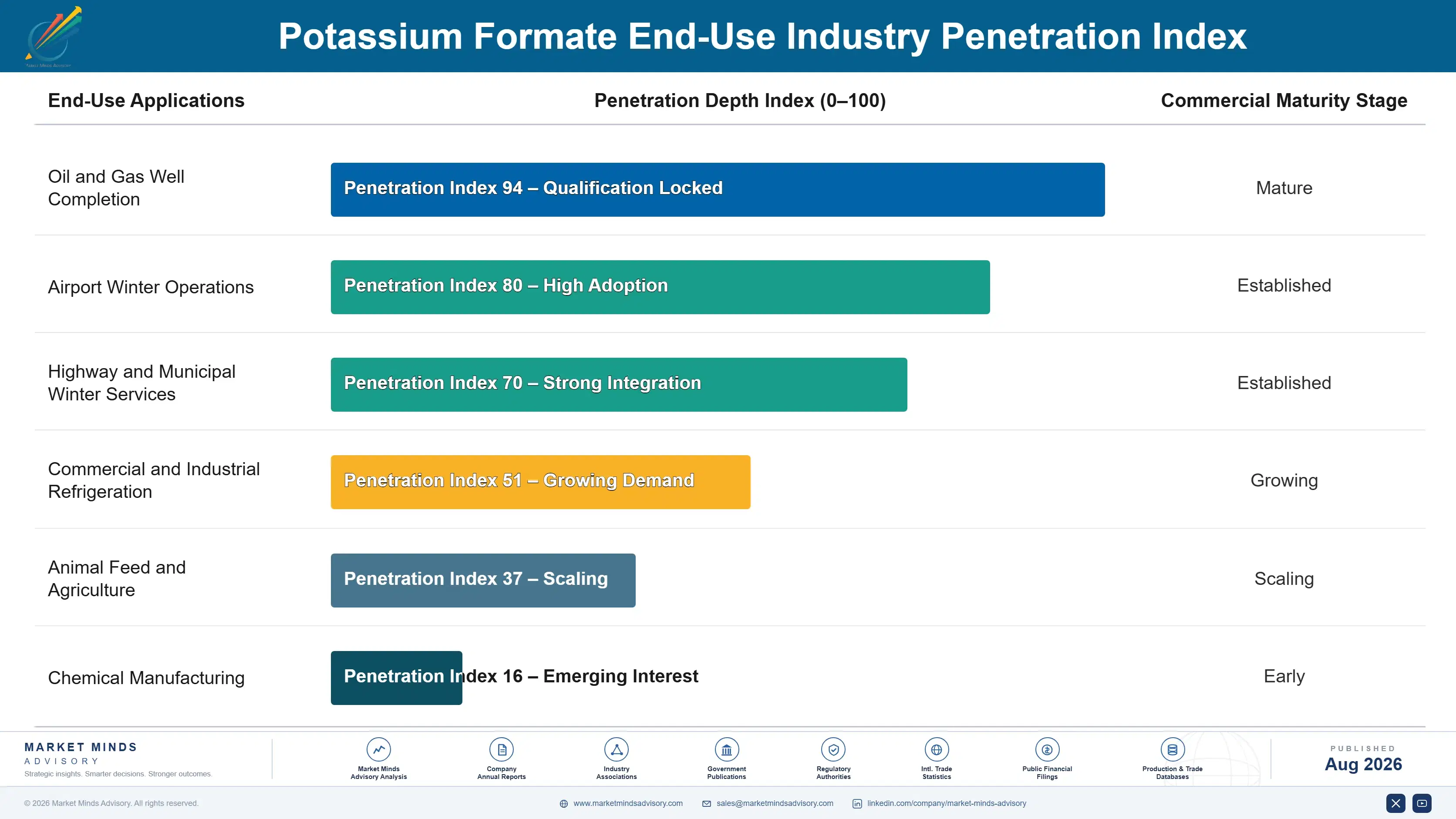
Airport supply behaves like a contracted annuity with a seasonal shape. A four-year tender fixes the supplier, the handling equipment is set up around the product, and volume then depends entirely on how much ice forms. Roughly 78% moves across four winter months. The contract is durable and the volume within it is not, which is an unusual combination and one that producers plan inventory around rather than forecast.
Completion fluid supply is durable in a different way. A field development specification holds for the programme rather than the well, and switching mid-programme means requalifying a fluid system that has already been proven downhole, which nobody does casually. Service companies rather than operators hold the relationship. Industrial and agricultural grades sit at the other extreme, switching on delivered price with no qualification standing in the way at all.

The specifying buyer differs completely between the halves. Airport de-icer is chosen by airfield operations staff working to an approval list and a tender process. Completion fluid is specified by drilling engineers working to a well design. Neither has any reason to talk to the other, and a producer serving both is effectively running two businesses that happen to share a plant.
potassium-formate-market-trends-end-use-penetration-index-1787580745428

Where We Would Focus

These are among the four positions where our research anticipates prominent divergence between winners and laggards over the coming forecast period. Each is grounded in the demand model, the regulatory perimeter, and the announced capacity pipeline.
01 / AVIATION TENDER TARGETING

Track the tender calendar at airports still using acetate

Carbon brake oxidation guidance has moved European airports toward formate and North American and Asian operators lag that substantially, which leaves a defined conversion opportunity running through the next several tender cycles. Each award carries four years of volume with minimum commitments attached, and switching happens only at tender rather than continuously. Approval and handling equipment compatibility must both be established before a bid, so producers tracking those calendars capture conversions that competitors only learn about after the award has been made.
02 / COMPLETION FLUID QUALIFICATION

Qualify through service companies, not through operators

Completion fluid demand follows well complexity rather than rig count, and a solids-free brine at 1.57 specific gravity earns its cost only where formation damage would carry real production consequences. Gulf and Brazilian pre-salt programmes are exactly the conditions where that applies. Qualification runs through service companies rather than operators directly, which is a different selling motion from anything in de-icing, and a position won on a field development then holds for the whole of that programme rather than a single well.
03 / FORMIC ACID SECURITY

Integrate or contract long, because spot has already failed

Formic acid is 58% of production cost and world capacity sits with a small number of producers, which leaves any non-integrated formate producer buying most of its cost from a concentrated field with no realistic alternative supplier. Force majeure events during 2021 and 2022 demonstrated the consequence, and producers on spot terms bought at the top against downstream contracts they could not reprice inside a season. Multi-year contracting is the only practical protection available, and the premium is modest against what the exposure has already cost.
04 / SEASONAL HEDGE CONSTRUCTION

Serve both halves rather than specialising in either one

Roughly 78% of de-icing volume moves across four winter months and a mild season removes demand that never returns, while completion fluid runs year-round on entirely unrelated drivers. A producer serving both carries a natural hedge that no de-icing specialist can construct artificially. The two require different approvals, distribution and selling motions, which is precisely why so few producers do both properly and precisely why those few that do manage it show materially lower earnings volatility than either specialist group.

Engagement Snapshot From the Field

A live engagement with an industry participant carrying material or product regulatory and market exposure ahead of a defining policy shift, showing how our research translates into a defensible multi-year portfolio strategy.
MARKET MINDS ADVISORY · CLIENT ENGAGEMENT SUMMARY
Potassium Formate Producer Strategic Portfolio Review and Transition Roadmap 2026·Investment Scenario on Potassium Formate Exposure Evaluation 2025-26
CLIENT PROFILE
A European specialty chemical producer manufacturing formate salts from purchased formic acid, with annual potassium formate output near 22 thousand tonnes and divisional revenue around 58 million euros (client-reported, unverified by MMA). Volume was weighted heavily toward Nordic and northern European airport de-icing contracts, with a small industrial and agricultural grade business alongside. No completion fluid business existed at all.
STRATEGIC CHALLENGE
Two consecutive mild winters had cut de-icing volumes sharply against a fixed cost base, and formic acid pricing had risen through a supplier force majeure the company could not pass on inside its four-year airport contracts. Management needed to decide whether to diversify into completion fluids, pursue acid integration, or accept the volatility and manage inventory harder.
MMA APPROACH
MMA modelled de-icing volume against thirty years of winter severity data at the client's contracted airports, costed completion fluid qualification through two service companies, and assessed formic acid contracting alternatives with three suppliers. Chinese delivered cost into European industrial grades was benchmarked directly. Interviews with 47 experts covered airport operations, completion fluid specification and formate production economics.
KEY FINDINGS
  1. Winter severity modelling showed de-icing volume varying by more than 40% between a mild and severe season at the same contracted airports, against an essentially fixed cost base.
  2. Completion fluid qualification through service companies would take roughly eighteen months and required technical support capability the company did not currently employ anywhere.
  3. Formic acid multi-year contracting was available at a premium near 7% over recent spot averages, and would have covered the entire force majeure period comfortably.
  4. Industrial and agricultural grade volumes could not be defended against Chinese delivered cost, and were consuming production slots that de-icing peaks needed anyway.
CLIENT PROFILE
A European specialty chemical producer manufacturing formate salts from purchased formic acid, with annual potassium formate output near 22 thousand tonnes and divisional revenue around 58 million euros (client-reported, unverified by MMA). Volume was weighted heavily toward Nordic and northern European airport de-icing contracts, with a small industrial and agricultural grade business alongside. No completion fluid business existed at all.
STRATEGIC CHALLENGE
Two consecutive mild winters had cut de-icing volumes sharply against a fixed cost base, and formic acid pricing had risen through a supplier force majeure the company could not pass on inside its four-year airport contracts. Management needed to decide whether to diversify into completion fluids, pursue acid integration, or accept the volatility and manage inventory harder.
MMA APPROACH
MMA modelled de-icing volume against thirty years of winter severity data at the client's contracted airports, costed completion fluid qualification through two service companies, and assessed formic acid contracting alternatives with three suppliers. Chinese delivered cost into European industrial grades was benchmarked directly. Interviews with 47 experts covered airport operations, completion fluid specification and formate production economics.
KEY FINDINGS
  1. Winter severity modelling showed de-icing volume varying by more than 40% between a mild and severe season at the same contracted airports, against an essentially fixed cost base.
  2. Completion fluid qualification through service companies would take roughly eighteen months and required technical support capability the company did not currently employ anywhere.
  3. Formic acid multi-year contracting was available at a premium near 7% over recent spot averages, and would have covered the entire force majeure period comfortably.
  4. Industrial and agricultural grade volumes could not be defended against Chinese delivered cost, and were consuming production slots that de-icing peaks needed anyway.
RECOMMENDED STRATEGY
Phase 1: Phase one: contract formic acid on multi-year terms immediately, since the premium is small against the exposure two recent disruptions have already demonstrated. Phase 2: Phase two: begin completion fluid qualification through one service company, hiring the technical support capability that the application requires from the outset. Phase 3: Phase three: exit industrial and agricultural grades progressively, freeing production capacity for de-icing peaks and for completion fluid volumes instead.
OUTCOME
The producer contracted acid supply in late 2025 and began completion fluid qualification during 2026, reporting divisional margin improving by roughly five percentage points as industrial grade volumes were withdrawn (client-reported, unverified by MMA). Winter volume volatility remains, though the acid contract removed the input mismatch that had compounded it previously.

Frequently Asked Questions

Foundational context covering the market sizes, CAGR, scope, country, region and competition that inform every finding below. This section is provided to cover basics and most often pre-purchase conversations, answered from the MMA Primary Research Dataset.

What is the current size of the Potassium Formate Market?

MMA sizes it at USD 0.28 billion in 2025, rising to USD 0.30 billion in 2026. The figure covers potassium formate salts and solutions across all applications at producer selling price.

How large will the Potassium Formate Market be by 2036?

USD 0.55 billion by 2036, an incremental USD 0.25 billion over the 2026 base and an expansion multiple of 1.83 times. Runway de-icing accounts for a disproportionate share.

What is the CAGR for the Potassium Formate Market 2026 to 2036?

6.2% in the base case, with a bull case at 7.4% and a bear case at 5.0%. The spread turns on acetate substitution pace and on high pressure completion activity.

Which segment is growing fastest?

Runway de-icing grade at 9.3%, half again the market rate of 6.2%. Growth comes from substitution away from acetate on carbon brake oxidation concerns rather than air traffic.

Who are the major companies in the Potassium Formate Market?

Perstorp, BASF, ADDCON Group, Shandong Baoyuan Chemical and Chongqing Chuandong Chemical lead on annual production capacity. Fifteen further participants are profiled in the full report.

Which country is growing fastest?

India at 8.6%, on offshore completion activity in deepwater high pressure basins alongside industrial cooling demand as refrigerant rules take effect. Domestic production remains very limited.

Report Segmentation Architecture

The full report scope spans multiple orthogonal segmentation dimensions, with cross-tabulated demand data provided for each dimension pair. Coverage extends further to regional breakdowns, trend trajectories, and the competitive detail needed to support segment-level decision-making.

By Specification Class

  • Drilling and Completion Fluid Grade
  • Runway De-Icing Grade
  • Road and Pavement De-Icing Grade
  • Heat Transfer and Secondary Refrigerant Grade
  • Industrial and Chemical Intermediate Grade
  • Feed and Agricultural Grade

By End-Use Industry

  • Oil and Gas Well Completion
  • Airport Winter Operations
  • Highway and Municipal Winter Services
  • Commercial and Industrial Refrigeration
  • Animal Feed and Agriculture
  • Chemical Manufacturing

By Commercial Dimension

  • Direct Supply to End Users
  • Service Company Contract Supply
  • Airport Tender Supply
  • Distributor and Trader Supply
  • Export and Cross-Border Trade
  • Toll Manufacturing Agreements

By Region

  • North America
  • Western Europe
  • East Asia
  • South Asia and Pacific
  • Latin America
  • Middle East and Africa
  • Eastern Europe

Scope, Methodology, and Coverage

Every figure in this report is reproducible from documented input assumptions. The scope below maps the historical period, the forecast horizon, the segmentation dimensions, and the countries covered, alongside the underlying primary and qualitative methodology.
Historical Period
2020 to 2025
Forecast Period
2026 to 2036
Base Year
2025 (USD billions; MMA Primary Research Dataset, August 2026)
Market Definition
Potassium formate salts and solutions produced for drilling and completion fluids, runway and road de-icing, heat transfer and secondary refrigeration, agricultural and industrial applications, supplied in solid and solution form and measured at producer selling price. Formic acid itself, sodium and calcium formate, caesium formate, glycol and urea based de-icing fluids, and finished drilling fluid systems are excluded from scope entirely.
Quantitative Units
USD billions (current prices); thousand tonnes produced annually; USD per tonne by specification class and region
Segmentation Dimensions
Specification class; end-use industry; commercial dimension; region
Regions Covered
North America, Western Europe, East Asia, South Asia and Pacific, Latin America, Middle East and Africa, Eastern Europe
Countries Covered
United States, Canada, Norway, Sweden, Finland, Germany, Netherlands, United Kingdom, China, Japan, South Korea, India, Australia, Malaysia, Brazil, Argentina, Saudi Arabia, United Arab Emirates, Qatar, Poland
Key Companies Profiled
Perstorp, BASF, ADDCON Group, Shandong Baoyuan Chemical, Chongqing Chuandong Chemical, Nouryon, Cabot Corporation, LANXESS, Gujarat Alkalies and Chemicals, Hawkins, Kilfrost, Clariant, Kemira, Aviform, Shandong Yuxin Chemical, Zibo Xinlong Chemical, Tiande Chemical, Feicheng Acid Chemicals, Luxi Chemical Group, Helm AG
Quantitative Methodology
Primary survey, n=3,800 respondents, Q4 2025, six countries; demand-side model with trade association cross-validation
Qualitative Methodology
47 expert interviews, Q4 2025; applied to validate demand model assumptions, identify emerging dynamics, and assess competitive positioning
Report Format
PDF and XLSX data workbook (Word format preview document)
Publisher
Market Minds Advisory
Report Code
MMA-2026-CHM-129
Published
August 2026
Contact
sales@marketmindsadvisory.com | www.marketmindsadvisory.com

Purchase the full Potassium Formate Market Report (2026 to 2036).

The full report treats the de-icing and completion fluid halves as the separate businesses they commercially are, sizing each specification class independently through 2036. It tracks acetate to formate substitution across airport tender calendars by region, models de-icing volume against winter severity distributions, and quantifies completion fluid demand against high pressure well counts rather than rig activity. Regional chapters cover all seven regions with airport and field level detail where disclosure permits. Competitive profiling covers 20 participants on a single production capacity basis, with formic acid integration positions compared across producers.
De-icing and completion halves sized as separate businesses
Acetate substitution tracked across airport tender calendars
De-icing volume modelled against winter severity distributions
Completion demand quantified against high pressure well counts
Twenty participants profiled on one consistent basis
Formic acid integration positions compared across producers

Built For The People Who Decide

From boardroom strategy to bench-side execution, this report is read cover-to-cover by leaders shaping the next decade of their industry, turning demand scenarios, market dynamics and valuation benchmarks into decisions.
CXOs/ Presidents/ VPs/ Managers
M&A and Corporate Development
Strategy Teams and R&D Heads
Procurement and Product Directors
Regulatory and Compliance Leaders
Investor Relations and Equity Analysts