Market Minds Advisory
Potassium Fluoride Market

Potassium Fluoride Market: A Small Salt Behind Half the New Agrochemicals

More than half of new crop protection actives now contain fluorine, and almost all of that fluorine arrives through a halogen exchange reaction that needs a salt kept obsessively dry.

Lead Analyst

Bilal Shaikh

Published

September 2026

Make Smarter Decisions with Customized Research Insights

Request a free sample report and evaluate market opportunities, growth trends, and competitive dynamics relevant to your business needs.

2025 MARKET VALUE$0.4BMarket Size 2025
2036 FORECAST VALUE$0.8BBase Case , 2026 to 2036
CAGR 2026 TO 20366.4 %Bull 7.6% / Bear 5.2%
INCREMENTAL OPPORTUNITY$0.4BNet 10- year value creation
EXPANSION MULTIPLE1.86x2036 value over 2026 base
Strategic Levers
M&A Pipeline
Regional Outlook
Country Rankings
Competitive Intelligence
Segmental Deep-dive
Call-Us : 91 93563 13602

Executive Snapshot and Market Trajectory

Fluorine appears in roughly 53% of new crop protection actives and a substantial share of new pharmaceuticals, because a carbon fluorine bond changes metabolic stability and binding in ways nothing else replicates. Getting fluorine onto an aromatic ring usually means halogen exchange, and that reaction runs on potassium fluoride.
The salt itself is trivially cheap to make and extremely difficult to make well. Potassium fluoride is hygroscopic, and water above roughly 0.1% causes hydrolysis and collapses halogen exchange yields, so drying, milling and packaging matter more than the chemistry does. Spray-dried high-reactivity grade commands 2.4 times standard anhydrous pricing for that reason alone. Drying, milling and packaging matter far more than the chemistry ever does.
Everything upstream depends on acid grade fluorspar, and roughly 56% of world output is mined in China, which has consolidated and restricted supply repeatedly. Spray-dried grade grows at 9.6%, half again the market rate of 6.4%, on fluorinated active ingredient development. East Asia holds 41% of value, far above the usual band. South Asia and Pacific sits above its usual band at 14% on Indian intermediate manufacturing expanding for customers reducing single-country dependence.
Market Definition
Potassium fluoride and potassium bifluoride salts produced for chemical synthesis, electronics, metallurgical flux and glass etching applications, across anhydrous, spray-dried, solution and high-purity grades, measured at producer selling price. Excludes hydrofluoric acid, fluorspar, other alkali metal fluorides including sodium and caesium fluoride, fluoropolymers, and finished fluorinated active ingredients.
Base Year Value
$0.4B in 2025 (MMA Primary Research Dataset, August 2026)
Forecast Period
2026 to 2036, eleven discrete annual values
CAGR
6.4% base case. Bull 7.6%. Bear 5.2%.
Fastest Growth Segment
Spray-Dried High-Reactivity Grade: 9.6% CAGR
Fastest Growth Country
India: 10.2% CAGR
Fastest Growth Region
South Asia and Pacific: 8.7% CAGR
Largest Region
East Asia: 41% of 2025 global value
Market Leaders
Solvay, Honeywell, Do-Fluoride New Materials, Morita Chemical Industries, Stella Chemifa. Source: MMA Primary Research Dataset, July 2026.
Primary Survey
n=3,800 procurement and R&D decision-makers, Q4 2025, six countries
Methodology
Demand-side build-up, cross-validated against public data, 47 expert interviews

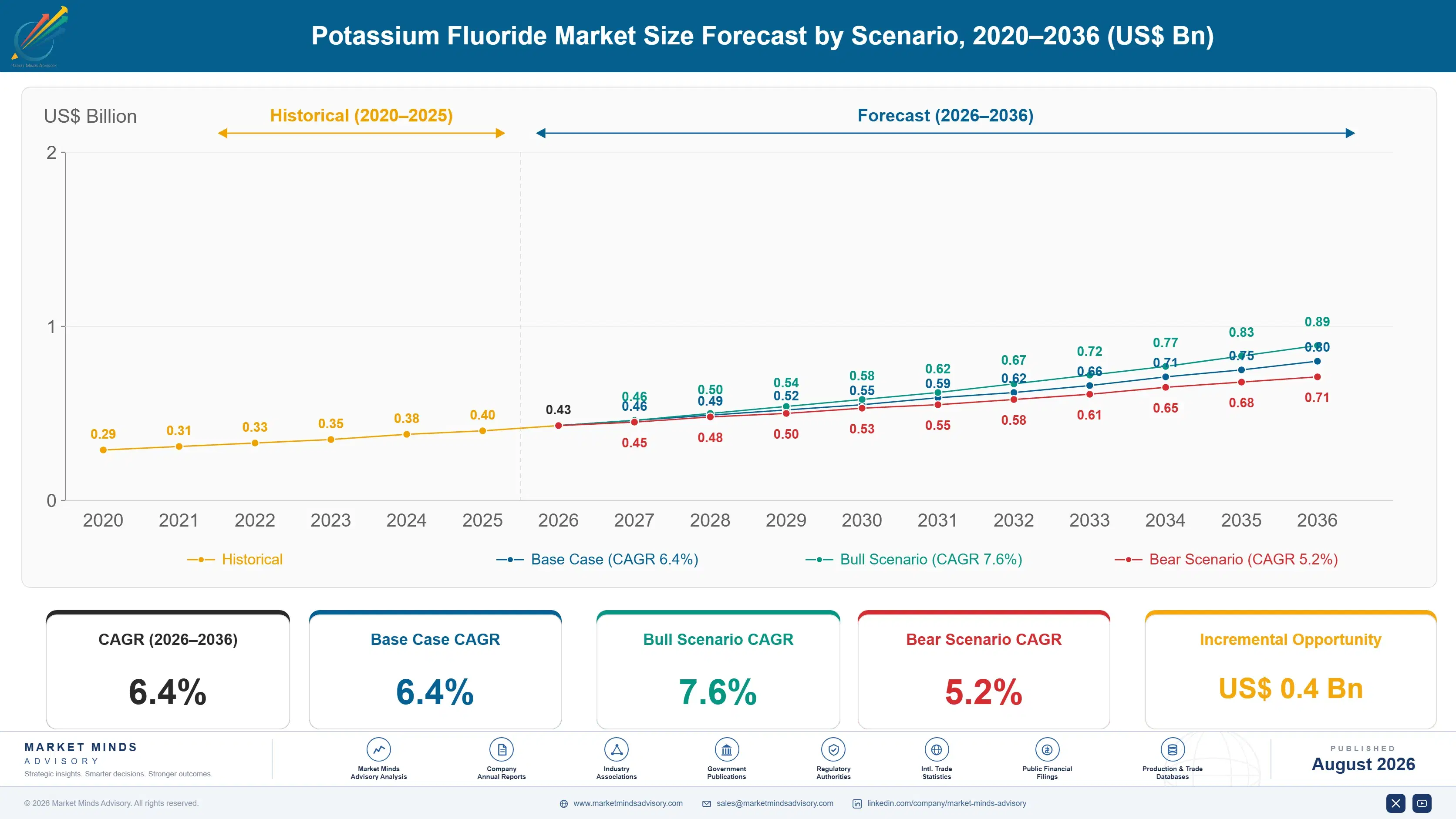
Potassium Fluoride Market Forecast Scenarios

potassium-fluoride-market-trends-size-forecast-scenario-1787580719499
Growth ran near 5.3% between 2020 and 2025, tracking fluorinated active ingredient development rather than any bulk chemical cycle. Chinese fluorspar consolidation and periodic export restriction tightened supply repeatedly through the period, lifting price more than volume in several years. Agrochemical destocking during 2023 and 2024 cut intermediate demand sharply before it recovered, which made the underlying trend harder to read than it should have been.
Base case 6.4% rests on three mechanisms. Fluorine content in new crop protection actives keeps rising because it delivers metabolic stability and rainfastness that formulators cannot obtain otherwise. Indian and Chinese pharmaceutical and agrochemical intermediate manufacturing is expanding, and both consume halogen exchange chemistry heavily. And electronic grade demand is growing with semiconductor and display etching requirements that specify purity levels ordinary production cannot reach. None depends on a bulk chemical cycle.
The bull case at 7.6% assumes agrochemical pipelines continue moving toward fluorinated chemistry at current rates while fluorspar supply stays adequate. The bear case at 5.2% is the European universal restriction proposal on fluorinated substances broadening in scope, which would not capture these intermediates directly but would slow investment across fluorochemistry through uncertainty alone. Scope clarification would release that.

Everything Depends on Keeping It Dry

A carbon fluorine bond does things nothing else does. It resists metabolic breakdown, alters how a molecule binds to a target, and changes solubility and membrane behaviour, which is why fluorine appears in roughly 53% of new agrochemical actives and a large share of new drugs. Putting it on an aromatic ring is the difficult part, and halogen exchange with potassium fluoride is how most of it happens.
TOP FIVE CONCENTRATION58%Fluorspar access and handling capability narrow the supplier field
FLUORSPAR COST SHARE47%Share of production cost carried by acid grade spar
CHINESE FLUORSPAR OUTPUT56%Portion of world acid grade spar mined in one country
SPRAY-DRIED GRADE PREMIUM2.4xPrice against standard anhydrous for high reactivity material
FLUORINATED AGROCHEMICAL SHARE53%Portion of new crop protection actives containing fluorine
MOISTURE SPECIFICATION LIMIT0.1%Water content above which exchange yields fall sharply
The reaction is unforgiving about water. Potassium fluoride is hygroscopic, and above roughly 0.1% moisture the fluoride ion hydrates, loses nucleophilicity and starts hydrolysing the substrate instead. Yields fall away quickly. So the commercial product is not really a salt, it is a salt that has been dried, milled to a particular surface area and packaged so it stays that way through shipping and storage.
Spray drying produces the highest surface area and reactivity, and it sells at roughly 2.4 times standard anhydrous material of identical composition. Customers running halogen exchange at scale pay it without much argument, because a few points of yield on a high-value intermediate is worth far more than the salt costs. That price gap is the whole commercial structure of the business.
"People assume this is a commodity salt because the formula is simple. What customers actually buy is surface area and dryness, and the producers who understand that charge more than twice what the ones selling potassium fluoride by the tonne manage to get."
Director, Fine and Specialty Chemicals Practice · MMA Chemicals and Materials Practice · August 2026

Market Trends

Fluorine content rising across new crop protection actives

Roughly 53% of crop protection actives entering development now contain fluorine, up steadily over two decades, because fluorination improves metabolic stability, rainfastness and target binding in ways that formulation cannot reproduce. Each fluorinated aromatic intermediate typically runs through halogen exchange, which makes potassium fluoride demand a direct bet on agrochemical pipeline composition rather than on tonnage. Resistance pressure is pushing discovery toward novel modes of action, and fluorinated scaffolds feature heavily among them. That trend shows no sign of reversing. Resistance pressure pushes discovery toward novel modes of action, and fluorinated scaffolds feature heavily among them.
Market Impact: Delivers 10.2% annual Indian growth

Fluorspar supply concentration prompting critical raw material designation

Acid grade fluorspar begins every fluorine value chain and roughly 56% of world output is mined in China, which has consolidated producers and periodically restricted exports. Both the European Union and United States list fluorspar as a critical raw material, and Mexican and Mongolian output is the only meaningful alternative at scale. Downstream producers have begun contracting spar on multi-year terms and qualifying non-Chinese sources at higher cost. Nobody has yet solved the concentration, and the designation acknowledges rather than addresses it. The designation acknowledges the exposure rather than doing anything about it.
Market Impact: Requires purity beyond 5 nines

Market Opportunities and Growth Drivers

Indian agrochemical intermediate manufacturing expanding rapidly

India grows fastest anywhere at 10.2%, on custom synthesis and intermediate manufacturing for global agrochemical and pharmaceutical companies relocating supply away from single-country Chinese dependence. Halogen exchange chemistry is well within Indian capability and several producers including Navin Fluorine and Gujarat Fluorochemicals have expanded fluorination capacity deliberately. Each new intermediate contract carries multi-year volume attached. The demand is qualification-driven rather than price-driven, which favours suppliers able to hold moisture and surface area specification consistently. Moisture and surface area specification rather than price is what decides these qualifications, which suits producers who invested in drying capability.
Market Impact: Fails above 0.1% moisture

Electronic grade purity requirements tightening in etching applications

Semiconductor and display manufacturers use fluoride chemistry in etching and cleaning steps where metallic contamination at parts per billion levels causes device failure. Purity specifications have tightened with each node transition, and the qualification process at a fab runs for a year or more before any commercial supply begins. Electronic grade material commands substantial premiums over chemical synthesis grades. Very few producers hold both the purification capability and the fab qualifications, which keeps that segment considerably narrower than the overall market suggests. A single fab position takes a year to establish and effectively never changes afterwards.
Market Impact: Delays decisions across 27 markets

Market Restraints and Challenges

Hygroscopicity making handling and logistics the real constraint

Potassium fluoride absorbs atmospheric moisture readily, and water above roughly 0.1% hydrates the fluoride ion, destroys nucleophilicity and causes substrate hydrolysis in halogen exchange. The root cause is thermodynamic rather than a process defect, so no purification step removes the tendency. Commercially it means packaging, storage and customer handling determine whether the product performs, and complaints often trace to the customer's warehouse. Producers are moving to sealed foil-lined packaging, nitrogen blanketing and smaller pack sizes that get used within a single campaign. Complaints frequently trace to a customer warehouse rather than to the plant.
Market Impact: Covers 53% of new actives

Fluorochemical regulatory uncertainty slowing investment decisions

The European universal restriction proposal on fluorinated substances would not capture potassium fluoride or the aromatic intermediates it produces, since neither meets the persistence definitions at issue. The root cause of the commercial problem is scope uncertainty rather than likely inclusion, and boards approving fluorochemical capacity read headlines rather than annexes. Commercially it delays capacity decisions across the chain. Producers and trade bodies are working on scope clarification, and several have published position papers separating intermediates from persistent fluorinated substances. Boards approving fluorochemical capacity read headlines rather than annexes. Position papers have not resolved it.
Market Impact: Concentrates 56% in one country
3 additional market trends, 4 additional growth drivers, and 2 additional restraints and challenges are covered in the full report. Contact sales@marketmindsadvisory.com to access the complete intelligence.

Segment CAGR and Growth Architecture

Six segments split by grade and physical form, because form determines reactivity, purity determines application access and both determine price for chemically identical material. A spray-dried grade and a technical flux grade share a formula and nothing commercially. Application and channel splits are handled in the framework instead. Form and purity are what the buyer is actually paying for here.
potassium-fluoride-market-trends-market-share-analysis-1787580720075

Spray-Dried High-Reactivity Grade

Growing at 9.6%, half again the market rate of 6.4%, spray-dried potassium fluoride delivers the surface area and low moisture that halogen exchange requires, at roughly 2.4 times the price of standard anhydrous material of identical composition. Customers running fluorination at scale pay it because a few points of yield on a high-value intermediate outweighs the salt cost many times over. Drying technology and packaging integrity are the actual competitive variables rather than any chemistry. Demand tracks fluorinated active ingredient development in agrochemicals and pharmaceuticals, which continues rising and shows no sign of reversing at all. Producers who invested in drying and packaging integrity hold this business, and those selling on composition alone do not compete for it at all.
CAGR 9.6%

Electronic and High-Purity Grade

At 8.4% electronic grade material serves semiconductor and display etching and cleaning steps where metallic contamination at parts per billion causes device failure. Purification requirements are considerably more demanding than chemical synthesis grades, and fab qualification runs for a year or more before commercial supply begins. Very few producers hold both the purification capability and the qualifications, which keeps competition narrow and pricing firm. Specifications tighten with each node transition, so the segment requires continuing investment rather than a single qualification. Japanese producers hold the strongest positions here by a considerable margin. Node transitions reset the specification rather than settling it, which makes this a continuing investment rather than a single qualification event.
CAGR 8.4%
Full segment breakdown across 6 segments available in the complete report.

Regional Architecture and Country Demand Map

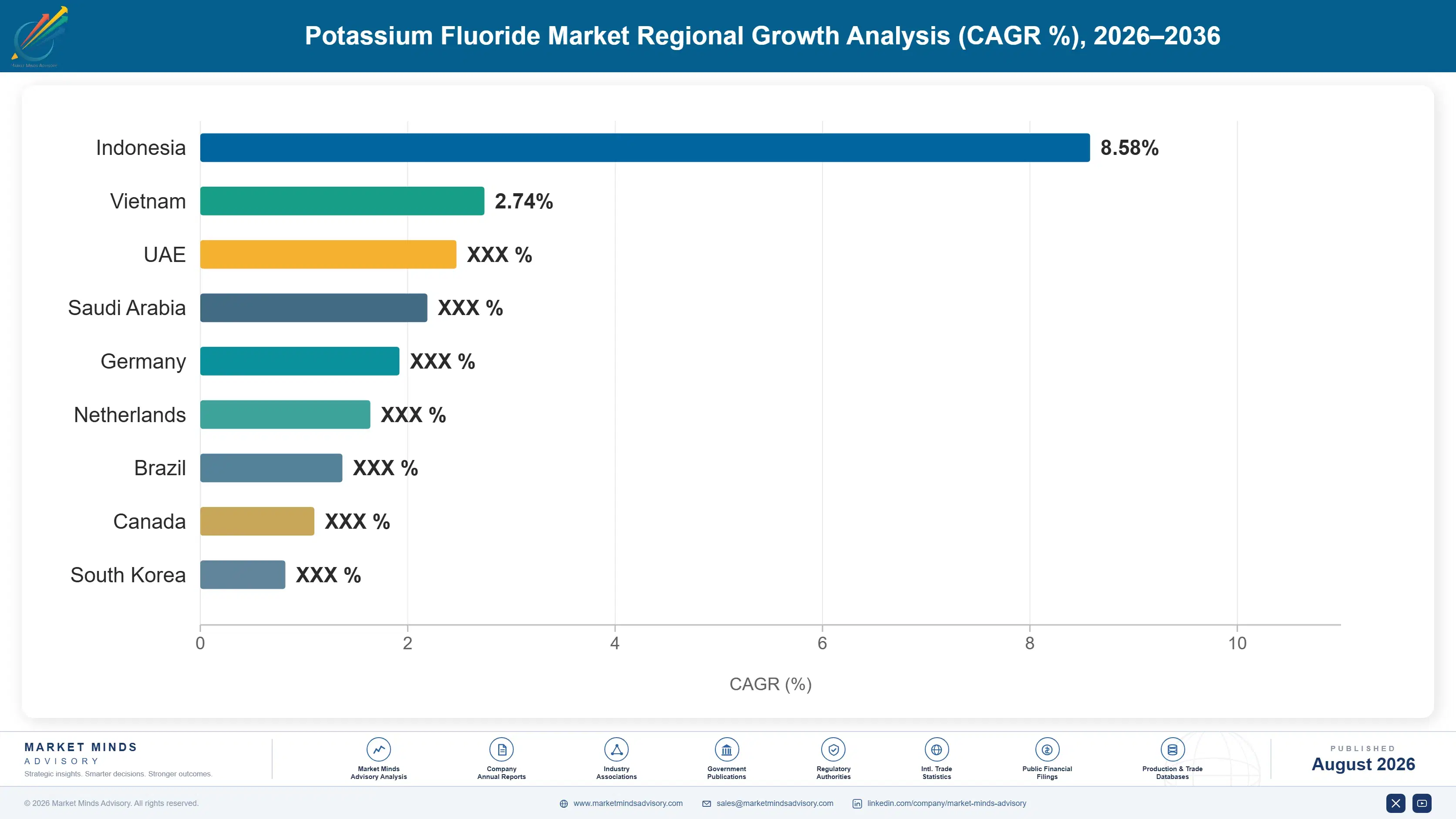
East Asia holds 41% of value, far above its usual band, because Chinese fluorspar mining and fluorochemical capacity dominate the upstream chain. South Asia and Pacific at 14% sits above its band on Indian intermediate manufacturing, while North America at 17% falls below its own band as synthesis moved east.

North America

Honeywell holds the most significant domestic fluorochemical position, and the 17% share sits below the usual band because agrochemical and pharmaceutical intermediate synthesis has moved substantially toward Asia over two decades. What remains is high-value custom synthesis and electronic grade supply where proximity and confidentiality matter. Fluorspar is listed as a critical raw material and almost entirely imported, principally from Mexico. Mexican mining output is the largest outside China and gives North American producers a supply position Europe cannot match. Semiconductor fab expansion under domestic incentives is lifting electronic grade demand steadily. Mexican spar access is the one upstream advantage the region holds over Europe, and it matters more than any conversion capability does.
Share: 17% | CAGR: 5.5% (2026 to 2036)

Western Europe

European producers hold specialty and high-purity positions rather than volume, with Solvay operating the most significant capacity and several smaller producers serving pharmaceutical custom synthesis. Fluorspar is designated a critical raw material and imported almost entirely, which leaves the region exposed to Chinese supply decisions with limited alternatives. The universal restriction proposal on fluorinated substances originates here, and the resulting scope uncertainty has slowed European fluorochemical investment more than anywhere else. Agrochemical intermediate demand is served increasingly from Indian and Chinese synthesis rather than domestically. Scope uncertainty around the restriction proposal has slowed European fluorochemical investment more than anywhere else in the world. Domestic synthesis keeps shrinking. Intermediate synthesis moved east.
Share: 18% | CAGR: 4.9% (2026 to 2036)
Regional intelligence for 5 additional markets available in the complete report: East Asia, South Asia and Pacific, Latin America, Middle East and Africa, Eastern Europe. Contact sales@marketmindsadvisory.com.
potassium-fluoride-market-trends-country-cagr-analysis-1787580720641

Four Moves in a Specification Business

Chemically identical material sells at 2.4 times the price depending on how it was dried and packaged, which tells you where the value sits. Fluorspar access sets the floor and specification capability sets the ceiling. Selling potassium fluoride by the tonne is the one approach that reliably fails. Grade and origin are the whole strategy.

Invest in spray drying and packaging integrity

Spray-dried high-reactivity grade commands roughly 2.4 times standard anhydrous pricing for chemically identical material, because surface area and moisture below 0.1% determine halogen exchange yield. A spray drying line with nitrogen handling and foil-lined packaging costs perhaps 12 million dollars and takes two years to commission and qualify. Customers running fluorination at scale pay the premium without argument, since yield on a high-value intermediate outweighs the salt cost many times over. This is the clearest upgrade available. Nothing else moves margin comparably in this business. The upgrade pays back on grade mix alone.
Market Impact: Costs $12 million for each spray drying line

Contract fluorspar outside the dominant origin

Acid grade fluorspar is 47% of production cost and roughly 56% of world output is mined in one country that has restricted exports repeatedly. Mexican, South African and Mongolian spar costs more and sells against that concentration rather than against Chinese pricing. Customers with supply continuity policies increasingly require a documented non-Chinese route and pay for it. Multi-year spar contracting also removes the price volatility that Chinese consolidation announcements produce, which is worth more than the premium in most years. Multi-year contracting also removes the volatility that consolidation announcements produce.
Market Impact: Hedges against a 56% concentration in one origin

Qualify into semiconductor fabrication customers properly

Electronic grade material serves etching and cleaning steps where contamination at parts per billion causes device failure, and fab qualification runs a year or more before commercial supply begins. That barrier keeps competition genuinely narrow and pricing firm, and specifications tighten with each node transition rather than settling. Purification capability costs real money and produces a position competitors cannot enter quickly. Semiconductor capacity expansion under industrial incentives in several regions is adding qualified demand faster than qualified supply is appearing. A qualification runs 12 months or more before commercial supply begins.
Market Impact: Requires a full 12 months of fabrication qualification

Solve customer handling rather than blaming it

Most performance complaints trace to moisture picked up in a customer's warehouse rather than to material leaving specification at the plant. Smaller pack sizes used within a single campaign, sealed foil liners and nitrogen blanketing all address it, at packaging cost perhaps 4% higher than bulk supply. Producers who solved handling for their customers keep accounts that competitors periodically lose on a bad batch that was never actually theirs. It is the cheapest retention investment available in this business. Retention is cheaper than acquisition here. A lost account rarely comes back afterwards.
Market Impact: Adds 4% packaging cost to protect account retention

Who Controls the Margin Pool

Participation is measured on annual production capacity in tonnes, and the top five hold 58%. Concentration is high because hydrogen fluoride handling requires permits and safety infrastructure that few chemical sites carry, and because fluorspar access is not universally available. Solvay and Honeywell lead on Western specialty positions, with Do-Fluoride the largest Chinese producer. The gap to challengers is spar access and specification capability rather than salt chemistry.
Competition runs on three fronts. Grade capability decides pricing most directly, since spray-dried and electronic grades earn multiples of standard anhydrous for identical composition. Fluorspar security is the second, and it has become a formal customer requirement rather than a supplier concern. Qualification depth is the third, particularly in semiconductor applications where a fab position takes a year to establish and effectively never changes afterwards.

The pressure ahead is regulatory rather than competitive. Scope uncertainty around the European restriction proposal is slowing investment across fluorochemistry even where the substances involved are plainly outside it. Expect capacity qualification and spar contracting rather than acquisitions, since the permitted sites that would be worth buying rarely trade. Rankings shift as Indian producers qualify into custom synthesis positions that were Chinese by default a decade ago.
potassium-fluoride-market-trends-company-positioning-matrix-1787580721183

Competitive Moat and Risk Dimensions

SOLVAY

Moat: Fluorine handling and specialty grades

Solvay operates hydrogen fluoride handling infrastructure and permits across several European and American sites, which very few chemical companies hold and none can assemble quickly under current permitting practice. Combined with specialty grade capability across pharmaceutical and electronic applications, that produces a position built on regulatory history as much as on technology.
SOLVAY

Risk: European fluorspar import exposure

European operations depend almost entirely on imported acid grade fluorspar, with no domestic source of scale and Chinese output dominating world supply. Restriction announcements transmit directly into European cost and availability, and the critical raw material designation acknowledges the exposure without providing any alternative supply that could actually be developed quickly.
DO-FLUORIDE NEW MATERIALS

Moat: Domestic spar and integration

Do-Fluoride sits inside the country that mines roughly 56% of world acid grade fluorspar, with integration back toward hydrogen fluoride production that removes the largest purchased input from its cost stack. That upstream position is unavailable to any producer outside China at comparable cost, and it holds through every supply disruption that damages competitors.
DO-FLUORIDE NEW MATERIALS

Risk: Customer origin diversification pressure

Global agrochemical and pharmaceutical customers are deliberately qualifying Indian and Western suppliers to reduce single-country dependence, which caps how much of any account a Chinese producer can hold regardless of price or quality. Specification capability in high-purity electronic grades also lags Japanese producers, closing the segment where pricing is firmest.

Players Tracked

Prominent Players

Solvay
Honeywell
Do-Fluoride New Materials
Morita Chemical Industries
Stella Chemifa

Other Key Players

Fluorsid
Derivados del Fluor
Gulf Fluor
Sinochem Lantian
Zhejiang Sanmei Chemical
Yingpeng Chemical
Shaowu Fluoride Chemical
Navin Fluorine International
Gujarat Fluorochemicals
SRF Limited
Tanfac Industries
Buss ChemTech
Chemours
Arkema
Merck KGaA

Recent Developments

MARCH 2026

Indian producer commissions spray-dried fluoride capacity for export synthesis

An Indian fluorochemical producer commissioned spray-dried potassium fluoride capacity aimed at custom synthesis customers running halogen exchange for agrochemical intermediates. The investment is an organic capacity addition with nitrogen handling and sealed packaging rather than any partnership or licensing arrangement. Customer qualification is under way at present.
Signal: Indian producers are entering the high-reactivity grade where the premium sits rather than competing on standard material
AUGUST 2025

Fluorspar export administration tightened following mining consolidation

Administrative measures on acid grade fluorspar exports were tightened following further consolidation among domestic mining operators, restricting availability to converters outside the country. Downstream producers reported extended lead times and moved to multi-year contracting where alternative sources permitted it. Lead times extended across several months.
Signal: Upstream concentration transmits into downstream availability far faster than any critical raw material designation could address
JANUARY 2026

European trade body publishes scope position separating intermediates from restriction

A European chemical trade body published a position paper distinguishing fluorinated synthesis intermediates from the persistent substances targeted by the universal restriction proposal. The paper addresses scope interpretation and carries no regulatory force, though several producers cited it in board investment submissions. No regulatory response has been issued.
Signal: Scope uncertainty rather than likely inclusion is what has been delaying fluorochemical capacity decisions across Europe

It Starts With the Spar

Acid grade fluorspar accounts for roughly 47% of production cost, mined principally in China, Mexico, Mongolia and South Africa and converted to hydrogen fluoride before any fluoride salt is made. Potassium hydroxide or carbonate adds a further 18%, carrying potash volatility with it. Drying, milling and packaging together take about 19%, rising for spray-dried and electronic grades needing nitrogen handling and sealed packaging.
Chinese fluorspar administration has been the defining input event of this decade. Mining consolidation and periodic export restriction tightened availability repeatedly, and acid grade spar prices rose well above historic ranges across several years. Both the European Union and United States responded by listing fluorspar as a critical raw material, which documented the exposure without creating alternative supply anywhere. Converters elsewhere reported extended lead times and moved toward multi-year contracting.

The competitive mechanism runs through spar access rather than through conversion efficiency. A Chinese producer takes domestic spar at prices set inside a controlled market, while a European or Indian converter buys imported material with freight, duty and availability risk attached. That gap is larger than any processing advantage available anywhere. Mexican and South African supply is the practical hedge, and both cost more.
potassium-fluoride-market-trends-cost-volatility-analysis-1787580721381

Contract fluorspar on multi-year terms outside the dominant origin

Mexican, South African and Mongolian spar costs more than Chinese material in normal conditions and removes exposure to export administration that has tightened repeatedly this decade. Customers with supply continuity policies increasingly require the documented alternative route and pay for it, which converts a cost disadvantage into a commercial position worth holding. Few converters had contracted this way before.

Match potassium supply tenor to downstream contract tenor

Potassium hydroxide and carbonate carry potash volatility and represent about 18% of cost, while downstream chemical contracts frequently run annually. Matching tenor on both sides removes most of the resulting margin variance at modest premium. Producers who left potassium on spot terms through the 2022 disruption absorbed the increase against fixed downstream pricing. Most restructured procurement afterwards.

Price drying and packaging separately from the salt

Spray-dried and electronic grades carry drying, nitrogen handling and packaging costs that standard anhydrous does not, and producers pricing them as a single delivered number obscure where the value sits. Separating the specification premium in contract structure protects it when standard grade pricing moves, and customers understand it readily once the yield economics are explained to them.

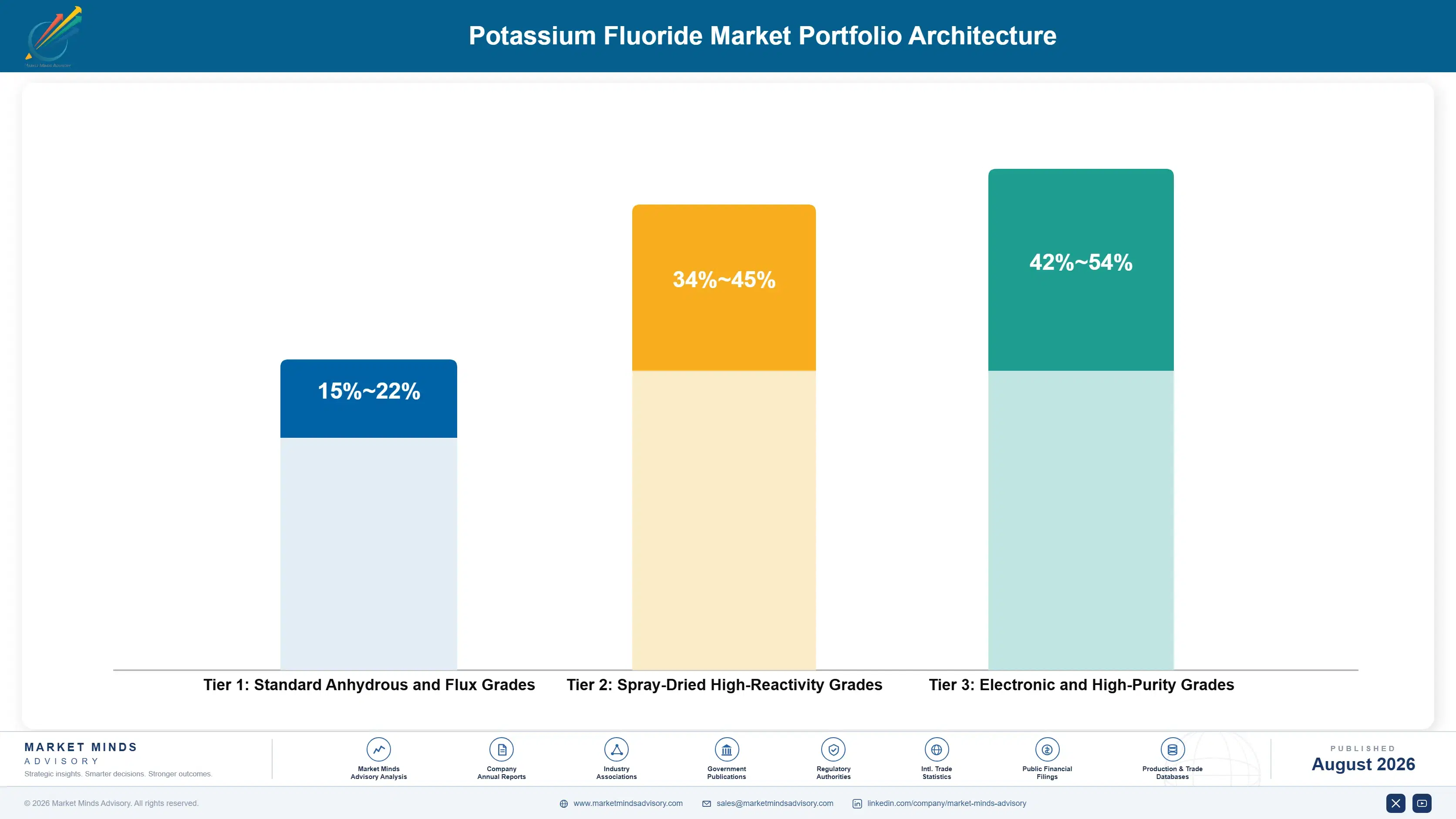
Portfolio Architecture for Margin Defence

Margin here tracks specification rather than chemistry to an unusual degree. Standard anhydrous and technical flux grades earn margins in the high teens, because the material is interchangeable and Chinese spar integration sets the floor. Nothing about conversion skill closes a 47% input cost gap, and producers competing here from imported spar are competing on somebody else's terms entirely.
Spray-dried high-reactivity grade sits in a different economy at margins in the mid thirties to mid forties, because customers buy surface area and dryness rather than composition and pay 2.4 times accordingly. The range is wide because drying technology, packaging integrity and how much of the customer's handling problem a producer solves all vary considerably between suppliers. Solving the customer's handling problem is worth more than incremental purity.

Electronic and high-purity grades hold the strongest position, running into the low fifties, where fab qualification takes over a year and specifications tighten with each node. Those margins reflect a qualification barrier that resets rather than settling, which requires continuing investment and rewards it. Japanese producers hold most of that position and have done for a long time. It rewards continuing investment and punishes anyone treating it as a single event.

Standard Anhydrous and Flux Grades

Standard anhydrous potassium fluoride and technical flux material sold on composition rather than performance. The seven point range reflects fluorspar access and freight position, with conversion efficiency contributing very little either way.
Gross Margin: 15-22%

Spray-Dried High-Reactivity Grades

Spray-dried material sold on surface area and moisture specification for halogen exchange chemistry. The eleven point range reflects drying technology, packaging integrity and how far a producer solves the customer's own handling problem.
Gross Margin: 34-45%

Electronic and High-Purity Grades

Semiconductor and display grade material qualified against parts per billion contamination limits. The twelve point range reflects qualification depth and node currency, since specifications tighten with each transition rather than settling permanently.
Gross Margin: 42-54%
potassium-fluoride-market-trends-portfolio-architecture-1787580721932

High-value Sub-segments and Strategic Watch-out

Spray-Dried Halogen Exchange Grades

High value and the fastest growth at 9.6% on fluorinated active ingredient development. Customers pay 2.4 times standard pricing for surface area and dryness rather than composition. Yield on a high-value intermediate makes the premium easy to justify. Drying capability decides who competes. Composition alone sells nothing.
Gross Margin: 36-45%

Semiconductor Etching Grades

High value, moderate growth, and the narrowest competition anywhere in this market. Fab qualification runs over a year and specifications tighten at each node transition. Very few producers hold both purification capability and current qualifications together. Japanese producers hold most of that position. Entry takes over a year.
Gross Margin: 44-54%

Standard Anhydrous Supply

The volume core and permanently set by Chinese fluorspar integration. Imported spar leaves Western and Indian converters competing on a permanent input disadvantage. Growth follows chemical synthesis volumes with no specification premium available at all. No specification premium is available at all. Spar access sets the floor.
Gross Margin: 15-22%

European Capacity Facing Scope Uncertainty

The strategic watch-out. Restriction scope uncertainty is delaying investment decisions even where the substances involved sit plainly outside the proposal. The margin range assumes current capacity, since new European investment has largely stalled pending clarification. Clarification would release several deferred decisions. New investment has largely stalled.
Gross Margin: 14-26%

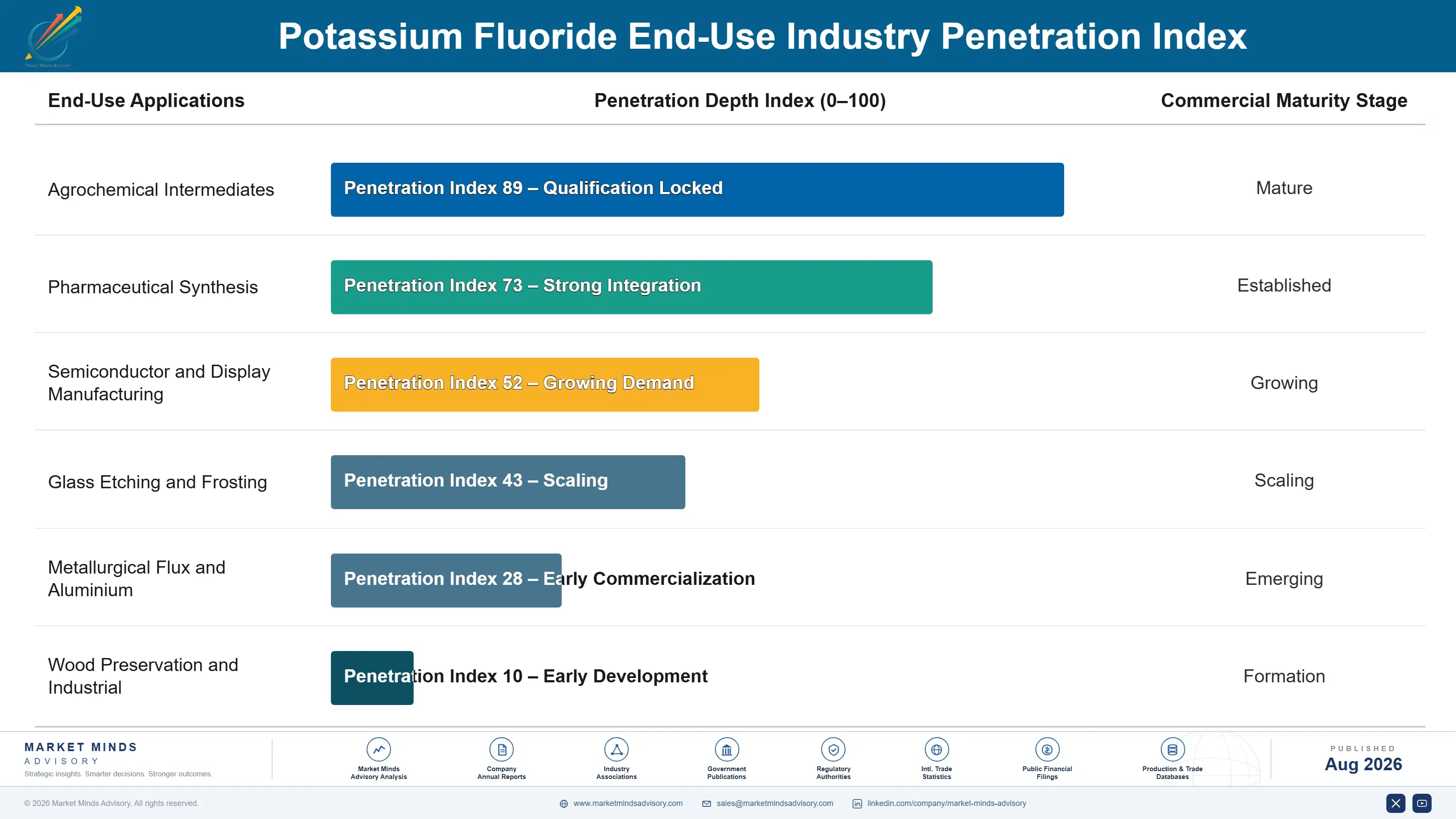
How the Volume Returns

Custom synthesis supply behaves like an annuity attached to a molecule. Once a fluoride grade is written into a validated route for an agrochemical or pharmaceutical intermediate, it is consumed for as long as that product sells, at volumes following the customer's own order book rather than any purchasing decision. Changing it means revalidating the route, which nobody does to save on a salt representing a small fraction of intermediate cost.
Stickiness varies sharply by application. Semiconductor supply is stickiest, since a fab qualification takes over a year and a material change risks yield on wafers worth far more than any chemical. Pharmaceutical intermediate routes come next, held by regulatory filings. Agrochemical custom synthesis is moderately sticky, held by validated routes rather than filings. Technical flux and glass etching applications switch on price within specification.

The buyer has shifted toward process chemists and away from procurement. Potassium fluoride was once purchased on composition and price by people who never ran the reaction. Yield sensitivity to moisture and surface area moved the decision toward the people who do, and they specify a grade and a supplier rather than a chemical, which is why the premium grades hold their pricing so well.
potassium-fluoride-market-trends-end-use-penetration-index-1787580722433

Where We Would Invest

These are among the four positions where our research anticipates prominent divergence between winners and laggards over the coming forecast period. Each is grounded in the demand model, the regulatory perimeter, and the announced capacity pipeline.
01 / SPECIFICATION GRADE INVESTMENT

Build spray drying capability rather than selling salt by weight

Spray-dried high-reactivity grade commands roughly 2.4 times standard anhydrous pricing for chemically identical material, because surface area and moisture below 0.1% determine halogen exchange yield directly. A drying line with nitrogen handling and sealed packaging costs perhaps 12 million dollars over about two years, including customer qualification. Customers running fluorination at scale accept the premium without argument, since a few points of yield on a high-value intermediate outweighs the entire salt cost many times over on any realistic campaign volume.
02 / FLUORSPAR SUPPLY SECURITY

Contract spar outside the dominant origin and sell that position

Acid grade fluorspar is 47% of production cost and roughly 56% of world output is mined in a single country that has tightened export administration repeatedly this decade. Mexican, South African and Mongolian material costs rather more and sells against that concentration rather than against Chinese pricing at all. Customers operating formal supply continuity policies increasingly require a documented alternative route and will pay for it, which turns what looks like a cost disadvantage into a commercial position worth holding.
03 / SEMICONDUCTOR QUALIFICATION ENTRY

Enter fab qualification now, because specifications keep resetting

Electronic grade material serves the etching and cleaning steps where contamination at parts per billion causes outright device failure, and fab qualification runs a year or more before any commercial supply begins at all. That barrier keeps competition genuinely narrow and pricing firm, and node transitions keep resetting specifications rather than settling them permanently. Semiconductor capacity expanding under industrial incentives across several regions is adding qualified demand considerably faster than qualified supply has been appearing to meet any of it.
04 / CUSTOMER HANDLING SUPPORT

Fix the warehouse problem before a competitor does

Most performance complaints in this business trace back to moisture picked up in a customer's own warehouse rather than to material leaving specification at the plant gate. Sealed foil liners, nitrogen blanketing and smaller pack sizes used within a single campaign all address it, at a packaging cost of around 4% above ordinary bulk supply. Producers who solved handling for their customers retain accounts that competitors periodically lose over a bad batch that was never actually theirs to begin with.

Engagement Snapshot From the Field

A live engagement with an industry participant carrying material or product regulatory and market exposure ahead of a defining policy shift, showing how our research translates into a defensible multi-year portfolio strategy.
MARKET MINDS ADVISORY · CLIENT ENGAGEMENT SUMMARY
Potassium Fluoride Producer Strategic Portfolio Review and Transition Roadmap 2026·Investment Scenario on Potassium Fluoride Exposure Evaluation 2025-26
CLIENT PROFILE
A European fluorochemical producer manufacturing potassium fluoride and related salts from imported acid grade fluorspar, with annual output near 9 thousand tonnes and divisional revenue around 74 million euros (client-reported, unverified by MMA). Output was weighted toward standard anhydrous grades sold to agrochemical and pharmaceutical intermediate manufacturers across Europe and India. Spray drying capability had never been installed.
STRATEGIC CHALLENGE
Standard grade margins had compressed as Chinese material reached European buyers, while fluorspar availability had tightened twice following export administration changes. A board proposal to expand standard capacity had been deferred twice over restriction scope uncertainty. Management needed a view on grade strategy, spar sourcing and whether European investment made sense at all.
MMA APPROACH
MMA modelled fluorspar availability and pricing under three export administration scenarios, costed spray drying and packaging upgrade requirements with two engineering contractors, and benchmarked the client's grade mix and margins against six European, Chinese and Indian producers. Restriction scope interpretation was tested with regulatory counsel. Interviews with 47 experts covered fluorination chemistry, spar mining and semiconductor qualification.
KEY FINDINGS
  1. Standard anhydrous grade could not be sold profitably against Chinese material in any modelled spar scenario, since the 47% input cost gap exceeded any conversion advantage available.
  2. Spray drying upgrade costs came in near 12 million dollars over two years, against pricing roughly 2.4 times the standard grade the same plant already produced.
  3. Four of the client's seven largest customers operated documented single-origin limits on fluorspar-derived materials and would pay for a qualified non-Chinese route.
  4. Regulatory counsel confirmed the aromatic intermediates produced from this material fell outside restriction scope, which the board had not previously established with any confidence.
CLIENT PROFILE
A European fluorochemical producer manufacturing potassium fluoride and related salts from imported acid grade fluorspar, with annual output near 9 thousand tonnes and divisional revenue around 74 million euros (client-reported, unverified by MMA). Output was weighted toward standard anhydrous grades sold to agrochemical and pharmaceutical intermediate manufacturers across Europe and India. Spray drying capability had never been installed.
STRATEGIC CHALLENGE
Standard grade margins had compressed as Chinese material reached European buyers, while fluorspar availability had tightened twice following export administration changes. A board proposal to expand standard capacity had been deferred twice over restriction scope uncertainty. Management needed a view on grade strategy, spar sourcing and whether European investment made sense at all.
MMA APPROACH
MMA modelled fluorspar availability and pricing under three export administration scenarios, costed spray drying and packaging upgrade requirements with two engineering contractors, and benchmarked the client's grade mix and margins against six European, Chinese and Indian producers. Restriction scope interpretation was tested with regulatory counsel. Interviews with 47 experts covered fluorination chemistry, spar mining and semiconductor qualification.
KEY FINDINGS
  1. Standard anhydrous grade could not be sold profitably against Chinese material in any modelled spar scenario, since the 47% input cost gap exceeded any conversion advantage available.
  2. Spray drying upgrade costs came in near 12 million dollars over two years, against pricing roughly 2.4 times the standard grade the same plant already produced.
  3. Four of the client's seven largest customers operated documented single-origin limits on fluorspar-derived materials and would pay for a qualified non-Chinese route.
  4. Regulatory counsel confirmed the aromatic intermediates produced from this material fell outside restriction scope, which the board had not previously established with any confidence.
RECOMMENDED STRATEGY
Phase 1: Phase one: commission spray drying and sealed packaging capability, since standard grade cannot be sold profitably against Chinese material at any spar price modelled. Phase 2: Phase two: contract Mexican and South African fluorspar on multi-year terms and market the documented alternative route to customers holding origin limits. Phase 3: Phase three: establish restriction scope position formally with counsel opinion, removing the uncertainty that had deferred two board investment decisions already.
OUTCOME
The producer commissioned spray drying capability during 2026 and reported spray-dried grades reaching 31% of volume within a year at roughly 2.4 times standard pricing (client-reported, unverified by MMA). Multi-year spar contracts were signed with two non-Chinese suppliers, and three customers moved additional volume across on origin diversification grounds.

Frequently Asked Questions

Foundational context covering the market sizes, CAGR, scope, country, region and competition that inform every finding below. This section is provided to cover basics and most often pre-purchase conversations, answered from the MMA Primary Research Dataset.

What is the current size of the Potassium Fluoride Market?

MMA sizes it at USD 0.41 billion in 2025, rising to USD 0.44 billion in 2026. The figure covers potassium fluoride and bifluoride salts across all grades at producer selling price.

How large will the Potassium Fluoride Market be by 2036?

USD 0.82 billion by 2036, an incremental USD 0.38 billion over the 2026 base and an expansion multiple of 1.86 times. Spray-dried and electronic grades account for a disproportionate share.

What is the CAGR for the Potassium Fluoride Market 2026 to 2036?

6.4% in the base case, with a bull case at 7.6% and a bear case at 5.2%. The spread turns on fluorinated active ingredient development and on fluorochemical restriction scope.

Which segment is growing fastest?

Spray-dried high-reactivity grade at 9.6%, half again the market rate of 6.4%. Surface area and moisture below 0.1% determine halogen exchange yield, which customers pay 2.4 times for.

Who are the major companies in the Potassium Fluoride Market?

Solvay, Honeywell, Do-Fluoride New Materials, Morita Chemical Industries and Stella Chemifa lead on annual production capacity. Fifteen further participants are profiled in the full report.

Which country is growing fastest?

India at 10.2%, on custom synthesis and intermediate manufacturing expanding for global agrochemical and pharmaceutical customers reducing single-country dependence. Several producers have added fluorination capacity deliberately.

Report Segmentation Architecture

The full report scope spans multiple orthogonal segmentation dimensions, with cross-tabulated demand data provided for each dimension pair. Coverage extends further to regional breakdowns, trend trajectories, and the competitive detail needed to support segment-level decision-making.

By Grade and Form

  • Standard Anhydrous Potassium Fluoride
  • Spray-Dried High-Reactivity Grade
  • Potassium Bifluoride
  • Aqueous Solution Grades
  • Electronic and High-Purity Grade
  • Technical and Flux Grade

By End-Use Industry

  • Agrochemical Intermediates
  • Pharmaceutical Synthesis
  • Semiconductor and Display Manufacturing
  • Glass Etching and Frosting
  • Metallurgical Flux and Aluminium
  • Wood Preservation and Industrial

By Commercial Dimension

  • Direct Supply to Synthesis Customers
  • Custom Synthesis Contract Supply
  • Distributor and Trader Supply
  • Semiconductor Qualified Supply
  • Export and Cross-Border Trade
  • Toll Processing Agreements

By Region

  • North America
  • Western Europe
  • East Asia
  • South Asia and Pacific
  • Latin America
  • Middle East and Africa
  • Eastern Europe

Scope, Methodology, and Coverage

Every figure in this report is reproducible from documented input assumptions. The scope below maps the historical period, the forecast horizon, the segmentation dimensions, and the countries covered, alongside the underlying primary and qualitative methodology.
Historical Period
2020 to 2025
Forecast Period
2026 to 2036
Base Year
2025 (USD billions; MMA Primary Research Dataset, August 2026)
Market Definition
Potassium fluoride and potassium bifluoride salts produced for chemical synthesis, electronics, metallurgical flux and glass etching applications, across standard anhydrous, spray-dried high-reactivity, aqueous solution, electronic high-purity and technical flux grades, measured at producer selling price. Hydrofluoric acid, fluorspar, other alkali metal fluorides including sodium and caesium fluoride, fluoropolymers, and finished fluorinated active ingredients are excluded from scope entirely.
Quantitative Units
USD billions (current prices); thousand tonnes produced annually; USD per tonne by grade and region
Segmentation Dimensions
Grade and form; end-use industry; commercial dimension; region
Regions Covered
North America, Western Europe, East Asia, South Asia and Pacific, Latin America, Middle East and Africa, Eastern Europe
Countries Covered
United States, Canada, Mexico, Germany, France, Belgium, Spain, Italy, China, Japan, South Korea, Taiwan, India, Australia, Brazil, Mongolia, South Africa, United Arab Emirates, Poland, Czech Republic
Key Companies Profiled
Solvay, Honeywell, Do-Fluoride New Materials, Morita Chemical Industries, Stella Chemifa, Fluorsid, Derivados del Fluor, Gulf Fluor, Sinochem Lantian, Zhejiang Sanmei Chemical, Yingpeng Chemical, Shaowu Fluoride Chemical, Navin Fluorine International, Gujarat Fluorochemicals, SRF Limited, Tanfac Industries, Buss ChemTech, Chemours, Arkema, Merck KGaA
Quantitative Methodology
Primary survey, n=3,800 respondents, Q4 2025, six countries; demand-side model with trade association cross-validation
Qualitative Methodology
47 expert interviews, Q4 2025; applied to validate demand model assumptions, identify emerging dynamics, and assess competitive positioning
Report Format
PDF and XLSX data workbook (Word format preview document)
Publisher
Market Minds Advisory
Report Code
MMA-2026-CHM-128
Published
August 2026
Contact
sales@marketmindsadvisory.com | www.marketmindsadvisory.com

Purchase the full Potassium Fluoride Market Report (2026 to 2036).

The full report sizes each grade independently through 2036 and explains why chemically identical material sells at multiples of the standard price depending on how it was dried and packaged. It traces fluorspar availability and pricing under several export administration scenarios, quantifies fluorine content trends across agrochemical and pharmaceutical development pipelines, and maps semiconductor qualification positions by producer. Regional chapters cover all seven regions with capacity level detail where disclosure permits. Competitive profiling covers 20 participants on a single production capacity basis, with restriction scope interpretation assessed against intermediate chemistry.
Each grade sized independently with pricing multiples explained
Fluorspar availability modelled under several administration scenarios
Fluorine content trends quantified across development pipelines
Semiconductor qualification positions mapped by producer
Twenty participants profiled on one consistent basis
Restriction scope interpretation assessed against intermediate chemistry

Built For The People Who Decide

From boardroom strategy to bench-side execution, this report is read cover-to-cover by leaders shaping the next decade of their industry, turning demand scenarios, market dynamics and valuation benchmarks into decisions.
CXOs/ Presidents/ VPs/ Managers
M&A and Corporate Development
Strategy Teams and R&D Heads
Procurement and Product Directors
Regulatory and Compliance Leaders
Investor Relations and Equity Analysts