Market Minds Advisory
Potassium Citrate Market

Potassium Citrate Market: One Salt, Two Businesses, and a Single Country of Origin

Potassium chloride tastes metallic and potassium citrate does not, and that single sensory fact is the entire reason one of them is winning the sodium reduction argument in processed meat and cheese.

Lead Analyst

Bilal Shaikh

Published

September 2026

Make Smarter Decisions with Customized Research Insights

Request a free sample report and evaluate market opportunities, growth trends, and competitive dynamics relevant to your business needs.

2025 MARKET VALUE$0.7BMarket Size 2025
2036 FORECAST VALUE$1.4BBase Case , 2026 to 2036
CAGR 2026 TO 20366.0 %Bull 7.2% / Bear 4.8%
INCREMENTAL OPPORTUNITY$0.6BNet 10- year value creation
EXPANSION MULTIPLE1.79x2036 value over 2026 base
Strategic Levers
M&A Pipeline
Regional Outlook
Country Rankings
Competitive Intelligence
Segmental Deep-dive
Call-Us : 91 93563 13602

Executive Snapshot and Market Trajectory

Two businesses share this molecule and almost nothing else. One is a pharmacopoeia-grade salt prescribed against kidney stone recurrence at roughly 3.2 times food grade pricing. The other is a buffering and acidity regulating salt sold by the tonne into processed food. Nothing about the molecule differs between them.
The food side is where sodium reduction changed the argument. Potassium chloride is the cheap sodium replacement and it tastes metallic at the levels reformulation requires, which limits it badly in processed meat, cheese and bakery. Potassium citrate carries no comparable off-note and costs considerably more, so it wins where taste is the binding constraint rather than the budget. Manufacturers pay several times the chloride price deliberately.
Pharmaceutical grade grows at 9.0%, half again the market rate of 6.0%, on rising kidney stone incidence and on urology guidance recommending citrate therapy for hypocitraturic stone formers. Roughly 63% of world output comes from China, since the salt is made by neutralising citric acid and citric acid fermentation concentrated there decades ago. Antidumping measures on Chinese citric acid apply in two major jurisdictions. Trade measures shape the flows more than cost does.
Market Definition
Potassium citrate salts produced for food, pharmaceutical, supplement, beverage and industrial applications, in anhydrous and monohydrate forms, measured at producer selling price. Excludes citric acid and other citrate salts including sodium and calcium citrate, potassium chloride and other potassium salts, and finished pharmaceutical or food products containing potassium citrate.
Base Year Value
$0.7B in 2025 (MMA Primary Research Dataset, August 2026)
Forecast Period
2026 to 2036, eleven discrete annual values
CAGR
6.0% base case. Bull 7.2%. Bear 4.8%.
Fastest Growth Segment
Pharmaceutical Grade: 9.0% CAGR
Fastest Growth Country
India: 9.6% CAGR
Fastest Growth Region
South Asia and Pacific: 8.2% CAGR
Largest Region
East Asia: 36% of 2025 global value
Market Leaders
Jungbunzlauer, Cargill, RZBC Group, Gadot Biochemical Industries, Weifang Ensign Industry. Source: MMA Primary Research Dataset, July 2026.
Primary Survey
n=3,800 procurement and R&D decision-makers, Q4 2025, six countries
Methodology
Demand-side build-up, cross-validated against public data, 47 expert interviews

Potassium Citrate Market Forecast Scenarios

potassium-citrate-market-trends-size-forecast-scenario-1787580700545
Growth ran near 4.9% between 2020 and 2025 on food demand that tracked processed food volumes and a pharmaceutical business that grew faster throughout. The 2022 potash disruption raised potassium hydroxide and carbonate costs sharply and producers passed most of it through, which lifted value more than volume in that year. Antidumping measures on Chinese citric acid continued shaping trade flows across the whole period.
Base case 6.0% rests on three mechanisms. Sodium reduction targets across the United Kingdom, Argentina, South Africa and elsewhere keep pushing reformulation, and potassium citrate takes the applications where potassium chloride's metallic note is unacceptable. Kidney stone incidence continues rising with obesity prevalence and heat exposure, which urology guidance addresses partly through citrate therapy. And Indian pharmaceutical manufacturing is expanding active salt consumption from a low base. None depends on the others arriving.
The bull case at 7.2% assumes sodium reduction targets tighten into binding requirements rather than voluntary schemes, which would move reformulation from the applications that can afford citrate to the ones that currently cannot. The bear case at 4.8% is potassium chloride formulation improving enough through masking technology to close the taste gap, which would remove citrate's principal advantage in food.

The Salt That Does Not Taste Metallic

Every sodium reduction programme runs into the same wall. Removing salt removes flavour, preservation and texture at once, and potassium chloride is the obvious replacement because potassium behaves similarly on the tongue and costs very little. It also carries a metallic, faintly bitter note that becomes obvious above modest inclusion levels, and no amount of reformulation removes it entirely.
TOP FIVE CONCENTRATION51%Citric acid producers dominate through backward integration into fermentation
CHINESE SUPPLY SHARE63%Portion of world output produced within a single country
CITRIC ACID COST SHARE54%Share of production cost carried by the acid itself
PHARMACEUTICAL GRADE PREMIUM3.2xPrice against food grade for pharmacopoeia compliant material
SODIUM REDUCTION PENETRATION8%Share of processed food reformulation using potassium citrate
TRADE MEASURE JURISDICTIONS2Major jurisdictions applying duties to citric acid imports
Potassium citrate does not have that problem. It delivers potassium without the off-note, buffers pH, and works as an emulsifying salt in processed cheese where it does two jobs at once. It costs several times potassium chloride, which confines it to applications where the taste penalty matters more than the ingredient budget. Processed meat, cheese and bakery are exactly those applications. Nothing about the argument is nutritional.
The pharmaceutical business runs on entirely separate logic. Urology guidance recommends citrate therapy for stone formers with low urinary citrate, and kidney stone incidence has been rising with obesity prevalence and heat exposure across most developed markets. Pharmacopoeia-grade material commands roughly 3.2 times food grade pricing, and qualification into a drug filing keeps a supplier in place for years. That is a separate business sharing a molecule.
"Nobody buys potassium citrate for the potassium. They buy it because the cheap alternative tastes of metal, and that single sensory fact is worth more to this industry than any nutritional argument anyone has ever made about sodium."
Principal, Food Ingredients and Fine Chemicals Practice · MMA Chemicals and Materials Practice · August 2026

Market Trends

Sodium reduction reformulation reaching taste-constrained applications

Voluntary and mandatory sodium targets across the United Kingdom, Argentina, South Africa and several other markets have pushed manufacturers through the easy reformulations and into the difficult ones. Processed meat, cheese and bakery all resist potassium chloride because the metallic note becomes obvious at the inclusion levels required. Potassium citrate takes those applications at several times the cost, which manufacturers accept because the alternative is a product consumers reject. Penetration sits near 8% of reformulation activity and rises as the remaining targets tighten further. Manufacturers accept the cost because the alternative is a product shoppers reject.
Market Impact: Replaces 2 functions in one salt

Kidney stone incidence rising with obesity and heat exposure

Stone prevalence has risen across most developed markets over three decades, tracking obesity, dehydration and rising ambient temperatures, and the geographic band where incidence is highest has widened measurably. Urology guidance recommends citrate therapy for stone formers with documented low urinary citrate, which converts a clinical finding directly into a prescription. Pharmaceutical grade demand grows at 9.0% on that mechanism. The demand is entirely insulated from food ingredient pricing and from anything happening in sodium reduction policy. Prescription demand follows a clinical finding rather than a purchasing decision. It is entirely insulated from food ingredient pricing.
Market Impact: Delivers 9.6% annual Indian growth

Market Opportunities and Growth Drivers

Processed cheese reformulation needing dual-function emulsifying salts

Processed cheese depends on emulsifying salts to prevent fat separation, and phosphate salts have done that job for decades while contributing sodium. Potassium citrate performs the emulsifying function and reduces sodium simultaneously, which no single-purpose replacement achieves. That dual role justifies the cost premium in a way straight sodium substitution rarely does. Manufacturers reformulating under sodium targets have adopted it faster in cheese than in any other category, and the switching is largely permanent once a texture specification has been reset. No single-purpose sodium replacement can make that argument at all.
Market Impact: Concentrates 63% in one country

Indian pharmaceutical manufacturing expanding active salt consumption

India grows fastest anywhere at 9.6%, on generic pharmaceutical manufacturing consuming potassium citrate as an active ingredient and as an excipient in effervescent and urological formulations. Export approval growth pulls volume with it, since a formulation approved for American or European supply requires pharmacopoeia-compliant material with full documentation. Domestic producers hold cost advantages, though qualification into a drug master file favours suppliers with established regulatory records. The demand is unaffected by food ingredient pricing entirely. Documentation rather than chemistry is what a pharmaceutical buyer is actually purchasing here, and Indian producers have been building exactly that.
Market Impact: Exposes 22% of production cost

Market Restraints and Challenges

Supply concentrated in one country with trade measures attached

Roughly 63% of world output originates in China, because potassium citrate is made by neutralising citric acid and citric acid fermentation concentrated in Shandong and Anhui decades ago. The root cause is scale economics in fermentation that Western producers could not match on corn and energy cost. Commercially it leaves buyers exposed to a single origin, and antidumping measures on Chinese citric acid in two major jurisdictions complicate the trade further. European and North American producers have retained specialty and pharmaceutical capacity, which is the available hedge. Buyers increasingly quantify that concentration formally.
Market Impact: Covers 8% of reformulation activity

Potassium hydroxide cost volatility passing straight through

The potassium source, usually hydroxide or carbonate, derives from potash and carries its volatility directly. The root cause is that potash supply is geographically concentrated, and the 2022 disruption to Belarusian and Russian exports demonstrated exactly how quickly that transmits. Producers holding annual food ingredient contracts absorbed a substantial share before repricing. Multi-year potassium supply contracts and index-linked ingredient pricing both address it, and neither is universally adopted across a fragmented buying base. Potash roughly 22% of cost transmits with almost no lag, and a fragmented food buying base resists indexing until a disruption teaches it otherwise.
Market Impact: Drives 9.0% pharmaceutical grade growth
3 additional market trends, 4 additional growth drivers, and 2 additional restraints and challenges are covered in the full report. Contact sales@marketmindsadvisory.com to access the complete intelligence.

Segment CAGR and Growth Architecture

Five segments split by product grade, because grade determines the specification, the qualification burden and the price a producer can achieve for chemically identical material. Pharmacopoeia compliance is worth several times what food compliance is worth. Application and channel splits are handled in the framework rather than folded into this hierarchy. Documentation is what the buyer pays for.
potassium-citrate-market-trends-market-share-analysis-1787580701079

Pharmaceutical Grade

Growing at 9.0%, half again the market rate of 6.0%, pharmacopoeia-grade potassium citrate serves urological prescriptions against stone recurrence and effervescent formulations requiring documented purity. Pricing runs roughly 3.2 times food grade for material that differs in impurity profile, documentation and facility standard rather than in the molecule itself. Qualification into a drug master file takes over a year and holds for the commercial life of the product, which makes positions here unusually durable. Rising stone incidence and urology guidance recommending citrate therapy both support demand that has no relationship to food ingredient markets at all. Chinese producers have made comparatively little regulatory progress in this grade, which leaves the field considerably narrower than volume figures suggest.
CAGR 9.0%

Food Grade

At 7.8% food grade carries the largest volume and the sodium reduction story that has changed this category. Potassium citrate delivers potassium without the metallic note that limits potassium chloride, and in processed cheese it performs an emulsifying function simultaneously. That combination justifies several times the cost of chloride in applications where taste rather than budget is the binding constraint. Penetration across reformulation activity sits near 8% and rises as sodium targets tighten. Competition here is genuinely open and pricing follows citric acid, which is why the margin sits well below pharmaceutical grade. Processed cheese has adopted faster than any other category, because the emulsifying function justifies the premium on its own terms.
CAGR 7.8%
Full segment breakdown across 5 segments available in the complete report.

Regional Architecture and Country Demand Map

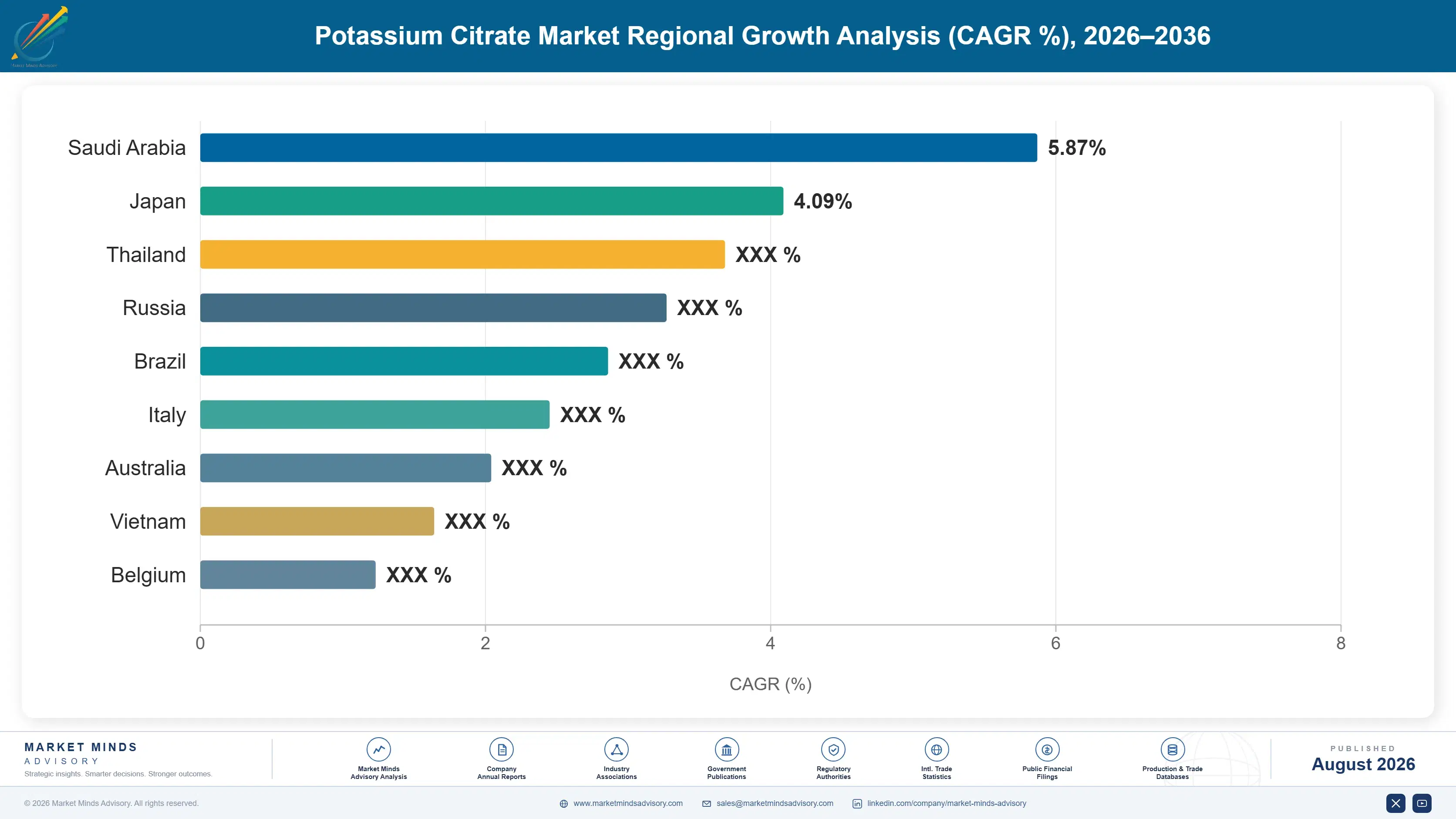
East Asia holds 36% of value, above its usual band, because roughly 63% of world production sits in China where citric acid fermentation concentrated decades ago. North America follows at 24% and Western Europe at 19%, both weighted toward pharmaceutical and specialty grades rather than volume.

North America

Sodium reduction in the United States runs on voluntary targets rather than binding limits, which has slowed reformulation relative to markets with mandatory schemes and left adoption concentrated among manufacturers acting ahead of regulation. Processed cheese has moved fastest, since the emulsifying function justifies the cost independently. Kidney stone incidence across the American Southeast is among the highest documented anywhere, supporting a substantial pharmaceutical grade market. Antidumping measures on Chinese citric acid shape import economics directly. Cargill retains domestic capacity, and pharmaceutical grade qualification is where the remaining value concentrates. Voluntary rather than binding targets are what hold American food adoption below European levels. Pharmaceutical qualification is where the remaining value concentrates.
Share: 24% | CAGR: 5.2% (2026 to 2036)

Western Europe

European producers hold specialty and pharmaceutical grade positions rather than volume ones, with Jungbunzlauer operating the most significant Western capacity outside North America. The 19% share reflects value weighting toward high-grade material rather than tonnage. British sodium reduction targets are among the most developed anywhere and have pushed reformulation well into the difficult applications. Antidumping duties on Chinese citric acid apply across the European Union and have shaped supply relationships for years. German and French pharmaceutical manufacturing supports steady pharmacopoeia-grade demand across the region. Value weighting toward high grades rather than tonnage is what keeps the regional share where it is. Duties have shaped supply relationships here for years. Volume production left long ago.
Share: 19% | CAGR: 4.6% (2026 to 2036)
Regional intelligence for 5 additional markets available in the complete report: East Asia, South Asia and Pacific, Latin America, Middle East and Africa, Eastern Europe. Contact sales@marketmindsadvisory.com.
potassium-citrate-market-trends-country-cagr-analysis-1787580701594

Four Moves Worth Making Here

Chemically identical material sells at 3.2 times the price depending on which documentation accompanies it, and the food business follows citric acid pricing that a producer rarely controls. The levers all involve moving up the grade ladder or reducing exposure to a single country of origin. Volume alone earns very little. Grade is the strategy here.

Qualify capacity to pharmacopoeia grade standards

Pharmaceutical grade commands roughly 3.2 times food grade pricing for material differing in impurity profile, documentation and facility standard rather than in chemistry. Upgrading a food-grade line to pharmacopoeia compliance costs perhaps 4 million dollars in facility, quality systems and validation, and takes about two years. Qualification into a drug master file then holds for the commercial life of the product. Producers who made that investment hold positions that Chinese food-grade capacity cannot contest whatever its cost advantage happens to be. Regulatory position beats cost position. Nothing in food grade competes with that.
Market Impact: Costs $4 million to reach full pharmacopoeia grade

Sell the emulsifying function alongside sodium reduction

In processed cheese, potassium citrate replaces phosphate emulsifying salts and reduces sodium in the same addition, which is two jobs from one ingredient. That dual role justifies several times potassium chloride pricing far more convincingly than a sodium argument alone ever does. Technical selling into cheese formulation teams therefore converts better than selling into procurement, and the switching is largely permanent once a texture specification has been reset. Cheese has adopted faster than any other category for exactly this reason. Cheese adoption has run roughly 3 times ahead of other food categories for exactly that reason.
Market Impact: Replaces 2 ingredient functions in a single addition

Establish supply outside the single dominant origin

Roughly 63% of world output originates in China and antidumping measures on citric acid apply in two major jurisdictions, which leaves buyers with concentration risk they increasingly quantify. Western and Indian capacity, even at higher cost, sells against that exposure rather than against Chinese pricing. Food manufacturers with supply continuity requirements pay for a qualified second origin, and pharmaceutical buyers require one as a matter of policy. Positioning on origin diversification is worth more than competing on landed cost. Insurance is what the premium actually buys. Landed cost is not the argument.
Market Impact: Hedges against a 63% supply concentration in one country

Index food contracts to citric acid and potash references

Citric acid is 54% of production cost and the potassium source carries potash volatility on top, which together leave roughly three quarters of cost outside a producer's control. The 2022 potash disruption showed how quickly that transmits, and producers holding annual fixed food ingredient contracts absorbed a substantial share before repricing. Indexing to published references converts a volatile margin into a conversion fee. Buyers resist until a disruption teaches them what supplier failure costs them instead. Pharmaceutical customers accept indexing more readily than food buyers ever have. Food buyers resist until a disruption arrives.
Market Impact: Covers the 54% acid cost inside every contract

Who Controls the Margin Pool

Participation is measured on annual production capacity in tonnes, and the top five hold 51%. Concentration is high for a food ingredient because backward integration into citric acid fermentation is what makes production economic, and fermentation capacity is capital intensive. Jungbunzlauer and Cargill lead on grade breadth and Western capacity, RZBC and Ensign on scale. The gap to challengers is fermentation integration rather than salt production capability.
Competition runs quite differently by grade. Food grade competes on landed cost against Chinese material, with antidumping duties and freight shaping the outcome more than any producer's efficiency does. Pharmaceutical grade competes on documentation, facility standard and drug master file positions, where Chinese producers have made much less progress. Technical selling into formulation teams is the third front, particularly in cheese and processed meat where application knowledge decides adoption.

The pressure ahead comes from potassium chloride masking technology improving. If flavour modifiers close the metallic gap sufficiently, citrate loses its principal advantage in food at several times the cost. Expect qualification investment and origin diversification rather than acquisitions, since the fragmented Chinese base is difficult to consolidate. Rankings shift as pharmaceutical grade grows and food grade competition intensifies further on price.
potassium-citrate-market-trends-company-positioning-matrix-1787580702112

Competitive Moat and Risk Dimensions

JUNGBUNZLAUER

Moat: Western fermentation and grade breadth

Jungbunzlauer operates citric acid fermentation and downstream salt capacity in Europe and North America, which gives customers a supply origin outside China at a time when concentration risk is increasingly quantified. Grade breadth from food through pharmacopoeia compliance means one supplier can serve a customer across applications, which simplifies qualification considerably for multinational buyers.
JUNGBUNZLAUER

Risk: European cost base exposure

European fermentation carries corn, energy and labour costs well above Chinese levels on a process where those inputs dominate. Food grade competition is therefore fought on a permanent cost disadvantage that only antidumping duties and origin preference offset. Any narrowing of those duties would expose the volume business directly, whatever the pharmaceutical position happens to be earning.
RZBC GROUP

Moat: Fermentation scale and cost

RZBC operates citric acid fermentation at a scale and cost position that Western producers cannot approach, built on Chinese corn supply and energy costs. Backward integration means the 54% of cost represented by citric acid is internal rather than purchased, which is the single largest cost advantage available anywhere in this business.
RZBC GROUP

Risk: Trade measure and origin exposure

Antidumping duties on Chinese citric acid apply in two major jurisdictions and shape access to the highest-value Western markets directly. Buyers quantifying single-origin concentration risk increasingly require a second qualified source, which caps how much of any customer's volume a Chinese producer can hold regardless of its pricing.

Players Tracked

Prominent Players

Jungbunzlauer
Cargill
RZBC Group
Gadot Biochemical Industries
Weifang Ensign Industry

Other Key Players

COFCO Biochemical
Anhui BBCA Group
Huangshi Xinghua Biochemical
Foodchem International
Dr. Paul Lohmann
Merck KGaA
Tate and Lyle
Pfanstiehl
Global Calcium
Sucroal
Shandong Juxian Hongde
Nikunj Chemicals
Vasa Pharmachem
Krishna Chemicals
Anhui Sealong Biotechnology

Recent Developments

FEBRUARY 2026

European cheese manufacturer converts emulsifying salt system to potassium citrate

A European processed cheese manufacturer replaced phosphate emulsifying salts with potassium citrate across its principal ranges, reducing sodium while retaining texture specification. The company confirmed the change was driven by sodium targets in its largest retail markets rather than by any cost consideration. Texture specification was reset once and retained.
Signal: Dual-function ingredients justify a cost premium that straight sodium substitution arguments have never managed to sustain
SEPTEMBER 2025

Indian producer completes drug master file qualification for pharmacopoeia grade

An Indian fine chemical producer completed drug master file qualification for pharmacopoeia-grade potassium citrate, targeting generic urological formulations for export approval. The qualification is an organic regulatory investment rather than any partnership or acquisition arrangement with a Western supplier. Commercial supply follows customer qualification during the coming year.
Signal: Indian producers are entering the grade where Chinese capacity has made the least regulatory progress so far
APRIL 2026

Food manufacturer qualifies second origin against single-country concentration risk

A multinational food manufacturer qualified a Western potassium citrate supplier as a second origin alongside its Chinese source, citing supply continuity policy rather than any price or quality consideration. The qualified volume carries a cost premium the company accepted explicitly as insurance. Volumes were split across both origins deliberately.
Signal: Origin diversification is being purchased deliberately, which changes what a higher-cost Western producer is actually selling

Acid, Potash and Very Little Else

Citric acid accounts for roughly 54% of production cost, produced by submerged fermentation of glucose from corn or cassava starch and concentrated overwhelmingly in Shandong and Anhui. The potassium source, usually hydroxide or carbonate derived from potash, carries a further 22%. Crystallisation energy, drying and packaging together add about 14%, with pharmaceutical grade adding testing and documentation on top.
The 2022 potash disruption is the reference event for this industry. Belarusian and Russian potash exports were curtailed following sanctions, and potassium hydroxide and carbonate prices rose sharply across the year, per published trade data on potash flows for that period. Potassium citrate producers holding annual food ingredient contracts absorbed a substantial share of the increase before repricing, and several disclosed the effect in their reporting for that year.

The competitive mechanism runs through fermentation integration. A producer making its own citric acid holds 54% of cost internally, while a merchant buyer of acid purchases it at whatever the Chinese market sets. That single fact explains why the top five are all citric acid producers rather than salt specialists. Chinese fermentation on domestic corn and energy also runs cheaper than any Western equivalent, per USDA corn trade data.
potassium-citrate-market-trends-cost-volatility-analysis-1787580702306

Integrate backward into fermentation or contract acid annually

Citric acid at 54% of cost is too large a share to buy on spot terms into annual downstream contracts. Full integration is rarely available to purchase, so annual acid contracting matched to ingredient contract tenor is the practical alternative. It costs a modest premium and removes most of the variance that damaged merchant producers through the last input cycle.

Contract potassium supply on multi-year terms

Potash supply is geographically concentrated and the 2022 disruption demonstrated how quickly that transmits into potassium hydroxide and carbonate pricing. Multi-year supply agreements cost a premium in normal conditions and function as insurance against an event that has now occurred once this decade. Most producers restructured potassium procurement afterwards, though not all did. Few producers had done so beforehand.

Index food ingredient contracts to published references

Roughly three quarters of production cost sits outside a producer's control between citric acid and the potassium source. Indexing food ingredient contracts to published references converts a volatile margin into a stable conversion fee. Pharmaceutical customers accept indexing more readily than food buyers do, which is one more reason the higher grade is the better business.

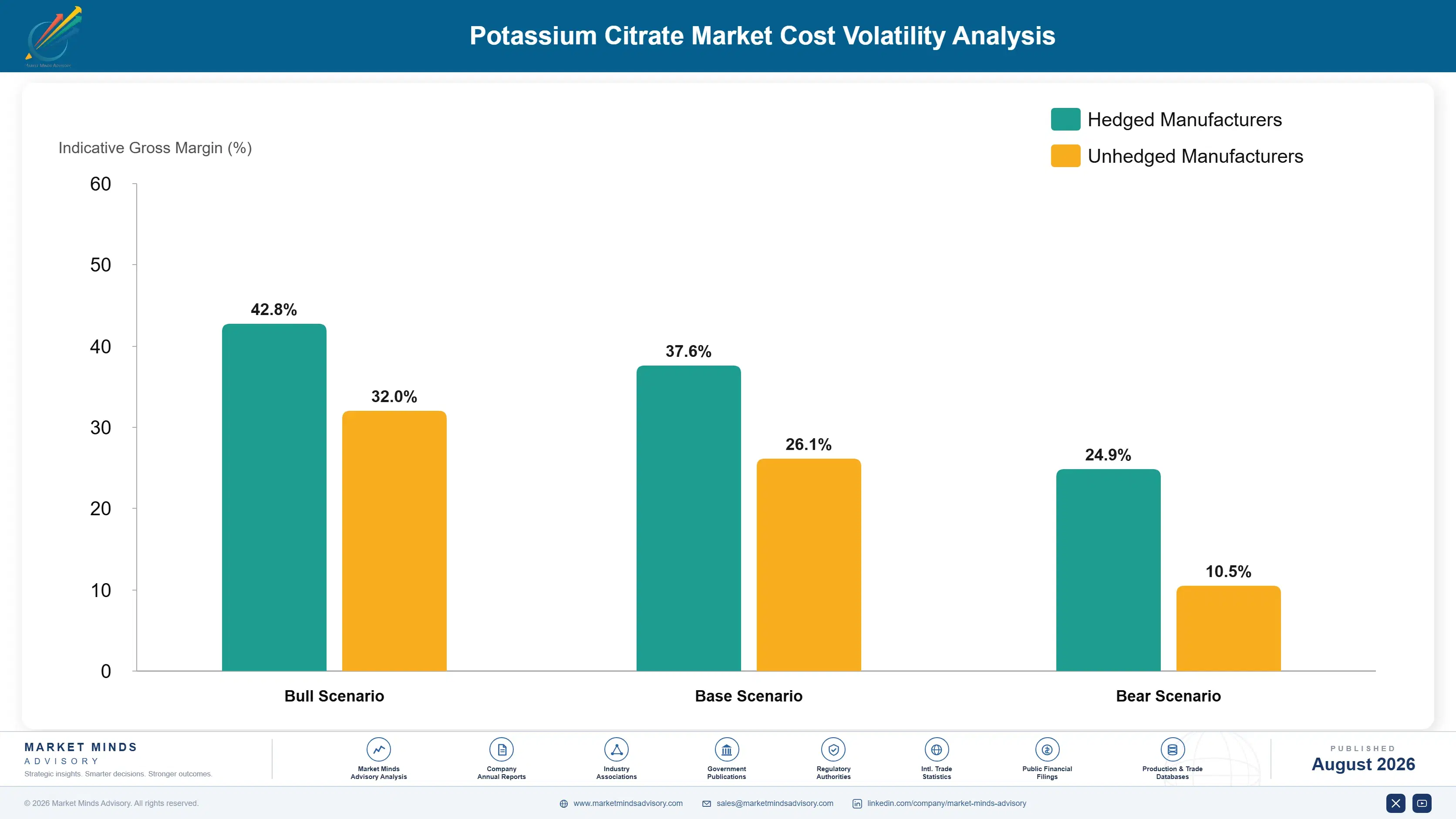
Portfolio Architecture for Margin Defence

Margin here tracks documentation rather than chemistry, which is unusual even among fine chemicals. Food grade earns margins in the mid to high teens, because the molecule is identical everywhere and Chinese fermentation integration sets the price floor. Antidumping duties and origin preference are what allow Western producers to participate at all in that tier, and neither is a durable commercial position.
Supplement and beverage grades occupy a better middle, at margins in the mid twenties to mid thirties, where purity specifications and customer qualification limit the field somewhat. The range is wide because beverage applications demand solubility and clarity performance that not every producer holds, while supplement grades sit closer to food specification and compete accordingly. Qualification depth rather than chemistry separates the two ends of that band.

Pharmaceutical grade holds the strongest economics, running into the mid forties, at roughly 3.2 times food grade pricing for material differing in impurity profile and paperwork. Those margins reflect a regulatory barrier and a qualification one together, and a drug master file position holds for the commercial life of the product it sits inside. A drug master file position outlasts almost any commercial relationship in food ingredients.

Food Grade Potassium Citrate

Standard food grade material sold into processed food, dairy and bakery reformulation. The six point range reflects fermentation integration and origin, with antidumping duties rather than any product advantage allowing Western participation.
Gross Margin: 14-20%

Supplement and Beverage Grades

Higher purity grades for dietary supplements, effervescent products and beverage applications requiring solubility and clarity performance. The ten point range separates beverage specifications that few producers meet from supplement grades sitting close to food.
Gross Margin: 25-35%

Pharmacopoeia Grade Material

Material compliant with United States, European or Japanese pharmacopoeia standards and qualified into drug filings. The twelve point range reflects qualification depth, from general pharmaceutical supply through to named source in a specific formulation.
Gross Margin: 36-48%
potassium-citrate-market-trends-portfolio-architecture-1787580702806

High-value Sub-segments and Strategic Watch-out

Pharmacopoeia Grade Urological Supply

High value and the fastest growth at 9.0% on rising stone incidence and urology guidance. Drug master file positions hold for the commercial life of the product. Chinese capacity has made comparatively little regulatory progress in this grade so far. Regulatory barriers reinforce the qualification one.
Gross Margin: 40-48%

Processed Cheese Emulsifying Applications

High value in food terms and growing steadily. The salt replaces phosphate emulsifiers and reduces sodium in one addition, which justifies its premium far better than substitution arguments do. Texture specifications reset once and rarely revisited. Adoption has outrun every other food category here. Switching is rare.
Gross Margin: 22-30%

Commodity Food Grade Supply

The volume core and permanently price-led against Chinese fermentation integration. Antidumping duties and origin preference are what allow Western producers any participation. Growth follows processed food volumes with no margin improvement available. Duties and origin preference are the only things allowing Western producers any participation in this tier at all.
Gross Margin: 14-20%

Sodium Reduction Applications Facing Masking Technology

The strategic watch-out. Potassium citrate charges a food premium on potassium chloride tasting metallic, and flavour houses are working on masking systems. Any genuine closing of that gap removes the argument the premium rests on entirely. Independent sensory validation has not yet been published anywhere.
Gross Margin: 18-28%

Where the Tonnage Returns

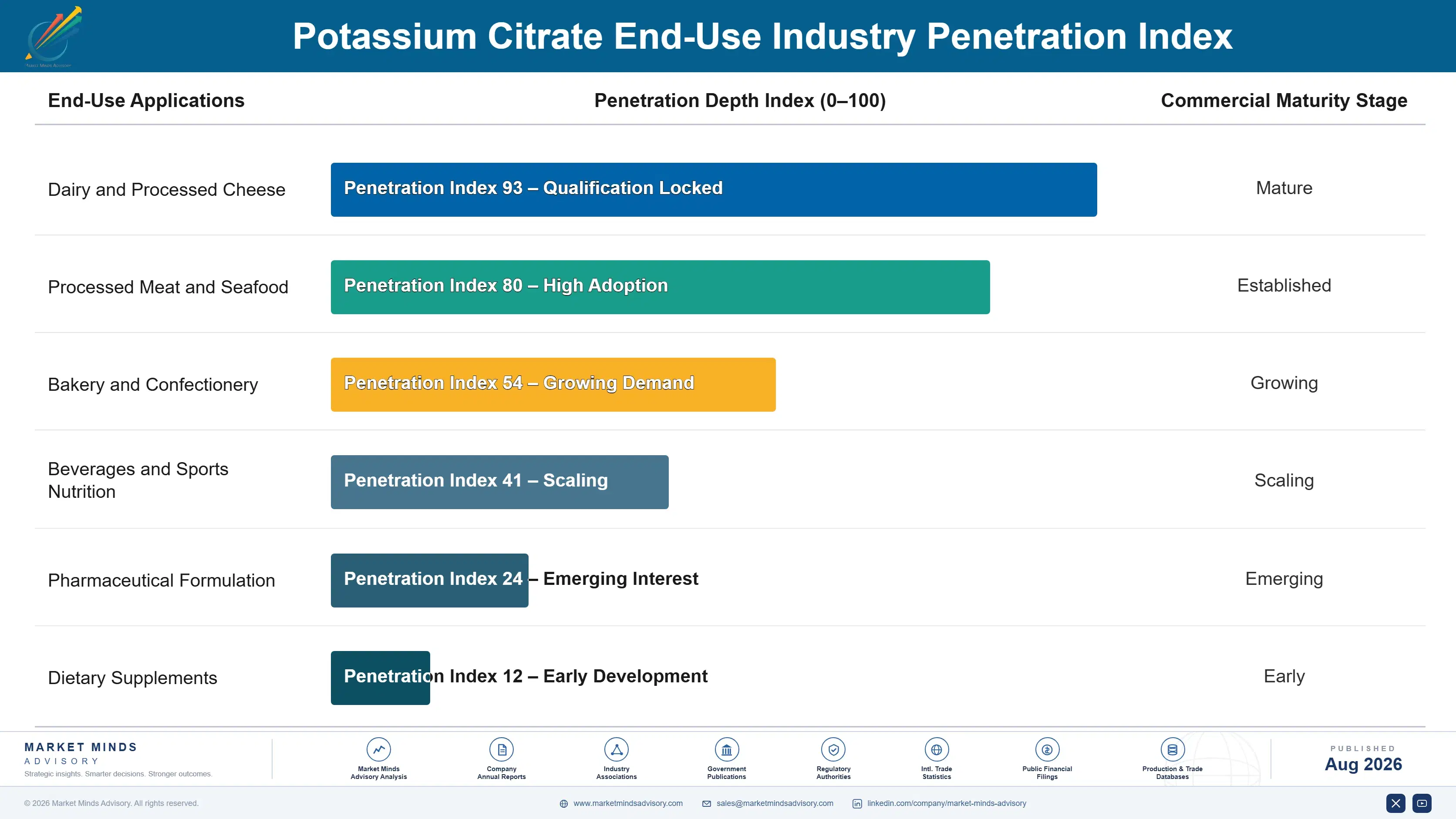
Pharmaceutical supply is the closest thing to an annuity this market offers. A salt written into a drug master file is consumed for the commercial life of that product at volumes following prescription demand, and changing it requires regulatory variation filings that nobody undertakes to save on an excipient or active salt. Rising stone incidence adds to that base rather than replacing it, which makes the demand both durable and quietly compounding.
Stickiness falls away by grade. Food applications are moderately sticky where a texture specification has been reset, as in processed cheese, because reformulating a second time means new sensory and shelf-life work nobody wants to repeat. Bakery and processed meat switch more readily on price within specification. Beverage applications sit between the two. Commodity food grade supply is close to spot business in character throughout the year.

The specifying buyer differs completely between the two businesses. Food grade is bought by procurement against a specification a formulation team wrote once. Pharmaceutical grade is specified inside a regulatory filing by people who will never negotiate a price, which is why the same molecule commands 3.2 times as much when it carries the right paperwork with it.
potassium-citrate-market-trends-end-use-penetration-index-1787580703292

Where We Would Place Capital

These are among the four positions where our research anticipates prominent divergence between winners and laggards over the coming forecast period. Each is grounded in the demand model, the regulatory perimeter, and the announced capacity pipeline.
01 / PHARMACOPOEIA GRADE QUALIFICATION

Climb the grade ladder rather than fighting on landed cost

Pharmaceutical grade commands roughly 3.2 times food grade pricing for material that differs in impurity profile, facility standard and documentation rather than in chemistry at all. Upgrading a line costs perhaps 4 million dollars over about two years of facility, quality system and validation work. A drug master file position then holds for the commercial life of the product, and Chinese food-grade capacity cannot contest it whatever cost advantage that capacity happens to enjoy in the food grade tier below it.
02 / DUAL FUNCTION SELLING

Sell the emulsifying job, not the sodium argument

In processed cheese, potassium citrate replaces the phosphate emulsifying salts and cuts sodium in a single addition, which amounts to two jobs from a single ingredient and justifies several times potassium chloride pricing rather convincingly. Sodium substitution arguments made on their own rarely survive a procurement conversation intact. Technical selling into formulation teams therefore converts considerably better than selling into purchasing does, and a texture specification that has been reset once is very rarely revisited afterwards by anybody at all.
03 / ORIGIN DIVERSIFICATION POSITIONING

Sell supply continuity rather than competing on Chinese price

Roughly 63% of world output originates in one country and antidumping measures on citric acid apply in two major jurisdictions, which leaves buyers carrying a concentration risk that many of them now quantify formally in policy. Western and Indian capacity therefore sells against that exposure rather than against Chinese landed cost at all. Pharmaceutical buyers require a second qualified origin as a matter of standing policy, and food manufacturers carrying continuity obligations increasingly pay a premium for one quite deliberately.
04 / CONTRACT INDEXING DISCIPLINE

Index food contracts before the next potash disruption arrives

Citric acid is 54% of production cost and the potassium source carries potash volatility on top, which together leave roughly three quarters of total cost entirely outside a producer's own control. The 2022 potash disruption showed exactly how fast that transmits downstream, and producers on annual fixed food contracts absorbed a substantial share before they could reprice. Indexing to published references converts a volatile margin into a stable conversion fee, which is the only structure that survives the next such event intact.

Engagement Snapshot From the Field

A live engagement with an industry participant carrying material or product regulatory and market exposure ahead of a defining policy shift, showing how our research translates into a defensible multi-year portfolio strategy.
MARKET MINDS ADVISORY · CLIENT ENGAGEMENT SUMMARY
Potassium Citrate Producer Strategic Portfolio Review and Transition Roadmap 2026·Investment Scenario on Potassium Citrate Exposure Evaluation 2025-26
CLIENT PROFILE
A European fine chemicals producer manufacturing citrate salts from purchased citric acid, with annual potassium citrate output near 14 thousand tonnes and divisional revenue around 96 million euros (client-reported, unverified by MMA). Output was almost entirely food grade, sold into dairy, bakery and processed meat manufacturers across the European Union and United Kingdom. Citric acid was purchased entirely on the open market.
STRATEGIC CHALLENGE
Food grade margins had compressed steadily as Chinese material reached European buyers despite duties, and the 2022 potassium cost increase had been only partly recovered. Management needed to decide whether to invest in pharmacopoeia grade capability, pursue backward integration into citric acid, or accept the position and compete on service and origin.
MMA APPROACH
MMA modelled landed cost for Chinese material under several duty and freight scenarios, costed pharmacopoeia grade upgrade requirements with two regulatory consultancies, and benchmarked the client's food grade margins against six European and Chinese producers. Customer origin diversification policies were tested across eleven food and pharmaceutical buyers. Interviews with 47 experts covered citrate production, sodium reduction reformulation and pharmaceutical qualification.
KEY FINDINGS
  1. Backward integration into citric acid fermentation was uneconomic at European corn and energy costs under every scenario modelled, regardless of scale assumptions applied.
  2. Pharmacopoeia grade upgrade costs came in near 4 million dollars over two years, against pricing roughly 3.2 times the food grade the same line already produced.
  3. Seven of eleven buyers interviewed operated formal single-origin concentration limits, and three would pay a premium for a qualified non-Chinese source explicitly.
  4. Processed cheese customers valued the emulsifying function independently of sodium reduction, and switched supplier far less readily than bakery or meat accounts did.
CLIENT PROFILE
A European fine chemicals producer manufacturing citrate salts from purchased citric acid, with annual potassium citrate output near 14 thousand tonnes and divisional revenue around 96 million euros (client-reported, unverified by MMA). Output was almost entirely food grade, sold into dairy, bakery and processed meat manufacturers across the European Union and United Kingdom. Citric acid was purchased entirely on the open market.
STRATEGIC CHALLENGE
Food grade margins had compressed steadily as Chinese material reached European buyers despite duties, and the 2022 potassium cost increase had been only partly recovered. Management needed to decide whether to invest in pharmacopoeia grade capability, pursue backward integration into citric acid, or accept the position and compete on service and origin.
MMA APPROACH
MMA modelled landed cost for Chinese material under several duty and freight scenarios, costed pharmacopoeia grade upgrade requirements with two regulatory consultancies, and benchmarked the client's food grade margins against six European and Chinese producers. Customer origin diversification policies were tested across eleven food and pharmaceutical buyers. Interviews with 47 experts covered citrate production, sodium reduction reformulation and pharmaceutical qualification.
KEY FINDINGS
  1. Backward integration into citric acid fermentation was uneconomic at European corn and energy costs under every scenario modelled, regardless of scale assumptions applied.
  2. Pharmacopoeia grade upgrade costs came in near 4 million dollars over two years, against pricing roughly 3.2 times the food grade the same line already produced.
  3. Seven of eleven buyers interviewed operated formal single-origin concentration limits, and three would pay a premium for a qualified non-Chinese source explicitly.
  4. Processed cheese customers valued the emulsifying function independently of sodium reduction, and switched supplier far less readily than bakery or meat accounts did.
RECOMMENDED STRATEGY
Phase 1: Phase one: begin pharmacopoeia grade upgrade on the newer of the two production lines, since backward integration is uneconomic at any modelled scale. Phase 2: Phase two: reposition food grade selling around origin diversification and supply continuity, targeting the buyers already operating formal concentration limits. Phase 3: Phase three: concentrate technical selling effort on processed cheese accounts, where the emulsifying function supports pricing that other food applications do not.
OUTCOME
The producer began the pharmacopoeia upgrade in early 2026 and repositioned its food grade sales approach immediately, reporting food grade volume holding steady at a roughly 9% price premium to Chinese landed cost (client-reported, unverified by MMA). Three new accounts were won on origin diversification grounds during the year, and the pharmaceutical qualification remains in progress.

Frequently Asked Questions

Foundational context covering the market sizes, CAGR, scope, country, region and competition that inform every finding below. This section is provided to cover basics and most often pre-purchase conversations, answered from the MMA Primary Research Dataset.

What is the current size of the Potassium Citrate Market?

MMA sizes it at USD 0.72 billion in 2025, rising to USD 0.76 billion in 2026. The figure covers potassium citrate salts across food, pharmaceutical, supplement, beverage and industrial applications at producer selling price.

How large will the Potassium Citrate Market be by 2036?

USD 1.36 billion by 2036, an incremental USD 0.60 billion over the 2026 base and an expansion multiple of 1.79 times. Pharmaceutical grade accounts for a disproportionate share.

What is the CAGR for the Potassium Citrate Market 2026 to 2036?

6.0% in the base case, with a bull case at 7.2% and a bear case at 4.8%. The spread turns on sodium target tightening and on potassium chloride masking technology.

Which segment is growing fastest?

Pharmaceutical grade at 9.0%, half again the market rate of 6.0%. Rising kidney stone incidence and urology guidance recommending citrate therapy both support that demand.

Who are the major companies in the Potassium Citrate Market?

Jungbunzlauer, Cargill, RZBC Group, Gadot Biochemical Industries and Weifang Ensign Industry lead on annual production capacity. Fifteen further participants are profiled in the full report.

Which country is growing fastest?

India at 9.6%, on generic pharmaceutical manufacturing consuming potassium citrate as an active ingredient and excipient. Export approval growth pulls pharmacopoeia-grade demand along with it in the same proportion.

Report Segmentation Architecture

The full report scope spans multiple orthogonal segmentation dimensions, with cross-tabulated demand data provided for each dimension pair. Coverage extends further to regional breakdowns, trend trajectories, and the competitive detail needed to support segment-level decision-making.

By Product Grade

  • Food Grade
  • Pharmaceutical Grade
  • Supplement and Nutraceutical Grade
  • Beverage and Effervescent Grade
  • Industrial and Technical Grade
  • High Purity and Analytical Grade

By End-Use Industry

  • Dairy and Processed Cheese
  • Processed Meat and Seafood
  • Bakery and Confectionery
  • Beverages and Sports Nutrition
  • Pharmaceutical Formulation
  • Dietary Supplements

By Commercial Dimension

  • Direct Supply to Manufacturers
  • Distributor and Trader Supply
  • Pharmaceutical Contract Supply
  • Private Label Ingredient Supply
  • Export and Cross-Border Trade
  • Toll Processing Agreements

By Region

  • North America
  • Western Europe
  • East Asia
  • South Asia and Pacific
  • Latin America
  • Middle East and Africa
  • Eastern Europe

Scope, Methodology, and Coverage

Every figure in this report is reproducible from documented input assumptions. The scope below maps the historical period, the forecast horizon, the segmentation dimensions, and the countries covered, alongside the underlying primary and qualitative methodology.
Historical Period
2020 to 2025
Forecast Period
2026 to 2036
Base Year
2025 (USD billions; MMA Primary Research Dataset, August 2026)
Market Definition
Potassium citrate salts produced for food, pharmaceutical, supplement, beverage and industrial applications, in anhydrous and monohydrate forms and across food, pharmacopoeia, supplement and technical grades, measured at producer selling price. Citric acid itself, other citrate salts including sodium and calcium citrate, potassium chloride and other potassium salts, and finished pharmaceutical or food products containing potassium citrate are excluded from scope.
Quantitative Units
USD billions (current prices); thousand tonnes produced annually; USD per tonne by grade and region
Segmentation Dimensions
Product grade; end-use industry; commercial dimension; region
Regions Covered
North America, Western Europe, East Asia, South Asia and Pacific, Latin America, Middle East and Africa, Eastern Europe
Countries Covered
United States, Canada, Mexico, Germany, France, United Kingdom, Austria, Italy, China, Japan, South Korea, India, Thailand, Indonesia, Australia, Brazil, Argentina, Colombia, South Africa, Poland
Key Companies Profiled
Jungbunzlauer, Cargill, RZBC Group, Gadot Biochemical Industries, Weifang Ensign Industry, COFCO Biochemical, Anhui BBCA Group, Huangshi Xinghua Biochemical, Foodchem International, Dr. Paul Lohmann, Merck KGaA, Tate and Lyle, Pfanstiehl, Global Calcium, Sucroal, Shandong Juxian Hongde, Nikunj Chemicals, Vasa Pharmachem, Krishna Chemicals, Anhui Sealong Biotechnology
Quantitative Methodology
Primary survey, n=3,800 respondents, Q4 2025, six countries; demand-side model with trade association cross-validation
Qualitative Methodology
47 expert interviews, Q4 2025; applied to validate demand model assumptions, identify emerging dynamics, and assess competitive positioning
Report Format
PDF and XLSX data workbook (Word format preview document)
Publisher
Market Minds Advisory
Report Code
MMA-2026-CHM-127
Published
August 2026
Contact
sales@marketmindsadvisory.com | www.marketmindsadvisory.com

Purchase the full Potassium Citrate Market Report (2026 to 2036).

The full report separates the pharmaceutical and food businesses that share this molecule and sizes each grade independently through 2036. It quantifies sodium reduction penetration by application against the taste constraints that govern it, maps antidumping and trade measures affecting citric acid flows, and models production cost across integrated and merchant positions. Regional chapters cover all seven regions with capacity level detail where disclosure permits. Competitive profiling covers 20 participants on a single production capacity basis, alongside pharmacopoeia qualification positions compared across each producer covered.
Pharmaceutical and food businesses separated and sized independently
Sodium reduction penetration quantified by application category
Trade measures on citric acid flows mapped by jurisdiction
Production cost modelled for integrated and merchant positions
Twenty participants profiled on one consistent basis
Pharmacopoeia qualification positions compared across producers

Built For The People Who Decide

From boardroom strategy to bench-side execution, this report is read cover-to-cover by leaders shaping the next decade of their industry, turning demand scenarios, market dynamics and valuation benchmarks into decisions.
CXOs/ Presidents/ VPs/ Managers
M&A and Corporate Development
Strategy Teams and R&D Heads
Procurement and Product Directors
Regulatory and Compliance Leaders
Investor Relations and Equity Analysts