Market Minds Advisory
Postnatal Nutrition Market

Postnatal Nutrition Market: A Category Built Where the Guidelines Stop

No health authority anywhere issues micronutrient guidance for the postpartum year distinct from pregnancy, which is precisely why most of the products sold as postnatal are prenatal formulas wearing different labels.

Lead Analyst

Lisa Gevelber

Published

September 2026

Make Smarter Decisions with Customized Research Insights

Request a free sample report and evaluate market opportunities, growth trends, and competitive dynamics relevant to your business needs.

2025 MARKET VALUE$3.9BMarket Size 2025
2036 FORECAST VALUE$9.9BBase Case , 2026 to 2036
CAGR 2026 TO 20368.8 %Bull 10.1% / Bear 7.5%
INCREMENTAL OPPORTUNITY$5.6BNet 10- year value creation
EXPANSION MULTIPLE2.33x2036 value over 2026 base
Strategic Levers
M&A Pipeline
Regional Outlook
Country Rankings
Competitive Intelligence
Segmental Deep-dive
Call-Us : 91 93563 13602

Executive Snapshot and Market Trajectory

Prenatal supplementation rests on clinical guidance that every health authority publishes. Postnatal supplementation rests on almost none, and roughly 71% of products sold as postnatal are chemically indistinguishable from the prenatal formula on the next shelf. The difference is packaging, claim language and price.
That gap is the category's commercial problem and its opportunity together. Three genuine clinical needs exist and are narrow: iron repletion after delivery blood loss, where postpartum deficiency affects around 27% of mothers, maternal vitamin D supplementation reaching breastfed infants, and omega-3 and choline intake during lactation. Products built around those hold defensible positions. Products built on label copy do not. Both are measurable clinical states rather than commercial propositions.
Maternal omega-3 and choline formulations grow at 13.2%, half again the market rate of 8.8%, on evidence that is genuinely emerging rather than asserted. East Asia holds 34% of value, above the usual band, because month-long postpartum confinement in China and Korea creates a structured nutrition occasion with no Western equivalent. Those facilities purchase institutionally, which Western analysis rarely counts. The occasion is culturally established rather than commercially created. Nothing comparable exists in the West.
Market Definition
Nutritional supplements and formulated foods marketed for maternal use following delivery, spanning postnatal multivitamins, lactation support products, omega-3 and choline formulations, protein and recovery nutrition, iron repletion products and traditional confinement nutrition. Excludes prenatal supplements, infant formula and baby food, prescription pharmaceuticals, and general adult multivitamins not positioned for postpartum use.
Base Year Value
$3.9B in 2025 (MMA Primary Research Dataset, August 2026)
Forecast Period
2026 to 2036, eleven discrete annual values
CAGR
8.8% base case. Bull 10.1%. Bear 7.5%.
Fastest Growth Segment
Maternal Omega-3 and Choline Formulations: 13.2% CAGR
Fastest Growth Country
India: 12.6% CAGR
Fastest Growth Region
South Asia and Pacific: 11.1% CAGR
Largest Region
East Asia: 34% of 2025 global value
Market Leaders
Bayer, Nestlé Health Science, Reckitt, Church and Dwight, Ritual. Source: MMA Primary Research Dataset, July 2026.
Primary Survey
n=3,800 procurement and R&D decision-makers, Q4 2025, six countries
Methodology
Demand-side build-up, cross-validated against public data, 47 expert interviews

Postnatal Nutrition Market Forecast Scenarios

postnatal-nutrition-market-trends-size-forecast-scenario-1787580682371
Growth ran near 7.4% between 2020 and 2025 as direct-to-consumer maternal brands built the category out of what had been a small extension of prenatal ranges. Social platforms did most of the demand creation, and several brands reached meaningful scale on marketing rather than on evidence. Chinese confinement centre demand grew separately and faster throughout, on a base Western analysis rarely counts at all.
Base case 8.8% rests on three mechanisms. Postpartum depression screening is becoming routine at six-week checks across several health systems, which is drawing clinical attention to omega-3 and choline intake during lactation. Iron repletion after delivery is being addressed more systematically as anaemia screening improves. And Indian and Southeast Asian maternal supplement demand is growing from a low base against a genuinely high deficiency burden. None of the three depends on any new health authority guidance appearing.
The bull case at 10.1% assumes a major health authority publishes postpartum-specific micronutrient guidance, which would convert a marketing-led category into a clinically guided one and pull it into pharmacy and practitioner channels. The bear case at 7.5% is regulatory action on lactation support claims, particularly around galactagogue botanicals, which carry substantial volume and very little supporting evidence.

Where the Guidance Runs Out

Pregnancy supplementation is one of the best-guided areas in nutrition. Folic acid, iodine and iron intakes are specified by health authorities in almost every country, and prenatal products are formulated against those numbers. The postpartum year has no equivalent framework. The World Health Organization addresses maternal anaemia and lactation broadly and issues nothing resembling a postnatal micronutrient standard.
TOP FIVE CONCENTRATION22%Established vitamin houses lead a fragmented specialist field
PRENATAL FORMULA OVERLAP71%Share of postnatal products chemically matching prenatal formulations
AVERAGE COURSE DURATION5.4 monthsTypical supplementation period following delivery across surveyed markets
CLINICAL CHANNEL SHARE19%Portion of sales arising from practitioner or hospital recommendation
POSTPARTUM ANAEMIA PREVALENCE27%Share of mothers presenting with iron deficiency after delivery
REPEAT PURCHASE RATE43%Buyers reordering within the measured replenishment window observed
So the category filled the space with positioning. Around 71% of products sold as postnatal match a prenatal formulation on composition, differing in packaging, claim language and price. That is not fraud and it is not defensible either, because a shopper who notices can buy the prenatal product and often does. Brands aware of this have been reformulating toward the things that actually change after delivery.
Three of those are real. Blood loss at delivery leaves roughly 27% of mothers iron deficient, which is a measurable clinical state rather than a marketing proposition. Maternal vitamin D supplementation raises breast milk concentrations enough to matter for the infant. And omega-3 and choline requirements during lactation differ from pregnancy because the demand is now output rather than tissue building.
"The uncomfortable question in this category is what happens when a shopper compares the ingredient panels. Three quarters of these products cannot survive that comparison, and the brands building around iron status and lactation-specific nutrients are quietly separating themselves from the ones selling a different coloured box."
Director, Nutrition and Consumer Health Practice · MMA Healthcare and Nutrition Practice · August 2026

Market Trends

Postpartum depression screening drawing clinical attention to nutrition

Routine screening at six-week postnatal checks is now standard across several health systems, which has put maternal mental health in front of clinicians who previously saw mothers only for obstetric follow-up. Omega-3 status and choline intake during lactation have both attracted research attention as a result, and practitioners increasingly discuss them even where guidance does not yet exist. That conversation moves purchasing from a retail shelf toward a clinical recommendation, and roughly 19% of category sales now arrive that way rather than through pure retail choice. A recommendation carries authority through the whole course rather than a single purchase.
Market Impact: Addresses 27% deficiency prevalence

Confinement centre demand formalising postpartum nutrition in East Asia

Month-long postpartum confinement, practised as zuo yuezi in China and through sanhujoriwon facilities in Korea, has commercialised into a residential care industry with structured nutrition programmes attached. Those facilities purchase supplements and formulated foods institutionally rather than through retail, at daily specification and volume that no Western postpartum practice approaches. The occasion is culturally established rather than newly created, which makes the demand unusually durable. Western analysis of this category routinely omits it, which is why regional sizing so often looks wrong. Facility purchasing behaves like institutional catering supply, which is a different commercial relationship entirely from retail.
Market Impact: Delivers 12.6% annual Indian growth

Market Opportunities and Growth Drivers

Postpartum iron deficiency screening improving across health systems

Blood loss at delivery leaves roughly 27% of mothers iron deficient, and screening at postnatal checks has become more systematic across European and North American health systems over the past several years. Detection converts a nutritional issue into a clinical one with a recommended intervention attached, which moves purchasing toward pharmacy and practitioner channels. Iron repletion formulations grow considerably faster than the category average as a result. This is the clearest evidence-based demand in postnatal nutrition and the one least exposed to any claims regulation. Nothing about it depends on a claim a regulator might withdraw.
Market Impact: Leaves 71% duplicating prenatal formulas

Indian maternal supplement demand rising against high deficiency burden

India grows fastest anywhere at 12.6%, on maternal anaemia prevalence that public health surveys have documented as among the highest of any large economy, alongside rising household spending on maternal health. Government supplementation programmes address part of the need and leave substantial private demand, particularly in urban markets where branded products carry perceived quality advantages. Ayurvedic postpartum nutrition traditions provide a cultural framework that a supplement fits into readily. Distribution through obstetric practices rather than retail is where the growth concentrates. Obstetric practice recommendation carries considerably more weight there than any retail brand position does.
Market Impact: Threatens claims on 3 botanicals

Market Restraints and Challenges

No health authority publishes postpartum-specific micronutrient guidance

Prenatal supplementation is specified by national and international guidance while the postpartum year has no equivalent framework anywhere. The root cause is that research funding has concentrated on pregnancy outcomes and infant health, leaving maternal recovery comparatively unstudied. Commercially it means products cannot make guideline-referenced claims and roughly 71% simply replicate prenatal formulations instead. Participants are funding research on lactation-specific nutrient requirements and working with professional bodies on practice guidance, which is slow and is the only route to a defensible position. No authority has signalled that guidance is imminent.
Market Impact: Moves 19% into clinical channel

Galactagogue claims under regulatory pressure in several markets

Fenugreek, moringa, shatavari and similar botanicals carry substantial volume in lactation support products on traditional use rather than on clinical evidence. The root cause is that controlled studies on milk production are difficult to design and few have been adequately powered. European and American regulators have both signalled tightening on lactation claims, which would remove the selling proposition from a meaningful share of the category. Producers are commissioning clinical work on individual botanicals and repositioning products toward nutritional rather than functional claims. Traditional use is not a substantiation standard in either jurisdiction.
Market Impact: Drives 34% East Asian value share
3 additional market trends, 4 additional growth drivers, and 2 additional restraints and challenges are covered in the full report. Contact sales@marketmindsadvisory.com to access the complete intelligence.

Segment CAGR and Growth Architecture

Six segments split by product type, because type determines the evidence position, the regulatory exposure and the channel a product reaches its buyer through. An iron repletion product and a galactagogue botanical face entirely different futures. End-use setting and commercial channel are handled in the framework rather than folded in here. The two ends face entirely different regulatory futures.
postnatal-nutrition-market-trends-market-share-analysis-1787580682904

Maternal Omega-3 and Choline Formulations

Growing at 13.2%, half again the market rate of 8.8%, these products address nutrient requirements that genuinely change during lactation, where the demand is milk output rather than tissue building. Research attention has followed postpartum depression screening becoming routine, and practitioners increasingly raise omega-3 status even where formal guidance is absent. Choline requirements during lactation exceed pregnancy levels, a point most prenatal formulas do not accommodate. Products here can differentiate on composition rather than on packaging, which almost nothing else in the category manages. The clinical channel takes a disproportionate share of the volume. Growth here rests on evidence that continues to accumulate rather than on positioning that a regulator might one day withdraw.
CAGR 13.2%

Iron Repletion Formulations

At 11.8% iron repletion is the most clinically grounded position in postnatal nutrition. Delivery blood loss leaves roughly 27% of mothers deficient, screening has become more systematic across health systems, and the intervention is well established rather than asserted. Formulation competition runs on tolerability, since conventional iron salts cause gastrointestinal effects that reduce adherence sharply, and bisglycinate and sucrosomial forms command premiums for that reason. Pharmacy and practitioner channels dominate distribution. This segment carries essentially no exposure to the claims tightening that threatens lactation support products elsewhere in the category. Adherence rather than dose determines whether a course achieves anything, which is why tolerable forms command the premium they do.
CAGR 11.8%
Full segment breakdown across 6 segments available in the complete report.

Regional Architecture and Country Demand Map

East Asia holds 34% of value, above its usual band, because month-long confinement practice in China and Korea creates institutional postpartum nutrition demand with no Western equivalent. North America follows at 24%, with Western Europe below its band at 17% and South Asia and Pacific above at 14%.

North America

Direct-to-consumer maternal brands built this category in the United States, reaching scale through social platforms and subscription models rather than through pharmacy or practitioner channels. That origin left the American market unusually marketing-led and unusually exposed to ingredient panel comparison by informed shoppers. Six-week postnatal check screening for depression has begun moving some purchasing toward clinical recommendation. Canadian demand follows similar patterns at smaller scale with somewhat tighter claim regulation. Mexican demand runs through obstetric practices, where the recommendation carries considerably more weight than any retail brand position does. Ingredient panel comparison in online communities has become a genuine commercial risk to brands with nothing compositional to say. Nobody planned for that.
Share: 24% | CAGR: 7.9% (2026 to 2036)

Western Europe

European claim regulation is the strictest anywhere and the 17% share sits below the usual band partly as a consequence, since products cannot make the lactation and recovery claims that drive purchasing elsewhere. What sells instead is pharmacy-channel iron and vitamin D, positioned nutritionally rather than functionally. German and French pharmacy chains dominate distribution, with midwife recommendation carrying real weight in both markets. British demand moved earlier toward direct-to-consumer subscription models. Southern European volumes are smaller, where extended family postpartum support substitutes for commercial products more than it does further north. The 17% share sits below the usual band on claim restriction rather than on any lack of maternal health spending.
Share: 17% | CAGR: 7.2% (2026 to 2036)
Regional intelligence for 5 additional markets available in the complete report: East Asia, South Asia and Pacific, Latin America, Middle East and Africa, Eastern Europe. Contact sales@marketmindsadvisory.com.
postnatal-nutrition-market-trends-country-cagr-analysis-1787580683442

Four Moves Toward Real Defensibility

A category where 71% of products duplicate prenatal formulations is one where differentiation is available cheaply to anyone willing to formulate for what actually changes after delivery. The levers all involve moving from asserted positioning toward evidence, and from retail shelves toward the people mothers actually ask. Positioning alone has stopped working here. Evidence is the only defence.

Reformulate around lactation-specific nutrient requirements properly

Choline requirements during lactation exceed pregnancy levels and most prenatal formulations do not accommodate that, which gives a reformulated postnatal product a genuine compositional difference rather than a packaging one. Reformulation and stability work costs perhaps 300 thousand dollars across a range and takes about a year. The commercial value is that an informed shopper comparing ingredient panels finds a reason to choose, which roughly 71% of the category currently cannot offer at all. Practitioners notice the difference too. Nothing in packaging or claim language achieves the same thing. Practitioners notice it immediately.
Market Impact: Differentiates the range against 71% of the category

Build the practitioner and pharmacy channel deliberately

Roughly 19% of category sales already arrive through practitioner or hospital recommendation, and that share rises as postnatal screening becomes routine. A recommendation converts far better than any retail impression and produces repeat purchase near 43% rather than the single-course behaviour retail generates. Building the channel means medical education materials, sampling through obstetric and midwifery practices, and evidence a clinician can read. It costs less than equivalent consumer marketing and compounds over time rather than decaying. It compounds rather than decaying with each campaign. Retail acquisition costs keep rising regardless.
Market Impact: Grows the 19% clinical channel share much further

Compete on iron tolerability rather than iron content

Postpartum iron deficiency affects roughly 27% of mothers and conventional iron salts cause gastrointestinal effects that cut adherence badly, so a course frequently goes unfinished. Bisglycinate and sucrosomial forms improve tolerability and command premiums of 40% or more over ferrous sulphate. The commercial point is adherence rather than absorption, since an unfinished course delivers nothing regardless of the dose on the label. Practitioners recommending repletion increasingly specify tolerable forms, which excludes commodity iron products from the recommendation entirely. The premium is unusually durable for that reason. Commodity iron falls out of the recommendation.
Market Impact: Commands a 40% premium over ferrous sulphate forms

Serve East Asian confinement facilities institutionally

Chinese and Korean confinement centres purchase nutrition institutionally on daily specification rather than through retail, at volumes and consistency no consumer channel matches. Winning that business means meeting a facility's dietary programme requirements and holding regulatory registration in market, not building a consumer brand at all. This demand accounts for a large part of why East Asia holds 34% of category value. Facility contracts renew annually and switch infrequently, which makes them considerably more durable than any retail listing. Registration and specification compliance matter more than any brand. Facility contracts renew annually and rarely switch.
Market Impact: Serves the 34% of global value in Asia

Who Controls the Margin Pool

Participation is measured on retail and clinical channel sales value, and the top five hold 22%. Concentration is low because barriers are minimal: a postnatal supplement is a contract-manufactured formulation with a label, and hundreds of brands have entered on that basis. Bayer and Nestlé Health Science lead on distribution reach rather than on formulation distinctiveness. The gap to challengers is channel access, not product.
Competition currently runs on three things. Channel position matters most, with practitioner and pharmacy access worth far more than retail shelf space per unit of effort. Formulation differentiation is second and largely unexploited, since most products replicate prenatal composition. Regulatory positioning is third, as claim tightening around lactation support separates brands with evidence from those without. Consumer marketing spend has fallen as acquisition costs on social platforms rose.

The pressure ahead comes from two directions. Claim regulation on galactagogue botanicals would remove the proposition from a meaningful share of volume, while any health authority publishing postpartum guidance would reward whoever formulated toward it first. Expect brand acquisitions by established vitamin houses rather than consolidation among specialists. Rankings shift as the clinical channel grows and marketing-led positions become harder to defend.
postnatal-nutrition-market-trends-company-positioning-matrix-1787580683960

Competitive Moat and Risk Dimensions

BAYER

Moat: Pharmacy channel and brand trust

Bayer holds pharmacy distribution and pharmacist familiarity across most major markets, built over decades in consumer health, and pharmacists recommend brands they know when guidance is absent. In a category where clinical evidence is thin, that institutional trust functions as a substitute for evidence in the recommendation moment, and no new brand can assemble it quickly.
BAYER

Risk: Formulation differentiation weakness

The postnatal range largely mirrors prenatal composition, which is exactly the position an informed shopper comparing ingredient panels can see through. Specialist brands reformulating around lactation-specific requirements can make a compositional argument that a large consumer health portfolio moves slowly to answer, and practitioners increasingly ask about it directly.
NESTLÉ HEALTH SCIENCE

Moat: Clinical channel infrastructure

Nestlé Health Science operates medical affairs and practitioner education infrastructure built for clinical nutrition, which reaches obstetric and midwifery practices in a way consumer brands cannot replicate. As postnatal screening pushes purchasing toward recommendation, that infrastructure becomes the most valuable asset in the category rather than an overhead.
NESTLÉ HEALTH SCIENCE

Risk: Infant formula reputational adjacency

Association with infant formula marketing carries reputational weight with lactation consultants and midwives, who are precisely the practitioners whose recommendation matters most in this category. That history complicates the clinical relationships the business depends on, in a way competitors without formula exposure do not have to manage at all.

Players Tracked

Prominent Players

Bayer
Nestlé Health Science
Reckitt
Church and Dwight
Ritual

Other Key Players

Pfizer
Haleon
Perrigo
Blackmores
By-Health
Health and Happiness Group
Amway
Pharmavite
Jamieson Wellness
Swisse Wellness
Needed
Danone
Abbott
FrieslandCampina
Suntory Wellness

Recent Developments

FEBRUARY 2026

European regulator signals tightening on lactation support botanical claims

A European regulatory review indicated that lactation support claims on several botanical ingredients lack sufficient substantiation under existing food supplement rules. Products relying on those claims would need reformulation or repositioning toward nutritional statements rather than functional ones across affected member states. Affected brands are reviewing their ranges now.
Signal: Claim substantiation is becoming the dividing line between brands with evidence and brands with positioning alone
SEPTEMBER 2025

Korean confinement centre operator standardises supplement specification across facilities

A Korean postpartum care operator standardised nutrition supplement specifications across its facility network, moving from individual facility purchasing to a central programme. The change consolidates institutional demand that had previously been fragmented across dozens of separate purchasing decisions. Individual facility purchasing has ceased entirely. Suppliers must now meet one specification.
Signal: Institutional confinement demand is professionalising, which rewards suppliers able to meet a full dietary programme specification
APRIL 2026

Specialist brand publishes lactation choline requirement research with academic partner

A specialist maternal nutrition brand published peer-reviewed work with an academic partner on choline requirements during lactation, supporting a compositional difference from prenatal formulations. The company reformulated its postnatal range around the findings ahead of publication rather than afterwards. Competitors have not yet followed the reformulation.
Signal: Funding research is how a brand escapes the comparison with prenatal formulas that most of this category loses

What Sits Inside the Capsule

Active ingredients account for roughly 34% of finished product cost and vary enormously by formulation. Marine omega-3 concentrates come from Peruvian and Chilean anchovy processing or from algal fermentation, iron salts and chelates from Chinese and Indian producers, and choline bitartrate largely from Chinese manufacture. Encapsulation, packaging and quality testing add about 29%, with testing costs rising sharply where clinical channel documentation is required.
Marine omega-3 pricing moved sharply through 2023 and 2024 when Peruvian anchoveta quotas were cut severely on El Niño conditions, per published fisheries management decisions and company reporting for that period. Producers formulating on marine sources carried the increase directly, while those on algal oil were insulated but paying a permanently higher base price. Several brands reformulated toward algal sources permanently rather than returning when quotas recovered.

The competitive mechanism runs through formulation flexibility and scale. A brand holding a single approved omega-3 source cannot substitute when quotas move, while one with both marine and algal qualified switches between production runs. Scale matters too: contract manufacturers price small runs at substantial premiums, so a brand doing 50 thousand units pays materially more per unit than one doing 500 thousand, which compounds against the smaller specialist brands.
postnatal-nutrition-market-trends-cost-volatility-analysis-1787580684154

Qualify both marine and algal omega-3 sources

Holding two approved omega-3 sources for the same product lets a brand switch when fishery quotas move, which they do on climate cycles rather than predictably. Qualification requires stability and sensory testing costing perhaps 80 thousand dollars per formulation, and it recovers within a single quota disruption. Algal sources also support vegan positioning that marine sources cannot.

Consolidate contract manufacturing volume for scale pricing

Contract manufacturers price small runs at substantial premiums, so a brand spreading volume across several manufacturers pays for the privilege. Consolidating onto fewer partners improves unit cost materially and simplifies quality documentation, which matters more as clinical channel requirements tighten. The trade-off is supply concentration risk, which a qualified second source addresses at modest cost.

Move testing costs into clinical channel pricing

Practitioner and hospital channels require documentation and testing that retail does not, which raises unit cost meaningfully. Those channels also support higher pricing and produce repeat purchase near 43%, so the cost is recoverable where brands price the channel separately. Brands applying uniform pricing across channels absorb clinical documentation costs against retail margins instead.

Portfolio Architecture for Margin Defence

Margin here tracks channel and evidence rather than formulation cost. Retail postnatal multivitamins duplicating prenatal composition earn margins in the mid twenties at best, because the product is contract-manufactured and hundreds of brands offer something equivalent. Consumer acquisition cost on social platforms has risen enough that several direct-to-consumer entrants now spend more winning a customer than the first course returns.
Clinical channel products do considerably better, at margins in the high thirties to high forties, because practitioner recommendation converts far more reliably than advertising and repeat purchase reaches 43% rather than the single-course behaviour retail produces. The range is wide because documentation and testing requirements differ substantially between pharmacy, midwifery and hospital settings. Documentation is the cost and the barrier at once.

Specialised repletion and lactation-specific formulations hold the strongest position, running into the low fifties, where tolerability or composition supports a genuine premium and commodity products cannot enter the recommendation. Those margins reflect formulation work and clinical evidence rather than branding, which makes them considerably more durable than anything positioning alone achieves. Evidence is slower to build than a brand and harder to copy.

Retail Postnatal Multivitamins

Contract-manufactured multivitamins largely replicating prenatal composition sold through retail and online channels. The eight point range reflects order scale with contract manufacturers and consumer acquisition cost rather than any formulation advantage.
Gross Margin: 22-30%

Clinical Channel and Pharmacy Products

Products distributed through practitioner recommendation, pharmacy and hospital channels with supporting documentation. The eleven point range reflects testing and medical affairs requirements, which differ substantially between pharmacy, midwifery and hospital settings.
Gross Margin: 37-48%

Evidence-Led Specialised Formulations

Iron repletion in tolerable forms and lactation-specific omega-3 and choline products supported by clinical work. The twelve point range reflects the depth of evidence behind each product, which varies from published research to reasoned formulation.
Gross Margin: 42-54%
postnatal-nutrition-market-trends-portfolio-architecture-1787580684647

High-value Sub-segments and Strategic Watch-out

Tolerable Iron Repletion Products

High value and high growth on the most clinically grounded need in the category. Bisglycinate and sucrosomial forms command premiums above 40% on adherence rather than absorption. Practitioners increasingly specify tolerable forms, which excludes commodity iron products entirely. Adherence is the commercial argument here. Dose is not.
Gross Margin: 44-54%

Lactation-Specific Omega-3 and Choline

High value and the fastest growing position at 13.2%. Choline requirements during lactation exceed pregnancy levels, which gives a genuine compositional argument against prenatal formulas. Research attention followed postpartum depression screening becoming routine practice. Evidence continues to accumulate steadily. Prenatal formulas do not accommodate the difference at all.
Gross Margin: 42-52%

Retail Postnatal Multivitamins

The volume core and the position least able to survive ingredient panel comparison. Roughly 71% of the category duplicates prenatal composition, and consumer acquisition costs have risen faster than the first course returns for several direct-to-consumer entrants. Panel comparison is now a live commercial risk.
Gross Margin: 22-30%

Galactagogue Botanical Products

The strategic watch-out. Substantial volume rests on traditional use claims that European and American regulators have both signalled tightening on. The margin range assumes current claim permissions, which look unlikely to survive the review process intact. Reformulation is the only defence available. Volume at risk is substantial.
Gross Margin: 26-38%

How the Course Gets Repeated

Postnatal supplementation is a finite course rather than an ongoing habit, which makes this category quite unlike the rest of consumer health. The average course runs 5.4 months and then stops, so a brand acquires a customer, serves one episode and loses her unless a second child arrives. Repeat purchase within the window reaches 43%, meaning most courses go unfinished, which is a retention problem and an adherence problem at once.
That arithmetic is why channel matters so much. A practitioner recommendation converts reliably and carries authority through the whole course, so adherence and reorder both improve. Institutional confinement facility demand is different again, behaving like a supply contract with annual renewal rather than a consumer relationship at all. Retail and social acquisition produce the weakest economics, since the customer is expensive to win and gone within months.

The buyer is also younger and better informed than the category assumes. Mothers now compare ingredient panels between prenatal and postnatal products routinely, often prompted by online communities, and a product that cannot explain its difference loses the comparison. That is a new dynamic and it falls hardest on exactly the products with nothing compositional to say.
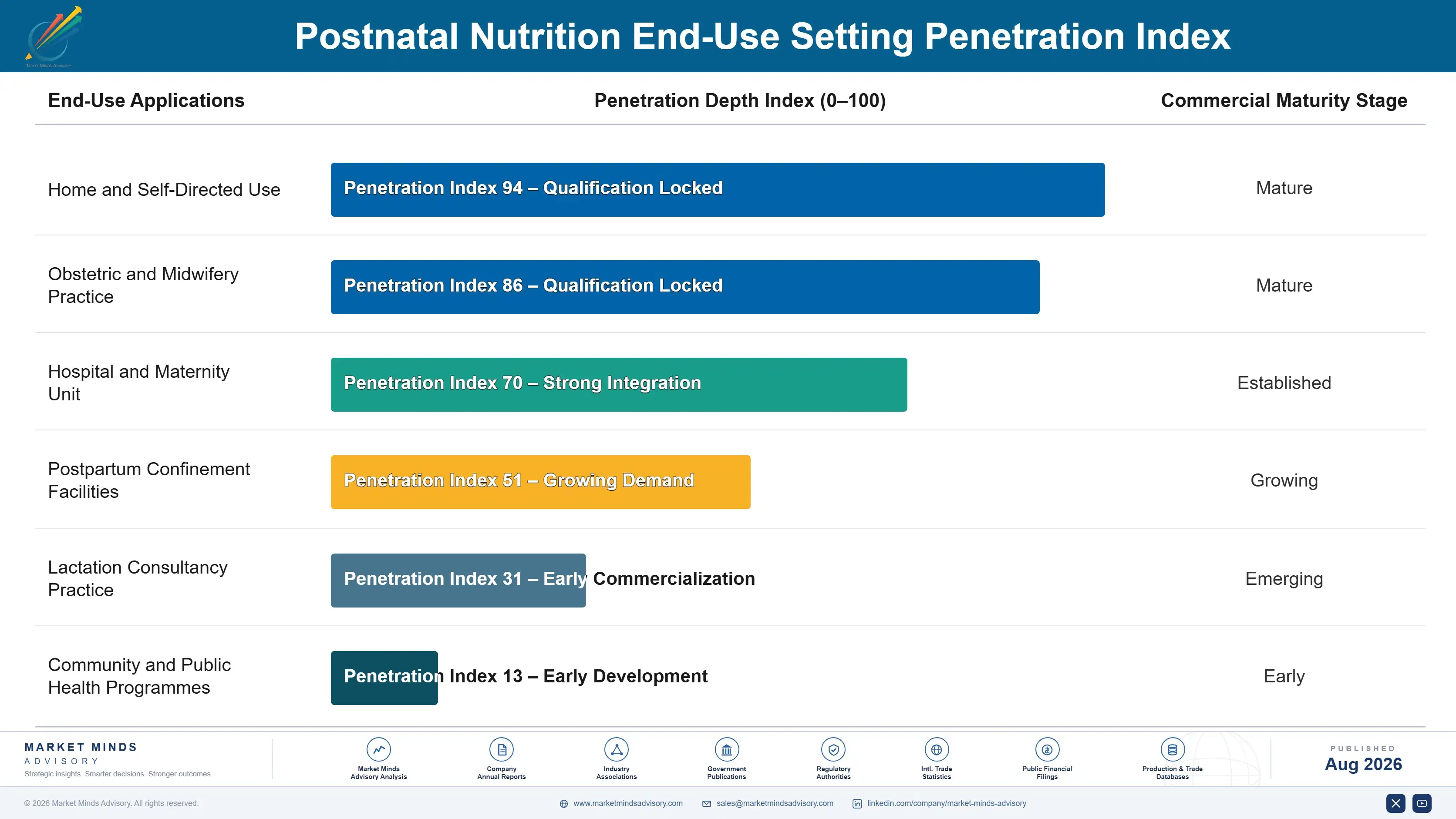
postnatal-nutrition-market-trends-end-use-penetration-index-1787580685136

Where We Would Commit Capital

These are among the four positions where our research anticipates prominent divergence between winners and laggards over the coming forecast period. Each is grounded in the demand model, the regulatory perimeter, and the announced capacity pipeline.
01 / COMPOSITIONAL DIFFERENTIATION WORK

Formulate for what actually changes after delivery

Roughly 71% of postnatal products duplicate prenatal composition, which is precisely what an informed shopper comparing ingredient panels can see through, and mothers prompted by online communities increasingly do exactly that. Choline requirements during lactation exceed pregnancy levels and most prenatal formulas do not accommodate it. Reformulation and stability work costs perhaps 300 thousand dollars across a range and produces the only argument that survives the comparison, which no amount of packaging or claim language is ever going to achieve on its own.
02 / CLINICAL CHANNEL BUILDING

Invest where mothers actually ask rather than where they browse

About 19% of category sales already arrive through practitioner or hospital recommendation, and that share keeps growing as postnatal screening becomes routine practice across health systems. A recommendation converts far better than any retail impression and lifts repeat purchase toward 43% rather than the single-course behaviour retail produces. Medical education materials, practice sampling and readable evidence all cost less than equivalent consumer marketing and compound over time instead of decaying with each successive campaign, which paid social acquisition never does.
03 / IRON TOLERABILITY POSITIONING

Sell adherence, because an unfinished course delivers nothing

Postpartum iron deficiency affects roughly 27% of mothers and conventional iron salts cause gastrointestinal effects that cut adherence badly, which leaves courses unfinished and outcomes unchanged. Bisglycinate and sucrosomial forms command premiums above 40% over ferrous sulphate on tolerability rather than on absorption at all. Practitioners recommending repletion now increasingly specify the tolerable forms by name, which excludes commodity iron products from the recommendation entirely and that makes the premium unusually durable for a supplement category built on so little evidence elsewhere.
04 / CONFINEMENT FACILITY SUPPLY

Sell to the institution rather than to the mother in Asia

Chinese and Korean confinement centres buy nutrition institutionally against daily dietary specification, at volumes and with a consistency that no consumer channel anywhere matches, and that institutional demand explains much of why East Asia holds 34% of total category value. Winning it requires meeting a facility dietary programme specification and holding local product registration rather than building any consumer brand at all. Contracts renew annually and switch infrequently, which makes them considerably more durable than any retail listing anywhere in the region.

Engagement Snapshot From the Field

A live engagement with an industry participant carrying material or product regulatory and market exposure ahead of a defining policy shift, showing how our research translates into a defensible multi-year portfolio strategy.
MARKET MINDS ADVISORY · CLIENT ENGAGEMENT SUMMARY
Postnatal Nutrition Producer Strategic Portfolio Review and Transition Roadmap 2026·Investment Scenario on Postnatal Nutrition Exposure Evaluation 2025-26
CLIENT PROFILE
A direct-to-consumer maternal nutrition brand selling prenatal and postnatal supplements across the United States and United Kingdom, with annual revenue near 68 million dollars and roughly 40% from postnatal products (client-reported, unverified by MMA). Acquisition ran almost entirely through paid social, and the postnatal formulation differed from the prenatal one in dosage of two ingredients.
STRATEGIC CHALLENGE
Customer acquisition cost on social platforms had risen to the point where the first postnatal course no longer covered it, and community discussion comparing the two ingredient panels had begun appearing in the brand's own review threads. Management needed to decide whether to reformulate, shift channel investment, or reposition the range, with limited capital for any of them.
MMA APPROACH
MMA reviewed the evidence base for postpartum-specific nutrient requirements with independent academic input, benchmarked the client's formulations against eleven competitors on composition rather than claims, and modelled channel economics for practitioner, pharmacy and retail routes. Interviews with 47 experts covered lactation consultancy, obstetric practice and supplement regulation across both markets.
KEY FINDINGS
  1. The postnatal formulation differed from the prenatal one only in dosages that no published evidence supported differentiating, which review threads had already identified and discussed publicly.
  2. Choline and omega-3 requirements during lactation had genuine research support for exceeding pregnancy levels, and no competitor in the benchmark set had formulated around it.
  3. Practitioner-recommended customers showed repeat purchase near double that of the social-acquired cohort, and acquisition cost through practice sampling ran well below paid social.
  4. Iron tolerability was the single most cited adherence obstacle in lactation consultant interviews, and the client used ferrous sulphate throughout its range.
CLIENT PROFILE
A direct-to-consumer maternal nutrition brand selling prenatal and postnatal supplements across the United States and United Kingdom, with annual revenue near 68 million dollars and roughly 40% from postnatal products (client-reported, unverified by MMA). Acquisition ran almost entirely through paid social, and the postnatal formulation differed from the prenatal one in dosage of two ingredients.
STRATEGIC CHALLENGE
Customer acquisition cost on social platforms had risen to the point where the first postnatal course no longer covered it, and community discussion comparing the two ingredient panels had begun appearing in the brand's own review threads. Management needed to decide whether to reformulate, shift channel investment, or reposition the range, with limited capital for any of them.
MMA APPROACH
MMA reviewed the evidence base for postpartum-specific nutrient requirements with independent academic input, benchmarked the client's formulations against eleven competitors on composition rather than claims, and modelled channel economics for practitioner, pharmacy and retail routes. Interviews with 47 experts covered lactation consultancy, obstetric practice and supplement regulation across both markets.
KEY FINDINGS
  1. The postnatal formulation differed from the prenatal one only in dosages that no published evidence supported differentiating, which review threads had already identified and discussed publicly.
  2. Choline and omega-3 requirements during lactation had genuine research support for exceeding pregnancy levels, and no competitor in the benchmark set had formulated around it.
  3. Practitioner-recommended customers showed repeat purchase near double that of the social-acquired cohort, and acquisition cost through practice sampling ran well below paid social.
  4. Iron tolerability was the single most cited adherence obstacle in lactation consultant interviews, and the client used ferrous sulphate throughout its range.
RECOMMENDED STRATEGY
Phase 1: Phase one: reformulate the postnatal range around lactation choline and omega-3 requirements, giving the product a compositional argument the panel comparison cannot defeat. Phase 2: Phase two: switch iron to a bisglycinate form across the range and lead on tolerability, since adherence rather than dose determines whether repletion works. Phase 3: Phase three: redirect acquisition spend from paid social toward practitioner sampling and midwifery education, where conversion and repeat purchase are both materially better.
OUTCOME
The brand reformulated during 2026 and shifted roughly 60% of acquisition spend into practitioner channels, reporting blended acquisition cost falling by about a third and postnatal repeat purchase rising to 51% (client-reported, unverified by MMA). Review thread comparisons of the two panels stopped appearing once the compositions genuinely diverged.

Frequently Asked Questions

Foundational context covering the market sizes, CAGR, scope, country, region and competition that inform every finding below. This section is provided to cover basics and most often pre-purchase conversations, answered from the MMA Primary Research Dataset.

What is the current size of the Postnatal Nutrition Market?

MMA sizes it at USD 3.9 billion in 2025, rising to USD 4.24 billion in 2026. The figure covers maternal supplements and formulated foods for the postpartum period, excluding prenatal products and infant formula.

How large will the Postnatal Nutrition Market be by 2036?

USD 9.86 billion by 2036, an incremental USD 5.62 billion over the 2026 base and an expansion multiple of 2.33 times. Evidence-led formulations account for a disproportionate share.

What is the CAGR for the Postnatal Nutrition Market 2026 to 2036?

8.8% in the base case, with a bull case at 10.1% and a bear case at 7.5%. The spread turns on whether postpartum guidance emerges and on how claim regulation lands.

Which segment is growing fastest?

Maternal omega-3 and choline formulations at 13.2%, half again the market rate of 8.8%. Lactation requirements genuinely differ from pregnancy, which gives these products a compositional argument.

Who are the major companies in the Postnatal Nutrition Market?

Bayer, Nestlé Health Science, Reckitt, Church and Dwight and Ritual lead on retail and clinical channel sales value. Fifteen further participants are profiled in the full report.

Which country is growing fastest?

India at 12.6%, on maternal anaemia prevalence among the highest of any large economy alongside rising household health spending. Obstetric practice distribution is where that growth concentrates.

Report Segmentation Architecture

The full report scope spans multiple orthogonal segmentation dimensions, with cross-tabulated demand data provided for each dimension pair. Coverage extends further to regional breakdowns, trend trajectories, and the competitive detail needed to support segment-level decision-making.

By Product Type

  • Postnatal Multivitamin and Mineral Supplements
  • Lactation Support and Galactagogue Products
  • Maternal Omega-3 and Choline Formulations
  • Postpartum Protein and Recovery Nutrition
  • Iron Repletion Formulations
  • Confinement and Traditional Postpartum Nutrition

By End-Use Setting

  • Home and Self-Directed Use
  • Obstetric and Midwifery Practice
  • Hospital and Maternity Unit
  • Postpartum Confinement Facilities
  • Lactation Consultancy Practice
  • Community and Public Health Programmes

By Commercial Dimension

  • Retail Pharmacy
  • Grocery and Mass Retail
  • Direct-to-Consumer Subscription
  • Practitioner Dispensing
  • Institutional and Facility Supply
  • Online Marketplace Sales

By Region

  • North America
  • Western Europe
  • East Asia
  • South Asia and Pacific
  • Latin America
  • Middle East and Africa
  • Eastern Europe

Scope, Methodology, and Coverage

Every figure in this report is reproducible from documented input assumptions. The scope below maps the historical period, the forecast horizon, the segmentation dimensions, and the countries covered, alongside the underlying primary and qualitative methodology.
Historical Period
2020 to 2025
Forecast Period
2026 to 2036
Base Year
2025 (USD billions; MMA Primary Research Dataset, August 2026)
Market Definition
Nutritional supplements and formulated foods marketed for maternal use following delivery, spanning postnatal multivitamins and minerals, lactation support and galactagogue products, omega-3 and choline formulations, postpartum protein and recovery nutrition, iron repletion products and traditional confinement nutrition, measured at retail and institutional selling value. Prenatal supplements, infant formula and baby food, prescription pharmaceuticals, and general adult multivitamins not positioned for postpartum use are excluded from scope.
Quantitative Units
USD billions (current prices); million courses supplied annually; USD per course by product type and channel
Segmentation Dimensions
Product type; end-use setting; commercial dimension; region
Regions Covered
North America, Western Europe, East Asia, South Asia and Pacific, Latin America, Middle East and Africa, Eastern Europe
Countries Covered
United States, Canada, Mexico, Germany, France, United Kingdom, Italy, Spain, China, Japan, South Korea, India, Indonesia, Vietnam, Australia, Brazil, Saudi Arabia, United Arab Emirates, Poland, Czech Republic
Key Companies Profiled
Bayer, Nestlé Health Science, Reckitt, Church and Dwight, Ritual, Pfizer, Haleon, Perrigo, Blackmores, By-Health, Health and Happiness Group, Amway, Pharmavite, Jamieson Wellness, Swisse Wellness, Needed, Danone, Abbott, FrieslandCampina, Suntory Wellness
Quantitative Methodology
Primary survey, n=3,800 respondents, Q4 2025, six countries; demand-side model with trade association cross-validation
Qualitative Methodology
47 expert interviews, Q4 2025; applied to validate demand model assumptions, identify emerging dynamics, and assess competitive positioning
Report Format
PDF and XLSX data workbook (Word format preview document)
Publisher
Market Minds Advisory
Report Code
MMA-2026-HLT-119
Published
August 2026
Contact
sales@marketmindsadvisory.com | www.marketmindsadvisory.com

Purchase the full Postnatal Nutrition Market Report (2026 to 2036).

The full report separates products with a genuine compositional basis from those replicating prenatal formulations, and sizes each product type independently through 2036. It maps the evidence position for each nutrient claim, tracks claim regulation developments by jurisdiction, and quantifies East Asian confinement facility demand that most analysis of this category omits entirely. Regional chapters cover all seven regions with channel level detail across retail, pharmacy, practitioner and institutional routes. Competitive profiling covers 20 participants on a single sales value basis, with channel economics compared across four distribution routes.
Compositional overlap with prenatal formulations quantified by brand
Evidence position mapped for each nutrient claim
Claim regulation developments tracked by jurisdiction
Confinement facility demand sized across East Asian markets
Twenty participants profiled on one consistent basis
Channel economics compared across four distribution routes

Built For The People Who Decide

From boardroom strategy to bench-side execution, this report is read cover-to-cover by leaders shaping the next decade of their industry, turning demand scenarios, market dynamics and valuation benchmarks into decisions.
CXOs/ Presidents/ VPs/ Managers
M&A and Corporate Development
Strategy Teams and R&D Heads
Procurement and Product Directors
Regulatory and Compliance Leaders
Investor Relations and Equity Analysts