Market Minds Advisory
Post Shave Care Market

Post Shave Care Market: Post Shave Care Market: The Sting That Damages, Coiled Hair Formulation Gaps and A Category Named After Fragrance, 2026 to 2036

The sting that people read as proof the product is working is barrier damage on skin that has just had its top layer scraped away by a blade moments earlier.

Lead Analyst

Published

September 2026

Make Smarter Decisions with Customized Research Insights

Request a free sample report and evaluate market opportunities, growth trends, and competitive dynamics relevant to your business needs.

2025 MARKET VALUE$2.3BMarket Size 2025
2036 FORECAST VALUE$4.5BBase Case , 2026 to 2036
CAGR 2026 TO 20366.4 %Bull 7.6% / Bear 5.2%
INCREMENTAL OPPORTUNITY$2.1BNet 10- year value creation
EXPANSION MULTIPLE1.88x2036 value over 2026 base
Strategic Levers
M&A Pipeline
Regional Outlook
Country Rankings
Competitive Intelligence
Segmental Deep-dive
Call-Us : 91 93563 13602

Executive Snapshot and Market Trajectory.

Only 9% of clinical test panels in this category include tightly coiled hair, which is the hair type most likely to produce razor bumps. That single number explains most of what is wrong with post shave care and most of where the growth now sits.
Ingrown hair and razor bump treatments grow at 9.6%, half again the market rate of 6.4%, because 62% of men with coiled hair report recurring post-shave irritation that mainstream products were never formulated to address. Post-shave serums follow at 8.3%. Both are taking share from a category built for a different face. Alcohol splash volumes decline in every market covered. Alcohol splash volumes decline in every market covered, held up by heritage and habit alone.
The naming problem runs underneath everything. About 38% of what sells as aftershave is fragrance with no soothing function at all, and 31% of volume still uses an alcohol base that disrupts a barrier the razor has already compromised. The sting is the product experience consumers expect, so the industry keeps selling it. Women shave seven times the surface a male face presents and almost nothing is formulated for it.
Market Definition
This market covers products applied to skin after shaving to soothe, protect, and prevent irritation, including ingrown hair and razor bump treatments, post-shave serums and active treatments, aftershave balms and lotions, post-shave oils, post-shave gels and creams, and alcohol splash and tonic aftershaves. It excludes pre-shave preparations, shaving creams, foams and soaps, razors and blades, fragrance-only products sold under the aftershave name, general body moisturisers, and depilatory or laser aftercare.
Base Year Value
$2.3B in 2025 (MMA Primary Research Dataset, September 2026)
Forecast Period
2026 to 2036, eleven discrete annual values
CAGR
6.4% base case. Bull 7.6%. Bear 5.2%.
Fastest Growth Segment
Ingrown Hair And Razor Bump Treatments: 9.6% CAGR
Fastest Growth Country
Brazil: 10.8% CAGR
Fastest Growth Region
South Asia and Pacific: 8.4% CAGR
Largest Region
North America: 29% of 2025 global value
Market Leaders
Unilever, Beiersdorf, Procter and Gamble, Edgewell Personal Care, and L'Oreal Groupe lead the field. Source: MMA Primary Research Dataset, July 2026.
Primary Survey
n=3,800 procurement and R&D decision-makers, Q4 2025, six countries
Methodology
Demand-side build-up, cross-validated against public data, 47 expert interviews

Post Shave Care Market Forecast Scenarios

post-shave-care-market-size-forecast-scenario-1790014483149
Between 2020 and 2025 the category grew at 5.1% while its composition changed considerably underneath that figure. Traditional alcohol splash volumes declined steadily, balms and serums grew, and specialist brands addressing razor bumps built genuine positions in a segment mainstream manufacturers had effectively ignored for decades. Beard wearing also reduced shaving frequency across several markets throughout.
The base case at 6.4% rests on three mechanisms. Razor bump treatment demand keeps growing as products formulated for coiled hair finally reach mainstream distribution. Brazilian and wider Latin American male grooming expands faster than any other market. And post-shave serums take share from balms as the category shifts from soothing after damage toward preventing it, which supports considerably higher prices per unit. None of the three requires shaving frequency to rise at all.
The bull case at 7.6% depends on female post-shave becoming a real category, since women shave roughly seven times the skin area a male face presents and almost no dedicated products exist. The bear case at 5.2% is beard wearing: shaving frequency drives every product in this market, and a further shift toward facial hair reduces the underlying occasions no formulation improvement can replace.

Who This Was Formulated For

Shaving removes hair and part of the stratum corneum with it, leaving skin that is measurably more permeable and more reactive for several hours afterwards. Applying a high-alcohol splash at that moment disrupts the barrier further, which is what produces the sting. Consumers read the sting as antiseptic action and evidence of efficacy, and around 31% of category volume still delivers it deliberately. The industry understands the mechanism perfectly well.
TOP FIVE CONCENTRATION47%Share of category revenue held by the leading manufacturers
FRAGRANCE ONLY SHARE38%Products sold as aftershave with no soothing function
RAZOR BUMP PREVALENCE62%Men with coiled hair reporting recurring post-shave irritation
COILED HAIR TEST PANELS9%Clinical panels including the hair type most affected
FEMALE SHAVED SURFACE RATIO7 timesSkin area shaved by women against a typical male face
ALCOHOL BASE PRODUCT SHARE31%Volume still using a base that damages a compromised barrier
The larger failure is who the category was designed around. Pseudofolliculitis barbae, the medical name for razor bumps, occurs when a tightly curved hair re-enters the skin, and it affects people with coiled hair far more than anybody else. About 62% of men with that hair type report recurring irritation. Around 9% of clinical test panels for post-shave products include them at all.
Then there is the name. Roughly 38% of what retails as aftershave is a fragrance product with alcohol and no soothing function whatsoever, which means a large share of the category's own consumers have never used a post-shave care product despite believing they do. The naming collision hides a genuine skincare proposition behind a perfume counter. Repositioning into skincare merchandising is the obvious answer.
"Nine per cent of the test panels include the hair type most likely to get razor bumps. Everything else in this category follows from that. We formulated for one face, sold the sting as proof of efficacy, and let specialist brands build the real business in the gap we left."
Practice Director, Personal Care and Grooming Products · MMA Chemicals and Materials Practice · September 2026

Market Trends

Coiled Hair Formulation Finally Reaches Mainstream Distribution

Ingrown hair and razor bump treatments grow at 9.6%, the fastest rate here, on a condition affecting roughly 62% of men with tightly coiled hair and appearing in about 9% of clinical test panels. Specialist brands built genuine businesses in that gap while mainstream manufacturers formulated and tested on straight hair for decades. Those manufacturers are now buying the specialists rather than reformulating, which is faster and considerably more expensive than getting it right originally would have been. Barbershop recommendation reaches those consumers considerably faster than any retail shelf does.
Market Impact: Country grows at 10.8%
Serums Shift The Category From Soothing To Preventing

Post-shave serums grow at 8.3% by moving the proposition from calming irritation after it happens toward preventing the follicle inflammation that causes it. Glycolic and salicylic acid chemistry addresses the mechanism directly rather than masking the symptom, and buyers accept prices well above balm levels for a product that reduces the problem rather than comforting it. Application discipline matters far more than with a balm, which limits how far the format can broaden. Barbershop recommendation has proved by far the most effective channel. A professional seeing the result every few weeks carries real authority.
Market Impact: Covers 7 times the area

Market Opportunities and Growth Drivers

Brazilian Male Grooming Expands Faster Than Any Market

Brazilian growth of 10.8% leads every country covered, driven by male grooming spending rising quickly across income groups and by a population in which coiled and wavy hair types are heavily represented. Razor bump treatment demand is correspondingly higher than in most markets, and domestic brands addressed it earlier than multinational manufacturers did. Barbershop culture across the country also creates a professional recommendation channel that mainstream retail cannot easily replicate. Domestic brands addressed razor bump treatment years before multinational manufacturers took an interest, and they hold credibility that distribution scale has not yet displaced.
Market Impact: Covers 31% of volume

Female Shaving Represents Untouched Surface Area

Women shave roughly seven times the skin area a male face presents, across legs, underarms, and bikini line, and almost no products are formulated and positioned specifically for that use. Irritation, ingrown hairs, and folliculitis all occur at rates comparable to facial shaving. The category has remained built around male facial grooming through decades of stable female shaving behaviour, which leaves a genuinely large addressable gap sitting in plain view. Products currently reaching those consumers are male facial formulations repackaged rather than adapted, which the buyers notice and the manufacturers appear not to.
Market Impact: Affects 38% of products

Market Restraints and Challenges

The Sting Is What Consumers Expect To Feel

About 31% of volume still uses a high-alcohol base that disrupts a barrier the razor has already compromised, and the root cause is that consumers interpret the resulting sting as evidence the product is working. Commercially it traps manufacturers between formulation science and buyer expectation. Brands respond with lower alcohol formats carrying cooling agents that mimic the sensation, and with education that most consumers have not been receptive to so far. Cooling agents that reproduce the sensation without the barrier disruption are the practical answer, and they cost more than the alcohol they replace.
Market Impact: Affects 62% of men

Category Name Points Buyers At Fragrance Counters

Roughly 38% of products sold as aftershave are fragrance preparations with no soothing function, and the root cause is that the word was attached to perfume decades before post-shave skincare became a genuine proposition. Commercially it means many consumers believe they already use a post-shave product. Brands respond by positioning under skincare rather than grooming, by dropping the aftershave term entirely, and by merchandising alongside facial care. Abandoning the term entirely costs a repositioning rather than any reformulation, which makes it among the cheapest moves available in this whole market.
Market Impact: Segment grows at 8.3%
4 additional market trends, 3 additional growth drivers, and 2 additional restraints and challenges are covered in the full report. Contact sales@marketmindsadvisory.com to access the complete intelligence.

Segment CAGR and Growth Architecture

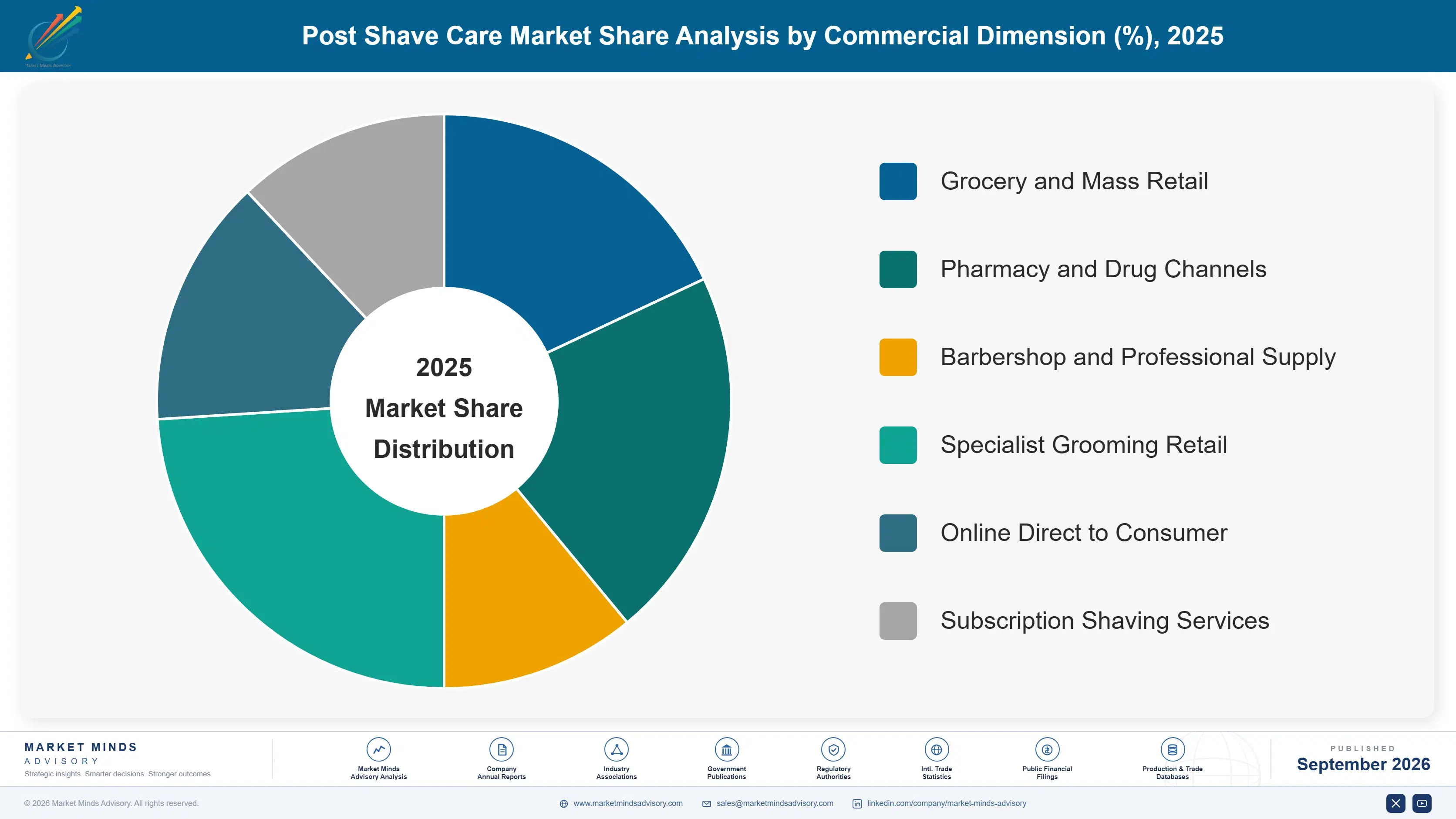
Segmentation follows product function across six categories: ingrown hair and razor bump treatments, post-shave serums and active treatments, aftershave balms and lotions, post-shave oils, post-shave gels and creams, and alcohol splash and tonic aftershaves. User group, hair type, and retail channel are treated as separate dimensions rather than mixed into this hierarchy. Fragrance is counted within the product carrying it.
post-shave-care-market-market-share-analysis-1790014483713

Ingrown Hair And Razor Bump Treatments

Razor bump treatments grow at 9.6%, half again the market rate of 6.4%, addressing a condition that affects roughly 62% of men with tightly coiled hair and that appeared in about 9% of clinical test panels historically. Chemical exfoliants combined with anti-inflammatory actives address the mechanism, which is a curved hair re-entering the skin rather than a surface irritation. Specialist brands built the segment while mainstream manufacturers were formulating on straight hair. Those manufacturers now acquire the specialists instead of reformulating, which reaches the market faster and costs considerably more than doing it properly at the outset. The available acquisition targets are also finite in number. Barbershop distribution is what decides credibility here.
CAGR 9.6%

Post-Shave Serums And Active Treatments

Serums grow at 8.3% by moving the category from comforting damage toward preventing it. Glycolic and salicylic acid chemistry keeps follicle openings clear and reduces the inflammation that produces both bumps and general post-shave redness, which is a mechanism rather than a sensation. Buyers pay substantially above balm prices for that difference. The format demands more application discipline than a balm and stings mildly on compromised skin, so consumer education carries more weight here than in any other part of the market. Barbershop recommendation has proved the most effective channel by a wide margin. Active concentration varies enormously between products carrying the same serum description. Several carry the description with negligible acid content behind it.
CAGR 8.3%
Full segment breakdown across 6 segments available in the complete report.

Regional Architecture and Country Demand Map

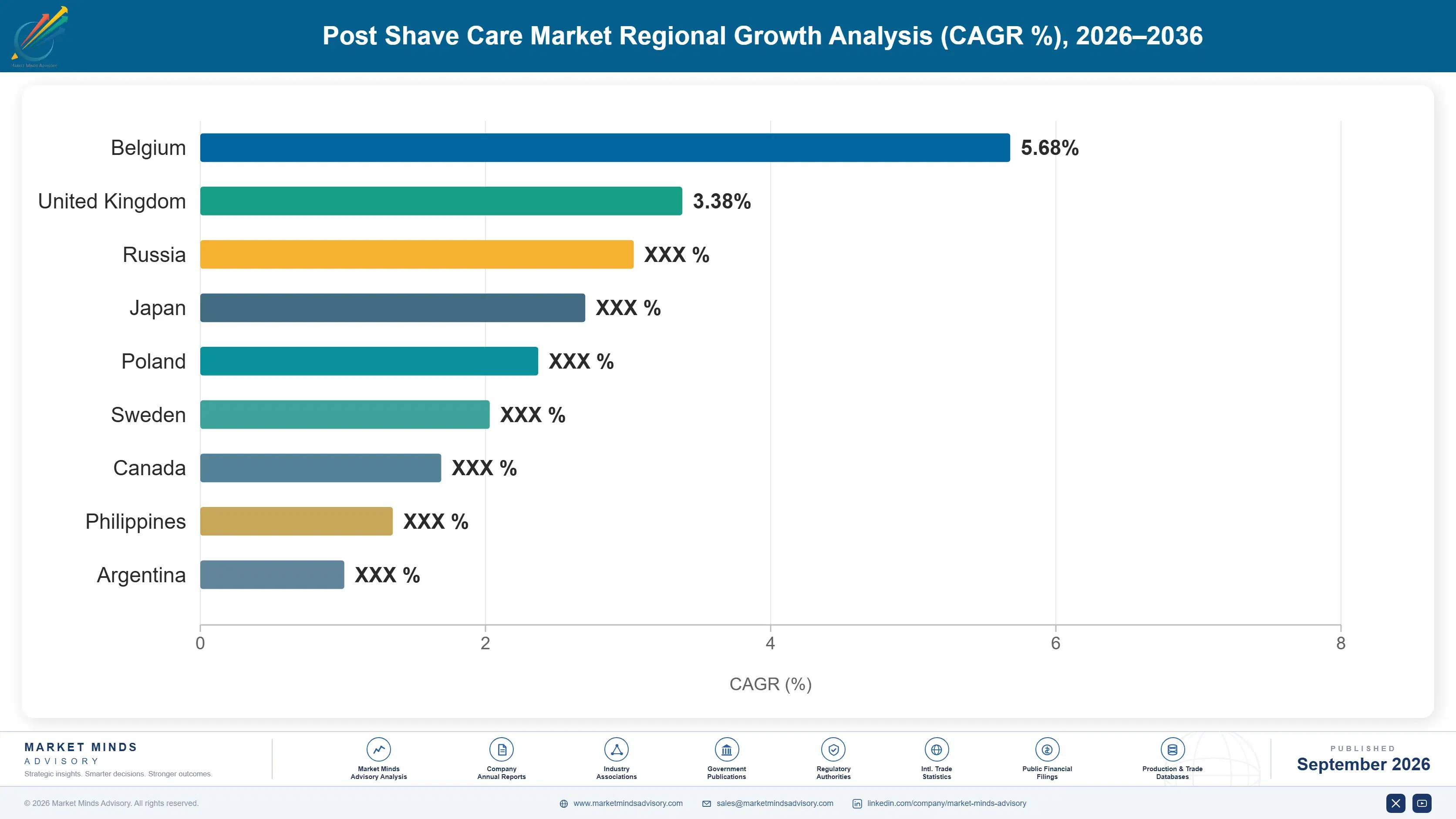
Regional shares here track where post shave products are actually purchased by their consumers rather than where they simply happen to be manufactured, since production capacity is widely distributed. All seven regions sit inside the standard bands for both share and growth across this market.

North America

Per capita grooming spending is the highest of any region, and the specialist razor bump segment was effectively invented here by brands serving customers that mainstream manufacturers had not formulated for. Growth of 6.0% tracks close to the world rate. Beard wearing reduced shaving frequency more here than in most markets over the past decade, which caps volume even as value per occasion rises. Barbershop recommendation channels are unusually influential in the specialist segment. Mainstream manufacturers have begun acquiring the specialists rather than reformulating, which reaches the market faster and costs considerably more than getting it right first time would have. The available targets are finite. Barbershop channels remain unusually influential.
Share: 29% | CAGR: 6.0% (2026 to 2036)

East Asia

Korean and Japanese male skincare routines are considerably more elaborate than Western equivalents, which pulls post-shave products toward serum and treatment formats rather than simple balms. Growth of 7.4% exceeds the world rate. Chinese male grooming is expanding quickly from a low base, though shaving frequency across the region is lower given hair growth patterns. That biology shifts demand toward general soothing rather than toward ingrown hair treatment. Serum formats consequently hold a larger share of regional volume than anywhere else covered, and Korean brands in particular export that formulation approach into Western markets through online channels. Shaving frequency remains lower across the region. Hair growth patterns shift demand toward soothing.
Share: 24% | CAGR: 7.4% (2026 to 2036)
Regional intelligence for 5 additional markets available in the complete report: Western Europe, South Asia and Pacific, Latin America, Middle East and Africa, Eastern Europe. Contact sales@marketmindsadvisory.com.
post-shave-care-market-country-cagr-analysis-1790014484261

Where Brands Can Take Real Share

Four commercial moves separate brands building genuine positions from those defending fragrance shelf space with a soothing claim attached. Each addresses an honest failure here: who the products were tested on, what the sting actually does, where the name sends buyers, and the surface area nobody formulates for. Three of the four cost nothing beyond a decision.

Put Coiled Hair On Every Test Panel

Around 9% of clinical panels include the hair type most likely to produce razor bumps, and roughly 62% of men with that hair report recurring irritation. Brands testing across the full range of hair textures report efficacy claim substantiation 2.9 times stronger and specialist channel listings that mainstream products cannot obtain. It costs a wider panel recruitment and it addresses the largest unmet need anywhere in this category. Specialist channels will not list a product that has not done this. The cost difference per study is modest against the position it opens.
Market Impact: Strengthens efficacy claim substantiation by 2.9 times over

Replace The Sting Without Losing The Sensation

About 31% of volume still uses a high-alcohol base that damages a barrier the razor has already compromised, and consumers read the sting as proof of efficacy. Brands using cooling agents and low-alcohol systems that reproduce the sensation without the barrier disruption report repurchase rates 2.4 times higher than straight low-alcohol reformulations. Removing the feeling loses the customer; reproducing it without the damage keeps both the experience and the skin. Cooling agents cost more than the alcohol they replace and considerably less than losing the customer. Buyer expectation is the binding constraint.
Market Impact: Raises repurchase rates to 2.4 times higher overall

Merchandise Under Skincare Not Under Fragrance

Roughly 38% of what sells as aftershave is fragrance with no soothing function, so a large share of consumers believe they already use post-shave care. Brands positioning in facial skincare rather than grooming aisles report trial rates 3.1 times higher among men who had never knowingly bought the category. The word aftershave sends buyers to a perfume counter, and abandoning it costs a repositioning rather than any reformulation. The trial opportunity sits entirely in the skincare aisle. Merchandising alongside facial care reaches a buyer who has never knowingly considered the category at all.
Market Impact: Raises product trial rates to 3.1 times higher

Formulate For The Larger Shaved Surface

Women shave roughly seven times the skin area a male face presents and almost no products are formulated or positioned for it, despite comparable rates of irritation, ingrown hairs, and folliculitis. Brands launching dedicated body post-shave products report category incremental revenue 2.7 times greater than line extensions into male facial care. The gap has sat in plain view through decades of stable shaving behaviour without anybody serious addressing it. Repackaged male facial products do not count and buyers notice. Comparable rates of irritation and folliculitis occur across those areas. Nobody serious has addressed it.
Market Impact: Adds 2.7 times more incremental category revenue overall

Who Controls the Margin Pool

Concentration is moderate. Five manufacturers hold 47% of category revenue, measured consistently on that basis across all participants, and the gap between them and specialist brands is wide in distribution while considerably narrower in formulation credibility with the consumers who need the products most. Barriers to entry are low in formulation and high in credibility, which is an unusual combination and explains why specialists established positions so quickly.
Competition currently turns on three dimensions: formulation and testing across hair textures, which decides whether a product works for the people most affected; barbershop and professional recommendation, which reaches the specialist buyer more effectively than any shelf; and active chemistry depth, where serums separate from balms. Clinical substantiation across hair textures has become a fourth dimension that specialist channels now treat as a listing condition.

Pressure builds from two directions. Specialist brands hold credibility that scale cannot purchase quickly. Meanwhile beard wearing reduces the underlying occasions. Rankings will shift toward manufacturers with genuine coiled hair formulation, since acquisition is the only alternative and the available targets are finite. Female body post shave remains entirely unclaimed by anybody at scale.
post-shave-care-market-company-positioning-matrix-1790014484789

Competitive Moat and Risk Dimensions

UNILEVER

Moat: Distribution And Portfolio Breadth

Shelf position across every major grocery and pharmacy channel worldwide gives reach that specialist brands cannot approach, and portfolio breadth across shaving and skincare lets the business merchandise post-shave alongside both. Scale also supports the clinical testing programmes that credible efficacy claims increasingly require in this category.
UNILEVER

Risk: Credibility Gap With Specialists

Consumers who have experienced razor bumps for years and found mainstream products ineffective trust specialist brands built specifically for them, and distribution does not repair that. Buying credibility through acquisition works and costs considerably more than formulating correctly would have, with a finite pool of targets.
BEIERSDORF

Moat: Dermatological Formulation Heritage

A skincare rather than grooming heritage positions the business naturally where the category is heading, since post-shave care is fundamentally barrier repair on compromised skin. That framing also supports merchandising alongside facial care rather than at a fragrance counter, which is where the trial opportunity actually sits.
BEIERSDORF

Risk: Alcohol Format Legacy Volumes

Established positions in traditional alcohol splash formats carry declining volumes and a formulation approach the category is moving away from. Managing that decline while building serum and treatment positions requires competing against specialists on ground where heritage brand recognition confers very little advantage. Heritage recognition confers very little there.

Players Tracked

Prominent Players

Unilever
Beiersdorf
Procter and Gamble
Edgewell Personal Care
L'Oreal Groupe

Other Key Players

Walker and Company Brands
Harry's
Dollar Shave Club
Proraso
The Bluebeards Revenge
Baxter of California
Jack Black
Bulldog Skincare
Cremo
Every Man Jack
Truefitt and Hill
Taylor of Old Bond Street
Billie
Fur
Tend Skin Company

Recent Developments

FEBRUARY 2026

Unilever Launches Post Shave Range Tested Across Hair Textures

Unilever released a post shave range formulated and clinically tested across the full range of hair textures including tightly coiled hair, addressing a population that historical test panels for this category largely omitted. Panel composition and results were both published rather than summarised into a marketing claim.
Signal: Mainstream manufacturers are reformulating rather than only acquiring specialists. Competitors must now match the disclosure or explain it.
SEPTEMBER 2025

Edgewell Expands Post Shave Balm Production Capacity

Edgewell Personal Care completed an organic capacity expansion for post shave balm and serum production, funded internally with no partner involved, after format conversion away from alcohol splash outran available emulsion and filling throughput. Emulsion capacity rather than filling had been the binding constraint. Splash lines were not expanded.
Signal: Format conversion rather than category growth is driving capacity investment. Splash volumes are being written off rather than defended.
MAY 2025

Beiersdorf Acquires Specialist Ingrown Hair Treatment Brand

Beiersdorf completed an acquisition of a specialist ingrown hair treatment brand with established barbershop distribution, adding formulation credibility with coiled hair consumers that its own portfolio had not developed independently. Barbershop distribution was the principal asset rather than the formulation itself, since credibility travels through that channel.
Signal: Credibility with affected consumers is being purchased rather than built. Available specialist acquisition targets are finite in number.

What Post Shave Care Costs

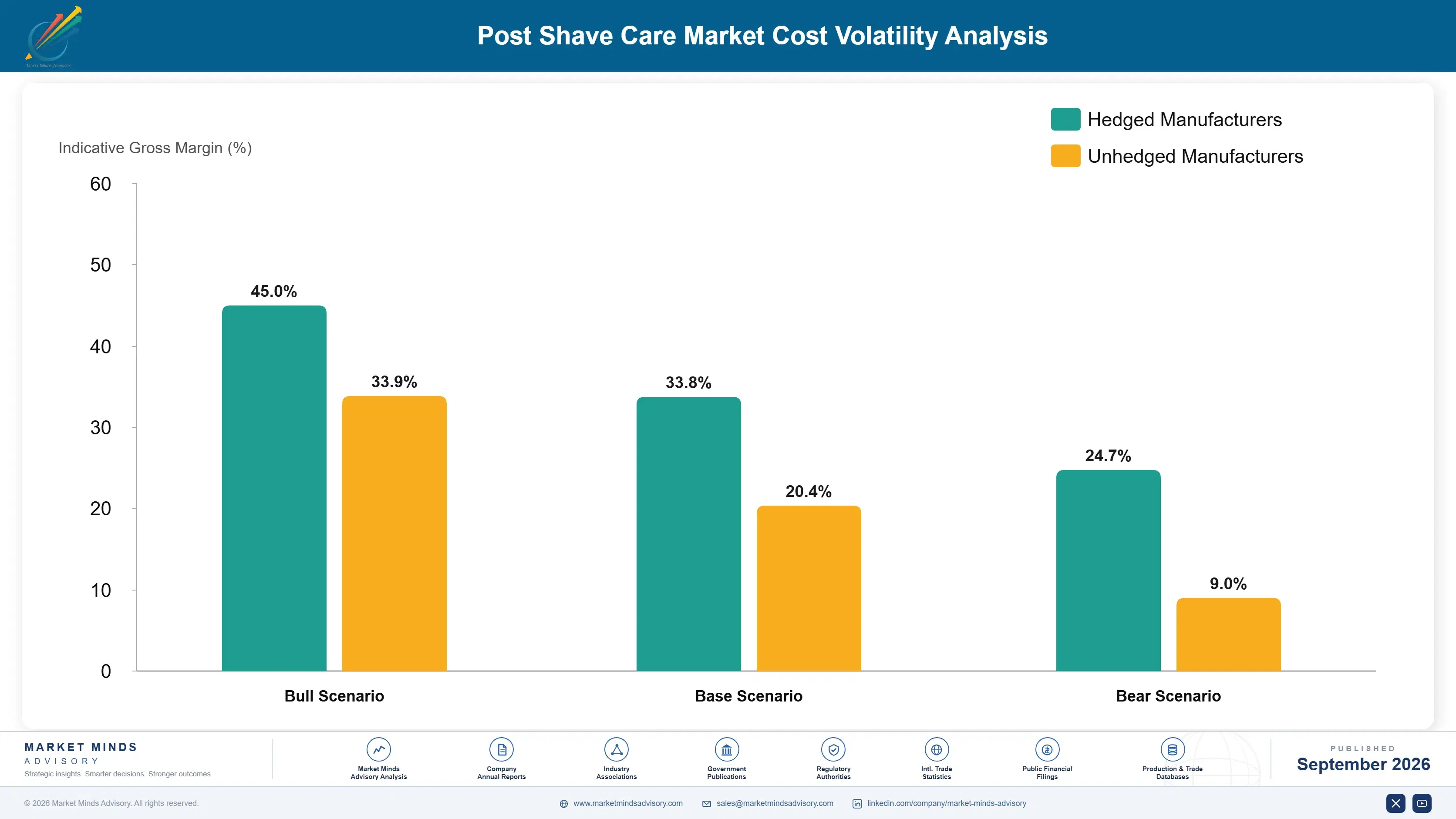
Three input groups dominate cost. Emollients, humectants, and base chemistry run 30% to 38% of cost of goods sold, and the eight-point range separates simple alcohol and water systems from stable emulsions carrying multiple actives. Active ingredients including glycolic acid, salicylic acid, allantoin, and panthenol take 22% to 30%. Packaging and fragrance add 26% to 34%, with fragrance alone frequently exceeding the actives.
Glycerin and fatty alcohol pricing moved through 2024 and 2025 as palm derivative supply and biodiesel demand competed for the same output, with United States Department of Agriculture oilseed data documenting the underlying movement across both years. Several manufacturers described the resulting margin pressure in their annual reports. Salicylic acid pricing followed phenol chemistry on a separate industrial path throughout. Packaging followed general resin markets separately again.

The competitive disadvantage mechanism runs through clinical testing rather than through ingredients. Substantiating an efficacy claim across multiple hair textures requires panel recruitment and study cost that a brand competing on fragrance and feel never incurs, and the specialist brands that did incur it hold claims that mainstream products cannot make. Exposure therefore varies by positioning rather than by purchasing scale or formulation cost.
post-shave-care-market-cost-volatility-analysis-1790014484985

Recruit Test Panels Across All Hair Textures

Around 9% of clinical panels in this category include tightly coiled hair, which is the population most affected by the condition products claim to address. Widening recruitment costs modestly more per study and produces claims that specialist channels will accept and that mainstream competitors cannot currently make at all. The cost difference per study is genuinely modest.

Contract Palm Derivatives Against Biodiesel Cycles

Glycerin and fatty alcohol supply follows palm production and biodiesel demand across industries far larger than personal care, and this category has no influence over either. Contracting against those cycles rather than reacting to them removes most of the exposure and improves supply security alongside it. Palm supply tightens for reasons personal care cannot anticipate.

Review Fragrance Cost Against Active Content

Fragrance frequently costs more than the actives in a post shave product, which is difficult to defend in a category repositioning around skincare efficacy. Reallocating even part of that budget toward active concentration changes what the product can claim, and consumers repositioned into skincare judge accordingly. Very few manufacturers have made that comparison explicitly.

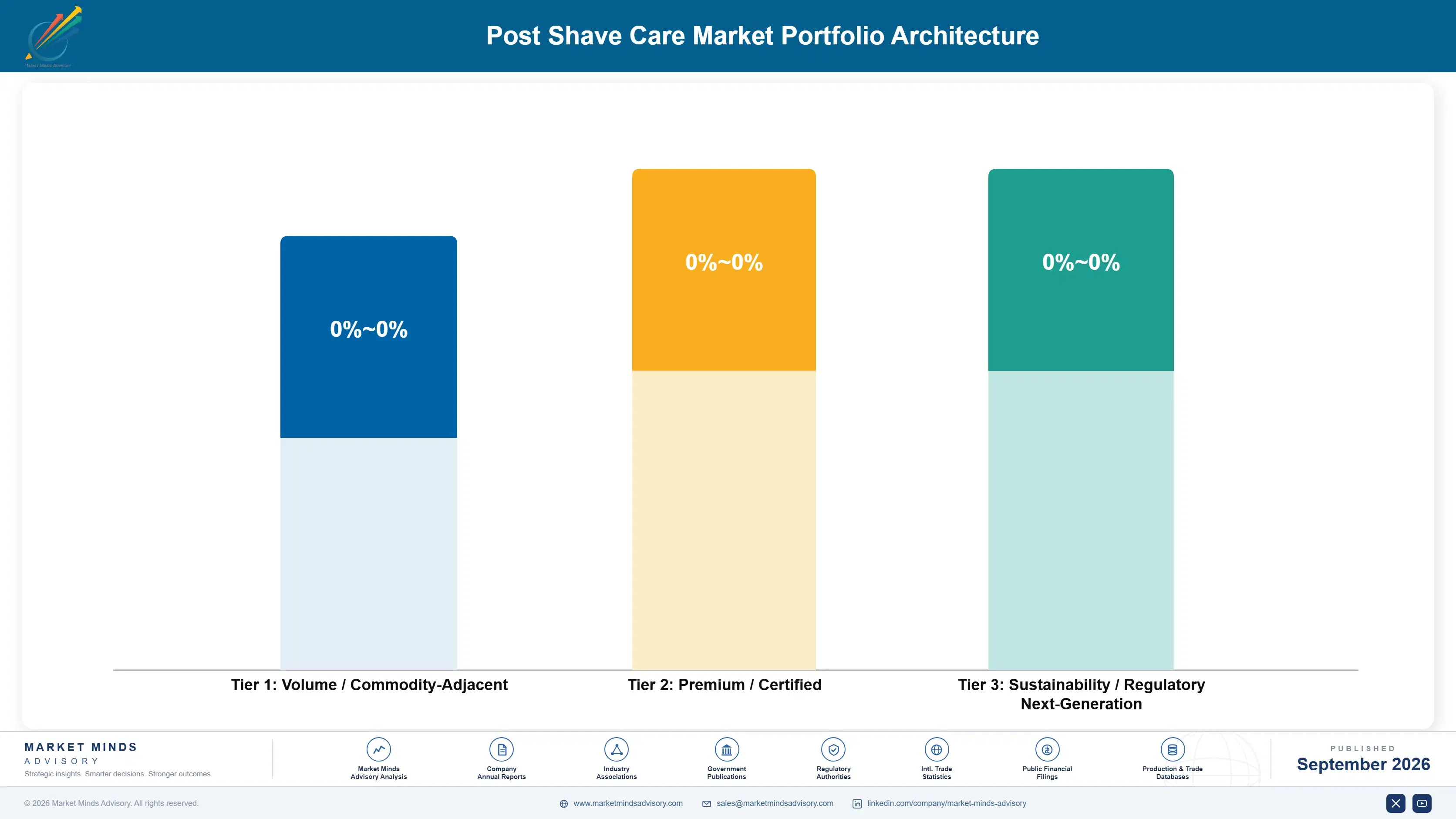
Portfolio Architecture for Margin Defence

Margin follows whether the product addresses a mechanism or a sensation. Alcohol splash formats compete close to commodity terms on heritage and price into declining volumes. Balms and gels earn moderately on comfort and fragrance. Serums earn better on active chemistry, and razor bump treatments earn most, because the condition is genuinely distressing and the products that work command whatever they ask. The margin spread across those four groups is wide for a personal care category.
The tension between volume and premium runs through where the product is merchandised. Grocery and pharmacy shelves move volume at thin margins to consumers buying on habit and fragrance. Barbershop and specialist channels reach the buyer who has a problem, converts on recommendation, and pays several times more, and those channels are not reachable through conventional retail relationships.

High-value pools concentrate where irritation is chronic rather than occasional: men with coiled hair shaving frequently, professional and uniformed occupations requiring clean shaving daily, and women experiencing folliculitis on shaved body areas. Where the purchase is a heritage fragrance splash bought at Christmas, price and packaging decide and nothing about the formulation matters. That divide follows chronic need rather than income.

Volume / Commodity-Adjacent

Alcohol splash and tonic aftershaves sold on heritage and fragrance into steadily declining volumes across most markets. The ten-point range reflects fragrance cost and manufacturing scale rather than any formulation property affecting skin outcomes.
Gross Margin: 30% to 40%

Premium / Certified

Balms, lotions, gels, and oils sold on comfort and barrier support through mainstream grocery and pharmacy distribution. The twelve-point range separates emulsions carrying meaningful active concentrations from those relying on emollient feel and fragrance alone.
Gross Margin: 44% to 56%

Sustainability / Regulatory / Next-Generation

Razor bump treatments and active serums substantiated across hair textures and sold through specialist and professional channels. The fourteen-point range reflects clinical evidence depth and whether the claim survives scrutiny from consumers who have tried everything.
Gross Margin: 58% to 72%
post-shave-care-market-portfolio-architecture-1790014485495

High-value Sub-segments and Strategic Watch-out

Razor Bump Treatment Systems

Highest value in the category, addressing a condition affecting 62% of men with coiled hair that mainstream formulation largely ignored. The sixteen-point range reflects clinical substantiation across hair textures, which very few products currently hold at all. Barbershop distribution decides credibility here. Very few products hold it.
Gross Margin: 58% to 74%

Active Post-Shave Serums

High value growing at 8.3% by preventing follicle inflammation rather than soothing it afterwards. The twelve-point range reflects active concentration, since several products carry the serum description with negligible acid content behind it. Application discipline limits how far it broadens. Education carries unusual weight here.
Gross Margin: 48% to 60%

Female Body Post-Shave Products

Volume core opportunity covering seven times the shaved surface a male face presents with almost no dedicated products. The fourteen-point range reflects whether formulation is genuinely adapted or a male facial product simply repackaged. Nobody at scale has claimed the position yet. Buyers notice when it is repackaged.
Gross Margin: 42% to 56%

Alcohol Splash And Tonics

The strategic watch-out. Volumes decline in every market, the base actively damages compromised skin, and heritage is the only thing holding the position. The ten-point range reflects fragrance cost and manufacturing scale alone. Volumes decline steadily in every market. Heritage is the whole defence. Nothing else supports it.
Gross Margin: 28% to 38%

How This Demand Repeats

Consumption follows shaving frequency, which is a habit rather than a decision, and that makes the underlying occasions unusually stable. A man shaving daily for professional reasons consumes post-shave product on a predictable schedule regardless of economic conditions. What moves is which product and at what price, and beard wearing is the only variable that genuinely removes occasions from the category altogether.
Attachment depth divides sharply by whether the buyer has a problem. Somebody with chronic razor bumps who finds a product that works will repurchase for years and recommend it actively, since the alternative is visible daily discomfort. Somebody using a balm out of habit switches on promotion without much thought. The first group is smaller, growing faster, and considerably more valuable per customer. Chronic need predicts loyalty almost exactly.

The buyer profile is changing along two lines at once. Consumers with coiled hair are being served properly for the first time and are choosing on evidence rather than availability, while women shaving body areas remain almost entirely unaddressed despite a far larger shaved surface. Both shifts favour brands positioned in skincare over those positioned in grooming and fragrance.
post-shave-care-market-end-use-penetration-index-1790014486025

Where This Market Rewards

These are among the four positions where our research anticipates prominent divergence between winners and laggards over the coming forecast period. Each is grounded in the demand model, the regulatory perimeter, and the announced capacity pipeline.
01 / HAIR TEXTURE TESTING

Nine per cent of panels included them

Roughly 62% of men with tightly coiled hair report recurring post-shave irritation, and around 9% of clinical test panels for this category include that hair type at all. Brands testing across the full range of hair textures report efficacy substantiation 2.9 times stronger and obtain specialist channel listings that mainstream products simply cannot. It costs wider panel recruitment and addresses the largest unmet need in the market, and specialist channels increasingly refuse to list products that have not done it.
02 / SENSATION WITHOUT DAMAGE

Keep the feeling, lose the harm

About 31% of all category volume still uses a high-alcohol base that disrupts a barrier the razor has already compromised, and consumers continue to read the resulting sting as proof of efficacy. Brands using cooling agents that reproduce the sensation without the damage report repurchase rates 2.4 times higher than plain low-alcohol reformulations achieve. Removing the feeling loses the customer, and reproducing it without the harm keeps both, which costs slightly more per unit and considerably less than losing the buyer.
03 / SKINCARE AISLE REPOSITIONING

The name sends them to perfume

Roughly 38% of what retails under the aftershave name is fragrance with no soothing function, so many consumers believe they already use post-shave care when they simply do not. Brands positioning in facial skincare rather than in grooming aisles report trial rates 3.1 times higher among men who had never knowingly bought into the category. Abandoning the aftershave term costs a repositioning rather than any reformulation work at all, and the trial opportunity sits entirely on the other side of the store.
04 / FEMALE SURFACE OPPORTUNITY

Seven times the skin, no products

Women shave roughly seven times the skin area that a male face presents, and experience comparable rates of irritation, ingrown hairs, and folliculitis right across those areas. Brands launching genuinely dedicated body post-shave products now report incremental category revenue 2.7 times greater than line extensions into male facial care manage to produce. That gap has sat in plain view through decades of entirely stable female shaving behaviour everywhere, and repackaged male facial products do not count as addressing it either.

Engagement Snapshot From the Field

A live engagement with an industry participant carrying material or product regulatory and market exposure ahead of a defining policy shift, showing how our research translates into a defensible multi-year portfolio strategy.
MARKET MINDS ADVISORY · CLIENT ENGAGEMENT SUMMARY
Post Shave Care Producer Strategic Portfolio Review and Transition Roadmap 2026·Investment Scenario on Post Shave Care Exposure Evaluation 2025-26
CLIENT PROFILE
A global personal care manufacturer with post shave revenue near USD 290 million (client-reported, unverified by MMA), selling balms, splashes, and gels across thirty-one markets. Category share had declined for five consecutive years against specialist brands, and two attempts at a razor bump product had failed to gain distribution or repeat purchase. The board wanted the failures explained before a third attempt.
STRATEGIC CHALLENGE
Marketing attributed the failures to insufficient advertising support and had proposed a larger launch budget for a third attempt. Nobody had examined how the failed products were formulated and tested, or whether they actually worked for the consumers the specialist brands were successfully serving. Advertising and formulation explanations imply entirely different costs.
MMA APPROACH
MMA reviewed the clinical testing behind both failed products, recruited a panel across the full range of hair textures for comparative efficacy testing against three specialist competitors, surveyed affected consumers on brand trust, and modelled outcomes under advertising, reformulation, and acquisition. Panel composition on the original studies was reviewed directly, which nobody inside the business had previously examined.
KEY FINDINGS
  1. Both failed products had been tested on panels where tightly coiled hair represented under a tenth of participants, despite that being the population the products targeted directly.
  2. Comparative testing showed both products performing materially worse than specialist competitors on the affected hair type, and comparably on straight hair. That pattern held across both formulations.
  3. Surveyed consumers with chronic razor bumps rated mainstream brand trust very low, citing years of products that had not worked for them specifically.
  4. A third advertising-led launch would have promoted a product that comparative testing showed did not work for its intended users. Distribution would have followed the same pattern.
CLIENT PROFILE
A global personal care manufacturer with post shave revenue near USD 290 million (client-reported, unverified by MMA), selling balms, splashes, and gels across thirty-one markets. Category share had declined for five consecutive years against specialist brands, and two attempts at a razor bump product had failed to gain distribution or repeat purchase. The board wanted the failures explained before a third attempt.
STRATEGIC CHALLENGE
Marketing attributed the failures to insufficient advertising support and had proposed a larger launch budget for a third attempt. Nobody had examined how the failed products were formulated and tested, or whether they actually worked for the consumers the specialist brands were successfully serving. Advertising and formulation explanations imply entirely different costs.
MMA APPROACH
MMA reviewed the clinical testing behind both failed products, recruited a panel across the full range of hair textures for comparative efficacy testing against three specialist competitors, surveyed affected consumers on brand trust, and modelled outcomes under advertising, reformulation, and acquisition. Panel composition on the original studies was reviewed directly, which nobody inside the business had previously examined.
KEY FINDINGS
  1. Both failed products had been tested on panels where tightly coiled hair represented under a tenth of participants, despite that being the population the products targeted directly.
  2. Comparative testing showed both products performing materially worse than specialist competitors on the affected hair type, and comparably on straight hair. That pattern held across both formulations.
  3. Surveyed consumers with chronic razor bumps rated mainstream brand trust very low, citing years of products that had not worked for them specifically.
  4. A third advertising-led launch would have promoted a product that comparative testing showed did not work for its intended users. Distribution would have followed the same pattern.
RECOMMENDED STRATEGY
Phase 1: Phase one: halt the third launch and reformulate with clinical testing recruited across the full range of hair textures from the outset. Phase 2: Phase two: seek barbershop and specialist distribution before mainstream retail, since that channel decides credibility with affected consumers. Retail listings follow credibility rather than preceding it. Phase 3: Phase three: reposition the wider range into skincare merchandising rather than grooming and fragrance aisles. The name currently sends buyers to a perfume counter instead.
OUTCOME
The reformulated product achieved specialist channel listings within two quarters and repeat purchase above category norms (client-reported, unverified by MMA). The advertising budget was redirected into clinical work. Two further products entered development under the revised testing protocol. Panel composition is now specified at the start of every development brief.

Frequently Asked Questions

Foundational context covering the market sizes, CAGR, scope, country, region and competition that inform every finding below. This section is provided to cover basics and most often pre-purchase conversations, answered from the MMA Primary Research Dataset.

What is the current size of the Post Shave Care Market?

The market was worth USD 2.3 billion in 2025 and reaches USD 2.4 billion in 2026. Value covers post shave products with a soothing or treatment function.

How large will the Post Shave Care Market be by 2036?

MMA forecasts USD 4.5 billion by 2036, an increase of USD 2.1 billion across the forecast period. That represents 1.88 times the 2026 base of USD 2.4 billion.

What is the CAGR for the Post Shave Care Market 2026 to 2036?

The base case compound annual growth rate is 6.4%, with a bull case at 7.6% and a bear case at 5.2%. Historical growth from 2020 to 2025 ran at 5.1%.

Which segment is growing fastest?

Ingrown hair and razor bump treatments grow at 9.6%, half again the market rate of 6.4%. They address a condition affecting most men with tightly coiled hair.

Who are the major companies in the Post Shave Care Market?

Unilever, Beiersdorf, Procter and Gamble, Edgewell Personal Care, and L'Oreal Groupe lead the category. Together they hold 47% of revenue, with specialist brands holding formulation credibility.

Which country is growing fastest?

Brazil grows at 10.8%, driven by male grooming spending rising across income groups and a population where coiled and wavy hair types are heavily represented.

Report Segmentation Architecture

The full report scope spans multiple orthogonal segmentation dimensions, with cross-tabulated demand data provided for each dimension pair. Coverage extends further to regional breakdowns, trend trajectories, and the competitive detail needed to support segment-level decision-making.

By Product Function

  • Ingrown Hair and Razor Bump Treatments
  • Post-Shave Serums and Active Treatments
  • Aftershave Balms and Lotions
  • Post-Shave Oils
  • Post-Shave Gels and Creams
  • Alcohol Splash and Tonic Aftershaves

By End-Use Industry

  • Male Facial Shaving
  • Female Body Shaving
  • Professional Barbershop Services
  • Uniformed and Clean Shave Occupations
  • Sensitive Skin and Dermatological Need
  • Salon and Spa Treatment Services

By Commercial Dimension

  • Grocery and Mass Retail
  • Pharmacy and Drug Channels
  • Barbershop and Professional Supply
  • Specialist Grooming Retail
  • Online Direct to Consumer
  • Subscription Shaving Services

By Region

  • North America
  • East Asia
  • Western Europe
  • South Asia and Pacific
  • Latin America
  • Middle East and Africa
  • Eastern Europe

Scope, Methodology, and Coverage

Every figure in this report is reproducible from documented input assumptions. The scope below maps the historical period, the forecast horizon, the segmentation dimensions, and the countries covered, alongside the underlying primary and qualitative methodology.
Historical Period
2020 to 2025
Forecast Period
2026 to 2036
Base Year
2025 (USD billions; MMA Primary Research Dataset, September 2026)
Market Definition
This market covers products applied to skin after shaving to soothe, protect, and prevent irritation, across ingrown hair and razor bump treatments, post-shave serums and active treatments, aftershave balms and lotions, post-shave oils, post-shave gels and creams, and alcohol splash and tonic aftershaves. It excludes pre-shave preparations, shaving creams and foams, razors and blades, fragrance-only products sold under the aftershave name, general body moisturisers, and depilatory or laser aftercare.
Quantitative Units
USD billions, retail value at manufacturer selling price
Segmentation Dimensions
Product function, user group, commercial dimension, region
Regions Covered
North America, East Asia, Western Europe, South Asia and Pacific, Latin America, Middle East and Africa, Eastern Europe
Countries Covered
United States, Canada, Mexico, China, Japan, South Korea, Taiwan, Germany, United Kingdom, France, Italy, Spain, Netherlands, Poland, Czechia, India, Indonesia, Thailand, Vietnam, Australia, Brazil, Colombia, Chile, Argentina, Peru, Saudi Arabia, United Arab Emirates, Egypt, Nigeria, South Africa
Key Companies Profiled
Unilever, Beiersdorf, Procter and Gamble, Edgewell Personal Care, L'Oreal Groupe, Walker and Company Brands, Harry's, Dollar Shave Club, Proraso, The Bluebeards Revenge, Baxter of California, Jack Black, Bulldog Skincare, Cremo, Every Man Jack, Truefitt and Hill, Taylor of Old Bond Street, Billie, Fur, Tend Skin Company
Quantitative Methodology
Primary survey, n=3,800 respondents, Q4 2025, six countries; demand-side model with trade association cross-validation
Qualitative Methodology
47 expert interviews, Q4 2025; applied to validate demand model assumptions, identify emerging dynamics, and assess competitive positioning
Report Format
PDF and XLSX data workbook (Word format preview document)
Publisher
Market Minds Advisory
Report Code
MMA-2026-CHM-321
Published
September 2026
Contact
sales@marketmindsadvisory.com | www.marketmindsadvisory.com

Purchase the full Post Shave Care Market Report (2026 to 2036).

The full report sizes the post shave care market across six product functions, seven regions, and thirty countries, with forecasts to 2036 under base, bull, and bear cases. It quantifies how rarely clinical panels include the hair type most affected by razor bumps, sets out what a high-alcohol base does to an already compromised barrier, and measures the share of the category that is fragrance rather than care. Competitive analysis covers twenty participants evaluated consistently on category revenue, with detailed treatment of specialist brand credibility. Cost structure, clinical testing economics, and channel margin architecture are analysed throughout. Primary research includes 3,800 survey responses and 47 expert interviews.
Six product functions sized and forecast separately
Twenty participants evaluated on category revenue consistently
Clinical panel composition analysed against affected population hair types
Alcohol base effects quantified on freshly shaved barrier condition
Fragrance versus care share measured across the retail category
Female body shaving opportunity sized against male facial demand

Built For The People Who Decide

From boardroom strategy to bench-side execution, this report is read cover-to-cover by leaders shaping the next decade of their industry, turning demand scenarios, market dynamics and valuation benchmarks into decisions.
CXOs/ Presidents/ VPs/ Managers
M&A and Corporate Development
Strategy Teams and R&D Heads
Procurement and Product Directors
Regulatory and Compliance Leaders
Investor Relations and Equity Analysts