Market Minds Advisory
Positive Displacement Pumps Market

Positive Displacement Pumps Market: Precision Metering as a Process Reliability Standard

Chemical and pharmaceutical processors now specify pump repeatability in fractions of a percent, wastewater utilities retrofit aging fleets to cut downtime, and suppliers without seal life data increasingly lose bids before price becomes the factor.

Lead Analyst

David Horsley

Published

September 2026

Make Smarter Decisions with Customized Research Insights

Request a free sample report and evaluate market opportunities, growth trends, and competitive dynamics relevant to your business needs.

2025 MARKET VALUE$6.8BMarket Size 2025
2036 FORECAST VALUE$12.2BBase Case , 2026 to 2036
CAGR 2026 TO 20365.5 %Bull 6.7% / Bear 4.3%
INCREMENTAL OPPORTUNITY$5.1BNet 10- year value creation
EXPANSION MULTIPLE1.71x2036 value over 2026 base
Strategic Levers
M&A Pipeline
Regional Outlook
Country Rankings
Competitive Intelligence
Segmental Deep-dive
Call-Us : 91 93563 13602

Executive Snapshot and Market Trajectory

Process engineers increasingly treat pump dosing accuracy as a quality-control specification rather than a purely mechanical concern, since pharmaceutical and specialty chemical batches now fail entirely when metering tolerance drifts even slightly outside validated ranges during extended production runs spanning multiple consecutive manufacturing shifts across a typical week.
Progressive cavity pumps lead growth at 7.2%, roughly 1.31 times the overall rate, as wastewater utilities and mining operators specify screw pump designs for abrasive slurry handling that lobe and gear pumps cannot match reliably over comparable service intervals across demanding industrial duty cycles. East Asia now holds the largest regional share at 28%, driven by China's expanding chemical manufacturing base and continued wastewater infrastructure investment across second-tier and inland cities.
Competitive intensity stays moderate at 35% held by five suppliers, since application-specific engineering expertise fragments share across dozens of credible regional specialists rather than concentrating around a handful of global platforms the way more capital-intensive equipment categories often do. Digital condition monitoring is emerging as a genuine differentiator, and process industries increasingly select suppliers on validated seal life data spanning several years of documented field service.
Market Definition
Base Year Value
$6.8B in 2025 (MMA Primary Research Dataset, August 2026)
Forecast Period
2026 to 2036, eleven discrete annual values
CAGR
5.5% base case. Bull 6.7%. Bear 4.3%.
Fastest Growth Segment
Progressive Cavity (Screw) Pumps: 7.2% CAGR
Fastest Growth Country
China: 8.5% CAGR
Fastest Growth Region
South Asia and Pacific: 7.6% CAGR
Largest Region
East Asia: 28% of 2025 global value
Market Leaders
Primary Survey
n=3,800 procurement and R&D decision-makers, Q4 2025, six countries
Methodology
Demand-side build-up, cross-validated against public data, 47 expert interviews

Positive Displacement Pumps Market Forecast Scenarios

positive-displacement-pumps-market-size-forecast-scenario-1787300478943
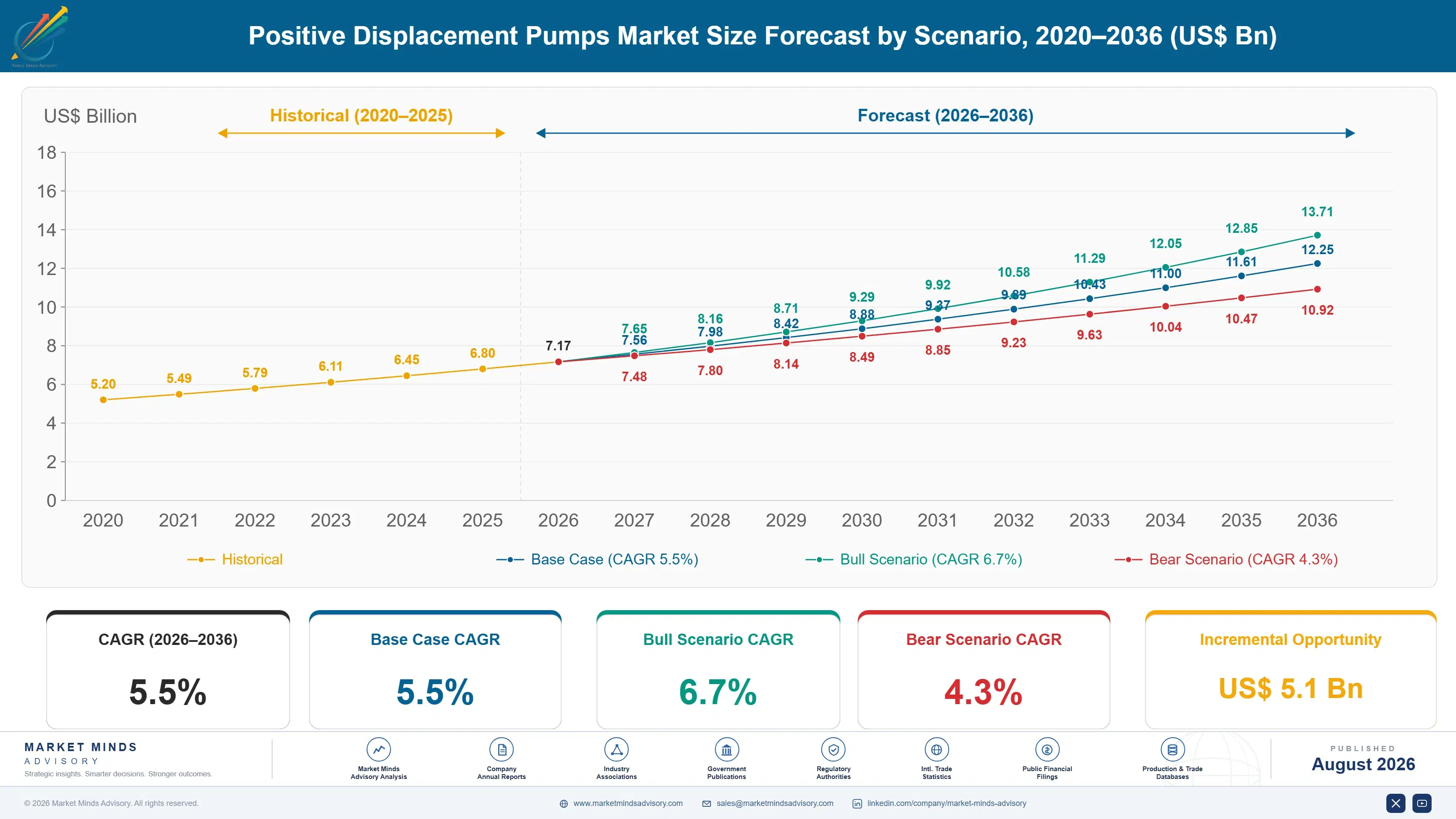
Between 2020 and 2025 the market grew at an estimated 4.8% annually, slowed initially by pandemic-driven industrial capex cuts before recovering as chemical and pharmaceutical manufacturers resumed delayed capacity expansion projects across multiple regions. Growth accelerated further after 2023 as wastewater utilities began deploying long-delayed infrastructure funding into aging treatment plant fleets across many major municipal systems.
Three mechanisms carry the base case to 5.5%. First, pharmaceutical and biotech manufacturing capacity keeps expanding globally, and each new facility specifies precision metering pumps validated against strict batch consistency requirements. Second, wastewater utilities are replacing aging fleets with abrasion-resistant screw and diaphragm designs as biosolids handling volumes climb. Third, digital condition monitoring is extending average pump life, which lets suppliers justify premium pricing on total cost of ownership grounds rather than unit price alone.
The bull case at 6.7% assumes sustained industrial capex growth across chemical and pharmaceutical manufacturing keeps replacement and expansion demand elevated throughout the forecast period. The bear case at 4.3% assumes a broader industrial slowdown delays capacity expansion projects, pushing utilities and processors to extend existing pump life rather than committing to new capital purchases.

Repeatability as the Real Purchasing Criterion

Positive displacement pumps sit at the center of process reliability for any operation moving viscous, shear-sensitive, or precisely metered fluids, since flow accuracy and repeatability increasingly matter more than raw throughput to buyers across chemical, pharmaceutical, food, and wastewater applications. Centrifugal pumps remain the default for high-volume, low-viscosity transfer, but positive displacement designs win whenever dosing precision or fluid handling gentleness genuinely matters t
MARKET CONCENTRATION (CR5)35%Five suppliers hold moderate share across fragmented specialist field
AVERAGE SEAL LIFE3 to 5 yearsTypical service interval before major seal replacement occurs
TOP PRODUCING COUNTRY SHARE22%China supplies largest share of installed pump manufacturing capacity
REPLACEMENT CYCLE LENGTH7 to 12 yearsPump systems typically operate this long before full replacement
POWER COST SHARE18-25% of lifecycle costElectricity consumption weighs meaningfully on total ownership economics
TRADE INTENSITY33% cross-borderPump components frequently cross borders before final assembly occurs
Commercially, the category behaves like a specialized engineering business wrapped inside a broader industrial equipment relationship. Suppliers bundle pump hardware with application engineering support and seal replacement service contracts, which locks process customers into a single vendor relationship across an entire production line rather than encouraging unit-by-unit shopping on price. Switching suppliers mid-process requires requalification that most regulated manufacturers are reluctant to undertake without strong cause.
Over the next decade, expect digital condition monitoring to become standard across mid-size and larger installations, as sensor cost keeps falling and process customers demand predictive seal failure data rather than reactive maintenance schedules. Single-use and hygienic pump designs will also keep gaining share as biopharmaceutical manufacturing continues its rapid capacity expansion worldwide, particularly across cell and gene therapy production facilities.
"Nobody buys a positive displacement pump for its horsepower rating. They buy it because it does the exact same thing ten thousand times in a row."
Director, Industrial Equipment and Fluid Handling Practice · MMA Industrial Equi

Market Trends

Biopharmaceutical Capacity Expansion Drives Hygienic Pump Demand

Cell and gene therapy manufacturing capacity is expanding rapidly across North America and Western Europe, and each new facility specifies single-use and hygienic-design pumps validated against strict sterility and cross-contamination requirements that conventional industrial pumps cannot meet. Watson-Marlow and Netzsch have both expanded single-use peristaltic product lines specifically targeting this segment, adding disposable fluid path components that eliminate cleaning validation entirely between production batches. Smaller specialty biotech manufacturers, previously priced out of dedicated hygienic equipment, increasingly find affordable modular options entering the market. The shift is turning pump selection into a regulatory compliance decision as much as a mechanical one.
Market Impact: Adds 12,000 treatment plant upgrades
Digital Condition Monitoring Becomes Standard Specification

Process customers are increasingly writing predictive monitoring requirements directly into pump procurement specifications, requiring vendors to deliver real-time pressure, vibration, and seal condition data rather than a bare mechanical warranty. IDEX and SPX Flow have both expanded cloud-connected monitoring platforms that flag seal degradation weeks before failure, letting process engineers schedule replacement during planned maintenance windows instead of losing production unexpectedly. Smaller regional suppliers without comparable platforms increasingly struggle in competitive bidding processes against larger diversified competitors. The shift rewards suppliers who invested early in digital infrastructure ahead of broader industry adoption.
Market Impact: Cuts batch failure rate by 25%

Market Opportunities and Growth Drivers

Wastewater Infrastructure Investment Sustains Replacement Demand

Municipal wastewater utilities across developed and developing markets alike are deploying long-delayed infrastructure funding to replace aging fleets, and progressive cavity and lobe pumps handling biosolids and sludge represent a meaningful share of that capital spending. The United States Environmental Protection Agency has directed billions in state revolving fund financing toward treatment plant modernization, and comparable programs are advancing across the European Union and China. Each modernized treatment plant typically specifies abrasion-resistant pump designs rated for decades of continuous service, giving suppliers with proven biosolids-handling technology a durable replacement tailwind independent of broader industrial capital cycles.
Market Impact: Limits share to 30% of transfer

Specialty Chemical Production Growth Requires Precision Metering

Specialty and fine chemical production keeps expanding as manufacturers shift away from commodity chemicals toward higher-margin formulated products requiring exact ingredient ratios during batch production. Each specialty chemical batch depends on metering pumps holding tolerance within a fraction of a percent, since even minor dosing drift can ruin an entire production run and its associated raw material cost. Ingersoll Rand and Netzsch have both expanded precision metering product lines targeting this segment specifically, and formulators increasingly specify documented repeatability data during vendor qualification rather than relying on nameplate specifications alone.
Market Impact: Adds 15% annual maintenance cost

Market Restraints and Challenges

Higher Upfront Cost Limits Adoption Versus Centrifugal Alternatives

Positive displacement pumps typically cost considerably more upfront than comparable centrifugal alternatives for straightforward high-volume transfer applications where precision metering genuinely does not matter to the process outcome. The root cause is mechanical complexity: rotating or reciprocating elements with tight tolerances cost more to manufacture than a simple centrifugal impeller design. That cost gap pushes budget-constrained buyers toward centrifugal pumps even in applications where positive displacement would technically perform better over the equipment's operating life. Suppliers are responding with total-cost-of-ownership calculators that quantify maintenance and downtime savings to justify the higher purchase price.
Market Impact: Adds 18% pharma segment growth

Seal and Wear Component Failure Drives Maintenance Cost

Seals and elastomer components in positive displacement pumps wear faster than the pump housing itself, particularly in abrasive slurry or highly corrosive chemical service, creating a recurring maintenance cost that erodes the total-cost-of-ownership advantage suppliers often claim over centrifugal alternatives. The root cause is materials science: standard elastomer compounds degrade faster than premium alternatives that cost considerably more upfront but extend service intervals meaningfully. That tradeoff creates real confusion for buyers comparing quotes on sticker price alone. Suppliers are responding with advanced polymer seal technology marketed specifically at the harshest chemical service applications.
Market Impact: Cuts unplanned downtime by 30%
3 additional market trends, 4 additional growth drivers, and 2 additional restraints and challenges are covered in the full report. Contact sales@marketmindsadvisory.com to access the complete intelligence.

Segment CAGR and Growth Architecture

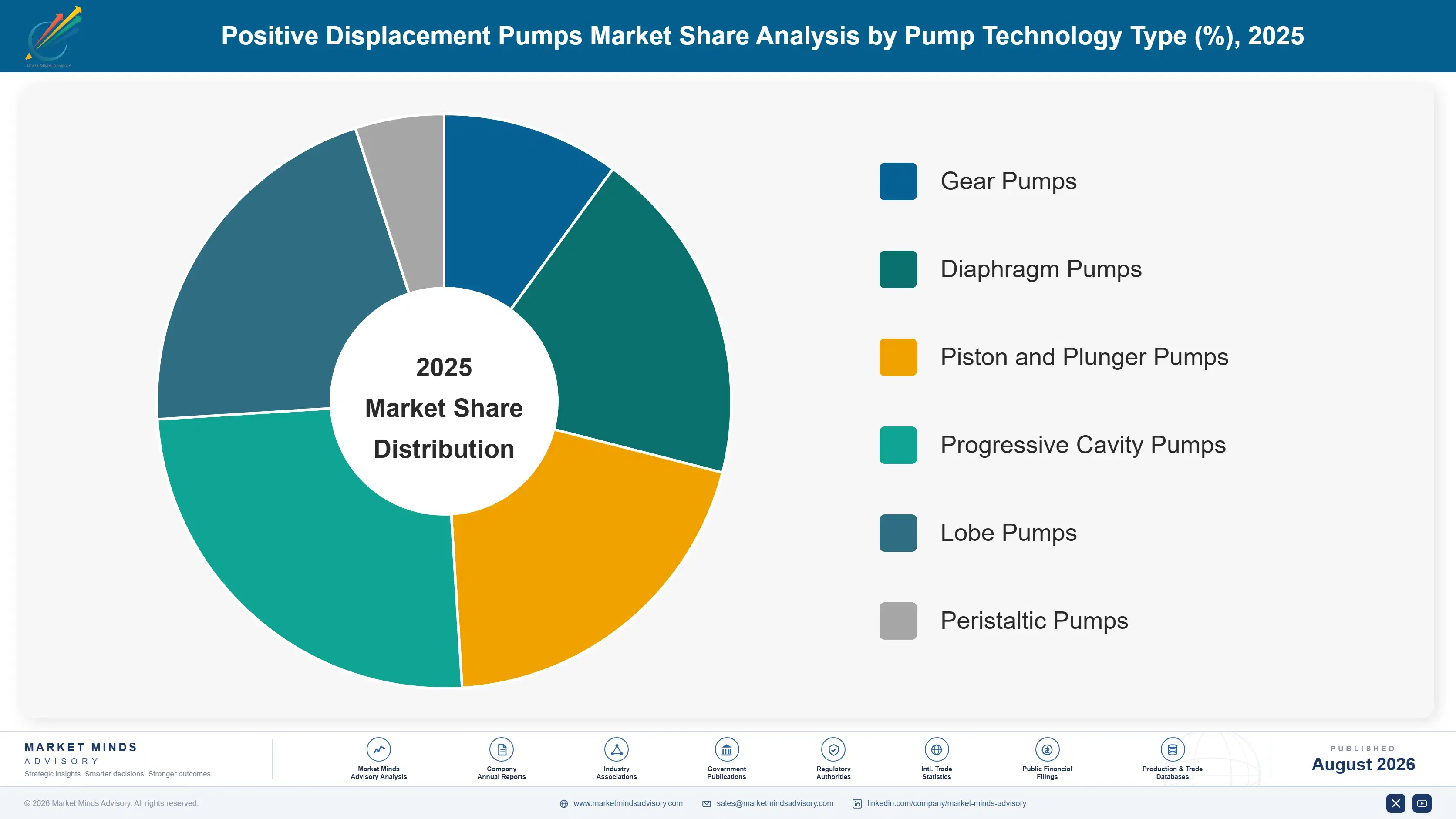
Segmentation follows pump technology type, a single mechanical-principle logic spanning gear, diaphragm, piston and plunger, progressive cavity, lobe, and peristaltic designs. Each technology carries distinct tolerance, materials, and application fit, so commercial position tracks the underlying mechanism rather than the industry it happens to serve at any given moment in time, regardless of end-market.
positive-displacement-pumps-market-market-share-analysis-1787300479482

Progressive Cavity (Screw) Pumps

Progressive cavity pumps grow fastest at 7.2%, about 1.31 times the overall market rate, as wastewater utilities and mining operators increasingly specify screw pump designs for abrasive slurry and high-viscosity biosolids handling that lobe and gear pumps struggle to match reliably over comparable service life. Municipal treatment plant modernization programs across the United States, European Union, and China are driving much of this growth, as aging fleets reach end of service life simultaneously across many facilities built during the same infrastructure investment wave decades ago. Netzsch and SEEPEX have both expanded biosolids-specific product lines, and utilities increasingly specify documented abrasion-resistance data during vendor qualification rather than relying on generic wear-life claims from manufacturer brochures.
CAGR 7.2%

Peristaltic Pumps

Peristaltic pumps grow second-fastest at 6.8%, driven overwhelmingly by biopharmaceutical manufacturing expansion, since the technology's fluid path never contacts moving mechanical parts, eliminating contamination risk that regulated drug production cannot tolerate under any circumstances. Single-use disposable tubing assemblies have become the default specification for cell and gene therapy production, since they eliminate cleaning validation entirely between production batches and reduce cross-contamination risk to essentially zero across every processing step. Watson-Marlow dominates this application specifically, having built its business almost entirely around hygienic and single-use peristaltic technology, and newer entrants struggle to match its decades of accumulated validation documentation and regulatory relationships across major pharmaceutical manufacturers worldwide, from established biologics leaders to newer gene therapy startups.
CAGR 6.8%
Full segment breakdown across 6 segments available in the complete report.

Regional Architecture and Country Demand Map

East Asia leads at 28% of global value on China's expanding chemical manufacturing base and wastewater investment, followed by North America at 24% and Western Europe at 20% on pharmaceutical capacity expansion. South Asia and Pacific, Latin America, Middle East and Africa, and Eastern Europe account for the remainder.

North America

Chemical manufacturing along the United States Gulf Coast anchors North American demand, where precision metering pumps serve specialty and fine chemical production alongside the region's still-substantial base commodity chemical output. Pharmaceutical manufacturing capacity expansion, accelerated by reshoring incentives and cell and gene therapy investment, is adding a genuinely new demand layer distinct from replacement volume in mature process industries. Canada's oil sands and mining sector contribute meaningful progressive cavity pump demand for slurry handling applications. Municipal wastewater utilities across major metropolitan areas are also replacing aging fleets under long-delayed infrastructure funding programs. Growth of 5.8% outpaces the global rate as pharmaceutical capacity additions compound with steady chemical sector replacement demand.
Share: 24% | CAGR: 5.8% (2026 to 2036)

Western Europe

Germany's chemical cluster around Ludwigshafen and the broader Rhine corridor sustains a large installed base of precision pumps serving specialty chemical and pharmaceutical production, though as a mature market its growth trails newer expansion regions considerably. Switzerland and Ireland host concentrated biopharmaceutical manufacturing capacity that specifies hygienic single-use pump designs almost universally across new facility construction. The United Kingdom and France maintain steady wastewater utility replacement demand under European Union environmental compliance directives requiring treatment plant modernization. Growth of 4.0% trails the global average because chemical sector capacity additions have slowed considerably compared with faster-growing regions, leaving replacement demand as the dominant driver across most of the region's mature process industries.
Share: 20% | CAGR: 4.0% (2026 to 2036)
Regional intelligence for 5 additional markets available in the complete report: East Asia, South Asia and Pacific, Latin America, Middle East and Africa, Eastern Europe. Contact sales@marketmindsadvisory.com.
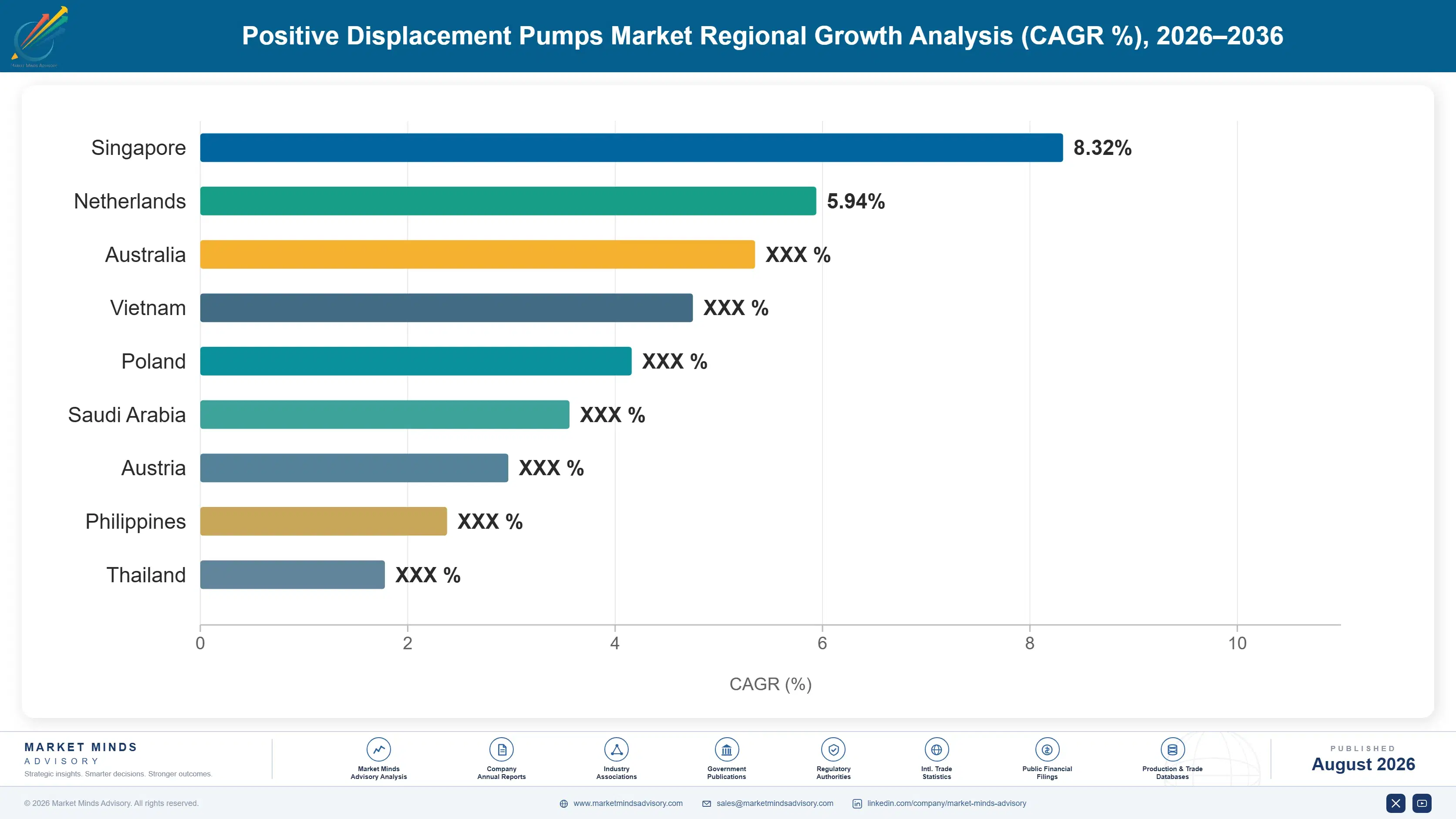
positive-displacement-pumps-market-country-cagr-analysis-1787300479994

Where Pump Suppliers Can Defend Margin

Suppliers can defend margin against commoditized hardware pricing in several distinct ways beyond simply selling more pump units into a growing installed base. The four levers below identify genuine commercial advantage: hygienic and single-use design specialization, digital monitoring attachment, seal life documentation, and abrasion-resistant metallurgy and premium documentation for the harshest and most regulated process applications.

Specialize in Single-Use Hygienic Pump Designs

Biopharmaceutical manufacturers pay meaningful premiums, often 30% to 50% above conventional stainless steel equivalents, for single-use pump systems that eliminate cleaning validation entirely between production batches. Suppliers with proven single-use platforms and accumulated regulatory validation documentation can win business that generalist industrial pump makers simply cannot bid on competitively, since qualification requirements alone take years to satisfy for a new entrant. Watson-Marlow has built its business almost entirely around this specialization, and the barrier to replicating its documentation base protects margin far more durably than mechanical design alone ever could.
Market Impact: Commands a durable 30% to 50% price premium

Attach Predictive Monitoring to Every Pump Sale

Selling bare hardware alone commoditizes quickly, since competing pumps often meet similar mechanical specifications within a given price band across most conventional applications. Suppliers that bundle predictive monitoring software, charging a recurring subscription fee of roughly 2,000 to 5,000 dollars per installation annually, convert a one-time equipment sale into a recurring revenue relationship that also generates the failure data needed to improve future product design. IDEX and SPX Flow have both scaled this attachment strategy successfully across their largest process industry accounts, compounding data advantage over time across an ever-growing connected installation base.
Market Impact: Adds up to 3,500 dollars in recurring revenue

Document Seal Life Data for Vendor Qualification

Process customers increasingly demand documented seal life performance data during vendor qualification rather than accepting nameplate specifications on faith, particularly in regulated pharmaceutical and food production environments where batch failure carries steep financial consequences. Suppliers with several years of accumulated field performance data across comparable applications can charge premiums of 15% to 25% over unproven competitors, since operators value the downside protection more than the incremental cost difference involved. Netzsch has built a dedicated performance-tracking program specifically around this structure, targeting its largest regulated pharmaceutical and food industry accounts directly.
Market Impact: Commands a durable 15% to 25% price premium

Develop Abrasion-Resistant Metallurgy for Slurry Service

Standard pump metallurgy fails quickly in abrasive slurry and highly corrosive chemical service, creating a genuine technical differentiation opportunity rather than a purely commercial one for suppliers willing to invest in premium materials science. Suppliers with proven abrasion-resistant alloys and coatings can charge meaningfully more, often 25% to 35% above standard configurations, because the alternative for operators is expensive, frequent pump failure rather than a modest price difference. SEEPEX and Netzsch have both built specific reputations around this capability in demanding mining and municipal wastewater slurry handling applications across multiple continents.
Market Impact: Commands a durable 25% to 35% price premium

Who Controls the Margin Pool

Concentration stays moderate at 35% held by the top five suppliers, evaluated on revenue from positive displacement pump systems specifically. IDEX and Ingersoll Rand lead on scale and application breadth, while Watson-Marlow and Netzsch compete as technology specialists with deep expertise in hygienic and abrasion-resistant designs respectively. The gap between leader and challenger is real but not decisive, since application-specific engineering fragments share broadly.
Competitive activity currently runs along three dimensions. Application specialization matters most, as suppliers focus resources on winning specific verticals like biopharma or wastewater rather than competing broadly across every application. Digital monitoring attachment runs a close second, converting hardware sales into recurring service relationships. Seal life documentation is the third, since regulated industries increasingly demand proof before qualifying a new vendor for production use.

Pressure is building from two directions. Chinese domestic pump manufacturers are scaling rapidly and narrowing the technology gap on conventional applications, threatening incumbents' share in price-sensitive segments across emerging markets. Meanwhile specialty biotech equipment startups are commercializing novel single-use designs that could challenge Watson-Marlow's hygienic pump dominance. Rankings will shift toward suppliers combining defensible application expertise with genuine digital differentiation.
positive-displacement-pumps-market-company-positioning-matrix-1787300480517

Competitive Moat and Risk Dimensions

IDEX CORPORATION

Moat: Broad Application Engineering Portfolio

IDEX holds a diversified portfolio spanning gear, diaphragm, and metering pump technologies across dozens of application-specific brands, giving it breadth few specialists can match. That diversification lets IDEX serve customers across chemical, water, and industrial markets simultaneously, spreading cyclical risk across genuinely uncorrelated end markets.
IDEX CORPORATION

Risk: Integration Complexity Across Many Brands

Managing dozens of acquired brands under one corporate umbrella creates integration complexity that more focused competitors avoid entirely, and cross-selling opportunities across the portfolio remain harder to capture than the acquisition strategy originally assumed. Brand consolidation risk could alienate customers loyal to specific legacy names.
INGERSOLL RAND INC.

Moat: Scale in Industrial Distribution Channels

Ingersoll Rand's broad industrial distribution network gives its pump products shelf space and service reach that smaller specialists cannot easily replicate, particularly across smaller regional accounts that value single-vendor purchasing convenience. That distribution scale compounds with cross-selling opportunities across its broader compressed air and fluid handling portfolio.
INGERSOLL RAND INC.

Risk: Broad Portfolio Dilutes Pump Focus

Pumps represent one segment within a much larger diversified industrial portfolio, and specialized competitors sometimes out-innovate Ingersoll Rand on pump-specific technology since their entire engineering focus concentrates there exclusively. That divided attention could erode share in the most technically demanding application niches over the coming years.

Key Players

IDEX Corporation
Ingersoll Rand Inc.
Watson-Marlow Fluid Technology Group
Netzsch Pumpen & Systeme GmbH
SPX Flow, Inc.

Others

CIRCOR International, Inc.
Grundfos Holding A/S
Xylem Inc.
Flowserve Corporation
KSB SE & Co. KGaA
Sulzer Ltd
Dover Corporation
Yamada Corporation
Tapflo Group
Verder Group
SEEPEX GmbH
Roper Technologies, Inc.
Alfa Laval AB
PCM SA
Wangen Pumpen GmbH

Recent Developments

JUNE 2025

Watson-Marlow expands single-use pump manufacturing capacity in Massachusetts

Watson-Marlow opened an expanded manufacturing facility dedicated to single-use peristaltic pump components, adding capacity to serve growing cell and gene therapy manufacturing demand across North America. This was an organic capacity expansion, not a corporate transaction, reflecting direct investment in response to sustained biopharma demand growth.
Signal: Shows leading suppliers investing directly in dedicated capacity ahead of continued biopharmaceutical manufacturing expansion worldwide across multiple therapeutic categories.
OCTOBER 2024

Netzsch acquires specialty abrasion-resistant coating technology firm

Netzsch acquired a privately held coatings technology developer specializing in abrasion-resistant surface treatments for pump wear components used across mining and wastewater applications. The acquisition was a full corporate purchase, not a licensing arrangement or joint venture, giving Netzsch direct ownership of the underlying coating intellectual property outright.
Signal: Indicates suppliers increasingly prefer owning differentiating materials technology outright rather than sourcing it externally through licensing arrangements.
MARCH 2025

IDEX and a regional wastewater utility sign multi-year service agreement

IDEX signed a multi-year maintenance and monitoring service agreement with a large regional wastewater utility covering dozens of treatment plants across multiple states. This was a service contract, not an acquisition or joint venture, extending IDEX's existing digital monitoring platform into a major public-sector account.
Signal: Signals large public-sector utilities increasingly prefer long-term service relationships over one-off equipment purchase transactions with multiple competing vendors.

Specialty Alloy and Elastomer Exposure

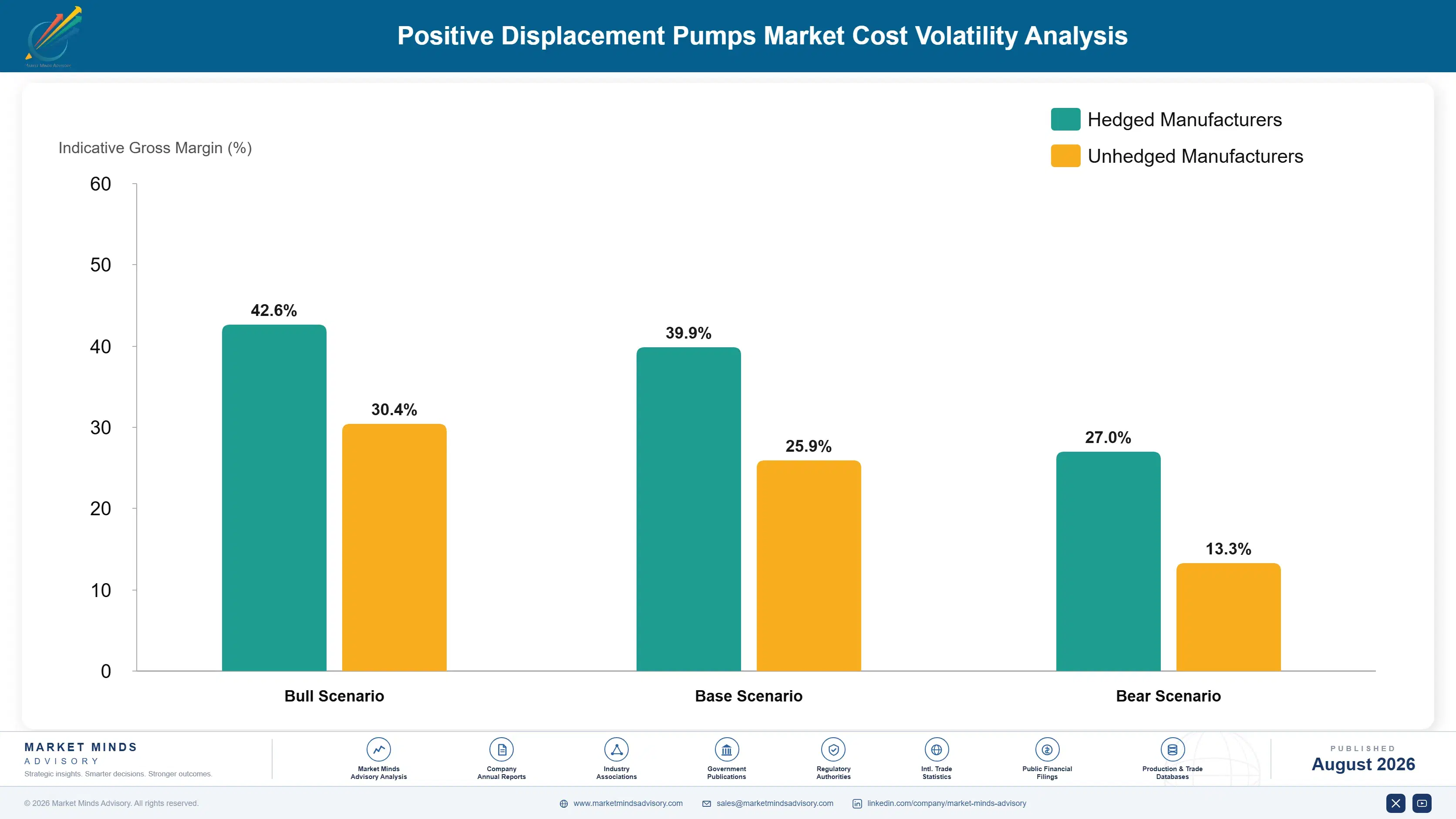
Stainless steel, specialty alloy castings, and elastomer seal materials together account for roughly 28% to 35% of pump system COGS, sourced primarily from steel producers in the United States, Germany, and Japan and from specialty elastomer compounders concentrated in Germany and the United States. Precision-machined components add a further 10% to 15%, sourced from a mix of in-house and specialized contract machine shops.
Stainless steel prices rose meaningfully through 2024 as nickel input costs climbed on Indonesian export policy changes affecting global nickel pig iron supply, feeding directly into 300-series stainless alloy pricing used throughout the pump industry. IDEX's 2024 annual report disclosed higher input costs attributable to metals inflation, noting that specialty alloy castings rose meaningfully faster than the company could pass through to customers without margin compression across its pump segment.

Smaller regional pump manufacturers carry more exposure than the largest diversified suppliers, since they lack the purchasing scale to negotiate favorable long-term metals contracts with primary steel producers. Suppliers sourcing elastomer compounds from single regional suppliers face additional exposure to localized supply disruption, while those with diversified global sourcing absorb volatility more predictably across their broader supply chain.
positive-displacement-pumps-market-cost-volatility-analysis-1787300480711

Lock Steel Pricing Through Annual Supply Contracts

Stainless steel is the largest single volatile input across most pump product lines and the most actively traded on organized metals markets globally. Annual supply agreements with fixed or collared pricing, common practice among larger diversified manufacturers, smooth quarter-to-quarter volatility and let commercial teams quote multi-year contracts with genuine confidence rather than repricing constantly.

Diversify Elastomer Sourcing Across Multiple Compounders

Reliance on a single elastomer compounder concentrates both price and availability risk unnecessarily across an entire product line. Qualifying secondary compounders across multiple regions, even at modestly higher unit cost, protects continuity when any single supplier faces capacity outage, raw material shortage, or a sudden demand spike from competing industrial sectors expanding worldwide simultaneously.

Bring Precision Machining Capacity In-House

Suppliers that bring precision machining in-house rather than relying entirely on contract machine shops capture manufacturing margin previously paid to a third party while gaining direct visibility into actual material consumption and lead times across every product line. That integration also shortens delivery timelines meaningfully during periods of tight global machining capacity and rising demand.

Portfolio Architecture for Margin Defence

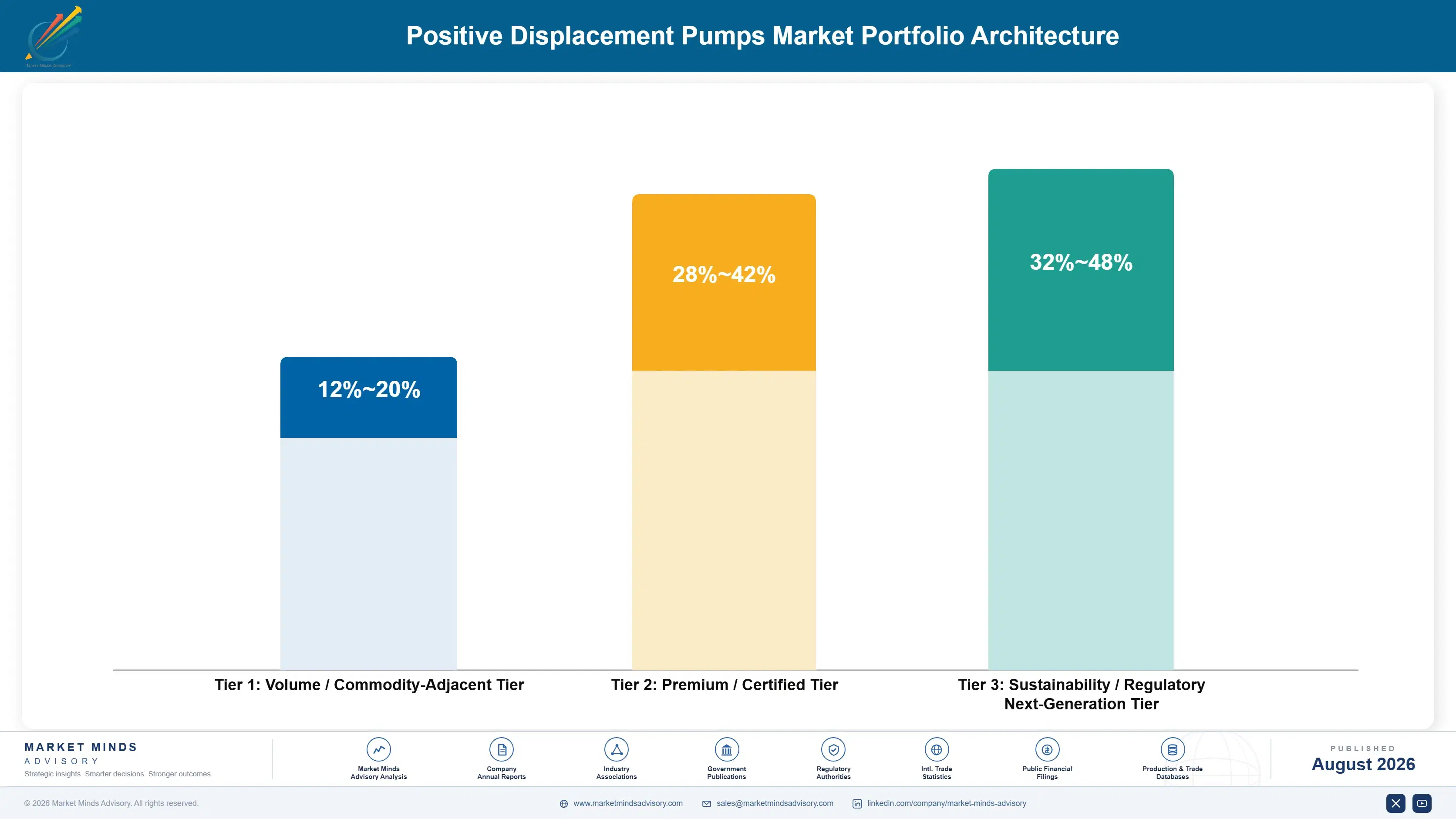
The portfolio splits into three tiers with meaningful margin separation tied to application specialization and documentation depth. Volume tier products carry standard gear and lobe pump configurations for conventional industrial transfer, competing largely on price against regional manufacturers. Premium certified products carry hygienic and abrasion-resistant designs backed by documented performance data. Sustainability and next-generation products attract the sector's most active research inv
The tension between volume and premium runs through nearly every supplier's product roadmap. Volume products fund the manufacturing scale and distribution network premium products eventually depend on, yet volume margins keep compressing as Chinese manufacturers scale aggressively on conventional designs. Suppliers that under-invest in premium engineering risk commoditization, while those chasing premium exclusively struggle to fund the manufacturing base needed to serve high-volume replacement demand.

High-value margin pools concentrate specifically in biopharmaceutical and highly regulated chemical applications where failure consequences carry the largest financial and compliance stakes, and where documented performance data commands genuine pricing power. Conventional industrial transfer generates steadier volume but thinner margin, since that segment competes against a wider set of lower-cost regional suppliers with adequate but genuinely unremarkable engineering capability.

Volume / Commodity-Adjacent Tier

Standard gear and lobe pump configurations for conventional industrial transfer applications, competing largely on price against a crowded field of regional and domestic manufacturers offering broadly comparable mechanical specifications and materials.
Gross Margin: 12-20%

Premium / Certified Tier

Hygienic single-use and abrasion-resistant pump designs backed by documented performance data and formal regulatory qualification, commanding meaningful pricing premiums over standard equivalents across regulated pharmaceutical, food processing, and mining industries specifically and consistently.
Gross Margin: 28-42%

Sustainability / Regulatory / Next-Generation Tier

Single-use biopharmaceutical systems and digitally monitored platforms still scaling rapidly across the installed base, targeting reliability and compliance outcomes that current hardware-only offerings simply cannot fully match consistently across every application.
Gross Margin: 32-48%
positive-displacement-pumps-market-portfolio-architecture-1787300481202

High-value Sub-segments and Strategic Watch-out

Biopharmaceutical Single-Use Pump Systems

High value and high growth, driven by cell and gene therapy manufacturing capacity expansion across North America and Western Europe, with regulatory validation barriers protecting incumbent suppliers from new entrant price competition on the most technically demanding and heavily regulated pharmaceutical accounts worldwide, from established biologics leaders to emerging startups.
Gross Margin: 32-48%

Progressive Cavity Wastewater Systems

High value with moderate growth, anchored by long-delayed municipal infrastructure funding finally reaching aging treatment plant fleets, where documented abrasion-resistance data increasingly decides vendor qualification outcomes across major municipal utility contracts nationwide, from coastal cities to inland treatment districts serving smaller and mid-sized communities across many states.
Gross Margin: 25-38%

Conventional Gear and Lobe Pump Units

The category's largest volume base by unit count, competing on price against a crowded field of regional suppliers, generating steady but thin margin as conventional industrial transfer demand matures across most producing economies worldwide, from Western Europe to Southeast Asia and Latin America simultaneously across most producing markets.
Gross Margin: 12-20%

Legacy Elastomer Seal Technology

Strategic watch-out where advanced polymer seal technology threatens to displace legacy elastomer compounds across harsh chemical applications, creating genuine technology risk for suppliers slow to invest in next-generation materials science and premium alloy development ahead of competitors still relying entirely on legacy elastomer compounds and older formulations.
Gross Margin: 15-28%

Qualification Economics of Process Contracts

Pump demand behaves like an annuity once a process line qualifies a specific vendor, since regulated industries require costly requalification testing before switching suppliers mid-process, and most operators avoid that disruption unless a competitor demonstrates a decisive reliability or compliance advantage. That structure rewards incumbency heavily across pharmaceutical and specialty chemical accounts, where a supplier winning the initial qualification keeps the relationship through multiple
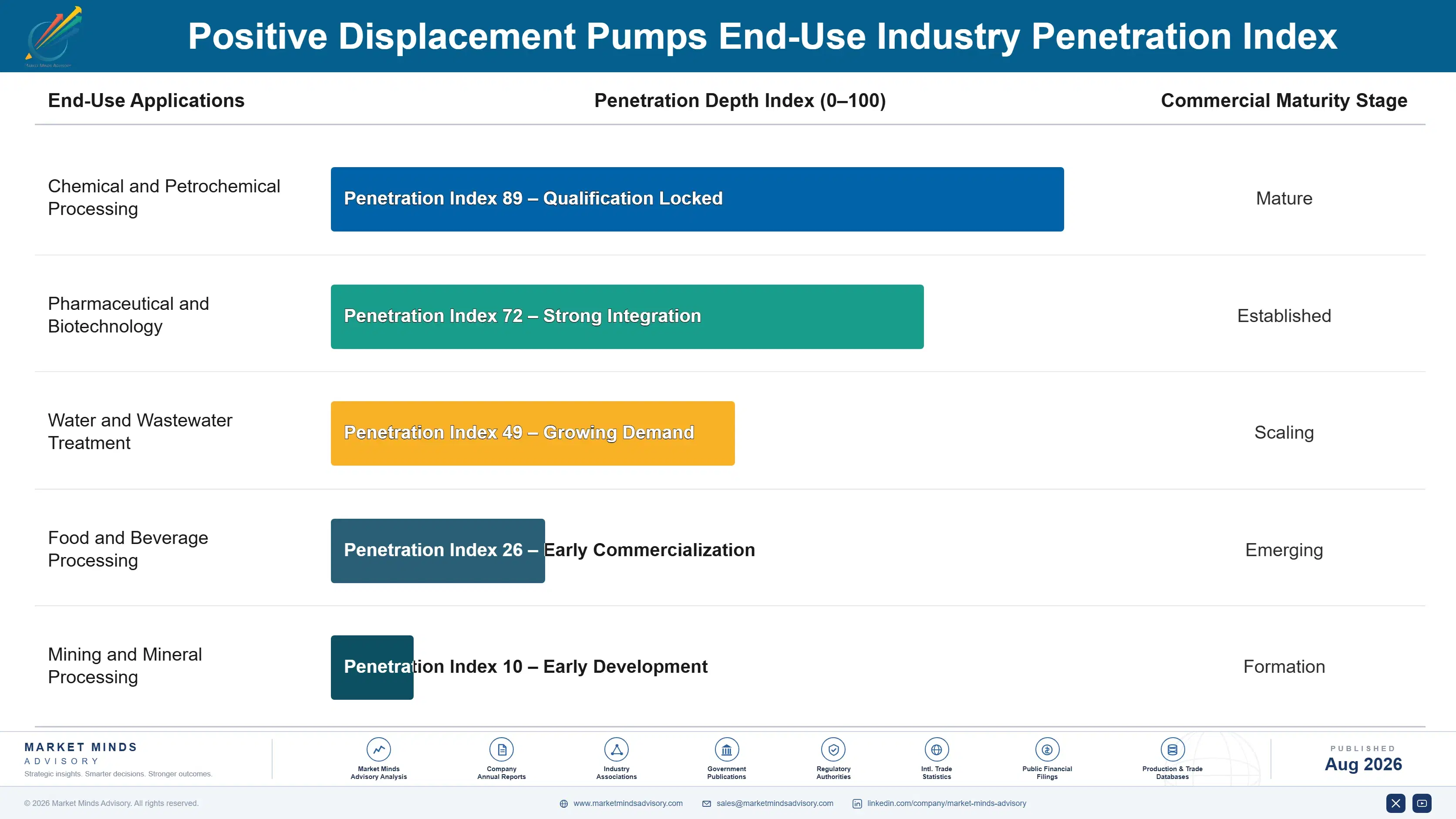
Adoption depth varies sharply by end-use vertical. Pharmaceutical and biotech manufacturers have adopted documented seal life and hygienic design specification almost universally, since batch failure consequences there are severe and tightly regulated. Conventional industrial transfer applications lag well behind, treating documentation as optional rather than standard, partly because failure consequences are genuinely lower and partly because budget scrutiny is tighter outside regulated production environments.

Buyer profiles have shifted generationally. Procurement decisions that once sat primarily with plant maintenance engineers now route through formal quality and reliability engineering functions at larger manufacturers, rewarding suppliers able to present integrated performance data rather than relationship selling alone. Younger process engineers entering leadership roles treat documented seal life and monitoring data as a baseline procurement input rather than a marketing claim.
positive-displacement-pumps-market-end-use-penetration-index-1787300481690

MMA's Read on Fluid Handling

These are among the four positions where our research anticipates prominent divergence between winners and laggards over the coming forecast period. Each is grounded in the demand model, the regulatory perimeter, and the announced capacity pipeline.
01 / APPLICATION SPECIALIZATION STRATEGY

Vertical-specific engineering expertise will separate winners from generalist suppliers

Conventional pump hardware is becoming commoditized across most standard industrial applications, which means suppliers competing solely on price rather than a documented application advantage will see margin compress steadily over the next several years across nearly every conventional segment. Deep vertical expertise in biopharma, wastewater, or specialty chemicals addresses genuine qualification requirements that generic hardware quality alone cannot satisfy. Suppliers that build documented performance advantages now, before switching costs harden around a qualified incumbent, will hold accounts rivals cannot easily dislodge for years.
02 / BIOPHARMA CAPACITY POSITIONING

Single-use hygienic pump platforms will define share gains through 2036

Cell and gene therapy manufacturing capacity keeps expanding across North America and Western Europe, and each new facility specifies single-use pump systems validated against strict sterility requirements that conventional hardware simply cannot satisfy under current regulatory frameworks. Suppliers without proven hygienic platforms increasingly cannot bid competitively on this segment, regardless of reputation built in conventional industrial markets over decades of prior operation. Those investing in single-use technology now, ahead of competitors still focused on conventional designs, will capture disproportionate share as biopharma capacity keeps expanding.
03 / WASTEWATER INFRASTRUCTURE RECOVERY

Documented abrasion resistance will decide utility contract renewals

Long-delayed municipal wastewater infrastructure funding is finally reaching aging treatment plant fleets, and utilities increasingly demand documented abrasion-resistance performance data during vendor qualification rather than accepting nameplate claims at face value. Suppliers without credible field performance data cannot simply buy their way into this segment quickly, since utilities will not risk expensive treatment plant downtime on unproven equipment regardless of price offered. Incumbent suppliers with documented performance histories are positioned to capture a disproportionate share of this recovering capital spending cycle.
04 / CHINESE MANUFACTURING COMPETITION

Domestic Chinese suppliers will permanently reshape conventional segment economics

Chinese domestic pump manufacturers are scaling rapidly and narrowing the technology gap on conventional gear and lobe pump applications, permanently compressing margin in price-sensitive segments that Western suppliers once dominated by default across most emerging markets. That competition is simultaneously freeing Western suppliers to redirect investment toward higher-margin specialized applications including biopharma and abrasion-resistant mining equipment where documentation barriers still protect incumbents. The net effect redraws competitive geography in ways unlikely to reverse regardless of future trade policy shifts in either direction.

Engagement Snapshot From the Field

A live engagement with an industry participant carrying material or product regulatory and market exposure ahead of a defining policy shift, showing how our research translates into a defensible multi-year portfolio strategy.
MARKET MINDS ADVISORY · CLIENT ENGAGEMENT SUMMARY
Positive Displacement Pumps Producer Strategic Portfolio Review and Transition Roadmap 2026·Investment Scenario on Positive Displacement Pumps Exposure Evaluation 2025-26
CLIENT PROFILE
A specialty chemical formulator operating four production sites across the United States and Germany, reporting approximately 850 million dollars in annual revenue, approached MMA after inconsistent pump performance across sites drove a meaningfully higher-than-budgeted maintenance spend during 2024, prompting leadership to question its long-standing decentralized site-by-site procurement approach across the entire organization (client-reported, unverified by MMA).
STRATEGIC CHALLENGE
Leadership faced pressure to standardize pump procurement across sites without disrupting validated production processes that took years to qualify originally. Plant managers at each site had historically selected suppliers independently based on local relationships, producing an inconsistent fleet with no shared maintenance data or bulk purchasing leverage across the company's four manufacturing locations.
MMA APPROACH
MMA benchmarked pump performance and total cost of ownership across all four sites against comparable specialty chemical manufacturers, identified which existing suppliers offered the strongest documented reliability data, and modeled the requalification cost and timeline required to consolidate toward a smaller set of preferred vendors across the company's entire manufacturing footprint.
KEY FINDINGS
  1. Two of the four sites used pumps from suppliers with meaningfully weaker documented seal life data, and consolidating toward the strongest performers reduced projected annual maintenance spend considerably.
  2. Requalification cost was lower than leadership initially feared, since most product lines could transition during scheduled maintenance windows rather than requiring dedicated downtime.
  3. Consolidating to two preferred suppliers, rather than one, preserved negotiating leverage while still capturing most of the standardization benefit identified (client-reported, unverified by MMA).
  4. Digital monitoring attachment varied significantly by site, and sites with monitoring installed showed measurably fewer unplanned failures than comparable sites operating without any equivalent monitoring system installed.
CLIENT PROFILE
A specialty chemical formulator operating four production sites across the United States and Germany, reporting approximately 850 million dollars in annual revenue, approached MMA after inconsistent pump performance across sites drove a meaningfully higher-than-budgeted maintenance spend during 2024, prompting leadership to question its long-standing decentralized site-by-site procurement approach across the entire organization (client-reported, unverified by MMA).
STRATEGIC CHALLENGE
Leadership faced pressure to standardize pump procurement across sites without disrupting validated production processes that took years to qualify originally. Plant managers at each site had historically selected suppliers independently based on local relationships, producing an inconsistent fleet with no shared maintenance data or bulk purchasing leverage across the company's four manufacturing locations.
MMA APPROACH
MMA benchmarked pump performance and total cost of ownership across all four sites against comparable specialty chemical manufacturers, identified which existing suppliers offered the strongest documented reliability data, and modeled the requalification cost and timeline required to consolidate toward a smaller set of preferred vendors across the company's entire manufacturing footprint.
KEY FINDINGS
  1. Two of the four sites used pumps from suppliers with meaningfully weaker documented seal life data, and consolidating toward the strongest performers reduced projected annual maintenance spend considerably.
  2. Requalification cost was lower than leadership initially feared, since most product lines could transition during scheduled maintenance windows rather than requiring dedicated downtime.
  3. Consolidating to two preferred suppliers, rather than one, preserved negotiating leverage while still capturing most of the standardization benefit identified (client-reported, unverified by MMA).
  4. Digital monitoring attachment varied significantly by site, and sites with monitoring installed showed measurably fewer unplanned failures than comparable sites operating without any equivalent monitoring system installed.
RECOMMENDED STRATEGY
Phase 1: Phase 1 (0 to 6 months): Transition the two weakest-performing sites to the preferred suppliers identified in the analysis, prioritizing the highest-maintenance-cost product lines first. Phase 2: Phase 2 (6 to 18 months): Negotiate a two-supplier company-wide contract structure with mandatory digital monitoring attachment across all four manufacturing sites. Phase 3: Phase 3 (18 to 36 months): Build a shared performance tracking dashboard across all sites, benchmarking supplier reliability independently of individual plant manager preference.
OUTCOME
The company reduced unplanned maintenance spending meaningfully within eighteen months of beginning the transition, and the two-supplier structure preserved negotiating leverage at contract renewal across all four sites. The shared performance dashboard has since informed procurement decisions at two additional sites added through acquisition (client-reported, unverified by MMA).

Frequently Asked Questions

Foundational context covering the market sizes, CAGR, scope, country, region and competition that inform every finding below. This section is provided to cover basics and most often pre-purchase conversations, answered from the MMA Primary Research Dataset.

What is the current size of the Positive Displacement Pumps Market?

The market reached an estimated 6.8 billion dollars in 2025. That figure reflects global revenue across gear, diaphragm, piston, progressive cavity, lobe, and peristaltic pump technologies.

How large will the Positive Displacement Pumps Market be by 2036?

MMA projects the market will reach approximately 12.3 billion dollars by 2036 under the base case scenario. That represents roughly 1.71 times the 2026 market value.

What is the CAGR for the Positive Displacement Pumps Market 2026 to 2036?

The base case CAGR is 5.5% annually across the full ten-year forecast period from 2026 to 2036. Bull and bear scenarios run 6.7% and 4.3% respectively, reflecting industrial capex uncertainty.

Which segment is growing fastest?

Progressive cavity pumps grow fastest at 7.2% CAGR, about 1.31 times the overall market rate. Wastewater infrastructure investment and mining slurry handling are the primary drivers.

Who are the major companies in the Positive Displacement Pumps Market?

IDEX, Ingersoll Rand, Watson-Marlow, Netzsch, and SPX Flow lead the category by a consistent revenue basis. Together they hold roughly 35% of global pump system revenue combined.

Which country is growing fastest?

China leads national growth at an estimated 8.5% CAGR, driven by expanding chemical manufacturing capacity and wastewater infrastructure investment. Domestic pump manufacturing is also scaling rapidly.

Report Segmentation Architecture

The full report scope spans multiple orthogonal segmentation dimensions, with cross-tabulated demand data provided for each dimension pair. Coverage extends further to regional breakdowns, trend trajectories, and the competitive detail needed to support segment-level decision-making.

By Pump Technology Type

  • Gear Pumps
  • Diaphragm Pumps
  • Piston and Plunger Pumps
  • Progressive Cavity Pumps
  • Lobe Pumps
  • Peristaltic Pumps

By End-Use Industry

  • Chemical and Petrochemical Processing
  • Pharmaceutical and Biotechnology
  • Water and Wastewater Treatment
  • Food and Beverage Processing
  • Mining and Mineral Processing

By Commercial Dimension

  • Original Equipment Sales
  • Replacement Unit Sales
  • Maintenance Service Contracts
  • Digital Monitoring Subscriptions

By Region

  • North America
  • Western Europe
  • East Asia
  • South Asia and Pacific
  • Latin America
  • Middle East and Africa
  • Eastern Europe

Scope, Methodology, and Coverage

Every figure in this report is reproducible from documented input assumptions. The scope below maps the historical period, the forecast horizon, the segmentation dimensions, and the countries covered, alongside the underlying primary and qualitative methodology.
Historical Period
2020 to 2025
Forecast Period
2026 to 2036
Base Year
2025 (USD billions; MMA Primary Research Dataset, August 2026)
Market Definition
The positive displacement pumps market covers gear, diaphragm, piston and plunger, progressive cavity, lobe, and peristaltic pump systems used for precise metering and fluid transfer across process industries. It includes original equipment sales, replacement units, and maintenance service contracts. Centrifugal and axial-flow pumps, along with dry vacuum and compressed air systems, are excluded.
Quantitative Units
USD billions (current prices); unit shipment volume where applicable
Segmentation Dimensions
By Pump Technology Type; By End-Use Industry; By Commercial Dimension; By Region
Regions Covered
North America, Western Europe, East Asia, South Asia and Pacific, Latin America, Middle East and Africa, Eastern Europe
Countries Covered
USA, China, Germany, France, UK, Japan, South Korea, India, Australia, Canada, Brazil, Mexico, Indonesia, Vietnam, Thailand, Malaysia, UAE, Saudi Arabia, South Africa, Nigeria, Turkey, Poland, Netherlands, Italy, Spain, Sweden, Switzerland, Argentina, Colombia, Singapore, and additional markets relevant to this sector
Key Companies Profiled
IDEX Corporation; Ingersoll Rand Inc.; Watson-Marlow Fluid Technology Group; Netzsch Pumpen & Systeme GmbH; SPX Flow, Inc.; CIRCOR International, Inc.; Grundfos Holding A/S; Xylem Inc.; Flowserve Corporation; KSB SE & Co. KGaA; Sulzer Ltd; Dover Corporation; Yamada Corporation; Tapflo Group; Verder Group; SEEPEX GmbH; Roper Technologies, Inc.; Alfa Laval AB; PCM SA; Wangen Pumpen GmbH
Quantitative Methodology
Primary survey, n=3,800 respondents, Q4 2025, six countries; demand-side model with trade association cross-validation
Qualitative Methodology
47 expert interviews, Q4 2025; applied to validate demand model assumptions, identify emerging dynamics, and assess competitive positioning
Report Format
PDF and XLSX data workbook (Word format preview document)
Publisher
Market Minds Advisory
Report Code
MMA-2026-CON-103
Published
August 2026
Contact
sales@marketmindsadvisory.com | www.marketmindsadvisory.com

Purchase the full Positive Displacement Pumps Market Report (2026 to 2036).

The full MMA Positive Displacement Pumps report sizes the market across six technology categories, five end-use industries, four commercial contracting models, and seven regions through 2036. It profiles twenty participants on a consistent basis of pump system revenue, scoring the top five on application specialization, digital platform depth, and documentation breadth. Scenario models quantify how biopharma capacity expansion, wastewater infrastructure investment, and specialty alloy price volatility move both demand and achievable pricing. The report also includes delivered cost modeling by technology category, a seal life benchmarking dataset across major applications, and a supplier displacement risk assessment built for process engineers, suppliers, and investors.
Six-segment technology demand model through 2036
Seal life benchmarking dataset across applications
Digital monitoring platform competitive positioning assessment
Biopharma capacity and qualification barrier tracker
Specialty alloy and elastomer cost sensitivity model
Supplier displacement risk scoring by technology

Built For The People Who Decide

From boardroom strategy to bench-side execution, this report is read cover-to-cover by leaders shaping the next decade of their industry, turning demand scenarios, market dynamics and valuation benchmarks into decisions.
CXOs/ Presidents/ VPs/ Managers
M&A and Corporate Development
Strategy Teams and R&D Heads
Procurement and Product Directors
Regulatory and Compliance Leaders
Investor Relations and Equity Analysts