Market Minds Advisory
Portable Oxygen Concentrators Market

Portable Oxygen Concentrators Market: Battery Density and Connected Monitoring Redefine Patient Mobility

Device makers are racing to shrink battery weight and extend runtime as home healthcare providers push portable oxygen concentrators toward true all-day mobility, while reimbursement policy shifts reshape which manufacturers win long-term national payer contracts.

Lead Analyst

Alice Ballenger

Published

September 2026

Make Smarter Decisions with Customized Research Insights

Request a free sample report and evaluate market opportunities, growth trends, and competitive dynamics relevant to your business needs.

2025 MARKET VALUE$3.2BMarket Size 2025
2036 FORECAST VALUE$7.8BBase Case , 2026 to 2036
CAGR 2026 TO 20368.5 %Bull 9.8% / Bear 7.2%
INCREMENTAL OPPORTUNITY$4.4BNet 10- year value creation
EXPANSION MULTIPLE2.26x2036 value over 2026 base
Strategic Levers
M&A Pipeline
Regional Outlook
Country Rankings
Competitive Intelligence
Segmental Deep-dive
Call-Us : 91 93563 13602

Executive Snapshot and Market Trajectory

Device makers are compressing battery weight and extending runtime faster than any prior product generation, as patients and home healthcare providers push portable oxygen concentrators toward genuine all-day mobility rather than short-trip supplemental use alone. Providers slow to upgrade risk losing patients to competitors offering lighter, longer-lasting device alternatives.
Connected monitoring is the second clear growth driver, and commercial momentum concentrates in home healthcare channels, where remote compliance tracking increasingly determines reimbursement eligibility ahead of device weight or battery life alone across most national payer systems in use today. North America leads regional volume by a wide margin, reflecting deep insurance reimbursement infrastructure and the highest chronic respiratory disease prevalence MMA tracks anywhere in the world.
Five device makers hold well over half of global revenue, reflecting a regulatory approval barrier and clinical validation requirement that keeps smaller entrants confined largely to value-tier or regional markets rather than full multinational competition across every geography served. Reimbursement policy and battery cell supply shape purchasing decisions as much as clinical performance does across every device tier in this market, and that dependency is only deepening as payer scrutiny intensifies.
Market Definition
The Portable Oxygen Concentrators Market covers battery-powered medical devices that filter ambient air to deliver concentrated oxygen therapy to patients outside a clinical setting, including pulse-dose, continuous-flow, and dual-mode formats. It excludes stationary home oxygen concentrators, liquid oxygen systems, and compressed gas cylinders sold as separate device categories.
Base Year Value
$3.2B in 2025 (MMA Primary Research Dataset, August 2026)
Forecast Period
2026 to 2036, eleven discrete annual values
CAGR
8.5% base case. Bull 9.8%. Bear 7.2%.
Fastest Growth Segment
Battery-Only Ultra-Lightweight Concentrators: 13.0% CAGR
Fastest Growth Country
India: 10.5% CAGR
Fastest Growth Region
South Asia and Pacific: 10.5% CAGR
Largest Region
North America: 34% of 2025 global value
Market Leaders
ResMed Inc, Inogen Inc, Koninklijke Philips NV, Invacare Corporation, Drive DeVilbiss Healthcare. Source: MMA Analysis based on company annual reports.
Primary Survey
n=3,800 procurement and R&D decision-makers, Q4 2025, six countries
Methodology
Demand-side build-up, cross-validated against public data, 47 expert interviews

Portable Oxygen Concentrators Market Forecast Scenarios

portable-oxygen-concentrators-market-size-forecast-scenario-1787308183438
Between 2020 and 2025 the market grew steadily as home healthcare adoption expanded and battery technology improved across most major markets and patient populations worldwide, interrupted briefly by pandemic-era supply chain disruption affecting semiconductor and battery cell availability before recovering through 2022 as device makers rebuilt component inventory buffers. The historical CAGR ran at roughly 7.5%.
The base case assumes steady 8.5% annual growth through 2036, anchored to three commercial mechanisms: rising chronic obstructive pulmonary disease prevalence expanding the addressable patient population across most major markets worldwide and every age cohort tracked, home healthcare providers shifting oxygen therapy away from hospital-based delivery toward portable devices patients manage themselves at home each day, and battery chemistry advances extending runtime enough to support genuine all-day mobility rather than short supplemental use alone.
The bull case centers on reimbursement policy expanding faster than currently modeled across additional national payer systems, pulling forward adoption timelines considerably across several major markets and patient segments worldwide. The bear case centers on battery cell supply constraints limiting production scaling, stretching device delivery timelines by several months for smaller manufacturers facing component allocation pressure.

Battery Density Reshapes Mobility Economics

Device makers increasingly treat all-day battery runtime as a mandatory design specification rather than a premium feature, since patients and caregivers now expect portability to match stationary oxygen performance across an expanding range of daily activities and travel needs beyond the home and workplace entirely. Devices that fail this expectation increasingly lose consideration entirely regardless of clinical performance elsewhere.
MARKET CONCENTRATIONCR5 56%Reflects a regulatory barrier limiting new entrant access
AVERAGE SELLING PRICE$1,800-3,200 per unitVaries considerably by flow mode and battery capacity
TOP PRODUCING COUNTRYUnited States, 26% shareLargest base of medical device manufacturing capacity available
TRADE INTENSITY42% cross-border volumeShare of devices sold outside their country of manufacture
REPLACEMENT CYCLE LENGTH5-7 years per deviceTypical interval before a device requires full replacement
INSURANCE REIMBURSEMENT SHARE64% of unit volumeReflects devices purchased through payer reimbursement channels widely
Reimbursement eligibility now shapes which device specification reaches meaningful order volume more than clinical performance alone does, since a device without payer-approved compliance monitoring capability increasingly struggles to secure national contract placement regardless of its underlying oxygen delivery quality or battery life, particularly as audit scrutiny intensifies across most major reimbursement systems, provider networks, and patient advocacy channels alike.
Over the next decade, connected monitoring capable of transmitting compliance and usage data directly to payers will likely become the default specification across most major reimbursement systems worldwide, narrowing the gap between devices built for basic mobility and those engineered for full remote clinical oversight, particularly across markets with the strictest documentation demands and the tightest audit cycles currently in force across leading provider networks and payer systems.
"A portable concentrator used to mean a weekend trip. Now patients expect it to replace stationary oxygen entirely, and battery chemistry is the bottleneck holding that back."
Director, Medical Devices Practice · MMA Medical Devices Practice ·

Market Trends

Battery Chemistry Advances Extend All-Day Runtime

Lithium-ion battery chemistry improvements are extending portable oxygen concentrator runtime well beyond the four to six hours typical of earlier device generations, pushing several new models toward eight hours or more on a single charge without meaningfully increasing device weight or overall footprint. Several leading device makers have publicly committed to next-generation battery platforms targeting a full waking day of continuous use, and manufacturers report meaningfully higher order volume for extended-runtime models from patients with the most active lifestyles compared to patients using devices primarily at home throughout the day.
Market Impact: Adds roughly 4.5% annual demand gro
Connected Monitoring Enables Remote Compliance Tracking

Connected portable oxygen concentrators capable of transmitting usage and compliance data directly to payers and clinicians are gaining specification priority as national health systems tighten reimbursement documentation requirements for durable medical equipment across most major markets, payer categories, and provider networks worldwide today. Device makers report meaningfully higher connected-device order volume from durable medical equipment providers operating under stricter payer audit regimes, and this gap is widening as more national payer systems adopt remote compliance monitoring as a reimbursement prerequisite rather than an optional add-on feature offered at extra cost.
Market Impact: Adds roughly 3.0% annual demand gro

Market Opportunities and Growth Drivers

Rising COPD Prevalence Expands the Patient Population

Chronic obstructive pulmonary disease prevalence continues rising across most major consumer markets as aging populations and historical smoking rates drive diagnosis volume higher, directly widening the addressable portable oxygen concentrator patient population for device makers supplying this growing therapeutic segment. Health authority data shows meaningfully rising COPD diagnosis rates in several large-population countries, and each additional diagnosed patient represents incremental device demand across the reimbursement channel. This prevalence trend is expected to continue for at least the next decade given sustained demographic aging across most tracked markets and healthcare systems.
Market Impact: Extends purchasing delays by 6 mont

Home Healthcare Shift Reduces Hospital-Based Oxygen Therapy

Healthcare systems across most major markets continue shifting oxygen therapy delivery away from hospital-based settings toward home healthcare management, directly widening demand for portable devices patients and caregivers can operate without clinical supervision or added training. Device makers and durable medical equipment providers report meaningfully higher order volume from healthcare systems citing hospital bed capacity constraints as their primary driver for expanding home oxygen therapy programs across their networks. This shift is broadening across an expanding number of health systems beyond the markets where it first took hold several years ago.
Market Impact: Extends lead times by 3 months

Market Restraints and Challenges

Reimbursement Policy Uncertainty Slows Purchasing Decisions

National payer reimbursement policy for portable oxygen concentrators varies considerably across markets and periodically shifts with little advance notice, creating budgeting uncertainty that slows durable medical equipment provider purchasing decisions ahead of policy clarification each budget cycle and contract term. The root cause is that reimbursement committees weigh device cost against clinical outcome data that takes years to accumulate for newer device generations, leaving providers reluctant to commit capital before coverage terms stabilize across their patient networks. Device makers are increasingly funding independent clinical outcome studies to accelerate this reimbursement decision process.
Market Impact: Shifts roughly 22% of orders

Battery Cell Supply Constraints Limit Production Scaling

Lithium-ion battery cell supply has shown periodic constraints tied to broader consumer electronics and electric vehicle battery demand, limiting how quickly device makers can scale production of extended-runtime portable oxygen concentrator models during periods of strong order growth across their manufacturing networks and existing certified supplier base. The root cause is that medical-grade battery cells require specialized certification that most consumer battery suppliers have not pursued, narrowing the qualified supplier base considerably compared to consumer electronics. Device makers are increasingly qualifying additional certified battery suppliers to reduce this production constraint.
Market Impact: Expands connected orders by 18% yea
3 additional market trends, 4 additional growth drivers, and 3 additional restraints and challenges are covered in the full report. Contact sales@marketmindsadvisory.com to access the complete intelligence.

Segment CAGR and Growth Architecture

The market segments by device technology and flow mode, spanning pulse-dose, continuous-flow, dual-mode, battery-only ultra-lightweight, connected smart, and rental or subscription-model concentrators, since each format follows a distinct clinical use case and reimbursement pathway within payer and provider purchasing programs across most tracked markets, patient categories, provider networks, and reimbursement regimes worldwide today and going forward.
portable-oxygen-concentrators-market-market-share-analysis-1787308183970

Battery-Only Ultra-Lightweight Concentrators

Battery-only ultra-lightweight concentrators are the fastest-growing segment as patients increasingly demand devices that support genuine all-day mobility rather than short supplemental trips outside the home. Device makers have invested heavily in lithium-ion battery chemistry and airflow efficiency improvements that extend runtime without meaningfully increasing device weight, addressing the mobility-versus-battery-life tradeoff that historically limited broader patient confidence in portable formats for active daily use across most patient segments. Major durable medical equipment providers increasingly specify ultra-lightweight models as their default recommendation for newly diagnosed patients with active lifestyles, and device makers supplying this segment report meaningfully higher order volume growth than device makers focused primarily on legacy continuous-flow-only formats without comparable weight reduction achievements.
CAGR 13.0%

Connected Smart Concentrators With Remote Monitoring

Connected smart concentrators are growing quickly as national payer systems tighten reimbursement documentation requirements and increasingly require remote compliance monitoring capability as a coverage prerequisite rather than an optional feature across most reimbursement categories and provider networks worldwide today. Device makers have invested in improving cellular connectivity reliability and data transmission accuracy, addressing technical concerns that historically limited broader durable medical equipment provider confidence in connected formats for large-scale patient fleets. Large national payer systems increasingly specify connected monitoring as their default reimbursement requirement for new device placements, broadening the addressable market considerably beyond the premium-tier-only positioning connected devices held five years ago across most major markets and provider categories.
CAGR 11.5%
Full segment breakdown across 6 segments available in the complete report.

Regional Architecture and Country Demand Map

North America carries the largest regional share by a wide margin, reflecting deep insurance reimbursement infrastructure and high chronic respiratory disease prevalence, while South Asia and Pacific posts the fastest regional growth rate off a considerably smaller existing installed device base across most surveyed countries.

North America

The United States carries a share of regional demand well above the standard band for this market, a concentration justified by the combination of the highest chronic obstructive pulmonary disease prevalence MMA tracks anywhere and the deepest Medicare and private insurance reimbursement infrastructure supporting durable medical equipment purchases globally. Canada contributes steady additional volume tied to its own aging population and public healthcare system oxygen therapy programs. Home healthcare providers across both countries increasingly specify connected, battery-only devices as their default fleet standard, accelerating replacement of legacy continuous-flow-only units still in active patient use. Reimbursement policy stability across most states continues to support predictable multi-year purchasing cycles for the largest national providers.
Share: 34% | CAGR: 8.5% (2026 to 2036)

Western Europe

Germany and the United Kingdom carry the largest share of regional demand, supported by well-established public healthcare oxygen therapy programs alongside their position as home to several leading device makers with global service reach and established payer relationships built over many decades of steady operation. France contributes meaningful additional volume tied to its own national health insurance system and aging population profile across its major metropolitan centers. National health service procurement processes across the region increasingly favor connected devices capable of supporting remote compliance verification, giving device makers serving this market meaningful experience with reimbursement documentation that increasingly transfers to their operations in other regulated healthcare markets worldwide and beyond.
Share: 21% | CAGR: 7.0% (2026 to 2036)
Regional intelligence for 5 additional markets available in the complete report: East Asia, South Asia and Pacific, Latin America, Middle East and Africa, Eastern Europe. Contact sales@marketmindsadvisory.com.
portable-oxygen-concentrators-market-country-cagr-analysis-1787308184481

Where Device Makers Can Grow Margin

Beyond unit volume growth, device makers have several concrete paths to lift revenue per durable medical equipment provider account, spanning connected monitoring subscription services, battery replacement programs, extended service contracts, and rental fleet management platforms layered on top of the core device sale and its full lifetime value across every account tier and region served.

Connected Monitoring Subscription Services Offered Yearly

Device makers increasingly attach connected monitoring subscription services to device sales, converting a one-time capital transaction into a recurring revenue relationship worth roughly 12 to 18% of the original device price annually across the subscription term and its renewal cycle each year, account tier, and geography served nationwide and abroad. Durable medical equipment providers favor bundled monitoring services because payer audit compliance increasingly requires documented usage data, creating strong incentive to prioritize a vendor's monitoring platform reliability over marginal price savings from unconnected device alternatives lacking comparable compliance support and reporting.
Market Impact: Adds 12 to 18% recurring annual rev

Battery Replacement and Upgrade Program Bundles

Device makers increasingly offer scheduled battery replacement and upgrade programs that let durable medical equipment providers refresh aging device fleets with newer battery chemistry without replacing the full device, converting a capital replacement decision into a lower-cost recurring upgrade sale worth roughly 15 to 20% of a comparable new unit price and specification across the fleet and account base. These programs typically extend the useful life of existing capital equipment considerably, making them an attractive option for providers facing budget constraints without full fleet replacement funding available in the current budget cycle.
Market Impact: Adds 15 to 20% of new unit value

Extended Service and Preventive Maintenance Contracts

Extended service and preventive maintenance contracts lower unplanned downtime risk for durable medical equipment providers managing large device fleets, expanding the addressable customer base into providers that would otherwise defer service investment until a device failure forces reactive repair spending and patient disruption across the network, referral base, and payer relationships built over time. These contracts typically carry an annual premium of roughly 8 to 12% of device value, compensating device makers for ongoing service obligations while still closing accounts that a purely transactional sales relationship would have lost to lower-touch competitors.
Market Impact: Expands service revenue by roughly

Rental Fleet Management Platform Partnerships Built

Device makers winning rental fleet management partnerships with national durable medical equipment providers capture the full multi-year device replacement pipeline rather than competing unit by unit against rival device makers, typically securing 3 to 5 years of predictable order volume across the provider's national patient network and referral base spanning many states, regions, and payer categories nationwide and internationally as well. This account continuity meaningfully reduces the cost of ongoing sales pursuit and gives device makers forward visibility into replacement demand that unit-by-unit competition never provides at comparable scale or duration.
Market Impact: Secures 3 to 5 years of order volum

Who Controls the Margin Pool

Five device makers hold 56% of global revenue, with ResMed and Inogen forming a clear leading pair whose combined clinical validation depth and payer relationships give them a durable gap over the next tier of challengers, including Philips, Invacare, and Drive DeVilbiss Healthcare, none of which currently matches their reimbursement contract breadth or global service footprint at meaningful scale.
Current competitive activity centers on three dimensions: extending battery runtime ahead of patient mobility expectations, building connected monitoring platforms that satisfy tightening payer documentation requirements across most reimbursement categories and provider networks, and winning rental fleet management partnerships with national durable medical equipment providers expanding their own service footprints across multiple states, regions, and countries worldwide.

Emerging pressure comes from Chinese device manufacturers offering lower-cost standard concentrators with increasingly credible battery technology, gaining ground fastest among price-sensitive emerging markets across South Asia and parts of Latin America and Eastern Europe as well. Rankings among the established multinational leaders are unlikely to shift materially before 2030, but the value-tier segment is becoming considerably more contested territory as regional manufacturers close the technical gap much faster than expected.
portable-oxygen-concentrators-market-company-positioning-matrix-1787308184995

Competitive Moat and Risk Dimensions

RESMED INC

Moat: Clinical Data and Payer Relationships

ResMed's extensive clinical outcome data and established payer relationships give it a reimbursement approval advantage that competitors without comparable evidence depth cannot easily replicate, and this advantage becomes more valuable as national payer systems tighten coverage documentation requirements for durable medical equipment across most major markets.
RESMED INC

Risk: High Regulatory Compliance Cost

ResMed's sustained investment in clinical trials and regulatory compliance infrastructure creates a meaningful cost structure that leaner regional manufacturers do not carry, potentially limiting its ability to compete on price in value-tier segments where cost sensitivity outweighs clinical evidence depth for many patients across emerging markets.
INOGEN INC

Moat: Direct-to-Patient Sales Channel

Inogen's established direct-to-patient sales and marketing infrastructure gives it a consumer awareness advantage that competitors relying primarily on durable medical equipment provider channels cannot easily match, and this advantage increasingly matters as more patients research device options themselves before engaging their provider or treating physician.
INOGEN INC

Risk: Narrower Product Portfolio Breadth

Inogen's concentrated focus on portable oxygen concentrators leaves it considerably more exposed to category-specific demand swings than diversified competitors like Philips, whose broader respiratory device portfolio can absorb weaker segment performance across multiple product lines, geographies, and payer categories simultaneously without carrying comparable concentration risk.

Players Tracked

Prominent Players

ResMed Inc
Inogen Inc
Koninklijke Philips NV
Invacare Corporation
Drive DeVilbiss Healthcare

Other Key Players

Chart Industries Inc
O2 Concepts LLC
Precision Medical Inc
GCE Group
Nidek Medical Products Inc
Yuwell Medical Equipment and Supply Co Ltd
Beijing Aeonmed Co Ltd
Longfian Scitech Co Ltd
Shenzhen Creative Industry Co Ltd
Foshan Kaiyuan Medical Equipment Co Ltd
Zhengzhou Olive Electronic Technology Co Ltd
OxyGo LLC
Teijin Pharma Limited
Inova Labs Inc
AirSep Corporation

Recent Developments

FEBRUARY 2026

ResMed Launches Extended-Runtime Connected Concentrator Platform

ResMed introduced an extended-runtime portable oxygen concentrator platform with integrated connected monitoring capability targeting payer compliance documentation requirements across major markets and provider networks worldwide. The launch targeted durable medical equipment providers first, with broader direct-to-patient availability planned across the following fiscal year and beyond.
Signal: Battery runtime paired with connected comp
SEPTEMBER 2025

Inogen Acquires Battery Cell Certification Specialist

Inogen completed the acquisition of a medical-grade battery cell certification specialist to secure supply ahead of anticipated order backlog growth across its manufacturing network. The deal brought additional certified component sourcing capability in-house, expanding Inogen's supply chain footprint considerably beyond its prior external sourcing arrangement and vendor base.
Signal: Certified medical-grade battery cell sourc
MAY 2025

Philips Signs Rental Fleet Management Partnership

Philips entered a rental fleet management partnership with a major national durable medical equipment provider covering device replacement across the provider's full patient network. The agreement was a fleet management contract, not a joint venture or acquisition, covering device specifications across the provider's multi-year plan.
Signal: Multi-year, full-network fleet management

Battery Cell and Sieve Bed Exposure

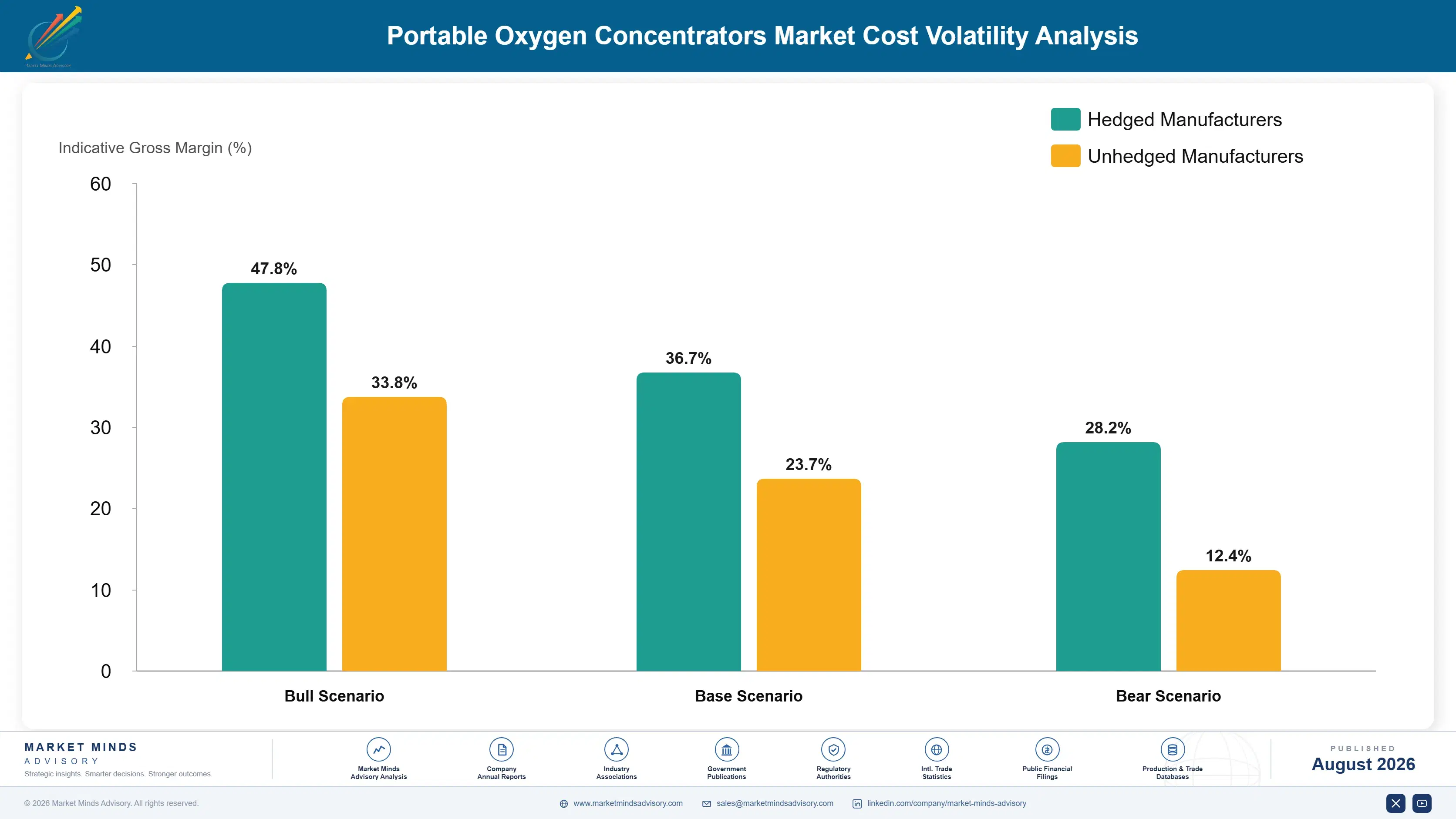
Lithium-ion battery cells and molecular sieve beds together represent roughly 38% of cost of goods sold for a typical portable oxygen concentrator, sourced predominantly from certified battery cell manufacturers concentrated in East Asia and specialized sieve material suppliers in the United States and Western Europe holding proprietary formulation expertise built over many decades of research.
The 2021 to 2022 global battery cell supply constraint, driven by surging electric vehicle and consumer electronics demand, pushed medical-grade lithium-ion cell prices meaningfully higher across most qualified suppliers, with several device makers reporting extended component lead times in company annual reports covering that period. The International Energy Agency's supply chain analysis of that period noted the disproportionate impact on medical device manufacturers competing for battery cell allocation against far larger automotive buyers.

Smaller device makers without long-term battery supply agreements or direct cell manufacturer relationships bear considerably more exposure to allocation constraints than the largest players, who can negotiate volume commitments and secure priority access during shortages. This dynamic reinforces the advantage already held by the leading device makers, since a battery shortage can delay a smaller competitor's production while larger players continue fulfilling orders on schedule and protecting payer relationships.
portable-oxygen-concentrators-market-cost-volatility-analysis-1787308185191

Long-Term Battery Cell Supply Agreements

Larger device makers are moving from spot battery cell purchasing to multi-year supply agreements with certified manufacturers directly, trading some pricing flexibility for supply certainty and predictable input costs across budget planning cycles that stretch several years into the future for major accounts and product lines across most regions served worldwide and every battery grade.

Dual-Sourcing Certified Battery Suppliers

Device makers are increasingly qualifying second certified battery cell suppliers to reduce dependence on any single source, a step that adds qualification cost upfront but meaningfully reduces disruption risk during future allocation shortages tied to automotive demand cycles and consumer electronics competition for the same limited certified cell supply base worldwide each budget year.

In-House Battery Pack Assembly Investment

The largest device makers are investing in in-house battery pack assembly capability to reduce reliance on external assemblers entirely for at least a portion of production volume across their full product range and geography, insulating margin from assembly capacity constraints over a multi-year investment horizon smaller rivals generally cannot fund given tighter capital budgets.

Portfolio Architecture for Margin Defence

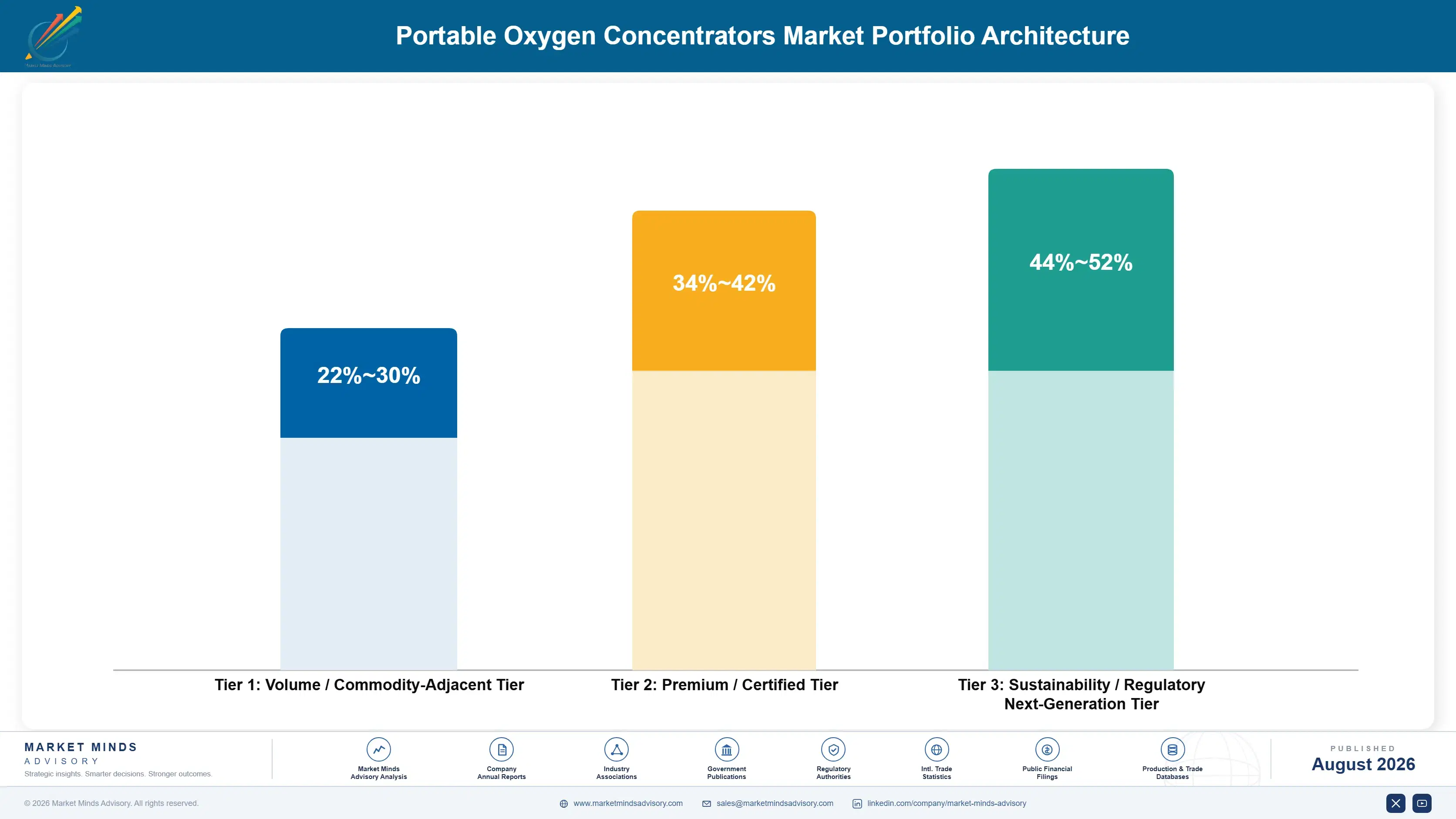
The market organizes into three tiers by connectivity and battery capability, with margin profile widening accordingly across each successive tier. Volume-tier standard pulse-dose concentrators cover the broadest patient base, sold largely through payer reimbursement channels at set device pricing determined by national coverage schedules. Premium-tier connected and extended-battery devices command meaningfully higher prices tied to compliance documentation and mobility performance that patients
Gross margins widen considerably moving up the tiers, since connected and extended-battery formats carry disproportionate pricing power relative to their incremental manufacturing cost, while standard devices compete primarily on reimbursement rate against a growing field of regional manufacturers entering the value tier from multiple geographies. Providers rarely downgrade device sophistication once compliance documentation or mobility benefits have been realized in daily patient care and reporting workflows.

High-value margin pools concentrate in connected devices bundled with monitoring subscription services, where recurring subscription revenue carries substantially wider margin than the underlying device sale that first brought the provider account onto the device maker's platform in the first place. This dynamic is reshaping how device makers prioritize account investment across their commercial and clinical sales organizations.

Volume / Commodity-Adjacent Tier

Standard pulse-dose concentrators sold largely through reimbursement channels at set pricing, competing primarily on device cost against a growing field of regional manufacturers with limited connectivity differentiation between competing bids submitted.
Gross Margin: 22-30%

Premium / Certified Tier

Extended-battery and dual-mode concentrators carrying stronger mobility credentials, commanding meaningfully wider margins than standard formats while requiring greater battery engineering investment and validation effort from suppliers across every product launch and market.
Gross Margin: 34-42%

Sustainability / Regulatory / Next-Generation Tier

Connected smart concentrators bundled with monitoring subscription services, representing the newest category and commanding the highest margins given their compliance documentation and remote oversight advantage over legacy device formats used industry-wide.
Gross Margin: 44-52%
portable-oxygen-concentrators-market-portfolio-architecture-1787308185693

High-value Sub-segments and Strategic Watch-out

Connected Concentrators With Remote Monitoring

Connected concentrators paired with monitoring subscription services combine the category's fastest growth with its widest margins, drawing concentrated device maker investment as payer systems increasingly require this capability across coverage programs worldwide and every major reimbursement category, provider network, and patient segment tracked by MMA analysts.
Gross Margin: 46-54%

Battery-Only Ultra-Lightweight Concentrators

Battery-only ultra-lightweight concentrators deliver strong unit growth on the back of rising patient mobility expectations, though margins sit a tier below fully connected designs, supported by broadening adoption across active-lifestyle patient segments and younger diagnosed patients seeking mobility, independence, and freedom from stationary equipment entirely.
Gross Margin: 36-44%

Standard Pulse-Dose Concentrators

Standard pulse-dose concentrators remain the category's volume backbone across reimbursement-driven purchasing worldwide, competing mainly on payer rate that leaves thin margins and limited room for meaningful feature differentiation across most geographies, patient segments, provider categories, and national reimbursement systems currently tracked closely by MMA analysts.
Gross Margin: 20-28%

Legacy Continuous-Flow-Only Concentrators

Legacy continuous-flow-only concentrators still in active patient use warrant monitoring as connected and battery-only formats continue gaining reimbursement priority, a dynamic that could compress this once-standard installed base faster than smaller providers currently plan for in their own fleet and capital investment strategies over the next several years.
Gross Margin: 18-24%

Reimbursement Cycles and Patient Retention

Device makers generate recurring revenue through reimbursement-linked service and monitoring contracts far more than through any single device sale, since a patient, once qualified and onboarded under a payer's coverage terms, typically remains on that device maker's platform for the full multi-year reimbursement cycle rather than switching providers absent a major service failure or clinical complication requiring intervention or escalation.
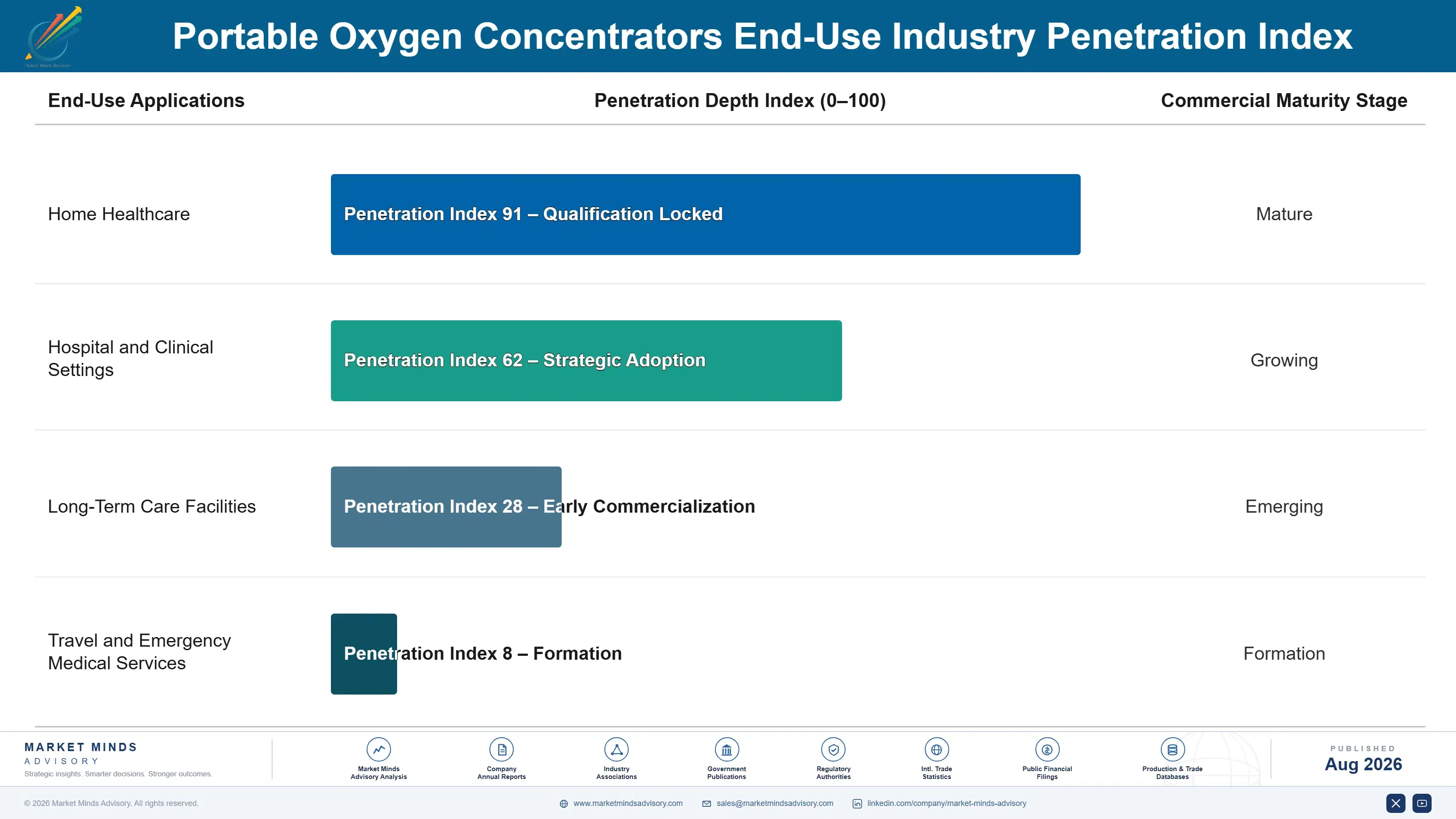
Adoption depth varies considerably by end-use vertical. Large national durable medical equipment providers adopt connected and extended-battery formats fastest and often serve as reference accounts device makers use to influence broader payer specification standards, while smaller regional providers typically wait for reimbursement clarity before committing to full fleet conversion at meaningful volume across their patient networks, referral channels, and payer relationships.

Buyer profiles are shifting generationally as younger respiratory therapists and care coordinators who trained during the connected-health era show far greater comfort specifying connected, data-driven devices than an older cohort that historically defaulted to proven standard formats before considering newer capability at all. This generational shift is accelerating purchasing decisions across organizations where younger staff increasingly hold budget authority and full clinical decision rights.
portable-oxygen-concentrators-market-end-use-penetration-index-1787308186183

Positioning for the Mobility Shift

These are among the four positions where our research anticipates prominent divergence between winners and laggards over the coming forecast period. Each is grounded in the demand model, the regulatory perimeter, and the announced capacity pipeline.
01 / BATTERY RUNTIME STRATEGY

Device makers without extended runtime will lose share to faster movers

Extended-battery devices command meaningfully higher pricing and patient loyalty than standard formats, and device makers without competitive runtime capability risk losing consideration entirely as mobility expectations continue rising across major markets. This gap is widening as more patients cite all-day battery life as their primary device selection driver, and that delay carries real commercial consequence for makers slow to respond with a competitive offering. Companies that close this gap early stand to capture disproportionate share of the fastest-growing segment before rankings solidify further.
02 / CONNECTED MONITORING INVESTMENT

Compliance data platforms will separate reimbursement leaders from the rest

National payer systems increasingly require documented compliance data before approving reimbursement, and device makers with established connected monitoring platforms capture disproportionate share of this higher-margin segment simply by virtue of a shorter payer approval timeline than newer entrants face. Device makers still building this capability increasingly lose consideration to competitors who can demonstrate a proven compliance track record, and that delay carries real commercial consequence as approval timelines stretch further behind schedule. That gap widens with every new documentation requirement payers introduce across major markets.
03 / RENTAL FLEET PARTNERSHIP INVESTMENT

Fleet partnerships will separate durable provider loyalty from one-off sales

Device makers winning rental fleet management partnerships capture the full multi-year replacement pipeline rather than competing unit by unit, and makers without this capability increasingly lose account relationships to competitors who have already built these fleet partnerships across major provider networks. This gap is widening as more national providers seek operational consistency across their patient networks, and delayed investment here carries real commercial cost as competitors lock in multi-year contracts. Companies that build this capability early stand to capture disproportionate long-term provider loyalty.
04 / BATTERY SUPPLY CHAIN DEPTH

Battery supply integration will separate margin leaders from exposed rivals

Certified medical-grade battery cell supply requires manufacturing relationships that few device makers currently possess at scale, and companies with the deepest battery supply investment capture disproportionate order fulfillment share simply by being able to guarantee stable delivery through allocation shortages that disrupt weaker rivals entirely. Device makers still exposed to spot battery purchasing increasingly lose order consideration to competitors who can demonstrate reliable, predictable supply across every account. That exposure gap widens further with every fresh battery allocation shortage that hits the broader supply chain.

Engagement Snapshot From the Field

A live engagement with an industry participant carrying material or product regulatory and market exposure ahead of a defining policy shift, showing how our research translates into a defensible multi-year portfolio strategy.
MARKET MINDS ADVISORY · CLIENT ENGAGEMENT SUMMARY
Portable Oxygen Concentrators Producer Strategic Portfolio Review and Transition Roadmap 2026·Investment Scenario on Portable Oxygen Concentrators Exposure Evaluation 2025-26
CLIENT PROFILE
The client is a regional durable medical equipment provider operating across six states in the southeastern United States, serving approximately 14,000 active oxygen therapy patients with roughly $210 million in annual revenue (client-reported, unverified by MMA). The provider faced rising payer audit scrutiny over compliance documentation across its aging device fleet and existing patient network.
STRATEGIC CHALLENGE
The provider's existing device fleet lacked connected monitoring capability, and leadership needed clear, defensible data on fleet modernization costs and reimbursement impact before committing fresh capital across its full multi-state patient network and its upcoming contract renewal cycle with major regional payers, referral partners, and clinical networks across the region.
MMA APPROACH
MMA benchmarked connected device costs and reimbursement approval rates across three device makers against the provider's current standard-device baseline, incorporating patient-segment volume and phased conversion options across the network. The analysis modeled projected outcomes over a four-year forward planning horizon under two payer audit intensity scenarios developed with the client's compliance team.
KEY FINDINGS
  1. Connected device conversion was projected to reduce payer audit documentation disputes by roughly 40% across the provider's full patient network and referral base.
  2. Approximately 60% of the provider's existing patient base had sufficient remaining device life to defer immediate replacement in favor of a phased approach.
  3. Reimbursement approval rates for connected devices ran meaningfully higher than for standard devices across every payer type evaluated during the analysis phase.
  4. A phased, region-by-region conversion sequenced carefully around contract renewal dates minimized disruption compared to converting the full device fleet all at once.
CLIENT PROFILE
The client is a regional durable medical equipment provider operating across six states in the southeastern United States, serving approximately 14,000 active oxygen therapy patients with roughly $210 million in annual revenue (client-reported, unverified by MMA). The provider faced rising payer audit scrutiny over compliance documentation across its aging device fleet and existing patient network.
STRATEGIC CHALLENGE
The provider's existing device fleet lacked connected monitoring capability, and leadership needed clear, defensible data on fleet modernization costs and reimbursement impact before committing fresh capital across its full multi-state patient network and its upcoming contract renewal cycle with major regional payers, referral partners, and clinical networks across the region.
MMA APPROACH
MMA benchmarked connected device costs and reimbursement approval rates across three device makers against the provider's current standard-device baseline, incorporating patient-segment volume and phased conversion options across the network. The analysis modeled projected outcomes over a four-year forward planning horizon under two payer audit intensity scenarios developed with the client's compliance team.
KEY FINDINGS
  1. Connected device conversion was projected to reduce payer audit documentation disputes by roughly 40% across the provider's full patient network and referral base.
  2. Approximately 60% of the provider's existing patient base had sufficient remaining device life to defer immediate replacement in favor of a phased approach.
  3. Reimbursement approval rates for connected devices ran meaningfully higher than for standard devices across every payer type evaluated during the analysis phase.
  4. A phased, region-by-region conversion sequenced carefully around contract renewal dates minimized disruption compared to converting the full device fleet all at once.
RECOMMENDED STRATEGY
Phase 1: Phase 1 (Months 1-4): Complete a detailed device evaluation and patient-segment conversion prioritization across the full provider network and territory. Phase 2: Phase 2 (Months 5-18): Execute phased conversion starting with the two regions facing the nearest payer contract renewal dates first. Phase 3: Phase 3 (Months 19-30): Complete conversion of remaining regions sequenced carefully around subsequent contract renewal and audit review cycles ahead.
OUTCOME
The provider selected a phased connected-device conversion strategy across its full network, prioritizing the two regions facing the nearest contract renewals first. Projected annual compliance-related cost avoidance reached approximately $3.4 million (client-reported, unverified by MMA) against the prior standard-device baseline across the provider's full network and patient base.

Frequently Asked Questions

Foundational context covering the market sizes, CAGR, scope, country, region and competition that inform every finding below. This section is provided to cover basics and most often pre-purchase conversations, answered from the MMA Primary Research Dataset.

What is the current size of the Portable Oxygen Concentrators Market?

The Portable Oxygen Concentrators Market was valued at approximately $3.2 billion globally in 2025. This includes pulse-dose, continuous-flow, dual-mode, battery-only, and connected device formats sold worldwide.

How large will the Portable Oxygen Concentrators Market be by 2036?

The market is projected to reach approximately $7.9 billion by 2036, roughly 2.26 times its 2026 value. Growth is driven by rising COPD prevalence and battery technology advances.

What is the CAGR for the Portable Oxygen Concentrators Market 2026 to 2036?

The base case CAGR is 8.5% annually, with a bull case of 9.8% and a bear case of 7.2%. This reflects steady demand growth alongside accelerating connected-device adoption.

Which segment is growing fastest?

Battery-only ultra-lightweight concentrators are the fastest-growing segment, expanding at roughly 13.0% annually through 2036. Rising patient demand for genuine all-day mobility is driving this shift.

Who are the major companies in the Portable Oxygen Concentrators Market?

Leading companies include ResMed, Inogen, Philips, Invacare, and Drive DeVilbiss Healthcare. Together these five leading device makers hold roughly 56 percent of global market revenue.

Which country is growing fastest?

India is the fastest-growing country, expanding at roughly 10.5% annually through 2036. This reflects rapidly expanding healthcare infrastructure and rising respiratory disease diagnosis rates nationwide.

Report Segmentation Architecture

The full report scope spans multiple orthogonal segmentation dimensions, with cross-tabulated demand data provided for each dimension pair. Coverage extends further to regional breakdowns, trend trajectories, and the competitive detail needed to support segment-level decision-making.

By Device Technology and Flow Mode

  • Pulse-Dose Concentrators
  • Continuous-Flow Concentrators
  • Dual-Mode Concentrators
  • Battery-Only Ultra-Lightweight Concentrators
  • Connected Smart Concentrators
  • Rental and Subscription-Model Concentrators

By End-Use Industry

  • Home Healthcare
  • Hospital and Clinical Settings
  • Long-Term Care Facilities
  • Travel and Emergency Medical Services

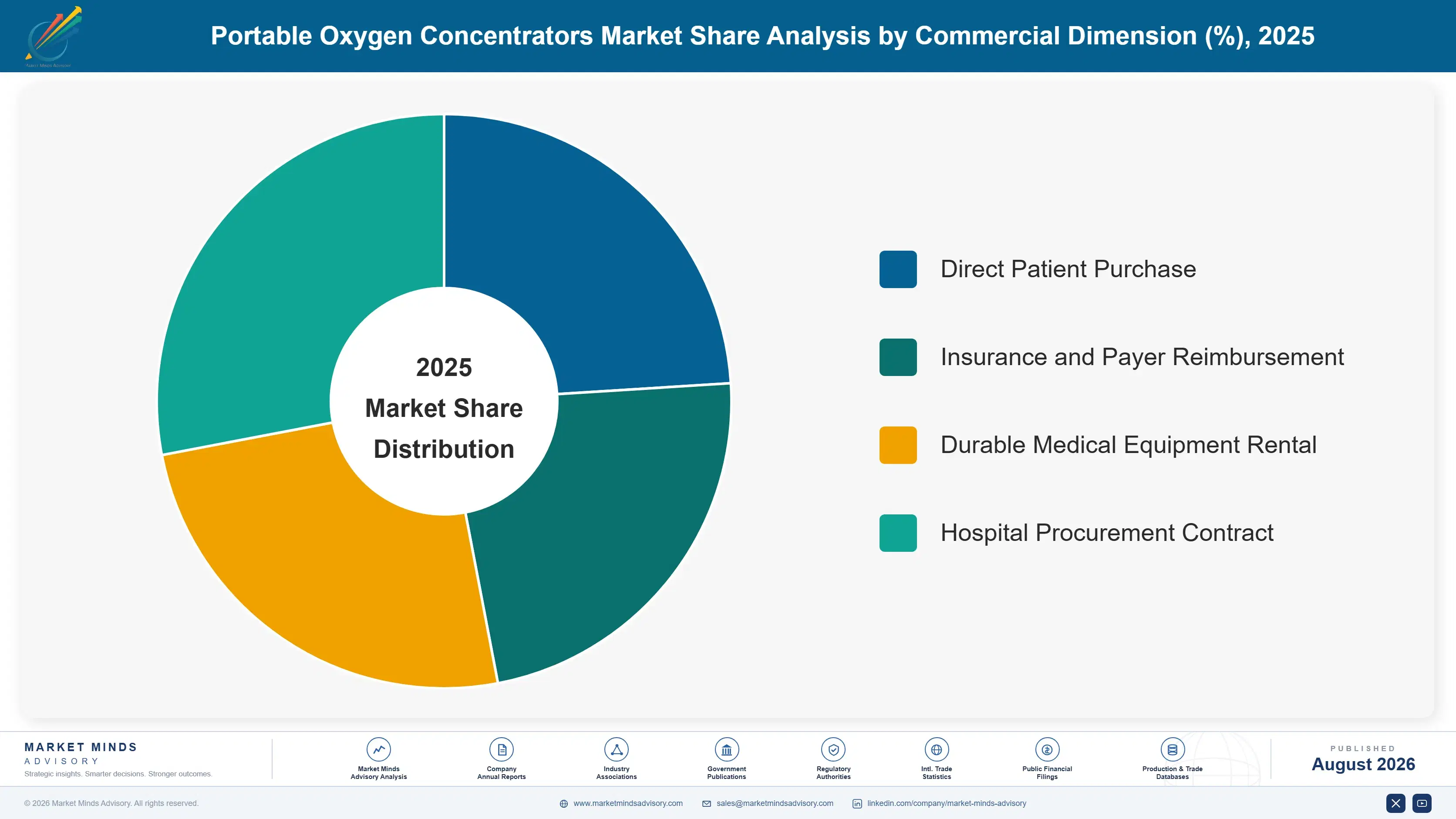
By Commercial Dimension

  • Direct Patient Purchase
  • Insurance and Payer Reimbursement
  • Durable Medical Equipment Rental
  • Hospital Procurement Contract

By Region

  • North America
  • Western Europe
  • East Asia
  • South Asia and Pacific
  • Latin America
  • Middle East and Africa
  • Eastern Europe

Scope, Methodology, and Coverage

Every figure in this report is reproducible from documented input assumptions. The scope below maps the historical period, the forecast horizon, the segmentation dimensions, and the countries covered, alongside the underlying primary and qualitative methodology.
Historical Period
2020 to 2025
Forecast Period
2026 to 2036
Base Year
2025 (USD billions; MMA Primary Research Dataset, August 2026)
Market Definition
The Portable Oxygen Concentrators Market covers battery-powered medical devices that filter ambient air to deliver concentrated oxygen therapy to patients outside a clinical setting, including pulse-dose, continuous-flow, and dual-mode formats. It excludes stationary home oxygen concentrators, liquid oxygen systems, and compressed gas cylinders sold as separate device categories.
Quantitative Units
USD billions (current prices); unit shipment volume where applicable
Segmentation Dimensions
By Device Technology and Flow Mode; By End-Use Industry; By Commercial Dimension; By Region
Regions Covered
North America, Western Europe, East Asia, South Asia and Pacific, Latin America, Middle East and Africa, Eastern Europe
Countries Covered
USA, China, Germany, France, UK, Japan, South Korea, India, Australia, Canada, Brazil, Mexico, Indonesia, Vietnam, Thailand, Malaysia, UAE, Saudi Arabia, South Africa, Nigeria, Turkey, Poland, Netherlands, Italy, Spain, Sweden, Switzerland, Argentina, Colombia, Singapore, and additional markets relevant to this sector
Key Companies Profiled
ResMed Inc, Inogen Inc, Koninklijke Philips NV, Invacare Corporation, Drive DeVilbiss Healthcare, Chart Industries Inc, O2 Concepts LLC, Precision Medical Inc, GCE Group, Nidek Medical Products Inc, Yuwell Medical Equipment and Supply Co Ltd, Beijing Aeonmed Co Ltd, Longfian Scitech Co Ltd, Shenzhen Creative Industry Co Ltd, Foshan Kaiyuan Medical Equipment Co Ltd, Zhengzhou Olive Electronic Technology Co Ltd, OxyGo LLC, Teijin Pharma Limited, Inova Labs Inc, AirSep Corporation
Quantitative Methodology
Primary survey, n=3,800 respondents, Q4 2025, six countries; demand-side model with trade association cross-validation
Qualitative Methodology
47 expert interviews, Q4 2025; applied to validate demand model assumptions, identify emerging dynamics, and assess competitive positioning
Report Format
PDF and XLSX data workbook (Word format preview document)
Publisher
Market Minds Advisory
Report Code
MMA-2026-MED-151
Published
August 2026
Contact
sales@marketmindsadvisory.com | www.marketmindsadvisory.com

Purchase the full Portable Oxygen Concentrators Market Report (2026 to 2036).

The full report delivers detailed segmentation across all six device technology and flow mode categories, with country-level sizing for all thirty-one covered markets. It profiles the complete competitive landscape of all twenty companies named in this summary, including moat and risk analysis for the two leading device makers. Multi-year forecast models are provided under base, bull, and bear scenarios. Primary survey data drawn from durable medical equipment providers, respiratory therapists, and device maker representatives across six countries supports every major finding, and purchasers receive editable data files alongside the formatted report.
Reimbursement policy tracker by country and payer type
Battery runtime and weight benchmark comparison model
Connected monitoring compliance requirement tracker updated
Battery cell pricing comparison updated quarterly
Device maker production capacity database by region
Competitive benchmarking across key device manufacturers

Built For The People Who Decide

From boardroom strategy to bench-side execution, this report is read cover-to-cover by leaders shaping the next decade of their industry, turning demand scenarios, market dynamics and valuation benchmarks into decisions.
CXOs/ Presidents/ VPs/ Managers
M&A and Corporate Development
Strategy Teams and R&D Heads
Procurement and Product Directors
Regulatory and Compliance Leaders
Investor Relations and Equity Analysts