Market Minds Advisory
Portable Monitor Market

Portable Monitor Market: Portable Monitor Market. USB-C Powered and OLED Secondary Display Solutions Through 2036

Hybrid work adoption and mobile content creation are pushing portable monitor demand toward USB-C single cable designs and OLED panels, while direct-to-consumer brands compete against established laptop makers for shelf space and buyer trust.

Lead Analyst

Published

September 2026

Make Smarter Decisions with Customized Research Insights

Request a free sample report and evaluate market opportunities, growth trends, and competitive dynamics relevant to your business needs.

2025 MARKET VALUE$2.1BMarket Size 2025
2036 FORECAST VALUE$5.7BBase Case , 2026 to 2036
CAGR 2026 TO 20369.5 %Bull 10.8% / Bear 8.2%
INCREMENTAL OPPORTUNITY$3.4BNet 10- year value creation
EXPANSION MULTIPLE2.48x2036 value over 2026 base
Strategic Levers
M&A Pipeline
Regional Outlook
Country Rankings
Competitive Intelligence
Segmental Deep-dive
Call-Us : 91 93563 13602

Executive Snapshot and Market Trajectory.

Hybrid work adoption is pushing portable monitor demand well beyond its original travel-accessory niche, as USB-C single cable designs let workers quickly add a second screen to any laptop in seconds without extra cables, adapters, or a dedicated power brick required, right at the desk.
OLED and touchscreen portable monitors are capturing disproportionate revenue growth as buyers pay a meaningful premium for color accuracy and responsiveness, while North America and East Asia together drive the large majority of unit demand worldwide today. Content creators, gamers, and hybrid office workers now represent the three largest buyer segments, each with distinct feature priorities that manufacturers increasingly design entirely separate product lines to address specifically across every major retail channel.
Competition splits between scaled laptop brands extending their platforms with matching portable displays, and a crowded field of direct-to-consumer Chinese manufacturers competing almost entirely on price and specification sheets. Falling OLED panel costs and expanding USB-C Power Delivery adoption across laptops are reshaping which product tiers can compete profitably, squeezing out brands that cannot match either premium build quality or rock-bottom pricing on comparable specifications sold online today.
Market Definition
The portable monitor market covers standalone external displays designed for mobility, including USB-C powered, battery-integrated, and touchscreen models used to extend or mirror a laptop, tablet, or smartphone screen away from a fixed desk setup. It excludes built-in laptop displays, fixed desktop monitors, and projector-based display solutions.
Base Year Value
$2.1B in 2025 (MMA Primary Research Dataset, September 2026)
Forecast Period
2026 to 2036, eleven discrete annual values
CAGR
9.5% base case. Bull 10.8%. Bear 8.2%.
Fastest Growth Segment
OLED Portable Monitors: 14.0% CAGR
Fastest Growth Country
South Korea: 12.0% CAGR
Fastest Growth Region
South Asia and Pacific: 11.5% CAGR
Largest Region
North America: 30% of 2025 global value
Market Leaders
[object Object]
Primary Survey
n=3,800 procurement and R&D decision-makers, Q4 2025, six countries
Methodology
Demand-side build-up, cross-validated against public data, 47 expert interviews

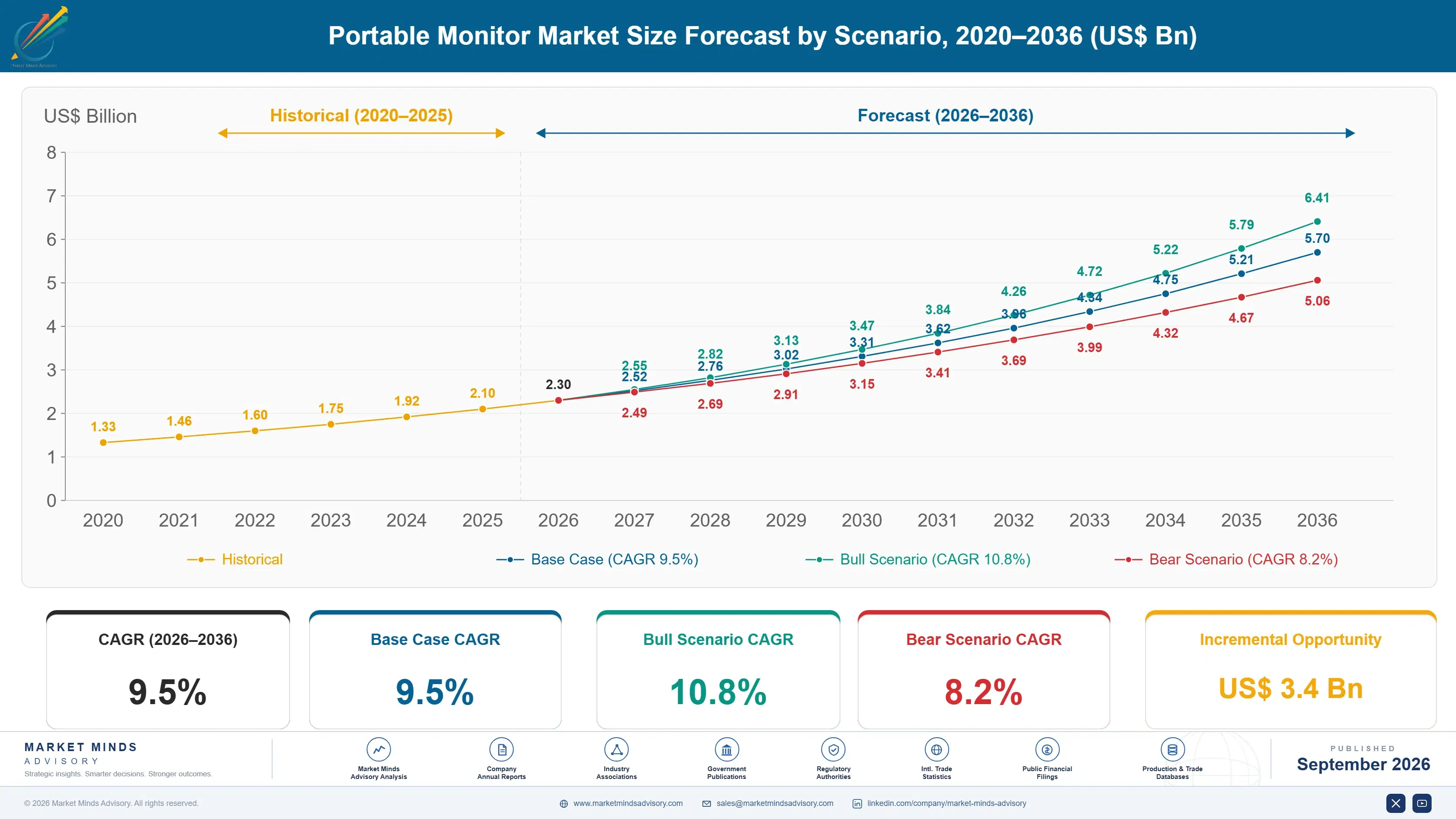
Portable Monitor Market Forecast Scenarios

portable-monitor-market-size-forecast-scenario-1790006190185
Between 2020 and 2025 the category grew from a niche travel accessory into a mainstream computing peripheral, as remote work adoption during the pandemic introduced millions of buyers to the concept of a second screen that folds neatly into a laptop bag. Historical annual growth ran near eight and a half percent as USB-C adoption spread across nearly every laptop model sold.
The base case assumes nine and a half percent annual growth through 2036, driven by three mechanisms: falling OLED panel costs expanding premium tier accessibility to mainstream buyers everywhere, rising hybrid work adoption sustaining a permanent second-screen buying habit across corporate and freelance workforces alike worldwide, and expanding gaming and content creation use cases that demand much higher refresh rates and color accuracy than earlier generations ever offered at comparable price points to consumers.
A bull scenario centers on OLED and touchscreen models becoming the default expectation across every price tier faster than currently expected, lifting average selling prices industry-wide across nearly every region tracked. The bear risk is commoditization among low-cost Chinese direct-to-consumer brands compressing margins faster than unit volume growth can offset across the category, squeezing out mid-tier competitors entirely within a few years.

USB-C and OLED Standards Reshape Portable Display Economics

Panel and driver board costs set the floor for portable monitor economics, since these two components together typically represent more than half of finished product cost across nearly every price tier manufactured today. Aluminum or plastic housing, protective smart covers, and packaging make up most of the remaining cost base for a typical unit sold through online retail channels worldwide.
MARKET CONCENTRATIONCR5 35%Top five brands hold a moderate combined market presence
AVERAGE SELLING PRICE+7% YoYPrices climb steadily as OLED adoption expands broadly
TOP PRODUCING COUNTRYChina 62%One country supplies most global unit assembly volume
CAPACITY UTILISATION74%Panel assembly lines run below theoretical maximum output
TRADE INTENSITYHighMost finished units cross a border before reaching buyers
PANEL COST SHARE55% of COGSDisplay panels remain the single largest cost driver
Brand differentiation increasingly hinges on stand design, kickstand durability, and bundled accessories rather than raw resolution specifications alone. Buyers comparing similarly priced units now weigh build quality and port selection as heavily as panel type, narrowing the room for undifferentiated commodity entrants competing purely on price. Warranty length and customer support have also become meaningful differentiators as buyers increasingly research detailed reviews and comparison videos before purchasing online.
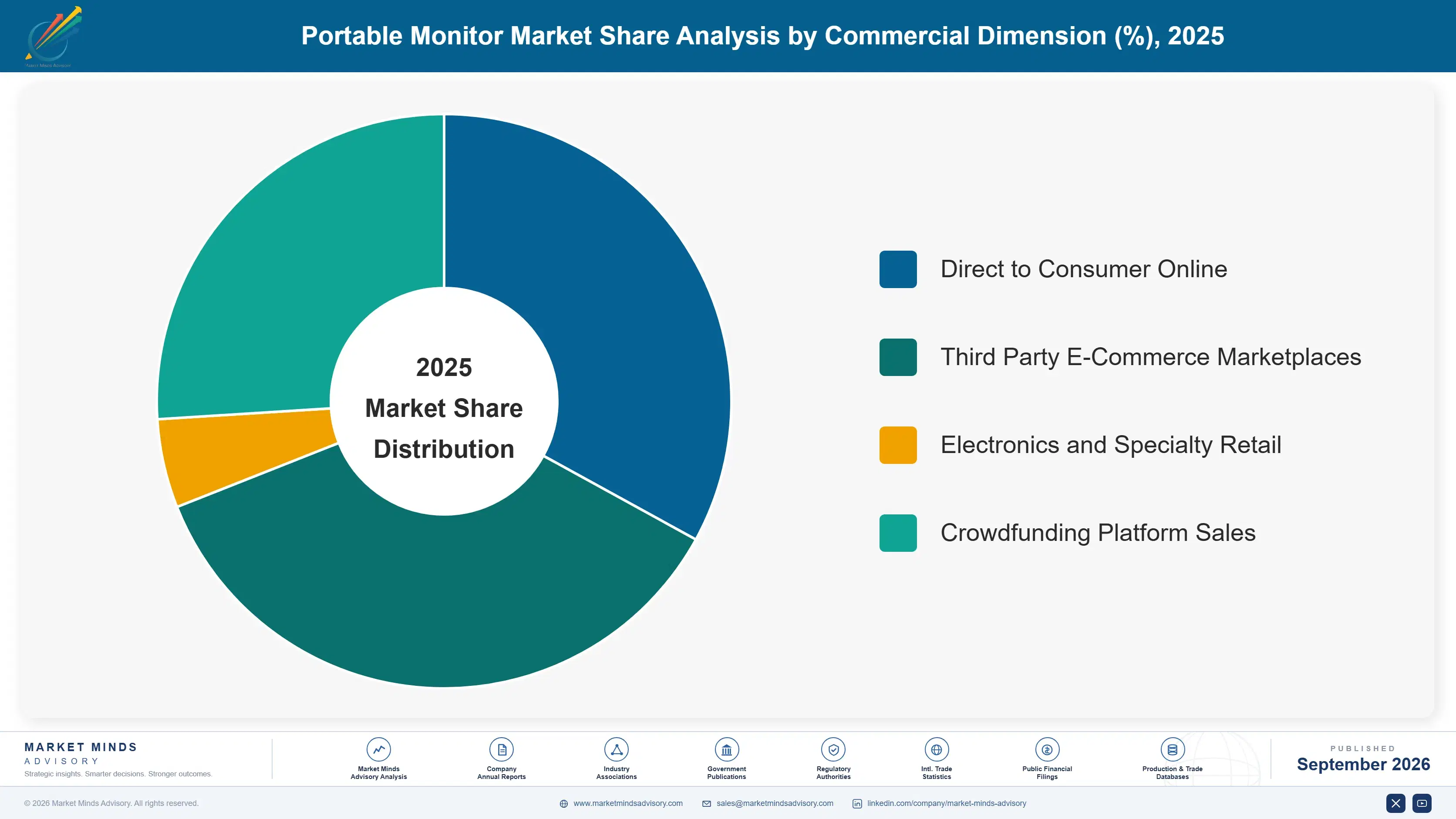
Direct-to-consumer online sales dominate this category far more than most computing peripherals, since buyers rarely need in-person demonstrations before purchasing and crowdfunding platforms remain a common launch channel for newer brands entering the market each year. That dynamic keeps customer acquisition costs central to profitability across nearly every competitor in the space, particularly smaller brands without established retail distribution relationships in place.
"Panel quality, not marketing spend, is quietly deciding which portable monitor brands survive the next price war. The vendors treating OLED certification as a checkbox exercise will find their margins gone within two product cycles."
Principal Analyst, Portable Display and Computing Peripherals Practice · MMA Technology: Portable Display and Computing Peripherals Practice · September 2026

Market Trends

USB-C Power Delivery Standardization Simplifies Portable Monitor Setup

USB-C Power Delivery support has become the default expectation across nearly every portable monitor sold today, letting a single cable simultaneously carry video signal and power between a laptop and the external display without a separate charger required. This single-cable simplicity has removed the biggest early adoption barrier for casual buyers who previously found multi-cable setups confusing and inconvenient to carry while traveling for business or leisure. Retailers increasingly list single-cable compatibility prominently in product titles, and brands lacking full Power Delivery support are losing search visibility to competitors that qualified their designs early on.
Market Impact: Sustains 280 million hybrid workers
OLED Panel Costs Fall Sharply Enabling Wider Adoption

OLED panel manufacturing costs have declined substantially as production scales up across South Korean and Chinese display fabs, letting portable monitor brands introduce OLED models at price points that were previously reserved for premium desktop displays alone. Buyers increasingly expect deep blacks and vibrant color accuracy even in compact secondary displays, particularly among content creators editing photos and video footage while traveling for freelance client work assignments abroad. Manufacturers that qualified OLED supply relationships early are capturing outsized share of this rapidly growing premium tier as demand continues to accelerate across nearly every region tracked.
Market Impact: Adds 50 million creator economy participants

Market Opportunities and Growth Drivers

Hybrid Work Adoption Sustains Strong Second Screen Demand

Hybrid and remote work arrangements have normalized the expectation of a multi-monitor setup even outside a traditional office, driving sustained demand for portable displays that fold into a bag between home, office, and coworking space visits throughout a typical work week. Employers increasingly reimburse portable monitor purchases as part of home office equipment stipends, treating them as standard productivity tools rather than optional accessories reserved for senior executives alone. Surveys consistently show multi-monitor setups improve reported productivity meaningfully, reinforcing purchase justification even among cost-conscious buyers evaluating the expense against measurable output gains achieved over time.
Market Impact: Overstates brightness ratings by 40 percent

Content Creator Economy Expands Secondary Display Demand Rapidly

The growing population of independent content creators, streamers, and freelance video editors increasingly relies on portable monitors to preview footage, monitor camera feeds, or extend workspace while filming on location away from a fixed studio setup entirely. Higher refresh rate and color-accurate models command meaningful premiums within this buyer segment, since color grading and live streaming both depend on accurate, responsive displays under variable lighting conditions found on set. Equipment sponsorship and creator marketing partnerships have become an increasingly important customer acquisition channel for brands targeting this fast-growing segment specifically across every major streaming platform.
Market Impact: Adds 15 dollars battery compliance cost

Market Restraints and Challenges

Counterfeit and Gray Market Listings Undermine Brand Trust

A persistent share of portable monitors sold through third-party online marketplaces misrepresent panel specifications, brightness ratings, or refresh rates, sometimes substantially overstating actual performance compared to what buyers ultimately receive. The root cause is minimal enforcement of listing accuracy across major e-commerce platforms, which rarely verify seller specification claims before allowing products to go live for sale. The commercial impact falls hardest on legitimate brands, whose accurately specified products appear overpriced next to inflated competitor listings. Several marketplaces have begun requiring third-party lab verification before approving new listings as a mitigation measure.
Market Impact: Enables 100 watt single cable setup

Battery Integration Raises Cost and Safety Compliance Complexity

Battery-integrated portable monitors add meaningful bill of materials cost and introduce lithium battery safety and shipping compliance requirements that non-battery models avoid entirely. The root cause is buyer demand for cable-free operation colliding with the practical challenge of packing a display, driver board, and battery into an already thin enclosure without overheating. The commercial impact falls hardest on smaller brands lacking the safety certification budget and testing infrastructure that larger competitors can spread across bigger production volumes. Several manufacturers are now partnering with certified battery pack suppliers to reduce this compliance burden going forward.
Market Impact: Cuts OLED panel costs 30 percent
3 additional market trends, 4 additional growth drivers, and 2 additional restraints and challenges are covered in the full report. Contact sales@marketmindsadvisory.com to access the complete intelligence.

Segment CAGR and Growth Architecture

Portable monitors segment cleanly by panel and power technology, spanning standard IPS panels through premium OLED and battery-integrated designs. Each tier serves a distinct buyer occasion, from budget travel use to professional content creation, with price and feature depth scaling together across the full range of products sold worldwide today across every major retail and online channel.
portable-monitor-market-market-share-analysis-1790006190720

OLED Portable Monitors

OLED portable monitors use organic light-emitting diode panels to deliver true blacks, wider color gamuts, and faster pixel response than conventional IPS alternatives, commanding a substantial price premium among content creators and gamers who value color accuracy and motion clarity above all else. Demand concentrates heavily in North America, East Asia, and Western Europe, where disposable income supports premium accessory purchases across every major retail channel. Manufacturers have moved toward thinner, lighter OLED enclosures as panel costs decline, gradually expanding accessibility beyond the earliest premium adopters toward a broader base of enthusiast buyers willing to pay more for visibly better picture quality on the go, wherever they happen to be working.
CAGR 14.0%

Battery-Integrated Portable Monitors

Battery-integrated portable monitors include a built-in rechargeable battery, letting the display run independently of a laptop power source for several hours, a feature particularly valued by outdoor content creators, campers, and buyers wanting a secondary screen during flights without draining laptop battery life unnecessarily during travel. This segment carries meaningful bill of materials premiums over non-battery designs but commands correspondingly higher retail prices that partially offset the added component and certification cost involved in bringing such a unit to market. Growth here tracks closely with expanding outdoor content creation and van-life lifestyle trends gaining visibility across social media platforms worldwide, particularly among younger digital nomad buyers seeking full mobility and independence.
CAGR 11.5%
Full segment breakdown across 6 segments available in the complete report.

Regional Architecture and Country Demand Map

Regional demand tracks hybrid work adoption, disposable income, and content creator density, with North America leading on remote work culture and East Asia close behind on manufacturing proximity and domestic gaming enthusiast demand across nearly every major market segment and product category this full study actually tracks.

North America

Hybrid work culture anchors North American demand, where corporate reimbursement programs and a large freelance workforce both drive steady purchase volume across nearly every price tier sold today. Content creator and streaming communities concentrated in major US cities represent an outsized share of premium OLED unit sales relative to the broader population overall. Direct-to-consumer brands originally launched through crowdfunding campaigns have built substantial market share here, competing directly against established laptop makers entering the category with matching accessory lines of their own design. Retailers report portable monitors increasingly bundled with laptop accessory kits targeting new remote hires during onboarding season each year, a trend expected to continue growing steadily across nearly every major metropolitan market and suburb alike.
Share: 30% | CAGR: 9.8% (2026 to 2036)

Western Europe

Design-conscious buyers across Germany, the UK, and France favor premium OLED and touchscreen models over budget alternatives, supporting healthier average selling prices than most other regions achieve. Strict product safety and battery certification requirements across the European Union have pushed several smaller Chinese brands to exit the market rather than pursue costly compliance testing, concentrating share among established players with existing certification infrastructure already firmly in place. Remote work adoption trails North America somewhat but continues climbing steadily as more companies formalize hybrid policies across the entire bloc region overall. Sustainability labeling and repairability scoring requirements are beginning to influence packaging and product design choices among premium brands operating here, well ahead of stricter rules taking effect soon.
Share: 22% | CAGR: 8.0% (2026 to 2036)
Regional intelligence for 5 additional markets available in the complete report: East Asia, South Asia and Pacific, Latin America, Middle East and Africa, Eastern Europe. Contact sales@marketmindsadvisory.com.
portable-monitor-market-country-cagr-analysis-1790006191262

Monetizing Panel Quality and Accessory Bundling

Portable monitor margins increasingly depend on premium panel differentiation and bundled accessory attachment rather than raw specification competition. Brands that build repeat purchase relationships and premium accessory portfolios around a core display capture disproportionate lifetime value from every single customer relationship they manage to establish and carefully sustain over many future repeat purchase cycles ahead.

OLED Premium Tier Positioning Growth Strategy

Introducing OLED variants alongside standard IPS models lets brands capture a substantially higher average selling price from buyers willing to pay for color accuracy and contrast, often 40 to 60 percent above comparable IPS specifications sold at retail. This tiered approach also protects margin during price wars in the commodity segment, since premium buyers rarely comparison shop purely on price alone. Brands that introduced OLED tiers early report meaningfully stronger brand loyalty and repeat purchase rates than commodity-only competitors still relying on IPS panels exclusively across their full product lineup.
Market Impact: Commands a 50 percent premium over IPS models

Bundled Accessory and Case Attachment Sales

Selling protective cases, stands, and stylus accessories alongside the core monitor meaningfully lifts average order value without requiring additional core product development investment from the brand itself. Attachment rates for premium cases and stands can exceed 30 percent of unit sales when bundled at checkout with a modest discount versus standalone purchase pricing. Brands with strong accessory lineups also see higher customer satisfaction scores, since properly protected units suffer noticeably fewer shipping damage returns and associated support costs across the full multi-year warranty coverage period each brand ultimately offers customers.
Market Impact: Lifts average customer order value by 25 percent overall

Direct To Consumer Subscription Replacement Programs

A small but growing set of brands now offer subscription-style upgrade programs, shipping a newer model every 24 months as panel technology improves, billed as a recurring annual fee rather than a one-time purchase at checkout. Early adopters report retention rates meaningfully above one-time purchase customers, since the recurring relationship keeps the brand top of mind ahead of the next upgrade decision each cycle. This model remains a minority of total revenue today but is expanding fastest among corporate bulk buyers issuing devices to distributed remote teams across multiple offices.
Market Impact: Generates recurring revenue every 24 months from subscribers

Who Controls the Margin Pool

Concentration is moderate, with the top five brands by annual shipment volume holding roughly 35 percent combined share of a fragmented direct-to-consumer heavy category overall today. ASUS leads by a meaningful margin over the next closest challenger, built on established laptop platform cross-selling and broad retail distribution that smaller pure-play brands struggle to match at comparable scale, marketing budget, and overall brand recognition.
Current competitive activity centers on OLED tier expansion, bundled accessory attachment, and crowdfunding-driven product launches from newer entrants seeking early market visibility and buyer trust. Established laptop brands continue expanding matching accessory lines to capture cross-sell revenue from existing customers, while direct-to-consumer Chinese manufacturers compete on price and rapid feature iteration through online marketplaces and targeted social media advertising channels reaching younger buyers most directly.

Emerging pressure comes from smaller Chinese brands scaling aggressively through crowdfunding and social media marketing, threatening to squeeze mid-tier Western challengers out of the value segment entirely within just a few short years ahead. Rankings could shift meaningfully if any top-five player secures a dominant retail exclusivity deal in North America or successfully launches a genuine major breakthrough OLED product line first.
portable-monitor-market-company-positioning-matrix-1790006191785

Competitive Moat and Risk Dimensions

ASUS

Moat: Laptop platform cross-selling advantage

ASUS sells portable monitors as a natural extension of its established laptop and gaming hardware lineup, letting it cross-promote accessories to an existing customer base at low incremental marketing cost. That built-in distribution advantage and existing brand trust is difficult for standalone portable monitor brands to match without years of comparable retail relationship building.
ASUS

Risk: Slower iteration than niche specialists

ASUS moves more slowly on niche feature iteration than smaller specialist brands solely focused on portable displays, since portable monitors represent a small fraction of its overall product portfolio and engineering attention. If nimble competitors continue capturing enthusiast mindshare through faster feature releases, ASUS could lose share in the fastest-growing premium tiers.
MOBILE PIXELS

Moat: Direct to consumer crowdfunding pipeline

Mobile Pixels built its brand through successful crowdfunding campaigns that generated early buyer enthusiasm and product validation before committing to mass production runs. That direct-to-consumer playbook lets it iterate faster and maintain healthier margins than brands relying on traditional retail distribution and wholesale markup structures.
MOBILE PIXELS

Risk: Limited retail shelf presence

Mobile Pixels lacks the broad physical retail shelf presence that established laptop brands command, limiting its visibility among buyers who prefer to see and touch a product before purchasing. If larger competitors successfully replicate its crowdfunding playbook while also exploiting existing retail relationships, Mobile Pixels could struggle to defend its current market position.

Players Tracked

Prominent Players

ASUS
Lenovo
ViewSonic
AOC
Dell Technologies

Other Key Players

Mobile Pixels
UPERFECT
Arzopa
Gechic
Lepow
Cocopar
InnoView
Kensington (ACCO Brands)
Eyoyo
ZSCMALLS
GAEMS
Espresso Displays
Acer
MSI
Samsung Electronics

Recent Developments

MARCH 2026

ASUS: product launch

ASUS launched a new OLED portable monitor line targeting content creators and gamers, featuring faster refresh rates and improved color calibration than its prior generation models. The launch follows growing demand for premium secondary displays among ASUS laptop owners seeking a matching accessory lineup for mobile productivity.
Signal: Signals established laptop brands doubling down heavily on premium display accessory lineups strategically going forward now
JUNE 2026

Mobile Pixels: funding round

Mobile Pixels raised a new funding round to expand manufacturing capacity for its triple-display laptop attachment products, responding to sustained demand exceeding available inventory across multiple recent product launches this year. The investment will fund expanded production lines and new product development efforts going forward.
Signal: Signals strong investor confidence in direct-to-consumer portable display brands continuing to grow steadily worldwide each year
SEPTEMBER 2026

AOC: acquisition

AOC, through parent company TPV Technology, acquired a smaller portable monitor startup to gain rapid access to battery-integrated display technology and associated patents held by the acquired target firm. The deal accelerates AOC entry into the fastest-growing battery-powered segment without years of internal development work.
Signal: Signals established display makers acquiring smaller startups quickly for rapid new technology access strategically each year

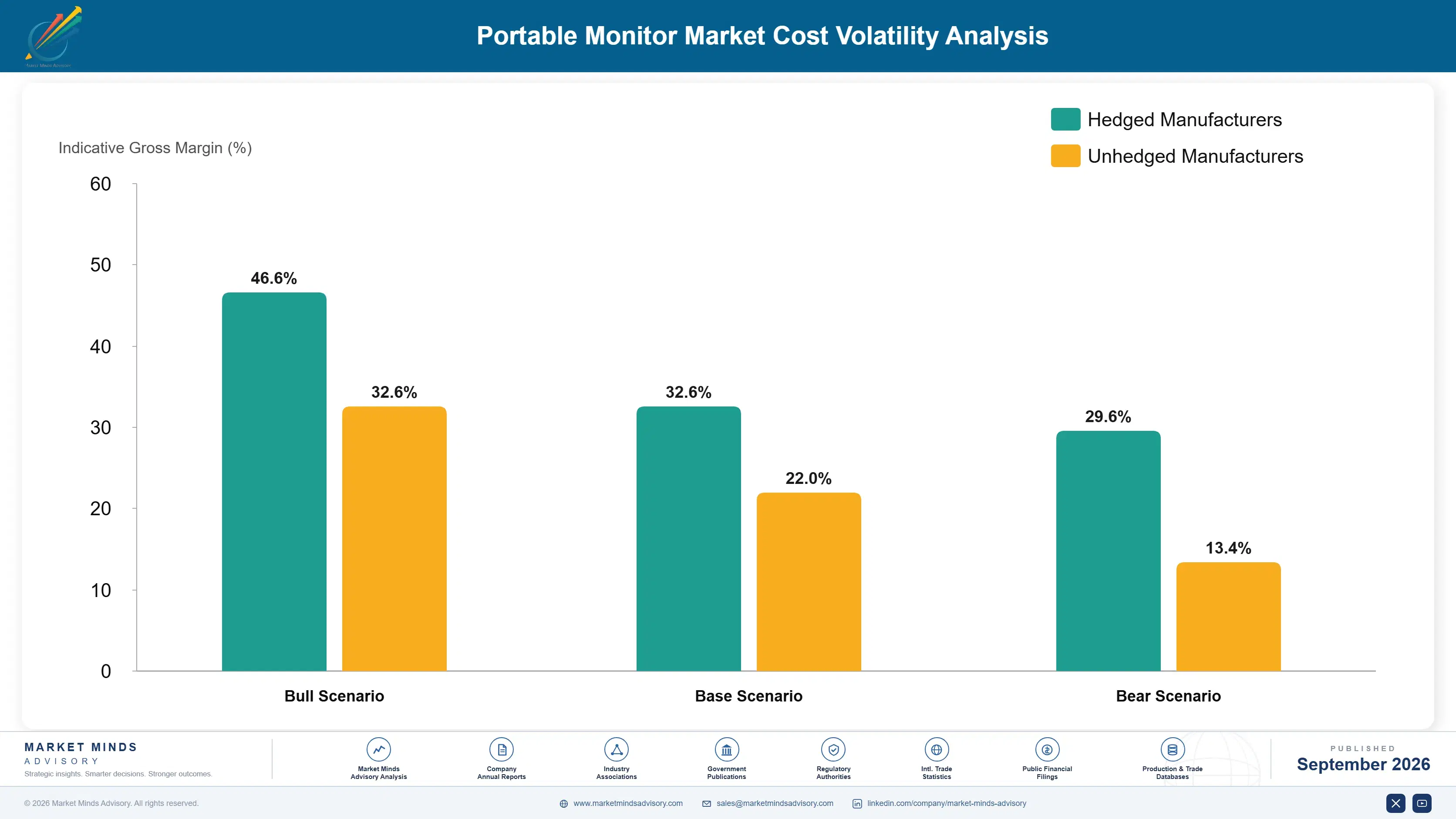
Panel and Driver Board Cost Exposure

LCD or OLED panel and driver board assemblies together represent more than half of finished product cost, sourced predominantly from Chinese, South Korean, and Taiwanese display panel manufacturers who supply the vast majority of global portable monitor demand today. Plastic or aluminum housing, protective covers, and retail packaging make up most of the remaining cost base for a typical unit.
OLED panel prices swung meaningfully between 2023 and 2025, according to LG Display Annual Report 2024, as smartphone and television panel demand competed with portable monitor makers for limited fabrication capacity across the same shared production lines and facilities worldwide today. Smaller brands without long-term panel supply agreements faced cost increases exceeding 20 percent within a single procurement cycle, forcing several to delay new product launches until pricing eventually stabilized.

Scaled brands with direct panel manufacturer relationships absorbed that volatility with far less retail price disruption than smaller competitors buying through intermediary distributors at marked-up prices. This exposure gap compounds further since Chinese-headquartered assemblers sit much closer to panel suppliers than Western brands, shortening lead times and reducing currency conversion risk on every single purchase order placed with suppliers directly each time around.
portable-monitor-market-cost-volatility-analysis-1790006191981

Multi Year Fixed Price Panel Supply Contracts

Locking in panel prices through multi-year supply agreements with major display manufacturers shields larger brands from spot market volatility, though it requires forecasting volume commitments years in advance and carries meaningful penalty exposure if actual demand falls well short of contracted minimums during an unexpected industry downturn or unforeseen sudden slowdown in consumer spending.

Alternative Panel Technology Qualification Programs

Several brands are qualifying mini-LED backlit LCD panels as a hedge against OLED price swings, even though this technology currently delivers less contrast than true OLED alternatives available today. Early qualification work positions those brands to shift sourcing quickly if OLED costs spike again unexpectedly across the wider global supply chain network in future years.

Regional Assembly Diversification Beyond China

Shifting final assembly to Vietnam and India reduces single-country tariff and supply disruption exposure, though panel sourcing for the display itself still traces back to the same concentrated East Asian suppliers regardless of where final assembly physically takes place across the much wider global supply network overall, year after year without any exception whatsoever.

Portfolio Architecture for Margin Defence

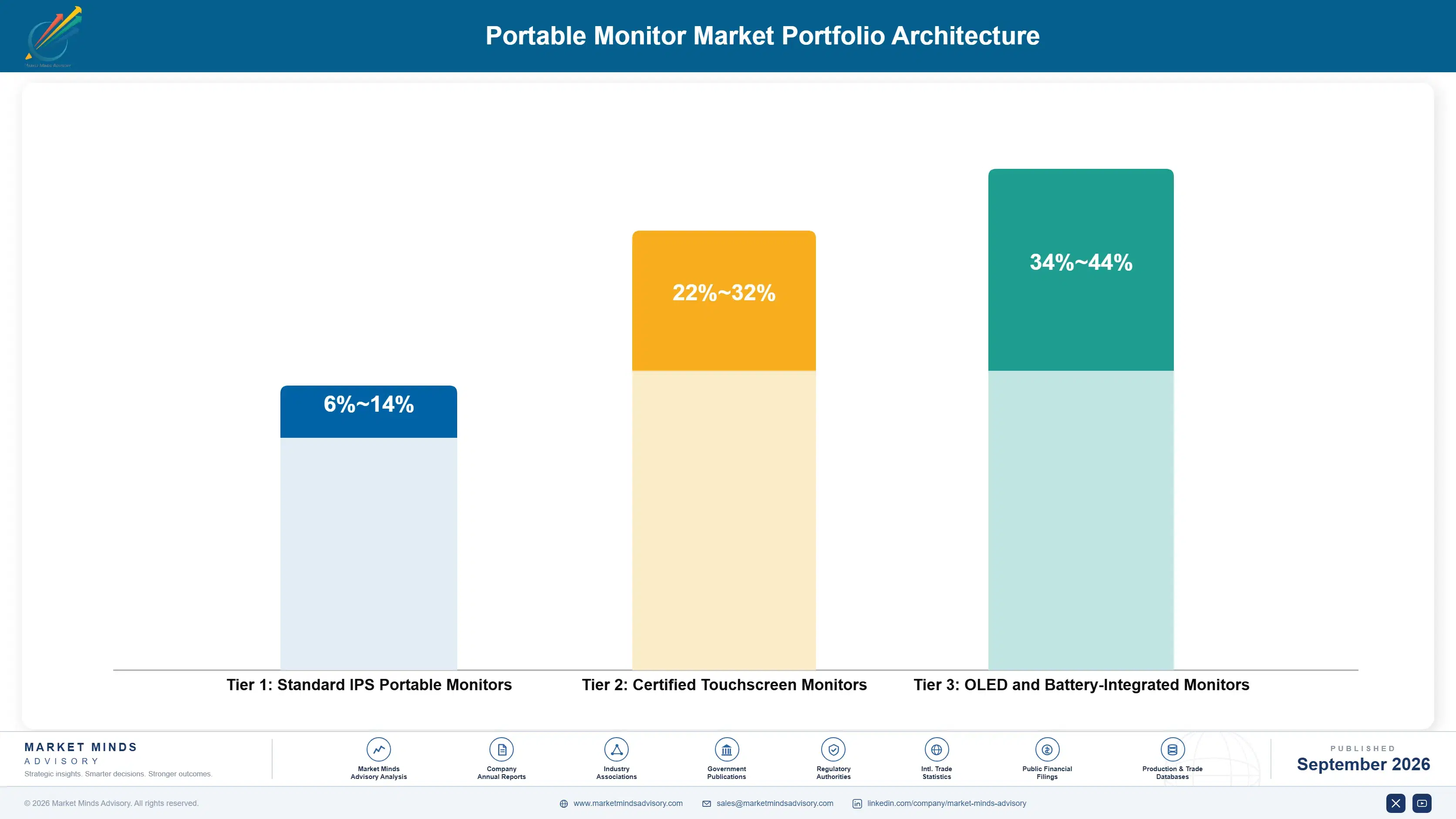
Gross margins vary widely across the portfolio, from thin single-digit margins on commodity IPS units up to healthy margins on OLED and battery-integrated premium tiers sold through premium retail channels worldwide. Volume sits overwhelmingly in the commodity-adjacent tier, but value concentrates in the smaller premium and next-generation tiers instead, across nearly every single regional market this full study actually tracks in the very finest detail.
The tension between chasing unit volume and protecting margin plays out visibly in retail assortment planning, where brands must decide how many commodity-tier SKUs to carry purely for shelf presence against how much marketing budget to dedicate toward premium tier storytelling that actually drives measurable profit across the entire full product lineup each and every single fiscal calendar year ahead.

High-value pools concentrate in OLED and battery-integrated premium units, where buyers pay for visible picture quality and mobility rather than raw specification numbers alone. That is where most brands are now directing new product development spend, well ahead of any planned commodity-tier expansion currently under serious boardroom consideration at any of these particular companies operating today worldwide right now overall.

Standard IPS Portable Monitors

Thin margin commodity IPS units sold primarily on price per inch through online marketplaces and discount retail, competing almost entirely on specification sheets rather than brand name or build quality.
Gross Margin: 6-14%

Certified Touchscreen Monitors

Certified premium units carrying full sRGB or DCI-P3 color accuracy claims and extended warranty coverage, sold through branded retail and direct online channels at a meaningful premium over commodity equivalents.
Gross Margin: 22-32%

OLED and Battery-Integrated Monitors

High-capacity OLED and battery-integrated systems built around premium panels and expandable accessory lineups, targeting content creators and mobile professionals willing to pay extra for genuine expandability and superior picture quality.
Gross Margin: 34-44%
portable-monitor-market-portfolio-architecture-1790006192487

High-value Sub-segments and Strategic Watch-out

OLED Portable Monitors

The highest value, fastest growing pocket of the market, driven by content creator adoption and premium OLED tier expansion that extends customer lifetime value well beyond the initial hardware purchase across multiple future upgrade cycles and product generations for years to come across every major market.
Gross Margin: 34-44%

Certified Touchscreen Monitors

A high-value, moderate-growth pocket where certification and warranty positioning support durable pricing power even as unit volume growth moderates relative to newer OLED categories gaining share steadily across every single region tracked worldwide over the entire coming decade and well beyond that point in time.
Gross Margin: 22-32%

Standard IPS Portable Monitors

The volume core of the market, competing almost entirely on price per inch through online marketplaces, generating thin margins but sustaining the largest absolute unit shipment base globally each and every single calendar year without exception across nearly every single regional market tracked here today.
Gross Margin: 6-14%

Counterfeit Specification Marketplace Listings

A strategic watch-out rather than a true revenue segment, where counterfeit specification claims on third-party marketplaces erode consumer trust and pressure legitimate brands to invest much more heavily in strong verification programs and authenticity labeling initiatives across every major online retail platform currently operating today.
Gross Margin: n/a

Repeat Purchase and Multi-Unit Patterns

Portable monitor revenue is not annuity revenue, but replacement and multi-unit purchase patterns create a recurring tail of their own quite particular kind. Buyers who adopt one unit for travel frequently add a second unit for permanent home desk use within a year, meaningfully expanding average customer lifetime spend well beyond the initial single unit purchase across the full multi-year ownership relationship.
Adoption depth varies sharply by end use. Business travelers tend to buy one compact lightweight unit and replace it only on failure, while content creators and gamers invest in larger, higher refresh rate models they treat as permanent desk fixtures alongside their primary display, creating meaningfully deeper engagement within that specific buyer segment than travel-focused purchasers ever demonstrate over the full working life of their own particular unit.

Buyer profiles are shifting generationally as younger remote and hybrid workers increasingly treat a portable monitor as standard home office equipment purchased alongside a first laptop, rather than a specialty accessory bought only by frequent business travelers, broadening the addressable buyer base considerably beyond its original travel-focused niche market of years past entirely for good.
portable-monitor-market-end-use-penetration-index-1790006192979

Where Portable Display Value Concentrates

These are among the four positions where our research anticipates prominent divergence between winners and laggards over the coming forecast period. Each is grounded in the demand model, the regulatory perimeter, and the announced capacity pipeline.
01 / PREMIUM PANEL CERTIFICATION STRATEGY

Premium panel certification separates durable brands from commodity price takers

Brands that invest early in OLED and touchscreen certification build a defensible pricing advantage that commodity IPS makers cannot easily replicate at comparable cost or speed. That advantage compounds as content creator and gaming demand keeps outrunning available premium panel supply, pushing buyers toward suppliers with proven color accuracy track records and established quality reputations. Vendors treating premium tier investment as optional will find their addressable customer base shrinking steadily as buyer expectations keep rising across nearly every major market this study tracks.
02 / BUNDLED ACCESSORY ATTACHMENT STRATEGY

Bundled accessory attachment captures the highest customer lifetime value overall

Bundled accessory attachment turns a single hardware sale into a recurring purchase relationship worth substantially more than the initial transaction alone across a comparable ownership period. Brands committing engineering resources to modular case and stand compatibility now will capture disproportionate share of the fastest-growing content creator segment through 2036 as demand keeps climbing steadily across every major regional market. Competitors relying solely on standalone unit sales risk losing customers to whichever brand locks in the accessory relationship first across the wider industry.
03 / MANUFACTURING FOOTPRINT DIVERSIFICATION

Manufacturing footprint diversification reduces tariff and disruption exposure meaningfully

Brands that diversify manufacturing footprint beyond a single country reduce tariff and disruption exposure that competitors concentrated entirely in one region cannot absorb as easily during periods of real stress. Vietnam and India are emerging as credible secondary assembly hubs even though panel sourcing still traces back to concentrated East Asian suppliers regardless of final assembly location chosen. Brands that diversify assembly earliest will hold a cost and resilience advantage over slower-moving rivals across the wider industry for years to come.
04 / MARKETPLACE TRUST PROTECTION STRATEGY

Marketplace trust protection determines which brands retain pricing power long term

Counterfeit specification claims on third-party marketplaces erode consumer trust across the entire category, not just for the specific brands being misrepresented online by opportunistic resellers seeking quick profit margins. Legitimate manufacturers investing in verified listing programs and clear authenticity labeling protect pricing power that would otherwise erode as buyers grow increasingly skeptical of published specifications. This protection becomes more valuable as marketplace volume keeps growing faster than enforcement capacity worldwide, particularly in fast-growing emerging markets with much weaker regulatory oversight.

Engagement Snapshot From the Field

A live engagement with an industry participant carrying material or product regulatory and market exposure ahead of a defining policy shift, showing how our research translates into a defensible multi-year portfolio strategy.
MARKET MINDS ADVISORY · CLIENT ENGAGEMENT SUMMARY
Portable Monitor Producer Strategic Portfolio Review and Transition Roadmap 2026·Investment Scenario on Portable Monitor Exposure Evaluation 2025-26
CLIENT PROFILE
The client is a mid-tier laptop accessory brand with an established compact IPS portable monitor product line sold primarily through North American and Western European online retail channels for several years running strong. Annual revenue from portable monitor products was approximately 45 million dollars (client-reported, unverified by MMA) prior to the engagement, concentrated almost entirely in the commodity-adjacent tier of the market.
STRATEGIC CHALLENGE
The client faced stalling growth in a crowded commodity IPS segment, facing intensifying price pressure from Chinese direct-to-consumer brands selling nearly identical specifications through the same online marketplaces at similar price points daily. Leadership needed a credible path into higher-margin OLED and battery-integrated segments without alienating its existing price-sensitive customer base or requiring an entirely new brand identity.
MMA APPROACH
MMA conducted primary interviews with retail buyers and end consumers across three countries, benchmarked the client's certification and warranty positioning against premium competitors in the same channels, and modeled margin outcomes across three portfolio restructuring scenarios ranging from incremental OLED tier entry to a full brand repositioning effort spanning multiple future product generations and several more years ahead.
KEY FINDINGS
  1. Consumers consistently associated certification badges with safety more than any single specification figure, including headline resolution or brightness ratings shown on packaging.
  2. An OLED product line could reach positive gross margin within eighteen months given the client's existing manufacturing relationships and component sourcing arrangements.
  3. Retail buyers indicated willingness to expand shelf space for the brand if warranty coverage matched leading premium competitors within about two years.
  4. Bundled accessory subscription programs tested well among existing customers but required simplified billing communication to avoid subscription fatigue concerns entirely going forward.
CLIENT PROFILE
The client is a mid-tier laptop accessory brand with an established compact IPS portable monitor product line sold primarily through North American and Western European online retail channels for several years running strong. Annual revenue from portable monitor products was approximately 45 million dollars (client-reported, unverified by MMA) prior to the engagement, concentrated almost entirely in the commodity-adjacent tier of the market.
STRATEGIC CHALLENGE
The client faced stalling growth in a crowded commodity IPS segment, facing intensifying price pressure from Chinese direct-to-consumer brands selling nearly identical specifications through the same online marketplaces at similar price points daily. Leadership needed a credible path into higher-margin OLED and battery-integrated segments without alienating its existing price-sensitive customer base or requiring an entirely new brand identity.
MMA APPROACH
MMA conducted primary interviews with retail buyers and end consumers across three countries, benchmarked the client's certification and warranty positioning against premium competitors in the same channels, and modeled margin outcomes across three portfolio restructuring scenarios ranging from incremental OLED tier entry to a full brand repositioning effort spanning multiple future product generations and several more years ahead.
KEY FINDINGS
  1. Consumers consistently associated certification badges with safety more than any single specification figure, including headline resolution or brightness ratings shown on packaging.
  2. An OLED product line could reach positive gross margin within eighteen months given the client's existing manufacturing relationships and component sourcing arrangements.
  3. Retail buyers indicated willingness to expand shelf space for the brand if warranty coverage matched leading premium competitors within about two years.
  4. Bundled accessory subscription programs tested well among existing customers but required simplified billing communication to avoid subscription fatigue concerns entirely going forward.
RECOMMENDED STRATEGY
Phase 1: Phase one: pursue full color accuracy certification across the entire compact IPS product line within a full twelve calendar months. Phase 2: Phase two: launch an OLED premium tier product line targeting content creators and gamers with bundled accessories fully included at launch. Phase 3: Phase three: pilot a subscription replacement program among existing loyalty customers before expanding it much more broadly nationwide going forward.
OUTCOME
Within twelve months of certification completion, the client reported a 20 percent increase in average selling price across its certified product line and secured expanded retail shelf placement with two major North American retail chains (client-reported, unverified by MMA), well ahead of the original planned rollout timeline schedule.

Frequently Asked Questions

Foundational context covering the market sizes, CAGR, scope, country, region and competition that inform every finding below. This section is provided to cover basics and most often pre-purchase conversations, answered from the MMA Primary Research Dataset.

What is the current size of the Portable Monitor Market?

The global portable monitor market was valued at approximately 2.1 billion dollars in 2025, covering IPS, OLED, and battery-integrated secondary displays sold across every major retail channel worldwide.

How large will the Portable Monitor Market be by 2036?

The market is projected to reach approximately 5.7 billion dollars by 2036, up from 2.3 billion dollars in 2026, an incremental gain of roughly 3.4 billion dollars over the forecast period.

What is the CAGR for the Portable Monitor Market 2026 to 2036?

The market is expected to grow at a compound annual rate of 9.5 percent between 2026 and 2036, with a bull case near 10.8 percent and a bear case near 8.2 percent annually.

Which segment is growing fastest?

OLED portable monitors lead segment growth at 14.0 percent annually, roughly 1.47 times the overall market rate, driven by content creator and gaming demand for color accuracy.

Who are the major companies in the Portable Monitor Market?

ASUS, Lenovo, ViewSonic, AOC, and Dell Technologies lead the market on annual shipment volume, together holding roughly 35 percent of the combined global share overall.

Which country is growing fastest?

South Korea leads country-level growth at approximately 12.0 percent annually, driven by concentrated OLED panel manufacturing capacity and a strong domestic gaming culture nationwide overall today.

Report Segmentation Architecture

The full report scope spans multiple orthogonal segmentation dimensions, with cross-tabulated demand data provided for each dimension pair. Coverage extends further to regional breakdowns, trend trajectories, and the competitive detail needed to support segment-level decision-making.

By Product Form Factor

  • Standard IPS Portable Monitors
  • OLED Portable Monitors
  • Touchscreen Portable Monitors
  • Battery-Integrated Portable Monitors
  • Triple-Display Laptop Attachments
  • E-Ink Portable Monitors

By End-Use Application

  • Business Travel and Remote Work
  • Content Creation and Video Editing
  • Gaming and Entertainment
  • Home Office Multi-Monitor Setups
  • Outdoor and Mobile Lifestyle Use

By Commercial Dimension

  • Direct to Consumer Online
  • Third Party E-Commerce Marketplaces
  • Electronics and Specialty Retail
  • Crowdfunding Platform Sales

By Region

  • North America
  • Western Europe
  • East Asia
  • South Asia and Pacific
  • Latin America
  • Middle East and Africa
  • Eastern Europe

Scope, Methodology, and Coverage

Every figure in this report is reproducible from documented input assumptions. The scope below maps the historical period, the forecast horizon, the segmentation dimensions, and the countries covered, alongside the underlying primary and qualitative methodology.
Historical Period
2020 to 2025
Forecast Period
2026 to 2036
Base Year
2025 (USD billions; MMA Primary Research Dataset, September 2026)
Market Definition
The portable monitor market covers standalone external displays designed for mobility, including USB-C powered, battery-integrated, and touchscreen models used to extend or mirror a laptop, tablet, or smartphone screen away from a fixed desk setup. It excludes built-in laptop displays, fixed desktop monitors, and projector-based display solutions.
Quantitative Units
USD Billion, CAGR (%) 2026-2036
Segmentation Dimensions
Product Form Factor, End-Use Application, Commercial Dimension, Region
Regions Covered
North America, Western Europe, East Asia, South Asia and Pacific, Latin America, Middle East and Africa, Eastern Europe
Countries Covered
US, Canada, Germany, UK, France, China, Japan, South Korea, India, Australia, Brazil, Mexico, UAE, South Africa, Poland
Key Companies Profiled
20
Quantitative Methodology
Primary survey, n=3,800 respondents, Q4 2025, six countries; demand-side model with trade association cross-validation
Qualitative Methodology
47 expert interviews, Q4 2025; applied to validate demand model assumptions, identify emerging dynamics, and assess competitive positioning
Report Format
PDF and XLSX data workbook (Word format preview document)
Publisher
Market Minds Advisory
Report Code
MMA-2026-TEC-701
Published
September 2026
Contact
sales@marketmindsadvisory.com | www.marketmindsadvisory.com

Purchase the full Portable Monitor Market Report (2026 to 2036).

The full report delivers a complete strategic assessment of the portable monitor market, spanning detailed segment-level forecasts, regional demand modeling, and competitive benchmarking across the top twenty market participants. It includes proprietary primary survey data covering three thousand eight hundred respondents and forty-seven expert interviews conducted in the fourth quarter of 2025. Buyers receive access to editable data tables alongside the narrative analysis for internal strategic planning use across product, marketing, and channel teams. The analysis is designed to support decisions on portfolio investment, certification strategy, and channel expansion over the coming decade.
Segment level revenue forecasts through the year 2036
Regional market sizing across seven world regions
Competitive benchmarking of twenty key market participants
Editable data tables for internal strategic planning
Primary survey data from 3,800 global respondents
Expert interview insights from 47 industry practitioners

Built For The People Who Decide

From boardroom strategy to bench-side execution, this report is read cover-to-cover by leaders shaping the next decade of their industry, turning demand scenarios, market dynamics and valuation benchmarks into decisions.
CXOs/ Presidents/ VPs/ Managers
M&A and Corporate Development
Strategy Teams and R&D Heads
Procurement and Product Directors
Regulatory and Compliance Leaders
Investor Relations and Equity Analysts