

Market Minds Advisory
Portable Gas Conditioning Skids Market

Portable Gas Conditioning Skids Market: Portable Gas Conditioning Skids Market: A Rental Business In Equipment Clothing

Regulators stopped letting operators burn associated gas, and the wells that produce it will be gone in three years. Nobody wants to own a fixed plant for a job like that.

Lead Analyst

Published

September 2026

Make Smarter Decisions with Customized Research Insights

Request a free sample report and evaluate market opportunities, growth trends, and competitive dynamics relevant to your business needs.

2025 MARKET VALUE$3.6BMarket Size 2025
2036 FORECAST VALUE$8.6BBase Case , 2026 to 2036
CAGR 2026 TO 20368.2 %Bull 9.5% / Bear 7.0%
INCREMENTAL OPPORTUNITY$4.7BNet 10- year value creation
EXPANSION MULTIPLE2.20x2036 value over 2026 base
Strategic Levers
M&A Pipeline
Regional Outlook
Country Rankings
Competitive Intelligence
Segmental Deep-dive
Call-Us : 91 93563 13602

Executive Snapshot and Market Trajectory.

This is a rental business wearing an equipment business's clothes, and the participants who understand that earn twice what the others do. Fleet utilisation decides profitability, not units shipped, because an operator conditioning gas at a well with three years left has no reason to buy anything.
Biogas and RNG upgrading skids grow at 12.3%, half again the market rate of 8.2%, because landfill and digester sites are small, scattered and short-lived in exactly the way a modular package suits. North America holds 32% of demand on the largest population of small wellhead sites anywhere and a rental culture the rest of the world has never built. Middle East and Africa takes 14%, far above its usual band, on sour gas.
Concentration is moderate at 38% of deployed fleet, because a skid is a weldment, a vessel and a control panel and a competent shop can build one. What a competent shop cannot build is a fleet positioned close enough to redeploy in nine days. The competitive contest is logistics and capital, not engineering, and almost every participant still markets on process performance. That mismatch is the whole opportunity here.
Market Definition
The portable gas conditioning skids market covers modular, relocatable process packages that treat raw gas streams to pipeline, engine or upgrading specification at the point of production, spanning glycol dehydration skids, amine treating and sour gas removal skids, dew point control and Joule-Thomson skids, filtration and separation skids, biogas and RNG upgrading skids, and mercury and trace contaminant removal skids. Scope covers both rental and outright sale of relocatable units. Excluded are fixed central gas processing plants, standalone compression packages, pipeline infrastructure, LNG liquefaction trains, and permanently installed refinery treating units.
Base Year Value
$3.6B in 2025 (MMA Primary Research Dataset, August 2026)
Forecast Period
2026 to 2036, eleven discrete annual values
CAGR
8.2% base case. Bull 9.5%. Bear 7.0%.
Fastest Growth Segment
Biogas and RNG Upgrading Skids: 12.3% CAGR
Fastest Growth Country
India: 10.4% CAGR
Fastest Growth Region
South Asia and Pacific: 10.4% CAGR
Largest Region
North America: 32% of 2025 global value
Market Leaders
Enerflex, SLB, Baker Hughes, Pietro Fiorentini and Air Liquide. Source: MMA Analysis, July 2026.
Primary Survey
n=3,800 procurement and R&D decision-makers, Q4 2025, six countries
Methodology
Demand-side build-up, cross-validated against public data, 47 expert interviews

Portable Gas Conditioning Skids Market Forecast Scenarios

portable-gas-conditioning-skids-market-size-forecast-scenario-1788193731679
Between 2020 and 2025 the sector compounded at 7.0%, and the shape of that growth mattered more than the rate. The 2020 collapse in drilling emptied rental fleets almost overnight and the recovery refilled them at day rates operators had never previously paid. Utilisation, not pricing, produced the numbers. Several participants learned what a fleet costs when nobody is renting any of it.
The 8.2% base case rests on three mechanisms. Methane and flaring regulation now requires conditioning of associated gas that operators previously burned, on timetables published by the EPA and by the European Commission for imported gas. Biogas and landfill upgrading keeps adding small, scattered sites that no fixed plant can serve. And short well lives keep pushing operators toward rental rather than ownership, which raises revenue per unit. None of the three depends on a drilling recovery.
The bull case at 9.5% turns on European methane import rules biting harder than expected from 2027, which would force conditioning across supplying regions that currently vent and flare freely. The bear case at 7.0% is gathering infrastructure: every pipeline connection built removes a rental skid from a site permanently, and midstream buildout competes directly with this equipment.

A Fleet Business, Not Equipment

The single most useful number in this sector is not process efficiency, it is utilisation. A skid earning a day rate 84% of the year returns its manufacturing cost in around 31 months and then produces margin for a decade. A skid sitting in a yard is a depreciating steel liability. Every participant knows this and remarkably few of them are actually organised around it.
TOP FIVE CONCENTRATION38%Share of fleet held by the five largest suppliers
FLEET UTILISATION RATE84%Portion of available units earning a day rate
AVERAGE RENTAL TERM26 monthsMedian contract length across the deployed rental fleet
RENTAL REVENUE SHARE57%Portion of sector revenue earned from rental rather than sale
REDEPLOYMENT CYCLE TIME9 daysMedian time between demobilisation and earning at another site
SKID PAYBACK PERIOD31 monthsTime for rental income to recover unit manufacturing cost
Utilisation is a logistics problem rather than a sales one. Median redeployment takes nine days between a unit demobilising at one site and earning at the next, and that number is decided by yard location, transport availability and refurbishment turnaround rather than by anything a salesperson does. Participants with dense regional yard networks run several points of utilisation above those without, on completely identical equipment.
Rental now accounts for 57% of sector revenue and the share keeps climbing, because well lives are shortening while conditioning obligations are lengthening. An operator facing a three-year production profile and a permanent regulatory requirement rents. The commercial consequence is that this sector's balance sheet looks like a leasing company's, and the participants still structured as fabricators are competing at a real capital disadvantage now.
"Ask a supplier about dehydration performance and you will get an hour of it. Ask what their fleet utilisation was last quarter and watch the room change, because that is the only number that decides whether the business works."
Director, Modular Process Equipment Practice · MMA Energy Practice · August 2026

Market Trends

Methane rules turned flared gas into conditioning demand

United States EPA methane standards and European import rules from 2027 have made routine flaring of associated gas a compliance problem rather than an operating preference, which means gas that used to burn now has to be dried, sweetened and either sold or used on site. The wells producing it often have three or four years left, so a fixed plant makes no sense at all. That combination of a permanent obligation against a temporary asset is precisely what a relocatable skid exists to solve, and it did not exist as a market five years ago.
Market Impact: Grows at 12.3% annually

Rental overtook sale as the dominant model

Rental now produces 57% of sector revenue and the share is still rising, because an operator with a three-year production profile will not capitalise a twenty-year asset for it. That shift changes what a participant has to be: fleet ownership, yard networks, transport logistics and refurbishment capacity matter more than fabrication capability, and the balance sheet looks like a leasing company's rather than a manufacturer's. Several long-established fabricators have found themselves competing against rental fleets they cannot fund, on equipment they build perfectly well themselves. That is an uncomfortable position to occupy.
Market Impact: Drives 14% regional demand share

Market Opportunities and Growth Drivers

Biogas sites are too small for fixed plants

Landfill and digester gas arrives loaded with carbon dioxide, hydrogen sulphide, siloxanes and moisture, at flow rates a fraction of a conventional gas processing plant and from sites scattered across agricultural and municipal geography. A fixed upgrading facility cannot be justified at that scale, and a modular skid can be delivered, commissioned and later relocated when the site changes. Biogas and RNG upgrading skids grow at 12.3% against a market rate of 8.2% for that reason alone. The buyer is a waste operator or a farm cooperative rather than an oil company, which most suppliers are poorly organised to reach.
Market Impact: Ends contracts within 1 quarter

Sour gas volumes keep rising across producing regions

Hydrogen sulphide content in produced gas rises as fields mature and as development moves into sourer formations across the Middle East, Central Asia and parts of North America. Amine treating is not optional at those concentrations, since sour gas destroys pipelines, engines and people, and the treating package has to sit at the wellhead rather than downstream. Amine skids grow at 9.8% for that reason. Middle East and Africa takes 14% of category demand, far above what its share of global gas activity would suggest, almost entirely because of sulphur.
Market Impact: Funds 31 months before payback

Market Restraints and Challenges

Every gathering pipeline built removes a skid

A portable conditioning package exists because a site has no pipeline connection, and the moment midstream gathering reaches that location the skid demobilises permanently. The root cause is that this equipment solves a temporary infrastructure gap rather than a permanent process need, which makes the addressable base a function of somebody else's capital programme. Commercial impact is fleet redeployment risk concentrated in basins where midstream buildout is active. Participants are responding by targeting biogas sites that will never receive gathering lines, diversifying across basins, and shortening contract terms deliberately to price the risk.
Market Impact: Applies from 2027 on imports

Fleet capital demands scale most fabricators lack

Building a rental fleet means funding equipment that earns back its cost over roughly 31 months while carrying it on the balance sheet from day one, which is a capital profile a fabrication business was never designed to hold. The root cause is that rental converted this from a working capital business into an asset-heavy one within about a decade. Commercial impact is that competent manufacturers lose work to better funded rental fleets on identical equipment. Mitigation runs through sale-leaseback structures, partnerships with rental specialists, private credit facilities and manufacturing for fleet owners rather than against them.
Market Impact: Rental produces 57% of revenue
3 additional market trends, 4 additional growth drivers, and 2 additional restraints and challenges are covered in the full report. Contact sales@marketmindsadvisory.com to access the complete intelligence.

Segment CAGR and Growth Architecture

Segmentation follows conditioning function, the dimension on which contaminant chemistry, package cost and rental term all move together. Dehydration and filtration carry the fleet volume at modest day rates. Amine treating and biogas upgrading carry the growth and the margin, because both handle contaminants that make the gas unusable rather than merely imperfect in some way.
portable-gas-conditioning-skids-market-market-share-analysis-1788193732244

Biogas and RNG Upgrading Skids

Biogas and RNG upgrading skids grow at 12.3%, half again the market rate of 8.2%, and the reason is site geometry rather than technology. Landfill and digester gas comes at flow rates a fraction of a conventional processing plant, from locations scattered across agricultural and municipal land that no central facility can economically reach. Carbon dioxide, hydrogen sulphide, siloxanes and moisture all have to come out before the gas reaches pipeline or engine specification, which makes the package considerably more complex than a wellhead dehydrator. The buyer is a waste operator, a municipality or a farm cooperative rather than an oil company, and most suppliers in this sector have no route to any of them.
CAGR 12.3%

Amine Treating and Sour Gas Removal Skids

Amine treating and sour gas removal skids at 9.8% handle the contaminant nobody can work around. Hydrogen sulphide corrodes pipelines, destroys engines and kills people at concentrations measured in parts per million, so treating is a safety requirement rather than a commercial optimisation, and it has to happen at the wellhead before the gas travels anywhere. Sour content rises as fields mature and as development moves into sourer formations, which makes this segment's growth a function of geology rather than of any market development effort. Package cost runs well above dehydration because amine circulation, regeneration and sulphur handling all need equipment that a dehydrator does not carry at all. Day rates follow that difference closely.
CAGR 9.8%
Full segment breakdown across 6 segments available in the complete report.

Regional Architecture and Country Demand Map

North America takes 32% on the largest population of small wellhead sites anywhere plus a rental culture nobody else built. Middle East and Africa reaches 14% on sour gas alone. South Asia grows fastest of the seven regions. Two of those three positions sit outside their usual bands.

North America

Three conditions coincide here and nowhere else does all three appear together. The United States holds more small, short-life wellhead sites than the rest of the world combined, EPA methane standards made conditioning of associated gas a compliance obligation rather than a choice, and a rental culture built over decades in compression makes operators comfortable renting process equipment they would elsewhere insist on owning. Canadian sour gas in Alberta adds amine demand on top. Dense yard networks across Texas, Oklahoma and the Appalachian basin keep redeployment times short, which is what actually produces the utilisation numbers this business runs on. No other market has assembled that combination, and none looks likely to.
Share: 32% | CAGR: 9.0% (2026 to 2036)

East Asia

The 20% share sits below the usual regional band, and the reason is a preference rather than a shortage of gas. Chinese and Southeast Asian development has favoured fixed central processing facilities served by gathering networks, which suits large field developments and leaves little room for relocatable packages. Where portable units do deploy, they go to unconventional gas in Sichuan and to offshore associated gas in Malaysia and Indonesia. Chinese fabrication capability is considerable and increasingly exports these packages rather than renting them domestically. Growth at 9.2% reflects a rental model arriving late rather than demand that was never there. The export position is the more interesting part of this region today.
Share: 20% | CAGR: 9.2% (2026 to 2036)
Regional intelligence for 5 additional markets available in the complete report: Western Europe, South Asia and Pacific, Latin America, Middle East and Africa, Eastern Europe. Contact sales@marketmindsadvisory.com.
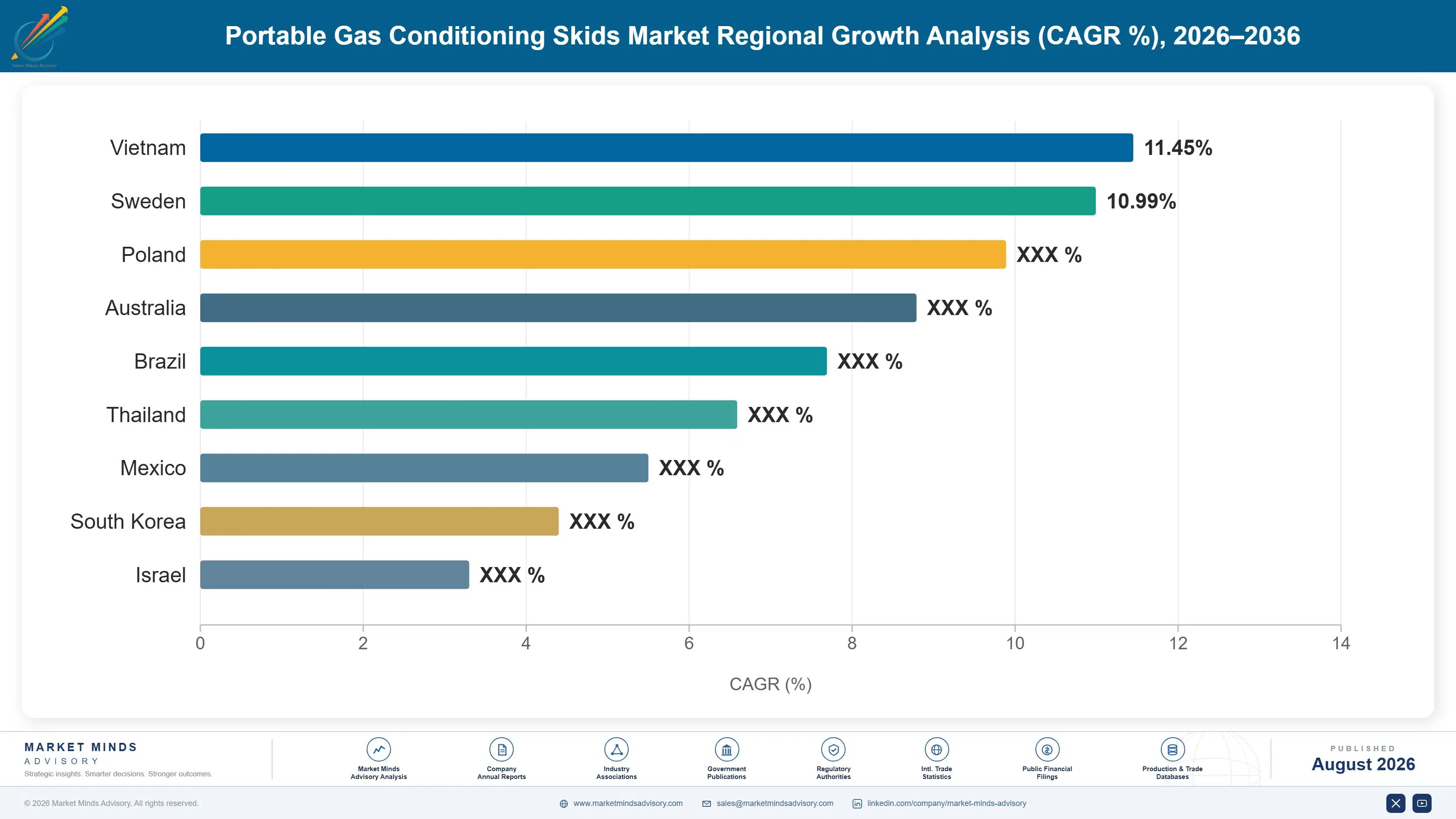
portable-gas-conditioning-skids-market-country-cagr-analysis-1788193732783

Four Moves On Fleet Economics

None of these four is about the process package, which is fortunate, because a competent shop anywhere can build one and several hundred of them do. Each works on what actually decides money here: how often a unit earns, how fast it moves between sites, and who is actually willing to fund all of it.

Put yards where the redeployments happen

Median redeployment takes 9 days between a unit demobilising and earning again, and that figure is set almost entirely by how far the yard sits from the basin. A participant with dense regional yards runs several points of utilisation above one shipping from a central facility, on identical equipment and identical day rates. At 84% utilisation a skid pays back in around 31 months; at 70% it does not pay back inside its useful life at all. Yard property is cheap compared with what those points are worth. Very few participants have run that comparison.
Market Impact: Cuts the redeployment cycle below 9 days consistently

Build the biogas route to market

Biogas and RNG upgrading skids grow at 12.3% against a market rate of 8.2%, and the constraint on capturing that growth is commercial rather than technical. The buyer is a waste operator, a municipality or a farm cooperative, none of which a sales organisation built around oil and gas operators knows how to reach or how to contract with. Municipal procurement runs on tender processes and multi-year budget cycles that an upstream sales team has never encountered. Hiring three people who understand waste procurement costs almost nothing against that segment's growth rate.
Market Impact: Reaches a buyer segment growing at 12.3% annually

Fund the fleet off the balance sheet

Rental produces 57% of sector revenue and a skid takes roughly 31 months to earn back its cost, which is a capital profile that has quietly excluded competent fabricators from their own market. Sale-leaseback structures, private credit facilities and partnerships with infrastructure funds all put fleet on somebody else's balance sheet at a cost well below what losing the rental business costs. Several participants have concluded they cannot compete on capital and withdrawn to manufacturing instead. The financing existed all along and almost nobody went looking for any of it.
Market Impact: Funds the 31 month payback off the balance sheet

Contract against the regulation, not the well

Operators sign conditioning contracts against well life, which produces terms of around 26 months and a redeployment risk the supplier carries entirely. The methane obligation behind the requirement is permanent and applies across the operator's whole portfolio rather than to any single site. A portfolio contract covering conditioning capacity wherever the operator needs it converts a series of short site deals into a term relationship, removes the redeployment gap from the supplier's utilisation and gives the operator compliance certainty. Almost nobody offers one, and the operators asked for it first in several markets.
Market Impact: Replaces the 26 month term with a portfolio deal

Who Controls the Margin Pool

CR5 stands at 38% measured on deployed skid fleet count, since revenue mixes sale and rental in proportions no participant discloses consistently. That is low for an industrial equipment sector and the reason is straightforward: a skid is a weldment, a vessel and a control panel, and competent fabrication shops exist everywhere. The gap between the leaders and the field is a gap in fleet scale.
Competition runs on fleet density, capital access and contract structure. Fleet density decides redeployment time and therefore utilisation, which is the only number that matters in a rental business. Capital access decides who can hold assets that take 31 months to pay back. Contract structure decides who carries the gap when a well stops producing. Process performance decides considerably less than any supplier's own marketing suggests.

Rankings will move on biogas rather than on oil and gas. That segment grows at 12.3% and it is bought by waste operators, municipalities and farm cooperatives through tender processes an upstream sales organisation has never run. The participants building that route to market now will hold positions the incumbents cannot contest later. The pressure comes from a different customer, which is harder to answer than a competitor.
portable-gas-conditioning-skids-market-company-positioning-matrix-1788193733320

Competitive Moat and Risk Dimensions

ENERFLEX

Moat: Fleet scale and yard density

Decades of building rental fleet across North American basins gives the group yard density that competitors cannot replicate quickly, and yard proximity is what decides redeployment time and therefore utilisation. Scale also supports the capital position that fleet ownership demands. Neither the yards nor the balance sheet can be assembled inside a single capital cycle by anybody starting now.
ENERFLEX

Risk: Upstream concentration limits biogas access

The commercial organisation is built around oil and gas operators, and the fastest growing segment is bought by municipalities and waste companies through tender processes that a wellhead sales team has never run. Growth at 12.3% is going somewhere the existing route to market cannot reach. Rebuilding a sales organisation is slower than most managements assume.
PIETRO FIORENTINI

Moat: Biogas upgrading process depth

Long engagement with European biogas and gas distribution gives the group process capability across the contaminants that make digester and landfill gas difficult, together with customer relationships in municipal and utility procurement that upstream suppliers do not hold. That combination sits exactly where the growth is. Building it requires years inside a procurement culture rather than any new equipment.
PIETRO FIORENTINI

Risk: Limited rental fleet position

Revenue weighted toward equipment supply rather than fleet rental leaves the group exposed as the market shifts toward day rate models that now produce 57% of sector revenue. Competing against rental fleets on sale economics means competing on a structure the customer increasingly does not want. Building fleet requires capital of a kind an equipment business rarely holds.

Players Tracked

Prominent Players

Enerflex
SLB
Baker Hughes
Pietro Fiorentini
Air Liquide

Other Key Players

NOV
Honeywell UOP
Chart Industries
Wartsila
Nikkiso
Bright Renewables
Greenlane Renewables
DMT Environmental Technology
Hitachi Zosen Inova
Wood Group
Petrogas Systems
Croft Production Systems
Axip Energy Services
Cimarron Energy
Sulzer

Recent Developments

JANUARY 2025

European methane import rules entered preparation phase

European methane import requirements moved into their preparation phase ahead of application, obliging suppliers into European markets to demonstrate methane intensity across their production. Conditioning demand across supplying regions in Africa, the Middle East and North America rose in anticipation, well before any compliance date arrived.
Signal: A rule applied at the border creates equipment demand thousands of kilometres from where it was written.
JUNE 2025

Enerflex expanded rental fleet across Middle Eastern basins

Enerflex expanded its regional rental fleet and yard footprint across Middle Eastern sour gas basins, an organic capacity expansion rather than any acquisition or joint venture. The investment targets amine treating demand from progressively sourer development, where operators have historically preferred outright ownership over rental arrangements.
Signal: Building fleet into an ownership culture is a bet that the ownership preference will not hold.
SEPTEMBER 2025

Biogas upgrading order intake overtook wellhead packages

Several European suppliers reported biogas and RNG upgrading order intake exceeding wellhead conditioning packages for the first time, driven by municipal and agricultural digester programmes across Germany, Denmark and Italy. The buyers reached procurement through public tender processes rather than through the operator relationships these sales teams were built around.
Signal: The customer changed before the equipment did, and most sales organisations have not yet caught up.

Steel, Vessels And Fabrication Labour

Pressure vessels and fabricated steel account for roughly 34% of package cost, rotating equipment and compression around 18%, and instrumentation with control systems a further 21%. Carbon and stainless steel come from regional mills priced off energy and scrap. Fabrication labour is the line that has moved most, and skilled pressure welders are scarce in every producing region at exactly the same time.
Steel pricing through 2021 and 2022 gave this sector an expensive lesson in quotation discipline. Energy Information Administration and US Census Bureau trade data tracked the movement, and pressure vessel plate rose faster than the fabricated products index. Suppliers holding firm-price orders taken months earlier delivered packages at losses. Those with steel escalation clauses passed the increase through and kept margins intact, and the difference between the two groups was contractual rather than operational.

Exposure varies by business model rather than by purchasing skill. A rental fleet owner absorbs steel cost once at manufacture and recovers it across 31 months of day rates that reprice annually. A fabricator selling outright carries the whole movement inside a single quotation. That is why rental participants weathered the last steel cycle and several fabricators did not survive it at all.
portable-gas-conditioning-skids-market-cost-volatility-analysis-1788193733517

Write steel escalation into every firm quotation

Pressure vessels and fabricated steel are 34% of package cost and plate pricing moved sharply through the last cycle, as trade data recorded at the time. An escalation clause costs a negotiation rather than money and it removed the single largest quotation risk for the suppliers that used one. Several who did not are no longer trading.

Standardise the fleet to a few configurations

A fleet built from four or five standard configurations redeploys faster, carries fewer spare part variants and refurbishes on a predictable cycle, which lifts utilisation without new capital. A fleet of bespoke packages does none of that and every unit becomes a separate engineering problem on demobilisation. Standardisation costs sales flexibility and buys utilisation points worth more.

Secure welding capacity before the order arrives

Skilled pressure welders are scarce across every producing region at once, and fabrication labour is the cost line that has moved furthest. Standing agreements with fabrication shops, or an owned shop running at deliberate spare capacity, convert a delivery risk into a scheduling decision. Suppliers quoting lead times they cannot staff lose the contract and the relationship.

Portfolio Architecture for Margin Defence

Margin here follows utilisation rather than product, which sounds obvious and is almost never how these businesses report. The same amine skid earns a 40% gross margin at 84% utilisation and loses money at 65%, and nothing about the equipment changed between those two outcomes. Participants managing by fleet cohort rather than by product line run a completely different business from those reporting by equipment type.
Volume and premium pull against each other through fleet composition rather than pricing. Dehydration and filtration units are cheap to build, easy to redeploy and earn modest day rates, and they keep a yard busy between larger jobs. Amine and biogas packages earn several times as much and sit idle longer when a contract ends. A fleet of only the premium units runs at a utilisation nobody survives.

High-value pools sit in biogas packages, in long-term service contracts and in portfolio conditioning agreements nobody offers. The third is the most valuable and the least understood: contracting against an operator's whole methane obligation rather than against a single well converts site rentals into a term relationship and moves the redeployment gap off the supplier's utilisation. Operators asked for that structure before a supplier proposed it.

Volume / Commodity-Adjacent

Glycol dehydration and filtration separation skids built to standard configurations and rented at modest day rates. Competes on availability and yard proximity against near-identical packages from regional fabricators. The 9 point spread reflects whether the unit is rented or sold outright instead.
Gross Margin: 18 to 27%

Premium / Certified

Amine treating, dew point control and mercury removal packages engineered to specific gas compositions and safety cases. Process capability and compliance documentation rather than price support the day rate. The 9 point spread reflects contract length and whether service is bundled with the rental.
Gross Margin: 34 to 43%

Sustainability / Regulatory / Next-Generation

Biogas and RNG upgrading packages, portfolio conditioning agreements and compliance-linked service contracts sold against methane obligations. Margins are high because the buyer is purchasing regulatory certainty. The 16 point spread separates equipment rental from bundled compliance service, which price on entirely different logic.
Gross Margin: 42 to 58%
portable-gas-conditioning-skids-market-portfolio-architecture-1788193734015

High-value Sub-segments and Strategic Watch-out

Biogas and RNG Upgrading Skids

High value and high growth at 12.3%. Small scattered sites suit modular packages and no fixed plant can reach them, but the buyer is a waste operator rather than an oil company. The 8 point spread reflects whether the contract includes ongoing service and monitoring.
Gross Margin: 46 to 54%

Amine Treating and Sour Gas Skids

High value with strong growth at 9.8%. Sour gas is a safety problem rather than a commercial one, so treating happens regardless of gas price, which makes demand unusually insensitive. The 8 point spread reflects sulphur handling scope and whether amine supply is included as well.
Gross Margin: 38 to 46%

Glycol Dehydration Skids

The volume core. It earns modestly and it keeps yards busy and operators in contract between the larger jobs, which is worth more than the margin line suggests. The 8 point spread reflects whether units are rented on term or sold to the operator outright.
Gross Margin: 20 to 28%

Mercury and Trace Contaminant Skids

The strategic watch-out. Demand depends entirely on specific field chemistry rather than on any general trend, so the addressable base is narrow and geographically unpredictable. The 22 point spread separates the simple adsorbent units from full regeneration systems, which are genuinely different businesses altogether in practice.
Gross Margin: 30 to 52%

Utilisation Is The Whole Business

The annuity here is a day rate rather than a purchase, which changes everything about how the revenue behaves. A deployed skid earns every day it sits on site under a contract averaging 26 months, and the revenue is recurring, predictable and independent of whether anybody sells anything new. Fleet utilisation at 84% turns that into an asset paying back in around 31 months quite comfortably.
Stickiness varies enormously by end-use rather than by customer size. A biogas site keeps its upgrading package for the life of the facility, because the gas never stops arriving and no pipeline is coming. A wellhead unit leaves when the well declines or gathering arrives, whichever comes first. Sour gas installations sit between the two, since the sulphur does not go away while the field produces.

Buyer profiles have shifted from production engineers toward compliance and sustainability functions, and very few suppliers have noticed. A production engineer asks about dew point specification and pressure drop. A compliance manager asks whether the package will satisfy a methane rule in 2027 and what the reporting output looks like. Those are different conversations requiring different documentation, and most sales teams can hold the first one.
portable-gas-conditioning-skids-market-end-use-penetration-index-1788193734519

Where The Money Actually Is

These are among the four positions where our research anticipates prominent divergence between winners and laggards over the coming forecast period. Each is grounded in the demand model, the regulatory perimeter, and the announced capacity pipeline.
01 / YARD NETWORK DENSITY

Put the steel near the redeployments

Median redeployment takes 9 days between a unit demobilising at one site and earning at the next, and that figure is set by yard distance from the basin rather than by anything a sales organisation actually does. A participant with dense regional yards runs several points of utilisation above one shipping from a central facility, on identical equipment. At 84% a skid pays back in 31 months and at 70% it never pays back inside its own useful life at all.
02 / BIOGAS ROUTE BUILDING

Hire people who understand municipal procurement

Biogas and RNG upgrading skids grow at 12.3% against a market rate of 8.2%, and the constraint on capturing that growth is entirely commercial rather than technical or financial. The buyer is a waste operator, a municipality or a farm cooperative, and none of them can be reached by a sales organisation built around oil and gas operators and their procurement habits. Municipal tenders and multi-year budget cycles are learnable, and hiring three people who already understand them costs almost nothing.
03 / FLEET CAPITAL STRUCTURE

Stop funding the fleet from working capital

Rental produces 57% of sector revenue and a skid takes roughly 31 months to earn back its cost, which is a capital profile that has quietly pushed competent fabricators out of their own market entirely. Sale-leaseback structures, private credit facilities and infrastructure fund partnerships all place fleet on somebody else's balance sheet at a cost well below what losing the rental business actually costs. Several participants concluded they could not compete on capital and withdrew, which was a decision rather than any necessity.
04 / PORTFOLIO CONTRACT DESIGN

Contract against the obligation, not the well

Operators sign conditioning contracts against well life, which produces terms averaging 26 months and leaves the supplier carrying the whole redeployment gap when a site stops producing. The methane obligation driving the requirement is permanent and portfolio-wide rather than site-specific, which nobody on either side has properly translated into a commercial structure yet. A portfolio agreement converts a series of short site rentals into a term relationship with predictable utilisation, and operators asked for exactly that before any supplier offered it.

Engagement Snapshot From the Field

A live engagement with an industry participant carrying material or product regulatory and market exposure ahead of a defining policy shift, showing how our research translates into a defensible multi-year portfolio strategy.
MARKET MINDS ADVISORY · CLIENT ENGAGEMENT SUMMARY
Portable Gas Conditioning Skids Producer Strategic Portfolio Review and Transition Roadmap 2026·Investment Scenario on Portable Gas Conditioning Skids Exposure Evaluation 2025-26
CLIENT PROFILE
A North American gas conditioning equipment company operating a rental fleet of several hundred skids across four basins, with annual revenue in the low hundreds of millions of dollars split roughly evenly between rental and outright sale (client-reported, unverified by MMA). Fleet utilisation had been running in the high sixties for three consecutive years. Management believed that was a demand problem.
STRATEGIC CHALLENGE
Utilisation had stayed in the high sixties while competitors reported figures in the low eighties on comparable equipment in comparable basins. Management had responded by discounting day rates, which produced no measurable improvement and considerable margin damage. They wanted to know whether the problem was pricing, product, sales coverage or something they had not considered at all.
MMA APPROACH
MMA reconstructed the movement history of every unit in the fleet across three years, measuring days between demobilisation and next revenue rather than contract counts. Forty-seven expert interviews with operators, transport contractors, refurbishment shops and competing fleet managers established what the redeployment cycle actually looked like at each stage and where exactly the days were being lost.
KEY FINDINGS
  1. Median redeployment took 23 days against a competitor benchmark of 9, and every one of those extra days came from transport and refurbishment queues.
  2. The fleet ran from 2 central yards while competitors operated 7 smaller ones, and the distance difference explained the entire utilisation gap by itself.
  3. Bespoke configurations meant 61 distinct spare part variants across the fleet, which added a week to every refurbishment cycle before work even started.
  4. Day rate discounting had reduced margin by roughly 11% and had won no measurable additional contracts, because operators were choosing on availability rather than price.
CLIENT PROFILE
A North American gas conditioning equipment company operating a rental fleet of several hundred skids across four basins, with annual revenue in the low hundreds of millions of dollars split roughly evenly between rental and outright sale (client-reported, unverified by MMA). Fleet utilisation had been running in the high sixties for three consecutive years. Management believed that was a demand problem.
STRATEGIC CHALLENGE
Utilisation had stayed in the high sixties while competitors reported figures in the low eighties on comparable equipment in comparable basins. Management had responded by discounting day rates, which produced no measurable improvement and considerable margin damage. They wanted to know whether the problem was pricing, product, sales coverage or something they had not considered at all.
MMA APPROACH
MMA reconstructed the movement history of every unit in the fleet across three years, measuring days between demobilisation and next revenue rather than contract counts. Forty-seven expert interviews with operators, transport contractors, refurbishment shops and competing fleet managers established what the redeployment cycle actually looked like at each stage and where exactly the days were being lost.
KEY FINDINGS
  1. Median redeployment took 23 days against a competitor benchmark of 9, and every one of those extra days came from transport and refurbishment queues.
  2. The fleet ran from 2 central yards while competitors operated 7 smaller ones, and the distance difference explained the entire utilisation gap by itself.
  3. Bespoke configurations meant 61 distinct spare part variants across the fleet, which added a week to every refurbishment cycle before work even started.
  4. Day rate discounting had reduced margin by roughly 11% and had won no measurable additional contracts, because operators were choosing on availability rather than price.
RECOMMENDED STRATEGY
Phase 1: Phase one: open 4 additional regional yards inside the client's existing basins, sized for staging and light refurbishment rather than fabrication. Phase 2: Phase two: standardise all new fleet additions to five configurations, and retire bespoke units as their current contracts expire naturally. Phase 3: Phase three: restore day rates to market level and compete on availability, which is what operators were actually selecting on all along.
OUTCOME
Within five quarters median redeployment had fallen from 23 days to 12 and fleet utilisation reached the high seventies, with day rates restored to market level (client-reported, unverified by MMA). The yard investment cost less than one quarter of the margin the discounting had given away. Standardisation is still in progress and will take years.

Frequently Asked Questions

Foundational context covering the market sizes, CAGR, scope, country, region and competition that inform every finding below. This section is provided to cover basics and most often pre-purchase conversations, answered from the MMA Primary Research Dataset.

What is the current size of the Portable Gas Conditioning Skids Market?

The global portable gas conditioning skids market was valued at USD 3.6 billion in 2025, covering relocatable process packages for gas treating. The 2026 figure reaches USD 3.90 billion.

How large will the Portable Gas Conditioning Skids Market be by 2036?

MMA forecasts USD 8.58 billion by 2036, an increase of USD 4.68 billion over the 2026 base. That represents an expansion multiple of 2.20 times across the forecast period.

What is the CAGR for the Portable Gas Conditioning Skids Market 2026 to 2036?

The base case compound annual growth rate is 8.2%, with a bull case at 9.5% and a bear case at 7.0%. Historical growth between 2020 and 2025 ran at 7.0%.

Which segment is growing fastest?

Biogas and RNG upgrading skids grow at 12.3%, half again the market rate of 8.2%, because scattered digester sites suit modular packages. Amine treating skids follow at 9.8%.

Who are the major companies in the Portable Gas Conditioning Skids Market?

Enerflex, SLB, Baker Hughes, Pietro Fiorentini and Air Liquide lead on deployed skid fleet count, with combined CR5 of 38%. Concentration is low because fabrication capability is widespread.

Which country is growing fastest?

India grows fastest at 10.4%, on city gas distribution expansion requiring conditioning across a rapidly built network. South Asia and Pacific leads regionally at 10.4%, with Australian coal seam gas alongside.

Report Segmentation Architecture

The full report scope spans multiple orthogonal segmentation dimensions, with cross-tabulated demand data provided for each dimension pair. Coverage extends further to regional breakdowns, trend trajectories, and the competitive detail needed to support segment-level decision-making.

By Conditioning Function

  • Glycol Dehydration Skids
  • Amine Treating and Sour Gas Removal Skids
  • Dew Point Control and Joule-Thomson Skids
  • Filtration and Separation Skids
  • Biogas and RNG Upgrading Skids
  • Mercury and Trace Contaminant Removal Skids

By End-Use Industry

  • Upstream Wellhead Production
  • Associated Gas and Flare Capture
  • Landfill Gas Recovery
  • Agricultural Digester Operations
  • Municipal Wastewater Treatment
  • Industrial Fuel Gas Conditioning

By Commercial Dimension

  • Term Rental Contracts
  • Outright Equipment Sale
  • Portfolio Conditioning Agreements
  • Operations and Maintenance Contracts
  • Lease to Own Structures
  • Engineering and Integration Services

By Region

  • North America
  • Western Europe
  • East Asia
  • South Asia and Pacific
  • Latin America
  • Middle East and Africa
  • Eastern Europe

Scope, Methodology, and Coverage

Every figure in this report is reproducible from documented input assumptions. The scope below maps the historical period, the forecast horizon, the segmentation dimensions, and the countries covered, alongside the underlying primary and qualitative methodology.
Historical Period
2020 to 2025
Forecast Period
2026 to 2036
Base Year
2025 (USD billions; MMA Primary Research Dataset, August 2026)
Market Definition
The portable gas conditioning skids market covers modular, relocatable process packages that treat raw gas streams to pipeline, engine or upgrading specification at the point of production, spanning glycol dehydration skids, amine treating and sour gas removal skids, dew point control and Joule-Thomson skids, filtration and separation skids, biogas and RNG upgrading skids, and mercury and trace contaminant removal skids. Scope covers both rental and outright sale of relocatable units. Excluded are fixed central gas processing plants, standalone compression packages, pipeline infrastructure, LNG liquefaction trains, and permanently installed refinery treating units.
Quantitative Units
USD billion, 2025 base year, 2026 to 2036 forecast period
Segmentation Dimensions
Conditioning function, end-use application, commercial model, region
Regions Covered
North America, Western Europe, East Asia, South Asia and Pacific, Latin America, Middle East and Africa, Eastern Europe
Countries Covered
United States, Canada, Germany, United Kingdom, Italy, Netherlands, Denmark, Poland, China, Japan, Malaysia, India, Australia, Brazil, Argentina, Saudi Arabia, United Arab Emirates, Nigeria
Key Companies Profiled
20 companies across equipment suppliers, rental fleet owners and biogas specialists
Quantitative Methodology
Primary survey, n=3,800 respondents, Q4 2025, six countries; demand-side model with trade association cross-validation
Qualitative Methodology
47 expert interviews, Q4 2025; applied to validate demand model assumptions, identify emerging dynamics, and assess competitive positioning
Report Format
PDF and XLSX data workbook (Word format preview document)
Publisher
Market Minds Advisory
Report Code
MMA-2026-ENE-321
Published
August 2026
Contact
sales@marketmindsadvisory.com | www.marketmindsadvisory.com

Purchase the full Portable Gas Conditioning Skids Market Report (2026 to 2036).

The full MMA report on the portable gas conditioning skids market runs to detailed function and regional models across the 2026 to 2036 forecast period, with package cost benchmarks separated by conditioning duty and fabrication origin. It profiles 20 companies on a consistent deployed fleet count basis, covering equipment suppliers, rental fleet owners and biogas upgrading specialists. Fleet utilisation, redeployment cycle times and day rate benchmarks are analysed by basin and by contract type. Regional chapters cover the seven MMA regions with country-level detail on the eighteen markets surveyed. Primary research draws on a quantitative survey of 3,800 respondents across six countries and 47 expert interviews conducted in Q4 2025.
Package cost benchmarks by conditioning duty and origin
Fleet utilisation and redeployment cycle benchmarks by basin
Day rate ranges across rental contract types and terms
Twenty company profiles on consistent deployed fleet basis
Methane regulation timelines mapped against conditioning demand
Seven regional chapters with eighteen country detail tables

Built For The People Who Decide

From boardroom strategy to bench-side execution, this report is read cover-to-cover by leaders shaping the next decade of their industry, turning demand scenarios, market dynamics and valuation benchmarks into decisions.
CXOs/ Presidents/ VPs/ Managers
M&A and Corporate Development
Strategy Teams and R&D Heads
Procurement and Product Directors
Regulatory and Compliance Leaders
Investor Relations and Equity Analysts