Market Minds Advisory
Portable Battery Pack Market

Portable Battery Pack Market: Portable Battery Pack Market. Fast-Charging Power Banks and Solar-Integrated Outdoor Power Systems Through 2036

USB-C fast charging standardization and rising outdoor recreation power demand push battery pack manufacturers toward higher capacity solar-integrated systems as travelers increasingly expect all-day device charging without carrying multiple separate charging accessories daily.

Lead Analyst

Published

September 2026

Make Smarter Decisions with Customized Research Insights

Request a free sample report and evaluate market opportunities, growth trends, and competitive dynamics relevant to your business needs.

2025 MARKET VALUE$13.4BMarket Size 2025
2036 FORECAST VALUE$28.2BBase Case , 2026 to 2036
CAGR 2026 TO 20367.0 %Bull 8.2% / Bear 5.8%
INCREMENTAL OPPORTUNITY$13.9BNet 10- year value creation
EXPANSION MULTIPLE1.97x2036 value over 2026 base
Strategic Levers
M&A Pipeline
Regional Outlook
Country Rankings
Competitive Intelligence
Segmental Deep-dive
Call-Us : 91 93563 13602

Executive Snapshot and Market Trajectory.

USB-C Power Delivery fast charging has become the default expectation across nearly every price tier, pushing manufacturers toward higher wattage output and denser cell chemistries in compact form factors that buyers now demand as standard equipment on nearly every new purchase made this year worldwide.
Shipment volume keeps climbing as smartphone battery life plateaus and outdoor recreation spending rises worldwide. Solar-integrated units and high-capacity outdoor power stations lead category growth, while China remains the dominant manufacturing base for cells, controllers, and finished assembly, concentrating supply risk and pricing power among a handful of contract manufacturers and branded assemblers competing for retail shelf space across nearly every major consumer electronics chain and online marketplace worldwide today and onward.
Competition splits between scaled Chinese brands competing on price and capacity per dollar, and premium Western brands competing on safety certification and design credibility. Airline lithium battery carriage rules, watt-hour labeling mandates, and tightening cell safety standards are reshaping which products can legally travel and ship, forcing smaller vendors to either certify properly or exit premium channels within a short window measured in months, not years, across jurisdictions.
Market Definition
The portable battery pack market covers standalone rechargeable power bank devices, including lithium-ion and lithium-polymer units, solar-integrated outdoor power systems, and high-capacity portable power stations used to recharge phones, laptops, cameras, and small appliances away from fixed electrical outlets. It excludes built-in device batteries, wireless charging pads without internal storage cells, and stationary home battery storage systems.
Base Year Value
$13.4B in 2025 (MMA Primary Research Dataset, September 2026)
Forecast Period
2026 to 2036, eleven discrete annual values
CAGR
7.0% base case. Bull 8.2%. Bear 5.8%.
Fastest Growth Segment
Solar Integrated Outdoor Power Stations: 10.5% CAGR
Fastest Growth Country
India: 9.0% CAGR
Fastest Growth Region
South Asia and Pacific: 9.0% CAGR
Largest Region
East Asia: 29% of 2025 global value
Market Leaders
[object Object]
Primary Survey
n=3,800 procurement and R&D decision-makers, Q4 2025, six countries
Methodology
Demand-side build-up, cross-validated against public data, 47 expert interviews

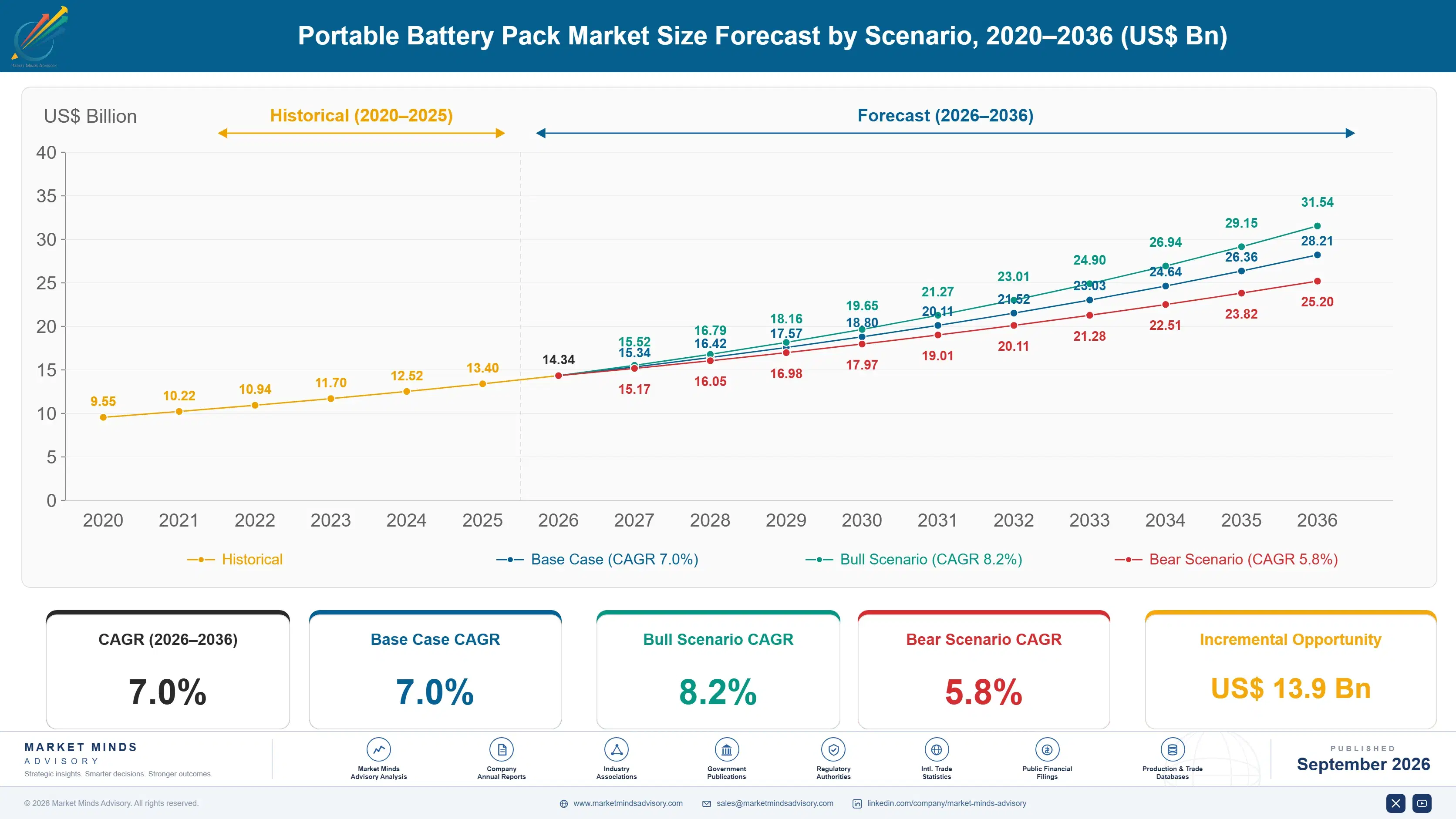
Portable Battery Pack Market Forecast Scenarios

portable-battery-pack-market-size-forecast-scenario-1790003546668
Between 2020 and 2025 the category matured from a commodity travel accessory into a differentiated hardware segment, with USB-C adoption, GaN charger compatibility, and capacity labeling standards reshaping product design decisions across nearly every manufacturer competing for retail shelf space. Historical annual growth ran near six percent as smartphone penetration plateaued in mature markets worldwide, while emerging market volume kept climbing steadily.
The base case assumes seven percent annual growth through 2036, driven by three mechanisms: rising average selling prices as fast-charging wattage climbs, expanding outdoor power station adoption among campers and emergency preparedness buyers, and replacement cycles shortening as airlines and safety regulators phase out older, uncertified cell designs from retail shelves across nearly every major consumer market worldwide over the coming decade. Manufacturers that align product roadmaps to these three forces early should capture.
A bull scenario centers on wide adoption of bidirectional home backup power banks that double as small appliance UPS units during grid outages, expanding the addressable buyer base substantially beyond current levels. The bear risk is oversupply from Chinese contract manufacturers compressing average selling prices faster than unit volume growth can compensate across the category, squeezing profitability for mid-tier brands lacking scale.

Fast-Charging Standards Reshape Portable Power Economics

Lithium-ion cell pricing sets the floor for portable battery pack economics, since cells typically represent close to half of finished product cost across nearly every price tier sold today. Cell price swings ripple through retail pricing within a single sales cycle, leaving little room for brands to absorb sudden input cost spikes without adjusting shelf prices for consumers almost immediately.
MARKET CONCENTRATIONCR5 42%Top five brands hold a large combined market presence.
AVERAGE SELLING PRICE+6% YoYPrices climb steadily as wattage output and capacity rise.
TOP PRODUCING COUNTRYChina 68%One single country supplies most global finished unit assembly.
CAPACITY UTILISATION76%Assembly lines run below their theoretical maximum output level.
TRADE INTENSITYHighMost units cross an international border before reaching buyers.
CELL COST SHARE48% of COGSLithium cells remain the single largest cost component.
Brand differentiation increasingly hinges on charging speed claims, safety certification, and warranty coverage rather than raw capacity alone. Buyers comparing similarly priced units now weigh watt output and pass-through charging support as heavily as milliamp-hour ratings, narrowing the room for undifferentiated commodity entrants to compete on price alone in crowded online marketplaces where reviews and star ratings increasingly drive purchase decisions more than headline capacity numbers ever did.
Retail channel mix is shifting toward direct online sales, where brands capture more margin and control the customer relationship, away from traditional electronics retail shelving where impulse purchases once dominated category volume. That shift is reshaping marketing budgets toward performance advertising and away from in-store point of sale displays, a transition that smaller regional retailers have struggled to keep pace with financially.
"Cell chemistry, not brand marketing, decides which power banks survive the next round of airline carriage restrictions. The vendors treating certification as a checkbox exercise will find their inventory stranded at customs while competitors ship."
Principal Analyst, Consumer Technology Hardware Practice · MMA Technology: Portable Power and Mobile Charging Hardware Practice · September 2026

Market Trends

USB-C Power Delivery 3.1 Standardization Accelerates Very Rapidly.

USB-C Power Delivery 3.1 support has moved from a premium feature to a baseline expectation across nearly every price tier sold today. The standard's 240-watt ceiling allows a single power bank to charge a laptop, tablet, and phone simultaneously without dedicated chargers for each device carried separately. Retailers now require PD 3.1 certification labeling on packaging in several major markets, and brands lacking compliant chipsets are losing shelf placement to competitors that qualified early, a gap that keeps widening each quarter as certification enforcement tightens across more jurisdictions and more major retail chains worldwide each.
Market Impact: Sustains demand across 4 billion smartphones.

Solar Integrated Outdoor Power Stations Gain Mainstream Traction.

Outdoor power stations combining large lithium battery banks with foldable solar panels have moved beyond niche camping gear into mainstream emergency preparedness purchases across many households. Grid outage events in several countries drove a visible spike in household interest, and manufacturers have responded with modular designs that let buyers add extra battery capacity over time rather than replacing the entire unit outright, extending average selling prices well above compact power bank tiers and lengthening the typical customer relationship considerably beyond a single purchase into a multi-year expansion sequence that few competing product categories can match today.
Market Impact: Sets 100 watt hour carry limit.

Market Opportunities and Growth Drivers

Smartphone Battery Life Plateau Sustains Accessory Demand Strongly.

Smartphone battery capacity growth has slowed as manufacturers prioritize thinner designs over larger cells, leaving daily battery life essentially flat across recent device generations sold worldwide. That plateau keeps portable charging accessories relevant even as phone makers tout improved software power management features in every marketing campaign. Heavy users of video streaming, navigation, and mobile gaming continue to drain a full charge before the day ends, sustaining consistent replacement demand for power banks across every major smartphone market and income bracket worldwide. Device makers show little sign of reversing this design tradeoff anytime soon, which keeps the accessory.
Market Impact: Cell costs swing 20 percent yearly.

Airline Carry On Battery Rules Standardize Purchasing Decisions.

Aviation authorities across major markets have converged on a 100 watt-hour carry-on threshold for lithium batteries, giving manufacturers a clear design target and giving travelers a simple purchasing rule to follow at checkout. Brands now label capacity in watt-hours prominently on packaging specifically to help units clear airport security without confusion, and several airlines have begun enforcing spot checks on unlabeled units, pushing uncertified low-cost imports out of duty-free and airport retail channels entirely within a short span of time. Manufacturers that align product labeling with this converged global standard early gain a meaningful edge in travel.
Market Impact: Overstates true capacity by 50 percent.

Market Restraints and Challenges

Lithium Cell Price Volatility Compresses Margins Quite Significantly.

Lithium carbonate price swings feed directly into cell costs, which make up close to half of finished product cost for most power bank makers operating today. The root cause is thin global refining capacity concentrated among a handful of processors, leaving little buffer when demand spikes unexpectedly across multiple end markets at once. Smaller brands lack the purchasing volume to negotiate fixed-price supply contracts that shield larger competitors, so margin compression hits them hardest during every downturn. Several mid-tier vendors are now pooling procurement through third-party buying groups to secure better cell pricing terms and more predictable delivery.
Market Impact: Enables 240 watt multi device charging.

Counterfeit Capacity Claims Undermine Consumer Trust Quite Broadly.

A persistent share of low-cost power banks sold through third-party online marketplaces overstate their true capacity, sometimes by more than double the labeled rating printed on the packaging. The root cause is minimal enforcement of labeling accuracy in cross-border e-commerce shipments, which slip past customs inspection in small parcel volumes routed through multiple intermediaries. The commercial impact falls hardest on legitimate brands, whose products appear overpriced next to inflated competitors on the same search results page. Several marketplaces have begun requiring third-party lab verification before listing approval as a mitigation measure ahead of the next major seasonal.
Market Impact: Adds 2 kilowatt hour capacity tier.
3 additional market trends, 4 additional growth drivers, and 2 additional restraints and challenges are covered in the full report. Contact sales@marketmindsadvisory.com to access the complete intelligence.

Segment CAGR and Growth Architecture

Portable battery packs segment cleanly by product form factor, spanning compact pocket units through high-capacity outdoor power stations. Each tier serves a distinct buyer occasion, from daily commuting to multi-day off-grid use, with capacity, weight, and price scaling together across the range of products sold worldwide today, reflecting how differently each buyer segment actually uses the hardware.
portable-battery-pack-market-market-share-analysis-1790003547278

Solar Integrated Outdoor Power Stations

Solar integrated outdoor power stations combine large lithium battery banks, typically above 500 watt-hours, with foldable solar panel accessories sold separately or bundled together as a kit. Demand concentrates among campers, van-life travelers, and households buying emergency backup power for grid outage protection during storm season. Manufacturers have moved toward modular battery expansion packs, letting buyers scale capacity over several purchases rather than committing to one large unit upfront at the outset. Average selling prices sit well above every other segment, and repeat attachment sales of solar panels and expansion modules extend customer lifetime value meaningfully beyond the initial hardware purchase across this fast-growing category of products sold through both specialty outdoor retailers and general online marketplaces alike.
CAGR 10.5%

Fast Charging Compact Power Banks

Fast charging compact power banks, generally under 20,000 milliamp-hours, remain the highest volume segment by unit count, sold primarily as everyday carry accessories for smartphones and small tablets across every income bracket. USB-C Power Delivery support above 65 watts has become standard even at mid-range price points, letting a single compact unit charge a laptop in a pinch when travelers forget their primary charger at home. Competitive intensity is highest here, with dozens of brands competing on price per watt-hour and fast-shipping availability through online marketplaces, compressing margins even as unit volumes continue climbing steadily across nearly every consumer electronics retail channel worldwide each year without exception, leaving thinner margins for smaller brands lacking meaningful manufacturing scale advantages.
CAGR 8.5%
Full segment breakdown across 6 segments available in the complete report.

Regional Architecture and Country Demand Map

Regional demand tracks smartphone density, disposable income, and outdoor recreation culture, with East Asia leading on combined manufacturing scale and domestic consumer volume, and North America close behind on premium brand spending across every major retail channel and distribution format tracked in this study across the full.

North America

Premium brand spending anchors North American demand, where buyers routinely pay a substantial markup for certified safety ratings and extended warranty coverage over unbranded imports sold through discount channels. Outdoor recreation and emergency preparedness purchases have become a meaningful growth pocket, accelerated by visible grid outage events in several states over recent years. Retailers report that bundled solar panel and power station kits now outsell standalone compact power banks in outdoor specialty channels across the region. Direct-to-consumer online sales continue capturing share from traditional electronics retail shelving as brands seek to protect margin and control the customer relationship end to end, from first purchase through eventual replacement several long years down the road for most households and families.
Share: 26% | CAGR: 7.3% (2026 to 2036)

Western Europe

Regulatory pressure shapes the Western European market more than any other region, with strict cell safety certification and mandatory watt-hour capacity labeling pushing uncertified low-cost imports out of major retail chains across the continent. Germany and the United Kingdom lead regional volume, driven by strong outdoor recreation culture and dense urban commuter populations who prioritize compact daily carry units above larger alternatives. Airline carry-on lithium battery enforcement is stricter here than in most other regions, reinforcing demand for clearly labeled, certified products over gray-market alternatives sold through informal channels. Sustainability labeling requirements are also beginning to influence packaging and repairability design choices among premium brands operating across the bloc as enforcement tightens steadily with each passing calendar year.
Share: 20% | CAGR: 5.6% (2026 to 2036)
Regional intelligence for 5 additional markets available in the complete report: East Asia, South Asia and Pacific, Latin America, Middle East and Africa, Eastern Europe. Contact sales@marketmindsadvisory.com.
portable-battery-pack-market-country-cagr-analysis-1790003547810

Capturing Value Beyond the Cell

Portable battery pack margins increasingly come from attachment sales, certification positioning, and channel control rather than raw capacity pricing. Manufacturers that build repeat purchase relationships and premium accessory portfolios around a base unit capture disproportionate lifetime value from every customer relationship they establish and continue nurturing well past the original purchase date, quarter after quarter.

Modular Expansion Pack Attachment Sales Strategy

Selling outdoor power stations as an expandable base unit, with separate battery expansion modules and solar panel accessories, converts a single hardware sale into a multi-purchase relationship spanning several years. Buyers who start with a base unit priced near 400 dollars frequently add one or two expansion modules within the first year, lifting total customer spend by roughly 60 percent above the initial transaction. Brands that bundle expansion compatibility into their product roadmap early retain customers through multiple replacement cycles rather than losing them to competitor upgrades sold through rival online storefronts each new buying season.
Market Impact: Lifts customer lifetime spend by 60 percent overall.

Premium Certification and Warranty Tier Positioning

Brands that invest in UL, CE, and airline compliance certification can charge a meaningful premium, often 25 to 35 percent above uncertified competitors offering similar specifications, because buyers increasingly associate certification with both safety and airport travel reliability. Extended warranty tiers of two to three years further reinforce this pricing power, since buyers view a longer warranty as evidence of cell quality. Vendors lacking certification budgets are increasingly locked out of premium retail shelving and corporate gifting contracts entirely across nearly every major market they try to enter with a brand new certified product line.
Market Impact: Supports 30 percent price premium over uncertified units sold.

Direct to Consumer Subscription Replacement Programs

A small but growing set of brands now offer subscription-style replacement programs, shipping a fresh unit every 18 to 24 months as cell capacity degrades, billed as a recurring annual fee rather than a one-time purchase at checkout. Early adopters report retention rates well above one-time purchase customers, since the recurring billing relationship keeps the brand top of mind ahead of the next replacement decision each cycle. This model remains a minority of total revenue today but is expanding fastest among corporate bulk buyers issuing devices to field staff across multiple industries and business sectors worldwide today.
Market Impact: Generates recurring revenue every 18 months from subscribers.

Who Controls the Margin Pool

Concentration sits at a moderate level, with the top five brands by annual shipment volume holding roughly 42 percent combined share of the category. Anker Innovations leads by a meaningful margin over the next closest challenger, built on years of direct-to-consumer brand investment and broad retail distribution that smaller rivals struggle to match at comparable scale across nearly every product tier it competes.
Current competitive activity centers on fast-charging wattage claims, certification badges displayed prominently on packaging, and expanding outdoor power station product lines across nearly every price tier. Several mid-tier brands are pursuing direct-to-consumer subscription and bundling models to differentiate on service rather than specification sheets alone, while larger players continue expanding manufacturing footprint outside China to reduce tariff exposure going forward into the next several years.

Emerging pressure comes from Chinese domestic brands scaling aggressively through e-commerce platforms with thin margins and rapid product refresh cycles, threatening to squeeze mid-tier Western challengers out of the value segment entirely within a few years. Rankings could shift meaningfully if any top-five player secures a dominant retail exclusivity deal in North America or expands aggressively into underserved rural Southeast Asian markets.
portable-battery-pack-market-company-positioning-matrix-1790003548349

Competitive Moat and Risk Dimensions

ANKER INNOVATIONS

Moat: Brand and distribution scale

Anker built its position through years of direct online brand investment and now holds broad retail shelf presence across nearly every major market worldwide. That combination of brand recognition and distribution reach lets it command premium pricing over unbranded competitors while still moving very high unit volumes, a difficult balance for smaller.
ANKER INNOVATIONS

Risk: Chinese domestic price pressure

Domestic Chinese brands selling directly through e-commerce platforms undercut Anker's pricing on comparable specifications, particularly in the compact power bank tier where differentiation is hardest to sustain over time. If that price pressure spreads into Anker's core Western markets, margin compression could outpace the volume growth needed to offset it.
XIAOMI CORPORATION

Moat: Hardware portfolio bundling

Xiaomi sells power banks as part of a broader hardware lineup spanning phones, wearables, and smart home devices, letting it cross-promote accessories to an existing customer base at low incremental marketing cost. That built-in distribution advantage is difficult for standalone power bank brands to match without a comparable device portfolio.
XIAOMI CORPORATION

Risk: Thin margin commodity positioning

Xiaomi competes heavily on price, which keeps unit margins thin compared to premium-positioned rivals across nearly every product category it enters. If component costs rise faster than Xiaomi can pass through to already price-sensitive buyers, profitability on the power bank line could come under real pressure well.

Players Tracked

Prominent Players

Anker Innovations
Xiaomi Corporation
Romoss Technology
Belkin International
Goal Zero

Other Key Players

Mophie
RAVPower
Aukey Technology
INIU
Baseus
EcoFlow
Jackery
Bluetti Power
Duracell
Energizer Holdings
Samsung Electronics
TP-Link Systems
Zendure Power
Nitecore
Ugreen Group

Recent Developments

MARCH 2026

Anker Innovations: capacity expansion

Anker Innovations announced an expanded assembly line in Vietnam intended to reduce reliance on Chinese-origin final assembly ahead of anticipated tariff changes affecting several key export markets. The new line adds meaningful annual unit capacity dedicated to outdoor power station products bound for North American and European.
Signal: Signals accelerating diversification away from single country manufacturing exposure entirely across the broader global competitive field this year.
JUNE 2026

Goal Zero: acquisition

Goal Zero acquired a small solar panel component maker to secure direct control over its outdoor power station supply chain, reducing dependence on third-party panel suppliers whose pricing and lead times had grown less predictable following recent trade policy changes across the wider global region this year.
Signal: Signals vertical integration becoming a competitive necessity in outdoor power stations for smaller brands too going forward now.
AUGUST 2026

Xiaomi Corporation: joint venture

Xiaomi Corporation formed a joint venture with a regional Southeast Asian distributor to accelerate retail penetration across a market where its brand recognition previously lagged competitors with longer-established local distribution partnerships and retail shelf relationships built over many long years across the entire wider region overall.
Signal: Signals emerging market retail access becoming a key battleground for scaled global brands worldwide over the coming years.

Cell Chemistry Cost Exposure

Lithium-ion cells account for close to half of finished product cost, sourced predominantly from Chinese and South Korean cell manufacturers who supply the vast majority of global consumer electronics battery demand each year. Plastics housings and printed circuit board controllers make up most of the remaining cost base, both similarly concentrated in East Asian supply chains as well, quite tightly.
Lithium carbonate prices swung sharply between 2022 and 2024, according to IEA critical minerals reporting, as electric vehicle demand pulled supply away from consumer electronics cell buyers competing for the same limited capacity. Smaller power bank makers without long-term supply contracts faced cell cost increases of over 30 percent within a single procurement cycle, forcing several to delay new product launches or raise retail prices mid-cycle across multiple global markets.

Scaled brands with multi-year fixed-price cell contracts absorbed that volatility with far less retail price disruption than smaller competitors buying on the spot market at prevailing rates. This exposure gap compounds by geography too, since Chinese-headquartered assemblers sit closer to cell suppliers than Western brands, shortening lead times and reducing currency conversion risk on every single new purchase order they place with suppliers.
portable-battery-pack-market-cost-volatility-analysis-1790003548549

Multi Year Fixed Price Cell Supply Contracts

Locking in cell prices through multi-year supply agreements with major manufacturers shields larger brands from spot market volatility, though it requires forecasting volume commitments years in advance and carries penalty exposure if actual demand falls short of contracted minimums during a downturn or unexpected slowdown across one or more major end markets currently served by the brand.

Alternative Cell Chemistry Qualification Programs

Several manufacturers are qualifying sodium-ion and alternative cell chemistries as a hedge against lithium price swings, even though these chemistries currently deliver lower energy density per unit weight than standard lithium-ion cells. Early qualification work positions those brands to shift sourcing quickly if lithium costs spike again unexpectedly again across the wider global supply chain network.

Regional Assembly Diversification Beyond China

Shifting final assembly to Vietnam, India, and Mexico reduces single-country tariff and supply disruption exposure, though component sourcing for cells and controllers still traces back to the same concentrated East Asian suppliers regardless of where final assembly physically takes place today, regardless of brand size or country of headquarters origin when everything is fully considered.

Portfolio Architecture for Margin Defence

Gross margins vary widely across the portfolio, from thin single-digit margins on unbranded commodity compact power banks up to healthy margins on certified premium and outdoor power station tiers sold through specialty channels. Volume sits overwhelmingly in the commodity-adjacent tier, but value concentrates in the smaller premium and next-generation tiers instead across nearly every regional market tracked in this full analysis and forecast study period.
The tension between chasing unit volume and protecting margin plays out visibly in retail assortment planning, where brands must decide how many commodity-tier SKUs to carry purely for shelf presence against how much marketing budget to dedicate toward premium tier storytelling that actually drives profit and long-term brand equity across the wider portfolio of products sold worldwide during each calendar.

High-value pools concentrate in outdoor power stations and certified fast-charging premium units, where buyers pay for peace of mind on safety and reliability rather than raw capacity per dollar spent. That is where most brands are now directing new product development spend and marketing investment for the coming years, well ahead of any planned commodity-tier initiative or campaign currently underway.

Compact Uncertified Power Banks

Thin margin compact units sold primarily on price per watt-hour through online marketplaces and discount retail, competing almost entirely on capacity and shipping speed rather than brand reputation or formal certification credentials.
Gross Margin: 8-15%

Certified Fast Charging Units

Certified units carrying UL and CE marks with extended warranty coverage, sold through branded retail and direct online channels at a meaningful premium over uncertified equivalents sold quite widely elsewhere.
Gross Margin: 28-38%

Solar Integrated Modular Power Stations

High-capacity modular systems built around expandable battery packs and solar charging accessories, targeting emergency preparedness and outdoor recreation buyers willing to pay for long-term expandability, reliability, and future-proofing of their overall system hardware investment.
Gross Margin: 35-45%
portable-battery-pack-market-portfolio-architecture-1790003549050

High-value Sub-segments and Strategic Watch-out

Solar Integrated Outdoor Power Stations

The highest value, fastest growing pocket of the market, driven by emergency preparedness buying and modular expansion sales that extend customer lifetime value well beyond the initial hardware purchase across multiple years and product generations, a pattern few other consumer electronics categories can easily replicate at scale.
Gross Margin: 35-45%

Certified Fast Charging Compact Units

A high-value, moderate-growth pocket where certification and warranty positioning support durable pricing power even as unit volume growth moderates relative to newer outdoor power categories gaining share steadily, though it still commands healthy margins across nearly every certified retail price band tracked worldwide today and beyond.
Gross Margin: 28-38%

Uncertified Commodity Compact Power Banks

The volume core of the market, competing almost entirely on price per watt-hour through online marketplaces, generating thin margins but sustaining the largest absolute unit shipment base globally each year, a foundation the entire industry still depends on for its baseline manufacturing scale and cost structure.
Gross Margin: 8-15%

Counterfeit Capacity Marketplace Listings

A strategic watch-out rather than a true revenue segment, where mislabeled capacity claims on third-party marketplaces erode consumer trust and pressure legitimate brands to invest more heavily in anti-counterfeiting labeling programs and dedicated marketplace enforcement partnerships going forward across nearly every single region tracked worldwide today.
Gross Margin: n/a

Repeat Purchase Economics

Portable battery packs are not annuity products in the software licensing sense, but replacement cycles create a recurring revenue pattern of their own particular kind. Cell degradation after roughly 500 charge cycles pushes most buyers back into the market within three to four years, generating a steady replacement tail beneath first-purchase volume that manufacturers can plan production capacity around with reasonable confidence.
Adoption depth varies sharply by end use. Commuters and business travelers tend to own one compact unit and treat it as disposable once it fails, while campers, contractors, and emergency preparedness buyers invest in larger capacity outdoor power stations they expect to service and repair, creating a distinct high-attachment ownership pattern within that vertical that extends well beyond the typical two to three year replacement window seen elsewhere.

Buyer profiles are shifting generationally as younger consumers increasingly treat a power bank as a standard bag item bought alongside a new phone, rather than a specialty accessory purchased only before travel, compressing the historical seasonal spike in category demand that once concentrated heavily around summer travel and holiday gift-giving periods of the calendar year.
portable-battery-pack-market-end-use-penetration-index-1790003549544

Where Portable Power Value Concentrates

These are among the four positions where our research anticipates prominent divergence between winners and laggards over the coming forecast period. Each is grounded in the demand model, the regulatory perimeter, and the announced capacity pipeline.
01 / CERTIFICATION AND COMPLIANCE STRATEGY

Certification investment separates durable premium brands from commodity price takers

Brands that invest early in UL, CE, and airline compliance certification build a defensible pricing advantage that unbranded competitors cannot easily replicate at comparable cost or speed. That advantage compounds as regulators tighten labeling enforcement across major retail markets worldwide, pushing uncertified imports off shelves entirely within a short span of time measured in months rather than years. Vendors treating certification as optional will find their addressable retail channels shrinking steadily through the forecast period as enforcement widens across nearly every single jurisdiction that matters.
02 / MODULAR PRODUCT ARCHITECTURE INVESTMENT

Modular outdoor power systems capture the highest customer lifetime value overall

Expandable battery and solar accessory architectures turn a single hardware sale into a recurring purchase relationship worth substantially more than the initial transaction across nearly every buyer segment tracked. Brands committing engineering resources to modular compatibility now will capture disproportionate share of the fastest-growing segment through 2036 as demand keeps accelerating. Competitors relying solely on standalone unit sales risk losing customers to whichever brand locks in the expansion advantage first across every major regional market tracked worldwide, spanning from North America through East Asia and well beyond that.
03 / SUPPLY CHAIN GEOGRAPHIC DIVERSIFICATION

Manufacturing footprint diversification reduces tariff and disruption exposure meaningfully

Reliance on a single manufacturing country leaves brands exposed to tariff shifts and logistics disruption that competitors with diversified assembly footprints can absorb more easily during periods of stress. Vietnam, India, and Mexico are emerging as credible secondary assembly hubs even though component sourcing still traces back to concentrated cell suppliers. Brands that diversify assembly earliest will hold a cost and resilience advantage over slower-moving rivals across the industry, particularly when abrupt trade policy shifts occur without very much advance warning at all being given.
04 / ANTI COUNTERFEITING TRUST PROTECTION

Marketplace trust protection determines which brands retain pricing power long term

Counterfeit capacity claims on third-party marketplaces erode consumer trust across the entire category, not just for the specific brands being misrepresented online by opportunistic sellers. Legitimate manufacturers investing in verified listing programs and clear authenticity labeling protect pricing power that would otherwise erode as buyers grow skeptical of published specifications across nearly every price tier. This protection becomes more valuable as marketplace volume keeps growing faster than enforcement capacity worldwide, particularly in fast-growing emerging markets where oversight resources remain relatively quite thin and stretched thin.

Engagement Snapshot From the Field

A live engagement with an industry participant carrying material or product regulatory and market exposure ahead of a defining policy shift, showing how our research translates into a defensible multi-year portfolio strategy.
MARKET MINDS ADVISORY · CLIENT ENGAGEMENT SUMMARY
Portable Battery Pack Producer Strategic Portfolio Review and Transition Roadmap 2026·Investment Scenario on Portable Battery Pack Exposure Evaluation 2025-26
CLIENT PROFILE
The client is a mid-tier consumer electronics brand with an established compact power bank product line sold primarily through North American and Western European online retail channels. Annual revenue from portable power products was approximately 180 million dollars (client-reported, unverified by MMA) prior to the engagement, concentrated almost entirely in the commodity-adjacent tier of the market at the time the engagement began.
STRATEGIC CHALLENGE
The client's product line had stalled in a low-margin commodity tier, facing intensifying price pressure from Chinese domestic brands selling through the same online marketplaces at similar price points. Leadership needed a credible path into higher-margin premium and outdoor power segments without alienating its existing price-sensitive customer base or requiring an entirely new overall corporate brand identity altogether.
MMA APPROACH
MMA conducted primary interviews with retail buyers and end consumers across three countries, benchmarked the client's certification and warranty positioning against premium competitors in the same channels, and modeled margin outcomes across three portfolio restructuring scenarios ranging from incremental premium tier entry to a full brand repositioning effort spanning multiple future product generations and global retail distribution channels.
KEY FINDINGS
  1. Consumers consistently associated certification badges with safety more than any single specification figure, including headline capacity ratings printed clearly on the outer packaging box.
  2. A modular outdoor power station line could reach positive gross margin within eighteen months given the client's existing manufacturing relationships and component sourcing arrangements already established.
  3. Retail buyers indicated willingness to expand shelf space for the brand if warranty coverage matched leading premium competitors within about two years of launch.
  4. Subscription-style replacement programs tested well among existing customers but required simplified billing communication to avoid subscription fatigue concerns among younger buyers overall.
CLIENT PROFILE
The client is a mid-tier consumer electronics brand with an established compact power bank product line sold primarily through North American and Western European online retail channels. Annual revenue from portable power products was approximately 180 million dollars (client-reported, unverified by MMA) prior to the engagement, concentrated almost entirely in the commodity-adjacent tier of the market at the time the engagement began.
STRATEGIC CHALLENGE
The client's product line had stalled in a low-margin commodity tier, facing intensifying price pressure from Chinese domestic brands selling through the same online marketplaces at similar price points. Leadership needed a credible path into higher-margin premium and outdoor power segments without alienating its existing price-sensitive customer base or requiring an entirely new overall corporate brand identity altogether.
MMA APPROACH
MMA conducted primary interviews with retail buyers and end consumers across three countries, benchmarked the client's certification and warranty positioning against premium competitors in the same channels, and modeled margin outcomes across three portfolio restructuring scenarios ranging from incremental premium tier entry to a full brand repositioning effort spanning multiple future product generations and global retail distribution channels.
KEY FINDINGS
  1. Consumers consistently associated certification badges with safety more than any single specification figure, including headline capacity ratings printed clearly on the outer packaging box.
  2. A modular outdoor power station line could reach positive gross margin within eighteen months given the client's existing manufacturing relationships and component sourcing arrangements already established.
  3. Retail buyers indicated willingness to expand shelf space for the brand if warranty coverage matched leading premium competitors within about two years of launch.
  4. Subscription-style replacement programs tested well among existing customers but required simplified billing communication to avoid subscription fatigue concerns among younger buyers overall.
RECOMMENDED STRATEGY
Phase 1: Phase one: pursue UL and CE certification across the full compact power bank line within twelve full months of launch. Phase 2: Phase two: launch a modular outdoor power station line targeting the certified premium tier with expandable battery and solar panel accessories. Phase 3: Phase three: pilot a subscription replacement program among existing loyalty customers before expanding it more broadly nationwide over the following.
OUTCOME
Within twelve months of certification completion, the client reported a 22 percent increase in average selling price across its certified product line and secured expanded retail shelf placement with two major North American retail chains within the very first full calendar year following launch (client-reported, unverified by MMA).

Frequently Asked Questions

Foundational context covering the market sizes, CAGR, scope, country, region and competition that inform every finding below. This section is provided to cover basics and most often pre-purchase conversations, answered from the MMA Primary Research Dataset.

What is the current size of the Portable Battery Pack Market?

The global portable battery pack market was valued at approximately 13.4 billion dollars in 2025, covering compact power banks, solar-integrated units, and outdoor power stations sold across every major retail channel worldwide.

How large will the Portable Battery Pack Market be by 2036?

The market is projected to reach approximately 28.21 billion dollars by 2036, up from 14.34 billion dollars in 2026, an incremental gain of roughly 13.87 billion dollars over the forecast period.

What is the CAGR for the Portable Battery Pack Market 2026 to 2036?

The market is expected to grow at a compound annual rate of 7.0 percent between 2026 and 2036, with a bull case near 8.2 percent and a bear case near 5.8 percent annually.

Which segment is growing fastest?

Solar integrated outdoor power stations lead segment growth at 10.5 percent annually, roughly 1.5 times the overall market rate, driven by emergency preparedness and outdoor recreation demand.

Who are the major companies in the Portable Battery Pack Market?

Anker Innovations, Xiaomi Corporation, Romoss Technology, Belkin International, and Goal Zero lead the market on annual shipment volume, together holding roughly 42 percent of combined global shipments.

Which country is growing fastest?

India leads country-level growth at approximately 9.0 percent annually, driven by rising smartphone penetration and unreliable grid electricity that makes portable charging closer to a daily necessity.

Report Segmentation Architecture

The full report scope spans multiple orthogonal segmentation dimensions, with cross-tabulated demand data provided for each dimension pair. Coverage extends further to regional breakdowns, trend trajectories, and the competitive detail needed to support segment-level decision-making.

By Product Form Factor

  • Compact Fast Charging Power Banks
  • Mid Capacity Multi Device Power Banks
  • Wireless Charging Power Banks
  • Rugged Outdoor Compact Units
  • Solar Integrated Outdoor Power Stations
  • Vehicle Jump Starter Combo Packs

By End-Use Industry

  • Smartphone and Tablet Charging
  • Laptop and Computing Device Charging
  • Outdoor Recreation and Camping
  • Emergency Preparedness and Backup Power
  • Photography and Videography Equipment

By Commercial Dimension

  • Direct to Consumer Online
  • Third Party E-Commerce Marketplaces
  • Electronics and Specialty Retail
  • Airport and Travel Retail

By Region

  • North America
  • Western Europe
  • East Asia
  • South Asia and Pacific
  • Latin America
  • Middle East and Africa
  • Eastern Europe

Scope, Methodology, and Coverage

Every figure in this report is reproducible from documented input assumptions. The scope below maps the historical period, the forecast horizon, the segmentation dimensions, and the countries covered, alongside the underlying primary and qualitative methodology.
Historical Period
2020 to 2025
Forecast Period
2026 to 2036
Base Year
2025 (USD billions; MMA Primary Research Dataset, September 2026)
Market Definition
The portable battery pack market covers standalone rechargeable power bank devices, including lithium-ion and lithium-polymer units, solar-integrated outdoor power systems, and high-capacity portable power stations used to recharge phones, laptops, cameras, and small appliances away from fixed electrical outlets. It excludes built-in device batteries, wireless charging pads without internal storage cells, and stationary home battery storage systems.
Quantitative Units
USD Billion, CAGR (%) 2026-2036
Segmentation Dimensions
Product Form Factor, End-Use Industry, Commercial Dimension, Region
Regions Covered
North America, Western Europe, East Asia, South Asia and Pacific, Latin America, Middle East and Africa, Eastern Europe
Countries Covered
US, Canada, Germany, UK, France, China, Japan, South Korea, India, Australia, Brazil, Mexico, UAE, South Africa, Poland
Key Companies Profiled
20
Quantitative Methodology
Primary survey, n=3,800 respondents, Q4 2025, six countries; demand-side model with trade association cross-validation
Qualitative Methodology
47 expert interviews, Q4 2025; applied to validate demand model assumptions, identify emerging dynamics, and assess competitive positioning
Report Format
PDF and XLSX data workbook (Word format preview document)
Publisher
Market Minds Advisory
Report Code
MMA-2026-TEC-684
Published
September 2026
Contact
sales@marketmindsadvisory.com | www.marketmindsadvisory.com

Purchase the full Portable Battery Pack Market Report (2026 to 2036).

The full report delivers a complete strategic assessment of the portable battery pack market, spanning detailed segment-level forecasts, regional demand modeling, and competitive benchmarking across the top twenty market participants. It includes proprietary primary survey data covering three thousand eight hundred respondents and forty-seven expert interviews conducted in the fourth quarter of 2025. Buyers receive access to editable data tables alongside the narrative analysis for internal strategic planning use across procurement, product, and investment teams. The analysis supports board-level decisions on portfolio investment, channel strategy, and manufacturing footprint over the decade ahead.
Segment level revenue forecasts through the year 2036
Regional market sizing across seven world regions
Competitive benchmarking of twenty key market participants
Editable data tables for internal strategic planning
Primary survey data from 3,800 global respondents
Expert interview insights from 47 industry practitioners

Built For The People Who Decide

From boardroom strategy to bench-side execution, this report is read cover-to-cover by leaders shaping the next decade of their industry, turning demand scenarios, market dynamics and valuation benchmarks into decisions.
CXOs/ Presidents/ VPs/ Managers
M&A and Corporate Development
Strategy Teams and R&D Heads
Procurement and Product Directors
Regulatory and Compliance Leaders
Investor Relations and Equity Analysts