Market Minds Advisory
Portable Audiometer Calibration System Market

Portable Audiometer Calibration System Market: Portable Audiometer Calibration System Market. Compliance, Digitisation, and Field Verification Economics.

Hospitals, occupational clinics, and audiology chains face pressure to keep hearing test equipment within calibration tolerance, even as portable field testing spreads faster than in-house metrology staff and accredited lab capacity can support.

Lead Analyst

Published

September 2026

Make Smarter Decisions with Customized Research Insights

Request a free sample report and evaluate market opportunities, growth trends, and competitive dynamics relevant to your business needs.

2025 MARKET VALUE$0.2BMarket Size 2025
2036 FORECAST VALUE$0.4BBase Case , 2026 to 2036
CAGR 2026 TO 20367.5 %Bull 8.8% / Bear 6.3%
INCREMENTAL OPPORTUNITY$0.2BNet 10- year value creation
EXPANSION MULTIPLE2.06x2036 value over 2026 base
Strategic Levers
M&A Pipeline
Regional Outlook
Country Rankings
Competitive Intelligence
Segmental Deep-dive
Call-Us : 91 93563 13602

Executive Snapshot and Market Trajectory.

Occupational hearing conservation programmes and portable audiometry field testing are pushing calibration frequency higher, forcing clinics and employers to choose between costly accredited lab turnaround and faster on-site verification systems. Suppliers that move early on this front tend to hold the advantage longest.
Demand concentrates around annual and biannual compliance calibration cycles tied to workplace hearing conservation regulation, with occupational health providers and hospital audiology departments the largest buyer segments across mature healthcare and industrial safety markets. Buyers increasingly treat this as a standard requirement rather than an exception. The effect compounds as replacement cycles turn over across the installed base. MMA expects this dynamic to persist through most of the forecast window.
Competitive character splits between legacy acoustic calibrator manufacturers defending accredited laboratory relationships and newer entrants offering cloud-connected field calibration units that shrink turnaround from weeks to hours for distributed clinic networks. MMA expects this dynamic to persist through most of the forecast window. This pattern is already visible across recent procurement cycles. Suppliers that move early on this front tend to hold the advantage longest, a distinction increasingly visible in recent multi-site procurement decisions.
Market Definition
This report covers portable calibration systems and reference standards used to verify audiometer accuracy, spanning manual analog, automated digital, and cloud-connected variants. Audiometers themselves and broader medical device calibration categories unrelated to audiometry are excluded.
Base Year Value
$0.2B in 2025 (MMA Primary Research Dataset, September 2026)
Forecast Period
2026 to 2036, eleven discrete annual values
CAGR
7.5% base case. Bull 8.8%. Bear 6.3%.
Fastest Growth Segment
Cloud-Connected Remote Calibration Verification Systems: 14.2% CAGR
Fastest Growth Country
India: 10.5% CAGR
Fastest Growth Region
South Asia and Pacific: 9.5% CAGR
Largest Region
North America: 30% of 2025 global value
Market Leaders
Interacoustics A/S, Natus Medical Incorporated, MAICO Diagnostics GmbH, GN Otometrics, Larson Davis. Source: MMA Analysis based on company annual reports.
Primary Survey
n=3,800 procurement and R&D decision-makers, Q4 2025, six countries
Methodology
Demand-side build-up, cross-validated against public data, 47 expert interviews

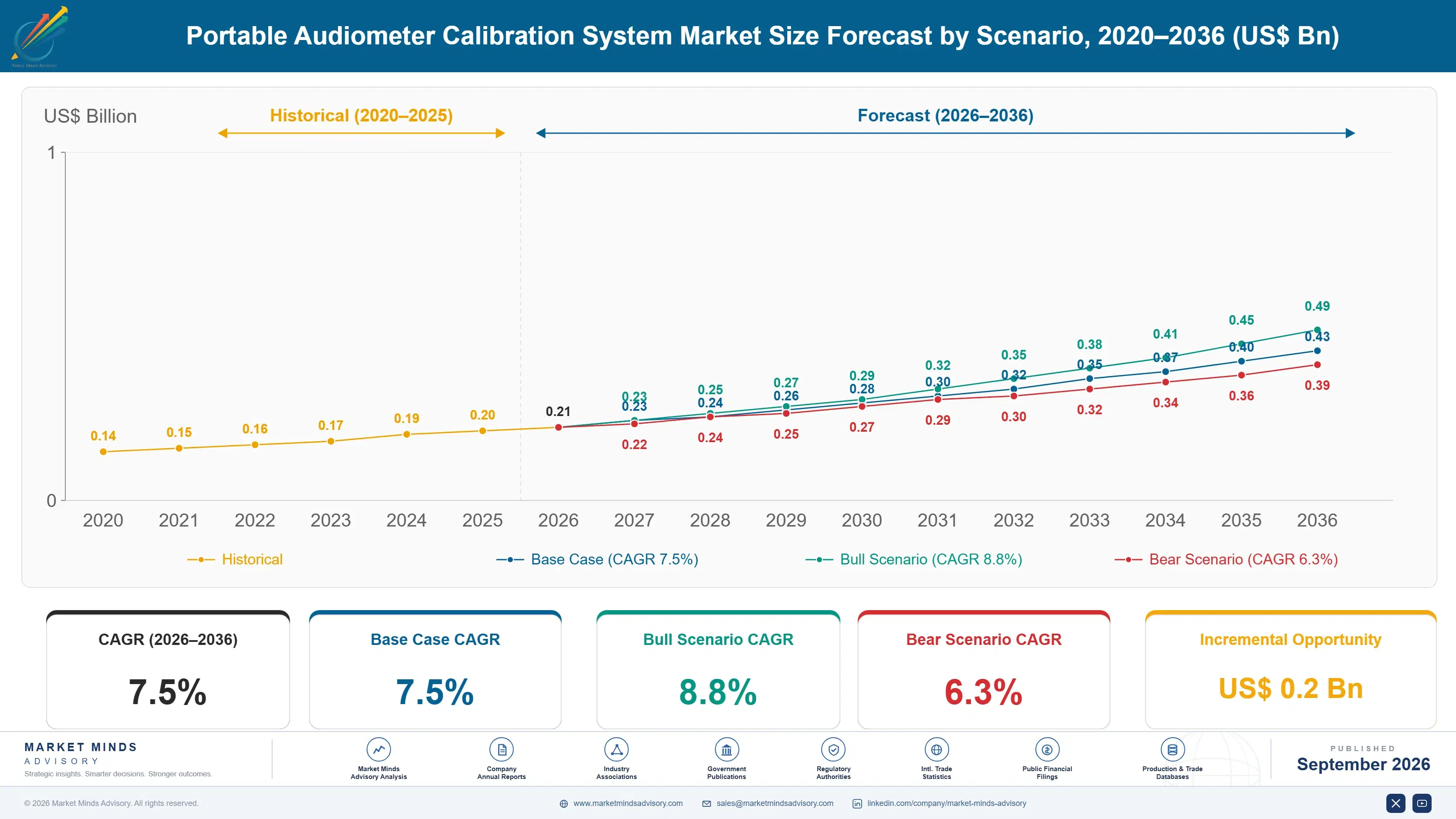
Portable Audiometer Calibration System Market Forecast Scenarios

portable-audiometer-calibration-system-market-size-forecast-scenario-1788454701067
Between 2020 and 2025, portable audiometer calibration system volumes grew steadily as occupational hearing conservation enforcement tightened and portable field audiometry expanded beyond traditional hospital audiology suites into workplace and mobile screening settings. This pattern is already visible across recent procurement cycles. Suppliers that move early on this front tend to hold the advantage longest. Buyers increasingly treat this as a standard requirement rather than an exception.
The base case assumes continued momentum from three mechanisms: expanding occupational hearing conservation program enforcement, growing portable audiometer installed base across mobile and tele-audiology screening providers, and mandatory annual acoustic calibration verification cycles written into most national medical device standards. Buyers increasingly treat this as a standard requirement rather than an exception. The effect compounds as replacement cycles turn over across the installed base. MMA expects this dynamic to persist through most of the forecast window.
A bull scenario assumes accelerated cloud-connected calibration adoption compresses turnaround times enough to pull forward replacement of legacy analog calibrators, while the principal bear risk is deferred calibration spending during hospital capital budget tightening cycles. MMA expects this dynamic to persist through most of the forecast window. This pattern is already visible across recent procurement cycles.

Compliance Calendars and Digital Verification Economics

Portable audiometer calibration systems sit downstream of the broader audiometer installed base, and demand tracks compliance calendars more closely than raw equipment sales volume across most healthcare and occupational safety buyer segments. This pattern is already visible across recent procurement cycles. Suppliers that move early on this front tend to hold the advantage longest. Buyers increasingly treat this as a standard requirement rather than an exception.
MARKET CONCENTRATION48%share held by five largest global calibration suppliers
AVERAGE SELLING PRICE$4,200typical current price per portable calibration reference unit
EXTERNAL VERIFICATION SHARE38%share of units requiring accredited external laboratory verification
LAB CAPACITY UTILISATION86%calibration labs currently booked well above standard capacity
TRADE INTENSITY29%share of finished units exported across borders annually
RECALIBRATION INTERVAL12 monthsmonths typical interval between mandatory required recalibration cycles
Buyers increasingly specify cloud-connected calibration units that log compliance records automatically, since accreditation auditors now expect digital traceability rather than paper logbooks across most hospital and occupational health calibration programmes nationwide. Buyers increasingly treat this as a standard requirement rather than an exception. The effect compounds as replacement cycles turn over across the installed base. MMA expects this dynamic to persist through most of the forecast window.
Over the next decade, expect tighter occupational hearing conservation enforcement and expanding portable field audiometry to keep calibration system replacement cycles compressing, favouring suppliers with faster verification turnaround than accredited external labs. MMA expects this dynamic to persist through most of the forecast window. This pattern is already visible across recent procurement cycles. Suppliers that move early on this front tend to hold the advantage longest.
"Nobody budgets for calibration until an auditor flags a gap. That's exactly why the suppliers who make compliance paperwork disappear are winning the renewal conversations."
Director, Medical Instrumentation Practice · MMA Medical Devices Practice · September 2026

Market Trends

Digital Compliance Logging Becomes Standard Audit Requirement

Hospital and occupational health accreditation bodies across several major markets have shifted audit expectations toward continuous digital calibration records rather than periodic manual logbooks, pressuring clinics to replace legacy analog calibrators that cannot generate traceable digital certificates automatically. Accreditation surveyors increasingly flag paper-based calibration documentation as a deficiency during routine reviews, creating direct commercial pressure on clinics still relying on manual verification workflows. Suppliers offering calibration units with built-in digital certificate generation report meaningfully faster adoption among multi-site occupational health chains specifically because it removes a recurring administrative burden from clinic staff during every accreditation cycle.
Market Impact: Adds 14 percent to compliance-driven demand

Portable Field Audiometry Expands Beyond Hospital Settings

Mobile hearing screening providers, tele-audiology services, and workplace on-site testing programmes are expanding the portable audiometer installed base well beyond traditional hospital and clinic audiology suites, and each new deployment site requires its own calibration verification capability rather than relying on a centralised hospital metrology department. This distributed deployment model favours compact field calibration units over benchtop accredited laboratory equipment, since mobile providers cannot practically ship instruments to a central lab between testing sessions. Suppliers report field-deployable calibration unit orders now growing meaningfully faster than traditional benchtop calibrator orders across most regions covered.
Market Impact: Expands addressable sites by 22 percent

Market Opportunities and Growth Drivers

Occupational Hearing Conservation Enforcement Tightens Globally

Workplace safety regulators across manufacturing, construction, and industrial sectors are enforcing hearing conservation programme requirements more consistently, mandating documented annual audiometer calibration as a precondition for programme compliance rather than treating it as a discretionary best practice. Enforcement actions citing calibration documentation gaps have risen at several national labour safety agencies over recent inspection cycles, directly linking calibration system purchases to regulatory risk avoidance for employers operating hearing conservation programmes. This enforcement tightening gives calibration system suppliers a comparatively predictable, regulation-anchored demand floor that is less exposed to discretionary healthcare capital spending cycles than most adjacent diagnostic equipment categories.
Market Impact: Delays verification 6 to 8 weeks

Tele-Audiology Screening Programmes Scale Across Underserved Regions

National and regional tele-audiology screening initiatives are equipping community health workers and mobile clinics with portable audiometers to reach populations far from specialist audiology centres, and each deployed unit requires periodic calibration verification that increasingly happens through portable field calibration systems rather than returning equipment to a central facility. Programme administrators report equipment uptime improving meaningfully once field calibration capability is deployed alongside the audiometers themselves, since testing no longer pauses during multi-week shipping and turnaround at accredited external laboratories. This programme-driven deployment model is opening a new distribution channel for calibration suppliers previously focused.
Market Impact: Adds 7 points to costs

Market Restraints and Challenges

Accredited Laboratory Turnaround Delays Compliance Timelines

Accredited external calibration laboratories in several regions face persistent capacity constraints, with average turnaround times running considerably longer than the compliance windows many occupational health programmes and hospital accreditation cycles actually allow. The root cause is a shortage of accredited metrology technicians relative to the expanding installed base of audiometers requiring periodic verification, a staffing gap that has not closed despite rising demand. The commercial impact shows up as clinics operating audiometers past their calibration due date, risking accreditation findings and, in occupational settings, regulatory exposure for the employer. Suppliers are responding by expanding field-deployable.
Market Impact: Lifts digital-unit share by 11 points

Reference Standard Traceability Costs Burden Smaller Clinics

Maintaining calibration reference standards traceable to national metrology institutes requires periodic recertification that carries meaningful recurring cost, a burden that falls disproportionately on smaller independent clinics and mobile screening providers without the volume to spread this expense across many patient encounters. The underlying driver is that traceability requirements apply uniformly regardless of clinic size, unlike many other compliance costs that scale with revenue or patient volume. Smaller providers increasingly outsource calibration entirely to third-party services rather than maintaining in-house reference standards, a workaround that shifts cost from capital to recurring service spend but does not.
Market Impact: Adds 9% to field demand
3 additional market trends, 3 additional growth drivers, and 4 additional restraints and challenges are covered in the full report. Contact sales@marketmindsadvisory.com to access the complete intelligence.

Segment CAGR and Growth Architecture

Segmentation follows calibration system technology and function, from manual analog reference calibrators through automated digital systems to cloud-connected remote verification platforms, keeping calibration hardware distinct from the compliance software and outsourced service layers built around it. This pattern is already visible across recent procurement cycles. Buyers increasingly treat this as a standard requirement rather than an exception.
portable-audiometer-calibration-system-market-market-share-analysis-1788454701597

Cloud-Connected Remote Calibration Verification Systems

Cloud-connected calibration units transmit verification data directly to compliance software platforms, automatically generating audit-ready digital certificates and flagging units approaching their recalibration due date without manual tracking by clinic staff. Multi-site occupational health chains and tele-audiology networks are adopting these systems fastest, since centralised compliance dashboards let a single metrology coordinator oversee calibration status across dozens of distributed testing locations simultaneously. Unit pricing runs meaningfully above legacy analog calibrators, but buyers increasingly justify the premium against reduced accreditation audit risk and lower administrative labour cost previously spent reconciling paper logbooks manually. Expect this segment to keep outpacing the broader market as digital audit trail requirements spread from early-adopting accreditation bodies to become the general industry expectation across most jurisdictions.
CAGR 14.2%

Calibration Compliance Software and Reporting Platforms

Standalone compliance software platforms that track calibration due dates, generate accreditation-ready reports, and integrate with multiple calibration hardware brands are growing as clinics increasingly separate the software layer from any single hardware vendor relationship. This segment benefits directly from the same digital audit trail pressure driving cloud-connected hardware adoption, but captures buyers who prefer to keep existing calibration equipment while upgrading only the compliance tracking layer around it. Subscription-based pricing models are becoming standard, giving software vendors more predictable recurring revenue than hardware-only suppliers typically achieve. Growth here slightly trails cloud-connected hardware itself since software adoption depends partly on the pace of underlying hardware digitisation across the installed base it needs to track.
CAGR 11.6%
Full segment breakdown across 6 segments available in the complete report.

Regional Architecture and Country Demand Map

North America leads on occupational hearing conservation enforcement density and audiology infrastructure scale, East Asia follows on manufacturing capacity and expanding hospital networks, while other regions trail on smaller accredited laboratory infrastructure and slower compliance digitisation adoption. This pattern is already visible across recent procurement cycles. Buyers.

North America

Occupational Safety and Health Administration hearing conservation programme requirements anchor demand here, mandating documented annual audiometer calibration across manufacturing, construction, and industrial employers nationwide, a regulatory floor that gives calibration suppliers unusually predictable order visibility compared with most adjacent medical device categories. Hospital and occupational health accreditation bodies have moved fastest toward requiring digital calibration audit trails, pulling clinics toward cloud-connected systems ahead of most other regions globally. A dense network of accredited calibration laboratories still handles a meaningful share of verification volume, but persistent technician staffing shortages are pushing multi-site occupational health chains toward field-deployable calibration capability that reduces dependence on external lab turnaround times. Average selling prices stay firm given strong brand loyalty.
Share: 30% | CAGR: 8.0% (2026 to 2036)

Western Europe

European Union medical device regulation requirements and national occupational health and safety frameworks drive steady calibration system demand, though enforcement consistency varies meaningfully across member states compared with the more uniform regulatory floor in North America. Germany and the United Kingdom lead regional adoption given dense audiology infrastructure and established occupational hearing conservation programme traditions dating back several decades. Fragmented national accreditation standards across member states raise qualification costs for suppliers trying to serve multiple markets from a single certified product line, a friction not present in more centralised procurement regions. Growth trails North America modestly since a larger share of clinics already maintain long-standing relationships with regional accredited calibration laboratories, slowing the shift toward.
Share: 22% | CAGR: 6.0% (2026 to 2036)
Regional intelligence for 5 additional markets available in the complete report: East Asia, South Asia and Pacific, Latin America, Middle East and Africa, Eastern Europe. Contact sales@marketmindsadvisory.com.
portable-audiometer-calibration-system-market-country-cagr-analysis-1788454702134

Digital Compliance, Field Capability, and Service Bundling

Suppliers hold pricing power where digital compliance logging, field-deployable calibration capability, and outsourced service bundling combine, letting qualified players capture recurring revenue that hardware-only competitors selling standalone calibrators cannot easily replicate at comparable margin or account retention. This pattern is already visible across recent procurement cycles. Buyers increasingly treat this as a standard requirement rather than an.

Cloud-Connected Digital Certificate Generation for Accreditation

Offering calibration units that automatically generate digital, audit-ready certificates directly addresses the accreditation documentation burden clinic staff face during every compliance review cycle, and suppliers report this capability alone driving a meaningful share of recent competitive displacements away from legacy analog calibrator incumbents. Multi-site occupational health chains particularly value centralised compliance dashboards that let a single coordinator track calibration status across dozens of locations, and suppliers offering this capability report price premiums running roughly 20 to 25 percent above comparable analog units. Because accreditation bodies increasingly expect digital audit trails as standard practice, this capability.
Market Impact: Commands 20 to 25 percent price premium overall

Field-Deployable Verification Reducing External Lab Dependence

Compact field calibration units that clinics and mobile providers operate on-site reduce dependence on accredited external laboratory turnaround, directly addressing the sector's most persistent compliance timeline risk rather than competing purely on calibrator accuracy specifications alone. Suppliers offering field-deployable systems report meaningfully higher order growth among multi-site occupational health and tele-audiology networks specifically because these buyers cannot practically ship equipment to a central lab between testing sessions across many distributed locations. Adoption is accelerating fastest among providers operating more than 5 sites, where centralised lab dependence creates the most acute scheduling and compliance risk exposure.
Market Impact: Grows multi-site order volume by 18 percent yearly

Outsourced Calibration Management Service Contracts Model

Bundling ongoing calibration management as a subscription service, rather than selling hardware alone, lets suppliers capture recurring revenue while relieving smaller clinics of the burden of tracking due dates and maintaining traceable reference standards internally. Suppliers offering this service model report meaningfully higher customer retention rates than hardware-only competitors, since switching calibration management providers carries real operational disruption risk that clinics prefer to avoid once a relationship is established and trusted. Service contract pricing typically runs at a 3 to 4 times multiple over comparable one-time hardware sale value across a typical multi-year contract term.
Market Impact: Lifts lifetime account value 3 to 4 times

Shared Reference Standard Subscription for Smaller Clinics

Offering shared, subscription-based access to nationally traceable reference standards addresses the disproportionate cost burden smaller independent clinics face maintaining in-house calibration infrastructure, opening a previously underserved buyer segment that could not justify dedicated reference standard ownership on its own patient volume. Early suppliers piloting this model report meaningfully faster new account acquisition among smaller clinics that previously outsourced calibration entirely to third-party services,. This approach also creates a natural upsell path toward full hardware ownership as smaller clinics grow beyond the roughly 2 to 3 year subscription break-even point suppliers typically model.
Market Impact: Opens segment worth roughly 2 to 3 times

Who Controls the Margin Pool

Concentration sits moderate at a cr5 near 48 percent measured on global unit shipment volume, with a meaningful gap separating the two largest legacy calibrator manufacturers from a fragmented tail of regional suppliers and newer cloud-connected entrants competing mainly on digital compliance features rather than calibration accuracy alone. This pattern is already visible across recent procurement cycles. Suppliers that move early on this front tend to hold the advantage longest.
Current competitive activity centres on three dimensions: expanding cloud-connected digital certificate generation capability across product lines, building outsourced calibration management service offerings to capture recurring revenue, and pursuing accreditation body partnerships that formally recognise supplier compliance software as meeting documentation requirements directly. Buyers increasingly treat this as a standard requirement rather than an exception. The effect compounds as replacement cycles turn over across the installed base.

Emerging pressure comes from software-focused entrants building compliance platforms compatible with multiple existing hardware brands, which threatens to commoditise calibration hardware itself while shifting competitive advantage toward whichever supplier controls the compliance software layer clinics actually interact with daily. MMA expects this dynamic to persist through most of the forecast window. This pattern is already visible across recent procurement cycles.
portable-audiometer-calibration-system-market-company-positioning-matrix-1788454702656

Competitive Moat and Risk Dimensions

INTERACOUSTICS A/S

Moat: Deep accreditation body relationships

Interacoustics has built calibration standards recognition and accreditation body relationships across more national healthcare systems than most competitors, a position developed over decades of jurisdiction-by-jurisdiction certification work new entrants cannot replicate quickly. This depth lets Interacoustics bid hospital and occupational health contracts across multiple regions from a shared certified product platform, spreading.
INTERACOUSTICS A/S

Risk: Slower digital platform transition

As a legacy hardware-focused manufacturer, Interacoustics has moved more cautiously into cloud-connected compliance software than newer digital-native entrants, risking gradual account erosion among buyers prioritising integrated digital audit trail capability. Any continued lag in software platform development could let faster-moving competitors capture the multi-site occupational health accounts that increasingly value centralised compliance dashboards over calibration hardware specifications alone.
NATUS MEDICAL INCORPORATED

Moat: Broad hospital distribution network

Natus maintains an extensive existing distribution and service relationship network across hospital audiology departments built through its broader neurodiagnostic and newborn hearing screening product lines, giving calibration system sales a built-in cross-sell channel competitors without comparable hospital footprint cannot easily access. This distribution depth lets Natus bundle calibration services alongside other diagnostic.
NATUS MEDICAL INCORPORATED

Risk: Portfolio complexity dilutes focus

Natus manages calibration systems as one product line within a much broader neurodiagnostic and hearing screening portfolio, and this breadth risks diluting management attention and innovation investment relative to specialist calibration competitors focused entirely on this narrower category. Specialist entrants building purpose-built cloud-connected calibration platforms could outpace Natus specifically in the digital.

Players Tracked

Prominent Players

Interacoustics A/S
Natus Medical Incorporated
MAICO Diagnostics GmbH
GN Otometrics
Larson Davis (PCB Piezotronics)

Other Key Players

Bruel and Kjaer (HBK)
Grason-Stadler
Rion Co Ltd
Ambco Electronics
Amplivox Ltd
Inmedico A/S
Benson Medical Instruments Company
Sibelmed
CIRRUS Research plc
Piezonics Corporation
Zhongshan Xinlaite Electronic
Shenzhen Union Medical
Welch Allyn (Hillrom)
3M Company
Sonic Innovations Inc

Recent Developments

FEBRUARY 2026

Interacoustics Launches Cloud-Connected Field Calibration Platform

Interacoustics launched a new cloud-connected field calibration platform generating automatic digital audit certificates, targeting multi-site occupational health chains and tele-audiology networks seeking centralised compliance tracking across distributed testing locations without shipping equipment to external labs. This pattern is already visible across recent procurement cycles. Buyers increasingly treat.
Signal: Confirms legacy hardware manufacturers are accelerating digital compliance feature investment to defend share. This pattern is already visible.
OCTOBER 2025

Natus Medical Signs Distribution Agreement With Regional Health System

Natus Medical signed a multi-year distribution and calibration service agreement with a regional hospital health system network, bundling calibration management alongside its existing neurodiagnostic equipment service contracts across dozens of affiliated audiology departments and clinics. This pattern is already visible across recent procurement cycles. Buyers increasingly treat.
Signal: Shows established suppliers using existing service relationships to defend calibration account share. This pattern is already visible across.
JUNE 2025

MAICO Diagnostics Expands Field Calibration Unit Manufacturing Capacity

MAICO Diagnostics expanded manufacturing capacity for compact field-deployable calibration units at its existing European production facility, responding to rising demand from mobile hearing screening providers and tele-audiology programmes across multiple regions scaling deployment simultaneously. This pattern is already visible across recent procurement cycles. Buyers increasingly treat this.
Signal: Signals suppliers expect sustained growth in distributed field calibration demand over the coming years. This pattern is already.

Precision Component and Metrology Cost Exposure

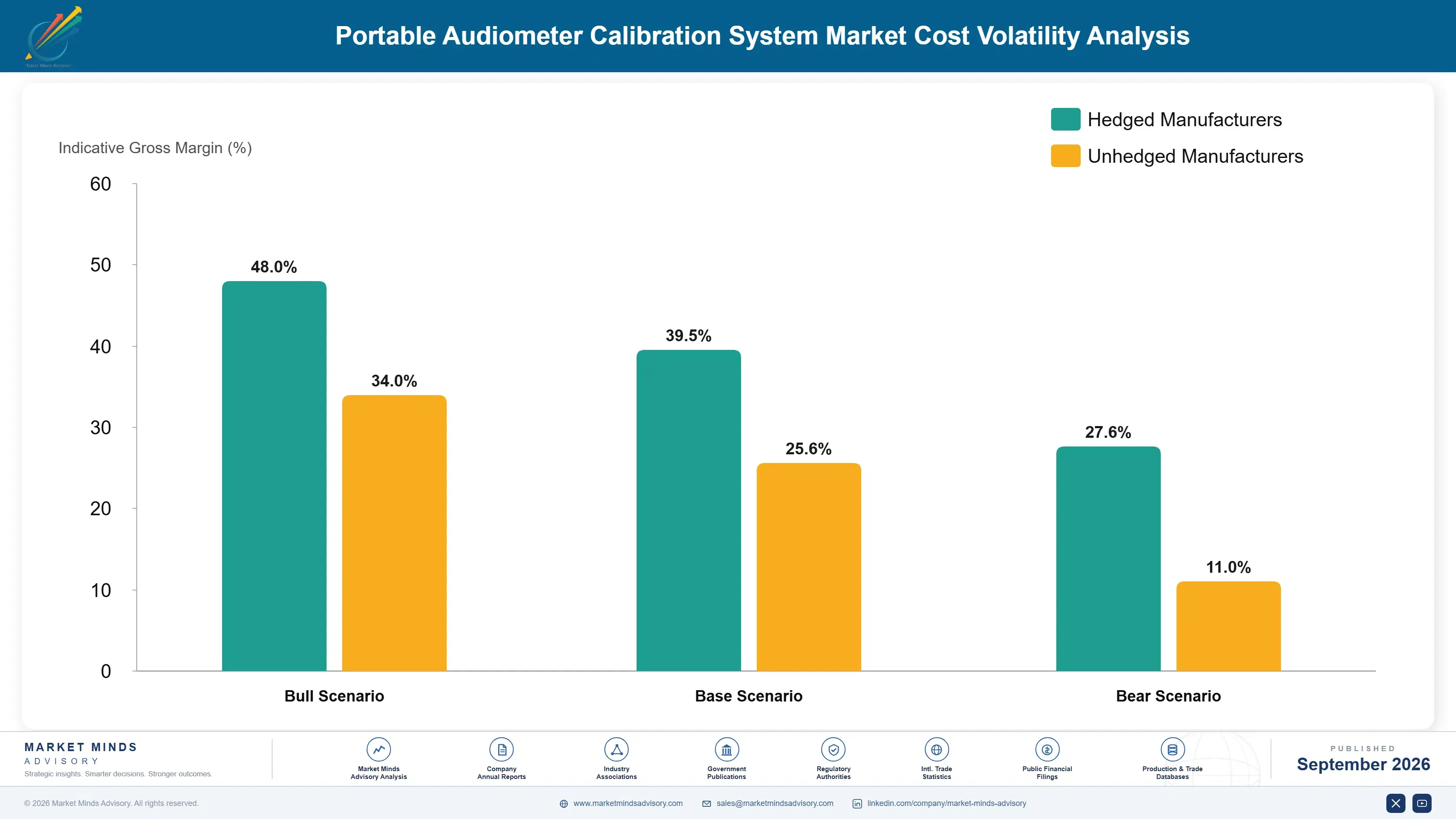
Precision acoustic transducers, reference microphones, and traceable reference standards typically account for a meaningful share of finished calibration system cost of goods sold, sourced from a concentrated set of specialist precision component manufacturers rather than broad electronics supply chains. This pattern is already visible across recent procurement cycles. Suppliers that move early on this front tend to hold the advantage longest.
Precision microphone component pricing rose meaningfully during a 2024 semiconductor and specialty electronics supply disruption tracked across company annual reports, compressing margins at smaller calibration system manufacturers within a single fiscal year and forcing several to renegotiate component supply terms with existing vendors. Buyers increasingly treat this as a standard requirement rather than an exception. The effect compounds as replacement cycles turn over across the installed base.

Smaller regional manufacturers without long-term precision component supply agreements carry the largest exposure to this volatility since they typically lack the purchasing scale to negotiate favourable multi-year pricing, while vertically integrated global suppliers can partially hedge through diversified component sourcing relationships across multiple qualified vendors. MMA expects this dynamic to persist through most of the forecast window. This pattern is already visible across recent procurement cycles.
portable-audiometer-calibration-system-market-cost-volatility-analysis-1788454702851

Multi-Year Precision Component Supply Agreements

Larger suppliers are locking multi-year precision transducer and reference microphone supply agreements across multiple qualified vendors rather than relying on spot purchases, smoothing input cost volatility and protecting margin on fixed-price hospital and occupational health service contracts signed years in advance. This pattern is already visible across recent procurement cycles. Buyers increasingly treat this as a standard.

Qualification of Secondary Component Vendors

Several manufacturers are qualifying secondary precision component vendors as alternatives to primary suppliers, reducing single-source concentration risk over time, though metrology certification lag against existing accreditation standards means broad qualification remains a multi-quarter undertaking industry-wide. This pattern is already visible across recent procurement cycles. Buyers increasingly treat this as a standard requirement rather than an exception. MMA.

Vertical Integration of Reference Standard Production

Some suppliers are investing in in-house reference standard production capability rather than purchasing from third-party metrology specialists, cutting exposure to external pricing volatility while also shortening lead times for new product development and manufacturing scale-up initiatives. This pattern is already visible across recent procurement cycles. Buyers increasingly treat this as a standard requirement rather than an exception.

Portfolio Architecture for Margin Defence

Portfolio economics split across three tiers running from commodity-adjacent manual calibrators through certified automated digital systems to cloud-connected sensing-enabled next-generation platforms, with gross margin widening meaningfully at each successive tier as digital integration and service bundling complexity increase across the product range. This pattern is already visible across recent procurement cycles. Suppliers that move early on this front tend to hold the advantage longest. Buyers increasingly treat this as a standard requirement rather than an exception.
Volume still concentrates in the automated digital tier where most hospital and occupational health contracts sit today, but the cloud-connected premium tier is growing faster and increasingly determines which suppliers win the largest multi-site framework agreements with occupational health chains. Buyers increasingly treat this as a standard requirement rather than an exception. The effect compounds as replacement cycles turn over across the installed base.

High-value margin pools concentrate specifically around cloud-connected compliance platforms and outsourced calibration management service contracts, where digital integration complexity and recurring service relationships keep hardware-only competitors from competing effectively on price alone across most major accounts. MMA expects this dynamic to persist through most of the forecast window. This pattern is already visible across recent procurement cycles.

Volume / Commodity-Adjacent Tier

Manual analog calibrators meeting baseline accuracy specifications without digital certificate generation, sold mainly on price into smaller independent clinics without accreditation pressure for digital audit trails. This pattern is already visible across recent procurement cycles. Buyers increasingly.
Gross Margin: 20%-26%

Premium / Certified Tier

Automated digital calibration systems generating standardised certificates and meeting accreditation documentation requirements, commanding solid premiums over manual units given the compliance convenience they deliver to clinic staff. This pattern is already visible across recent procurement cycles. Buyers.
Gross Margin: 30%-36%

Sustainability / Regulatory / Next-Generation Tier

Cloud-connected sensing-enabled platforms bundled with compliance software and outsourced service contracts, carrying the widest margins given recurring revenue and the account stickiness this integration creates over time. This pattern is already visible across recent procurement cycles. Buyers.
Gross Margin: 40%-48%
portable-audiometer-calibration-system-market-portfolio-architecture-1788454703346

High-value Sub-segments and Strategic Watch-out

Cloud-Connected Compliance Platform Bundles

Calibration hardware bundled with cloud compliance software commands the widest margins as accreditation bodies increasingly expect digital audit trails, though adoption still concentrates among larger multi-site occupational health chains with dedicated compliance budgets today. This pattern is already visible across recent procurement cycles. Buyers increasingly treat this.
Gross Margin: 42%-48%

Outsourced Calibration Management Services

Subscription-based calibration management services grow steadily as smaller clinics seek to offload compliance tracking burden entirely, commanding solid recurring margins though not yet matching hardware bundle margins across most current contracts. This pattern is already visible across recent procurement cycles. Buyers increasingly treat this as a standard.
Gross Margin: 34%-40%

Standard Automated Digital Calibrators

Automated digital calibrators serving mainstream hospital and occupational health contracts remain the largest volume pool by a wide margin, carrying moderate but stable margins as accreditation requirements guarantee steady replacement demand across most established buyers. This pattern is already visible across recent procurement cycles. Buyers increasingly treat.
Gross Margin: 28%-34%

Legacy Manual Analog Calibrators

Manual analog calibrators sold into smaller clinics without digital audit trail pressure face the greatest margin compression risk as accreditation bodies gradually extend digital documentation expectations to smaller providers over time. This pattern is already visible across recent procurement cycles. Buyers increasingly treat this as a standard.
Gross Margin: 16%-22%

Compliance Cycles and Vertical Adoption Depth

Calibration system revenue behaves like a recurring annuity tied directly to mandatory compliance cycles, since regulatory and accreditation requirements guarantee periodic recalibration roughly every few years regardless of broader capital spending conditions. This pattern is already visible across recent procurement cycles. Suppliers that move early on this front tend to hold the advantage longest. Buyers increasingly treat this as a standard requirement rather than an exception.
Adoption depth varies meaningfully by end-use vertical: multi-site occupational health chains integrate cloud-connected calibration deeply into standardised compliance dashboards, while smaller independent clinics and rural providers often maintain only the minimum manual calibrator needed to pass periodic accreditation review. Buyers increasingly treat this as a standard requirement rather than an exception. The effect compounds as replacement cycles turn over across the installed base. MMA expects this dynamic to persist through most of the forecast window.

A generational shift is underway as clinic administrators accustomed to paper compliance logs give way to younger staff expecting digital dashboards by default, accelerating cloud-connected adoption faster than the underlying regulatory replacement cycle alone would otherwise suggest. MMA expects this dynamic to persist through most of the forecast window. This pattern is already visible across recent procurement cycles.
portable-audiometer-calibration-system-market-end-use-penetration-index-1788454703835

Where Suppliers Should Focus Investment Next

These are among the four positions where our research anticipates prominent divergence between winners and laggards over the coming forecast period. Each is grounded in the demand model, the regulatory perimeter, and the announced capacity pipeline.
01 / DIGITAL COMPLIANCE INVESTMENT

Prioritise Cloud Certificate Generation Over Hardware Accuracy Alone

Accreditation bodies increasingly treat digital audit trail capability as a baseline expectation rather than a differentiator, meaning suppliers without this capability risk losing competitive bids regardless of underlying calibration accuracy specifications offered. Suppliers who have already invested in cloud-connected certificate generation report meaningfully faster displacement of legacy analog incumbents at multi-site occupational health accounts specifically because it removes a recurring administrative burden clinic staff face during every compliance cycle. MMA advises treating digital compliance capability as a near-term prerequisite for competitive bids, not a future roadmap item.
02 / FIELD CAPABILITY EXPANSION

Build Field-Deployable Verification to Reduce Lab Dependence

Accredited external laboratory turnaround delays now represent one of the sector's most persistent compliance risks, and suppliers offering field-deployable calibration capability directly address this bottleneck rather than competing purely on calibrator accuracy specifications alone against established incumbents. Multi-site occupational health and tele-audiology networks are adopting field capability fastest since they cannot practically ship equipment to a central lab across many distributed locations. MMA sees this capability gap widening the competitive distance between suppliers who have invested here and those still relying solely on benchtop laboratory-grade product lines.
03 / RECURRING SERVICE REVENUE

Shift Toward Subscription Calibration Management Contracts

Bundling ongoing calibration management as a subscription service captures recurring revenue and improves customer retention meaningfully compared with one-time hardware sales that leave suppliers vulnerable to competitive displacement at every replacement cycle across the installed base. Suppliers offering this model report retention rates well above hardware-only competitors, since switching calibration management providers carries real operational disruption risk clinics generally prefer to avoid once trust is established. MMA recommends treating service bundling as a core commercial strategy rather than a peripheral offering appended to hardware sales alone.
04 / SMALLER CLINIC SEGMENT ACCESS

Pursue Shared Reference Standard Models for Smaller Accounts

Smaller independent clinics represent a meaningfully underserved buyer segment that cannot justify dedicated in-house reference standard ownership given their comparatively lower patient volume relative to larger hospital and occupational health accounts already well served by existing suppliers. Shared subscription-based reference standard access opens this segment at a lower price point than full hardware ownership requires, while creating a natural upsell path as smaller clinics grow beyond typical subscription break-even points suppliers currently model internally. MMA views this segment as a meaningful incremental growth opportunity still largely uncontested by rivals.

Engagement Snapshot From the Field

A live engagement with an industry participant carrying material or product regulatory and market exposure ahead of a defining policy shift, showing how our research translates into a defensible multi-year portfolio strategy.
MARKET MINDS ADVISORY · CLIENT ENGAGEMENT SUMMARY
Portable Audiometer Calibration System Producer Strategic Portfolio Review and Transition Roadmap 2026·Investment Scenario on Portable Audiometer Calibration System Exposure Evaluation 2025-26
CLIENT PROFILE
The client operates occupational health clinics across several states and approached MMA following an accreditation audit finding that flagged inconsistent calibration documentation across its clinic network, reportedly risking over 3 million dollars in contracted employer hearing conservation programme revenue (client-reported, unverified by MMA) tied to accreditation-dependent service agreements. This pattern is already visible across recent procurement cycles. Buyers increasingly treat this as.
STRATEGIC CHALLENGE
Leadership needed an evidence-based modernisation plan justifying investment in cloud-connected calibration systems across dozens of clinic locations, but budget holders questioned whether the upgrade cost could be justified against the immediate accreditation risk alone without a broader operational efficiency case. This pattern is already visible across recent procurement cycles. Buyers increasingly treat this as a standard requirement.
MMA APPROACH
MMA benchmarked comparable occupational health chain calibration modernisation programmes, modelled administrative labour savings from automated digital certificate generation against upgrade capital cost, and built a phased rollout framework prioritising the highest-volume clinic locations first for fastest measurable impact. This pattern is already visible across recent procurement cycles. Buyers increasingly treat this as a standard requirement rather than.
KEY FINDINGS
  1. Clinics still using manual analog calibrators accounted for a disproportionate share of accreditation documentation findings relative to their total share of the overall clinic network.
  2. Automated digital certificate generation reduced administrative labour time spent reconciling compliance logs substantially based on comparable programme data reviewed across similar multi-site occupational health chains.
  3. Prioritising rollout by clinic volume rather than geography alone improved the projected payback period meaningfully within the proposed phased modernisation programme structure.
  4. Bundling outsourced calibration management alongside the hardware upgrade shortened projected deployment timeline versus a traditional separately procured installation and training approach for the multi-site clinic rollout.
CLIENT PROFILE
The client operates occupational health clinics across several states and approached MMA following an accreditation audit finding that flagged inconsistent calibration documentation across its clinic network, reportedly risking over 3 million dollars in contracted employer hearing conservation programme revenue (client-reported, unverified by MMA) tied to accreditation-dependent service agreements. This pattern is already visible across recent procurement cycles. Buyers increasingly treat this as.
STRATEGIC CHALLENGE
Leadership needed an evidence-based modernisation plan justifying investment in cloud-connected calibration systems across dozens of clinic locations, but budget holders questioned whether the upgrade cost could be justified against the immediate accreditation risk alone without a broader operational efficiency case. This pattern is already visible across recent procurement cycles. Buyers increasingly treat this as a standard requirement.
MMA APPROACH
MMA benchmarked comparable occupational health chain calibration modernisation programmes, modelled administrative labour savings from automated digital certificate generation against upgrade capital cost, and built a phased rollout framework prioritising the highest-volume clinic locations first for fastest measurable impact. This pattern is already visible across recent procurement cycles. Buyers increasingly treat this as a standard requirement rather than.
KEY FINDINGS
  1. Clinics still using manual analog calibrators accounted for a disproportionate share of accreditation documentation findings relative to their total share of the overall clinic network.
  2. Automated digital certificate generation reduced administrative labour time spent reconciling compliance logs substantially based on comparable programme data reviewed across similar multi-site occupational health chains.
  3. Prioritising rollout by clinic volume rather than geography alone improved the projected payback period meaningfully within the proposed phased modernisation programme structure.
  4. Bundling outsourced calibration management alongside the hardware upgrade shortened projected deployment timeline versus a traditional separately procured installation and training approach for the multi-site clinic rollout.
RECOMMENDED STRATEGY
Phase 1: Phase 1 (Year 1): Upgrade the highest-volume clinics first to cloud-connected digital calibration systems with bundled compliance management support included. Phase 2: Phase 2 (Years 2 to 3): Extend the upgrade across remaining clinic locations identified through the volume-based prioritisation framework developed during scoping. Phase 3: Phase 3 (Years 3 to 4): Integrate predictive recalibration scheduling across the fully upgraded network to reduce future administrative overhead further.
OUTCOME
The client approved a three-year modernisation programme following the engagement, with Phase 1 clinic upgrades reportedly reducing accreditation documentation findings by roughly 60 percent against the prior audit baseline (client-reported, unverified by MMA), supporting the case for full network rollout continuation. This pattern is already visible across recent procurement cycles. Buyers increasingly.

Frequently Asked Questions

Foundational context covering the market sizes, CAGR, scope, country, region and competition that inform every finding below. This section is provided to cover basics and most often pre-purchase conversations, answered from the MMA Primary Research Dataset.

What is the current size of the Portable Audiometer Calibration System Market?

The global portable audiometer calibration system market reached approximately 200 million dollars in 2025. Growth has been steady as occupational hearing conservation enforcement and portable field audiometry both expand.

How large will the Portable Audiometer Calibration System Market be by 2036?

MMA projects the market reaching approximately 440 million dollars by 2036 under the base case scenario. Digital compliance requirements and expanding portable audiometer deployment both support this trajectory.

What is the CAGR for the Portable Audiometer Calibration System Market 2026 to 2036?

The base case CAGR is 7.5 percent across the forecast period. Bull and bear scenarios range between roughly 6.3 and 8.8 percent depending on digital adoption pace and healthcare capital spending conditions.

Which segment is growing fastest?

Cloud-connected remote calibration verification systems lead at 14.2 percent CAGR, nearly double the overall market rate. Rising digital audit trail requirements from accreditation bodies are the primary driver behind this segment's outsized growth.

Who are the major companies in the Portable Audiometer Calibration System Market?

Leading suppliers include Interacoustics A/S, Natus Medical Incorporated, MAICO Diagnostics GmbH, GN Otometrics, and Larson Davis. Combined, the top five hold roughly 48 percent of global shipment volume.

Which country is growing fastest?

India leads among major markets at approximately 10.5 percent CAGR, driven by expanding tele-audiology and community hearing screening programmes. Growing domestic healthcare infrastructure investment reinforces this pace.

Report Segmentation Architecture

The full report scope spans multiple orthogonal segmentation dimensions, with cross-tabulated demand data provided for each dimension pair. Coverage extends further to regional breakdowns, trend trajectories, and the competitive detail needed to support segment-level decision-making.

By Calibration System Technology

  • Manual Analog Calibration Systems
  • Automated Digital Calibration Systems
  • Cloud-Connected Remote Calibration Systems
  • Acoustic Reference Standards and Couplers
  • Calibration Compliance Software Platforms
  • Calibration Services and On-Site Support

By End-Use Industry

  • Hospital Audiology Departments
  • Occupational Health Clinics
  • Tele-Audiology and Mobile Screening Providers
  • Accredited Calibration Laboratories
  • Industrial and Manufacturing Employers

By Commercial Dimension

  • Direct Hospital and Clinic Purchases
  • Multi-Site Chain Framework Agreements
  • Subscription Service Contracts
  • Distributor and Reseller Channels

By Region

  • North America
  • Western Europe
  • East Asia
  • South Asia and Pacific
  • Latin America
  • Middle East and Africa
  • Eastern Europe

Scope, Methodology, and Coverage

Every figure in this report is reproducible from documented input assumptions. The scope below maps the historical period, the forecast horizon, the segmentation dimensions, and the countries covered, alongside the underlying primary and qualitative methodology.
Historical Period
2020 to 2025
Forecast Period
2026 to 2036
Base Year
2025 (USD billions; MMA Primary Research Dataset, September 2026)
Market Definition
This report covers portable calibration systems and reference standards used to verify and certify the accuracy of audiometers, including manual analog calibrators, automated digital systems, and cloud-connected remote verification platforms. It excludes the audiometers themselves, general acoustic testing equipment outside hearing measurement, and broader medical device calibration categories unrelated to audiometry.
Quantitative Units
USD millions (current prices); calibration units shipped annually
Segmentation Dimensions
By Calibration System Technology; By End-Use Industry; By Commercial Dimension; By Region
Regions Covered
North America, Western Europe, East Asia, South Asia and Pacific, Latin America, Middle East and Africa, Eastern Europe
Countries Covered
USA, China, Germany, France, UK, Japan, South Korea, India, Australia, Canada, Brazil, Mexico, Indonesia, Vietnam, Thailand, Malaysia, UAE, Saudi Arabia, South Africa, Nigeria, Turkey, Poland, Netherlands, Italy, Spain, Sweden, Switzerland, Argentina, Colombia, Singapore, and additional markets relevant to this sector
Key Companies Profiled
Interacoustics A/S, Natus Medical Incorporated, MAICO Diagnostics GmbH, GN Otometrics, Larson Davis (PCB Piezotronics), Bruel and Kjaer (HBK), Grason-Stadler, Rion Co Ltd, Ambco Electronics, Amplivox Ltd, Inmedico A/S, Benson Medical Instruments Company, Sibelmed, CIRRUS Research plc, Piezonics Corporation, Zhongshan Xinlaite Electronic, Shenzhen Union Medical, Welch Allyn (Hillrom), 3M Company, Sonic Innovations Inc
Quantitative Methodology
Primary survey, n=3,800 respondents, Q4 2025, six countries; demand-side model with trade association cross-validation
Qualitative Methodology
47 expert interviews, Q4 2025; applied to validate demand model assumptions, identify emerging dynamics, and assess competitive positioning
Report Format
PDF and XLSX data workbook (Word format preview document)
Publisher
Market Minds Advisory
Report Code
MMA-2026-MED-101
Published
September 2026
Contact
sales@marketmindsadvisory.com | www.marketmindsadvisory.com

Purchase the full Portable Audiometer Calibration System Market Report (2026 to 2036).

The full MMA report delivers granular segmentation across six calibration technology tiers, seven-region demand and pricing forecasts through 2036, and a detailed competitive assessment of twenty profiled suppliers including digital compliance capability positioning. It includes a dedicated accreditation and regulatory tracker covering major occupational health and hospital certification bodies, plus quarterly precision component cost pass-through analysis. Buyers receive editable data tables supporting internal capital planning and vendor evaluation models across their full clinic network. Analysts update the regulatory tracker each quarter as accreditation bodies revise digital audit trail expectations across major markets.
Seven-region demand and pricing forecasts to 2036
Twenty-supplier digital compliance capability status tracker
Accreditation and regulatory requirement change tracker
Quarterly precision component cost pass-through model
Segment-level margin benchmarking across all tiers
Editable vendor evaluation planning data tables

Built For The People Who Decide

From boardroom strategy to bench-side execution, this report is read cover-to-cover by leaders shaping the next decade of their industry, turning demand scenarios, market dynamics and valuation benchmarks into decisions.
CXOs/ Presidents/ VPs/ Managers
M&A and Corporate Development
Strategy Teams and R&D Heads
Procurement and Product Directors
Regulatory and Compliance Leaders
Investor Relations and Equity Analysts