Market Minds Advisory
Polyurethane Foam Market

Polyurethane Foam Market: Building Energy Codes Reshape Insulation Demand Mix

Tightening building energy codes are pulling spray polyurethane foam demand well ahead of conventional flexible foam growth, rewarding producers with envelope application expertise over commodity foam capacity alone across the value chain.

Lead Analyst

Bilal Shaikh

Published

September 2026

Make Smarter Decisions with Customized Research Insights

Request a free sample report and evaluate market opportunities, growth trends, and competitive dynamics relevant to your business needs.

2025 MARKET VALUE$68.4BMarket Size 2025
2036 FORECAST VALUE$122.0BBase Case , 2026 to 2036
CAGR 2026 TO 20365.4 %Bull 6.4% / Bear 4.4%
INCREMENTAL OPPORTUNITY$49.9BNet 10- year value creation
EXPANSION MULTIPLE1.69x2036 value over 2026 base
Strategic Levers
M&A Pipeline
Regional Outlook
Country Rankings
Competitive Intelligence
Segmental Deep-dive
Call-Us : 91 93563 13602

Executive Snapshot and Market Trajectory

Polyurethane foam demand remains anchored in furniture and bedding, but spray foam is pulling ahead fast as building energy codes tighten and construction firms specify envelope insulation that fiberglass and cellulose alternatives cannot match on thermal performance. Non-formulated producers are recalculating capital strategy accordingly. That gap widens further each year.
Demand concentrates in three areas: furniture and bedding requiring flexible foam for comfort applications, construction requiring rigid and spray foam for building envelope and appliance insulation, and automotive requiring integral skin and molded foam for seating and interior components. China anchors global production given its dominant furniture, bedding, and construction manufacturing base. Appliance and packaging applications round out a genuinely diversified global demand base spanning multiple sectors.
Competition remains moderately concentrated among global chemical majors, led by BASF and Covestro, both maintaining deep formulation and application engineering relationships with fabricators worldwide. Application-specific formulation depth and installation support, not raw foam tonnage, increasingly decide which suppliers win long-term construction and automotive contracts. That formulation depth compounds as contractors and OEMs lock designs into engineering documentation for years, favoring early movers. Smaller producers lacking that depth compete mostly on price.
Market Definition
This market covers flexible, rigid, spray, and integral skin polyurethane foam products used across furniture, bedding, construction insulation, automotive, and packaging applications. It excludes polyurethane coatings, adhesives, and elastomers not in cellular foam form, and finished furniture or mattress products sold as complete goods.
Base Year Value
$68.4B in 2025 (MMA Primary Research Dataset, August 2026)
Forecast Period
2026 to 2036, eleven discrete annual values
CAGR
5.4% base case. Bull 6.4%. Bear 4.4%.
Fastest Growth Segment
Spray Polyurethane Foam: 7.3% CAGR
Fastest Growth Country
China: 6.7% CAGR
Fastest Growth Region
South Asia and Pacific: 7.3% CAGR
Largest Region
East Asia: 29% of 2025 global value
Market Leaders
BASF SE, Covestro AG, Huntsman Corporation, Dow Inc., Wanhua Chemical Group Co. Ltd. Source: MMA Analysis based on company annual reports.
Primary Survey
n=3,800 procurement and R&D decision-makers, Q4 2025, six countries
Methodology
Demand-side build-up, cross-validated against public data, 47 expert interviews

Polyurethane Foam Market Forecast Scenarios

polyurethane-foam-market-size-forecast-scenario-1787311564180
Polyurethane foam demand grew steadily through 2020 to 2025 as construction and furniture production recovered from pandemic-related disruption while spray foam adoption accelerated meaningfully. The market grew at an estimated 4.7% historical CAGR across the period, with spray foam volume consistently outpacing flexible foam demand from 2022 onward. Supply chain disruption affecting petrochemical feedstocks periodically constrained available production capacity.
The base case assumes 5.4% CAGR through 2036, driven by three mechanisms operating together. First, tightening building energy codes across major construction markets are driving specification of spray and rigid foam insulation for its superior thermal performance relative to conventional alternatives. Second, premium bedding and furniture manufacturers are increasingly specifying high-resilience and viscoelastic foam formulations as consumer demand for comfort and durability grows. Third, automotive lightweighting programs continue driving integral skin and molded foam demand across seating and interior component applications.
The bull case (6.4% CAGR) assumes faster-than-expected building code adoption and accelerated construction activity pull premium spray foam demand forward ahead of current planning assumptions. The bear case (4.4% CAGR) reflects the risk that global construction activity slows meaningfully, tempering the spray foam segment that has driven above-average growth across this otherwise mature specialty materials market overall.

Application Engineering Separates Premium From Commodity Foam

Polyurethane foam economics increasingly separate along application-specific formulation depth rather than raw production capacity, since construction and automotive customers pay premium pricing for thermal performance and dimensional consistency that generic flexible foam formulations cannot reliably deliver. This dynamic is reshaping how producers allocate capital across their existing production and formulation research infrastructure base worldwide.
CR5 CONCENTRATION36%share held by the top five global foam chemical producers
AVERAGE SELLING PRICE$1,400-3,800/tonrange spanning standard flexible to spray application grades
TOP PRODUCING COUNTRY SHAREChina, 26%share of total global polyurethane foam production today
CAPACITY UTILIZATION71%average operating rate across qualified foam production facilities
TRADE INTENSITY19%of finished foam volume crossing borders before end use
FEEDSTOCK COST SHARE48% of COGSpolyol and isocyanate raw material inputs combined together
Construction contractors and furniture manufacturers behave very differently as buyers. Construction contractors negotiate primarily on thermal performance documentation and installation support given the building code compliance stakes involved, while furniture manufacturers prioritize price and comfort consistency across standard commercial production purchases. Neither buyer type shows much willingness to switch suppliers once an established qualification relationship proves reliable over multiple project cycles. Certification depth increasingly separates qualified suppliers from transactional commodity sellers competing purely on price.
Over the next decade, two forces will determine winners. Continued building code tightening will keep expanding addressable spray and rigid foam demand, while premium bedding adoption adds a second, comfort-driven growth vector rewarding producers with strong formulation engineering support. Producers slow to invest in either dimension risk ceding share to faster-moving, better-capitalized competitors over the coming decade as building codes continue tightening.
"Polyurethane foam looks like a commodity until you're trying to hit an R-value target on a building envelope with three months left before code inspection. The suppliers winning construction contracts are the ones who can prove thermal performance on paper, not the ones quoting the cheapest drum."
Director, Building Materials and Polymer Foam Practice · MMA Chemicals and Mater

Market Trends

Tightening Building Codes Drive Spray Foam Specification

Construction firms are increasingly specifying spray polyurethane foam for building envelope insulation, driven by tightening energy code requirements across major construction markets that favor foam's superior thermal performance and air-sealing properties over fiberglass and cellulose alternatives. This demand has grown fastest in commercial and multifamily construction, where energy code compliance carries meaningful financial penalties for underperformance relative to residential applications with more lenient enforcement. Several major producers have expanded dedicated spray foam formulation lines specifically to serve this growing demand, recognizing that once a contractor standardizes on a formulation, switching becomes costly given the training involved.
Market Impact: Adds 4 percent automotive segment s

Premium Bedding Demand Sustains High-Resilience Foam Growth

Growing consumer preference for premium mattress and furniture products is sustaining demand for high-resilience and viscoelastic foam formulations that deliver superior comfort and durability relative to conventional flexible foam grades. This demand has grown steadily as bedding manufacturers increasingly position premium foam formulations as a differentiating feature in an otherwise commoditized product category, commanding meaningful pricing premiums over standard flexible foam. Producers serving this segment typically maintain close design collaboration relationships with bedding manufacturers from early product development through mass production qualification. Producers securing early qualification with bedding manufacturers gain multi-year program revenue visibility spanning multiple flagship product generations.
Market Impact: Adds 3 percent appliance segment de

Market Opportunities and Growth Drivers

Automotive Lightweighting Sustains Integral Skin Foam Demand

Automotive manufacturers continue specifying integral skin and molded polyurethane foam for seating, headrests, and interior components, driven by lightweighting requirements and the material's favorable strength-to-weight ratio relative to alternative cushioning materials. This demand has remained steady given the consistent design requirements across successive vehicle platform generations, supporting predictable baseline revenue for producers serving this application even during periods of construction demand softness. Producers serving this demand typically maintain long-standing relationships with automotive OEMs built over years of consistent formulation performance. Continued vehicle platform investment is expected to sustain this demand pattern well into the next decade.
Market Impact: Adds 18 percent feedstock cost vola

Appliance Insulation Regulations Sustain Rigid Foam Demand

Global appliance efficiency regulations, tied to energy consumption reduction targets for refrigerators and other insulated appliances, continue to drive demand for rigid polyurethane foam formulations that deliver superior thermal insulation performance in constrained cavity dimensions. This regulatory-driven demand has made efficiency-grade rigid foam a growing share of overall appliance component specification, commanding modest pricing premiums over standard-grade materials given the performance improvements these formulations deliver. Producers serving this demand typically maintain long-standing relationships with appliance manufacturers built over years of consistent formulation performance. Continued efficiency-driven investment is expected to sustain this demand pattern.
Market Impact: Adds 14 percent compliance formulat

Market Restraints and Challenges

Polyol and Isocyanate Price Volatility Compresses Margins

Polyol and isocyanate feedstock prices have shown meaningful volatility tied to broader petrochemical supply and demand cycles, creating margin pressure for producers unable to pass through cost increases quickly given multi-year fixed-price agreements common with construction and automotive contracts. This volatility disproportionately affects smaller producers with limited feedstock purchasing scale, since these raw materials represent a substantial share of total production cost that cannot easily be offset through process efficiency alone. Producers are addressing this through longer-term feedstock supply agreements and, where feasible, backward integration into upstream petrochemical production capacity.
Market Impact: Adds 9% spray foam segment volume

Flammability Regulation Compliance Adds Formulation Cost

Increasingly stringent flammability and fire safety regulations across construction and furniture applications require sustained formulation investment in flame-retardant additive systems that smaller producers often lack the technical infrastructure to develop without external partnership or dedicated capital investment. This root cause traces directly to genuine fire safety performance requirements that regulators have tightened following documented incidents involving conventional foam formulations, a compliance consideration that shapes formulation chemistry across the entire value chain. Producers are addressing this through flame-retardant additive partnerships and through dedicated regulatory compliance testing infrastructure that smaller competitors cannot easily replicate.
Market Impact: Adds 6% premium bedding segment dem
3 additional market trends, 4 additional growth drivers, and 3 additional restraints and challenges are covered in the full report. Contact sales@marketmindsadvisory.com to access the complete intelligence.

Segment CAGR and Growth Architecture

MMA segments this market by foam type, the classification fabricators and buyers use when specifying density, flexibility, and application requirements for a given use case. This lens separates flexible, rigid, spray, and integral skin foam by underlying physical properties rather than end-use industry alone. Buyer relationships vary considerably across each of these formulation categories and application contexts.
polyurethane-foam-market-market-share-analysis-1787311565134

Spray Polyurethane Foam

Spray polyurethane foam is the fastest-growing segment by a meaningful margin, expanding directly alongside tightening building energy codes as construction firms specify this application method for superior thermal performance and air-sealing properties relative to conventional insulation alternatives. This segment commands premium pricing in the market, reflecting the sustained formulation engineering and installer certification investment required to achieve consistent thermal performance across demanding building envelope applications. BASF and Covestro hold strong positions in this segment given established formulation chemistry expertise and long-standing contractor relationships built over years of qualification work. Growth here concentrates disproportionately in commercial and multifamily construction where energy code compliance stakes are highest and thermal performance directly translates into measurable cost savings customers value.
CAGR 7.3%

High-Resilience and Viscoelastic Foam

High-resilience and viscoelastic foam demand is expanding faster than the broader commodity base, driven by bedding and furniture manufacturers adopting premium formulations that deliver superior comfort and durability relative to conventional flexible foam grades. This segment requires close collaboration between chemical suppliers and bedding manufacturers during formulation selection, since comfort performance depends heavily on the specific density and support profile of each individual mattress or furniture design. Huntsman and Wanhua Chemical maintain meaningful positions in this segment given established formulation expertise. Growth here tracks premium consumer product design cycles rather than short-term commodity price swings affecting standard flexible foam. Continued global consumer demand supports durable long-term visibility for this segment specifically.
CAGR 6.5%
Full segment breakdown across 6 segments available in the complete report.

Regional Architecture and Country Demand Map

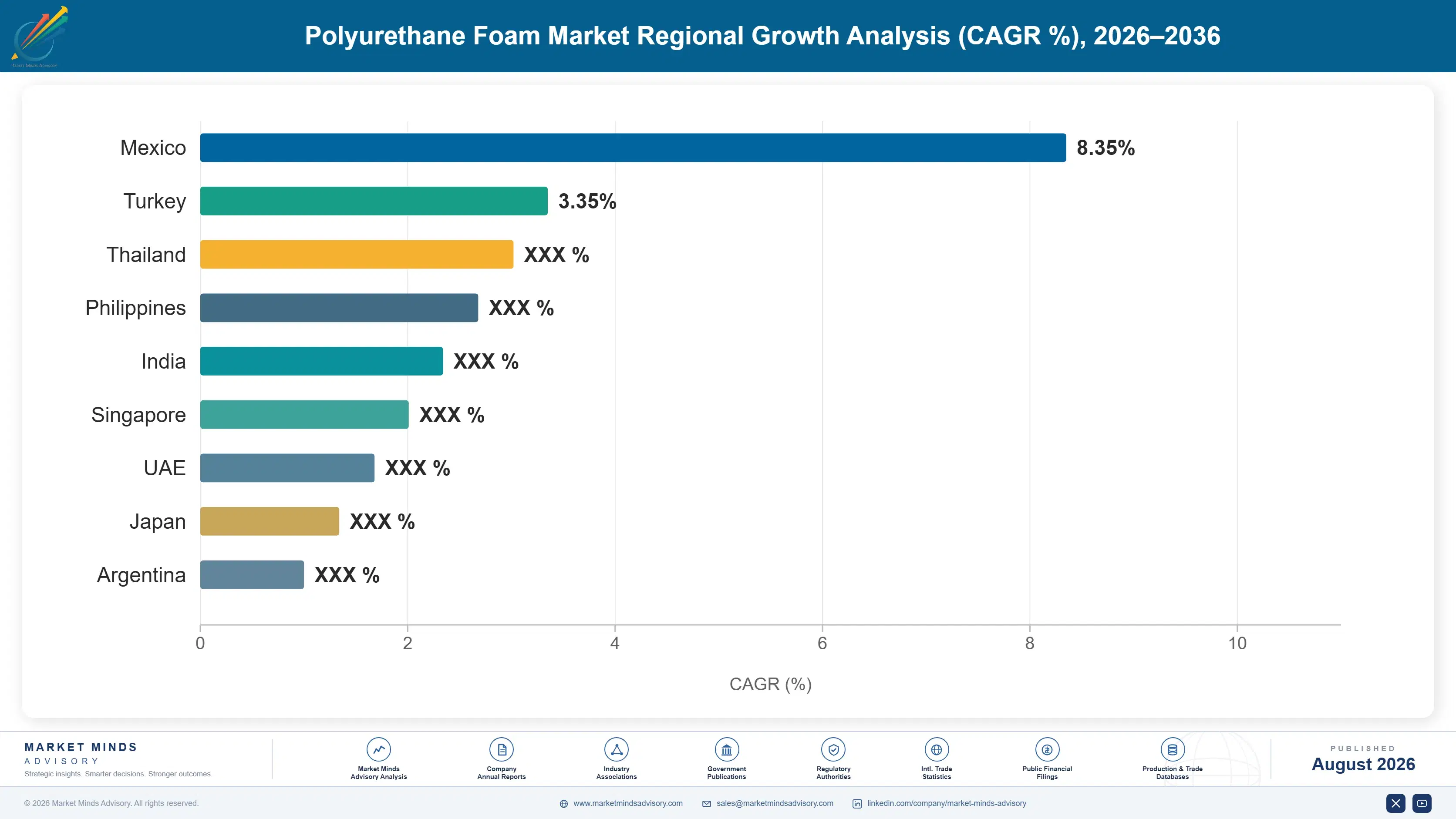
East Asia dominates polyurethane foam production and consumption given China's dominant furniture, bedding, and construction manufacturing base, with North America and Western Europe following through established construction and automotive demand. South Asia and Pacific trails only slightly given India's rapidly expanding construction and furniture investment.

North America

United States residential and commercial construction, supported by tightening state-level energy code adoption, anchors North American polyurethane foam demand alongside substantial furniture and automotive interior volume across the broader region. Dow and Huntsman maintain significant domestic production and application engineering capacity serving both construction contractors and automotive OEMs directly from established regional facilities. Canada contributes smaller but steady construction demand tied to its own energy code modernization initiatives. Growing domestic spray foam installer certification programs, driven by contractor training investment across the industry, have supported steady demand growth across multiple producers in recent years. Growth trails East Asia's faster-expanding manufacturing base but benefits from strong, diversified demand across construction, furniture, and automotive applications.
Share: 25% | CAGR: 5.7% (2026 to 2036)

Western Europe

Germany, France, and Italy anchor European polyurethane foam demand through established construction and furniture manufacturing industries. BASF and Covestro, both headquartered in the region, maintain deep production and formulation development infrastructure serving construction and furniture customers across established European facilities. European Union building energy performance directives have driven meaningful spray and rigid foam demand growth tied to renovation and new construction requirements across member states. Automotive interior demand across German and French manufacturers sustains steady baseline demand for integral skin and molded foam products. Growth trails the global average as the region's mature construction base grows more slowly than expanding Asian manufacturing markets. Regional producers continue investing in formulation research to sustain their qualification edge over Asian competitors.
Share: 18% | CAGR: 3.9% (2026 to 2036)
Regional intelligence for 5 additional markets available in the complete report: East Asia, South Asia and Pacific, Latin America, Middle East and Africa, Eastern Europe. Contact sales@marketmindsadvisory.com.
polyurethane-foam-market-country-cagr-analysis-1787311565969

Where Foam Producers Can Expand Margins

Producers create outsized value not from standard flexible foam tonnage but from spray formulation engineering, installer certification, and long-term construction contracts built over years of investment. The levers below identify where margin expands fastest, moving beyond commodity foam sales toward engineered thermal performance, certification, and contract security. Sustained investment across each dimension compounds meaningfully over time.

Spray Formulation Engineering Commands Strong Premium

Producers that develop spray foam formulations validated for specific thermal performance targets capture meaningfully higher realized pricing than standard flexible foam, often 2 to 3 times the price per ton for equivalent volume, because construction customers pay for the documented thermal performance and air-sealing properties this formulation engineering provides over generic alternatives. This formulation development requires sustained research and installer training investment, but producers that achieve proven thermal performance gain access to the highest-margin segment of the entire market well ahead of competitors selling standard commodity-grade foam. This positions certified producers to capture disproportionate profit share while holding modest tonnage.
Market Impact: Adds 350 to 450 basis points gross

Installer Certification Deepens Contractor Relationships Further

Producers that operate installer certification programs, training contractors on proper spray foam application technique, capture design-in advantages that transactional competitors cannot easily replicate once contractors standardize on a specific formulation and certification pathway. This certification model requires sustained training infrastructure investment, but producers achieving deep contractor relationships typically retain 80% or more of qualified installer accounts through multiple project cycles, converting training investment into recurring, low-churn revenue. This certification advantage compounds over time as design-in status makes it harder for competitors to displace an incumbent formulator across multiple project cycles.
Market Impact: Retains 80 percent of accounts each

Building Long-Term Construction Contractor Supply Contracts

Producers that secure multi-year supply agreements tied to specific construction firms gain revenue visibility spanning multiple project cycles, typically 3 to 5 years, since contractors rarely switch spray foam formulations mid-relationship given the retraining and requalification risk involved in changing suppliers. This contract security requires proven thermal performance consistency and delivery reliability, but producers achieving relationship-level qualification convert commodity volume into durable, multi-year revenue relationships smaller transactional sellers cannot match. This durability advantage compounds across each relationship's multi-year cycle, since requalification carries real retraining and disruption cost. Competitors rarely win these contracts back once lost.
Market Impact: Secures 3 to 5 years of contract re

Developing Premium Bedding Formulation Capability Broadly

Producers that develop premium high-resilience and viscoelastic formulations capture bedding manufacturer demand willing to pay meaningful pricing premiums for comfort differentiation in an otherwise commoditized product category, commanding 25 to 35% higher pricing than standard flexible foam grades. This formulation development requires sustained comfort testing investment, but producers achieving proven premium performance typically win design-in status with mattress manufacturers seeking to differentiate flagship product lines from competitors. This pricing advantage compounds over time as flagship product positioning locks in recurring design-in relationships across successive mattress generations. Investors reward this stability.
Market Impact: Commands 25 to 35 percent pricing p

Who Controls the Margin Pool

CR5 stands at 36%, reflecting a moderately concentrated market shaped by the formulation engineering and application support barriers that favor established chemical majors over smaller regional foam producers. The gap between the top five and smaller producers is widest in spray foam formulation, where thermal performance validation barriers protect leaders far more than in standard flexible foam production.
Competition currently plays out across three dimensions: spray formulation engineering races among majors serving construction contractors, installer certification investment among producers building contractor relationships, and capacity expansion timed to Asian construction and furniture manufacturing growth among a broader group of regional producers. Smaller regional producers compete primarily on proximity-driven cost advantage rather than formulation depth or global contract scale,. None of these dimensions alone determines competitive rank, but sustained investment across multiple fronts compounds meaningfully over time for leading producers.

Emerging pressure comes from two directions. Asian producers are investing in formulation research capability to reduce reliance on imported premium foam chemistry, though installer certification depth remains a gap relative to established Western suppliers. Continued building code tightening could also reorder competitive rankings if spray foam demand accelerates faster than currently expected, favoring producers with early formulation investment over standard-grade competitors.
polyurethane-foam-market-company-positioning-matrix-1787311566812

Competitive Moat and Risk Dimensions

BASF SE

Moat: Deepest Spray Formulation Portfolio

BASF operates extensive spray foam formulation research and installer certification infrastructure built over decades of thermal performance investment, giving it preferred supplier status across construction contractors requiring the deepest formulation documentation available in the industry. This documentation depth is difficult for smaller regional producers to replicate without comparable long-term technical relationship investment.
BASF SE

Risk: European Cost Base Exposure

BASF's substantial European production footprint exposes it to higher energy and labor costs than Asian competitors, creating margin pressure in standard flexible foam grades where regional cost differentials matter more than formulation depth. Shifting greater production toward lower-cost regions would help BASF narrow this gap over time.
COVESTRO AG

Moat: Broad Global Application Reach

Covestro operates production and technical support capacity across multiple continents spanning construction, automotive, and furniture applications, giving it diversified exposure across the market's most stable and fastest-growing segments simultaneously through its broad specialty chemicals business. This footprint gives Covestro resilience against regional demand softness that more geographically concentrated competitors cannot easily offset.
COVESTRO AG

Risk: Diversified Focus Limits Specialization

Covestro's broad specialty chemicals portfolio means polyurethane foam competes internally for capital and management attention against larger, more established product lines within the company's overall business strategy. Sharpening focus on foam-specific investment would help Covestro defend against more specialized competitors over time. Progress here remains gradual.

Players Tracked

Prominent Players

BASF SE
Covestro AG
Huntsman Corporation
Dow Inc.
Wanhua Chemical Group Co. Ltd.

Other Key Players

Recticel NV/SA
FoamPartner Group
Carpenter Co.
Future Foam Inc.
Vitafoam Products Canada Ltd.
Zotefoams plc
Woodbridge Group
Inoac Corporation
Sekisui Chemical Co. Ltd.
Dongsung Chemical Co. Ltd.
Lear Corporation
Trelleborg AB
Zhuzhou Times New Material Technology Co. Ltd.
Jiangsu Sanmu Group Co. Ltd.
NCFI Polyurethanes

Recent Developments

MARCH 2025

BASF Expands Spray Foam Formulation Production Capacity

BASF announced completion of a capacity expansion at its European production facility, adding qualified spray foam formulation capacity to serve growing construction contractor demand. The expansion follows several years of thermal performance investment supporting building code compliance documentation. The expansion strengthens BASF's position in the fastest-growing demand segment overall.
Signal: Confirms leading producers are dedicating
JULY 2025

Wanhua Chemical Expands Domestic Production Capacity

Wanhua Chemical announced completion of a capacity expansion at its domestic production facility, adding qualified polyurethane foam capacity to serve growing Chinese construction and furniture customer demand. The expansion follows several years of investment tracking continued domestic manufacturing growth. The expansion strengthens its position in the fast-growing domestic Chinese market.
Signal: Signals major Chinese producers are scalin
NOVEMBER 2025

Covestro and a Major Construction Firm Sign Supply Agreement

Covestro signed a multi-year supply agreement with a major construction firm covering spray foam formulation supply for commercial building envelope projects. The agreement secures forward volume at negotiated pricing tied to the firm's long-term construction schedule. The deal reflects growing preference for locked-in supply security over spot purchasing.
Signal: Signals construction firms are increasingl

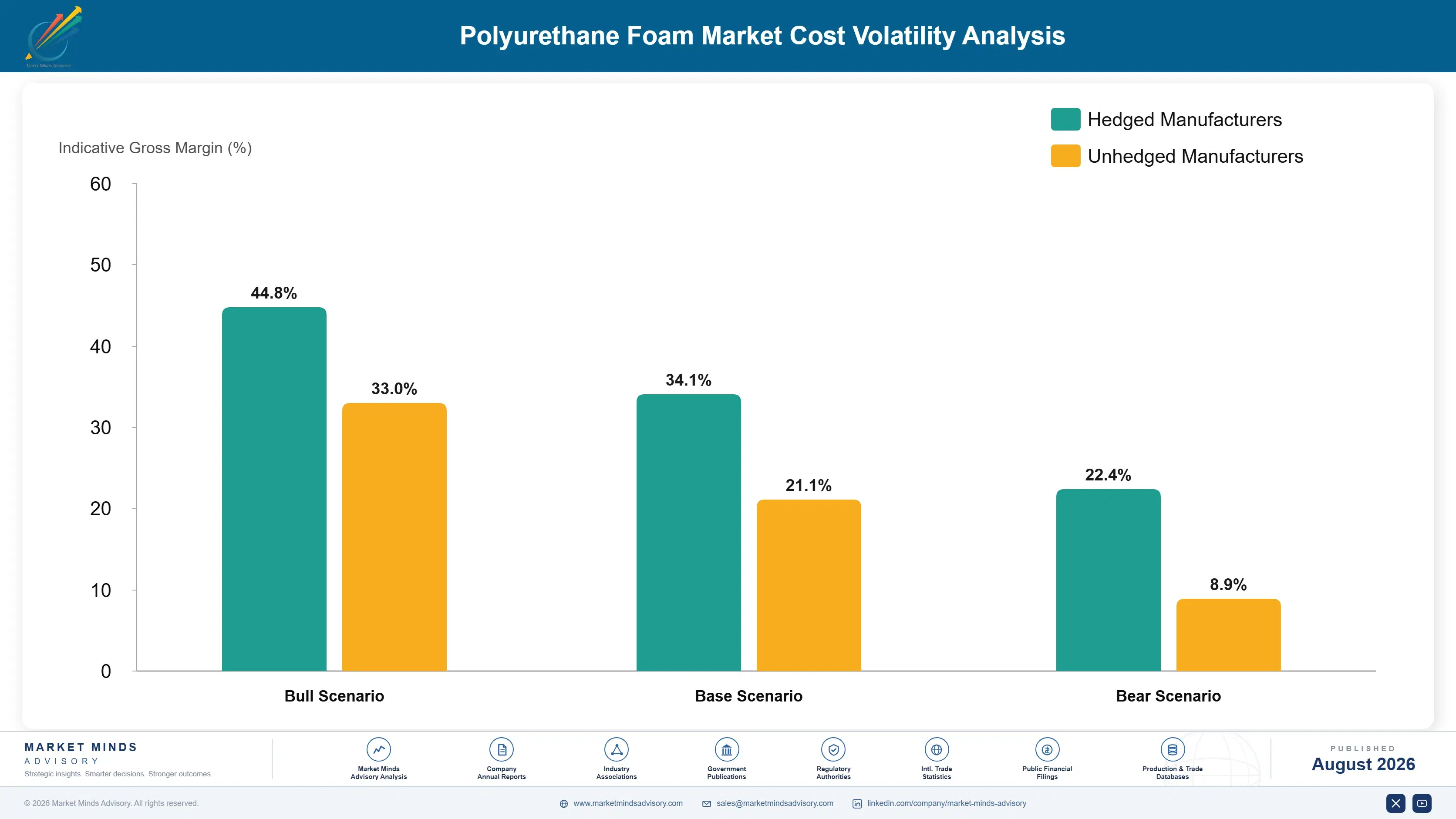
Polyol and Isocyanate Feedstock Exposure

Polyol and isocyanate together account for roughly 48% of cost of goods sold across polyurethane foam production, with pricing tied to broader petrochemical supply and demand cycles rather than foam-specific dynamics. Producers relying on spot-market feedstock purchases face greater price exposure than those with long-term supply agreements. Producers with long-term contracts face less exposure to short-term pricing volatility than spot-market buyers.
Isocyanate prices rose sharply during 2021 and 2022, documented in company annual reports across the sector, as broader petrochemical supply disruption tightened available material faster than downstream demand could adjust. Several producers reported compressed margins during this period, since customer pricing on longer-term construction and automotive contracts could not be renegotiated quickly enough to reflect rising feedstock cost. Recovery in downstream pricing followed only gradually as contract renegotiation cycles took time.

This exposure disadvantages smaller producers without long-term feedstock supply agreements relative to larger, better-capitalized competitors who hedge exposure through diversified sourcing and, in some cases, backward integration into upstream petrochemical production. Producers without secured supply face meaningfully greater difficulty maintaining consistent margins during periods of raw material volatility. Margin compression is most acute among smaller regional producers lacking diversified sourcing relationships.
polyurethane-foam-market-cost-volatility-analysis-1787311567185

Long-Term Feedstock Supply Contracts

Producers are locking in multi-year polyol and isocyanate supply contracts at fixed or formula-based pricing, trading some upside flexibility for predictable production costs. This approach has become more common since 2021 as producers sought greater cost predictability across volatile pricing periods. Producers report this approach has meaningfully smoothed quarterly production cost variance since broader adoption began.

Backward Integration Into Petrochemical Production

Several larger producers are investing in backward integration into upstream isocyanate and polyol production capacity, directly reducing exposure to merchant market pricing volatility. This approach requires substantial capital investment but delivers a durable cost advantage once facilities reach full operating scale. Several producers are pursuing this route to achieve durable long-term cost advantages over merchant market alternatives.

Diversified Geographic Sourcing Strategies

Producers are diversifying feedstock sourcing across multiple geographic suppliers, reducing overall exposure to any single region's petrochemical supply disruption or export policy risk. This diversification has become standard practice among the largest producers. This diversification has become a standard risk management practice among the largest global foam producers today. Adoption continues to grow steadily.

Portfolio Architecture for Margin Defence

MMA organizes this market into three tiers by formulation performance and margin profile. The volume tier covers standard flexible and rigid foam sold into conventional furniture and construction applications, competing primarily on price. The premium tier covers spray and high-resilience formulations commanding higher margins through engineering and certification barriers. The sustainability tier captures bio-based polyol formulations still scaling toward broader commercial adoption.
Volume tier producers compete on price and delivery consistency with moderate margins, while premium tier suppliers protect pricing power through formulation research and installer certification barriers that keep new entrants out for years at a time. This creates real tension inside diversified producers, since capital allocated to sustaining standard capacity competes directly with capital needed to fund spray formulation research and contractor training infrastructure, and most large producers now favor the latter given superior long-term returns.

The highest-value pools concentrate in spray foam formulations for construction and long-term contractor supply agreements, where certification barriers and contract security combine to support the strongest pricing power in the entire market. Premium bedding formulations are emerging as a further high-value position as consumer comfort demand intensifies industry-wide.

Volume / Commodity-Adjacent Tier

Standard flexible and rigid foam sold into conventional furniture and construction applications, competing primarily on price and delivery consistency. Producers compete mainly through delivery consistency and price position across established regional customer bases.
Gross Margin: 12-18%

Premium / Certified Tier

Spray and high-resilience formulations commanding higher margins through engineering, thermal validation, and durable multi-year contractor relationships. Suppliers protect this pricing power through sustained engineering and certification investment few competitors can match.
Gross Margin: 26-36%

Sustainability / Regulatory / Next-Generation Tier

Bio-based polyol formulations positioned ahead of rising sustainability procurement requirements, commanding premium pricing among sustainability-focused customers. Producers investing early in bio-based formulation development are positioned to capture durable advantages as demand grows.
Gross Margin: 20-30%
polyurethane-foam-market-portfolio-architecture-1787311568057

High-value Sub-segments and Strategic Watch-out

Spray Foam Formulation Engineering Programs

This segment combines the strongest thermal validation barriers in the market with steady growth tied to continued building code tightening. Producers with early certification investment and established programs hold a durable, difficult-to-replicate pricing advantage. That advantage compounds meaningfully as contractor relationships deepen over successive project bidding cycles.
Gross Margin: 28-36%

Long-Term Construction Contractor Agreements

Building code compliance supports steady demand growth largely independent of broader commodity foam cycles, with established certification providing meaningful competitive protection against new entrants lacking comparable infrastructure. Producers with multi-year contractor relationships hold the strongest position here over time. Requalification risk keeps contractors loyal to established formulators.
Gross Margin: 22-30%

Standard Flexible and Rigid Foam

The largest volume base by tonnage, this segment covers standard-grade foam sold into conventional furniture and construction applications, where competition is driven mostly by price. Margins stay thin for most participants competing here. Efficiency and logistics position remain the primary competitive levers available to producers here.
Gross Margin: 10-16%

Bio-Based Polyol Formulation Expansion

Producers are expanding bio-based polyol formulations to serve growing sustainability-conscious customer demand, a trajectory worth monitoring closely by producers still focused primarily on conventional petroleum-based formulations. Adoption is accelerating as customers formalize sustainability procurement requirements. Early movers gain a durable pricing advantage as this shift gains momentum.
Gross Margin: 18-26%

Certification Durability Across Application Categories

Once a producer secures certification within a contractor's standard installation practice or an automotive platform's engineering documentation, that relationship typically persists for the full duration of the training investment, since switching formulations requires retraining and requalification that most contractors avoid absorbing without strong cause. This creates durable, low-churn revenue characteristics for spray foam and automotive-linked supply, distinct from the more transactional
Adoption depth varies sharply by end use. Spray foam contractors show the deepest stickiness, since switching suppliers requires extensive installer retraining that most avoid absorbing without strong cause given certification cost. Automotive OEMs show similarly strong stickiness tied to platform-level engineering validation requirements. Standard furniture and bedding customers show the least stickiness of the three, since these purchases occur more transactionally on standard commodity specifications.

Buyer profiles are shifting as procurement teams increasingly weigh thermal performance documentation and installer certification depth, not just price, as explicit criteria following recent periods of building code enforcement tightening. Younger contractors increasingly favor suppliers with credible training programs over pure commodity sourcing, a consideration that has grown more prominent following recent code compliance disruption episodes across multiple markets.
polyurethane-foam-market-end-use-penetration-index-1787311568885

Where MMA Sees the Opportunity

These are among the four positions where our research anticipates prominent divergence between winners and laggards over the coming forecast period. Each is grounded in the demand model, the regulatory perimeter, and the announced capacity pipeline.
01 / SPRAY FORMULATION INVESTMENT

Build Spray Formulation Engineering Ahead of Growth

Spray foam formulations command the strongest pricing power in the entire market, and producers that invest in thermal performance research and certification documentation now position themselves ahead of continued building code tightening through 2036. This capability requires sustained research investment across multiple years of qualification work. Waiting until spray demand is obviously dominant risks ceding this formulation advantage to producers who invested earlier and already hold contractor relationships spanning multiple project cycles and years of accumulated thermal performance validation data.
02 / INSTALLER CERTIFICATION PROGRAMS

Build Installer Certification to Deepen Contractor Ties

Installer certification provides the most direct path to winning long-term spray foam contracts in a market where contractors increasingly value training support over pure material pricing. Producers that invest in certification infrastructure now position themselves ahead of competitors still selling purely as arms-length material suppliers. This capability requires substantial training investment, but producers that achieve deep certification collaboration convert training support into recurring, low-churn revenue that smaller competitors, lacking comparable staffing and fully dedicated training infrastructure depth, cannot easily replicate.
03 / LONG-TERM CONTRACTOR CONTRACTS

Secure Long-Term Contractor Contracts Early

Contractors rarely switch spray foam formulations mid-relationship, and producers that secure supply positions with construction firms currently expanding gain revenue visibility spanning years of future project cycles. This positioning requires proven thermal performance consistency and delivery reliability relative to competing suppliers. Producers that achieve it convert commodity volume into the most durable revenue relationships available in this market, and waiting until relationships are already committed risks missing this opportunity entirely, ceding it fully and permanently to earlier, better-qualified competitors instead.
04 / PREMIUM BEDDING FORMULATION DEVELOPMENT

Develop Premium Bedding Formulations for Comfort Buyers

Premium bedding formulation development represents an underappreciated growth opportunity in a market where most producers still compete primarily on standard flexible foam pricing rather than comfort differentiation. Producers that build premium high-resilience formulations capture value beyond standard material pricing through mattress manufacturer design-in relationships. This development requires sustained comfort testing investment, but producers achieving proven premium performance secure customer relationships that standard formulation competitors cannot access without comparable investment and years of accumulated mattress and furniture manufacturer design-in trust behind them.

Engagement Snapshot From the Field

A live engagement with an industry participant carrying material or product regulatory and market exposure ahead of a defining policy shift, showing how our research translates into a defensible multi-year portfolio strategy.
MARKET MINDS ADVISORY · CLIENT ENGAGEMENT SUMMARY
Polyurethane Foam Producer Strategic Portfolio Review and Transition Roadmap 2026·Investment Scenario on Polyurethane Foam Exposure Evaluation 2025-26
CLIENT PROFILE
The client is a regional construction contractor generating substantial annual revenue from commercial building envelope installation across multiple state markets. The company sourced spray foam formulations from a single supplier and was evaluating diversification amid growing concern about single-supplier capacity constraints during periods of surging construction demand. The company has invested steadily in expanding its commercial contract portfolio across multiple regional markets.
STRATEGIC CHALLENGE
The client needed to decide whether to invest approximately $1.6 million (client-reported, unverified by MMA) in qualifying a second spray foam supplier, adding installer retraining and certification cost, or maintain its existing single-supplier relationship despite growing concern about capacity allocation during periods of tight industry-wide demand. Leadership needed a defensible answer before the next construction season began.
MMA APPROACH
MMA's advisory team conducted primary interviews with spray foam producers about current and projected capacity allocation, and analyzed historical availability patterns during periods of tight industry demand to assess realistic single-supplier risk. The analysis weighed retraining cost and timeline against production disruption risk. Findings were validated against comparable contractor experiences during recent demand surges.
KEY FINDINGS
  1. Interview data indicated that spray foam allocation had been constrained by the client's existing supplier during a recent period of surging construction demand, confirming genuine single-supplier capacity risk.
  2. Second-supplier qualification, including installer retraining and certification, typically took 4 to 6 months, requiring advance planning relative to the client's project scheduling.
  3. The incremental retraining cost represented a modest share of the client's annual project budget relative to the production disruption risk a single-supplier shortfall could create for time-sensitive commercial projects.
  4. Comparable contractors that maintained dual-qualified spray foam suppliers reported no material project delays during recent periods of tight industry-wide capacity, unlike single-supplier peers.
CLIENT PROFILE
The client is a regional construction contractor generating substantial annual revenue from commercial building envelope installation across multiple state markets. The company sourced spray foam formulations from a single supplier and was evaluating diversification amid growing concern about single-supplier capacity constraints during periods of surging construction demand. The company has invested steadily in expanding its commercial contract portfolio across multiple regional markets.
STRATEGIC CHALLENGE
The client needed to decide whether to invest approximately $1.6 million (client-reported, unverified by MMA) in qualifying a second spray foam supplier, adding installer retraining and certification cost, or maintain its existing single-supplier relationship despite growing concern about capacity allocation during periods of tight industry-wide demand. Leadership needed a defensible answer before the next construction season began.
MMA APPROACH
MMA's advisory team conducted primary interviews with spray foam producers about current and projected capacity allocation, and analyzed historical availability patterns during periods of tight industry demand to assess realistic single-supplier risk. The analysis weighed retraining cost and timeline against production disruption risk. Findings were validated against comparable contractor experiences during recent demand surges.
KEY FINDINGS
  1. Interview data indicated that spray foam allocation had been constrained by the client's existing supplier during a recent period of surging construction demand, confirming genuine single-supplier capacity risk.
  2. Second-supplier qualification, including installer retraining and certification, typically took 4 to 6 months, requiring advance planning relative to the client's project scheduling.
  3. The incremental retraining cost represented a modest share of the client's annual project budget relative to the production disruption risk a single-supplier shortfall could create for time-sensitive commercial projects.
  4. Comparable contractors that maintained dual-qualified spray foam suppliers reported no material project delays during recent periods of tight industry-wide capacity, unlike single-supplier peers.
RECOMMENDED STRATEGY
Phase 1: Phase 1 (Months 1-2): Initiate installer retraining and certification with a second qualified spray foam supplier in parallel with the primary relationship. Phase 2: Phase 2 (Months 3-5): Complete certification and finalize supply agreement terms with the qualified second supplier for defined volume allocation. Phase 3: Phase 3 (Months 6): Integrate the second supplier into standard project rotation, maintaining dual-qualified status through ongoing operations., monitoring performance across both suppliers closely
OUTCOME
The client completed second-supplier qualification within 5 months, within the projected timeline, and avoided a documented capacity shortfall that affected a competing contractor's single-sourced projects during the same period. The client reported that dual-sourcing added modest incremental cost while eliminating a supply risk it judged unacceptable for time-sensitive commercial projects.

Frequently Asked Questions

Foundational context covering the market sizes, CAGR, scope, country, region and competition that inform every finding below. This section is provided to cover basics and most often pre-purchase conversations, answered from the MMA Primary Research Dataset.

What is the current size of the Polyurethane Foam Market?

The Polyurethane Foam Market was valued at $68.4 billion in 2025. MMA projects it will reach $72.09 billion in 2026 as construction and premium bedding demand both continue expanding.

How large will the Polyurethane Foam Market be by 2036?

MMA forecasts the market will reach $121.98 billion by 2036, up from $72.09 billion in 2026. That represents a 1.69 times expansion over the ten-year forecast window.

What is the CAGR for the Polyurethane Foam Market 2026 to 2036?

The market is projected to grow at a 5.4% CAGR between 2026 and 2036. MMA's bull and bear scenarios range from 6.4% to 4.4% depending on construction activity pace.

Which segment is growing fastest?

Spray Polyurethane Foam is the fastest-growing segment, expanding at a 7.3% CAGR, roughly 1.35 times the overall market rate as building energy codes tighten. This growth outpaces every other segment given intensifying construction code demand.

Who are the major companies in the Polyurethane Foam Market?

BASF, Covestro, Huntsman, Dow, and Wanhua Chemical lead the market, together holding an estimated 36% of global production capacity. CR5 concentration reflects the genuinely regional, engineering-driven nature of this industry.

Which country is growing fastest?

China is the fastest-growing country market, expanding at an estimated 6.7% CAGR as its furniture, bedding, and construction manufacturing base continues rapid expansion. This reflects both manufacturing scale and rapidly expanding construction investment.

Report Segmentation Architecture

The full report scope spans multiple orthogonal segmentation dimensions, with cross-tabulated demand data provided for each dimension pair. Coverage extends further to regional breakdowns, trend trajectories, and the competitive detail needed to support segment-level decision-making.

By Primary Market Dimension

  • Flexible Polyurethane Foam
  • Rigid Polyurethane Foam
  • Spray Polyurethane Foam
  • Integral Skin Foam
  • High-Resilience and Viscoelastic Foam

By End-Use Industry

  • Construction
  • Furniture and Bedding
  • Automotive
  • Appliances
  • Packaging

By Commercial Dimension

  • Manufacturer Direct Supply
  • Contractor and Fabricator Supply
  • Distribution and Trading Supply

By Region

  • North America
  • Western Europe
  • East Asia
  • South Asia and Pacific
  • Latin America
  • Middle East and Africa
  • Eastern Europe

Scope, Methodology, and Coverage

Every figure in this report is reproducible from documented input assumptions. The scope below maps the historical period, the forecast horizon, the segmentation dimensions, and the countries covered, alongside the underlying primary and qualitative methodology.
Historical Period
2020 to 2025
Forecast Period
2026 to 2036
Base Year
2025 (USD billions; MMA Primary Research Dataset, August 2026)
Market Definition
This report covers flexible, rigid, spray, and integral skin polyurethane foam products used across furniture, bedding, construction insulation, automotive, and packaging applications. It excludes polyurethane coatings, adhesives, and elastomers not in cellular foam form, and finished furniture or mattress products sold as complete goods.
Quantitative Units
USD billions (current prices); metric tons of production capacity where applicable
Segmentation Dimensions
By Foam Type; By End-Use Industry; By Commercial Dimension; By Region
Regions Covered
North America, Western Europe, East Asia, South Asia and Pacific, Latin America, Middle East and Africa, Eastern Europe
Countries Covered
USA, China, Germany, France, Italy, UK, Japan, South Korea, India, Australia, Canada, Brazil, Mexico, Vietnam, Thailand, UAE, Saudi Arabia, South Africa, Poland, Hungary, Netherlands, Spain, Argentina, Colombia, Singapore, and additional markets relevant to this sector
Key Companies Profiled
BASF SE, Covestro AG, Huntsman Corporation, Dow Inc., Wanhua Chemical Group Co. Ltd., Recticel NV/SA, FoamPartner Group, Carpenter Co., Future Foam Inc., Vitafoam Products Canada Ltd., Zotefoams plc, Woodbridge Group, Inoac Corporation, Sekisui Chemical Co. Ltd., Dongsung Chemical Co. Ltd., Lear Corporation, Trelleborg AB, Zhuzhou Times New Material Technology Co. Ltd., Jiangsu Sanmu Group Co. Ltd., NCFI Polyurethanes
Quantitative Methodology
Primary survey, n=3,800 respondents, Q4 2025, six countries; demand-side model with trade association cross-validation
Qualitative Methodology
47 expert interviews, Q4 2025; applied to validate demand model assumptions, identify emerging dynamics, and assess competitive positioning
Report Format
PDF and XLSX data workbook (Word format preview document)
Publisher
Market Minds Advisory
Report Code
MMA-2026-CHM-127
Published
August 2026
Contact
sales@marketmindsadvisory.com | www.marketmindsadvisory.com

Purchase the full Polyurethane Foam Market Report (2026 to 2036).

The full Polyurethane Foam Market report delivers ten-year forecasts across all seven regions, six foam type segments, and the full competitive landscape of twenty profiled producers. It includes detailed analysis of spray formulation economics, installer certification strategies, and demand drivers spanning construction, furniture, automotive, and appliance applications. Buyers receive segment-level margin benchmarking across the volume, premium, and sustainability tiers identified in this summary. The report also includes primary survey data from 3,800 respondents and 47 expert interviews conducted in the fourth quarter of 2025, supporting every demand and pricing assumption in the forecast.
Ten-year regional and segment-level forecast models
Competitive profiles covering twenty foam producers
Spray formulation economics and thermal performance analysis
Installer certification and contractor relationship mapping
Portfolio margin benchmarking across three commercial tiers
Primary survey and expert interview data appendix

Built For The People Who Decide

From boardroom strategy to bench-side execution, this report is read cover-to-cover by leaders shaping the next decade of their industry, turning demand scenarios, market dynamics and valuation benchmarks into decisions.
CXOs/ Presidents/ VPs/ Managers
M&A and Corporate Development
Strategy Teams and R&D Heads
Procurement and Product Directors
Regulatory and Compliance Leaders
Investor Relations and Equity Analysts