Market Minds Advisory
Polyunsaturated Fatty Acids Market

Polyunsaturated Fatty Acids Market: Production Route Economics, Marine Feedstock Constraint and the Fermentation Shift, 2026 to 2036

Wild marine feedstock stopped growing more than a decade ago while demand kept rising, and the entire commercial argument in this industry now turns on what replaces the fish that are not there.

Lead Analyst

Bilal Shaikh

Published

September 2026

Make Smarter Decisions with Customized Research Insights

Request a free sample report and evaluate market opportunities, growth trends, and competitive dynamics relevant to your business needs.

2025 MARKET VALUE$8.6BMarket Size 2025
2036 FORECAST VALUE$18.9BBase Case , 2026 to 2036
CAGR 2026 TO 20367.4 %Bull 8.7% / Bear 6.2%
INCREMENTAL OPPORTUNITY$9.6BNet 10- year value creation
EXPANSION MULTIPLE2.04x2036 value over 2026 base
Strategic Levers
M&A Pipeline
Regional Outlook
Country Rankings
Competitive Intelligence
Segmental Deep-dive
Call-Us : 91 93563 13602

Executive Snapshot and Market Trajectory

Marine feedstock is the binding constraint and everyone in the industry now plans around it. Global fishmeal and fish oil landings have been effectively flat since 2010 under quota management, while demand from aquaculture, supplements and regulated infant nutrition has kept compounding at rates well above anything the sea supplies.
Algal-derived polyunsaturated fatty acids grow at 11.1%, a full 1.50 times the market rate, driven by salmon feed qualification and by infant formula manufacturers who want a supply chain independent of fishing quotas. East Asia holds 30% of global value, resting on Chinese aquaculture volume and infant nutrition demand together with the highest per-capita marine lipid consumption found anywhere, in Japan.
The top five suppliers hold 36% between them, which is modest for an industry with this much technical complexity, and it reflects how many small marine oil refiners still operate. Pharmaceutical-grade concentration and algal fermentation are where consolidation is happening, because both demand capital and regulatory capability that regional refiners cannot assemble. Quota policy, rather than competitive strategy, remains the single largest determinant of who actually has product to sell in any given year.
Market Definition
The market covers polyunsaturated fatty acids supplied as refined oils, concentrates and purified esters for human nutrition, pharmaceutical and animal feed use. It spans omega-3 EPA, DHA and ALA and omega-6 arachidonic acid and gamma-linolenic acid, produced from wild marine catch, krill, algae, microbial fermentation and plant seed oils. It excludes bulk edible vegetable oils sold as food ingredients, fishmeal, finished supplement and formula products, and saturated or monounsaturated lipid fractions.
Base Year Value
$8.6B in 2025 (MMA Primary Research Dataset, August 2026)
Forecast Period
2026 to 2036, eleven discrete annual values
CAGR
7.4% base case. Bull 8.7%. Bear 6.2%.
Fastest Growth Segment
Algal-Derived Polyunsaturated Fatty Acids: 11.1% CAGR
Fastest Growth Country
India: 10.6% CAGR
Fastest Growth Region
South Asia and Pacific: 9.7% CAGR
Largest Region
East Asia: 30% of 2025 global value
Market Leaders
dsm-firmenich, BASF, Croda International, Corbion, Aker BioMarine. Source: MMA Primary Research Dataset, July 2026.
Primary Survey
n=3,800 procurement and R&D decision-makers, Q4 2025, six countries
Methodology
Demand-side build-up, cross-validated against public data, 47 expert interviews

Polyunsaturated Fatty Acids Market Forecast Scenarios

polyunsaturated-fatty-acids-market-trends-size-forecast-scenario-1787311397917
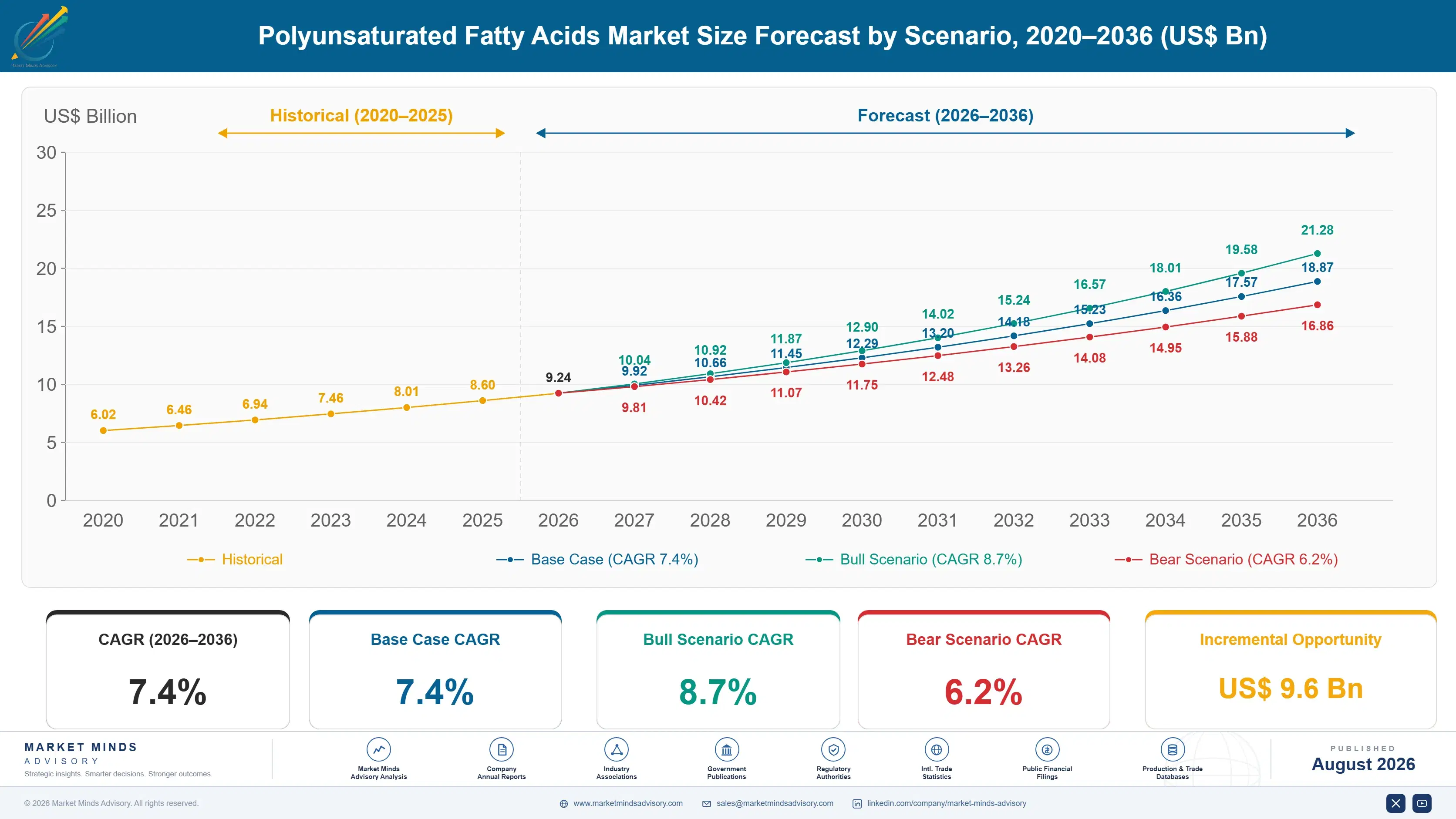
The market compounded at 6.2% between 2020 and 2025, with the pattern set by El Nino rather than by demand. The 2023 Peruvian anchoveta season was cancelled outright, fish oil pricing more than doubled within months, and aquafeed formulators cut marine lipid inclusion rates sharply. Supplement demand held up better because consumers absorb price increases that feed formulators simply engineer around.
The 7.4% base case rests on three mechanisms. First, aquaculture volume keeps growing at roughly 4% annually and each tonne of salmon still requires marine or algal lipid that no cheap substitute replaces. Second, algal and fermentation capacity is arriving at scale, converting a supply-limited market into a capacity-limited one with entirely different economics. Third, pharmaceutical and clinical nutrition demand grows independently of both, on cardiovascular and preterm infant indications that carry their own evidence base.
The bull case at 8.7% assumes cardiovascular prescription omega-3 indications broaden and algal capacity lands on schedule, letting volume grow without the feedstock ceiling binding. The bear case at 6.2% assumes repeated El Nino disruption keeps marine pricing volatile enough that aquafeed formulators permanently design down inclusion rates, which would remove the largest single volume pool from the growth arithmetic.

Why Feedstock Origin Decides Commercial Position

This industry runs on a raw material that nobody can produce more of. Peruvian anchoveta quotas, North Atlantic pelagic allocations and Antarctic krill limits are set by fisheries science and political negotiation, and no amount of capital investment expands them. That single fact shapes every commercial decision downstream.
TOP FIVE CONCENTRATION36%Combined position of the five largest polyunsaturated lipid suppliers
AVERAGE SELLING PRICE$46 per kilogramTypical realised price across concentrate and standard grades
CONCENTRATE PURITY CEILING90% ethyl esterHighest routinely achievable commercial concentrate purity level today
MARINE FEEDSTOCK SHARE48% of COGSCrude marine oil share of delivered concentrate production cost
AQUAFEED DEMAND SHARE58%Portion of global marine oil volume absorbed by aquaculture
CAPACITY UTILISATION72%Average operating rate across concentration and refining plants
The consequence is an unusual competitive structure. Refiners and concentrators compete for a fixed pool of crude marine oil, so a good year for one is generally a bad year for another, and integration back toward fishing rights matters more than efficiency in the plant. Meanwhile the highest-value applications, pharmaceutical concentrates and infant formula DHA, need purity and consistency that crude marine oil delivers only after expensive processing. Value therefore concentrates at both ends: at the quota and at the purification column.
Fermentation and algal cultivation are what change that structure. A fermenter produces DHA at a specified purity from sugar rather than from fish, at a cost that has fallen enough to compete in infant formula and salmon feed even without any feedstock premium. Capacity is still small against total demand, but it is the first genuinely elastic supply this industry has had, and incumbents are reading it accordingly.
"Every marine oil refiner will tell you algae is too expensive, and every one of them has a fermentation project. The honest position is that fish oil sets the price ceiling for algal DHA today and will set the floor for it within a decade, which reverses the entire logic of how this industry was built."
Principal Analyst, Nutritional Lipids and Ingredients Practice · MMA Healthcare

Market Trends

Salmon Feed Qualification Opens Algal Oil At Scale

Norwegian and Chilean salmon producers have qualified algal DHA into commercial feed formulations, and several now specify a minimum algal inclusion for their premium production. The driver is supply security rather than sustainability marketing: a feed formulator holding an algal contract is not exposed to a cancelled anchoveta season. Roughly 8% of salmon feed marine lipid content now comes from algal sources, against effectively nothing in 2018. Volumes at that scale change algal production economics materially, because fermenter utilisation improves and unit costs fall toward the level where feed applications work unsubsidised.
Market Impact: Absorbs 58% of marine oil volume

Concentrate Purity Requirements Climb Toward Pharmaceutical Levels

Supplement buyers have moved steadily up the purity curve, from 30% total omega-3 oils toward 60% and 85% concentrates, driven by consumer preference for smaller capsules and by clinical dosing evidence. Each step up requires additional molecular distillation and chromatographic capability, and yields fall as purity rises. Concentrators holding capability above 85% serve both supplement and pharmaceutical customers from the same asset, which improves loading considerably. Those stuck at 30% crude refining are competing on cost in the segment where marine feedstock volatility hurts most and where differentiation is essentially unavailable.
Market Impact: Covers 140 million annual births

Market Opportunities and Growth Drivers

Aquaculture Expansion Underpins The Largest Volume Pool

Farmed fish production grows around 4% annually and now exceeds wild capture in food fish terms, and salmonid and marine finfish species require dietary EPA and DHA that plant oils cannot supply. Aquafeed absorbs 58% of global marine oil volume, making it the demand pool that sets marginal pricing for everyone else. Formulators have cut inclusion rates as far as fish health permits, so further reduction is limited. That leaves volume growth translating directly into lipid demand, and it is the clearest reason algal capacity finds buyers before it is even commissioned.
Market Impact: Holds landings flat since 2010

Infant Formula DHA Requirements Become Regulatory Mandates

European Union rules have required DHA in all infant formula since 2020, and comparable requirements have followed across China, South Korea and several other markets. That converts a premium option into a compulsory ingredient across an entire product category. Formula manufacturers need documented, traceable and contaminant-free supply, which favours algal and fermentation-derived DHA over marine oil on qualification grounds rather than price. Roughly 140 million infants are born annually into markets with mandatory or near-universal DHA fortification, and that demand does not flex with commodity pricing at all, in either direction.
Market Impact: Requires $450 million per plant

Market Restraints and Challenges

Marine Landings Cannot Grow Under Quota Management

Global fishmeal and fish oil landings have been effectively flat since 2010, and the fisheries producing them are managed at or near maximum sustainable yield. The root cause is biological rather than commercial: the Peruvian anchoveta, Atlantic herring and blue whiting stocks that supply most crude marine oil have no headroom left. Commercially this caps the industry's traditional supply at a level demand passed years ago. Participants are responding through algal and fermentation capacity, through by-product recovery from fish processing that now supplies roughly a third of crude oil, and through krill quota expansion.
Market Impact: Reaches 8% of salmon feed lipid

Fermentation Capital Intensity Slows Algal Capacity Addition

A commercial algal DHA fermentation plant costs $250 million to $450 million and takes about four years to build and validate. The root cause is scale economics: fermentation unit costs fall steeply with vessel size, so viable plants are large, and large plants require demand commitments before financing closes. Commercially this means algal supply arrives in step changes rather than incrementally, and each step temporarily overshoots demand. Participants are addressing it through offtake agreements signed before construction, and through toll fermentation arrangements that use existing biotechnology capacity rather than building new.
Market Impact: Shifts demand toward 85% concentrat
2 additional market trends, 4 additional growth drivers, and 3 additional restraints and challenges are covered in the full report. Contact sales@marketmindsadvisory.com to access the complete intelligence.

Segment CAGR and Growth Architecture

Segmentation follows production route, meaning the biological origin and process by which the fatty acids are made. That single dimension determines feedstock exposure, cost structure, achievable purity, regulatory pathway and which customers a supplier can qualify with, and it is the division around which very nearly every strategic decision taken in this industry is currently organised.
polyunsaturated-fatty-acids-market-trends-market-share-analysis-1787311398454

Algal-Derived Polyunsaturated Fatty Acids

The fastest segment at 11.1%, a full 1.50 times the market rate, covering DHA and EPA produced by heterotrophic or photosynthetic algal cultivation rather than extracted from fish. Growth comes from infant formula, where regulatory DHA requirements favour a traceable and contaminant-free source, and increasingly from salmon feed where supply security matters more than unit cost. Realised pricing sits above marine oil today but the gap narrows with every capacity addition. The constraint is capital rather than biology: plants cost hundreds of millions and only work at scale, which keeps the producer field small, heavily contracted and effectively closed to anyone without access to several hundred million dollars of patient capital.
CAGR 11.1%

Microbial Fermentation-Derived Polyunsaturated Fatty Acids

Growing at 9.4% annually on fatty acids produced by fungal and yeast fermentation, principally arachidonic acid destined for infant formula alongside specialty omega-6 and omega-3 fractions. The infant nutrition application is effectively locked in by formula composition rules that specify arachidonic acid alongside DHA, and the qualified supplier list is short because formula manufacturers requalify very reluctantly. Production economics here are rather more favourable than algal DHA, because fermentation titres run higher and the target molecules are considerably less oxidation sensitive in handling. Growth here is steady rather than spectacular, tracking birth rates and formula penetration across middle-income markets where breastfeeding rates are falling and formula use is rising accordingly.
CAGR 9.4%
Full segment breakdown across 5 segments available in the complete report.

Regional Architecture and Country Demand Map

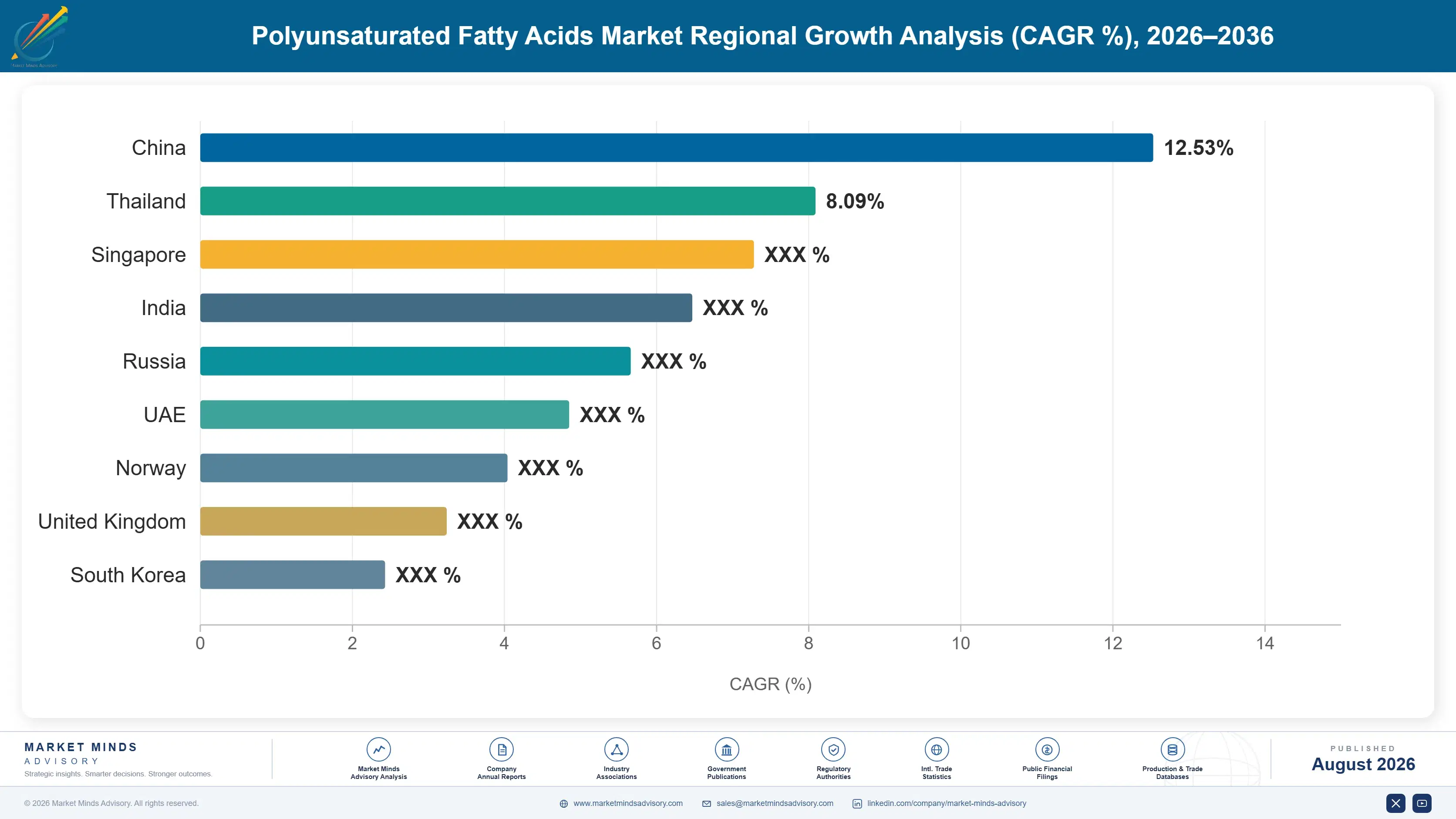
East Asia leads on Chinese aquaculture volume, infant nutrition demand and Japanese marine lipid consumption combined. North America holds the largest dietary supplement and prescription pharmaceutical pool. South Asia and Pacific grows fastest of all as Indian supplement penetration and Southeast Asian aquaculture both expand quickly.

East Asia

Thirty percent of global value, and it is a genuinely different demand mix from anywhere else. Chinese aquaculture is the largest single consumer of marine lipid on the planet, and Chinese infant formula demand drives more DHA and arachidonic acid volume than any other national market. Japan contributes the highest per-capita marine lipid consumption anywhere, spread across supplements, functional foods and pharmaceutical applications with unusual acceptance of fish-derived ingredients. Growth of 8.6% reflects rising supplement penetration alongside aquaculture expansion. Domestic Chinese concentration capacity has improved considerably since 2020, reducing dependence on imported concentrates and shifting the regional trade balance toward crude oil imports instead of finished concentrate. Korean demand is smaller but growing steadily across both channels.
Share: 30% | CAGR: 8.6% (2026 to 2036)

North America

Twenty-seven percent of global value, concentrated in dietary supplements and prescription omega-3 products rather than in feed applications. The United States holds the largest supplement pool by value anywhere, and the prescription cardiovascular segment adds high-value volume that behaves like pharmaceutical demand rather than nutritional demand. Growth of 6.8% is below the global rate, reflecting a mature supplement market where category growth comes from higher concentrations rather than more users. Menhaden fishing in the Gulf supplies domestic crude oil, though most concentrate feedstock is imported. Regulatory scrutiny of supplement health claims shapes marketing considerably more than it shapes any part of the ingredient specification itself. Pet nutrition adds a smaller but consistently expanding demand stream.
Share: 27% | CAGR: 6.8% (2026 to 2036)
Regional intelligence for 5 additional markets available in the complete report: Western Europe, South Asia and Pacific, Latin America, Middle East and Africa, Eastern Europe. Contact sales@marketmindsadvisory.com.
polyunsaturated-fatty-acids-market-trends-country-cagr-analysis-1787311398969

Where Lipid Margin Actually Accumulates

Four moves separate suppliers earning specialty margins from those trading crude oil at quota-driven pricing. Each depends on holding something a competitor cannot obtain by buying feedstock: purification capability above the commodity threshold, qualified fermentation supply, pharmaceutical site status, or contracted access to raw material that a single quota decision cannot simply remove overnight.

Push Concentration Capability Above Eighty-Five Percent

Concentrate purity above 85% serves supplement and pharmaceutical customers from a single asset, and it commands roughly 40% higher realised pricing per kilogram of active than 60% material does. The additional molecular distillation and chromatographic capability costs $25 million to $45 million on an existing refining site. Yield falls as purity climbs, which deters producers who model on volume rather than on active content. Those who make the investment find loading improves because two customer groups draw on the same capacity, smoothing the seasonal swings that supplement demand alone produces.
Market Impact: Commands roughly 40% higher realise

Contract Fermentation Capacity Before Building It

Algal and microbial plants only work at scale, and scale requires demand certainty that spot markets never provide. Producers who secured multi-year offtake from infant formula manufacturers and salmon feed formulators before construction reached financial close on terms that unsecured projects could not match. Committed offtake covering between 60% and 70% of nameplate capacity has now become the effective threshold for reaching financial close at all. It also removes the overshoot problem entirely: capacity arriving against contracted demand does not depress pricing the way speculative capacity additions have repeatedly done across this industry.
Market Impact: Secures up to 70% of nameplate befo

Qualify A Site For Pharmaceutical Grade Supply

Prescription omega-3 products require active pharmaceutical ingredient manufacturing standards, and that site qualification keeps the supplier list to a handful of names worldwide. Qualification costs roughly $30 million to $60 million including documentation systems and takes two to three years. Realised pricing runs three to four times supplement concentrate levels, and demand follows prescription volumes and clinical practice rather than retail supplement cycles. Customer positions last for many years, because reformulating a registered drug product to accommodate a new lipid supplier is expensive, slow and regulatorily unattractive for every party involved.
Market Impact: Returns roughly 4 times supplement

Integrate Backward Into By-Product Feedstock Streams

By-product oil recovered from fish processing now supplies roughly a third of global crude marine oil and is not constrained by the same quotas that cap direct reduction fisheries. Suppliers holding long-term arrangements with processing plants across Norway, Vietnam and Chile access this feedstock at prices 15% to 25% below reduction-fishery crude oil, while carrying far less quota exposure than their competitors do. The processing required is more demanding because by-product oil quality varies between plants and seasons, but that same variability is exactly what keeps competitors from bidding the feedstock away.
Market Impact: Sources feedstock up to 25% below r

Who Controls the Margin Pool

Concentration is moderate at 36% for the top five, measured on polyunsaturated fatty acid revenue across all participants, which understates how concentrated the high-value end actually is. dsm-firmenich leads on the breadth of its algal, fermentation and concentrate positions combined, and the gap to the second tier is widest in fermentation capability rather than in marine oil volume.
Competition runs on three dimensions. Feedstock access decides who has product at all in a poor fishing year, and integration back toward landings or by-product streams matters more than plant efficiency. Purification capability decides who serves the pharmaceutical and high-concentrate segments where margins live. Qualification depth decides infant formula and prescription positions, which change hands very rarely and are worth far more than their volume suggests on any tonnage basis.

Two pressures are building. Fermentation capacity coming online through 2028 will supply DHA volumes that do not depend on fishing at all, which threatens the scarcity premium marine refiners have enjoyed since 2023. Meanwhile Peruvian and Chilean processors have moved downstream into concentration, capturing value that previously flowed to European refiners. Rankings shift where fermentation supply meets the infant formula and salmon feed qualifications that incumbents currently hold.
polyunsaturated-fatty-acids-market-trends-company-positioning-matrix-1787311399496

Competitive Moat and Risk Dimensions

DSM-FIRMENICH

Moat: Only credible multi-route position

The company supplies polyunsaturated fatty acids from algal cultivation, microbial fermentation and marine sources, which no competitor matches across all three. When one route tightens on quota or feedstock cost, customers can be served from another without requalification, and that flexibility is worth more to infant formula and feed customers than any single-route cost advantage.
DSM-FIRMENICH

Risk: Heavy fermentation capital commitment

Large fermentation assets carry fixed costs that require high utilisation to earn their capital, and utilisation depends on demand arriving as forecast. If marine oil pricing falls back for several consecutive good fishing seasons, the cost comparison that justifies algal supply weakens considerably, and those assets become difficult to load at economic pricing.
BASF

Moat: Pharmaceutical grade concentration depth

Concentration and purification capability qualified to pharmaceutical manufacturing standards gives the company access to prescription omega-3 demand that supplement-grade competitors cannot serve. That position rests on site qualification and documentation systems accumulated over years, and drug product reformulation costs make customer relationships unusually durable once they are established.
BASF

Risk: Prescription indication concentration

A meaningful share of the high-margin position depends on a small number of registered cardiovascular products whose clinical evidence base remains contested in parts of the medical community. An unfavourable outcomes trial or a reimbursement reversal would remove prescription volume quickly, with no comparable-margin alternative available inside the existing asset base.

Players Tracked

Prominent Players

dsm-firmenich
BASF
Croda International
Corbion
Aker BioMarine

Other Key Players

KD Pharma Group
Golden Omega
GC Rieber Oils
Epax
Polaris
Omega Protein
TASA
Bioriginal Food and Science
Pharma Marine
Novotech Nutraceuticals
Nordic Naturals
Cargill
Evonik Industries
Veramaris
Mara Renewables

Recent Developments

FEBRUARY 2025

Veramaris expands algal oil supply into salmon feed contracts

Several additional multi-year supply agreements were concluded with Norwegian and Chilean salmon feed formulators covering specified minimum annual algal oil volumes, reflecting how salmon feed producers now value supply that is independent of anchoveta quota decisions considerably more highly than they value headline unit cost.
Signal: Feed formulators are paying for quota inde
JUNE 2025

Golden Omega commissions expanded concentration capacity in Chile

New high-concentration and molecular purification capacity entered commercial service at the company's northern Chile site, moving the company considerably further downstream from crude oil supply into the concentrate grades that had until recently been produced almost entirely at European and North American refining and distillation sites.
Signal: Feedstock-holding countries are now captur
OCTOBER 2025

Croda expands pharmaceutical grade lipid manufacturing capability

Investment in pharmaceutical grade lipid manufacturing capability and the supporting documentation systems was completed at an existing European site, targeting the prescription omega-3 and clinical nutrition customers who require active pharmaceutical ingredient manufacturing standards that ordinary supplement concentrate operations simply cannot satisfy at any volume.
Signal: Pharmaceutical qualification is now being

What Drives Delivered Lipid Cost

Crude marine oil accounts for roughly 48% of concentrate cost of goods, sourced principally from Peruvian and Chilean anchoveta reduction, North Atlantic pelagic landings and fish processing by-product streams across Norway and Southeast Asia. Solvents and processing consumables add 11%. Energy for molecular distillation contributes 14%, which is high because the separation is thermally demanding and runs under vacuum.
The 2023 Peruvian season cancellation was the clearest recent demonstration of feedstock exposure. Crude fish oil pricing more than doubled within four months as the first anchoveta season was called off entirely, and concentrators working without contracted feedstock found themselves unable to fill orders at any margin. Company reporting across the sector documented substantial input cost pressure and shortfalls. Aquafeed formulators responded by cutting inclusion rates, which permanently removed some demand.

The competitive disadvantage mechanism runs through feedstock contracting, not processing efficiency. Suppliers holding long-term arrangements with reduction plants or by-product streams kept producing through 2023 at workable cost, while spot buyers simply stopped. Fermentation-based producers were unaffected, which was the first time that route looked commercially superior rather than merely strategic. Geography matters too: Peruvian and Chilean concentrators sit beside their feedstock while European refiners carry freight on every tonne.
polyunsaturated-fatty-acids-market-trends-cost-volatility-analysis-1787311399696

Contract crude oil supply across multiple fisheries

Single-origin feedstock contracting leaves a concentrator fully exposed to one quota decision, as 2023 demonstrated across the industry. Suppliers now contract across Peruvian, North Atlantic and by-product streams simultaneously, accepting somewhat higher average cost in return for continuity which spot purchasing has repeatedly failed to deliver whenever fishing conditions turned sharply against the industry.

Develop by-product feedstock relationships with processors

Fish processing by-product is not constrained by reduction quotas and now supplies roughly a third of global crude marine oil. Long-term arrangements with processing plants secure material at 15% to 25% below reduction crude pricing. Quality varies more, requiring additional refining capability, but that variability is precisely what deters competitors from bidding the feedstock away.

Recover distillation energy through vacuum system upgrades

Molecular distillation under deep vacuum is thermally intensive and most of the applied heat is currently rejected. Heat recovery and vacuum system upgrades cost roughly $4 million per line and cut energy cost of goods by around three percentage points, with payback inside four years at European industrial power prices and considerably faster where carbon costs apply.

Portfolio Architecture for Margin Defence

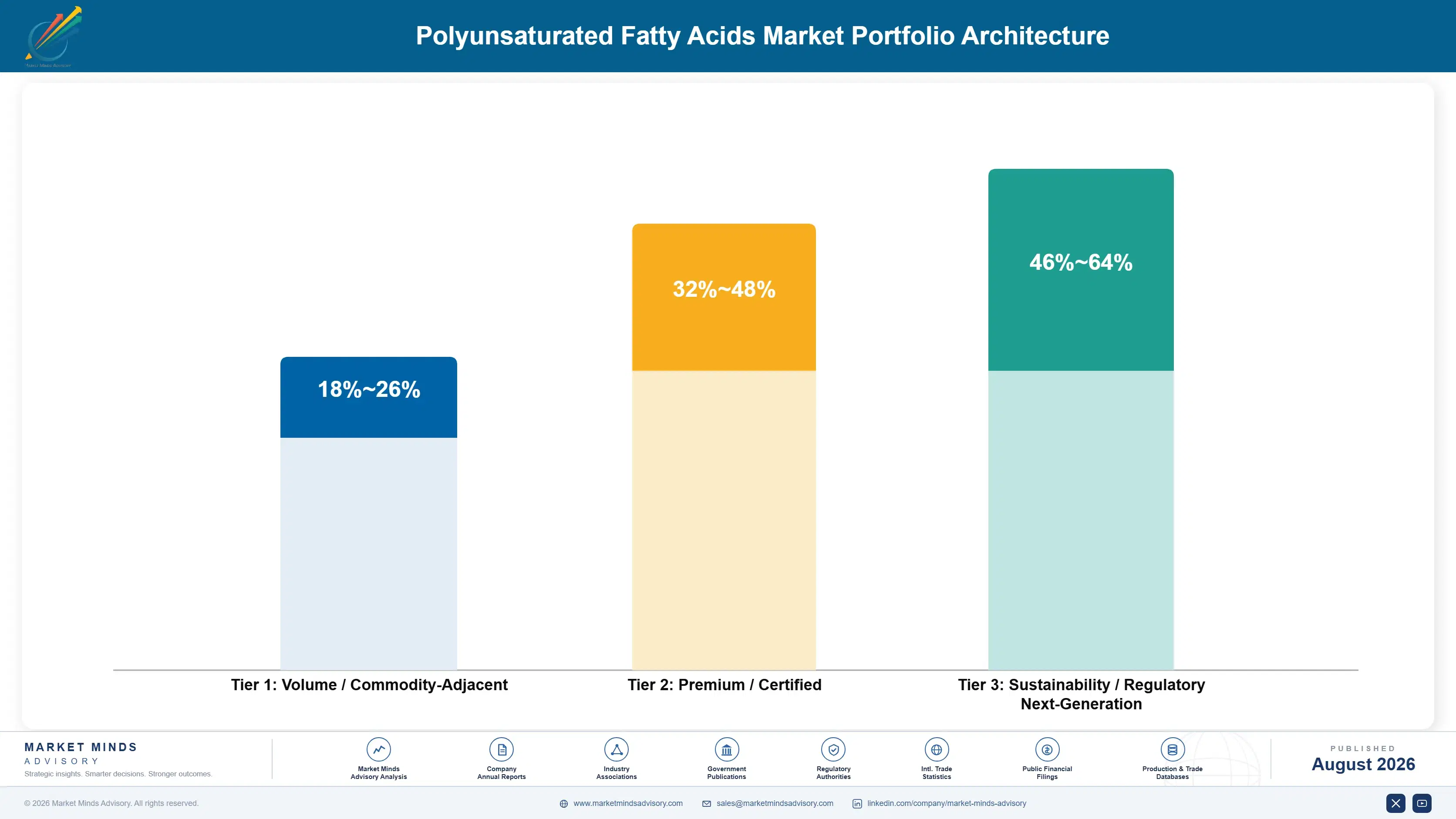
Margin architecture tracks purity and qualification burden almost exactly. Crude and low-concentration marine oils sold into aquafeed run at gross margins in the low twenties, with realisations swinging violently on quota news. Pharmaceutical grade concentrates and infant formula DHA earn two to three times that, and they barely move.
The volume-versus-premium tension is genuine because the two ends compete for the same feedstock. Aquafeed absorbs 58% of marine oil volume at the lowest margin per kilogram, yet it is the demand that keeps reduction fisheries and refining assets economically loaded. A concentrator who abandons feed-grade volume loses scale in crude oil purchasing, which raises the feedstock cost of its premium production. The two businesses subsidise each other more than most participants admit.

Value concentrates where the buyer cannot substitute. Infant formula DHA is the clearest case: composition rules require it, formula manufacturers requalify almost never, and the qualified supplier list runs to a handful of names. Prescription pharmaceutical concentrate sits alongside it on similar logic. Aquafeed lipid sits at the other extreme, where formulators reoptimise every season and any supplier is replaceable at short notice.

Volume / Commodity-Adjacent

Crude and refined marine oils supplied into aquafeed and animal nutrition at low concentration. Pricing follows quota-driven crude markets with essentially no differentiation available. This volume exists to keep refining assets loaded and to support scale in feedstock purchasing.
Gross Margin: 18-26%

Premium / Certified

Supplement-grade concentrates from 30% through 85% total omega-3, sold to encapsulators and branded supplement manufacturers. Pricing improves with purity because yield falls as concentration rises. Range reflects the wide spread between commodity thirty percent oils and high-concentration material.
Gross Margin: 32-48%

Sustainability / Regulatory / Next-Generation

Algal and fermentation-derived DHA and arachidonic acid for infant formula, plus pharmaceutical grade concentrates for prescription products. Regulatory qualification and traceable non-marine origin, rather than the lipid chemistry itself, justify the pricing achieved here.
Gross Margin: 46-64%
polyunsaturated-fatty-acids-market-trends-portfolio-architecture-1787311400199

High-value Sub-segments and Strategic Watch-out

Algal DHA for Infant Formula

High value on genuinely high growth at 11.1%, protected by composition rules that mandate DHA and by formula manufacturers who requalify suppliers almost never. Traceable non-marine origin is what wins the qualification, and the sheer capital scale required to build a plant keeps the competitive field very small indeed.
Gross Margin: 52-64%

Pharmaceutical Grade Concentrates

Excellent margins on steady growth, insulated from supplement retail cycles because prescription volumes follow clinical practice instead. Site qualification to pharmaceutical standards keeps the supplier list to a handful of names, and the cost of reformulating a registered drug product makes established positions unusually durable in practice.
Gross Margin: 50-62%

Aquafeed Marine Lipid

The volume backbone of the whole industry at 58% of marine oil consumption, necessary for feedstock scale but earning the thinnest margins available anywhere. Formulators reoptimise inclusion rates every season, and quota announcements move realisations here far more than any commercial decision a supplier makes ever will.
Gross Margin: 18-26%

Standard Supplement Concentrates

The strategic watch-out in this portfolio. Thirty percent oils are being squeezed from both directions as consumers move toward higher concentrations and private label retail compresses branded pricing, leaving refiners with capability only at this concentration level facing a segment that is slowly shrinking underneath them.
Gross Margin: 32-40%

How This Demand Actually Recurs

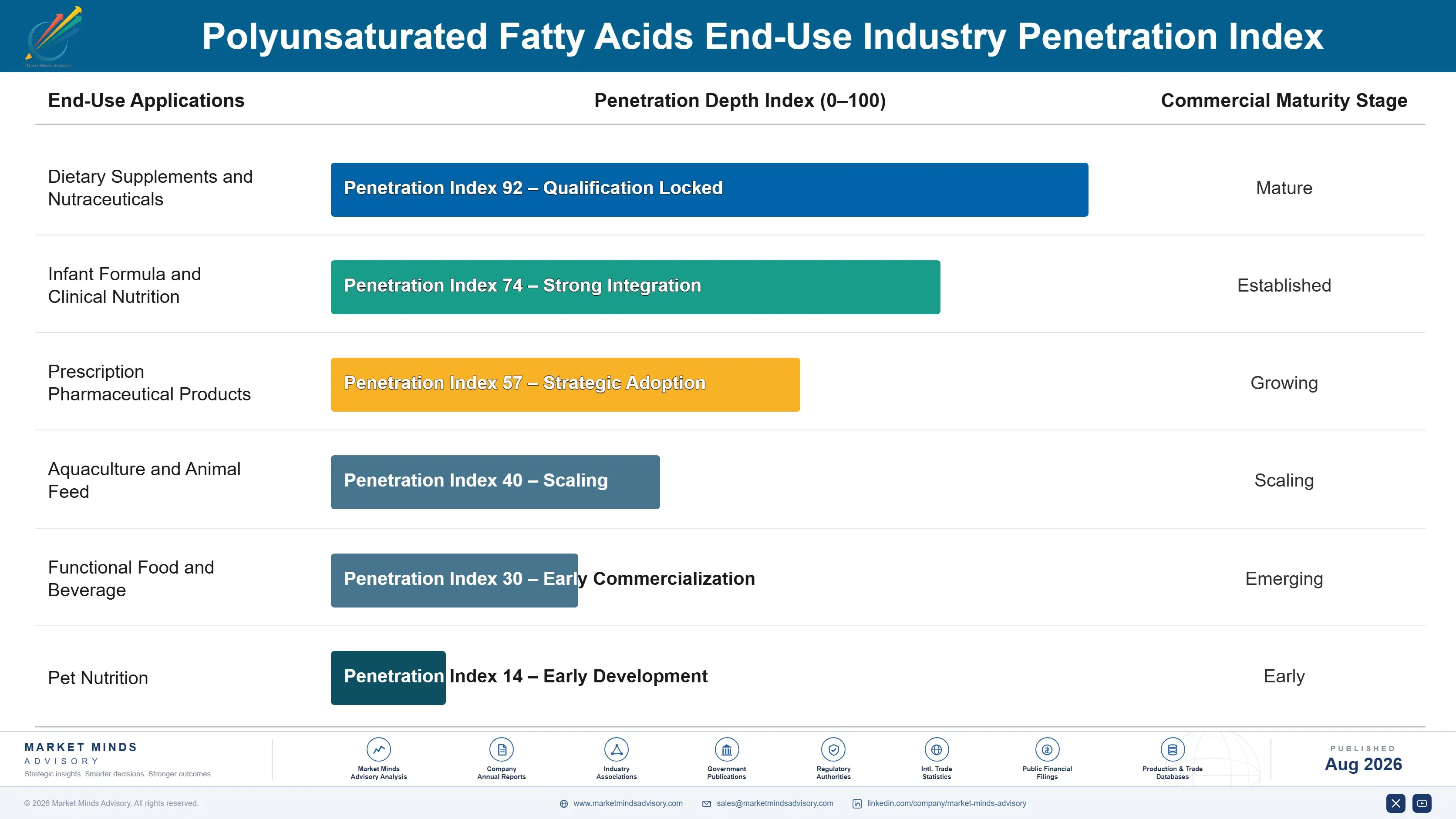
Infant formula and pharmaceutical demand behave as annuities attached to a registered product. Once a lipid source is qualified into a formula composition or a drug registration, it ships against that product for years, because requalification means regulatory filings that manufacturers avoid unless something forces the issue.
Stickiness varies enormously across end uses. Infant formula is the tightest, with composition changes requiring notification and in some markets reapproval, so suppliers hold positions for a decade or more. Branded supplement manufacturers are moderately sticky, holding qualified suppliers but reviewing them annually and moving volume on price within the qualified list. Aquafeed is barely sticky at all: formulators reoptimise inclusion and origin every season against current pricing, and a supplier who cannot deliver during a quota shortfall simply loses the business.

Buyer profiles have shifted markedly. Purchasing once sat with procurement teams comparing oxidation values and price per kilogram of oil. It increasingly involves regulatory, sustainability and supply security functions asking about traceability, quota exposure and contaminant testing regimes. Suppliers whose commercial approach still leads with specification sheets and competitive quotation are talking to people for whom continuity of supply is now the first question rather than the last.
polyunsaturated-fatty-acids-market-trends-end-use-penetration-index-1787311400689

Where To Commit Capital

These are among the four positions where our research anticipates prominent divergence between winners and laggards over the coming forecast period. Each is grounded in the demand model, the regulatory perimeter, and the announced capacity pipeline.
01 / FEEDSTOCK ACCESS SECURITY

Contracted supply beats processing efficiency every time

The 2023 anchoveta cancellation separated this industry cleanly into suppliers who had contracted feedstock and suppliers who did not, and plant efficiency proved entirely irrelevant to which of those two groups survived the year intact. Multi-origin contracting across Peruvian, North Atlantic and processing by-product streams costs somewhat more on average than opportunistic spot purchasing does. It is nonetheless the single most valuable insurance available anywhere in a business where the raw material cannot be manufactured to order at any price.
02 / FERMENTATION ROUTE POSITIONING

Algal supply is the first elastic capacity here

Fermentation produces DHA from sugar rather than from a quota, which makes it the only supply anywhere in this industry that responds to actual demand rather than to fisheries policy decisions. Plants cost between $250 million and $450 million and only work economically at real scale, so entry requires committed offtake covering 60% to 70% of nameplate before financing closes. Incumbents built entirely around marine feedstock access should assume that the cost comparison keeps moving against them with every capacity addition.
03 / PURIFICATION CAPABILITY DEPTH

Purity above eighty-five percent opens both doors

Concentrate capability above 85% serves both supplement and pharmaceutical customers from a single asset, and it commands roughly 40% higher realised pricing per kilogram of active ingredient than 60% material does. The additional molecular distillation and chromatographic capability costs between $25 million and $45 million on an existing refining site. Yield falls as purity rises, which deters producers who model on tonnage, and that widespread reluctance is exactly what keeps the segment profitable for the few who do commit to it.
04 / REGULATED APPLICATION QUALIFICATION

Infant formula positions last a decade

Composition rules across the European Union, China and South Korea now require DHA in infant formula, and manufacturers requalify lipid suppliers almost never, because the notification and reapproval burdens involved make any such change deeply unattractive commercially. Roughly 140 million infants are now born annually into markets operating mandatory or near-universal fortification requirements. Winning one of those qualifications is slow and expensive work, and holding it is worth considerably more than the tonnage figure alone would ever suggest to an outsider.

Engagement Snapshot From the Field

A live engagement with an industry participant carrying material or product regulatory and market exposure ahead of a defining policy shift, showing how our research translates into a defensible multi-year portfolio strategy.
MARKET MINDS ADVISORY · CLIENT ENGAGEMENT SUMMARY
Polyunsaturated Fatty Acids Producer Strategic Portfolio Review and Transition Roadmap 2026·Investment Scenario on Polyunsaturated Fatty Acids Exposure Evaluation 2025-26
CLIENT PROFILE
A privately held marine lipid concentrator with annual revenue near $180 million (client-reported, unverified by MMA), operating refining and molecular distillation capacity at a single Northern European site. Roughly 71% of volume was supplement-grade concentrate between 30% and 60% total omega-3, with crude oil purchased largely on spot and short-term contracts from Peruvian and North Atlantic suppliers.
STRATEGIC CHALLENGE
The 2023 anchoveta cancellation left the company unable to fill roughly a quarter of its order book, and two significant supplement customers moved volume permanently to competitors with contracted feedstock. The board needed to establish whether feedstock integration, higher-purity capability or a fermentation partnership offered the most reliable route out of that exposure.
MMA APPROACH
MMA modelled feedstock cost and availability under four contracting structures, assessed the capital and timeline for high-concentration capability at the existing site, and evaluated toll fermentation partnership options against building any algal capacity independently. Findings were tested against 47 expert interviews covering reduction plant contracting practice, by-product recovery economics and infant formula qualification requirements.
KEY FINDINGS
  1. Spot feedstock purchasing had delivered roughly 7% lower average crude cost across five years but caused the order shortfall that cost two long-standing supplement customers permanently.
  2. By-product feedstock arrangements with Norwegian and Vietnamese processors could supply about 30% of requirement at 19% below reduction crude pricing (client-reported, unverified by MMA), with additional refining cost.
  3. Upgrading to 85% concentration capability would cost roughly $31 million and open pharmaceutical customer conversations the company had never previously been able to hold at all.
  4. Independent algal capacity was entirely uneconomic at the client's scale, while toll fermentation arrangements offered qualified DHA supply without any capital commitment whatsoever.
CLIENT PROFILE
A privately held marine lipid concentrator with annual revenue near $180 million (client-reported, unverified by MMA), operating refining and molecular distillation capacity at a single Northern European site. Roughly 71% of volume was supplement-grade concentrate between 30% and 60% total omega-3, with crude oil purchased largely on spot and short-term contracts from Peruvian and North Atlantic suppliers.
STRATEGIC CHALLENGE
The 2023 anchoveta cancellation left the company unable to fill roughly a quarter of its order book, and two significant supplement customers moved volume permanently to competitors with contracted feedstock. The board needed to establish whether feedstock integration, higher-purity capability or a fermentation partnership offered the most reliable route out of that exposure.
MMA APPROACH
MMA modelled feedstock cost and availability under four contracting structures, assessed the capital and timeline for high-concentration capability at the existing site, and evaluated toll fermentation partnership options against building any algal capacity independently. Findings were tested against 47 expert interviews covering reduction plant contracting practice, by-product recovery economics and infant formula qualification requirements.
KEY FINDINGS
  1. Spot feedstock purchasing had delivered roughly 7% lower average crude cost across five years but caused the order shortfall that cost two long-standing supplement customers permanently.
  2. By-product feedstock arrangements with Norwegian and Vietnamese processors could supply about 30% of requirement at 19% below reduction crude pricing (client-reported, unverified by MMA), with additional refining cost.
  3. Upgrading to 85% concentration capability would cost roughly $31 million and open pharmaceutical customer conversations the company had never previously been able to hold at all.
  4. Independent algal capacity was entirely uneconomic at the client's scale, while toll fermentation arrangements offered qualified DHA supply without any capital commitment whatsoever.
RECOMMENDED STRATEGY
Phase 1: Phase one: contract by-product feedstock across two geographies covering thirty percent of requirement, removing the single-origin exposure that caused the 2023 shortfall. Phase 2: Phase two: install high-concentration capability targeting eighty-five percent material, opening pharmaceutical and clinical nutrition customers alongside the existing supplement demand base. Phase 3: Phase three: secure toll fermentation supply for algal DHA rather than building capacity, serving infant formula enquiries without any capital commitment.
OUTCOME
The client contracted by-product feedstock within nine months and commissioned high-concentration capability the following year, reporting realised pricing on 85% material roughly 37% above its 60% concentrates (client-reported, unverified by MMA). Feedstock continuity held through the subsequent season, and one of the lost supplement customers returned on a multi-year agreement.

Frequently Asked Questions

Foundational context covering the market sizes, CAGR, scope, country, region and competition that inform every finding below. This section is provided to cover basics and most often pre-purchase conversations, answered from the MMA Primary Research Dataset.

What is the current size of the Polyunsaturated Fatty Acids Market?

The market was worth $8.6 billion in 2025 and is forecast to reach $9.24 billion in 2026. Growth reflects aquaculture volume, supplement penetration and regulated infant nutrition demand together.

How large will the Polyunsaturated Fatty Acids Market be by 2036?

MMA forecasts $18.87 billion by 2036, an expansion multiple of 2.04 times the 2026 base. That represents $9.63 billion of incremental value across the forecast period.

What is the CAGR for the Polyunsaturated Fatty Acids Market 2026 to 2036?

The base case compound annual growth rate is 7.4%, with a bull case of 8.7% and a bear case of 6.2%. Historical growth from 2020 to 2025 ran at 6.2%.

Which segment is growing fastest?

Algal-derived polyunsaturated fatty acids at 11.1%, a full 1.50 times the market rate. Infant formula regulation and salmon feed qualification drive most of that demand.

Who are the major companies in the Polyunsaturated Fatty Acids Market?

dsm-firmenich, BASF, Croda International, Corbion and Aker BioMarine lead, holding 36% of revenue between them. Fifteen further suppliers hold meaningful positions across specific routes and grades.

Which country is growing fastest?

India at 10.6%, as supplement penetration rises from a low base among urban middle-income households. Domestic manufacturers now import concentrate and encapsulate locally rather than importing finished product.

Report Segmentation Architecture

The full report scope spans multiple orthogonal segmentation dimensions, with cross-tabulated demand data provided for each dimension pair. Coverage extends further to regional breakdowns, trend trajectories, and the competitive detail needed to support segment-level decision-making.

By Production Route

  • Algal-Derived Polyunsaturated Fatty Acids
  • Microbial Fermentation-Derived Polyunsaturated Fatty Acids
  • Krill and Marine Invertebrate Derived
  • Plant Seed Oil-Derived Polyunsaturated Fatty Acids
  • Wild Marine Catch and By-Product Derived

By End-Use Industry

  • Dietary Supplements and Nutraceuticals
  • Infant Formula and Clinical Nutrition
  • Prescription Pharmaceutical Products
  • Aquaculture and Animal Feed
  • Functional Food and Beverage
  • Pet Nutrition

By Commercial Dimension

  • Direct Supply to Brand Owners
  • Contract Encapsulator and Formulator Channel
  • Feed Formulator Supply Agreements
  • Toll Concentration and Custom Processing
  • Distributor and Ingredient Trader Channel

By Region

  • North America
  • Western Europe
  • East Asia
  • South Asia and Pacific
  • Latin America
  • Middle East and Africa
  • Eastern Europe

Scope, Methodology, and Coverage

Every figure in this report is reproducible from documented input assumptions. The scope below maps the historical period, the forecast horizon, the segmentation dimensions, and the countries covered, alongside the underlying primary and qualitative methodology.
Historical Period
2020 to 2025
Forecast Period
2026 to 2036
Base Year
2025 (USD billions; MMA Primary Research Dataset, August 2026)
Market Definition
This report covers polyunsaturated fatty acids supplied as refined oils, concentrates and purified esters for human nutrition, pharmaceutical and animal feed applications. Coverage spans omega-3 eicosapentaenoic acid, docosahexaenoic acid and alpha-linolenic acid together with omega-6 arachidonic acid and gamma-linolenic acid, produced from wild marine catch, fish processing by-product, krill, algal cultivation, microbial fermentation and plant seed oils. Bulk edible vegetable oils sold as food ingredients, fishmeal, finished supplement and formula products, and saturated or monounsaturated lipid fractions are excluded from scope.
Quantitative Units
USD billions at supplier realised prices; volume in thousand tonnes of active fatty acid; gross margin percentages and capacity utilisation by tier.
Segmentation Dimensions
Production route, end-use industry, commercial dimension, region.
Regions Covered
North America, Western Europe, East Asia, South Asia and Pacific, Latin America, Middle East and Africa, Eastern Europe
Countries Covered
Peru, Chile, Norway, Denmark, United Kingdom, Germany, France, United States, Canada, China, Japan, South Korea, India, Vietnam, Thailand, Indonesia, Australia, Brazil, Poland, Turkey.
Key Companies Profiled
dsm-firmenich, BASF, Croda International, Corbion, Aker BioMarine, KD Pharma Group, Golden Omega, Epax, Veramaris, Mara Renewables, and ten further suppliers.
Quantitative Methodology
Primary survey, n=3,800 respondents, Q4 2025, six countries; demand-side model with trade association cross-validation
Qualitative Methodology
47 expert interviews, Q4 2025; applied to validate demand model assumptions, identify emerging dynamics, and assess competitive positioning
Report Format
PDF and XLSX data workbook (Word format preview document)
Publisher
Market Minds Advisory
Report Code
MMA-2026-HLT-711
Published
August 2026
Contact
sales@marketmindsadvisory.com | www.marketmindsadvisory.com

Purchase the full Polyunsaturated Fatty Acids Market Report (2026 to 2036).

The full report sets out ten-year forecasts for polyunsaturated fatty acids by production route, end-use industry and commercial model across seven regions. It quantifies marine feedstock availability against demand under three quota scenarios, and models fermentation capacity arriving through 2032 with committed offtake mapped project by project. Competitive assessment covers twenty suppliers on a consistent revenue basis, separating marine access from purification and fermentation capability. Portfolio margin architecture is broken out across three tiers using ranges calibrated to disclosed segment performance. Findings draw on a quantitative survey of 3,800 respondents across six countries and 47 expert interviews conducted during the fourth quarter of 2025.
Ten-year forecasts by production route and region
Marine feedstock availability modelled under three quota scenarios
Fermentation capacity mapped project by project with offtake
Twenty-supplier competitive assessment on consistent revenue basis
Purity ladder economics from crude through pharmaceutical grade
Feedstock cost exposure compared across contracting structures

Built For The People Who Decide

From boardroom strategy to bench-side execution, this report is read cover-to-cover by leaders shaping the next decade of their industry, turning demand scenarios, market dynamics and valuation benchmarks into decisions.
CXOs/ Presidents/ VPs/ Managers
M&A and Corporate Development
Strategy Teams and R&D Heads
Procurement and Product Directors
Regulatory and Compliance Leaders
Investor Relations and Equity Analysts