Market Minds Advisory
Polypropylene Yarn Market

Polypropylene Yarn Market: Losing the Carpet, Winning the Road Base

The fibre that carpeted America for forty years is being quietly replaced underfoot by vinyl plank, while its real growth now sits buried under highways and behind retaining walls nobody ever sees.

Lead Analyst

Bilal Shaikh

Published

September 2026

Make Smarter Decisions with Customized Research Insights

Request a free sample report and evaluate market opportunities, growth trends, and competitive dynamics relevant to your business needs.

2025 MARKET VALUE$9.8BMarket Size 2025
2036 FORECAST VALUE$17.9BBase Case , 2026 to 2036
CAGR 2026 TO 20365.6 %Bull 6.8% / Bear 4.4%
INCREMENTAL OPPORTUNITY$7.5BNet 10- year value creation
EXPANSION MULTIPLE1.72x2036 value over 2026 base
Strategic Levers
M&A Pipeline
Regional Outlook
Country Rankings
Competitive Intelligence
Segmental Deep-dive
Call-Us : 91 93563 13602

Executive Snapshot and Market Trajectory

Bulked continuous filament polypropylene once carpeted most of America. Luxury vinyl tile took the floor instead, and carpet now supplies under 38% of American floorcovering. That was the fibre's biggest application and it is not coming back. Nobody in the industry has fully updated for it.
What replaced it is invisible. Geotextiles now take roughly 23% of polypropylene yarn output, going into road base separation, erosion control, retaining wall reinforcement and landfill capping, where the fibre's chemical inertness and cost beat polyester comfortably. Multifilament yarn grows at 8.4%, half again the market rate of 5.6%, almost entirely on civil engineering specification demand rather than on anything a consumer buys. Nothing a consumer buys is involved.
Tape yarn for woven sacks and bulk bags remains the volume story, and 61% of world bulk bag output comes from South Asia. That regional concentration puts the region at 31% of value, well above the usual band. Concentration among producers is negligible at 11%, since extrusion is cheap to enter and colour runs are the only real barrier. Extrusion lines are cheap, so the only durable barriers left are qualification and certification.
Market Definition
Polypropylene yarns and fibres produced by melt extrusion for textile and technical applications, spanning tape and raffia yarn, staple fibre, multifilament, bulked continuous filament, monofilament and fibrillated yarn. Excludes polypropylene resin sold as such, spunbond and meltblown nonwoven fabric produced in one step, woven and finished fabrics, and finished bags or carpets.
Base Year Value
$9.8B in 2025 (MMA Primary Research Dataset, August 2026)
Forecast Period
2026 to 2036, eleven discrete annual values
CAGR
5.6% base case. Bull 6.8%. Bear 4.4%.
Fastest Growth Segment
Multifilament Yarn: 8.4% CAGR
Fastest Growth Country
India: 8.6% CAGR
Fastest Growth Region
South Asia and Pacific: 7.8% CAGR
Largest Region
South Asia and Pacific: 31% of 2025 global value
Market Leaders
Beaulieu International Group, Thrace Group, Universal Fibers, Belgotex, Rishi FIBC Solutions. Source: MMA Primary Research Dataset, July 2026.
Primary Survey
n=3,800 procurement and R&D decision-makers, Q4 2025, six countries
Methodology
Demand-side build-up, cross-validated against public data, 47 expert interviews

Polypropylene Yarn Market Forecast Scenarios

polypropylene-yarn-market-trends-size-forecast-scenario-1787580626001
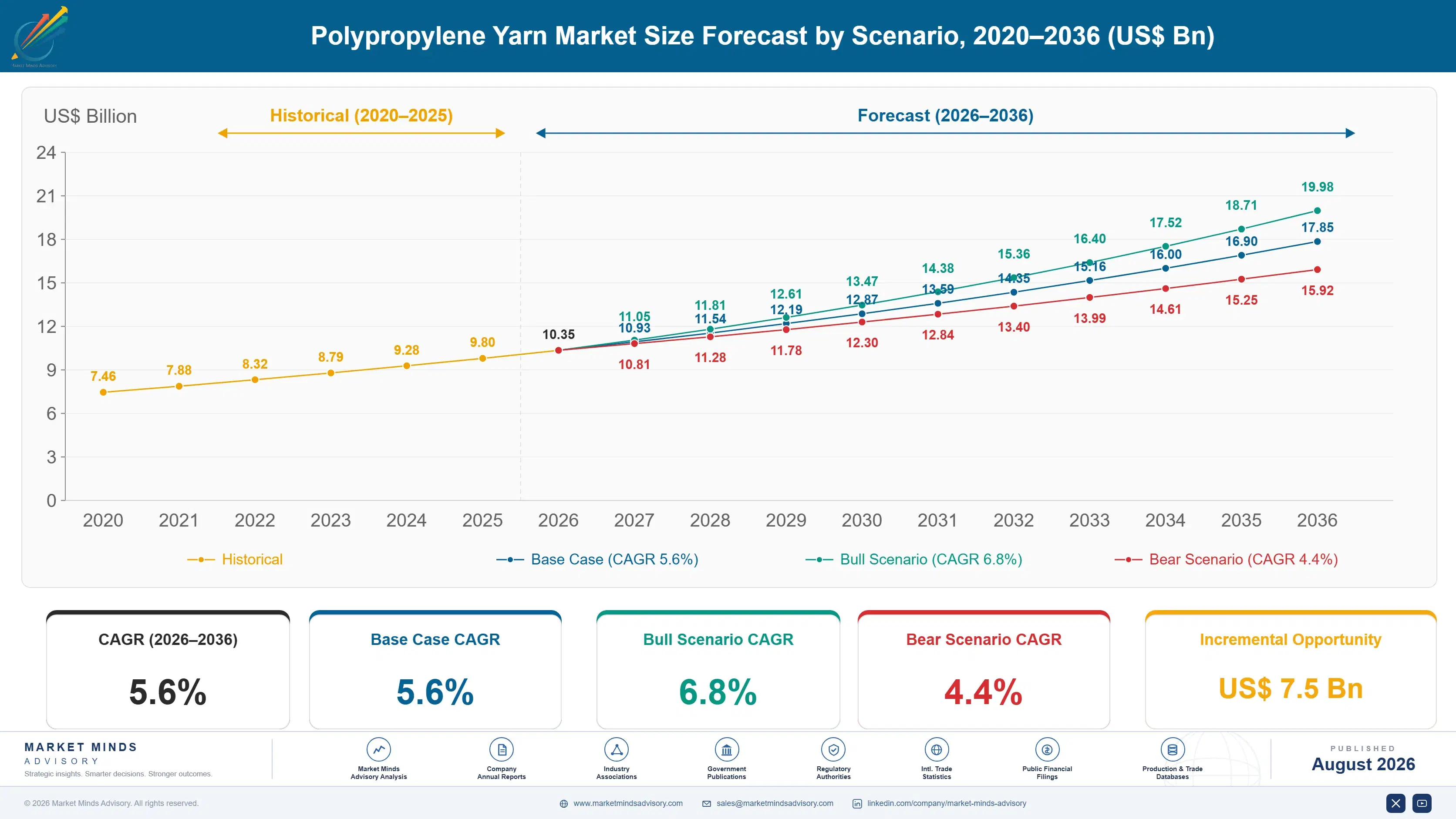
Growth ran near 4.5% between 2020 and 2025 on an average that conceals two opposite movements. Carpet fibre demand declined steadily as luxury vinyl tile took American floorcovering share, while geotextile and bulk bag demand grew through the same period on infrastructure spending and on agricultural packaging conversion. Resin price volatility made 2021 and 2022 unusually difficult for extruders holding fixed yarn contracts.
Base case 5.6% rests on three mechanisms. Infrastructure programmes across India, Southeast Asia and the United States specify geosynthetic separation and reinforcement layers as standard practice rather than as an option, which converts road building volume directly into yarn demand. Bulk bag and woven sack conversion continues to displace jute and multiwall paper in cement, fertiliser and grain handling. And agricultural textiles are deepening across shade netting, crop covers and silage protection.
The bull case at 6.8% assumes infrastructure spending across South and Southeast Asia runs above current programme schedules, since geosynthetic specification is now routine and each kilometre of road converts predictably into tonnes of yarn. The bear case at 4.4% is continued carpet share loss combined with a construction slowdown, which would leave only bulk bag demand growing and that at replacement rates.

From Living Rooms to Retaining Walls

Polypropylene cannot be dyed the way nylon or polyester can, because the polymer has no sites for conventional dyestuff to attach to. Colour has to go in as pigment while the polymer is still molten, which is called solution dyeing. That produces excellent lightfastness and terrible flexibility: changing colour means purging the extruder, and a purge is only economic above roughly four tonnes of a single shade.
TOP FIVE CONCENTRATION11%Production spread across thousands of small regional extruders
RESIN COST SHARE64%Share of yarn cost carried by polypropylene resin
MINIMUM COLOUR RUN4 tonnesVolume needed before an extruder purge becomes economic
GEOTEXTILE VOLUME SHARE23%Portion of output going into civil engineering fabrics
CARPET FLOORCOVERING SHARE38%Portion of American floorcovering still supplied by carpet
BULK BAG CONCENTRATION61%Share of world woven bulk bag output from one region
That single constraint shaped the entire industry. Long runs of few colours suit carpet, bulk bags and geotextiles; short runs of many colours suit apparel and furnishing, which is why polypropylene never took either. When carpet demand fell away, the fibre had nowhere obvious to go in consumer textiles, and the industry's attention moved to applications where colour barely matters at all.
Civil engineering turned out to be the answer. A geotextile separating road base from subgrade is black or grey, buried, and specified by an engineer working to a standard rather than chosen by anyone. Demand tracks infrastructure programmes with unusual predictability, since a kilometre of road converts into a known tonnage. Roughly 23% of output now goes this way and the share keeps rising.
"Everybody in this industry still talks about carpet and almost nobody has updated their mental model. The growth left the living room a decade ago and went into the ground, where the customer is a highways engineer following a specification and does not care what colour it is or who made it."
Principal, Technical Textiles and Fibres Practice · MMA Textiles and Materials Practice · August 2026

Market Trends

Geosynthetic specification becoming routine in road construction

Separation and reinforcement geotextiles have moved from optional to standard in highway specifications across India, Southeast Asia and much of the United States, driven by measurable pavement life extension rather than by any environmental argument. A specifying engineer working to a national standard selects the fabric class, not the supplier or the fibre. That converts infrastructure spending into yarn demand at a predictable tonnage per kilometre, and it removes the demand volatility that consumer textile applications always carried with them. Yarn producers gain a demand base behaving like public spending rather than consumer sentiment.
Market Impact: Covers 61% of bulk bag output
Luxury vinyl tile displacing carpet across American floorcovering

Carpet now supplies under 38% of American floorcovering by area, down from more than half a decade ago, as luxury vinyl plank took share on cleaning, moisture resistance and installation cost. Bulked continuous filament polypropylene was the volume fibre in that category, so the decline reads through directly into yarn demand. Solution-dyed nylon holds the premium end that remains. Producers who depended on carpet have been converting extrusion capacity toward geotextile and industrial yarn specifications, which needs different equipment settings but not different machines. Converting a line is cheaper than replacing it, so most capacity is moving rather than closing.
Market Impact: Adds 8.6% Indian growth annually

Market Opportunities and Growth Drivers

Bulk bag conversion displacing jute and multiwall paper packaging

Woven polypropylene sacks and flexible intermediate bulk containers continue to replace jute and multiwall paper in cement, fertiliser, grain and chemical handling across developing markets, on moisture resistance, strength to weight and cost. South Asia produces roughly 61% of world bulk bag output, which is why yarn capacity concentrated there. Food-grade and antistatic bag specifications carry qualification requirements that exclude the smallest extruders. Conversion is well advanced in India and still early across much of Africa and Southeast Asia, so the runway is longer than it looks. The runway in Africa alone is measured in decades.
Market Impact: Blocks runs under 4 tonnes

Agricultural textile demand deepening across shade and crop protection

Shade netting, crop covers, silage protection and ground cover fabrics are expanding across horticulture in Spain, Turkey, India and Latin America, where controlled environment growing is displacing open field production. Polypropylene suits these applications because ultraviolet stabilised tape and monofilament yarn hold up for several seasons at a cost polyester cannot match. Demand grows with protected cultivation area rather than with any commodity price. India grows fastest anywhere at 8.6%, with agricultural textiles contributing a meaningful share of that alongside infrastructure demand. Protected cultivation area, not commodity pricing, is the number worth tracking here.
Market Impact: Exposes 64% of yarn cost

Market Restraints and Challenges

Solution dyeing forces minimum run lengths that exclude small orders

Polypropylene carries no dye sites, so colour must be added as pigment in the melt and changing shade means purging the extruder entirely. The root cause is polymer chemistry rather than process design, and no economically viable dyeable polypropylene has reached commercial scale despite decades of work. Commercially it means runs below roughly four tonnes per colour lose money, which closes apparel, furnishing and short-run technical textiles. Producers are responding with masterbatch dosing systems that shorten purge time and with tighter colour range discipline. Neither approach opens the short-run markets that dyeable fibres serve.
Market Impact: Takes 23% of yarn output

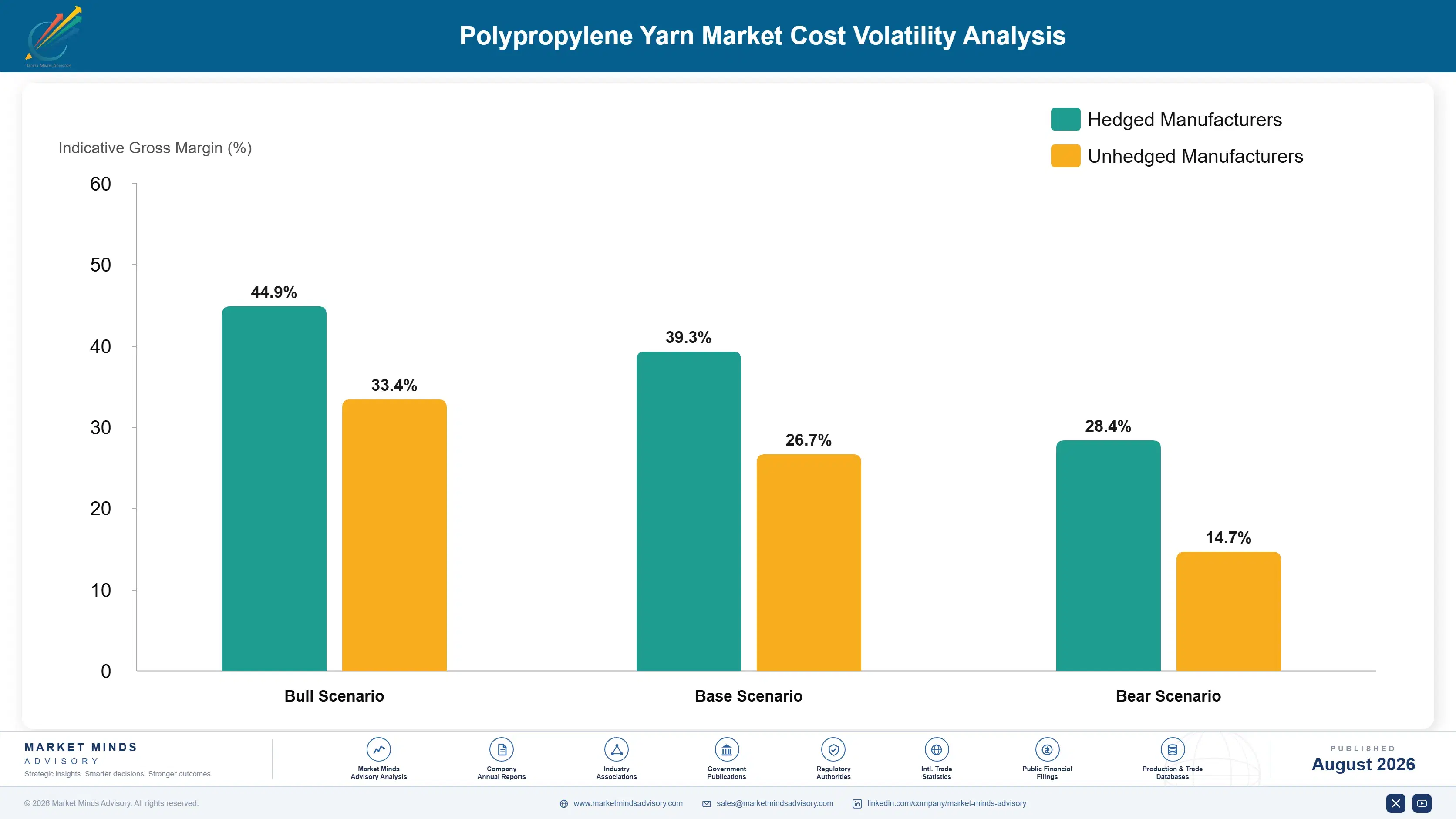
Resin price volatility transmits straight through to yarn margin

Polypropylene resin accounts for roughly 64% of yarn cost, the highest raw material share of any major fibre. The root cause is that extrusion adds relatively little value, so the yarn price is essentially resin plus a conversion margin that competition keeps thin. Extruders holding fixed price contracts through a resin move absorb the whole swing, and 2021 and 2022 removed several small producers entirely. Larger converters index contracts to a published resin reference, which passes the movement through with a lag. Contract structure rather than operational skill decides who survives a cycle.
Market Impact: Cuts carpet below 38% share
3 additional market trends, 4 additional growth drivers, and 2 additional restraints and challenges are covered in the full report. Contact sales@marketmindsadvisory.com to access the complete intelligence.

Segment CAGR and Growth Architecture

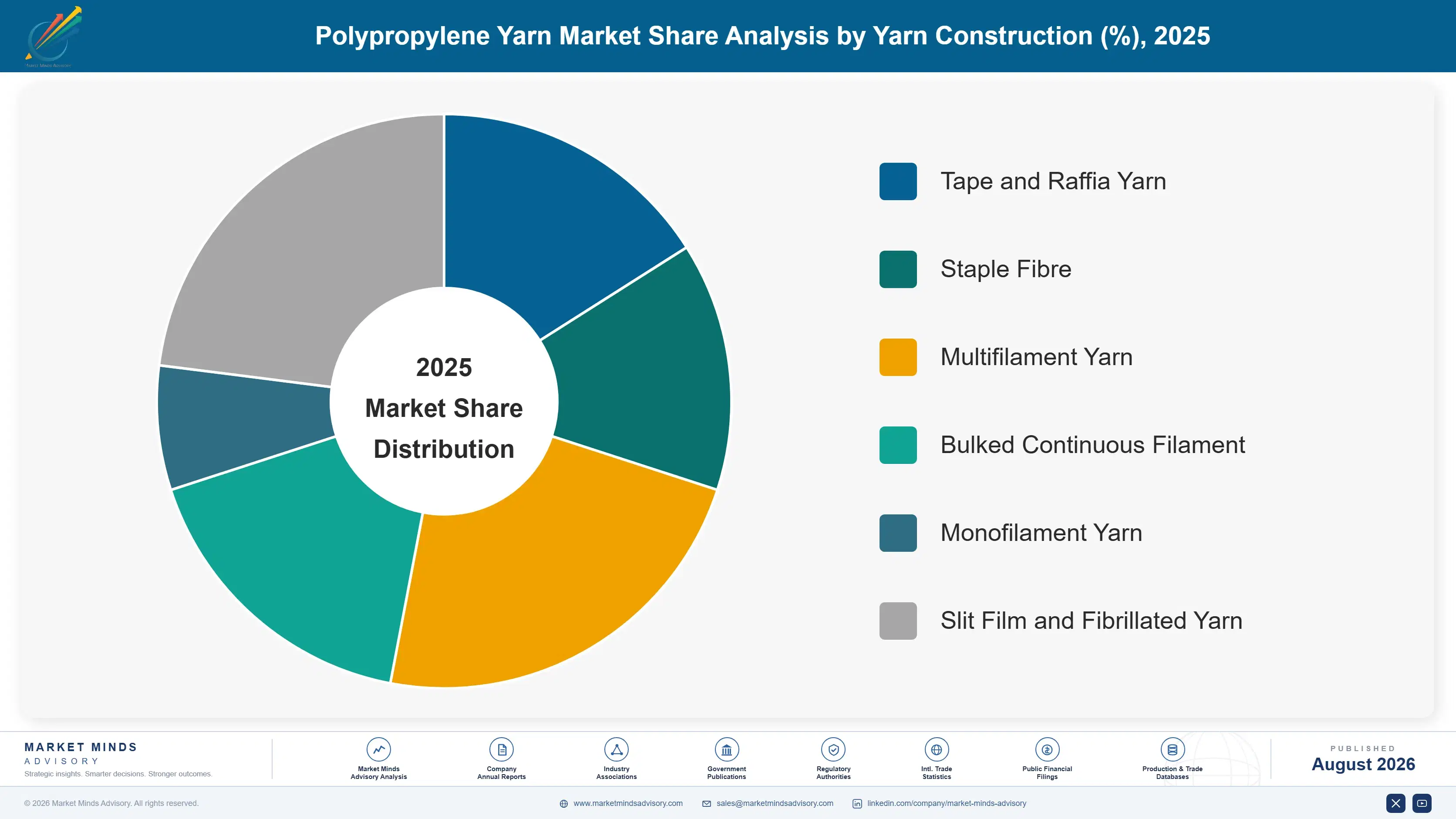
Six segments split by yarn construction, because construction determines the extrusion equipment, the achievable tenacity and therefore which applications a producer can serve at all. A tape yarn line and a multifilament line are different machines with different customers. Application and channel splits are handled in the framework rather than here. The two ends barely overlap commercially.
polypropylene-yarn-market-trends-market-share-analysis-1787580626547

Multifilament Yarn

Growing at 8.4%, half again the market rate of 5.6%, multifilament carries the civil engineering demand that now drives this market. Woven geotextiles for separation and reinforcement, ropes, slings, industrial webbing and filtration fabrics all use it, and all of them are specified against performance standards rather than chosen on appearance. Tenacity and creep behaviour under sustained load are the properties that matter, which requires drawing control that commodity tape lines cannot achieve. Qualification against national geosynthetic standards takes months and locks a producer into a specification. Growth follows infrastructure programmes rather than any consumer cycle at all. Qualification is slow and the resulting positions last as long as the standard does.
CAGR 8.4%

Staple Fibre

At 7.5% staple fibre feeds needle-punched nonwoven geotextiles, hygiene coverstock, automotive interior felts and filtration media. Nonwoven geotextiles serve drainage and filtration functions where woven fabric performs poorly, so the two grow together rather than competing directly. Fineness consistency and crimp control determine whether a fibre runs well on a carding line, which is a real qualification barrier at the finer deniers. Hygiene coverstock demand grows with ageing populations across East Asia and Europe. The segment sits between commodity tape and specification multifilament in both technical difficulty and achievable margin. Carding line performance is what a customer actually qualifies, and a fibre that runs badly gets rejected regardless of its published specification.
CAGR 7.5%
Full segment breakdown across 6 segments available in the complete report.

Regional Architecture and Country Demand Map

South Asia and Pacific holds 31% of value, well above its usual band, because India produces the majority of world woven bulk bag and sack yarn. East Asia follows at 28%. North America at 16% and Western Europe at 13% sit below their bands as carpet demand declined.

North America

Carpet was the American story and its decline is why this region sits at 16%, below the usual band. Georgia's carpet cluster around Dalton still holds substantial bulked continuous filament capacity, much of it now running at reduced utilisation or converted toward industrial yarn. What has grown is geotextile demand under federal and state highway programmes, where geosynthetic separation layers are specified as routine practice. Propex and TenCate hold strong positions in that segment. Mexican production serves both domestic agriculture and North American bulk bag demand, and has grown as nearshoring pulled packaging conversion closer. The region lost its largest fibre application and is rebuilding around an entirely different customer, which is why the share sits below its usual band.
Share: 16% | CAGR: 4.4% (2026 to 2036)

Western Europe

European producers ceded volume yarn production decades ago and the 13% share sits below the usual band accordingly, but the technical positions that remain are strong. Belgian and Greek producers, notably Beaulieu and Thrace, hold geosynthetic and technical yarn technology that Asian capacity has not replicated at specification grades. Spanish and Italian demand runs heavily toward agricultural textiles serving greenhouse horticulture. German geotextile specification standards are among the most demanding anywhere and set the reference other European markets follow. Regional growth runs below the base case on flat construction volumes rather than on any technical weakness. Specification depth rather than tonnage is what makes European producers commercially relevant, and it is the position most exposed to Asian qualification catching up.
Share: 13% | CAGR: 4.0% (2026 to 2036)
Regional intelligence for 5 additional markets available in the complete report: East Asia, South Asia and Pacific, Latin America, Middle East and Africa, Eastern Europe. Contact sales@marketmindsadvisory.com.
polypropylene-yarn-market-trends-country-cagr-analysis-1787580627058

Four Moves for an Extruder

Resin is 64% of cost and extrusion adds little, so this is a business where the money comes from what a producer is qualified to sell rather than from what it can make. Specification positions and contract structure decide returns. Competing on conversion cost against thousands of small extruders is not a strategy. Conversion cost is not one.

Qualify against national geosynthetic performance standards

Geotextile specification is written by engineers against national standards, and a yarn that has not been qualified against them cannot be sold into the application whatever its actual properties. Qualification testing covers tenacity, creep, ultraviolet resistance and durability, takes several months and costs perhaps 250 thousand dollars across a product range. Once held, the position lasts because respecifying a fabric on a highway programme is nobody's idea of a good afternoon. Roughly 23% of yarn output already moves through this channel and the share keeps growing. Entry is still open and narrowing.
Market Impact: Costs $250 thousand for a full standards qualification

Index yarn contracts to a published resin reference

Polypropylene resin is 64% of yarn cost and extruders holding fixed price contracts through a resin move absorb the entire swing, which removed several small producers during 2021 and 2022. Indexing contracts to a published resin reference passes the movement through with a short lag and converts a volatile margin into a stable conversion fee. Customers resist it until they understand the alternative is supplier failure. Larger converters have been indexed for years, and the practice is spreading slowly down the size range. Failure is the alternative structure. Larger converters moved years ago.
Market Impact: Removes 64% of the cost exposure from contracts

Convert idle carpet capacity toward industrial specifications

Bulked continuous filament lines running at reduced utilisation as carpet share fell below 38% can be redirected toward industrial and geotextile yarn with settings changes rather than new machines. The conversion needs drawing control work and qualification time, at perhaps 2 million dollars per line, against replacement capacity costing many times that. American producers in the Dalton cluster hold most of the idle capacity anywhere. Doing nothing means carrying fixed cost against a demand base that is not returning at all. Conversion beats closure on almost any arithmetic. Idle capacity earns nothing at all.
Market Impact: Converts each line for roughly $2 million spent

Build food-grade and antistatic bulk bag qualification

Standard woven sack yarn is made by hundreds of extruders and prices accordingly, but food-grade and antistatic bulk bag specifications carry certification requirements that exclude most of them. Type C and Type D antistatic bags for flammable powder handling need documented conductive yarn performance, and food contact bags need traceable resin and hygiene controls. Certification costs perhaps 400 thousand dollars and produces a position competitors cannot enter quickly. South Asia produces 61% of world bulk bag output and very little of it is certified. Very little of that output is certified today.
Market Impact: Costs $400 thousand for the full bag certification

Who Controls the Margin Pool

Participation is measured on annual yarn production capacity in tonnes, and the top five hold just 11%. This is one of the most fragmented industrial markets anywhere, because an extrusion line is inexpensive and thousands of small producers operate regionally. Beaulieu and Thrace lead on technical specification breadth rather than on tonnage. The gap to challengers is qualification against geosynthetic standards, not manufacturing scale.
Competition divides along a clean line. Commodity tape and sack yarn competes purely on conversion cost against very large numbers of small extruders, and pricing follows resin with a thin margin attached. Specification yarns for geotextiles, ropes and antistatic bags compete on qualification, testing capability and technical service. Very few producers operate credibly on both sides, and those attempting to usually subsidise the first from the second.

The pressure ahead is Chinese and Indian specification capability improving. Producers who competed only on commodity tape are qualifying against geosynthetic standards and entering the technical segment from below, which is how most fibre markets have been reordered historically. Expect capacity conversion and qualification investment rather than acquisitions, since balance sheets here are small. Rankings shift as carpet-dependent capacity either converts or exits altogether.
polypropylene-yarn-market-trends-company-positioning-matrix-1787580627580

Competitive Moat and Risk Dimensions

BEAULIEU INTERNATIONAL GROUP

Moat: Technical yarn specification breadth

Beaulieu holds qualification across geosynthetic, automotive and technical yarn standards built over decades, and those approvals do not transfer to a competitor arriving with equivalent equipment. Respecifying a fabric on a highway or automotive programme means retesting and reapproval that nobody undertakes without a serious reason, so incumbency compounds with each new standard qualified.
BEAULIEU INTERNATIONAL GROUP

Risk: European conversion cost position

European extrusion carries industrial energy and labour costs well above Asian levels on a process where resin is 64% of cost and conversion margin is thin. As Indian and Chinese producers qualify against the same standards, the technical protection narrows while the cost gap does not, which is the pattern that has reordered every commodity fibre segment before this one.
THRACE GROUP

Moat: Geosynthetic and agricultural range

Thrace combines technical geosynthetic yarn with a substantial agricultural textile position across Southern Europe and Turkey, giving it two demand streams that move on entirely different cycles. Manufacturing across several countries also lets it serve regional specification differences without freight penalties, which matters on a product where value density is low.
THRACE GROUP

Risk: Construction cycle concentration

Geosynthetic demand follows public infrastructure spending, which is politically determined and can pause abruptly when budgets are reset. A construction slowdown across Southern and Eastern Europe would hit the technical business and the agricultural one together, since both depend on the same regional economies rather than on globally diversified demand.

Players Tracked

Prominent Players

Beaulieu International Group
Thrace Group
Universal Fibers
Belgotex
Rishi FIBC Solutions

Other Key Players

Innegra Technologies
Filtec
Sansu Group
Marglen Industries
JB Ecotex
Ganesha Ecosphere
Karatzis
Don and Low
Low and Bonar
Propex Global
Fibertex Nonwovens
TenCate Geosynthetics
Toray Industries
Indorama Ventures
Grupo Fibras

Recent Developments

JANUARY 2026

Indian highways authority makes geosynthetic separation layers standard specification

The national highways specification was revised to require geosynthetic separation and reinforcement layers as standard on defined pavement classes rather than as an engineer's option. The change converts a large national road programme into predictable geotextile tonnage across the whole construction schedule. Contractors began sourcing immediately afterwards.
Signal: Specification changes convert infrastructure budgets into yarn demand far more reliably than any commercial effort ever could
SEPTEMBER 2025

American producer converts carpet filament lines to industrial yarn output

A Georgia-based producer converted bulked continuous filament capacity from carpet to industrial and geotextile yarn specifications, citing sustained decline in carpet demand. The conversion involved drawing control upgrades and requalification rather than any new extrusion equipment being installed. Three lines were converted in the first phase of the programme.
Signal: Carpet capacity is converting rather than closing, which will add real competition to technical yarn segments
MAY 2026

Indian bulk bag producer completes food-grade and antistatic certification

An Indian flexible bulk container producer completed food contact and Type C antistatic certification across its yarn and bag production, targeting European chemical and food ingredient customers. The certification is an organic capability investment rather than any partnership or acquisition arrangement. Audit completion took roughly nine months.
Signal: Certified bulk bag capability is where South Asian producers can escape commodity tape yarn pricing entirely

Resin and Very Little Else

Polypropylene resin accounts for roughly 64% of yarn cost, the highest raw material share of any major fibre, sourced from regional polymer producers or imported where local capacity is short. Masterbatch pigment and ultraviolet stabiliser packages add about 9%, with stabiliser cost rising sharply for agricultural and geotextile grades needing multi-season durability. Extrusion energy, labour and maintenance together carry a further 18% of the total.
The 2021 and 2022 resin cycle is the reference event for this industry. Polypropylene pricing rose sharply on propylene tightness and supply disruption, then fell back over the following eighteen months, per EIA petrochemical price reporting for the period. Extruders holding fixed price yarn contracts absorbed the full increase because conversion margin could not cover it, and several small producers closed permanently rather than trade through it.

Exposure is decided by contract structure rather than by operational skill. A producer with resin-indexed yarn contracts passes movements through with a short lag while one holding fixed prices carries everything, and on a 64% cost share that difference is the whole business. Geography compounds it: Indian and Chinese extruders sit beside domestic resin capacity while European producers buy at import parity, per IEA industrial energy data.
polypropylene-yarn-market-trends-cost-volatility-analysis-1787580627775

Index yarn pricing to a published resin reference

Passing resin movements through with a defined lag converts a volatile margin into a stable conversion fee, which is the single most effective protection available in this business. Customers resist until they see suppliers fail, and the practice has spread through larger converters first. Smaller producers holding fixed prices remain the most exposed participants in the entire market.

Contract resin annually to match yarn contract tenor

Where indexing is not accepted by customers, matching resin purchase tenor to yarn contract tenor removes most of the mismatch instead. Annual resin contracting costs a modest premium against spot and eliminates the exposure that closed several producers through the last cycle. Few small extruders do either, which is why failure rates through a resin cycle stay high.

Reduce colour range to shorten purge losses

Every colour change means purging the extruder, and material lost to purging is resin at full cost with no yarn to sell against it. Disciplining the colour range and scheduling runs by shade rather than by order date reduces purge frequency materially. Producers running many small colour orders lose several percentage points of resin that better scheduling would recover outright.

Portfolio Architecture for Margin Defence

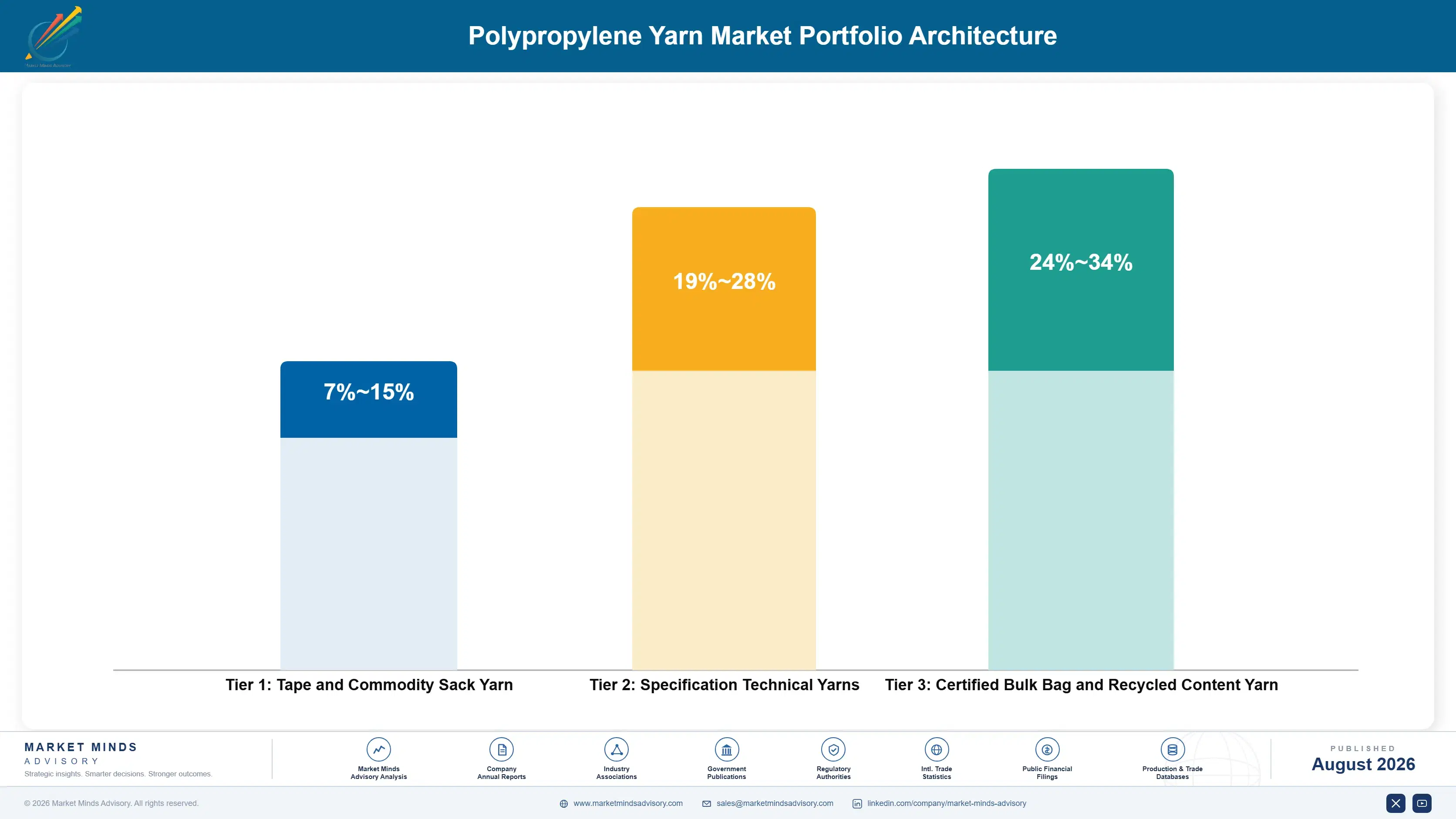
Margin here tracks qualification and almost nothing else. Commodity tape and sack yarn earns single-digit to low-teens margins because thousands of extruders make an interchangeable product and resin sets the price. Scale helps a little on purchasing and on purge efficiency, and it confers no pricing power whatever.
Specification yarns do considerably better, at margins in the low to high twenties. Geosynthetic multifilament, high tenacity rope yarn and automotive interior fibre all require testing and approval that most extruders cannot obtain, and respecifying a qualified fabric is a serious undertaking for the customer. The range is wide because standards depth varies enormously between applications. Testing depth rather than fibre quality separates the two ends of that range.

Certified bulk bag and specialty positions hold the best economics, running into the low thirties, because food contact and antistatic certification exclude nearly all of a very crowded field. Those margins reflect a documentation and audit barrier rather than any manufacturing advantage, which makes them unusually durable in an industry where equipment is cheap and everywhere. Equipment is cheap in this business and audit systems are not, which is why the documentation barrier holds.

Tape and Commodity Sack Yarn

Standard tape and raffia yarn for woven sacks and general packaging. Thousands of extruders make an interchangeable product and resin sets the price, so the eight point range reflects purchasing scale and purge efficiency alone.
Gross Margin: 7-15%

Specification Technical Yarns

Geosynthetic multifilament, high tenacity rope and automotive interior fibre requiring performance standard qualification. The nine point range reflects how demanding the applicable standard is, which varies enormously between national geosynthetic and automotive regimes.
Gross Margin: 19-28%

Certified Bulk Bag and Recycled Content Yarn

Food contact and antistatic certified bag yarn, plus recycled content grades meeting brand requirements. The ten point range reflects certification depth and audit burden, which differ sharply between food contact and flammable powder handling applications.
Gross Margin: 24-34%
polypropylene-yarn-market-trends-portfolio-architecture-1787580628304

High-value Sub-segments and Strategic Watch-out

Geosynthetic Multifilament Yarn

High value and the fastest growing position at 8.4%. Infrastructure specification converts road building budgets into predictable tonnage, and qualification against national standards excludes most extruders. Respecifying a highway fabric is something engineers avoid doing at all. Budget cycles set the pace of demand here.
Gross Margin: 22-30%

Certified Bulk Bag Yarn

High value, moderate growth, and genuinely defensible in a crowded market. Food contact and antistatic certification carry documentation and audit requirements that exclude nearly all of the South Asian extruder base currently producing standard sack yarn. European chemical customers increasingly require it. Certification is the barrier.
Gross Margin: 26-34%

Commodity Tape and Sack Yarn

The volume core and permanently price-led everywhere. Resin at 64% of cost sets the price and thousands of extruders compete on the remainder. Growth follows packaging conversion volume with no margin improvement realistically available to anyone. Resin pricing determines everything in this tier. Nothing else moves the price.
Gross Margin: 7-15%

Carpet Bulked Continuous Filament

The strategic watch-out and a declining position. Luxury vinyl tile has taken carpet below 38% of American floorcovering and the trend continues. Capacity is either converting toward industrial yarn or carrying fixed cost against demand that will not return. Conversion is the only sensible response left.
Gross Margin: 6-16%

How the Tonnage Repeats

Specification-driven demand is the closest thing to an annuity this industry offers. A geotextile qualified against a national highway standard gets consumed on every project built to that standard, at tonnages the engineer calculates rather than negotiates, for as long as the specification holds. Roughly 23% of output now moves this way, and neither the fabric maker nor the yarn producer has to sell anything once the qualification exists.
Stickiness falls away quickly outside specification work. Automotive interior fibre is stickiest of all, since it sits inside a part approval lasting a vehicle programme. Geosynthetic qualification comes next, held by the cost of retesting. Bulk bag yarn switches on price within certification class. Commodity tape and sack yarn is spot business in all but name, and buyers requalify sources within days rather than months.

The buyer has moved further from the producer over time. Yarn selection sat with fabric weavers choosing on processability and price. Specification writing now sits with civil engineers and standards bodies who never buy yarn at all, which means a producer's real customer is a testing laboratory and a national standard rather than the converter sending the order.
polypropylene-yarn-market-trends-end-use-penetration-index-1787580628792

Where We Would Focus Effort

These are among the four positions where our research anticipates prominent divergence between winners and laggards over the coming forecast period. Each is grounded in the demand model, the regulatory perimeter, and the announced capacity pipeline.
01 / STANDARDS QUALIFICATION INVESTMENT

Get qualified against geosynthetic standards while entry stays open

Roughly 23% of yarn output now moves through civil engineering specification, where a producer without qualification cannot sell whatever its actual fibre properties happen to be. Testing across tenacity, creep, ultraviolet resistance and durability takes several months and costs perhaps 250 thousand dollars over a product range. Once held, the position persists because respecifying a fabric on a highway programme means retesting that nobody undertakes casually, and Chinese and Indian producers are already qualifying into the same segment from below.
02 / CONTRACT STRUCTURE DISCIPLINE

Index to resin or accept eventual failure through a cycle

Polypropylene resin is 64% of yarn cost, the highest raw material share of any major fibre, and extruders holding fixed prices through a resin move absorb the entire swing on a thin conversion margin. That combination closed several small producers during 2021 and 2022, and it will certainly do so again. Indexing to a published resin reference converts a volatile margin into a stable conversion fee, and customers accept it readily once they understand what the alternative eventually costs them.
03 / CARPET CAPACITY CONVERSION

Convert idle filament lines rather than waiting for carpet

Carpet supplies under 38% of American floorcovering and luxury vinyl tile continues taking share, so bulked continuous filament capacity built for that demand now faces a permanent rather than a cyclical decline. Conversion to industrial and geotextile specification needs drawing control work and requalification at roughly 2 million dollars per line, set against replacement capacity that would cost many times more than that. Carrying fixed cost against demand that is plainly not returning is the far more expensive alternative here.
04 / BULK BAG CERTIFICATION

Certify food contact and antistatic before competitors do

South Asia produces 61% of world bulk bag output and very little of it carries food contact or Type C antistatic certification, which European chemical and food ingredient customers now increasingly require as a condition of supply. Certification costs perhaps 400 thousand dollars across documentation, laboratory testing and audit systems, and it produces a position that hundreds of competing extruders cannot enter quickly. It is comfortably the clearest available route out of commodity tape yarn pricing for any South Asian producer.

Engagement Snapshot From the Field

A live engagement with an industry participant carrying material or product regulatory and market exposure ahead of a defining policy shift, showing how our research translates into a defensible multi-year portfolio strategy.
MARKET MINDS ADVISORY · CLIENT ENGAGEMENT SUMMARY
Polypropylene Yarn Producer Strategic Portfolio Review and Transition Roadmap 2026·Investment Scenario on Polypropylene Yarn Exposure Evaluation 2025-26
CLIENT PROFILE
A North American polypropylene yarn extruder operating five bulked continuous filament lines in the Georgia carpet cluster, with annual capacity near 62 thousand tonnes and revenue around 190 million dollars (client-reported, unverified by MMA). Carpet mills accounted for over 80% of volume, and average utilisation had fallen to 64% as floorcovering demand shifted toward luxury vinyl tile.
STRATEGIC CHALLENGE
Three of the five lines had run below 60% utilisation for two consecutive years, and the board had rejected an earlier proposal to close two of them. Management needed to establish whether carpet demand would recover, what conversion to industrial yarn would cost and deliver, and which technical segments the company could realistically qualify into within a useful timeframe.
MMA APPROACH
MMA modelled American floorcovering share shifts through 2032, benchmarked the client's extrusion capability against geosynthetic and industrial yarn requirements, and costed drawing control and requalification work per line. Standards qualification timelines were tested with two independent testing laboratories. Interviews with 47 experts covered geosynthetic specification, carpet mill purchasing and industrial yarn conversion practice.
KEY FINDINGS
  1. No modelled scenario returned carpet above 42% of American floorcovering by 2032, which left three lines permanently surplus against carpet demand alone.
  2. Conversion to geosynthetic multifilament required drawing control upgrades at roughly 2 million dollars per line and qualification testing over about nine months.
  3. Geosynthetic yarn margins ran roughly twelve points above the carpet filament the lines were producing, on demand tied to federal highway programme schedules.
  4. Two lines lacked the drawing capability for geosynthetic tenacity requirements at any reasonable cost and were better suited to industrial webbing and rope yarn.
CLIENT PROFILE
A North American polypropylene yarn extruder operating five bulked continuous filament lines in the Georgia carpet cluster, with annual capacity near 62 thousand tonnes and revenue around 190 million dollars (client-reported, unverified by MMA). Carpet mills accounted for over 80% of volume, and average utilisation had fallen to 64% as floorcovering demand shifted toward luxury vinyl tile.
STRATEGIC CHALLENGE
Three of the five lines had run below 60% utilisation for two consecutive years, and the board had rejected an earlier proposal to close two of them. Management needed to establish whether carpet demand would recover, what conversion to industrial yarn would cost and deliver, and which technical segments the company could realistically qualify into within a useful timeframe.
MMA APPROACH
MMA modelled American floorcovering share shifts through 2032, benchmarked the client's extrusion capability against geosynthetic and industrial yarn requirements, and costed drawing control and requalification work per line. Standards qualification timelines were tested with two independent testing laboratories. Interviews with 47 experts covered geosynthetic specification, carpet mill purchasing and industrial yarn conversion practice.
KEY FINDINGS
  1. No modelled scenario returned carpet above 42% of American floorcovering by 2032, which left three lines permanently surplus against carpet demand alone.
  2. Conversion to geosynthetic multifilament required drawing control upgrades at roughly 2 million dollars per line and qualification testing over about nine months.
  3. Geosynthetic yarn margins ran roughly twelve points above the carpet filament the lines were producing, on demand tied to federal highway programme schedules.
  4. Two lines lacked the drawing capability for geosynthetic tenacity requirements at any reasonable cost and were better suited to industrial webbing and rope yarn.
RECOMMENDED STRATEGY
Phase 1: Phase one: convert the three highest-capability lines to geosynthetic multifilament, and begin standards qualification immediately rather than running it sequentially. Phase 2: Phase two: redirect the two remaining lines toward industrial webbing and rope yarn, where tenacity requirements sit within existing drawing capability. Phase 3: Phase three: retain a single carpet filament line serving the premium residual demand, rather than exiting that category altogether at this point.
OUTCOME
The extruder converted three lines during 2026 and completed geosynthetic qualification within eleven months, lifting group utilisation to 81% and gross margin by roughly nine points (client-reported, unverified by MMA). Carpet volume continued declining as modelled, and the retained line now serves premium residual demand at acceptable rates.

Frequently Asked Questions

Foundational context covering the market sizes, CAGR, scope, country, region and competition that inform every finding below. This section is provided to cover basics and most often pre-purchase conversations, answered from the MMA Primary Research Dataset.

What is the current size of the Polypropylene Yarn Market?

MMA sizes it at USD 9.8 billion in 2025, rising to USD 10.35 billion in 2026. The figure covers extruded polypropylene yarns and fibres at producer selling price, excluding resin and finished fabrics.

How large will the Polypropylene Yarn Market be by 2036?

USD 17.85 billion by 2036, an incremental USD 7.50 billion over the 2026 base and an expansion multiple of 1.72 times. Geosynthetic multifilament accounts for a disproportionate share.

What is the CAGR for the Polypropylene Yarn Market 2026 to 2036?

5.6% in the base case, with a bull case at 6.8% and a bear case at 4.4%. The spread turns on infrastructure programme pace and on how far carpet share continues falling.

Which segment is growing fastest?

Multifilament yarn at 8.4%, half again the market rate of 5.6%. Growth comes from geosynthetic specification in road construction rather than from any consumer textile application.

Who are the major companies in the Polypropylene Yarn Market?

Beaulieu International Group, Thrace Group, Universal Fibers, Belgotex and Rishi FIBC Solutions lead on annual production capacity. Fifteen further participants are profiled in the full report.

Which country is growing fastest?

India at 8.6%, on highway geosynthetic specification, protected cultivation and continued bulk bag conversion from jute. The country produces most of the world's woven sack yarn.

Report Segmentation Architecture

The full report scope spans multiple orthogonal segmentation dimensions, with cross-tabulated demand data provided for each dimension pair. Coverage extends further to regional breakdowns, trend trajectories, and the competitive detail needed to support segment-level decision-making.

By Yarn Construction

  • Tape and Raffia Yarn
  • Staple Fibre
  • Multifilament Yarn
  • Bulked Continuous Filament
  • Monofilament Yarn
  • Slit Film and Fibrillated Yarn

By End-Use Industry

  • Civil Engineering and Geotextiles
  • Bulk Packaging and Sacks
  • Carpet and Floorcovering
  • Agriculture and Horticulture
  • Automotive Interiors
  • Ropes, Nets and Industrial Webbing

By Commercial Dimension

  • Direct Supply to Weavers
  • Specification and Standards Channel
  • Distributor and Trader Supply
  • Contract Extrusion Agreements
  • Export and Cross-Border Trade
  • Integrated Captive Consumption

By Region

  • North America
  • Western Europe
  • East Asia
  • South Asia and Pacific
  • Latin America
  • Middle East and Africa
  • Eastern Europe

Scope, Methodology, and Coverage

Every figure in this report is reproducible from documented input assumptions. The scope below maps the historical period, the forecast horizon, the segmentation dimensions, and the countries covered, alongside the underlying primary and qualitative methodology.
Historical Period
2020 to 2025
Forecast Period
2026 to 2036
Base Year
2025 (USD billions; MMA Primary Research Dataset, August 2026)
Market Definition
Polypropylene yarns and fibres produced by melt extrusion for textile and technical applications, spanning tape and raffia yarn, staple fibre, multifilament, bulked continuous filament, monofilament and slit film or fibrillated yarn, measured at producer selling price. Polypropylene resin sold as such, spunbond and meltblown nonwoven fabric produced in a single step from resin, woven and finished fabrics, and finished bags or carpets are excluded from scope.
Quantitative Units
USD billions (current prices); million tonnes produced annually; USD per tonne by yarn construction and region
Segmentation Dimensions
Yarn construction; end-use industry; commercial dimension; region
Regions Covered
North America, Western Europe, East Asia, South Asia and Pacific, Latin America, Middle East and Africa, Eastern Europe
Countries Covered
United States, Canada, Mexico, Germany, Belgium, Greece, Spain, Italy, China, Japan, South Korea, India, Bangladesh, Vietnam, Australia, Brazil, Turkey, Saudi Arabia, Egypt, Poland
Key Companies Profiled
Beaulieu International Group, Thrace Group, Universal Fibers, Belgotex, Rishi FIBC Solutions, Innegra Technologies, Filtec, Sansu Group, Marglen Industries, JB Ecotex, Ganesha Ecosphere, Karatzis, Don and Low, Low and Bonar, Propex Global, Fibertex Nonwovens, TenCate Geosynthetics, Toray Industries, Indorama Ventures, Grupo Fibras
Quantitative Methodology
Primary survey, n=3,800 respondents, Q4 2025, six countries; demand-side model with trade association cross-validation
Qualitative Methodology
47 expert interviews, Q4 2025; applied to validate demand model assumptions, identify emerging dynamics, and assess competitive positioning
Report Format
PDF and XLSX data workbook (Word format preview document)
Publisher
Market Minds Advisory
Report Code
MMA-2026-CHM-124
Published
August 2026
Contact
sales@marketmindsadvisory.com | www.marketmindsadvisory.com

Purchase the full Polypropylene Yarn Market Report (2026 to 2036).

The full report sizes each yarn construction separately through 2036 and traces the demand shift from carpet toward civil engineering that most analysis of this market has not yet caught up with. It quantifies geotextile tonnage per kilometre across national highway specifications, models carpet share loss against luxury vinyl tile penetration, and maps bulk bag certification requirements by customer type. Regional chapters cover all seven regions with extrusion capacity detail where disclosure permits. Competitive profiling covers 20 participants on a single production capacity basis, with standards qualification timelines compared across jurisdictions.
Each yarn construction sized separately through 2036
Geotextile tonnage quantified per kilometre of specified road
Carpet share loss modelled against vinyl tile penetration
Bulk bag certification requirements mapped by customer type
Twenty participants profiled on one consistent basis
Standards qualification timelines compared across jurisdictions

Built For The People Who Decide

From boardroom strategy to bench-side execution, this report is read cover-to-cover by leaders shaping the next decade of their industry, turning demand scenarios, market dynamics and valuation benchmarks into decisions.
CXOs/ Presidents/ VPs/ Managers
M&A and Corporate Development
Strategy Teams and R&D Heads
Procurement and Product Directors
Regulatory and Compliance Leaders
Investor Relations and Equity Analysts