Market Minds Advisory
Polypropylene Random Copolymers Market

Polypropylene Random Copolymers Market: Plumbing Pipe Growth and the PEX Competition Question

Plumbing contractors switching from copper to polypropylene random copolymer pipe are running into cross-linked polyethylene systems that install faster with fewer joints, forcing producers to compete on total installed cost.

Lead Analyst

Bilal Shaikh

Published

September 2026

Make Smarter Decisions with Customized Research Insights

Request a free sample report and evaluate market opportunities, growth trends, and competitive dynamics relevant to your business needs.

2025 MARKET VALUE$8.9BMarket Size 2025
2036 FORECAST VALUE$15.5BBase Case , 2026 to 2036
CAGR 2026 TO 20365.2 %Bull 6.4% / Bear 4.0%
INCREMENTAL OPPORTUNITY$6.2BNet 10- year value creation
EXPANSION MULTIPLE1.66x2036 value over 2026 base
Strategic Levers
M&A Pipeline
Regional Outlook
Country Rankings
Competitive Intelligence
Segmental Deep-dive
Call-Us : 91 93563 13602

Executive Snapshot and Market Trajectory

Installed system economics, not raw resin price, now decides which producer wins a plumbing pipe specification contract. Producers holding documented joint-fusion data and plumbing code certification are winning contracts that undocumented commodity resin suppliers simply cannot match anymore across most major construction markets.
Construction and infrastructure programmes across China and India are pulling demand toward hot and cold water plumbing pipe faster than packaging and automotive volume combined, while medical packaging manufacturers increasingly specify high-clarity, PVC-free copolymer grades ahead of tightening regulatory scrutiny. Middle Eastern and Asian petrochemical majors hold the deepest propylene feedstock integration available today, while European and North American converters increasingly compete on installed system performance against cross-linked polyethylene alternatives that install with fewer joints.
Competition concentrates among a handful of large-scale petrochemical producers able to guarantee consistent copolymer performance and documented plumbing code compliance at commercial volume, a capability that cleanly separates qualified suppliers from smaller regional producers still selling undocumented commodity resin. Feedstock volatility, plumbing material competition, and medical packaging growth are reshaping which producers convert commodity sale into durable premium contracts. That shift already shapes contract awards across construction and healthcare markets globally.
Market Definition
The polypropylene random copolymer market covers PP-R resin sold across piping, packaging, injection moulding, medical packaging, automotive, and industrial sheet applications, distinguished from homopolymer polypropylene by its random ethylene comonomer distribution that improves clarity and impact resistance. It excludes homopolymer and block copolymer polypropylene grades and unrelated polyethylene piping systems.
Base Year Value
$8.9B in 2025 (MMA Primary Research Dataset, August 2026)
Forecast Period
2026 to 2036, eleven discrete annual values
CAGR
5.2% base case. Bull 6.4%. Bear 4.0%.
Fastest Growth Segment
Medical and Pharmaceutical Packaging: 7.5% CAGR
Fastest Growth Country
India: 8.2% CAGR
Fastest Growth Region
South Asia and Pacific: 7.2% CAGR
Largest Region
East Asia: 30% of 2025 global value
Market Leaders
Borealis AG, LyondellBasell Industries, Braskem S.A., SABIC, ExxonMobil Chemical. Source: MMA Analysis based on company annual reports.
Primary Survey
n=3,800 procurement and R&D decision-makers, Q4 2025, six countries
Methodology
Demand-side build-up, cross-validated against public data, 47 expert interviews

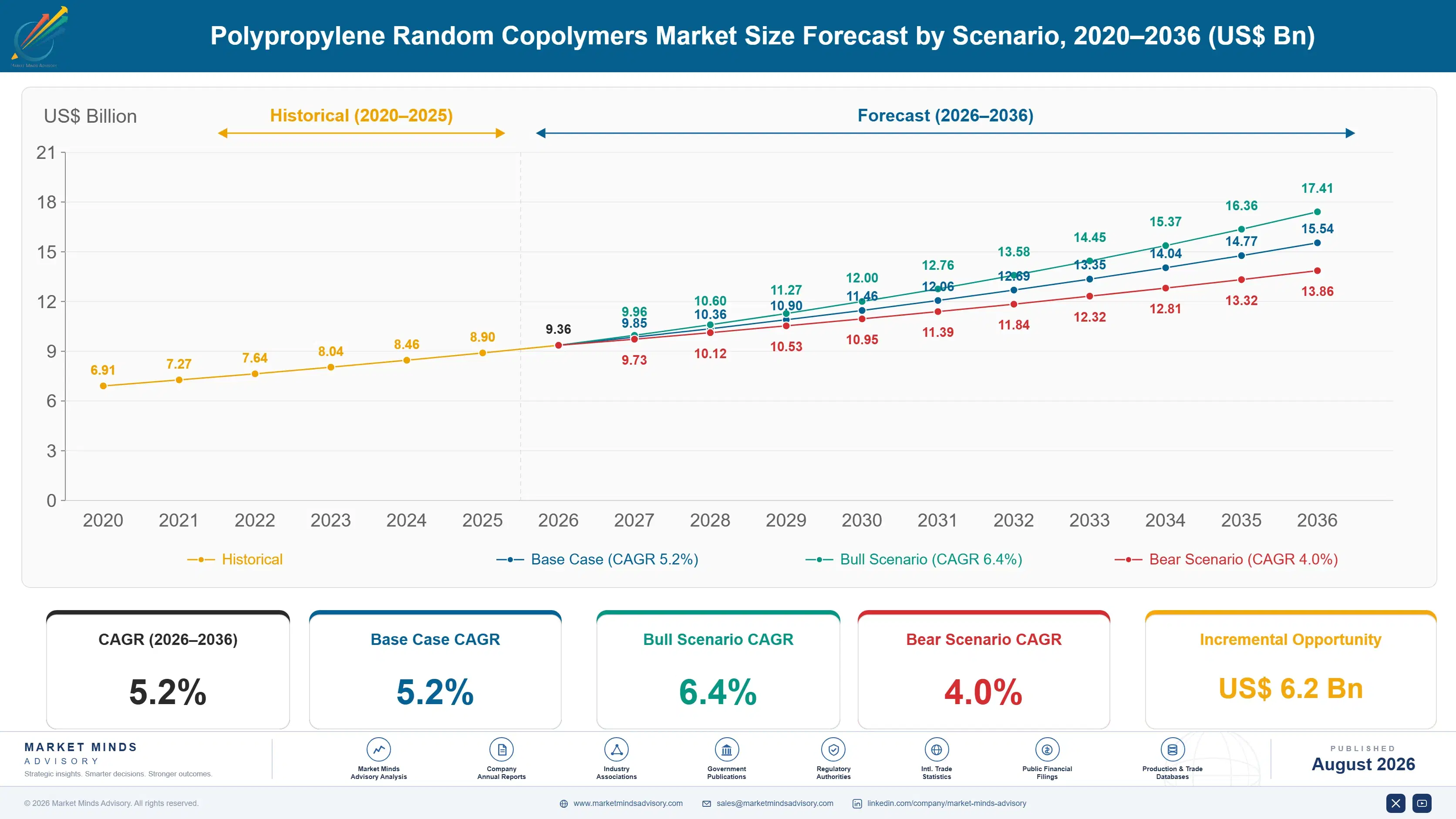
Polypropylene Random Copolymers Market Forecast Scenarios

polypropylene-random-copolymers-market-size-forecast-scenario-1787580228403
Between 2020 and 2025 the category grew near a 4.6% annual pace as construction-driven plumbing pipe demand recovered steadily from pandemic disruption across major markets, before medical packaging demand accelerated sharply from 2023 onward as pharmaceutical manufacturers increasingly specified clear, PVC-free copolymer packaging across multiple therapeutic categories worldwide. That recovery pattern held steady across nearly every major producing region through the period.
The base case carries the market to a 5.2% CAGR on three commercial mechanisms working together: continued construction-driven plumbing pipe demand across both mature and emerging infrastructure markets, medical packaging manufacturers specifying documented PVC-free copolymer grades as regulatory scrutiny on legacy materials intensifies across major pharmaceutical markets, and automotive interior manufacturers adopting lightweight copolymer components to meet weight reduction targets set across major electric and combustion vehicle programmes alike. Each mechanism reinforces the others across the forecast horizon.
The bull case at 6.4% assumes emerging market plumbing infrastructure investment accelerates faster than currently modelled across China and India's residential construction sectors, pulling forward demand that would otherwise materialise. The bear case at 4.0% assumes cross-linked polyethylene competition erodes plumbing pipe share more sharply than expected across mature construction markets in North America and Western Europe.

Installed System Economics and the Medical Packaging Premium

Three forces converge on this category at once. Plumbing contractors need pipe systems that install reliably against competing PEX and copper alternatives, medical packaging manufacturers need documented clarity and sterilisation compatibility that legacy PVC cannot always match, and automotive interior manufacturers want lightweight components that meet weight reduction targets without sacrificing durability across a vehicle's expected service life.
TOP PRODUCER SHAREChina, 28%Share of global output concentrated in Chinese facilities today
AVERAGE SELLING PRICEUSD 1.65 per kgBlended average price spanning piping and packaging grades overall
PROPYLENE FEEDSTOCK SHARE46% of COGSPropylene monomer feedstock share of total unit cost
PIPING SEGMENT SHARE42% of volumeTotal volume sold into plumbing and infrastructure piping projects
FORMULATION QUALIFICATION CYCLE6 to 12 monthsTypical time required to qualify a new copolymer grade
MARKET CONCENTRATIONCR5: 36%Combined share held by the five largest resin producers
Commercially, the category rewards documented system performance over raw resin output volume. Producers that can guarantee consistent joint-fusion compatibility and plumbing code certification command specification contracts that undocumented commodity producers cannot access, which is why major plumbing and medical packaging brands increasingly default to a small pool of qualified suppliers rather than sourcing opportunistically from whichever producer offers the lowest price that particular season. That preference has hardened considerably as installation failures have proven costly and slow to resolve well after a project completes.
Over the next decade, plumbing material competition, medical packaging certification, and automotive lightweighting will decide which producers convert commodity resin sale into durable premium specification contracts. Producers without documented performance data risk losing major construction and medical brand relationships entirely as certification becomes a baseline market entry requirement rather than a competitive differentiator worth paying extra for.
"Everyone still treats this as an undifferentiated commodity resin. The producers actually winning plumbing specification contracts have spent years proving their pipe outperforms copper and PEX on total installed cost, not just resin price."
Director, Commodity and Specialty Polymers Practice · MMA Commodity and Specialty Polymers Practice · August 2026

Market Trends

PP-R Pipe Continues Displacing Copper in New Construction

Plumbing contractors continue converting new construction projects from copper to polypropylene random copolymer pipe, driven by corrosion resistance and lower total installed cost relative to copper material and labour combined. Borealis and LyondellBasell have both expanded documented plumbing code certification across additional national building codes specifically to accelerate this displacement, since certification gaps have historically slowed adoption in markets where copper remains the traditional default choice for contractors. This shift is pulling qualified producers with documented certification breadth away from commodity packaging accounts toward premium plumbing contracts that pay substantially more per kilogram sold across a project's full duration.
Market Impact: Adds 14% to plumbing procurement

Medical Packaging Manufacturers Shift Away From PVC

Pharmaceutical and medical device manufacturers increasingly specify high-clarity polypropylene random copolymer as a PVC-free packaging alternative, responding to tightening regulatory scrutiny on PVC's plasticizer content in medical applications across major regulated markets. Braskem and SABIC have both expanded medical-grade copolymer capability specifically to serve this substitution demand, since switching packaging materials requires fresh stability and sterilisation testing that pharmaceutical manufacturers cannot skip regardless of formulation urgency or launch timeline pressure. This regulatory-driven substitution is proving more durable than a temporary compliance response, since manufacturers completing the switch rarely revert once qualification investment has been made.
Market Impact: Premium medical orders reach 12% share

Market Opportunities and Growth Drivers

Emerging Market Infrastructure Investment Sustains Pipe Volume

China and India's continued infrastructure and residential construction investment sustains substantial hot and cold water plumbing pipe demand, since polypropylene random copolymer pipe offers lower installed cost than copper alternatives across new construction in both countries. Major construction material brands have published specification guidelines favouring documented copolymer pipe across new residential development, giving suppliers with proven certification data a direct competitive advantage in specification decisions made at the project design stage. That infrastructure-driven volume growth has proven durable across multiple construction cycles rather than a passing trend, reinforcing sustained resin procurement growth for qualified suppliers.
Market Impact: PEX affects 20% of new specifications

Medical Device Manufacturers Specify Documented Clarity Grades

Medical device and pharmaceutical packaging manufacturers continue specifying high-clarity copolymer grades that support visual inspection of contents while maintaining documented sterilisation compatibility across radiation and steam sterilisation methods used throughout the industry. Braskem and other premium-grade suppliers have expanded medical-qualified capacity specifically to serve this demand, which requires far more rigorous testing documentation than standard packaging-grade material typically carries into a bid. This shift is pulling qualified producers toward medical accounts that pay meaningfully more per kilogram than commodity packaging-grade sale across comparable volume. That premium has widened steadily as documentation requirements have tightened across the industry.
Market Impact: Swings can move margin 16 points

Market Restraints and Challenges

Cross-Linked Polyethylene Competes Directly in Plumbing Applications

Cross-linked polyethylene pipe systems compete directly against polypropylene random copolymer in plumbing applications, offering faster installation with fewer joints in some configurations that appeals strongly to contractors prioritising labour cost over material cost on tight schedules. The root cause is a genuine installation trade-off rather than any inherent performance deficiency in copolymer pipe, since each material carries distinct joining methods with different labour requirements. Producers are mitigating this by developing improved fusion-welding systems that reduce installation time and documenting long-term durability advantages. Installation crews are increasingly trained on both systems to bid competitively either way.
Market Impact: PP-R pipe reaches 42% of volume

Propylene Feedstock Volatility Compresses Manufacturing Margin

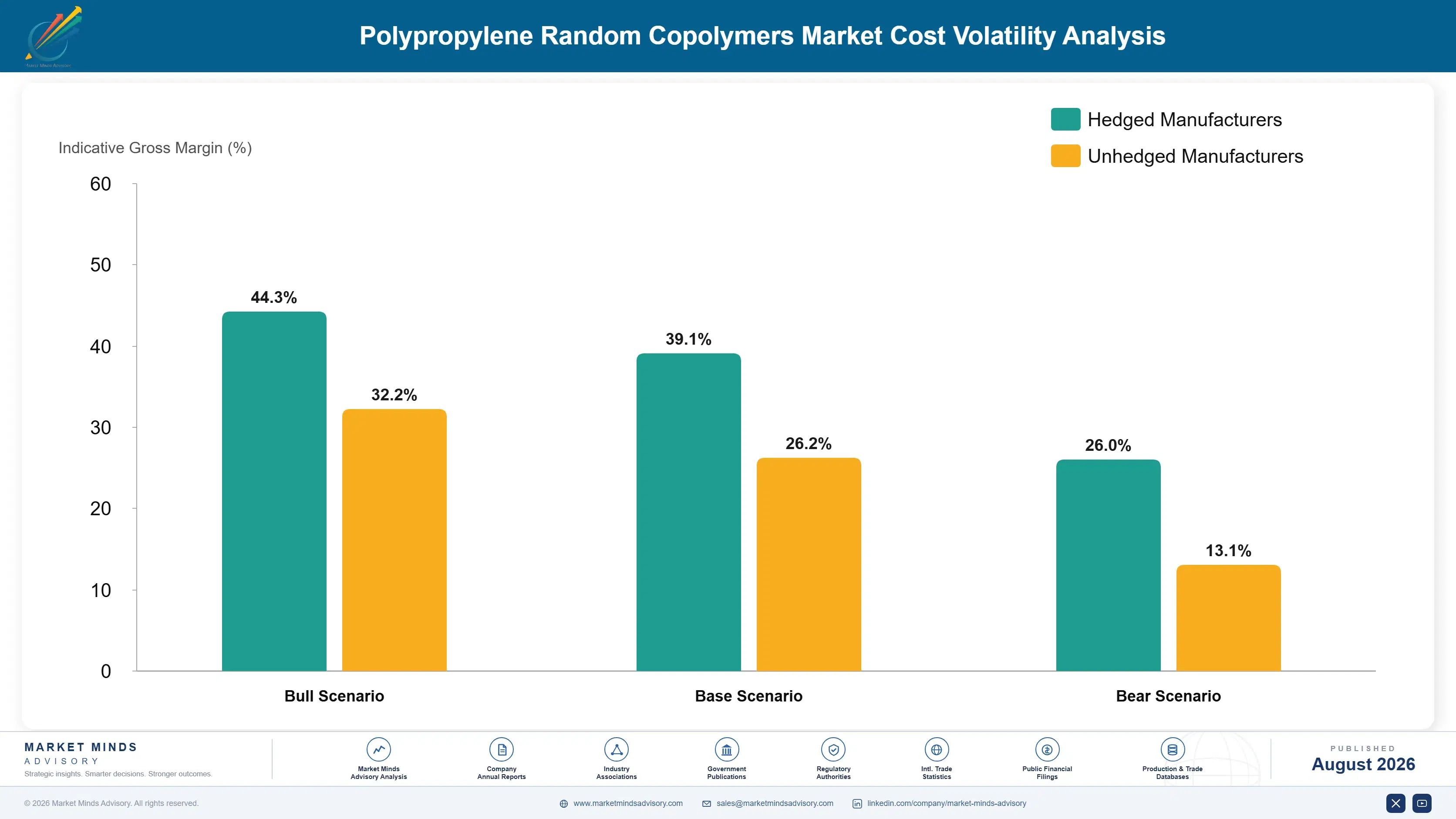
Propylene monomer feedstock prices have swung sharply in recent years as global refinery and petrochemical cracking economics moved independent of any change in underlying copolymer demand, since propylene serves much larger chemical industries whose combined demand dwarfs the random copolymer category entirely. The root cause is broad petrochemical market volatility rather than any category-specific supply issue, meaning resin producers absorb the same commodity price swings affecting far larger propylene-consuming industries elsewhere. Manufacturers are mitigating this through longer-term feedstock supply contracts and increased vertical integration into upstream propylene production capacity. Long-term contracts are proving the most durable hedge available.
Market Impact: Substitution grows past 14% yearly
3 additional market trends, 3 additional growth drivers, and 3 additional restraints and challenges are covered in the full report. Contact sales@marketmindsadvisory.com to access the complete intelligence.

Segment CAGR and Growth Architecture

Segmentation follows end-use application, a single formulation and certification logic, since piping, packaging, injection moulding, medical, automotive, and industrial sheet uses each require distinct compounding technology and regulatory pathways rather than differing by distribution channel, customer type, or ownership structure across the value chain. Buyers evaluate suppliers strictly within their own application dimension. That discipline holds firm.
polypropylene-random-copolymers-market-market-share-analysis-1787580228955

Medical and Pharmaceutical Packaging

Medical and pharmaceutical packaging applications grow fastest at 7.5%, about 1.44 times the overall 5.2% rate, as manufacturers substitute away from PVC toward documented PVC-free copolymer packaging that meets tightening regulatory scrutiny on legacy plasticizer content across major regulated markets. This segment demands the highest purity and clarity tier in the entire category, since medical packaging requires documented sterilisation compatibility that standard commodity-grade material cannot supply without dedicated capital investment in dedicated production lines. Braskem and SABIC lead qualified medical-grade supply, competing on documented clarity and sterilisation performance rather than price alone across every major bid. Growth concentrates in North America and Western Europe, where pharmaceutical regulatory scrutiny on legacy packaging materials runs deepest and moves fastest.
CAGR 7.5%

Automotive Components

Automotive component applications grow at 6.5%, the second-fastest segment in the category, as interior manufacturers specify lightweight copolymer components to meet weight reduction targets that matter increasingly for electric vehicle range and combustion efficiency alike. LyondellBasell and ExxonMobil Chemical lead qualified automotive-grade supply, competing on documented impact resistance and processing consistency rather than raw material cost alone in most sourcing decisions. Unlike piping applications, this segment sells substantially into direct automotive manufacturer contracts rather than distributor channels, so processing consistency and supply reliability matter just as much as the underlying material specification itself does to a purchasing programme. That direct-contract structure gives established qualified suppliers a durable advantage over new entrants lacking a proven track record.
CAGR 6.5%
Full segment breakdown across 6 segments available in the complete report.

Regional Architecture and Country Demand Map

East Asia leads on Chinese production scale and sustained plumbing pipe demand across residential and commercial construction projects nationwide, while South Asia and Pacific posts the fastest regional growth on India's rapidly expanding construction and infrastructure investment programme. Both regions anchor global feedstock and demand simultaneously.

North America

Established plumbing pipe conversion from copper and a growing medical packaging manufacturing base give North America 24% of global value, reflecting the region's documented certification activity rather than any domestic feedstock cost advantage alone. LyondellBasell and ExxonMobil's American operations supply both domestic converters and export packages meeting United States plumbing code and Food and Drug Administration packaging requirements simultaneously. United States medical device manufacturers increasingly specify documented PVC-free copolymer as packaging regulatory scrutiny tightens steadily across the industry. Growth of 5.8% tracks plumbing conversion and medical packaging substitution more directly than any broader general construction volume trend would suggest on its own. That dual demand base gives North American converters pricing resilience that single-application peers in other regions lack.
Share: 24% | CAGR: 5.8% (2026 to 2036)

Western Europe

Europe's leading role in medical packaging regulatory scrutiny, having originated much of the framework now influencing other regions worldwide, explains why Western Europe holds 22% of global value despite a construction pipe market smaller than East Asia's. Borealis, headquartered within the region, holds deep regulatory compliance relationships with European pharmaceutical manufacturers navigating PVC substitution timelines across multiple product lines. German and French plumbing contractors increasingly specify documented copolymer pipe for underfloor heating applications where performance certification matters most to the specifying engineer. Growth of 3.7%, the slowest among major regions, reflects an already mature plumbing and packaging base rather than any underlying demand weakness. That regulatory leadership continues to shape substitution timelines well beyond the region's own borders.
Share: 22% | CAGR: 3.7% (2026 to 2036)
Regional intelligence for 5 additional markets available in the complete report: East Asia, South Asia and Pacific, Latin America, Middle East and Africa, Eastern Europe. Contact sales@marketmindsadvisory.com.
polypropylene-random-copolymers-market-country-cagr-analysis-1787580229482

Where System Certification Creates Margin

Margin in this category increasingly sits in documented plumbing code certification and medical packaging compliance rather than in raw production scale alone. Producers converting that capability into premium specification contracts are pulling well ahead of competitors still selling undifferentiated commodity resin into price-only distribution channels. That gap will keep widening as documentation becomes a baseline market entry requirement.

Build Plumbing Code Certification Across Every Major Market

Producers that certify plumbing code compliance across multiple national and regional building codes simultaneously can bid on contractor specification contracts regardless of the project's jurisdiction, while narrowly-certified competitors must decline projects outside their certified scope entirely. Borealis's multi-region certification breadth lets it participate in roughly 75% of new construction tenders industry-wide, compared with a much narrower addressable share for producers holding only regional certification. Certification typically takes 12 to 18 months but opens the broadest possible contractor customer base. Producers who delay this investment risk permanent exclusion from the largest available tenders. That window is closing fast.
Market Impact: Multi-region certification opens roughly 75% of all tenders

Qualify PVC-Free Grades for Medical Packaging Substitution

Producers that qualify PVC-free copolymer grades ahead of confirmed pharmaceutical demand capture reformulation contracts that generic packaging producers cannot fulfil once a manufacturer requires proven sterilisation compatibility documentation. Braskem's medical-grade qualification programme illustrates how documentation investment made before regulatory scrutiny intensified converts directly into preferred-supplier status once pharmaceutical brands begin substitution projects. That qualification typically takes 10 to 16 months but opens a meaningfully higher-margin customer segment. Competitors without comparable documentation cannot bid regardless of price offered, since manufacturers will not risk an unqualified supplier disrupting a launch. Few competitors can close that gap quickly.
Market Impact: PVC-free qualification lifts blended margin by roughly 18%

Develop Fusion-Welding Systems to Compete With PEX Installation

Producers that develop improved fusion-welding systems reducing plumbing installation time capture contractor specification decisions that would otherwise default to faster-installing cross-linked polyethylene alternatives on tight project schedules. This technology typically adds 8% to 14% to development cost but lets copolymer pipe compete directly on total installed labour cost rather than conceding that ground to PEX systems entirely across every major plumbing market simultaneously and permanently. Producers who skip this step risk ceding new-build plumbing share for years to come. Producers who skip this step risk ceding new-build plumbing share for years to come.
Market Impact: Fusion-welding systems add 8% to 14% development cost

Diversify Propylene Feedstock Sourcing for Cost Stability

Producers that diversify propylene feedstock sourcing across multiple refining regions capture premium specification contracts that require documented cost stability, since construction and medical brands launching flagship projects cannot risk a feedstock disruption interrupting supply mid-project. That diversification typically adds 6% to 10% to procurement cost but secures the delivery reliability that premium contracts increasingly require as a standing condition of the relationship itself, not merely a preference stated during negotiation. Producers ignoring this exposure absorb far sharper margin swings during feedstock price spikes. Producers ignoring this exposure absorb far sharper margin swings whenever feedstock prices spike unexpectedly.
Market Impact: Diversified feedstock sourcing adds 6% to 10% cost

Who Controls the Margin Pool

Concentration sits at a moderate CR5 of 36%, reflecting a category where documented certification depth, not raw production scale, separates a small group of large-scale petrochemical leaders from a long tail of regional producers selling largely undocumented material. Borealis leads on documented plumbing code certification and medical packaging breadth, and the gap to mid-tier challengers is measured in regulatory documentation investment rather than production capacity alone. That gap has persisted across several product cycles now and shows no sign of narrowing soon.
All participants are assessed on unit shipment volume across commodity-grade and premium-grade material, a consistent basis given how widely certification maturity varies by producer. Current competitive activity concentrates on three fronts: certification across every major market, PVC-free qualification for medical substitution, and fusion-welding systems to compete with PEX economics. That pattern spans every major consuming region, not just the largest construction markets.

Emerging pressure comes from Chinese domestic producers scaling commodity-grade capacity faster than expected, backed by proximity to the world's largest propylene production base. Rankings are likely to shift toward producers combining certification depth with installation technology innovation, since neither production scale nor brand heritage alone decides premium contract awards anymore.
polypropylene-random-copolymers-market-company-positioning-matrix-1787580230005

Competitive Moat and Risk Dimensions

BOREALIS AG

Moat: Deepest plumbing code certification

Borealis's decades of polymer formulation science and established plumbing code certification across more national building codes than any single competitor give it contractor relationship access that newer entrants cannot replicate without years of dedicated certification work. That breadth lets it serve major construction brands across multiple countries simultaneously without declining a single tender.
BOREALIS AG

Risk: European Cost Base Exposure

Borealis's primary manufacturing base inside Western Europe carries meaningfully higher energy and labour cost than Middle Eastern or Chinese competitors, limiting its ability to compete purely on price for commodity-tier volume in price-sensitive emerging construction markets where budget dominates the buying decision. That gap has widened as Gulf and Chinese capacity has expanded.
LYONDELLBASELL INDUSTRIES

Moat: Strong North American medical relationships

LyondellBasell's established relationships with major North American medical packaging and automotive brands give it specification contract access that newer entrants must contest through lengthy qualification processes that these brands require before switching suppliers at all. That relationship depth also feeds product development data back into formulation ahead of competitors.
LYONDELLBASELL INDUSTRIES

Risk: Diversified Portfolio Distraction Risk

Random copolymer represents one of many business lines within LyondellBasell's much broader chemicals portfolio, meaning internal capital allocation and management attention could shift toward larger business lines during any broader corporate restructuring, leaving specialists room to capture share in specific high-growth segments left underserved. Specialists without that distraction can move faster on niche opportunities.

Players Tracked

Prominent Players

Borealis AG
LyondellBasell Industries
Braskem S.A.
SABIC
ExxonMobil Chemical

Other Key Players

TotalEnergies Petrochemicals
China Petroleum & Chemical Corporation
PetroChina Company
Reliance Industries
Formosa Plastics Corporation
INEOS Group
Hanwha Total Petrochemical
Lotte Chemical Corporation
Sumitomo Chemical
Mitsui Chemicals
Chevron Phillips Chemical
GAIL India Limited
Indian Oil Corporation
Nizhnekamskneftekhim
Repsol Quimica

Recent Developments

FEBRUARY 2025

Borealis Expands Plumbing Code Certification Coverage

Borealis secured expanded plumbing code certification covering additional national building codes across several emerging construction markets during the first quarter. The milestone was a certification achievement, not an acquisition or joint venture, extending Borealis's addressable specification pipeline well ahead of less-certified competitors across the industry overall.
Signal: Certification expansion, not a transaction, confirms regulatory breadth as the primary lever available to any producer.
JUNE 2025

Braskem Signs Multi-Year Medical Packaging Supply Agreement

Braskem signed a multi-year supply agreement with a global pharmaceutical manufacturer to provide PVC-free copolymer packaging for a major product reformulation programme launching in 2026. The arrangement was a supply agreement, not an acquisition or joint venture, securing guaranteed volume directly ahead of the manufacturer's regulatory compliance timeline.
Signal: A supply agreement, not M&A, shows medical contracts now drive multi-year procurement planning industry-wide across the sector today.
OCTOBER 2025

LyondellBasell Acquires Minority Stake in Fusion-Welding Startup

LyondellBasell acquired a minority equity stake in a fusion-welding technology startup, aiming to integrate faster installation systems into its plumbing pipe product line over two years. The transaction was an equity investment rather than a full acquisition or merger, giving LyondellBasell early technology access without full integration risk.
Signal: A minority stake, not a full acquisition, shows players hedging installation technology bets carefully and deliberately.

Propylene Feedstock and Compounding Exposure

Propylene monomer feedstock accounts for roughly 46% of unit cost, sourced predominantly from established petrochemical producers across the United States, Saudi Arabia, and China, with ethylene comonomer and compounding additives adding a further 14% to 20% depending on formulation complexity and certification depth required for the end application being served. Compounders add further processing cost depending on grade complexity.
Propylene prices climbed sharply through 2021 and 2022 as global petrochemical demand rebounded against constrained refinery capacity, before easing through 2023 and 2024 as new capacity expanded globally across several major producing regions. The American Chemistry Council has documented that volatility as a recurring feature of the broader petrochemical cycle rather than a one-time disruption, and producers without long-term feedstock contracts absorbed the cost spike directly into margin during the worst months of that period.

Exposure varies considerably by producer scale and sourcing diversity across the industry. Larger integrated producers like SABIC and ExxonMobil hedge feedstock exposure through vertical integration into upstream propylene production, while smaller regional producers buying on spot markets absorb price swings immediately into unit cost with no buffer. That gap leaves smaller producers at a persistent cost disadvantage precisely when feedstock prices spike.
polypropylene-random-copolymers-market-cost-volatility-analysis-1787580230200

Secure long-term propylene feedstock supply contracts

Locking propylene volume through long-term supplier contracts protects production schedules from spot market shortages during periods of peak construction and packaging demand across the calendar year. This trades some pricing flexibility for delivery certainty that premium specification contracts increasingly require as a standing condition. Contract terms typically span two to four years. Suppliers increasingly favour this structure too.

Invest in vertical integration into upstream propylene production

Producers shipping sufficient volume can justify investing in upstream propylene production capability, capturing margin currently paid to third-party petrochemical suppliers while gaining direct control over feedstock quality and supply timing considerably over the medium to long term horizon. Payback on such investment typically runs five to eight years. Larger producers pursue this route most aggressively.

Diversify feedstock sourcing across the United States, Middle East, and Asia

Qualifying propylene suppliers across multiple regions simultaneously reduces exposure to any single region's trade policy disruption or capacity constraint event. Producers with diversified sourcing recovered from the 2021 to 2022 spike measurably faster than single-source buyers did across the same period. Qualification across three regions typically takes about a year. Smaller producers rarely have the scale to pursue this alone.

Portfolio Architecture for Margin Defence

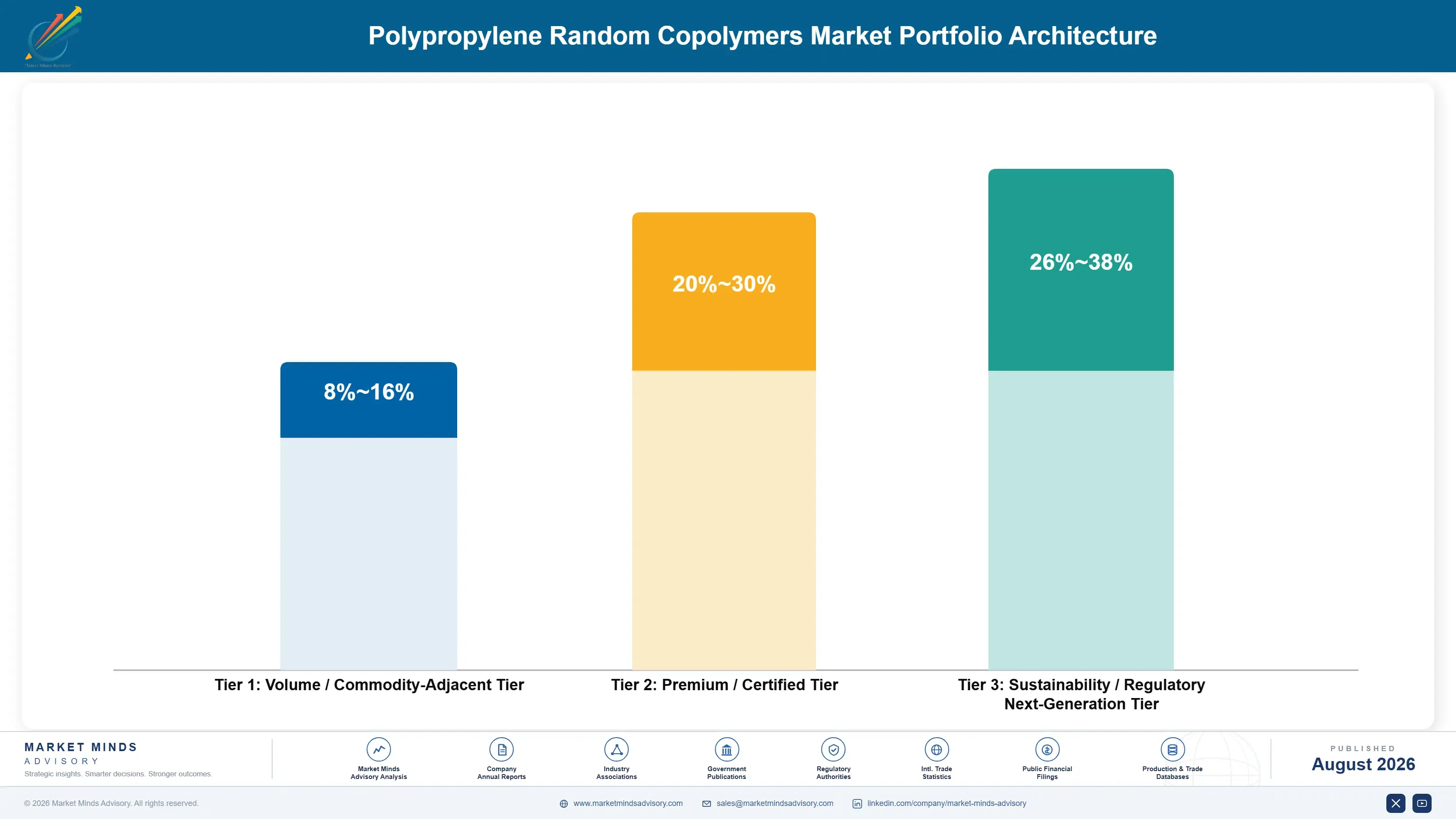
The portfolio splits into three tiers with clear margin separation tied to certification depth and application type served. Commodity-grade resin for basic packaging competes on price and earns thin margins, certified plumbing-grade and standard automotive-grade material earns considerably more, and next-generation medical-grade and premium automotive formulations carry the highest margin given their regulatory documentation depth and the certification barriers protecting that position from new entrants.
The tension between volume and premium reflects application type directly: medical and premium automotive brands reward documented compliance and performance over price, pulling producers toward sustained testing investment year after year, while much of the commodity packaging segment still buys on price and delivery volume alone with little brand loyalty. Producers running both product lines must manage genuinely distinct testing, documentation, and sales organisations without letting either investment starve the other of resources or management attention.

High-value margin pools concentrate in medical packaging and certified plumbing pipe contracts, where documented compliance and performance both reward proven producer capability directly and consistently. The volume core of commodity-grade packaging resin remains necessary for manufacturing scale but contributes comparatively little to blended margin across the portfolio as a whole, year after year.

Volume / Commodity-Adjacent Tier

Commodity-grade resin sold into mass-market packaging and basic injection moulding applications, competing primarily on price with limited certification investment and thin batch-to-batch consistency guarantees behind it overall. Buyers in this tier switch suppliers readily whenever price shifts.
Gross Margin: 8-16%

Premium / Certified Tier

Certified plumbing-grade pipe resin and standard automotive-grade material sold under documented compliance certification into major construction and mainstream automotive supply contracts across multiple regions. Buyers here value proven delivery reliability over marginal price differences.
Gross Margin: 20-30%

Sustainability / Regulatory / Next-Generation Tier

Medical-grade PVC-free formulations and premium automotive-grade copolymers engineered specifically for the most demanding compliance and performance requirements available in the category today. Buyers here pay a sustained premium for documented compliance assurance.
Gross Margin: 26-38%
polypropylene-random-copolymers-market-portfolio-architecture-1787580230746

High-value Sub-segments and Strategic Watch-out

Medical and Pharmaceutical Packaging

High value and the fastest-growing application at 7.5% CAGR, carrying both a substitution premium and genuine formulation engineering barriers to entry that protect incumbents from new entrants over time. Braskem and SABIC lead this tier, competing on documented compliance depth rather than price. Documentation depth decides most bids.
Gross Margin: 26-38%

Automotive Components

High value with strong growth, sustained by electric vehicle interior programmes specifying lightweight components across multiple platforms. Margin varies with qualification depth a producer holds with the automaker it serves. Suppliers here compete on testing depth. Depth matters most here. Electric vehicle scale-up keeps this segment attractive.
Gross Margin: 20-30%

Standard Plumbing Pipe

The volume core, competing on price and installation economics across most mainstream construction applications worldwide, from residential to light commercial builds. Margin stays thin because feedstock cost dominates pricing. That price sensitivity leaves little room for documentation-driven premiums to take hold. Few buyers pay extra here. Scale wins here instead.
Gross Margin: 8-16%

Industrial Sheet and Profile

The strategic watch-out, where buyer willingness to pay a documentation premium remains largely unproven across niche industrial sheet and profile applications today. Pricing power varies sharply by customer relationship. Producers are watching buyer response closely before committing further capital. Investment stays cautious for now. Few have committed capital yet.
Gross Margin: 12-24%

Specification Lock-In and System Depth

Demand behaves like an annuity once a producer wins a specification slot: construction and medical brands rarely requalify a resin supplier mid-project, since replacing an approved formulation means repeating months of compliance and performance testing against a formula that already works reliably. That repeat-purchase pattern gives incumbent qualified producers a durable revenue base that competitors cannot easily displace once approved.
Adoption depth varies sharply by application across the category. Medical and premium automotive buyers have converted deepest, since compliance requirements make qualified sourcing close to mandatory for any responsible purchasing team. Mainstream plumbing buyers adopt more selectively, weighing installed system cost against PEX alternatives, while industrial and packaging buyers remain the shallowest adopters, defaulting to whatever commodity resin is cheapest that quarter. That gap between adoption depth and application type continues to widen each year.

Buyer profiles are shifting generationally across the industry. Younger specification engineers increasingly default to documented certified formulations without evaluating commodity alternatives at all, treating compliance data as a baseline requirement. That default is spreading faster among medical and premium automotive brands than among mainstream construction buyers, who still weigh upfront cost most heavily at the point of decision.
polypropylene-random-copolymers-market-end-use-penetration-index-1787580231241

Certification Depth Beats Production Scale

These are among the four positions where our research anticipates prominent divergence between winners and laggards over the coming forecast period. Each is grounded in the demand model, the regulatory perimeter, and the announced capacity pipeline.
01 / PLUMBING CERTIFICATION STRATEGY

Producers without multi-region plumbing certification will lose contracts by 2029

Contractors increasingly default to producers holding plumbing code certification across every major building code simultaneously, since narrowly-certified competitors must decline projects outside their certified scope regardless of price offered on the bid. Borealis's broad certification shows how addressable tender share follows directly from certification investment completed years earlier rather than any bid submitted closer to award. That gap compounds rather than narrows as construction programmes diversify across more jurisdictions worldwide each year, and certification investment made today compounds into tender access for years to come.
02 / MEDICAL SUBSTITUTION TIMING

Early PVC-free qualification will decide medical packaging contract share

Pharmaceutical brands increasingly require documented PVC-free substitution data before approving any packaging reformulation, and producers without that documentation cannot bid on these contracts regardless of price offered during negotiation. Braskem's qualification investment shows how documentation completed years before requirements tightened converts directly into preferred-supplier status that competitors cannot quickly replicate today. That advantage will keep compounding as more pharmaceutical brands formalise substitution requirements across every major regulated market worldwide, and early movers are already locking in multi-year contracts on this exact basis.
03 / INSTALLATION TECHNOLOGY PUSH

Fusion-welding advances will determine plumbing share against PEX competition

Contractors increasingly weigh installation labour cost alongside material price when choosing between copolymer pipe and cross-linked polyethylene alternatives on a bid-by-bid basis across every project. Producers without improved fusion-welding technology cannot close that installation cost gap regardless of material performance advantages they might otherwise claim during a bid. LyondellBasell's fusion-welding investment shows how installation technology converts directly into specification wins that technology-lagging competitors cannot match today, since contractors across major markets are already factoring this exact gap into their supplier shortlists.
04 / FEEDSTOCK INTEGRATION STRATEGY

Vertically integrated feedstock access will separate resilient producers from exposed rivals

Propylene price volatility is exposing producers with concentrated single-region sourcing to recurring margin disruption that vertically integrated buyers largely avoid altogether across the cycle. SABIC's integrated feedstock position illustrates how upstream production access converts directly into cost stability that non-integrated competitors cannot match during acute price spikes. That resilience gap will only widen as premium contracts increasingly demand documented cost stability guarantees across every major consuming region, as integrated producers are already citing this exact stability advantage in new contract bids.

Engagement Snapshot From the Field

A live engagement with an industry participant carrying material or product regulatory and market exposure ahead of a defining policy shift, showing how our research translates into a defensible multi-year portfolio strategy.
MARKET MINDS ADVISORY · CLIENT ENGAGEMENT SUMMARY
Polypropylene Random Copolymers Producer Strategic Portfolio Review and Transition Roadmap 2026·Investment Scenario on Polypropylene Random Copolymers Exposure Evaluation 2025-26
CLIENT PROFILE
A global medical device manufacturer approached MMA while evaluating polypropylene random copolymer suppliers for a planned PVC-free packaging reformulation project spanning multiple product lines. The client reported annual packaging resin procurement volume exceeding 1,800 tonnes and a reformulation budget surpassing USD 4.8 million tied to upcoming regulatory compliance deadlines (client-reported, unverified by MMA). The evaluation covered its full global packaging supplier base.
STRATEGIC CHALLENGE
Management wanted to complete the substitution ahead of a regulatory compliance deadline but had not benchmarked sterilisation compatibility documentation across available suppliers, nor evaluated whether any single supplier could realistically cover its full product range in time. The regulatory affairs team wanted rigorous documentation; the commercial team wanted speed to compliance above all else.
MMA APPROACH
MMA benchmarked PVC-free substitution documentation, sterilisation compatibility testing, and existing production capacity across all six suppliers in the client's evaluated resin category. We modelled reformulation timelines against the compliance deadline and quantified realistic consolidation scenarios using comparable medical device manufacturer benchmarks drawn from prior engagements. Findings were validated against comparable reformulation projects completed in adjacent product categories.
KEY FINDINGS
  1. Only two of six evaluated suppliers held documented sterilisation compatibility data sufficient to meet the client's compliance deadline without gaps (client-reported, unverified by MMA).
  2. Consolidating onto two qualified suppliers added roughly 7% to procurement cost while meaningfully accelerating compliance timeline certainty across every affected product line.
  3. The fastest realistic reformulation timeline for a new, unproven supplier ran thirteen months, longer than the client's compliance deadline allowed for two of its product lines.
  4. Suppliers with existing sterilisation documentation delivered materially faster requalification since much of the stability testing work was already complete before the engagement began.
CLIENT PROFILE
A global medical device manufacturer approached MMA while evaluating polypropylene random copolymer suppliers for a planned PVC-free packaging reformulation project spanning multiple product lines. The client reported annual packaging resin procurement volume exceeding 1,800 tonnes and a reformulation budget surpassing USD 4.8 million tied to upcoming regulatory compliance deadlines (client-reported, unverified by MMA). The evaluation covered its full global packaging supplier base.
STRATEGIC CHALLENGE
Management wanted to complete the substitution ahead of a regulatory compliance deadline but had not benchmarked sterilisation compatibility documentation across available suppliers, nor evaluated whether any single supplier could realistically cover its full product range in time. The regulatory affairs team wanted rigorous documentation; the commercial team wanted speed to compliance above all else.
MMA APPROACH
MMA benchmarked PVC-free substitution documentation, sterilisation compatibility testing, and existing production capacity across all six suppliers in the client's evaluated resin category. We modelled reformulation timelines against the compliance deadline and quantified realistic consolidation scenarios using comparable medical device manufacturer benchmarks drawn from prior engagements. Findings were validated against comparable reformulation projects completed in adjacent product categories.
KEY FINDINGS
  1. Only two of six evaluated suppliers held documented sterilisation compatibility data sufficient to meet the client's compliance deadline without gaps (client-reported, unverified by MMA).
  2. Consolidating onto two qualified suppliers added roughly 7% to procurement cost while meaningfully accelerating compliance timeline certainty across every affected product line.
  3. The fastest realistic reformulation timeline for a new, unproven supplier ran thirteen months, longer than the client's compliance deadline allowed for two of its product lines.
  4. Suppliers with existing sterilisation documentation delivered materially faster requalification since much of the stability testing work was already complete before the engagement began.
RECOMMENDED STRATEGY
Phase 1: Phase 1 (0 to 4 months): Transition to the two suppliers with existing sterilisation compatibility documentation to meet the compliance deadline. Phase 2: Phase 2 (4 to 12 months): Complete full requalification across all remaining product lines using the newly consolidated supplier base. Phase 3: Phase 3 (12 to 24 months): Reassess supplier consolidation depth annually against compliance performance and pricing benchmarks achieved. under evolving conditions
OUTCOME
The client proceeded with the two-supplier consolidation, completing compliance-critical reformulation ahead of the restriction deadline across every affected product line. The client reported avoiding an estimated four-month compliance delay it had modelled under a single-source, unproven-supplier scenario (client-reported, unverified by MMA). Leadership credited the benchmarking work with avoiding a costly late-stage supplier switch.

Frequently Asked Questions

Foundational context covering the market sizes, CAGR, scope, country, region and competition that inform every finding below. This section is provided to cover basics and most often pre-purchase conversations, answered from the MMA Primary Research Dataset.

What is the current size of the Polypropylene Random Copolymers Market?

The Polypropylene Random Copolymers Market stood at USD 8.9 billion in 2025, based on MMA Primary Research Dataset estimates. Plumbing pipe demand is the primary near-term growth driver.

How large will the Polypropylene Random Copolymers Market be by 2036?

MMA projects the market reaching USD 15.54 billion by 2036 under the base case scenario. That represents a 1.66 times expansion over the 2026 base value.

What is the CAGR for the Polypropylene Random Copolymers Market 2026 to 2036?

The base case CAGR is 5.2% annually. The bull case reaches 6.4% and the bear case falls to 4.0%, depending on infrastructure investment pace and PEX competition.

Which segment is growing fastest?

Medical and pharmaceutical packaging grows fastest at 7.5% CAGR, about 1.44 times the overall market rate. PVC substitution and documented clarity requirements both drive that growth.

Who are the major companies in the Polypropylene Random Copolymers Market?

Borealis, LyondellBasell, Braskem, SABIC, and ExxonMobil Chemical lead the category today. Combined, the top five hold a CR5 of 36% across a moderately concentrated competitive field.

Which country is growing fastest?

India grows fastest at 8.2% CAGR, driven by its expanding construction and infrastructure investment programme. Rapid plumbing pipe adoption is reinforcing that pace further each year.

Report Segmentation Architecture

The full report scope spans multiple orthogonal segmentation dimensions, with cross-tabulated demand data provided for each dimension pair. Coverage extends further to regional breakdowns, trend trajectories, and the competitive detail needed to support segment-level decision-making.

By End-Use Application

  • Piping Systems
  • Packaging Films and Containers
  • Injection Molded Consumer Products
  • Medical and Pharmaceutical Packaging
  • Automotive Components
  • Industrial Sheet and Profile

By Product Grade

  • Commodity Grade
  • Plumbing-Certified Grade
  • Medical Grade
  • Automotive Grade

By Commercial Dimension

  • Direct Converter Sale
  • Construction Supply Agreements
  • Distributor and Catalogue Channel
  • Custom Formulation Contracts

By Region

  • North America
  • Western Europe
  • East Asia
  • South Asia and Pacific
  • Latin America
  • Middle East and Africa
  • Eastern Europe

Scope, Methodology, and Coverage

Every figure in this report is reproducible from documented input assumptions. The scope below maps the historical period, the forecast horizon, the segmentation dimensions, and the countries covered, alongside the underlying primary and qualitative methodology.
Historical Period
2020 to 2025
Forecast Period
2026 to 2036
Base Year
2025 (USD billions; MMA Primary Research Dataset, August 2026)
Market Definition
The polypropylene random copolymer market comprises PP-R resin sold across piping, packaging, injection moulding, medical packaging, automotive, and industrial sheet applications, distinguished from homopolymer polypropylene by its random ethylene comonomer distribution. Homopolymer and block copolymer polypropylene grades and unrelated polyethylene piping systems are excluded.
Quantitative Units
USD billions (current prices); production volume in metric tonnes where applicable
Segmentation Dimensions
By End-Use Application; By Product Grade; By Commercial Dimension; By Region
Regions Covered
North America, Western Europe, East Asia, South Asia and Pacific, Latin America, Middle East and Africa, Eastern Europe
Countries Covered
USA, China, Germany, France, UK, Japan, South Korea, India, Australia, Canada, Brazil, Mexico, Indonesia, Vietnam, Thailand, Malaysia, UAE, Saudi Arabia, South Africa, Nigeria, Turkey, Poland, Netherlands, Italy, Spain, Sweden, Switzerland, Argentina, Colombia, Singapore, and additional markets relevant to this sector
Key Companies Profiled
Borealis AG, LyondellBasell Industries, Braskem S.A., SABIC, ExxonMobil Chemical, TotalEnergies Petrochemicals, China Petroleum & Chemical Corporation, PetroChina Company, Reliance Industries, Formosa Plastics Corporation, INEOS Group, Hanwha Total Petrochemical, Lotte Chemical Corporation, Sumitomo Chemical, Mitsui Chemicals, Chevron Phillips Chemical, GAIL India Limited, Indian Oil Corporation, Nizhnekamskneftekhim, Repsol Quimica
Quantitative Methodology
Primary survey, n=3,800 respondents, Q4 2025, six countries; demand-side model with trade association cross-validation
Qualitative Methodology
47 expert interviews, Q4 2025; applied to validate demand model assumptions, identify emerging dynamics, and assess competitive positioning
Report Format
PDF and XLSX data workbook (Word format preview document)
Publisher
Market Minds Advisory
Report Code
MMA-2026-CHM-266
Published
August 2026
Contact
sales@marketmindsadvisory.com | www.marketmindsadvisory.com

Purchase the full Polypropylene Random Copolymers Market Report (2026 to 2036).

The full MMA Polypropylene Random Copolymers report sizes the market across six end-use applications, four product grades, four commercial dimensions, and seven regions through 2036. It profiles twenty producers on a consistent unit shipment volume basis, scoring each on plumbing code certification depth, PVC-free medical qualification, and installation technology innovation. Scenario models quantify how construction investment, medical packaging substitution, and propylene price cycles shift both volume and realised price across product grades over the forecast period. The report also includes delivered-cost modelling by application, a regulatory exposure screen, and installed system economics analysis built for producer strategy, procurement, and investment teams.
Six-application segmentation with cross-tabulated regional demand
Twenty-company competitive benchmarking on shipment volume
Plumbing code certification tracking by producer and region
PVC-free medical qualification and substitution analysis
Propylene feedstock cost scenario modelling through 2036
Country-level construction and medical regulatory policy tracking

Built For The People Who Decide

From boardroom strategy to bench-side execution, this report is read cover-to-cover by leaders shaping the next decade of their industry, turning demand scenarios, market dynamics and valuation benchmarks into decisions.
CXOs/ Presidents/ VPs/ Managers
M&A and Corporate Development
Strategy Teams and R&D Heads
Procurement and Product Directors
Regulatory and Compliance Leaders
Investor Relations and Equity Analysts