Market Minds Advisory
Polypropylene Market

Polypropylene Market: On-Purpose Propylene, Idle Dehydrogenation and the Food Contact Gap

Propylene stopped arriving as a by-product when the crackers switched to ethane, so an industry built on someone else's spare molecules now depends entirely on dedicated plants running at seventy percent.

Lead Analyst

Bilal Shaikh

Published

September 2026

Make Smarter Decisions with Customized Research Insights

Request a free sample report and evaluate market opportunities, growth trends, and competitive dynamics relevant to your business needs.

2025 MARKET VALUE$118.0BMarket Size 2025
2036 FORECAST VALUE$189.5BBase Case , 2026 to 2036
CAGR 2026 TO 20364.4 %Bull 5.6% / Bear 3.2%
INCREMENTAL OPPORTUNITY$66.3BNet 10- year value creation
EXPANSION MULTIPLE1.54x2036 value over 2026 base
Strategic Levers
M&A Pipeline
Regional Outlook
Country Rankings
Competitive Intelligence
Segmental Deep-dive
Call-Us : 91 93563 13602

Executive Snapshot and Market Trajectory

Polypropylene spent fifty years living on propylene it did not have to pay to make. Steam crackers running naphtha and refinery catalytic units both threw off propylene as a by-product, and the polymer industry took it cheaply. That arrangement has come apart. Nobody underwrote the replacement on the same arithmetic.
Crackers switched to ethane for shale and Gulf economics, and ethane produces almost no propylene. European refinery closures removed more. What filled the gap is propane dehydrogenation, now roughly 38% of propylene supply, built overwhelmingly in China. Those units need a propane to propylene spread near 350 dollars a tonne to cover cost, and they have been running below it, at utilisation around 71%.
Recycled and certified grades grow at 6.6%, half again the market rate of 4.4%, on packaging content mandates rather than economics. Barely 0.9% of recycled polypropylene output currently holds food contact clearance, which matters because yoghurt pots and ready meal trays are the largest application facing those rules. East Asia holds 45% of value, far above the usual band. The polymer that once enjoyed free feedstock now sits downstream of an asset class earning nothing.
Market Definition
Polypropylene homopolymer and copolymer resins produced for conversion into plastic products, spanning injection moulding, fibre and nonwoven, film and recycled grades, measured at producer selling price. Excludes propylene monomer sold as such, polypropylene compounds and masterbatch, converted products including nonwoven fabric and film, and other polyolefin resins.
Base Year Value
$118.0B in 2025 (MMA Primary Research Dataset, August 2026)
Forecast Period
2026 to 2036, eleven discrete annual values
CAGR
4.4% base case. Bull 5.6%. Bear 3.2%.
Fastest Growth Segment
Recycled and Certified Grades: 6.6% CAGR
Fastest Growth Country
India: 7.2% CAGR
Fastest Growth Region
South Asia and Pacific: 6.5% CAGR
Largest Region
East Asia: 45% of 2025 global value
Market Leaders
LyondellBasell, Sinopec, Borealis, Braskem, TotalEnergies. Source: MMA Primary Research Dataset, July 2026.
Primary Survey
n=3,800 procurement and R&D decision-makers, Q4 2025, six countries
Methodology
Demand-side build-up, cross-validated against public data, 47 expert interviews

Polypropylene Market Forecast Scenarios

polypropylene-market-trends-size-forecast-scenario-1787580607845
Growth ran near 3.4% between 2020 and 2025 through a period that scrambled every normal relationship in this market. Nonwoven grades spiked in 2020 and 2021 on medical and hygiene demand, then normalised abruptly. Chinese dehydrogenation and integrated capacity arrived continuously throughout, pushing operating rates down and margins with them. Automotive demand fell on the semiconductor shortage and recovered only partially afterwards.
Base case 4.4% rests on three mechanisms. Indian and Southeast Asian conversion demand is deepening across packaging, hygiene and construction from a low per capita base, and domestic capacity has not kept pace. European packaging rules requiring recycled content are creating demand for a grade that barely exists in food contact form. And dehydrogenation rationalisation in China should slowly restore propylene pricing from a position where a large share of capacity earns nothing at all.
The bull case at 5.6% assumes propane pricing softens against propylene while Chinese dehydrogenation capacity consolidates, restoring spreads above the 350 dollar breakeven and with them the pricing across the whole chain. The bear case at 3.2% is continued Chinese capacity addition into slower domestic demand, holding dehydrogenation utilisation near current levels and pushing surplus polymer into export markets.

The By-Product That Stopped Being One

For most of this industry's history propylene was somebody else's problem. A naphtha steam cracker produces ethylene and a useful quantity of propylene alongside it; a refinery catalytic cracker produces propylene as part of gasoline production. Polypropylene producers bought that stream at whatever it cost to separate, which was very little, and built a global business on the arithmetic.
TOP FIVE CONCENTRATION27%Capacity spread widely across national and integrated producers
ON-PURPOSE PROPYLENE SHARE38%Portion arriving from dedicated dehydrogenation rather than co-production
DEHYDROGENATION UTILISATION71%Operating rate across dedicated propane dehydrogenation capacity worldwide
PROPANE SPREAD BREAKEVEN$350Spread needed per tonne for dehydrogenation units to break even
RECYCLED CONTENT SHARE6%Portion of demand met from recycled polypropylene sources
FOOD CONTACT RECYCLED APPROVAL0.9%Share of recycled output cleared for food packaging use
Two changes broke it. American and Gulf crackers switched to ethane feedstock, which produces ethylene and almost no propylene at all, and European refineries began closing on their own economics. Propylene supply fell away from the polymer demand it had always tracked. The industry's answer was propane dehydrogenation, a dedicated route that makes propylene deliberately and now supplies roughly 38% of the world's requirement.
Dedicated capacity brought dedicated economics. A dehydrogenation unit lives on the spread between propane and propylene, needing roughly 350 dollars a tonne to cover cash cost and capital, and Chinese units built through the last cycle have spent two years below that. Utilisation sits near 71%. The polymer that used to enjoy free feedstock now sits downstream of an asset class earning nothing, and the pricing reflects it.
"Everyone models polypropylene demand and almost nobody models where the propylene comes from any more. The moment your feedstock stops being a by-product and starts being a plant with its own return requirement, this becomes a different business, and a lot of the capacity built in the last five years was underwritten on the old one."
Director, Petrochemicals and Polymers Practice · MMA Chemicals and Materials Practice · August 2026

Market Trends

Propane dehydrogenation displacing by-product propylene supply

On-purpose propylene now covers roughly 38% of global supply, up from a small fraction two decades ago, because ethane crackers and closing refineries no longer produce it in the quantities polymer demand requires. That shift moves the industry's cost structure from a by-product basis to a dedicated one, with all the return requirements a standalone plant carries. Chinese producers built most of the new capacity. Utilisation near 71% shows how far the build ran ahead of the spread economics needed to support it properly. The polymer industry inherited a cost structure it did not choose.
Market Impact: Delivers 7.2% annual Indian growth

Recycled content rules meeting a food contact approval gap

European packaging regulation requires recycled content in plastic packaging by 2030, and polypropylene carries the largest food packaging application set facing it, from yoghurt pots to ready meal trays. Barely 0.9% of recycled polypropylene output currently holds food contact clearance, because mechanical recycling cannot remove absorbed contaminants from a polymer that lacks the established bottle-to-bottle infrastructure polyester has. Dissolution and purification routes are being commercialised. None operates at anything approaching the volume the regulation assumes will exist by then. Regulation assumed a purification capacity that has simply not appeared on the timetable.
Market Impact: Grows nonwoven demand 5.9% yearly

Market Opportunities and Growth Drivers

Indian and Southeast Asian conversion demand deepening quickly

India grows fastest anywhere at 7.2%, on packaging, hygiene, construction and automotive conversion demand rising from per capita consumption far below Chinese levels. Domestic capacity has expanded but not enough, leaving the country a substantial net importer that every regional exporter targets. Southeast Asian demand in Vietnam, Indonesia and the Philippines follows the same path at smaller scale. This is the only large demand pool growing fast enough to absorb the surplus capacity built elsewhere, which is why netbacks there set the tone for the whole Asian market. Every regional exporter has noticed.
Market Impact: Leaves 71% utilisation across units

Hygiene and medical nonwoven demand growing on demographics

Fibre and nonwoven grades feed adult incontinence, infant hygiene and medical disposables, and demand in the first of those is growing with populations ageing across East Asia and Europe. Unlike the 2020 spike, this growth is demographic and therefore predictable to within a percentage point. Nonwoven grades require narrow molecular weight distribution and consistent rheology, which limits which producers can serve the segment credibly. Converters qualify resin carefully and change supplier reluctantly, so positions here last considerably longer than commodity injection moulding relationships. Demographics do not reverse on a business cycle.
Market Impact: Approves under 1% of output

Market Restraints and Challenges

Dehydrogenation economics failing at current propane spreads

Dedicated propane dehydrogenation needs a spread near 350 dollars a tonne to cover cash cost and capital, and Chinese units have run below that for roughly two years. The root cause is that capacity was underwritten on demand growth and propane pricing assumptions that both proved optimistic, and dehydrogenation plants are quick to build. Commercially it leaves 38% of propylene supply coming from assets earning nothing. Rationalisation among smaller Chinese operators has begun, and consolidation rather than demand recovery is the realistic route back. Polymer producers downstream inherit the problem without having built anything.
Market Impact: Covers 38% of propylene supply

Recycled polypropylene cannot reach food contact at scale

Mechanical recycling produces polypropylene carrying absorbed contaminants that no melt filtration removes, and unlike polyester there is no established closed-loop collection stream to draw clean feedstock from. The root cause is application diversity: polypropylene arrives in the waste stream from packaging, automotive parts, textiles and housewares at once. Commercially that leaves food packaging mandates facing a grade holding 0.9% approval. Dissolution and solvent purification routes produce approvable material, and none currently operates at anything like regulatory scale. Brand owners are contracting years ahead of their compliance dates as a direct result.
Market Impact: Clears only 0.9% for food contact
3 additional market trends, 4 additional growth drivers, and 2 additional restraints and challenges are covered in the full report. Contact sales@marketmindsadvisory.com to access the complete intelligence.

Segment CAGR and Growth Architecture

Six segments split by resin grade class, because grade determines the conversion process, the qualification depth a customer applies and therefore how contested the business is. A nonwoven grade and a commodity injection moulding grade compete for nothing at all. Application and channel splits are handled in the framework instead. The two ends of this market barely resemble each other.
polypropylene-market-trends-market-share-analysis-1787580608427

Recycled and Certified Grades

Growing at 6.6%, half again the market rate of 4.4%, this segment covers mechanically recycled, dissolution-purified and mass-balance certified polypropylene. Growth comes entirely from packaging content mandates rather than from any cost advantage, since recycled grades price above virgin resin in an oversupplied market. The commercial difficulty is that the largest application facing those mandates is food packaging, and barely 0.9% of recycled output holds the necessary clearance. Dissolution routes produce approvable material at costs regulation rather than economics must justify. Capacity is being built against long offtake agreements, and almost none of it speculatively. Whoever solves food contact purification at scale takes a position that nobody currently holds anywhere in polypropylene.
CAGR 6.6%

Fibre and Nonwoven Grades

At 5.9% nonwoven grades grow on demographics rather than on any cycle. Adult incontinence demand rises with ageing populations across East Asia and Europe, infant hygiene follows birth rates and penetration in developing markets, and medical disposables track healthcare activity. These grades demand narrow molecular weight distribution and consistent rheology for spinning at high line speeds, which excludes producers whose plants cannot hold the specification. Converters qualify resin carefully and switch reluctantly, so supplier positions persist far longer than in commodity applications. Margins run above the injection moulding grades for exactly that reason. Demand here is demographic rather than cyclical, which makes it the most reliable volume in the business and the least discussed.
CAGR 5.9%
Full segment breakdown across 6 segments available in the complete report.

Regional Architecture and Country Demand Map

East Asia holds 45% of value, far above its usual band, because Chinese capacity and conversion demand together dominate the global picture. North America at 17% and Western Europe at 13% sit below their bands, while South Asia and Pacific at 14% sits above on Indian demand growth.

North America

The shale gas transition that gave American producers their ethylene cost advantage took away their propylene, which is why this region sits at 17% and below the usual band on polypropylene specifically. Ethane crackers produce almost none, so American polypropylene relies on refinery catalytic units and on dehydrogenation capacity built along the Gulf Coast. Automotive and packaging conversion demand remains substantial, with Mexican conversion growing on nearshoring investment. State-level recycled content requirements are creating regulatory demand without any federal framework. PureCycle's dissolution capacity in Ohio is the most watched recycled polypropylene project anywhere. The region gained an ethylene advantage and lost a propylene one, and that trade is why the polypropylene share sits below its usual band.
Share: 17% | CAGR: 3.5% (2026 to 2036)

Western Europe

Refinery closures removed catalytic propylene at the same time as cracker economics deteriorated, leaving European polypropylene producers short of feedstock and long on cost, and the 13% share sits below the usual band as a direct consequence. Several units have closed permanently since 2023. What Europe retains is regulation and specialty position: packaging rules requiring recycled content make it the largest committed market for a grade that scarcely exists in approvable form. Borealis and LyondellBasell hold technology positions in nonwoven and automotive compounds that Asian capacity has not matched. Regulation rather than production is what makes this region matter commercially now, and the two are moving in opposite directions. Closures continue.
Share: 13% | CAGR: 2.9% (2026 to 2036)
Regional intelligence for 5 additional markets available in the complete report: East Asia, South Asia and Pacific, Latin America, Middle East and Africa, Eastern Europe. Contact sales@marketmindsadvisory.com.
polypropylene-market-trends-country-cagr-analysis-1787580608949

Four Moves in an Oversupplied Chain

Two things decide returns in polypropylene now: where the propylene comes from and which grades a producer can actually make. Commodity injection moulding volume is contested by everyone and earns accordingly. The defensible positions all involve either feedstock integration or a specification barrier that keeps most of the field out. Everything else is noise around those two variables.

Secure propylene position rather than buying merchant

On-purpose propylene now covers 38% of supply and prices against a dehydrogenation cost curve rather than a by-product one, which removes the cheap feedstock the industry was built on. Producers buying merchant propylene carry the full spread while integrated players absorb it internally. Securing refinery or dehydrogenation offtake on long tenor costs a premium in easy markets and protects margin when spreads widen. The producers who assumed by-product availability would persist are the ones now unable to run their polymer units economically. That assumption is no longer available. Integration is the only durable answer.
Market Impact: Covers 38% of supply now priced on cost curves

Build nonwoven and specialty grade capability

Nonwoven grades grow at 5.9% on demographics rather than on any economic cycle, and they require narrow molecular weight distribution and rheology consistency that commodity plants cannot hold reliably. Converters qualify resin over months and switch reluctantly afterwards, so positions persist. Upgrading a line to hold nonwoven specification costs roughly 15 million dollars in reactor control and catalyst work. Against commodity margins that looks expensive, and against nonwoven margins it pays back inside four years on a single large converter relationship. Qualification is the barrier and also the protection. Reactor control decides who can compete.
Market Impact: Costs about $15 million for every line upgraded

Take dissolution recycling capacity before mandates bite

Barely 0.9% of recycled polypropylene holds food contact clearance while European packaging rules assume a great deal more will exist by 2030. Dissolution and solvent purification produce approvable material at costs that regulation rather than economics must justify. Building or contracting that capacity now, against brand offtake agreements that transfer price risk, secures the only polypropylene position in the market with genuine pricing power. Waiting until the mandate date means competing for capacity that has already been contracted by somebody else entirely. Regulation created the buyer here. Nobody else can sell it yet.
Market Impact: Targets the 0.9% gap in food contact approval

Serve Indian import demand with local infrastructure

India grows at 7.2% and remains a substantial net importer despite domestic expansion, which makes it the most contested destination for Gulf, Chinese and American export volume. Winning there requires local warehousing, credit terms suited to a fragmented converter base and technical service that commodity exporters rarely provide. Producers who built that infrastructure hold share that price alone does not move. Roughly 3 million tonnes of annual import demand is contested this way, and the infrastructure takes years rather than quarters to assemble properly. Cargo price alone does not win this business.
Market Impact: Contests 3 million tonnes of annual import demand

Who Controls the Margin Pool

Participation is measured on annual polypropylene production capacity, and the top five hold 27%. That is low for a capital intensive business and reflects how many national and integrated producers hold regional positions. LyondellBasell and Sinopec lead on capacity and on process technology licensed widely across the industry. The gap to challengers is propylene integration and grade breadth rather than tonnage alone.
Competition runs on feedstock position before anything else. Producers with refinery or dehydrogenation integration hold a cost advantage merchant buyers cannot close, and that gap has widened as by-product propylene disappeared. Grade capability is the second front, since nonwoven and automotive compounds carry qualification barriers commodity plants cannot meet. Technology licensing is third, with a few licensors collecting from most new capacity built anywhere.

The pressure ahead is Chinese export volume and the recycled content gap arriving together. Continued capacity addition into slower domestic demand pushes surplus toward Southeast Asia and India, compressing netbacks. Expect capacity closures in Europe and consolidation among Chinese dehydrogenation operators rather than cross-border acquisitions. Rankings shift as European rationalisation continues and whoever solves food contact recycling at scale takes a position nobody currently holds.
polypropylene-market-trends-company-positioning-matrix-1787580609472

Competitive Moat and Risk Dimensions

LYONDELLBASELL

Moat: Process technology licensing position

LyondellBasell licenses polypropylene process technology used across a large share of world capacity, which produces royalty income independent of its own plant economics and gives it visibility into competitor projects nobody else has. That position is close to impossible to build now, since the installed base of licensees reinforces itself with every new plant that selects the technology.
LYONDELLBASELL

Risk: European asset cost exposure

European polypropylene assets face disappearing refinery propylene and industrial energy costs well above Asian and American levels, a position that no demand recovery corrects. Rationalising them means writing down capacity in a region where the company has historically held strong customer relationships, and conceding volume to importers who face none of those costs.
SINOPEC

Moat: Refinery propylene and domestic reach

Sinopec produces propylene from its own refinery catalytic units rather than paying dehydrogenation economics, giving it a feedstock position most Chinese competitors that built dehydrogenation capacity simply do not have. Combined with domestic distribution reach across the largest conversion market anywhere, that makes its cost position durable through a cycle that is punishing newer entrants.
SINOPEC

Risk: Domestic demand growth decelerating

Chinese polypropylene demand growth has slowed while domestic capacity kept arriving, which forces a domestically oriented producer into export markets it is not organised to serve. Competing for Indian and Southeast Asian volume means facing Gulf producers with better feedstock economics and established distribution, on netbacks that reward neither party particularly well.

Players Tracked

Prominent Players

LyondellBasell
Sinopec
Borealis
Braskem
TotalEnergies

Other Key Players

ExxonMobil
SABIC
Reliance Industries
Formosa Plastics
PetroChina
Hengli Petrochemical
Oriental Energy
Satellite Chemical
LG Chem
Mitsui Chemicals
Prime Polymer
INEOS
Repsol
Hanwha TotalEnergies
PureCycle Technologies

Recent Developments

MARCH 2026

Chinese dehydrogenation operators idle capacity as propane spreads stay negative

Several smaller Chinese propane dehydrogenation operators idled units after sustained spreads below the level needed to cover cash cost, according to industry association reporting. Larger integrated producers continued running while absorbing losses, expecting consolidation to reduce supply over the following two years. No formal rationalisation agreement exists.
Signal: Feedstock economics rather than polymer demand are now the binding constraint across the Asian polypropylene chain
AUGUST 2025

European producer closes polypropylene capacity following refinery shutdown

A European producer closed polypropylene capacity permanently after the adjacent refinery ceased operation, removing the catalytic propylene stream the unit had always depended upon. The company confirmed the plant would be dismantled rather than mothballed for any possible future restart. Downstream customers were reallocated to other sites.
Signal: Refinery closures are removing polypropylene capacity indirectly, which most European supply forecasting has not yet reflected
DECEMBER 2025

Brand owner contracts dissolution-purified recycled polypropylene for food packaging

A consumer goods company signed a multi-year offtake for dissolution-purified recycled polypropylene cleared for food contact, securing volume against packaging content obligations. The arrangement is a long-term supply agreement carrying volume commitments rather than an equity investment or joint venture. Volumes and pricing terms were not disclosed.
Signal: Food contact approved recycled polypropylene is being contracted years ahead because so little of it exists

Propylene Is the Whole Question

Propylene monomer accounts for roughly 68% of polypropylene cash cost, and where it comes from decides everything else. Refinery catalytic units and naphtha crackers supply it as co-product at separation cost. Dedicated dehydrogenation buys propane, largely from American and Middle Eastern export cargoes, and converts it deliberately. Catalyst, energy and conversion together add about 17%, with the balance in additives and packaging costs.
The 2023 and 2024 propane market showed what the shift means. Strong American export demand and Asian buying kept propane firm while polypropylene pricing stayed weak on oversupply, compressing the dehydrogenation spread below the roughly 350 dollars a tonne those units need, per EIA propane export and price reporting. Chinese operators disclosed sustained losses on dehydrogenation assets in their reporting for that period, and several suspended planned projects.

The competitive mechanism is integration. A producer taking refinery propylene internally is insulated from the propane spread entirely, while a merchant buyer or a standalone dehydrogenation operator carries all of it. That divides the industry more sharply than scale or technology ever has. Geography adds to it: Gulf producers with designed-in refinery integration hold the strongest position anywhere, while European producers losing adjacent refineries hold the weakest.
polypropylene-market-trends-cost-volatility-analysis-1787580609667

Contract propylene supply on long tenor rather than merchant

Producers without integration should secure refinery or dehydrogenation offtake on multi-year terms rather than buying merchant propylene into a volatile spread. Long tenor costs a premium in easy markets and protects margin when the spread widens, which is exactly what happened through the last two years. Relatively few merchant buyers did this before the shift became obvious to everyone.

Hold dual feedstock access where site configuration permits

A polymer unit able to take both refinery co-product and dehydrogenation propylene can follow whichever route is cheaper as the spread moves. Site configuration usually determines whether this is possible at all, and where it is, the pipeline and logistics investment is modest against the optionality gained. Very few sites were designed with this flexibility in mind originally.

Shift grade mix toward specifications that carry margin

When feedstock cost cannot be improved, the remaining lever is what the plant makes with it. Nonwoven and automotive compound grades carry margins commodity injection moulding cannot approach, and the qualification barriers keep competition limited. Reactor control upgrades are needed and payback runs several years, which is a long horizon in a business used to thinking in quarters.

Portfolio Architecture for Margin Defence

Margin here divides along feedstock position first and grade capability second. Commodity injection moulding grades made from merchant propylene earn very little and sometimes nothing, because everyone can make them and the feedstock carries no advantage. Integrated producers earn a spread on the same product that merchant buyers simply cannot access, whatever their conversion efficiency. Conversion efficiency cannot close a feedstock gap that size.
Specialty grades occupy a different economy. Nonwoven, automotive compound and high-clarity random copolymer grades hold margins in the high twenties to high thirties, because qualification takes months and converters change supplier reluctantly once a line is running well. The range spans applications with very different testing depth and switching cost. A line running well is not disturbed for a few dollars a tonne.

Food contact approved recycled polypropylene holds the strongest position in the market and almost the smallest volume. Margins run into the forties because mandates created buyers who cannot decline and barely 0.9% of recycled output qualifies. That premium reflects scarcity and regulation rather than production advantage, and it compresses when dissolution capacity finally arrives at scale. Until then it is the only place in polypropylene where the seller sets the price.

Commodity Injection Moulding Grades

Standard homopolymer and impact copolymer grades sold into open markets. The eleven point range reflects propylene integration position, which separates producers taking refinery co-product from those buying merchant at dehydrogenation-driven prices.
Gross Margin: 5-16%

Nonwoven, Automotive and Clarity Grades

Specification grades requiring narrow molecular weight distribution, rheology consistency or clarity performance. The twelve point range spans applications with very different qualification depth, from general nonwoven through to automotive interior compound approval.
Gross Margin: 26-38%

Recycled and Food Contact Approved Grades

Mechanically recycled, dissolution-purified and certified grades sold against packaging content obligations. The sixteen point range reflects the gap between non-food recycled material and the scarce food contact approved output that mandates actually require.
Gross Margin: 28-44%
polypropylene-market-trends-portfolio-architecture-1787580610171

High-value Sub-segments and Strategic Watch-out

Food Contact Approved Recycled Grades

High value and high growth, with barely 0.9% of recycled output qualifying today. Packaging mandates created buyers who cannot decline, and dissolution capacity remains scarce. Offtake agreements are being signed years ahead of the compliance dates that require them. Scarcity rather than technology sets the price.
Gross Margin: 36-44%

Fibre and Nonwoven Grades

High value, steady demographic growth at 5.9%, and genuinely defensible. Rheology and molecular weight requirements exclude commodity plants, and converters qualify resin over months before switching. Ageing populations rather than any economic cycle drive the demand here. Positions here outlast several commodity pricing cycles. Growth is demographic.
Gross Margin: 28-36%

Commodity Injection Moulding Grades

The volume core and the position most exposed to propylene economics. Merchant buyers earn almost nothing while integrated producers hold a spread. Growth tracks global conversion demand with no product differentiation available to anyone in the segment. Feedstock position is the only lever anyone holds.
Gross Margin: 5-16%

Merchant-Fed European Capacity

The strategic watch-out. Losing adjacent refinery propylene while carrying European energy costs puts these assets above the cost curve permanently rather than cyclically. The range includes periods of outright loss, and permanent closure is the realistic outcome for several units. Several units have already announced closure.
Gross Margin: 0-12%

How the Tonnage Keeps Repeating

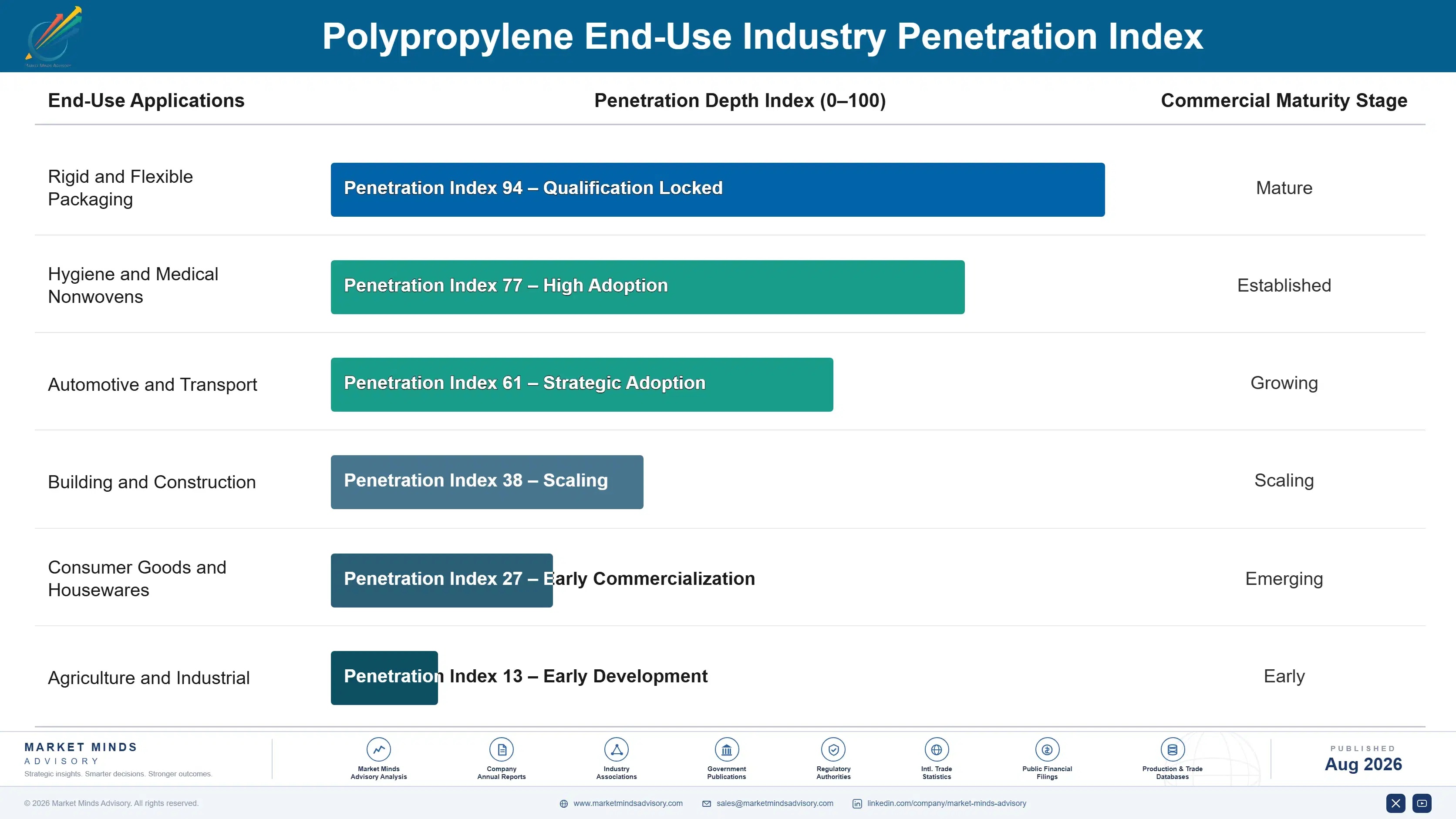
Polypropylene demand repeats with unusual reliability because packaging, hygiene and automotive conversion all run continuously against order books rather than against purchasing decisions. A nonwoven converter buys resin every week at volumes its own customers set, and a change of supplier means requalifying a spinning line rather than negotiating a price. That makes volume predictable and, in commodity grades, pricing power almost entirely absent.
Stickiness varies sharply by grade. Automotive compound grades are stickiest, since the resin sits inside a part approval that costs real money to redo and lasts a vehicle programme. Nonwoven grades come next, held by line qualification and by the cost of a spinning trial that goes wrong. Packaging film converters switch within specification on price. Commodity injection moulding is close to spot business.

The specifying buyer has moved up the chain in packaging. Resin selection sat with converters choosing on processability and price for decades. Recycled content obligations sit with brand owners rather than converters, so brands now contract directly with resin producers for approved recycled grades, bypassing a step that existed for fifty years. Converters now find out what resin they will be running rather than choosing it.
polypropylene-market-trends-end-use-penetration-index-1787580610668

Where We Would Put Capital

These are among the four positions where our research anticipates prominent divergence between winners and laggards over the coming forecast period. Each is grounded in the demand model, the regulatory perimeter, and the announced capacity pipeline.
01 / PROPYLENE INTEGRATION SECURITY

Secure feedstock position before the next spread widening

On-purpose propylene now covers 38% of supply and prices against a dehydrogenation cost curve rather than the by-product basis this industry was built on. Merchant buyers carry the whole spread while integrated producers absorb it internally, and that gap decides returns more than scale or conversion efficiency ever will. Securing refinery or dehydrogenation offtake on long tenor costs a premium in easy markets and protects the polymer business when spreads widen again, as they have reliably done in every previous cycle.
02 / SPECIALTY GRADE CAPABILITY

Upgrade lines toward nonwoven and automotive specifications

Nonwoven grades grow at 5.9% on ageing populations rather than on any economic cycle, and they require rheology consistency that commodity reactors cannot hold reliably enough for high-speed spinning. Upgrading a line costs roughly 15 million dollars in reactor control and catalyst work, which pays back inside four years against nonwoven margins on a single large converter relationship. Converters qualify over months and switch reluctantly, so a position won here outlasts several commodity pricing cycles without needing to be defended.
03 / FOOD CONTACT RECYCLING

Contract dissolution capacity ahead of the mandate dates

Barely 0.9% of recycled polypropylene output holds food contact clearance while European packaging rules assume far more will exist by 2030, and yoghurt pots and ready meal trays are precisely the applications that rule affects. Dissolution and solvent purification routes both produce approvable material at costs regulation rather than economics must justify. Contracting that capacity now, against firm brand offtake, secures what is currently the only position anywhere in polypropylene carrying genuine pricing power, and the capacity is being contracted now.
04 / IMPORT MARKET INFRASTRUCTURE

Build Indian service capability rather than quoting cargoes

India grows at 7.2% and remains a substantial net importer despite domestic expansion, making it the most contested destination for Gulf, Chinese and American export volume anywhere. Roughly 3 million tonnes of annual import demand is contested on warehousing, credit terms and technical service rather than on quoted cargo price. Producers who have already assembled that infrastructure hold share that price competition alone does not move, and assembling it takes years rather than the quarters most trading desks plan in.

Engagement Snapshot From the Field

A live engagement with an industry participant carrying material or product regulatory and market exposure ahead of a defining policy shift, showing how our research translates into a defensible multi-year portfolio strategy.
MARKET MINDS ADVISORY · CLIENT ENGAGEMENT SUMMARY
Polypropylene Producer Strategic Portfolio Review and Transition Roadmap 2026·Investment Scenario on Polypropylene Exposure Evaluation 2025-26
CLIENT PROFILE
An Asian polypropylene producer operating two polymer lines fed by a dedicated propane dehydrogenation unit commissioned in 2021, with annual capacity near 900 thousand tonnes and polymer revenue around 780 million dollars (client-reported, unverified by MMA). Output was weighted heavily toward commodity injection moulding and raffia grades sold into domestic and regional markets. Lenders had begun asking questions.
STRATEGIC CHALLENGE
The dehydrogenation unit had run below its breakeven spread for seven consecutive quarters, and the polymer lines could not price above the feedstock cost the unit was incurring. Management needed to decide whether to idle the dehydrogenation unit and buy merchant propylene, restructure the grade mix, or seek a partner, with lenders pressing for a view.
MMA APPROACH
MMA modelled propane to propylene spreads under three global supply scenarios through 2030, benchmarked the client's grade mix and margins against eleven regional producers, and costed reactor upgrades required for nonwoven and clarity grade capability. Merchant propylene availability was tested with regional refiners. Interviews with 47 experts covered dehydrogenation operations, hygiene converter qualification and regional polymer trading.
KEY FINDINGS
  1. Idling the dehydrogenation unit and buying merchant propylene improved cash position in only one of the three spread scenarios, and worsened it materially in the other two.
  2. Commodity injection moulding and raffia grades accounted for 78% of output and almost none of the gross margin, with pricing set entirely by regional import parity.
  3. Nonwoven grade upgrades to both lines would cost roughly 15 million dollars each and reach qualification with hygiene converters inside eighteen months.
  4. Two regional hygiene converters were actively seeking a second qualified resin supplier, having been single-sourced through the 2020 demand spike and unwilling to repeat it.
CLIENT PROFILE
An Asian polypropylene producer operating two polymer lines fed by a dedicated propane dehydrogenation unit commissioned in 2021, with annual capacity near 900 thousand tonnes and polymer revenue around 780 million dollars (client-reported, unverified by MMA). Output was weighted heavily toward commodity injection moulding and raffia grades sold into domestic and regional markets. Lenders had begun asking questions.
STRATEGIC CHALLENGE
The dehydrogenation unit had run below its breakeven spread for seven consecutive quarters, and the polymer lines could not price above the feedstock cost the unit was incurring. Management needed to decide whether to idle the dehydrogenation unit and buy merchant propylene, restructure the grade mix, or seek a partner, with lenders pressing for a view.
MMA APPROACH
MMA modelled propane to propylene spreads under three global supply scenarios through 2030, benchmarked the client's grade mix and margins against eleven regional producers, and costed reactor upgrades required for nonwoven and clarity grade capability. Merchant propylene availability was tested with regional refiners. Interviews with 47 experts covered dehydrogenation operations, hygiene converter qualification and regional polymer trading.
KEY FINDINGS
  1. Idling the dehydrogenation unit and buying merchant propylene improved cash position in only one of the three spread scenarios, and worsened it materially in the other two.
  2. Commodity injection moulding and raffia grades accounted for 78% of output and almost none of the gross margin, with pricing set entirely by regional import parity.
  3. Nonwoven grade upgrades to both lines would cost roughly 15 million dollars each and reach qualification with hygiene converters inside eighteen months.
  4. Two regional hygiene converters were actively seeking a second qualified resin supplier, having been single-sourced through the 2020 demand spike and unwilling to repeat it.
RECOMMENDED STRATEGY
Phase 1: Phase one: retain the dehydrogenation unit and run it through the spread trough, since idling improves cash in only one of three modelled scenarios. Phase 2: Phase two: upgrade one polymer line to nonwoven grade capability and qualify with the two converters actively seeking a second source. Phase 3: Phase three: reduce raffia and commodity injection moulding exposure gradually as nonwoven volumes build, rather than attempting both changes at once.
OUTCOME
The producer upgraded one line during 2026 and reached qualification with both target converters within fourteen months, with nonwoven grades reaching 22% of output and a materially higher share of gross margin (client-reported, unverified by MMA). The dehydrogenation unit was retained, and spreads recovered modestly over the same period as regional rationalisation began.

Frequently Asked Questions

Foundational context covering the market sizes, CAGR, scope, country, region and competition that inform every finding below. This section is provided to cover basics and most often pre-purchase conversations, answered from the MMA Primary Research Dataset.

What is the current size of the Polypropylene Market?

MMA sizes it at USD 118.0 billion in 2025, rising to USD 123.19 billion in 2026. The figure covers polypropylene homopolymer and copolymer resins at producer selling price, excluding compounds and converted products.

How large will the Polypropylene Market be by 2036?

USD 189.49 billion by 2036, an incremental USD 66.30 billion over the 2026 base and an expansion multiple of 1.54 times. Recycled and specialty grades account for a disproportionate share.

What is the CAGR for the Polypropylene Market 2026 to 2036?

4.4% in the base case, with a bull case at 5.6% and a bear case at 3.2%. The spread turns on propane to propylene economics and on Chinese capacity behaviour through the period.

Which segment is growing fastest?

Recycled and certified grades at 6.6%, half again the market rate of 4.4%. Growth comes from packaging content mandates rather than from any cost advantage over virgin resin.

Who are the major companies in the Polypropylene Market?

LyondellBasell, Sinopec, Borealis, Braskem and TotalEnergies lead on annual production capacity. Fifteen further participants are profiled in the full report on that same consistent basis.

Which country is growing fastest?

India at 7.2%, on packaging, hygiene, construction and automotive conversion demand rising from a low per capita base. The country remains a substantial net importer of polypropylene.

Report Segmentation Architecture

The full report scope spans multiple orthogonal segmentation dimensions, with cross-tabulated demand data provided for each dimension pair. Coverage extends further to regional breakdowns, trend trajectories, and the competitive detail needed to support segment-level decision-making.

By Resin Grade Class

  • Homopolymer Injection Moulding Grades
  • Random Copolymer Grades
  • Impact Copolymer Grades
  • Fibre and Nonwoven Grades
  • Film and BOPP Grades
  • Recycled and Certified Grades

By End-Use Industry

  • Rigid and Flexible Packaging
  • Hygiene and Medical Nonwovens
  • Automotive and Transport
  • Building and Construction
  • Consumer Goods and Housewares
  • Agriculture and Industrial

By Commercial Dimension

  • Direct Supply to Converters
  • Distributor and Trader Supply
  • Brand Owner Direct Contracting
  • Long-Term Offtake Agreements
  • Export and Cross-Border Trade
  • Toll Polymerisation Agreements

By Region

  • North America
  • Western Europe
  • East Asia
  • South Asia and Pacific
  • Latin America
  • Middle East and Africa
  • Eastern Europe

Scope, Methodology, and Coverage

Every figure in this report is reproducible from documented input assumptions. The scope below maps the historical period, the forecast horizon, the segmentation dimensions, and the countries covered, alongside the underlying primary and qualitative methodology.
Historical Period
2020 to 2025
Forecast Period
2026 to 2036
Base Year
2025 (USD billions; MMA Primary Research Dataset, August 2026)
Market Definition
Polypropylene homopolymer and copolymer resins produced for conversion into plastic products, spanning injection moulding, random and impact copolymer, fibre and nonwoven, film and recycled or certified grades, measured at producer selling price. Propylene monomer sold as such, polypropylene compounds and masterbatch, converted products including nonwoven fabric and finished film, and other polyolefin resins are excluded from scope.
Quantitative Units
USD billions (current prices); million tonnes produced annually; USD per tonne by grade class and region
Segmentation Dimensions
Resin grade class; end-use industry; commercial dimension; region
Regions Covered
North America, Western Europe, East Asia, South Asia and Pacific, Latin America, Middle East and Africa, Eastern Europe
Countries Covered
United States, Canada, Mexico, Germany, Belgium, Netherlands, France, Italy, China, Japan, South Korea, India, Thailand, Vietnam, Indonesia, Brazil, Saudi Arabia, United Arab Emirates, South Africa, Poland
Key Companies Profiled
LyondellBasell, Sinopec, Borealis, Braskem, TotalEnergies, ExxonMobil, SABIC, Reliance Industries, Formosa Plastics, PetroChina, Hengli Petrochemical, Oriental Energy, Satellite Chemical, LG Chem, Mitsui Chemicals, Prime Polymer, INEOS, Repsol, Hanwha TotalEnergies, PureCycle Technologies
Quantitative Methodology
Primary survey, n=3,800 respondents, Q4 2025, six countries; demand-side model with trade association cross-validation
Qualitative Methodology
47 expert interviews, Q4 2025; applied to validate demand model assumptions, identify emerging dynamics, and assess competitive positioning
Report Format
PDF and XLSX data workbook (Word format preview document)
Publisher
Market Minds Advisory
Report Code
MMA-2026-CHM-123
Published
August 2026
Contact
sales@marketmindsadvisory.com | www.marketmindsadvisory.com

Purchase the full Polypropylene Market Report (2026 to 2036).

The full report traces polypropylene economics back to propylene supply, separating refinery co-product, cracker co-product and on-purpose dehydrogenation with cost curves for each through 2036. It models dehydrogenation spread economics against announced capacity, sizes each resin grade class independently, and quantifies the food contact approval gap facing packaging content mandates. Regional chapters cover all seven regions with asset level detail wherever public disclosure permits it. Competitive profiling covers 20 participants on a single production capacity basis, alongside grade capability benchmarks compared across each producer covered.
Propylene supply separated by route with cost curves
Dehydrogenation spread economics modelled against announced capacity
Each resin grade class sized independently through 2036
Food contact approval gap quantified against packaging mandates
Twenty participants profiled on one consistent basis
Grade capability benchmarks compared across producers

Built For The People Who Decide

From boardroom strategy to bench-side execution, this report is read cover-to-cover by leaders shaping the next decade of their industry, turning demand scenarios, market dynamics and valuation benchmarks into decisions.
CXOs/ Presidents/ VPs/ Managers
M&A and Corporate Development
Strategy Teams and R&D Heads
Procurement and Product Directors
Regulatory and Compliance Leaders
Investor Relations and Equity Analysts