Market Minds Advisory
Polyol Sweeteners Market

Polyol Sweeteners Market: A Safety Literature Shock and a Capacity Hangover at Once

Two peer-reviewed cardiovascular papers took the confidence out of the fastest-growing polyol just as Chinese capacity built for a diet boom arrived and cut its price by more than half.

Lead Analyst

Lisa Gevelber

Published

September 2026

Make Smarter Decisions with Customized Research Insights

Request a free sample report and evaluate market opportunities, growth trends, and competitive dynamics relevant to your business needs.

2025 MARKET VALUE$3.6BMarket Size 2025
2036 FORECAST VALUE$6.7BBase Case , 2026 to 2036
CAGR 2026 TO 20365.8 %Bull 7.0% / Bear 4.6%
INCREMENTAL OPPORTUNITY$2.9BNet 10- year value creation
EXPANSION MULTIPLE1.76x2036 value over 2026 base
Strategic Levers
M&A Pipeline
Regional Outlook
Country Rankings
Competitive Intelligence
Segmental Deep-dive
Call-Us : 91 93563 13602

Executive Snapshot and Market Trajectory

Erythritol carried this category for a decade as the bulking agent behind almost every stevia and monk fruit blend on the market. Peer-reviewed cardiovascular work published in 2023, followed by comparable findings on xylitol, removed a good deal of that confidence. Formulators did not wait for a consensus.
The commercial damage arrived alongside a capacity problem. Chinese erythritol capacity built for the ketogenic diet boom reached start-up as demand growth slowed, and prices have fallen roughly 58% from peak. Formulators reformulating away from erythritol move toward allulose, which is not a polyol at all, or back toward maltitol and sorbitol, which carry decades of use and a digestive tolerance ceiling near 20 grams daily.
Growth has moved to the applications that never depended on consumer sweetener sentiment. Mannitol and lactitol grow at 8.7%, half again the market rate of 5.8%, on pharmaceutical excipient demand rather than on food. East Asia holds 36% of value, above the usual band, on Chinese production capacity. Concentration sits at 43%. Nobody markets a tablet excipient to a shopper, and that has proved its principal commercial advantage. The category's growth has quietly changed address.
Market Definition
Sugar alcohols produced for use as sweeteners, bulking agents, humectants and pharmaceutical excipients, spanning sorbitol, maltitol, xylitol, erythritol, isomalt, mannitol and lactitol in crystalline and syrup forms. Excludes high-intensity sweeteners, allulose and other rare sugars, sucrose and glucose syrups, and polyols sold as chemical intermediates for polyurethane production.
Base Year Value
$3.6B in 2025 (MMA Primary Research Dataset, August 2026)
Forecast Period
2026 to 2036, eleven discrete annual values
CAGR
5.8% base case. Bull 7.0%. Bear 4.6%.
Fastest Growth Segment
Mannitol and Lactitol: 8.7% CAGR
Fastest Growth Country
India: 8.2% CAGR
Fastest Growth Region
South Asia and Pacific: 7.9% CAGR
Largest Region
East Asia: 36% of 2025 global value
Market Leaders
Roquette, Cargill, Ingredion, Beneo, Mitsubishi Corporation Life Sciences. Source: MMA Primary Research Dataset, July 2026.
Primary Survey
n=3,800 procurement and R&D decision-makers, Q4 2025, six countries
Methodology
Demand-side build-up, cross-validated against public data, 47 expert interviews

Polyol Sweeteners Market Forecast Scenarios

polyol-sweeteners-market-size-forecast-scenario-1787580588704
Between 2020 and 2025 the category grew near 4.7% on an average that hides two opposite stories. Erythritol volumes expanded rapidly through 2022 on ketogenic and low-carbohydrate demand, then flattened as safety literature and price collapse arrived together. Sorbitol and maltitol, the mature workhorses, grew steadily on confectionery and oral care demand that pays little attention to nutrition headlines either way.
Base case 5.8% rests on three mechanisms. Pharmaceutical excipient demand for mannitol is growing with orally disintegrating tablet formats and with generic manufacturing capacity in India, and it is entirely insulated from consumer sweetener sentiment. Sugar reduction targets in the United Kingdom, Mexico and several other markets continue to push reformulation regardless of which bulk sweetener is chosen. And Chinese capacity rationalisation should stabilise erythritol pricing from an oversupplied base.
The bull case at 7.0% assumes follow-up research fails to confirm the cardiovascular findings and formulator confidence returns to erythritol, which would restore the fastest volume growth the category ever had. The bear case at 4.6% is regulatory action on erythritol or xylitol in a major market, which would strand capacity and push reformulation toward allulose and rare sugars outside this category entirely.

When the Bulking Agent Became the Story

Polyols are not really one market and treating them as one is how most analysis goes wrong. Sorbitol's largest uses are toothpaste humectancy and vitamin C synthesis, not sweetening anything. Mannitol sells mainly as a pharmaceutical excipient into tablet formulations. Erythritol and xylitol are the two that behave like consumer sweeteners, and they are the two carrying the safety literature.
TOP FIVE CONCENTRATION43%Western ingredient houses lead against Chinese capacity holders
RELATIVE SWEETNESS0.6xTypical sweetness against sucrose across the product range
ERYTHRITOL PRICE DECLINE58%Fall from peak following the Chinese capacity build
STARCH COST SHARE41%Share of production cost carried by starch feedstock
PHARMACEUTICAL GRADE SHARE17%Portion of output meeting excipient and pharmacopoeia standards
DIGESTIVE TOLERANCE THRESHOLD20 gramsDaily intake above which most consumers report discomfort
That literature has done real commercial damage. Work published in Nature Medicine in 2023 associated circulating erythritol with platelet aggregation and cardiovascular event risk, with comparable findings on xylitol following in 2024. The papers are observational and the mechanism is contested, but formulators do not wait for scientific consensus. Reformulation briefs went out within months at several large brand owners, and erythritol was removed from a number of launches.
Price made the damage worse. Chinese erythritol capacity built for the ketogenic boom reached start-up into weakening demand, and prices have fallen roughly 58% from peak. Producers now face reduced volumes at reduced prices simultaneously. The category's growth has quietly relocated to mannitol, lactitol and isomalt, which sell into pharmaceutical and confectionery applications where no consumer reads an ingredient panel looking for a health story.
"The industry spent ten years teaching consumers to look for erythritol on a label, and two papers undid a good deal of it. What nobody says out loud is that the growth is now in a tablet excipient nobody has ever heard of, which is a much better business than being on the front of a package."
Director, Food Ingredients and Specialty Chemicals Practice · MMA Food Ingredients and Specialty Chemicals Practice · August 2026

Market Trends

Formulators reformulating away from erythritol toward rare sugars

Brand owners have been moving stevia and monk fruit blends off erythritol bulking since the 2023 cardiovascular findings, most often toward allulose, which delivers comparable bulk and mouthfeel without the polyol classification or the literature attached to it. Allulose sits outside this category entirely, so every reformulation removes polyol volume permanently rather than shifting it between segments. Regulatory status differs by market, with allulose approved in the United States and still pending in the European Union, which has slowed the substitution considerably in Europe. Every reformulation completed is volume this category does not get back.
Market Impact: Applies across 4 major tax markets

Pharmaceutical excipient demand growing independent of food sentiment

Mannitol demand is expanding with orally disintegrating tablet formats, freeze-dried formulations and generic manufacturing capacity, particularly across Indian pharmaceutical production. Excipient grades require pharmacopoeia compliance, dedicated facilities and customer qualification measured in years, which excludes the food-grade capacity holders who might otherwise arbitrage into the segment. Roughly 17% of category output now meets excipient standards. This demand responds to drug pipelines and generic approvals rather than to anything a consumer reads, which makes it the most reliable growth in the whole category. Roughly 8.7% annual growth is coming from this direction while the consumer segments stall.
Market Impact: Delivers 8.2% annual Indian growth

Market Opportunities and Growth Drivers

Sugar reduction targets sustaining bulk sweetener reformulation

Sugar taxes and reformulation targets in the United Kingdom, Mexico, South Africa and elsewhere continue to push reformulation regardless of which bulk sweetener replaces sucrose. High-intensity sweeteners deliver sweetness but no bulk, so a polyol or a rare sugar has to fill the volume in confectionery, baked goods and chewing gum. That underlying need survives any individual ingredient falling out of favour. Roughly 20 grams daily is the tolerance ceiling most consumers report, which caps how far any single polyol can go in a portion. That ceiling is why blends rather than single polyols dominate reformulation work.
Market Impact: Triggered reformulation at 2 major brands

Indian generic pharmaceutical manufacturing expanding excipient demand

India grows fastest anywhere at 8.2%, driven by generic drug manufacturing capacity that consumes mannitol and sorbitol as tablet excipients and syrup vehicles at volumes rising with export approvals. Excipient qualification takes years and binds a supplier into a drug master file, so positions won here persist far longer than any food ingredient listing. Domestic producers including Gulshan Polyols hold cost advantages on local starch supply. The demand is entirely insulated from consumer sweetener sentiment, which is precisely what makes it valuable now. Nothing in a drug master file responds to a newspaper headline.
Market Impact: Cuts realised prices by 58%

Market Restraints and Challenges

Cardiovascular findings on erythritol and xylitol unsettling formulators

Observational work published in Nature Medicine associated circulating erythritol with platelet aggregation and cardiovascular events in 2023, with comparable xylitol findings following. The root cause of the commercial problem is not the science, which remains contested, but that brand owners cannot defend an ingredient under any public question. Reformulation briefs followed within months. Producers are funding intervention studies to test causation properly, and are repositioning erythritol toward applications where consumer-facing labelling matters less, though neither response works quickly. A brand owner facing a retailer question needs an answer this quarter, and intervention research takes three years to produce one.
Market Impact: Removes volume across 2 sweetener blends

Chinese erythritol overcapacity holding prices near cash cost

Erythritol capacity built across China for the ketogenic diet boom reached start-up as demand growth stalled, and prices have fallen roughly 58% from peak. The root cause is a fermentation process with modest capital intensity and short build times, which allowed capacity to arrive faster than any demand signal could correct. Commercially it leaves producers earning nothing on a product they expected to carry growth. Rationalisation has begun among the smallest Chinese producers, and consolidation looks more likely than any demand recovery. Fermentation plants are cheap to build and expensive to idle, which is the whole problem in one sentence.
Market Impact: Covers 17% of category output
3 additional market trends, 4 additional growth drivers, and 2 additional restraints and challenges are covered in the full report. Contact sales@marketmindsadvisory.com to access the complete intelligence.

Segment CAGR and Growth Architecture

Six segments split by polyol type, because each molecule carries its own production route, cost base, tolerance profile, regulatory position and application set. Grouping them as sweeteners obscures the fact that most sorbitol never sweetens anything at all. Application and channel splits are handled in the framework instead. Treating them as one product is the standing error here.
polyol-sweeteners-market-market-share-analysis-1787580589293

Mannitol and Lactitol

Growing at 8.7%, half again the market rate of 5.8%, this is where the category's reliable growth now sits. Mannitol serves as a tablet excipient and diluent, particularly in orally disintegrating formats where its negative heat of solution produces the cooling sensation those products depend on, and in freeze-dried injectable formulations. Lactitol serves both confectionery and a licensed medical use in chronic constipation. Both require pharmacopoeia compliance and customer qualification measured in years, which excludes food-grade producers from arbitraging in. Demand follows drug pipelines and generic approvals rather than consumer nutrition sentiment, which is exactly why it keeps growing. That insulation is now worth more than any growth rate the consumer segments ever posted.
CAGR 8.7%

Isomalt

At 7.6% isomalt holds the best position in sugar-free confectionery of any polyol. Derived from sucrose rather than starch, it delivers the closest sugar-like taste profile in the category, resists crystallisation in hard candy, and carries the mildest digestive tolerance profile of the bulk polyols. No safety literature attaches to it, which has become a genuine commercial asset since 2023. Production is concentrated with Beneo, which has held the technology position for decades and faces limited competition. Growth follows sugar-free confectionery reformulation in Europe and increasingly in Asian markets adopting similar sugar reduction targets. Capacity is genuinely scarce rather than merely expensive, and a hard candy recipe reformulated once tends not to be revisited for years afterwards.
CAGR 7.6%
Full segment breakdown across 6 segments available in the complete report.

Regional Architecture and Country Demand Map

East Asia holds 36% of value, above its usual band, because Chinese producers hold the majority of world erythritol, xylitol and sorbitol capacity. North America follows at 22% and Western Europe at 20%, where Roquette and Beneo hold the specialty and pharmaceutical grade technology positions.

North America

The cardiovascular findings landed hardest in this region, where erythritol had achieved the greatest consumer recognition through ketogenic and low-carbohydrate positioning. Brand owners reformulated fastest, helped by allulose already holding regulatory approval in the United States, which gave them a substitute available immediately rather than in several years. What remains strong is pharmaceutical excipient demand and oral care sorbitol, neither of which any consumer evaluates. Mexican confectionery reformulation under the country's front-of-pack warning labelling adds steady demand. Canadian volumes are modest and follow American formulation decisions almost automatically. The region reformulated faster than any other and it had the substitutes available to do so, which Europe did not. Recovery looks unlikely.
Share: 22% | CAGR: 4.9% (2026 to 2036)

Western Europe

European producers hold the specialty and pharmaceutical positions rather than the volume ones, with Roquette and Beneo controlling technology in mannitol, maltitol and isomalt that Chinese capacity has not replicated. Allulose remains unapproved in the European Union, which has slowed reformulation away from erythritol considerably and left European formulators with fewer options than their American counterparts. Sugar reduction targets across the United Kingdom, France and Belgium continue to drive confectionery and bakery reformulation. Regional growth runs below the base case on flat food volumes, offset partly by pharmaceutical excipient demand growing steadily. Technology position rather than tonnage is what makes this region commercially significant, and that has protected European producers through a difficult period.
Share: 20% | CAGR: 4.3% (2026 to 2036)
Regional intelligence for 5 additional markets available in the complete report: East Asia, South Asia and Pacific, Latin America, Middle East and Africa, Eastern Europe. Contact sales@marketmindsadvisory.com.
polyol-sweeteners-market-country-cagr-analysis-1787580589809

Four Moves Worth Making Now

The commercial logic here has inverted. Consumer-facing polyols carry reputational exposure and collapsing prices, while the applications nobody markets are growing steadily and defensibly. Capital should follow that inversion rather than the volume forecasts written before 2023, and most of the industry has been slow to accept it. The volume forecasts written before 2023 are worth very little now.

Move capital toward pharmaceutical excipient grades

Excipient demand grows at 8.7% on drug pipelines rather than consumer sentiment, and qualification into a drug master file binds a supplier for the life of the product. Converting a food-grade line to pharmacopoeia compliance costs roughly 6 million dollars in facility, documentation and validation work and takes about two years. That is expensive against food margins and cheap against excipient ones, where positions persist for a decade or more. Food-grade producers cannot arbitrage in without doing the same work first. The barrier protects whoever crosses it first. Nobody crosses it casually.
Market Impact: Costs $6 million per line converted to excipient

Fund intervention research rather than defending observationally

The erythritol and xylitol findings are observational, the mechanism is contested, and no producer has yet funded the controlled intervention work that would settle it. A properly powered study costs perhaps 4 million dollars over three years. The industry has instead issued statements, which has persuaded nobody and cost reformulation volume at several large brand owners. Whoever funds credible research and publishes it holds the only argument that would restore formulator confidence, and the alternative is watching allulose take the application permanently. Statements have persuaded nobody so far. Three years is the timeline.
Market Impact: Costs $4 million to test the causation properly

Reposition erythritol away from consumer-facing uses

Erythritol trades roughly 58% below peak and its consumer-facing position is damaged, but the molecule still performs as a bulking agent, a carrier and a crystallisation modifier. Industrial and business-to-business applications where no ingredient panel reaches a shopper carry none of the reputational exposure. Redirecting volume there recovers utilisation on capacity that would otherwise idle. The pricing is poor and it beats running a fermentation plant at half rate while waiting for consumer confidence that may not return at all. Utilisation is the only variable a producer still controls here.
Market Impact: Recovers utilisation despite the 58% collapse in price

Build isomalt and lactitol positions in sugar-free confectionery

Isomalt grows at 7.6% with the mildest tolerance profile of the bulk polyols, the closest sugar-like taste and no safety literature attached, which has become a commercial asset in itself. Production technology has been concentrated for decades and competition is limited accordingly. Confectionery reformulation under sugar reduction targets continues regardless of which ingredients fall in and out of favour with consumers. Capacity here is scarce and the applications are sticky, since a hard candy recipe reformulated once is rarely revisited. Roughly 7.6% annual growth is available in a segment with almost no competitive entry.
Market Impact: Targets 7.6% growth in a well protected segment

Who Controls the Margin Pool

Participation is measured on annual production capacity in tonnes, and the top five hold 43%. That is high for a food ingredient category and reflects the capital and technology required in hydrogenation and fermentation. Roquette and Cargill lead on breadth across polyol types rather than on any single position. The gap to challengers is pharmaceutical grade capability and specialty technology, not tonnage.
Competition splits along an unusually clear line. Chinese producers compete on cost in erythritol, xylitol and sorbitol, where the process is well understood and capacity is abundant. Western houses compete on pharmaceutical grades, specialty polyols and application support, where qualification barriers hold. Price competition is severe on the first set and almost absent on the second. Very few participants operate credibly on both sides of that line.

Pressure ahead comes from allulose and rare sugars, which sit outside this category and take volume permanently when they win a reformulation. European approval for allulose would accelerate that considerably. Expect consolidation among smaller Chinese erythritol producers rather than cross-border acquisitions. Rankings shift as pharmaceutical excipient demand grows and the consumer sweetener segment stays under a cloud that shows no sign of lifting.
polyol-sweeteners-market-company-positioning-matrix-1787580590333

Competitive Moat and Risk Dimensions

ROQUETTE

Moat: Pharmaceutical grade breadth and qualification

Roquette holds pharmacopoeia-compliant capacity across mannitol, sorbitol and maltitol with customer qualifications written into drug master files that take years to establish and rarely change afterwards. That position is insulated from the consumer sentiment damaging the sweetener segment, and Chinese capacity holders cannot enter it without building dedicated facilities and repeating the validation work.
ROQUETTE

Risk: European regulatory pace on substitutes

Allulose remains unapproved in the European Union, which currently protects European polyol volumes from substitution. Approval would open the same reformulation wave that has already moved American volume away, and Roquette's food-grade positions would face it with no equivalent rare sugar offering of its own in the portfolio to capture the switching demand.
CARGILL

Moat: Starch integration and application reach

Cargill's position in corn wet milling gives it starch feedstock at internal cost across a business where feedstock is 41% of production expense. Combined with formulation support reaching most large food manufacturers, that produces both a cost position and a specification influence smaller polyol producers cannot approach on either front.
CARGILL

Risk: Consumer sweetener portfolio exposure

The portfolio weights toward food and beverage applications where the erythritol and xylitol findings bite hardest, and where reformulation decisions are made by brand owners responding to headlines rather than to evidence. Building excipient position means facility investment and validation work on a timeline measured in years, which does not answer a reformulation brief issued this quarter.

Players Tracked

Prominent Players

Roquette
Cargill
Ingredion
Beneo
Mitsubishi Corporation Life Sciences

Other Key Players

Sanxinyuan Food Industry
Shandong Longlive Bio-Technology
Baolingbao Biology
Futaste
Zhejiang Huakang Pharmaceutical
IFF
Tereos
ADM
Gulshan Polyols
SPI Pharma
Merck KGaA
Ueno Fine Chemicals
Shandong Tianli Pharmaceutical
Zibo Zhongshi Green Bio-tech
Jungbunzlauer

Recent Developments

FEBRUARY 2026

Beverage brand removes erythritol from stevia blend across its portfolio

A large beverage brand owner completed reformulation removing erythritol from its stevia sweetener blends across the full portfolio, substituting allulose where approval permits. The company cited consumer research on ingredient perception rather than any regulatory requirement as the reason, with no timeline given for markets where allulose remains unapproved.
Signal: Reformulation is being driven by perception research rather than by evidence, which producers cannot argue against
AUGUST 2025

European producer commissions dedicated pharmaceutical mannitol capacity

A European ingredient producer commissioned dedicated pharmacopoeia-compliant mannitol capacity aimed at orally disintegrating tablet and freeze-dried formulation demand. The project is an organic capacity expansion with validation running through 2026, not an acquisition or any partnership, with validation running through 2026 before commercial supply. Capacity was not disclosed.
Signal: Capital is now moving toward excipient grades precisely because that demand ignores consumer sweetener sentiment entirely
NOVEMBER 2025

Chinese erythritol producers begin capacity rationalisation after price collapse

Several smaller Chinese erythritol producers suspended or idled fermentation capacity following sustained prices near cash cost, according to industry association reporting. Larger producers have maintained output while absorbing losses, expecting consolidation to reduce supply over the following two years. No formal industry rationalisation agreement exists between the producers involved.
Signal: Supply-side rationalisation rather than any demand recovery is the realistic route back to viable erythritol pricing

Starch, Hydrogen and Fermentation

Starch feedstock accounts for roughly 41% of production cost across hydrogenated polyols, sourced from corn wet milling in the United States and China and from wheat in Europe. Hydrogen and catalyst systems add about 12% for sorbitol and maltitol routes. Erythritol follows a different economy entirely, fermenting glucose with yeast, where fermentation yield and downstream crystallisation dominate. Energy and utilities add a further 15%.
European wheat starch and energy costs moved sharply through 2022 as gas prices rose and the wheat market reacted to supply disruption in the Black Sea region, per USDA grain trade reporting. European polyol producers carried both increases at once, since hydrogenation is energy intensive and wheat starch is the regional feedstock. Several disclosed margin compression in annual reporting for that year, and one suspended an expansion project.

The competitive mechanism runs through feedstock integration. A producer inside a corn wet milling operation takes starch at internal cost while a standalone hydrogenation plant buys it at market, and 41% of cost is a large thing to be exposed on. Geography compounds it: Chinese producers sit beside abundant corn starch and cheap energy, while European plants carry power costs well above Asian levels, per IEA tariff data.
polyol-sweeteners-market-cost-volatility-analysis-1787580590527

Integrate backward into starch or contract it annually

Starch is 41% of production cost, so a producer without wet milling integration should at minimum contract supply annually to match downstream pricing tenor. Full integration is expensive and rarely available to buy; annual contracting costs a modest premium and removes most of the variance that damaged European producers through the last grain and energy cycle.

Hold both hydrogenation and fermentation route capability

Hydrogenated polyols and fermented erythritol have almost independent cost structures, one driven by starch and hydrogen and the other by fermentation yield and energy. A producer holding both can shift emphasis as relative economics move, which no single-route producer can do at all. The capital requirement is the obstacle, and explains why few operate across the whole range.

Contract industrial energy on long tenor in exposed regions

Hydrogenation and crystallisation are both energy intensive, and European producers exposed to spot power and gas carried the full 2022 increase while those with long-dated supply absorbed a fraction. Long tenor costs a premium in normal conditions and functions as insurance against an event that has already occurred once this decade. Most European producers restructured energy procurement afterwards.

Portfolio Architecture for Margin Defence

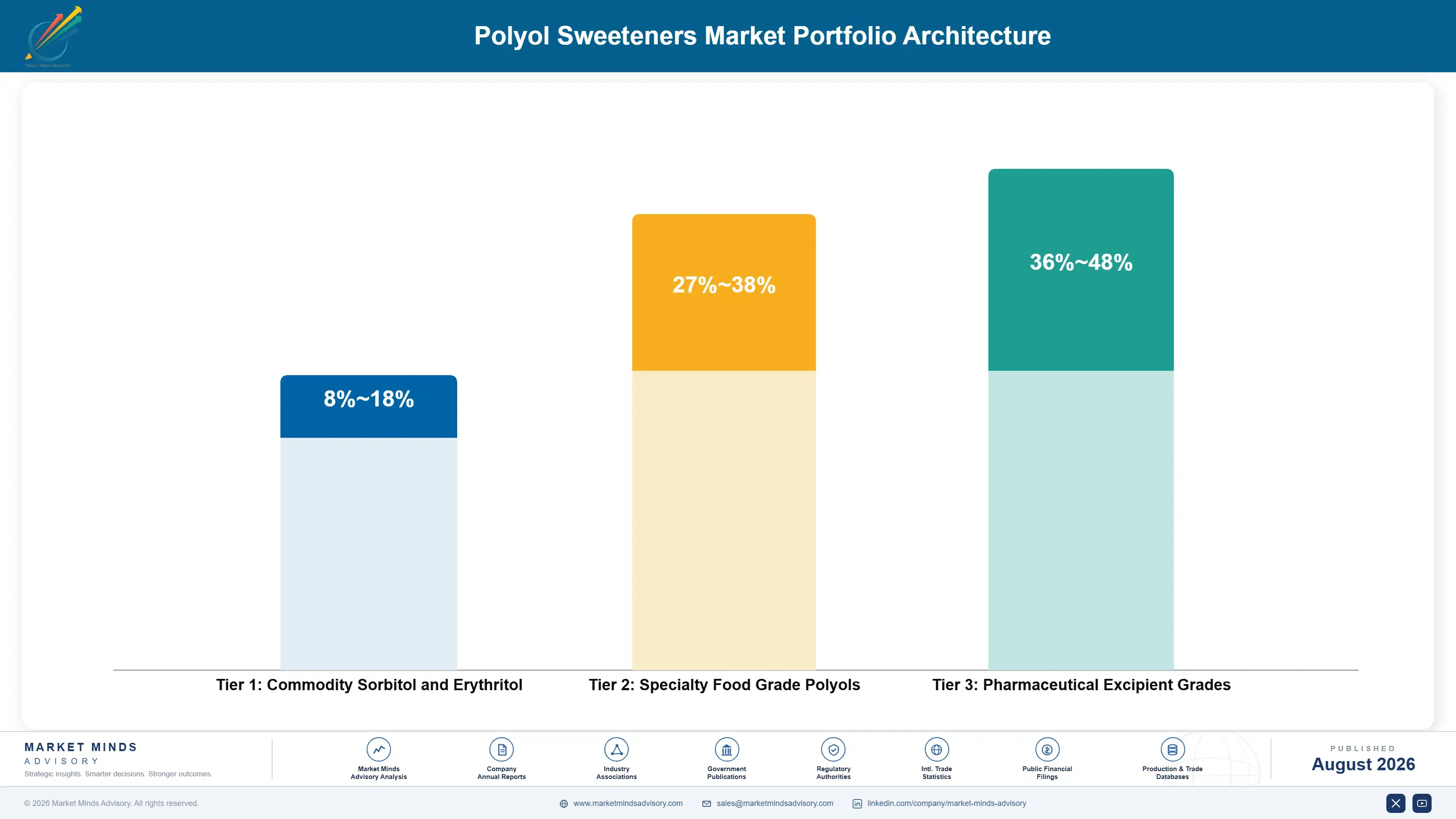
Margin architecture here follows qualification depth rather than molecule or volume. Commodity sorbitol and erythritol earn margins in the mid teens at best, and erythritol has been earning nothing at all since the capacity wave landed. Chinese cost positions set the floor and there is no product differentiation available to argue against them on any grade. The floor is set in Shandong and everyone else prices against it.
Specialty food polyols do considerably better at margins in the high twenties to high thirties. The range is wide because it spans maltitol syrups sold on price into confectionery at one end and isomalt sold into hard candy on a technology position at the other, where competition is limited and the application is sticky once formulated. Technology position, not molecule, is what separates the two ends of that range.

Pharmaceutical excipient grades hold the best economics, running into the mid forties, because pharmacopoeia compliance, dedicated facilities and drug master file inclusion exclude nearly everyone. Those margins reflect a qualification barrier rather than any molecular advantage, and they persist for as long as the drug does. Nothing else in this category offers comparable durability. A drug outlives almost any commercial relationship in food.

Commodity Sorbitol and Erythritol

Standard grade sorbitol syrup and crystalline erythritol sold into open markets. Chinese cost positions set the floor and no differentiation is available, so the ten point range reflects starch integration and energy cost position alone.
Gross Margin: 8-18%

Specialty Food Grade Polyols

Maltitol, isomalt and specialty crystalline grades sold into confectionery, bakery and chewing gum. The eleven point range spans price-led maltitol syrups through to isomalt sold on a technology position with very limited competition.
Gross Margin: 27-38%

Pharmaceutical Excipient Grades

Pharmacopoeia-compliant mannitol, sorbitol and lactitol qualified into drug master files. The twelve point range reflects how deeply a grade is qualified, from general excipient supply through to sole-source inclusion in a specific formulation.
Gross Margin: 36-48%
polyol-sweeteners-market-portfolio-architecture-1787580591026

High-value Sub-segments and Strategic Watch-out

Pharmacopoeia Grade Mannitol

High value and the fastest growing position at 8.7%. Orally disintegrating tablet formats and freeze-dried formulations drive demand that follows drug pipelines rather than consumer sentiment. Drug master file inclusion makes positions last a decade or more. Nothing in the category is comparably defensible. Pipelines set the pace.
Gross Margin: 40-48%

Isomalt for Sugar-Free Confectionery

High value, steady growth, and the best-positioned bulk polyol in food. The mildest tolerance profile, closest sugar-like taste and no safety literature attached. Production technology has been concentrated for decades, which keeps competition genuinely limited. Sugar reduction targets keep the reformulation demand running regardless of what happens elsewhere.
Gross Margin: 34-42%

Commodity Erythritol

The volume core and currently the worst position in the category. Chinese capacity built for a diet boom collapsed pricing by roughly 58% while safety literature removed formulator confidence. Recovery depends on rationalisation rather than on any demand return. Consolidation among smaller producers has already begun.
Gross Margin: 2-14%

Consumer-Facing Xylitol Applications

The strategic watch-out. Cardiovascular findings arrived a year after erythritol's and the reformulation response is still working through chewing gum and oral care. The margin range assumes no regulatory action, which is not a certainty in any market. Chewing gum carries most of the remaining exposure.
Gross Margin: 14-26%

Where the Volume Keeps Coming Back

Excipient supply is the closest thing to an annuity this category offers. A polyol written into a drug master file is consumed for the commercial life of that product, at volumes following prescription demand rather than purchasing decisions, and changing it requires variation filings nobody undertakes to save on an excipient. Roughly 17% of output sits in this pattern and it is the most defensible revenue anywhere in the business.
Stickiness falls away sharply outside pharmaceuticals. Confectionery recipes are moderately sticky, since a reformulated hard candy involves process trials and shelf-life work that manufacturers avoid repeating. Oral care sorbitol is specification-driven and switches on price within grade. Beverage and tabletop sweetener applications are the least sticky of all, which is exactly why erythritol volumes moved within months of the cardiovascular findings appearing.

The decision maker has also shifted. Polyol selection sat with food technologists choosing on functionality and cost for decades. Consumer perception research now drives reformulation at large brand owners, which means an ingredient can be removed on sentiment before any regulator has looked at it, and technologists find out afterwards. That is a new decision path for an ingredient business, and most producers are not organised for it.
polyol-sweeteners-market-end-use-penetration-index-1787580591514

Where We Would Put Capital

These are among the four positions where our research anticipates prominent divergence between winners and laggards over the coming forecast period. Each is grounded in the demand model, the regulatory perimeter, and the announced capacity pipeline.
01 / EXCIPIENT GRADE CONVERSION

Move capacity toward pharmacopoeia grades while the gap is open

Excipient demand grows at 8.7% on drug pipelines rather than on anything a consumer reads, and inclusion in a drug master file binds a supplier for the commercial life of the product. Converting an existing food-grade line to full pharmacopoeia compliance costs roughly 6 million dollars and about two years of facility, documentation and validation work. That is expensive against food margins and inexpensive against excipient ones, and the same qualification barrier keeps Chinese commodity capacity out of the segment altogether.
02 / INTERVENTION RESEARCH FUNDING

Test causation properly instead of issuing more statements

The erythritol and xylitol findings are observational and the mechanism is contested, yet no producer has so far funded the controlled intervention work that would resolve the question either way. A properly powered intervention study costs perhaps 4 million dollars over three years, which is trivial set against the volume already lost to reformulation at several major brand owners. Public statements have so far persuaded nobody, and the alternative to credible research is watching allulose take these applications permanently and irreversibly.
03 / ERYTHRITOL APPLICATION SHIFT

Redirect damaged volume to business-to-business applications

Erythritol trades roughly 58% below peak with a damaged consumer-facing position, but the molecule itself still works perfectly well as a bulking agent, carrier and crystallisation modifier in industrial applications that no shopper ever sees or evaluates. Redirecting that volume recovers utilisation on fermentation capacity that would otherwise idle at considerable cost. The pricing is unattractive, and it still comfortably beats running a plant at half rate while waiting on consumer confidence that currently shows no sign at all of returning.
04 / ISOMALT POSITION BUILDING

Take confectionery share while nothing threatens the molecule

Isomalt grows at 7.6% carrying much the mildest tolerance profile among the bulk polyols, the closest sugar-like taste and no safety literature attached to it at all. Sugar reduction targets keep confectionery reformulation work running regardless of which other ingredients fall out of favour elsewhere. Capacity is genuinely scarce because production technology has been concentrated for several decades, and a hard candy recipe once reformulated is very rarely revisited, which makes each application win unusually durable once it has been secured.

Engagement Snapshot From the Field

A live engagement with an industry participant carrying material or product regulatory and market exposure ahead of a defining policy shift, showing how our research translates into a defensible multi-year portfolio strategy.
MARKET MINDS ADVISORY · CLIENT ENGAGEMENT SUMMARY
Polyol Sweeteners Producer Strategic Portfolio Review and Transition Roadmap 2026·Investment Scenario on Polyol Sweeteners Exposure Evaluation 2025-26
CLIENT PROFILE
A global confectionery manufacturer with sugar-free ranges across chewing gum, hard candy and chocolate, selling in more than forty markets with annual sugar-free revenue near 1.9 billion dollars (client-reported, unverified by MMA). Sugar-free formulations relied on maltitol, xylitol and erythritol in varying combinations, most of them unchanged in specification for more than eight years. Two of those recipes predate the current management team.
STRATEGIC CHALLENGE
The cardiovascular findings on erythritol and then xylitol had reached consumer media in several of the group's largest markets, and two retail customers had asked what the company intended to do. Management needed a view on whether to reformulate proactively, wait for regulatory clarity, or defend the existing ingredients, with no internal consensus on any of the three.
MMA APPROACH
MMA reviewed the underlying literature with independent academic input, mapped regulatory positions across the group's forty markets, and modelled reformulation cost and timeline for each affected product line. Tolerance, taste and process performance of candidate substitutes were tested in the group's own pilot facilities. Interviews with 47 experts covered polyol production, regulatory affairs and confectionery formulation practice.
KEY FINDINGS
  1. No regulator in any of the group's forty markets had proposed restricting erythritol or xylitol, and the underlying findings were observational rather than causal in design.
  2. Isomalt matched or exceeded maltitol and xylitol on taste, tolerance and hard candy process performance, at an ingredient cost premium near 12% on affected lines.
  3. Chewing gum reformulation away from xylitol would forfeit the dental health claim that carries the category, since no substitute holds equivalent regulatory recognition.
  4. Retailer questions were driven by consumer media coverage rather than by any scientific assessment, and would recur regardless of what the company published in response.
CLIENT PROFILE
A global confectionery manufacturer with sugar-free ranges across chewing gum, hard candy and chocolate, selling in more than forty markets with annual sugar-free revenue near 1.9 billion dollars (client-reported, unverified by MMA). Sugar-free formulations relied on maltitol, xylitol and erythritol in varying combinations, most of them unchanged in specification for more than eight years. Two of those recipes predate the current management team.
STRATEGIC CHALLENGE
The cardiovascular findings on erythritol and then xylitol had reached consumer media in several of the group's largest markets, and two retail customers had asked what the company intended to do. Management needed a view on whether to reformulate proactively, wait for regulatory clarity, or defend the existing ingredients, with no internal consensus on any of the three.
MMA APPROACH
MMA reviewed the underlying literature with independent academic input, mapped regulatory positions across the group's forty markets, and modelled reformulation cost and timeline for each affected product line. Tolerance, taste and process performance of candidate substitutes were tested in the group's own pilot facilities. Interviews with 47 experts covered polyol production, regulatory affairs and confectionery formulation practice.
KEY FINDINGS
  1. No regulator in any of the group's forty markets had proposed restricting erythritol or xylitol, and the underlying findings were observational rather than causal in design.
  2. Isomalt matched or exceeded maltitol and xylitol on taste, tolerance and hard candy process performance, at an ingredient cost premium near 12% on affected lines.
  3. Chewing gum reformulation away from xylitol would forfeit the dental health claim that carries the category, since no substitute holds equivalent regulatory recognition.
  4. Retailer questions were driven by consumer media coverage rather than by any scientific assessment, and would recur regardless of what the company published in response.
RECOMMENDED STRATEGY
Phase 1: Phase one: reformulate hard candy and chocolate lines toward isomalt, where substitution is clean and taste performance improves rather than merely holding steady. Phase 2: Phase two: retain xylitol in chewing gum, since the dental claim has no substitute, and prepare a public evidence position for retailer and consumer questions. Phase 3: Phase three: contribute to industry funding of controlled intervention research, in the group's interest whichever way the findings eventually go.
OUTCOME
The group reformulated hard candy and chocolate lines during 2026 at an ingredient cost increase near 12%, absorbed within existing pricing, and reported no volume loss on the affected ranges (client-reported, unverified by MMA). Chewing gum formulations were retained unchanged, and the group joined an industry consortium funding intervention research in early 2026.

Frequently Asked Questions

Foundational context covering the market sizes, CAGR, scope, country, region and competition that inform every finding below. This section is provided to cover basics and most often pre-purchase conversations, answered from the MMA Primary Research Dataset.

What is the current size of the Polyol Sweeteners Market?

MMA sizes it at USD 3.6 billion in 2025, rising to USD 3.81 billion in 2026. The figure covers sugar alcohols across food, oral care and pharmaceutical excipient applications at producer selling price.

How large will the Polyol Sweeteners Market be by 2036?

USD 6.70 billion by 2036, an incremental USD 2.89 billion over the 2026 base and an expansion multiple of 1.76 times. Pharmaceutical excipient grades account for a disproportionate share.

What is the CAGR for the Polyol Sweeteners Market 2026 to 2036?

5.8% in the base case, with a bull case at 7.0% and a bear case at 4.6%. The spread turns on how the erythritol and xylitol safety literature resolves over the coming years.

Which segment is growing fastest?

Mannitol and lactitol at 8.7%, half again the market rate of 5.8%. Growth comes from pharmaceutical excipient demand that follows drug pipelines rather than consumer sweetener sentiment.

Who are the major companies in the Polyol Sweeteners Market?

Roquette, Cargill, Ingredion, Beneo and Mitsubishi Corporation Life Sciences lead on annual production capacity. Fifteen further participants are profiled in the full report on the same basis.

Which country is growing fastest?

India at 8.2%, where generic pharmaceutical manufacturing consumes mannitol and sorbitol as excipients at rising volumes. Excipient qualification creates positions that outlast any commercial cycle.

Report Segmentation Architecture

The full report scope spans multiple orthogonal segmentation dimensions, with cross-tabulated demand data provided for each dimension pair. Coverage extends further to regional breakdowns, trend trajectories, and the competitive detail needed to support segment-level decision-making.

By Polyol Type

  • Sorbitol
  • Maltitol and Maltitol Syrup
  • Xylitol
  • Erythritol
  • Isomalt
  • Mannitol and Lactitol

By End-Use Industry

  • Confectionery and Chewing Gum
  • Bakery and Dairy
  • Beverages and Tabletop Sweeteners
  • Oral Care and Personal Care
  • Pharmaceutical Excipients
  • Industrial and Chemical Intermediates

By Commercial Dimension

  • Direct Supply to Manufacturers
  • Distributor and Trader Supply
  • Pharmaceutical Contract Supply
  • Private Label Ingredient Supply
  • Export and Cross-Border Trade
  • Toll Processing Agreements

By Region

  • North America
  • Western Europe
  • East Asia
  • South Asia and Pacific
  • Latin America
  • Middle East and Africa
  • Eastern Europe

Scope, Methodology, and Coverage

Every figure in this report is reproducible from documented input assumptions. The scope below maps the historical period, the forecast horizon, the segmentation dimensions, and the countries covered, alongside the underlying primary and qualitative methodology.
Historical Period
2020 to 2025
Forecast Period
2026 to 2036
Base Year
2025 (USD billions; MMA Primary Research Dataset, August 2026)
Market Definition
Sugar alcohols produced for use as sweeteners, bulking agents, humectants and pharmaceutical excipients, spanning sorbitol, maltitol, xylitol, erythritol, isomalt, mannitol and lactitol in crystalline and syrup forms, measured at producer selling price. High-intensity sweeteners, allulose and other rare sugars, sucrose and glucose syrups, and polyether polyols sold as polyurethane intermediates are excluded from scope entirely.
Quantitative Units
USD billions (current prices); thousand tonnes produced annually; USD per tonne by polyol type and grade
Segmentation Dimensions
Polyol type; end-use industry; commercial dimension; region
Regions Covered
North America, Western Europe, East Asia, South Asia and Pacific, Latin America, Middle East and Africa, Eastern Europe
Countries Covered
United States, Canada, Mexico, Germany, France, Belgium, United Kingdom, Italy, China, Japan, South Korea, India, Indonesia, Thailand, Australia, Brazil, Saudi Arabia, South Africa, Poland, Czech Republic
Key Companies Profiled
Roquette, Cargill, Ingredion, Beneo, Mitsubishi Corporation Life Sciences, Sanxinyuan Food Industry, Shandong Longlive Bio-Technology, Baolingbao Biology, Futaste, Zhejiang Huakang Pharmaceutical, IFF, Tereos, ADM, Gulshan Polyols, SPI Pharma, Merck KGaA, Ueno Fine Chemicals, Shandong Tianli Pharmaceutical, Zibo Zhongshi Green Bio-tech, Jungbunzlauer
Quantitative Methodology
Primary survey, n=3,800 respondents, Q4 2025, six countries; demand-side model with trade association cross-validation
Qualitative Methodology
47 expert interviews, Q4 2025; applied to validate demand model assumptions, identify emerging dynamics, and assess competitive positioning
Report Format
PDF and XLSX data workbook (Word format preview document)
Publisher
Market Minds Advisory
Report Code
MMA-2026-CHM-122
Published
August 2026
Contact
sales@marketmindsadvisory.com | www.marketmindsadvisory.com

Purchase the full Polyol Sweeteners Market Report (2026 to 2036).

The full report sizes each polyol separately through 2036 and separates food sweetening applications from oral care, industrial and pharmaceutical excipient demand, which most analysis of this category conflates. It tracks the erythritol and xylitol safety literature and its measured effect on reformulation activity, models Chinese erythritol capacity against realised pricing, and maps excipient qualification barriers by grade. Regional chapters cover all seven regions with capacity level detail where disclosure permits. Competitive profiling covers 20 participants on a single production capacity basis, with excipient qualification barriers mapped by grade.
Each polyol sized separately across all applications
Food sweetening separated from excipient and industrial demand
Safety literature effect on reformulation activity measured
Chinese erythritol capacity modelled against realised pricing
Twenty participants profiled on one consistent basis
Excipient qualification barriers mapped by grade

Built For The People Who Decide

From boardroom strategy to bench-side execution, this report is read cover-to-cover by leaders shaping the next decade of their industry, turning demand scenarios, market dynamics and valuation benchmarks into decisions.
CXOs/ Presidents/ VPs/ Managers
M&A and Corporate Development
Strategy Teams and R&D Heads
Procurement and Product Directors
Regulatory and Compliance Leaders
Investor Relations and Equity Analysts