Market Minds Advisory
Polylaminate Capsules Market

Polylaminate Capsules Market: Selling the One Bottle Component That Does Nothing

The capsule does nothing once the bottle is opened. It exists so a neck does not look bare on shelf, which makes it the easiest line in the bottle to delete.

Lead Analyst

Bilal Shaikh

Published

September 2026

Make Smarter Decisions with Customized Research Insights

Request a free sample report and evaluate market opportunities, growth trends, and competitive dynamics relevant to your business needs.

2025 MARKET VALUE$1.2BMarket Size 2025
2036 FORECAST VALUE$1.8BBase Case , 2026 to 2036
CAGR 2026 TO 20363.6 %Bull 4.8% / Bear 2.4%
INCREMENTAL OPPORTUNITY$0.6BNet 10- year value creation
EXPANSION MULTIPLE1.43x2036 value over 2026 base
Strategic Levers
M&A Pipeline
Regional Outlook
Country Rankings
Competitive Intelligence
Segmental Deep-dive
Call-Us : 91 93563 13602

Executive Snapshot and Market Trajectory

Every other component of a wine bottle has a job. The glass holds the liquid, the cork seals it, the label carries the legal text. The capsule covers the neck so it does not look bare, and that is the whole argument for its existence on the bottle at all.
Growth runs at a modest 3.6%, held down by screwcap conversion and by premium producers shipping bare-necked bottles as a sustainability gesture. Metallised multi-ply laminate grows fastest at 5.4%, exactly 1.50 times the market rate, because decoration is the only thing anybody will pay more for here. Matte and soft-touch coated laminate follows at 4.9%. Western Europe holds 44% because that is where the world's wine is actually bottled, well above the framework band.
Concentration reaches 58% across the top five on annual capsule units shipped, which is high for a niche this small and reflects how specialised the forming and decorating equipment is. Aluminium runs 41% of cost of goods. The capsule costs a bottler about three cents, a fraction of a percent of finished bottle cost, and is argued over constantly in procurement anyway.
Market Definition
This market covers aluminium and polyethylene laminate capsules applied over the closure and neck of wine, spirits, and speciality food bottles, measured at supplier realised prices across standard, heavy-gauge, metallised, matte-coated, tear-tape, and reduced-aluminium laminate constructions. Pure tin capsules, polyvinyl chloride heat-shrink capsules, wax seals, screwcaps, corks, crowns, and the aluminium rolling mill supply behind the laminate all fall outside scope.
Base Year Value
$1.2B in 2025 (MMA Primary Research Dataset, August 2026)
Forecast Period
2026 to 2036, eleven discrete annual values
CAGR
3.6% base case. Bull 4.8%. Bear 2.4%.
Fastest Growth Segment
Metallised Multi-Ply Laminate: 5.4% CAGR
Fastest Growth Country
China: 6.2% CAGR
Fastest Growth Region
South Asia and Pacific: 5.4% CAGR
Largest Region
Western Europe: 44% of 2025 global value
Market Leaders
Amcor, Ramondin, Enoplastic, Rivercap, Sparflex. Source: MMA Analysis based on company annual reports.
Primary Survey
n=3,800 procurement and R&D decision-makers, Q4 2025, six countries
Methodology
Demand-side build-up, cross-validated against public data, 47 expert interviews

Polylaminate Capsules Market Forecast Scenarios

polylaminate-capsules-market-size-forecast-scenario-1787299639562
The 2020 to 2025 period ran at 3.0% and hid two opposing movements inside that number. Premium wine and spirits bottling grew, taking decoration specification upward and lifting realised price per capsule. Underneath it, screwcap conversion continued removing bottles from the addressable base permanently, and a small but visible group of premium producers began shipping bare-necked. Volume barely moved while value crept upward on specification alone.
Three mechanisms carry the 3.6% base case. Premiumisation is the largest, since a producer trading a bottle from twelve dollars to twenty upgrades the capsule as a matter of course and the decoration content roughly doubles. Spirits bottling growth is the second, particularly in Asia, where heavy-gauge decorated capsules carry far more value than wine equivalents. And speciality olive oil and vinegar bottling is the third, a small base growing steadily on premium positioning.
The 4.8% bull case rests on Asian spirits premiumisation accelerating, since a decorated heavy-gauge capsule on a premium baijiu or whisky bottle carries several times the value of a standard wine capsule. The 2.4% bear case is bare-necked bottling spreading from premium wine into the mid-market, which would remove volume permanently rather than merely shifting it between suppliers.

The Component Nobody Can Justify

Ask a winemaker what the capsule is for and the answers get vague quickly. Tamper evidence, they will say, though the cork and the fill level already provide that. Protection from cellar pests, which mattered a great deal in 1890 and rather less now. What it genuinely does is stop the neck looking unfinished on a shelf next to bottles that have one, which is a real commercial function and an uncomfortable one to defend in a sustainability review.
TOP FIVE CONCENTRATION58%High for a niche of this small absolute size
CAPSULE COST PER BOTTLE3.1 centsA fraction of a percent of finished bottle cost
ALUMINIUM SHARE OF COGS41%Metal input dominates before printing and forming are counted
SCREWCAP PENETRATION41%Of global still wine bottling, where no capsule applies
BARE-NECKED PREMIUM BOTTLING6%Of premium still wine now shipped without a neck sleeve
DECORATION PROCESS COUNT3 processesTypical for a premium capsule before it leaves the plant
That discomfort is why roughly 6% of premium still wine now ships bare-necked, a figure that was near zero a decade ago. The producers doing it are mostly at the top of the market, where the brand is strong enough that a bare neck reads as confidence rather than as cost-cutting. Nobody in the middle of the market has dared follow.
Meanwhile screwcap conversion keeps working in the background. A Stelvin closure needs no capsule at all, and screwcaps now cover 41% of global still wine bottling, with Australian and New Zealand penetration above ninety percent. Every conversion removes a bottle from the addressable base permanently, because nobody has ever converted back.
"This is the only packaging component I cover where the honest answer to what does it do is that it stops the bottle looking naked. That is a real function. It is also one consumer taste can revoke without warning."
Director, Beverage Packaging and Closure Systems Practice · MMA Packaging and Be

Market Trends

Decoration Content Rises As Volume Stays Flat

Unit volume has been essentially static for a decade, and value has grown anyway because the specification per capsule keeps climbing. A premium capsule now routinely carries three decoration processes: embossing, hot foil stamping, and multi-colour printing, where a standard one carried a single printed colour. Metallised multi-ply laminate grows fastest at 5.4% against 3.6% for the market, and matte and soft-touch coated finishes follow at 4.9%. Suppliers who invested in decorating capability rather than forming capacity have taken the value, and the two are entirely separate investments. Forming capacity is widely available and decorating capability is not.
Market Impact: Adds 2 decoration passes per capsule

Bare-Necked Bottling Spreads From The Top Downward

Around 6% of premium still wine now ships without any neck sleeve, up from close to nothing ten years ago. The producers doing it sit at the top of the market, where a strong label lets a bare neck read as confidence rather than as a saving. Sustainability reporting gives them an argument that is genuinely difficult to answer, since the capsule performs no function after opening and goes straight to waste. Whether this reaches the mid-market is the single most important question in this category, and nobody knows yet.
Market Impact: China grows at 6.2%

Market Opportunities and Growth Drivers

Premiumisation Doubles Decoration Content Per Bottle

A producer moving a wine from twelve dollars to twenty upgrades the capsule almost automatically, because the neck is the second thing a shopper sees after the label and a plain sleeve undercuts everything else on the bottle. That upgrade typically doubles decoration content, moving from one printed colour to embossing plus hot foil stamping plus multi-colour print. Realised price per capsule rises considerably more than unit cost does. This is the only mechanism in the category that reliably grows value without needing a single extra bottle. Nothing else in this category grows value without more bottles.
Market Impact: Screwcaps cover 41% of bottling

Asian Spirits Bottling Carries Far Higher Capsule Value

A premium baijiu or whisky bottle carries a heavy-gauge decorated capsule worth several times a standard wine equivalent, because the gift-giving context puts enormous weight on how the package presents. Chinese bottling contributes the fastest national growth rate in this forecast at 6.2%, and Indian and Japanese spirits bottling add further volume at rising specification. Spirits producers also change capsule designs far more often than wine producers do, which generates repeat tooling and short-run decorating work that wine bottling never provides. That short design cycle is worth as much as the higher unit price is, and wine bottling offers neither.
Market Impact: Aluminium is 41% of COGS

Market Restraints and Challenges

Screwcap Conversion Removes Bottles Permanently From The Base

A Stelvin closure needs no capsule of any kind, and screwcaps now cover 41% of global still wine bottling with Australian and New Zealand penetration above ninety percent. The root cause is that screwcaps eliminate cork taint and cost less to apply, which is a genuine technical argument rather than a fashion. Commercial impact is that every conversion removes a bottle from the addressable base for good, since nobody has ever converted back. Suppliers are responding by moving into spirits, olive oil, and speciality food bottling where cork closures remain standard.
Market Impact: Growing at 5.4% annually

Aluminium Price Moves Straight Through A Thin Margin

Aluminium runs 41% of cost of goods and the capsule sells for around three cents, so there is very little room between metal cost and selling price to absorb anything. The root cause is that the product is thin, light, and simple, which leaves conversion value low relative to the input. Commercial impact is that a metal price movement of any size forces an immediate customer conversation nobody wants to have over three cents. Mitigation runs through thinner gauge development, laminate reformulation, and shifting mix toward decoration where metal content matters less.
Market Impact: 6% of premium wine bare-necked
3 additional market trends, 4 additional growth drivers, and 2 additional restraints and challenges are covered in the full report. Contact sales@marketmindsadvisory.com to access the complete intelligence.

Segment CAGR and Growth Architecture

Segmentation follows laminate construction and coating specification, because construction determines metal content, forming behaviour on the capsuling head, decoration capability, and the price a supplier can realise. Beverage category and closure type both cut across every construction rather than separating them cleanly, which makes either a weak primary dimension for a business that sells a formed and decorated laminate.
polylaminate-capsules-market-market-share-analysis-1787299640089

Metallised Multi-Ply Laminate

The fastest construction at 5.4%, exactly 1.50 times the market rate, and the one carrying premiumisation across both wine and spirits. A vapour-deposited metallised layer within the laminate produces mirror and brushed metal effects that printing alone cannot approach, and the visual difference at arm's length on a shelf is genuinely large. Spirits bottling has adopted it fastest, since gift-context packaging rewards visual weight more than wine packaging does. The construction is harder to form cleanly over an irregular neck finish, so suppliers with older capsuling equipment struggle to run it consistently. That forming difficulty is exactly what protects the price. Suppliers with older heads simply cannot quote it, which narrows the field considerably.
CAGR 5.4%

Matte And Soft-Touch Coated Laminate

Second fastest at 4.9%, and the counter-movement to metallised: instead of more shine, deliberately less. A matte or soft-touch coating over the laminate produces a surface that reads as restrained and expensive, which suits natural wine, organic positioning, and the premium end of still wine where visible metal now looks dated. The coating adds a pass through the decorating line and roughly a fifth to the capsule cost. Adoption has been strongest in Western European wine bottling and slowest in spirits, where visual weight still sells. Fashion rather than technology drives this one, which makes forecasting it genuinely uncomfortable. Suppliers have to place decorating capacity against a movement that could reverse.
CAGR 4.9%
Full segment breakdown across 6 segments available in the complete report.

Regional Architecture and Country Demand Map

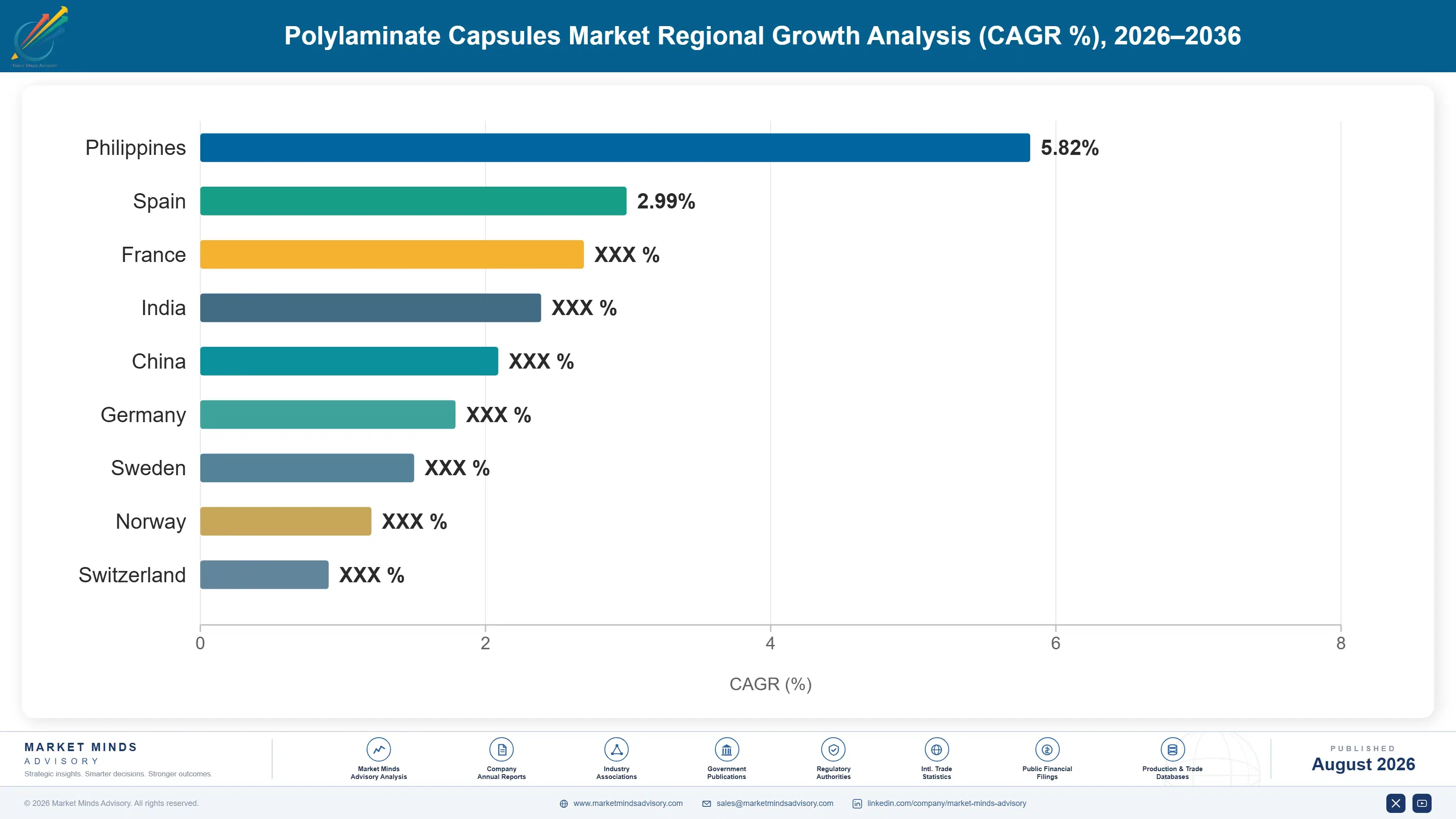
Capsules are applied at bottling rather than at consumption, so this market sits wherever wine and spirits are physically filled. That places Western Europe far above its framework band, since France, Italy, Spain, and Portugal together bottle close to half the world's wine between them.

Western Europe

Forty-four percent, far above the framework band, and the justification is simply where bottling happens: France, Italy, Spain, and Portugal between them fill close to half the world's wine, and the capsule is applied on the line rather than anywhere near the consumer. French bottling carries the highest specification, with Champagne and Bordeaux driving metallised and heavy-gauge demand. Italian and Spanish volume is larger and lower in specification. Portuguese cork production keeps cork closures standard there, which protects capsule demand directly. Growth at 2.2% is the slowest of any region, held down by flat European wine consumption and by bare-necked bottling starting at the premium end here first. Value per capsule is nonetheless the highest anywhere.
Share: 44% | CAGR: 2.2% (2026 to 2036)

North America

Fifteen percent, below the framework band, and the shortfall has two causes worth separating. A large share of American wine consumption arrives already bottled from Europe and South America, so the capsule was applied elsewhere and counts elsewhere. Californian bottling that does happen domestically has moved substantially to screwcap on everything below the premium tier. Spirits bottling is the genuine growth: American whiskey has premiumised hard and carries heavy-gauge decorated capsules. Growth at 3.1% sits below the global rate, with spirits offsetting continued wine screwcap conversion rather than exceeding it. Canadian bottling is small, and Mexican tequila capsuling counts within Latin America. What grows here grows on specification rather than on bottle count.
Share: 15% | CAGR: 3.1% (2026 to 2036)
Regional intelligence for 5 additional markets available in the complete report: East Asia, South Asia and Pacific, Latin America, Eastern Europe, Middle East and Africa. Contact sales@marketmindsadvisory.com.
polylaminate-capsules-market-country-cagr-analysis-1787299640609

Making Money On Three Cents

The capsule sells for around 3.1 cents and aluminium takes 41% of that, which leaves very little room to work with on the standard product. Value comes from moving specification upward, from owning the tooling relationship, from following bottling rather than consumption, and from getting into spirits before wine volume erodes further beneath everybody.

Sell Decoration Passes Rather Than Formed Capsules

A standard printed capsule realises around 3.1 cents and a metallised, embossed, hot-foil-stamped one realises closer to 9 cents, while the aluminium content barely changes between them. That means the entire value difference sits in decorating line passes, which is capacity a supplier controls directly rather than metal it has to buy. Suppliers investing in decorating capability rather than additional forming capacity have taken most of the value growth in this category over the past decade. Forming capacity is widely available right across the industry and decorating capability simply is not.
Market Impact: Realised price rises from 3 to 9 cents

Own The Tooling And You Own The Reorder

Embossing dies and foil stamping tools are made for a specific design and cost between 2,000 and 6,000 dollars each, which the producer usually pays for once. A supplier holding those tools holds the reorder without further competition, because switching means paying for tooling again on a three-cent component nobody wants to spend management time on. Suppliers who let tooling sit with the customer or a third party gave away the only genuine switching cost this product has. It is a small barrier that works remarkably well. Most suppliers have never audited where their tooling actually sits.
Market Impact: Tooling costs between 2,000 and 6,000 dollars each

Follow Bottling Lines Rather Than Wine Consumption

Capsules are applied on the filling line, so demand sits at the bottling plant and not at the drinker. Suppliers who built commercial coverage against consumption maps put resource into markets that import already-bottled wine and count nothing. Roughly 30% of wine crosses a border already filled, and every one of those bottles was capsuled where it was made. Mapping capsuling head installations rather than consumption volume redirects sales effort toward where the addressable units physically are, which is a cheap correction most suppliers have never made. Sales coverage still follows the wine map almost everywhere.
Market Impact: Around 30% of wine crosses borders already bottled

Build Into Spirits Before Wine Volume Erodes Further

Spirits capsules carry heavy gauge, more decoration passes, and far shorter design cycles than wine, which together deliver realised prices 3 to 4 times a standard wine capsule. They also sit outside the screwcap conversion that keeps shrinking the wine base year after year. Qualifying on spirits bottling lines requires different forming tolerances and tighter cosmetic standards, so the transition takes roughly eighteen months and real engineering attention. Suppliers still weighted heavily toward still wine are badly exposed to a base that has been contracting for twenty years without pause.
Market Impact: Spirits capsules realise 3 to 4 times wine

Who Controls the Margin Pool

Concentration reaches 58% across the top five measured on annual capsule units shipped, which is high for a niche of this absolute size and reflects how specialised the equipment is. Forming a laminate cleanly over an irregular cork finish, then decorating it in register, requires machinery that has no other application, so a new entrant cannot repurpose anything. The leader holds a clear gap over the nearest challenger on volume, though not on decoration capability.
Competitive activity runs on three things. Decoration capability is the first and it is where the value has moved, since forming capacity is widely available and decorating passes are not. Tooling ownership is the second, because the supplier holding the embossing die holds the reorder almost automatically. Proximity to the bottling line is the third, since capsules ship as air and freight economics punish distance badly.

Pressure comes from bare-necked bottling spreading downward from premium wine, which would remove volume rather than reallocate it between suppliers. Rankings will move toward whoever is furthest into spirits when that happens, because spirits sits outside both that movement and screwcap conversion. Nobody currently leading this market got there on spirits volume.
polylaminate-capsules-market-company-positioning-matrix-1787299641123

Competitive Moat and Risk Dimensions

AMCOR

Moat: Decorating capability at scale

The value in this category has moved from forming into decoration, and running metallised, embossed, and hot-foil-stamped work in register at volume needs equipment and operator skill that take years to build. Holding that across several plants lets one supplier serve producers whose specifications vary enormously from bottle to bottle. Forming capacity alone no longer wins anything.
AMCOR

Risk: Heavy exposure to still wine

The largest position sits where the base is shrinking, since screwcap conversion has removed bottles from still wine bottling for two decades without reversing once. Bare-necked premium bottling now adds a second erosion on top. Scale in a contracting base means the largest absolute volume loss, and rebuilding it in spirits needs qualification work at plants configured for wine.
RAMONDIN

Moat: Depth in premium wine bottling

Long-established positions across Rioja, Bordeaux, and the premium Italian regions mean the tooling for a great many high-specification designs already sits in one supplier's plants. On a three-cent component nobody re-tenders casually, that installed tooling base is worth considerably more than any price advantage. It also puts the supplier in the room when a producer upgrades specification.
RAMONDIN

Risk: Premium wine leads bare-necked adoption

Bare-necked bottling started at exactly the top of the wine market where this position is strongest, so the first volume to disappear is the most valuable volume held. A supplier concentrated in mid-market wine would feel that trend years later. Depth in the premium tier is an advantage until the premium tier decides the product is unnecessary.

Players Tracked

Prominent Players

Amcor
Ramondin
Enoplastic
Rivercap
Sparflex

Other Key Players

Maverick Enterprises
Alucap Group
Herti
Guala Closures
Massilly
Astir Vitogiannis
Federfin Tech
Torrent Closures
Vinventions
Bericap
Silgan Holdings
Crown Holdings
Closure Systems International
Cofimeta
Sacome

Recent Developments

APRIL 2025

Capsule supplier commissions additional hot foil stamping capacity in Europe

A capsule manufacturer commissioned additional hot foil stamping and embossing capacity at a European plant, targeting premium wine and spirits specifications where decoration passes rather than forming capacity constrain output. The investment was organic capital expenditure funded internally rather than any acquisition or joint venture with a competing supplier.
Signal: Decorating capacity rather than forming capacity is where suppliers are now putting money, which tells you where margin sits
JULY 2025

Premium wine group extends bare-necked bottling across further labels

A premium wine producer extended bare-necked bottling from a single label to most of its portfolio, citing packaging waste reduction in its published sustainability reporting. The decision was an internal packaging policy change rather than any supply agreement, contract termination dispute, or arrangement with an alternative capsule supplier.
Signal: Bare-necked bottling keeps spreading within premium producers rather than staying confined to a single flagship label
OCTOBER 2025

Chinese spirits bottler qualifies heavy-gauge metallised capsule specification

A Chinese baijiu producer qualified a heavy-gauge metallised capsule construction across a premium product range, raising decoration content substantially above the previous printed specification. The qualification was a routine supplier approval process rather than any equity stake, joint venture, or exclusive supply arrangement being established.
Signal: Asian spirits keeps pulling specification upward while European wine volume holds flat or contracts slowly beneath it

Aluminium On A Three-Cent Product

Aluminium foil dominates at roughly 41% of cost of goods, supplied by rolling mills in Europe, China, and the Gulf depending on the converting location. Polyethylene film for the laminate adds around eleven percent while printing inks and foils take about fourteen and adhesives six. On a component selling for near three cents, that metal share leaves almost nothing between input and price.
European aluminium premiums through 2022 were the event that mattered here, since energy costs forced smelter curtailments across the continent and regional premiums moved sharply above underlying metal. IEA reporting documented the electricity cost movements behind those curtailments. Capsule suppliers with quarterly-adjusting customer contracts absorbed the increase for months before recovering any of it, and several lost a full year of margin on standard work.

The competitive disadvantage mechanism runs through mix rather than through purchasing terms. A supplier weighted toward standard printed capsules carries 41% metal against a three-cent price and has nowhere to hide when aluminium moves. A supplier weighted toward metallised and heavily decorated work carries the same metal cost against a nine-cent price, so the same movement costs it a third as much proportionally. Geography matters less than specification here.
polylaminate-capsules-market-cost-volatility-analysis-1787299641318

Shift mix toward decorated specifications where metal share falls

Metal content per capsule is nearly identical across specifications while realised price triples, so aluminium exposure as a percentage of revenue falls by roughly two thirds on decorated work. That is the only mitigation available that improves both cost exposure and margin at once. It requires decorating capacity rather than negotiation, which is why suppliers keep choosing the negotiation instead.

Develop thinner gauge laminate without losing forming behaviour

Reducing aluminium thickness cuts the dominant input directly, but a thinner laminate tears or wrinkles on capsuling heads set up for standard gauge, which is why the obvious answer has been slow to arrive. Development work on laminate structure and annealing has narrowed that gap considerably. Each micron removed is metal cost saved on every capsule thereafter, permanently.

Move customer contracts to monthly metal index adjustment

Quarterly adjustment on a product with 41% metal content and a three-cent price means a supplier carries a full quarter of any aluminium movement before recovering any of it. Monthly adjustment removes most of that lag without changing the underlying price at all. Customers resist because they dislike frequent price conversations over a component this small.

Portfolio Architecture for Margin Defence

Three tiers describe this business and the margin spread is far wider than a three-cent component suggests. Standard printed capsules sit at the bottom, sold on price into mid-market wine bottling with metal cost dominating everything. Metallised and heavily decorated constructions sit meaningfully higher, since decoration passes are capacity a supplier controls rather than metal it must buy. Heavy-gauge spirits work occupies a third tier on shorter runs and tighter cosmetic standards.
The tension is that standard work fills the forming lines. Forming capacity and decorating capacity are separate assets, and the forming plant needs volume underneath it regardless of what the decorating lines are doing. Suppliers who chased premium specification and let standard volume go found their forming utilisation collapsed and their fixed cost per capsule rose across the whole portfolio, decorated work included.

High-value pools concentrate where design changes often. Spirits producers change capsule designs several times more frequently than wine producers do, which generates repeat tooling revenue and short-run decorating work that a stable wine label never provides. The pattern is consistent: wherever the design churns, the supplier holding the tooling earns twice, once on the tool and again on every capsule that follows it.

Volume / Commodity-Adjacent Tier

Standard printed aluminium-polyethylene capsules for mid-market wine bottling, sold largely on price with aluminium dominating cost. Thin margin, but the throughput that keeps forming lines loaded and fixed cost per capsule down across everything else the plant makes.
Gross Margin: 13-16%

Premium / Certified Tier

Metallised, embossed, and hot-foil-stamped constructions for premium wine and speciality bottling. Margin reflects decorating line passes that a supplier controls directly, plus the tooling ownership that makes reordering effectively automatic for the incumbent.
Gross Margin: 27-31%

Sustainability / Regulatory / Next-Generation Tier

Heavy-gauge spirits capsules and reduced-aluminium constructions supplied with recyclability documentation. Best margin on short runs, frequent design changes, and cosmetic standards that most wine-configured plants cannot hold consistently across a production shift.
Gross Margin: 34-38%
polylaminate-capsules-market-portfolio-architecture-1787299641816

High-value Sub-segments and Strategic Watch-out

Heavy-Gauge Spirits Capsules

Best margin, growing on Asian premiumisation, and sitting entirely outside both screwcap conversion and bare-necked bottling. Short runs and frequent design changes generate repeat tooling revenue that wine bottling never produces. Cosmetic standards are the entry barrier here. Wine-configured plants rarely hold them across a full shift.
Gross Margin: 34-38%

Metallised Multi-Ply Laminate

Fastest growth at 5.4%, exactly 1.50 times the market rate, and the construction carrying premiumisation across both wine and spirits. Forming it cleanly over an irregular cork finish is genuinely difficult, and that difficulty is precisely what protects the realised price. Spirits bottling adopted it fastest, and wine followed later.
Gross Margin: 27-31%

Standard Printed Wine Capsules

The volume core at thin margin, fully exposed to aluminium movement and to every screwcap conversion happening in mid-market wine bottling. It nonetheless loads the forming lines that carry fixed cost for the whole plant. Nobody has yet found a way to exit it cleanly.
Gross Margin: 13-16%

Premium Still Wine Capsules

The strategic watch-out, because bare-necked bottling started at exactly this tier and roughly 6% of premium still wine now ships without a sleeve. The volume most at risk is also among the most valuable held, and no supplier has a technical answer to a producer choosing nothing.
Gross Margin: 27-31%

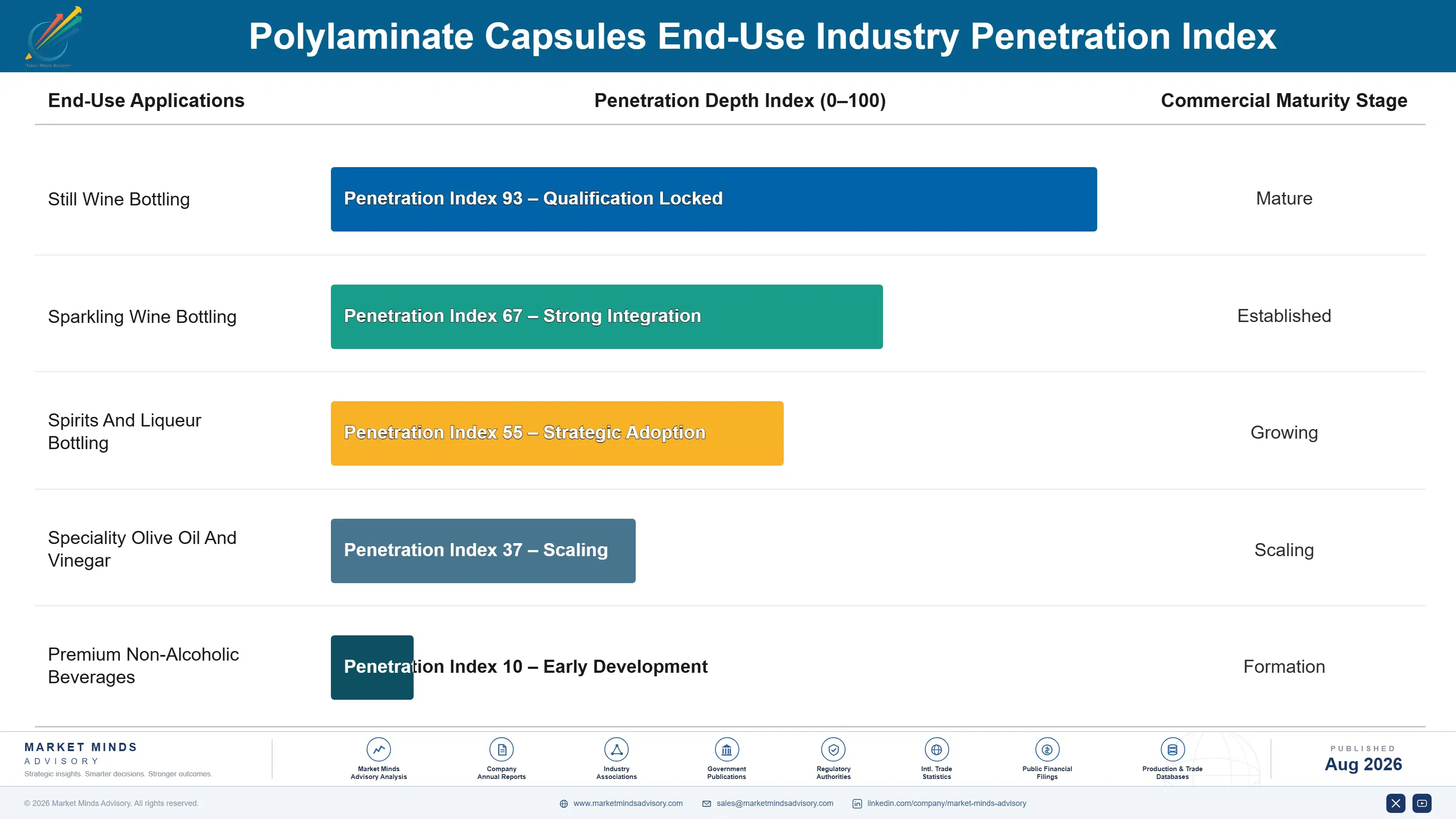
How Capsule Volume Recurs

Capsule demand recurs with the bottling line rather than with any purchasing decision, which makes it unusually predictable once qualified. A wine label bottled annually reorders the same capsule for as long as the design holds, and wine label designs change rarely: seven to twelve years is common on established brands. The reorder happens without a conversation, which is why suppliers holding the tooling hold the business almost passively for very long periods.
Stickiness varies sharply by category. Premium wine is the deepest, since the tooling investment is largest and the producer treats the neck as part of the brand. Mid-market wine sticks least and retenders on price whenever a procurement function notices the line item. Spirits sits differently again: designs change every two or three years, which breaks the passive reorder but generates fresh tooling revenue each time. Speciality olive oil behaves like premium wine at a smaller scale.

Buyer profiles have shifted in one specific direction. Winemakers and packaging technologists once owned this outright; sustainability reporting has now pulled the decision toward people who must publish waste figures, and a component with no post-opening function is difficult to defend in that room.
polylaminate-capsules-market-end-use-penetration-index-1787299642305

What We Would Tell a Board

These are among the four positions where our research anticipates prominent divergence between winners and laggards over the coming forecast period. Each is grounded in the demand model, the regulatory perimeter, and the announced capacity pipeline.
01 / DECORATION CAPACITY INVESTMENT

Value moved from forming into decorating a decade ago

A standard printed capsule realises around three cents and a metallised, embossed, hot-foil-stamped one realises closer to nine, while the aluminium content between them barely moves at all. The entire difference sits in decorating line passes, which is capacity a supplier owns and controls rather than metal it must buy at whatever the market charges. Suppliers who kept adding forming capacity instead have watched their revenue per capsule stay flat while competitors tripled theirs on precisely the same quantity of metal bought at the same price.
02 / TOOLING OWNERSHIP DISCIPLINE

The embossing die is the only switching cost here

Nobody re-tenders a three-cent component casually, and the reason is that changing supplier means paying two to six thousand dollars for new embossing and foil stamping tools on a line item too small to justify the management time. A supplier holding that tooling holds the reorder almost passively for the seven to twelve years a wine label design typically survives. Suppliers who let tooling sit with the customer or a third party gave away the only genuine barrier this product possesses.
03 / SPIRITS BASE DIVERSIFICATION

Wine volume has contracted for twenty years without pause

Screwcap conversion covers 41% of global still wine bottling and has never once reversed, while bare-necked bottling now removes a further 6% of premium wine on top of it. Spirits capsules sit outside both movements entirely and realise three to four times a standard wine capsule on heavier gauge and more decoration passes. Qualifying on spirits lines takes roughly eighteen months of forming tolerance and cosmetic standard work, which is why suppliers keep postponing a transition that gets harder annually.
04 / BOTTLING LINE MAPPING

Demand sits at the filler, not at the drinker

Capsules are applied on the filling line, so the addressable unit exists wherever a bottle is physically filled rather than wherever it is eventually opened and consumed. Around 30% of wine crosses a border already bottled, meaning every one of those capsules was bought and applied in the producing country entirely. Suppliers who built commercial coverage against consumption maps have resource sitting in import markets that count nothing, which is a cheap correction that remarkably few suppliers have ever bothered to make.

Engagement Snapshot From the Field

A live engagement with an industry participant carrying material or product regulatory and market exposure ahead of a defining policy shift, showing how our research translates into a defensible multi-year portfolio strategy.
MARKET MINDS ADVISORY · CLIENT ENGAGEMENT SUMMARY
Polylaminate Capsules Producer Strategic Portfolio Review and Transition Roadmap 2026·Investment Scenario on Polylaminate Capsules Exposure Evaluation 2025-26
CLIENT PROFILE
A European capsule manufacturer with approximately 92 million dollars in annual revenue (client-reported, unverified by MMA), operating three plants and supplying wine bottlers across five countries. The business was weighted heavily toward standard printed capsules for mid-market still wine, held limited hot foil stamping capacity, and had no meaningful position in spirits bottling of any kind.
STRATEGIC CHALLENGE
Unit volume had declined for four consecutive years while management attributed the fall entirely to European wine consumption. A proposal to add forming capacity in a lower-cost country was under board consideration. The board wanted an independent read on whether more forming capacity was the right answer to a volume problem nobody had properly diagnosed.
MMA APPROACH
We separated the volume decline into screwcap conversion, bare-necked bottling, share loss, and genuine consumption decline across the client's top forty accounts. Decorating capacity utilisation was measured against forming capacity utilisation separately. Tooling ownership was audited across the account base, and spirits bottling lines within the client's freight radius were mapped against current coverage.
KEY FINDINGS
  1. Screwcap conversion at existing accounts explained the largest share of the volume decline; consumption decline explained considerably less than management had assumed throughout.
  2. Forming lines ran at 61% utilisation while hot foil stamping capacity ran at 94% and was turning away premium work, which inverted the proposed capacity investment entirely.
  3. Tooling for 38% of accounts sat with the customer or a third-party toolmaker rather than with the client, removing the switching cost on precisely the accounts most at risk.
  4. Eleven spirits bottling lines sat within economic freight distance and none were covered by the sales function, which had been organised around wine consumption regions.
CLIENT PROFILE
A European capsule manufacturer with approximately 92 million dollars in annual revenue (client-reported, unverified by MMA), operating three plants and supplying wine bottlers across five countries. The business was weighted heavily toward standard printed capsules for mid-market still wine, held limited hot foil stamping capacity, and had no meaningful position in spirits bottling of any kind.
STRATEGIC CHALLENGE
Unit volume had declined for four consecutive years while management attributed the fall entirely to European wine consumption. A proposal to add forming capacity in a lower-cost country was under board consideration. The board wanted an independent read on whether more forming capacity was the right answer to a volume problem nobody had properly diagnosed.
MMA APPROACH
We separated the volume decline into screwcap conversion, bare-necked bottling, share loss, and genuine consumption decline across the client's top forty accounts. Decorating capacity utilisation was measured against forming capacity utilisation separately. Tooling ownership was audited across the account base, and spirits bottling lines within the client's freight radius were mapped against current coverage.
KEY FINDINGS
  1. Screwcap conversion at existing accounts explained the largest share of the volume decline; consumption decline explained considerably less than management had assumed throughout.
  2. Forming lines ran at 61% utilisation while hot foil stamping capacity ran at 94% and was turning away premium work, which inverted the proposed capacity investment entirely.
  3. Tooling for 38% of accounts sat with the customer or a third-party toolmaker rather than with the client, removing the switching cost on precisely the accounts most at risk.
  4. Eleven spirits bottling lines sat within economic freight distance and none were covered by the sales function, which had been organised around wine consumption regions.
RECOMMENDED STRATEGY
Phase 1: Phase 1 (months one to nine): cancel the forming capacity proposal and add hot foil stamping and embossing capacity at the existing sites instead. Phase 2: Phase 2 (months nine to twenty-four): recover tooling ownership across at-risk accounts and open commercial coverage on the eleven uncovered spirits bottling lines. Phase 3: Phase 3 (months twenty-four to forty): qualify heavy-gauge spirits forming tolerances and cosmetic standards on one dedicated line. Cosmetic standards are the gate, not the forming.
OUTCOME
The forming capacity proposal was cancelled and decorating capacity was added instead. Realised price per capsule rose by roughly a fifth within four quarters, tooling ownership was recovered on most at-risk accounts, and two spirits bottlers had qualified the client by year end (client-reported, unverified by MMA).

Frequently Asked Questions

Foundational context covering the market sizes, CAGR, scope, country, region and competition that inform every finding below. This section is provided to cover basics and most often pre-purchase conversations, answered from the MMA Primary Research Dataset.

What is the current size of the Polylaminate Capsules Market?

The market is valued at USD 1.24 billion in 2025, rising to USD 1.28 billion in 2026. Roughly thirty billion capsules are applied annually at around three cents each.

How large will the Polylaminate Capsules Market be by 2036?

MMA forecasts USD 1.83 billion by 2036, an increase of USD 0.55 billion over the 2026 base. That represents an expansion multiple of 1.43 times, driven by specification rather than units.

What is the CAGR for the Polylaminate Capsules Market 2026 to 2036?

The base case CAGR is 3.6%, with a bull case of 4.8% and a bear case of 2.4%. The historical rate from 2020 to 2025 was 3.0%, so growth is accelerating only slightly.

Which segment is growing fastest?

Metallised multi-ply laminate at 5.4%, exactly 1.50 times the market rate. A vapour-deposited metallised layer produces mirror and brushed effects that printing alone cannot approach at any cost.

Who are the major companies in the Polylaminate Capsules Market?

Amcor, Ramondin, Enoplastic, Rivercap, and Sparflex lead on annual capsule units shipped. The top five hold 58% between them, which is concentrated for a niche of this absolute size.

Which country is growing fastest?

China at 6.2%, driven by baijiu bottling where gift-giving convention rewards heavy-gauge decorated capsules. Specification per bottle there runs far above anything standard wine bottling requires.

Report Segmentation Architecture

The full report scope spans multiple orthogonal segmentation dimensions, with cross-tabulated demand data provided for each dimension pair. Coverage extends further to regional breakdowns, trend trajectories, and the competitive detail needed to support segment-level decision-making.

By Laminate Construction

  • Standard Aluminium-Polyethylene Laminate
  • Heavy-Gauge Spirits-Grade Laminate
  • Metallised Multi-Ply Laminate
  • Matte And Soft-Touch Coated Laminate
  • Tear-Tape And Perforated Laminate
  • Reduced-Aluminium Thin-Gauge Laminate

By End-Use Industry

  • Still Wine Bottling
  • Sparkling Wine Bottling
  • Spirits And Liqueur Bottling
  • Speciality Olive Oil And Vinegar
  • Premium Non-Alcoholic Beverages

By Customer Type

  • Large Integrated Wine Producers
  • Cooperative And Estate Bottlers
  • Contract Bottling Operations
  • International Spirits Groups
  • Packaging Distributors And Agents

By Region

  • Western Europe
  • North America
  • East Asia
  • South Asia and Pacific
  • Latin America
  • Eastern Europe
  • Middle East and Africa

Scope, Methodology, and Coverage

Every figure in this report is reproducible from documented input assumptions. The scope below maps the historical period, the forecast horizon, the segmentation dimensions, and the countries covered, alongside the underlying primary and qualitative methodology.
Historical Period
2020 to 2025
Forecast Period
2026 to 2036
Base Year
2025 (USD billions; MMA Primary Research Dataset, August 2026)
Market Definition
This market comprises capsules formed from aluminium and polyethylene laminate and applied over the closure and neck of wine, spirits, and speciality food bottles, measured at supplier realised prices for decorated and undecorated units. Construction coverage spans standard aluminium-polyethylene, heavy-gauge spirits-grade, metallised multi-ply, matte and soft-touch coated, tear-tape and perforated, and reduced-aluminium thin-gauge laminates. Pure tin capsules, polyvinyl chloride heat-shrink capsules, wax seals, screwcaps, corks, crown caps, roll-on pilfer-proof closures, capsuling machinery, and upstream aluminium rolling and polymer film production fall outside scope.
Quantitative Units
USD billions (current prices); billion capsule units shipped; realised price per capsule; decoration passes per unit
Segmentation Dimensions
By Laminate Construction; By End-Use Industry; By Customer Type; By Region
Regions Covered
Western Europe, North America, East Asia, South Asia and Pacific, Latin America, Eastern Europe, Middle East and Africa
Countries Covered
France, Italy, Spain, Portugal, Germany, Austria, Greece, Switzerland, Romania, Hungary, Bulgaria, Moldova, Georgia, Poland, USA, Canada, Mexico, Chile, Argentina, Brazil, Uruguay, China, Japan, South Korea, India, Australia, New Zealand, South Africa, Morocco, Israel, and additional markets relevant to this sector
Key Companies Profiled
Amcor, Ramondin, Enoplastic, Rivercap, Sparflex, Maverick Enterprises, Alucap Group, Herti, Guala Closures, Massilly, Astir Vitogiannis, Federfin Tech, Torrent Closures, Vinventions, Bericap, Silgan Holdings, Crown Holdings, Closure Systems International, Cofimeta, Sacome
Quantitative Methodology
Primary survey, n=3,800 respondents, Q4 2025, six countries; demand-side model with trade association cross-validation
Qualitative Methodology
47 expert interviews, Q4 2025; applied to validate demand model assumptions, identify emerging dynamics, and assess competitive positioning
Report Format
PDF and XLSX data workbook (Word format preview document)
Publisher
Market Minds Advisory
Report Code
MMA-2026-PAC-385
Published
August 2026
Contact
sales@marketmindsadvisory.com | www.marketmindsadvisory.com

Purchase the full Polylaminate Capsules Market Report (2026 to 2036).

The full report sizes polylaminate capsules across six laminate constructions, five end-use industries, five customer types, and seven regions, with country detail for the thirty largest bottling markets. Screwcap penetration and bare-necked bottling adoption are tracked by country and by price tier, since both remove units from the addressable base permanently rather than reallocating them. Decoration pass counts and realised price by specification are quantified across the construction range. Competitive profiling covers twenty companies on annual capsule units shipped. Capsuling head installations are mapped against wine and spirits bottling volume by country.
Screwcap penetration tracked by country and price tier
Bare-necked bottling adoption measured across premium wine producers
Decoration pass counts and realised price by specification
Capsuling head installations mapped against national bottling volume
Tooling ownership patterns assessed across supplier and customer
Aluminium cost exposure modelled by construction and specification

Built For The People Who Decide

From boardroom strategy to bench-side execution, this report is read cover-to-cover by leaders shaping the next decade of their industry, turning demand scenarios, market dynamics and valuation benchmarks into decisions.
CXOs/ Presidents/ VPs/ Managers
M&A and Corporate Development
Strategy Teams and R&D Heads
Procurement and Product Directors
Regulatory and Compliance Leaders
Investor Relations and Equity Analysts