Market Minds Advisory
Polyimide Fibers Market

Polyimide Fibers Market: Hot-Gas Filtration, Emissions Rules, and the Chinese Capacity Race

China's emission retrofits and expanding fab exhaust systems are pulling polyimide fiber demand past what Evonik and Tanlon's combined capacity can comfortably supply, even as aramid fibers keep pressing on price in less demanding applications.

Lead Analyst

Bilal Shaikh

Published

September 2026

Make Smarter Decisions with Customized Research Insights

Request a free sample report and evaluate market opportunities, growth trends, and competitive dynamics relevant to your business needs.

2025 MARKET VALUE$0.6BMarket Size 2025
2036 FORECAST VALUE$1.2BBase Case , 2026 to 2036
CAGR 2026 TO 20367.4 %Bull 8.7% / Bear 6.1%
INCREMENTAL OPPORTUNITY$0.6BNet 10- year value creation
EXPANSION MULTIPLE2.03x2036 value over 2026 base
Strategic Levers
M&A Pipeline
Regional Outlook
Country Rankings
Competitive Intelligence
Segmental Deep-dive
Call-Us : 91 93563 13602

Executive Snapshot and Market Trajectory

Polyimide fiber demand is shifting from a niche hot-gas filtration input toward a genuinely diversified specialty material as semiconductor fab exhaust systems and tightening firefighter protective standards both pull volume that filtration bag makers alone never generated across the wider industry.
Hot gas filtration media still carries the largest volume, but semiconductor cleanroom filtration and firefighter protective apparel pull growth fastest as chip fab expansion and updated safety standards both reward thermal stability few competing fibers can genuinely match today. East Asia manufactures nearly all global polyimide fiber capacity, while North America compounds meaningfully as CHIPS Act-driven fab construction pulls domestic filtration demand that Asian supply alone increasingly cannot serve fast enough for security-sensitive customers.
Five suppliers hold over half of a genuinely concentrated global market, and Evonik's decades of P84 process expertise have proven durable even as Shanghai Tanlon's lower-cost Chinese capacity captures share across price-sensitive industrial filtration applications specifically, consistently, and profitably. Emissions regulation tightening, semiconductor fab capacity expansion, and Chinese capacity additions now decide who wins large filtration contracts faster than any single fiber formulation improvement moving through this category this decade.
Market Definition
The market covers polyimide fiber sold in yarn, staple, and nonwoven form for hot-gas filtration, protective apparel, aerospace textiles, and industrial insulation applications, sold to filtration bag makers, apparel manufacturers, and industrial converters. Polyimide film and standalone precursor chemicals are excluded.
Base Year Value
$0.6B in 2025 (MMA Primary Research Dataset, August 2026)
Forecast Period
2026 to 2036, eleven discrete annual values
CAGR
7.4% base case. Bull 8.7%. Bear 6.1%.
Fastest Growth Segment
Semiconductor and Cleanroom Filtration Media: 12.5% CAGR
Fastest Growth Country
China: 10.2% CAGR
Fastest Growth Region
South Asia and Pacific: 9.5% CAGR
Largest Region
East Asia: 42% of 2025 global value
Market Leaders
Evonik Industries AG, Kolon Industries Inc., Shanghai Tanlon Fiber Co. Ltd., Toray Industries Inc., Teijin Limited. Source: MMA Analysis based on company annual reports.
Primary Survey
n=3,800 procurement and R&D decision-makers, Q4 2025, six countries
Methodology
Demand-side build-up, cross-validated against public data, 47 expert interviews

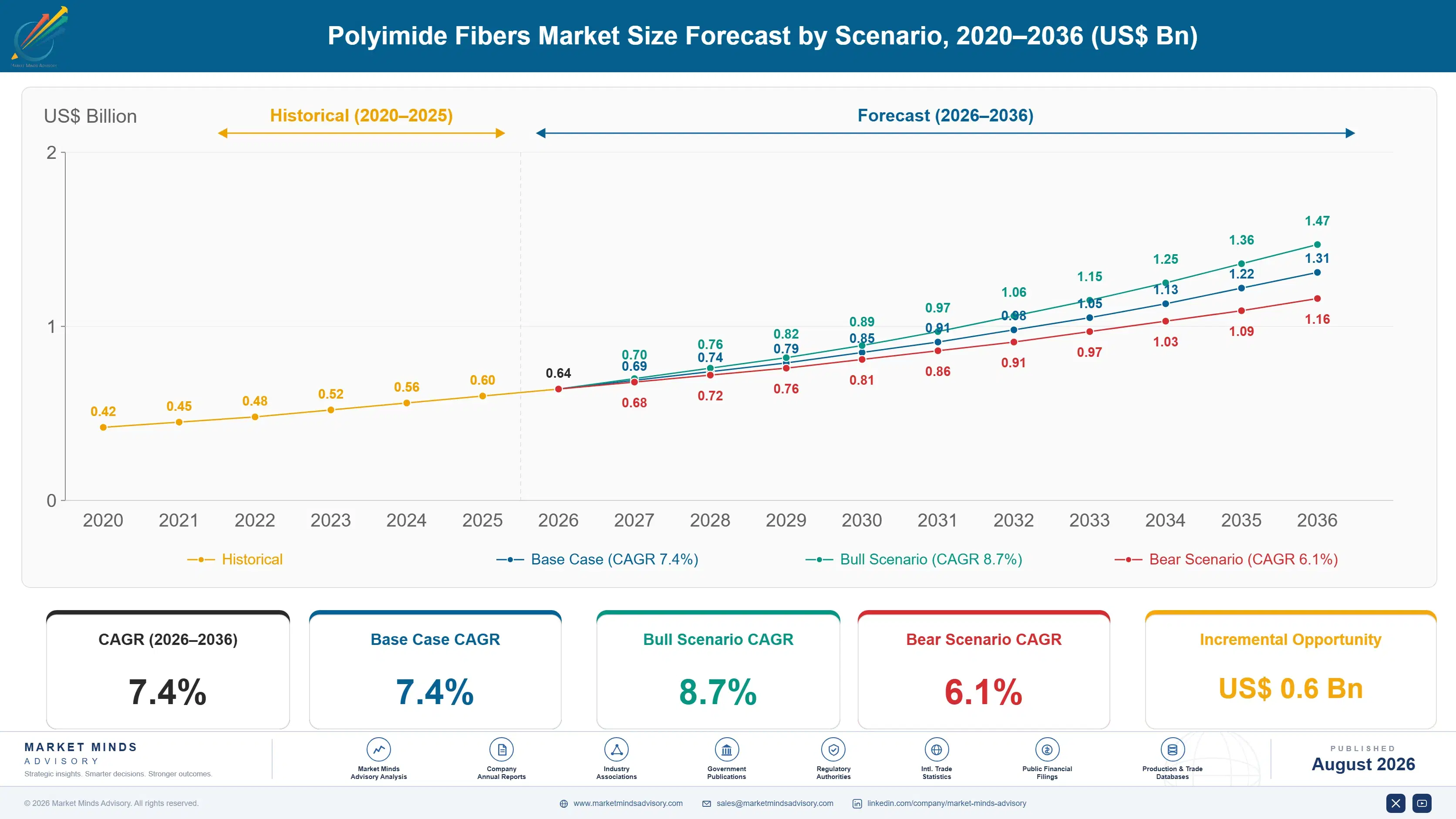
Polyimide Fibers Market Forecast Scenarios

polyimide-fibers-market-size-forecast-scenario-1787300872080
Polyimide fiber demand grew near 6.3% annually between 2020 and 2025, held back by pandemic-disrupted industrial capital spending before China's ultra-low emission retrofit programme and semiconductor fab construction restored steadier momentum through the back half of the period across most major consuming markets tracked worldwide, particularly across East Asian filtration and electronics manufacturing hubs specifically.
The base case reaches 7.4% on three mechanisms. First, semiconductor fab construction across the United States, Taiwan, and South Korea pulls exhaust filtration demand that barely existed at meaningful scale a decade ago. Second, updated firefighter protective apparel standards push fire departments toward thermally superior fibers that older aramid-based gear cannot match. Third, Chinese industrial emissions enforcement keeps expanding beyond power plants into steel, cement, and waste incineration facilities requiring comparable filtration upgrades.
The bull case at 8.7% assumes semiconductor fab construction accelerates faster than currently modelled and firefighter apparel standard updates roll out across more jurisdictions than presently scheduled across the industry. The bear case at 6.1% assumes industrial capital spending slows broadly and Chinese emissions enforcement plateaus once the easiest retrofit gains across major facilities are already captured.

Filtration Economics Behind the Emissions Push

Polyimide fiber behaves like an industrial compliance input wearing a specialty materials label. Hot gas filtration media competes on thermal stability and filter bag life under continuous high-temperature exhaust exposure, while protective apparel fiber competes on weight and flexibility across a completely different buyer relationship structure entirely, and both draw on the same specialty diamine precursor supply chain that a single feedstock shock can disrupt at once.
CR5 CONCENTRATION52%Top five suppliers hold a genuinely concentrated global share
AVERAGE SELLING PRICEUSD 28 per kilogramBlended price across filtration and apparel grade fiber
LEADING PRODUCING COUNTRYChina, 34% shareOne country hosts the deepest low-cost fiber capacity
FILTER BAG SERVICE LIFE3 to 5 yearsTypical continuous-duty replacement interval under sustained high-heat exposure
TRADE INTENSITY64% cross-borderMost finished fiber crosses a border before conversion
PRECURSOR SHARE OF COGS35-42%Specialty diamine feedstock dominates the input cost base
Commercial activity concentrates around filtration contract renewals rather than fiber innovation alone. Suppliers that secure long-term precursor chemical supply and hold qualified capacity for demanding continuous-duty applications win large industrial contracts that lower-cost aramid competitors increasingly cannot match on thermal performance, since a filter bag failure under continuous heat exposure carries real operational cost and downtime risk for the buyer.
Over the next decade, emissions regulation enforcement and semiconductor fab capacity investment will matter more than any single fiber formulation improvement introduced this cycle. Chinese capacity expansion, precursor chemical supply security, and firefighter standard updates will decide who captures the next wave of large filtration contracts before customers lock multi-year supply agreements that are costly to unwind mid-contract.
"Everyone assumed this stayed a niche filtration fiber forever. Then chip fabs started buying it, and now the qualification queue is longer than the production line."
Director, Specialty Materials Practice · MMA High-Performance Specialty Fibers P

Market Trends

Semiconductor Fab Construction Pulls Exhaust Filtration Demand

New semiconductor fabrication plants across Arizona, Texas, Taiwan, and South Korea require exhaust filtration systems capable of handling corrosive and high-temperature process gases that standard filter media cannot reliably withstand across a full operating life. Polyimide fiber's thermal stability and chemical resistance make it a preferred material for these specialized filtration applications, a use case that barely registered in industry demand forecasts five years ago. Fab operators specify filtration media replacement cycles tied to production uptime commitments, converting what was once a maintenance afterthought into a qualified, contracted supply relationship that filtration system integrators now compete to secure.
Market Impact: Covers 3,200 additional regulated facilities
Updated Firefighter Standards Push Departments Toward Superior Fibers

The National Fire Protection Association and several international equivalents have updated protective apparel standards to require higher thermal protective performance ratings, pushing fire departments toward fibers that outperform legacy aramid-based turnout gear on heat and flame resistance combined. Polyimide fiber blends have gained meaningful traction in premium turnout gear lines specifically, where departments with adequate budgets are willing to pay a real premium for measurably better firefighter protection during extended structural fire exposure. Manufacturers report that budget-constrained departments still default to aramid, creating a genuine two-tier market that tracks municipal fire budget levels closely.
Market Impact: Adds 40 new fabs through 2030

Market Opportunities and Growth Drivers

China's Emissions Enforcement Expands Beyond Power Plants

China's ultra-low emission programme, which drove a major retrofit wave across coal-fired power plants earlier this decade, is now expanding enforcement into steel, cement, and municipal waste incineration facilities that had previously operated under looser filtration requirements. Each newly regulated facility category requires hot-gas filtration media capable of continuous operation at elevated temperatures, a specification only polyimide and a handful of competing high-performance fibers can reliably satisfy across a full multi-year service life. This regulatory expansion converts what was a largely completed power sector retrofit cycle into a fresh, multi-year demand wave across entirely different industrial sectors.
Market Impact: Cuts commodity pricing by 25%

Semiconductor Capacity Expansion Creates New Filtration Demand Pool

Global semiconductor fabrication capacity investment has accelerated meaningfully since 2021, driven by both AI chip demand and national security-motivated reshoring programmes across the United States, Europe, and Asia simultaneously. Each new fab requires specialized exhaust and scrubber filtration systems handling corrosive process chemicals that conventional filter media degrades under within a fraction of polyimide's service life. This creates a genuinely new demand pool layered on top of traditional industrial filtration customers, and suppliers with cleanroom-compatible qualified product lines are capturing outsized share of this specific growth segment as fab construction accelerates worldwide.
Market Impact: Constrains capacity growth to 6% yearly

Market Restraints and Challenges

Chinese Low-Cost Capacity Compresses Global Pricing Power

Shanghai Tanlon and several other Chinese producers have scaled polyimide fiber capacity meaningfully over the past decade, offering pricing that established Western suppliers with higher-cost manufacturing bases cannot match on commodity-grade filtration applications specifically. The root cause is lower Chinese labor and energy cost structures combined with domestic government support for import substitution in specialty materials broadly. This has compressed pricing power across less differentiated filtration applications, pushing Evonik and other established suppliers to defend share through premium application qualification rather than competing purely on unit price. Some suppliers are focusing capacity on higher-margin aerospace and protective apparel applications instead.
Market Impact: Adds 18 new fab filtration contracts

Specialty Precursor Supply Concentration Limits Capacity Flexibility

Polyimide fiber production depends on specialty diamine precursor chemicals manufactured by a limited number of qualified global producers, creating a genuine supply bottleneck that constrains how quickly fiber makers can scale capacity regardless of downstream demand growth. The root cause is the specialized chemistry and capital intensity required for diamine production, which has not attracted comparable investment as more commodity petrochemical categories have over recent decades. This concentration means fiber makers compete for allocation from the same limited precursor pool during demand surges, regardless of spinning capacity built. Several producers now pursue backward integration into precursor manufacturing to secure supply.
Market Impact: Lifts premium gear orders by 22%
3 additional market trends, 4 additional growth drivers, and 2 additional restraints and challenges are covered in the full report. Contact sales@marketmindsadvisory.com to access the complete intelligence.

Segment CAGR and Growth Architecture

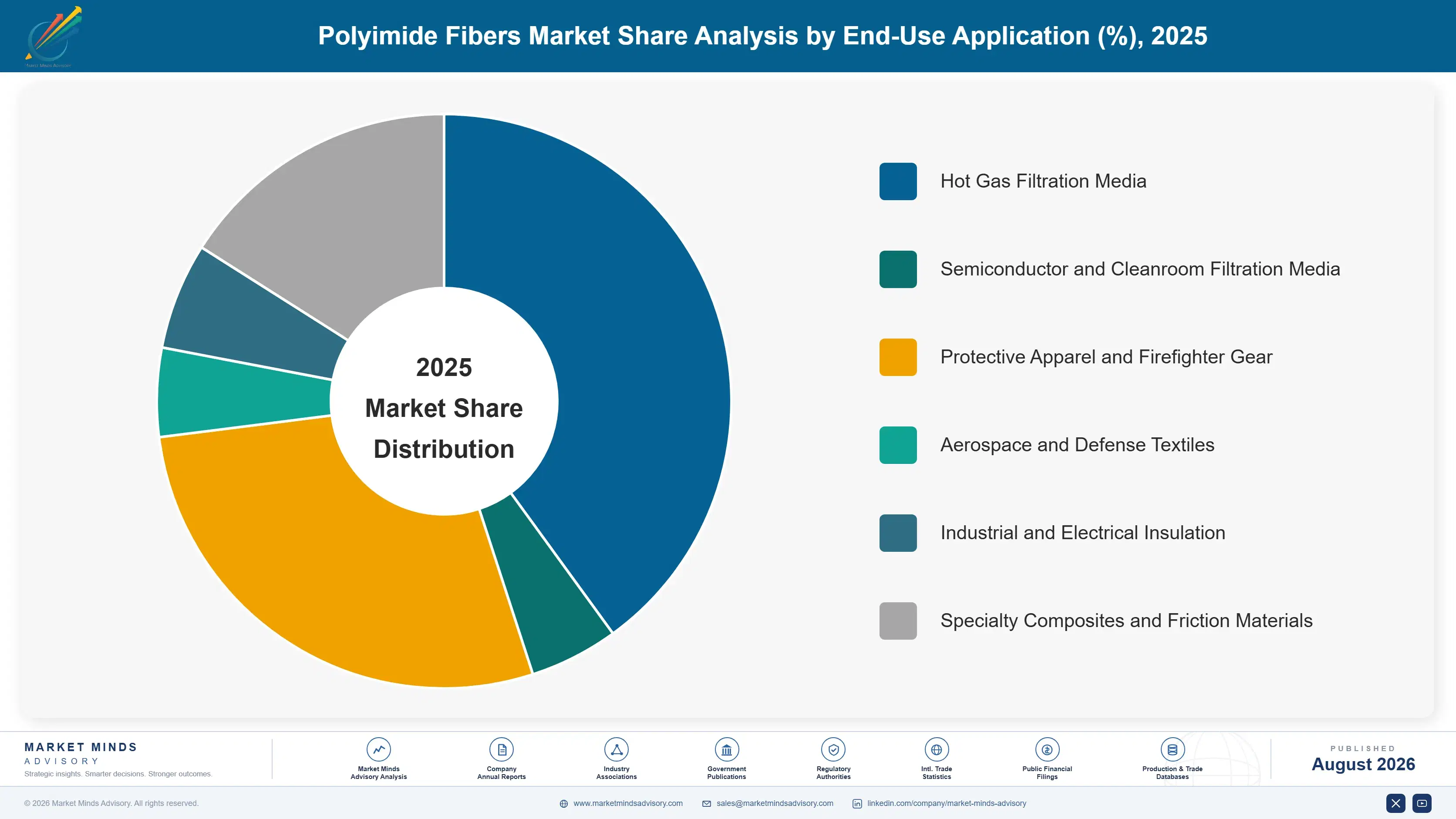
Segmentation follows end-use application, a single classification logic grounded in the operating environment and performance requirement each use case demands, from continuous hot-gas exhaust to structural fire exposure. Each application carries its own qualification standard, service life expectation, and buyer relationship structure, so commercial position tracks application requirement rather than fiber grade alone specifically.
polyimide-fibers-market-market-share-analysis-1787300872612

Semiconductor and Cleanroom Filtration Media

Semiconductor and cleanroom filtration media grows fastest at 12.5%, about 1.69 times the overall 7.4% rate, as new fab construction across the United States, Taiwan, and South Korea requires exhaust systems capable of handling corrosive, high-temperature process gases that standard filter media cannot withstand. This application barely registered in industry demand forecasts five years ago, and qualified capacity remains genuinely scarce relative to the pace of announced fab construction across multiple regions. Evonik and Kolon Industries both hold early qualification positions with major fab operators, a relationship depth newer entrants cannot easily replicate given lengthy qualification cycles. Fab operators tie filtration media replacement directly to production uptime commitments, converting what was once a maintenance afterthought into contracted, recurring supply relationships.
CAGR 12.5%

Protective Apparel and Firefighter Gear

Protective apparel and firefighter gear grows second-fastest at 9.8%, driven by updated National Fire Protection Association standards requiring higher thermal protective performance ratings that legacy aramid-based turnout gear increasingly cannot satisfy on its own. Polyimide fiber blends have gained meaningful traction in premium turnout gear lines specifically, where departments with adequate budgets pay a real premium for measurably better firefighter protection during extended structural fire exposure. This creates a genuine two-tier market, since budget-constrained fire departments still default to aramid gear that costs less upfront despite offering inferior thermal protection over a full service life. Manufacturers serving this segment increasingly compete on documented performance data rather than price alone, a shift that favours established suppliers with credible third-party testing records.
CAGR 9.8%
Full segment breakdown across 6 segments available in the complete report.

Regional Architecture and Country Demand Map

Seven regions divide unevenly around a genuinely concentrated Asian manufacturing base. East Asia holds the overwhelming majority of global fiber capacity, while South Asia and Pacific compounds fastest as Southeast Asian semiconductor assembly growth and industrial emissions enforcement both pull demand imports increasingly cannot serve.

North America

CHIPS Act-driven semiconductor fab construction across Arizona, Texas, and New York is pulling nascent domestic exhaust filtration demand that barely existed at any meaningful scale before this current wave of fab announcements began. PBI Performance Products and other domestic specialty fiber makers are expanding capacity specifically to serve this fab-adjacent filtration demand rather than competing purely on legacy industrial hot-gas applications alone. Firefighter apparel standard updates separately sustain steady premium turnout gear demand across well-funded metropolitan fire departments specifically and consistently. Growth here trails East Asia because domestic fiber manufacturing capacity remains a small fraction of qualified global output, so absolute volume stays modest even as fab-driven demand accelerates meaningfully.
Share: 23% | CAGR: 7.0% (2026 to 2036)

Western Europe

Evonik's Austrian P84 manufacturing base anchors the region's position as the historic pioneer of polyimide fiber technology, having developed much of the process chemistry other global producers now license or replicate under their own brands and formulations. European industrial emissions regulation, tightened progressively over multiple regulatory cycles, sustains steady hot-gas filtration demand across waste incineration and cement facilities specifically and continuously. German and Austrian aerospace and defense customers separately anchor demand for premium thermal protective textile applications across the region. Growth trails East Asia and the fastest-growing regions because the European industrial base is mature and largely already compliant, so incremental growth comes from replacement cycles rather than new regulatory-driven volume.
Share: 18% | CAGR: 5.8% (2026 to 2036)
Regional intelligence for 5 additional markets available in the complete report: East Asia, South Asia and Pacific, Latin America, Middle East and Africa, Eastern Europe. Contact sales@marketmindsadvisory.com.
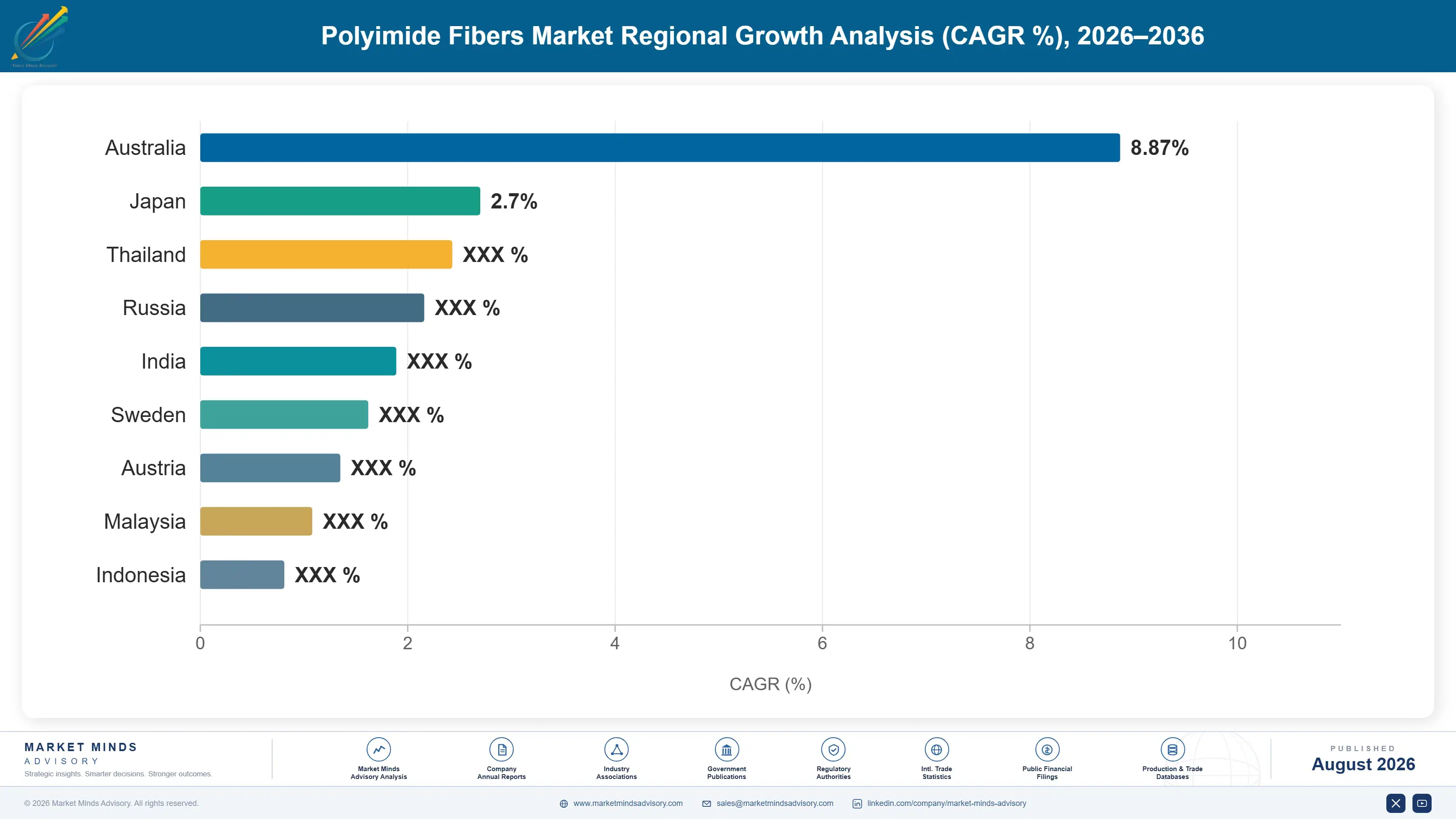
polyimide-fibers-market-country-cagr-analysis-1787300873126

How Fiber Makers Can Capture More Margin

Margin in this market concentrates where semiconductor qualification, precursor supply security, and documented performance data protect a supplier from Chinese price competition and commodity filtration pressure simultaneously across a full multi-year customer relationship cycle. The four moves below shift revenue toward buyers who pay for qualification depth rather than fiber priced purely off weight.

Qualify Semiconductor Fab Filtration Applications Ahead Of Rivals

Semiconductor fab exhaust filtration remains a genuinely new demand pool where qualified capacity lags announced fab construction meaningfully, giving early-qualifying suppliers a real window before broader competition catches up on certification depth. Suppliers completing fab operator qualification now can capture pricing roughly 25% to 35% above commodity hot-gas filtration rates, since fab customers value proven reliability under corrosive process gas exposure far more than incremental cost savings. Evonik and Kolon Industries both moved early into this qualification process, and their resulting relationship depth with major fab operators gives them a genuine head start competitors entering later cannot easily close.
Market Impact: Captures a 25% to 35% fab filtration premium

Pursue Backward Integration Into Precursor Diamine Manufacturing

Specialty diamine precursor supply concentration among a limited number of qualified producers constrains how quickly fiber makers can scale capacity regardless of downstream demand growth, creating genuine allocation risk during demand surges. Suppliers investing directly in precursor manufacturing capacity, rather than depending entirely on external supply, secure guaranteed feedstock and typically reduce precursor cost by roughly 12% to 18% compared with market purchasing during tight cycles specifically. This integration requires substantial capital investment, but it converts a genuine supply chain vulnerability into a durable competitive advantage that pure fiber spinners cannot replicate without comparable investment.
Market Impact: Cuts precursor cost by roughly 12% to 18%

Build Documented Performance Data For Premium Firefighter Gear

Fire departments with adequate budgets increasingly demand third-party tested performance data before specifying premium polyimide-blend turnout gear over legacy aramid alternatives, and suppliers without credible documented testing struggle to win this higher-margin segment regardless of actual fiber performance delivered in the field. Manufacturers investing in independent thermal protective performance testing and publishing results transparently are capturing roughly 20% to 30% price premiums over suppliers relying on manufacturer-only performance claims that procurement officers increasingly discount. This data investment pays for itself within one or two major municipal fire department contract wins specifically.
Market Impact: Earns a 20% to 30% documented performance premium

Focus Capacity On Aerospace Applications Chinese Rivals Have Not Qualified

Chinese producers have scaled commodity hot-gas filtration capacity aggressively, compressing pricing power in less differentiated applications that established Western suppliers cannot profitably defend on cost alone anymore today. Redirecting capacity toward aerospace and defense thermal protective applications, where qualification cycles run years and Chinese competitors have not yet established comparable credentials, preserves margins roughly 30% to 40% above commodity filtration rates that Chinese competition has already compressed meaningfully. This strategic repositioning trades some volume for materially better unit economics in applications where price competition matters far less than proven reliability.
Market Impact: Preserves 30% to 40% margin over commodity rates

Who Controls the Margin Pool

Concentration is genuine at CR5 52%, assessed on installed fiber spinning capacity, and the gap between leader and challenger reflects process technology depth as much as raw manufacturing scale. Evonik's P84 process expertise and Shanghai Tanlon's lower-cost Chinese capacity each defend a distinct niche neither has displaced.
Three dimensions define current activity. Semiconductor fab qualification racing continues as suppliers pursue fab operator certification faster than qualified capacity can scale to match construction announcements. Precursor supply security is accelerating, as fiber makers pursue backward integration into diamine manufacturing to insulate margin from allocation risk. Premium application repositioning keeps advancing too, as Western suppliers redirect capacity toward aerospace and firefighter applications where Chinese competitors have not yet qualified.

Pressure is building from two directions at once. Chinese producers keep scaling commodity filtration capacity, testing whether established Western suppliers can defend premium positioning against steadily improving process quality. Meanwhile semiconductor fab operators themselves are increasingly specifying filtration performance requirements that only a handful of qualified suppliers can currently satisfy, concentrating the highest-value contracts among fewer participants. Rankings will shift toward suppliers combining precursor supply security with premium application qualification, not toward whoever spins the most commodity fiber globally.
polyimide-fibers-market-company-positioning-matrix-1787300873641

Competitive Moat and Risk Dimensions

EVONIK INDUSTRIES AG

Moat: Decades Of P84 Process Expertise

Evonik's multi-decade process refinement, dating back to the fiber's original industrial development, gives it fiber consistency and thermal performance rivals without comparable process history struggle to match reliably at scale. That expertise depth compounds as fab operators and aerospace customers increasingly demand documented, auditable manufacturing consistency.
EVONIK INDUSTRIES AG

Risk: Legacy Industrial Customer Concentration

A meaningful share of Evonik's polyimide fiber revenue ties to legacy industrial filtration applications, including coal-adjacent power generation facing genuine long-term decline across several Western markets specifically. A faster-than-expected decommissioning wave would compress this revenue base faster than diversified competitors serving newer applications would feel it.
SHANGHAI TANLON FIBER CO. LTD.

Moat: Lowest-Cost Chinese Manufacturing Scale

Shanghai Tanlon's domestic manufacturing scale, built specifically to serve China's own expanding industrial emissions enforcement, gives it a genuine cost advantage in commodity filtration applications that Western suppliers cannot profitably match. That scale advantage compounds as China's regulatory enforcement expands into new industrial sectors requiring comparable filtration upgrades.
SHANGHAI TANLON FIBER CO. LTD.

Risk: Limited Premium Application Qualification

Tanlon has not yet established comparable qualification credentials in aerospace, defense, or premium firefighter apparel applications where Western suppliers still command materially better pricing and customer trust built over decades. Remaining confined to commodity filtration applications would cap margin expansion as Chinese domestic capacity continues scaling further.

Key Players

Evonik Industries AG
Kolon Industries Inc.
Shanghai Tanlon Fiber Co. Ltd.
Toray Industries Inc.
Teijin Limited

Others

DuPont de Nemours Inc.
Kermel SAS
PBI Performance Products Inc.
Huvis Corporation
Hyosung Advanced Materials
Nitivy Co. Ltd.
Toyobo Co. Ltd.
Yantai Tayho Advanced Materials Co. Ltd.
Zhejiang Guxiandao Industrial Fiber Co. Ltd.
W.L. Gore & Associates Inc.
Freudenberg Performance Materials
BWF Group
Parker Hannifin Corporation
China Bluestar (Lanzhou) New Chemical Materials Co.
Sinopec Yizheng Chemical Fibre Company Limited

Recent Developments

FEBRUARY 2026

Evonik expands Austrian P84 fiber capacity

Evonik announced expanded P84 fiber production capacity at its Austrian facility specifically targeted at qualifying additional semiconductor fab exhaust filtration customers, adding spinning capacity to serve fab operators whose construction timelines continue exceeding what existing qualified industry capacity can reliably supply this cycle and the next.
Signal: Organic capacity expansion, not an acquisition, signals confidence in sustained semiconductor fab filtration demand growth ahead.
SEPTEMBER 2025

China extends ultra-low emission standards further

China's Ministry of Ecology and Environment finalized updated emissions standards extending ultra-low emission requirements to additional steel and cement facility categories, clarifying compliance timelines that had created ambiguity for industrial operators and filtration suppliers since the broader programme initial rollout years earlier across the country.
Signal: A regulatory expansion, not a corporate transaction, extends the addressable compliance-driven filtration demand pool substantially further.
JUNE 2025

Kolon Industries signs South Korean fab supply agreement

Kolon Industries signed a multi-year supply agreement with a major South Korean semiconductor fab operator, securing contracted exhaust filtration fiber volume ahead of the fab planned capacity expansion across multiple new production lines scheduled over the coming several years and well beyond current installed capacity.
Signal: A supply agreement, not a joint venture, extends Kolon's recurring revenue base within a rapidly expanding customer.

Diamine, Solvent, and Cost

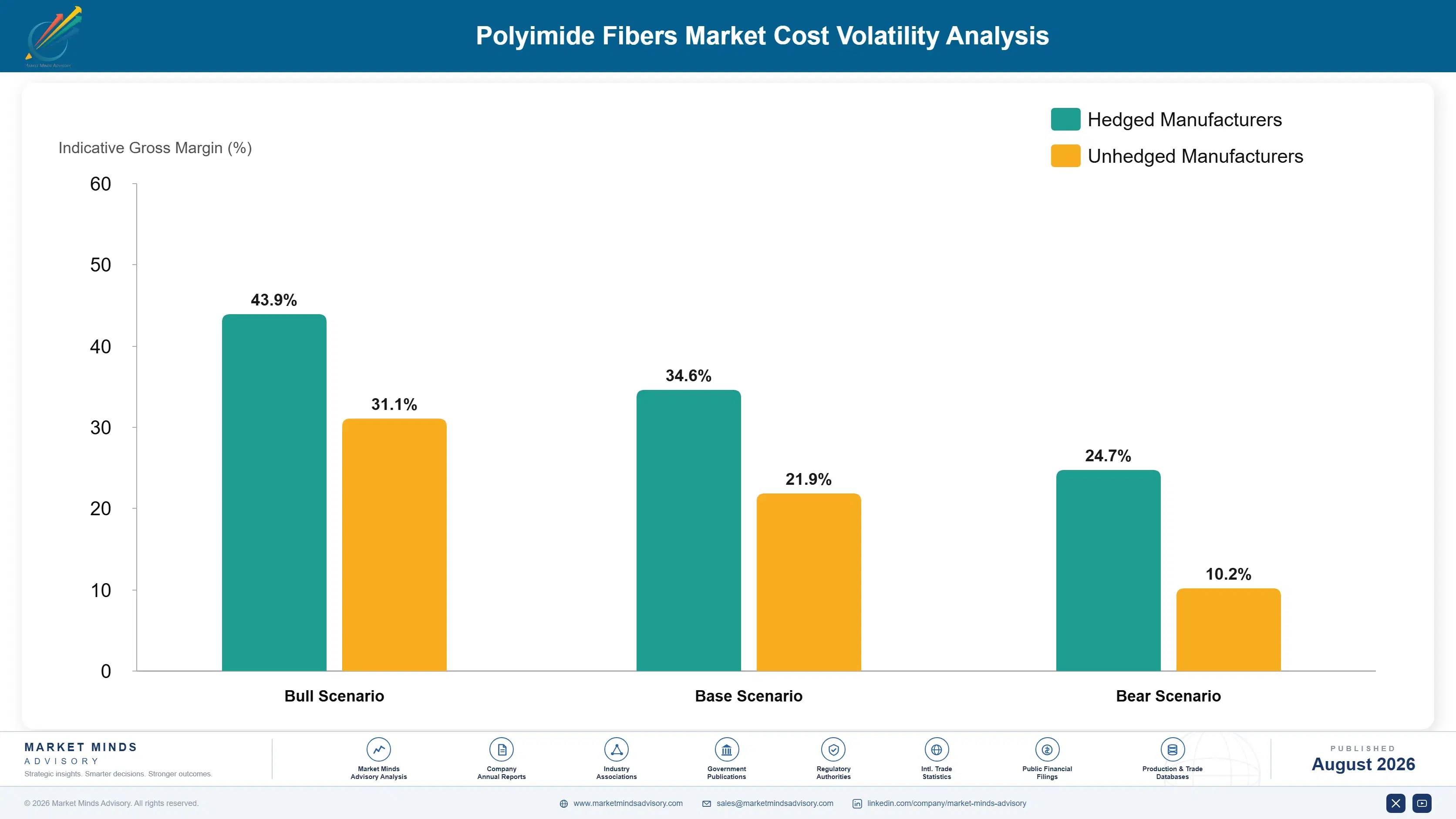
Specialty diamine precursor chemicals account for 35% to 42% of cash cost of goods sold in polyimide fiber manufacturing, sourced from a limited number of qualified producers concentrated in Japan, Germany, and China. NMP solvent used in fiber spinning contributes a further 14% to 18%, with energy for high-temperature curing making up most of the remainder.
The 2021 to 2022 petrochemical feedstock spike remains the sector's defining volatility event. Pandemic-disrupted supply chains and the subsequent European energy crisis together pushed NMP solvent and diamine precursor costs to multi-year highs across most producing regions. Evonik disclosed materially higher raw material costs in subsequent annual reporting periods, a pattern smaller fiber spinners felt more acutely given thinner margins. EIA and European industrial pricing data confirmed the spike traced to feedstock and energy disruption.

Exposure separates suppliers with diversified precursor sourcing from single-source spinners dependent on spot market purchasing. Evonik and Kolon Industries, holding broader chemical supply relationships and longer-standing precursor contracts, absorb feedstock swings more gradually than smaller regional spinners whose entire cost base moves with one precursor grade. Suppliers without comparable sourcing depth face genuine margin compression during tight feedstock cycles that larger diversified competitors increasingly avoid.
polyimide-fibers-market-cost-volatility-analysis-1787300873835

Pursue Backward Integration Into Diamine Precursor Manufacturing

Investing directly in precursor manufacturing capacity, rather than depending entirely on external qualified suppliers, secures guaranteed feedstock supply and insulates margin from allocation risk during tight demand cycles that regularly squeeze pure fiber spinners without comparable integration in place. This structure has already proven valuable for suppliers that completed it before the last precursor tightening episode specifically.

Diversify Solvent Sourcing Across Multiple Producing Regions

Qualifying NMP solvent from multiple regional producers, rather than concentrating purchases with any single energy-constrained region, reduces exposure to any one area's feedstock or energy cost shock during future volatility episodes across the industry and calendar year. Suppliers with diversified solvent relationships also negotiate more favourable terms during periods of genuine regional supply tightness.

Hedge Precursor Exposure Through Multi-Year Supply Contracts

Locking multi-year diamine and solvent supply agreements with qualified producers, rather than buying entirely on the spot market, gives fiber makers pricing confidence that smaller spinners exposed to daily spot precursor swings cannot match reliably across a full contract cycle. This confidence increasingly wins large customer framework agreements against competitors still quoting on spot precursor assumptions.

Portfolio Architecture for Margin Defence

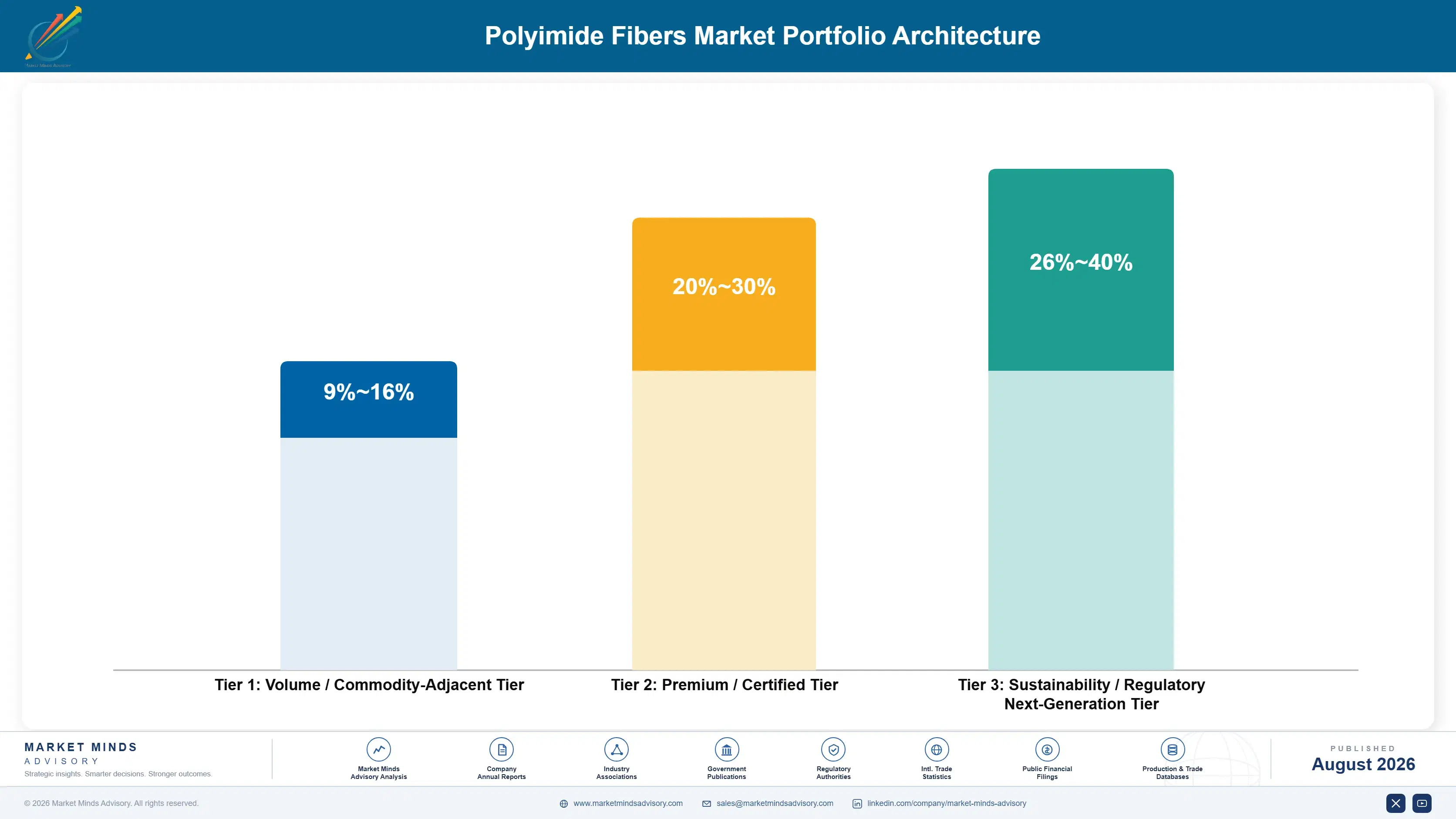
The portfolio splits into three margin tiers separated by qualification depth, application criticality, and precursor supply security rather than volume alone. Commodity hot-gas filtration fiber competes almost entirely on unit cost and delivery reliability, while semiconductor fab and aerospace-qualified fiber earn considerably more because fewer suppliers can meet the certification and consistency requirements these applications demand.
The tension running through every supplier's strategy is volume against premium. Commodity filtration fiber funds spinning line overhead and keeps capacity utilised, but it earns thin single-digit to low-double-digit margins that barely survive a bad precursor quarter given Chinese price competition. Semiconductor and aerospace-qualified fiber carry the earnings upside, yet they demand qualification investment, documented performance testing, and precursor supply security that smaller spinners often cannot sustain through a full investment cycle.

High-value pools concentrate wherever qualification or reliability matters most: semiconductor fab exhaust filtration, aerospace thermal protective textiles, and premium firefighter apparel with documented performance data all sit here. Commodity hot-gas filtration fiber, sold into distributed industrial channels, remains the volume anchor that keeps spinning capacity utilised but contributes comparatively little to blended profitability across a typical supplier's full product mix.

Volume / Commodity-Adjacent Tier

Commodity hot-gas filtration fiber sold into distributed industrial channels on unit cost and delivery reliability, competing directly against Chinese producers on landed cost with minimal qualification differentiation today across most markets.
Gross Margin: 9-16%

Premium / Certified Tier

Certified semiconductor fab exhaust filtration and premium firefighter apparel fiber carrying documented performance data and fab operator qualification that commodity suppliers cannot credibly offer institutional buyers anywhere reliably or consistently.
Gross Margin: 20-30%

Sustainability / Regulatory / Next-Generation Tier

Aerospace and defense thermal protective textiles, plus emissions-compliance-driven fiber for newly regulated industrial sectors, commanding a genuine premium for certification depth and precursor supply security already fully achieved and validated.
Gross Margin: 26-40%
polyimide-fibers-market-portfolio-architecture-1787300874331

High-value Sub-segments and Strategic Watch-out

Semiconductor and Cleanroom Filtration Media

Semiconductor and cleanroom filtration media is the high-value, high-growth pool, expanding at 12.5% as fab construction requires exhaust systems standard media cannot withstand. The wide margin range reflects qualification status: fab-certified suppliers capture the top end, while unqualified competitors earn considerably less on comparable fiber.
Gross Margin: 24-38%

Protective Apparel and Firefighter Gear

Protective apparel and firefighter gear forms the high-value, moderate-growth pool at 9.8%, serving departments upgrading beyond legacy aramid gear under updated thermal protection standards. The wide range reflects documentation depth, since suppliers with published third-party testing earn more than those relying on manufacturer claims alone.
Gross Margin: 18-30%

Hot Gas Filtration Media

Hot gas filtration media is the volume core, the largest tonnage segment by far and the one every spinner depends on to keep production lines running through demand cycles. Margins stay thin because pricing tracks precursor and delivered cost closely, leaving limited room for differentiation across competing supply.
Gross Margin: 9-15%

Industrial and Electrical Insulation

Industrial and electrical insulation is the strategic watch-out, squeezed as lower-cost alternative materials and Chinese commodity fiber both compress pricing in less demanding insulation applications. The wide range reflects that suppliers holding specialized high-voltage insulation qualifications still earn well while undifferentiated capacity increasingly competes on price.
Gross Margin: 10-22%

How Fiber Demand Actually Repeats

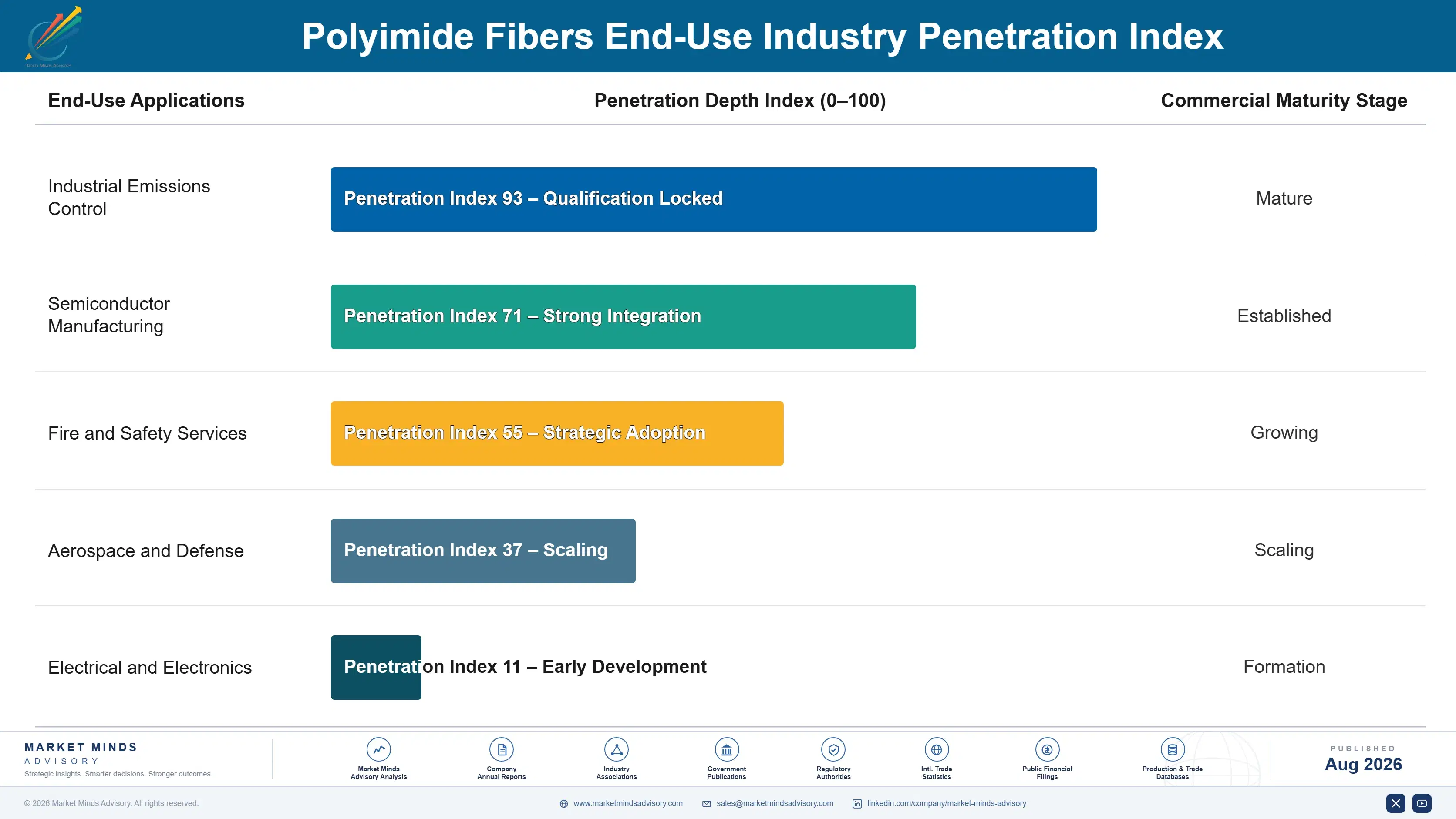
Demand here runs on scheduled replacement cycles that vary by application, from filter bags replaced every three to five years under continuous high-heat exposure to firefighter turnout gear replaced on department-specific schedules. Semiconductor fab contracts increasingly lock multi-year filtration supply agreements tied to production uptime commitments, giving suppliers a revenue base considerably more predictable than reactive replacement demand alone.
Adoption depth varies sharply by vertical. Semiconductor fab operators, once a supplier clears qualification for a specific exhaust application, rarely switch mid-programme, since requalifying filtration media risks production downtime that costs far more than any price gap could offset. Industrial filtration customers sit closer to the middle, loyal within a facility but open-bid when adding new capacity. Fire departments sit at the far end, constrained by budget cycles that make switching to premium fiber a genuinely multi-year decision.

Buyer profiles have shifted generationally too. Fab operator procurement teams increasingly run qualification through formal data-driven review that scores suppliers on documented reliability rather than relationship alone, opening qualification to newer entrants that can demonstrate the data. Younger fire department procurement officers also weigh independently verified thermal performance more heavily than predecessors did, mattering as much as price in some tenders.
polyimide-fibers-market-end-use-penetration-index-1787300874818

Where Fiber Makers Should Bet Next

These are among the four positions where our research anticipates prominent divergence between winners and laggards over the coming forecast period. Each is grounded in the demand model, the regulatory perimeter, and the announced capacity pipeline.
01 / FAB QUALIFICATION TIMING

Semiconductor filtration qualification now determines who wins the highest-margin contracts

Fab operators are specifying exhaust filtration requirements that only a handful of qualified suppliers can currently satisfy, and the qualification window before broader competition catches up is narrowing as more suppliers recognise the opportunity. Evonik and Kolon Industries both moved early into this segment, and their resulting relationship depth with major fab operators gives them a genuine head start that later entrants cannot easily close given lengthy qualification cycles. Suppliers still treating semiconductor filtration as a secondary application should reconsider that positioning quickly.
02 / PRECURSOR INTEGRATION STRATEGY

Backward integration into diamine manufacturing is becoming a genuine competitive differentiator

Specialty diamine precursor supply concentration among a limited number of qualified producers creates genuine allocation risk that has repeatedly squeezed fiber makers without secured supply during demand surges over the past several years. Suppliers investing directly in precursor manufacturing capacity convert a persistent vulnerability into a durable advantage that pure fiber spinners cannot replicate without comparable capital investment and lead time. This integration decision increasingly separates suppliers who can reliably fulfil large multi-year contracts from those exposed to the next feedstock tightening episode.
03 / PREMIUM APPLICATION REPOSITIONING

Documented testing now matters as much as the fiber itself

Chinese producers have scaled commodity hot-gas filtration capacity aggressively enough that established Western suppliers cannot profitably defend pricing in less differentiated applications through cost competition alone anymore today whatsoever. Redirecting capacity toward aerospace, defense, and semiconductor applications where qualification cycles run years preserves margin that commodity competition has already compressed meaningfully across the broader category and industry overall. Suppliers still competing primarily on commodity filtration pricing should treat this repositioning as a near-term strategic priority rather than a distant consideration.
04 / PERFORMANCE DATA INVESTMENT

Documented testing now matters as much as the fiber itself

Fire departments and fab operators alike increasingly demand independently verified performance data before specifying premium fiber over cheaper, less-tested alternatives that procurement officers now scrutinise more carefully than in prior purchasing cycles. Suppliers publishing transparent third-party testing results are capturing meaningful price premiums over competitors relying on manufacturer-only performance claims that buyers increasingly discount as insufficient evidence. This data investment pays for itself within one or two major institutional contract wins, making it one of the higher-return capital allocation decisions available.

Engagement Snapshot From the Field

A live engagement with an industry participant carrying material or product regulatory and market exposure ahead of a defining policy shift, showing how our research translates into a defensible multi-year portfolio strategy.
MARKET MINDS ADVISORY · CLIENT ENGAGEMENT SUMMARY
Polyimide Fibers Producer Strategic Portfolio Review and Transition Roadmap 2026·Investment Scenario on Polyimide Fibers Exposure Evaluation 2025-26
CLIENT PROFILE
A semiconductor fab operator planning a new fabrication facility approached MMA while evaluating filtration fiber suppliers for its corrosive process gas exhaust system ahead of construction. The client reported projected facility filtration spend near USD 24 million over the first five years of operation, with no prior direct experience procuring specialty filtration fiber (client-reported, unverified by MMA).
STRATEGIC CHALLENGE
Two qualified suppliers offered similar technical specifications and pricing, but the client's engineering team could not determine whether either supplier's actual field performance track record at comparable fabs justified a long-term exclusive supply commitment over a more flexible dual-sourcing approach given the facility's multi-decade planned operating life and expansion plans.
MMA APPROACH
MMA reviewed both suppliers' documented field performance data at comparable semiconductor fabs, benchmarking filter service life and failure rates against the client's specific process chemistry profile in careful detail. We also assessed each supplier's precursor supply security position, given its direct relevance to long-term delivery reliability and overall contract risk.
KEY FINDINGS
  1. One supplier's field data showed measurably longer filter service life under the client's specific corrosive process chemistry, reducing projected replacement frequency by roughly 20%.
  2. That same supplier held direct backward integration into precursor manufacturing, giving it meaningfully better supply security than its competitor's external sourcing arrangement.
  3. Exclusive supply pricing saved approximately 7% versus a dual-sourced approach, a gap smaller than the modelled cost of a single-supplier delivery disruption.
  4. A structured single-primary-supplier approach with a qualified backup for volume overflow balanced cost savings against supply continuity risk most effectively (client-reported, unverified by MMA).
CLIENT PROFILE
A semiconductor fab operator planning a new fabrication facility approached MMA while evaluating filtration fiber suppliers for its corrosive process gas exhaust system ahead of construction. The client reported projected facility filtration spend near USD 24 million over the first five years of operation, with no prior direct experience procuring specialty filtration fiber (client-reported, unverified by MMA).
STRATEGIC CHALLENGE
Two qualified suppliers offered similar technical specifications and pricing, but the client's engineering team could not determine whether either supplier's actual field performance track record at comparable fabs justified a long-term exclusive supply commitment over a more flexible dual-sourcing approach given the facility's multi-decade planned operating life and expansion plans.
MMA APPROACH
MMA reviewed both suppliers' documented field performance data at comparable semiconductor fabs, benchmarking filter service life and failure rates against the client's specific process chemistry profile in careful detail. We also assessed each supplier's precursor supply security position, given its direct relevance to long-term delivery reliability and overall contract risk.
KEY FINDINGS
  1. One supplier's field data showed measurably longer filter service life under the client's specific corrosive process chemistry, reducing projected replacement frequency by roughly 20%.
  2. That same supplier held direct backward integration into precursor manufacturing, giving it meaningfully better supply security than its competitor's external sourcing arrangement.
  3. Exclusive supply pricing saved approximately 7% versus a dual-sourced approach, a gap smaller than the modelled cost of a single-supplier delivery disruption.
  4. A structured single-primary-supplier approach with a qualified backup for volume overflow balanced cost savings against supply continuity risk most effectively (client-reported, unverified by MMA).
RECOMMENDED STRATEGY
Phase 1: Phase 1 (0 to 6 months): Qualify the precursor-integrated supplier as primary, with the alternative qualified as full backup capacity. Phase 2: Phase 2 (6 to 24 months): Monitor actual filter service life against modelled projections through the facility's initial ramp period. Phase 3: Phase 3 (24 to 60 months): Reassess supplier terms at the first major contract renewal using accumulated field performance data.
OUTCOME
The client selected the precursor-integrated supplier as primary and secured backup qualification with the alternative supplier for overflow volume needs. Filter service life during the first full operating year tracked within 5% of MMA's modelled projection, avoiding an unplanned mid-cycle replacement (client-reported, unverified by MMA).

Frequently Asked Questions

Foundational context covering the market sizes, CAGR, scope, country, region and competition that inform every finding below. This section is provided to cover basics and most often pre-purchase conversations, answered from the MMA Primary Research Dataset.

What is the current size of the Polyimide Fibers Market?

The global polyimide fibers market was valued at USD 0.55 billion in 2025. Semiconductor cleanroom filtration accounts for the fastest-growing share of that total across major producing regions.

How large will the Polyimide Fibers Market be by 2036?

The market is projected to reach USD 1.2 billion by 2036, up from USD 0.59 billion in 2026. That represents an incremental opportunity of roughly USD 0.61 billion across the decade.

What is the CAGR for the Polyimide Fibers Market 2026 to 2036?

The base case CAGR is 7.4% annually. MMA models a bull case of 8.7% if fab construction accelerates further, and a bear case of 6.1% if industrial capital spending slows broadly.

Which segment is growing fastest?

Semiconductor and cleanroom filtration media grows fastest at 12.5% CAGR, about 1.69 times the overall market rate, as fab construction requires exhaust systems standard filter media cannot withstand.

Who are the major companies in the Polyimide Fibers Market?

Evonik, Kolon Industries, Shanghai Tanlon, Toray Industries, and Teijin lead the category on installed fiber spinning capacity worldwide. Evonik holds the deepest P84 process expertise specifically.

Which country is growing fastest?

China posts the fastest national CAGR at 10.2%, driven by expanding industrial emissions enforcement reaching steel, cement, and waste incineration facilities beyond the original power sector retrofit programme.

Report Segmentation Architecture

The full report scope spans multiple orthogonal segmentation dimensions, with cross-tabulated demand data provided for each dimension pair. Coverage extends further to regional breakdowns, trend trajectories, and the competitive detail needed to support segment-level decision-making.

By End-Use Application

  • Hot Gas Filtration Media
  • Semiconductor and Cleanroom Filtration Media
  • Protective Apparel and Firefighter Gear
  • Aerospace and Defense Textiles
  • Industrial and Electrical Insulation
  • Specialty Composites and Friction Materials

By End-Use Industry

  • Industrial Emissions Control
  • Semiconductor Manufacturing
  • Fire and Safety Services
  • Aerospace and Defense
  • Electrical and Electronics

By Commercial Dimension

  • Direct Industrial Supply Contracts
  • Fab Operator Qualification Agreements
  • Distributor and Converter Channels
  • Government and Institutional Procurement

By Region

  • North America
  • Western Europe
  • East Asia
  • South Asia and Pacific
  • Latin America
  • Middle East and Africa
  • Eastern Europe

Scope, Methodology, and Coverage

Every figure in this report is reproducible from documented input assumptions. The scope below maps the historical period, the forecast horizon, the segmentation dimensions, and the countries covered, alongside the underlying primary and qualitative methodology.
Historical Period
2020 to 2025
Forecast Period
2026 to 2036
Base Year
2025 (USD billions; MMA Primary Research Dataset, August 2026)
Market Definition
The market covers polyimide fiber sold in yarn, staple, and nonwoven form for hot-gas filtration, protective apparel, aerospace textiles, and industrial insulation applications, sold to filtration bag makers, apparel manufacturers, and industrial converters. Polyimide film and standalone precursor chemicals sold separately are excluded.
Quantitative Units
USD billions (current prices); metric tonnes of fiber shipped where applicable
Segmentation Dimensions
By End-Use Application; By End-Use Industry; By Commercial Dimension; By Region
Regions Covered
North America, Western Europe, East Asia, South Asia and Pacific, Latin America, Middle East and Africa, Eastern Europe
Countries Covered
USA, China, Germany, France, UK, Japan, South Korea, India, Australia, Canada, Brazil, Mexico, Indonesia, Vietnam, Thailand, Malaysia, UAE, Saudi Arabia, South Africa, Nigeria, Turkey, Poland, Netherlands, Italy, Spain, Sweden, Switzerland, Argentina, Colombia, Singapore, and additional markets relevant to this sector
Key Companies Profiled
Evonik Industries AG, Kolon Industries Inc., Shanghai Tanlon Fiber Co. Ltd., Toray Industries Inc., Teijin Limited, DuPont de Nemours Inc., Kermel SAS, PBI Performance Products Inc., Huvis Corporation, Hyosung Advanced Materials, Nitivy Co. Ltd., Toyobo Co. Ltd., Yantai Tayho Advanced Materials Co. Ltd., Zhejiang Guxiandao Industrial Fiber Co. Ltd., W.L. Gore & Associates Inc., Freudenberg Performance Materials, BWF Group, Parker Hannifin Corporation, China Bluestar (Lanzhou) New Chemical Materials Co., Sinopec Yizheng Chemical Fibre Company Limited
Quantitative Methodology
Primary survey, n=3,800 respondents, Q4 2025, six countries; demand-side model with trade association cross-validation
Qualitative Methodology
47 expert interviews, Q4 2025; applied to validate demand model assumptions, identify emerging dynamics, and assess competitive positioning
Report Format
PDF and XLSX data workbook (Word format preview document)
Publisher
Market Minds Advisory
Report Code
MMA-2026-CHM-108
Published
August 2026
Contact
sales@marketmindsadvisory.com | www.marketmindsadvisory.com

Purchase the full Polyimide Fibers Market Report (2026 to 2036).

The full MMA Polyimide Fibers report sizes the market across six end-use applications, five end-use industries, four commercial channels, and seven regions through 2036. It profiles 20 participants on a consistent installed spinning capacity basis, scoring the top two on process technology depth, precursor supply security, and semiconductor fab qualification progress. Scenario models quantify how emissions regulation enforcement, semiconductor fab construction, and Chinese capacity expansion move both demand and realised pricing. The report also includes delivered-cost modelling by application, a precursor exposure screen, fab qualification tracking, and a premium application repositioning framework built for strategy, procurement, and investment teams.
Six-application segmentation with volume and value forecasts
Seven-region demand map with country-level detail
Twenty-company competitive profiles on spinning capacity
Diamine and solvent feedstock cost sensitivity modelling
Emissions regulation and fab qualification tracking
Premium application repositioning and certification playbook

Built For The People Who Decide

From boardroom strategy to bench-side execution, this report is read cover-to-cover by leaders shaping the next decade of their industry, turning demand scenarios, market dynamics and valuation benchmarks into decisions.
CXOs/ Presidents/ VPs/ Managers
M&A and Corporate Development
Strategy Teams and R&D Heads
Procurement and Product Directors
Regulatory and Compliance Leaders
Investor Relations and Equity Analysts