Market Minds Advisory
Polyacrylate Rubber Market

Polyacrylate Rubber Market: Priced By The Seal, Sized By The Engine

This elastomer exists because hot engine oil destroys everything cheaper, which ties a specialty chemical to a powertrain the automotive industry has spent a decade planning to replace. That dependency is the whole story.

Lead Analyst

Bilal Shaikh

Published

September 2026

Make Smarter Decisions with Customized Research Insights

Request a free sample report and evaluate market opportunities, growth trends, and competitive dynamics relevant to your business needs.

2025 MARKET VALUE$0.7BMarket Size 2025
2036 FORECAST VALUE$1.2BBase Case , 2026 to 2036
CAGR 2026 TO 20364.9 %Bull 6.1% / Bear 3.7%
INCREMENTAL OPPORTUNITY$0.4BNet 10- year value creation
EXPANSION MULTIPLE1.61x2036 value over 2026 base
Strategic Levers
M&A Pipeline
Regional Outlook
Country Rankings
Competitive Intelligence
Segmental Deep-dive
Call-Us : 91 93563 13602

Executive Snapshot and Market Trajectory

Polyacrylate rubber is specified because hot engine oil at 150 degrees destroys nitrile within months and fluoroelastomer costs several times more. That narrow window between two alternatives is the entire commercial basis of the material, and it sits inside a powertrain the industry is slowly replacing.
Growth runs at 4.9% and electrified applications lead it. Low-temperature grades for hybrid and electric drivetrains grow at 7.35%, exactly 1.50 times the market rate, because e-axle and reduction gear seals face cold-start torque requirements conventional grades were never formulated for. East Asia holds 41%, far outside band, since Japanese and Chinese producers make most of the world's polyacrylate and seal it into regional vehicle production.
Concentration is very high at 79% across the top five measured on polymer tonnage supplied, and monomer chemistry and cure system know-how hold it there. Roughly 84% of demand goes into automotive sealing, which makes this a specialty polymer whose fate is decided in powertrain engineering meetings it never attends. Qualification runs around 26 months, which makes any position won unusually durable. It also means a lost qualification waits for the next platform.
Market Definition
This market covers polyacrylate elastomer supplied as raw polymer for compounding and sealing applications, spanning standard ethyl acrylate grades, butyl acrylate low-temperature grades, low-temperature grades for electrified powertrains, chlorine-cure and carboxyl-cure specialty grades, and blended and modified acrylic elastomer grades. Compounded and moulded seal products sold as finished parts, acrylic emulsion polymers for coatings and adhesives, hydrogenated nitrile and fluoroelastomers, thermoplastic elastomers, and sealing system design services fall outside scope.
Base Year Value
$0.7B in 2025 (MMA Primary Research Dataset, August 2026)
Forecast Period
2026 to 2036, eleven discrete annual values
CAGR
4.9% base case. Bull 6.1%. Bear 3.7%.
Fastest Growth Segment
Low-Temperature Grades for Electrified Powertrains: 7.3% CAGR
Fastest Growth Country
India: 7.8% CAGR
Fastest Growth Region
South Asia and Pacific: 7.2% CAGR
Largest Region
East Asia: 41% of 2025 global value
Market Leaders
Zeon Corporation, NOK Corporation, Denka, Wanda Group, Toyo Ink. Source: MMA Analysis based on company annual reports.
Primary Survey
n=3,800 procurement and R&D decision-makers, Q4 2025, six countries
Methodology
Demand-side build-up, cross-validated against public data, 47 expert interviews

Polyacrylate Rubber Market Forecast Scenarios

polyacrylate-rubber-market-size-forecast-scenario-1787302390774
The 2020 to 2025 period ran at 3.9% and vehicle production explained almost all of it. Volumes fell sharply in 2020, recovered through the semiconductor shortage years unevenly, and returned to trend by 2024 without any change in the material's position. What did change was formulation direction, as hybrid transmission and e-axle programmes began asking for low-temperature performance that standard grades could not deliver.
Three mechanisms carry the 4.9% base case. Hybrid powertrain growth is the largest, since hybrids retain the hot oil sealing requirement that pure battery vehicles remove while adding cold-start demands of their own. Emissions durability requirements are the second, extending seal life expectations across the powertrain. And Indian and Southeast Asian vehicle production is the third, adding volume where fleets remain overwhelmingly combustion. Aftermarket seal demand sits behind all three on a longer replacement cycle.
The 6.1% bull case rests on hybrid share holding higher for longer than current forecasts assume, which would sustain hot oil sealing demand well into the next decade. The 3.7% bear case is faster battery electric penetration in the largest vehicle markets, since a battery drivetrain removes most of the sealing applications this material was formulated to serve.

A Window Between Two Alternatives

This material occupies a gap rather than a category. Nitrile rubber fails within months in engine oil above about 130 degrees, fluoroelastomer handles far more but costs several times as much, and polyacrylate sits between them at roughly a third of fluoroelastomer pricing with continuous service around 150 degrees. Engineers specify it when nitrile will not survive and fluoroelastomer cannot be justified.
TOP FIVE CONCENTRATION79%Very high, held through monomer chemistry and cure system knowledge
CONTINUOUS SERVICE TEMPERATURE150 degreesIn hot engine oil, where cheaper elastomers fail quickly
AUTOMOTIVE DEMAND SHARE84%Of total consumption going into vehicle sealing applications alone
PRICE AGAINST FLUOROELASTOMER0.3 timesWhich is the whole reason this material gets specified
SEAL QUALIFICATION CYCLE26 monthsFrom material selection through to volume production release
MONOMER SHARE OF COST57%Of polymer production cost from acrylate monomer feedstock
That leaves the material's fate outside its own control. Around 84% of demand goes into automotive sealing, mostly crankshaft and camshaft seals, transmission and valve body gaskets, and hoses in contact with hot oil. A battery drivetrain removes most of those applications outright. Hybrids retain them, which is why hybrid share matters more to this market than total vehicle production does.
Concentration at 79% reflects chemistry rather than scale. Acrylate copolymer synthesis with the right cure site monomer and the corresponding cure system is genuinely difficult to get right, and small differences show up as compression set and heat aging failures years into a seal's life. Qualification runs around 26 months, which makes any position won unusually durable. A lost qualification then waits for the next platform, which can be a decade away.
"Everybody in this business knows the arithmetic. Every hybrid sold is a customer. Every battery electric vehicle sold is one fewer, and nobody has found a second market large enough to matter."
Director, Specialty Elastomers and Sealing Materials Practice · MMA Chemicals an

Market Trends

Electrified Drivetrains Demand Different Low-Temperature Behaviour

Hybrid transmissions and electric drive units start under torque from cold in ways combustion engines never did, and standard polyacrylate grades stiffen enough at low temperature to leak on those first rotations. Grades formulated for that duty grow at 7.35% against 4.9% for the market. Balancing low-temperature flexibility against hot oil resistance is the formulation problem, since the monomer choices that improve one consistently degrade the other. Producers who solved that balance are qualifying into programmes that will run for a decade. Those who have not are quoting the shrinking half. The gap widens each model year.
Market Impact: Priced at 0.3 times fluoroelastomer

Battery Electric Penetration Removes The Core Application

Roughly 84% of demand serves hot oil sealing that a battery drivetrain simply does not have, and no comparable second market exists at the volumes this material needs. Producers have looked at industrial hydraulics, oilfield seals, and wire and cable jacketing without finding anything that replaces automotive scale. Hybrid retention is therefore the variable that matters most, and it is one nobody in this industry controls. Capacity planned against total vehicle production rather than powertrain architecture will run empty. Several producers have already revised those assumptions. Others have not yet.
Market Impact: Qualification runs 26 months

Market Opportunities and Growth Drivers

Price Position Against Fluoroelastomer Defends The Specification

Polyacrylate costs roughly a third of fluoroelastomer while handling continuous service near 150 degrees in hot oil, which is precisely the gap engineers specify it into. Fluoroelastomer wins where temperatures or chemical exposure genuinely demand it and loses everywhere else on cost. That relative position has held for decades and shows no sign of moving, since the underlying monomer economics of the two chemistries are not converging in any direction. Hydrogenated nitrile has taken some applications at the upper boundary without disturbing the wider position. The gap this material occupies remains open. Nothing cheaper survives hot oil.
Market Impact: Battery drivetrains remove 84% base

Indian And Southeast Asian Production Stays Combustion Heavy

Vehicle fleets across India, Indonesia, and Vietnam remain overwhelmingly combustion and hybrid rather than battery electric, and production volumes there are growing while European and Chinese combustion output declines. That geographic shift partly offsets the drivetrain shift, though not entirely, since vehicle content of this material is lower in smaller engines. Regional compounders have built capability alongside, which changes where the polymer is consumed. Regional compounders have built genuine capability, which shifts where polymer is consumed rather than only where vehicles are assembled. That changes who suppliers must serve. Few have adjusted their commercial footprint.
Market Impact: Monomers are 57% of cost

Market Restraints and Challenges

Drivetrain Electrification Removes The Core Demand Base

A battery electric vehicle has no crankshaft seal, no camshaft seal, and no hot oil transmission circuit, and the root cause is simply that the applications this material was formulated for do not exist in that architecture. Commercial impact is a demand base that shrinks as battery share rises regardless of any commercial effort. Mitigation runs through electrified drivetrain grades, industrial and oilfield sealing development, and honest capacity planning against realistic hybrid forecasts. Producers have examined industrial hydraulics, oilfield seals, and cable jacketing without finding comparable scale. The search has been serious and unsuccessful.
Market Impact: Electrified grades grow at 7.35%

Monomer Cost Movement Cannot Be Passed Through Quickly

Acrylate monomers carry roughly 57% of polymer production cost and move with propylene and refinery economics, while the root cause of the pass-through problem is that seal makers price parts to vehicle manufacturers on multi-year programme terms. Commercial impact is margin compression through every rising monomer period. Mitigation runs through indexed supply agreements with compounders, formulation flexibility across monomer ratios, and weighting toward specialty grades where monomer share of cost is lower. Purchasing scale helps far less than expected, since acrylate monomer pricing is broadly transparent. Upstream integration changes the position. Contract structure changes the rest.
Market Impact: Automotive is 84% of demand
3 additional market trends, 4 additional growth drivers, and 2 additional restraints and challenges are covered in the full report. Contact sales@marketmindsadvisory.com to access the complete intelligence.

Segment CAGR and Growth Architecture

Segmentation follows polymer grade and the cure system it carries, because those determine heat aging behaviour, low-temperature flexibility, compression set, and which sealing duty the material can be qualified into. Application and vehicle segment both cut across every grade rather than separating them, which makes either a weaker primary dimension. Grade is what the programme actually qualifies.
polyacrylate-rubber-market-market-share-analysis-1787302391303

Low-Temperature Grades For Electrified Powertrains

The fastest grade family at 7.35%, exactly 1.50 times the market rate, formulated for hybrid transmissions and electric drive units that apply torque from cold in ways combustion engines never did. Standard grades stiffen enough at low temperature to leak on those first rotations, which is a failure mode the industry only encountered once e-axles reached volume. The formulation difficulty is real: monomer choices improving low-temperature flexibility consistently degrade hot oil resistance, and balancing the two is where producers separate from each other. Two producers have already qualified into e-axle programmes that competitors were never invited to quote for. Positions won there run a decade. Nothing reopens them in between. Qualification takes 26 months regardless.
CAGR 7.3%

Chlorine-Cure And Carboxyl-Cure Specialty Grades

Second fastest at 5.6%, covering grades whose cure site chemistry supports faster moulding cycles, better compression set retention, and cleaner processing than conventional systems allow. Seal makers value cycle time as much as material properties, since moulding throughput decides part cost more than polymer price does at the volumes involved. Cure system knowledge is the least visible part of this business and among the most defensible, because getting it wrong shows up as heat aging failure years into a seal's service life rather than at qualification. Vehicle manufacturers pay for chemistry that demonstrably avoids warranty claims, which is a different argument from datasheet properties. Very few producers make it that way. Most still compare heat aging curves.
CAGR 5.6%
Full segment breakdown across 5 segments available in the complete report.

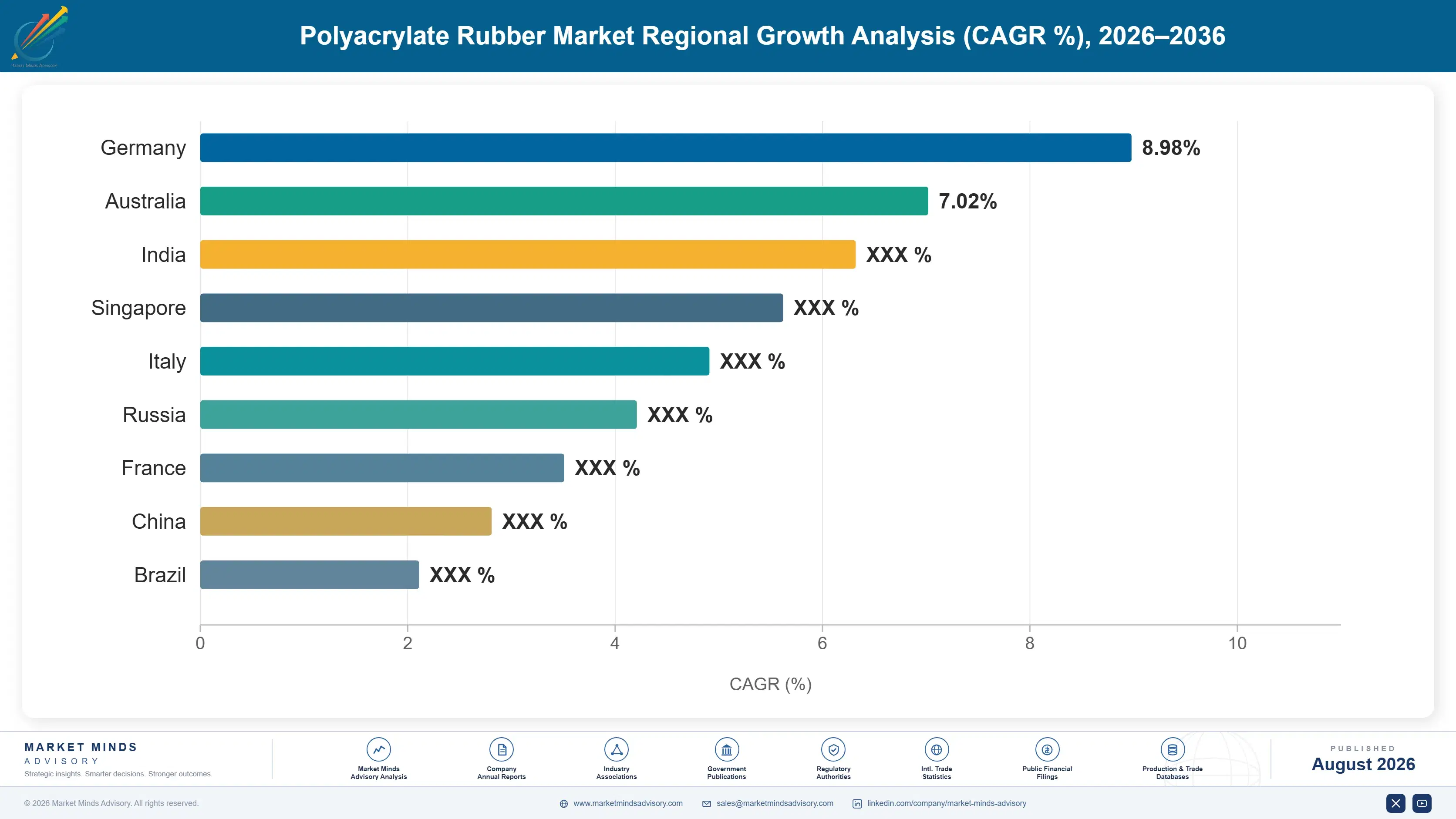
Regional Architecture and Country Demand Map

East Asia leads at 41%, far outside band, because Japanese and Chinese producers make most of the world's polyacrylate and it is consumed in regional vehicle production. India grows fastest as combustion output rises. Five regional shares sit outside their framework bands. Vehicle production and powertrain mix explain them.

East Asia

Forty-one percent, far outside the framework band, and justified because Japanese producers developed this chemistry and still hold most of the world's polymer capacity, while Chinese producers have added substantial volume alongside enormous regional vehicle output. Polymer made here is compounded and sealed into vehicles built here, so the supply chain barely leaves the region. Japanese cure system expertise remains the technical reference point globally. Growth at 5.8% runs above the market rate on hybrid production expanding across the region. Chinese producers have added capacity and compete on standard grades at prices Japanese producers do not attempt to match. Cure system chemistry remains the dividing line. Standard grades are where the pressure lands.
Share: 41% | CAGR: 5.8% (2026 to 2036)

North America

Twenty percent, below the framework band because demand follows combustion and hybrid vehicle production rather than industrial output, and light truck engines with large displacement carry more sealing content per vehicle than passenger cars do. That content advantage partly offsets lower unit volumes. Hybrid adoption has grown faster here than battery electric over the last two years, which supports the sealing base. Growth at 4.5% sits near the market rate, held there by that hybrid shift. Aftermarket seal demand is proportionally large here, running on fleet age rather than on new vehicle production, which adds a steadier base beneath the programme volumes. Replacement cycles are long. Nothing about that demand moves quickly.
Share: 20% | CAGR: 4.5% (2026 to 2036)
Regional intelligence for 5 additional markets available in the complete report: Western Europe, South Asia and Pacific, Latin America, Eastern Europe, Middle East and Africa. Contact sales@marketmindsadvisory.com.
polyacrylate-rubber-market-country-cagr-analysis-1787302391821

Grades, Cure Systems And Realism

Automotive carries 84% of demand, qualification runs 26 months, monomers are 57% of cost, and electrified grades grow at 7.35%. Value comes from electrified drivetrain formulation, from cure system depth, and from planning capacity against realistic drivetrain forecasts rather than hopeful ones. Volume forecasts have been the recurring error. Architecture beats volume. Nothing else has.

Formulate For Electrified Drivetrain Duty Cycles

Hybrid transmissions and electric drive units apply torque from cold in ways combustion engines never did, and standard grades stiffen enough to leak on those first rotations. Grades formulated for that duty grow at 7.35% against 4.9% for the market. The formulation difficulty is genuine, since monomer choices improving low-temperature flexibility degrade hot oil resistance, and producers who solved that balance are qualifying into programmes that will run for a decade. Two competitors have already qualified into programmes their rivals were never invited to quote for. Those positions run a decade.
Market Impact: Electrified grades grow at 7.35% ev

Sell Cure System Knowledge Rather Than Polymer Properties

Cure site chemistry determines moulding cycle time, compression set retention, and processing cleanliness, and seal makers value throughput as much as material properties because moulding cycle decides part cost at volume. Datasheet property comparison rarely settles anything. Producers who work alongside compounders on cure system optimisation hold positions through qualification cycles running around 26 months, and those positions rarely reopen afterwards. Moulding cycle time decides seal part cost far more than polymer price does at these volumes. Producers optimising cure systems alongside compounders win on that basis. Datasheets settle very little.
Market Impact: Qualification alone runs about 26 m

Plan Capacity Against Realistic Hybrid Retention

Roughly 84% of demand serves hot oil sealing that battery drivetrains do not have, and no second market of comparable scale has been found despite serious searching across industrial and oilfield applications. Capacity added on optimistic combustion forecasts will run empty. Producers planning against realistic hybrid retention rather than against total vehicle production have made better capital decisions than those treating electrification as a distant problem. Industrial hydraulics, oilfield sealing, and cable jacketing have all been examined without finding comparable scale. The search was serious and unsuccessful. Hybrid retention is the variable that decides this.
Market Impact: Automotive still carries fully 84%

Index Supply Agreements To Acrylate Monomer Movement

Acrylate monomers carry roughly 57% of polymer production cost and follow propylene and refinery economics, while seal makers price parts to vehicle manufacturers on multi-year programme terms that absorb nothing. Indexed agreements with compounders shift the exposure toward the party closer to the programme pricing. Compounders resist indexation and accept it more readily during qualification than after a programme has entered volume production. Ethyl and butyl acrylate move on related but not identical paths, and grades locked to one ratio cannot respond. Qualifying property windows preserves that flexibility. It must be built in from the start.
Market Impact: Monomers carry 57% of the total pol

Who Controls the Margin Pool

Concentration is very high at 79% across the top five measured on polymer tonnage supplied, and cure system chemistry rather than production scale holds it there. Acrylate copolymer synthesis with the right cure site monomer is genuinely difficult, and errors appear as compression set or heat aging failures years into a seal's service life rather than at qualification. The leader to challenger gap is widest in electrified drivetrain grades and narrower in standard hot oil applications.
Competitive activity runs on three fronts. Electrified drivetrain formulation is the first, where the only real growth in this market sits. Cure system optimisation alongside compounders is the second, since moulding cycle time decides seal part cost more than polymer price does. And regional supply positions are the third, because polymer, compounding, and sealing tend to happen inside one region.

Pressure arrives from two directions. Chinese producers have added capacity and compete on standard grades at prices Japanese producers do not match. And hydrogenated nitrile has taken some applications at the upper temperature boundary. Rankings shift on programme qualifications rather than on capacity announcements. Neither pressure reaches the electrified drivetrain grades, where formulation difficulty restricts the field to producers who solved the low-temperature balance.
polyacrylate-rubber-market-company-positioning-matrix-1787302392337

Competitive Moat and Risk Dimensions

ZEON CORPORATION

Moat: Cure system and qualification depth

Decades of acrylate elastomer development combined with qualification positions across engine, transmission, and driveline sealing programmes give a position no competitor assembles quickly. Cure system knowledge shows its value years into service life rather than at material selection, which makes it difficult for a challenger to demonstrate. Each qualified programme runs for that vehicle platform's whole production life.
ZEON CORPORATION

Risk: Exposure to combustion powertrain decline

Around 84% of demand serves hot oil sealing that battery drivetrains remove entirely, and depth in this chemistry is depth in a shrinking application base. Electrified drivetrain grades grow at 7.35% and are far smaller in absolute volume. No second market of comparable scale has been found despite considerable searching across industrial applications.
NOK CORPORATION

Moat: Integrated polymer and seal production

Producing both polymer and finished seals lets a supplier optimise cure system and moulding process together rather than across a commercial boundary, which shortens development and improves cycle time where seal makers earn their margin. That integration also secures polymer volume against internal demand. Competitors selling polymer alone depend on compounders they do not control.
NOK CORPORATION

Risk: Concentration in Japanese vehicle programmes

Weighting toward Japanese vehicle manufacturers ties demand to their powertrain strategies and production volumes rather than spreading across global programmes. Those manufacturers have committed to hybrids more than most, which currently helps and concentrates the risk. Growth in Indian and Southeast Asian production favours suppliers already positioned with regional compounders.

Players Tracked

Prominent Players

Zeon Corporation
NOK Corporation
Denka
Wanda Group
Toyo Ink

Other Key Players

Dow
Mitsubishi Chemical
Sumitomo Chemical
JSR Corporation
Kuraray
Trelleborg
Freudenberg Sealing Technologies
SKF
Parker Hannifin
Hutchinson
Zhejiang Jiaao Enprotech
Shandong Rike Chemical
Wuxi Yikailong
Eagle Industry
Tenneco

Recent Developments

JANUARY 2025

Producer qualifies low-temperature grade into e-axle programme

A polyacrylate producer completed qualification of a low-temperature grade into an electric drive unit sealing application after standard grades leaked during cold-start torque testing at the vehicle manufacturer. The qualification was a technical development outcome rather than any partnership, acquisition, or commercial arrangement change. Standard grades were withdrawn from consideration.
Signal: Cold-start torque is a failure mode this c
MAY 2025

Seal maker consolidates polyacrylate supply on cycle time

A sealing component manufacturer consolidated its polyacrylate purchasing onto one grade family after moulding trials showed materially shorter cycle times than the alternatives it had been running across several plants. The consolidation was an internal manufacturing decision rather than any supply dispute or pricing negotiation.
Signal: Moulding cycle time decides the seal part
AUGUST 2025

Producer defers capacity expansion on drivetrain forecast revision

A specialty elastomer producer deferred a planned polyacrylate capacity addition after revising its internal assumptions on combustion and hybrid vehicle production across its main regional markets. The deferral was an internal capital decision rather than any demand loss, customer change, or competitive development. Hybrid retention assumptions were lowered.
Signal: Capacity planning here now runs on drivetr

Acrylate Monomers, Cure Sites and Energy

Production cost divides between acrylate monomers including ethyl and butyl acrylate at roughly 57%, cure site monomers and specialty comonomers near 13%, polymerisation and finishing energy around 12%, emulsifiers, initiators, and process chemicals about 9%, and quality control, labour, and overhead the balance. Monomer dominates and follows propylene and refinery economics that no elastomer producer influences in any way.
Acrylate monomer pricing moved sharply through 2022 as propylene and energy costs tightened across Europe and Asia, and several specialty chemical producers disclosed input cost pressure in filings covering that year, with IEA data tracking the underlying energy movement. Cure site monomers, made in far smaller volumes, moved further again. Neither could be passed through quickly because seal prices are set on multi-year vehicle programme terms.

The competitive disadvantage mechanism runs through integration rather than through purchasing scale. Acrylate monomer pricing is broadly transparent and large buyers pay only modestly less, while a producer with upstream monomer positions carries a materially different cost structure through a cycle. Producers buying all monomer externally absorb the full movement, and the multi-year programme pricing downstream gives them nowhere to put it.
polyacrylate-rubber-market-cost-volatility-analysis-1787302392533

Index compounder agreements to published monomer movement

Acrylate monomers carry roughly 57% of production cost and follow propylene economics no elastomer producer influences, while downstream seal pricing runs on multi-year vehicle programme terms. Indexed agreements with compounders move that exposure toward parties closer to the programme. Compounders resist indexation and accept it considerably more readily during a qualification than after volume production has started.

Formulate across flexible monomer ratio windows

Ethyl and butyl acrylate move on related but not identical price paths, and a grade specified against one fixed ratio removes any ability to respond when that ratio becomes unfavourable. Qualifying property windows rather than single formulations during development preserves flexibility later. The constraint is that vehicle qualification documents specification tightly, so the flexibility has to be built

Weight the portfolio toward cure system specialty grades

Specialty cure site chemistry carries around 13% of cost while commanding pricing well above standard grades, which reduces the share of revenue exposed to base monomer movement. That mix shift also moves the business toward the properties compounders genuinely value. Specialty grades require closer technical work with seal makers, which is a capability rather than merely a cost.

Portfolio Architecture for Margin Defence

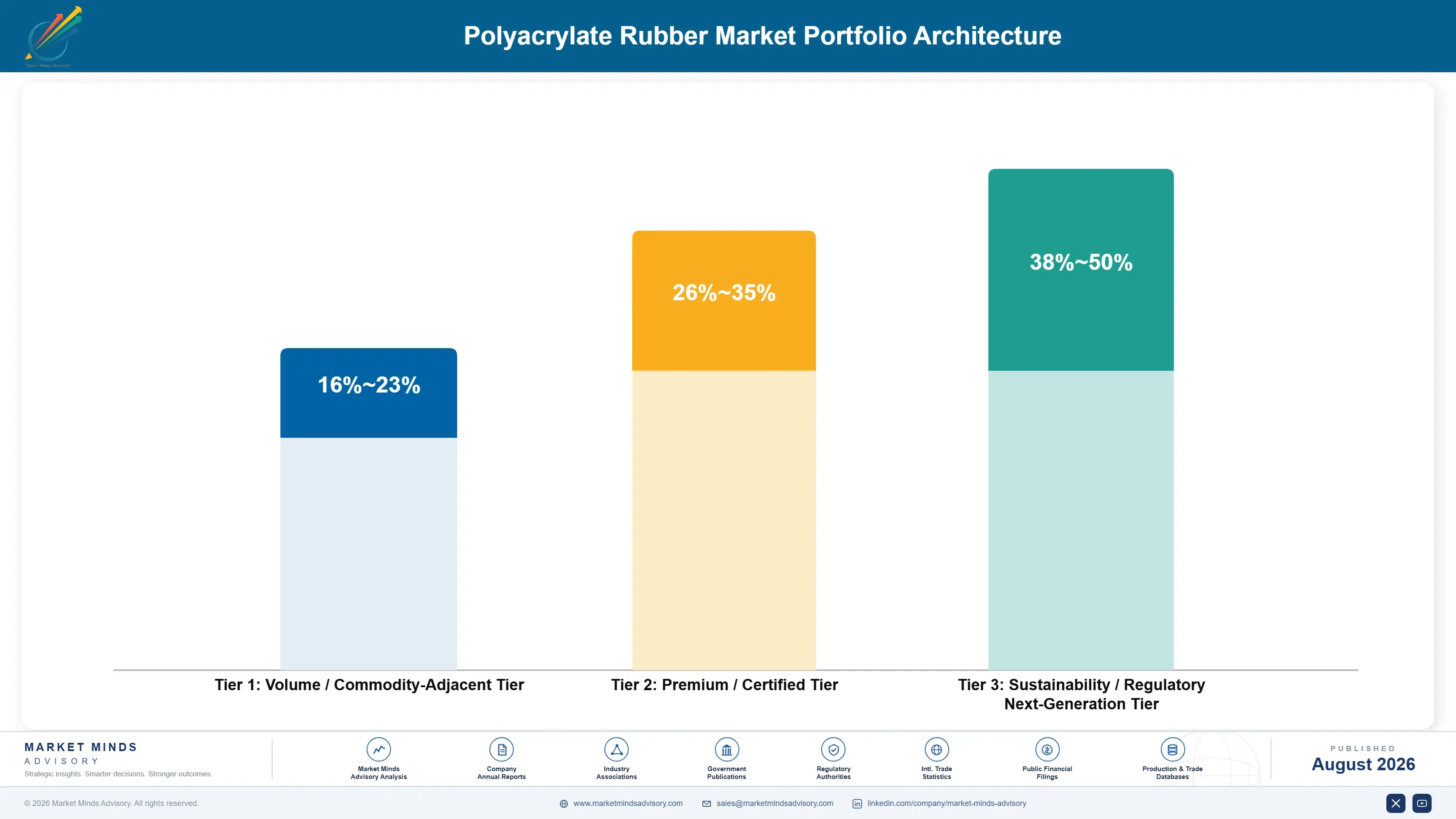
Three tiers describe this business and the spread follows cure system sophistication rather than volume. Standard ethyl acrylate grades sit at the bottom, where Chinese capacity competes on price and the chemistry is well understood. Butyl acrylate low-temperature and blended grades occupy the middle. Electrified drivetrain and specialty cure grades sit at the top, where formulation difficulty and programme qualification both restrict who competes.
The tension is that standard grades carry the volume into an application base that electrification is removing, while the growth tier is real but far smaller in absolute tonnage. A producer weighted to standard grades is defending share in a shrinking pool. One weighted toward electrified grades holds better margin on volumes that cannot fill a polymerisation line by themselves.

High-value pools concentrate where the failure mode is expensive and delayed. Specialty cure grades are the clearest case, since a compression set failure appears years into a seal's service life as a warranty claim, and vehicle manufacturers pay for chemistry that demonstrably does not do that. Electrified drivetrain grades are the second such pool, where the formulation balance restricts the field to very few producers.

Volume / Commodity-Adjacent Tier

Standard ethyl acrylate grades for conventional hot oil sealing where the chemistry is well understood and Chinese capacity competes hard on price. Carries the volume into a shrinking application base.
Gross Margin: 16-23%

Premium / Certified Tier

Butyl acrylate low-temperature and blended grades balancing cold flexibility against hot oil resistance. Formulation genuinely differentiates producers here, and qualification positions run for a platform's life. Cold flexibility and oil resistance trade against each other constantly.
Gross Margin: 26-35%

Sustainability / Regulatory / Next-Generation Tier

Electrified drivetrain grades and specialty cure site chemistries supporting shorter moulding cycles and better compression set. Best margin available and the only genuine growth anywhere in this market. Volumes cannot fill a polymerisation line alone.
Gross Margin: 38-50%
polyacrylate-rubber-market-portfolio-architecture-1787302393021

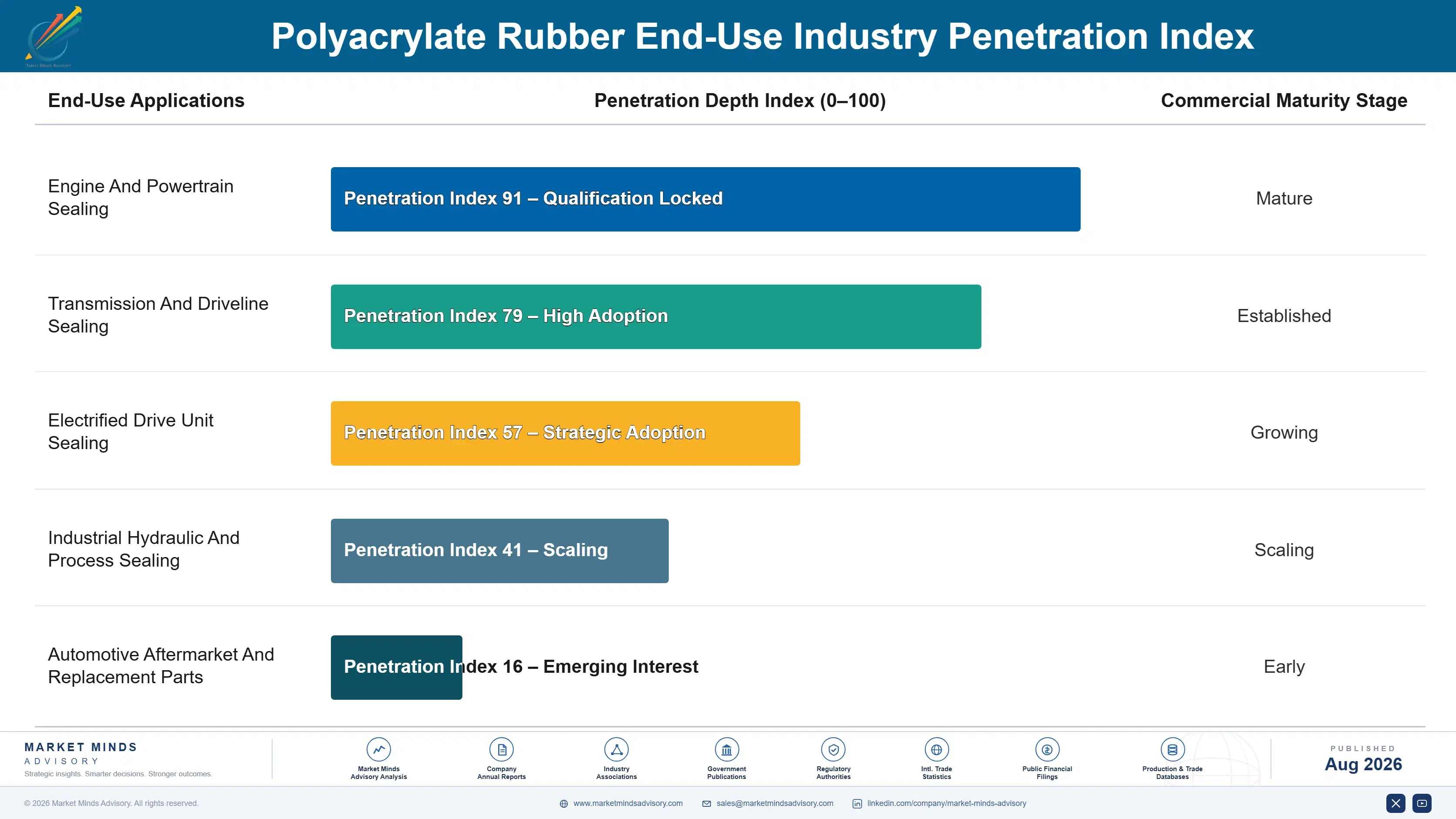
Programmes, Platforms and Aftermarket

Demand follows vehicle platform programmes rather than annual purchasing, which puts the commercial decision two to three years ahead of any volume and inside a qualification process running around 26 months. Once a grade is released into production it ships against that platform's build volume for years with no further selling activity. Losing a qualification means waiting for the next platform, which may be a decade away.
Stickiness is unusually strong and unusually brittle at the same time. A qualified grade cannot be substituted without requalification that no seal maker or vehicle manufacturer will undertake for material savings, so positions hold for a platform's life. The brittleness is that platforms end, and an electrified replacement may not need the material at all. Aftermarket seal demand runs on a longer and steadier cycle behind that.

Buyer profiles shifted as electrification progressed. The earlier conversation was with a seal maker's material engineer selecting against heat aging and compression set requirements. The current one increasingly involves a powertrain engineer at the vehicle manufacturer who is deciding whether the application exists at all in the next architecture, which is a conversation about survival rather than specification.
polyacrylate-rubber-market-end-use-penetration-index-1787302393519

What We Would Tell a Board

These are among the four positions where our research anticipates prominent divergence between winners and laggards over the coming forecast period. Each is grounded in the demand model, the regulatory perimeter, and the announced capacity pipeline.
01 / ELECTRIFIED GRADE PRIORITY

The only real growth is in electrified duty

Hybrid transmissions and electric drive units apply torque from cold in ways combustion engines never did, and standard grades stiffen enough at low temperature to leak on those first rotations. Grades formulated for that duty grow at 7.35% against 4.9% for the wider market and qualify into programmes running a decade. Producers who have not solved the low-temperature and hot oil balance are competing entirely inside the shrinking half of this market, against a base that battery drivetrains keep removing.
02 / CURE SYSTEM SELLING

Cycle time sells better than datasheet properties

Cure site chemistry determines moulding cycle time, compression set retention, and processing cleanliness, and seal makers value throughput quite as much as material properties, because moulding cycle decides part cost at any real volume. Datasheet property comparison between two already qualified grades rarely settles a purchasing decision on its own anywhere in this industry at all. Producers working alongside compounders on cure system optimisation hold positions through qualification cycles running around 26 months, and those positions very rarely reopen afterwards.
03 / CAPACITY REALISM DISCIPLINE

Plan against hybrids, not vehicle production totals

Roughly 84% of demand serves hot oil sealing that a battery drivetrain does not have at all, and no second market of remotely comparable scale has emerged despite serious searching across industrial, oilfield, and cable applications. Capacity added against total vehicle production forecasts rather than powertrain architecture will simply run empty as battery electric share continues rising. Planning against realistic hybrid retention rather than optimistic combustion forecasts has already produced measurably better capital decisions at several producers in this industry.
04 / MONOMER EXPOSURE MANAGEMENT

Index the agreement or absorb the whole cycle

Acrylate monomers carry roughly 57% of polymer production cost and follow propylene and refinery economics that no elastomer producer influences in any direction. Seal prices downstream are set on multi-year vehicle programme terms that absorb none of that movement whatsoever, which leaves the producer carrying all of it. Indexed supply agreements with compounders remain the only mechanism that actually works here at all, and they are negotiated far more easily during a qualification programme than after volume production has actually begun.

Engagement Snapshot From the Field

A live engagement with an industry participant carrying material or product regulatory and market exposure ahead of a defining policy shift, showing how our research translates into a defensible multi-year portfolio strategy.
MARKET MINDS ADVISORY · CLIENT ENGAGEMENT SUMMARY
Polyacrylate Rubber Producer Strategic Portfolio Review and Transition Roadmap 2026·Investment Scenario on Polyacrylate Rubber Exposure Evaluation 2025-26
CLIENT PROFILE
A specialty elastomer producer with approximately 340 million dollars in annual revenue (client-reported, unverified by MMA), of which polyacrylate represented a substantial minority supplied to automotive compounders across three regions. No electrified drivetrain grade existed, a capacity expansion had been approved on volume forecasts, and non-automotive applications had never been systematically examined. Capacity had been approved on volume forecasts.
STRATEGIC CHALLENGE
The board wanted an independent view on whether the approved capacity expansion made sense against realistic drivetrain forecasts, and whether the business had a future beyond the combustion sealing applications that carried almost all of its polyacrylate volume. Nobody internally had rebuilt demand from powertrain architecture rather than from vehicle totals.
MMA APPROACH
We rebuilt demand forecasts from powertrain architecture rather than vehicle production totals, by region and platform. Electrified drivetrain sealing requirements were assessed against the client's formulation capability. Non-automotive applications were screened for scale and technical fit, and monomer cost exposure was modelled across three price scenarios. Competitor qualification positions were then mapped by programme.
KEY FINDINGS
  1. Demand rebuilt from powertrain architecture rather than vehicle totals ran materially below the forecast underpinning the capacity approval, in every region examined.
  2. The client held no low-temperature grade suitable for electric drive unit sealing, and two competitors had already qualified into programmes the client had not been invited to quote.
  3. Non-automotive screening found no application combining adequate scale with a technical fit, confirming rather than resolving the concentration problem the board had suspected.
  4. Fixed annual pricing to compounders had cost the client meaningfully through the 2022 monomer cycle, and no agreement carried any indexation clause at all.
CLIENT PROFILE
A specialty elastomer producer with approximately 340 million dollars in annual revenue (client-reported, unverified by MMA), of which polyacrylate represented a substantial minority supplied to automotive compounders across three regions. No electrified drivetrain grade existed, a capacity expansion had been approved on volume forecasts, and non-automotive applications had never been systematically examined. Capacity had been approved on volume forecasts.
STRATEGIC CHALLENGE
The board wanted an independent view on whether the approved capacity expansion made sense against realistic drivetrain forecasts, and whether the business had a future beyond the combustion sealing applications that carried almost all of its polyacrylate volume. Nobody internally had rebuilt demand from powertrain architecture rather than from vehicle totals.
MMA APPROACH
We rebuilt demand forecasts from powertrain architecture rather than vehicle production totals, by region and platform. Electrified drivetrain sealing requirements were assessed against the client's formulation capability. Non-automotive applications were screened for scale and technical fit, and monomer cost exposure was modelled across three price scenarios. Competitor qualification positions were then mapped by programme.
KEY FINDINGS
  1. Demand rebuilt from powertrain architecture rather than vehicle totals ran materially below the forecast underpinning the capacity approval, in every region examined.
  2. The client held no low-temperature grade suitable for electric drive unit sealing, and two competitors had already qualified into programmes the client had not been invited to quote.
  3. Non-automotive screening found no application combining adequate scale with a technical fit, confirming rather than resolving the concentration problem the board had suspected.
  4. Fixed annual pricing to compounders had cost the client meaningfully through the 2022 monomer cycle, and no agreement carried any indexation clause at all.
RECOMMENDED STRATEGY
Phase 1: Phase 1 (months one to nine): defer the capacity expansion and redirect that capital into low-temperature grade development for electrified drivetrains. Phase 2: Phase 2 (months nine to thirty): introduce monomer indexation at every compounder agreement renewal, starting with those in active qualification. Phase 3: Phase 3 (months thirty to sixty): pursue electrified programme qualifications directly with vehicle manufacturers rather than only through compounders. Bypass the compounder where necessary.
OUTCOME
The capacity expansion was deferred and development funding redirected within two quarters. Indexation was accepted by three of five compounders at renewal, and a low-temperature grade entered qualification with one vehicle manufacturer (client-reported, unverified by MMA). Non-automotive screening was formally closed rather than left open indefinitely. The board accepted the concentration.

Frequently Asked Questions

Foundational context covering the market sizes, CAGR, scope, country, region and competition that inform every finding below. This section is provided to cover basics and most often pre-purchase conversations, answered from the MMA Primary Research Dataset.

What is the current size of the Polyacrylate Rubber Market?

The market is valued at USD 0.68 billion in 2025, rising to USD 0.72 billion in 2026. Scope covers polyacrylate elastomer supplied as raw polymer, not finished seals, acrylic emulsions, or other elastomer chemistries.

How large will the Polyacrylate Rubber Market be by 2036?

MMA forecasts USD 1.16 billion by 2036, an increase of USD 0.44 billion over the 2026 base. That represents an expansion multiple of 1.61 times across the forecast period.

What is the CAGR for the Polyacrylate Rubber Market 2026 to 2036?

The base case CAGR is 4.9%, with a bull case of 6.1% and a bear case of 3.7%. The historical rate from 2020 to 2025 was 3.9%, disrupted by vehicle production volatility.

Which segment is growing fastest?

Low-temperature grades for electrified powertrains at 7.35%, exactly 1.50 times the market rate. Hybrid transmissions and electric drive units apply cold-start torque that standard grades leak under.

Who are the major companies in the Polyacrylate Rubber Market?

Zeon Corporation, NOK Corporation, Denka, Wanda Group, and Toyo Ink lead on polymer tonnage supplied. The top five hold 79%, held there by cure system chemistry rather than by scale.

Which country is growing fastest?

India at 7.8%, where vehicle production is rising while fleets remain overwhelmingly combustion and hybrid. Sealing content per vehicle is lower than in North America because engines are smaller.

Report Segmentation Architecture

The full report scope spans multiple orthogonal segmentation dimensions, with cross-tabulated demand data provided for each dimension pair. Coverage extends further to regional breakdowns, trend trajectories, and the competitive detail needed to support segment-level decision-making.

By Polymer Grade And Cure System

  • Standard Ethyl Acrylate Grades
  • Butyl Acrylate Low-Temperature Grades
  • Low-Temperature Grades For Electrified Powertrains
  • Chlorine-Cure And Carboxyl-Cure Specialty Grades
  • Blended And Modified Acrylic Elastomer Grades

By End-Use Industry

  • Engine And Powertrain Sealing
  • Transmission And Driveline Sealing
  • Electrified Drive Unit Sealing
  • Industrial Hydraulic And Process Sealing
  • Automotive Aftermarket And Replacement Parts

By Commercial Model

  • Direct Polymer Supply To Compounders
  • Integrated Polymer And Seal Production
  • Vehicle Manufacturer Specified Programmes
  • Distributor And Regional Reseller Channels
  • Toll Polymerisation And Custom Grades

By Region

  • East Asia
  • North America
  • Western Europe
  • South Asia and Pacific
  • Latin America
  • Eastern Europe
  • Middle East and Africa

Scope, Methodology, and Coverage

Every figure in this report is reproducible from documented input assumptions. The scope below maps the historical period, the forecast horizon, the segmentation dimensions, and the countries covered, alongside the underlying primary and qualitative methodology.
Historical Period
2020 to 2025
Forecast Period
2026 to 2036
Base Year
2025 (USD billions; MMA Primary Research Dataset, August 2026)
Market Definition
This market comprises polyacrylate elastomer supplied as raw polymer for compounding into sealing and related applications, measured at producer revenue across direct compounder, integrated, specified programme, distribution, and toll channels. Coverage spans standard ethyl acrylate grades, butyl acrylate low-temperature grades, low-temperature grades formulated for electrified powertrain duty, chlorine-cure and carboxyl-cure specialty grades, and blended and modified acrylic elastomer grades. Compounded rubber and moulded seals sold as finished components, acrylic emulsion and solution polymers for coatings, adhesives and textiles, hydrogenated nitrile, fluoroelastomer and silicone chemistries, thermoplastic elastomers and vulcanisates, sealing system design and engineering services, and rubber processing equipment fall outside scope.
Quantitative Units
USD billions (current prices); polymer tonnage supplied; price per tonne by grade; sealing content per vehicle by powertrain type
Segmentation Dimensions
By Polymer Grade And Cure System; By End-Use Industry; By Commercial Model; By Region
Regions Covered
East Asia, North America, Western Europe, South Asia and Pacific, Latin America, Eastern Europe, Middle East and Africa
Countries Covered
Japan, China, South Korea, Taiwan, United States, Canada, Mexico, Germany, France, Italy, United Kingdom, Spain, India, Indonesia, Vietnam, Thailand, Brazil, Argentina, Turkey, South Africa, Poland, Czechia, Slovakia, Hungary, and additional markets relevant to this sector
Key Companies Profiled
Zeon Corporation, NOK Corporation, Denka, Wanda Group, Toyo Ink, Dow, Mitsubishi Chemical, Sumitomo Chemical, JSR Corporation, Kuraray, Trelleborg, Freudenberg Sealing Technologies, SKF, Parker Hannifin, Hutchinson, Zhejiang Jiaao Enprotech, Shandong Rike Chemical, Wuxi Yikailong, Eagle Industry, Tenneco
Quantitative Methodology
Primary survey, n=3,800 respondents, Q4 2025, six countries; demand-side model with trade association cross-validation
Qualitative Methodology
47 expert interviews, Q4 2025; applied to validate demand model assumptions, identify emerging dynamics, and assess competitive positioning
Report Format
PDF and XLSX data workbook (Word format preview document)
Publisher
Market Minds Advisory
Report Code
MMA-2026-CHM-854
Published
August 2026
Contact
sales@marketmindsadvisory.com | www.marketmindsadvisory.com

Purchase the full Polyacrylate Rubber Market Report (2026 to 2036).

The full report sizes polyacrylate rubber across five polymer grades, five end-use applications, five commercial models, and seven regions, with demand rebuilt from powertrain architecture rather than from vehicle production totals throughout. Sealing content per vehicle is quantified separately by combustion, hybrid, and battery electric drivetrain. Cure system capability is assessed as a distinct competitive dimension from polymerisation capacity. Competitive profiling covers twenty participants on polymer tonnage supplied, and non-automotive application options are screened for scale and technical fit. Regional demand is built from powertrain mix rather than from vehicle assembly volume.
Demand rebuilt from powertrain architecture rather than vehicle production totals
Sealing content per vehicle quantified separately by drivetrain type
Cure system capability assessed separately from polymerisation production capacity
Electrified drivetrain grade qualifications tracked by programme and producer
Non-automotive applications screened for scale and genuine technical fit
Acrylate monomer cost exposure modelled across three price scenarios

Built For The People Who Decide

From boardroom strategy to bench-side execution, this report is read cover-to-cover by leaders shaping the next decade of their industry, turning demand scenarios, market dynamics and valuation benchmarks into decisions.
CXOs/ Presidents/ VPs/ Managers
M&A and Corporate Development
Strategy Teams and R&D Heads
Procurement and Product Directors
Regulatory and Compliance Leaders
Investor Relations and Equity Analysts