Market Minds Advisory
Poly Cotton Market

Poly Cotton Market: Blend Ratio Economics and the Separation Problem Nobody Has Solved

The blend that took over workwear because it holds a press and costs less than cotton is now the one fabric on earth that almost nothing can pull back apart into usable fibre.

Lead Analyst

Bilal Shaikh

Published

September 2026

Make Smarter Decisions with Customized Research Insights

Request a free sample report and evaluate market opportunities, growth trends, and competitive dynamics relevant to your business needs.

2025 MARKET VALUE$28.4BMarket Size 2025
2036 FORECAST VALUE$46.6BBase Case , 2026 to 2036
CAGR 2026 TO 20364.6 %Bull 5.8% / Bear 3.4%
INCREMENTAL OPPORTUNITY$16.9BNet 10- year value creation
EXPANSION MULTIPLE1.57x2036 value over 2026 base
Strategic Levers
M&A Pipeline
Regional Outlook
Country Rankings
Competitive Intelligence
Segmental Deep-dive
Call-Us : 91 93563 13602

Executive Snapshot and Market Trajectory

Poly cotton exists because pure cotton will not hold a press and pure polyester will not breathe. That compromise took over workwear, uniforms and institutional textiles, and the same chemistry that makes it useful makes it almost impossible to recycle. Fifty years of convenience produced one very awkward disposal problem.
Separating polyester from cotton at commercial scale is the unsolved problem in textile circularity. Cellulose dissolution and glycolysis routes both work in a laboratory and almost nowhere else, with roughly 0.4% of global blended fibre volume having any commercial separation route available. European textile producer responsibility schemes are arriving anyway, and they will price a disposal problem the industry has spent fifty years creating. Nobody built the recovery route while the volume was being created.
Recycled polyester content blends grow at 6.9%, half again the market rate of 4.6%, on brand commitments rather than on any cost logic. East Asia holds 38% of value and South Asia and Pacific 20%, both well above the usual bands, because fabric production sits where the mills are rather than where the garments are worn. Concentration is negligible at 14%. Nothing here rewards scale.
Market Definition
Woven and knitted fabrics blending polyester with cotton in any ratio, measured at fabric producer selling price, including standard polyester-rich and cotton-rich constructions, stretch blends and recycled or preferred fibre content variants. Excludes pure cotton and pure polyester fabrics, blends with cellulosics other than cotton, finished garments, and yarn sold as yarn.
Base Year Value
$28.4B in 2025 (MMA Primary Research Dataset, August 2026)
Forecast Period
2026 to 2036, eleven discrete annual values
CAGR
4.6% base case. Bull 5.8%. Bear 3.4%.
Fastest Growth Segment
Recycled Polyester Content Blends: 6.9% CAGR
Fastest Growth Country
Bangladesh: 7.4% CAGR
Fastest Growth Region
South Asia and Pacific: 6.8% CAGR
Largest Region
East Asia: 38% of 2025 global value
Market Leaders
Weiqiao Textile, Texhong Textile Group, Arvind Limited, Vardhman Textiles, Nien Hsing Textile. Source: MMA Primary Research Dataset, July 2026.
Primary Survey
n=3,800 procurement and R&D decision-makers, Q4 2025, six countries
Methodology
Demand-side build-up, cross-validated against public data, 47 expert interviews

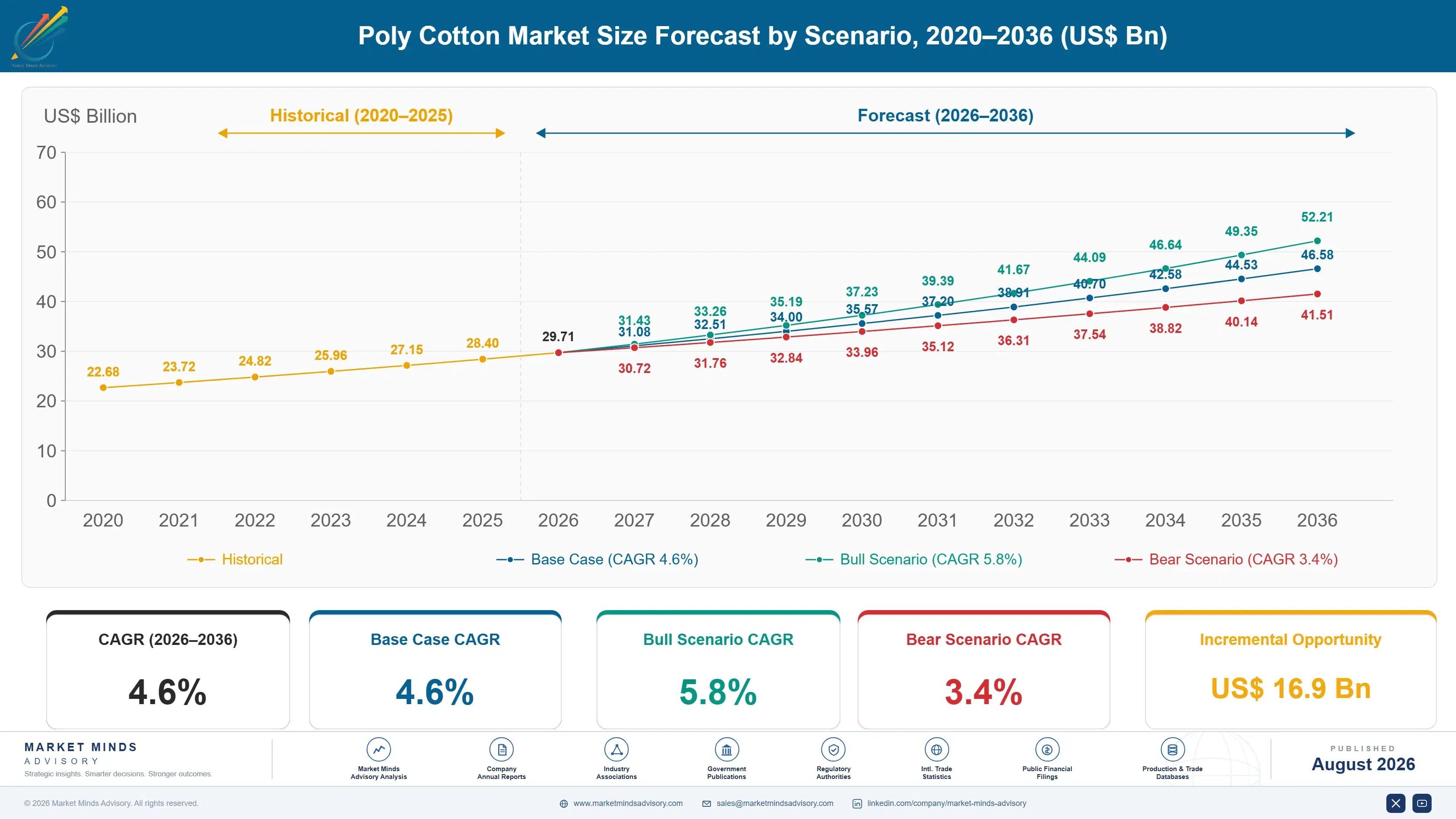
Poly Cotton Market Forecast Scenarios

poly-cotton-market-trends-size-forecast-scenario-1787580565663
Growth ran near 3.5% from 2020 to 2025 through a period that broke most textile forecasting. Pandemic demand collapsed and then overcorrected, freight costs made sourcing decisions temporarily irrational, and cotton prices swung violently in 2022 before falling back. Blend ratios drifted toward polyester through the cotton spike and drifted back afterwards, which is normal behaviour that few observers outside the mills actually track.
Base case 4.6% rests on three mechanisms. Institutional and workwear demand grows with employment in services, healthcare and logistics, and it replaces on a fixed cycle regardless of fashion. Bangladeshi and Vietnamese fabric capacity is expanding to serve garment assembly that has already relocated there, pulling fabric production out of China. And brand recycled content commitments are creating demand for recycled polyester blends that would not exist on price alone.
The bull case at 5.8% assumes separation technology reaches commercial scale during the forecast period, which would turn blended textile waste from a liability into a feedstock and change the material's regulatory position entirely. The bear case at 3.4% is European producer responsibility fees set high enough to push brands toward mono-material alternatives, conceding volume that polyester and cotton alone would take back.

Sixty-Five Thirty-Five and Why It Sticks

The 65/35 polyester cotton specification has survived six decades because it solves a problem nothing else solves as cheaply. Polyester carries the dimensional stability, the crease recovery and the abrasion resistance; cotton carries the hand, the moisture absorption and the comfort next to skin. Neither fibre alone delivers a garment that survives 200 industrial launderings and still looks presentable on the two hundred and first.
TOP FIVE CONCENTRATION14%Fabric production spread across thousands of independent mills
STANDARD BLEND RATIO65/35Polyester to cotton split on the dominant workwear specification
FIBRE COST SHARE58%Share of greige fabric cost carried by raw fibre
WORKWEAR VOLUME SHARE31%Portion of output going into uniform and workwear
BLEND SEPARATION CAPACITY0.4%Global blended fibre volume with commercial separation available
UNIFORM REPLACEMENT CYCLE3.5 yearsTypical garment life across managed uniform rental programmes
Blend ratio is also a quiet margin lever that outsiders rarely notice. When cotton prices spike relative to polyester staple, mills shift standard constructions by two or three percentage points toward polyester without changing the fabric name or the customer specification. Buyers testing fibre content find it inside tolerance and say nothing. That drift is worth real money across a mill's output, and it moves both ways.
What has changed is disposal. A pure cotton garment can be mechanically shredded into staple; a pure polyester one can be depolymerised. A blended garment can be neither, because cotton chars before polyester melts and mechanical routes cannot separate the fibres. Roughly 0.4% of global blended fibre volume has any commercial separation route today, and European producer responsibility schemes are written as though it were far larger.
"Every mill manager I have spoken to understands blend ratio drift and almost no brand sustainability team does. That gap is where the margin in this business has always lived, and it explains why recycled content pledges written in a boardroom keep arriving at a mill that has already optimised around something else entirely."
Principal, Textiles and Apparel Materials Practice · MMA Textiles and Materials Practice · August 2026

Market Trends

Fabric capacity relocating toward Bangladeshi and Vietnamese assembly

Garment assembly moved out of China more than a decade ago, but fabric production followed slowly because spinning and weaving are capital intensive and China held the cost position. That gap is now closing, with Bangladeshi and Vietnamese mills adding blended fabric capacity to shorten lead times and to satisfy rules of origin requirements in trade agreements. Bangladesh grows fastest anywhere at 7.4% on this basis. Local fabric supply removes weeks from a critical path that brands care about more than they care about the fabric price itself. Chinese cost advantage narrows every year this continues.
Market Impact: Replaces stock every 3.5 years

European textile producer responsibility schemes reaching blended fabrics

Extended producer responsibility for textiles is being implemented across France, the Netherlands and shortly the wider European Union, with fees weighted by how recyclable a product is. Blended fabrics fall into the worst category available, because no commercial route separates polyester from cotton at scale. Fee differentials are already visible in French eco-modulation schedules and will widen. Brands are responding by asking mills for mono-material alternatives on some programmes, and by demanding recycled content on the blends they intend to keep using regardless. Nobody expects the fee gap to narrow.
Market Impact: Drives 6.9% segment growth annually

Market Opportunities and Growth Drivers

Institutional and workwear demand replacing on fixed cycles

Uniform and workwear textiles account for roughly 31% of poly cotton output, and that demand behaves nothing like fashion. Garments in managed rental programmes are replaced every 3.5 years on average, driven by industrial laundering wear rather than by any style decision, and the specification is written into a service contract. Employment growth in healthcare, logistics and food service adds new wearers on top of the replacement base. It is the most predictable demand in the entire textile industry and the least discussed. Nothing about it responds to consumer sentiment, and nobody in fashion pays it much attention at all.
Market Impact: Leaves 99.6% without separation

Brand recycled content commitments pulling recycled polyester into blends

Apparel brands have set recycled content targets that are tracked publicly and expensive to abandon, and recycled polyester staple is the cheapest way to hit them. Blending recycled polyester with cotton produces a fabric that reports high recycled content without any change to the finished garment specification. Recycled polyester content blends grow at 6.9% as a result, against no cost advantage whatsoever over virgin staple. Mills that qualified recycled polyester supply chains early have taken programme business that price competition alone would never have won for them. The documentation, not the fibre, is the product being bought.
Market Impact: Exposes 58% of fabric cost

Market Restraints and Challenges

No commercial route separates polyester from cotton at scale

Blended textile waste cannot be mechanically shredded into usable staple and cannot be depolymerised without destroying the cotton first. The root cause is thermal: cellulose chars around 200 degrees while polyester needs considerably more to melt or depolymerise, so no single process handles both. Commercially it makes poly cotton the worst-scoring material under every producer responsibility scheme now being written. Cellulose dissolution and selective glycolysis routes both work at pilot scale, and roughly 0.4% of global blended volume currently has any commercial separation available. Neither route is close to the scale that European fee schedules assume exists.
Market Impact: Cuts 3 weeks from lead time

Cotton price volatility transmits directly into fabric margins

Fibre accounts for about 58% of greige fabric cost, and cotton is the volatile half of the blend. The root cause is agricultural: cotton is an annual crop exposed to weather, water availability and planting decisions made a year before the fabric is sold, while polyester staple tracks a petrochemical chain that moves differently. Mills holding fixed-price fabric contracts absorb the swing directly. Blend ratio drift within specification tolerance offsets part of it, and forward cotton contracting covers more, though few mills hedge systematically. The ones that do hedge systematically outperform through every cotton cycle.
Market Impact: Applies fees across 27 markets
3 additional market trends, 4 additional growth drivers, and 2 additional restraints and challenges are covered in the full report. Contact sales@marketmindsadvisory.com to access the complete intelligence.

Segment CAGR and Growth Architecture

Six segments split by fibre composition, because composition determines cost position, performance, regulatory treatment and recyclability all at once. Nothing else in this market separates products so cleanly. Fabric construction, end-use application and channel are handled in the framework rather than folded into this hierarchy at all. Composition is the only split that predicts anything useful. The rest is description.
poly-cotton-market-trends-market-share-analysis-1787580566239

Recycled Polyester Content Blends

Growing at 6.9%, half again the market rate of 4.6%, these are conventional poly cotton constructions using recycled rather than virgin polyester staple, typically from bottle-derived flake. The finished fabric performs identically and costs slightly more, so growth comes entirely from brand recycled content commitments rather than from any commercial advantage. Chain of custody documentation is the real product: buyers pay for verified recycled content, not for fibre properties. Mills that built certified supply chains early hold programme positions competitors cannot take on price. The segment does nothing whatever to solve the separation problem, which is the awkward part of its story. Growth continues regardless, because a public commitment is harder to abandon than a cost line is to absorb.
CAGR 6.9%

Organic and Preferred Cotton Content Blends

At 6.2% these blends substitute certified organic, Better Cotton or regenerative cotton for conventional fibre on the cellulosic side. Demand comes from the same brand commitment mechanism that drives recycled polyester, and often from the same programmes, since a brand reporting on both fibres wants both certified. Certified cotton carries a premium of roughly 15 to 30% over conventional depending on the standard, and supply is genuinely constrained rather than merely priced up. Verification fraud has been a recurring problem across the certified cotton chain, which has pushed brands toward mills able to demonstrate traceability directly rather than through intermediaries. Growth here runs slightly behind recycled polyester because certified cotton supply is physically constrained rather than merely expensive to buy.
CAGR 6.2%
Full segment breakdown across 6 segments available in the complete report.

Regional Architecture and Country Demand Map

East Asia holds 38% and South Asia and Pacific 20%, both well above their usual bands, because blended fabric production concentrates where spinning and weaving capacity sits. North America at 14% and Western Europe at 12% fall below their bands for the same reason, as consumption markets rather than producers.

North America

Domestic fabric production is a fraction of what it was, and the 14% share sits below the usual band because this is a consumption market rather than a producing one. What survives is concentrated and defensible: flame-retardant workwear fabric for utility and energy sector programmes, military and government specification cloth subject to domestic sourcing rules, and uniform fabric for rental operators who value short lead times over landed cost. Mexican fabric capacity serves North American garment assembly under trade agreement rules of origin. The recycling problem is being addressed here through state legislation rather than through any federal framework. Volume production is not coming back, and nobody in the industry pretends otherwise about it.
Share: 14% | CAGR: 3.4% (2026 to 2036)

Western Europe

The 12% share falls below the usual band because European mills long ago ceded volume production to Asia, retaining only technical and specification work. Italian and Portuguese mills hold positions in higher-value blended fabrics where lead time and small minimum orders matter more than price. Turkish capacity, counted separately, supplies a great deal of what European brands source as near-shore fabric. What makes this region matter is regulation rather than production: French and Dutch producer responsibility schemes are setting the fee structures that will govern blended fabrics across the whole European Union. What Europe writes into fee schedules will govern blended fabric specifications far beyond its own borders, which makes a small production share commercially misleading.
Share: 12% | CAGR: 3.0% (2026 to 2036)
Regional intelligence for 5 additional markets available in the complete report: East Asia, South Asia and Pacific, Latin America, Middle East and Africa, Eastern Europe. Contact sales@marketmindsadvisory.com.
poly-cotton-market-trends-country-cagr-analysis-1787580566783

Four Levers That Move Mill Margin

Fabric is a commodity with a specification, which means margin comes from what happens inside the tolerance band rather than from any price the customer agrees to pay. The mills that earn well manage fibre position, certification and lead time. The ones that compete on quoted price per metre do not last long. Price per metre is a losing argument.

Manage blend ratio actively against the fibre spread

Standard specifications carry tolerance, and shifting a 65/35 construction by two or three points toward polyester when cotton spikes stays comfortably inside it while fibre is 58% of fabric cost. Across a mill running 40 million metres a year the effect is worth several million dollars through a volatile cotton season. The discipline is doing it systematically against a spread signal rather than reactively when margins are already gone. Buyers test fibre content and find it in specification, which is exactly the point of working inside the tolerance. Few mills formalise the practice.
Market Impact: Protects 58% of fabric cost from fibre swings

Build verified recycled and preferred fibre chains early

Brand recycled content commitments are tracked publicly and cannot be quietly dropped, which makes certified supply a qualification requirement rather than a selling point. Recycled polyester blends grow at 6.9% with no cost advantage at all, so the product being bought is chain of custody documentation. Mills that built verified chains before the commitments matured hold programme business that competitors cannot take on price. Setting up certification and traceability costs perhaps 200 thousand dollars and takes a year, which is cheap against a multi-year programme award. Certification is a qualification gate now, not a differentiator.
Market Impact: Costs $200 thousand to qualify certified fibre chains

Locate capacity inside garment assembly regions

Trade agreement rules of origin reward fabric produced in the same region as the garment, and brands value the three weeks a local fabric supply removes from a critical path. Bangladeshi and Vietnamese capacity is being built on exactly this logic, and Bangladesh grows at 7.4% because of it. A mill positioned beside assembly wins programmes that a Chinese mill quoting a lower price per metre simply cannot access. Lead time and origin have become qualification criteria rather than commercial preferences. Capacity is being built on exactly this reasoning across the region.
Market Impact: Removes 3 weeks from the sourcing critical path

Take a position in separation technology before fees bite

European producer responsibility fees will penalise blended fabrics precisely because no commercial separation route exists, and roughly 0.4% of global blended volume currently has one. Mills that partner with cellulose dissolution or selective glycolysis developers now secure both feedstock offtake and a defensible position when fee structures mature. The investment is modest against the alternative, which is watching brands migrate blended programmes toward mono-material substitutes. Whoever holds separation capacity when the fees arrive prices it accordingly. Feedstock offtake is the part worth securing first, and terms available today will not survive the fee schedules maturing.
Market Impact: Positions against just 0.4% of global separation capacity

Who Controls the Margin Pool

Participation is measured on annual blended fabric production volume in metres, and the top five hold just 14%. This is among the most fragmented industrial markets anywhere, with thousands of mills at regional scale and nobody able to influence pricing. Weiqiao and Texhong lead on integrated scale rather than on any commercial position that scale confers. The gap to challengers is fibre integration and finishing breadth.
Competition runs on cost position first, since fabric to a written specification is close to interchangeable. Fibre integration is second: mills spinning their own staple and buying cotton directly hold several points over those buying yarn. Certification and traceability is the third, and it has become a qualification requirement for brand programmes rather than a differentiator. Lead time and origin now decide awards that price used to settle outright.

Pressure ahead comes from regulation rather than from any competitor. Producer responsibility fees weighted by recyclability fall hardest on exactly this product, and brands are already testing mono-material alternatives on some programmes. Expect joint development arrangements with separation technology developers rather than acquisitions, since mills lack the balance sheets for anything larger. Rankings shift as Bangladeshi and Vietnamese capacity matures and Chinese cost advantage narrows.
poly-cotton-market-trends-company-positioning-matrix-1787580567307

Competitive Moat and Risk Dimensions

WEIQIAO TEXTILE

Moat: Integrated scale and cotton access

Weiqiao operates spinning, weaving and finishing at a scale few competitors approach, with direct cotton procurement that removes a trading layer from the cost stack. That integration produces several points of margin over mills buying yarn, which matters enormously in a business where fabric to specification is otherwise close to interchangeable between suppliers.
WEIQIAO TEXTILE

Risk: Xinjiang sourcing restriction exposure

Restrictions on Xinjiang cotton across Western markets have narrowed which of the company's output can serve European and American brand programmes, regardless of the actual provenance of any given lot. Demonstrating traceability to Western brand standards is expensive and slow, and it pushes volume toward domestic Chinese customers who pay considerably less for it.
TEXHONG TEXTILE GROUP

Moat: Vietnamese capacity and origin advantage

Texhong built substantial Vietnamese spinning and fabric capacity ahead of most competitors, which places it inside the rules of origin that trade agreements reward and beside the garment assembly base brands now use. That combination of location and scale is difficult to replicate quickly, since the capital and the land both take years to assemble properly.
TEXHONG TEXTILE GROUP

Risk: Cotton price exposure on volume

The group's scale in cotton-weighted yarns means cotton price movements transmit into results with unusual force, and fabric contracts rarely reprice fast enough to follow. A repeat of the 2022 cotton spike would compress margins across a large share of output before any blend ratio adjustment could work through the production and contract cycle.

Players Tracked

Prominent Players

Weiqiao Textile
Texhong Textile Group
Arvind Limited
Vardhman Textiles
Nien Hsing Textile

Other Key Players

Paramount Textile
Shenzhou International
Youngone Corporation
Far Eastern New Century
Toray Industries
Welspun Living
Trident Group
KPR Mill
Nahar Spinning Mills
Interloop
Nishat Mills
Lu Thai Textile
Huafang Group
Alok Industries
Grasim Industries

Recent Developments

APRIL 2026

French eco-modulation schedule widens fee gap for blended textiles

The French textile producer responsibility scheme widened the fee differential between mono-material and blended products in its published eco-modulation schedule, citing the absence of any commercial separation route. Blended workwear and uniform fabrics fall into the highest fee category under the revised structure. Further increases are already scheduled.
Signal: Regulators are now pricing recyclability directly, which turns a technical limitation into a per-garment cost for brands
OCTOBER 2025

Bangladeshi group commissions integrated blended fabric capacity

A Bangladeshi textile group commissioned spinning and weaving capacity for blended fabrics adjacent to its existing garment assembly operations, targeting lead time reduction and rules of origin qualification. The project is an organic capacity expansion rather than an acquisition or a joint venture with any foreign partner.
Signal: Fabric production is following garment assembly at last, which reorders where blended volume is actually made
FEBRUARY 2026

Separation technology developer signs mill offtake for dissolved cellulose

A cellulose dissolution technology developer signed an offtake arrangement with an Asian mill group covering recovered cellulosic pulp from blended textile waste. The agreement is a feedstock and offtake supply arrangement rather than an equity investment or a merger of the two businesses. Volumes were not disclosed by either party.
Signal: Mills are taking positions in separation before fees mature, which is the only defensive move available to them

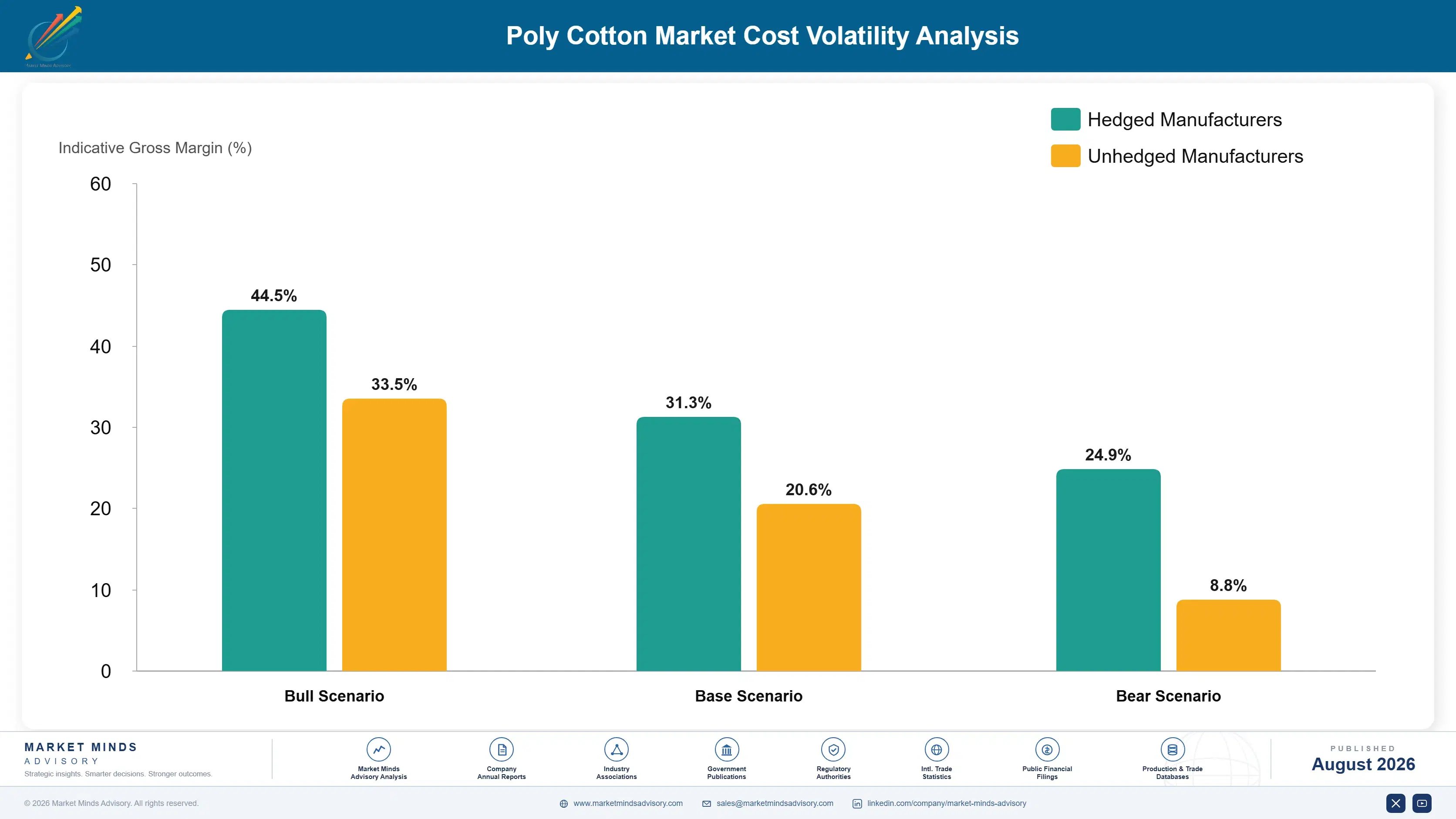
Fibre Is Most of the Cost

Raw fibre accounts for roughly 58% of greige fabric cost, split between polyester staple and cotton in whatever ratio the construction specifies. Polyester staple comes from terephthalic acid and glycol chains concentrated in China, India and Southeast Asia, or from recycled bottle flake. Cotton arrives from the United States, Brazil, India, Australia and West Africa. Spinning and weaving add about 22%, dyeing and finishing a further 14%.
The 2022 cotton price movement is the reference event for this industry. Cotton reached decade highs on drought in the American Southwest and strong post-pandemic demand, per USDA cotton supply and demand reporting for that season, then fell back over the following year. Mills holding fixed-price fabric contracts absorbed the increase directly, and several Indian and Pakistani spinners disclosed material margin compression in their annual reporting for that period.

Exposure varies by integration and by blend position. An integrated mill spinning its own staple and buying cotton forward moves within a season, while one buying yarn on spot carries everything. Cotton-weighted constructions carry more risk than polyester-weighted ones for obvious reasons. Geography matters too: Indian and Chinese mills sit beside domestic staple capacity that European producers must import at freight and duty parity.
poly-cotton-market-trends-cost-volatility-analysis-1787580567502

Contract cotton forward against committed fabric orders

Matching cotton purchase tenor to fabric contract tenor removes most of the exposure that damaged spinners through the last cotton spike. Forward contracting costs a modest premium in normal conditions and eliminates the mismatch entirely when prices move. Relatively few mills do this systematically, which is why the same margin compression recurs in every cotton cycle without much variation.

Use blend ratio tolerance as a standing hedge

Standard constructions carry fibre content tolerance wide enough to absorb a two or three point shift toward whichever fibre is cheaper. Managed against the cotton to polyester staple spread rather than reactively, this offsets a meaningful share of fibre cost movement at no capital cost at all. The practice is universal among experienced mills and almost never formalised.

Qualify recycled polyester staple as a second supply route

Recycled staple from bottle flake prices differently from virgin polyester and moves on a partly separate supply chain, so holding both qualified gives a mill genuine substitution options. Certification work is needed regardless for brand programmes, so the hedging benefit arrives free once traceability is in place. Most qualify it for compliance and never use it commercially.

Portfolio Architecture for Margin Defence

Margin in blended fabric tracks specification difficulty and certification, not volume. Commodity greige and standard finished constructions earn single-digit to low-teens margins, because thousands of mills can make them and buyers can qualify a second source in weeks. Scale helps with cost but confers no pricing power at all, which is why the largest producers are not the most profitable ones.
Certified and performance-finished fabrics do considerably better, at margins in the low to high twenties. The range is wide because it spans simple recycled content certification at one end and flame-retardant or antimicrobial finished workwear cloth at the other, where testing and approval requirements exclude most of the field and buyers accept the price that follows. Approval work, not fibre, is what the buyer purchases here.

The strongest positions are in specification-locked institutional fabrics, running into the low thirties, where a rental operator or government body has written the cloth into a multi-year contract. Those margins reflect switching cost rather than product superiority, and they persist as long as the contract does. Nothing else in this market offers comparable durability. The contract is the asset.

Standard Greige and Finished Blends

Conventional polyester cotton constructions sold to open specification. Thousands of mills compete and second sourcing takes weeks, so the eight point range reflects fibre integration and mill scale rather than any product position worth defending.
Gross Margin: 8-16%

Certified and Performance-Finished Blends

Recycled content, preferred cotton and performance-finished fabrics carrying verification or test approval. The ten point range spans simple content certification through to flame-retardant workwear cloth, where approval requirements exclude most competing mills entirely.
Gross Margin: 18-28%

Separation-Ready and Contract-Locked Fabrics

Institutional cloth written into multi-year rental or government contracts, and fabrics designed for emerging separation routes. The ten point range reflects contract tenor and switching cost, which vary from a single season to a full replacement cycle.
Gross Margin: 24-34%
poly-cotton-market-trends-portfolio-architecture-1787580568004

High-value Sub-segments and Strategic Watch-out

Institutional Contract-Locked Workwear Cloth

High value and steadily growing. Rental operators and government bodies write cloth into multi-year contracts that replace on a fixed cycle, insulating volume from fashion and from promotional pricing entirely. Switching cost rather than product superiority sustains the margin here. Contract tenor is the variable that matters most.
Gross Margin: 26-34%

Certified Recycled Content Blends

High value and the fastest growing position at 6.9%. Brand commitments make certification a qualification requirement rather than a selling point, and the product being purchased is chain of custody documentation rather than any fibre property. Mills that qualified early hold positions competitors cannot bid against on price at all.
Gross Margin: 20-28%

Standard Commodity Blended Fabric

The volume core and permanently price-led across every producing region. Thousands of mills make an interchangeable product and buyers requalify sources in weeks. Growth follows apparel and workwear volume with no margin improvement realistically available. Fibre integration and mill scale are the only cost levers available anywhere here.
Gross Margin: 8-16%

Blends Facing Producer Responsibility Fees

The strategic watch-out. European fee schedules penalise blended fabrics precisely because separation does not exist commercially, and brands are testing mono-material substitutes on affected programmes. The margin range shown assumes fees at current rather than announced future levels. Announced future schedules would compress the range considerably further.
Gross Margin: 6-18%

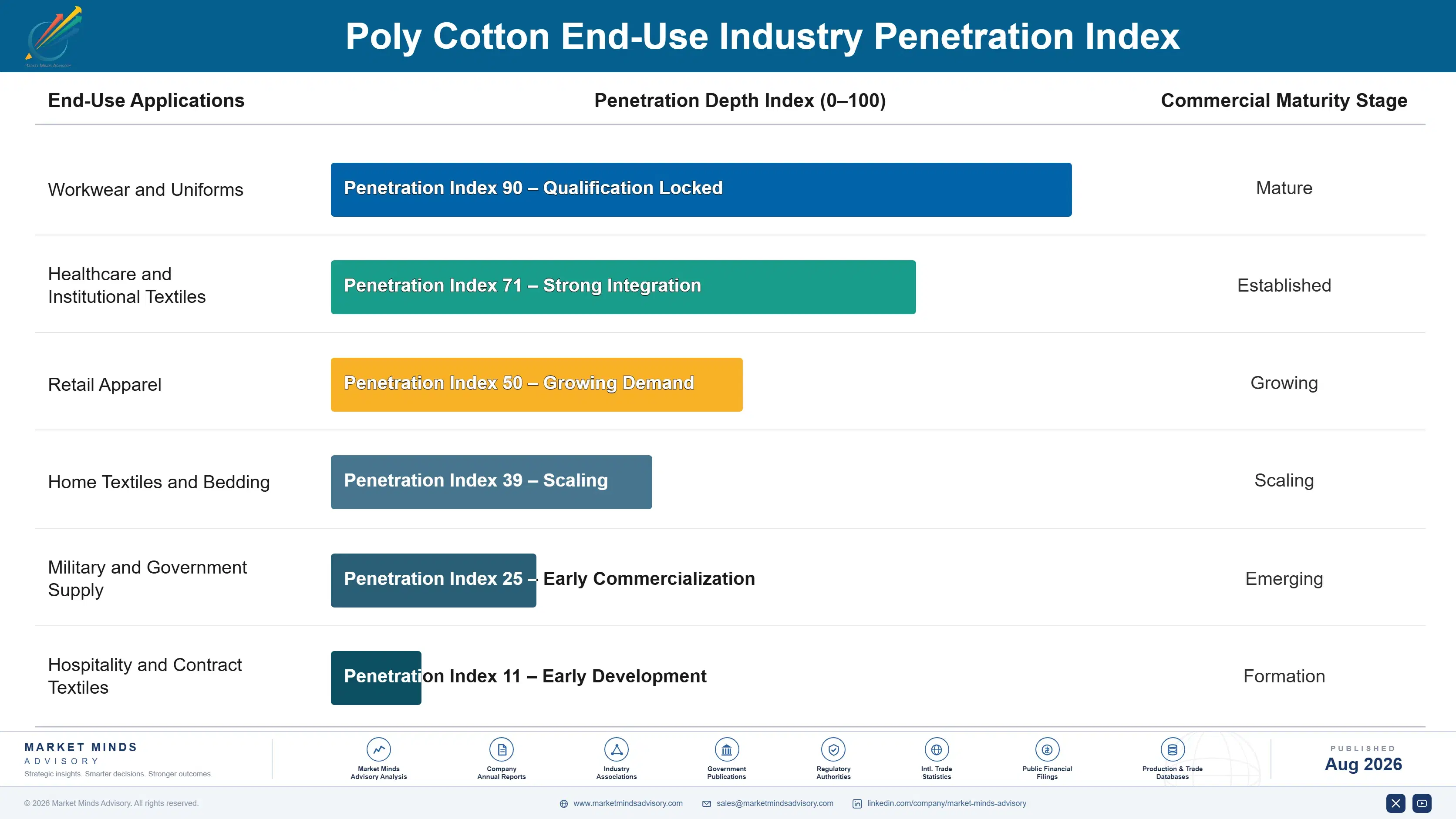
Where the Repeat Volume Lives

Institutional textile demand is the closest thing to an annuity in apparel materials. A uniform rental operator replaces garments every 3.5 years on a schedule set by industrial laundering wear rather than by anything a customer decides, and the fabric specification sits inside a service contract running for years. Roughly 31% of poly cotton output goes into this pattern, and it is why the material survived every fashion cycle that came and went around it.
Stickiness varies sharply by end use. Government and military specification cloth is stickiest, since the fabric is written into a procurement standard that takes years to amend. Rental operator programmes come next, held by contract tenor and by the cost of requalifying a cloth across a whole garment range. Retail apparel brands switch mills seasonally on price and lead time. Promotional and fast fashion volume is effectively spot business throughout.

The specifying buyer has moved. Fabric selection sat with garment technologists choosing on hand feel and durability for decades. Recycled content commitments and producer responsibility fees have pulled it toward sustainability and compliance functions, who buy documentation and fee exposure rather than fabric, and who often have never visited a mill.
poly-cotton-market-trends-end-use-penetration-index-1787580568493

Where We Would Focus

These are among the four positions where our research anticipates prominent divergence between winners and laggards over the coming forecast period. Each is grounded in the demand model, the regulatory perimeter, and the announced capacity pipeline.
01 / FIBRE POSITION MANAGEMENT

Run blend ratio against the spread, not against panic

Fibre is 58% of greige fabric cost and standard specifications carry tolerance wide enough to absorb a two or three point shift toward whichever fibre is cheaper. Across a mill running 40 million metres annually that is worth several million dollars through a volatile cotton season. Most mills do this reactively once margin has already gone; doing it systematically against a spread signal, alongside forward cotton contracting, is what separates the consistently profitable operations from the merely large ones in this industry.
02 / CERTIFICATION CHAIN BUILDING

Qualify verified fibre chains before brand commitments mature

Recycled polyester blends grow at 6.9% with no cost advantage over virgin staple, which means the product being purchased is chain of custody documentation rather than fibre performance. Brand commitments are tracked publicly and cannot be dropped quietly, so certification has become a qualification requirement. Setting up traceability costs roughly 200 thousand dollars and takes a year, which is inexpensive against multi-year programme awards that competitors lacking the documentation cannot bid for at all, whatever price they are prepared to quote.
03 / ORIGIN AND LEAD TIME

Put capacity beside the assembly, not beside the cheapest labour

Trade agreement rules of origin reward fabric produced in the same region as the garment, and local fabric supply removes roughly three weeks from a critical path brands care about more than fabric price. Bangladesh grows at 7.4% on exactly this logic and nothing else. A mill positioned beside the assembly base wins programmes that a Chinese competitor quoting a lower price per metre simply cannot access, because origin and lead time have both become formal qualification criteria rather than commercial preferences.
04 / SEPARATION TECHNOLOGY POSITION

Secure a separation partnership before the fees mature

European producer responsibility fees penalise blended fabrics precisely because roughly 0.4% of global blended volume has any commercial separation route available to it today. Mills that partner with cellulose dissolution or selective glycolysis developers now secure both feedstock offtake and a defensible commercial position before fee structures reach their full weight. The alternative is watching brands quietly migrate blended programmes toward mono-material substitutes instead, which removes volume permanently, since no amount of price competition brings a reformulated programme back afterwards.

Engagement Snapshot From the Field

A live engagement with an industry participant carrying material or product regulatory and market exposure ahead of a defining policy shift, showing how our research translates into a defensible multi-year portfolio strategy.
MARKET MINDS ADVISORY · CLIENT ENGAGEMENT SUMMARY
Poly Cotton Producer Strategic Portfolio Review and Transition Roadmap 2026·Investment Scenario on Poly Cotton Exposure Evaluation 2025-26
CLIENT PROFILE
A European uniform rental operator serving healthcare, food processing and industrial customers across six countries, with roughly 4.1 million garments in circulation and annual revenue near 720 million euros (client-reported, unverified by MMA). Fabric was purchased against internal specifications largely unchanged for a decade, mostly 65/35 polyester cotton constructions from four Asian mills. Specifications had not been reviewed since 2016.
STRATEGIC CHALLENGE
French producer responsibility fees had begun applying to the operator's garment pool and were scheduled to rise, with blended fabrics falling into the highest category. Several large customers had separately asked for recycled content commitments. Management needed to know whether to reformulate specifications, absorb the fees, or restructure sourcing, and had no view on which would cost least.
MMA APPROACH
MMA modelled fee exposure across the garment pool under current and announced eco-modulation schedules, then tested mono-material and recycled content alternatives against industrial laundering durability requirements. Mill capability was benchmarked across eleven suppliers on certification, traceability and separation partnerships. Interviews with 47 experts covered textile recycling technology, producer responsibility policy and rental garment specification.
KEY FINDINGS
  1. Mono-material polyester alternatives failed comfort and moisture requirements in healthcare applications, and pure cotton failed durability across the industrial laundering cycles the pool requires.
  2. Recycled polyester content satisfied customer commitments at a fabric cost premium near 6%, recoverable within contract pricing, but changed fee exposure not at all.
  3. Fee exposure over the replacement cycle exceeded the cost of qualifying mills with separation partnerships, making the sourcing question a compliance decision rather than a procurement one.
  4. Only two of the eleven mills benchmarked held any separation technology relationship, and both were already allocating that capability to larger customers.
CLIENT PROFILE
A European uniform rental operator serving healthcare, food processing and industrial customers across six countries, with roughly 4.1 million garments in circulation and annual revenue near 720 million euros (client-reported, unverified by MMA). Fabric was purchased against internal specifications largely unchanged for a decade, mostly 65/35 polyester cotton constructions from four Asian mills. Specifications had not been reviewed since 2016.
STRATEGIC CHALLENGE
French producer responsibility fees had begun applying to the operator's garment pool and were scheduled to rise, with blended fabrics falling into the highest category. Several large customers had separately asked for recycled content commitments. Management needed to know whether to reformulate specifications, absorb the fees, or restructure sourcing, and had no view on which would cost least.
MMA APPROACH
MMA modelled fee exposure across the garment pool under current and announced eco-modulation schedules, then tested mono-material and recycled content alternatives against industrial laundering durability requirements. Mill capability was benchmarked across eleven suppliers on certification, traceability and separation partnerships. Interviews with 47 experts covered textile recycling technology, producer responsibility policy and rental garment specification.
KEY FINDINGS
  1. Mono-material polyester alternatives failed comfort and moisture requirements in healthcare applications, and pure cotton failed durability across the industrial laundering cycles the pool requires.
  2. Recycled polyester content satisfied customer commitments at a fabric cost premium near 6%, recoverable within contract pricing, but changed fee exposure not at all.
  3. Fee exposure over the replacement cycle exceeded the cost of qualifying mills with separation partnerships, making the sourcing question a compliance decision rather than a procurement one.
  4. Only two of the eleven mills benchmarked held any separation technology relationship, and both were already allocating that capability to larger customers.
RECOMMENDED STRATEGY
Phase 1: Phase one: specify minimum recycled polyester content across the pool at the next replacement cycle, meeting customer commitments without altering garment performance. Phase 2: Phase two: qualify the two mills holding separation partnerships as preferred suppliers, accepting a modest cost premium against future fee exposure. Phase 3: Phase three: pilot separation-ready constructions on a single customer contract before committing the wider pool to any unproven fabric specification.
OUTCOME
The operator specified recycled content across the pool from the 2026 replacement cycle and qualified both separation-partnered mills, reporting a fabric cost increase near 6% offset within contract repricing (client-reported, unverified by MMA). Fee exposure modelling now forms part of the annual specification review, which it had never previously done.

Frequently Asked Questions

Foundational context covering the market sizes, CAGR, scope, country, region and competition that inform every finding below. This section is provided to cover basics and most often pre-purchase conversations, answered from the MMA Primary Research Dataset.

What is the current size of the Poly Cotton Market?

MMA sizes it at USD 28.4 billion in 2025, rising to USD 29.71 billion in 2026. The figure covers woven and knitted polyester cotton blended fabrics at producer selling price.

How large will the Poly Cotton Market be by 2036?

USD 46.58 billion by 2036, an incremental USD 16.87 billion over the 2026 base and an expansion multiple of 1.57 times. Certified fibre content blends account for a disproportionate share.

What is the CAGR for the Poly Cotton Market 2026 to 2036?

4.6% in the base case, with a bull case at 5.8% and a bear case at 3.4%. The spread turns on separation technology reaching scale and on how heavily producer responsibility fees land.

Which segment is growing fastest?

Recycled polyester content blends at 6.9%, half again the market rate of 4.6%. Growth comes from brand commitments rather than from any cost or performance advantage.

Who are the major companies in the Poly Cotton Market?

Weiqiao Textile, Texhong Textile Group, Arvind Limited, Vardhman Textiles and Nien Hsing Textile lead on annual fabric production volume. Fifteen further participants are profiled in the full report.

Which country is growing fastest?

Bangladesh at 7.4%, as blended fabric capacity is built behind garment assembly that relocated there years ago. Local fabric supply removes roughly three weeks from sourcing lead times.

Report Segmentation Architecture

The full report scope spans multiple orthogonal segmentation dimensions, with cross-tabulated demand data provided for each dimension pair. Coverage extends further to regional breakdowns, trend trajectories, and the competitive detail needed to support segment-level decision-making.

By Fibre Composition

  • Standard Polyester-Rich Blends
  • Cotton-Rich CVC Blends
  • Elastane-Containing Stretch Blends
  • Recycled Polyester Content Blends
  • Organic and Preferred Cotton Blends
  • Specialty Fibre Blends

By End-Use Industry

  • Workwear and Uniforms
  • Healthcare and Institutional Textiles
  • Retail Apparel
  • Home Textiles and Bedding
  • Military and Government Supply
  • Hospitality and Contract Textiles

By Commercial Dimension

  • Direct Supply to Garment Makers
  • Brand Nominated Fabric Supply
  • Uniform Rental Operator Contracts
  • Converter and Trader Supply
  • Government Tender Supply
  • Export and Cross-Border Trade

By Region

  • North America
  • Western Europe
  • East Asia
  • South Asia and Pacific
  • Latin America
  • Middle East and Africa
  • Eastern Europe

Scope, Methodology, and Coverage

Every figure in this report is reproducible from documented input assumptions. The scope below maps the historical period, the forecast horizon, the segmentation dimensions, and the countries covered, alongside the underlying primary and qualitative methodology.
Historical Period
2020 to 2025
Forecast Period
2026 to 2036
Base Year
2025 (USD billions; MMA Primary Research Dataset, August 2026)
Market Definition
Woven and knitted fabrics blending polyester with cotton in any ratio, measured at fabric producer selling price, spanning standard polyester-rich and cotton-rich constructions, stretch blends containing elastane, recycled polyester content variants, preferred and organic cotton content variants, and specialty fibre blends. Pure cotton and pure polyester fabrics, blends with cellulosics other than cotton, finished garments and yarn sold as yarn are excluded from scope.
Quantitative Units
USD billions (current prices); billion linear metres produced; USD per metre by construction and region
Segmentation Dimensions
Fibre composition; end-use industry; commercial dimension; region
Regions Covered
North America, Western Europe, East Asia, South Asia and Pacific, Latin America, Middle East and Africa, Eastern Europe
Countries Covered
United States, Canada, Mexico, Germany, Italy, Portugal, France, United Kingdom, China, Japan, South Korea, India, Bangladesh, Pakistan, Vietnam, Brazil, Turkey, Egypt, Poland, Romania
Key Companies Profiled
Weiqiao Textile, Texhong Textile Group, Arvind Limited, Vardhman Textiles, Nien Hsing Textile, Paramount Textile, Shenzhou International, Youngone Corporation, Far Eastern New Century, Toray Industries, Welspun Living, Trident Group, KPR Mill, Nahar Spinning Mills, Interloop, Nishat Mills, Lu Thai Textile, Huafang Group, Alok Industries, Grasim Industries
Quantitative Methodology
Primary survey, n=3,800 respondents, Q4 2025, six countries; demand-side model with trade association cross-validation
Qualitative Methodology
47 expert interviews, Q4 2025; applied to validate demand model assumptions, identify emerging dynamics, and assess competitive positioning
Report Format
PDF and XLSX data workbook (Word format preview document)
Publisher
Market Minds Advisory
Report Code
MMA-2026-CHM-121
Published
August 2026
Contact
sales@marketmindsadvisory.com | www.marketmindsadvisory.com

Purchase the full Poly Cotton Market Report (2026 to 2036).

The full report sizes each fibre composition class separately through 2036 and quantifies blend ratio drift against the cotton to polyester staple spread, which is the margin mechanism most analysis of this market ignores entirely. It maps producer responsibility fee schedules by jurisdiction, benchmarks separation technology readiness across developers, and tracks fabric capacity relocation toward garment assembly regions. Regional chapters cover all seven regions with mill level detail where disclosure permits. Competitive profiling covers 20 participants on a single fabric production volume basis, with certification requirements compared by brand.
Blend ratio drift quantified against the fibre spread
Producer responsibility fee schedules mapped by jurisdiction
Separation technology readiness benchmarked across developers
Capacity relocation tracked toward garment assembly regions
Twenty participants profiled on one consistent basis
Certification and traceability requirements compared by brand

Built For The People Who Decide

From boardroom strategy to bench-side execution, this report is read cover-to-cover by leaders shaping the next decade of their industry, turning demand scenarios, market dynamics and valuation benchmarks into decisions.
CXOs/ Presidents/ VPs/ Managers
M&A and Corporate Development
Strategy Teams and R&D Heads
Procurement and Product Directors
Regulatory and Compliance Leaders
Investor Relations and Equity Analysts