Market Minds Advisory
Poly(butylene Succinate) (PBS) Market

Poly(butylene Succinate) (PBS) Market: The Compostable Polyester Scaling Behind Mulch Film And Bag Mandates

PBS compostable resin scales fastest wherever a mulch film or bag mandate makes the switch mandatory, and producers investing in new succinic acid and BDO capacity bet that regulation, not preference, keeps growing the market.

Lead Analyst

Bilal Shaikh

Published

September 2026

Make Smarter Decisions with Customized Research Insights

Request a free sample report and evaluate market opportunities, growth trends, and competitive dynamics relevant to your business needs.

2025 MARKET VALUE$0.6BMarket Size 2025
2036 FORECAST VALUE$2.9BBase Case , 2026 to 2036
CAGR 2026 TO 203615.0 %Bull 16.3% / Bear 13.7%
INCREMENTAL OPPORTUNITY$2.2BNet 10- year value creation
EXPANSION MULTIPLE4.04x2036 value over 2026 base
Strategic Levers
M&A Pipeline
Regional Outlook
Country Rankings
Competitive Intelligence
Segmental Deep-dive
Call-Us : 91 93563 13602

Executive Snapshot and Market Trajectory

PBS has moved from a niche biodegradable specialty polymer to a mandated substitute material, because agricultural mulch film and single-use bag regulations in multiple jurisdictions now specify certified compostability that conventional polyethylene simply cannot satisfy. Producers convert capacity announcements into offtake contracts faster than feedstock supply can support.
Commercial demand concentrates around agricultural mulch films, compostable bags, and food service disposables, where regulatory mandates rather than voluntary sustainability preference drive most near-term purchasing decisions. Agricultural mulch films are pulling ahead of packaging applications as farm-level regulation in China and parts of Europe converts entire regional plastic film markets toward biodegradable alternatives. East Asia leads volume on China's mandate and capacity. Compostable bags follow closely on ban enforcement timelines.
Competitive character splits between diversified chemical majors bundling PBS into wider biodegradable polymer portfolios and specialist Asian producers built specifically around succinic acid and BDO integration. Regulatory pressure is the defining constant here: single-use plastic bans, extended producer responsibility fees, and agricultural film mandates in multiple jurisdictions are converting what was once a premium sustainability material into the default specification for regulated applications. That shift is happening faster than most producers had planned for.
Market Definition
The PBS market covers poly(butylene succinate) and its copolymers, including PBSA and PBS-PBAT blends, produced from succinic acid and 1,4-butanediol, used across packaging films, agricultural mulch films, food service ware, compostable bags, injection molded products, and fibre applications. It excludes other biodegradable plastics such as PLA and standalone PBAT, and excludes conventional non-biodegradable polyesters.
Base Year Value
$0.6B in 2025 (MMA Primary Research Dataset, August 2026)
Forecast Period
2026 to 2036, eleven discrete annual values
CAGR
15.0% base case. Bull 16.3%. Bear 13.7%.
Fastest Growth Segment
Agricultural Mulch Films: 18.5% CAGR
Fastest Growth Country
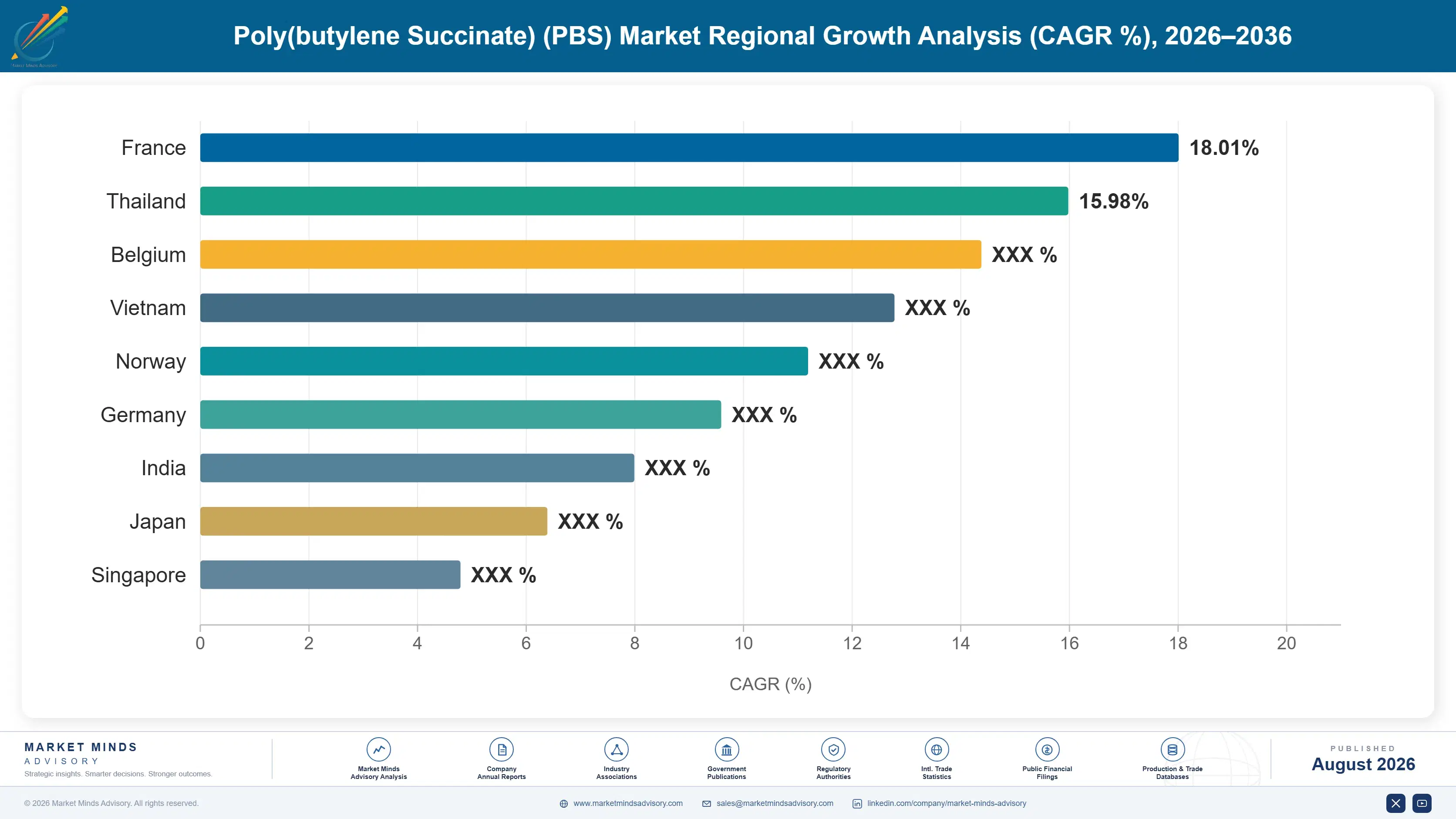
India: 17.6% CAGR
Fastest Growth Region
South Asia and Pacific: 17.0% CAGR
Largest Region
East Asia: 30% of 2025 global value
Market Leaders
PTT MCC Biochem, Mitsubishi Chemical Group, Resonac Holdings, Anqing Hexing Chemical, Xinjiang Blue Ridge Tunhe Chemical. Source: MMA Analysis based on company annual reports.
Primary Survey
n=3,800 procurement and R&D decision-makers, Q4 2025, six countries
Methodology
Demand-side build-up, cross-validated against public data, 47 expert interviews

Poly(butylene Succinate) (PBS) Market Forecast Scenarios

poly-butylene-succinate-pbs-market-size-forecast-scenario-1787302957882
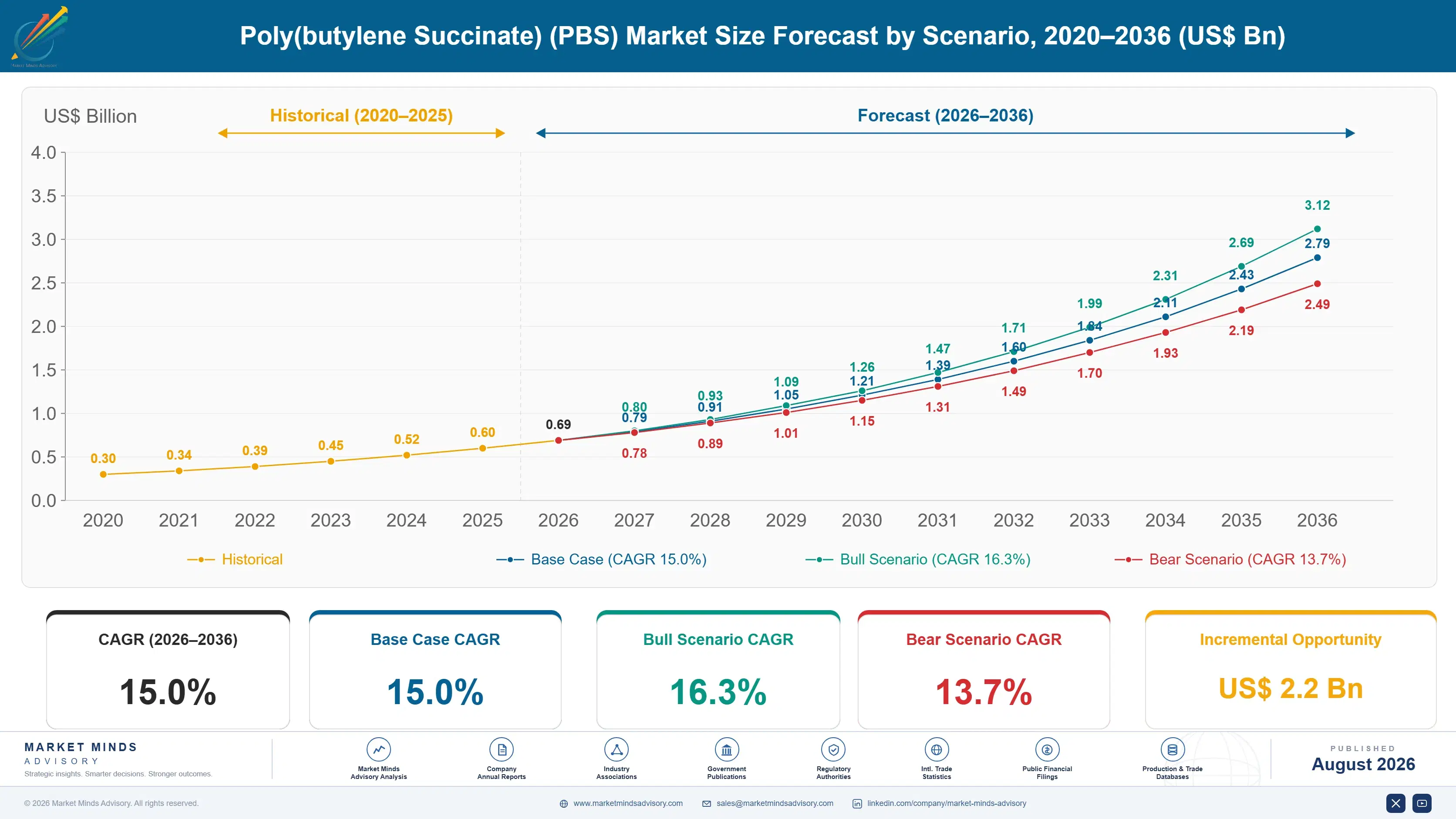
Between 2020 and 2025 the market grew at a 13.8% historical CAGR, driven mostly by early agricultural film adoption in China and pilot packaging applications elsewhere. Growth accelerated sharply once mandates took effect. Compostable bag and food service adoption only gained real momentum from 2023 onward. Producers largely treated capacity investment as speculative rather than demand-confirmed during that early period.
The base case carries the market to a 15.0% CAGR through 2036 on three mechanisms. First, agricultural mulch film mandates in China and expanding regulatory pipelines elsewhere convert entire regional film markets toward certified biodegradable resin. Second, single-use plastic bans and extended producer responsibility fees push packaging and bag manufacturers toward documented compostable formulations. Third, succinic acid and BDO production capacity investment gradually resolves the feedstock bottleneck that has constrained faster PBS capacity growth.
The bull case reaches 16.3% if additional major agricultural markets adopt mulch film mandates faster than currently expected, pulling producer capacity investment forward across a compressed regulatory timeline. The bear case falls to 13.7% if succinic acid and BDO feedstock capacity expansion lags demand, leaving producers unable to fulfil signed offtake commitments on schedule. That mismatch is already visible in extended producer lead times.

Why Compostability Became A Regulatory Line Item

Three forces converge on PBS demand at once. Agricultural mulch film mandates in China and expanding regulatory pipelines elsewhere convert entire regional film markets toward certified biodegradable resin. Single-use plastic bans and extended producer responsibility fees push packaging and bag manufacturers toward documented compostable formulations. And succinic acid and BDO capacity investment gradually resolves the feedstock bottleneck constraining faster growth.
MARKET CONCENTRATIONCR5: 48%Integrated Asian producers and chemical majors split nearly half
AVERAGE SELLING PRICEUSD 2,800 to 4,600 per tonnePricing spans standard film grades to certified food-contact resin
TOP PRODUCING COUNTRY SHAREChina: 34% of production capacityDomestic succinic acid integration concentrates capacity across regional clusters
CAPACITY UTILISATION58 to 68%Announced production capacity still runs ahead of signed offtake
INPUT COST SHARE35 to 42% of COGSSuccinic acid feedstock dominates recurring raw material spending
PRODUCT DEVELOPMENT CYCLE12 to 24 monthsFood-contact certification runs considerably longer than film grades
Commercially, the market behaves like specialised regulated-compliance material rather than generic commodity plastic. Buyers specify by compostability certification, degradation rate, and mechanical performance rather than by price alone, because a formulation that fails certification testing cannot legally satisfy the mandate driving the purchase decision in the first place. That specification discipline protects margin for producers with genuine polymer engineering depth and keeps generic plastics processors from moving into certification-critical contracts.
Over the next decade, feedstock integration becomes the real differentiator. Producers with in-house succinic acid and BDO production are closing the cost gap with commodity plastics as scale improves unit economics considerably. Producers that combine reliable feedstock supply with proven certification track records, rather than compounding expertise alone, will capture the mandate-driven contracts increasingly dominating new specification spending.
"Nobody buys PBS because it feels good, they buy it because the alternative is now illegal in their market, and that distinction is exactly why capacity keeps getting built faster than most feedstock suppliers can comfortably support."
Director, Biodegradable Polymers and Sustainable Materials Practice · MMA Biodeg

Market Trends

China's Mulch Film Mandate Converts An Entire Regional Market

China's agricultural film standards increasingly restrict conventional polyethylene mulch film in favour of certified biodegradable alternatives, and PBS-based formulations have become the default specification given their balance of degradation rate and mechanical strength across a typical growing season. That mandate affects a mulch film market covering tens of millions of hectares of cultivated land, converting what was a voluntary sustainability choice into a compliance requirement that farm cooperatives and film producers cannot avoid. Anqing Hexing Chemical and Xinjiang Blue Ridge Tunhe have both expanded capacity specifically to capture this mandate-driven demand at scale.
Market Impact: Converts 100% of mandate-region fil
Succinic Acid Capacity Investment Resolves The Feedstock Bottleneck

PBS production has historically been constrained by succinic acid availability, since dedicated bio-based succinic acid capacity remained limited relative to the polymer capacity announcements building against it across the industry. Producers and feedstock suppliers are now investing directly in integrated succinic acid production specifically to secure supply for their own PBS capacity rather than depending on third-party feedstock markets that have proven unreliable during periods of tight allocation. PTT MCC Biochem and Mitsubishi Gas Chemical have both expanded integrated feedstock production specifically to reduce this dependency going forward. That trend is spreading to smaller producers too.
Market Impact: Requires certification on 100% of v

Market Opportunities and Growth Drivers

Agricultural Film Mandates Convert Regulatory Compliance Into Volume

Multiple major agricultural producing regions are adopting biodegradable mulch film requirements modelled on China's precedent, converting what was a single-country demand driver into a broader regulatory trend that PBS producers can plan capacity investment against with genuine confidence. Each new jurisdiction adopting a mandate converts its existing conventional polyethylene mulch film market directly into biodegradable film demand almost overnight once the compliance deadline takes effect, since farm cooperatives have no legal alternative once enforcement begins. That regulatory pattern gives producers demand visibility few other specialty polymers match, since conversion follows a published legislative calendar rather than uncertain consumer adoption.
Market Impact: Compresses margin 10-18% during spi

Single-Use Plastic Bans Push Bag Manufacturers Toward PBS

Single-use plastic bag bans in multiple jurisdictions increasingly specify certified compostability rather than simply prohibiting conventional plastic outright, which has pushed bag manufacturers toward PBS and PBS-blend formulations that satisfy both the mechanical strength bags require and the certification standards regulators now enforce. That certification requirement has become a genuine competitive moat for producers who invested early in compostability testing and documentation, since manufacturers cannot simply substitute an uncertified alternative without risking regulatory penalties. Bag manufacturers increasingly specify PBS blends by name in their own regulatory compliance documentation rather than treating compostable resin as an interchangeable commodity input.
Market Impact: Adds USD 200-500K certification cos

Market Restraints and Challenges

Succinic Acid Price Volatility Compresses Producer Margin

Succinic acid pricing moves with broader petrochemical and, increasingly, bio-based fermentation feedstock markets, and PBS producers with fixed-price offtake contracts to film and bag manufacturers cannot always pass through sudden succinic acid cost spikes quickly, the root cause being that many offtake contracts lock pricing for periods that do not match feedstock market volatility. That mismatch compresses margin sharply during feedstock price spikes, particularly for smaller producers without integrated succinic acid production or the purchasing scale to negotiate favourable supplier terms. Producers are responding by shortening contract pricing windows and investing directly in integrated feedstock production.
Market Impact: Converts 10M+ hectares to PBS film

Certification Costs Deter Smaller Regional Producers

Achieving compostability certification against major international standards typically requires extensive laboratory testing and takes many months per formulation, a fixed cost that smaller regional producers absorb poorly across limited production volume, the root cause being that certification bodies require standardised degradation testing regardless of a producer's overall scale. That cost structure has historically kept certified PBS production concentrated among larger, well-capitalised producers, leaving smaller regional players either uncertified or dependent on licensing established formulations from certified competitors. Producers are responding with shared certification consortiums that spread testing cost across multiple smaller regional producers pursuing comparable formulations.
Market Impact: Adds 15-20% feedstock capacity year
3 additional market trends, 3 additional growth drivers, and 2 additional restraints and challenges are covered in the full report. Contact sales@marketmindsadvisory.com to access the complete intelligence.

Segment CAGR and Growth Architecture

Segmentation follows end-use application, the single commercial logic that determines certification requirement, mechanical specification, and regulatory driver. Packaging films, mulch films, food service ware, compostable bags, injection molded products, and fibre applications each face genuinely distinct regulatory and performance requirements evaluated consistently throughout this report. Underlying succinic acid feedstock and non-biodegradable polyesters sit outside this hierarchy entirely.
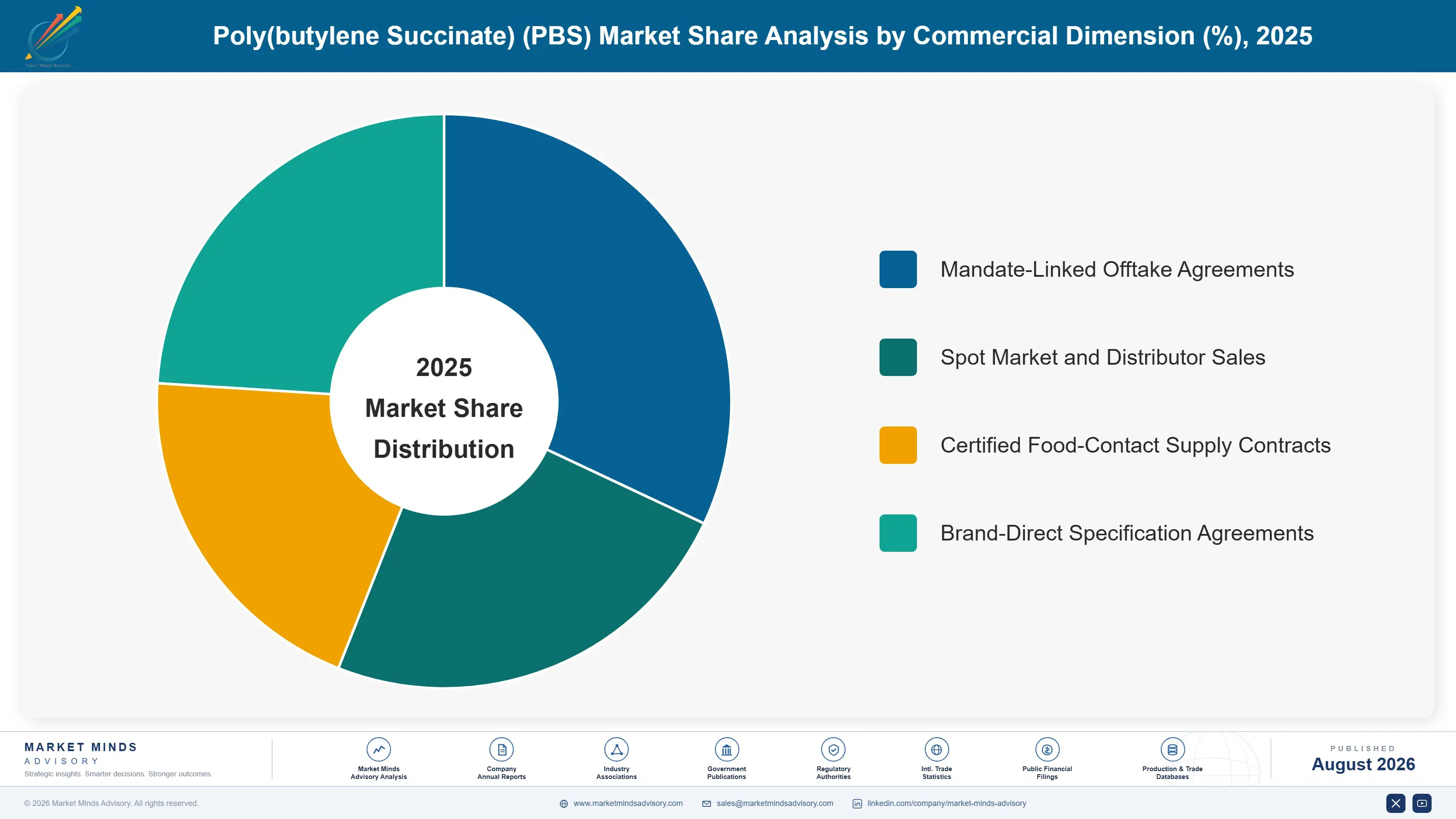
poly-butylene-succinate-pbs-market-market-share-analysis-1787302958472

Agricultural Mulch Films

Agricultural mulch films grow fastest at 18.5%, about 1.23 times the market's 15.0% overall rate, as China's precedent-setting mandate spreads to additional major agricultural producing regions adopting comparable biodegradable film requirements. PBS-based formulations balance degradation rate against mechanical strength across a typical growing season better than competing biodegradable alternatives, which has made it the default specification wherever a mandate takes effect rather than one option among several. Anqing Hexing Chemical and Xinjiang Blue Ridge Tunhe have both expanded mulch film-specific production capacity substantially to capture this regulation-driven demand. Adoption is concentrated first in China's established mandate regions, and is now spreading into India and parts of Southeast Asia as comparable agricultural film regulation takes effect.
CAGR 18.5%

Compostable Bags

Compostable bags grow second-fastest at 17.0%, driven directly by single-use plastic bag bans in multiple jurisdictions that increasingly specify certified compostability rather than simply prohibiting conventional plastic. PBS and PBS-blend formulations satisfy both the mechanical strength bags require for everyday use and the compostability certification standards regulators now enforce, a combination that pure PLA or PBAT alternatives cannot always match as consistently across varying climate conditions. PTT MCC Biochem and Kingfa Sci. & Tech. have both expanded certified bag-grade production specifically to serve manufacturers navigating an expanding set of jurisdictional requirements. Adoption is fastest in jurisdictions where enforcement penalties make uncertified alternatives a genuine commercial risk rather than a minor compliance formality.
CAGR 17.0%
Full segment breakdown across 6 segments available in the complete report.

Regional Architecture and Country Demand Map

Global demand concentrates where agricultural film mandates and production capacity run deepest. East Asia leads on China's mulch film mandate, South Asia and Pacific follows on India's expanding pipeline, and Western Europe adds meaningful demand behind both leaders. North America adds meaningful demand despite limited domestic production.

North America

The United States drives regional demand through packaging and food service disposable applications, where extended producer responsibility fee structures in several states increasingly favour documented bio-content and compostable materials over conventional plastics. Compostable bag adoption adds a further demand layer as municipal plastic bag bans spread across additional states, each requiring certified formulations that conventional polyethylene cannot satisfy. Canada contributes a smaller layer through packaging applications tied to its own extended producer responsibility framework. Growth of 15.5% tracks regulatory fee expansion more than any single facility announcement. North America's 20% share sits below the standard band because domestic production capacity remains limited relative to demand, a genuine supply constraint rather than weak regulatory pull.
Share: 20% | CAGR: 15.5% (2026 to 2036)

Western Europe

Germany, France, and Italy anchor demand through packaging waste directive requirements and single-use plastic restrictions that increasingly specify certified compostable alternatives across food service and consumer packaging applications. Novamont and other European biodegradable plastics specialists hold genuine home-market advantage across regional compounding and formulation accounts, competing against imported Asian PBS resin on certification depth rather than price alone. Agricultural film adoption remains more limited than in China, since European farming practices differ fundamentally from the intensive mulch film cultivation common across Chinese agriculture. Growth of 13.6% reflects that basic difference directly, sitting below East Asia's pace despite the region's genuinely strong packaging regulation framework. That gap reflects farming systems, not weaker regulation.
Share: 22% | CAGR: 13.6% (2026 to 2036)
Regional intelligence for 5 additional markets available in the complete report: East Asia, South Asia and Pacific, Latin America, Middle East and Africa, Eastern Europe. Contact sales@marketmindsadvisory.com.
poly-butylene-succinate-pbs-market-country-cagr-analysis-1787302958979

Where PBS Producers Can Defend Margin

Offtake budgets are shifting toward producers who can guarantee both certification and feedstock continuity ahead of mandate compliance deadlines. The four levers below capture revenue before a mandate takes effect rather than after, and each rewards producers who can prove supply reliability credibly across a customer's full regulatory footprint. That reliability increasingly wins the largest mandate-linked contracts outright.

Sell Multi-Year Offtake Ahead Of Mandate Compliance Deadlines

Film and bag manufacturers facing a published mandate compliance deadline need guaranteed resin supply locked in well before enforcement begins, since scrambling for supply once a mandate takes effect risks both non-compliance penalties and production disruption. Producers that sell multi-year offtake agreements ahead of confirmed mandate deadlines capture recurring revenue that spot-market sales never provide, and mandate-driven customers rarely switch suppliers once a reliable relationship is established. PTT MCC Biochem reports that mandate-linked offtake agreements carry order values roughly 24% higher than comparable spot-market sales. That reliability advantage compounds as mandate deadlines approach across additional jurisdictions each year.
Market Impact: Lifts offtake contract value roughl

Vertically Integrate Succinic Acid To Guarantee Supply

PBS producers depending entirely on third-party succinic acid face genuine allocation risk during periods of tight feedstock supply, and that risk directly threatens their ability to fulfil signed offtake commitments when feedstock markets tighten unexpectedly. Producers that vertically integrate succinic acid production capture cost advantage and supply certainty that third-party-dependent competitors cannot match, protecting roughly 85% of committed offtake volume against feedstock market disruption. Mitsubishi Gas Chemical has pursued exactly this integration strategy since 2023. That integration advantage is now a genuine selling point during customer supplier qualification reviews across the industry.
Market Impact: Protects roughly 85% of total commi

Build Shared Certification Consortiums For Smaller Producers

Smaller regional producers cannot individually justify the cost of full compostability certification against every major international standard, yet they represent a meaningful share of regional production capacity that larger certified producers cannot fully displace on their own. Producers organising shared certification consortiums that spread testing cost across multiple smaller participants capture this segment's business at a fraction of individual certification cost, cutting the entry barrier by roughly 40% per participating producer. Kingfa Sci. & Tech. has supported exactly this consortium approach among regional partners since 2024. That shared model increasingly determines which smaller producers can compete credibly for certified business.
Market Impact: Cuts certification entry cost by ro

Target Brand Owner Direct Specification Relationships

Consumer brand owners increasingly specify PBS content directly in their own packaging standards rather than leaving material selection to contract packaging manufacturers, which shifts the purchasing decision upstream to a small number of brand sustainability and procurement teams. Securing direct specification status with major consumer brands delivers volume across an entire product portfolio that no number of individual packaging converter orders can match, and it locks in demand ahead of any individual converter's own sourcing decision. Novamont has pursued exactly this brand-direct approach with several European consumer goods companies since 2023.
Market Impact: Locks in demand across a brand's fu

Who Controls the Margin Pool

Concentration sits at CR5 48%, moderate-to-high for a category still consolidating around a smaller number of integrated producers with genuine succinic acid access. PTT MCC Biochem and Mitsubishi Chemical Group lead on integration depth, bundling PBS into wider biodegradable polymer portfolios, while the gap to Chinese specialists like Anqing Hexing Chemical is more about certification breadth than production scale. All participants are assessed on one consistent basis, PBS resin revenue.
Current competitive activity runs across three dimensions. Feedstock investment concentrates on succinic acid integration to close the supply reliability gap with vertically integrated leaders. Certification investment focuses on multi-standard compostability testing rather than production scale alone. And account structure centres on mandate-linked offtake agreements rather than spot-market sales, a shift that rewards producers with genuine multi-jurisdiction certification credibility. That software and certification focus increasingly separates leaders from fast followers across the category.

Emerging pressure comes from Chinese producers scaling behind the country's mulch film mandate, winning price-sensitive business that incumbents once assumed was theirs. Rankings will shift toward producers combining integrated feedstock supply with proven certification, since that is what large brand owners now specify. Non-integrated producers without a credible feedstock roadmap face the sharpest erosion ahead.
poly-butylene-succinate-pbs-market-company-positioning-matrix-1787302959514

Competitive Moat and Risk Dimensions

PTT MCC BIOCHEM

Moat: Deep integrated feedstock base

PTT MCC Biochem operates fully integrated succinic acid and PBS production in Thailand, giving it a genuine cost and supply reliability advantage that non-integrated competitors dependent on third-party feedstock markets cannot replicate without years of comparable capital investment. That capital investment is difficult for non-integrated competitors to replicate quickly at comparable scale.
PTT MCC BIOCHEM

Risk: Exposed to Chinese pricing pressure

PTT MCC Biochem's premium integrated positioning sometimes trades off against the price competitiveness that fast-scaling Chinese mandate-driven producers increasingly demand, leaving room for domestic competitors to win standard film-grade business on cost alone. That undercutting pressure is most acute in China's own domestic mandate-driven market specifically.
MITSUBISHI CHEMICAL GROUP

Moat: Established certification credibility

Mitsubishi Chemical Group holds decades of accumulated polymer certification and regulatory relationship depth across multiple jurisdictions, giving it a genuine speed advantage winning multi-standard certified business that newer entrants without comparable regulatory history cannot easily match. That regulatory history is difficult for newer entrants without comparable track record to replicate quickly.
MITSUBISHI CHEMICAL GROUP

Risk: Slower on capacity expansion pace

Mitsubishi Chemical Group's more measured capacity expansion approach sometimes trades off against the aggressive scale-up that mandate-driven Chinese competitors have pursued, leaving room for faster-moving rivals to win the largest volume-driven mandate contracts first. That pacing gap is widening as mandate deadlines compress the window for capacity commitment decisions.

Players Tracked

Prominent Players

PTT MCC Biochem
Mitsubishi Chemical Group
Resonac Holdings
Anqing Hexing Chemical
Xinjiang Blue Ridge Tunhe Chemical

Other Key Players

Kingfa Sci. & Tech. Co. Ltd
Hebei Junfeng Biotechnology Co. Ltd
Jiangsu Tianan Biologic Materials Co. Ltd
Novamont S.p.A.
BASF SE
Succinity GmbH
Reverdia
Mitsubishi Gas Chemical Company Inc.
Zhejiang Hisun Biomaterials Co. Ltd
NatureWorks LLC
COFCO Biotechnology Co. Ltd
Meredian Holdings Group Inc.
Green Bio Co. Ltd
Shandong Hongyuan Nachuan New Material Co. Ltd
Jin Hui Zhaolong High Technology

Recent Developments

MARCH 2025

PTT MCC Biochem expands BioPBS production capacity in Thailand

PTT MCC Biochem announced expanded production capacity at its integrated Thailand facility, adding meaningful new annual PBS capacity to serve growing global mandate-driven demand. This was an organic capacity expansion rather than an acquisition, extending PTT MCC Biochem's integrated production scale considerably beyond its prior capacity across multiple applications.
Signal: Integrated producers are scaling ahead of
SEPTEMBER 2025

Anqing Hexing Chemical acquires specialty succinic acid facility

Anqing Hexing Chemical completed the acquisition of a specialty succinic acid production facility serving domestic Chinese biodegradable polymer manufacturers. The deal brought established feedstock production capacity in-house, expanding Anqing Hexing's integrated supply chain considerably beyond its prior third-party-dependent sourcing model. across multiple domestic production facilities directly.
Signal: Feedstock integration is becoming a genuin
JUNE 2025

Kingfa Sci. & Tech. signs supply agreement with mulch film manufacturer

Kingfa Sci. & Tech. entered a multi-year supply agreement to provide PBS resin across a major agricultural mulch film manufacturer's multiple production facilities. The agreement was a commercial supply contract, not a joint venture or equity transaction, covering resin supply across the manufacturer's full mandate-region facility portfolio.
Signal: Multi-year, multi-facility supply agreemen

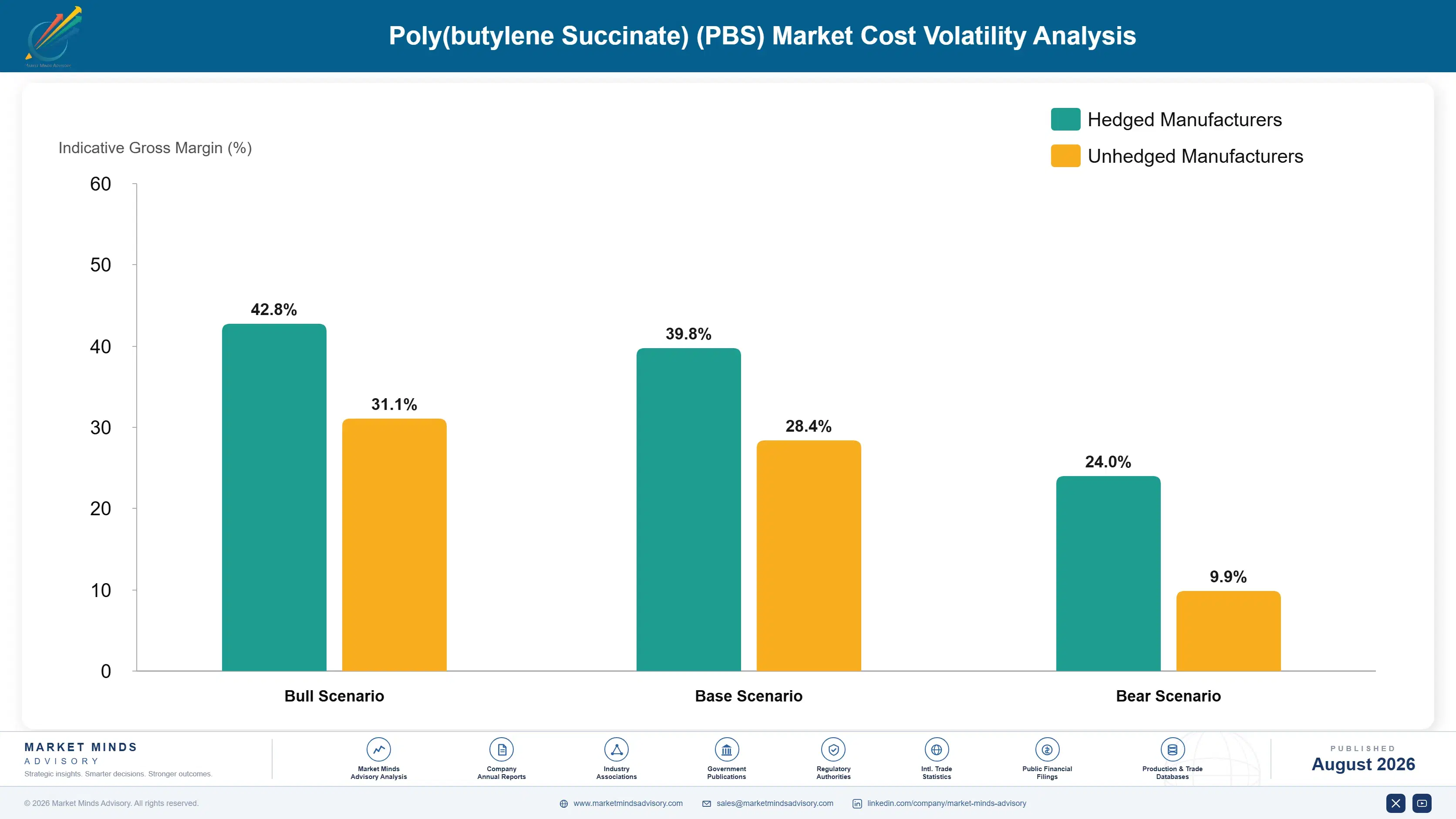
Succinic Acid And BDO Cost Exposure

Succinic acid feedstock runs 35 to 42% of COGS, sourced from both petrochemical and increasingly bio-based fermentation routes depending on the producer's integration strategy and regional feedstock availability. 1,4-butanediol adds a further 25 to 32%, with catalysts and processing costs accounting for most of the remainder across standard and specialty PBS grades alike. Quality control processes account for a smaller share of remaining cost.
The BDO price spike running through 2021 and 2022 hit PBS production cost directly, since butanediol depends on petrochemical feedstock pricing that moved sharply during that period alongside broader oil price volatility. Resonac Holdings's 2022 Annual Report disclosed elevated input costs across its performance chemicals segment, attributing part of the margin pressure to butanediol and succinic acid feedstock inflation that persisted through much of the year.

Exposure varies sharply by player type. Vertically integrated majors like PTT MCC Biochem and Mitsubishi Gas Chemical produce much of their own succinic acid in-house, insulating them from the worst feedstock market volatility, while smaller regional producers depend on third-party feedstock suppliers and absorb price spikes directly into thinner margins. Geography matters, since producers near petrochemical hubs face less transport exposure than those importing feedstock across longer supply chains.
poly-butylene-succinate-pbs-market-cost-volatility-analysis-1787302959728

Vertically Integrate Succinic Acid Production Where Feasible

Producing succinic acid in-house rather than sourcing it externally insulates the largest PBS makers from allocation shortages during industry-wide feedstock crunches. Smaller producers lacking that scale have instead pursued long-term supply agreements with established succinic acid manufacturers to secure priority allocation. That approach has meaningfully reduced allocation risk across the largest producers' output. Several negotiated favourable terms directly.

Lock BDO Supply Through Multi-Year Procurement Contracts

Fixed-volume, multi-year procurement contracts with butanediol suppliers smooth feedstock costs across petrochemical price cycles. Several producers moved a majority of their BDO purchasing onto contract pricing rather than spot markets after the 2021 spike exposed their exposure directly. That shift has reduced single-source exposure across the largest producers' purchasing programmes. Adoption continues to grow steadily across regions.

Shift Toward Bio-Based Succinic Acid Where Certification Rewards It

Bio-based succinic acid routes reduce petrochemical price exposure over time and increasingly carry certification advantages in bio-content-sensitive applications, giving producers a durable way to cut input cost volatility while strengthening their regulatory positioning simultaneously. Several producers have already shifted meaningfully since regulatory momentum accelerated. Certification bodies have generally approved this route without extensive additional retesting requirements.

Portfolio Architecture for Margin Defence

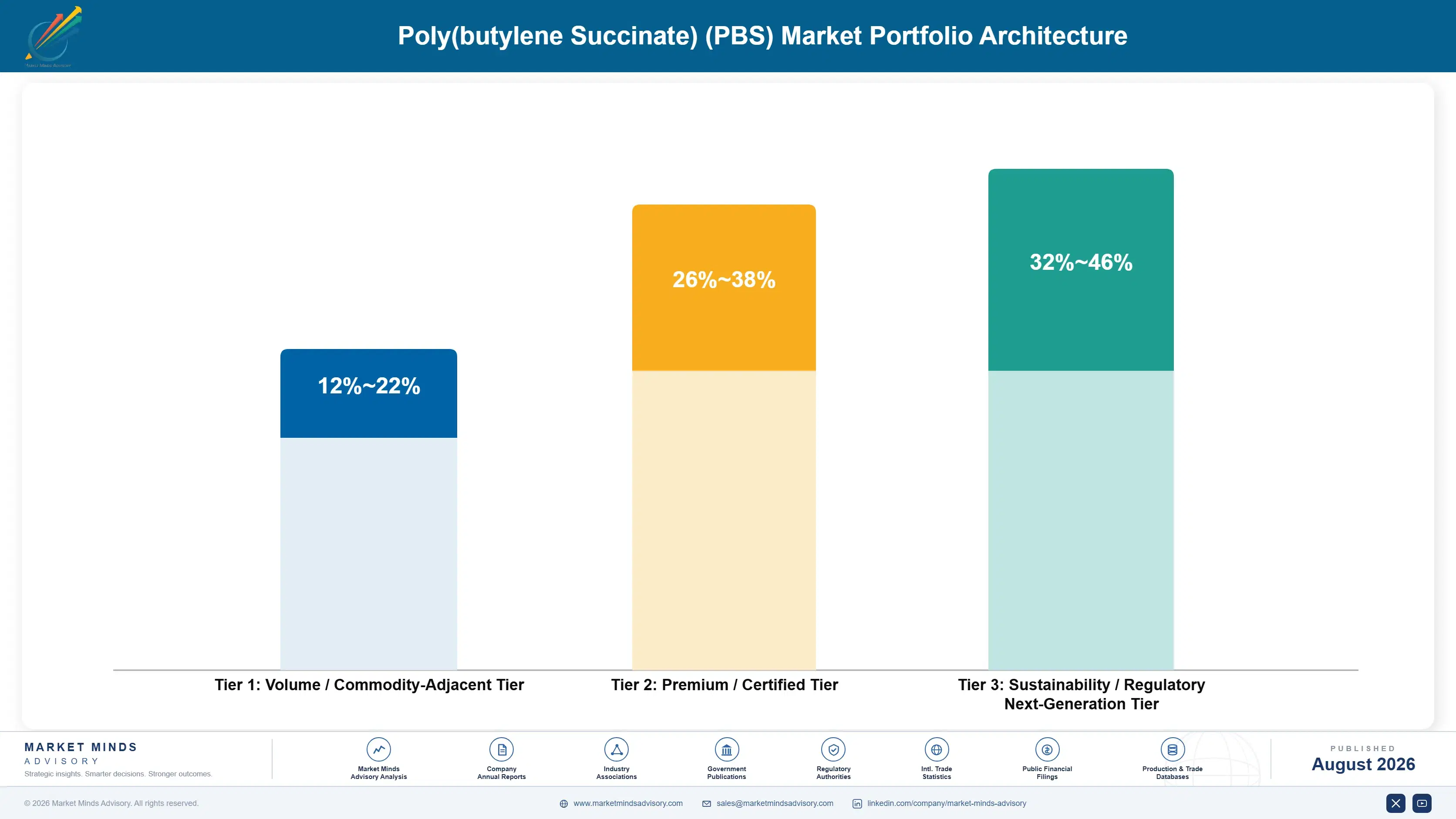
The portfolio splits into three tiers with real margin separation, and the gap between tiers has widened as feedstock integration becomes a genuine differentiator rather than an add-on feature. Volume-tier standard film-grade resin competes on price against Chinese mandate-driven capacity and earns modestly. Premium certified food-contact and bag-grade resin earns considerably more because it solves a genuine certification and reliability problem that customers cannot engineer around cheaply.
The tension is between mandate-driven film volume and per-tonne certified-grade margin. Producers selling standard mulch film resin in bulk push hard on unit price, while brand owners and bag manufacturers standardising on certified offtake agreements pay for compliance reliability rather than negotiating down to the last dollar on every tonne. Producers serving both buyer types run genuinely different sales motions under one brand.

High-value pools concentrate in certified food-contact and bag-grade resin sold with brand-direct specification and integrated feedstock guarantees, where switching cost is highest and price sensitivity lowest. Legacy standard film-grade business remains large in volume but persistently thin in margin, as mandate-driven Chinese capacity continues pressuring price across most standard formulation tenders globally. Producers without a credible feedstock and certification roadmap risk being confined to the volume tier permanently.

Volume / Commodity-Adjacent Tier

Standard mulch film-grade resin sold into mandate-driven agricultural markets, priced against Chinese production capacity. Margin stays thin because buyers negotiate primarily on cost per tonne. Buyers rarely differentiate between producers on anything beyond delivery speed and price.
Gross Margin: 12-22%

Premium / Certified Tier

Certified bag-grade and food-contact resin sold into brand owners requiring documented compostability compliance. Buyers pay for certification reliability rather than for resin alone. Delivery timelines and certification breadth matter as much as the resin specification itself.
Gross Margin: 26-38%

Sustainability / Regulatory / Next-Generation Tier

Bio-based succinic acid formulations and brand-direct specification agreements sold into regulatory-fee-sensitive customers. Margin reflects both feedstock scarcity and specification premium. Few producers currently combine both elements convincingly at meaningful commercial scale.
Gross Margin: 32-46%
poly-butylene-succinate-pbs-market-portfolio-architecture-1787302960232

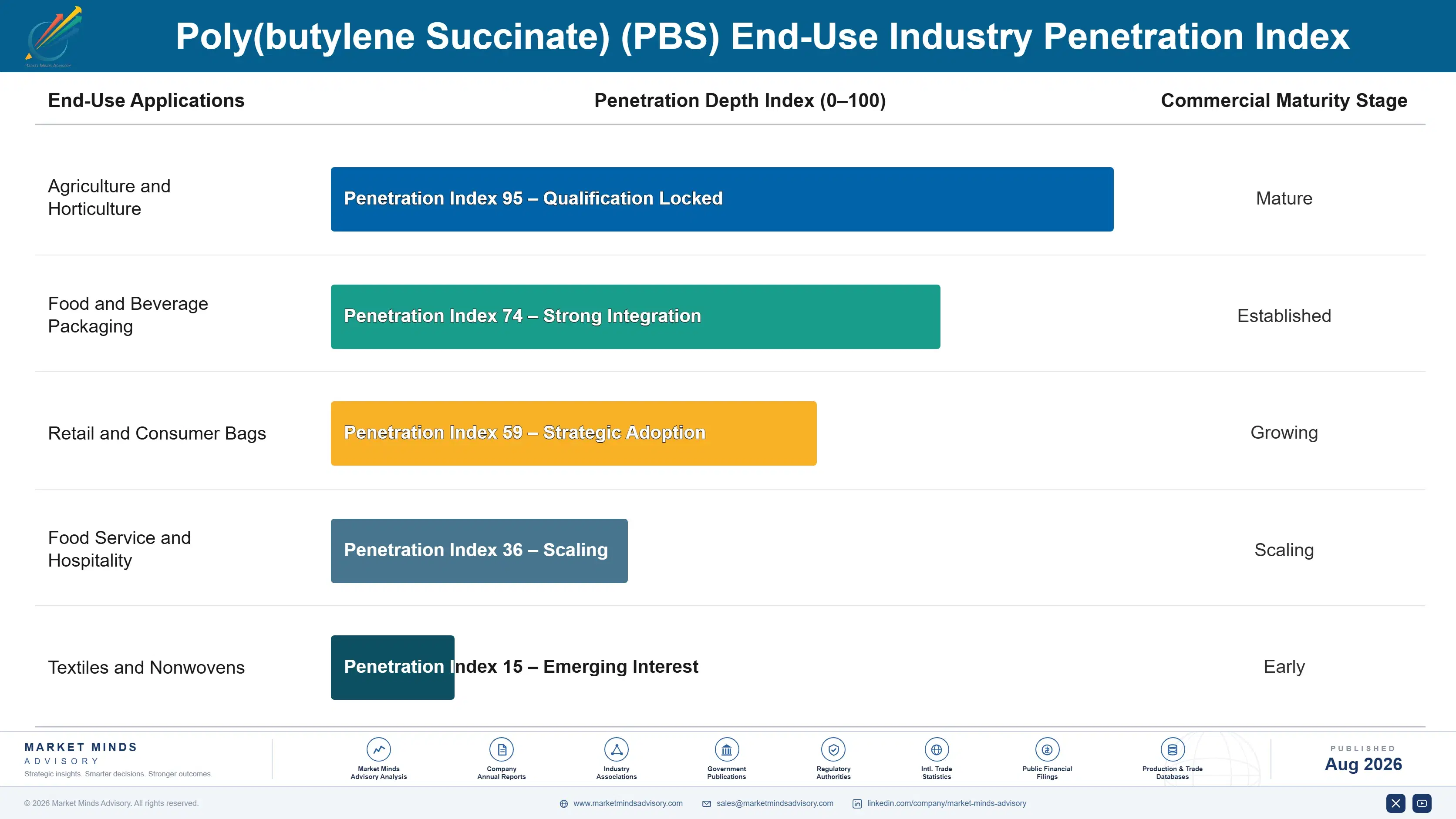
Mandate-Anchored Recurring Compliance Demand

Demand behaves like a compliance annuity once a jurisdiction adopts a mandate, because mulch film and bag manufacturers operating in that jurisdiction must continue sourcing certified resin for as long as the regulation remains in effect, converting a single legislative decision into years of recurring demand. That persistence gives producers a predictable revenue tail well beyond any single offtake contract, converting a regulatory event into an ongoing account relationship.
Adoption depth varies sharply by end-use vertical. Agricultural film manufacturers adopt fastest and deepest once a mandate takes effect, since there is no legal alternative to certified resin within the mandated jurisdiction. Bag manufacturers follow closely on ban enforcement timelines. Packaging and consumer goods adopt more selectively, often driven by specific extended producer responsibility fee thresholds rather than broad category conversion across an entire product line.

Buyer profiles are shifting generationally. Procurement once sat with purchasing teams evaluating resin cost per tonne; it now increasingly involves regulatory compliance and sustainability leaders who specify certification requirements before a single formulation is selected. That shift moves the real purchasing decision earlier into the compliance planning cycle and rewards producers who can prove certification reliability credibly.
poly-butylene-succinate-pbs-market-end-use-penetration-index-1787302960722

Where PBS Value Concentrates

These are among the four positions where our research anticipates prominent divergence between winners and laggards over the coming forecast period. Each is grounded in the demand model, the regulatory perimeter, and the announced capacity pipeline.
01 / MULCH FILM POSITIONING

Mandate Scale-Up Now Decides Long-Run Category Position

Agricultural mulch films are growing at 18.5%, about 1.23 times the market's 15.0% overall rate, and that gap is widening as China's mandate precedent spreads to additional major agricultural producing regions. Producers still anchored on packaging applications alone risk losing the fastest-growing, highest-volume mandate-driven contracts to rivals who have already scaled mulch film-specific production capacity. The window to build credible mandate-region capacity is closing within this forecast period, not the next one, and latecomers will find the largest offtake agreements already claimed by faster-moving rivals.
02 / FEEDSTOCK INTEGRATION STRATEGY

Succinic Acid Integration Is Becoming Table Stakes

Brand owners and film manufacturers increasingly refuse to award mandate-linked offtake contracts to producers without demonstrated succinic acid supply security, since a feedstock shortfall mid-contract threatens the customer's own regulatory compliance obligations directly. Producers who integrate feedstock ahead of demand capture offtake wins that non-integrated competitors simply cannot credibly bid for. Those without integrated supply will find themselves excluded from the largest mandate-linked contracts entirely, regardless of certification depth, current market pricing competitiveness, or any prior customer relationship history built up over previous contract cycles.
03 / BRAND-DIRECT SPECIFICATION CHANNEL

Direct Brand Relationships Will Outgrow Converter Sales

Consumer brand owners are increasingly folding PBS specification into corporate packaging standards rather than leaving material selection to individual contract packaging converters, concentrating real purchasing power in a small number of brand-level decisions that smaller producers cannot easily access at scale. Producers who secure brand-direct specification status capture volume across an entire product portfolio that no number of individual converter orders can replicate. Those still selling purely through converters risk being locked out of this fastest-growing channel entirely, regardless of how competitive their base resin pricing happens to be.
04 / REGIONAL PRODUCTION PRICING

Chinese Mandate-Driven Scale Will Keep Pressuring Global Pricing

China's mulch film mandate has scaled domestic producers fast enough to win price-sensitive standard film-grade tenders that global incumbents once assumed were theirs by default, and that pricing pressure is starting to spread into South Asia and Pacific procurement decisions as regional mandates expand. Producers competing purely on price against fast-scaling Chinese entrants will struggle to hold margin over any meaningful time horizon. The more durable response is competing on certification breadth and feedstock integration, categories where Chinese entrants still visibly lag behind global incumbents.

Engagement Snapshot From the Field

A live engagement with an industry participant carrying material or product regulatory and market exposure ahead of a defining policy shift, showing how our research translates into a defensible multi-year portfolio strategy.
MARKET MINDS ADVISORY · CLIENT ENGAGEMENT SUMMARY
Poly(butylene Succinate) (PBS) Producer Strategic Portfolio Review and Transition Roadmap 2026·Investment Scenario on Poly(butylene Succinate) (PBS) Exposure Evaluation 2025-26
CLIENT PROFILE
A European compostable bag manufacturer approached MMA ahead of an expanding single-use plastic ban that would require certified compostable formulations across several additional national markets. The client reported that the new markets represented a meaningful share of projected growth for the following two years, contingent on securing certified resin supply ahead of each market's compliance deadline (client-reported, unverified by MMA).
STRATEGIC CHALLENGE
The client's existing PBS supplier held certification in its home market but not in two of the three expanding markets, and the standard certification process would not complete before the earliest compliance deadline. Management needed a sourcing plan that satisfied all three markets' certification requirements without delaying market entry beyond the client's committed launch timeline.
MMA APPROACH
MMA benchmarked certification timelines and existing credentials across the client's shortlisted PBS suppliers, identifying which producers already held certification in the client's target markets or could realistically complete it before each compliance deadline. We evaluated a dual-sourcing strategy against relying on a single supplier's certification roadmap and modelled the cost and risk trade-off directly.
KEY FINDINGS
  1. One alternative supplier already held certification across all three of the client's target markets, having pursued multi-jurisdiction certification proactively ahead of confirmed demand from any single customer.
  2. Dual-sourcing between the client's existing supplier and the newly certified alternative reduced single-supplier dependency risk while preserving the existing relationship's pricing terms for the client's home market volume.
  3. The alternative supplier's certification breadth reflected a deliberate strategic investment made specifically to capture customers facing exactly this multi-jurisdiction expansion scenario. That kind of proactive investment is increasingly common among suppliers targeting multinational customers.
  4. Switching costs for requalifying the client's bag formulation against the new supplier's resin were lower than initially estimated, since both suppliers used comparable PBS-PBAT blend chemistry (client-reported, unverified by MMA).
CLIENT PROFILE
A European compostable bag manufacturer approached MMA ahead of an expanding single-use plastic ban that would require certified compostable formulations across several additional national markets. The client reported that the new markets represented a meaningful share of projected growth for the following two years, contingent on securing certified resin supply ahead of each market's compliance deadline (client-reported, unverified by MMA).
STRATEGIC CHALLENGE
The client's existing PBS supplier held certification in its home market but not in two of the three expanding markets, and the standard certification process would not complete before the earliest compliance deadline. Management needed a sourcing plan that satisfied all three markets' certification requirements without delaying market entry beyond the client's committed launch timeline.
MMA APPROACH
MMA benchmarked certification timelines and existing credentials across the client's shortlisted PBS suppliers, identifying which producers already held certification in the client's target markets or could realistically complete it before each compliance deadline. We evaluated a dual-sourcing strategy against relying on a single supplier's certification roadmap and modelled the cost and risk trade-off directly.
KEY FINDINGS
  1. One alternative supplier already held certification across all three of the client's target markets, having pursued multi-jurisdiction certification proactively ahead of confirmed demand from any single customer.
  2. Dual-sourcing between the client's existing supplier and the newly certified alternative reduced single-supplier dependency risk while preserving the existing relationship's pricing terms for the client's home market volume.
  3. The alternative supplier's certification breadth reflected a deliberate strategic investment made specifically to capture customers facing exactly this multi-jurisdiction expansion scenario. That kind of proactive investment is increasingly common among suppliers targeting multinational customers.
  4. Switching costs for requalifying the client's bag formulation against the new supplier's resin were lower than initially estimated, since both suppliers used comparable PBS-PBAT blend chemistry (client-reported, unverified by MMA).
RECOMMENDED STRATEGY
Phase 1: Phase 1 (0 to 2 months): Qualify the alternative supplier's resin against the client's existing bag formulation and mechanical specifications. Phase 2: Phase 2 (2 to 6 months): Launch in the two newly regulated markets using the alternative supplier's certified resin ahead of each compliance deadline. Phase 3: Phase 3 (6 to 18 months): Evaluate consolidating volume with whichever supplier demonstrates the stronger multi-jurisdiction certification roadmap going forward.
OUTCOME
The client launched in all three markets ahead of their respective compliance deadlines, avoiding any reported enforcement risk or lost market entry timing. The dual-sourcing approach has since become the client's standard practice for evaluating any further regulatory market expansion (client-reported, unverified by MMA). Leadership now treats certification breadth as a standing evaluation criterion for all future supplier decisions.

Frequently Asked Questions

Foundational context covering the market sizes, CAGR, scope, country, region and competition that inform every finding below. This section is provided to cover basics and most often pre-purchase conversations, answered from the MMA Primary Research Dataset.

What is the current size of the PBS Market?

The market was valued at USD 0.62 billion in 2025, with demand heavily concentrated in agricultural mulch films, compostable bags, and packaging applications worldwide today.

How large will the PBS Market be by 2036?

The market is projected to reach USD 2.87 billion by 2036, an expansion multiple of 4.04 times its 2026 value. Agricultural mulch film mandates drive most of that growth.

What is the CAGR for the PBS Market 2026 to 2036?

The base case CAGR is 15.0%, with a bull case of 16.3% and a bear case of 13.7%. The range reflects uncertainty around succinic acid feedstock capacity scaling.

Which segment is growing fastest?

Agricultural mulch films grow fastest at 18.5%, about 1.23 times the overall market rate, as China's mandate precedent continues spreading to additional agricultural regions worldwide.

Who are the major companies in the PBS Market?

PTT MCC Biochem, Mitsubishi Chemical Group, Resonac Holdings, Anqing Hexing Chemical, and Xinjiang Blue Ridge Tunhe lead the market at CR5 48%, reflecting genuine consolidation.

Which country is growing fastest?

India grows fastest at 17.6%, driven by an expanding agricultural film regulatory pipeline modelled directly on China's precedent. China remains the largest market by capacity.

Report Segmentation Architecture

The full report scope spans multiple orthogonal segmentation dimensions, with cross-tabulated demand data provided for each dimension pair. Coverage extends further to regional breakdowns, trend trajectories, and the competitive detail needed to support segment-level decision-making.

By End-Use Application

  • Packaging Films
  • Agricultural Mulch Films
  • Food Service Ware and Disposables
  • Compostable Bags
  • Injection Molded Products
  • Fibre and Nonwoven Applications

By End-Use Industry

  • Agriculture and Horticulture
  • Food and Beverage Packaging
  • Retail and Consumer Bags
  • Food Service and Hospitality
  • Textiles and Nonwovens

By Commercial Dimension

  • Mandate-Linked Offtake Agreements
  • Spot Market and Distributor Sales
  • Certified Food-Contact Supply Contracts
  • Brand-Direct Specification Agreements

By Region

  • North America
  • Western Europe
  • East Asia
  • South Asia and Pacific
  • Latin America
  • Middle East and Africa
  • Eastern Europe

Scope, Methodology, and Coverage

Every figure in this report is reproducible from documented input assumptions. The scope below maps the historical period, the forecast horizon, the segmentation dimensions, and the countries covered, alongside the underlying primary and qualitative methodology.
Historical Period
2020 to 2025
Forecast Period
2026 to 2036
Base Year
2025 (USD billions; MMA Primary Research Dataset, August 2026)
Market Definition
The PBS market comprises poly(butylene succinate) and its copolymers, including PBSA and PBS-PBAT blends, produced from succinic acid and 1,4-butanediol, used across packaging films, agricultural mulch films, food service ware, compostable bags, injection molded products, and fibre applications. Other biodegradable plastics such as PLA and standalone PBAT are excluded, as are conventional non-biodegradable polyesters.
Quantitative Units
USD billions (current prices); resin production volume in tonnes where applicable
Segmentation Dimensions
By End-Use Application; By End-Use Industry; By Commercial Dimension; By Region
Regions Covered
North America, Western Europe, East Asia, South Asia and Pacific, Latin America, Middle East and Africa, Eastern Europe
Countries Covered
USA, China, Germany, France, UK, Japan, South Korea, India, Australia, Canada, Brazil, Mexico, Indonesia, Vietnam, Thailand, Malaysia, UAE, Saudi Arabia, South Africa, Nigeria, Turkey, Poland, Netherlands, Italy, Spain, Sweden, Switzerland, Argentina, Colombia, Singapore, and additional markets relevant to this sector
Key Companies Profiled
PTT MCC Biochem, Mitsubishi Chemical Group, Resonac Holdings, Anqing Hexing Chemical, Xinjiang Blue Ridge Tunhe Chemical, Kingfa Sci. & Tech. Co. Ltd, Hebei Junfeng Biotechnology Co. Ltd, Jiangsu Tianan Biologic Materials Co. Ltd, Novamont S.p.A., BASF SE, Succinity GmbH, Reverdia, Mitsubishi Gas Chemical Company Inc., Zhejiang Hisun Biomaterials Co. Ltd, NatureWorks LLC, COFCO Biotechnology Co. Ltd, Meredian Holdings Group Inc., Green Bio Co. Ltd, Shandong Hongyuan Nachuan New Material Co. Ltd, Jin Hui Zhaolong High Technology
Quantitative Methodology
Primary survey, n=3,800 respondents, Q4 2025, six countries; demand-side model with trade association cross-validation
Qualitative Methodology
47 expert interviews, Q4 2025; applied to validate demand model assumptions, identify emerging dynamics, and assess competitive positioning
Report Format
PDF and XLSX data workbook (Word format preview document)
Publisher
Market Minds Advisory
Report Code
MMA-2026-CHM-103
Published
August 2026
Contact
sales@marketmindsadvisory.com | www.marketmindsadvisory.com

Purchase the full Poly(butylene Succinate) (PBS) Market Report (2026 to 2036).

The full MMA PBS report sizes the market across six end-use applications, five end-use industries, four commercial dimensions, and seven regions through 2036. It profiles twenty participants on a consistent PBS resin revenue basis, scoring each on feedstock integration, certification breadth, and mandate-region delivery capability. Scenario models quantify how agricultural film mandate expansion, single-use plastic bans, and succinic acid capacity scaling move both demand and realised pricing. The report also includes delivered-cost modelling by end-use application and a mandate-compliance benchmarking tool built for regulatory affairs, sourcing, and product development teams.
End-use application cost and certification benchmarking
Agricultural mandate expansion tracker by region
Succinic acid feedstock supply risk assessment
Single-use plastic ban compliance timeline model
Component and materials supply chain risk screen
Brand-direct specification revenue forecasting and tracking model

Built For The People Who Decide

From boardroom strategy to bench-side execution, this report is read cover-to-cover by leaders shaping the next decade of their industry, turning demand scenarios, market dynamics and valuation benchmarks into decisions.
CXOs/ Presidents/ VPs/ Managers
M&A and Corporate Development
Strategy Teams and R&D Heads
Procurement and Product Directors
Regulatory and Compliance Leaders
Investor Relations and Equity Analysts