Market Minds Advisory
Pollution-Fighting Urban Skincare Market

Pollution-Fighting Urban Skincare Market: Pollution-Fighting Urban Skincare Market: A Claim With No Agreed Test, And Revenue That Concentrates Where The Air Is Cleanest, 2026 to 2036

There is no agreed in-vivo protocol for substantiating an anti-pollution claim. Ordinary cleansing removes about 76% of deposited particulate, and only 14% of category revenue arises in the worst air cities.

Lead Analyst

Published

September 2026

Make Smarter Decisions with Customized Research Insights

Request a free sample report and evaluate market opportunities, growth trends, and competitive dynamics relevant to your business needs.

2025 MARKET VALUE$3.2BMarket Size 2025
2036 FORECAST VALUE$8.1BBase Case , 2026 to 2036
CAGR 2026 TO 20368.8 %Bull 10.1% / Bear 7.5%
INCREMENTAL OPPORTUNITY$4.6BNet 10- year value creation
EXPANSION MULTIPLE2.31x2036 value over 2026 base
Strategic Levers
M&A Pipeline
Regional Outlook
Country Rankings
Competitive Intelligence
Segmental Deep-dive
Call-Us : 91 93563 13602

Executive Snapshot and Market Trajectory.

No agreed in-vivo protocol exists for substantiating an anti-pollution claim. Substantiation runs on cell assays and skin explants exposed to pollutant concentrations averaging around 40 times ambient urban levels, which is a laboratory result rather than a use result. Nothing here can be disproved and nothing can be proved.
Chelating and antioxidant depollution serums grow at 13.2%, half again the market rate of 8.8%, on the most credible mechanism in the category, since metal chelation and oxidative defence are measurable properties rather than assertions. Anti-particulate barrier films follow at 11.4%. Urban cleansing products grow slowest of the six functions at 7.8%, despite doing most of the actual work. Blue light claims sit on 27% of products with almost no chemistry behind them.
East Asia holds 41% of demand, and Chinese growth of 14.6% leads every market covered. Ordinary surfactant cleansing removes roughly 76% of deposited particulate, so the expensive serum in a routine is addressing the residual. Only about 14% of category revenue arises in the hundred worst air quality cities, which is the uncomfortable arithmetic underneath the whole positioning. The worst air sits over cities with low premium penetration.
Market Definition
This market covers finished topical skincare products marketed with anti-pollution or urban environmental positioning, including chelating and antioxidant depollution serums, anti-particulate barrier films, urban cleansing and depollution cleansers, pollution-adaptive moisturisers, blue light positioned day products, and urban photoprotective hybrid products. It excludes conventional sunscreens where ultraviolet protection is the primary claim, exfoliating acid serums, cosmetic ingredients sold to formulators, air purification devices, oral supplements, and prescription dermatology.
Base Year Value
$3.2B in 2025 (MMA Primary Research Dataset, September 2026)
Forecast Period
2026 to 2036, eleven discrete annual values
CAGR
8.8% base case. Bull 10.1%. Bear 7.5%.
Fastest Growth Segment
Chelating And Antioxidant Depollution Serums: 13.2% CAGR
Fastest Growth Country
China: 14.6% CAGR
Fastest Growth Region
South Asia and Pacific: 10.8% CAGR
Largest Region
East Asia: 41% of 2025 global value
Market Leaders
L'Oreal Groupe, Shiseido, Amorepacific, Estee Lauder Companies, and Beiersdorf lead the field. Source: MMA Primary Research Dataset, July 2026.
Primary Survey
n=3,800 procurement and R&D decision-makers, Q4 2025, six countries
Methodology
Demand-side build-up, cross-validated against public data, 47 expert interviews

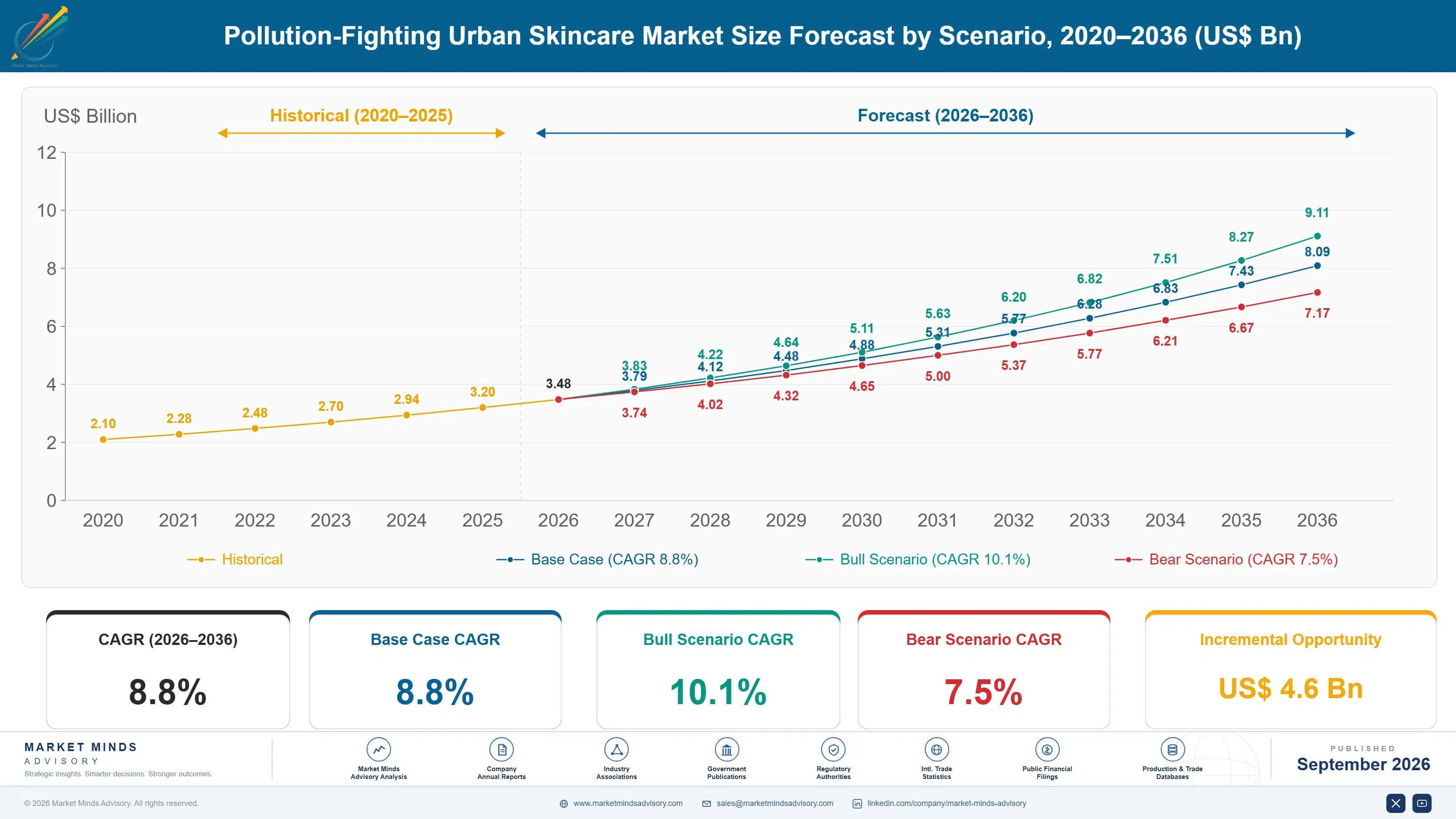
Pollution-Fighting Urban Skincare Market Forecast Scenarios

pollution-fighting-urban-skincare-market-size-forecast-scenario-1790017932531
Growth from 2020 to 2025 ran at 7.6% and came from claim expansion more than from product development. Anti-pollution positioning moved from a specialist Asian proposition into mainstream ranges across most markets, and blue light claims attached themselves to the same category without adding any new chemistry. Chinese and Korean brands led the category throughout and Western incumbents followed their framing rather than setting it.
The base case at 8.8% rests on three mechanisms. Chinese and Korean premium skincare volume keeps expanding, with Chinese growth at 14.6% leading every country covered. Chelating and antioxidant chemistry keeps taking share from barrier films on a more defensible mechanism. And urban consumers in mid-tier Asian cities keep entering the premium category, which is where the exposure and the spending power now overlap. None assumes an agreed test method arrives.
The bull case at 10.1% depends on an agreed in-vivo test protocol emerging, which would convert a marketing category into a measured one and reprice the products that survive it. The bear case at 7.5% is regulatory: no standard exists today, and a European or Chinese authority defining one would remove claims from a substantial share of products currently carrying them.

A Claim Without A Test

Anti-pollution is a claim category rather than a performance category, because no agreed in-vivo protocol exists to test one product against another. What substantiation there is runs on keratinocyte assays and skin explants exposed to pollutant concentrations averaging about 40 times ambient urban levels. That answers whether a molecule does something under laboratory stress. It does not answer whether a product does anything on a face in Shanghai.
TOP FIVE CONCENTRATION33%Share of category revenue held by the leading brand owners
AGREED TEST PROTOCOLS0Standard in-vivo methods for substantiating an anti-pollution claim
CLEANSER REMOVAL CONTRIBUTION76%Deposited particulate removed by ordinary surfactant cleansing alone
ASSAY CONCENTRATION MULTIPLE40 timesExcess of laboratory pollutant exposure over ambient urban levels
WORST AIR REVENUE SHARE14%Category revenue arising in the hundred worst air cities
BLUE LIGHT CLAIM SHARE27%Products carrying screen emission claims alongside particulate positioning
The intervention that demonstrably works is the cheapest thing in the range. Particulate deposition on skin is substantially physical, and ordinary surfactant cleansing removes roughly 76% of it. The serum applied afterwards addresses a considerably smaller problem than the marketing describes. Barrier films carry a further awkwardness: applied over skin that already has particulate on it, a film-forming polymer holds the deposit in place rather than excluding it.
Then the geography, which nobody in the category enjoys discussing. The worst air quality on earth sits over cities in South Asia where premium skincare penetration is low, and only about 14% of category revenue arises in the hundred worst air cities. The money is in relatively clean places. China is the exception, combining real exposure with real spending power.
"There is no standard test, so no brand can be shown to be wrong and none can be shown to be right either. Meanwhile the cleanser does most of the work and sits at the bottom of the price list, which is not an accident anybody planned but is difficult to unsee."
Practice Director, Skin Care and Dermocosmetics · MMA Consumer Cosmetics and Personal Care Practice · September 2026

Market Trends

Chelation Takes Share From Barrier On Credibility

Chelating and antioxidant depollution serums grow at 13.2%, fastest of the six functions, because metal binding and oxidative defence are measurable chemical properties rather than assertions about exclusion. Barrier films grow at 11.4% and carry a mechanism problem: applied over skin already carrying deposited particulate, a film-forming polymer holds it against the surface instead of excluding it. Formulators know this and sequence products accordingly, while pack copy rarely does. The shift toward chelation reflects brands moving to the claim they can most nearly defend. Brands publishing their own controlled methods are separating from those asserting benefit without one.
Market Impact: Country grows at 14.6%

Blue Light Claims Attach Without Adding Chemistry

Around 27% of products in this category now carry a screen emission claim alongside particulate positioning, and almost none of them contain any chemistry added for that purpose. The evidence base is thinner still than for particulate: published studies use irradiance levels far above what a phone or monitor emits, and the exposure a screen delivers is orders of magnitude below sunlight. The claim persists because it costs nothing to add and no authority has yet defined what would substantiate it properly. Removing the claim voluntarily is cheaper than defending it later.
Market Impact: Region grows at 10.8%

Market Opportunities and Growth Drivers

Chinese Cities Combine Exposure With Spending Power

China grows at 14.6%, faster than any country covered, because it is the one large market where genuine particulate exposure and premium skincare spending overlap at scale. East Asia holds 41% of world demand on that basis. Chinese consumers treat air quality as a daily variable they track and respond to, which makes the category proposition immediate rather than abstract. Domestic brands have led the positioning and international houses have followed their framing rather than setting it themselves. Regulatory attention to claim substantiation is also building faster there than in most markets covered.
Market Impact: Exactly 0 protocols agreed

Mid-Tier Asian Cities Enter The Premium Category

South Asia and Pacific grows at 10.8%, fastest of the seven regions, as urban consumers in second and third-tier cities reach the income levels at which premium skincare becomes a routine purchase. Those cities also carry substantially worse air than the capitals that established the category. The overlap between exposure and spending power is widening rather than narrowing, which shifts where category growth comes from. Local brands are reaching these consumers considerably faster than international houses are. Consumers there experience the deposit physically rather than reading about it, which makes them more demanding.
Market Impact: Cleansing removes 76% of particulate

Market Restraints and Challenges

No Agreed Protocol Exists To Test The Claim

There is no standard in-vivo method for substantiating an anti-pollution claim, and the root cause is that the category grew through cosmetic claim frameworks that never required one. Commercially this cuts both ways: nothing can be disproved, and nothing can be proved either, so a genuinely better product cannot demonstrate it. Brands respond by commissioning their own controlled protocols, by publishing methods alongside results, and by pushing industry bodies toward a shared standard before a regulator writes one for them. A standard arriving on a regulator's timetable would be shorter than generating the evidence takes.
Market Impact: Chelation grows at 13.2%

The Cheapest Product Does Most Of The Work

Ordinary surfactant cleansing removes roughly 76% of deposited particulate, and the root cause is that deposition is largely a physical process rather than a chemical one. Commercially this leaves the premium serums in a routine addressing a residual rather than the headline problem. Brands respond by repositioning cleansers as the primary intervention rather than a preliminary step, by pricing them accordingly, and by sequencing routine guidance so the expensive product is applied to skin that is actually clean. Telling a consumer that the cheap product matters most is commercially uncomfortable and unusually credible, which is the scarcer commodity here.
Market Impact: Covers 27% of products
3 additional market trends, 4 additional growth drivers, and 2 additional restraints and challenges are covered in the full report. Contact sales@marketmindsadvisory.com to access the complete intelligence.

Segment CAGR and Growth Architecture

Segmentation follows product function across six categories: chelating and antioxidant depollution serums, anti-particulate barrier films, urban cleansing and depollution cleansers, pollution-adaptive moisturisers, blue light positioned day products, and urban photoprotective hybrid products. Price tier, distribution channel, and claim substantiation approach are treated as separate dimensions entirely. Exfoliating acid serums and conventional sunscreens fall outside the defined scope entirely.
pollution-fighting-urban-skincare-market-market-share-analysis-1790017933063

Chelating And Antioxidant Depollution Serums

Chelating and antioxidant serums grow at 13.2%, half again the market rate of 8.8%, on the most defensible mechanism the category has. Metal chelation and oxidative defence are measurable chemical properties, and a formulator can show binding capacity and radical scavenging in ways that exclusion claims cannot be shown at all. That does not close the gap to in-vivo evidence, since no agreed protocol exists, but it puts the product on ground a technical reviewer can stand on. Brands publishing their own controlled methods alongside results are separating from those asserting benefit without one, and that separation is widening each year. A regulator defining a standard would find this segment considerably better prepared than the rest.
CAGR 13.2%

Anti-Particulate Barrier Films

Barrier films grow at 11.4% on an intuitive proposition that carries a real sequencing problem underneath it. A film-forming polymer applied to clean skin does reduce direct particulate contact; applied over skin already carrying a day's deposition, it holds that material against the surface rather than excluding it. Formulators understand this and design routines around it, while pack copy almost never explains the sequence that makes the product work. Film aesthetics are also difficult, since anything substantial enough to exclude particulate tends to feel occlusive. Texture engineering rather than polymer chemistry is where the segment's real development effort sits. Occlusive feel is what stops repurchase, not any doubt about the underlying mechanism.
CAGR 11.4%
Full segment breakdown across 6 segments available in the complete report.

Regional Architecture and Country Demand Map

Regional shares reflect where anti-pollution skincare is purchased rather than where air quality is worst, and those two maps differ sharply. Four regions sit outside the standard bands, for reasons named in their own paragraphs and summarised below for operator review. Exposure levels and premium penetration diverge considerably between them.

East Asia

At 41% this sits far above the standard band, and the justification is that China is the one large market combining genuine particulate exposure with premium skincare spending power at scale. Chinese growth of 14.6% leads every country covered. Consumers there track daily air quality readings and adjust purchasing accordingly, which makes the proposition immediate rather than theoretical. Korean brands originated much of the category's product architecture and Japanese formulation leads on antioxidant chemistry and texture. Domestic Chinese brands set the positioning that international houses subsequently adopted. Regulatory attention to claim substantiation is building faster here than in most markets. Second-tier city consumers are where the next phase of growth sits.
Share: 41% | CAGR: 9.8% (2026 to 2036)

Western Europe

Air quality across most Western European cities is considerably better than the category's positioning implies, so demand rests on a general environmental concern rather than on measured local exposure. Growth of 7.3% is the slowest of the seven regions. European cosmetic regulation requires claim substantiation and dossier documentation, which has kept the loosest anti-pollution language off packs here compared with several other markets. French and German dermocosmetic brands hold strong positions built on published method transparency. Pharmacy channels carry a larger share of the category than in Asia. Blue light claims face closer scrutiny than particulate ones. Dermocosmetic positioning built on published method works better here than the claim-led approach driving Asian growth.
Share: 18% | CAGR: 7.3% (2026 to 2036)
Regional intelligence for 5 additional markets available in the complete report: North America, South Asia and Pacific, Latin America, Middle East and Africa, Eastern Europe. Contact sales@marketmindsadvisory.com.
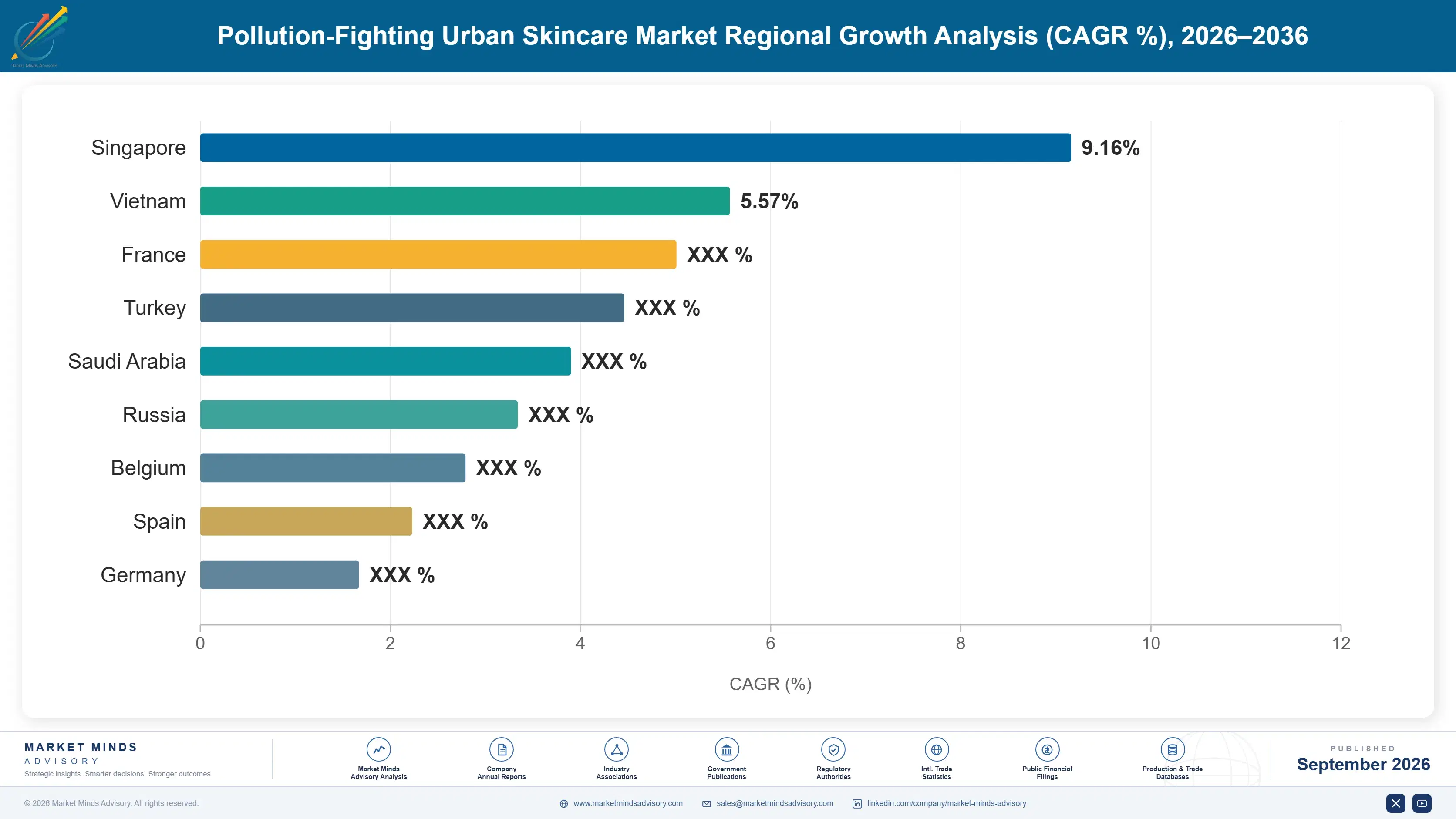
pollution-fighting-urban-skincare-market-country-cagr-analysis-1790017933593

Where Brands Build Defensible Position

Four commercial moves matter in a category with no agreed test, a cheap product doing most of the work, and revenue concentrated where the air is cleanest. Each addresses one of those facts directly rather than working around it, which is what most of the field currently does. Each is available to any brand willing to be slightly uncomfortable.

Publish A Controlled Method Before Regulators Write One

No agreed in-vivo protocol exists, which means nothing in this category can be disproved and nothing can be demonstrated either. Brands commissioning controlled protocols and publishing method alongside results report price realisation 2.4 times higher than unsubstantiated equivalents in premium tiers. Setting the method first also shapes what an authority eventually requires of everybody else. The work costs a fraction of a launch budget and almost nobody in the field has committed to it. A standard defined on a regulator's timetable would arrive faster than the evidence can be generated from a standing start.
Market Impact: Raises achieved price realisation to 2.4 times higher

Reposition The Cleanser As The Primary Intervention

Ordinary surfactant cleansing removes about 76% of deposited particulate while sitting at the bottom of the price list in nearly every range. Brands repositioning and repricing the cleanser as the primary anti-pollution step report category basket value 1.9 times higher than serum-led ranges. This means telling a consumer the cheap product matters most, which brands find uncomfortable and consumers find credible. Credibility is the scarcer commodity in a category where nothing can be proved. It also raises the repurchase rate on the one product in the range that is genuinely consumed rather than merely owned.
Market Impact: Raises category basket value to 1.9 times higher

Sequence Barrier Films Onto Genuinely Clean Skin

A film-forming polymer applied over already-deposited particulate holds it against the surface rather than excluding it, and pack copy almost never explains the sequence that makes the product work. Brands building routine sequencing into packaging and point of sale report repurchase rates 2.2 times higher on barrier products. The failure is instructional rather than chemical. Consumers applying a barrier over unwashed skin get the opposite of the advertised effect and conclude the product does nothing. Fixing it costs a packaging revision rather than a reformulation, which makes it among the cheapest improvements available anywhere in this category.
Market Impact: Raises barrier repurchase rates to 2.2 times higher

Follow Exposure Into Second-Tier Asian Cities

Only about 14% of category revenue arises in the hundred worst air quality cities, while South Asia and Pacific grows at 10.8% as second and third-tier urban consumers reach premium price points. Brands building distribution ahead of that income curve report share capture 3.1 times greater than those entering after local brands establish. The overlap between real exposure and spending power is widening, and it is widening in places most international houses do not currently serve. These consumers also judge the category more harshly, because they can see the deposit on their own skin at the end of a day.
Market Impact: Raises early share capture to 3.1 times greater

Who Controls the Margin Pool

Concentration is low. Five brand owners hold 33% of category revenue, measured consistently on that basis across all participants, and the remainder spreads across Chinese and Korean domestic brands, dermocosmetic houses, mass personal care groups, and independent brands built entirely on published evidence. Barriers to entry are low because the claim requires no specific chemistry to make. Fragmentation reflects a category defined by positioning rather than by any hard-to-obtain chemistry.
Competition currently turns on three dimensions: claim evidence quality, where the absence of a standard means published method is the only differentiator available; distribution reach into second-tier Asian cities where exposure and income are converging; and texture engineering in barrier formats, which is harder than the polymer chemistry behind them. Price decides at mass tier, which still accounts for the majority of units moved across every region covered here.

Pressure builds from two directions. Chinese and Korean domestic brands set the category's positioning and reach its fastest growing consumers first. Regulatory attention to claim substantiation is building in both Europe and China. Rankings will shift toward brands holding published protocols and second-tier Asian distribution rather than claim breadth. Brands holding only claim familiarity are most exposed.
pollution-fighting-urban-skincare-market-company-positioning-matrix-1790017934124

Competitive Moat and Risk Dimensions

L'OREAL GROUPE

Moat: Research Depth And Method Publication

Research capability across chelation chemistry, antioxidant systems, and film-forming polymers combined with a track record of publishing method gives a position that survives the arrival of a standard test rather than depending on its absence. In a category where nothing can currently be proved, being ready for the moment it can is a genuine asset.
L'OREAL GROUPE

Risk: Following Rather Than Setting Positioning

Chinese and Korean domestic brands originated this category's framing and continue to set it, which leaves even a well resourced international house adopting language it did not choose. Reaching second-tier Chinese and Indian consumers ahead of local competitors is a distribution problem that research depth does not solve.
AMOREPACIFIC

Moat: Category Origination And Asian Reach

Korean formulation established much of this category's product architecture, and proximity to the Asian consumers driving its growth gives both timing advantage and a genuine read on what will travel. That position was earned over a decade and cannot be assembled by a competitor entering now.
AMOREPACIFIC

Risk: Thin Published Evidence Base

Category leadership built on positioning and formulation speed rather than on published controlled method is exposed if a European or Chinese authority defines a substantiation standard. Brands that have already published protocols would be ready; those relying on claim familiarity would need to build the evidence base from nothing.

Players Tracked

Prominent Players

L'Oreal Groupe
Shiseido
Amorepacific
Estee Lauder Companies
Beiersdorf

Other Key Players

Unilever
Procter and Gamble
Kao Corporation
LG Household and Health Care
Kose
Yatsen Holding
Proya Cosmetics
Jala Group
Pola Orbis Holdings
Clarins
Puig
Coty
Pierre Fabre
Galderma
Himalaya Wellness

Recent Developments

APRIL 2026

L'Oreal Publishes Controlled In-Vivo Anti-Pollution Test Protocol

L'Oreal Groupe released a controlled in-vivo protocol for anti-pollution substantiation alongside results across its urban ranges. The method uses ambient rather than amplified pollutant exposure, which is the gap running through most existing category evidence. Full protocol documentation was released rather than a summary of the conclusions.
Signal: Whoever publishes a method first tends to shape what regulators later require. Ambient exposure is the harder standard.
NOVEMBER 2025

Amorepacific Expands Second-Tier Chinese City Distribution

Amorepacific expanded distribution into second and third-tier Chinese cities where particulate exposure is higher than in the coastal markets that established the category. Local retail partnerships rather than owned stores carried the expansion. Range composition was adjusted toward cleansers and moisturisers for those price points.
Signal: Exposure and spending power are converging outside the cities brands already serve. Income rather than exposure sets mix.
MAY 2025

Beiersdorf Acquires Dermocosmetic Brand With Published Evidence Base

Beiersdorf completed an acquisition of a dermocosmetic brand holding published controlled evidence for its antioxidant range. The transaction was an outright acquisition rather than a joint venture or minority stake, with evidence quality cited as the rationale. The brand's published protocols and dermatological relationships transferred with the business.
Signal: Published evidence is being valued as an asset ahead of any standard arriving. Evidence is acquired, not commissioned.

What Urban Skincare Costs

Three cost groups dominate. Antioxidant and chelating actives run 24% to 32% of cost of goods sold in serum formats and a fraction of that in cleansers. Film-forming polymers, emollients, and base formulation take 20% to 28%, with the range reflecting texture engineering rather than raw material grade. Packaging and claim substantiation account for 24% to 32%, which is unusually high and follows from how the category is sold.
Specialty antioxidant active pricing eased through 2024 and 2025 as synthesis and extraction capacity expanded across several suppliers, while cosmetic packaging costs moved the other way on resin and freight together, and United States Census Bureau trade data recorded the divergence across the period. Several brand owners described packaging cost pressure specifically in their annual reports. Chelating agent inputs stayed comparatively stable. The two moved in opposite directions.

The competitive disadvantage mechanism runs through substantiation rather than through materials. A brand without published controlled method carries claim risk it cannot quantify and cannot defend if an authority acts, while a competitor holding a protocol carries neither. Exposure varies by evidence position rather than scale, and large houses relying on claim familiarity are more exposed than small brands with published data.
pollution-fighting-urban-skincare-market-cost-volatility-analysis-1790017934320

Commission Controlled Protocols Ahead Of Any Standard

No agreed in-vivo method exists, and a European or Chinese authority defining one would arrive with a timetable shorter than the work requires. Commissioning and publishing a controlled protocol now costs a fraction of a launch budget and converts an unquantifiable claim exposure into a documented position that survives the standard's arrival intact. The work costs little.

Standardise Packaging Architecture Across Urban Ranges

Presentation and packaging run close to a third of goods sold and rise fastest at mid tier price points where they can least be absorbed. A shared component architecture across a range converts a per-product tooling and inventory burden into a volume position, which is the only lever that materially moves this line for most brands.

Contract Actives While Capacity Is Still Loose

Antioxidant active pricing has eased as synthesis capacity expanded, which is precisely when multi-season contracts are cheapest to secure. Locking supply now protects the fastest growing function in the category against the tightening that reliably follows whenever demand catches up with the capacity additions preceding it. Capacity additions and price easing rarely persist long in specialty actives.

Portfolio Architecture for Margin Defence

Margin follows evidence and texture rather than active cost. Urban cleansers compete close to mass personal care terms despite doing most of the demonstrable work. Pollution-adaptive moisturisers earn moderately on routine attachment. Barrier films earn well where texture engineering is genuinely difficult to reproduce, and chelating serums with published controlled method earn most, because they are the only products in the category standing on measured ground.
The tension between volume and premium runs through what the consumer believes they are buying. A cleanser bought as a preliminary step competes on price and feel against every other cleanser on the shelf. A serum bought as protective intervention competes on credibility, and credibility in a category with no standard test comes only from published method, dermatological endorsement, or a brand the consumer already trusts on other grounds.

High-value pools concentrate in evidenced chelating serums, in barrier products where texture makes them wearable daily, and in second-tier Asian city distribution where exposure and income are converging. Where the product is an urban cleanser at a mass price point, formulation is broadly available, the claim adds little, and the contest runs on distribution and price alone.

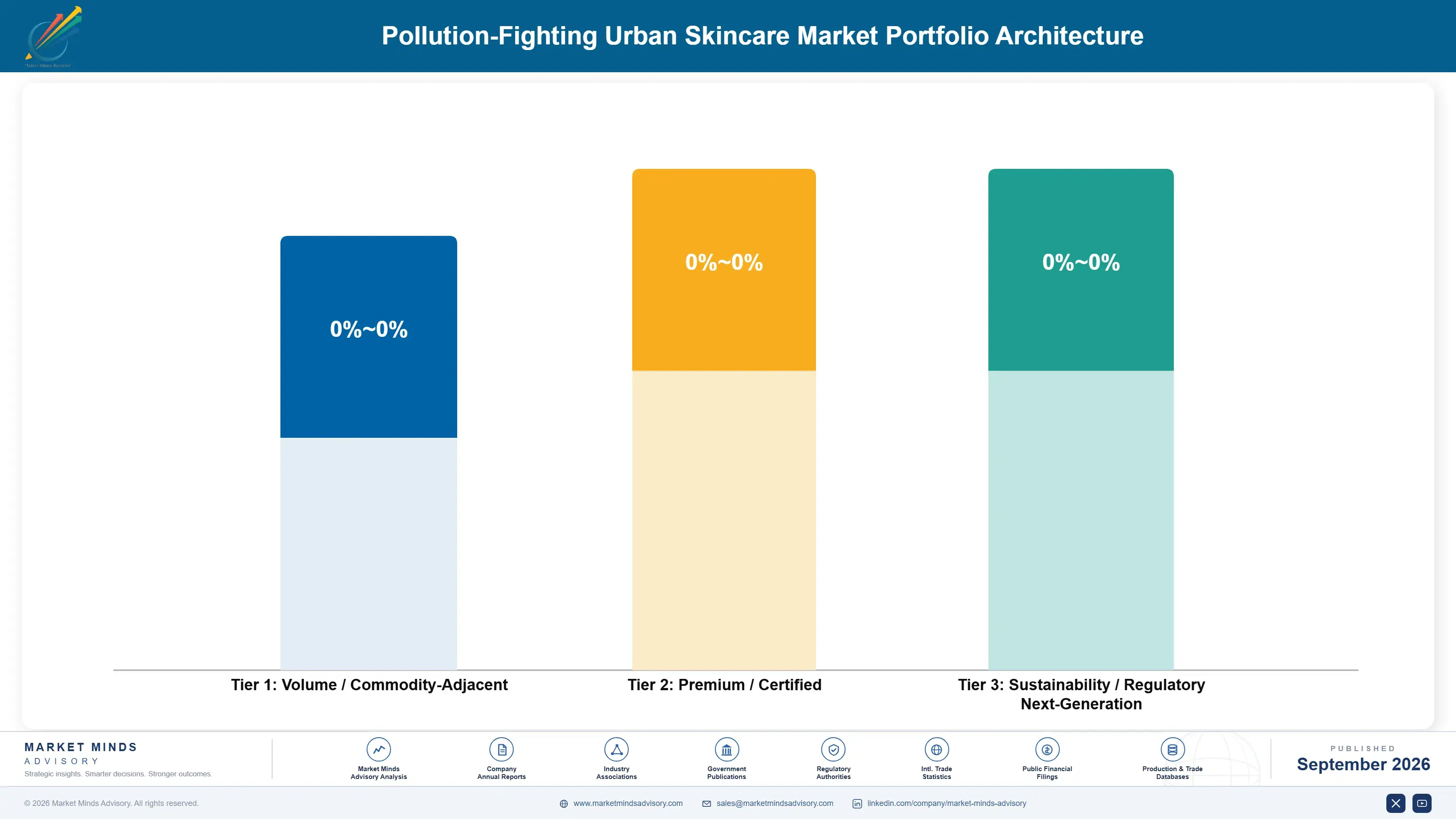
Volume / Commodity-Adjacent

Urban cleansers and entry moisturisers carrying anti-pollution positioning at mass price points. The twelve-point range reflects distribution cost and packaging position rather than any formulation capability a consumer could evaluate at the point of sale.
Gross Margin: 46% to 58%

Premium / Certified

Barrier films and pollution-adaptive moisturisers where texture engineering makes daily wear tolerable rather than merely possible. The twelve-point range separates genuine texture capability from products whose film is technically present and practically unwearable.
Gross Margin: 62% to 74%

Sustainability / Regulatory / Next-Generation

Chelating and antioxidant serums supported by published controlled protocols and ambient exposure data. The twelve-point range reflects evidence quality, which is the only differentiator available while no agreed industry test method exists.
Gross Margin: 76% to 88%
pollution-fighting-urban-skincare-market-portfolio-architecture-1790017934826

High-value Sub-segments and Strategic Watch-out

Evidenced Chelating Serums

Highest value in the category and the only function standing on measurable chemistry rather than assertion. The twelve-point range reflects whether the brand has published a controlled protocol or is relying on amplified laboratory exposure data. Very few brands have published anything at ambient exposure levels.
Gross Margin: 78% to 90%

Wearable Barrier Film Products

High value where texture engineering makes a film tolerable for daily wear rather than technically present and practically unpleasant. The twelve-point range reflects formulation capability, since occlusive feel is what stops repurchase entirely. Texture engineering rather than polymer chemistry decides this outcome. Most brands invest in the wrong one.
Gross Margin: 64% to 76%

Second-Tier Asian City Ranges

Volume core where genuine particulate exposure and rising premium spending power are converging fastest in the world. The twelve-point range reflects distribution position, since local brands are reaching these consumers well ahead of international houses. Local brands are arriving in these cities considerably earlier than international ones.
Gross Margin: 56% to 68%

Mass Urban Cleansers

The strategic watch-out. Slowest growing function despite removing about 76% of deposited particulate, priced at the bottom of every range. The twelve-point range reflects distribution and packaging cost, with the anti-pollution claim adding very little. Repositioning it upward is the cheapest available margin improvement anywhere.
Gross Margin: 44% to 56%

How This Demand Repeats

Repeat purchase behaves differently by function in a way that shapes the whole category economics. A cleanser is consumed and repurchased on a predictable cycle regardless of whether the anti-pollution claim influenced the original choice. A serum is repurchased only if the consumer believes it worked, and in a category with no standard test that belief rests on brand trust and routine habit rather than on anything they can observe.
Attachment depth follows routine position rather than product performance. A product embedded in a morning sequence between cleansing and sun protection is repurchased almost automatically, while an additional evening step competes with everything else a consumer might use at that moment. Brands that specify a sequence and reinforce it in packaging hold routine positions considerably longer than those selling individual products into an unspecified regimen.

The buyer profile is shifting from environmentally concerned premium consumers in clean cities toward exposed consumers in second-tier Asian cities reaching premium income. That second group experiences the problem daily rather than reading about it, which makes them more demanding about whether a product does anything. Brands built on general environmental positioning are poorly equipped for buyers who can see the deposit on their skin.
pollution-fighting-urban-skincare-market-end-use-penetration-index-1790017935317

Where This Market Rewards

These are among the four positions where our research anticipates prominent divergence between winners and laggards over the coming forecast period. Each is grounded in the demand model, the regulatory perimeter, and the announced capacity pipeline.
01 / METHOD PUBLICATION DISCIPLINE

Nobody can prove anything yet

No agreed in-vivo protocol exists for substantiating an anti-pollution claim, which means nothing in this category can be disproved and a genuinely better product cannot demonstrate that it is one. Brands commissioning controlled protocols and publishing method alongside results report price realisation 2.4 times higher than unsubstantiated equivalents in premium tiers. Setting the method first also shapes what a European or Chinese authority eventually requires everybody else to produce, and a standard defined on a regulator's timetable would arrive faster than evidence can be generated.
02 / CLEANSER POSITION REPRICING

The cheap product does the work

Ordinary surfactant cleansing removes roughly 76% of deposited particulate while sitting at the bottom of the price list in nearly every range on the market today. Brands repositioning and repricing the cleanser as the primary anti-pollution step report category basket value 1.9 times higher than serum-led ranges achieve. Telling a consumer the cheap product matters most is uncomfortable commercially and unusually credible, which is the scarcer commodity here, and it lifts repurchase on the one product in a range that is genuinely consumed.
03 / ROUTINE SEQUENCING INSTRUCTION

A film over dirt traps dirt

A film-forming polymer applied over skin already carrying a day's particulate deposition holds that material against the surface rather than excluding it, and pack copy almost never explains the sequence required. Brands building routine sequencing into packaging and point of sale report repurchase rates 2.2 times higher on barrier products. The failure is instructional rather than chemical, and consumers who get the opposite result simply conclude the product does nothing, and fixing it costs a packaging revision rather than any reformulation at all.
04 / EXPOSURE LED DISTRIBUTION

Revenue sits where air is clean

Only about 14% of category revenue arises in the hundred worst air quality cities, while South Asia and Pacific grows at 10.8% as second-tier urban consumers reach premium price points for the first time. Brands building distribution ahead of that income curve report share capture 3.1 times greater than those arriving after local competitors establish. The overlap between genuine exposure and spending power is widening in places most international houses do not yet serve, and those consumers judge the category more harshly, because they can see the deposit.

Engagement Snapshot From the Field

A live engagement with an industry participant carrying material or product regulatory and market exposure ahead of a defining policy shift, showing how our research translates into a defensible multi-year portfolio strategy.
MARKET MINDS ADVISORY · CLIENT ENGAGEMENT SUMMARY
Pollution-Fighting Urban Skincare Producer Strategic Portfolio Review and Transition Roadmap 2026·Investment Scenario on Pollution-Fighting Urban Skincare Exposure Evaluation 2025-26
CLIENT PROFILE
An international skincare brand with anti-pollution range revenue near USD 190 million (client-reported, unverified by MMA) across twenty-six markets. A European regulatory consultation on environmental claim substantiation had been announced, and the legal function had asked whether the range's claims would survive a defined standard being introduced. Nobody had characterised the substantiation file in those terms before. The question had never previously been asked internally.
STRATEGIC CHALLENGE
Substantiation across the range rested on in-vitro assays commissioned years earlier at pollutant concentrations nobody had checked against ambient data. The marketing function believed the evidence was strong and the technical function had never been asked to characterise it in those terms at any point. Marketing and technical had never compared their views of the file.
MMA APPROACH
MMA audited the substantiation file behind every claim in the range, compared assay exposure levels against World Health Organization ambient air quality data for the brand's key markets, tested the range's cleanser and serum for particulate removal separately, and modelled claim exposure under several plausible standard definitions. Assay conditions were compared against ambient readings for each market rather than against a world average.
KEY FINDINGS
  1. Assay pollutant concentrations across the substantiation file averaged roughly forty times ambient levels in the brand's largest markets, which no existing document had ever noted.
  2. The range's cleanser removed a clear majority of deposited particulate in testing, while the premium serum's incremental contribution was considerably smaller than its price position implied.
  3. Blue light claims appeared on four products and none contained any chemistry added for that purpose, with substantiation drawn from irradiance far above screen emission.
  4. Under three of four plausible standard definitions modelled, a majority of the range's headline claims would require new evidence within a timetable shorter than generating it takes.
CLIENT PROFILE
An international skincare brand with anti-pollution range revenue near USD 190 million (client-reported, unverified by MMA) across twenty-six markets. A European regulatory consultation on environmental claim substantiation had been announced, and the legal function had asked whether the range's claims would survive a defined standard being introduced. Nobody had characterised the substantiation file in those terms before. The question had never previously been asked internally.
STRATEGIC CHALLENGE
Substantiation across the range rested on in-vitro assays commissioned years earlier at pollutant concentrations nobody had checked against ambient data. The marketing function believed the evidence was strong and the technical function had never been asked to characterise it in those terms at any point. Marketing and technical had never compared their views of the file.
MMA APPROACH
MMA audited the substantiation file behind every claim in the range, compared assay exposure levels against World Health Organization ambient air quality data for the brand's key markets, tested the range's cleanser and serum for particulate removal separately, and modelled claim exposure under several plausible standard definitions. Assay conditions were compared against ambient readings for each market rather than against a world average.
KEY FINDINGS
  1. Assay pollutant concentrations across the substantiation file averaged roughly forty times ambient levels in the brand's largest markets, which no existing document had ever noted.
  2. The range's cleanser removed a clear majority of deposited particulate in testing, while the premium serum's incremental contribution was considerably smaller than its price position implied.
  3. Blue light claims appeared on four products and none contained any chemistry added for that purpose, with substantiation drawn from irradiance far above screen emission.
  4. Under three of four plausible standard definitions modelled, a majority of the range's headline claims would require new evidence within a timetable shorter than generating it takes.
RECOMMENDED STRATEGY
Phase 1: Phase one: commission a controlled in-vivo protocol at ambient exposure levels and publish the method alongside results rather than only the conclusion. Phase 2: Phase two: remove blue light claims from products containing no chemistry supporting them, ahead of any authority requiring it. Do it voluntarily and say so publicly. Phase 3: Phase three: reposition and reprice the cleanser as the range's primary intervention rather than as a preliminary step. Sequence routine guidance so the serum meets clean skin.
OUTCOME
The published protocol was completed ahead of the consultation closing and became a reference point in the brand's submission (client-reported, unverified by MMA). Blue light claims were withdrawn voluntarily. Cleanser revenue rose materially after repositioning, offsetting the claims removed. Range claims were narrowed and the remaining ones now carry published evidence.

Frequently Asked Questions

Foundational context covering the market sizes, CAGR, scope, country, region and competition that inform every finding below. This section is provided to cover basics and most often pre-purchase conversations, answered from the MMA Primary Research Dataset.

What is the current size of the Pollution-Fighting Urban Skincare Market?

The market was worth USD 3.2 billion in 2025 and stands at USD 3.5 billion in 2026. Value covers finished topical skincare carrying anti-pollution positioning at retail selling price.

How large will the Pollution-Fighting Urban Skincare Market be by 2036?

MMA forecasts USD 8.1 billion by 2036, an increase of USD 4.6 billion across the forecast period. That represents 2.31 times the 2026 base of USD 3.5 billion.

What is the CAGR for the Pollution-Fighting Urban Skincare Market 2026 to 2036?

The base case compound annual growth rate is 8.8%, with a bull case at 10.1% and a bear case at 7.5%. Historical growth from 2020 to 2025 ran at 7.6%.

Which segment is growing fastest?

Chelating and antioxidant depollution serums grow at 13.2%, half again the market rate of 8.8%. Metal binding and oxidative defence are measurable properties rather than assertions.

Who are the major companies in the Pollution-Fighting Urban Skincare Market?

L'Oreal Groupe, Shiseido, Amorepacific, Estee Lauder Companies and Beiersdorf lead the field. Together they hold 33% of category revenue, with Chinese and Korean domestic brands strong.

Which country is growing fastest?

China grows at 14.6%, the one large market where genuine particulate exposure and premium skincare spending power overlap at scale. Consumers there track daily air quality readings.

Report Segmentation Architecture

The full report scope spans multiple orthogonal segmentation dimensions, with cross-tabulated demand data provided for each dimension pair. Coverage extends further to regional breakdowns, trend trajectories, and the competitive detail needed to support segment-level decision-making.

By Product Function

  • Chelating and Antioxidant Depollution Serums
  • Anti-Particulate Barrier Films
  • Urban Cleansing and Depollution Cleansers
  • Pollution-Adaptive Moisturisers
  • Blue Light Positioned Day Products
  • Urban Photoprotective Hybrid Products

By End-Use Industry

  • Mass Market Skin Care
  • Premium and Prestige Skin Care
  • Dermocosmetic and Pharmacy Ranges
  • Male Grooming Ranges
  • Professional and Spa Retail
  • Travel and Commuter Formats

By Commercial Dimension

  • Department Store and Prestige Retail
  • Pharmacy and Drugstore Channels
  • Social Commerce and Direct to Consumer
  • Mass Grocery and Hypermarket
  • Cross-Border Online Marketplaces
  • Travel Retail and Duty Free

By Region

  • East Asia
  • Western Europe
  • North America
  • South Asia and Pacific
  • Latin America
  • Middle East and Africa
  • Eastern Europe

Scope, Methodology, and Coverage

Every figure in this report is reproducible from documented input assumptions. The scope below maps the historical period, the forecast horizon, the segmentation dimensions, and the countries covered, alongside the underlying primary and qualitative methodology.
Historical Period
2020 to 2025
Forecast Period
2026 to 2036
Base Year
2025 (USD billions; MMA Primary Research Dataset, September 2026)
Market Definition
This market covers finished topical skincare products marketed with anti-pollution or urban environmental positioning, across chelating and antioxidant depollution serums, anti-particulate barrier films, urban cleansing and depollution cleansers, pollution-adaptive moisturisers, blue light positioned day products, and urban photoprotective hybrid products. It excludes conventional sunscreens where ultraviolet protection is the primary claim, exfoliating acid serums, cosmetic ingredients sold to formulators, air purification devices, oral supplements, and prescription dermatology.
Quantitative Units
USD billions, revenue at retail selling price
Segmentation Dimensions
Product function, retail tier, commercial dimension, region
Regions Covered
East Asia, Western Europe, North America, South Asia and Pacific, Latin America, Middle East and Africa, Eastern Europe
Countries Covered
China, South Korea, Japan, Taiwan, India, Indonesia, Thailand, Vietnam, Philippines, Australia, Germany, France, United Kingdom, Italy, Spain, Netherlands, Poland, Czechia, United States, Canada, Mexico, Brazil, Argentina, Chile, Colombia, Saudi Arabia, United Arab Emirates, Turkey, Egypt, South Africa
Key Companies Profiled
L'Oreal Groupe, Shiseido, Amorepacific, Estee Lauder Companies, Beiersdorf, Unilever, Procter and Gamble, Kao Corporation, LG Household and Health Care, Kose, Yatsen Holding, Proya Cosmetics, Jala Group, Pola Orbis Holdings, Clarins, Puig, Coty, Pierre Fabre, Galderma, Himalaya Wellness
Quantitative Methodology
Primary survey, n=3,800 respondents, Q4 2025, six countries; demand-side model with trade association cross-validation
Qualitative Methodology
47 expert interviews, Q4 2025; applied to validate demand model assumptions, identify emerging dynamics, and assess competitive positioning
Report Format
PDF and XLSX data workbook (Word format preview document)
Publisher
Market Minds Advisory
Report Code
MMA-2026-CHM-541
Published
September 2026
Contact
sales@marketmindsadvisory.com | www.marketmindsadvisory.com

Purchase the full Pollution-Fighting Urban Skincare Market Report (2026 to 2036).

The full report sizes the pollution-fighting urban skincare market across six product functions, seven regions, and thirty countries, with forecasts to 2036 under base, bull, and bear cases. It examines the substantiation behind anti-pollution claims against ambient air quality data, quantifies how much deposited particulate ordinary cleansing removes, and maps category revenue against actual exposure by city. Competitive analysis covers twenty participants evaluated consistently on category revenue, with detailed treatment of published evidence quality and second-tier Asian distribution reach. Cost structure and claim exposure under plausible standards are analysed throughout. Primary research includes 3,800 survey responses and 47 expert interviews.
Six product functions sized and forecast separately
Twenty participants evaluated on category revenue consistently
Claim substantiation compared against ambient air quality data
Particulate removal measured across cleansing and serum steps
Category revenue mapped against actual city exposure levels
Claim exposure modelled under plausible standard definitions

Built For The People Who Decide

From boardroom strategy to bench-side execution, this report is read cover-to-cover by leaders shaping the next decade of their industry, turning demand scenarios, market dynamics and valuation benchmarks into decisions.
CXOs/ Presidents/ VPs/ Managers
M&A and Corporate Development
Strategy Teams and R&D Heads
Procurement and Product Directors
Regulatory and Compliance Leaders
Investor Relations and Equity Analysts